
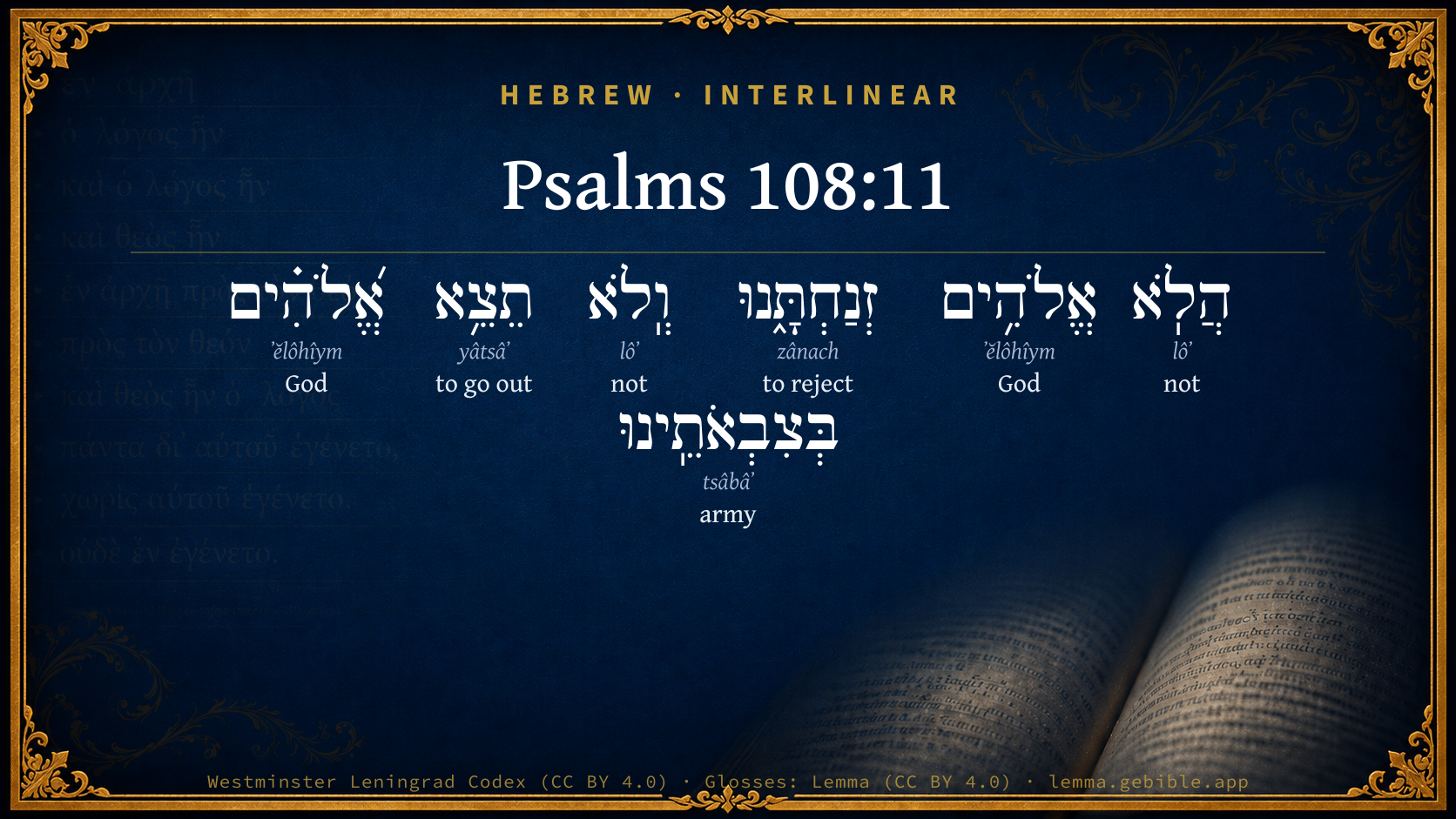
Psalms 108:11

Hebrew (Westminster Leningrad Codex) Psalms 108:11 appears in the Hebrew Old Testament. The text above is from the Westminster Leningrad Codex. Each word links to its Strong’s number, a concise gloss, and parsing drawn from the Open Scriptures Hebrew Bible morphology. Click any word for its full Brown-Driver-Briggs (BDB) entry.
Download image
Cite this verse

Psalms 108:11 (World English Bible). Public Domain. Lemma interlinear Bible study tool, https://lemma.gebible.app/v/psalms/108/11.

Show BibTeX & RIS
BibTeX
RIS
English Translation
Haven't you rejected us, God? You don't go forth, God, with our armies.
World English Bible · Public Domain
Download a study sheet

One document with this verse’s original text, its word-by-word gloss line, the meaning frame, cross-references with their text, attributed commentary, and full source and license credits — printable, and it pastes into notes with its structure intact.

This verse Autodidact and up

Study sheet (.html) Plain text (.txt)

A passage Seminary Student

Up to 50 verses in one chapter. A passage sheet keeps up to 6 commentary sources and 12 cross-references per verse, in the order this page ranks them, and says so on the sheet whenever that leaves anything out. Ask for a single verse and you get the Autodidact verse sheet above.

Everything on this page stays free to read, with no account — the sheet is a download of what is already on screen, not access to it.

Want to remove ads? Support Godless Engineer
Compare translations 3

The same verse in 3 English versions, stacked beneath the original-language interlinear above. Click any original word for its lexicon entry.

Each is an independent rendering of the whole verse — the interlinear is not word-aligned to these translations.

Highlighted words mark where these versions differ — a whole-verse word diff, not a word-by-word alignment.

  • World English Bible Public Domain
    Haven't you rejected us, God? You don't go forth, God, with our armies.
  • King James Version Public Domain
    Wilt not thou, O God, who hast cast us off? and wilt not thou, O God, go forth with our hosts?
  • unfoldingWord Literal Text CC BY-SA 4.0
    God, have you not rejected us? And you do not go out with our army, God.

unfoldingWord Literal Text — © unfoldingWord, licensed CC BY-SA 4.0. Word-aligned USFM3 via Door43 (git.door43.org/unfoldingWord/en_ult).

Versions to compare (up to 4)

3 of 4 selected

Show all 18 translations

Every available English version of this verse, each an independent rendering of the whole verse.

  • World English Bible Public Domain
    Haven't you rejected us, God? You don't go forth, God, with our armies.
  • Berean Standard Bible Public Domain
    Have You not rejected us, O God? Will You no longer march out, O God, with our armies?
  • Majority Standard Bible Public Domain
    Have You not rejected us, O God? Will You no longer march out, O God, with our armies?
  • King James Version Public Domain
    Wilt not thou, O God, who hast cast us off? and wilt not thou, O God, go forth with our hosts?
  • American Standard Version (1901) Public Domain
    Hast not thou cast us off, O God? And thou goest not forth, O God, with our hosts.
  • Revised Version (1885) Public Domain
    Hast not thou cast us off, O God? and thou goest not forth, O God, with our hosts.
  • Geneva Bible (1599) Public Domain
    Wilt not thou, O God, which haddest forsaken vs, and diddest not goe foorth, O God, with our armies?
  • Douay-Rheims (1899) Public Domain
    Who will bring me into the strong city? who will lead me into Edom?
  • Young's Literal Translation Public Domain
    Hast not Thou, O God, cast us off? And Thou goest not out, O God, with our hosts!
  • Literal Standard Version CC BY-SA 4.0
    Have You not, O God, cast us off? And You do not go out, O God, with our hosts!
  • Unlocked Literal Bible CC BY-SA 4.0
    God, have you not rejected us? You do not go into battle with our army.
  • unfoldingWord Literal Text CC BY-SA 4.0
    God, have you not rejected us? And you do not go out with our army, God.
  • Darby Bible Public Domain
    [Wilt] not [thou], O God, who didst cast us off? and didst not go forth, O God, with our armies?
  • World Messianic Bible Public Domain
    Haven’t you rejected us, God? You don’t go out, God, with our armies.
  • Webster's Bible Public Domain
    \\108:10\\Who will bring me into the strong city: who will lead me into Edom?
  • Free Bible Version CC BY-SA 4.0
    Have you rejected us, God? Won't you go out with our armies?
  • Bible in Basic English Public Domain
    Have you not sent us away from you, O God? and you go not out with our armies.
  • JPS Tanakh (1917) Public Domain
    (108-12) Hast not Thou cast us off, O God? and Thou goest not forth, O God, with our hosts?

Literal Standard Version (2020), Covenant Press — licensed CC BY-SA 4.0. Text via the HelloAO Bible API (eBible.org). Unlocked Literal Bible (unfoldingWord) — licensed CC BY-SA 4.0. Text via the HelloAO Bible API (eBible.org). unfoldingWord Literal Text — © unfoldingWord, licensed CC BY-SA 4.0. Word-aligned USFM3 via Door43 (git.door43.org/unfoldingWord/en_ult). Free Bible Version, Dr. Jonathan Gallagher — licensed CC BY-SA 4.0. Text via the HelloAO Bible API (eBible.org).

Word by word

More ways to search: Search by grammar → Find every occurrence → Compare this word →

Practice this passage: Drill this verse → Learn its vocabulary →

About this verse

These counts appear in no published source. They are computed here, from the morphology-tagged text and Lemma’s own curated glosses. What Lemma adds →

7
words
5
distinct lemmas
Wisdom
section

Notable vocabulary

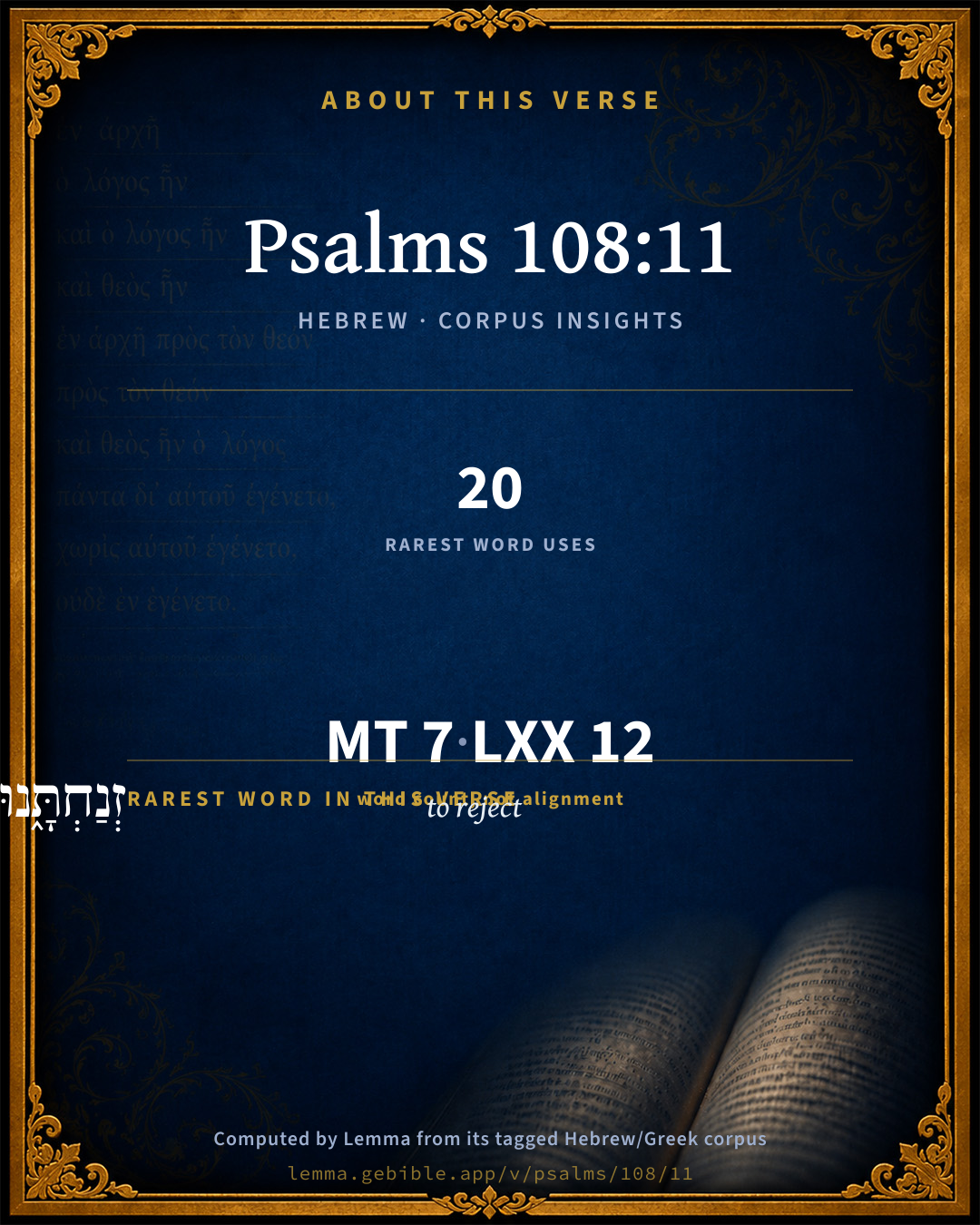
The rarest word here is זְנַחְתָּ֑נוּ to reject H2186 — appearing just 20 times in the whole Hebrew Bible.

Shared distinctive vocabulary

זְנַחְתָּ֑נוּ to reject H2186 occurs in 20 verses of the Hebrew Bible. Also found in:

Grammatical profile

  • 2 verbs
  • 3 nouns
  • 2 particles

Verb forms

  • זְנַחְתָּ֑נוּ Qal · Perfect
  • תֵצֵ֥א Qal · Imperfect

Repetition

Words recur within this verse — often emphatic in Hebrew:

  • אֱלֹהִ֥ים God H430 ×2
  • הֲלֹֽא not H3808 ×2

Hebrew & Septuagint length

In English translation the verse runs 13 words from the Hebrew and 20 from the Septuagint (LXX English) — closely comparable.

A rough comparison of the two English renderings, which tokenize alike — not a word-level alignment.

Word counts can differ between the Hebrew and the Greek without any difference in meaning — e.g. the Hebrew direct-object marker אֵת has no separate Greek word, and Greek often adds the article ὁ.

In the original languages it is 7 Hebrew tokens and 12 Greek tokens — but the two are counted differently (Hebrew bundles its prefixes and suffixes into one token; the Greek is in lemma form), so that isn’t a like-for-like length.

Cross-references

9

Topical passages linked to Psalms 108:11 in the Treasury of Scripture Knowledge — connected by theme and wording, ordered by reader-vote popularity; previews shown in the World English Bible.

  • 2 Chronicles 13:12 Behold, God is with us at our head, and his priests with the trumpets of alarm to sound an alarm against you. Children of Israel, don't you fight against Yahweh, the God of your fathers; for you shall not prosper.
  • Psalms 44:9 But now you rejected us, and brought us to dishonor, And don't go out with our armies.
  • 1 Samuel 17:36 Your servant struck both the lion and the bear: and this uncircumcised Philistine shall be as one of them, seeing he has defied the armies of the living God.
  • 1 Samuel 29:1–11 Now the Philistines gathered together all their hosts to Aphek: and the Israelites encamped by the spring which is in Jezreel.
  • 2 Chronicles 20:15 and he said, Listen you, all Judah, and you inhabitants of Jerusalem, and you king Jehoshaphat: Thus says Yahweh to you, Don't be afraid you, neither be dismayed by reason of this great multitude; for the battle is not yours, but God's.
  • Numbers 10:9 When you go to war in your land against the adversary who oppresses you, then you shall sound an alarm with the trumpets; and you shall be remembered before Yahweh your God, and you shall be saved from your enemies.
  • Deuteronomy 20:3–4 and shall tell them, Hear, Israel, you draw near this day to battle against your enemies: don't let your heart faint; don't be afraid, nor tremble, neither be scared of them;
  • 1 Samuel 17:26 David spoke to the men who stood by him, saying, What shall be done to the man who kills this Philistine, and takes away the reproach from Israel? for who is this uncircumcised Philistine, that he should defy the armies of the living God?
  • 2 Chronicles 14:11 Asa cried to Yahweh his God, and said, Yahweh, there is none besides you to help, between the mighty and him who has no strength: help us, Yahweh our God; for we rely on you, and in your name are we come against this multitude. Yahweh, you are our God; don't let man prevail against you.

Cross-references courtesy of OpenBible.info (CC BY 4.0).

Hebrew and Greek witnesses Masoretic Hebrew ↔ Greek Septuagint

The same verse in the two great witnesses to the Old Testament, shown verse-for-verse.

You’re reading Greek Psalm 107 (Hebrew Psalm 108). The Septuagint counts the superscription, so verse numbers can differ from the Hebrew — chapter-level alignment, not verse-by-verse. Numbering follows Rahlfs.

These are two independent witnesses, not word-aligned to each other, and the Septuagint is shown in lemma (dictionary) form.

Hebrew Psalms 108:11 Masoretic · Westminster Leningrad Codex

הֲלֹֽא אֱלֹהִ֥ים זְנַחְתָּ֑נוּ וְֽלֹא תֵצֵ֥א אֱ֝לֹהִ֗ים בְּצִבְאֹתֵֽינוּ

Haven't you rejected us, God? You don't go forth, God, with our armies.

World English Bible · Public Domain

Greek LXX Greek Psalm 107:11 Septuagint · lemma form

τίς ἀποἄγω ἐγώ εἰς πόλις περιοχή τίς ὁδηγέω ἐγώ ἕως ὁ ιδουμαία

Will not you, O God, who have rejected us? and will not you, O God, go forth with our hosts?

LXX2012 (modern English Septuagint) · Public Domain

On this verse, The Cambridge Bible for Schools and Colleges discusses the Septuagint’s reading. Read the note in Commentary ↓

Hebrew: Westminster Leningrad Codex (CC BY 4.0). Greek: Septuagint (public domain); English from LXX2012 (modern English Septuagint) (Public Domain). How the Septuagint differs from the Hebrew →

Commentary

Notes on Psalms 108:11 from classic Christian and Jewish commentators (each source and its license shown beneath its notes). The classic Christian expositions comment on the surrounding passage and are grouped to its opening verse, so a note may address several verses; the Jewish commentaries on the Tanakh (Rashi and others) are per-verse, so they appear only where the commentator wrote on this verse.

Lemma curates 59 commentaries, every one of them public domain or Creative Commons licensed, each selected and text-cleaned for this edition rather than reprinted as found. About our sources →

J. A. Alexander on Psalms

Joseph Addison Alexander

12. (Psa 108:11) (Is it) not God who has cast us off, and wilt not go forth with our hosts? See above, on Psa 60:10. The only variation consists in the omission of the emphatic pronoun thou, which is expressed in the parallel passage, and only implied in the one before us. Some interpreters suppose a sudden change of construction from the third to the second person. Is it not God--(even thou who) didst cast us off etc.

Joseph Addison Alexander, The Psalms Translated and Explained (1850) — public domain. Text from a community e-Sword module.

unfoldingWord translationNotes

Door43 World Missions Community

General Information:

These verses are the same as those in Psalms 60:10-12, but notice that Psa 108:11 does not have the phrase "But you," like the beginning of Psa 60:10.

God, have you not rejected us?

The psalmist uses this question to express his sadness that it seems that God has rejected them. AT: "It seems like you have rejected us!" or "God, you seem to have abandoned us!" (See: Rhetorical Question)

You do not go into battle with our army

The psalmist speaks of God helping their army as if God were to go and fight with them. AT: "you do not help our army when we go into battle" (See: Metaphor)

is futile

"is worthless"

will triumph

"will defeat our enemies"

he will trample down our enemies

The psalmist speaks of God helping their army defeat their enemies as if God were to trample down the enemies. AT: "he will enable us to trample down our enemies" or "he will make us able to defeat our enemies. (See: Metaphor)

translationWords

God

reject

adversary

unfoldingWord translationNotes — © Distant Shores Media and the Door43 World Missions Community, licensed CC BY-SA 4.0. Source: git.door43.org/Door43/en_tn.

Geneva Bible (1599)

Geneva Bible translators

From the sixth verse of this Psalm unto the last, read the exposition of Ps. 60:5.

Geneva Bible (1599) marginal notes — public domain. Text via Bolls.life.

The Cambridge Bible for Schools and Colleges

gen. ed. J. J. S. Perowne

11. The emphatic Thou of Psa_60:10 is omitted here. Two renderings are possible, that of the A.V., which is that of the LXX and Jer., and that of the R.V., which is substantially that of the Syr. and Targ.;

Hast not thou cast us off, O God?

And thou goest not forth, O God, with our hosts.

The first suits the context better as the answer to Psa_108:10 in a tone of confidence which corresponds to that of Psa_108:13. Though God has for the moment deserted us, He will now give us help, for we trust in Him alone. The second rendering introduces a note of despair, which does not seem to harmonise with the confidence of Psa_108:13. With it the connexion of thought would be, Who can lead us into the enemy’s stronghold? None but God, and God has deserted us. Yet even now perhaps He will hear our prayer. With the second line cp. Psa_44:9.

The Cambridge Bible for Schools and Colleges (gen. ed. J. J. S. Perowne; Cambridge University Press, 1878–1918) — public domain. Text from a community e-Sword module.

Albert Barnes' Notes on the Bible

Wilt not thou, O God ... - This is taken from Psa 60:10, with no change in the Hebrew, except that the word “thou” (in the first member of the verse) is omitted.

Albert Barnes' Notes on the Bible (1834–1885) — public domain. Text from a community e-Sword/MySword module.

The Treasury of David

Charles H. Spurgeon

Ver. 11. Wilt not thou, O God, who hast cast us off? This is grand faith which can trust the Lord even when he seems to have cast us off. Some can barely trust him when he pampers them, and yet David relied upon him when Israel seemed under a cloud and the Lord had hidden his face. O for more of this real and living faith. The casting off will not last long when faith so gloriously keeps her hold. None but the elect of God who have obtained "like precious faith" can sing

"Now thou arrayest thine awful face

In angry frowns, without a smile;

We, through the cloud, believe thy grace,

Secure of thy compassion still."

And wilt not thou, O God, go forth with our hosts? Canst thou for ever forsake thine own and leave thy people to be overthrown by thine enemies? The sweet singer is sure that Edom shall be captured, because he cannot and will not believe that God will refrain from going forth with the armies of his chosen people. When we ask ourselves, "Who will be the means of our obtaining a promised blessing?" we need not be discouraged if we perceive no secondary agent, for we may then fall back upon the great Promiser himself, and believe that he himself will perform his word unto us. If no one else will lead us into Edom, the Lord himself will do it, if he has promised it. Or if there must be visible instruments he will use our hosts, feeble as they are. We need not that any new agency should be created, God can strengthen our present hosts and enable them to do all that is needed; all that is wanted even for the conquest of a world is that the Lord go forth with such forces as we already have. He can bring us into the strong city even by such weak weapons as we wield today.

Ver. 11. Wilt not thou, O God? His hand shall lead him even to Petra, which seems unapproachable by human strength. That marvellous rock city of the Edomites is surrounded by rocks some of which are three hundred feet high, and a single path twelve in width leads to it. The city itself is partly hewn out of the cloven rocks, and its ruins, which however belong to a later period, fill travellers with amazement. Augustus F. Tholuck.

Ver. 11. He who came victorious from Edom, and with garments dyed in the blood of his passion from Bozrah, will henceforth now go forth with the armies of the true Israel, for what are hosts without the Lord of hosts? to subdue their enemy. Plain Commentary.

Ver. 11. (first clause). Confidence in a frowning God.

Ver. 11. (second clause). Whether God will go forth with our hosts depends uponWho they are? What is their object? What is their motive and spirit? What weapons do they use? etc.

Psalms 108:12*

Charles H. Spurgeon's The Treasury of David (1869–1885) — public domain. Psalms only. Text from a community e-Sword/MySword module.

The Pulpit Commentary

Wilt not thou, O God, who hast cast us off? and wilt not thou, O God, go forth with our hosts? Identical with Psa_60:10, with the exception that there, in the first clause, "thou" is expressed by hTa. The meaning is probably that assigned in the Revised Version, "Hast not thou cast us off, O God? and thou goest not forth, O God, with our hosts". (see the comment on Psa_60:10)

God with us assures confidence and victory.

What "casting off" is here referred to by the psalmist no one seems to have satisfactorily explained. The best suggestion, perhaps, is that the sentiments of a returned exile are here interwoven with the sentiments of David. The idea of God, as one who had cast off his people for awhile, is quite suitable to a returned exile, but quite unsuitable to David. The thought is, however, found in the original of this psalm; (Psa_60:1) and if we must connect it with David, it is necessary to assume that he suffered some temporary repulse in the beginning of his national wars, and that, in a gloomy, poetic way, he regarded this as "God casting off his people." A good writer on Ps 9 says, "From the first five verses we should gather that the country had been crushed by some great national disaster." One is forcibly reminded of two scenes in the national history.

I THE ANXIETY OF MOSES ABOUT GOD GOING WITH ISRAEL. Recall the expressions of Divine indignation in the matter of the golden calf. The purpose was, as it were half formed, to cast off a people who were showing themselves so unfaithful to the trust reposed in them. Moses interceded. The evident burden on his heart was the possibility that God might not himself go with them; and he passionately pleaded, "If thy presence go not with me, carry us not up hence." Well he knew that "God with us assures confidence and victory.

II THE ANXIETY OF JOSHUA ABOUT GOD GOING WITH ISRAEL. When the covenant was broken, through the covetousness of Achan, God for a time withdrew his defense and help, cast off his people, with the result that the army was defeated, and the whole expedition placed in jeopardy. Joshua was terribly distressed. It seemed to him (not knowing the real cause of the disaster) that the very Name of God was being dishonored, and he passionately pleaded for that restoration of God"s presence and power which alone could give confidence and victory. The history of God"s people furnishes abundant illustrations of the same truth; and it was sealed for ever, as the truth of truths for helpless man, when the ascending Jesus gave his assurance, "Lo, I am with you all the days. R.T.

The Pulpit Commentary (1880–1919), ed. H.D.M. Spence-Jones & Joseph S. Exell — public domain. Text from a community e-Sword module.

Rashi

Rabbi Shlomo Yitzchaki (Rashi)

Who will bring me in the time of the Messiah, to stretch forth my hand upon Esau in his fortified cities? He Who Who led us already upon Edom, that I smote them in the Valley of Salt, eighteen thousand.

Rashi on the Tanakh — English translations: “The Judaica Press complete Tanach with Rashi, translated by A. J. Rosenberg” (CC BY 4.0); “Pentateuch with Rashi's commentary by M. Rosenbaum and A.M. Silbermann, 1929-1934” (public domain); “The Metsudah Tanach series, Lakewood, N.J” (CC BY 4.0); and “The Book of Joshua, Metsudah Publications, 1997” (CC BY 4.0). Text via Sefaria.

Lesson kit

Teaching starters — assembled from the data on this page, not authored interpretation. Every prompt links to the verse data it draws on. Edit before teaching.

Psalms, in the Wisdom, opens this verse with 7 words (5 distinct Hebrew lemmas). Its most distinctive word is zânach (“to reject”). A historical commentator’s framing appears above. Read the whole chapter for the surrounding context.

Discussion questions

  1. The word zânach carries the sense “to reject.” How does it shape the verse?
  2. How does 1 Chronicles 28:9, which shares the word «to reject», read alongside this verse?
  3. What does the repetition of “God” (2× in this one verse) do in this verse?
  4. These translations render this verse differently; the difference is in the English rendering, not the original. What questions does that raise?
  5. «זְנַחְתָּ֑נוּ» is a Qal Perfect verb. How does that grammatical form shape the action described?
  6. Compare how J. A. Alexander on Psalms and unfoldingWord translationNotes read this verse. Where do they agree or differ?

Things to notice

Reading settings

Reading text

Shown beneath each verse's original-language words.

Old Testament
Old Testament edition

Read the OT as the Masoretic Hebrew (MT) or the Greek Septuagint (LXX).

English shown for the Greek Septuagint (in the Hebrew ↔ Greek comparison).

Comparing translations? Open the Compare panel on any verse page to stack up to four side by side.