Daniel 8:10

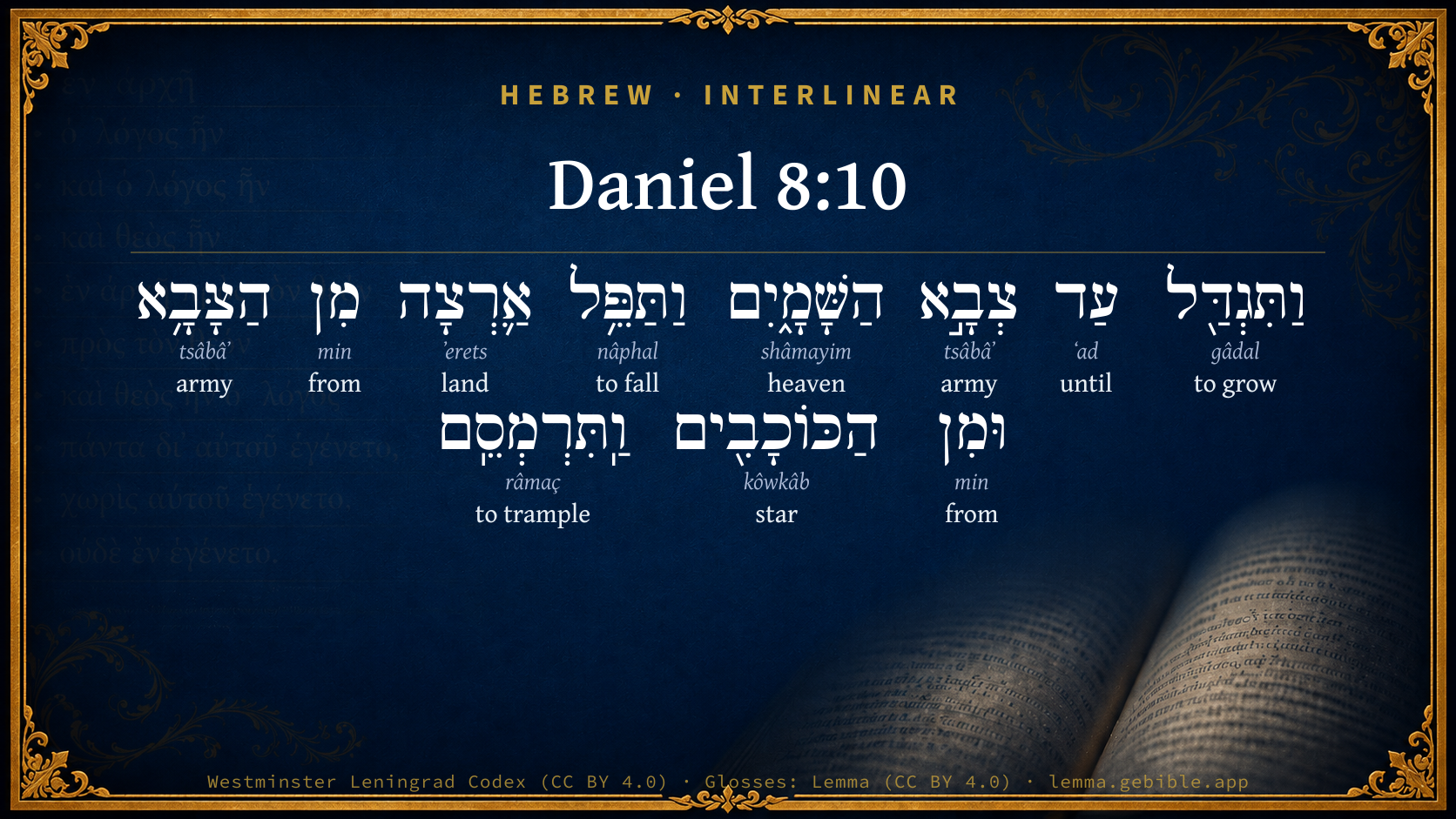
Hebrew (Westminster Leningrad Codex) Daniel 8:10 appears in the Hebrew Old Testament. The text above is from the Westminster Leningrad Codex. Each word links to its Strong’s number, a concise gloss, and parsing drawn from the Open Scriptures Hebrew Bible morphology. Click any word for its full Brown-Driver-Briggs (BDB) entry.
Download image
Cite this verse

Daniel 8:10 (World English Bible). Public Domain. Lemma interlinear Bible study tool, https://lemma.gebible.app/v/daniel/8/10.

Show BibTeX & RIS
BibTeX
RIS
English Translation
It grew great, even to the host of the sky; and some of the host and of the stars it cast down to the ground, and trampled on them.
World English Bible · Public Domain
Download a study sheet

One document with this verse’s original text, its word-by-word gloss line, the meaning frame, cross-references with their text, attributed commentary, and full source and license credits — printable, and it pastes into notes with its structure intact.

This verse Autodidact and up

Study sheet (.html) Plain text (.txt)

A passage Seminary Student

Up to 50 verses in one chapter. A passage sheet keeps up to 6 commentary sources and 12 cross-references per verse, in the order this page ranks them, and says so on the sheet whenever that leaves anything out. Ask for a single verse and you get the Autodidact verse sheet above.

Everything on this page stays free to read, with no account — the sheet is a download of what is already on screen, not access to it.

Want to remove ads? Support Godless Engineer
Compare translations 3

The same verse in 3 English versions, stacked beneath the original-language interlinear above. Click any original word for its lexicon entry.

Each is an independent rendering of the whole verse — the interlinear is not word-aligned to these translations.

Highlighted words mark where these versions differ — a whole-verse word diff, not a word-by-word alignment.

  • World English Bible Public Domain
    It grew great, even to the host of the sky; and some of the host and of the stars it cast down to the ground, and trampled on them.
  • King James Version Public Domain
    And it waxed great, even to the host of heaven; and it cast down some of the host and of the stars to the ground, and stamped upon them.
  • unfoldingWord Literal Text CC BY-SA 4.0
    It grew up to the host of heaven. Some of the host and some of the stars it threw down to the earth and trampled on them.

unfoldingWord Literal Text — © unfoldingWord, licensed CC BY-SA 4.0. Word-aligned USFM3 via Door43 (git.door43.org/unfoldingWord/en_ult).

Versions to compare (up to 4)

3 of 4 selected

Show all 18 translations

Every available English version of this verse, each an independent rendering of the whole verse.

  • World English Bible Public Domain
    It grew great, even to the host of the sky; and some of the host and of the stars it cast down to the ground, and trampled on them.
  • Berean Standard Bible Public Domain
    It grew as high as the host of heaven, and it cast down some of the host and some of the stars to the earth, and trampled them.
  • Majority Standard Bible Public Domain
    It grew as high as the host of heaven, and it cast down some of the host and some of the stars to the earth and trampled them.
  • King James Version Public Domain
    And it waxed great, even to the host of heaven; and it cast down some of the host and of the stars to the ground, and stamped upon them.
  • American Standard Version (1901) Public Domain
    And it waxed great, even to the host of heaven; and some of the host and of the stars it cast down to the ground, and trampled upon them.
  • Revised Version (1885) Public Domain
    And it waxed great, even to the host of heaven; and some of the host and of the stars it cast down to the ground, and trampled upon them.
  • Geneva Bible (1599) Public Domain
    Yea, it grewe vp vnto the hoste of heauen, and it cast downe some of the hoste, and of the starres to the ground, and trode vpon them,
  • Douay-Rheims (1899) Public Domain
    And it was magnified even unto the strength of heaven: and it threw down of the strength, and of the stars, and trod upon them.
  • Young's Literal Translation Public Domain
    yea, it exerteth unto the host of the heavens, and causeth to fall to the earth of the host, and of the stars, and trampleth them down.
  • Literal Standard Version CC BY-SA 4.0
    indeed, it exerts to the host of the heavens, and causes to fall to the earth of the host, and of the stars, and tramples them down.
  • Unlocked Literal Bible CC BY-SA 4.0
    It became so large as to engage in war with the army of heaven. Some of that army and some of the stars were thrown down to the earth, and it trampled on them.
  • unfoldingWord Literal Text CC BY-SA 4.0
    It grew up to the host of heaven. Some of the host and some of the stars it threw down to the earth and trampled on them.
  • Darby Bible Public Domain
    And it became great, even to the host of heaven; and it cast down [some] of the host and of the stars to the ground, and trampled upon them.
  • World Messianic Bible Public Domain
    It grew great, even to the army of the sky; and it cast down some of the army and of the stars to the ground and trampled on them.
  • Webster's Bible Public Domain
    And it grew great, even to the host of heaven; and it cast down some of the host and of the stars to the ground, and stamped upon them.
  • Free Bible Version CC BY-SA 4.0
    It grew in power until it reached the heavenly army, throwing some of them and some of the stars down to the earth and trampled on them.
  • Bible in Basic English Public Domain
    And it became great, even as high as the army of heaven, pulling down some of the army, even of the stars, to the earth and crushing them under its feet.
  • JPS Tanakh (1917) Public Domain
    And it waxed great, even to the host of heaven; and some of the host and of the stars it cast down to the ground, and trampled upon them.

Literal Standard Version (2020), Covenant Press — licensed CC BY-SA 4.0. Text via the HelloAO Bible API (eBible.org). Unlocked Literal Bible (unfoldingWord) — licensed CC BY-SA 4.0. Text via the HelloAO Bible API (eBible.org). unfoldingWord Literal Text — © unfoldingWord, licensed CC BY-SA 4.0. Word-aligned USFM3 via Door43 (git.door43.org/unfoldingWord/en_ult). Free Bible Version, Dr. Jonathan Gallagher — licensed CC BY-SA 4.0. Text via the HelloAO Bible API (eBible.org).

Word by word

More ways to search: Search by grammar → Find every occurrence → Compare this word →

Practice this passage: Drill this verse → Learn its vocabulary →

וַֽתִּרְמְסֵֽם
râmaç
H7429
“and · to trample · them”
Conjunction + Verb, Qal, Sequential Imperfect, 3rd Person, Feminine, Singular + Suffix, Personal, 3rd Person, Masculine, Plural
Part of Speech
Conjunction + Verb
Stem
Qal
Form
Sequential Imperfect
Person
3rd Person
Gender
Feminine
Number
Singular
Full BDB Definition

Origin: a primitive root

TWOT: 2176

to trample - (Qal) - to trample - trampler (participle) - (Niphal) to be trampled
  1. וַתִּגְדַּ֖ל gâdal H1431 “and · to grow” Conjunction + Verb, Qal, Sequential Imperfect, 3rd Person, Feminine, Singular
  2. עַד ʻad H5704 “until” Preposition
  3. צְבָ֣א tsâbâʼ H6635 “army of” Noun, Common, Both, Singular, Construct
  4. הַשָּׁמָ֑יִם shâmayim H8064 “the · heaven(s)” Particle, Definite Article + Noun, Common, Masculine, Plural, Absolute
  5. וַתַּפֵּ֥ל nâphal H5307 “and · to fall” Conjunction + Verb, Hiphil, Sequential Imperfect, 3rd Person, Feminine, Singular
  6. אַ֛רְצָה ʼerets H776 “land · toward” Noun, Common, Both, Singular, Absolute + Suffix, Demonstrative
  7. מִן min H4480 “from” Preposition
  8. הַצָּבָ֥א tsâbâʼ H6635 “the · army” Particle, Definite Article + Noun, Common, Both, Singular, Absolute
  9. וּמִן min H4480 “and · from” Conjunction + Preposition
  10. הַכּוֹכָבִ֖ים kôwkâb H3556 “the · stars” Particle, Definite Article + Noun, Common, Masculine, Plural, Absolute

About this verse

These counts appear in no published source. They are computed here, from the morphology-tagged text and Lemma’s own curated glosses. What Lemma adds →

11
words
9
distinct lemmas
Prophets
section

Notable vocabulary

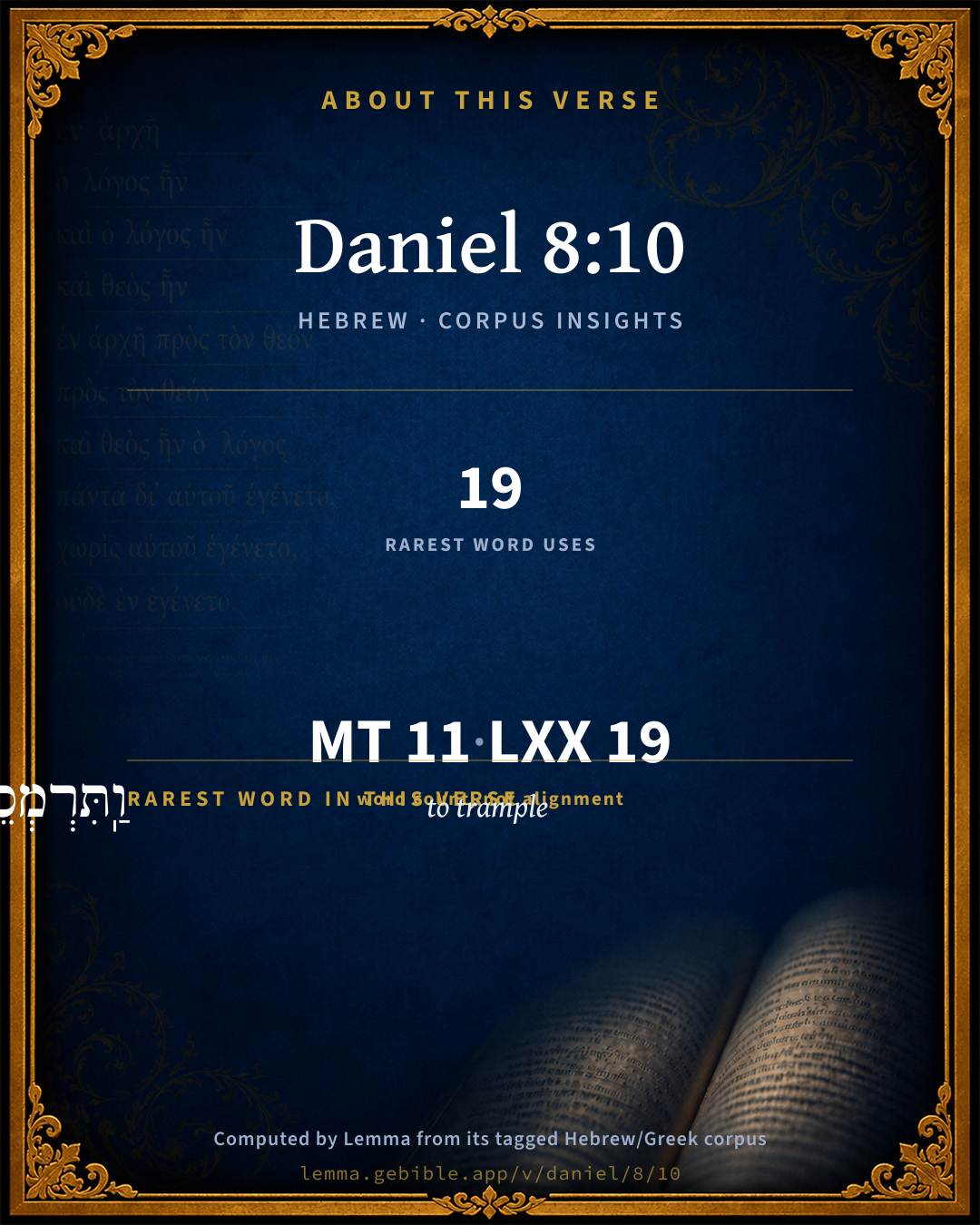
The rarest word here is וַֽתִּרְמְסֵֽם to trample H7429 — appearing just 19 times in the whole Hebrew Bible.

Shared distinctive vocabulary

וַֽתִּרְמְסֵֽם to trample H7429 occurs in 19 verses of the Hebrew Bible. Also found in:

Grammatical profile

  • 3 verbs
  • 5 nouns
  • 3 prepositions

Verb forms

  • וַתִּגְדַּ֖ל Qal · Sequential Imperfect
  • וַתַּפֵּ֥ל Hiphil · Sequential Imperfect
  • וַֽתִּרְמְסֵֽם Qal · Sequential Imperfect

Repetition

Words recur within this verse — often emphatic in Hebrew:

  • צְבָ֣א army H6635 ×2
  • מִן from H4480 ×2

Hebrew & Septuagint length

In English translation the verse runs 29 words from the Hebrew and 30 from the Septuagint (LXX English) — closely comparable.

A rough comparison of the two English renderings, which tokenize alike — not a word-level alignment.

Word counts can differ between the Hebrew and the Greek without any difference in meaning — e.g. the Hebrew direct-object marker אֵת has no separate Greek word, and Greek often adds the article ὁ.

In the original languages it is 11 Hebrew tokens and 19 Greek tokens — but the two are counted differently (Hebrew bundles its prefixes and suffixes into one token; the Greek is in lemma form), so that isn’t a like-for-like length.

Cross-references

8

Topical passages linked to Daniel 8:10 in the Treasury of Scripture Knowledge — connected by theme and wording, ordered by reader-vote popularity; previews shown in the World English Bible.

  • Isaiah 14:13 You said in your heart, I will ascend into heaven, I will exalt my throne above the stars of God; and I will sit on the mountain of congregation, in the uttermost parts of the north;
  • Revelation 12:4 His tail drew one third of the stars of the sky, and threw them to the earth. The dragon stood before the woman who was about to give birth, so that when she gave birth he might devour her child.
  • Daniel 7:7 After this I saw in the night-visions, and, behold, a fourth animal, awesome and powerful, and strong exceedingly; and it had great iron teeth; it devoured and broke in pieces, and stamped the residue with its feet: and it was diverse from all the animals that were before it; and it had ten horns.
  • Daniel 8:7 I saw him come close to the ram, and he was moved with anger against him, and struck the ram, and broke his two horns; and there was no power in the ram to stand before him; but he cast him down to the ground, and trampled on him; and there was none who could deliver the ram out of his hand.
  • Daniel 11:28 Then shall he return into his land with great substance; and his heart [shall be] against the holy covenant; and he shall do [his pleasure], and return to his own land.
  • Daniel 11:33–36 Those who are wise among the people shall instruct many; yet they shall fall by the sword and by flame, by captivity and by spoil, [many] days.
  • Daniel 8:24–25 His power shall be mighty, but not by his own power; and he shall destroy wonderfully, and shall prosper and do [his pleasure]; and he shall destroy the mighty ones and the holy people.
  • Daniel 11:30 For ships of Kittim shall come against him; therefore he shall be grieved, and shall return, and have indignation against the holy covenant, and shall do [his pleasure]: he shall even return, and have regard to those who forsake the holy covenant.

Cross-references courtesy of OpenBible.info (CC BY 4.0).

Hebrew and Greek witnesses Masoretic Hebrew ↔ Greek Septuagint

The same verse in the two great witnesses to the Old Testament, shown verse-for-verse.

These are two independent witnesses, not word-aligned to each other, and the Septuagint is shown in lemma (dictionary) form.

Hebrew Daniel 8:10 Masoretic · Westminster Leningrad Codex

וַתִּגְדַּ֖ל עַד צְבָ֣א הַשָּׁמָ֑יִם וַתַּפֵּ֥ל אַ֛רְצָה מִן הַצָּבָ֥א וּמִן הַכּוֹכָבִ֖ים וַֽתִּרְמְסֵֽם

It grew great, even to the host of the sky; and some of the host and of the stars it cast down to the ground, and trampled on them.

World English Bible · Public Domain

Greek LXX Daniel 8:10 Septuagint · lemma form

καί ὑψόω ἕως ὁ ἀστήρ ὁ οὐρανός καί ῥάσσω ἐπί ὁ γῆ ἀπό ὁ ἀστήρ καί ἀπό αὐτός καταπατέω

and it magnified itself to the host of heaven; and there fell to the earth some of the host of heaven and of the stars, and they trampled on them.

LXX2012 (modern English Septuagint) · Public Domain

On this verse, Whedon's Commentary on the Bible discusses the Septuagint’s reading. Read the note in Commentary ↓

Hebrew: Westminster Leningrad Codex (CC BY 4.0). Greek: Septuagint (public domain); English from LXX2012 (modern English Septuagint) (Public Domain). How the Septuagint differs from the Hebrew →

Commentary

Notes on Daniel 8:10 from classic Christian and Jewish commentators (each source and its license shown beneath its notes). The classic Christian expositions comment on the surrounding passage and are grouped to its opening verse, so a note may address several verses; the Jewish commentaries on the Tanakh (Rashi and others) are per-verse, so they appear only where the commentator wrote on this verse.

Lemma curates 59 commentaries, every one of them public domain or Creative Commons licensed, each selected and text-cleaned for this edition rather than reprinted as found. About our sources →

Trapp's Complete Commentary

John Trapp

Dan 8:10 And it waxed great, [even] to the host of heaven; and it cast down [some] of the host and of the stars to the ground, and stamped upon them.

Ver. 10. And it waxed great, even to the host of heaven.] Or, Against the host of heaven, so the Church militant is called. The saints are the world’s great luminaries, yea, the only earthly angels, although wicked people count and call them the "filth and offscouring of all things."

And of the stars.] Such as shone in the light of holy doctrine; {Rev 1:10} persecutors’ spite is specially against such. {Zec 13:7}

John Trapp, A Commentary or Exposition upon All the Books of the Old and New Testament (1647–1656) — public domain. Text from a community e-Sword module.

Joseph Benson's Commentary

Dan 8:10-11. And it waxed great, even to the host of heaven — By the host of heaven, seems to be here meant the Jewish priesthood, so called from their continual attendance on God’s service in the temple, as the angels do in heaven. The word צבא, here rendered host, is applied to the attendants in the sanctuary, Exo 38:8; Num 4:23. And it cast down some of the host and of the stars to the ground — Persons of principal dignity and high offices are often called stars in the Scriptures. In Isa 24:21, The host of the high ones that are on high, is explained by Vitringa of the Jewish rulers and people: see Dan 12:3, and Rev 1:20, where the angels, or governors of the church, are called stars. The words here seem to import, either that Antiochus should put an end to the services of the temple, by taking away the daily sacrifice, Dan 8:12; or else that he should seduce some of the priests and rulers, by threats and flatteries, to turn apostates. And stamped upon them — Utterly subdued and destroyed them: see Dan 7:7. Yea, he magnified himself even to [or against] the prince of the host — This may be understood of the high-priest Onias, (compare Dan 11:22,) whom Antiochus deprived of his office, putting Jason in his place, an ungodly wretch, who set up heathen rites in God’s temple, 2Ma 4:13-17. But Jerome and Theodoret understand it of God himself, as do many others; or of Christ, the High-Priest over the house of God, whose sanctuary the temple is called in the following words. Antiochus erected in the temple a statue to Jupiter Olympus, deservedly esteemed the abomination of desolation, and thus magnified himself against God, to whom the sanctuary and its services were appropriated. And by him the daily sacrifice was taken away — The sacrifice which was offered, in the name of the whole nation, every morning and evening: see Num 28:3. This was taken away by Antiochus, together with the whole customary worship, and both altar and temple profaned: see 1Ma 1:44-64. And the place of his sanctuary was cast down — Or cast out, or rendered profane: comp. Rev 11:2. It was deprived of the honour and privileges that belonged to a holy place, as if the enclosures had been thrown down which separated it from common ground. It may include also the profanation of the high- priesthood, which Antiochus set up to sale, and let men of the most profligate lives have it; so that both the sanctuary itself, and the priesthood, might truly be said to be rendered profane.

Joseph Benson's Commentary on the Old and New Testaments (1811–1818) — public domain. Text from a community e-Sword module.

Scofield Reference Notes

C. I. Scofield

And it waxed great

This passage (Dan 8:10-14) is confessedly the most difficult in prophecy, a difficulty increased by the present state of the text. Historically this was fulfilled in and by Antiochus Epiphanes, but in a more intense and final sense Antiochus but adumbrates the awful blasphemy of the "little horn" of; Dan 7:8; Dan 7:24; Dan 7:25; Dan 9:27; Dan 11:36-45; Dan 12:11. In Daniel Dan 8:10-14 the actions of both "little horns" blend.

The Scofield Reference Bible (1917 edition), notes by C. I. Scofield — public domain. Text from a community e-Sword module.

Tyndale Open Study Notes

Tyndale Open Resources

8:10 The heavenly army could refer to (1) actual divine beings, since the “small horn” attempted to destroy Israel’s divinely given religion and Israel was protected by God’s watchful eye and his armies; and/or (2) the human defenders of Israel that were fighting for God’s holy people and the Temple. Both the physical and the spiritual realms were affected by these events.

Tyndale Open Study Notes — © Tyndale Open Resources, licensed CC BY-SA 4.0. Text via the HelloAO Bible API.

Geneva Bible (1599)

Geneva Bible translators

Antiochus raged against the elect of God, and trode his precious stars under feet, which are so called, because they are separated from the world.

Geneva Bible (1599) marginal notes — public domain. Text via Bolls.life.

Jamieson, Fausset & Brown

Robert Jamieson, A. R. Fausset & David Brown

great, even to . . . host of heaven--explained in Dan 8:24, "the mighty and holy people," that is, the Jews (Dan 7:21) and their priests (compare Isa 24:21). The Levites' service is called "a warfare" (Num 8:24-25, Margin). Great civil and religious powers are symbolized by "stars" (Mat 24:29). See 1 Maccabees 1:25, &c.; 1 Maccabees 2:35, &c.; 1 Maccabees 5:2, 12, 13. TREGELLES refers "stars" to those Jews whose portion from God is heavenly glory (Dan 12:3), being believers in Him who is above at God's right hand: not the blinded Jews.

cast . . . stars to the ground--So Babel, as type of Antichrist, is described (Isa 14:13-14), "I will exalt my throne above the stars of God." Compare Rev 12:4; 2 Maccabees 9:10, as to Antiochus.

Jamieson, Fausset & Brown — Commentary Critical and Explanatory on the Whole Bible (1871) — public domain (CC PDM 1.0). Text via the HelloAO Bible API.

Adam Clarke's Commentary

Verse 10. The host of heaven] The Jewish hierarchy. The stars, the priests and Levites. The powers or host of heaven are probably intended by our Lord, Mt 24:29, to signify the whole Jewish hierarchy.

Adam Clarke's Commentary on the Bible (1810–1826) — public domain. Text from a community e-Sword/MySword module.

John Calvin's Commentaries

Here Daniel continues the vision which he had received. We have already shewn he object of the Almighty to be the preparation of the faithful to bear serious calamities, because nothing new or unexpected should happen to them. Now, Daniel’s dwelling upon this point is not surprising, for it becomes his duty to inform the faithful of the heavy calamities which were at hand, and thus to mould them to patience and equity. Thus he says, The horn became magnificent, even to the army of the heavens. Without the slightest doubt this figure marks the elect people of God. Although the Church often lies prostrate in the world, and is trodden under foot and buried, yet it is always precious before God. Hence the Prophet adorns the Church with this remarkable praise, not to obtain for it any honor before men, but because God has separated it from the world, and provided a sure inheritance in heaven. Although the sons of God are pilgrims on earth, and have scarcely any dwelling-place here, becoming like castaways before men, yet they are nevertheless citizens of heaven. The usefulness of this teaching to us is apparent, by its inducing us to bear it patiently whenever we are often thrown prostrate on the ground, and whenever tyrants and the despiser’s of God look down upon us with scorn. Meanwhile our seat is laid up in heaven, and God numbers us among the stars, although, as Paul says, we are as dung and the offscouring of all things. (1 Corinthians 4:13.) In fine, God here shews his Prophet, as in a mirror, the estimation in which he holds his Church, however contemptible it is on earth. That horn, then, was magnified before the army of the heavens, and cast down some of that army upon the earth, and trod them out of the stars Exactly as if he proclaimed the loosening of the reins from the tyrant, permitting him to treat the Church with contempt, to tread it under foot;, and to draw down the stars from heaven, just as if God never appeared for its protection. For when God permits us to be safe and secure in his hand, and pronounces it impossible to prevail against his help, while tyrants harass and oppress us by their lust, it is like drawing down stars from heaven. God therefore, while he takes us under his guardianship, does not offer us any succor, but dissembles as if he wished to betray us to our enemies. Nothing therefore is superfluous in these expressions of the Prophet — The stars were trodden down and the heavenly army thrown down to earth He now adds —

John Calvin's Commentaries (1540-1563) — public domain. Text from the Calvin Translation Society English edition (1840s-50s) via the Christian Classics Ethereal Library (ccel.org). Calvin's coverage is partial (roughly two-thirds of the Bible); uncommented books and verses are honest gaps, never fabricated. The 19th-century editor's footnotes and remarks are omitted so the notes are faithfully Calvin's own voice.

Ellicott's Commentary for English Readers

(10) The host of heaven.—Probably meaning the stars, as Jer_33:22, but in a metaphorical sense indicating the people of Israel. (Comp. Exo_7:4; Num_24:17.) The actions of Antiochus, predicted here, are related 1Ma_1:24; 1Ma_1:30; 1Ma_1:37; 1Ma_2:38; 2Ma_9:10.

A Bible Commentary for English Readers, edited by Charles John Ellicott (1878–1897) — public domain. Text from a community e-Sword module.

The Cambridge Bible for Schools and Colleges

gen. ed. J. J. S. Perowne

10. The horn ‘waxed great,’ in the vision, not only over the surface of the earth (Dan_8:9); it even towered up to heaven, struck and hurled down to the earth some of the stars, and then trampled contumeliously upon them.

even to] as far as, so as even to reach. Cf. Isa_14:13-14; Job_20:6; and 2Ma_9:10, ‘the man (Ant. Ep.) that a little afore supposed himself to touch the stars of heaven.’ The ‘host of heaven’ are the stars (as Deu_4:19, Jer_8:2; Jer_33:22, and elsewhere)[323]. Antiochus did not merely (cf. the passages quoted) touch heaven in his pride: he is represented further, with allusion to his insolent assaults upon the religion of the Jews, and to the martyrs who fell in consequence (Dan_8:24; cf. 1Ma_1:24; 1Ma_1:30; 1Ma_1:57; 1Ma_1:63, &c.), as audaciously attacking it, and hurling down some of the stars to the earth.

[323] See Host of Heaven in Hasytings’ Dict. of the Bible. It denotes them as a disciplined army, obedient to the commands of its leader (Isa_40:26).

and it cast, &c.] better, R.V. and some of the host and of the stars it cast down to the ground, and trampled (Dan_8:7) upon them. The stars are intended to symbolize the faithful Israelites: cf. Enoch xlvi. 7.

The Cambridge Bible for Schools and Colleges (gen. ed. J. J. S. Perowne; Cambridge University Press, 1878–1918) — public domain. Text from a community e-Sword module.

John Gill's Exposition

And it waxed great, even to the host of heaven,.... The people of the Jews, the army of the living God, the church militant, among whom were many of the citizens of heaven, whose names are written there; such was the insolence of this king, as to molest and disturb them:

and it cast down some of the host and of the stars to the ground, and stamped them; some of the common people he persecuted and destroyed, or prevailed upon them, either by threats or flatteries, to relinquish their religion; and even some of the "stars", the lights of the people, the priests and Levites, that ministered unto them; or the princes, and elders of the people, whom he slew, as Jacchiades interprets it; or removed from their posts so that they could not do their office; or they turned apostates; and those that did not he barbarously put to death, and insulted over them, and used them in a very contemptuous manner, as old Eleazar, the mother and her seven sons; see 2 Maccabees chapter 7.

John Gill's Exposition of the Whole Bible (1746–1763) — public domain (CC PDM 1.0). Text via the HelloAO Bible API.

Albert Barnes' Notes on the Bible

And it waxed great - It became very powerful. This was eminently true of Antiochus, after having subdued Egypt, etc.

Even to the host of heaven - Margin, against. The Hebrew word (עד ‛ad) means “to” or “unto,” and the natural idea would seem to be that he wished to place himself among the stars, or to exalt himself above all that was earthly. Compare the notes at Isa 14:13 : “For thou hast said in thine heart, I will ascend into heaven, I will exalt my throne above the stars of God.” Lengerke supposes that the meaning here is, that he not only carried his conquests to Egypt and to the East, and to the holy land in general, but that he made war on the holy army of God - the priests and worshippers of Jehovah, here spoken of as the host of heaven. So Maurer understands it. In 2 Macc. 9:10, Antiochus is described in this language: “And the man that thought a little afore he could reach the stars of heaven, etc.” The connection, would seem to demand the interpretation proposed by Lengerke and Maurer, for it is immediately said that he cast down some of the host and the stars to the ground. And such an interpretation accords with the language elsewhere used, of the priests and rulers of the Hebrew people. Thus, in Isa 24:21, they are called “the host of the high ones that are on high.” See the note at that passage. This language is by no means uncommon in the Scriptures. It is usual to compare princes and rulers, and especially ecclesiastical rulers, with the sun, moon, and stars. Undoubtedly it is the design here to describe the pride and ambition of Antiochus, and to show that he did not think anything too exalted for his aspiration. None were too high or too sacred to be secure from his attempts to overthrow them, and even those who, by their position and character, seemed to deserve to be spoken of as suns and stars, as “the host of heaven,” were not secure.

And it cast down some of the host and of the stars to the ground - The horn seemed to grow up to the stars, and to wrest them from their places, and to cast them to the earth. Antiochus, in the fulfillment of this, east down and trampled on the princes, and rulers, and people, of the holy host or army of God. All that is implied in this was abundantly fulfilled in what he did to the Jewish people. Compare 1 Macc. 1, and 2 Macc. 8:2.

And stamped upon them - With indignation and contempt. Nothing could better express the conduct of Antiochus toward the Jews.

Albert Barnes' Notes on the Bible (1834–1885) — public domain. Text from a community e-Sword/MySword module.

Haydock's Catholic Bible Commentary

Even unto, or against the strength of heaven. So are here called the army of the Jews, the people of God, (Challoner) and particularly the teachers. Many priests gave way to idolatry. (1 Machabees i. 48. and 2 Machabees iv. 14.) (Calmet)

George Leo Haydock (1774–1849), Haydock's Catholic Family Bible and Commentary, 1859 edition — public domain. Excludes Psalms (Douay-Rheims chapter numbering differs from Protestant) and Deuterocanonical books (Catholic canon only).

Matthew Poole's English Annotations

Even to the host of heaven, i.e. the church of God militant, who worship the God of heaven, who are citizens of heaven, whose names are written in heaven; and among these chiefly the priests, and nobles, and champions, who were as stars shining above the rest; these he profaned and slew cruelly.

Matthew Poole's English Annotations on the Holy Bible (1683–1685) — public domain. Text from a community e-Sword/MySword module.

Whedon's Commentary on the Bible

Daniel D. Whedon

10. The little evil horn grew till it reached heaven and made war on the stars (compare Isa_14:13) and the host, that is, the army of stars (Deu_4:19; 2Ki_17:16; Jer_8:2), or of angels (Dan_4:35, Aramaic; 1Ki_22:19; Neh_9:6). On the stars compare Isa_14:13; the LXX. in its oldest manuscript speaks only of the stars. Professor G.F. Moore’s conjecture that this verse refers to Antiochus’s treatment of heathen religions (compare Dan_11:36; 1Ma_1:42; 1Ma_1:51) while the next verse refers to the Jewish religion — “the prince of the host” — has not met with much favor (Journal of Biblical Literature, 1896). Thomson’s idea that the host means the various guardian angels of the nations which Antiochus defeated (the stars being the symbols of those angels) is also too ingenious to be probable (yet compare note Dan_10:13). It seems more natural to suppose that these heavenly lights and ministers are all only symbols of the holy heavenly people against whom Antiochus was most fierce (Dan_8:24-25; Dan_11:36-37).

Daniel D. Whedon (gen. ed.), Commentary on the Old and New Testaments (1874–1909) — public domain. Text from a community e-Sword module.

The Pulpit Commentary

And it waxed great, even to the host of heaven; and it cast down some of the host and of the stars to the ground, and stamped upon them. The reading of the LXX is very different after the first clause, "And it was exalted to the stars of heaven, and it was shattered to the earth by thestars, and by them trampled down." The verb lSeT (tappayl) translated "cast down," has been read as if it had been lPTu (tooppal). So too the last verb has evidently been read WhWsmryw (vayyir"msoohoo) instead of (vattir"msaym), due to the resemblance which there was between yod and tan in the older script. Theodotion differs hardly less from the Massoretic, "And it was magnified to the power of heaven, and it fell to the earth from the power of heaven and from the stars, and they trode them down." The verb translated "fell" is evidently read with a vocalization different from both the Massoretic and the LXX The sense of Theodotion is more in accordance with the Septuagint than with the Massoretic. The Peshitta and the Vulgate agree with the Massoretic. The question of which reading is to be preferred can scarcely be settled without regarding the meaning of the terms here used. The crucial point is What is the meaning of the "host of heaven"? The general consensus of interpreters is that this refers to Israel. Some maintain that the best of heaven is Israel, and the stars their leaders (Glassins); the stars are the Levites (Grotius). Moses Stuart would hold the host to be the priests, and the stars the teachers. Kliefoth is right in commencing first with the picture, and requiring that it be realized in thought. The horn grows and grows before Daniel"s gaze, until it seems to touch the stars, that is, the host of heaven. As to what is meant by the stars, we must look elsewhere for an explanation. Have we any right to take "the host of heaven" as meaning the people of God? The phrase, "host of heaven," occurs elsewhere in Scripture nearly a score of times, and it rover means anything else than the stars or the angels. Therefore all interpretations that make this mean either the people of God or the Levites, must be thrown aside. It may, however, mean the people of God mediately. A quite elaborate line of deduction has been brought forward the promise to Abraham, (Gen_15:5) to (Gen_26:4) that their seed should be as the stars of heaven, is brought into connection with the use of the word "hosts" in regard to Israel (Num_1:52, etc.) and the title given to God as the God of Israel, "Jehovah of hosts." This is very ingenious, but it has no support from scriptural usage or from the usage in apocalyptic writings. In the Book of Enoch, which, since it is modelled on this book, furnishes us with the earliest commentary on it, we find the stars are invariably the symbol of the angels. When we pass to the Book of Revelation, we find the same thing. We find when we pass on to the tenth chapter of this book, that all the nations are regarded as under the rule of some special angel We must apply, so far as we can, rules of interpretation which the author himself supplies us with. Using this guide, we see next that, when a nation was defeated and oppressed, its angel or star was regarded as thrown to the earth and trodden underfoot. The treatment Epiphanes meted out to Egypt and Palestine seems specially referred to. If we take the reading of the LXX, then the reference will be to the humiliation Epiphanes received at the hands of the Romans first, and then the Jews, and lastly the Elamites, whose temple he attempted to plunder.

The Pulpit Commentary (1880–1919), ed. H.D.M. Spence-Jones & Joseph S. Exell — public domain. Text from a community e-Sword module.

John Wesley's Explanatory Notes

The host of heaven - The church of God militant, who worship the God of heaven, who are citizens of heaven, whose names are written in heaven; and among these the priests, and champions, who were as stars shining above the rest; these he profaned and slew cruelly.

John Wesley, Explanatory Notes Upon the Whole Bible (1754–1765) — public domain. Text via the GEBible commentary corpus.

Rashi

Rabbi Shlomo Yitzchaki (Rashi)

until the host of heaven They are Israel, who were compared to the stars.

Rashi on the Tanakh — English translations: “The Judaica Press complete Tanach with Rashi, translated by A. J. Rosenberg” (CC BY 4.0); “Pentateuch with Rashi's commentary by M. Rosenbaum and A.M. Silbermann, 1929-1934” (public domain); “The Metsudah Tanach series, Lakewood, N.J” (CC BY 4.0); and “The Book of Joshua, Metsudah Publications, 1997” (CC BY 4.0). Text via Sefaria.

Lesson kit

Teaching starters — assembled from the data on this page, not authored interpretation. Every prompt links to the verse data it draws on. Edit before teaching.

Daniel, in the Prophets, opens this verse with 11 words (9 distinct Hebrew lemmas). Its most distinctive word is râmaç (“to trample”). A historical commentator’s framing appears above. Read the whole chapter for the surrounding context.

Discussion questions

  1. What does “to trample” (râmaç) contribute to the verse as a whole?
  2. 2 Kings 7:17 shares the word «to trample» with this verse. How do the two illuminate each other?
  3. “army” occurs 2× in this one verse. What is the effect of the repetition?
  4. These translations render this verse differently. What is at stake in choosing one wording over another?
  5. The verb «וַתִּגְדַּ֖ל» is Qal Sequential Imperfect. How does its form color the action?
  6. Reading how Trapp's Complete Commentary and Joseph Benson's Commentary read this verse, where do the two commentators agree and where do they part?

Things to notice

Reading settings

Reading text

Shown beneath each verse's original-language words.

Old Testament
Old Testament edition

Read the OT as the Masoretic Hebrew (MT) or the Greek Septuagint (LXX).

English shown for the Greek Septuagint (in the Hebrew ↔ Greek comparison).

Comparing translations? Open the Compare panel on any verse page to stack up to four side by side.