Joshua 22:12

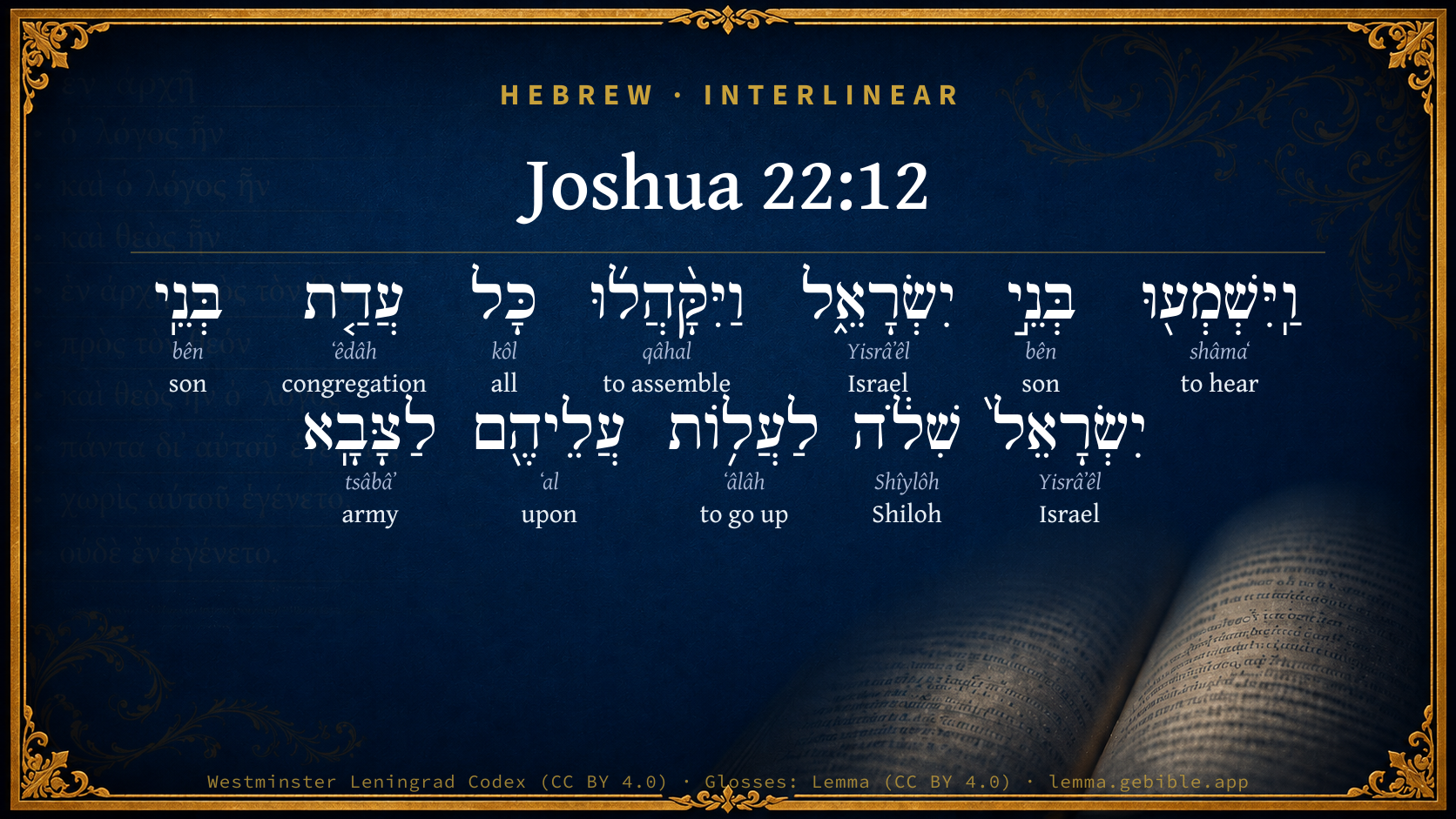
Hebrew (Westminster Leningrad Codex) Joshua 22:12 appears in the Hebrew Old Testament. The text above is from the Westminster Leningrad Codex. Each word links to its Strong’s number, a concise gloss, and parsing drawn from the Open Scriptures Hebrew Bible morphology. Click any word for its full Brown-Driver-Briggs (BDB) entry.
Download image
Cite this verse

Joshua 22:12 (World English Bible). Public Domain. Lemma interlinear Bible study tool, https://lemma.gebible.app/v/joshua/22/12.

Show BibTeX & RIS
BibTeX
RIS
English Translation
When the children of Israel heard of it, the whole congregation of the children of Israel gathered themselves together at Shiloh, to go up against them to war.
World English Bible · Public Domain
Download a study sheet

One document with this verse’s original text, its word-by-word gloss line, the meaning frame, cross-references with their text, attributed commentary, and full source and license credits — printable, and it pastes into notes with its structure intact.

This verse Autodidact and up

Study sheet (.html) Plain text (.txt)

A passage Seminary Student

Up to 50 verses in one chapter. A passage sheet keeps up to 6 commentary sources and 12 cross-references per verse, in the order this page ranks them, and says so on the sheet whenever that leaves anything out. Ask for a single verse and you get the Autodidact verse sheet above.

Everything on this page stays free to read, with no account — the sheet is a download of what is already on screen, not access to it.

Want to remove ads? Support Godless Engineer
Compare translations 3

The same verse in 3 English versions, stacked beneath the original-language interlinear above. Click any original word for its lexicon entry.

Each is an independent rendering of the whole verse — the interlinear is not word-aligned to these translations.

Highlighted words mark where these versions differ — a whole-verse word diff, not a word-by-word alignment.

  • World English Bible Public Domain
    When the children of Israel heard of it, the whole congregation of the children of Israel gathered themselves together at Shiloh, to go up against them to war.
  • King James Version Public Domain
    And when the children of Israel heard of it, the whole congregation of the children of Israel gathered themselves together at Shiloh, to go up to war against them.
  • unfoldingWord Literal Text CC BY-SA 4.0
    When the sons of Israel heard, then all of the congregation of the sons of Israel gathered themselves at Shiloh to go up against them to war.

unfoldingWord Literal Text — © unfoldingWord, licensed CC BY-SA 4.0. Word-aligned USFM3 via Door43 (git.door43.org/unfoldingWord/en_ult).

Versions to compare (up to 4)

3 of 4 selected

Show all 18 translations

Every available English version of this verse, each an independent rendering of the whole verse.

  • World English Bible Public Domain
    When the children of Israel heard of it, the whole congregation of the children of Israel gathered themselves together at Shiloh, to go up against them to war.
  • Berean Standard Bible Public Domain
    And when they heard this, the whole congregation of Israel assembled at Shiloh to go to war against them.
  • Majority Standard Bible Public Domain
    And when they heard this, the whole congregation of Israel assembled at Shiloh to go to war against them.
  • King James Version Public Domain
    And when the children of Israel heard of it, the whole congregation of the children of Israel gathered themselves together at Shiloh, to go up to war against them.
  • American Standard Version (1901) Public Domain
    And when the children of Israel heard of it, the whole congregation of the children of Israel gathered themselves together at Shiloh, to go up against them to war.
  • Revised Version (1885) Public Domain
    And when the children of Israel heard of it, the whole congregation of the children of Israel gathered themselves together at Shiloh, to go up against them to war.
  • Geneva Bible (1599) Public Domain
    When the children of Israel heard it, then the whole Congregation of the children of Israel gathered them together at Shiloh to goe vp to warre against them.
  • Douay-Rheims (1899) Public Domain
    They all assembled in Silo, to go up and fight against them.
  • Young's Literal Translation Public Domain
    And the sons of Israel hear, and all the company of the sons of Israel is assembled at Shiloh, to go up against them to war;
  • Literal Standard Version CC BY-SA 4.0
    And the sons of Israel hear, and all the congregation of the sons of Israel is assembled at Shiloh, to go up against them to war;
  • Unlocked Literal Bible CC BY-SA 4.0
    When the people of Israel heard of it, the whole assembly of the people of Israel gathered together at Shiloh to go up to make war against them.
  • unfoldingWord Literal Text CC BY-SA 4.0
    When the sons of Israel heard, then all of the congregation of the sons of Israel gathered themselves at Shiloh to go up against them to war.
  • Darby Bible Public Domain
    And when the children of Israel heard [of it], the whole assembly of the children of Israel gathered together at Shiloh, to go up against them to war.
  • World Messianic Bible Public Domain
    When the children of Israel heard of it, the whole congregation of the children of Israel gathered themselves together at Shiloh, to go up against them to war.
  • Webster's Bible Public Domain
    And when the children of Israel heard of it, the whole congregation of the children of Israel assembled at Shiloh, to go up to war against them.
  • Free Bible Version CC BY-SA 4.0
    The Israelites gathered at Shiloh to go to war against them.
  • Bible in Basic English Public Domain
    Then all the meeting of the children of Israel, hearing this, came together at Shiloh to go up against them to war.
  • JPS Tanakh (1917) Public Domain
    And when the children of Israel heard of it, the whole congregation of the children of Israel gathered themselves together at Shiloh, to go up against them to war.

Literal Standard Version (2020), Covenant Press — licensed CC BY-SA 4.0. Text via the HelloAO Bible API (eBible.org). Unlocked Literal Bible (unfoldingWord) — licensed CC BY-SA 4.0. Text via the HelloAO Bible API (eBible.org). unfoldingWord Literal Text — © unfoldingWord, licensed CC BY-SA 4.0. Word-aligned USFM3 via Door43 (git.door43.org/unfoldingWord/en_ult). Free Bible Version, Dr. Jonathan Gallagher — licensed CC BY-SA 4.0. Text via the HelloAO Bible API (eBible.org).

Word by word

More ways to search: Search by grammar → Find every occurrence → Compare this word →

Practice this passage: Drill this verse → Learn its vocabulary →

שִׁלֹ֔ה
Shîylôh
H7887
“Shiloh”
Noun, Proper
Part of Speech
Noun
Type
Proper
Full BDB Definition

Origin: from the same as H7886

TWOT: 2376

Shiloh = "place of rest" - a city in Ephraim and temporary home of the Ark of the Covenant and the Tabernacle, the place where Samuel grew up
  1. וַֽיִּשְׁמְע֖וּ shâmaʻ H8085 “and · to hear” Conjunction + Verb, Qal, Sequential Imperfect, 3rd Person, Masculine, Plural
  2. בְּנֵ֣י bên H1121 “sons of” Noun, Common, Masculine, Plural, Construct
  3. יִשְׂרָאֵ֑ל Yisrâʼêl H3478 “Israel” Noun, Proper
  4. וַיִּקָּ֨הֲל֜וּ qâhal H6950 “and · to assemble” Conjunction + Verb, Niphal, Sequential Imperfect, 3rd Person, Masculine, Plural
  5. כָּל kôl H3605 “all of” Noun, Common, Masculine, Singular, Construct
  6. עֲדַ֤ת ʻêdâh H5712 “congregation of” Noun, Common, Feminine, Singular, Construct
  7. בְּנֵֽי bên H1121 “sons of” Noun, Common, Masculine, Plural, Construct
  8. יִשְׂרָאֵל֙ Yisrâʼêl H3478 “Israel” Noun, Proper
  9. לַעֲל֥וֹת ʻâlâh H5927 “to go up” Preposition + Verb, Qal, Infinitive Construct
  10. עֲלֵיהֶ֖ם ʻal H5921 “upon · them” Preposition + Suffix, Personal, 3rd Person, Masculine, Plural
  11. לַצָּבָֽא tsâbâʼ H6635 “to/for the · army” Preposition, Determined + Noun, Common, Both, Singular, Absolute

About this verse

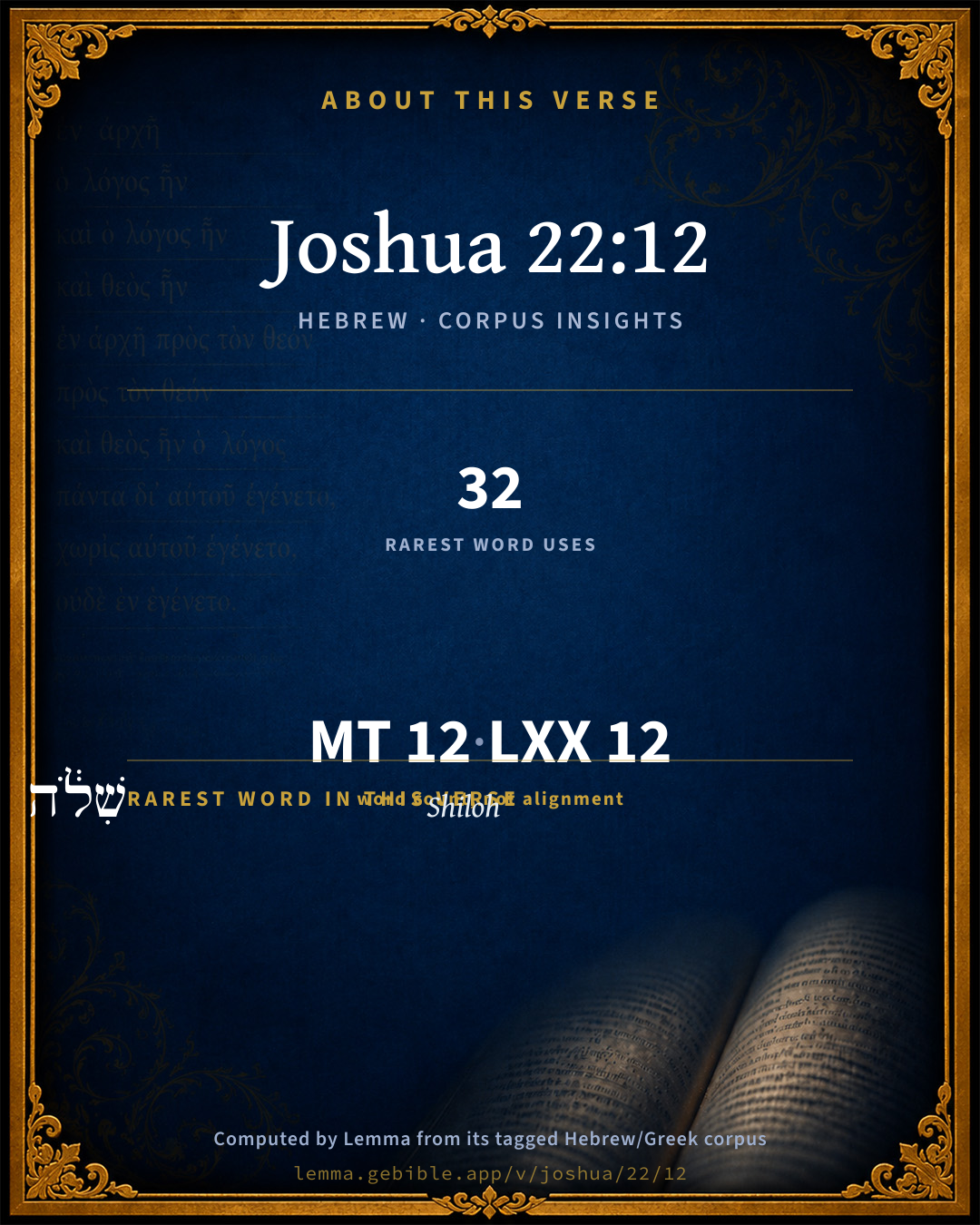
These counts appear in no published source. They are computed here, from the morphology-tagged text and Lemma’s own curated glosses. What Lemma adds →

12
words
10
distinct lemmas
Historical
section

Shared distinctive vocabulary

שִׁלֹ֔ה Shiloh H7887 occurs in 30 verses of the Hebrew Bible. Also found in:

Grammatical profile

  • 3 verbs
  • 8 nouns
  • 1 preposition

Verb forms

  • וַֽיִּשְׁמְע֖וּ Qal · Sequential Imperfect
  • וַיִּקָּ֨הֲל֜וּ Niphal · Sequential Imperfect
  • לַעֲל֥וֹת Qal · Infinitive Construct

Repetition

Words recur within this verse — often emphatic in Hebrew:

  • בְּנֵ֣י son H1121 ×2
  • יִשְׂרָאֵ֑ל Israel H3478 ×2

Hebrew & Septuagint length

In English translation the verse runs 28 words from the Hebrew and 19 from the Septuagint (LXX English) — the Septuagint runs noticeably shorter here. See the side-by-side →

A rough comparison of the two English renderings, which tokenize alike — not a word-level alignment.

Word counts can differ between the Hebrew and the Greek without any difference in meaning — e.g. the Hebrew direct-object marker אֵת has no separate Greek word, and Greek often adds the article ὁ.

In the original languages it is 12 Hebrew tokens and 12 Greek tokens — but the two are counted differently (Hebrew bundles its prefixes and suffixes into one token; the Greek is in lemma form), so that isn’t a like-for-like length.

Cross-references

6

Topical passages linked to Joshua 22:12 in the Treasury of Scripture Knowledge — connected by theme and wording, ordered by reader-vote popularity; previews shown in the World English Bible.

  • Judges 20:1–11 Then all the children of Israel went out, and the congregation was assembled as one man, from Dan even to Beersheba, with the land of Gilead, to Yahweh at Mizpah.
  • Deuteronomy 13:15 you shall surely strike the inhabitants of that city with the edge of the sword, destroying it utterly, and all that is therein and the cattle of it, with the edge of the sword.
  • Joshua 18:1 The whole congregation of the children of Israel assembled themselves together at Shiloh, and set up the tent of meeting there: and the land was subdued before them.
  • Acts 11:2–3 When Peter had come up to Jerusalem, those who were of the circumcision contended with him,
  • Romans 10:2 For I testify about them that they have a zeal for God, but not according to knowledge.
  • Galatians 4:17–18 They zealously seek you in no good way. No, they desire to alienate you, that you may seek them.

Cross-references courtesy of OpenBible.info (CC BY 4.0).

Hebrew and Greek witnesses Masoretic Hebrew ↔ Greek Septuagint

The same verse in the two great witnesses to the Old Testament, shown verse-for-verse.

Here the Septuagint runs noticeably shorter than the Hebrew — LXX2012 (modern English Septuagint) 19 words vs World English Bible 28. A rough length comparison of the two English translations, not a word-level alignment — read both below.

These are two independent witnesses, not word-aligned to each other, and the Septuagint is shown in lemma (dictionary) form.

Hebrew Joshua 22:12 Masoretic · Westminster Leningrad Codex

וַֽיִּשְׁמְע֖וּ בְּנֵ֣י יִשְׂרָאֵ֑ל וַיִּקָּ֨הֲל֜וּ כָּל עֲדַ֤ת בְּנֵֽי יִשְׂרָאֵל֙ שִׁלֹ֔ה לַעֲל֥וֹת עֲלֵיהֶ֖ם לַצָּבָֽא

When the children of Israel heard of it, the whole congregation of the children of Israel gathered themselves together at Shiloh, to go up against them to war.

World English Bible · Public Domain

Greek LXX Joshua 22:12 Septuagint · lemma form

καί συνἀθροίζω πᾶς ὁ υἱός ἰσραήλ εἰς σηλω ὥστε ἀναβαίνω ἐκπολεμέω αὐτός

And all the children of Israel gathered together to Selo, so as to go up and fight against them.

LXX2012 (modern English Septuagint) · Public Domain

Hebrew: Westminster Leningrad Codex (CC BY 4.0). Greek: Septuagint (public domain); English from LXX2012 (modern English Septuagint) (Public Domain). How the Septuagint differs from the Hebrew →

Targum (Aramaic paraphrase)

1

The Targum is the ancient Jewish Aramaic paraphrase of the Hebrew Scriptures — an interpretive translation, not the Hebrew text itself. Onkelos (literal) and Pseudo-Jonathan (expansive) render the Torah, and Jonathan the Prophets. Coverage is partial: where no permissively-licensed English translation exists for a verse, only the Aramaic is shown. This is verse-level text, not a word-by-word alignment to the Hebrew.

  1. Targum Jonathan Prophets (Joshua–Malachi)
    וּשְׁמָעוּ בְּנֵי יִשְׂרָאֵל וְאִתְכְּנִישׁוּ כָּל כְּנִשְׁתָּא דִבְנֵי יִשְׂרָאֵל לְשִׁלֹה לְמֵיסַק עֲלֵיהוֹן לְחֵילָא:

    (no public-domain English translation for this verse)

    Targum Jonathan — Aramaic: “Mikraot Gedolot” (public domain). English: “Sefaria Community Translation” (CC0 1.0 (public-domain dedication)); “London "Chaldee Paraphrase," 1871” (public domain). Text via Sefaria.

Commentary

Notes on Joshua 22:12 from classic Christian and Jewish commentators (each source and its license shown beneath its notes). The classic Christian expositions comment on the surrounding passage and are grouped to its opening verse, so a note may address several verses; the Jewish commentaries on the Tanakh (Rashi and others) are per-verse, so they appear only where the commentator wrote on this verse.

Lemma curates 59 commentaries, every one of them public domain or Creative Commons licensed, each selected and text-cleaned for this edition rather than reprinted as found. About our sources →

Trapp's Complete Commentary

John Trapp

Jos 22:12 And when the children of Israel heard [of it], the whole congregation of the children of Israel gathered themselves together at Shiloh, to go up to war against them.

Ver. 12. To go up to war against them.] According to Deu 13:13, &c., so blessedly blown up were they with a zeal for God - the Levites also and Manassites, though of the same tribe; howbeit this holy fire was not without some smoke.

John Trapp, A Commentary or Exposition upon All the Books of the Old and New Testament (1647–1656) — public domain. Text from a community e-Sword module.

Joseph Benson's Commentary

Jos 22:12. The whole congregation of the children of Israel — Not in their own persons, but by their elders, who were used to transact all affairs of this kind in the name of all the people. Gathered themselves together against them — As apostates from God, and the true religion, according to God’s command in such a case. For they too hastily inferred, from the erection of this altar, that their brethren were either going to serve other gods, or to worship the God of Israel in a manner different from that which he had prescribed. For they were expressly commanded that, as there was but one God, so they should offer only upon one altar, and in that one place which the Lord should choose, Deu 12:5-18.

Joseph Benson's Commentary on the Old and New Testaments (1811–1818) — public domain. Text from a community e-Sword module.

Tyndale Open Study Notes

Tyndale Open Resources

22:12 The western tribes were ready to go to war because they saw the altar as violating Lev 17:8-9 and Deut 13:12-15.

Tyndale Open Study Notes — © Tyndale Open Resources, licensed CC BY-SA 4.0. Text via the HelloAO Bible API.

Geneva Bible (1599)

Geneva Bible translators

Such now was their zeal, that they would rather lose their lives, than suffer the true religion to be changed or corrupted.

Geneva Bible (1599) marginal notes — public domain. Text via Bolls.life.

Adam Clarke's Commentary

Verse 12. To go up to war against them.] Supposing that they had built this altar in opposition to that which Moses, by the command of God, had erected, and were consequently become rebels against God and the Israelitish constitution, and should be treated as such. Their great concern for the glory of God led them to take this step, which at first view might appear precipitate; but, that they might do nothing rashly, they first sent Phinehas and ten princes, one out of each tribe, to require an explanation of their motives in erecting this altar.

Adam Clarke's Commentary on the Bible (1810–1826) — public domain. Text from a community e-Sword/MySword module.

Ellicott's Commentary for English Readers

(12) To go up to war against them.—There is no more striking proof of Israel’s obedience to the law and veneration for it in the days of Joshua than this. A single altar to Jehovah, besides the one in Shiloh. is sufficient cause for war against the builders of it. But see what is the language of the prophet. “According to the number of thy cities were thy gods, O Judah; and according to the number of the streets of Jerusalem have ye set up altars to Bosheth (disgrace), even altars to burn incense to Baal” (Jer_11:13). What stronger proof could we require of the veracity of the narrative in this place, and that it is genuine contemporary history? What writer of the days of Jeremiah, to which date some have referred the Book of Deuteronomy and its requirements, could have conceived such a scene as this, when altars to Jehovah on the high places were hardly regarded as illegal, and altars to Baal were as numerous as the very streets?

Another passage in a different part of the Old Testament corroborates indirectly, but in a striking manner, the tone of this (Neh_8:17): “The congregation. . . . made booths, and sat under the booths” (as required by the law of Moses in the Feast of Tabernacles); “for since the days of Joshua the son of Nun unto that day had not the children of Israel done so.”

A Bible Commentary for English Readers, edited by Charles John Ellicott (1878–1897) — public domain. Text from a community e-Sword module.

The Cambridge Bible for Schools and Colleges

gen. ed. J. J. S. Perowne

12. gathered themselves together] The act of their trans-Jordanic brethren, done without any authority of the High Priest, appeared at first sight to be a direct infringement of the express commands against another altar and other worship (Lev_17:8-9; Deu_12:5-7; Deu_13:12-18). It was open to the suspicion that they meant, if not to adopt another worship, at least to set up another and an independent establishment for worship, which, besides the obvious tendency to idolatry, could not fail in the event to destroy the connection by which the tribes were linked together. “The obligation of all the Israelites to resort three times in the year for worship to the sole altar of the people, was admirably suited to retain them as one people by continually keeping before their minds their common origin and common obligations; but if a separate establishment were allowed to exist there could be no difficulty in divining that they would cease to put themselves to the trouble of visiting the parent establishment in Canaan, and would, in no long time, come to regard themselves, with a country so congenial to their pastoral character and a geographical separation so complete, as a distinct people.”

The Cambridge Bible for Schools and Colleges (gen. ed. J. J. S. Perowne; Cambridge University Press, 1878–1918) — public domain. Text from a community e-Sword module.

John Gill's Exposition

And the children of Israel,.... In the land of Canaan:

sent unto the children of Reuben, and to the children of Gad, and to the half tribe of Manasseh, unto the land of Gilead; they were possessed of, and had now returned unto and dwelt in; hither they sent an embassy to them, to inquire into the truth of what they had heard, and the reason of it, before they went to war with them, or proclaimed it, or took any further steps towards it; and which they were obliged to do by the above law, when there was any suspicion of idolatry, and any good ground and reason for it, Deu 13:14; and at the head of this deputation was

Phinehas the son of Eleazar the priest; a man zealous for the Lord of hosts, and his glory, of which there is an instance in Num 25:7; and so a fit person to be employed in this affair, who would be faithful, bold, and zealous, as well as capable of giving advice and counsel to both parties, if needful.

John Gill's Exposition of the Whole Bible (1746–1763) — public domain (CC PDM 1.0). Text via the HelloAO Bible API.

Albert Barnes' Notes on the Bible

Gathered themselves together - The various tribes had already dispersed to their homes, and were now summoned together again.

Albert Barnes' Notes on the Bible (1834–1885) — public domain. Text from a community e-Sword/MySword module.

Haydock's Catholic Bible Commentary

In Silo, without being called, as they were all fired with a holy zeal, (Menochius) to prevent the growth of idolatry among their brethren. (Haydock) --- They knew that one altar was to be allowed (Menochius) in the place which the Lord should appoint, Leviticus xvii. 8., and Deuteronomy xii. 5., &c. (Haydock) --- God had ordered such cities as embraced idolatry among them, to be exterminated, Deuteronomy xiii. 12. (Calmet)

George Leo Haydock (1774–1849), Haydock's Catholic Family Bible and Commentary, 1859 edition — public domain. Excludes Psalms (Douay-Rheims chapter numbering differs from Protestant) and Deuterocanonical books (Catholic canon only).

Matthew Poole's English Annotations

The children of Israel; not in their own persons, but by their elders, who used to transact all affairs of this kind in the name and stead of all the people.

To go up to war against them; as apostates from God, according to God’s command in that case, Deu 13:13, &c.

Matthew Poole's English Annotations on the Holy Bible (1683–1685) — public domain. Text from a community e-Sword/MySword module.

Whedon's Commentary on the Bible

Daniel D. Whedon

12. The children of Israel gathered themselves together — The news produced the greatest consternation, and caused an uprising of all the tribes. A separate altar implied the setting up of a new religion, and fore-shadowed a secession from the theocratic state. Such a movement, therefore, demanded the most careful investigation, according to the express provision of the law. Deu_13:13-14. So at a later time all Israel assembled at Mizpeh to investigate the offence of Benjamin. Judges 20.

To go up to war against them — For the law ordained that if any city went over to idolatry it should be smitten with the edge of the sword, and utterly destroyed. Deu_13:15-16.

Daniel D. Whedon (gen. ed.), Commentary on the Old and New Testaments (1874–1909) — public domain. Text from a community e-Sword module.

The Pulpit Commentary

Gathered themselves together at Shiloh. The commentators refer here to Lev_17:8, Lev_17:9, and Deu_12:4-14. See also Lev_17:4. The punishment for the sin is to be found in Deu_13:12-16. We have before remarked (note on ver. 3) upon the singular obedience of the Israelites during the life of Joshua. The present incident is another exemplification of the fact. It is not Joshua who summons the children of Israel, it is they who voluntarily gather themselves together. The solemn provisions of the law have been infringed, they hasten at once, if necessary, to put the law in execution. The vivid sense of the triumphs they had enjoyed under Joshua, and the safety in which they now were enabled to dwell, filled their hearts with a strong, if short-lived, feeling of gratitude to Him who had done so great things for them, and of indignation against his foes. We may here observe two points which demonstrate the consistency of the narrative, and are evidences for its genuineness.

(1) The children of Israel were not remarkable for their obedience to the law, or to heaven-sent leaders. Both their previous and subsequent history forbid us to predicate for them the quality of obedience. Whence, then, comes this new born and ephemeral "zeal for the Lord," which displays itself in such a remarkable manner on the present occasion? Whence, but from the long catalogue of splendid victories and wonderful Divine interpositions recorded in this book, and from the sense of security arising out of them? Whence, but from the great fear of the children of Israel that had fallen upon the inhabitants of Canaan, so that, to use the striking expression of our historian in Jos_10:21, "none moved his tongue against any of the children of Israel.

(2) The offence and its penalty are recorded in the book of the law, and especially in the Book of Deuteronomy. Unless, therefore, we are to conclude that all this history, in spite of its natural and life-like character, was entirely the invention of later ages, we can scarcely avoid the conclusion that Deuteronomy, as well as the other books of the Pentateuch, was in existence when these events occurred. For if not, where was the offence of the two tribes and a half? How was its gravity to be determined? What induced the rest of Israel, including apparently the other half of the tribe of Manasseh, to prepare for war with their brethren? The only rational explanation of the history is that the tribes beyond Jordan had contravened the provisions of the law of Moses, contained in the Book of Deuteronomy, and that the rest of Israel were preparing to inflict the punishment decreed in that law against such contravention. And these provisions and that punishment we find in the five books of that law as it is at present handed down to us. Our only alternatives, then, would seem to be, to reject the history, or to accept the law in tote. And if we take the former, we have to explain how it is that the law and the subsequent history, though entirely fabulous, came to be arranged into so harmonious and consistent a whole. To go up to war against them. Calvin blames the Israelites a little unjustly here. They did not act rashly, as he asserts. Though they prepared to visit the offence with instant chastisement, they gave their brethren an opportunity of explanation. And when that explanation was given, it proved so entirely satisfactory that all hostile intentions were laid aside. "Not only wisdom, but charity moved them to this message. For grant they had been guilty, must they perish unwarned? Peaceable means must first be used to recall them, ere violence be sent to persecute them" (Bp. Hall). It is to be feared that Christians have not always so restrained their impetuosity when the cry that the faith was in danger has been raised, and that the zeal, so well tempered by discretion, of the Israelitish congregation at this time, is an example of both qualities which puts many Christians to shame. Even Masius cautions us here that we should not "temere moveamur suspicionibus." But he derives hence an argument, and cites St. Augustine in favour of it, for the doctrine that heretics may be proceeded against by the civil sword. Knobel"s remark upon this verse is a perfect gem of the "destructive criticism." The account of all Israel gathering together to war against the two tribes and a half "is unsuitable to the circumspect and mild Elohist." Are all writers of history, except those who have no battles or sieges to describe, rash and savage by nature? And even the "circumspect and mild Elohist," or a member of the Peace Society itself, might venture to describe a gathering which, though at first it assumed a warlike form, ended in mutual explanations and a perfect understanding. Of a very different stamp is Bp. Hall"s apostrophe, "O noble and religious zeal of Israel! Who would think these men the sons of them that danced around the molten calf?"

The Pulpit Commentary (1880–1919), ed. H.D.M. Spence-Jones & Joseph S. Exell — public domain. Text from a community e-Sword module.

John Wesley's Explanatory Notes

The children of Israel - Not in their own persons, not by their elders, who used to transact all affairs of this kind in the name of all the people. Against them - As apostates from God, according to God's command in that case, Deut. xiii, 13. &c.

John Wesley, Explanatory Notes Upon the Whole Bible (1754–1765) — public domain. Text via the GEBible commentary corpus.

unfoldingWord translationNotes

Door43 World Missions Community

war

a state of armed conflict between two nations or people groups

translationWords

assembly

Shiloh

unfoldingWord translationNotes — © Distant Shores Media and the Door43 World Missions Community, licensed CC BY-SA 4.0. Source: git.door43.org/Door43/en_tn.

Rashi

Rabbi Shlomo Yitzchaki (Rashi)

To go up against them to war. [They were prepared to do this] because בָּמוֹת were prohibited or the Beis ha Mikdosh. These בָּמוֹת were permitted during the period before the establishment of the Mishkan, but were prohibited so long as the Mishkan was intact. They were considered a threat to the unity of the Klal Yisroel and to the centrality of the Mishkan. once the Mishkan was established at Shiloh.

Rashi on the Tanakh — English translations: “The Judaica Press complete Tanach with Rashi, translated by A. J. Rosenberg” (CC BY 4.0); “Pentateuch with Rashi's commentary by M. Rosenbaum and A.M. Silbermann, 1929-1934” (public domain); “The Metsudah Tanach series, Lakewood, N.J” (CC BY 4.0); and “The Book of Joshua, Metsudah Publications, 1997” (CC BY 4.0). Text via Sefaria.

Lesson kit

Teaching starters — assembled from the data on this page, not authored interpretation. Every prompt links to the verse data it draws on. Edit before teaching.

Joshua, in the Historical, opens this verse with 12 words (10 distinct Hebrew lemmas). Its most distinctive word is Shîylôh (“Shiloh”). The Greek Septuagint runs shorter here. A historical commentator’s framing appears above. Read the whole chapter for the surrounding context.

Discussion questions

  1. How does “Shiloh” (Shîylôh) shape what this verse is saying?
  2. How does Joshua 18:1, which shares the word «Shiloh», read alongside this verse?
  3. What does the repetition of “son” (2× in this one verse) do in this verse?
  4. The Septuagint runs shorter here than the Hebrew. What might account for the difference?
  5. These translations render this verse differently. What is at stake in choosing one wording over another?
  6. «וַֽיִּשְׁמְע֖וּ» is a Qal Sequential Imperfect verb. How does that grammatical form shape the action described?
  7. Compare how Trapp's Complete Commentary and Joseph Benson's Commentary read this verse. Where do they agree or differ?

Things to notice

Reading settings

Reading text

Shown beneath each verse's original-language words.

Old Testament
Old Testament edition

Read the OT as the Masoretic Hebrew (MT) or the Greek Septuagint (LXX).

English shown for the Greek Septuagint (in the Hebrew ↔ Greek comparison).

Comparing translations? Open the Compare panel on any verse page to stack up to four side by side.