
Psalms 24:10

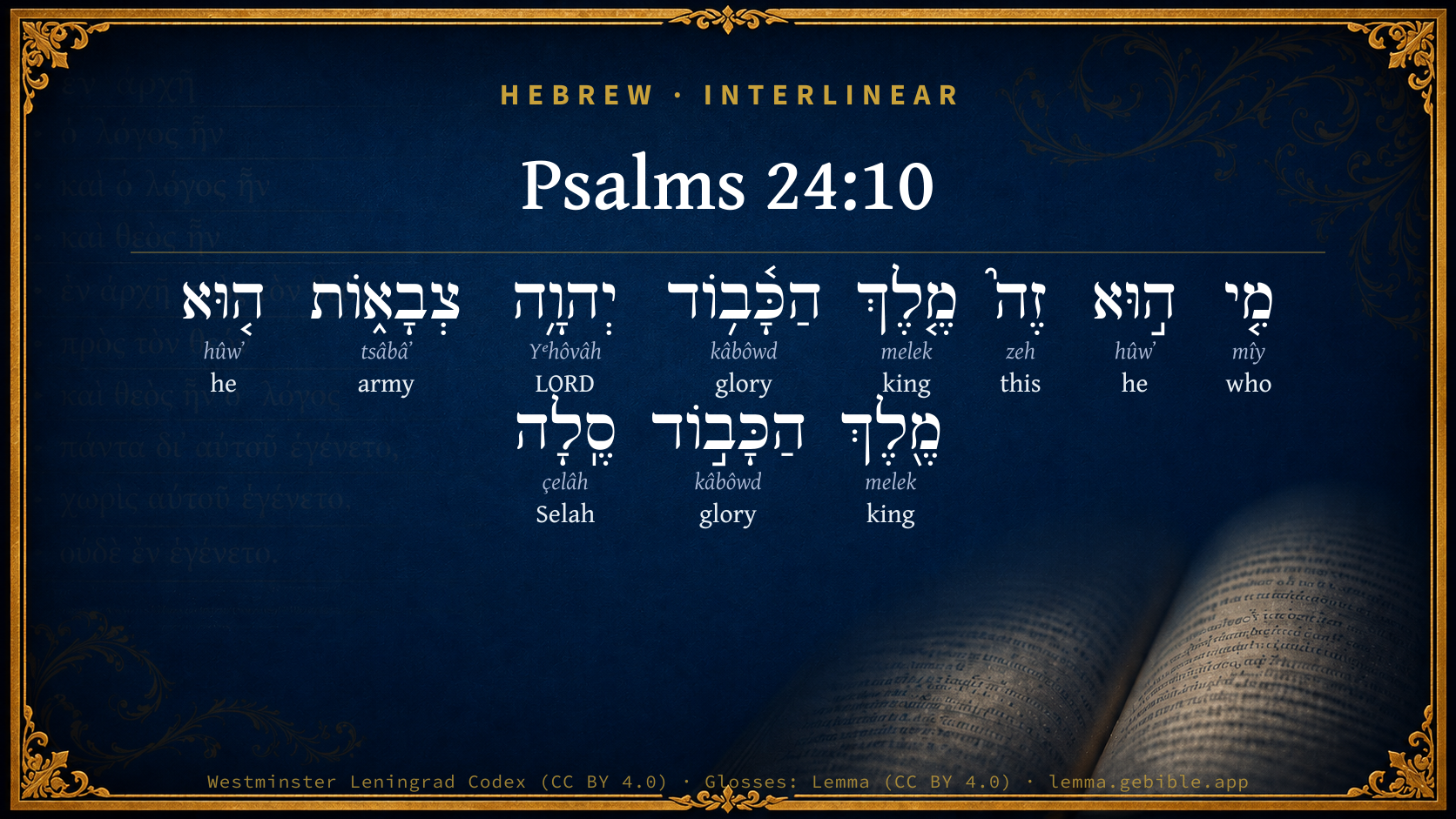
Hebrew (Westminster Leningrad Codex) Psalms 24:10 appears in the Hebrew Old Testament. The text above is from the Westminster Leningrad Codex. Each word links to its Strong’s number, a concise gloss, and parsing drawn from the Open Scriptures Hebrew Bible morphology. Click any word for its full Brown-Driver-Briggs (BDB) entry.
Download image
Cite this verse

Psalms 24:10 (World English Bible). Public Domain. Lemma interlinear Bible study tool, https://lemma.gebible.app/v/psalms/24/10.

Show BibTeX & RIS
BibTeX
RIS
English Translation
Who is this King of glory? Yahweh of Hosts, He is the King of glory. Selah.
World English Bible · Public Domain
Download a study sheet

One document with this verse’s original text, its word-by-word gloss line, the meaning frame, cross-references with their text, attributed commentary, and full source and license credits — printable, and it pastes into notes with its structure intact.

This verse Autodidact and up

Study sheet (.html) Plain text (.txt)

A passage Seminary Student

Up to 50 verses in one chapter. A passage sheet keeps up to 6 commentary sources and 12 cross-references per verse, in the order this page ranks them, and says so on the sheet whenever that leaves anything out. Ask for a single verse and you get the Autodidact verse sheet above.

Everything on this page stays free to read, with no account — the sheet is a download of what is already on screen, not access to it.

Want to remove ads? Support Godless Engineer
Compare translations 3

The same verse in 3 English versions, stacked beneath the original-language interlinear above. Click any original word for its lexicon entry.

Each is an independent rendering of the whole verse — the interlinear is not word-aligned to these translations.

Highlighted words mark where these versions differ — a whole-verse word diff, not a word-by-word alignment.

  • World English Bible Public Domain
    Who is this King of glory? Yahweh of Hosts, He is the King of glory. Selah.
  • King James Version Public Domain
    Who is this King of glory? The LORD of hosts, he is the King of glory. Selah.
  • unfoldingWord Literal Text CC BY-SA 4.0
    Who he, this King of Glory? Yahweh of Armies, he the King of Glory. Selah

unfoldingWord Literal Text — © unfoldingWord, licensed CC BY-SA 4.0. Word-aligned USFM3 via Door43 (git.door43.org/unfoldingWord/en_ult).

Versions to compare (up to 4)

3 of 4 selected

Show all 18 translations

Every available English version of this verse, each an independent rendering of the whole verse.

  • World English Bible Public Domain
    Who is this King of glory? Yahweh of Hosts, He is the King of glory. Selah.
  • Berean Standard Bible Public Domain
    Who is He, this King of Glory? The LORD of Hosts—He is the King of Glory. Selah
  • Majority Standard Bible Public Domain
    Who is He, this King of Glory? The LORD of Hosts—He is the King of Glory. Selah
  • King James Version Public Domain
    Who is this King of glory? The LORD of hosts, he is the King of glory. Selah.
  • American Standard Version (1901) Public Domain
    Who is this King of glory? Jehovah of hosts, He is the King of glory. Selah Psalm 25 `A Psalm' of David.
  • Revised Version (1885) Public Domain
    Who is this King of glory? The LORD of hosts, he is the King of glory. Selah
  • Geneva Bible (1599) Public Domain
    Who is this King of glory? the Lord of hostes, he is the King of glorie. Selah.
  • Douay-Rheims (1899) Public Domain
    Who is this King of Glory? the Lord of hosts, he is the King of Glory.
  • Young's Literal Translation Public Domain
    Who `is' He -- this `king of glory?' Jehovah of hosts -- He `is' the king of glory! Selah.
  • Literal Standard Version CC BY-SA 4.0
    Who [is] He—this “King of Glory?” YHWH of hosts—He [is] the King of Glory! Selah.
  • Unlocked Literal Bible CC BY-SA 4.0
    Who is this King of glory? Yahweh of hosts, he is the King of glory. Selah
  • unfoldingWord Literal Text CC BY-SA 4.0
    Who he, this King of Glory? Yahweh of Armies, he the King of Glory. Selah
  • Darby Bible Public Domain
    Who is he, this King of glory? Jehovah of hosts, he is the King of glory. Selah.
  • World Messianic Bible Public Domain
    Who is this King of glory? The LORD of Hosts is the King of glory! Selah.
  • Webster's Bible Public Domain
    Who is this King of glory? the LORD of hosts, he is the King of glory. Selah.
  • Free Bible Version CC BY-SA 4.0
    Who is this King of glory? The Lord Almighty, he is the King of glory! Selah.
  • Bible in Basic English Public Domain
    Who is the King of glory? The Lord of armies, he is the King of glory. (Selah.)
  • JPS Tanakh (1917) Public Domain
    'Who then is the King of glory?' 'The LORD of hosts; He is the King of glory.' Selah

Literal Standard Version (2020), Covenant Press — licensed CC BY-SA 4.0. Text via the HelloAO Bible API (eBible.org). Unlocked Literal Bible (unfoldingWord) — licensed CC BY-SA 4.0. Text via the HelloAO Bible API (eBible.org). unfoldingWord Literal Text — © unfoldingWord, licensed CC BY-SA 4.0. Word-aligned USFM3 via Door43 (git.door43.org/unfoldingWord/en_ult). Free Bible Version, Dr. Jonathan Gallagher — licensed CC BY-SA 4.0. Text via the HelloAO Bible API (eBible.org).

Word by word

More ways to search: Search by grammar → Find every occurrence → Compare this word →

Practice this passage: Drill this verse → Learn its vocabulary →

About this verse

These counts appear in no published source. They are computed here, from the morphology-tagged text and Lemma’s own curated glosses. What Lemma adds →

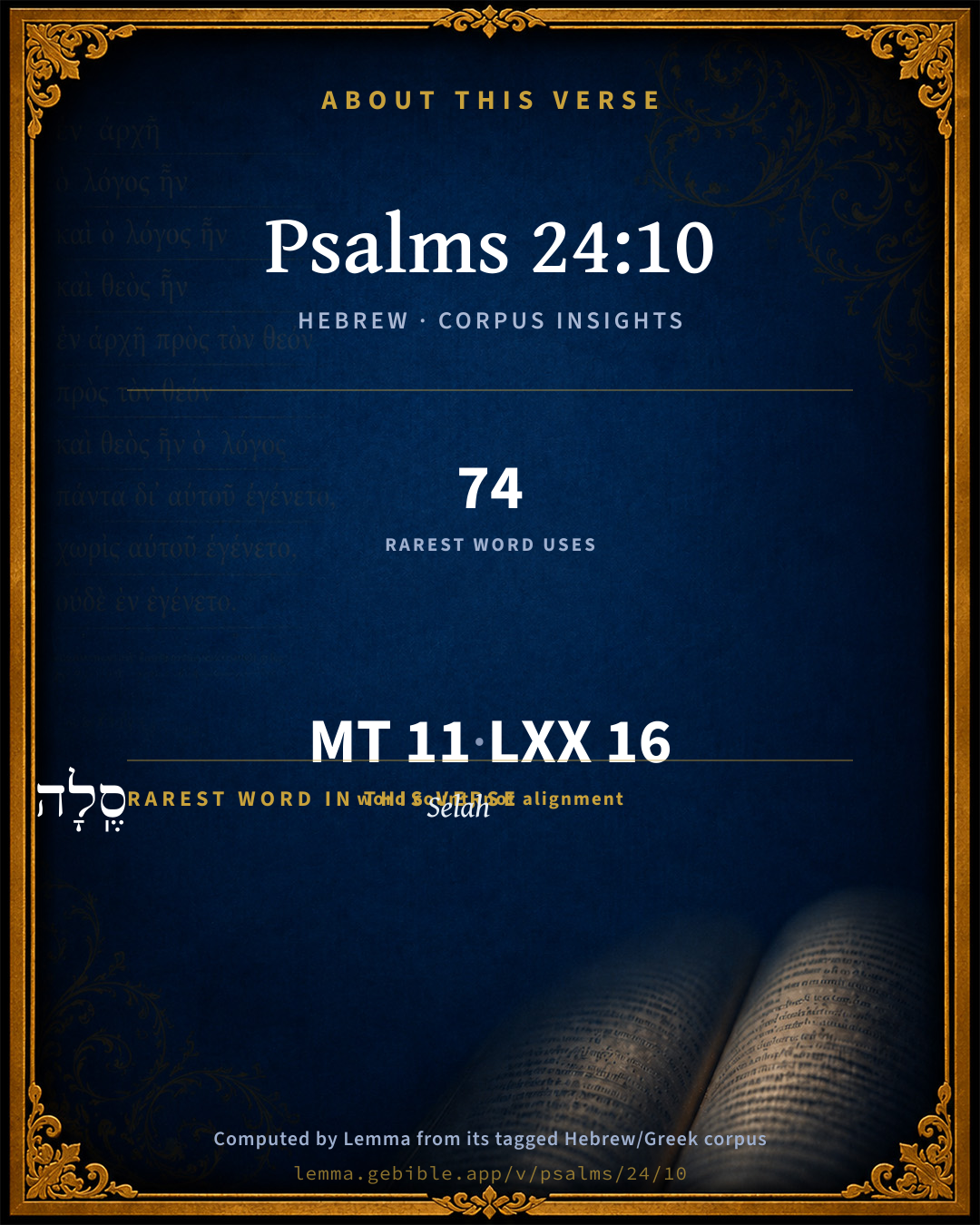
11
words
8
distinct lemmas
Wisdom
section

Grammatical profile

  • 6 nouns
  • 3 pronouns
  • 2 particles

Repetition

Words recur within this verse — often emphatic in Hebrew:

  • מֶ֤לֶךְ king H4428 ×2
  • הַכָּ֫ב֥וֹד glory H3519 ×2
  • ה֣וּא he H1931 ×2

Hebrew & Septuagint length

In English translation the verse runs 16 words from the Hebrew and 16 from the Septuagint (LXX English) — the same length.

A rough comparison of the two English renderings, which tokenize alike — not a word-level alignment.

Word counts can differ between the Hebrew and the Greek without any difference in meaning — e.g. the Hebrew direct-object marker אֵת has no separate Greek word, and Greek often adds the article ὁ.

In the original languages it is 11 Hebrew tokens and 16 Greek tokens — but the two are counted differently (Hebrew bundles its prefixes and suffixes into one token; the Greek is in lemma form), so that isn’t a like-for-like length.

Cross-references

11

Topical passages linked to Psalms 24:10 in the Treasury of Scripture Knowledge — connected by theme and wording, ordered by reader-vote popularity; previews shown in the World English Bible.

  • Titus 2:13 looking for the blessed hope and appearing of the glory of our great God and Savior, Jesus Christ;
  • Matthew 25:34 Then the King will tell those on his right hand, 'Come, blessed of my Father, inherit the Kingdom prepared for you from the foundation of the world;
  • Isaiah 54:5 For your Maker is your husband; Yahweh of Hosts is his name: and the Holy One of Israel is your Redeemer; the God of the whole earth shall he be called.
  • Zechariah 2:8–11 For thus says Yahweh of hosts: 'For honor he has sent me to the nations which plundered you; for he who touches you touches the apple of his eye.
  • Matthew 25:31 "But when the Son of Man comes in his glory, and all the holy angels with him, then he will sit on the throne of his glory.
  • Luke 9:26 For whoever will be ashamed of me and of my words, of him will the Son of Man be ashamed, when he comes in his glory, and the glory of the Father, and of the holy angels.
  • John 12:40 "He has blinded their eyes and he hardened their heart, Lest they should see with their eyes, And perceive with their heart, And would turn, And I would heal them."
  • John 14:9 Jesus said to him, "Have I been with you such a long time, and do you not know me, Philip? He who has seen me has seen the Father. How do you say, 'Show us the Father?'
  • Psalms 2:6–12 "Yet I have set my king on my holy hill of Zion."
  • Isaiah 6:3–5 One called to another, and said, "Holy, holy, holy, is Yahweh of Hosts! The whole earth is full of his glory!"
  • Hosea 12:3–5 In the womb he took his brother by the heel; And in his manhood he had power with God.

Cross-references courtesy of OpenBible.info (CC BY 4.0).

Hebrew and Greek witnesses Masoretic Hebrew ↔ Greek Septuagint

The same verse in the two great witnesses to the Old Testament, shown verse-for-verse.

You’re reading Greek Psalm 23 (Hebrew Psalm 24). The Septuagint counts the superscription, so verse numbers can differ from the Hebrew — chapter-level alignment, not verse-by-verse. Numbering follows Rahlfs.

These are two independent witnesses, not word-aligned to each other, and the Septuagint is shown in lemma (dictionary) form.

Hebrew Psalms 24:10 Masoretic · Westminster Leningrad Codex

מִ֤י ה֣וּא זֶה֮ מֶ֤לֶךְ הַכָּ֫ב֥וֹד יְהוָ֥ה צְבָא֑וֹת ה֤וּא מֶ֖לֶךְ הַכָּב֣וֹד סֶֽלָה

Who is this King of glory? Yahweh of Hosts, He is the King of glory. Selah.

World English Bible · Public Domain

Greek LXX Greek Psalm 23:10 Septuagint · lemma form

τίς εἰμί οὗτος ὁ βασιλεύς ὁ δόξα κύριος ὁ δύναμις αὐτός εἰμί ὁ βασιλεύς ὁ δόξα

Who is this king of glory? The Lord of hosts, he is this king of glory.

LXX2012 (modern English Septuagint) · Public Domain

On this verse, J. A. Alexander on Psalms discusses the Septuagint’s reading. Read the note in Commentary ↓

Hebrew: Westminster Leningrad Codex (CC BY 4.0). Greek: Septuagint (public domain); English from LXX2012 (modern English Septuagint) (Public Domain). How the Septuagint differs from the Hebrew →

Commentary

Notes on Psalms 24:10 from classic Christian and Jewish commentators (each source and its license shown beneath its notes). The classic Christian expositions comment on the surrounding passage and are grouped to its opening verse, so a note may address several verses; the Jewish commentaries on the Tanakh (Rashi and others) are per-verse, so they appear only where the commentator wrote on this verse.

Lemma curates 59 commentaries, every one of them public domain or Creative Commons licensed, each selected and text-cleaned for this edition rather than reprinted as found. About our sources →

Trapp's Complete Commentary

John Trapp

Psa 24:10 Who is this King of glory? The LORD of hosts, he [is] the King of glory. Selah.

Ver. 10. Who is this King of glory?] The best are acute obtusi in the mystery of Christ crucified; and must therefore by study and inquiry grow in grace, and in the knowledge of our Lord Jesus Christ, 2Pe 3:18, praying for that Spirit of wisdom and revelation, for the acknowledgment of him, Eph 1:17.

The Lord of hosts] He who hath all creatures at his beck and check, the Lord of Sabaoth, Rom 9:29 Jas 5:4, where the word signifying hosts or arms is used untranslated, because well understood both by Jews and Gentiles, as is also Hosanna, Hallelujah, Amen.

John Trapp, A Commentary or Exposition upon All the Books of the Old and New Testament (1647–1656) — public domain. Text from a community e-Sword module.

J. A. Alexander on Psalms

Joseph Addison Alexander

10. (Psa 24:10) Who is this, the king of glory? Jehovah (God) of Hosts, he is the king of glory. Selah. Between the question here and in ver. 8 the only variation is one which cannot well be imitated in translation. For the simple Hebrew phrase: Who is this? we have here the fuller form, in which the personal pronoun is interposed between the interrogative and demonstrative, so as to suggest the two forms, Who is he? and Who is this? though really constituting but a single question, as the personal pronoun, in Hebrew usage, often serves as an index of the substantive when not expressed.—There is a more material variation in the answer, where, instead of the two phrases, Jehovah strong and mighty, Jehovah mighty in battle, the Psalmist substitutes the single but still more expressive title, Jehovah Zebaoth, or of Hosts. In Exo 12:41, Israel is called the hosts of Jehovah; but a much more frequent designation is the host or hosts of heaven, sometimes applied to the heavenly bodies, especially as objects of idolatrous worship (Deu 4:19; Deu 17:3, 2Ki 17:16, Isa 24:4, Jer 33:22, Zep 1:5, Dan 8:10), and sometimes to the angels (Jos 5:14-15, 1Ki 22:19, 2Ch 18:18, Psa 103:21; Psa 148:2). In both these senses God may be described as the God of Hosts, i.e. as the sovereign both of the material heavens and of their inhabitants. From the use of hosts in Gen 2:1, some would extend it to the earth as well as the heavens, and explain the compound title as denoting Lord of the Universe, as Mohammed in the Koran speaks of Allah as the Lord of Worlds. But this explanation, even supposing it to be correct as to the single place on which it rests, derives no countenance from usage elsewhere. Still less admissible is that which makes it simply mean the God of Battles or the God of War, a name and an idea much less scriptural than heathenish. The phrase Jehovah Zebaoth does not occur in the Pentateuch, Joshua or Judges, from which some have inferred that it was afterwards introduced in opposition to the worship of the heavenly bodies, and of the spirits which were supposed to govern and inhabit them. According to the usage of the Hebrew language, Jehovah, as a proper name, cannot be construed with a genitive directly, nor is it ever so connected with any other noun. The anomaly can only be removed by making Zebaoth itself a proper name, or by supplying the word God between it and Jehovah. The first solution may appear to be favoured by the Septuagint, retained in Rom 9:29 and Jas 5:4. But the other is proved to be the true one by such passages as Hos 12:6 (5), Amo 4:13, where we have the full form, Jehovah God of Hosts. Compare Psa 59:6 (5), Psa 80:5 (4), Psa 84:9 (8).—This description of Jehovah as the God of heaven no less than of earth, while it sensibly strengthens the expressions of Psa 24:8, and thus removes the appearance of a mere tautological reiteration, at the same time brings us back in the conclusion to the point from which we set out in Psa 24:1, to wit, the universal sovereignty of God. The whole psalm is then brought to a solemn and sonorous close by making the answer echo the terms of the interrogation, He is the king of glory! These points of difference between Psa 24:8 and Psa 24:10 impart a beautiful variety to the repeated sentence, without impairing in the least the rhetorical or musical effect of the repetition itself, which is followed only by the customary indication of a pause, both in the sense and the performance. See above, on Psa 3:3 (2).

Joseph Addison Alexander, The Psalms Translated and Explained (1850) — public domain. Text from a community e-Sword module.

Tyndale Open Study Notes

Tyndale Open Resources

24:10 The Lord of Heaven’s Armies reigns from his home, the Temple in Jerusalem (84:3-5). He excludes sin and sinners (24:3-6) but protects all who dwell in Zion.

Tyndale Open Study Notes — © Tyndale Open Resources, licensed CC BY-SA 4.0. Text via the HelloAO Bible API.

Jamieson, Fausset & Brown

Robert Jamieson, A. R. Fausset & David Brown

Lord of hosts--or fully, Lord God of hosts (Hos 12:5; Amo 4:13), describes God by a title indicative of supremacy over all creatures, and especially the heavenly armies (Jos 5:14; Kg1 22:19). Whether, as some think, the actual enlargement of the ancient gates of Jerusalem be the basis of the figure, the effect of the whole is to impress us with a conception of the matchless majesty of God.

Next: Psalms Chapter 25

Jamieson, Fausset & Brown — Commentary Critical and Explanatory on the Whole Bible (1871) — public domain (CC PDM 1.0). Text via the HelloAO Bible API.

Ellicott's Commentary for English Readers

(10) The Lord of hosts.—A second challenge from the reluctant gates serves as the inauguration of the great name by which the Divine nature was especially known under the monarchy. (For its origin and force, see Note on 1Sa_1:3.)

A Bible Commentary for English Readers, edited by Charles John Ellicott (1878–1897) — public domain. Text from a community e-Sword module.

The Cambridge Bible for Schools and Colleges

gen. ed. J. J. S. Perowne

10. The Lord of hosts] The climax is reached. He claims to enter, not merely as a victorious warrior, but as the Sovereign of the Universe. The great title Jehovah Tsebâôth or Lord of hosts, which was characteristic of the regal and prophetic period, meets us here for the first time in the Psalter. Originally perhaps it designated Jehovah as “the God of the armies of Israel” (1Sa_17:45), who went forth with His people’s hosts to battle (Psa_44:9; Psa_40:10), and whose Presence was the source of victory (Psa_46:7; Psa_46:11). But as the phrase “host of heaven” was used for the celestial bodies (Gen_2:1), and celestial beings (1Ki_22:19), the meaning of the title was enlarged to designate Jehovah as the ruler of the heavenly powers, the supreme Sovereign of the universe. Hence one of the renderings in the LXX is κύριος παντοκράτωρ, Lord Almighty, or rather, All-sovereign. See Additional Note on 1 Samuel in this series, p. 235.

The Cambridge Bible for Schools and Colleges (gen. ed. J. J. S. Perowne; Cambridge University Press, 1878–1918) — public domain. Text from a community e-Sword module.

Albert Barnes' Notes on the Bible

Who is this King of glory? - See the notes at Psa 24:8.

The Lord of hosts, he is the King of glory - On the meaning of the phrase, “the Lord of hosts,” see the notes at Isa 1:9. The essential idea is, that God rules over the universe of worlds considered as marshalled in order, or arrayed as hosts or armies are for battle. All are under His command. The stars in the sky, that seem to be marshalled and led forth in such perfect and beautiful order - the inhabitants of heaven in their different orders and ranks - all these acknowledge Him, and submit to Him as the supreme God. In the close of the psalm, therefore, there is an exact accordance with the thought in the beginning, that God is the Sovereign Ruler of the universe, and that He should everywhere be recognized and regarded as such. The entrance of the ark of the covenant into the place provided for it as a permanent residence was a fit occasion to proclaim this thought; and this is proclaimed in the psalm in a manner befitting so solemn an occasion and so sublime a truth.

Albert Barnes' Notes on the Bible (1834–1885) — public domain. Text from a community e-Sword/MySword module.

Matthew Poole's English Annotations

Under whose command are all the hosts of heaven and earth, angels and men, and ah other creatures.

Matthew Poole's English Annotations on the Holy Bible (1683–1685) — public domain. Text from a community e-Sword/MySword module.

The Treasury of David

Charles H. Spurgeon

Ver. 10. The closing note is inexpressibly grand. Jehovah of hosts, Lord of men and angels, Lord of the universe, Lord of the worlds, is the King of glory. All true glory is concentrated upon the true God, for all other glory is but a passing pageant, the painted pomp of an hour. The ascended Saviour is here declared to be the Head and Crown of the universe, the King of Glory. Our Immanuel is hymned in most sublime strains. Jesus of Nazareth is Jehovah Sabaoth.

Ver. 10. The sovereignty and glory of God in Christ.

Charles H. Spurgeon's The Treasury of David (1869–1885) — public domain. Psalms only. Text from a community e-Sword/MySword module.

Whedon's Commentary on the Bible

Daniel D. Whedon

10. Lord of hosts— “Hosts” designates angels, celestial beings, or armies, when used in this connexion, as in Psa_103:21. See Psa_68:17. Not the idea of multitude only, but of a marshalled army.

Daniel D. Whedon (gen. ed.), Commentary on the Old and New Testaments (1874–1909) — public domain. Text from a community e-Sword module.

The Pulpit Commentary

Who is this King of glory? The second part of the choir reiterates its question, as though not yet quite understanding. "Who is he, this King of glory?" and the first, slightly varying its answer, replies, The Lord of hosts, he is the King of glory. The epithet, "Lord of hosts" well known at the time, (1Sa_1:11 2Sa_5:10 2Sa_6:2 2Sa_7:18, 2Sa_7:26, 2Sa_7:27, etc.) made all clear, and, the gates being thrown open, the ark was brought in, and set in its place in the midst of the tabernacle. (2Sa_6:17) It has been generally recognized that the reception of the ark into the tabernacle on Mount Zion typified the entrance of our Lord into heaven after his ascension, whence our Church appoints this psalm as one of those to be recited on Ascension Day.

The Pulpit Commentary (1880–1919), ed. H.D.M. Spence-Jones & Joseph S. Exell — public domain. Text from a community e-Sword module.

John Wesley's Explanatory Notes

Of hosts - Under whose command are all the hosts of heaven and earth, angels and men, and all other creatures.

John Wesley, Explanatory Notes Upon the Whole Bible (1754–1765) — public domain. Text via the GEBible commentary corpus.

Radak

Rabbi David Kimhi (Radak)

Who is the King of Glory? – And in this verse he does notmention mighty in battle, and the reason is, according to our interpretation, because after the ark had once rested in the House of Eternity, it should not go out again to battle; therefore the reply is according to the change of meaning.

The Lord of Hosts, He is the King of Glory. Selah: – because He appeared in His glory in the House of Eternity. And so Solomon says (in the verse) (1 Kings 8:12; 2 Chron. 6:1): “The Lord hath said that He would dwell in the thick darkness.” And he says Lord of Hosts, because all the hosts of Israel were coming into this House and offered sacrifice only in it. And according to the interpretation of the learned Rabbi Abraham ben Ezra, (the Psalmist) mentions mighty in battle in the first instance because, while the Glory dwelt among Israel, they should dwell in peace and have no war and not fear an enemy, because the Glory would fight for His holy ones. And he does not mention mighty in battle in the second instance because of (the passage) (Isaiah 2:4; Mic. 4:3) “and they shall beat their swords into ploughshares,” and the land shall rest from all war. And the reason for Lord of Hosts is because the men of the generation shall be as the angels of the Name (i.e. God), for the Lord is called so because of the host of heaven.

Radak on the Tanakh — English translations: “Sefaria Community Translation” (CC0 1.0 (public-domain dedication)); “Eliyahu Munk, HaChut Hameshulash” (CC BY 4.0); “Rabbi Mike Feuer, Jerusalem Anthology” (CC BY 4.0); and “R. David Kimhi on the first book of Psalms, Translated by R.G. Finch, London, 1919” (public domain). Text via Sefaria.

Lesson kit

Teaching starters — assembled from the data on this page, not authored interpretation. Every prompt links to the verse data it draws on. Edit before teaching.

Psalms, in the Wisdom, opens this verse with 11 words (8 distinct Hebrew lemmas). Its most distinctive word is çelâh (“Selah”). A historical commentator’s framing appears above. Read the whole chapter for the surrounding context.

Discussion questions

  1. How does “Selah” (çelâh) shape what this verse is saying?
  2. How does Titus 2:13, which shares this passage’s theme, read alongside this verse?
  3. What does the repetition of “king” (2× in this one verse) do in this verse?
  4. The translations on this page render this verse differently — a whole-verse word diff, not a word-by-word alignment. What might account for the different wordings?
  5. Compare how Trapp's Complete Commentary and J. A. Alexander on Psalms read this verse. Where do they agree or differ?

Things to notice

Reading settings

Reading text

Shown beneath each verse's original-language words.

Old Testament
Old Testament edition

Read the OT as the Masoretic Hebrew (MT) or the Greek Septuagint (LXX).

English shown for the Greek Septuagint (in the Hebrew ↔ Greek comparison).

Comparing translations? Open the Compare panel on any verse page to stack up to four side by side.