2 Samuel 20:23

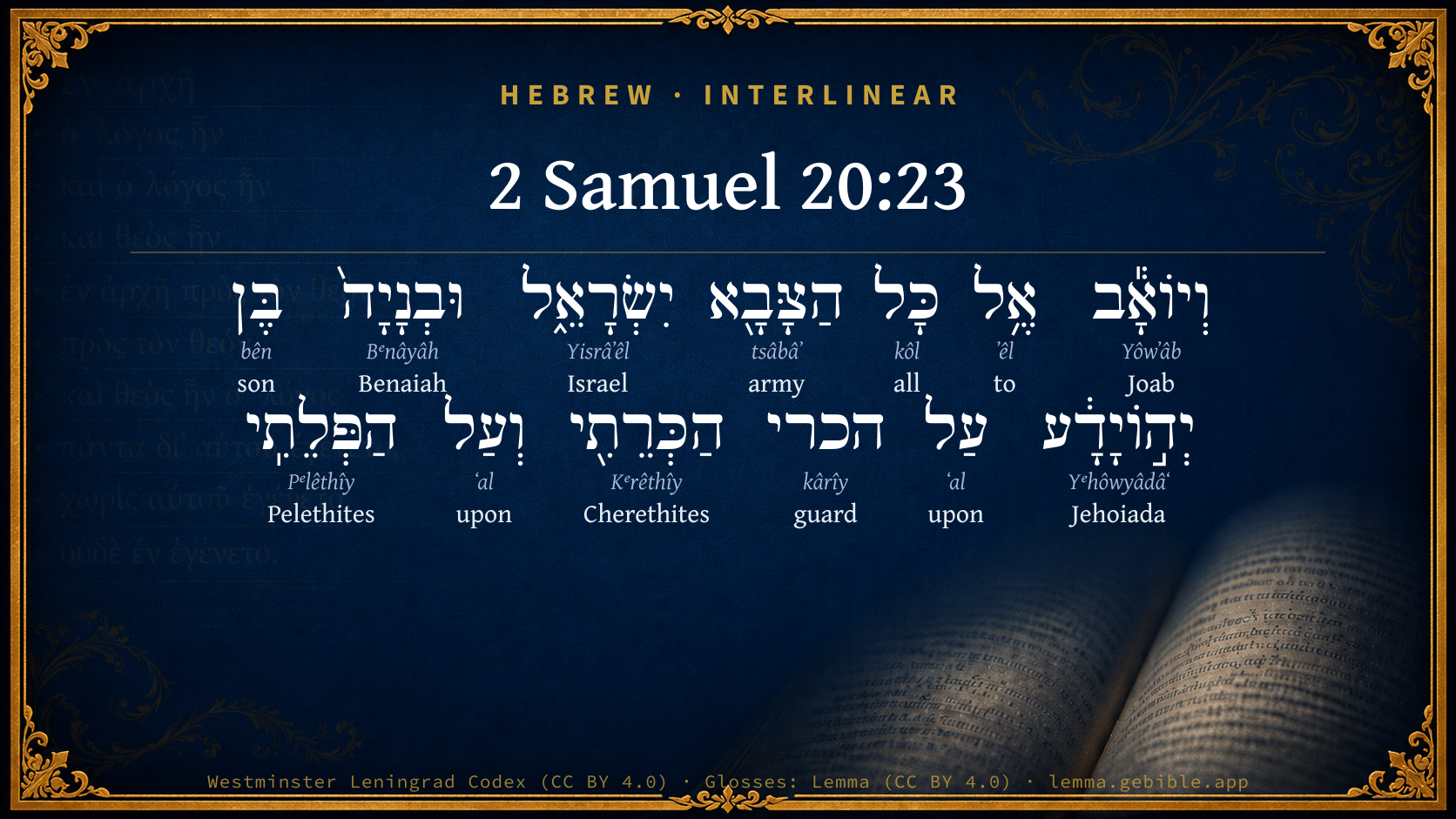
Hebrew (Westminster Leningrad Codex) 2 Samuel 20:23 appears in the Hebrew Old Testament. The text above is from the Westminster Leningrad Codex. Each word links to its Strong’s number, a concise gloss, and parsing drawn from the Open Scriptures Hebrew Bible morphology. Click any word for its full Brown-Driver-Briggs (BDB) entry.
Download image
Cite this verse

2 Samuel 20:23 (World English Bible). Public Domain. Lemma interlinear Bible study tool, https://lemma.gebible.app/v/2-samuel/20/23.

Show BibTeX & RIS
BibTeX
RIS
English Translation
Now Joab was over all the host of Israel; and Benaiah the son of Jehoiada was over the Cherethites and over the Pelethites;
World English Bible · Public Domain
Highlights
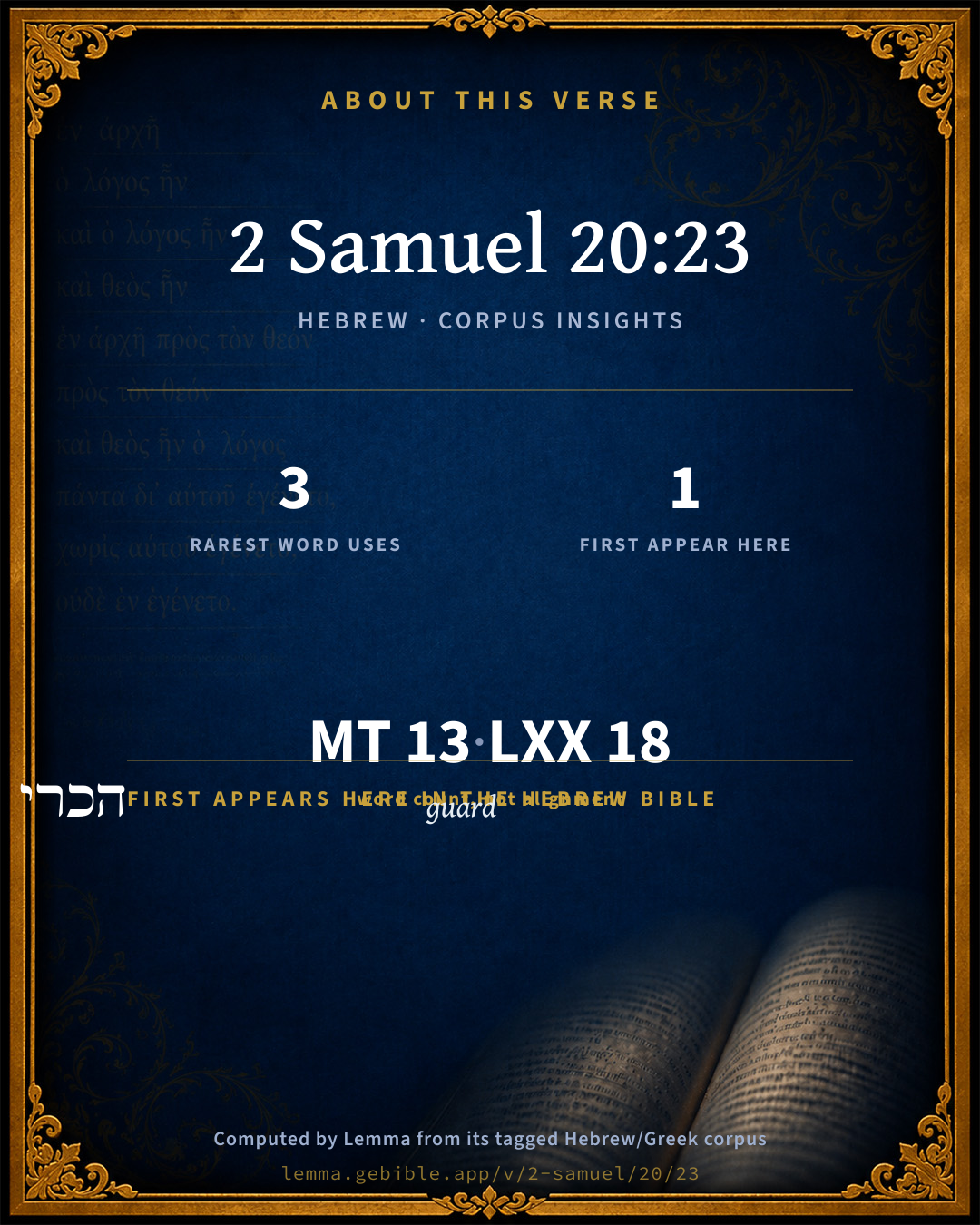
  • 1 first appearance in the Hebrew Bible
Full analysis ↓
Download a study sheet

One document with this verse’s original text, its word-by-word gloss line, the meaning frame, cross-references with their text, attributed commentary, and full source and license credits — printable, and it pastes into notes with its structure intact.

This verse Autodidact and up

Study sheet (.html) Plain text (.txt)

A passage Seminary Student

Up to 50 verses in one chapter. A passage sheet keeps up to 6 commentary sources and 12 cross-references per verse, in the order this page ranks them, and says so on the sheet whenever that leaves anything out. Ask for a single verse and you get the Autodidact verse sheet above.

Everything on this page stays free to read, with no account — the sheet is a download of what is already on screen, not access to it.

Want to remove ads? Support Godless Engineer
Compare translations 3

The same verse in 3 English versions, stacked beneath the original-language interlinear above. Click any original word for its lexicon entry.

Each is an independent rendering of the whole verse — the interlinear is not word-aligned to these translations.

Highlighted words mark where these versions differ — a whole-verse word diff, not a word-by-word alignment.

  • World English Bible Public Domain
    Now Joab was over all the host of Israel; and Benaiah the son of Jehoiada was over the Cherethites and over the Pelethites;
  • King James Version Public Domain
    Now Joab was over all the host of Israel: and Benaiah the son of Jehoiada was over the Cherethites and over the Pelethites:
  • unfoldingWord Literal Text CC BY-SA 4.0
    Now Joab over all of the army of Israel. And Benaiah, the son of Jehoiada, over the Cherethites and over the Pelethites.

unfoldingWord Literal Text — © unfoldingWord, licensed CC BY-SA 4.0. Word-aligned USFM3 via Door43 (git.door43.org/unfoldingWord/en_ult).

Versions to compare (up to 4)

3 of 4 selected

Show all 18 translations

Every available English version of this verse, each an independent rendering of the whole verse.

  • World English Bible Public Domain
    Now Joab was over all the host of Israel; and Benaiah the son of Jehoiada was over the Cherethites and over the Pelethites;
  • Berean Standard Bible Public Domain
    Now Joab was over the whole army of Israel; Benaiah son of Jehoiada was over the Cherethites and Pelethites;
  • Majority Standard Bible Public Domain
    Now Joab was over the whole army of Israel; Benaiah son of Jehoiada was over the Cherethites and Pelethites;
  • King James Version Public Domain
    Now Joab was over all the host of Israel: and Benaiah the son of Jehoiada was over the Cherethites and over the Pelethites:
  • American Standard Version (1901) Public Domain
    Now Joab was over all the host of Israel; and Benaiah the son of Jehoiada was over the Cherethites and over the Pelethites;
  • Revised Version (1885) Public Domain
    Now Joab was over all the host of Israel: and Benaiah the son of Jehoiada was over the Cherethites and over the Pelethites:
  • Geneva Bible (1599) Public Domain
    Then Ioab was ouer all the hoste of Israel, and Benaiah the sonne of Iehoiada ouer the Cherethites and ouer the Pelethies,
  • Douay-Rheims (1899) Public Domain
    So Joab was over all the army of Israel: and Banaias the son of Joiada was over the Cerethites and Phelethites,
  • Young's Literal Translation Public Domain
    And Joab `is' over all the host of Israel, and Benaiah son of Jehoiada `is' over the Cherethite, and over the Pelethite,
  • Literal Standard Version CC BY-SA 4.0
    And Joab [is] over all the host of Israel, and Benaiah son of Jehoiada [is] over the Cherethite, and over the Pelethite,
  • Unlocked Literal Bible CC BY-SA 4.0
    Now Joab was over all the army of Israel, and Benaiah son of Jehoiada was over the Kerethites and over the Pelethites.
  • unfoldingWord Literal Text CC BY-SA 4.0
    Now Joab over all of the army of Israel. And Benaiah, the son of Jehoiada, over the Cherethites and over the Pelethites.
  • Darby Bible Public Domain
    And Joab was over all the host of Israel; and Benaiah the son of Jehoiada was over the Cherethites and over the Pelethites;
  • World Messianic Bible Public Domain
    Now Joab was over all the army of Israel, Benaiah the son of Jehoiada was over the Cherethites and over the Pelethites,
  • Webster's Bible Public Domain
    Now Joab was over all the host of Israel: and Benaiah the son of Jehoiada was over the Cherethites and over the Pelethites:
  • Free Bible Version CC BY-SA 4.0
    Joab commanded the whole army of Israel. Benaiah, son of Jehoiada, was in charge of the Cherethites and Pelethites.
  • Bible in Basic English Public Domain
    Now Joab was over all the army; and Benaiah, the son of Jehoiada, was at the head of the Cherethites and the Pelethites;
  • JPS Tanakh (1917) Public Domain
    Now Joab was over all the host of Israel; and Benaiah the son of Jehoiada was over the Cherethites and over the Pelethites;

Literal Standard Version (2020), Covenant Press — licensed CC BY-SA 4.0. Text via the HelloAO Bible API (eBible.org). Unlocked Literal Bible (unfoldingWord) — licensed CC BY-SA 4.0. Text via the HelloAO Bible API (eBible.org). unfoldingWord Literal Text — © unfoldingWord, licensed CC BY-SA 4.0. Word-aligned USFM3 via Door43 (git.door43.org/unfoldingWord/en_ult). Free Bible Version, Dr. Jonathan Gallagher — licensed CC BY-SA 4.0. Text via the HelloAO Bible API (eBible.org).

Word by word

More ways to search: Search by grammar → Find every occurrence → Compare this word →

Practice this passage: Drill this verse → Learn its vocabulary →

הכרי
kârîy
H3746
“the · guard”
Particle, Definite Article + Noun, Gentilic, Masculine, Singular, Absolute
Part of Speech
Particle + Noun
Type
Gentilic
Gender
Masculine
Number
Singular
State
Absolute
Full BDB Definition

Origin: perhaps an abridged plural of H3733 in the sense of leader (of the flock)

TWOT: None

a group of foreign mercenary soldiers serving as a bodyguard for king David; also executioners
  1. וְיוֹאָ֕ב Yôwʼâb H3097 “and · Joab” Conjunction + Noun, Proper
  2. אֶ֥ל ʼêl H413 “to” Preposition
  3. כָּל kôl H3605 “all of” Noun, Common, Masculine, Singular, Construct
  4. הַצָּבָ֖א tsâbâʼ H6635 “the · army” Particle, Definite Article + Noun, Common, Both, Singular, Absolute
  5. יִשְׂרָאֵ֑ל Yisrâʼêl H3478 “Israel” Noun, Proper
  6. וּבְנָיָה֙ Bᵉnâyâh H1141 “and · Benaiah” Conjunction + Noun, Proper
  7. בֶּן bên H1121 “son of” Noun, Common, Masculine, Singular, Construct
  8. יְה֣וֹיָדָ֔ע Yᵉhôwyâdâʻ H3077 “Jehoiada” Noun, Proper
  9. עַל ʻal H5921 “upon” Preposition
  10. הַכְּרֵתִ֖י Kᵉrêthîy H3774 “the · Cherethites” Particle, Definite Article + Noun, Gentilic, Masculine, Singular, Absolute
  11. וְעַל ʻal H5921 “and · upon” Conjunction + Preposition
  12. הַפְּלֵתִֽי Pᵉlêthîy H6432 “the · Pelethites” Particle, Definite Article + Noun, Gentilic, Masculine, Singular, Absolute

About this verse

These counts appear in no published source. They are computed here, from the morphology-tagged text and Lemma’s own curated glosses. What Lemma adds →

13
words
12
distinct lemmas
Historical
section

Notable vocabulary

The rarest word here is הכרי guard H3746 — appearing just 3 times in the whole Hebrew Bible.

First appearance in Scripture

This word makes its first canonical appearance in the Hebrew Bible here:

Shared distinctive vocabulary

הכרי guard H3746 occurs in 3 verses of the Hebrew Bible. Also found in:

Grammatical profile

  • 10 nouns
  • 3 prepositions

Repetition

A word recurs within this verse — often emphatic in Hebrew:

Hebrew & Septuagint length

In English translation the verse runs 23 words from the Hebrew and 23 from the Septuagint (LXX English) — the same length.

A rough comparison of the two English renderings, which tokenize alike — not a word-level alignment.

Word counts can differ between the Hebrew and the Greek without any difference in meaning — e.g. the Hebrew direct-object marker אֵת has no separate Greek word, and Greek often adds the article ὁ.

In the original languages it is 13 Hebrew tokens and 18 Greek tokens — but the two are counted differently (Hebrew bundles its prefixes and suffixes into one token; the Greek is in lemma form), so that isn’t a like-for-like length.

Cross-references

3

Topical passages linked to 2 Samuel 20:23 in the Treasury of Scripture Knowledge — connected by theme and wording, ordered by reader-vote popularity; previews shown in the World English Bible.

  • 2 Samuel 8:16–18 Joab the son of Zeruiah was over the host; and Jehoshaphat the son of Ahilud was recorder;
  • 1 Kings 4:3–6 Elihoreph and Ahijah, the sons of Shisha, scribes; Jehoshaphat the son of Ahilud, the recorder;
  • 1 Chronicles 18:15–17 Joab the son of Zeruiah was over the host; and Jehoshaphat the son of Ahilud was recorder;

Cross-references courtesy of OpenBible.info (CC BY 4.0).

Hebrew and Greek witnesses Masoretic Hebrew ↔ Greek Septuagint

The same verse in the two great witnesses to the Old Testament, shown verse-for-verse.

These are two independent witnesses, not word-aligned to each other, and the Septuagint is shown in lemma (dictionary) form.

Hebrew 2 Samuel 20:23 Masoretic · Westminster Leningrad Codex

וְיוֹאָ֕ב אֶ֥ל כָּל הַצָּבָ֖א יִשְׂרָאֵ֑ל וּבְנָיָה֙ בֶּן יְה֣וֹיָדָ֔ע עַל הכרי הַכְּרֵתִ֖י וְעַל הַפְּלֵתִֽי

Now Joab was over all the host of Israel; and Benaiah the son of Jehoiada was over the Cherethites and over the Pelethites;

World English Bible · Public Domain

Greek LXX 2 Samuel 20:23 Septuagint · lemma form

καί ιωαβ πρός πᾶς ὁ δύναμις ἰσραήλ καί βαναιας υἱός ιωδαε ἐπί ὁ χερεθθι καί ἐπί ὁ φελεθθι

And Joab was over all the forces of Israel: and Banaias the son of Jodae was over the Cherethites and over the Phelethites.

LXX2012 (modern English Septuagint) · Public Domain

Hebrew: Westminster Leningrad Codex (CC BY 4.0). Greek: Septuagint (public domain); English from LXX2012 (modern English Septuagint) (Public Domain). How the Septuagint differs from the Hebrew →

Targum (Aramaic paraphrase)

1

The Targum is the ancient Jewish Aramaic paraphrase of the Hebrew Scriptures — an interpretive translation, not the Hebrew text itself. Onkelos (literal) and Pseudo-Jonathan (expansive) render the Torah, and Jonathan the Prophets. Coverage is partial: where no permissively-licensed English translation exists for a verse, only the Aramaic is shown. This is verse-level text, not a word-by-word alignment to the Hebrew.

  1. Targum Jonathan Prophets (Joshua–Malachi)
    וְיוֹאָב מְמַנָא עַל כָּל חֵילָא דְיִשְׂרָאֵל וּבְנָיָה בַּר יְהוֹיָדָע עַל קַשָׁתַיָא וְעַל קַלָעַיָא:

    (no public-domain English translation for this verse)

    Targum Jonathan — Aramaic: “Mikraot Gedolot” (public domain). English: “Sefaria Community Translation” (CC0 1.0 (public-domain dedication)); “London "Chaldee Paraphrase," 1871” (public domain). Text via Sefaria.

Commentary

Notes on 2 Samuel 20:23 from classic Christian and Jewish commentators (each source and its license shown beneath its notes). The classic Christian expositions comment on the surrounding passage and are grouped to its opening verse, so a note may address several verses; the Jewish commentaries on the Tanakh (Rashi and others) are per-verse, so they appear only where the commentator wrote on this verse.

Lemma curates 59 commentaries, every one of them public domain or Creative Commons licensed, each selected and text-cleaned for this edition rather than reprinted as found. About our sources →

Jamieson, Fausset & Brown

Robert Jamieson, A. R. Fausset & David Brown

DAVID'S GREAT OFFICERS. (Sa2 20:23-26)

Now Joab was over all the host of Israel--David, whatever his private wishes, found that he possessed not the power of removing Joab; so winking at the murder of Amasa, he re-established that officer in his former post of commander-in-chief. The enumeration of David's cabinet is here given to show that the government was re-established in its wonted course.

Next: 2 Samuel Chapter 21

Jamieson, Fausset & Brown — Commentary Critical and Explanatory on the Whole Bible (1871) — public domain (CC PDM 1.0). Text via the HelloAO Bible API.

Trapp's Complete Commentary

John Trapp

2Sa 20:23 Now Joab [was] over all the host of Israel: and Benaiah the son of Jehoiada [was] over the Cherethites and over the Pelethites:

Ver. 23. Now Joab was over all the host.] He would be so; neither was it in David’s power to put him by; so great a sway bare he in the army, who were all for General Joab. Neither, indeed, could David well spare him, so necessary was his service.

John Trapp, A Commentary or Exposition upon All the Books of the Old and New Testament (1647–1656) — public domain. Text from a community e-Sword module.

Joseph Benson's Commentary

2Sa 20:23-24. Joab was over all the host — The king continued him in the chief command of the army, because the good success of this, and of the former expedition under his conduct, had so fixed his interest with the soldiers, and others of David’s fastest friends, that he could not be displaced without danger. Adoram was over the tribute — That is, he was the treasurer or receiver of the king’s revenue. Jehoshaphat was recorder — See on 2Sa 8:16.

Joseph Benson's Commentary on the Old and New Testaments (1811–1818) — public domain. Text from a community e-Sword module.

Whedon's Commentary on the Bible

Daniel D. Whedon

DAVID’S OFFICIALS, 2Sa_20:23-26.

This list differs from that given in 2Sa_8:16-18, only in the addition of the names of Adoram and Ira the Jairite, and belongs to a later period of David’s reign. Our author seems to have had before him the records of Jehoshaphat, the king’s recorder, and finding therein these two lists, he inserted them both at the proper places in his own narrative to show how few changes the king made among his officials in a reign of forty years.

Daniel D. Whedon (gen. ed.), Commentary on the Old and New Testaments (1874–1909) — public domain. Text from a community e-Sword module.

Tyndale Open Study Notes

Tyndale Open Resources

20:23-26 This list of David’s leaders and the similar list in 8:15-18 bracket chs 9–20 in David’s life. Even after the major crises described in these 12 chapters, David’s monarchy did not fall apart; he still had an intact administration.

20:23 In 8:16, Joab was called “commander of the army,” but here he is commander of the army of Israel. David’s wider control of Israel was established when the northern secessionist movements were defeated.

Tyndale Open Study Notes — © Tyndale Open Resources, licensed CC BY-SA 4.0. Text via the HelloAO Bible API.

Matthew Henry's Commentary

Here is an account of the state of David's court after his restoration. Joab retained the office of general, being too great to be displaced. Benaiah, as before, was captain of the guards. Here is one new office erected, which we had not (Sa2 8:16-18), that of treasurer, or one over the tribute, for it was not till towards the latter end of his time that David began to raise taxes. Adoram was long in this office, but it cost him his life at last, Kg1 12:18.

Matthew Henry's Commentary on the Whole Bible (1708–1710) — public domain (CC PDM 1.0). Text via the HelloAO Bible API.

Adam Clarke's Commentary

Verse 23. Joab was over all the host] He had murdered Amasa, and seized on the supreme command: and such was his power at present, and the service which he had rendered to the state by quelling the rebellion of Sheba, that David was obliged to continue him; and dared not to call him to account for his murders without endangering the safety of the state by a civil war.

Benaiah - over the Cherethites] Benaiah was over the archers and slingers. 2Sa 8:18.

Adam Clarke's Commentary on the Bible (1810–1826) — public domain. Text from a community e-Sword/MySword module.

The Cambridge Bible for Schools and Colleges

gen. ed. J. J. S. Perowne

23. Joab] Retaining his post in spite of David’s resolution to depose him.

the Cherethites] So the Qrî and the Sept. and Vulg.: but the Kthîbh has the Cari, a word found in 2Ki_11:4; 2Ki_11:19 (E. V. wrongly captains), and like Cherethites variously explained to mean executioners, the body-guard acting in that capacity, or Carians, foreign mercenaries employed as a body-guard.

23–26. The officers of David’s court

A similar list has already been given in ch. 2Sa_8:16-18. There the account of the general administration of the kingdom appropriately follows the summary record of the wars by which that kingdom was established; and the repetition of it here, after David’s restoration to the throne, is equally appropriate. Some differences between the lists are explained by their belonging to different periods.

The Cambridge Bible for Schools and Colleges (gen. ed. J. J. S. Perowne; Cambridge University Press, 1878–1918) — public domain. Text from a community e-Sword module.

John Gill's Exposition

Now Joab was over all the host of Israel,.... Established in the post in which he formerly was; either having been never displaced, which though David thought to do, he was not able to effect it, because of his power and influence with the people; or if he had displaced him, which by some things in this chapter seemed to be the case, yet Amasa being dead, and the rebellion crushed by Joab, which still made him more haughty, and increased his popularity, David saw it most advisable to replace him; and because mention is made of him, as established in his office as general over the whole army, an account is given of the rest of David's officers; and the rather, as it was a sort of beginning his reign anew, after quelling the above rebellions:

and Benaiah the son of Jehoiada was over the Cherethites, and over the Pelethites; was continued in his post, see Sa2 8:18.

John Gill's Exposition of the Whole Bible (1746–1763) — public domain (CC PDM 1.0). Text via the HelloAO Bible API.

Albert Barnes' Notes on the Bible

Now Joab ... - This is by no means an unmeaning repetition. Joab had been dismissed to make room for Amasa, and was now, as the result of his successful expedition against Sheba, and the death of Amasa, reinstated in his command. Moreover, this was a fresh beginning of David’s reign, and therefore a statement of his chief officers is as proper as in 2Sa 8:16, when he had just established himself on the throne of Israel. Compare 1Ki 4:2-6.

Albert Barnes' Notes on the Bible (1834–1885) — public domain. Text from a community e-Sword/MySword module.

Matthew Poole's English Annotations

Joab was over all the host of Israel: the good success of this and of the former expedition, under the conduct of Joab, had so fixed his interest in the army, and others of David’s fastest friends, that the king could not without danger to the public weal displace him.

Matthew Poole's English Annotations on the Holy Bible (1683–1685) — public domain. Text from a community e-Sword/MySword module.

The Pulpit Commentary

Now Josh, etc. With this list of his chief officers, the narrator closes the history of David"s reign; for the remaining four chapters form a kind of appendix. A similar list closes ch. 8., where, too, there is a break in the history, the previous narra-tire having been a summary of the rapid rise of David"s empire. In this section, ch. 9-20, we have a more full and detailed account of David"s wars, leading on to his crime and its punishment. The rest of David"s life we may trust was calm and uneventful, but it was the life of a sorrow stricken man; and the sword again woke up against his family when his end was approaching, and filled his dying hours with grief and trouble. This list is much later in date than that previously given, though most of the officers are the same. Cherethites. This is a correction of the Massorites to make the passage agree with 2Sa_8:18. The K"tib has cari, a word which occurs in 2Ki_11:4, 2Ki_11:19, where in the Authorized Version it is translated "captains," but in the Revised Version Carites, which here appears only in the margin. But there is no reason why the place of the Cherethites should not have been taken by Carian mercenaries later on in David"s reign, though really we know too little about such matters to be able to form a judgment. Some commentators translate cari "digger," and suppose that it means executioner; but why a digger should have such a meaning is inexplicable. It may be interesting to add that the Caftans were famous in old times as mercenaries. During the reign of Manasseh, Psammetichus won the throne of all Egypt by the aid of Caftans, and from that period they took a leading part in all Egyptian wars. The age of David is much more antique, but as there was constant communication between Phoenicia and Asia Minor and Greece, there is nothing improbable in David taking Caftans into his service in place of the Philistine Cherethites. His connection with them would soon cease after he left Ziklag.

The Pulpit Commentary (1880–1919), ed. H.D.M. Spence-Jones & Joseph S. Exell — public domain. Text from a community e-Sword module.

Keil & Delitzsch

C. F. Keil & F. Delitzsch

David's Ministers of State. - The second section of the history of David's reign closes, like the first (Sa2 8:16.), with a list of the leading ministers of state. The author evidently found the two lists in his sources, and included them both in his work, for the simple reason that they belonged to different periods, as the difference in the names of some of the officers clearly shows, and that they supplemented on another. The list before us belongs to a later period of David's reign than the one in Sa2 8:16-18. In addition to the office-bearers mentioned in 2 Samuel 8, we find here Adoram over the tribute, and Ira the Kairite a confidential counsellor (cohen: see at Sa2 8:18), in the place of the sons of David noticed in Sa2 8:18. The others are the same in both lists. The Chethib הכרי is to be read הכּרי (cf. Kg2 11:4, Kg2 11:19), from כוּר, perfodit, and is synonymous with הכּרתי (see at Sa2 8:18). Adoram is the same person as Adoniram, who is mentioned in Kg1 4:6 and Kg1 5:14 as overseer over the tributary service in the time of Solomon; as we may see from the fact, that the latter is also called Adoram in Kg1 12:18, and Hadoram in Ch2 10:18. Hadoram is apparently only a contracted form of the name, and not merely a copyist's mistake for Adoniram. But when we find that, according to the passage cited, the same man filled this office under three kings, we must bear in mind that he did not enter upon it till the close of David's reign, as he is not mentioned in Sa2 8:16., and that his name only occurs in connection with Rehoboam's ascent of the throne; so that there is no ground for assuming that he filled the office for any length of time under that monarch. המּס does not mean vectigal, i.e., tribute or tributary service, but tributary labourers. The derivation of the word is uncertain, and has been disputed. The appointment of a special prefect over the tributary labourers can hardly have taken place before the closing years of David's reign, when the king organized the internal administration of the kingdom more firmly than before. On the tributary labourers, see at Kg1 5:13. Ira the Jairite is never mentioned again. There is no ground for altering Jairi (the Jairite) into Jithri (the Jithrite), as Thenius proposes, since the rendering given in the Syriac ("from Jathir") is merely an inference from Sa2 23:38; and the assumption upon which this conclusion is founded, viz., that Ira, the hero mentioned in Sa2 23:38, is the same person as Ira the royal cohen, is altogether unfounded.

Keil & Delitzsch — Biblical Commentary on the Old Testament (1861–1891) — public domain (CC PDM 1.0). Text via the HelloAO Bible API. (Old Testament only.)

unfoldingWord translationNotes

Door43 World Missions Community

Now

"Now" marks a break in the main story line. This new section gives background information about the men who served King David. (See: Background Information)

Joab was over ... Benaiah son of Jehoiada was over ... Adoniram was over

The phrase "was over" refers to having authority over a group of people. AT: "Joab had authority over ... Benaiah son of Jehoiada had authority over ... Adoniram had authority over" (See: Idiom)

Jehoiada ... Jehoshaphat ... Ahilud

Translate the names of these men the same as you did in 2 Samuel 8:16-18. (See: How to Translate Names)

Kerethites ... Pelethites

Translate the names of these people groups the same as you did in 2 Samuel 8:16-18. (See: How to Translate Names)

the men who did forced labor

"the slave workers"

Adoniram ... Sheva ... Ira

These are names of men. (See: How to Translate Names)

Jairite

This is the name of a people group. (See: How to Translate Names)

translationWords

Joab

Benaiah

labor

Jehoshaphat

scribe

Zadok

Abiathar

priest

chief

to minister

unfoldingWord translationNotes — © Distant Shores Media and the Door43 World Missions Community, licensed CC BY-SA 4.0. Source: git.door43.org/Door43/en_tn.

Rashi

Rabbi Shlomo Yitzchaki (Rashi)

Yoav commanded the entire army. Despite the fact that Dovid had said to Amosoh, "I will make you the commanding general in Yoav's stead", now that Amsoh was dead Yoav was not replaced. And because of Yoav [remaining commander], he [Dovid] had to appoint his [Yoav's] friends.

Rashi on the Tanakh — English translations: “The Judaica Press complete Tanach with Rashi, translated by A. J. Rosenberg” (CC BY 4.0); “Pentateuch with Rashi's commentary by M. Rosenbaum and A.M. Silbermann, 1929-1934” (public domain); “The Metsudah Tanach series, Lakewood, N.J” (CC BY 4.0); and “The Book of Joshua, Metsudah Publications, 1997” (CC BY 4.0). Text via Sefaria.

Lesson kit

Teaching starters — assembled from the data on this page, not authored interpretation. Every prompt links to the verse data it draws on. Edit before teaching.

2 Samuel, in the Historical, opens this verse with 13 words (12 distinct Hebrew lemmas). Its most distinctive word is kârîy (“guard”). A historical commentator’s framing appears above. Read the whole chapter for the surrounding context.

Discussion questions

  1. What does “guard” (kârîy) contribute to the verse as a whole?
  2. The word “guard” first appears here in Scripture. What is being introduced at this debut?
  3. 2 Kings 11:4 shares the word «guard» with this verse. How do the two illuminate each other?
  4. “upon” occurs 2× in this one verse. What is the effect of the repetition?
  5. These translations render this verse differently; the difference is in the English rendering, not the original. What questions does that raise?
  6. Reading how Jamieson, Fausset & Brown and Trapp's Complete Commentary read this verse, where do the two commentators agree and where do they part?

Things to notice

Reading settings

Reading text

Shown beneath each verse's original-language words.

Old Testament
Old Testament edition

Read the OT as the Masoretic Hebrew (MT) or the Greek Septuagint (LXX).

English shown for the Greek Septuagint (in the Hebrew ↔ Greek comparison).

Comparing translations? Open the Compare panel on any verse page to stack up to four side by side.