
Numbers 1:20

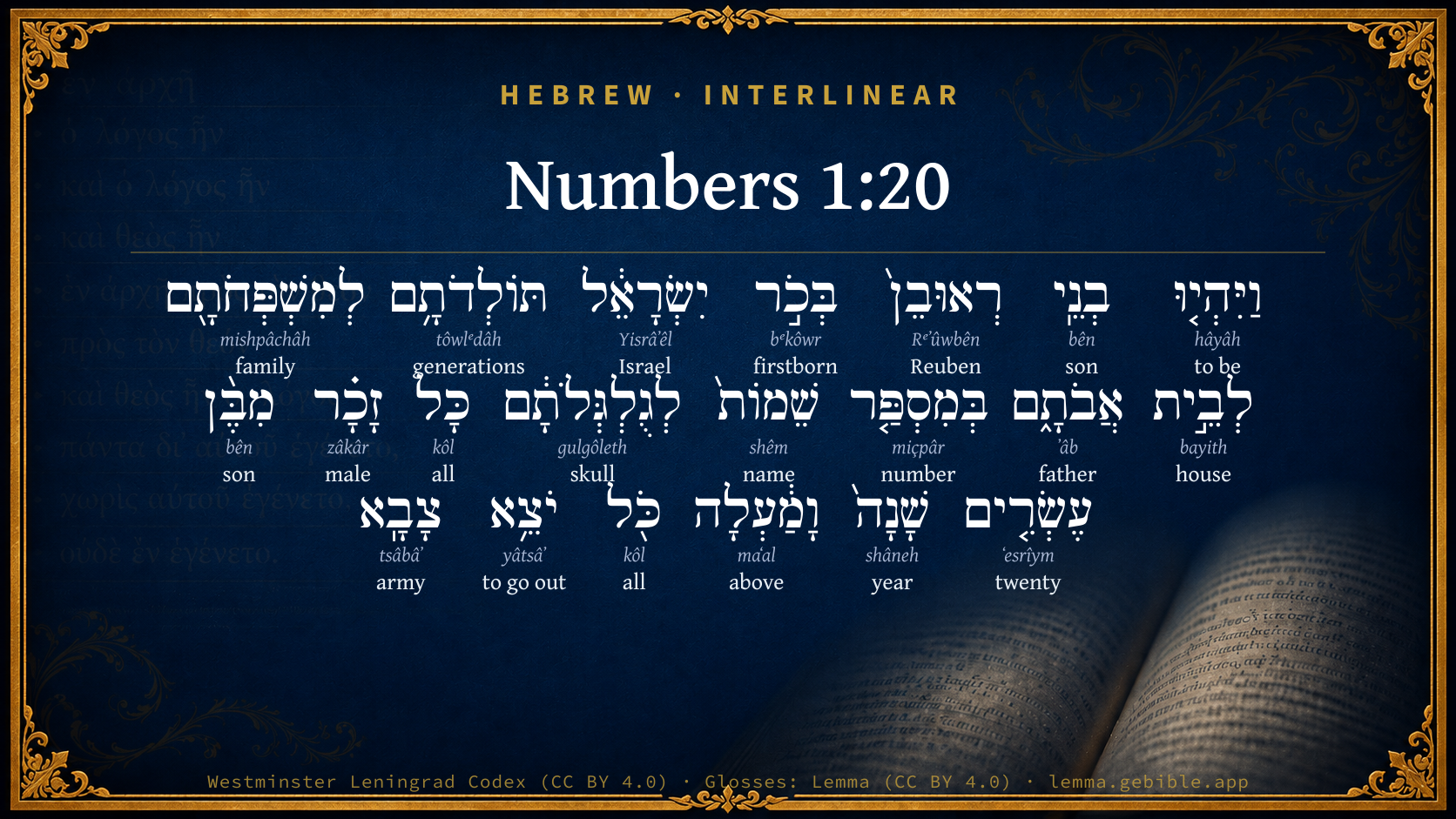
Hebrew (Westminster Leningrad Codex) Numbers 1:20 appears in the Hebrew Old Testament. The text above is from the Westminster Leningrad Codex. Each word links to its Strong’s number, a concise gloss, and parsing drawn from the Open Scriptures Hebrew Bible morphology. Click any word for its full Brown-Driver-Briggs (BDB) entry.
Download image
Cite this verse

Numbers 1:20 (World English Bible). Public Domain. Lemma interlinear Bible study tool, https://lemma.gebible.app/v/numbers/1/20.

Show BibTeX & RIS
BibTeX
RIS
English Translation
The children of Reuben, Israel's firstborn, their generations, by their families, by their fathers' houses, according to the number of the names, one by one, every male from twenty years old and upward, all who were able to go out to war;
World English Bible · Public Domain
Download a study sheet

One document with this verse’s original text, its word-by-word gloss line, the meaning frame, cross-references with their text, attributed commentary, and full source and license credits — printable, and it pastes into notes with its structure intact.

This verse Autodidact and up

Study sheet (.html) Plain text (.txt)

A passage Seminary Student

Up to 50 verses in one chapter. A passage sheet keeps up to 6 commentary sources and 12 cross-references per verse, in the order this page ranks them, and says so on the sheet whenever that leaves anything out. Ask for a single verse and you get the Autodidact verse sheet above.

Everything on this page stays free to read, with no account — the sheet is a download of what is already on screen, not access to it.

Want to remove ads? Support Godless Engineer
Compare translations 3

The same verse in 3 English versions, stacked beneath the original-language interlinear above. Click any original word for its lexicon entry.

Each is an independent rendering of the whole verse — the interlinear is not word-aligned to these translations.

Highlighted words mark where these versions differ — a whole-verse word diff, not a word-by-word alignment.

  • World English Bible Public Domain
    The children of Reuben, Israel's firstborn, their generations, by their families, by their fathers' houses, according to the number of the names, one by one, every male from twenty years old and upward, all who were able to go out to war;
  • King James Version Public Domain
    And the children of Reuben, Israel's eldest son, by their generations, after their families, by the house of their fathers, according to the number of the names, by their polls, every male from twenty years old and upward, all that were able to go forth to war;
  • unfoldingWord Literal Text CC BY-SA 4.0
    And they were the sons of Reuben, the firstborn of Israel, their generations according to their clans, according to the house of their fathers, by the number of the names, according to their skulls, every male from a son of 20 years and upward, everyone who goes out to war,

unfoldingWord Literal Text — © unfoldingWord, licensed CC BY-SA 4.0. Word-aligned USFM3 via Door43 (git.door43.org/unfoldingWord/en_ult).

Versions to compare (up to 4)

3 of 4 selected

Show all 18 translations

Every available English version of this verse, each an independent rendering of the whole verse.

  • World English Bible Public Domain
    The children of Reuben, Israel's firstborn, their generations, by their families, by their fathers' houses, according to the number of the names, one by one, every male from twenty years old and upward, all who were able to go out to war;
  • Berean Standard Bible Public Domain
    From the sons of Reuben, the firstborn of Israel, according to the records of their clans and families, counting one by one the names of every male twenty years of age or older who could serve in the army,
  • Majority Standard Bible Public Domain
    From the sons of Reuben, the firstborn of Israel, according to the records of their clans and families, counting one by one the names of every male twenty years of age or older who could serve in the army,
  • King James Version Public Domain
    And the children of Reuben, Israel's eldest son, by their generations, after their families, by the house of their fathers, according to the number of the names, by their polls, every male from twenty years old and upward, all that were able to go forth to war;
  • American Standard Version (1901) Public Domain
    And the children of Reuben, Israel's first-born, their generations, by their families, by their fathers' houses, according to the number of the names, by their polls, every male from twenty years old and upward, all that were able to go forth to war;
  • Revised Version (1885) Public Domain
    And the children of Reuben, Israel’s firstborn, their generations, by their families, by their fathers’ houses, according to the number of the names, by their polls, every male from twenty years old and upward, all that were able to go forth to war;
  • Geneva Bible (1599) Public Domain
    So were the sonnes of Reuben Israels eldest sonne by their generations, by their families, and by the houses of their fathers, according to the nomber of their names, man by man euery male from twentie yere olde and aboue, as many as went forth to warre:
  • Douay-Rheims (1899) Public Domain
    Of Ruben the eldest son of Israel, by their generations and families and houses and names of every head, all that were of the male sex, from twenty years old and upward, that were able to go forth to war,
  • Young's Literal Translation Public Domain
    And the sons of Reuben, Israel's first-born -- their births, by their families, by the house of their fathers, in the number of names, by their polls, every male from a son of twenty years and upward, every one going out to the host --
  • Literal Standard Version CC BY-SA 4.0
    And the sons of Reuben, Israel’s firstborn—their births, by their families, by the house of their fathers, in the number of names, by their counted heads, every male from a son of twenty years and upward, everyone going out to the host—
  • Unlocked Literal Bible CC BY-SA 4.0
    From the descendants of Reuben, Israel's firstborn, were counted all the names of each and every man twenty years old or older able to go to war, from the records of their ancestor's clans and families.
  • unfoldingWord Literal Text CC BY-SA 4.0
    And they were the sons of Reuben, the firstborn of Israel, their generations according to their clans, according to the house of their fathers, by the number of the names, according to their skulls, every male from a son of 20 years and upward, everyone who goes out to war,
  • Darby Bible Public Domain
    And the sons of Reuben, Israel's eldest son, their generations, after their families, according to their fathers' houses, by the number of the names, according to their polls, every male from twenty years old and upward, all that went forth to military service:
  • World Messianic Bible Public Domain
    The children of Reuben, Israel’s firstborn, their generations, by their families, by their fathers’ houses, according to the number of the names, one by one, every male from twenty years old and upward, all who were able to go out to war:
  • Webster's Bible Public Domain
    And the children of Reuben, Israel's eldest son, by their generations, after their families, by the house of their fathers, according to the number of the names, by their polls, every male from twenty years old and upward, all that were able to go forth to war;
  • Free Bible Version CC BY-SA 4.0
    The descendants of Reuben (he was Israel's firstborn son), men aged twenty or over, were recorded by name according to the genealogical records of their tribe and families. All those registered who could serve in the army
  • Bible in Basic English Public Domain
    The generations of the sons of Reuben, the oldest son of Israel, were numbered by their families and their fathers' houses, every male of twenty years old and over, who was able to go to war;
  • JPS Tanakh (1917) Public Domain
    And the children of Reuben, Israel's first-born, their generations, by their families, by their fathers' houses, according to the number of names, by their polls, every male from twenty years old and upward, all that were able to go forth to war;

Literal Standard Version (2020), Covenant Press — licensed CC BY-SA 4.0. Text via the HelloAO Bible API (eBible.org). Unlocked Literal Bible (unfoldingWord) — licensed CC BY-SA 4.0. Text via the HelloAO Bible API (eBible.org). unfoldingWord Literal Text — © unfoldingWord, licensed CC BY-SA 4.0. Word-aligned USFM3 via Door43 (git.door43.org/unfoldingWord/en_ult). Free Bible Version, Dr. Jonathan Gallagher — licensed CC BY-SA 4.0. Text via the HelloAO Bible API (eBible.org).

Word by word

More ways to search: Search by grammar → Find every occurrence → Compare this word →

Practice this passage: Drill this verse → Learn its vocabulary →

לְגֻלְגְּלֹתָ֔ם
gulgôleth
H1538
“to/for · skulls · their”
Preposition + Noun, Common, Feminine, Plural, Construct + Suffix, Personal, 3rd Person, Masculine, Plural
Part of Speech
Preposition + Noun
Type
Common
Gender
Feminine
Number
Plural
State
Construct
Full BDB Definition

Origin: by reduplication from H1556

TWOT: 353l

head, poll, skull - skull - head, poll (of census)
  1. וַיִּהְי֤וּ hâyâh H1961 “and · to be” Conjunction + Verb, Qal, Sequential Imperfect, 3rd Person, Masculine, Plural
  2. בְנֵֽי bên H1121 “sons of” Noun, Common, Masculine, Plural, Construct
  3. רְאוּבֵן֙ Rᵉʼûwbên H7205 “Reuben” Noun, Proper
  4. בְּכֹ֣ר bᵉkôwr H1060 “firstborn of” Noun, Common, Masculine, Singular, Construct
  5. יִשְׂרָאֵ֔ל Yisrâʼêl H3478 “Israel” Noun, Proper
  6. תּוֹלְדֹתָ֥ם tôwlᵉdâh H8435 “generations · their” Noun, Common, Feminine, Plural, Construct + Suffix, Personal, 3rd Person, Masculine, Plural
  7. לְמִשְׁפְּחֹתָ֖ם mishpâchâh H4940 “to/for · families · their” Preposition + Noun, Common, Feminine, Plural, Construct + Suffix, Personal, 3rd Person, Masculine, Plural
  8. לְבֵ֣ית bayith H1004 “to/for · house of” Preposition + Noun, Common, Masculine, Singular, Construct
  9. אֲבֹתָ֑ם ʼâb H1 “fathers · their” Noun, Common, Masculine, Plural, Construct + Suffix, Personal, 3rd Person, Masculine, Plural
  10. בְּמִסְפַּ֤ר miçpâr H4557 “in/at · number of” Preposition + Noun, Common, Masculine, Singular, Construct
  11. שֵׁמוֹת֙ shêm H8034 “names” Noun, Common, Masculine, Plural, Absolute
  12. כָּל kôl H3605 “all of” Noun, Common, Masculine, Singular, Construct
  13. זָכָ֗ר zâkâr H2145 “male” Adjective, Adjective, Masculine, Singular, Absolute
  14. מִבֶּ֨ן bên H1121 “from · son of” Preposition + Noun, Common, Masculine, Singular, Construct
  15. עֶשְׂרִ֤ים ʻesrîym H6242 “twenty” Adjective, Cardinal number, Both, Plural, Absolute
  16. שָׁנָה֙ shâneh H8141 “year” Noun, Common, Feminine, Singular, Absolute
  17. וָמַ֔עְלָה maʻal H4605 “and · above · toward” Conjunction + Adverb + Suffix, Demonstrative
  18. כֹּ֖ל kôl H3605 “all of” Noun, Common, Masculine, Singular, Construct
  19. יֹצֵ֥א yâtsâʼ H3318 “going out” Verb, Qal, Participle Active, Masculine, Singular, Construct
  20. צָבָֽא tsâbâʼ H6635 “army” Noun, Common, Both, Singular, Absolute

About this verse

These counts appear in no published source. They are computed here, from the morphology-tagged text and Lemma’s own curated glosses. What Lemma adds →

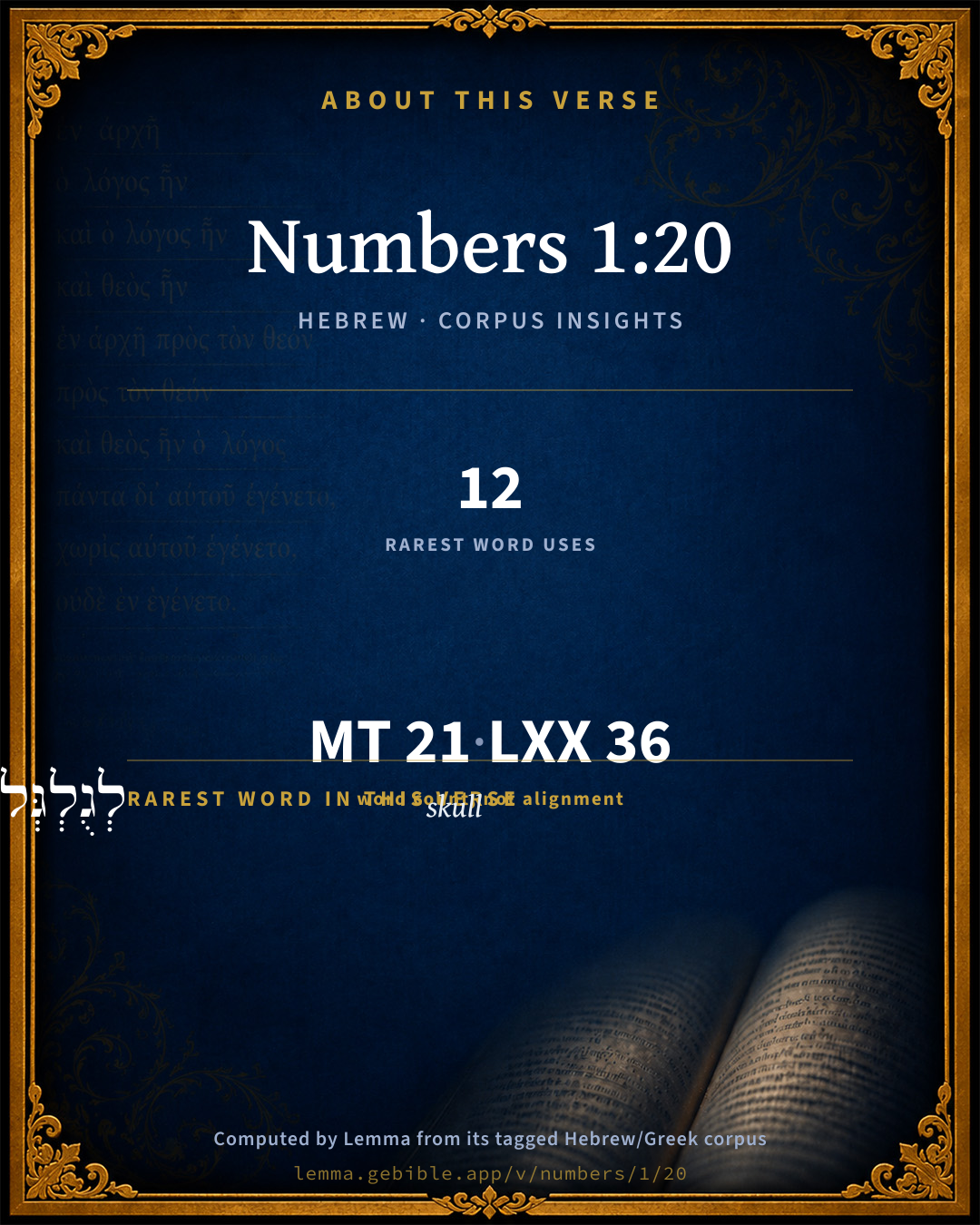
21
words
19
distinct lemmas
Pentateuch
section

Notable vocabulary

The rarest word here is לְגֻלְגְּלֹתָ֔ם skull H1538 — appearing just 12 times in the whole Hebrew Bible.

Shared distinctive vocabulary

לְגֻלְגְּלֹתָ֔ם skull H1538 occurs in 12 verses of the Hebrew Bible. Also found in:

Grammatical profile

  • 2 verbs
  • 16 nouns
  • 2 adjectives
  • 1 adverb

Verb forms

  • וַיִּהְי֤וּ Qal · Sequential Imperfect
  • יֹצֵ֥א Qal · Participle Active

Repetition

Words recur within this verse — often emphatic in Hebrew:

  • בְנֵֽי son H1121 ×2
  • כָּל all H3605 ×2

Hebrew & Septuagint length

In English translation the verse runs 42 words from the Hebrew and 51 from the Septuagint (LXX English) — closely comparable.

A rough comparison of the two English renderings, which tokenize alike — not a word-level alignment.

Word counts can differ between the Hebrew and the Greek without any difference in meaning — e.g. the Hebrew direct-object marker אֵת has no separate Greek word, and Greek often adds the article ὁ.

In the original languages it is 21 Hebrew tokens and 36 Greek tokens — but the two are counted differently (Hebrew bundles its prefixes and suffixes into one token; the Greek is in lemma form), so that isn’t a like-for-like length.

Cross-references

6

Topical passages linked to Numbers 1:20 in the Treasury of Scripture Knowledge — connected by theme and wording, ordered by reader-vote popularity; previews shown in the World English Bible.

  • Numbers 26:5–7 Reuben, the firstborn of Israel; the sons of Reuben: [of] Hanoch, the family of the Hanochites; of Pallu, the family of the Palluites;
  • Numbers 2:10–11 "On the south side shall be the standard of the camp of Reuben according to their divisions. The prince of the children of Reuben shall be Elizur the son of Shedeur.
  • Genesis 29:32 Leah conceived, and bore a son, and she named him Reuben. For she said, "Because Yahweh has looked at my affliction. For now my husband will love me."
  • Genesis 46:9 The sons of Reuben: Hanoch, Pallu, Hezron, and Carmi.
  • Genesis 49:3–4 "Reuben, you are my firstborn, my might, and the beginning of my strength; The pre-eminence of dignity, and the pre-eminence of power.
  • 1 Chronicles 5:1 The sons of Reuben the firstborn of Israel (for he was the firstborn; but, because he defiled his father's couch, his birthright was given to the sons of Joseph the son of Israel; and the genealogy is not to be reckoned after the birthright.

Cross-references courtesy of OpenBible.info (CC BY 4.0).

Hebrew and Greek witnesses Masoretic Hebrew ↔ Greek Septuagint

The same verse in the two great witnesses to the Old Testament, shown verse-for-verse.

These are two independent witnesses, not word-aligned to each other, and the Septuagint is shown in lemma (dictionary) form.

Hebrew Numbers 1:20 Masoretic · Westminster Leningrad Codex

וַיִּהְי֤וּ בְנֵֽי רְאוּבֵן֙ בְּכֹ֣ר יִשְׂרָאֵ֔ל תּוֹלְדֹתָ֥ם לְמִשְׁפְּחֹתָ֖ם לְבֵ֣ית אֲבֹתָ֑ם בְּמִסְפַּ֤ר שֵׁמוֹת֙ לְגֻלְגְּלֹתָ֔ם כָּל זָכָ֗ר מִבֶּ֨ן עֶשְׂרִ֤ים שָׁנָה֙ וָמַ֔עְלָה כֹּ֖ל יֹצֵ֥א צָבָֽא

The children of Reuben, Israel's firstborn, their generations, by their families, by their fathers' houses, according to the number of the names, one by one, every male from twenty years old and upward, all who were able to go out to war;

World English Bible · Public Domain

Greek LXX Numbers 1:20 Septuagint · lemma form

καί γίγνομαι ὁ υἱός ρουβην πρωτότοκος ἰσραήλ κατά συγγένεια αὐτός κατά δῆμος αὐτός κατά οἶκος πατριά αὐτός κατά ἀριθμός ὄνομα αὐτός κατά κεφαλή αὐτός πᾶς ἀρσενικός ἀπό εἰκοσαετής καί ἐπάνω πᾶς ὁ ἐκπορεύομαι ἐν ὁ δύναμις

And the sons of Ruben the firstborn of Israel according to their kindred, according to their divisions, according to the houses of their families, according to the number of their names, according to their heads, were—all males from twenty years old and upward, every one that went out with the host—

LXX2012 (modern English Septuagint) · Public Domain

Hebrew: Westminster Leningrad Codex (CC BY 4.0). Greek: Septuagint (public domain); English from LXX2012 (modern English Septuagint) (Public Domain). How the Septuagint differs from the Hebrew →

Targum (Aramaic paraphrase)

2

The Targum is the ancient Jewish Aramaic paraphrase of the Hebrew Scriptures — an interpretive translation, not the Hebrew text itself. Onkelos (literal) and Pseudo-Jonathan (expansive) render the Torah, and Jonathan the Prophets. Coverage is partial: where no permissively-licensed English translation exists for a verse, only the Aramaic is shown. This is verse-level text, not a word-by-word alignment to the Hebrew.

  1. Targum Onkelos Torah (Genesis–Deuteronomy)
    וַהֲווֹ בְנֵי רְאוּבֵן בּוּכְרָא דְיִשְׂרָאֵל תּוּלְדַתְהוֹן לְזַרְעֲיַתְהוֹן לְבֵית אֲבָהַתְהוֹן בְּמִנְיַן שְׁמָהָן לְגֻלְגְלַתְהוֹן כָּלּ דְכוּרָא מִבַּר עַשְׂרִין שְׁנִין וּלְעֵלָא כֹּל נָפֵק חֵילָא

    (no public-domain English translation for this verse)

    Targum Onkelos — Aramaic: “Onkelos Genesis” (public domain); “Onkelos Exodus” (public domain); “Onkelos Leviticus” (public domain); “Onkelos Numbers” (public domain); “Onkelos Deuteronomy” (public domain). English: “Sefaria Community Translation” (CC0 1.0 (public-domain dedication)); “J.W. Etheridge. The Targums of Onkelos and Jonathan Ben Uzziel on the Pentateuch. London: Longmans, Green, 1862” (public domain). Text via Sefaria.

  2. Targum Pseudo-Jonathan Torah (Genesis–Deuteronomy)
    וַהֲווֹ בְנֵי רְאוּבֵן בּוּכְרָא דְיִשְרָאֵל יִחוּסֵיהוֹן לִגְנִיסַתְהוֹן לְבֵית אַבְהַתְהוֹן בְּמִנְיַן שְׁמָהָן לְגוּלְגְלַתְהוֹן כָּל דְכוּרָא מִבַּר עַשְרִין שְׁנִין וּלְעֵילָא כָּל נָפִיק חֵילָא

    And the sons of Reuben, the first-born of Israel by the families of the generations of their fathers' house, in the number of their names by their polls, every male from twenty years old and upward, all going forth in the host,

    Targum Pseudo-Jonathan — Aramaic: “Targum Jonathan on Genesis” (public domain); “Targum Jonathan on Exodus” (public domain); “Targum Jonathan on Leviticus” (public domain); “Targum Jonathan on Numbers” (public domain); “Targum Jonathan on Deuteronomy” (public domain). English: “The Targum of Jonathan ben Uzziel, trans. J. W. Etheridge, London, 1862” (public domain). Text via Sefaria.

Commentary

Notes on Numbers 1:20 from classic Christian and Jewish commentators (each source and its license shown beneath its notes). The classic Christian expositions comment on the surrounding passage and are grouped to its opening verse, so a note may address several verses; the Jewish commentaries on the Tanakh (Rashi and others) are per-verse, so they appear only where the commentator wrote on this verse.

Lemma curates 59 commentaries, every one of them public domain or Creative Commons licensed, each selected and text-cleaned for this edition rather than reprinted as found. About our sources →

Albert Barnes' Notes on the Bible

The enrollment, being taken principally for military purposes (compare Num 1:3, Num 1:20), would naturally be arranged by hundreds, fifties, etc. (cf. 2Ki 1:9, 2Ki 1:11, 2Ki 1:13). In eleven tribes the number enrolled consists of complete hundreds. The difference, in this respect, observable in the case of the tribe of Gad here Num 1:25, and of the tribe of Reuben at the later census Num 26:7, is probably to be accounted for by the pastoral, and consequently nomadic, habits of these tribes, which rendered it difficult to bring all their members together at once for a census. Judah already takes precedence of his brethren in point of numbers (compare Gen 49:8 note), and Ephraim of Manasseh (compare Gen 48:19-20).

Albert Barnes' Notes on the Bible (1834–1885) — public domain. Text from a community e-Sword/MySword module.

The Biblical Illustrator

Joseph S. Exell

Num_1:20-46

Those that were numbered.

The first army of Israel, an illustration of the Church militant

I. The necessity of this army. The Church must be militant.

1. Internal foes have to be conquered. Carnal appetites, evil passions, &c.

2. External foes have to be conquered. Ignorance and superstition, immorality and irreligion, dirt and disease, vice and crime.

II. The authority for organising this army. Gods command.

III. The composition of this army.

1. Israelites only. Thoroughly decided Christians are needed now.

2. Able men only. Christ gives strength even to the weak and timid.

3. All the able men. None exempt. We must either vanquish our spiritual enemies, or they will vanquish us. Neutrality is out of the question here. Neither can we do our fighting by proxy.

IV. The conquering spirit of this army. When our faith in God is strong, we are invincible. When it fails, we are overthrown by the first assault of the enemy. True faith gives glorious visions to the spirit, inspires us with heroic courage, girds us with all-sufficient strength. Conclusion--

1. A call to decision. Who is on the Lords side?

2. A call to courage. Our arms are tried and true; our great Leader is invincible; let us then be strong and of a good courage.

3. A call to confidence. Our courage, to be true, must spring from faith, By trust we triumph. (W. Jones.)

The necessity of war:

I believe in war. I believe there are times when it must be taken. I believe in it as a medicine. Medicine is not good to eat, but when you are sick it is good to take. War is not a part of the gospel; but while men and the world are travelling on a plain where they are not capable of comprehending the gospel, a rude form of justice is indispensable, though it is very low down. If you go to a plain still higher, war seems to be a very poor instrumentality. And if you go yet higher and higher till you reach that sphere where the crowned Sufferer stands, how hideous war seems! ]n the earlier periods of society it is recognised as having a certain value; but its value is the very lowest, and at every step upward, till you come to this central Divine exhibition, it loses in value. Always it is a rude and uncertain police of nations. It is never good. It is simply better than something worse. Physical force is the alternative of moral influence; if you have not one, you must have the other. (H. W. Beecher.)

The Biblical Illustrator, edited by Joseph S. Exell (c. 1880s–1900s) — public domain. Text from a community e-Sword module.

Joseph Benson's Commentary

Num 1:20. By their generations — That is, the persons begotten of Reuben’s immediate children, who are here subdivided into families, and they into houses, and they into particular persons.

Joseph Benson's Commentary on the Old and New Testaments (1811–1818) — public domain. Text from a community e-Sword module.

Tyndale Open Study Notes

Tyndale Open Resources

1:20-43 In this second list of the tribes, Gad is placed alongside Reuben and Simeon, the tribes with whom Gad would camp while Israel was on the march.

Tyndale Open Study Notes — © Tyndale Open Resources, licensed CC BY-SA 4.0. Text via the HelloAO Bible API.

Geneva Bible (1599)

Geneva Bible translators

These are the names of the twelve tribes, as first of Reuben.

Or, as were able to bear weapons.

Geneva Bible (1599) marginal notes — public domain. Text via Bolls.life.

Jamieson, Fausset & Brown

Robert Jamieson, A. R. Fausset & David Brown

These are those that were numbered--In this registration the tribe of Judah appears the most numerous; and accordingly, as the pre-eminence had been assigned to it by Jacob [Gen 49:8-12], it got the precedence in all the encampments of Israel. Of the two half-tribes of Joseph, who is seen to be "a fruitful bough" [Gen 49:22], that of Ephraim was the larger, as had been predicted. The relative increase of all, as in the two just mentioned, was owing to the special blessing of God, conformably to the prophetic declaration of the dying patriarch. But the divine blessing is usually conveyed through the influence of secondary causes; and there is reason to believe that the relative populousness of the tribes would, under God, depend upon the productiveness of the respective localities assigned to them. [For tabular chart, see on Num 26:64.]

Jamieson, Fausset & Brown — Commentary Critical and Explanatory on the Whole Bible (1871) — public domain (CC PDM 1.0). Text via the HelloAO Bible API.

Ellicott's Commentary for English Readers

(20) By their generations.—The toledoth, or generations, included the whole of the descendants of the head of the tribe (Gen_5:1; Gen_6:9).

A Bible Commentary for English Readers, edited by Charles John Ellicott (1878–1897) — public domain. Text from a community e-Sword module.

John Gill's Exposition

And the children of Reuben, Israel's eldest son,.... Were numbered first, and next to them those of Simeon and Gad, for they were numbered according to the order in which they were to be encamped; for under Reuben's standard were Simeon and Gad, and under Judah's Issachar and Zebulun, and under Ephraim's Manasseh and Benjamin, and under Dan's Asher and Naphtali; and according to their order were the tribes numbered:

by their generations: or "their generations", the birth, descent, and pedigree of them:

after their families, by the house of their fathers: according to the families and houses to which they belonged:

according to the number of the names by their polls, every male from twenty years old and upward; their names were taken down, the number of them counted by their heads, even all the males that were above twenty years of age:

all that were able to go forth to war; which phrase, as it suggests that before this age they were not reckoned able bodied men for war, in common, though some might; so it seems to except all infirm persons, by reason of age and otherwise: now in all the other account of the numbering of the rest of the tribes, the same forms of expression are used as here, only the tribe of Simeon, which is the next, these words are left out, "by their polls, every male", which being twice observed, need not be repeated, since by these instances it might be sufficiently known that the number was taken by a poll, and only of males; so that in Num 1:23, there is nothing material to observe, or anything different from what is in this verse, but the particular sums of each tribe numbered, which stand thus: of the tribe of Reuben 46,500; of the tribe of Simeon, 59,300; of the tribe of Gad, 45,650; of the tribe of Judah, 74,600; of the tribe of Issachar, 54,400; of the tribe of Zebulun, 57,400; of the tribe of Ephraim, 40,500; of the tribe of Manasseh, 32,200; of the tribe of Benjamin 35,400; of the tribe of Dan, 62,700; of the tribe of Asher 41,500; of the tribe of Naphtali, 53,400; in which may be observed the various increase of the tribes, agreeably to divine predictions, and according to the sovereign will and infinite wisdom of God: Reuben, the firstborn, did not excel in number, six of the tribes having more in number than he: Judah had by far the greatest increase of them all, from whom the chief ruler was to come, and even the King Messiah; and in process of time was to become a kingdom of itself; Ephraim, the younger son of Joseph, was much more fruitful than Manasseh, his elder, more than eight thousand being numbered of the former than of the latter, all which agree with Jacob's prophecies, Gen 49:4; nor had they always the greatest number who had the most sons at their going down into Egypt; for though Simeon, who had then more sons than Reuben, had at this time a larger posterity; yet Gad, who had more than Simeon, had now fewer descendants; and Dan, who had but one son at that time, had now almost double the number of Benjamin, who then had ten sons: and it may be observed of other tribes, that their increase was not in proportion to the number of the sons of the patriarchs then; see Gen 46:8.

John Gill's Exposition of the Whole Bible (1746–1763) — public domain (CC PDM 1.0). Text via the HelloAO Bible API.

Matthew Poole's English Annotations

By their generations, Heb. to wit, their generations, i.e. the persons begotten of Reuben’s immediate children, who are here subdivided into families, and they into houses, and they into particular persons.

Matthew Poole's English Annotations on the Holy Bible (1683–1685) — public domain. Text from a community e-Sword/MySword module.

John Wesley's Explanatory Notes

By their generations - That is, the persons begotten of Reuben's immediate children, who are here subdivided into families, and they into houses, and they into particular persons.

John Wesley, Explanatory Notes Upon the Whole Bible (1754–1765) — public domain. Text via the GEBible commentary corpus.

unfoldingWord translationNotes

Door43 World Missions Community

were counted all the names

This can be stated in active form. AT: "they counted all the names" (See: Active or Passive)

able to go to war

"who was able to go to war"

46,500 men

"forty-six thousand five hundred men" (See: Numbers)

translationWords

descend

Reuben

Jacob

firstborn

unfoldingWord translationNotes — © Distant Shores Media and the Door43 World Missions Community, licensed CC BY-SA 4.0. Source: git.door43.org/Door43/en_tn.

Lesson kit

Teaching starters — assembled from the data on this page, not authored interpretation. Every prompt links to the verse data it draws on. Edit before teaching.

Numbers, in the Pentateuch, opens this verse with 21 words (19 distinct Hebrew lemmas). Its most distinctive word is gulgôleth (“skull”). A historical commentator’s framing appears above. Read the whole chapter for the surrounding context.

Discussion questions

  1. What does “skull” (gulgôleth) contribute to the verse as a whole?
  2. How does Exodus 16:16, which shares the word «skull», read alongside this verse?
  3. What does the repetition of “son” (2× in this one verse) do in this verse?
  4. The translations on this page render this verse differently — a whole-verse word diff, not a word-by-word alignment. What might account for the different wordings?
  5. «וַיִּהְי֤וּ» is a Qal Sequential Imperfect verb. How does that grammatical form shape the action described?
  6. Compare how Albert Barnes' Notes on the Bible and The Biblical Illustrator read this verse. Where do they agree or differ?

Things to notice

Reading settings

Reading text

Shown beneath each verse's original-language words.

Old Testament
Old Testament edition

Read the OT as the Masoretic Hebrew (MT) or the Greek Septuagint (LXX).

English shown for the Greek Septuagint (in the Hebrew ↔ Greek comparison).

Comparing translations? Open the Compare panel on any verse page to stack up to four side by side.