
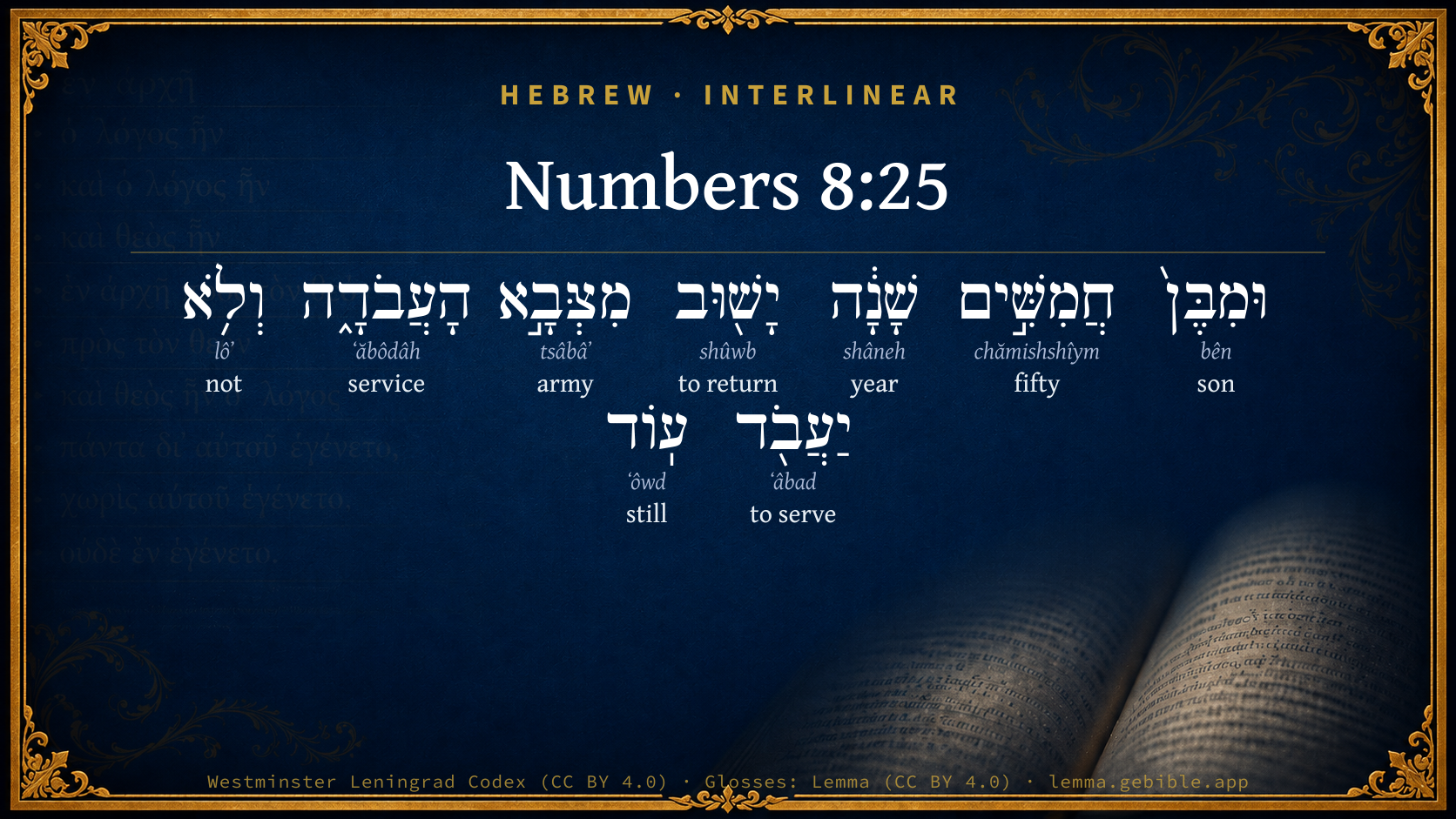
Numbers 8:25

Hebrew (Westminster Leningrad Codex) Numbers 8:25 appears in the Hebrew Old Testament. The text above is from the Westminster Leningrad Codex. Each word links to its Strong’s number, a concise gloss, and parsing drawn from the Open Scriptures Hebrew Bible morphology. Click any word for its full Brown-Driver-Briggs (BDB) entry.
Download image
Cite this verse

Numbers 8:25 (World English Bible). Public Domain. Lemma interlinear Bible study tool, https://lemma.gebible.app/v/numbers/8/25.

Show BibTeX & RIS
BibTeX
RIS
English Translation
and from the age of fifty years they shall cease waiting on the work, and shall serve no more,
World English Bible · Public Domain
Download a study sheet

One document with this verse’s original text, its word-by-word gloss line, the meaning frame, cross-references with their text, attributed commentary, and full source and license credits — printable, and it pastes into notes with its structure intact.

This verse Autodidact and up

Study sheet (.html) Plain text (.txt)

A passage Seminary Student

Up to 50 verses in one chapter. A passage sheet keeps up to 6 commentary sources and 12 cross-references per verse, in the order this page ranks them, and says so on the sheet whenever that leaves anything out. Ask for a single verse and you get the Autodidact verse sheet above.

Everything on this page stays free to read, with no account — the sheet is a download of what is already on screen, not access to it.

Want to remove ads? Support Godless Engineer
Compare translations 3

The same verse in 3 English versions, stacked beneath the original-language interlinear above. Click any original word for its lexicon entry.

Each is an independent rendering of the whole verse — the interlinear is not word-aligned to these translations.

Highlighted words mark where these versions differ — a whole-verse word diff, not a word-by-word alignment.

  • World English Bible Public Domain
    and from the age of fifty years they shall cease waiting on the work, and shall serve no more,
  • King James Version Public Domain
    And from the age of fifty years they shall cease waiting upon the service thereof, and shall serve no more:
  • unfoldingWord Literal Text CC BY-SA 4.0
    And from a son of 50 years he shall return from the army of the service, and he shall not serve more.

unfoldingWord Literal Text — © unfoldingWord, licensed CC BY-SA 4.0. Word-aligned USFM3 via Door43 (git.door43.org/unfoldingWord/en_ult).

Versions to compare (up to 4)

3 of 4 selected

Show all 18 translations

Every available English version of this verse, each an independent rendering of the whole verse.

  • World English Bible Public Domain
    and from the age of fifty years they shall cease waiting on the work, and shall serve no more,
  • Berean Standard Bible Public Domain
    But at the age of fifty, they must retire from performing the work and no longer serve.
  • Majority Standard Bible Public Domain
    But at the age of fifty, they must retire from performing the work and no longer serve.
  • King James Version Public Domain
    And from the age of fifty years they shall cease waiting upon the service thereof, and shall serve no more:
  • American Standard Version (1901) Public Domain
    and from the age of fifty years they shall cease waiting upon the work, and shall serve no more,
  • Revised Version (1885) Public Domain
    and from the age of fifty years they shall cease waiting upon the work, and shall serve no more;
  • Geneva Bible (1599) Public Domain
    And after the age of fiftie yeere, they shall cease from executing the office, and shall serue no more:
  • Douay-Rheims (1899) Public Domain
    And when they shall have accomplished the fiftieth year of their age, they shall cease to serve:
  • Young's Literal Translation Public Domain
    and from a son of fifty years he doth return from the host of the service, and doth not serve any more,
  • Literal Standard Version CC BY-SA 4.0
    and from a son of fifty years he returns from the host of the service, and does not serve anymore,
  • Unlocked Literal Bible CC BY-SA 4.0
    They must stop serving in this way at the age of fifty years. At that age they must not serve any longer.
  • unfoldingWord Literal Text CC BY-SA 4.0
    And from a son of 50 years he shall return from the army of the service, and he shall not serve more.
  • Darby Bible Public Domain
    And from fifty years old he shall retire from the labour of the service, and shall serve no more;
  • World Messianic Bible Public Domain
    and from the age of fifty years they shall retire from doing the work, and shall serve no more,
  • Webster's Bible Public Domain
    And from the age of fifty years they shall cease waiting upon the service of it, and shall serve no more:
  • Free Bible Version CC BY-SA 4.0
    However, once they reach the age of fifty they need to retire from the work and won't serve any longer.
  • Bible in Basic English Public Domain
    But after they are fifty years old, they are to give up their work and do no more;
  • JPS Tanakh (1917) Public Domain
    and from the age of fifty years they shall return from the service of the work, and shall serve no more;

Literal Standard Version (2020), Covenant Press — licensed CC BY-SA 4.0. Text via the HelloAO Bible API (eBible.org). Unlocked Literal Bible (unfoldingWord) — licensed CC BY-SA 4.0. Text via the HelloAO Bible API (eBible.org). unfoldingWord Literal Text — © unfoldingWord, licensed CC BY-SA 4.0. Word-aligned USFM3 via Door43 (git.door43.org/unfoldingWord/en_ult). Free Bible Version, Dr. Jonathan Gallagher — licensed CC BY-SA 4.0. Text via the HelloAO Bible API (eBible.org).

Word by word

More ways to search: Search by grammar → Find every occurrence → Compare this word →

Practice this passage: Drill this verse → Learn its vocabulary →

הָעֲבֹדָ֑ה
ʻăbôdâh
H5656
“the · service”
Particle, Definite Article + Noun, Common, Feminine, Singular, Absolute
Part of Speech
Particle + Noun
Type
Common
Gender
Feminine
Number
Singular
State
Absolute
Full BDB Definition

Origin: from H5647

TWOT: 1553c

labour, service - labour, work - labour (of servant or slave) - labour, service (of captives or subjects) - service (of God)
  1. וּמִבֶּן֙ bên H1121 “and · from · son of” Conjunction + Preposition + Noun, Common, Masculine, Singular, Construct
  2. חֲמִשִּׁ֣ים chămishshîym H2572 “fifty” Adjective, Cardinal number, Both, Plural, Absolute
  3. שָׁנָ֔ה shâneh H8141 “year” Noun, Common, Feminine, Singular, Absolute
  4. יָשׁ֖וּב shûwb H7725 “to return” Verb, Qal, Imperfect, 3rd Person, Masculine, Singular
  5. מִצְּבָ֣א tsâbâʼ H6635 “from · army of” Preposition + Noun, Common, Both, Singular, Construct
  6. וְלֹ֥א lôʼ H3808 “and · not” Conjunction + Particle, Negative
  7. יַעֲבֹ֖ד ʻâbad H5647 “to serve” Verb, Qal, Imperfect, 3rd Person, Masculine, Singular
  8. עֽוֹד ʻôwd H5750 “still” Adverb

About this verse

These counts appear in no published source. They are computed here, from the morphology-tagged text and Lemma’s own curated glosses. What Lemma adds →

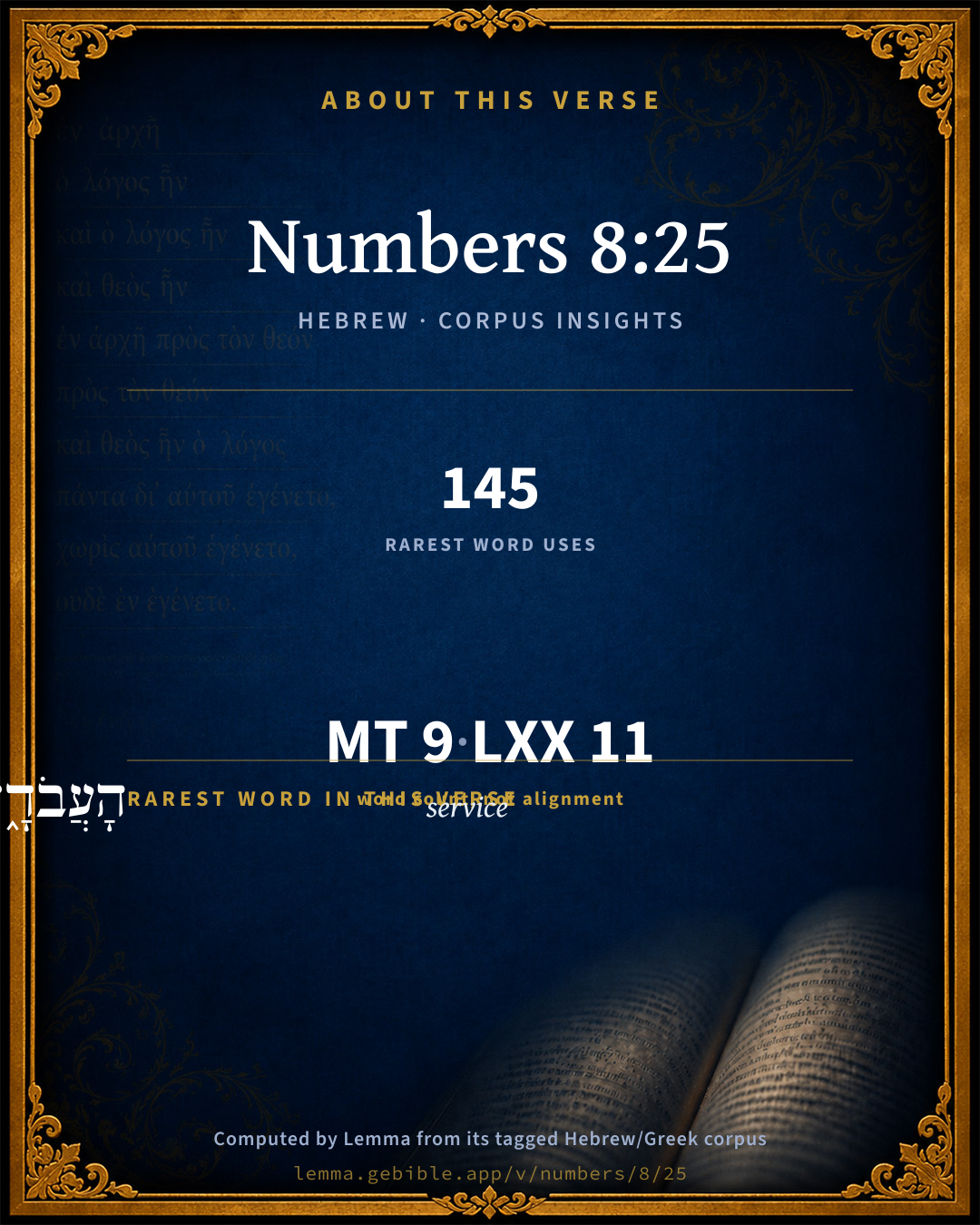
9
words
9
distinct lemmas
Pentateuch
section

Grammatical profile

  • 2 verbs
  • 4 nouns
  • 1 adjective
  • 1 adverb
  • 1 particle

Verb forms

  • יָשׁ֖וּב Qal · Imperfect
  • יַעֲבֹ֖ד Qal · Imperfect

Hebrew & Septuagint length

In English translation the verse runs 19 words from the Hebrew and 18 from the Septuagint (LXX English) — closely comparable.

A rough comparison of the two English renderings, which tokenize alike — not a word-level alignment.

Word counts can differ between the Hebrew and the Greek without any difference in meaning — e.g. the Hebrew direct-object marker אֵת has no separate Greek word, and Greek often adds the article ὁ.

In the original languages it is 9 Hebrew tokens and 11 Greek tokens — but the two are counted differently (Hebrew bundles its prefixes and suffixes into one token; the Greek is in lemma form), so that isn’t a like-for-like length.

Cross-references

2

Topical passages linked to Numbers 8:25 in the Treasury of Scripture Knowledge — connected by theme and wording, ordered by reader-vote popularity; previews shown in the World English Bible.

  • Numbers 4:23 from thirty years old and upward until fifty years old shall you number them; all who enter in to wait on the service, to do the work in the Tent of Meeting.
  • 2 Timothy 4:7 I have fought the good fight. I have finished the course. I have kept the faith.

Cross-references courtesy of OpenBible.info (CC BY 4.0).

Hebrew and Greek witnesses Masoretic Hebrew ↔ Greek Septuagint

The same verse in the two great witnesses to the Old Testament, shown verse-for-verse.

These are two independent witnesses, not word-aligned to each other, and the Septuagint is shown in lemma (dictionary) form.

Hebrew Numbers 8:25 Masoretic · Westminster Leningrad Codex

וּמִבֶּן֙ חֲמִשִּׁ֣ים שָׁנָ֔ה יָשׁ֖וּב מִצְּבָ֣א הָעֲבֹדָ֑ה וְלֹ֥א יַעֲבֹ֖ד עֽוֹד

and from the age of fifty years they shall cease waiting on the work, and shall serve no more,

World English Bible · Public Domain

Greek LXX Numbers 8:25 Septuagint · lemma form

καί ἀπό πεντηκονταετής ἀποἵστημι ἀπό ὁ λειτουργία καί οὐ ἐργάζομαι ἔτι

And from fifty years old the Levites shall cease from the ministry, and shall not work any longer.

LXX2012 (modern English Septuagint) · Public Domain

Hebrew: Westminster Leningrad Codex (CC BY 4.0). Greek: Septuagint (public domain); English from LXX2012 (modern English Septuagint) (Public Domain). How the Septuagint differs from the Hebrew →

Targum (Aramaic paraphrase)

2

The Targum is the ancient Jewish Aramaic paraphrase of the Hebrew Scriptures — an interpretive translation, not the Hebrew text itself. Onkelos (literal) and Pseudo-Jonathan (expansive) render the Torah, and Jonathan the Prophets. Coverage is partial: where no permissively-licensed English translation exists for a verse, only the Aramaic is shown. This is verse-level text, not a word-by-word alignment to the Hebrew.

  1. Targum Onkelos Torah (Genesis–Deuteronomy)
    וּמִבַּר חַמְשִׁין שְׁנִין יְתוּב מֵחֵיל פּוּלְחָנָא וְלָא יִפְלַח עוֹד

    (no public-domain English translation for this verse)

    Targum Onkelos — Aramaic: “Onkelos Genesis” (public domain); “Onkelos Exodus” (public domain); “Onkelos Leviticus” (public domain); “Onkelos Numbers” (public domain); “Onkelos Deuteronomy” (public domain). English: “Sefaria Community Translation” (CC0 1.0 (public-domain dedication)); “J.W. Etheridge. The Targums of Onkelos and Jonathan Ben Uzziel on the Pentateuch. London: Longmans, Green, 1862” (public domain). Text via Sefaria.

  2. Targum Pseudo-Jonathan Torah (Genesis–Deuteronomy)
    וּמִבַּר חַמְשִׁין שְׁנִין יֵיתוּב מֵחֵיל פּוּלְחָנָא וְלָא יִפְלַח תּוּב

    and from fifty years of age he shall return from the band of the service, and serve no more.

    Targum Pseudo-Jonathan — Aramaic: “Targum Jonathan on Genesis” (public domain); “Targum Jonathan on Exodus” (public domain); “Targum Jonathan on Leviticus” (public domain); “Targum Jonathan on Numbers” (public domain); “Targum Jonathan on Deuteronomy” (public domain). English: “The Targum of Jonathan ben Uzziel, trans. J. W. Etheridge, London, 1862” (public domain). Text via Sefaria.

Commentary

Notes on Numbers 8:25 from classic Christian and Jewish commentators (each source and its license shown beneath its notes). The classic Christian expositions comment on the surrounding passage and are grouped to its opening verse, so a note may address several verses; the Jewish commentaries on the Tanakh (Rashi and others) are per-verse, so they appear only where the commentator wrote on this verse.

Lemma curates 59 commentaries, every one of them public domain or Creative Commons licensed, each selected and text-cleaned for this edition rather than reprinted as found. About our sources →

Joseph Benson's Commentary

Num 8:25-26. From the age of fifty — they shall cease waiting — Shall be excused from carrying the parts and vessels of the tabernacle, and all the toilsome duties of the service, and shall only give advice and direction, and assist in lesser and easier works. How merciful and full of compassion are the laws of God! When his servants became advanced in years in his service, they were not required to do the same work which they did when younger. But doubtless many of them, who were of age to take the benefit of this kind provision made for them, would show their love to God by still exerting in some way their last remains of strength in his service. And surely happy are they who, by the blessing of God on a temperate life, are preserved to old age, with strength to labour in His service who gave them being, and died to redeem them.

Joseph Benson's Commentary on the Old and New Testaments (1811–1818) — public domain. Text from a community e-Sword module.

Geneva Bible (1599)

Geneva Bible translators

Such office as was painful, as to bear burdens and such like.

Geneva Bible (1599) marginal notes — public domain. Text via Bolls.life.

Jamieson, Fausset & Brown

Robert Jamieson, A. R. Fausset & David Brown

from the age of fifty years they shall cease waiting upon the service thereof, &c.--that is, on the laborious and exhausting parts of their work.

Jamieson, Fausset & Brown — Commentary Critical and Explanatory on the Whole Bible (1871) — public domain (CC PDM 1.0). Text via the HelloAO Bible API.

John Gill's Exposition

But shall minister with their brethren in the tabernacle of the congregation,.... By giving advice, instructing younger Levites, and doing lighter service. Jarchi says, they shall return to shutting of doors, singing and loading wagons; but the last especially seems too burdensome: the ministry of such is explained by the next clause:

to keep the charge; of the tabernacle, to watch and observe that no stranger or unclean person enter into it; and this they were capable of when at the age of fifty, and upwards:

and shall do no service; heavy and laborious:

thus thou shall do unto the Levites touching their charge; dismiss them from service when at such an age, or however make their service easier; for this respects ancient men, as Aben Ezra notes; though it may include both their entrance on their work, and their cessation from it.

Next: Numbers Chapter 9

John Gill's Exposition of the Whole Bible (1746–1763) — public domain (CC PDM 1.0). Text via the HelloAO Bible API.

Haydock's Catholic Bible Commentary

Serve, in any laborious functions, as the original imports.

George Leo Haydock (1774–1849), Haydock's Catholic Family Bible and Commentary, 1859 edition — public domain. Excludes Psalms (Douay-Rheims chapter numbering differs from Protestant) and Deuterocanonical books (Catholic canon only).

Matthew Poole's English Annotations

i.e. Upon the difficult and cumbersome part of their work.

Matthew Poole's English Annotations on the Holy Bible (1683–1685) — public domain. Text from a community e-Sword/MySword module.

unfoldingWord translationNotes

Door43 World Missions Community

at the age of fifty years

"at 50 years old" or "when they become 50 years old" (See: Numbers)

translationWords

brother

tent of meeting

Levi

unfoldingWord translationNotes — © Distant Shores Media and the Door43 World Missions Community, licensed CC BY-SA 4.0. Source: git.door43.org/Door43/en_tn.

Rashi

Rabbi Shlomo Yitzchaki (Rashi)

ולא יעבד עוד [AND FROM THE AGE OF FIFTY YEARS HE SHALL CEASE WAITING UPON THE SERVICE] AND SHALL DO NO MORE SERVICE — the service of bearing loads on the shoulder, but he still returns (i. e. may be called upon) for closing the Temple gates, for the service of singing and for loading sacred articles upon the wagons; for this is the meaning of (v. 26) “But he shall serve את אחיו” i. e. together with his brethren, just as the Targum renders it (not, “he shall serve his brethren, i. e. wait upon them) (cf. Sifrei Bamidbar 63).

Rashi on the Tanakh — English translations: “The Judaica Press complete Tanach with Rashi, translated by A. J. Rosenberg” (CC BY 4.0); “Pentateuch with Rashi's commentary by M. Rosenbaum and A.M. Silbermann, 1929-1934” (public domain); “The Metsudah Tanach series, Lakewood, N.J” (CC BY 4.0); and “The Book of Joshua, Metsudah Publications, 1997” (CC BY 4.0). Text via Sefaria.

Ramban (Nachmanides)

Rabbi Moshe ben Nachman (Ramban / Nachmanides)

AND FROM THE AGE OF FIFTY YEARS HE SHALL RETURN FROM THE SERVICE OF THE WORK, AND HE SHALL SERVE NO MORE — “the service of carrying loads upon the shoulders, but he returns [i.e., he may still serve] to close the gates, or to sing, or to load the wagons.” This is Rashi’s language. But in the Sifre 63. the Rabbis mentioned only that “he returns to close the gates or to the work of the sons of Gershon” [but they did not say that he may return to the service of singing]! And this indeed appears correct [that a Levite above the age of fifty was not allowed to take part in the singing] — for if it were as the Rabbi [Rashi] has written, why were the twenty-year old Levites not appointed to sing, to close the gates and to load the wagons until they reached the required age, and why were they counted from thirty to fifty years old and only for the work of bearing burdens [since both before and after these two age-limits they could still serve by singing etc., therefore they should have been counted from twenty years, with no upper limit]? Moreover, why were the sons of Gershon and Merari counted in this way [from thirty to fifty] since all their work [i.e., singing, closing the gates and loading the wagons] could be done when they were older?We must rather say that since they were appointed to carry the ark at the age from thirty to fifty, they [therefore] were not appointed to sing, which was the main function of the Levites, unless they were also qualified to carry the ark, for all those who were appointed to sing were qualified to perform all the services [including the carrying of the ark]. And since the Kohathites [who were the only ones permitted to carry the ark] were counted from thirty to fifty years old, even for singing, they were all counted in this manner, in order that the sons of Gershon and Merari should not be qualified to sing during these years [i.e., below the age of thirty and above the age of fifty] and the sons of Kohath be disqualified. [Hence the age limits of thirty and fifty applied to the Kohathites’ singing, which was their main function, as well as to their carrying of the parts of the Tabernacle, and therefore these age limits applied to the function of singing of the sons of Gershon and Merari as well, and they could not, as Rashi wrote, return to the singing.] But for closing the gates or loading the wagons all of them were qualified [even after the age of fifty, as quoted in the Sifre above]. Furthermore it is written, from thirty years old and upward even unto fifty years old, every one that entered in to do the work of the service, and the work of bearing burdens in the Tent of Meeting, and the Rabbis interpreted in the Tractate of Shechitath Chullin: is in contrast to the Tractate Schechitath Kodashim (The Slaughtering of Hallowed Animals), now generally called Zebachim (Offerings). “I might think that in Shiloh and in the Eternal House [at Jerusalem, when the services of the Levites were limited to gatekeeping and singing] it was also so [that the Levites were disqualified after the age of fifty]; Scripture therefore says, to do the work of service, and the work of bearing burdens. I have only said so with respect to a time when there is bearing burdens upon the shoulders.” Now [the expression] ‘avodath avodah’ [the work of service, but literally “a service of a service”] is a reference to singing, as Rashi has written above in Seder Naso; if so [it is clear that] when there was [the duty of] bearing the burdens upon the shoulders, the Levites were disqualified from singing as well [after the age of fifty]. And so it is said in the words of David, And the Levites were numbered from thirty years old and upward, and it is further written there, Of these twenty and four thousand were to oversee the work of the House of the Eternal etc., Verse 4. and four thousand praised the Eternal with the instruments which I made to praise therewith., Verse 5. For until the House [of G-d in Jerusalem] was built, when they still had to carry [the ark and the Tabernacle] on their shoulders, they only appointed Levites to sing who were also fit to carry [i.e., from the age of thirty to fifty]; but David counted them again from twenty years old, Verse 27. to meet the requirements of the House [of G-d] when it was built, as has been explained [above at the end of Verse 4].

Ramban (Nachmanides) on the Tanakh — English translation: “Commentary on the Torah by Ramban (Nachmanides). Translated and annotated by Charles B. Chavel. New York, Shilo Pub. House, 1971-1976” (CC BY 4.0). Text via Sefaria.

Lesson kit

Teaching starters — assembled from the data on this page, not authored interpretation. Every prompt links to the verse data it draws on. Edit before teaching.

Numbers, in the Pentateuch, opens this verse with 9 words (9 distinct Hebrew lemmas). Its most distinctive word is ʻăbôdâh (“service”). A historical commentator’s framing appears above. Read the whole chapter for the surrounding context.

Discussion questions

  1. The word ʻăbôdâh carries the sense “service.” How does it shape the verse?
  2. How does Numbers 4:23, which shares this passage’s theme, read alongside this verse?
  3. The translations on this page render this verse differently — a whole-verse word diff, not a word-by-word alignment. What might account for the different wordings?
  4. «יָשׁ֖וּב» is a Qal Imperfect verb. How does that grammatical form shape the action described?
  5. Compare how Joseph Benson's Commentary and Geneva Bible (1599) read this verse. Where do they agree or differ?

Things to notice

Reading settings

Reading text

Shown beneath each verse's original-language words.

Old Testament
Old Testament edition

Read the OT as the Masoretic Hebrew (MT) or the Greek Septuagint (LXX).

English shown for the Greek Septuagint (in the Hebrew ↔ Greek comparison).

Comparing translations? Open the Compare panel on any verse page to stack up to four side by side.