
2 Samuel 19:13

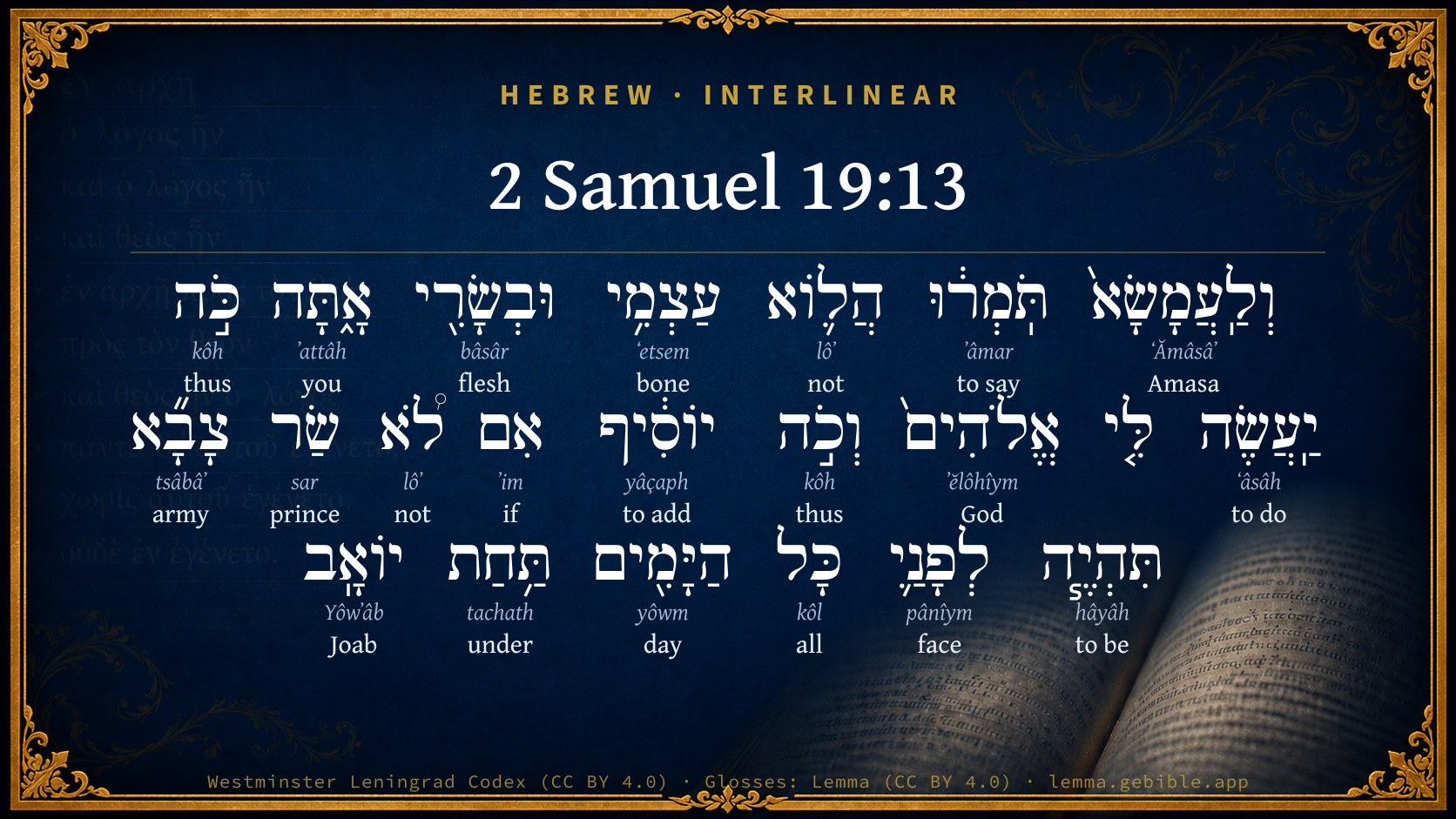
Hebrew (Westminster Leningrad Codex) 2 Samuel 19:13 appears in the Hebrew Old Testament. The text above is from the Westminster Leningrad Codex. Each word links to its Strong’s number, a concise gloss, and parsing drawn from the Open Scriptures Hebrew Bible morphology. Click any word for its full Brown-Driver-Briggs (BDB) entry.
Download image
Cite this verse

2 Samuel 19:13 (World English Bible). Public Domain. Lemma interlinear Bible study tool, https://lemma.gebible.app/v/2-samuel/19/13.

Show BibTeX & RIS
BibTeX
RIS
English Translation
Say you to Amasa, Aren't you my bone and my flesh? God do so to me, and more also, if you aren't captain of the host before me continually in the room of Joab.
World English Bible · Public Domain
Download a study sheet

One document with this verse’s original text, its word-by-word gloss line, the meaning frame, cross-references with their text, attributed commentary, and full source and license credits — printable, and it pastes into notes with its structure intact.

This verse Autodidact and up

Study sheet (.html) Plain text (.txt)

A passage Seminary Student

Up to 50 verses in one chapter. A passage sheet keeps up to 6 commentary sources and 12 cross-references per verse, in the order this page ranks them, and says so on the sheet whenever that leaves anything out. Ask for a single verse and you get the Autodidact verse sheet above.

Everything on this page stays free to read, with no account — the sheet is a download of what is already on screen, not access to it.

Want to remove ads? Support Godless Engineer
Compare translations 3

The same verse in 3 English versions, stacked beneath the original-language interlinear above. Click any original word for its lexicon entry.

Each is an independent rendering of the whole verse — the interlinear is not word-aligned to these translations.

Highlighted words mark where these versions differ — a whole-verse word diff, not a word-by-word alignment.

  • World English Bible Public Domain
    Say you to Amasa, Aren't you my bone and my flesh? God do so to me, and more also, if you aren't captain of the host before me continually in the room of Joab.
  • King James Version Public Domain
    And say ye to Amasa, Art thou not of my bone, and of my flesh? God do so to me, and more also, if thou be not captain of the host before me continually in the room of Joab.
  • unfoldingWord Literal Text CC BY-SA 4.0
    And to Amasa you shall say, ‘ you not my bone and my flesh? Thus may God do to me, and thus may he add, if you are not the commander of the army to my face all of the years in place of Joab.’”

unfoldingWord Literal Text — © unfoldingWord, licensed CC BY-SA 4.0. Word-aligned USFM3 via Door43 (git.door43.org/unfoldingWord/en_ult).

Versions to compare (up to 4)

3 of 4 selected

Show all 18 translations

Every available English version of this verse, each an independent rendering of the whole verse.

  • World English Bible Public Domain
    Say you to Amasa, Aren't you my bone and my flesh? God do so to me, and more also, if you aren't captain of the host before me continually in the room of Joab.
  • Berean Standard Bible Public Domain
    And say to Amasa, ‘Aren’t you my flesh and blood? May God punish me, and ever so severely, if from this time you are not the commander of my army in place of Joab!’”
  • Majority Standard Bible Public Domain
    And say to Amasa, ‘Aren’t you my flesh and blood? May God punish me, and ever so severely, if from now on you are not the commander of my army in place of Joab!’”
  • King James Version Public Domain
    And say ye to Amasa, Art thou not of my bone, and of my flesh? God do so to me, and more also, if thou be not captain of the host before me continually in the room of Joab.
  • American Standard Version (1901) Public Domain
    And say ye to Amasa, Art thou not my bone and my flesh? God do so to me, and more also, if thou be not captain of the host before me continually in the room of Joab.
  • Revised Version (1885) Public Domain
    And say ye to Amasa, Art thou not my bone and my flesh? God do so to me, and more also, if thou be not captain of the host before me continually in the room of Joab.
  • Geneva Bible (1599) Public Domain
    Also say ye to Amasa, Art thou not my bone and my flesh? God do so to me and more also, if thou be not captaine of the hoste to me for euer in the roume of Ioab.
  • Douay-Rheims (1899) Public Domain
    And say ye to Amasa: Art not thou my bone, and my flesh? So do God to me and add more, if thou be not the chief captain of the army before me always in the place of Joab.
  • Young's Literal Translation Public Domain
    And to Amasa say ye, Art not thou my bone and my flesh? Thus doth God do to me, and thus He doth add, if thou art not head of the host before me all the days instead of Joab.'
  • Literal Standard Version CC BY-SA 4.0
    And say to Amasa, Are you not my bone and my flesh? Thus God does to me, and thus He adds, if you are not head of the host before me instead of Joab [for] all the days.”
  • Unlocked Literal Bible CC BY-SA 4.0
    Then say to Amasa, 'Are you not my flesh and my bone? God do so to me, and more also, if you are not captain of my army from now on in the place of Joab.'”
  • unfoldingWord Literal Text CC BY-SA 4.0
    And to Amasa you shall say, ‘ you not my bone and my flesh? Thus may God do to me, and thus may he add, if you are not the commander of the army to my face all of the years in place of Joab.’”
  • Darby Bible Public Domain
    And say to Amasa, Art thou not my bone and my flesh? God do so to me and more also, if thou be not captain of the host before me continually instead of Joab.
  • World Messianic Bible Public Domain
    Say to Amasa, ‘Aren’t you my bone and my flesh? God do so to me, and more also, if you aren’t captain of the army before me continually instead of Joab.’”
  • Webster's Bible Public Domain
    And say ye to Amasa, Art thou not of my bone, and of my flesh? God do so to me, and more also, if thou be not captain of the host before me continually in the room of Joab.
  • Free Bible Version CC BY-SA 4.0
    Tell Amasa, ‘Aren't you my flesh and blood too? May God punish me very severely if from now on you're not the commander of my army instead of Joab!’”
  • Bible in Basic English Public Domain
    And say to Amasa, Are you not my bone and my flesh? May God's punishment be on me, if I do not make you chief of the army before me at all times in place of Joab!
  • JPS Tanakh (1917) Public Domain
    (19-14) And say ye to Amasa: Art thou not my bone and my flesh? God do so to me, and more also, if thou be not captain of the host before me continually in the room of Joab.'

Literal Standard Version (2020), Covenant Press — licensed CC BY-SA 4.0. Text via the HelloAO Bible API (eBible.org). Unlocked Literal Bible (unfoldingWord) — licensed CC BY-SA 4.0. Text via the HelloAO Bible API (eBible.org). unfoldingWord Literal Text — © unfoldingWord, licensed CC BY-SA 4.0. Word-aligned USFM3 via Door43 (git.door43.org/unfoldingWord/en_ult). Free Bible Version, Dr. Jonathan Gallagher — licensed CC BY-SA 4.0. Text via the HelloAO Bible API (eBible.org).

Word by word

More ways to search: Search by grammar → Find every occurrence → Compare this word →

Practice this passage: Drill this verse → Learn its vocabulary →

וְלַֽעֲמָשָׂא֙
ʻĂmâsâʼ
H6021
“and · to/for · Amasa”
Conjunction + Preposition + Noun, Proper
Part of Speech
Conjunction + Preposition + Noun
Type
Proper
Full BDB Definition

Origin: from H6006

TWOT: None

Amasa = "burden" - son of Ithra or Jether by Abigail the sister of David and general of the army of Absalom - son of Hadlai and a prince of Ephraim in the reign of king Ahaz
  1. תֹּֽמְר֔וּ ʼâmar H559 “to say” Verb, Qal, Imperfect, 2nd Person, Masculine, Plural
  2. הֲל֛וֹא lôʼ H3808 “not” Particle, Interrogative + Particle, Negative
  3. עַצְמִ֥י ʻetsem H6106 “bone · my” Noun, Common, Feminine, Singular, Construct + Suffix, Personal, 1st Person, Common, Singular
  4. וּבְשָׂרִ֖י bâsâr H1320 “and · flesh · my” Conjunction + Noun, Common, Masculine, Singular, Construct + Suffix, Personal, 1st Person, Common, Singular
  5. אָ֑תָּה ʼattâh H859 “you” Pronoun, Personal, 2nd Person, Masculine, Singular
  6. כֹּ֣ה kôh H3541 “thus” Adverb
  7. יַֽעֲשֶׂה ʻâsâh H6213 “to do” Verb, Qal, Jussive, 3rd Person, Masculine, Singular
  8. אֱלֹהִים֙ ʼĕlôhîym H430 “God(s)” Noun, Common, Masculine, Plural, Absolute
  9. וְכֹ֣ה kôh H3541 “and · thus” Conjunction + Adverb
  10. יוֹסִ֔יף yâçaph H3254 “to add” Verb, Hiphil, Jussive, 3rd Person, Masculine, Singular
  11. אִם ʼim H518 “if” Conjunction
  12. לֹ֠א lôʼ H3808 “not” Particle, Negative
  13. שַׂר sar H8269 “prince of” Noun, Common, Masculine, Singular, Construct
  14. צָבָ֞א tsâbâʼ H6635 “army” Noun, Common, Both, Singular, Absolute
  15. תִּהְיֶ֧ה hâyâh H1961 “to be” Verb, Qal, Imperfect, 2nd Person, Masculine, Singular
  16. לְפָנַ֛י pânîym H6440 “to/for · face(s) · my” Preposition + Noun, Common, Both, Plural, Construct + Suffix, Personal, 1st Person, Common, Singular
  17. כָּל kôl H3605 “all of” Noun, Common, Masculine, Singular, Construct
  18. הַיָּמִ֖ים yôwm H3117 “the · days” Particle, Definite Article + Noun, Common, Masculine, Plural, Absolute
  19. תַּ֥חַת tachath H8478 “under” Preposition
  20. יוֹאָֽב Yôwʼâb H3097 “Joab” Noun, Proper

About this verse

These counts appear in no published source. They are computed here, from the morphology-tagged text and Lemma’s own curated glosses. What Lemma adds →

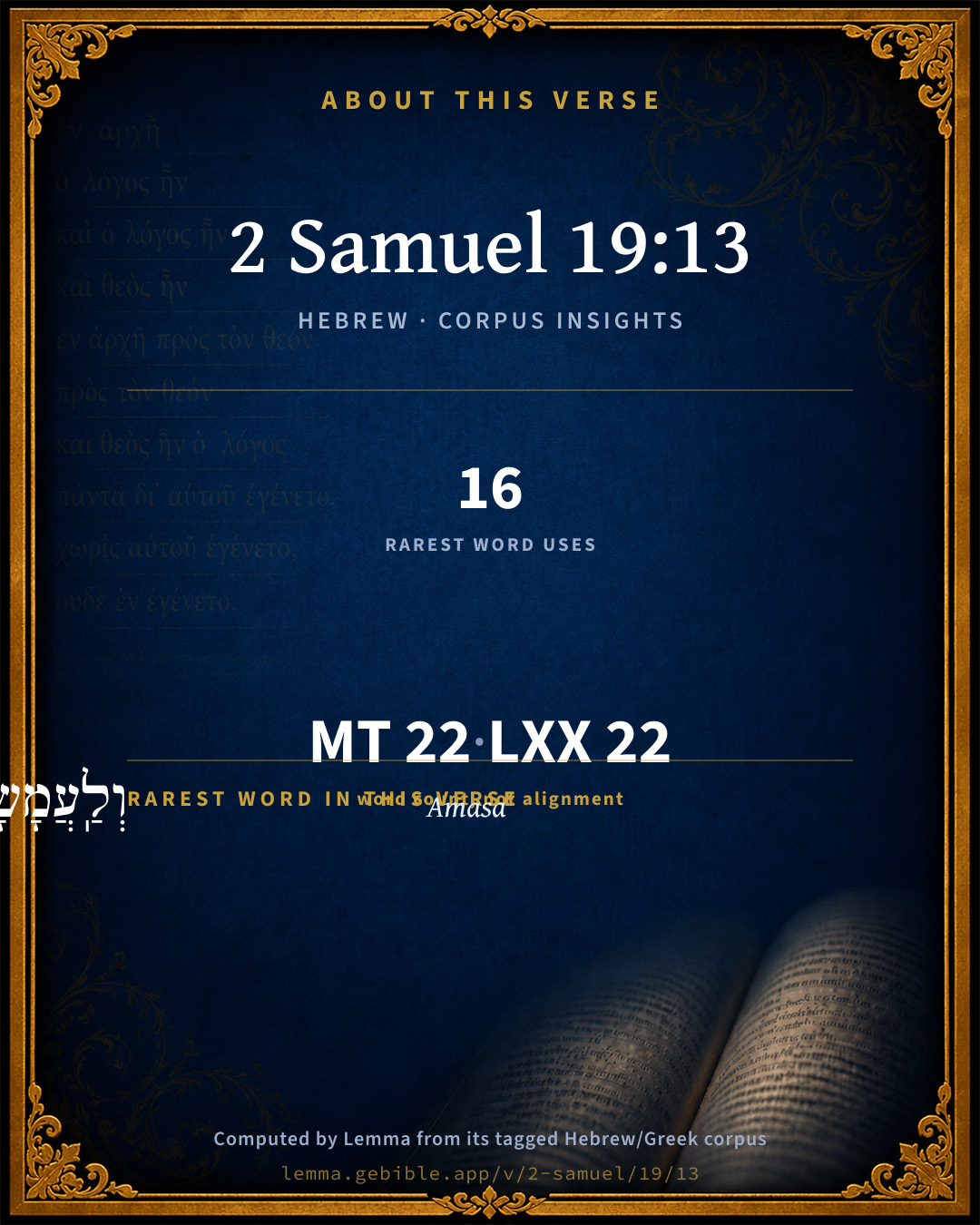
22
words
19
distinct lemmas
Historical
section

Notable vocabulary

The rarest word here is וְלַֽעֲמָשָׂא֙ Amasa H6021 — appearing just 16 times in the whole Hebrew Bible.

Shared distinctive vocabulary

וְלַֽעֲמָשָׂא֙ Amasa H6021 occurs in 12 verses of the Hebrew Bible. Also found in:

Grammatical profile

  • 4 verbs
  • 10 nouns
  • 1 pronoun
  • 2 prepositions
  • 1 conjunction
  • 2 adverbs
  • 2 particles

Verb forms

  • תֹּֽמְר֔וּ Qal · Imperfect
  • יַֽעֲשֶׂה Qal · Jussive
  • יוֹסִ֔יף Hiphil · Jussive
  • תִּהְיֶ֧ה Qal · Imperfect

Repetition

Words recur within this verse — often emphatic in Hebrew:

  • כֹּ֣ה thus H3541 ×2
  • הֲל֛וֹא not H3808 ×2

Hebrew & Septuagint length

In English translation the verse runs 34 words from the Hebrew and 41 from the Septuagint (LXX English) — closely comparable.

A rough comparison of the two English renderings, which tokenize alike — not a word-level alignment.

Word counts can differ between the Hebrew and the Greek without any difference in meaning — e.g. the Hebrew direct-object marker אֵת has no separate Greek word, and Greek often adds the article ὁ.

In the original languages it is 22 Hebrew tokens and 22 Greek tokens — but the two are counted differently (Hebrew bundles its prefixes and suffixes into one token; the Greek is in lemma form), so that isn’t a like-for-like length.

Cross-references

9

Topical passages linked to 2 Samuel 19:13 in the Treasury of Scripture Knowledge — connected by theme and wording, ordered by reader-vote popularity; previews shown in the World English Bible.

  • 2 Samuel 17:25 Absalom set Amasa over the host instead of Joab. Now Amasa was the son of a man, whose name was Ithra the Israelite, who went in to Abigail the daughter of Nahash, sister to Zeruiah, Joab's mother.
  • Ruth 1:17 where you die, will I die, and there will I be buried: Yahweh do so to me, and more also, if anything but death part you and me."
  • 2 Samuel 8:16 Joab the son of Zeruiah was over the host; and Jehoshaphat the son of Ahilud was recorder;
  • 1 Kings 19:2 Then Jezebel send a messenger to Elijah, saying, So let the gods do to me, and more also, if I don't make your life as the life of one of them by tomorrow about this time.
  • 2 Samuel 3:29–30 let it fall on the head of Joab, and on all his father's house; and let there not fail from the house of Joab one who has an issue, or who is a leper, or who leans on a staff, or who falls by the sword, or who lacks bread.
  • 2 Samuel 19:5–7 Joab came into the house to the king, and said, You have shamed this day the faces of all your servants, who this day have saved your life, and the lives of your sons and of your daughters, and the lives of your wives, and the lives of your concubines;
  • 2 Samuel 18:11 Joab said to the man who told him, Behold, you saw it, and why didn't you strike him there to the ground? and I would have given you ten [pieces of] silver, and a sash.
  • 1 Chronicles 2:16–17 and their sisters were Zeruiah and Abigail. The sons of Zeruiah: Abishai, and Joab, and Asahel, three.
  • 1 Chronicles 12:18 Then the Spirit came on Amasai, who was chief of the thirty, [and he said], "We are yours, David, and on your side, you son of Jesse: peace, peace be to you, and peace be to your helpers; for your God helps you." Then David received them, and made them captains of the band.

Cross-references courtesy of OpenBible.info (CC BY 4.0).

Hebrew and Greek witnesses Masoretic Hebrew ↔ Greek Septuagint

The same verse in the two great witnesses to the Old Testament, shown verse-for-verse.

These are two independent witnesses, not word-aligned to each other, and the Septuagint is shown in lemma (dictionary) form.

Hebrew 2 Samuel 19:13 Masoretic · Westminster Leningrad Codex

וְלַֽעֲמָשָׂא֙ תֹּֽמְר֔וּ הֲל֛וֹא עַצְמִ֥י וּבְשָׂרִ֖י אָ֑תָּה כֹּ֣ה יַֽעֲשֶׂה לִּ֤י אֱלֹהִים֙ וְכֹ֣ה יוֹסִ֔יף אִם לֹ֠א שַׂר צָבָ֞א תִּהְיֶ֧ה לְפָנַ֛י כָּל הַיָּמִ֖ים תַּ֥חַת יוֹאָֽב

Say you to Amasa, Aren't you my bone and my flesh? God do so to me, and more also, if you aren't captain of the host before me continually in the room of Joab.

World English Bible · Public Domain

Greek LXX 2 Samuel 19:13 Septuagint · lemma form

ἀδελφός ἐγώ σύ ὀστέον ἐγώ καί σάρξ ἐγώ σύ καί ἵνα τίς γίγνομαι ἔσχατος ὁ ἐπιστρέφω ὁ βασιλεύς εἰς ὁ οἶκος αὐτός

And you⌃ shall say to Amessai, Are you not my bone and my flesh? and now God do so to me, and more also, if you shall not be commander of the host before me continually in the room of Joab.

LXX2012 (modern English Septuagint) · Public Domain

Hebrew: Westminster Leningrad Codex (CC BY 4.0). Greek: Septuagint (public domain); English from LXX2012 (modern English Septuagint) (Public Domain). How the Septuagint differs from the Hebrew →

Targum (Aramaic paraphrase)

1

The Targum is the ancient Jewish Aramaic paraphrase of the Hebrew Scriptures — an interpretive translation, not the Hebrew text itself. Onkelos (literal) and Pseudo-Jonathan (expansive) render the Torah, and Jonathan the Prophets. Coverage is partial: where no permissively-licensed English translation exists for a verse, only the Aramaic is shown. This is verse-level text, not a word-by-word alignment to the Hebrew.

  1. Targum Jonathan Prophets (Joshua–Malachi)
    אֲחַי אַתּוּן קְרִיבַי וּבִסְרַי אַתּוּן וּלְמָא תְהוֹן בַּתְרָאִין לַאֲתָבָא יַת מַלְכָּא:

    (no public-domain English translation for this verse)

    Targum Jonathan — Aramaic: “Mikraot Gedolot” (public domain). English: “Sefaria Community Translation” (CC0 1.0 (public-domain dedication)); “London "Chaldee Paraphrase," 1871” (public domain). Text via Sefaria.

Commentary

Notes on 2 Samuel 19:13 from classic Christian and Jewish commentators (each source and its license shown beneath its notes). The classic Christian expositions comment on the surrounding passage and are grouped to its opening verse, so a note may address several verses; the Jewish commentaries on the Tanakh (Rashi and others) are per-verse, so they appear only where the commentator wrote on this verse.

Lemma curates 59 commentaries, every one of them public domain or Creative Commons licensed, each selected and text-cleaned for this edition rather than reprinted as found. About our sources →

Trapp's Complete Commentary

John Trapp

2Sa 19:13 And say ye to Amasa, [Art] thou not of my bone, and of my flesh? God do so to me, and more also, if thou be not captain of the host before me continually in the room of Joab.

Ver. 13. And say ye to Amasa.] Who having been Absalom’s captain general, had still the command of the strong tower of Zion, and of the city of Jerusalem, and so might have raised further troubles and tragedies had he not been thus won over by promise of free pardon and highest preferment.

Art thou not of my bone? &c.] Mine own sister’s son, and not a bastard neither, as some would prove from 2Sa 17:25. And should not good blood bewray itself?

God do so to me, and more also.] Ita faciat mihi Deus, et ita pergat. So? How? So as I cannot tell how: it importeth the heaviest penalty: it being a fearful thing to fall into the punishing hands of the living God.

In the room of Joab.] Who, though faithful to David, yet was always overbold with him, and therefore suspected by him, nequid novi in eum moliretur, saith Theodoret, lest he should work some treason. The murder of Abner also was fresh in David’s memory, who it seemeth was resolved to cut him off (as the French king did Biron lately), which he could not have done but by making Amasa generalissimo, who was of great power with all Israel. Thus David had designed it likely; but God had otherwise ordered it.

John Trapp, A Commentary or Exposition upon All the Books of the Old and New Testament (1647–1656) — public domain. Text from a community e-Sword module.

Joseph Benson's Commentary

2Sa 19:13. Say to Amasa, Art thou not of my bone, &c. — That is, nearly related to me, being my sister’s son. God do so to me, and more also, &c. — He solemnly promises to prefer him to the highest command in the kingdom; for he now thought it a fit time to depress Joab, who was grown insufferably insolent and imperious, and who, through his credit with the army, had protected himself in the commission of the greatest crimes. He had slain Abner most perfidiously in cold blood, and killed Absalom contrary to the king’s express command, and now lately had insulted him in his sorrow. Having, therefore, now an opportunity of transferring the command to another person, who had as great an interest in the people’s favour as Joab, he gladly embraces it, that so he might both chastise Joab for his faults, and rescue himself from the bondage in which that general had hitherto held him. Some, however, have thought that, considering Joab’s very faithful services to David in all the changes of his fortune, and that his violent measures proceeded in part from a regard to him, as judging them necessary for his safety and tranquillity, David’s conduct in this instance, in making Amasa captain of the host in Joab’s room, is not an amiable trait in his character, and was not a prudent step at this time, especially considering Joab’s violent temper: and, it must be acknowledged, it brought on the murder of Amasa.

Joseph Benson's Commentary on the Old and New Testaments (1811–1818) — public domain. Text from a community e-Sword module.

Tyndale Open Study Notes

Tyndale Open Resources

19:13 commander . . . in his place: Amasa’s appointment would be short-lived (20:7-10).

Tyndale Open Study Notes — © Tyndale Open Resources, licensed CC BY-SA 4.0. Text via the HelloAO Bible API.

Geneva Bible (1599)

Geneva Bible translators

By this policy David thought that by winning of the captain, he should have the hearts of all the people.

Geneva Bible (1599) marginal notes — public domain. Text via Bolls.life.

Jamieson, Fausset & Brown

Robert Jamieson, A. R. Fausset & David Brown

And say ye to Amasa, &c.--This also was a dextrous stroke of policy. David was fully alive to the importance, for extinguishing the rebellion, of withdrawing from that cause the only leader who could keep it alive; and he, therefore, secretly intimated his intention to raise Amasa to the command of the army in the place of Joab, whose overbearing haughtiness had become intolerable. The king justly reckoned, that from natural temper as well as gratitude for the royal pardon, he would prove a more tractable servant; and David, doubtless, intended in all sincerity to fulfil this promise. But Joab managed to retain his high position (see on Sa2 20:4-10).

Jamieson, Fausset & Brown — Commentary Critical and Explanatory on the Whole Bible (1871) — public domain (CC PDM 1.0). Text via the HelloAO Bible API.

Ellicott's Commentary for English Readers

(13) Say ye to Amasa.—Amasa, like Joab, was David’s nephew, although possibly his mother may have been only half-sister to David. In this offer of the command-in-chief to the rebel general, David adopted a bold, but a rash and unjust policy. Amasa should have been punished, not rewarded for his treason. He had given no evidence of loyalty, nor was there proof that he would be trustworthy. Moreover, this appointment would be sure to provoke the jealousy and hostility of Joab. But David had long been restless under the overbearing influence of Joab (see 2Sa_19:22; 2Sa_16:10; 2Sa_3:39), and now since he had murdered Absalom, was determined to be rid of him. He therefore took advantage of the opportunity by this means to win over to himself what remained of the military organisation of Absalom.

A Bible Commentary for English Readers, edited by Charles John Ellicott (1878–1897) — public domain. Text from a community e-Sword module.

The Cambridge Bible for Schools and Colleges

gen. ed. J. J. S. Perowne

13. Art thou not of my bone, and of my flesh] Art thou not my bone and my flesh, exactly as in 2Sa_19:12. Amasa was David’s nephew, the son of his sister or step-sister Abigail. See ch. 2Sa_17:25. Of course the message was to be privately conveyed to Amasa through the priests. It was a bold stroke of policy to promise the post of commander-in chief to the general of the rebel army. By so doing, David designed at once to secure the allegiance of that army, and to punish Joab for killing Absalom in defiance of his command. But it was hardly prudent. Joab was certain not to submit to it tamely: Amasa’s military skill was probably inferior, and his loyalty remained to be proved.

God do so, &c.] See note on ch. 2Sa_3:9.

in the room of Joab] i.e. instead of. Room = place, space, from A.-S. rúm, Germ. Raum. Cp. Mat_2:22.

The Cambridge Bible for Schools and Colleges (gen. ed. J. J. S. Perowne; Cambridge University Press, 1878–1918) — public domain. Text from a community e-Sword module.

John Gill's Exposition

And say ye to Amasa,.... Who was the general of Absalom's army, and who might fear he should never be pardoned, whoever was, and looked upon his case as desperate; who had led on the army with Absalom against the king's threes, and fought them:

art thou not of my bone, and of my flesh? nearly related to him, being his sister's son:

God do so to me, and more also: than he had done to Absalom; or he imprecates the greatest evil upon himself that could be thought of or named:

if thou be not captain of the host before me continually in the room of Joab; signifying that he would not only pardon the treason he had been guilty of, but raise him to the highest post in the army; and to assure him of it, of which he might be doubtful, considering what he had done to merit his displeasure, he makes this oath or imprecation. Joab had got his ill will by many instances, as by the murder of Abner, and now by slaying Absalom against his orders; and by his rude and insolent behaviour to him when lamenting the death of his son; he wanted to be rid of him, and now, having an opportunity of putting a valiant man into his place, and thereby attaching him to his interest, he was determined to make use of it.

John Gill's Exposition of the Whole Bible (1746–1763) — public domain (CC PDM 1.0). Text via the HelloAO Bible API.

Albert Barnes' Notes on the Bible

Of my bone ... - Render as in preceding verse, “art thou not my bone and my flesh?” It is curious to note how the phrase is used in 2Sa 5:1 of common descent from Israel, in 2Sa 19:12 of the closer kindred of the tribe of Judah, and in this verse of the yet nearer kindred between David and Amasa his sister’s son.

Captain ... in the room of Joab - It is very plain that David felt the weight of Joab’s overbearing influence to be very oppressive (compare 2Sa 19:22; 2Sa 3:39; 2Sa 16:10). He was, at this time, very angry with Joab for killing Absalom; and so, thinking it of vital importance to win over Amasa and the army of Judah, he did not scruple to offer him Joab’s high post.

Albert Barnes' Notes on the Bible (1834–1885) — public domain. Text from a community e-Sword/MySword module.

Haydock's Catholic Bible Commentary

Flesh? Amasa was his nephew, and as he had been appointed general by Absalom, his influence would be the greatest to bring back those who had given into the delusion. A sense of his misconduct would also render him more humble, and easier to manage than Joab, whose insolence caused him to be insupportable to the king. David designed to transfer the authority of the latter, (Calmet) which he had now enjoyed 23 years, since the taking of Sion. David’s promise did not oblige him to keep Joab in that office for life, if his conduct should prove unsatisfactory. Hence he appointed Amasa to pursue the rebels, and afterwards Abisai, setting Joab aside. But the haughty warrior supplanted both, and retained the command, as it were in spite of his sovereign, chap. xx. 4, 15., &c. (Haydock)

George Leo Haydock (1774–1849), Haydock's Catholic Family Bible and Commentary, 1859 edition — public domain. Excludes Psalms (Douay-Rheims chapter numbering differs from Protestant) and Deuterocanonical books (Catholic canon only).

Matthew Poole's English Annotations

Amasa, Absalom’s late general; who judging his case, above all others, desperate, might be ready to use all his interest with that tribe to delay or hinder the king’s return.

Of my bone, and of my flesh, i.e. my near kinsman, my nephew. See 1Ch 2:16,17.

Before me, i.e. in my presence, or now whilst I live; lest he should think he promised him only the reversion of it.

In the room of Joab; who, besides his other crimes, had lately exasperated the king by his wilful murder of Absalom, contrary to David’s express command; and by his insolent carriage towards him. And therefore the king having now the opportunity of another person, who had a greater interest both in Judah and Israel than Joab, he gladly complies with it, that so he might both chastise Joab for his faults, and rescue himself from the bondage in which Joab had hitherto held him. Yet it is not necessary, from those words in the room of Joab, to conclude that Joab was to be displaced to make room for Amasa, but that he might be in like condition with Joab; but what follows in the next chapter makes it very probable that he was indeed displaced, and Amasa put in his place.

Matthew Poole's English Annotations on the Holy Bible (1683–1685) — public domain. Text from a community e-Sword/MySword module.

Whedon's Commentary on the Bible

Daniel D. Whedon

13. Say ye to Amasa — Amasa had been captain of the rebel hosts, (2Sa_17:25,) and David hoped by honouring him to secure fully the allegiance of his disaffected subjects who had taken up arms against him; but this politic measure — the untimely offspring of his bitter enmity against Joab — was a serious and fatal error. It was also a measure dangerous to himself, and soon resulted in making Amasa the victim of Joab’s deadly jealousy. Chap. 2Sa_20:10.

Daniel D. Whedon (gen. ed.), Commentary on the Old and New Testaments (1874–1909) — public domain. Text from a community e-Sword module.

The Pulpit Commentary

Of my bone, and of my flesh; Hebrew, art thou not my bone and my flesh? a most near and dear relative. It is difficult to understand why in the Authorized Version this common metaphor in the Hebrew has been so meddled with, Ewald thinks that this purposed degradation of Joab and the substitution of Amasa in his stead was a wise and politic act. It was to some extent just, for Joab was a man stained with many murders; but politic it was not. Passing over the fact that Amasa had actually taken the command of the rebel army, he was an ambitious and selfish man, and could lay no claim to that sturdy fidelity which had characterized Joab throughout his long service. For all he had done had been for David"s good, and his advice, however roughly given, had averted grave misfortunes. Joab"s murder of Absalom was an act of wilful disobedience; but David had used Joab for a far meaner murder, committed, not for reasons of statesmanship; but for purposes of lust. The guilt of slaying Absalom was as nothing compared with that of slaying Uriah, nor was it so base as the assassination of Abner, which David had tolerated, though made angry by it. The dismissal of Joab could have been effected only by putting him to death, and this certainly he did not deserve at David"s hands; and the attempt, unless carried out secretly, would have led to tumult and insurrection. Joab, too, was a far more skilful general than Amasa, who, with larger forces, had just suffered a disastrous defeat; and if Joab was removed secretly, his brother Abishai remained to avenge him. David was, in fact, blinded by love for the son whom for so many years he had treated with coldness. There was a strong reaction now in the father"s mind, and under its influence he was prepared to sacrifice the nephew who had been faithful to him and saved him, for the nephew who had joined in Absalom"s rebellion. But possibly it had an immediate good effect, as Amasa, assured of forgiveness and promotion, now took David"s side.

The Pulpit Commentary (1880–1919), ed. H.D.M. Spence-Jones & Joseph S. Exell — public domain. Text from a community e-Sword module.

John Wesley's Explanatory Notes

Of Joab - Who, besides his other crimes, had lately exasperated the king by his murder of Absalom, contrary to David's express command. And therefore the king having now the opportunity of another person who had a greater interest than Joab, gladly complies with it, that so he might both chastise Joab for his faults, and rescue himself from the bondage in which Joab had hitherto held him.

John Wesley, Explanatory Notes Upon the Whole Bible (1754–1765) — public domain. Text via the GEBible commentary corpus.

Keil & Delitzsch

C. F. Keil & F. Delitzsch

"And say ye to Amasa, Art thou not my bone and flesh? so shall God do to me, and so add, if thou shalt not be prince of the army (chief captain) before me continually in the place of Joab."

Keil & Delitzsch — Biblical Commentary on the Old Testament (1861–1891) — public domain (CC PDM 1.0). Text via the HelloAO Bible API. (Old Testament only.)

unfoldingWord translationNotes

Door43 World Missions Community

Amasa

See how you translated this man's name in 2 Samuel 17:25. (See: How to Translate Names)

Are you not my flesh and my bone?

David uses this rhetorical question to emphasize that they are related. This can be written as a statement. AT: "You are my flesh and my bones." (See: Rhetorical Question)

my flesh and my bone

Here David speaks of them being related by saying that they have the same flesh and bones. See how you translated a similar phrase in 2 Samuel 19:12. AT: "my relative" (See: Metaphor)

God do so to me

This is an idiom that means for God to kill him. AT: "May God kill me" (See: Idiom)

he won the hearts

Here the mens' loyalty is referred to as their "hearts." AT: "he won the loyalty" (See: Metonymy)

as one man

This speaks of the men being united in their loyalty to the king as if they were one man with the same mind. AT: "and they were united together" or "they were united in their loyalty to the king" (See: Metaphor)

They sent to the king

This means that they sent a messenger to the king. AT: "They sent a messenger to the king" (See: Idiom)

translationWords

heart

Gilgal

unfoldingWord translationNotes — © Distant Shores Media and the Door43 World Missions Community, licensed CC BY-SA 4.0. Source: git.door43.org/Door43/en_tn.

Lesson kit

Teaching starters — assembled from the data on this page, not authored interpretation. Every prompt links to the verse data it draws on. Edit before teaching.

2 Samuel, in the Historical, opens this verse with 22 words (19 distinct Hebrew lemmas). Its most distinctive word is ʻĂmâsâʼ (“Amasa”). A historical commentator’s framing appears above. Read the whole chapter for the surrounding context.

Discussion questions

  1. The word ʻĂmâsâʼ carries the sense “Amasa.” How does it shape the verse?
  2. How does 2 Samuel 17:25, which shares the word «Amasa», read alongside this verse?
  3. What does the repetition of “thus” (2× in this one verse) do in this verse?
  4. The translations on this page render this verse differently — a whole-verse word diff, not a word-by-word alignment. What might account for the different wordings?
  5. «תֹּֽמְר֔וּ» is a Qal Imperfect verb. How does that grammatical form shape the action described?
  6. Compare how Trapp's Complete Commentary and Joseph Benson's Commentary read this verse. Where do they agree or differ?

Things to notice

Reading settings

Reading text

Shown beneath each verse's original-language words.

Old Testament
Old Testament edition

Read the OT as the Masoretic Hebrew (MT) or the Greek Septuagint (LXX).

English shown for the Greek Septuagint (in the Hebrew ↔ Greek comparison).

Comparing translations? Open the Compare panel on any verse page to stack up to four side by side.