
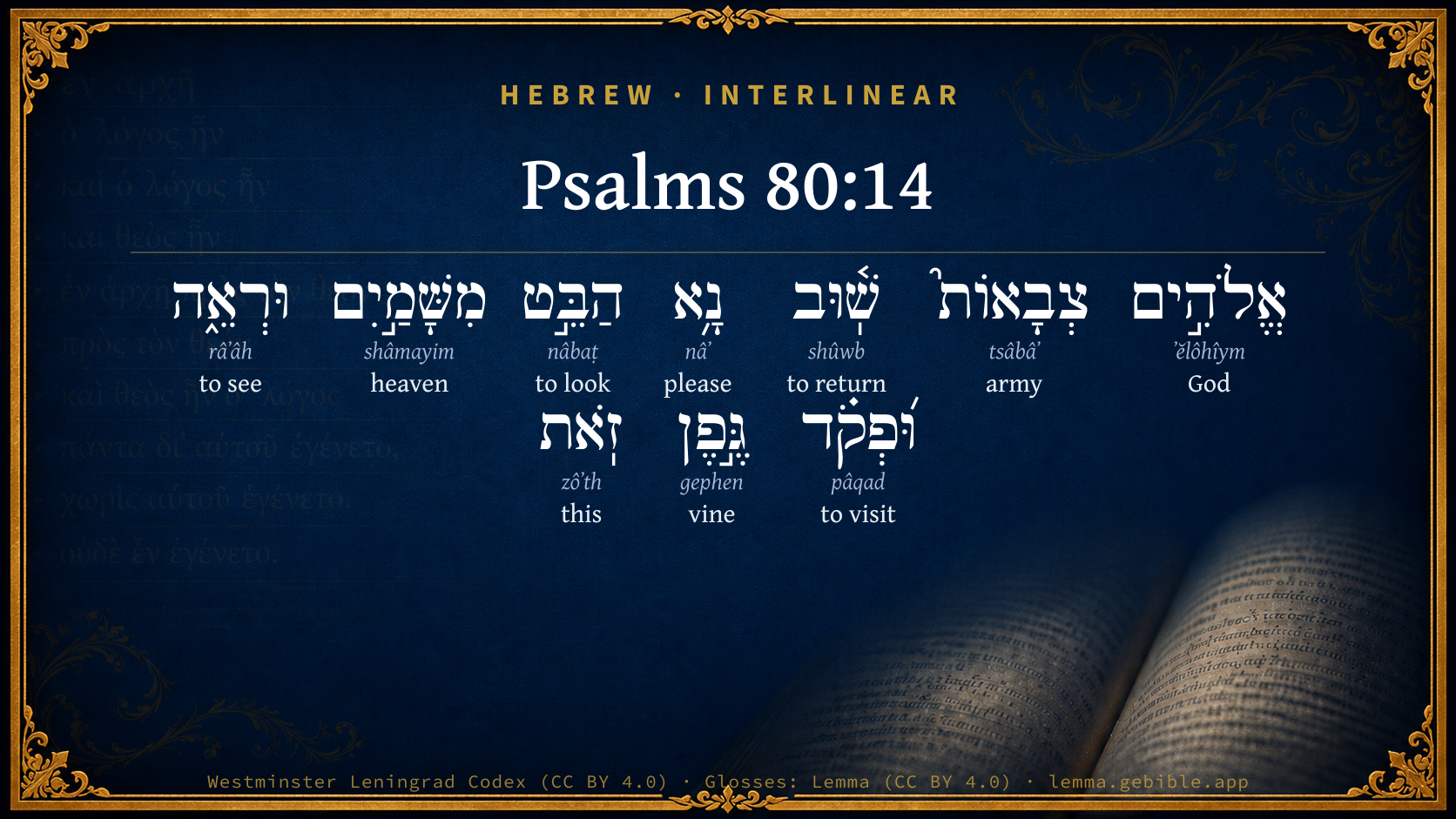
Psalms 80:14

Hebrew (Westminster Leningrad Codex) Psalms 80:14 appears in the Hebrew Old Testament. The text above is from the Westminster Leningrad Codex. Each word links to its Strong’s number, a concise gloss, and parsing drawn from the Open Scriptures Hebrew Bible morphology. Click any word for its full Brown-Driver-Briggs (BDB) entry.
Download image
Cite this verse

Psalms 80:14 (World English Bible). Public Domain. Lemma interlinear Bible study tool, https://lemma.gebible.app/v/psalms/80/14.

Show BibTeX & RIS
BibTeX
RIS
English Translation
Turn again, we beg you, God of hosts. Look down from heaven, and see, and visit this vine,
World English Bible · Public Domain
Download a study sheet

One document with this verse’s original text, its word-by-word gloss line, the meaning frame, cross-references with their text, attributed commentary, and full source and license credits — printable, and it pastes into notes with its structure intact.

This verse Autodidact and up

Study sheet (.html) Plain text (.txt)

A passage Seminary Student

Up to 50 verses in one chapter. A passage sheet keeps up to 6 commentary sources and 12 cross-references per verse, in the order this page ranks them, and says so on the sheet whenever that leaves anything out. Ask for a single verse and you get the Autodidact verse sheet above.

Everything on this page stays free to read, with no account — the sheet is a download of what is already on screen, not access to it.

Want to remove ads? Support Godless Engineer
Compare translations 3

The same verse in 3 English versions, stacked beneath the original-language interlinear above. Click any original word for its lexicon entry.

Each is an independent rendering of the whole verse — the interlinear is not word-aligned to these translations.

Highlighted words mark where these versions differ — a whole-verse word diff, not a word-by-word alignment.

  • World English Bible Public Domain
    Turn again, we beg you, God of hosts. Look down from heaven, and see, and visit this vine,
  • King James Version Public Domain
    Return, we beseech thee, O God of hosts: look down from heaven, and behold, and visit this vine;
  • unfoldingWord Literal Text CC BY-SA 4.0
    God of armies, return, please. Look down from heaven and see, and visit this vine,

unfoldingWord Literal Text — © unfoldingWord, licensed CC BY-SA 4.0. Word-aligned USFM3 via Door43 (git.door43.org/unfoldingWord/en_ult).

Versions to compare (up to 4)

3 of 4 selected

Show all 18 translations

Every available English version of this verse, each an independent rendering of the whole verse.

  • World English Bible Public Domain
    Turn again, we beg you, God of hosts. Look down from heaven, and see, and visit this vine,
  • Berean Standard Bible Public Domain
    Return, O God of Hosts, we pray! Look down from heaven and see! Attend to this vine—
  • Majority Standard Bible Public Domain
    Return, O God of Hosts, we pray! Look down from heaven and see! Attend to this vine—
  • King James Version Public Domain
    Return, we beseech thee, O God of hosts: look down from heaven, and behold, and visit this vine;
  • American Standard Version (1901) Public Domain
    Turn again, we beseech thee, O God of hosts: Look down from heaven, and behold, and visit this vine,
  • Revised Version (1885) Public Domain
    Turn again, we beseech thee, O God of hosts: look down from heaven, and behold, and visit this vine,
  • Geneva Bible (1599) Public Domain
    Returne we beseech thee, O God of hostes: looke downe from heauen and beholde and visite this vine,
  • Douay-Rheims (1899) Public Domain
    The boar out of the wood hath laid it waste: and a singular wild beast hath devoured it.
  • Young's Literal Translation Public Domain
    God of Hosts, turn back, we beseech Thee, Look from heaven, and see, and inspect this vine,
  • Literal Standard Version CC BY-SA 4.0
    God of Hosts, turn back, we implore You, || Look from the heavens, and see, and inspect this vine,
  • Unlocked Literal Bible CC BY-SA 4.0
    Turn back, God of hosts; look down from heaven and take notice and take care of this vine.
  • unfoldingWord Literal Text CC BY-SA 4.0
    God of armies, return, please. Look down from heaven and see, and visit this vine,
  • Darby Bible Public Domain
    O God of hosts, return, we beseech thee; look down from the heavens, and behold, and visit this vine;
  • World Messianic Bible Public Domain
    Turn again, we beg you, God of Hosts. Look down from heaven, and see, and visit this vine,
  • Webster's Bible Public Domain
    \\80:13\\The boar from the wood doth waste it, and the wild beast of the field doth devour it.
  • Free Bible Version CC BY-SA 4.0
    God Almighty, please return to us! Look down from heaven and see what's happening to us! Come and care for this vine
  • Bible in Basic English Public Domain
    Come back, O God of armies: from heaven let your eyes be turned to this vine, and give your mind to it,
  • JPS Tanakh (1917) Public Domain
    (80-15) O God of hosts, return, we beseech Thee; look from heaven, and behold, and be mindful of this vine,

Literal Standard Version (2020), Covenant Press — licensed CC BY-SA 4.0. Text via the HelloAO Bible API (eBible.org). Unlocked Literal Bible (unfoldingWord) — licensed CC BY-SA 4.0. Text via the HelloAO Bible API (eBible.org). unfoldingWord Literal Text — © unfoldingWord, licensed CC BY-SA 4.0. Word-aligned USFM3 via Door43 (git.door43.org/unfoldingWord/en_ult). Free Bible Version, Dr. Jonathan Gallagher — licensed CC BY-SA 4.0. Text via the HelloAO Bible API (eBible.org).

Word by word

More ways to search: Search by grammar → Find every occurrence → Compare this word →

Practice this passage: Drill this verse → Learn its vocabulary →

גֶּ֣פֶן
gephen
H1612
“vine”
Noun, Common, Both, Singular, Absolute
Part of Speech
Noun
Type
Common
Gender
Both
Number
Singular
State
Absolute
Full BDB Definition

Origin: from an unused root meaning to bend

TWOT: 372a

vine, vine tree - of Israel (figuratively) - of stars fading at Jehovah's judgment (metaphorically) - of prosperity
  1. אֱלֹהִ֣ים ʼĕlôhîym H430 “God(s)” Noun, Common, Masculine, Plural, Absolute
  2. צְבָאוֹת֮ tsâbâʼ H6635 “armies” Noun, Common, Both, Plural, Absolute
  3. שֽׁ֫וּב shûwb H7725 “return” Verb, Qal, Imperative, 2nd Person, Masculine, Singular
  4. נָ֥א nâʼ H4994 “please” Particle, Exhortation
  5. הַבֵּ֣ט nâbaṭ H5027 “look” Verb, Hiphil, Imperative, 2nd Person, Masculine, Singular
  6. מִשָּׁמַ֣יִם shâmayim H8064 “from · heaven(s)” Preposition + Noun, Common, Masculine, Plural, Absolute
  7. וּרְאֵ֑ה râʼâh H7200 “and · see” Conjunction + Verb, Qal, Imperative, 2nd Person, Masculine, Singular
  8. וּ֝פְקֹ֗ד pâqad H6485 “and · visit” Conjunction + Verb, Qal, Imperative, 2nd Person, Masculine, Singular
  9. זֹֽאת zôʼth H2063 “this” Pronoun, Demonstrative, Feminine, Singular

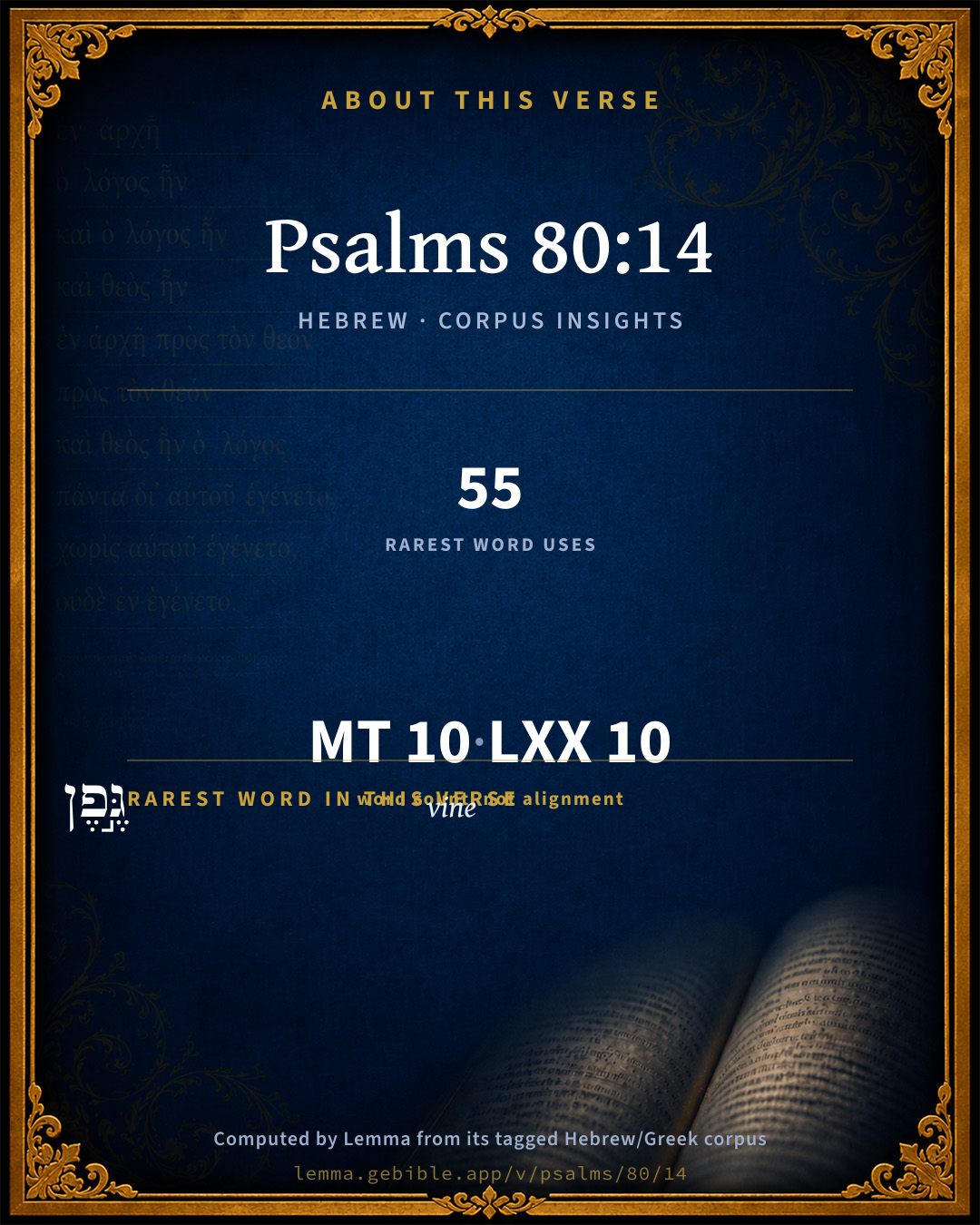
About this verse

These counts appear in no published source. They are computed here, from the morphology-tagged text and Lemma’s own curated glosses. What Lemma adds →

10
words
10
distinct lemmas
Wisdom
section

Shared distinctive vocabulary

גֶּ֣פֶן vine H1612 occurs in 53 verses of the Hebrew Bible. Also found in:

Grammatical profile

  • 4 verbs
  • 4 nouns
  • 1 pronoun
  • 1 particle

Verb forms

  • שֽׁ֫וּב Qal · Imperative
  • הַבֵּ֣ט Hiphil · Imperative
  • וּרְאֵ֑ה Qal · Imperative
  • וּ֝פְקֹ֗ד Qal · Imperative

Hebrew & Septuagint length

In English translation the verse runs 18 words from the Hebrew and 19 from the Septuagint (LXX English) — closely comparable.

A rough comparison of the two English renderings, which tokenize alike — not a word-level alignment.

Word counts can differ between the Hebrew and the Greek without any difference in meaning — e.g. the Hebrew direct-object marker אֵת has no separate Greek word, and Greek often adds the article ὁ.

In the original languages it is 10 Hebrew tokens and 10 Greek tokens — but the two are counted differently (Hebrew bundles its prefixes and suffixes into one token; the Greek is in lemma form), so that isn’t a like-for-like length.

Cross-references

10

Topical passages linked to Psalms 80:14 in the Treasury of Scripture Knowledge — connected by theme and wording, ordered by reader-vote popularity; previews shown in the World English Bible.

  • Isaiah 63:15 Look down from heaven, and see from the habitation of your holiness and of your glory: where are your zeal and your mighty acts? the yearning of your heart and your compassion is restrained toward me.
  • Psalms 90:13 Relent, Yahweh! How long? Have compassion on your servants!
  • Isaiah 63:17 O Yahweh, why do you make us to err from your ways, and harden our heart from your fear? Return for your servants' sake, the tribes of your inheritance.
  • Daniel 9:16–19 Lord, according to all your righteousness, let your anger and please let your wrath be turned away from your city Jerusalem, your holy mountain; because for our sins, and for the iniquities of our fathers, Jerusalem and your people are become a reproach to all who are round about us.
  • Malachi 3:7 From the days of your fathers you have turned aside from my ordinances, and have not kept them. Return to me, and I will return to you," says Yahweh of Hosts. "But you say, 'How shall we return?'
  • Psalms 7:7 Let the congregation of the peoples surround you. Rule over them on high.
  • Psalms 33:13 Yahweh looks from heaven. He sees all the sons of men.
  • Lamentations 3:50 Until Yahweh look down, and see from heaven.
  • Joel 2:14 Who knows? He may turn and relent, And leave a blessing behind him, Even a meal offering and a drink offering to Yahweh, your God.
  • Acts 15:16 'After these things I will return. I will again build the tent of David, which has fallen. I will again build its ruins. I will set it up,

Cross-references courtesy of OpenBible.info (CC BY 4.0).

Hebrew and Greek witnesses Masoretic Hebrew ↔ Greek Septuagint

The same verse in the two great witnesses to the Old Testament, shown verse-for-verse.

You’re reading Greek Psalm 79 (Hebrew Psalm 80). The Septuagint counts the superscription, so verse numbers can differ from the Hebrew — chapter-level alignment, not verse-by-verse. Numbering follows Rahlfs.

These are two independent witnesses, not word-aligned to each other, and the Septuagint is shown in lemma (dictionary) form.

Hebrew Psalms 80:14 Masoretic · Westminster Leningrad Codex

אֱלֹהִ֣ים צְבָאוֹת֮ שֽׁ֫וּב נָ֥א הַבֵּ֣ט מִשָּׁמַ֣יִם וּרְאֵ֑ה וּ֝פְקֹ֗ד גֶּ֣פֶן זֹֽאת

Turn again, we beg you, God of hosts. Look down from heaven, and see, and visit this vine,

World English Bible · Public Domain

Greek LXX Greek Psalm 79:14 Septuagint · lemma form

λυμαίνω αὐτός σῦς ἐκ δρυμός καί μονιός ἄγριος κατανέμω αὐτός

O God of hosts, turn, we pray you: look on us from heaven, and behold and visit this vine;

LXX2012 (modern English Septuagint) · Public Domain

Hebrew: Westminster Leningrad Codex (CC BY 4.0). Greek: Septuagint (public domain); English from LXX2012 (modern English Septuagint) (Public Domain). How the Septuagint differs from the Hebrew →

Commentary

Notes on Psalms 80:14 from classic Christian and Jewish commentators (each source and its license shown beneath its notes). The classic Christian expositions comment on the surrounding passage and are grouped to its opening verse, so a note may address several verses; the Jewish commentaries on the Tanakh (Rashi and others) are per-verse, so they appear only where the commentator wrote on this verse.

Lemma curates 59 commentaries, every one of them public domain or Creative Commons licensed, each selected and text-cleaned for this edition rather than reprinted as found. About our sources →

Trapp's Complete Commentary

John Trapp

Psa 80:14 Return, we beseech thee, O God of hosts: look down from heaven, and behold, and visit this vine;

Ver. 14. Visit this vine] Some understand it of Christ’s incarnation, Luk 1:78.

John Trapp, A Commentary or Exposition upon All the Books of the Old and New Testament (1647–1656) — public domain. Text from a community e-Sword module.

J. A. Alexander on Psalms

Joseph Addison Alexander

15. (Psa 80:14) O God, (God of) Hosts, pray return, look from heaven and see and visit this vine. The expostulation and complaint are followed by an earnest prayer. Pray return is used to represent the Hebrew particle of entreaty, expressed in the English Bible by a circumlocution (we beseech thee). The prayer that God will return, implies that the evils just complained of were occasioned by his absence. Visit, manifest thy presence and thy favourable disposition. See above, on Psa 8:4. This vine, Israel, the church or chosen people, which, though robbed of some of its luxuriant branches, still lives and is yet to bear abundant fruit.

Joseph Addison Alexander, The Psalms Translated and Explained (1850) — public domain. Text from a community e-Sword module.

Geneva Bible (1599)

Geneva Bible translators

They gave not place to tentation, knowing that albeit there were no help in earth, yet God was able to succor them from heaven.

Geneva Bible (1599) marginal notes — public domain. Text via Bolls.life.

Adam Clarke's Commentary

Verse 14. Return - O God of hosts] Thou hast abandoned us, and therefore our enemies have us in captivity. Come back to us, and we shall again be restored.

Behold, and visit this vine] Consider the state of thy own people, thy own worship, thy own temple. Look down! Let thine eye affect thy heart.

Adam Clarke's Commentary on the Bible (1810–1826) — public domain. Text from a community e-Sword/MySword module.

John Calvin's Commentaries

14. Return, I beseech thee, O God of Hosts! In these words it is intended to teach, that we ought not to yield to temptation although God should hide his face from us for a time, yea even although to the eye of sense and reason he should seem to be alienated from us. For, provided he is sought in the confident expectation of his showing mercy, he will become reconciled, and receive into his favor those whom he seemed to have cast off. It was a distinguished honor for the seed of Abraham to be accounted the vineyard of God; but while the faithful adduce this consideration as an argument for obtaining the favor of God, instead of bringing forward any claims of their own, they only beseech him not to cease to exercise his accustomed liberality towards them. The words, from heaven, have, no doubt, been introduced, that the faithful might find no difficulty in extending their faith to a distance, although God, from whom they had departed, was far from them; and, farther that if they saw no prospect of deliverance upon earth, they might lift up their eyes to heaven.

John Calvin's Commentaries (1540-1563) — public domain. Text from the Calvin Translation Society English edition (1840s-50s) via the Christian Classics Ethereal Library (ccel.org). Calvin's coverage is partial (roughly two-thirds of the Bible); uncommented books and verses are honest gaps, never fabricated. The 19th-century editor's footnotes and remarks are omitted so the notes are faithfully Calvin's own voice.

The Cambridge Bible for Schools and Colleges

gen. ed. J. J. S. Perowne

14. Return] Or, as R.V., Turn again. It is the intransitive form of the verb turn us again in Psa_80:3; Psa_80:7; Psa_80:19.

14–19. Repeated prayers for the restoration of God’s favour to Israel.

The Cambridge Bible for Schools and Colleges (gen. ed. J. J. S. Perowne; Cambridge University Press, 1878–1918) — public domain. Text from a community e-Sword module.

John Gill's Exposition

And the vineyard which thy right hand hath planted,.... The word "Cannah" is only used in this place, and the first letter of it is larger than usual, to keep in perpetual remembrance, as is thought by some (t), the bringing of this vine out of Egypt, and the great things done for it in the land of Israel; and the letter, being crooked, may denote the oppression of this vine by various calamities. The Targum renders the word, a branch or shoot; and Kimchi, according to the scope of the place, a plant; and observes, that others interpret it an habitation or dwelling place; and so may be understood of Jerusalem, or the temple. Aben Ezra takes it to be an adjective, and to signify "prepared" or "established", which is said of this vine, Psa 80:9. It is an Egyptian word used by the psalmist, treating of the vine brought out of Egypt, and signifies a plant; hence the ivy is by the Greeks called the plant of Osiris (u); the clause carries in it a reason or argument, enforcing the above petition, taken from this vine being of the Lord's planting, as in Psa 80:8 and therefore his own honour and glory were concerned in it:

and the branch that thou madest strong for thyself: meaning the same thing, and the same people whom he confirmed in the land of Canaan, and made strong for his service and glory. The word (w) translated "branch" signifies a son, as Israel was, to the Lord, son and firstborn. The Targum understands it of Christ, and paraphrases it thus,

"and for the King Messiah, whom thou hast strengthened for thyself;''

that is, for the sake of Christ, whom thou hast appointed to work out the salvation of thy people by his great strength, and who was to come from this vine, or descend from Israel; for the sake of him destroy it not, nor suffer it to be destroyed; and is the same with the Son of man, Psa 80:17, and so it is read in a manuscript.

(t) Vid. Buxtorf. Tiberias, c. 14. (u) Plutarch de lsid. & Osir. (w) "super filium", V. L. Pagninus, Montanus, Musculus; "propter filium", Junius & Tremellius, Michaelis.

John Gill's Exposition of the Whole Bible (1746–1763) — public domain (CC PDM 1.0). Text via the HelloAO Bible API.

Albert Barnes' Notes on the Bible

Return, we beseech thee, O God of hosts - Again come and visit thy people; come back again to thy forsaken land. This is language founded on the idea that God had withdrawn from the land, or had forsaken it; that he had left his people without a protector, and had left them exposed to the ravages of fierce foreign enemies. It is language which will describe what seems often to occur when the church is apparently forsaken; when there are no cheering tokens of the divine presence; and when the people of God, discouraged, seem themselves to be forsaken by him. Compare Jer 14:8.

Look down from heaven - The habitation of God. As if he did not now see his desolate vineyard, or regard it. The idea is, that if he would look upon it, he would pity it, and would come to its relief.

And behold, and visit this vine - It is a visitation of mercy and not of wrath that is asked; the coming of one who is able to save, and without whose coming there could be no deliverance.

Albert Barnes' Notes on the Bible (1834–1885) — public domain. Text from a community e-Sword/MySword module.

The Treasury of David

Charles H. Spurgeon

Ver. 14. Return, we beseech thee, O God of hosts. Turn thyself to us as well as us to thee. Thou hast gone from us because of our sins, come back to us, for we sigh and cry after thee. Or, if it be too much to ask thee to come then do at least give us some consideration and cast an eye upon our griefs.

Look down from heaven, and behold, and visit this vine. Do not close thine eyes; it is thy vine, do not utterly turn away from it as though it were quite gone from thy mind. Great Husbandman, at least note the mischief which the beasts have done, for then it may be thy heart will pity, and thy hand will be outstretched to deliver.

Ver. 8-19. See Psalms on "Ps 80:8" for further information.

Ver. 14. Look down from heaven, and behold. This prayer is fit for none but the truly contrite, and those who are in heart returning. Otherwise, with what conscience could we entreat God to look down from heaven and behold our affairs? Should we not inflame his anger all the more, if, besides living in sin, we dared to challenge the all holy eyes of God to behold from heaven our wickedness? Musculus.

Ver. 14. Look down from heaven. Thou hast gone far from us, thou hast ascended to heaven. Thou hast departed from us, look down at least upon us from heaven, if thou art not willing to descend to earth, if our sins do not merit this. Savonarola.

Ver. 14. Visit this vine. Still it has roots, still some branches are living. In the beginning of the world it began, and never has failed, and never will. For thou hast said, Lo, I am with you always, even unto the end of the world. It may be diminished, it can never utterly fall. This vine is the vine which thou hast planted. There is one spirit, one faith, one baptism, one God, and Lord of all, who is all in all. Visit, then, this vine, for thy visitation preserves her spirit; visit by thy grace, by thy presence, by thy Holy Spirit. Visit with thy rod, and with thy staff; for thy rod and thy staff comfort her. Visit with thy scourge that she may be chastened and purified, for the time of pruning comes. Cast out the stones, gather up the dry branches, and bind them in bundles for burning. Raise her up, cut off the superfluous shoots, make fast her supports, enrich the soil, build up the fence, and visit this vine, as now thou visitest the earth and watereth it. Savonarola.

Charles H. Spurgeon's The Treasury of David (1869–1885) — public domain. Psalms only. Text from a community e-Sword/MySword module.

The Pulpit Commentary

Return, we beseech thee, O God of hosts; i.e. "come back to us, to be our Helper and Defender." Look down from heaven, and behold. Condescend to "look down" upon us "from heaven," thy dwelling place, and "behold take note of our condition, see how we suffer, and thou wilt be sure to visit this vine; i.e. to "visit" it, not in wrath, but in loving kindness and compassion to "visit it with thy salvation". (Psa_106:4)

The Pulpit Commentary (1880–1919), ed. H.D.M. Spence-Jones & Joseph S. Exell — public domain. Text from a community e-Sword module.

unfoldingWord translationNotes

Door43 World Missions Community

General Information:

Asaph finishes speaking of Israel in their land as if Israel were a grapevine in a vineyard.

Turn back

The writer wants God to turn back in order to help them. This can be stated explicitly. AT: "Turn back to us" or "Come and help us again" (See: Assumed Knowledge and Implicit Information)

take notice

"look at"

this vine

The writer continues comparing the nation of Israel to the vine. (See: Metaphor)

This is the root that your right hand planted

The right hand represents the Yahweh's power and control. AT: "This is the root that you, Yahweh, planted" (See: Metonymy)

shoot

the part of a new plant that is just starting to grow above the ground. See how you translated this in Psalms 80:11.

down; they perish because of your rebuke

Possible meanings are 1) "down; your people perish because of your rebuke." or 2) "down. May your enemies perish because of your rebuke!"

translationWords

turn

Yahweh of hosts

heaven

right hand

perish

rebuke

unfoldingWord translationNotes — © Distant Shores Media and the Door43 World Missions Community, licensed CC BY-SA 4.0. Source: git.door43.org/Door43/en_tn.

Rashi

Rabbi Shlomo Yitzchaki (Rashi)

The boar from the forest gnaws at it Heb. יכרסמנה, as (Peah 2:7): “A field that the ants have nibbled (קרסמוה),” an expression of plucking out.

from the forest Heb. מיער. The “ayin” is suspended (as though it were written with an “aleph”). If Israel is worthy, the enemies are like the beasts of the river, which have no strength to climb out upon the dry land; but when retribution is decreed upon them, he (sic) grows strong as the beast of the forest, which destroys and kills. The boar of the forest is Esau, as is written (Dan. 7:7): “It devoured and broke in pieces and the rest it trampled with its feet.” And it (the swine) has some signs of purity. Esau, too, has the merit of his fathers.

and the creeping things of the field Heb. זיז, all creeping things of the field. The expression זיז means anything that constantly moves from its place.

graze upon it Graze upon it and its branches and eat them.

Rashi on the Tanakh — English translations: “The Judaica Press complete Tanach with Rashi, translated by A. J. Rosenberg” (CC BY 4.0); “Pentateuch with Rashi's commentary by M. Rosenbaum and A.M. Silbermann, 1929-1934” (public domain); “The Metsudah Tanach series, Lakewood, N.J” (CC BY 4.0); and “The Book of Joshua, Metsudah Publications, 1997” (CC BY 4.0). Text via Sefaria.

Lesson kit

Teaching starters — assembled from the data on this page, not authored interpretation. Every prompt links to the verse data it draws on. Edit before teaching.

Psalms, in the Wisdom, opens this verse with 10 words (10 distinct Hebrew lemmas). Its most distinctive word is gephen (“vine”). A historical commentator’s framing appears above. Read the whole chapter for the surrounding context.

Discussion questions

  1. How does “vine” (gephen) shape what this verse is saying?
  2. How does Genesis 40:9, which shares the word «vine», read alongside this verse?
  3. These translations render this verse differently. What is at stake in choosing one wording over another?
  4. «שֽׁ֫וּב» is a Qal Imperative verb. How does that grammatical form shape the action described?
  5. Compare how Trapp's Complete Commentary and J. A. Alexander on Psalms read this verse. Where do they agree or differ?

Things to notice

Reading settings

Reading text

Shown beneath each verse's original-language words.

Old Testament
Old Testament edition

Read the OT as the Masoretic Hebrew (MT) or the Greek Septuagint (LXX).

English shown for the Greek Septuagint (in the Hebrew ↔ Greek comparison).

Comparing translations? Open the Compare panel on any verse page to stack up to four side by side.