
Deuteronomy 4:19

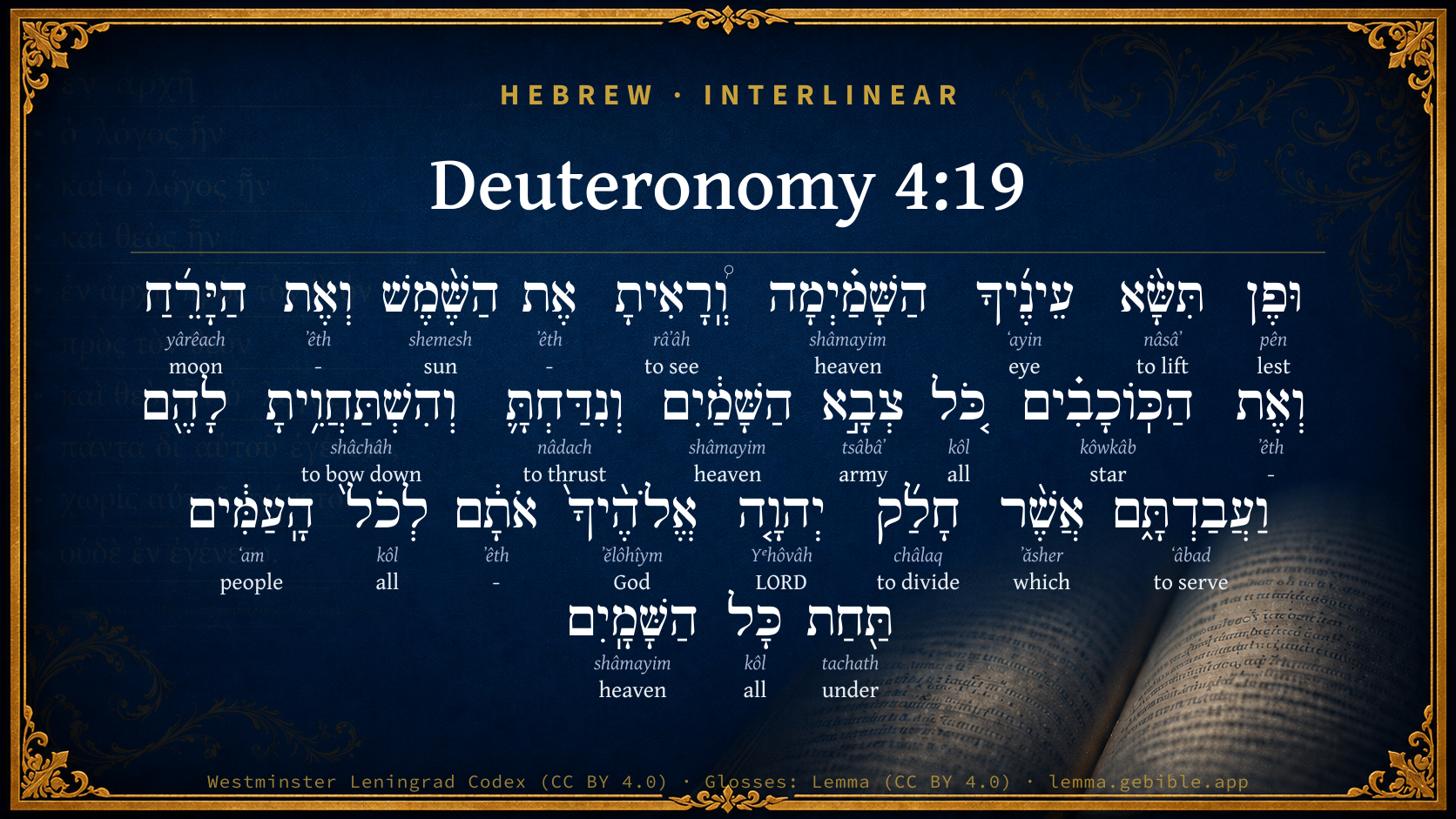
Hebrew (Westminster Leningrad Codex) Deuteronomy 4:19 appears in the Hebrew Old Testament. The text above is from the Westminster Leningrad Codex. Each word links to its Strong’s number, a concise gloss, and parsing drawn from the Open Scriptures Hebrew Bible morphology. Click any word for its full Brown-Driver-Briggs (BDB) entry.
Download image
Cite this verse

Deuteronomy 4:19 (World English Bible). Public Domain. Lemma interlinear Bible study tool, https://lemma.gebible.app/v/deuteronomy/4/19.

Show BibTeX & RIS
BibTeX
RIS
English Translation
and lest you lift up your eyes to the sky, and when you see the sun and the moon and the stars, even all the host of the sky, you are drawn away and worship them, and serve them, which Yahweh your God has allotted to all the peoples under the whole sky.
World English Bible · Public Domain
Highlights
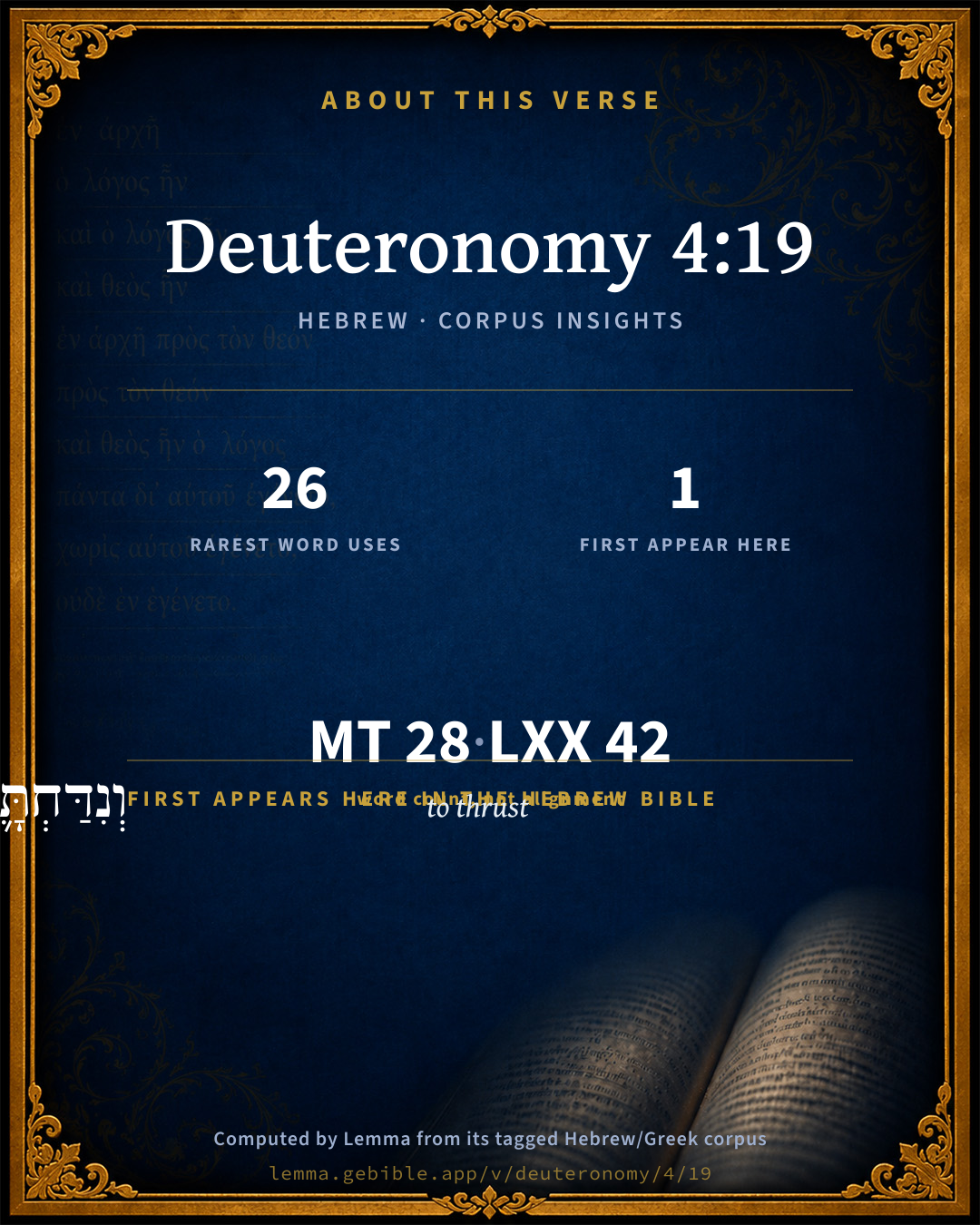
  • 1 first appearance in the Hebrew Bible
Full analysis ↓
Download a study sheet

One document with this verse’s original text, its word-by-word gloss line, the meaning frame, cross-references with their text, attributed commentary, and full source and license credits — printable, and it pastes into notes with its structure intact.

This verse Autodidact and up

Study sheet (.html) Plain text (.txt)

A passage Seminary Student

Up to 50 verses in one chapter. A passage sheet keeps up to 6 commentary sources and 12 cross-references per verse, in the order this page ranks them, and says so on the sheet whenever that leaves anything out. Ask for a single verse and you get the Autodidact verse sheet above.

Everything on this page stays free to read, with no account — the sheet is a download of what is already on screen, not access to it.

Want to remove ads? Support Godless Engineer
Compare translations 3

The same verse in 3 English versions, stacked beneath the original-language interlinear above. Click any original word for its lexicon entry.

Each is an independent rendering of the whole verse — the interlinear is not word-aligned to these translations.

Highlighted words mark where these versions differ — a whole-verse word diff, not a word-by-word alignment.

  • World English Bible Public Domain
    and lest you lift up your eyes to the sky, and when you see the sun and the moon and the stars, even all the host of the sky, you are drawn away and worship them, and serve them, which Yahweh your God has allotted to all the peoples under the whole sky.
  • King James Version Public Domain
    And lest thou lift up thine eyes unto heaven, and when thou seest the sun, and the moon, and the stars, even all the host of heaven, shouldest be driven to worship them, and serve them, which the LORD thy God hath divided unto all nations under the whole heaven.
  • unfoldingWord Literal Text CC BY-SA 4.0
    And lest you lift up your eyes to the heavens and see the sun and the moon and the stars, all the multitude of the heavens, and be seduced and bow down to them and serve them, those which Yahweh your God has allotted for all the peoples under all the heavens.

unfoldingWord Literal Text — © unfoldingWord, licensed CC BY-SA 4.0. Word-aligned USFM3 via Door43 (git.door43.org/unfoldingWord/en_ult).

Versions to compare (up to 4)

3 of 4 selected

Show all 18 translations

Every available English version of this verse, each an independent rendering of the whole verse.

  • World English Bible Public Domain
    and lest you lift up your eyes to the sky, and when you see the sun and the moon and the stars, even all the host of the sky, you are drawn away and worship them, and serve them, which Yahweh your God has allotted to all the peoples under the whole sky.
  • Berean Standard Bible Public Domain
    When you look to the heavens and see the sun and moon and stars—all the host of heaven—do not be enticed to bow down and worship what the LORD your God has apportioned to all the nations under heaven.
  • Majority Standard Bible Public Domain
    When you look to the heavens and see the sun and moon and stars—all the host of heaven—do not be enticed to bow down and worship what the LORD your God has apportioned to all the nations under heaven.
  • King James Version Public Domain
    And lest thou lift up thine eyes unto heaven, and when thou seest the sun, and the moon, and the stars, even all the host of heaven, shouldest be driven to worship them, and serve them, which the LORD thy God hath divided unto all nations under the whole heaven.
  • American Standard Version (1901) Public Domain
    and lest thou lift up thine eyes unto heaven, and when thou seest the sun and the moon and the stars, even all the host of heaven, thou be drawn away and worship them, and serve them, which Jehovah thy God hath allotted unto all the peoples under the whole heaven.
  • Revised Version (1885) Public Domain
    and lest thou lift up thine eyes unto heaven, and when thou seest the sun and the moon and the stars, even all the host of heaven, thou be drawn away and worship them, and serve them, which the LORD thy God hath divided unto all the peoples under the whole heaven.
  • Geneva Bible (1599) Public Domain
    And lest thou lift vp thine eyes vnto heauen, and when thou seest the sunne and the moone and the starres with all the host of heauen, shouldest bee driuen to worship them and serue them, which the Lord thy God hath distributed to all people vnder the whole heauen.
  • Douay-Rheims (1899) Public Domain
    Lest perhaps lifting up thy eyes to heaven, thou see the sun and the moon, and all the stars of heaven, and being deceived by error thou adore and serve them, which the Lord thy God created for the service of all the nations, that are under heaven.
  • Young's Literal Translation Public Domain
    `And lest thou lift up thine eyes towards the heavens, and hast seen the sun, and the moon, and the stars, all the host of the heavens, and thou hast been forced, and hast bowed thyself to them, and served them, which Jehovah thy God hath apportioned to all the peoples under the whole heavens.
  • Literal Standard Version CC BY-SA 4.0
    And lest you lift up your eyes to the heavens, and have seen the sun, and the moon, and the stars, all the host of the heavens, and have been drawn away, and have bowed yourself to them and served them, which your God YHWH has apportioned to all the peoples under all the heavens.
  • Unlocked Literal Bible CC BY-SA 4.0
    You shall not lift your eyes up to the heavens and look at the sun, the moon, or the stars—all the host of the heavens—and be drawn away to worship them and adore them—those things of which Yahweh your God has given a share all the peoples under the whole sky.
  • unfoldingWord Literal Text CC BY-SA 4.0
    And lest you lift up your eyes to the heavens and see the sun and the moon and the stars, all the multitude of the heavens, and be seduced and bow down to them and serve them, those which Yahweh your God has allotted for all the peoples under all the heavens.
  • Darby Bible Public Domain
    and lest thou lift up thine eyes to the heavens, and see the sun, and the moon, and the stars, the whole host of heaven, and be drawn away and bow down to them and serve them, which Jehovah thy God hath assigned unto all peoples under the whole heaven.
  • World Messianic Bible Public Domain
    and lest you lift up your eyes to the sky, and when you see the sun and the moon and the stars, even all the army of the sky, you are drawn away and worship them, and serve them, which the LORD your God has allotted to all the peoples under the whole sky.
  • Webster's Bible Public Domain
    And lest thou shouldst lift up thy eyes to heaven, and when thou seest the sun, and the moon, and the stars, even all the host of heaven, shouldst be driven to worship them, and serve them, which the LORD thy God hath divided to all nations under the whole heaven.
  • Free Bible Version CC BY-SA 4.0
    When you look up at the sky and see the sun, moon, and stars—all the heavenly bodies—don't be tempted to bow down to them. Don't worship them like all the other nations on earth in the way that the Lord has allowed.
  • Bible in Basic English Public Domain
    And when your eyes are lifted up to heaven, and you see the sun and the moon and the stars, all the army of heaven, do not let yourselves be moved to give them worship, or become the servants of what the Lord has given equally to all peoples under heaven.
  • JPS Tanakh (1917) Public Domain
    and lest thou lift up thine eyes unto heaven, and when thou seest the sun and the moon and the stars, even all the host of heaven, thou be drawn away and worship them, and serve them, which the LORD thy God hath allotted unto all the peoples under the whole heaven.

Literal Standard Version (2020), Covenant Press — licensed CC BY-SA 4.0. Text via the HelloAO Bible API (eBible.org). Unlocked Literal Bible (unfoldingWord) — licensed CC BY-SA 4.0. Text via the HelloAO Bible API (eBible.org). unfoldingWord Literal Text — © unfoldingWord, licensed CC BY-SA 4.0. Word-aligned USFM3 via Door43 (git.door43.org/unfoldingWord/en_ult). Free Bible Version, Dr. Jonathan Gallagher — licensed CC BY-SA 4.0. Text via the HelloAO Bible API (eBible.org).

Word by word

More ways to search: Search by grammar → Find every occurrence → Compare this word →

Practice this passage: Drill this verse → Learn its vocabulary →

הַיָּרֵ֜חַ
yârêach
H3394
“the · moon”
Particle, Definite Article + Noun, Common, Masculine, Singular, Absolute
Part of Speech
Particle + Noun
Type
Common
Gender
Masculine
Number
Singular
State
Absolute
Full BDB Definition

Origin: from the same as H3391

TWOT: 913a

moon
  1. וּפֶן pên H6435 “and · lest” Conjunction + Conjunction
  2. תִּשָּׂ֨א nâsâʼ H5375 “to lift” Verb, Qal, Imperfect, 2nd Person, Masculine, Singular
  3. עֵינֶ֜יךָ ʻayin H5869 “eyes · your” Noun, Common, Both, Dual, Construct + Suffix, Personal, 2nd Person, Masculine, Singular
  4. הַשָּׁמַ֗יְמָה shâmayim H8064 “the · heaven(s) · toward” Particle, Definite Article + Noun, Common, Masculine, Plural, Absolute + Suffix, Demonstrative
  5. וְֽ֠רָאִיתָ râʼâh H7200 “and · to see” Conjunction + Verb, Qal, Sequential Perfect, 2nd Person, Masculine, Singular
  6. אֶת ʼêth H853 “-” Particle, Direct Object
  7. הַשֶּׁ֨מֶשׁ shemesh H8121 “the · sun” Particle, Definite Article + Noun, Common, Both, Singular, Absolute
  8. וְאֶת ʼêth H853 “and · -” Conjunction + Particle, Direct Object
  9. וְאֶת ʼêth H853 “and · -” Conjunction + Particle, Direct Object
  10. הַכּֽוֹכָבִ֗ים kôwkâb H3556 “the · stars” Particle, Definite Article + Noun, Common, Masculine, Plural, Absolute
  11. כֹּ֚ל kôl H3605 “all of” Noun, Common, Masculine, Singular, Construct
  12. צְבָ֣א tsâbâʼ H6635 “army of” Noun, Common, Both, Singular, Construct
  13. הַשָּׁמַ֔יִם shâmayim H8064 “the · heaven(s)” Particle, Definite Article + Noun, Common, Masculine, Plural, Absolute
  14. וְנִדַּחְתָּ֛ nâdach H5080 “and · to thrust” Conjunction + Verb, Niphal, Sequential Perfect, 2nd Person, Masculine, Singular
  15. וְהִשְׁתַּחֲוִ֥יתָ shâchâh H7812 “and · to bow down” Conjunction + Verb, Hishtaphel, Sequential Perfect, 2nd Person, Masculine, Singular
  16. וַעֲבַדְתָּ֑ם ʻâbad H5647 “and · to serve · them” Conjunction + Verb, Qal, Sequential Perfect, 2nd Person, Masculine, Singular + Suffix, Personal, 3rd Person, Masculine, Plural
  17. אֲשֶׁ֨ר ʼăsher H834 “which” Particle, Relative
  18. חָלַ֜ק châlaq H2505 “to divide” Verb, Qal, Perfect, 3rd Person, Masculine, Singular
  19. יְהוָ֤ה Yᵉhôvâh H3068 “LORD” Noun, Proper
  20. אֱלֹהֶ֨יךָ֙ ʼĕlôhîym H430 “God(s) · your” Noun, Common, Masculine, Plural, Construct + Suffix, Personal, 2nd Person, Masculine, Singular
  21. אֹתָ֔ם ʼêth H853 “- · them” Particle, Direct Object + Suffix, Personal, 3rd Person, Masculine, Plural
  22. לְכֹל֙ kôl H3605 “to/for · all of” Preposition + Noun, Common, Masculine, Singular, Construct
  23. הָֽעַמִּ֔ים ʻam H5971 “the · peoples” Particle, Definite Article + Noun, Common, Masculine, Plural, Absolute
  24. תַּ֖חַת tachath H8478 “under” Preposition
  25. כָּל kôl H3605 “all of” Noun, Common, Masculine, Singular, Construct
  26. הַשָּׁמָֽיִם shâmayim H8064 “the · heaven(s)” Particle, Definite Article + Noun, Common, Masculine, Plural, Absolute

About this verse

These counts appear in no published source. They are computed here, from the morphology-tagged text and Lemma’s own curated glosses. What Lemma adds →

28
words
20
distinct lemmas
Pentateuch
section

First appearance in Scripture

This word makes its first canonical appearance in the Hebrew Bible here:

  • וְנִדַּחְתָּ֛ to thrust H5080

Shared distinctive vocabulary

הַיָּרֵ֜חַ moon H3394 occurs in 26 verses of the Hebrew Bible. Also found in:

Grammatical profile

  • 6 verbs
  • 14 nouns
  • 2 prepositions
  • 1 conjunction
  • 5 particles

Verb forms

  • תִּשָּׂ֨א Qal · Imperfect
  • וְֽ֠רָאִיתָ Qal · Sequential Perfect
  • וְנִדַּחְתָּ֛ Niphal · Sequential Perfect
  • וְהִשְׁתַּחֲוִ֥יתָ Hishtaphel · Sequential Perfect
  • וַעֲבַדְתָּ֑ם Qal · Sequential Perfect
  • חָלַ֜ק Qal · Perfect

Repetition

Words recur within this verse — often emphatic in Hebrew:

  • הַשָּׁמַ֗יְמָה heaven H8064 ×3
  • כֹּ֚ל all H3605 ×3

Hebrew & Septuagint length

In English translation the verse runs 53 words from the Hebrew and 47 from the Septuagint (LXX English) — closely comparable.

A rough comparison of the two English renderings, which tokenize alike — not a word-level alignment.

Word counts can differ between the Hebrew and the Greek without any difference in meaning — e.g. the Hebrew direct-object marker אֵת has no separate Greek word, and Greek often adds the article ὁ.

In the original languages it is 28 Hebrew tokens and 42 Greek tokens — but the two are counted differently (Hebrew bundles its prefixes and suffixes into one token; the Greek is in lemma form), so that isn’t a like-for-like length.

Cross-references

23

Topical passages linked to Deuteronomy 4:19 in the Treasury of Scripture Knowledge — connected by theme and wording, ordered by reader-vote popularity; previews shown in the World English Bible.

  • Romans 1:25 who exchanged the truth of God for a lie, and worshiped and served the creature rather than the Creator, who is blessed forever. Amen.
  • Deuteronomy 17:3 and has gone and served other gods, and worshiped them, or the sun, or the moon, or any of the host of the sky, which I have not commanded;
  • 2 Kings 21:3 For he built again the high places which Hezekiah his father had destroyed; and he reared up altars for Baal, and made an Asherah, as did Ahab king of Israel, and worshiped all the host of the sky, and served them.
  • Genesis 1:16–18 God made the two great lights: the greater light to rule the day, and the lesser light to rule the night. He also made the stars.
  • Genesis 2:1 The heavens and the earth were finished, and all the host of them.
  • 2 Kings 17:16 They forsook all the commandments of Yahweh their God, and made them molten images, even two calves, and made an Asherah, and worshiped all the host of the sky, and served Baal.
  • Joshua 10:12–13 Then spoke Joshua to Yahweh in the day when Yahweh delivered up the Amorites before the children of Israel; and he said in the sight of Israel, Sun, stand you still on Gibeon; You, Moon, in the valley of Aijalon.
  • Nehemiah 9:6 You are Yahweh, even you alone; you have made heaven, the heaven of heavens, with all their host, the earth and all things that are thereon, the seas and all that is in them, and you preserve them all; and the host of heaven worships you.
  • Psalms 148:3–5 Praise him, sun and moon! Praise him, all you shining stars!
  • Psalms 74:16–17 The day is yours, the night is also yours. You have prepared the light and the sun.
  • Psalms 136:7–9 To him who made the great lights; For his loving kindness endures forever:
  • Jeremiah 33:25 Thus says Yahweh: If my covenant of day and night fails, if I have not appointed the ordinances of heaven and earth;
  • Amos 5:25–26 "Did you bring to me sacrifices and offerings in the wilderness forty years, house of Israel?
  • Matthew 5:45 that you may be children of your Father who is in heaven. For he makes his sun to rise on the evil and the good, and sends rain on the just and the unjust.
  • Job 31:26–28 If I have seen the sun when it shined, Or the moon moving in splendor,
  • Jeremiah 8:2 and they shall spread them before the sun, and the moon, and all the host of the sky, which they have loved, and which they have served, and after which they have walked, and which they have sought, and which they have worshiped: they shall not be gathered, nor be buried, they shall be for dung on the surface of the earth.
  • Jeremiah 19:13 and the houses of Jerusalem, and the houses of the kings of Judah, which are defiled, shall be as the place of Topheth, even all the houses on whose roofs they have burned incense to all the host of the sky, and have poured out drink-offerings to other gods.
  • Jeremiah 31:35 Thus says Yahweh, who gives the sun for a light by day, and the ordinances of the moon and of the stars for a light by night, who stirs up the sea, so that the waves of it roar; Yahweh of hosts is his name:
  • 2 Kings 23:4–5 The king commanded Hilkiah the high priest, and the priests of the second order, and the keepers of the threshold, to bring forth out of the temple of Yahweh all the vessels that were made for Baal, and for the Asherah, and for all the host of the sky, and he burned them outside of Jerusalem in the fields of the Kidron, and carried the ashes of them to Bethel.
  • 2 Kings 23:11 He took away the horses that the kings of Judah had given to the sun, at the entrance of the house of Yahweh, by the chamber of Nathan-melech the chamberlain, which was in the precincts; and he burned the chariots of the sun with fire.
  • Ezekiel 8:16 He brought me into the inner court of Yahweh's house; and see, at the door of the temple of Yahweh, between the porch and the altar, were about twenty-five men, with their backs toward the temple of Yahweh, and their faces toward the east; and they were worshipping the sun toward the east.
  • Zephaniah 1:5 those who worship the host of the sky on the housetops, those who worship and swear by Yahweh and also swear by Malcam,
  • Acts 7:42 But God turned, and gave them up to serve the host of the sky, as it is written in the book of the prophets, 'Did you offer to me slain animals and sacrifices Forty years in the wilderness, O house of Israel?

Cross-references courtesy of OpenBible.info (CC BY 4.0).

Hebrew and Greek witnesses Masoretic Hebrew ↔ Greek Septuagint

The same verse in the two great witnesses to the Old Testament, shown verse-for-verse.

These are two independent witnesses, not word-aligned to each other, and the Septuagint is shown in lemma (dictionary) form.

Hebrew Deuteronomy 4:19 Masoretic · Westminster Leningrad Codex

וּפֶן תִּשָּׂ֨א עֵינֶ֜יךָ הַשָּׁמַ֗יְמָה וְֽ֠רָאִיתָ אֶת הַשֶּׁ֨מֶשׁ וְאֶת הַיָּרֵ֜חַ וְאֶת הַכּֽוֹכָבִ֗ים כֹּ֚ל צְבָ֣א הַשָּׁמַ֔יִם וְנִדַּחְתָּ֛ וְהִשְׁתַּחֲוִ֥יתָ לָהֶ֖ם וַעֲבַדְתָּ֑ם אֲשֶׁ֨ר חָלַ֜ק יְהוָ֤ה אֱלֹהֶ֨יךָ֙ אֹתָ֔ם לְכֹל֙ הָֽעַמִּ֔ים תַּ֖חַת כָּל הַשָּׁמָֽיִם

and lest you lift up your eyes to the sky, and when you see the sun and the moon and the stars, even all the host of the sky, you are drawn away and worship them, and serve them, which Yahweh your God has allotted to all the peoples under the whole sky.

World English Bible · Public Domain

Greek LXX Deuteronomy 4:19 Septuagint · lemma form

καί μή ἀναβλέπω εἰς ὁ οὐρανός καί ὁράω ὁ ἥλιος καί ὁ σελήνη καί ὁ ἀστήρ καί πᾶς ὁ κόσμος ὁ οὐρανός πλανάω προςκυνέω αὐτός καί λατρεύω αὐτός ὅς ἀπονέμω κύριος ὁ θεός σύ αὐτός πᾶς ὁ ἔθνος ὁ ὑποκάτω ὁ οὐρανός

and lest having looked up to the sky, and having seen the sun and the moon and the stars, and all the heavenly bodies, you should go astray and worship them, and serve them, which the Lord your God has distributed to all the nations under heaven.

LXX2012 (modern English Septuagint) · Public Domain

On this verse, The Cambridge Bible for Schools and Colleges discusses the Septuagint’s reading. Read the note in Commentary ↓

Hebrew: Westminster Leningrad Codex (CC BY 4.0). Greek: Septuagint (public domain); English from LXX2012 (modern English Septuagint) (Public Domain). How the Septuagint differs from the Hebrew →

Targum (Aramaic paraphrase)

2

The Targum is the ancient Jewish Aramaic paraphrase of the Hebrew Scriptures — an interpretive translation, not the Hebrew text itself. Onkelos (literal) and Pseudo-Jonathan (expansive) render the Torah, and Jonathan the Prophets. Coverage is partial: where no permissively-licensed English translation exists for a verse, only the Aramaic is shown. This is verse-level text, not a word-by-word alignment to the Hebrew.

  1. Targum Onkelos Torah (Genesis–Deuteronomy)
    וְדִילְמָא תִזְקוֹף עֵינָיךְ לִשְׁמַיָא וְתֶחֱזֵי יָת שִׁמְשָׁא וְיָת סִיהֲרָא וְיָת כּוֹכְבַיָא כֹּל חֵילֵי שְׁמַיָא וְתִטְעֵי וְתִסְגוּד לְהוֹן וְתִפְלְחִנוּן דִי זַמִין יְיָ אֱלָהָךְ יָתְהוֹן לְכֹל עַמְמַיָא תְּחוֹת כָּל שְׁמַיָא

    (no public-domain English translation for this verse)

    Targum Onkelos — Aramaic: “Onkelos Genesis” (public domain); “Onkelos Exodus” (public domain); “Onkelos Leviticus” (public domain); “Onkelos Numbers” (public domain); “Onkelos Deuteronomy” (public domain). English: “Sefaria Community Translation” (CC0 1.0 (public-domain dedication)); “J.W. Etheridge. The Targums of Onkelos and Jonathan Ben Uzziel on the Pentateuch. London: Longmans, Green, 1862” (public domain). Text via Sefaria.

  2. Targum Pseudo-Jonathan Torah (Genesis–Deuteronomy)
    וְדִלְמָא תִתְּלוּן עֵינֵיכוֹן לְצֵית שְׁמַיָא וְתֶחֱמוּן יַת שִׁמְשָׁא וְיַת זִיהֲרָא וְיַת רֵישֵׁי כּוֹכְבַיָא כָּל חֵילֵי שְׁמַיָא וְתִטְעוּן וְתִסְגְּדוּן לְהוֹן וְתִפְלְחִינוּן דְּפַלֵיג יְיָ אֱלָהָכוֹן בְּהוֹן דַּעְתְּהוֹן דְּכָל עַמְמַיָא דִתְחוֹת כָּל שְׁמַיָא

    And lest, when you lift up your eyes to the height of the heavens, and gaze at the sun, or the moon, and the principal stars of all the hosts of the heavens, you go astray, and adore and serve them; for the Lord your God hath by them distributed (or divided) the knowledge of all the peoples that are under the whole heavens.

    Targum Pseudo-Jonathan — Aramaic: “Targum Jonathan on Genesis” (public domain); “Targum Jonathan on Exodus” (public domain); “Targum Jonathan on Leviticus” (public domain); “Targum Jonathan on Numbers” (public domain); “Targum Jonathan on Deuteronomy” (public domain). English: “The Targum of Jonathan ben Uzziel, trans. J. W. Etheridge, London, 1862” (public domain). Text via Sefaria.

Commentary

Notes on Deuteronomy 4:19 from classic Christian and Jewish commentators (each source and its license shown beneath its notes). The classic Christian expositions comment on the surrounding passage and are grouped to its opening verse, so a note may address several verses; the Jewish commentaries on the Tanakh (Rashi and others) are per-verse, so they appear only where the commentator wrote on this verse.

Lemma curates 59 commentaries, every one of them public domain or Creative Commons licensed, each selected and text-cleaned for this edition rather than reprinted as found. About our sources →

Ellicott's Commentary for English Readers

(19) The sun, and the moon, and the stars.—The purest worship of antiquity—that which we find among the Persians—hardly escaped this snare.

Which the Lord thy God hath divided unto all nations.—The heavenly bodies could never be regarded as special protectors of any one nation. But Jehovah was pledged to be the God of Israel. This appears to be the argument of Deu_4:19-20.

A Bible Commentary for English Readers, edited by Charles John Ellicott (1878–1897) — public domain. Text from a community e-Sword module.

Trapp's Complete Commentary

John Trapp

Deu 4:19 And lest thou lift up thine eyes unto heaven, and when thou seest the sun, and the moon, and the stars, [even] all the host of heaven, shouldest be driven to worship them, and serve them, which the LORD thy God hath divided unto all nations under the whole heaven.

Ver. 19. All the host of heaven.] Called the queen of heaven. {Jer 7:18}

Should be driven.] Or, Drawn by the enticement of the devil, who is ειδωλοχαρης, saith Synisius, a great imagemonger; or by the seduction of others, or of thine own evil heart; for nemo sibi de suo palpet: quisque sibi Satan est, saith a father.

Which the Lord thy God hath divided.] And shall we fight against God, as Jehu did against Jehoram, with his own servants, nay, with those things which he hath given us for common servants to us all?

John Trapp, A Commentary or Exposition upon All the Books of the Old and New Testament (1647–1656) — public domain. Text from a community e-Sword module.

Joseph Benson's Commentary

Deu 4:19. Lest thou shouldest be driven — Strongly inclined; to worship them. Which the Lord hath divided unto all nations — Which are not gods, but creatures, made not for worship, but for the use of men; yea, of the meanest and most barbarous people under heaven, and therefore cannot, without great absurdity, be worshipped, especially by you, who are so much advanced above other nations in wisdom and in knowledge, and in this, that you are my peculiar people.

Joseph Benson's Commentary on the Old and New Testaments (1811–1818) — public domain. Text from a community e-Sword module.

Tyndale Open Study Notes

Tyndale Open Resources

4:19 forces of heaven: This phrase refers to the stars and other heavenly bodies, which, like earthly creations, were thought to embody or represent deities. Instead, they are servants of God, named by him to carry out their duties of marking the times and seasons (Gen 1:14-19; Isa 40:26). • The Lord your God gave them: Rather than worshiping these heavenly bodies, the people of Israel were to recognize that God’s creation was made, among other reasons, to serve humankind (Gen 1:28).

Tyndale Open Study Notes — © Tyndale Open Resources, licensed CC BY-SA 4.0. Text via the HelloAO Bible API.

Geneva Bible (1599)

Geneva Bible translators

He hath appointed them for to serve man.

Geneva Bible (1599) marginal notes — public domain. Text via Bolls.life.

Adam Clarke's Commentary

Verse 19. When thou seest the sun, and the moon, and the stars] The worship of the heavenly bodies was the oldest species of idolatry. Those who had not the knowledge of the true God were led to consider the sun, moon, planets, and stars, as not only self-existing, but the authors of all the blessings possessed by mankind. The knowledge of a rational system of astronomy served to destroy this superstition; and very little of it remains now in the world, except among a few Christian and Mohammedan astrologers; those miserable sinners who endeavour, as much as possible, to revive the old idolatry, while vainly professing to believe in the true God! Nor is it to be doubted that God will proceed with them as he has done of old with the worshippers of the host of heaven. Sound philosophy is next in importance to sound divinity; and next to the study of the work of grace is that of the operations of God in nature; for these visible things make known his eternal power and Godhead.

Adam Clarke's Commentary on the Bible (1810–1826) — public domain. Text from a community e-Sword/MySword module.

The Cambridge Bible for Schools and Colleges

gen. ed. J. J. S. Perowne

19. lest thou lift up thine eyes unto heaven] Change to Sg., confirmed by Sam. and LXX.

and when thou seest the sun, etc.] Deu_17:3 : sun, moon or any of the host of heaven. Unlike the warnings against idolatry this one is not found in JE or P. The host of heaven was the dominant influence in Babylonian religion, and though there are traces of astral worship from the earliest times in the neighbourhood of Jerusalem (cp. Bit-Ninib in the Tell-el-Amarna Letters, Beth-shemesh, etc.), it first became an active danger to Israel, when under Ahaz Assyrian example began to tempt the people of Jehovah, and in the last days of N. Israel, 2Ki_17:16, and in Judah under Manasseh, 2Ki_21:3; 2Ki_21:5; 2Ki_23:4-5; 2Ki_23:11, Assyria imposed on her tributaries the forms of Babyl. culture. Cp. the pre-exilic prophets Zep_1:5; Jer_7:18; Jer_8:2; Jer_19:13; Jer_44:17; Eze_8:16. These show that the worship was both national, in the temple, and domestic. On the temptations in Jerusalem to the worship of the heavenly host see Jerusalem, ii. 186 f. The natural seductiveness of the worship is well indicated by the successive verbs used here.

thou be drawn away] Rather reflexive, let thyself be drawn, Deu_30:4; Deu_30:17; cp. the active form, Deu_13:5; Deu_13:10; Deu_13:13 [Heb. 6, 11, 14].

worship them, and serve them,] Rather, bow down to them and worship them. Cp. Deu_5:9, Deu_8:19, Deu_11:16, Deu_17:3, Deu_29:26 (25), Deu_30:17, and the addition to E, Exo_20:5.

which the Lord thy God hath divided unto all the peoples] Distributed, or allotted. An interesting attempt by the writer to reconcile his great truth that Jehovah is God alone with the fact that the other nations worship other gods (cp. Deu_29:26). This is part of His supreme Providence. Some find also in the words the feeling that such cults preserved the Gentiles from utter ignorance of God, and cite Clem. Alex. (Strom. vi. 14, 110 f.): the stars have been assigned to them, ἵνα μὴ τέλεον ἄθεοι γενόμενοι τελέως καὶ διαφάρωσιν, and as a guide to God Himself, ὁδὸς γὰρ αὕτη δοθεῖσα τοῖς ἔθνεσιν ἀνακῦψαι πρὸς θεόν.

The coincidence of the change of address to the Sg. with the change of subject leads some to take the verse as an intrusion by a later hand. But it may be a later addition by the author of the context himself on consideration of Deu_17:3, and as this is in the Sg. form it would account for his change to the Sg. here. But note the parallel under the whole heaven with Deu_2:25. In any case there is no need to take the passage as post-exilic; the danger it would avert was, as the passages cited show, especially strong before the exile.

The Cambridge Bible for Schools and Colleges (gen. ed. J. J. S. Perowne; Cambridge University Press, 1878–1918) — public domain. Text from a community e-Sword module.

John Gill's Exposition

And lest thou lift up thine eyes unto heaven,.... The starry heaven, which to do in itself is not sinful; and may be lawfully and commendably done, to raise admiration at the wonderful works of God in them, and lead to adore the author of them: but if not guarded against may be ensnaring:

and when thou seest the sun and the moon, and the stars, even all the host of heaven; those bright luminaries, so glorious to behold, and so useful and beneficial to the earth, and the inhabitants of it:

shouldest be driven to worship them, and serve them; should have an impulse on their minds and their hearts, be inclined and drawn to the worship of them, partly by considering their splendour, glory, and usefulness, and partly by the example of others; for the worshipping of these seems to be and is the first kind of idolatry men gave into, at least it was very ancient; see Job 31:26,

which the Lord thy God hath divided unto all nations under the whole heaven; the sun and the moon by their constant revolutions visit all the parts of the world, and stars are fixed in both hemispheres, so that all nations of the earth receive the benefit and advantage of all these heavenly bodies; but were never designed to be the objects of their worship, as might be learnt from their being divided to them, sometimes one part of the earth enjoying them, and then another, and not present with them all at one and the same time, which, if deities, would have been necessary; see Psa 19:6.

John Gill's Exposition of the Whole Bible (1746–1763) — public domain (CC PDM 1.0). Text via the HelloAO Bible API.

Albert Barnes' Notes on the Bible

Divided - i. e., “whose light God has distributed to the nations for their use and benefit, and which therefore being creatures ministering to man’s convenience must not be worshipped as man’s lords.”

Albert Barnes' Notes on the Bible (1834–1885) — public domain. Text from a community e-Sword/MySword module.

Haydock's Catholic Bible Commentary

Service. How then could the nations give way to such stupidity, but because they had forgotten the design of God in creating the heavenly bodies, which Moses therefore takes care to inculcate? (Genesis i. 14.) Hebrew and Septuagint, "which God has divided unto all," &c.; whence some have falsely supposed, that God had tolerated the worship of the stars in other nations. See chap. xxix. 26. (Drusius) (Calmet)

George Leo Haydock (1774–1849), Haydock's Catholic Family Bible and Commentary, 1859 edition — public domain. Excludes Psalms (Douay-Rheims chapter numbering differs from Protestant) and Deuterocanonical books (Catholic canon only).

Matthew Poole's English Annotations

Driven to worship them, i.e. strongly inclined, and in a manner constrained, partly by the glory of these heavenly bodies, which may seem to be made for higher purposes than to enlighten this lump of earth; partly from that natural propension which is in men to idolatry. Or, shouldest be driven or thrust, to wit, out of the way of the Lord, (as it is more fully expressed, Deu 13:5) or be seduced, or led aside, as silly sheep easily are, and worship them. Or, shouldest be cast down, or throw down thyself and worship them, i.e. worship them by falling down before them.

Unto all nations, which are not gods, but creatures, made not for the worship, but for the use of men, yea, of the meanest and most barbarous people under heaven, and therefore cannot without great absurdity be worshipped, especially by you who are so much advanced above other nations in wisdom and knowledge, and in this, that you are my peculiar people.

Matthew Poole's English Annotations on the Holy Bible (1683–1685) — public domain. Text from a community e-Sword/MySword module.

Whedon's Commentary on the Bible

Daniel D. Whedon

19. The Lord… hath divided — The view held by many of this passage is that God permitted the nations to choose the heavenly bodies as objects of worship — as Justin Martyr, Clement of Alexandria, and some modern critics, as Keil and Knobel. The meaning is, rather, that God has given the nations the heavenly bodies for service, and to lead them to the knowledge of himself. Comp. Rom_1:20.

Daniel D. Whedon (gen. ed.), Commentary on the Old and New Testaments (1874–1909) — public domain. Text from a community e-Sword module.

The Pulpit Commentary

Lest thou lift up thine eyes unto heaven, etc. The worship of the heavenly bodies, especially star-worship, prevailed among the Canaanites and many of the Semitic tribes, but was not confined to them; the Egyptians also reverenced the sun as Re, the moon as Isis, and the stars as the symbols of deities. The Israelites were thus, both from past associations and from what they might encounter in Canaan, exposed to the danger of being seduced into idolatry. Shouldest be driven: shouldest be urged on, drawn, or constrained (cf. Deu_13:13) Which the Lord thy God hath divided unto all nations under the whole heaven, God had allotted (qlj) to all mankind the heavenly bodies for their advantage (Gen_1:14-18; Psa_104:19; Jer_31:35) it was, therefore, not competent for any one nation to seek to appropriate them as specially theirs, and it was absurd for any to offer religious service to objects intended for the service of man. Targum: Which the Lord thy God prepared for all peoples under heaven; Vulgate: Quae creavit Dominus Deus tuus in ministerium cunctis gentibus. This seems better than the interpretation that God had "allotted them for worship, i.e. had permitted them the nations to choose them as the objects of their worship" (Keil, etc.); for:

1. There is no distinction here between the Hebrews and the other nations of the earth; "all nations" includes them as well as the heathen.

2. Though God permitted the heathen to worship the heavenly bodies, he never allotted these to men in order that they might worship them. "It noteth God"s bounty in giving all people the use of those creatures, and the base mind of man to worship such things as are given for servants unto men" (Ainsworth).

The Pulpit Commentary (1880–1919), ed. H.D.M. Spence-Jones & Joseph S. Exell — public domain. Text from a community e-Sword module.

John Wesley's Explanatory Notes

Driven - Strongly inclined. Which the Lord hath divided unto all nations - Which are not Gods, but creatures, made not for the worship, but for the use of men; yea, of the meanest and most barbarous people under heaven, and therefore cannot without great absurdity be worshipped, especially by you who are so much advanced above other nations in wisdom and knowledge, and in this, that you are my peculiar people.

John Wesley, Explanatory Notes Upon the Whole Bible (1754–1765) — public domain. Text via the GEBible commentary corpus.

Keil & Delitzsch

C. F. Keil & F. Delitzsch

They were not to allow themselves to be torn away (נדּח) to worship the stars of heaven, namely, by the seductive influence exerted upon the senses by the sight of the heavenly bodies as they shone in their glorious splendour. The reason for this prohibition is given in the relative clause, "which Jehovah thy God hath allotted to all nations under the whole heaven." The thought is not, "God has given the heathen the sun, moon, and stars for service, i.e., to serve them with their light," as Onkelos, the Rabbins, Jerome, and others, suppose, but He has allotted them to them for worship, i.e., permitted them to choose them as the objects of their worship, which is the view adopted by Justin Martyr, Clemens Alex., and others. According to the scriptural view, even the idolatry of the heathen existed by divine permission and arrangement. God gave up the heathen to idolatry and shameful lusts, because, although they knew Him from His works, they did not praise Him as God (Rom 1:21, Rom 1:24, Rom 1:26).

Keil & Delitzsch — Biblical Commentary on the Old Testament (1861–1891) — public domain (CC PDM 1.0). Text via the HelloAO Bible API. (Old Testament only.)

unfoldingWord translationNotes

Door43 World Missions Community

You shall not lift your eyes ... and look ... and be drawn ... Yahweh your God

Moses speaks to the Israelites as if they were one man, so all instances of "you" and "your" and the words "lift," "look," and "be drawn" are singular. (See: Forms of You)

You shall not ... and be drawn away to worship

This can be stated in active form. AT: "Do not ... and do not let anyone make you want to worship" or "Do not ... and do not allow yourself worship" (See: Active or Passive)

all the host of the heavens

"everything you can see in the sky." This is another way of referring to the sun, moon, and stars.

of which Yahweh your God has given a share all the peoples

This is an idiom. Moses speaks of the stars as if they were small objects like food that Yahweh was dividing and giving out to the people groups. AT: "that Yahweh your God has put there to help all people groups" (See: Idiom)

brought you out of the iron furnace

Moses speaks of Egypt and the hard work the Israelites did there as if it were an oven in which iron is heated and the Israelites were the iron. AT: "brought you out of the land where people made you do hard work" (See: Metaphor)

a people of his own inheritance

This is an idiom that can be translated "people who belong only to him." (See: Idiom)

translationWords

heaven

worship

Yahweh

God

Egypt

inherit

unfoldingWord translationNotes — © Distant Shores Media and the Door43 World Missions Community, licensed CC BY-SA 4.0. Source: git.door43.org/Door43/en_tn.

Rashi

Rabbi Shlomo Yitzchaki (Rashi)

ופן תשא עיניך AND LEST THOU LIFT UP THINE EYES to ponder on the matter, and to set your heart to go astray after them.

אשר חלק ה׳ WHICH THE LORD ASSIGNED to give light to them (to all peoples) (Megillah 9b). — Another explanation: which God assigned to them as deities; He did not prevent them from going astray after them, but He allowed them to err (to slip) through vain speculations, in order to drive them out from the world. Similarly it states, (Psalms 36:3) "He (God) made him err (slip) through his eyes (i.e. through what his eyes behold) until his iniquity be found and he be hated” (Avodah Zarah 55a).

Rashi on the Tanakh — English translations: “The Judaica Press complete Tanach with Rashi, translated by A. J. Rosenberg” (CC BY 4.0); “Pentateuch with Rashi's commentary by M. Rosenbaum and A.M. Silbermann, 1929-1934” (public domain); “The Metsudah Tanach series, Lakewood, N.J” (CC BY 4.0); and “The Book of Joshua, Metsudah Publications, 1997” (CC BY 4.0). Text via Sefaria.

Lesson kit

Teaching starters — assembled from the data on this page, not authored interpretation. Every prompt links to the verse data it draws on. Edit before teaching.

Deuteronomy, in the Pentateuch, opens this verse with 28 words (20 distinct Hebrew lemmas). Its most distinctive word is yârêach (“moon”). A historical commentator’s framing appears above. Read the whole chapter for the surrounding context.

Discussion questions

  1. The word yârêach carries the sense “moon.” How does it shape the verse?
  2. This is the first place “to thrust” appears in Scripture (first appears here). What does its debut here establish?
  3. How does Genesis 37:9, which shares the word «moon», read alongside this verse?
  4. What does the repetition of “heaven” (3× in this one verse) do in this verse?
  5. These translations render this verse differently; the difference is in the English rendering, not the original. What questions does that raise?
  6. «תִּשָּׂ֨א» is a Qal Imperfect verb. How does that grammatical form shape the action described?
  7. Compare how Ellicott's Commentary for English Readers and Trapp's Complete Commentary read this verse. Where do they agree or differ?

Things to notice

Reading settings

Reading text

Shown beneath each verse's original-language words.

Old Testament
Old Testament edition

Read the OT as the Masoretic Hebrew (MT) or the Greek Septuagint (LXX).

English shown for the Greek Septuagint (in the Hebrew ↔ Greek comparison).

Comparing translations? Open the Compare panel on any verse page to stack up to four side by side.