Exodus 12:51

Hebrew (Westminster Leningrad Codex) Exodus 12:51 appears in the Hebrew Old Testament. The text above is from the Westminster Leningrad Codex. Each word links to its Strong’s number, a concise gloss, and parsing drawn from the Open Scriptures Hebrew Bible morphology. Click any word for its full Brown-Driver-Briggs (BDB) entry.
Download image
Cite this verse

Exodus 12:51 (World English Bible). Public Domain. Lemma interlinear Bible study tool, https://lemma.gebible.app/v/exodus/12/51.

Show BibTeX & RIS
BibTeX
RIS
English Translation
It happened the same day, that Yahweh brought the children of Israel out of the land of Egypt by their hosts.
World English Bible · Public Domain
Download a study sheet

One document with this verse’s original text, its word-by-word gloss line, the meaning frame, cross-references with their text, attributed commentary, and full source and license credits — printable, and it pastes into notes with its structure intact.

This verse Autodidact and up

Study sheet (.html) Plain text (.txt)

A passage Seminary Student

Up to 50 verses in one chapter. A passage sheet keeps up to 6 commentary sources and 12 cross-references per verse, in the order this page ranks them, and says so on the sheet whenever that leaves anything out. Ask for a single verse and you get the Autodidact verse sheet above.

Everything on this page stays free to read, with no account — the sheet is a download of what is already on screen, not access to it.

Want to remove ads? Support Godless Engineer
Compare translations 3

The same verse in 3 English versions, stacked beneath the original-language interlinear above. Click any original word for its lexicon entry.

Each is an independent rendering of the whole verse — the interlinear is not word-aligned to these translations.

Highlighted words mark where these versions differ — a whole-verse word diff, not a word-by-word alignment.

  • World English Bible Public Domain
    It happened the same day, that Yahweh brought the children of Israel out of the land of Egypt by their hosts.
  • King James Version Public Domain
    And it came to pass the selfsame day, that the LORD did bring the children of Israel out of the land of Egypt by their armies.
  • unfoldingWord Literal Text CC BY-SA 4.0
    And so it was, in that very day, Yahweh brought the sons of Israel out from the land of Egypt by their hosts.

unfoldingWord Literal Text — © unfoldingWord, licensed CC BY-SA 4.0. Word-aligned USFM3 via Door43 (git.door43.org/unfoldingWord/en_ult).

Versions to compare (up to 4)

3 of 4 selected

Show all 18 translations

Every available English version of this verse, each an independent rendering of the whole verse.

  • World English Bible Public Domain
    It happened the same day, that Yahweh brought the children of Israel out of the land of Egypt by their hosts.
  • Berean Standard Bible Public Domain
    And on that very day the LORD brought the Israelites out of the land of Egypt by their divisions.
  • Majority Standard Bible Public Domain
    And on that very day the LORD brought the Israelites out of the land of Egypt by their divisions.
  • King James Version Public Domain
    And it came to pass the selfsame day, that the LORD did bring the children of Israel out of the land of Egypt by their armies.
  • American Standard Version (1901) Public Domain
    And it came to pass the selfsame day, that Jehovah did bring the children of Israel out of the land of Egypt by their hosts.
  • Revised Version (1885) Public Domain
    And it came to pass the selfsame day, that the LORD did bring the children of Israel out of the land of Egypt by their hosts.
  • Geneva Bible (1599) Public Domain
    And the selfe same day did the Lord bring the children of Israel out of the land of Egypt by their armies.
  • Douay-Rheims (1899) Public Domain
    And the same day the Lord brought forth the children of Israel out of the land of Egypt by their companies.
  • Young's Literal Translation Public Domain
    And it cometh to pass in this self-same day, Jehovah hath brought out the sons of Israel from the land of Egypt, by their hosts.
  • Literal Standard Version CC BY-SA 4.0
    And it comes to pass on this very same day, YHWH has brought out the sons of Israel from the land of Egypt by their hosts.
  • Unlocked Literal Bible CC BY-SA 4.0
    It came about that very day that Yahweh brought Israel out of the land of Egypt by their armed groups.
  • unfoldingWord Literal Text CC BY-SA 4.0
    And so it was, in that very day, Yahweh brought the sons of Israel out from the land of Egypt by their hosts.
  • Darby Bible Public Domain
    And it came to pass on that same day, [that] Jehovah brought the children of Israel out of the land of Egypt according to their hosts.
  • World Messianic Bible Public Domain
    That same day, the LORD brought the children of Israel out of the land of Egypt by their armies.
  • Webster's Bible Public Domain
    And it came to pass the same day, that the LORD brought the children of Israel out of the land of Egypt by their armies.
  • Free Bible Version CC BY-SA 4.0
    That very day the Lord led the Israelite tribes out of Egypt by their respective tribal divisions.
  • Bible in Basic English Public Domain
    And on that very day the Lord took the children of Israel out of the land of Egypt by their armies.
  • JPS Tanakh (1917) Public Domain
    And it came to pass the selfsame day that the LORD did bring the children of Israel out of the land of Egypt by their hosts.

Literal Standard Version (2020), Covenant Press — licensed CC BY-SA 4.0. Text via the HelloAO Bible API (eBible.org). Unlocked Literal Bible (unfoldingWord) — licensed CC BY-SA 4.0. Text via the HelloAO Bible API (eBible.org). unfoldingWord Literal Text — © unfoldingWord, licensed CC BY-SA 4.0. Word-aligned USFM3 via Door43 (git.door43.org/unfoldingWord/en_ult). Free Bible Version, Dr. Jonathan Gallagher — licensed CC BY-SA 4.0. Text via the HelloAO Bible API (eBible.org).

Word by word

More ways to search: Search by grammar → Find every occurrence → Compare this word →

Practice this passage: Drill this verse → Learn its vocabulary →

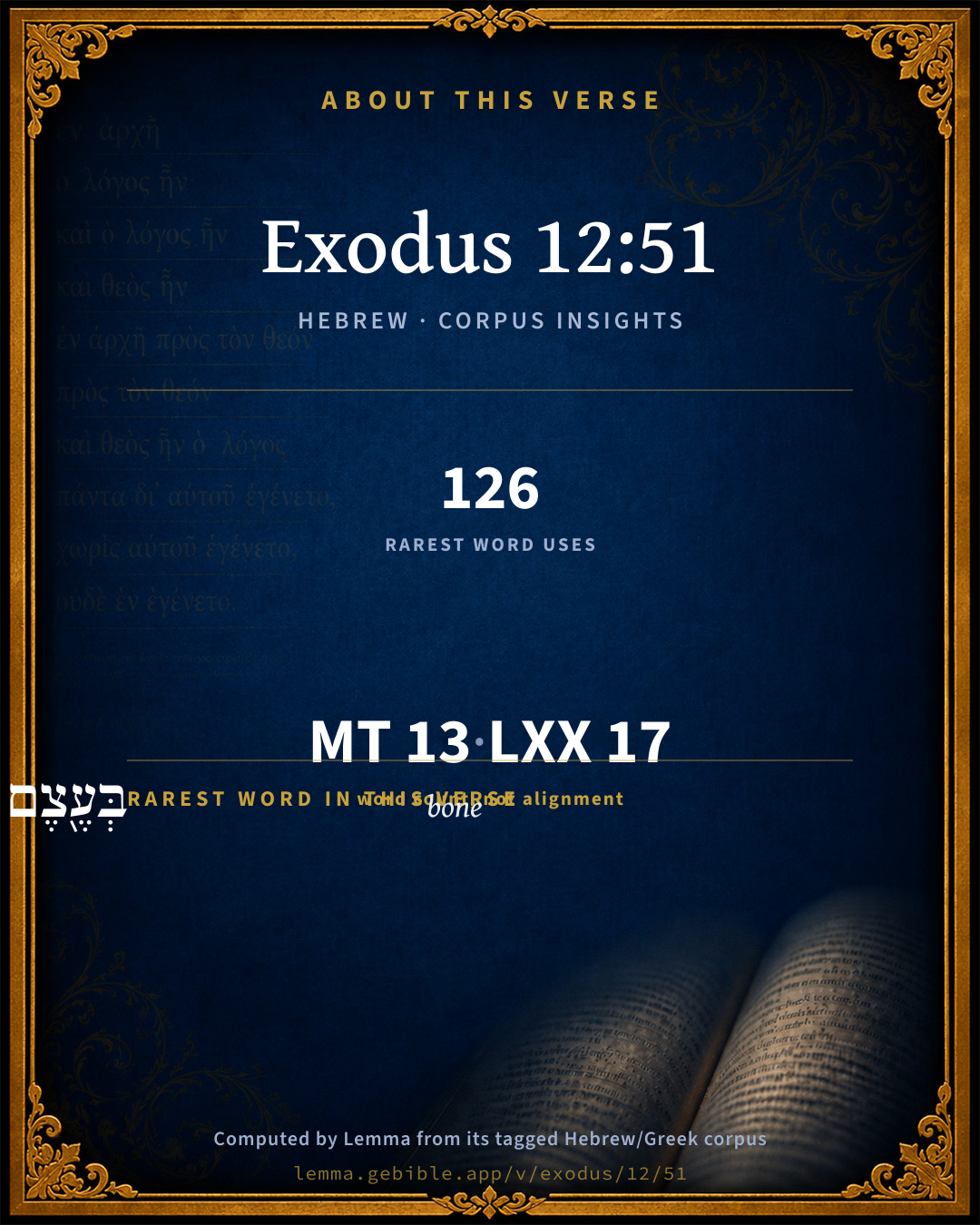
בְּעֶ֖צֶם
ʻetsem
H6106
“in/at · bone of”
Preposition + Noun, Common, Feminine, Singular, Construct
Part of Speech
Preposition + Noun
Type
Common
Gender
Feminine
Number
Singular
State
Construct
Full BDB Definition

Origin: from H6105

TWOT: 1673c

bone, essence, substance - bone - body, limbs, members, external body - bone (of animal) - substance, self
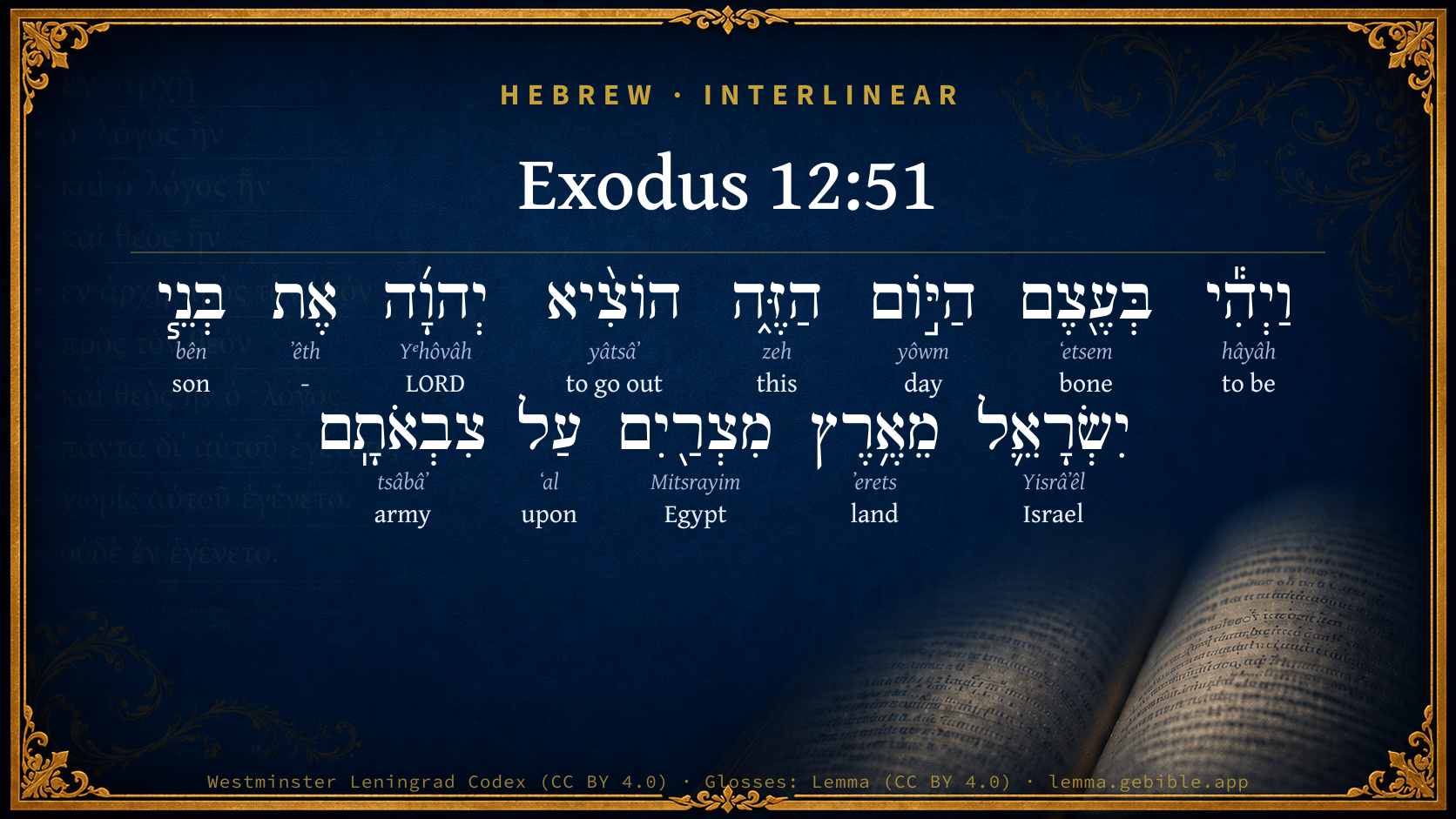
  1. וַיְהִ֕י hâyâh H1961 “and · to be” Conjunction + Verb, Qal, Sequential Imperfect, 3rd Person, Masculine, Singular
  2. הַיּ֣וֹם yôwm H3117 “the · day” Particle, Definite Article + Noun, Common, Masculine, Singular, Absolute
  3. הַזֶּ֑ה zeh H2088 “the · this” Particle, Definite Article + Pronoun, Demonstrative, Masculine, Singular
  4. הוֹצִ֨יא yâtsâʼ H3318 “to go out” Verb, Hiphil, Perfect, 3rd Person, Masculine, Singular
  5. יְהוָ֜ה Yᵉhôvâh H3068 “LORD” Noun, Proper
  6. אֶת ʼêth H853 “-” Particle, Direct Object
  7. בְּנֵ֧י bên H1121 “sons of” Noun, Common, Masculine, Plural, Construct
  8. יִשְׂרָאֵ֛ל Yisrâʼêl H3478 “Israel” Noun, Proper
  9. מֵאֶ֥רֶץ ʼerets H776 “from · land of” Preposition + Noun, Common, Both, Singular, Construct
  10. מִצְרַ֖יִם Mitsrayim H4714 “Egypt” Noun, Proper
  11. עַל ʻal H5921 “upon” Preposition
  12. צִבְאֹתָֽם tsâbâʼ H6635 “armies · their” Noun, Common, Both, Plural, Construct + Suffix, Personal, 3rd Person, Masculine, Plural

About this verse

These counts appear in no published source. They are computed here, from the morphology-tagged text and Lemma’s own curated glosses. What Lemma adds →

13
words
13
distinct lemmas
Pentateuch
section

Grammatical profile

  • 2 verbs
  • 8 nouns
  • 1 pronoun
  • 1 preposition
  • 1 particle

Verb forms

  • וַיְהִ֕י Qal · Sequential Imperfect
  • הוֹצִ֨יא Hiphil · Perfect

Hebrew & Septuagint length

In English translation the verse runs 21 words from the Hebrew and 25 from the Septuagint (LXX English) — closely comparable.

A rough comparison of the two English renderings, which tokenize alike — not a word-level alignment.

Word counts can differ between the Hebrew and the Greek without any difference in meaning — e.g. the Hebrew direct-object marker אֵת has no separate Greek word, and Greek often adds the article ὁ.

In the original languages it is 13 Hebrew tokens and 17 Greek tokens — but the two are counted differently (Hebrew bundles its prefixes and suffixes into one token; the Greek is in lemma form), so that isn’t a like-for-like length.

Cross-references

2

Topical passages linked to Exodus 12:51 in the Treasury of Scripture Knowledge — connected by theme and wording, ordered by reader-vote popularity; previews shown in the World English Bible.

  • Exodus 12:41 It happened at the end of four hundred thirty years, even the same day it happened, that all the hosts of Yahweh went out from the land of Egypt.
  • Exodus 6:26 These are that Aaron and Moses, to whom Yahweh said, "Bring out the children of Israel from the land of Egypt according to their hosts."

Cross-references courtesy of OpenBible.info (CC BY 4.0).

Hebrew and Greek witnesses Masoretic Hebrew ↔ Greek Septuagint

The same verse in the two great witnesses to the Old Testament, shown verse-for-verse.

These are two independent witnesses, not word-aligned to each other, and the Septuagint is shown in lemma (dictionary) form.

Hebrew Exodus 12:51 Masoretic · Westminster Leningrad Codex

וַיְהִ֕י בְּעֶ֖צֶם הַיּ֣וֹם הַזֶּ֑ה הוֹצִ֨יא יְהוָ֜ה אֶת בְּנֵ֧י יִשְׂרָאֵ֛ל מֵאֶ֥רֶץ מִצְרַ֖יִם עַל צִבְאֹתָֽם

It happened the same day, that Yahweh brought the children of Israel out of the land of Egypt by their hosts.

World English Bible · Public Domain

Greek LXX Exodus 12:51 Septuagint · lemma form

καί γίγνομαι ἐν ὁ ἡμέρα ἐκεῖνος ἐκἄγω κύριος ὁ υἱός ἰσραήλ ἐκ γῆ αἴγυπτος σύν δύναμις αὐτός

And it came to pass in that day that the Lord brought out the children of Israel from the land of Egypt with their forces.

LXX2012 (modern English Septuagint) · Public Domain

Hebrew: Westminster Leningrad Codex (CC BY 4.0). Greek: Septuagint (public domain); English from LXX2012 (modern English Septuagint) (Public Domain). How the Septuagint differs from the Hebrew →

Targum (Aramaic paraphrase)

2

The Targum is the ancient Jewish Aramaic paraphrase of the Hebrew Scriptures — an interpretive translation, not the Hebrew text itself. Onkelos (literal) and Pseudo-Jonathan (expansive) render the Torah, and Jonathan the Prophets. Coverage is partial: where no permissively-licensed English translation exists for a verse, only the Aramaic is shown. This is verse-level text, not a word-by-word alignment to the Hebrew.

  1. Targum Onkelos Torah (Genesis–Deuteronomy)
    וַהֲוָה בִּכְרַן יוֹמָא הָדֵין אַפֵּיק יְיָ יָת בְּנֵי יִשְׂרָאֵל מֵאַרְעָא דְמִצְרַיִם עַל חֵילֵיהוֹן:

    (no public-domain English translation for this verse)

    Targum Onkelos — Aramaic: “Onkelos Genesis” (public domain); “Onkelos Exodus” (public domain); “Onkelos Leviticus” (public domain); “Onkelos Numbers” (public domain); “Onkelos Deuteronomy” (public domain). English: “Sefaria Community Translation” (CC0 1.0 (public-domain dedication)); “J.W. Etheridge. The Targums of Onkelos and Jonathan Ben Uzziel on the Pentateuch. London: Longmans, Green, 1862” (public domain). Text via Sefaria.

  2. Targum Pseudo-Jonathan Torah (Genesis–Deuteronomy)
    וַהֲוָה בִּכְרַן יוֹמָא הָדֵין אַפֵּיק יְיָ יַת בְּנֵי יִשְרָאֵל מֵאַרְעָא דְמִצְרַיִם עַל חֵילֵיהוֹן

    And it was on that same day that the Lord brought forth the sons of Israel from the land of Mizraim, with their hosts.

    Targum Pseudo-Jonathan — Aramaic: “Targum Jonathan on Genesis” (public domain); “Targum Jonathan on Exodus” (public domain); “Targum Jonathan on Leviticus” (public domain); “Targum Jonathan on Numbers” (public domain); “Targum Jonathan on Deuteronomy” (public domain). English: “The Targum of Jonathan ben Uzziel, trans. J. W. Etheridge, London, 1862” (public domain). Text via Sefaria.

Commentary

Notes on Exodus 12:51 from classic Christian and Jewish commentators (each source and its license shown beneath its notes). The classic Christian expositions comment on the surrounding passage and are grouped to its opening verse, so a note may address several verses; the Jewish commentaries on the Tanakh (Rashi and others) are per-verse, so they appear only where the commentator wrote on this verse.

Lemma curates 59 commentaries, every one of them public domain or Creative Commons licensed, each selected and text-cleaned for this edition rather than reprinted as found. About our sources →

Trapp's Complete Commentary

John Trapp

Exo 12:51 And it came to pass the selfsame day, [that] the LORD did bring the children of Israel out of the land of Egypt by their armies.

Ver. 51. The selfsame day.] See on Exo 12:41 God is very precise and punctual. We have a saying much like ourselves, A day breaks no square. But it is not so with God.

John Trapp, A Commentary or Exposition upon All the Books of the Old and New Testament (1647–1656) — public domain. Text from a community e-Sword module.

Tyndale Open Study Notes

Tyndale Open Resources

12:51 The Israelites left Egypt like an army, with the Lord as their commander-in-chief.

Tyndale Open Study Notes — © Tyndale Open Resources, licensed CC BY-SA 4.0. Text via the HelloAO Bible API.

Adam Clarke's Commentary

Verse 51. By their armies.] צבאתם tsibotham, from צבא tsaba, to assemble, meet together, in an orderly or regulated manner, and hence to war, to act together as troops in battle; whence צבאות tsebaoth, troops, armies, hosts. It is from this that the Divine Being calls himself יהוה צבאות Yehovah tsebaoth, the LORD of HOSTS or armies, because the Israelites were brought out of Egypt under his direction, marshalled and ordered by himself, guided by his wisdom, supported by his providence, and protected by his might. This is the true and simple reason why God is so frequently styled in Scripture the Lord of hosts; for the LORD did bring the children of Israel out of the land of Egypt by their ARMIES.

ON this chapter the notes have been so full and so explicit, that little can be added to set the subject before the reader in a clearer light. On the ordinance of the PASSOVER, the reader is requested to consult the notes on verses 7, 14, and 27. See Clarke on Ex 12:7; "Ex 12:14"; "Ex 12:27". For the display of God's power and providence in supporting so great a multitude where, humanly speaking, there was no provision, and the proof that the exodus of the Israelites gives of the truth of the Mosaic history, he is referred to Ex 12:37. And for the meaning of the term LAW, to Ex 12:49.

On the ten plagues it may be but just necessary, after what has been said in the notes, to make a few general reflections. When the nature of the Egyptian idolatry is considered, and the plagues which were sent upon them, we may see at once the peculiarity of the judgment, and the great propriety of its being inflicted in the way related by Moses. The plagues were either inflicted on the objects of their idolatry, or by their means.

1. That the river Nile was an object of their worship and one of their greatest gods, we have already seen. As the FIRST plague, its waters were therefore turned into blood; and the fish, many of which were objects also of their adoration, died. Blood was particularly offensive to them, and the touch of any dead animal rendered them unclean. When then their great god, the river, was turned into blood, and its waters became putrid, so that all the fish, minor objects of their devotion, died, we see a judgment at once calculated to punish, correct, and reform them. Could they ever more trust in gods who could neither save themselves nor their deluded worshippers?

2. Mr. Bryant has endeavoured to prove that frogs, the SECOND plague, were sacred animals in Egypt, and dedicated to Osiris: they certainly appear on many ancient Egyptian monuments, and in such circumstances and connections as to show that they were held in religious veneration. These therefore became an awful scourge; first, by their numbers, and their intrusion into every place; and, secondly, by their death, and the infection of the atmosphere which took place in consequence.

3. We have seen also that the Egyptians, especially the priests, affected great cleanliness, and would not wear woollen garments lest any kind of vermin should harbour about them. The THIRD plague, by means of lice or such like vermin, was wisely calculated both to humble and confound them. In this they immediately saw a power superior to any that could be exerted by their gods or their magicians; and the latter were obliged to confess, This is the finger of God!

4. That flies were held sacred among the Egyptians and among various other nations, admits of the strongest proof. It is very probable that Baal-zebub himself was worshipped under the form of a fly or great cantharid. These, therefore, or some kind of winged noxious insects, became the prime agents in the FOURTH plague; and if the cynomyia or dog-fly be intended, we have already seen in the notes with what propriety and effect this judgment was inflicted.

5. The murrain or mortality among the cattle was the FIFTH plague, and the most decisive mark of the power and indignation of Jehovah. That dogs, cats, monkeys, rams, heifers, and bulls, were all objects of their most religious veneration, all the world knows. These were smitten in a most singular manner by the hand of God; and the Egyptians saw themselves deprived at once of all their imaginary helpers. Even Apis, their ox-god, in whom they particularly trusted, now suffers, groans, and dies under the hand of Jehovah. Thus does he execute judgment against all the gods of Egypt. See Ex 12:12.

6. The SIXTH plague, viz., of boils and blains, was as appropriate as any of the preceding; and the sprinkling of the ashes, the means by which it was produced, peculiarly significant. Pharmacy, Mr. Bryant has observed, was in high repute among the Egyptians; and Isis, their most celebrated goddess, was considered as the preventer or healer of all diseases. "For this goddess," says Diodorus, Hist., lib. i., "used to reveal herself to people in their sleep when they laboured under any disorder, and afford them relief. Many who placed their confidence in her influence, παραδοξως υγιαινεσθαι, were miraculously restored. Many likewise who had been despaired of and given over by the physicians on account of the obstinacy of the distemper, were saved by this goddess. Numbers who had been deprived of their eyes, and of other parts of their bodies, were all restored on their application to Isis." By this disorder, therefore, which no application to their gods could cure, and which was upon the magicians also, who were supposed to possess most power and influence, God confounded their pride, showed the folly of their worship, and the vanity of their dependence. The means by which these boils and blains were inflicted, viz., the sprinkling of ashes from the furnace, was peculiarly appropriate. Plutarch assures us, De Iside et Osiride, that in several cities of Egypt they were accustomed to sacrifice human beings to Typhon, which they burned alive upon a high altar; and at the close of the sacrifice the priests gathered the ashes of these victims, and scattered them in the air: "I presume, says Mr. Bryant, "with this view, that where an atom of their dust was wafted, a blessing might be entailed. The like was done by Moses with the ashes of the furnace, that wherever any, the smallest portion, alighted, it might prove a plague and a curse to this cruel, ungrateful, and infatuated people. Thus there was a designed contrast in these workings of Providence, an apparent opposition to the superstition of the times."

7. The grievous hail, the SEVENTH plague, attended with rain, thunder, and lightning, in a country where these scarcely ever occur, and according to an express prediction of Moses, must in the most signal manner point out the power and justice of God. Fire and water were some of the principal objects of Egyptian idolatry; and fire, as Porphyry says, they considered μεγαν ειναι θεον, to be a great god. To find, therefore, that these very elements, the objects of their adoration, were, at the command of a servant of Jehovah, brought as a curse and scourge on the whole land, and upon men also and cattle, must have shaken their belief in these imaginary deities, while it proved to the Israelites that there was none like the God of Jeshurun.

8. In the EIGHTH plague we see by what insignificant creatures God can bring about a general destruction. A caterpillar is beyond all animals the most contemptible, and, taken singly, the least to be dreaded in the whole empire of nature; but in the hand of Divine justice it becomes one of the most formidable foes of the human race. From the examples in the notes we see how little human power, industry, or art, can avail against this most awful scourge. Not even the most contemptible animal should be considered with disrespect, as in the hand of God it may become the most terrible instrument for the punishment of a criminal individual or a guilty land.

9. The NINTH plague, the total and horrible darkness that lasted for three days, afforded both Israelites and Egyptians the most illustrious proof of the power and universal dominion of God; and was particularly to the latter a most awful yet instructive lesson against a species of idolatry which had been long prevalent in that and other countries, viz., the worship of the celestial luminaries. The sun and moon were both adored as supreme deities, as the sole dispensers of light and life; and the sun was invoked as the giver of immortality and eternal blessedness. Porphyry, De Abstin., l. 4, preserves the very form used by the Egyptian priests in addressing the sun on behalf of a deceased person, that he might be admitted into the society of the gods: Ω δεσποτα Ἡλιε, και Θεοι παντες, οἱ την ζωην τοις ανθρωποις δοντες, προσδεξασθε με, και παραδοτε τοις αΐδιοις Θεοις συνοικον, "O sovereign lord the sun, and all ye other deities who bestow life on mankind! Receive me, and grant that I may be admitted as a companion with the immortal gods!" These objects of their superstitious worship Jehovah showed by this plague to be his creatures, dispensing or withholding their light merely at his will and pleasure; and that the people might be convinced that all this came by his appointment alone, he predicted this awful darkness; and that their astronomers might have the fullest proof that this was no natural occurrence, and could not be the effect of any kind of eclipse, which even when total could endure only about four minutes, (and this case could happen only once in a thousand years,) he caused this palpable darkness to continue for three days!

10. The TENTH and last plague, the slaying of the first-born or chief person in each family, may be considered in the light of a Divine retribution: for after that their nation had been preserved by one of the Israelitish family, "they had," says Mr. Bryant, "contrary to all right, and in defiance of original stipulation, enslaved the people to whom they had been so much indebted; and not contented with this, they had proceeded to murder their offspring, and to render the people's bondage intolerable by a wanton exertion of power. It had been told them that the family of the Israelites were esteemed as God's first-born, Ex 4:22; therefore God said: Let my son go, that he may serve me; and if thou refuse - behold, I will slay thy son, even thy FIRST-BORN, Ex 4:23. But they heeded not this admonition, and hence those judgments came upon them that terminated in the death of the eldest in each family; a just retaliation for their disobedience and cruelty." See several curious and important remarks on this subject in a work entitled, Observations upon the Plagues inflicted on the Egyptians, by Jacob Bryant, 8vo., 1810.

On the whole we may say, Behold the goodness and severity of God! Severity mixed with goodness even to the same people. He punished and corrected them at the same time; for there was not one of these judgments that had not, from its peculiar nature and circumstances, some emendatory influence. Nor could a more effectual mode be adopted to demonstrate to that people the absurdity of their idolatry, and the inefficacy of their dependence, than that made use of on this occasion by the wise, just, and merciful God. At the same time the Israelites themselves must have received a lesson of the most impressive instruction on the vanity and wickedness of idolatry, to which they were at all times most deplorably prone, and of which they would no doubt have given many more examples, had they not had the Egyptian plagues continually before their eyes. It was probably these signal displays of God's rower and justice, and these alone, that induced them to leave Egypt at his command by Moses and Aaron; otherwise, with the dreadful wilderness before them, totally unprovided for such a journey, in which humanly speaking it was impossible for them and their households to subsist, they would have rather preferred the ills they then suffered, than have run the risk of greater by an attempt to escape from their present bondage. This is proved by their murmurings, Ex 16:2-3, from which it is evident that they preferred Egypt with all its curses to their situation in the wilderness, and never could have been induced to leave it had they not had the fullest evidence that it was the will of God; which will they were obliged, on pain of utter destruction, to obey.

Adam Clarke's Commentary on the Bible (1810–1826) — public domain. Text from a community e-Sword/MySword module.

Ellicott's Commentary for English Readers

(51) This last verse of the chapter would more appropriately commence Exodus 13, with which it is to be united. Translate—“And it came to pass, on the self same day that the Lord brought the children of Israel out of the land of Egypt by their armies, that the Lord spake unto Moses, saying,” &c.

By their armies.—See Note 2 on Exo_13:18.

A Bible Commentary for English Readers, edited by Charles John Ellicott (1878–1897) — public domain. Text from a community e-Sword module.

The Cambridge Bible for Schools and Colleges

gen. ed. J. J. S. Perowne

51. A repetition of the substance of v. 41b (cf. Exo_6:30 repeated from Exo_6:12), intended seemingly to close the account of the departure from Egypt.

The Cambridge Bible for Schools and Colleges (gen. ed. J. J. S. Perowne; Cambridge University Press, 1878–1918) — public domain. Text from a community e-Sword module.

Whedon's Commentary on the Bible

Daniel D. Whedon

51. This verse, as a final summary, brings the account of the departure from Egypt to a formal close.

The selfsame day — That is, the fifteenth of Abib, the momentous day whose events have just been related. CONCLUDING NOTE.

Length of Sojourn in Egypt, and Census of Israel at the Exode. These two topics are so connected that it is convenient to discuss them together. Was the Egyptian sojourn a period of four hundred and thirty or of two hundred and fifteen years? In the note on verse forty the short period is favoured. Two things are specially relied upon by the advocates of the long period in proof of their view: (1,) The genealogy of individuals; (2,) The census of the Exode.

The genealogy is supposed to show that in some lines several generations have been omitted. (The genealogy of Moses is discussed in the note on Exo_6:20.) While Moses and Aaron are only the third generation from Levi, Dathan and Abiram the third from Reuben, (Numbers 26,) and Achan the fourth from Judah, (Joshua 7,) Bezaleel is the sixth from Judah, (1 Chronicles 2,) Elishama the eighth from Joseph, and Joshua the tenth from Joseph, (1Ch_7:23-27.) Colenso presents these discrepancies as fatal objections to the authenticity of the history. But we may easily suppose Moses, when past his century, to have been contemporary with Bezaleel, who was of the same generation with his great-grandchildren, so that Elishama and Joshua give us the only real difficulty. But their genealogy is given in only one passage, (1Ch_7:23-27,) which is on all hands confessed to be very obscure, and has probably been corrupted in transcription, so that it ought to have no decisive weight whatever, especially against passages of unmistakable clearness. Colenso, like his kin of all generations, ignores the clear to burrow in the obscure or unknown.

As to the census of Israel at the Exode, we are to consider that extraordinary fruitfulness is spoken of in Exo_1:7, as it had been specially promised to the patriarchs. There were more than 600,000 men at the Exode, and these numbers would have been reached in two hundred and fifteen years if they continued to multiply as they commenced. This is proved thus: Jacob and his sons averaged five sons each, (not reckoning daughters at all in this calculation,) for he had twelve sons and fifty-three grandsons, (Genesis 46,) and (53+12)/13=5. Now if each man had, at the age of thirty-five, five sons, and had none born to him thereafter, we may reckon six generations in two hundred and fifteen years, since 215/35=6+. To find, then, the number of Jacob’s male posterity of the sixth generation we have 53×5*6=53×15,625, or 828,125, a surplus of 200,000 over the number of the text. This calculation, moreover, makes no account of the survivors of previous generations.

The census of the Kohathites, given in Num_3:28, is also presented by Tiele, Kurtz, Keil, etc., as an argument for the long chronology or for the omission of generations, since the four families of the Kohathites numbered 8,600, thus averaging 2,150 each, while one of the four, the Amramites, numbered, as far as the record shows, only two men who could have been counted in the 8,600, since Aaron and his sons, and Moses himself, are not reckoned. But, (1,) The general calculation before given covers the whole ground. (2,) We have no right to assume that the record gives us all the Amramites. Amram may have had other children besides the famous historic three, and the argument from silence is always dubious. (3,) Still more dubious is the argument from averages to particulars. (4,) The other three families might have made up the lack of the Amramites, if lack there were. While these facts, given in the record itself, enable us to fully account for the numbers of Israel at the Exode, the objections of Knobel, Colenso, etc., are of no weight.

Daniel D. Whedon (gen. ed.), Commentary on the Old and New Testaments (1874–1909) — public domain. Text from a community e-Sword module.

The Pulpit Commentary

This verse should be transferred to the commencement of the next chapter, which should run as follows: it came to pass on the self-same day that the Lord brought the children of Israel out of the land of Egypt by their armies that the Lord spake unto Moses, saying," etc. The word "armies," which at first sight may seem inappropriate, occurs also in Exo_6:26. It is probably intended to mark that the people were thoroughly organised, and marshalled in divisions resembling those of an army.

The Pulpit Commentary (1880–1919), ed. H.D.M. Spence-Jones & Joseph S. Exell — public domain. Text from a community e-Sword module.

Ramban (Nachmanides)

Rabbi Moshe ben Nachman (Ramban / Nachmanides)

AND IT CAME TO PASS THE SELFSAME DAY THE ETERNAL DID BRING THE CHILDREN OF ISRAEL OUT OF THE LAND OF EGYPT. Since Scripture said above, It was a night of watching unto the Eternal for bringing them out of the land of Egypt, it reverted and explained that they did not go out at all of the land then, but that Pharaoh gave them permission [at night] to go out, and thus they became free men. Instead, it was in the glare of full daylight that they went out from all the borders of Egypt with all their hosts — the hosts of women and the mixed multitude, Verse 38. that attached themselves to them.Rabbi Abraham ibn Ezra explained the purport of the verse as follows: “And it came to pass the selfsame day that the Eternal did bring the children of Israel out of the land of Egypt that He spoke to Moses, saying, Sanctify unto Me.”

Ramban (Nachmanides) on the Tanakh — English translation: “Commentary on the Torah by Ramban (Nachmanides). Translated and annotated by Charles B. Chavel. New York, Shilo Pub. House, 1971-1976” (CC BY 4.0). Text via Sefaria.

Lesson kit

Teaching starters — assembled from the data on this page, not authored interpretation. Every prompt links to the verse data it draws on. Edit before teaching.

Exodus, in the Pentateuch, opens this verse with 13 words (13 distinct Hebrew lemmas). Its most distinctive word is ʻetsem (“bone”). A historical commentator’s framing appears above. Read the whole chapter for the surrounding context.

Discussion questions

  1. What does “bone” (ʻetsem) contribute to the verse as a whole?
  2. How does Exodus 12:41, which shares this passage’s theme, read alongside this verse?
  3. These translations render this verse differently; the difference is in the English rendering, not the original. What questions does that raise?
  4. «וַיְהִ֕י» is a Qal Sequential Imperfect verb. How does that grammatical form shape the action described?
  5. Compare how Trapp's Complete Commentary and Tyndale Open Study Notes read this verse. Where do they agree or differ?

Things to notice

Reading settings

Reading text

Shown beneath each verse's original-language words.

Old Testament
Old Testament edition

Read the OT as the Masoretic Hebrew (MT) or the Greek Septuagint (LXX).

English shown for the Greek Septuagint (in the Hebrew ↔ Greek comparison).

Comparing translations? Open the Compare panel on any verse page to stack up to four side by side.