Numbers 10:14

Hebrew (Westminster Leningrad Codex) Numbers 10:14 appears in the Hebrew Old Testament. The text above is from the Westminster Leningrad Codex. Each word links to its Strong’s number, a concise gloss, and parsing drawn from the Open Scriptures Hebrew Bible morphology. Click any word for its full Brown-Driver-Briggs (BDB) entry.
Download image
Cite this verse

Numbers 10:14 (World English Bible). Public Domain. Lemma interlinear Bible study tool, https://lemma.gebible.app/v/numbers/10/14.

Show BibTeX & RIS
BibTeX
RIS
English Translation
In the first [place] the standard of the camp of the children of Judah set forward according to their hosts: and over his host was Nahshon the son of Amminadab.
World English Bible · Public Domain
Download a study sheet

One document with this verse’s original text, its word-by-word gloss line, the meaning frame, cross-references with their text, attributed commentary, and full source and license credits — printable, and it pastes into notes with its structure intact.

This verse Autodidact and up

Study sheet (.html) Plain text (.txt)

A passage Seminary Student

Up to 50 verses in one chapter. A passage sheet keeps up to 6 commentary sources and 12 cross-references per verse, in the order this page ranks them, and says so on the sheet whenever that leaves anything out. Ask for a single verse and you get the Autodidact verse sheet above.

Everything on this page stays free to read, with no account — the sheet is a download of what is already on screen, not access to it.

Want to remove ads? Support Godless Engineer
Compare translations 3

The same verse in 3 English versions, stacked beneath the original-language interlinear above. Click any original word for its lexicon entry.

Each is an independent rendering of the whole verse — the interlinear is not word-aligned to these translations.

Highlighted words mark where these versions differ — a whole-verse word diff, not a word-by-word alignment.

  • World English Bible Public Domain
    In the first [place] the standard of the camp of the children of Judah set forward according to their hosts: and over his host was Nahshon the son of Amminadab.
  • King James Version Public Domain
    In the first place went the standard of the camp of the children of Judah according to their armies: and over his host was Nahshon the son of Amminadab.
  • unfoldingWord Literal Text CC BY-SA 4.0
    And the banner of the camp of the sons of Judah set out in the first according to their armies: and over his army Nahshon, the son of Amminadab,

unfoldingWord Literal Text — © unfoldingWord, licensed CC BY-SA 4.0. Word-aligned USFM3 via Door43 (git.door43.org/unfoldingWord/en_ult).

Versions to compare (up to 4)

3 of 4 selected

Show all 18 translations

Every available English version of this verse, each an independent rendering of the whole verse.

  • World English Bible Public Domain
    In the first [place] the standard of the camp of the children of Judah set forward according to their hosts: and over his host was Nahshon the son of Amminadab.
  • Berean Standard Bible Public Domain
    First, the divisions of the camp of Judah set out under their standard, with Nahshon son of Amminadab in command.
  • Majority Standard Bible Public Domain
    First, the divisions of the camp of Judah set out under their standard, with Nahshon son of Amminadab in command.
  • King James Version Public Domain
    In the first place went the standard of the camp of the children of Judah according to their armies: and over his host was Nahshon the son of Amminadab.
  • American Standard Version (1901) Public Domain
    And in the first `place' the standard of the camp of the children of Judah set forward according to their hosts: and over his host was Nahshon the son of Amminadab.
  • Revised Version (1885) Public Domain
    And in the first place the standard of the camp of the children of Judah set forward according to their hosts: and over his host was Nahshon the son of Amminadab.
  • Geneva Bible (1599) Public Domain
    In the first place went the standerd of the hoste of the children of Iudah, according to their armies: and Nahshon the sonne of Amminabad was ouer his band.
  • Douay-Rheims (1899) Public Domain
    The sons of Juda by their troops: whose prince was Nahasson the son of Aminadab.
  • Young's Literal Translation Public Domain
    And the standard of the camp of the sons of Judah journeyeth in the first `place', by their hosts, and over its host `is' Nahshon son of Amminadab.
  • Literal Standard Version CC BY-SA 4.0
    And the standard of the camp of the sons of Judah journeys in the first [place], by their hosts, and over its host [is] Nahshon son of Amminadab.
  • Unlocked Literal Bible CC BY-SA 4.0
    The camp under the banner of Judah's descendants went out first, moving out their individual armies. Nahshon son of Amminadab led Judah's army.
  • unfoldingWord Literal Text CC BY-SA 4.0
    And the banner of the camp of the sons of Judah set out in the first according to their armies: and over his army Nahshon, the son of Amminadab,
  • Darby Bible Public Domain
    The standard of the camp of the children of Judah set forward first according to their hosts, and over his host was Nahshon the son of Amminadab;
  • World Messianic Bible Public Domain
    First, the standard of the camp of the children of Judah went forward according to their armies. Nahshon the son of Amminadab was over his army.
  • Webster's Bible Public Domain
    In the first place went the standard of the camp of the children of Judah according to their armies: and over his host was Nahshon the son of Amminadab.
  • Free Bible Version CC BY-SA 4.0
    The tribal divisions of Judah went first, marching out under their flag, with Nahshon, son of Amminadab, in charge.
  • Bible in Basic English Public Domain
    First the flag of the children of Judah went forward with their armies: and at the head of his army was Nahshon, the son of Amminadab.
  • JPS Tanakh (1917) Public Domain
    And in the first place the standard of the camp of the children of Judah set forward according to their hosts; and over his host was Nahshon the son of Amminadab.

Literal Standard Version (2020), Covenant Press — licensed CC BY-SA 4.0. Text via the HelloAO Bible API (eBible.org). Unlocked Literal Bible (unfoldingWord) — licensed CC BY-SA 4.0. Text via the HelloAO Bible API (eBible.org). unfoldingWord Literal Text — © unfoldingWord, licensed CC BY-SA 4.0. Word-aligned USFM3 via Door43 (git.door43.org/unfoldingWord/en_ult). Free Bible Version, Dr. Jonathan Gallagher — licensed CC BY-SA 4.0. Text via the HelloAO Bible API (eBible.org).

Word by word

More ways to search: Search by grammar → Find every occurrence → Compare this word →

Practice this passage: Drill this verse → Learn its vocabulary →

נַחְשׁ֖וֹן
Nachshôwn
H5177
“Nahshon”
Noun, Proper
Part of Speech
Noun
Type
Proper
Full BDB Definition

Origin: from H5172

TWOT: None

Nahshon = "enchanter" - son of Amminadab and prince of the Judah at the first numbering in the wilderness; 5th in descent from Judah in the genealogy of Christ
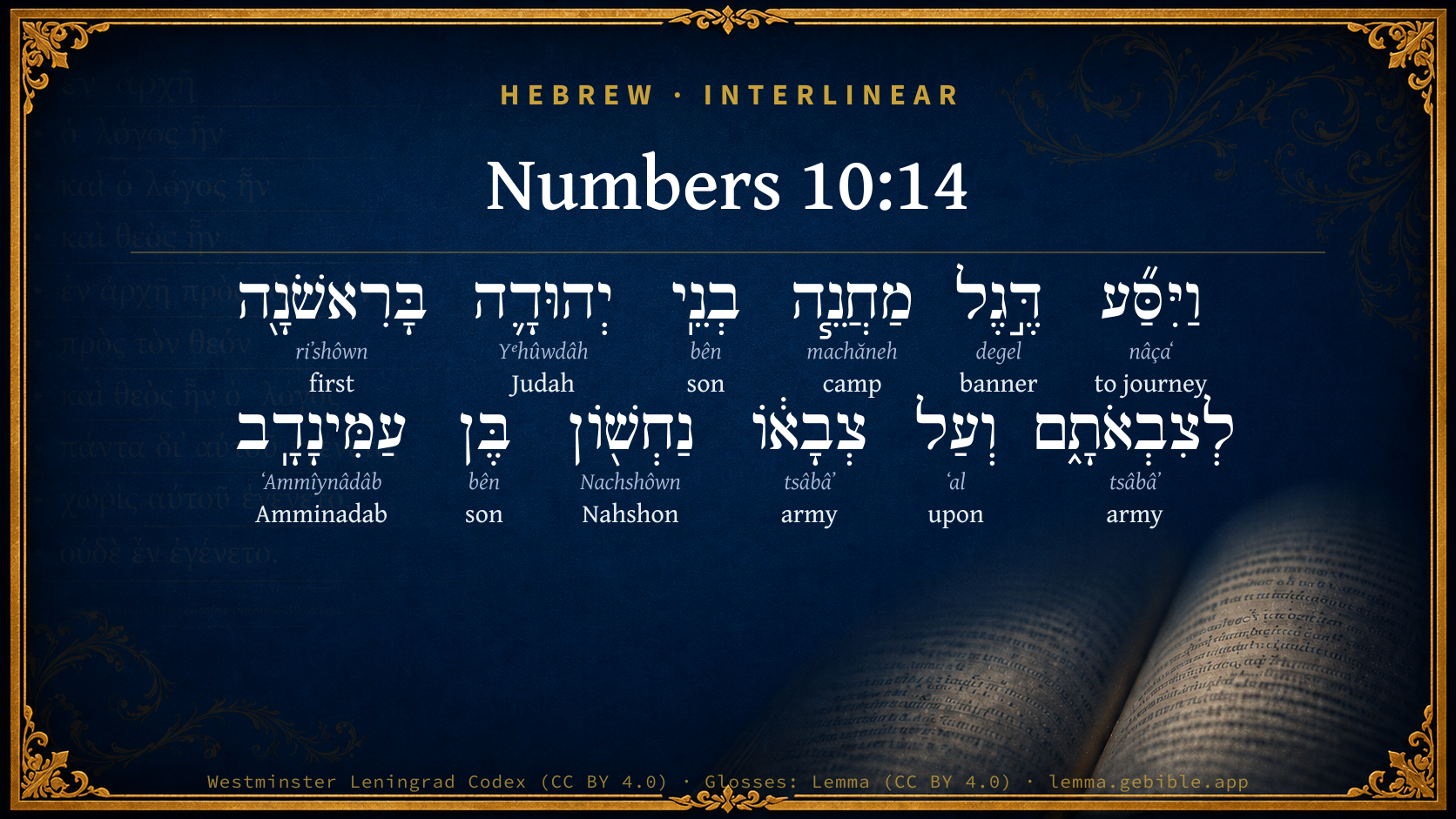
  1. וַיִּסַּ֞ע nâçaʻ H5265 “and · to journey” Conjunction + Verb, Qal, Sequential Imperfect, 3rd Person, Masculine, Singular
  2. דֶּ֣גֶל degel H1714 “banner of” Noun, Common, Masculine, Singular, Construct
  3. מַחֲנֵ֧ה machăneh H4264 “camp of” Noun, Common, Both, Singular, Construct
  4. בְנֵֽי bên H1121 “sons of” Noun, Common, Masculine, Plural, Construct
  5. יְהוּדָ֛ה Yᵉhûwdâh H3063 “Judah” Noun, Proper
  6. בָּרִאשֹׁנָ֖ה riʼshôwn H7223 “in/at the · first” Preposition, Determined + Adjective, Adjective, Feminine, Singular, Absolute
  7. לְצִבְאֹתָ֑ם tsâbâʼ H6635 “to/for · armies · their” Preposition + Noun, Common, Both, Plural, Construct + Suffix, Personal, 3rd Person, Masculine, Plural
  8. וְעַל ʻal H5921 “and · upon” Conjunction + Preposition
  9. צְבָא֔וֹ tsâbâʼ H6635 “army · his” Noun, Common, Both, Singular, Construct + Suffix, Personal, 3rd Person, Masculine, Singular
  10. בֶּן bên H1121 “son of” Noun, Common, Masculine, Singular, Construct
  11. עַמִּינָדָֽב ʻAmmîynâdâb H5992 “Amminadab” Noun, Proper

About this verse

These counts appear in no published source. They are computed here, from the morphology-tagged text and Lemma’s own curated glosses. What Lemma adds →

12
words
10
distinct lemmas
Pentateuch
section

Notable vocabulary

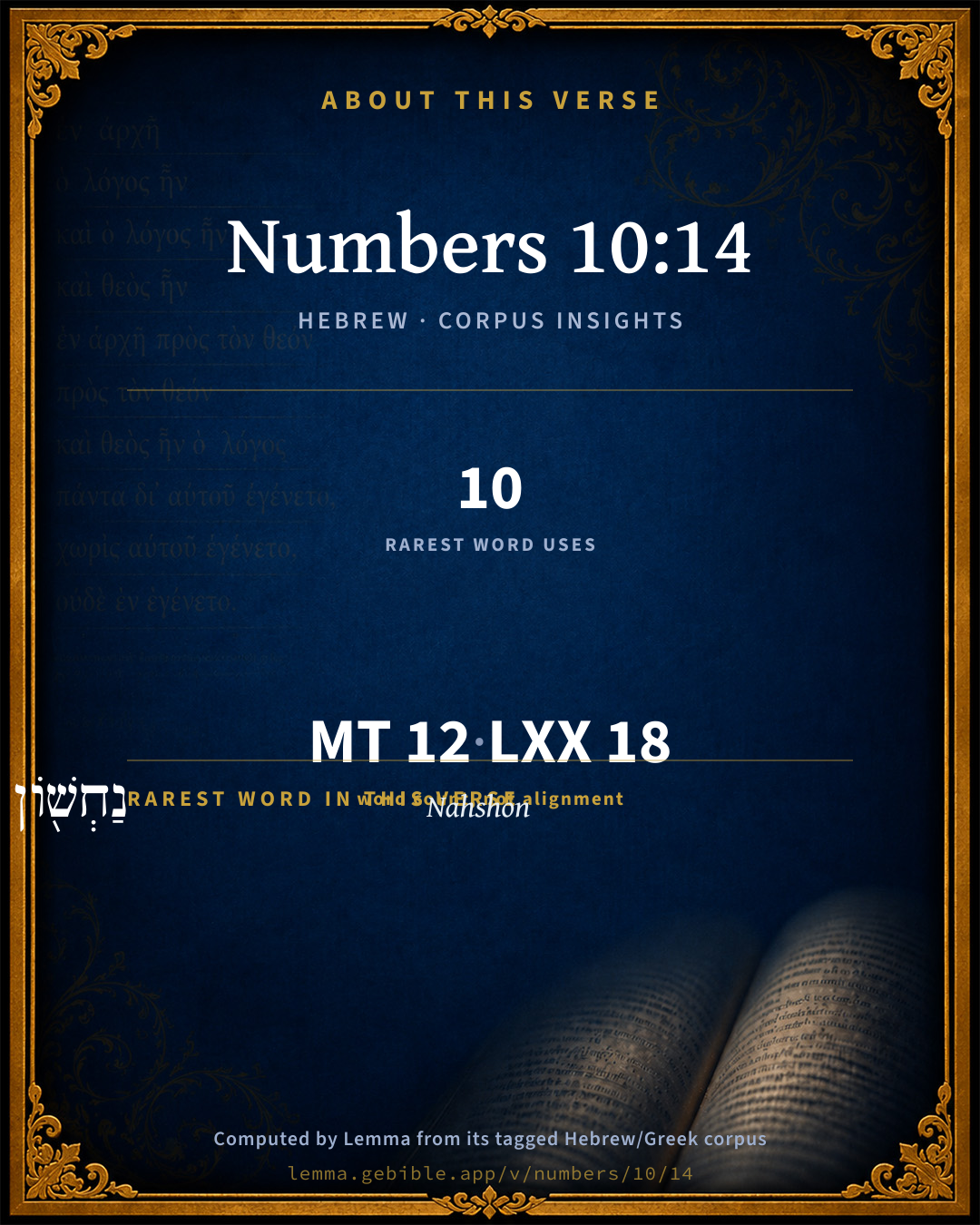
The rarest word here is נַחְשׁ֖וֹן Nahshon H5177 — appearing just 10 times in the whole Hebrew Bible.

Shared distinctive vocabulary

נַחְשׁ֖וֹן Nahshon H5177 occurs in 9 verses of the Hebrew Bible. Also found in:

Grammatical profile

  • 1 verb
  • 9 nouns
  • 1 adjective
  • 1 preposition

Verb forms

  • וַיִּסַּ֞ע Qal · Sequential Imperfect

Repetition

Words recur within this verse — often emphatic in Hebrew:

  • בְנֵֽי son H1121 ×2
  • לְצִבְאֹתָ֑ם army H6635 ×2

Hebrew & Septuagint length

In English translation the verse runs 30 words from the Hebrew and 28 from the Septuagint (LXX English) — closely comparable.

A rough comparison of the two English renderings, which tokenize alike — not a word-level alignment.

Word counts can differ between the Hebrew and the Greek without any difference in meaning — e.g. the Hebrew direct-object marker אֵת has no separate Greek word, and Greek often adds the article ὁ.

In the original languages it is 12 Hebrew tokens and 18 Greek tokens — but the two are counted differently (Hebrew bundles its prefixes and suffixes into one token; the Greek is in lemma form), so that isn’t a like-for-like length.

Cross-references

5

Topical passages linked to Numbers 10:14 in the Treasury of Scripture Knowledge — connected by theme and wording, ordered by reader-vote popularity; previews shown in the World English Bible.

  • Numbers 2:3–9 Those who encamp on the east side toward the sunrise shall be of the standard of the camp of Judah, according to their divisions: and the prince of the children of Judah shall be Nahshon the son of Amminadab.
  • Numbers 1:7 Of Judah: Nahshon the son of Amminadab.
  • Genesis 49:8 "Judah, your brothers will praise you: Your hand will be on the neck of your enemies; Your father's sons will bow down before you.
  • Numbers 7:12 He who offered his offering the first day was Nahshon the son of Amminadab, of the tribe of Judah,
  • Numbers 26:19–27 The sons of Judah: Er and Onan; and Er and Onan died in the land of Canaan.

Cross-references courtesy of OpenBible.info (CC BY 4.0).

Hebrew and Greek witnesses Masoretic Hebrew ↔ Greek Septuagint

The same verse in the two great witnesses to the Old Testament, shown verse-for-verse.

These are two independent witnesses, not word-aligned to each other, and the Septuagint is shown in lemma (dictionary) form.

Hebrew Numbers 10:14 Masoretic · Westminster Leningrad Codex

וַיִּסַּ֞ע דֶּ֣גֶל מַחֲנֵ֧ה בְנֵֽי יְהוּדָ֛ה בָּרִאשֹׁנָ֖ה לְצִבְאֹתָ֑ם וְעַל צְבָא֔וֹ נַחְשׁ֖וֹן בֶּן עַמִּינָדָֽב

In the first [place] the standard of the camp of the children of Judah set forward according to their hosts: and over his host was Nahshon the son of Amminadab.

World English Bible · Public Domain

Greek LXX Numbers 10:14 Septuagint · lemma form

καί ἐκαἴρω τάγμα παρεμβολή υἱός ιουδα πρῶτος σύν δύναμις αὐτός καί ἐπί ὁ δύναμις αὐτός ναασσων υἱός αμιναδαβ

And they first set in motion the order of the camp of the children of Juda with their host; and over their host was Naasson, son of Aminadab.

LXX2012 (modern English Septuagint) · Public Domain

Hebrew: Westminster Leningrad Codex (CC BY 4.0). Greek: Septuagint (public domain); English from LXX2012 (modern English Septuagint) (Public Domain). How the Septuagint differs from the Hebrew →

Targum (Aramaic paraphrase)

2

The Targum is the ancient Jewish Aramaic paraphrase of the Hebrew Scriptures — an interpretive translation, not the Hebrew text itself. Onkelos (literal) and Pseudo-Jonathan (expansive) render the Torah, and Jonathan the Prophets. Coverage is partial: where no permissively-licensed English translation exists for a verse, only the Aramaic is shown. This is verse-level text, not a word-by-word alignment to the Hebrew.

  1. Targum Onkelos Torah (Genesis–Deuteronomy)
    וּנְטַל טֵקַס מַשְׁרִית בְּנֵי יְהוּדָה בְּקַדְמֵיתָא לְחֵילֵיהוֹן וְעַל חֵילֵהּ נַחְשׁוֹן בַּר עַמִינָדָב

    (no public-domain English translation for this verse)

    Targum Onkelos — Aramaic: “Onkelos Genesis” (public domain); “Onkelos Exodus” (public domain); “Onkelos Leviticus” (public domain); “Onkelos Numbers” (public domain); “Onkelos Deuteronomy” (public domain). English: “Sefaria Community Translation” (CC0 1.0 (public-domain dedication)); “J.W. Etheridge. The Targums of Onkelos and Jonathan Ben Uzziel on the Pentateuch. London: Longmans, Green, 1862” (public domain). Text via Sefaria.

  2. Targum Pseudo-Jonathan Torah (Genesis–Deuteronomy)
    וּנְטָלוּ טֵיקַס מַשִׁרְיַית בְּנֵי יְהוּדָה לְחֵילֵיהוֹן וְרַבָּא דְהַוָה מְמַנֵי עַל חֵילְוַות שִׁבְטָא דִבְנֵי יְהוּדָה נַחְשׁוֹן בַּר עַמִינָדָב

    The standard of the camps of the Beni Jehudah went forward by their hosts, and the Rabba who was appointed over the host of the tribe of the Beni Jehudah was Nachshon bar Amminadab;

    Targum Pseudo-Jonathan — Aramaic: “Targum Jonathan on Genesis” (public domain); “Targum Jonathan on Exodus” (public domain); “Targum Jonathan on Leviticus” (public domain); “Targum Jonathan on Numbers” (public domain); “Targum Jonathan on Deuteronomy” (public domain). English: “The Targum of Jonathan ben Uzziel, trans. J. W. Etheridge, London, 1862” (public domain). Text via Sefaria.

Commentary

Notes on Numbers 10:14 from classic Christian and Jewish commentators (each source and its license shown beneath its notes). The classic Christian expositions comment on the surrounding passage and are grouped to its opening verse, so a note may address several verses; the Jewish commentaries on the Tanakh (Rashi and others) are per-verse, so they appear only where the commentator wrote on this verse.

Lemma curates 59 commentaries, every one of them public domain or Creative Commons licensed, each selected and text-cleaned for this edition rather than reprinted as found. About our sources →

The Biblical Illustrator

Joseph S. Exell

Num_10:14-28

The standard of the camp.

The Divine standard to be maintained

There are few things in which we are more prone to fail than in the maintenance of the Divine standard when human failure has set in. Like David, when the Lord made a breach upon Uzza, because of his failure in putting his hand to the ark, He was afraid of God that day, saying, How shall I bring the ark of God home to me? (1Ch_13:12). It is exceedingly difficult to bow to the Divine judgment, and, at the same time, to hold fast the Divine ground. The temptation is to lower the standard, to come down from the lofty elevation, to take human ground. We must ever carefully guard against this evil, which is all the more dangerous as wearing the garb of modesty, self-distrust, and humility. Aaron and his sons, notwithstanding all that had occurred, were to eat the meat offering in the holy place. They were to do so, not because all had gone on in perfect order, but because it is thy due, and so I am commanded. Though there had been failure, yet their place was in the tabernacle; and those who were there had certain dues founded upon the Divine commandment. Though man had failed ten thousand times over, the word of the Lord cannot fail: and that word had secured certain privileges for all true priests, which it was their place to enjoy. Were Gods priests to have nothing to eat, no priestly food, because failure had set in? Were those that were left to be allowed to starve, because Nadab and Abihu had offered strange fire? This would never do. God is faithful, and He can never allow any one to be empty in His blessed presence. The prodigal may wander, and squander, and come to poverty; but it must ever hold good that in my Fathers house is bread enough and to spare. (C. H. Mackintosh.)

God would have order observed among His people at all times

When Christ our Saviour intended to feed the multitude that had continued with Him to hear His word, He commanded His disciples to make all sit down in ranks by hundreds and fifties (Mar_6:40), so that He would have all things, even the most common, done in order. For all disorder came into the world by Satan, and his chief employment is to make a breach into that order which God hath established. He shuffleth and mingleth all together, and seeketh to disturb and destroy what he can, and how he can. Again, order is a means to preserve every society; the want of it threateneth ruin to every society. This serveth, first, to reprove such as keep not their places, but break out of order, and will not be held within the compass that God hath set them. Every man hath his bounds set him, and is enclosed in them as in a circle, which he may not pass. No man hath any promise of blessing when he keepeth not the order God hath set him. Secondly, acknowledge from hence that the Church is a blessed company, it is the very school of good order, wherein all things are done in number, weight, and measure. When Balaam had seen the goodly order of this host of God, as the valleys that were spread forth, as gardens by the rivers side, as the trees which the Lord had planted, and as cedar trees beside the waters, he cried out in admiration of this comely, decent, and seemly order, How goodly are thy tents, O Jacob! and thy tabernacles, O Israel! For who is it that ruleth in the Church? and who is it by whom it is guided? Is it not God, who is the God of order? No confusion cleaveth or can cleave to Him, He is not the God of confusion, He is light, and in Him is no darkness at all (1Jn_1:5). He hath set an order among all His works. Thirdly, when we see this order interrupted in the works of God, know that it cometh not of God. Acknowledge therein the corruption of man and the work of Satan. Fourthly, whensoever we cannot sound the depth of Gods works nor judge of them as we ought, when we see to our appearance much out of square, as soldiers out of their squadrons, we must not condemn the works of God, but accuse our own blindness and ignorance, Forasmuch as God hath made all beautiful in his season (Ecc_3:11). When we behold how the wicked prosper for the most part, and are of great power (Psa_37:35), and on the other side the godly all the day long plagued and chastened every morning (Psa_73:14), we are ready to misjudge and misdeem of these works of God. Howbeit, the ways of God are not as our ways. This is therefore our weakness in judgment. Thus also was Jeremy troubled (Jer_12:1-2), and no less the prophet Habbakuk (Hab_1:13). This which we esteem to be a confusion is indeed no confusion; and that is in order which we suppose to be out of order. For God is a God of long suffering, who Will take vengeance on His adversaries, and He reserveth wrath for His enemies (Nah_1:2), and therefore is the prophet (much perplexed in spirit) willed to wait by faith the issue that God will make, For the vision is yet for an appointed time, but at the end it shall speak and not lie: though it tarry, wait for it; because it will surely come, it will not tarry (Hab_2:3). Lastly, from hence every man must learn to do the duties of his own calling. God hath set every man in a certain calling. We are apt, indeed, to break out into the callings of other men, as if we were pinned up in too narrow a room. This made Solomon to say, I have seen servants on horses, and princes walking as servants upon the earth. And as God hath set every man in a calling, so must every man wait and attend upon that calling, whether it be in the Church, or in the family, or in the commonwealth. (W. Attersoll.)

The Biblical Illustrator, edited by Joseph S. Exell (c. 1880s–1900s) — public domain. Text from a community e-Sword module.

Adam Clarke's Commentary

Verse 14. The standard - of Judah] See this order of marching explained at large on Nu 2:1-31. The following is the order in which this vast company proceeded in their march: -

JUDAH

Issachar

Zebulun

Gershonites, and

Merarites carrying the tabernacle.

REUBEN

Simeon

Gad

The Kohathites with the sanctuary.

EPHRAIM

Manasseh

Benjamin

DAN

Asher

Naphtali.

Adam Clarke's Commentary on the Bible (1810–1826) — public domain. Text from a community e-Sword/MySword module.

The Cambridge Bible for Schools and Colleges

gen. ed. J. J. S. Perowne

14–27. The group of tribes on the east of the Tabernacle having marched first, the hangings and structure of the Tent and the court were then carried by the Gershonites and Merarites. They were followed by the tribes on the south side; and then the sacred furniture and utensils were carried by the Kohathites. Next came the tribes on the west side, and those on the north side brought up the rear.

The Cambridge Bible for Schools and Colleges (gen. ed. J. J. S. Perowne; Cambridge University Press, 1878–1918) — public domain. Text from a community e-Sword module.

John Gill's Exposition

In the first place went the standard of the camp of the children of Judah,.... Which tribe had the honour to go foremost and lead the van, the chief ruler, the Messiah being to come of it, as he did; who is King of Israel, and has gone forth at the head of them, fighting their battles for them:

according to their armies: having, besides the army of the tribe of Judah, the armies of the tribes of Issachar and Zebulun under his standard:

and over his host was Nahshon the son of Amminadab; he was captain general of the army of the tribe of Judah, as Nethaneel was over the host of the tribe of Issachar, Num 10:15; and Eliab over the host of the tribe of Zebulun, Num 10:16; the same commanders as were fixed at the time of settling the order of their encampment, Num 2:3.

John Gill's Exposition of the Whole Bible (1746–1763) — public domain (CC PDM 1.0). Text via the HelloAO Bible API.

Albert Barnes' Notes on the Bible

According to their armies - Compare Num 1:3. There were three tribal hosts in each camp; and each tribe had of course its subdivisions.

Albert Barnes' Notes on the Bible (1834–1885) — public domain. Text from a community e-Sword/MySword module.

Whedon's Commentary on the Bible

Daniel D. Whedon

14. In the first place — The following is the order in which the tribes marched:

FIRST DIVISION.

Judah,

Issachar, Zebulun,

Gershonites and Merarites bearing the Tabernacle.

SECOND DIVISION.

Reuben,

Simeon,

Gad,

Kohathites with the Sanctuary.

THIRD DIVISION.

Ephraim,

Manasseh,

Benjamin.

FOURTH DIVISION.

Dan,

Ashur,

Naphtali.

For military reasons the advance and rear guards were stronger than the centre. See Num_2:4, note.

Standard — See Num_1:52, note.

Nahshon — See Num_1:1-15, note.

Daniel D. Whedon (gen. ed.), Commentary on the Old and New Testaments (1874–1909) — public domain. Text from a community e-Sword module.

The Pulpit Commentary

According to their armies. In each camp, and under each of the four standards, there were three tribal hosts, each an army in itself.

The Pulpit Commentary (1880–1919), ed. H.D.M. Spence-Jones & Joseph S. Exell — public domain. Text from a community e-Sword module.

unfoldingWord translationNotes

Door43 World Missions Community

The camp under the banner of Judah's descendants

This camp includes the three tribes under the division of Judah: Judah, Issachar, and Zebulun.

went out first

They packed up their camp and they left that place before all the others left. (See: Ordinal Numbers)

Nahshon son of Amminadab

See how you translated this man's name in Numbers 1:7.

Nethanel son of Zuar

See how you translated this man's name in Numbers 1:8.

Eliab son of Helon

See how you translated this man's name in Numbers 1:9.

translationWords

Judah

descend

son

Issachar

tribe

Zebulun

unfoldingWord translationNotes — © Distant Shores Media and the Door43 World Missions Community, licensed CC BY-SA 4.0. Source: git.door43.org/Door43/en_tn.

Ramban (Nachmanides)

Rabbi Moshe ben Nachman (Ramban / Nachmanides)

AND OVER HIS HOST WAS NACHSHON THE SON OF AMMINADAB. I do not know why He mentioned here the names of the princes of the standards, since He has already mentioned them. And if you answer that this was to hint that [on the twentieth of Iyar when they set out on the first journey from the wilderness] these princes were alive — this has already been alluded to in the section of the standards, since from the day of the census [on the first of Iyar] till the time of the journey [on the twentieth of that month] not one of all those who were counted died. Perhaps the verse comes to tell us that even when they travel on the way the prince is to go at the head of his host, who are to follow his command, and he is to dwell as a king in the army, and they are not to travel as sheep which have no shepherd, nor are they to appoint someone else for this purpose, as they do in the case of the priest who was anointed for war purposes.

Ramban (Nachmanides) on the Tanakh — English translation: “Commentary on the Torah by Ramban (Nachmanides). Translated and annotated by Charles B. Chavel. New York, Shilo Pub. House, 1971-1976” (CC BY 4.0). Text via Sefaria.

Lesson kit

Teaching starters — assembled from the data on this page, not authored interpretation. Every prompt links to the verse data it draws on. Edit before teaching.

Numbers, in the Pentateuch, opens this verse with 12 words (10 distinct Hebrew lemmas). Its most distinctive word is Nachshôwn (“Nahshon”). A historical commentator’s framing appears above. Read the whole chapter for the surrounding context.

Discussion questions

  1. What does “Nahshon” (Nachshôwn) contribute to the verse as a whole?
  2. Exodus 6:23 shares the word «Nahshon» with this verse. How do the two illuminate each other?
  3. “son” occurs 2× in this one verse. What is the effect of the repetition?
  4. The translations on this page render this verse differently — a whole-verse word diff, not a word-by-word alignment. What might account for the different wordings?
  5. The verb «וַיִּסַּ֞ע» is Qal Sequential Imperfect. How does its form color the action?
  6. Reading how The Biblical Illustrator and Adam Clarke's Commentary read this verse, where do the two commentators agree and where do they part?

Things to notice

Reading settings

Reading text

Shown beneath each verse's original-language words.

Old Testament
Old Testament edition

Read the OT as the Masoretic Hebrew (MT) or the Greek Septuagint (LXX).

English shown for the Greek Septuagint (in the Hebrew ↔ Greek comparison).

Comparing translations? Open the Compare panel on any verse page to stack up to four side by side.