
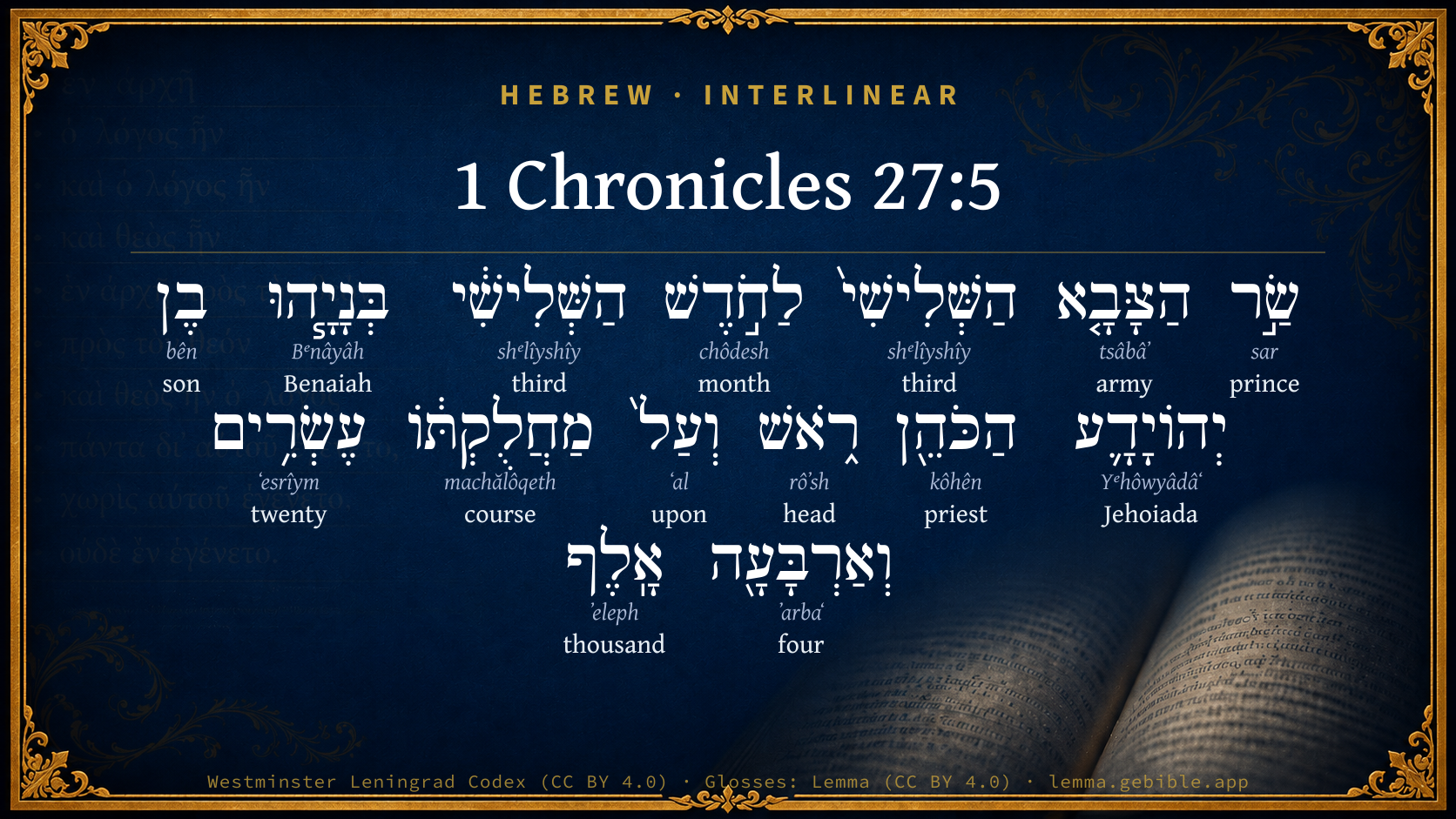
1 Chronicles 27:5

Hebrew (Westminster Leningrad Codex) 1 Chronicles 27:5 appears in the Hebrew Old Testament. The text above is from the Westminster Leningrad Codex. Each word links to its Strong’s number, a concise gloss, and parsing drawn from the Open Scriptures Hebrew Bible morphology. Click any word for its full Brown-Driver-Briggs (BDB) entry.
Download image
Cite this verse

1 Chronicles 27:5 (World English Bible). Public Domain. Lemma interlinear Bible study tool, https://lemma.gebible.app/v/1-chronicles/27/5.

Show BibTeX & RIS
BibTeX
RIS
English Translation
The third captain of the host for the third month was Benaiah, the son of Jehoiada the priest, chief: and in his division were twenty-four thousand.
World English Bible · Public Domain
Download a study sheet

One document with this verse’s original text, its word-by-word gloss line, the meaning frame, cross-references with their text, attributed commentary, and full source and license credits — printable, and it pastes into notes with its structure intact.

This verse Autodidact and up

Study sheet (.html) Plain text (.txt)

A passage Seminary Student

Up to 50 verses in one chapter. A passage sheet keeps up to 6 commentary sources and 12 cross-references per verse, in the order this page ranks them, and says so on the sheet whenever that leaves anything out. Ask for a single verse and you get the Autodidact verse sheet above.

Everything on this page stays free to read, with no account — the sheet is a download of what is already on screen, not access to it.

Want to remove ads? Support Godless Engineer
Compare translations 3

The same verse in 3 English versions, stacked beneath the original-language interlinear above. Click any original word for its lexicon entry.

Each is an independent rendering of the whole verse — the interlinear is not word-aligned to these translations.

Highlighted words mark where these versions differ — a whole-verse word diff, not a word-by-word alignment.

  • World English Bible Public Domain
    The third captain of the host for the third month was Benaiah, the son of Jehoiada the priest, chief: and in his division were twenty-four thousand.
  • King James Version Public Domain
    The third captain of the host for the third month was Benaiah the son of Jehoiada, a chief priest: and in his course were twenty and four thousand.
  • unfoldingWord Literal Text CC BY-SA 4.0
    The third commander of the army, for the third month, Benaiah, the son of Jehoiada the head priest, and in his division 24,000.

unfoldingWord Literal Text — © unfoldingWord, licensed CC BY-SA 4.0. Word-aligned USFM3 via Door43 (git.door43.org/unfoldingWord/en_ult).

Versions to compare (up to 4)

3 of 4 selected

Show all 18 translations

Every available English version of this verse, each an independent rendering of the whole verse.

  • World English Bible Public Domain
    The third captain of the host for the third month was Benaiah, the son of Jehoiada the priest, chief: and in his division were twenty-four thousand.
  • Berean Standard Bible Public Domain
    The third army commander, as chief for the third month, was Benaiah son of Jehoiada the priest. There were 24,000 men in his division.
  • Majority Standard Bible Public Domain
    The third army commander, as chief for the third month, was Benaiah son of Jehoiada the priest. There were 24,000 men in his division.
  • King James Version Public Domain
    The third captain of the host for the third month was Benaiah the son of Jehoiada, a chief priest: and in his course were twenty and four thousand.
  • American Standard Version (1901) Public Domain
    The third captain of the host for the third month was Benaiah, the son of Jehoiada the priest, chief: and in his course were twenty and four thousand.
  • Revised Version (1885) Public Domain
    The third captain of the host for the third month was Benaiah, the son of Jehoiada the priest, chief: and in his course were twenty and four thousand.
  • Geneva Bible (1599) Public Domain
    The captaine of the thirde hoste for the third moneth was Benaiah the sonne of Iehoiada the chiefe Priest: and in his course were foure and twentie thousand.
  • Douay-Rheims (1899) Public Domain
    And the captain of the third company for the third month, was Banaias the son of Joiada the priest: and in his division were four and twenty thousand.
  • Young's Literal Translation Public Domain
    Head of the third host, for the third month, `is' Benaiah son of Jehoiada, the head priest, and on his course `are' twenty and four thousand.
  • Literal Standard Version CC BY-SA 4.0
    Head of the third host, for the third month, [is] Benaiah son of Jehoiada, the head priest, and twenty-four thousand [are] on his division.
  • Unlocked Literal Bible CC BY-SA 4.0
    The commander of the army for the third month was Benaiah son of Jehoiada, a priest and leader. In his division were twenty-four thousand men.
  • unfoldingWord Literal Text CC BY-SA 4.0
    The third commander of the army, for the third month, Benaiah, the son of Jehoiada the head priest, and in his division 24,000.
  • Darby Bible Public Domain
    The third captain of the host for the third month was Benaiah (the son of Jehoiada, a principal officer): [he was] head; and in his division were twenty-four thousand.
  • World Messianic Bible Public Domain
    The third captain of the army for the third month was Benaiah, the son of Jehoiada the chief priest. In his division were twenty-four thousand.
  • Webster's Bible Public Domain
    The third captain of the host for the third month was Benaiah the son of Jehoiada, a chief priest: and in his course were twenty and four thousand.
  • Free Bible Version CC BY-SA 4.0
    The third army commander for the third month was Benaiah, son of Jehoiada the priest. He was chief and there were 24,000 men in his division.
  • Bible in Basic English Public Domain
    The third captain of the army for the third month was Benaiah, the son of Jehoiada the priest; and in his division were twenty-four thousand.
  • JPS Tanakh (1917) Public Domain
    The third captain of the host for the third month was Benaiah the son of Jehoiada, the priest, chief; and in his course were twenty and four thousand.

Literal Standard Version (2020), Covenant Press — licensed CC BY-SA 4.0. Text via the HelloAO Bible API (eBible.org). Unlocked Literal Bible (unfoldingWord) — licensed CC BY-SA 4.0. Text via the HelloAO Bible API (eBible.org). unfoldingWord Literal Text — © unfoldingWord, licensed CC BY-SA 4.0. Word-aligned USFM3 via Door43 (git.door43.org/unfoldingWord/en_ult). Free Bible Version, Dr. Jonathan Gallagher — licensed CC BY-SA 4.0. Text via the HelloAO Bible API (eBible.org).

Word by word

More ways to search: Search by grammar → Find every occurrence → Compare this word →

Practice this passage: Drill this verse → Learn its vocabulary →

בְּנָיָ֧הוּ
Bᵉnâyâh
H1141
“Benaiah”
Noun, Proper
Part of Speech
Noun
Type
Proper
Full BDB Definition

Origin: from H1129 and H3050

TWOT: None

Benaiah = "Jehovah has built" or " Yahweh has built up" - one of David's mighty warriors, son of Jehoiada the chief priest, a Levite, set by David over his bodyguard, later having remained faithful to Solomon during Adonijah's attempt on the crown, was raised into the place of Joab as commander-in-chief of the army - the Pirathonite, an Ephraimite, one of David's thirty mighty warriors, and the captain of the eleventh monthly course - a Simeonite, a prince of the families of Simeon - a Levite in the time of David who played with a psaltery on Alamoth - a priest in the time of David, appointed to blow the trumpet before the ark - a Levite of the sons of Asaph - a Levite in the time of Hezekiah - Four Israelites in the time of Ezra who had taken strange wives - the father of Pelatiah
  1. שַׂ֣ר sar H8269 “prince of” Noun, Common, Masculine, Singular, Construct
  2. הַצָּבָ֤א tsâbâʼ H6635 “the · army” Particle, Definite Article + Noun, Common, Both, Singular, Absolute
  3. הַשְּׁלִישִׁי֙ shᵉlîyshîy H7992 “the · third” Particle, Definite Article + Adjective, Ordinal number, Masculine, Singular, Absolute
  4. לַחֹ֣דֶשׁ chôdesh H2320 “to/for the · month” Preposition, Determined + Noun, Common, Masculine, Singular, Absolute
  5. הַשְּׁלִישִׁ֔י shᵉlîyshîy H7992 “the · third” Particle, Definite Article + Adjective, Ordinal number, Masculine, Singular, Absolute
  6. בֶן bên H1121 “son of” Noun, Common, Masculine, Singular, Construct
  7. יְהוֹיָדָ֛ע Yᵉhôwyâdâʻ H3077 “Jehoiada” Noun, Proper
  8. הַכֹּהֵ֖ן kôhên H3548 “the · priest” Particle, Definite Article + Noun, Common, Masculine, Singular, Absolute
  9. רֹ֑אשׁ rôʼsh H7218 “head” Noun, Common, Masculine, Singular, Absolute
  10. וְעַל֙ ʻal H5921 “and · upon” Conjunction + Preposition
  11. מַחֲלֻקְתּ֔וֹ machălôqeth H4256 “course · his” Noun, Common, Feminine, Singular, Construct + Suffix, Personal, 3rd Person, Masculine, Singular
  12. עֶשְׂרִ֥ים ʻesrîym H6242 “twenty” Adjective, Cardinal number, Both, Plural, Absolute
  13. וְאַרְבָּעָ֖ה ʼarbaʻ H702 “and · four” Conjunction + Adjective, Cardinal number, Masculine, Singular, Absolute
  14. אָֽלֶף ʼeleph H505 “thousand” Adjective, Cardinal number, Both, Singular, Absolute

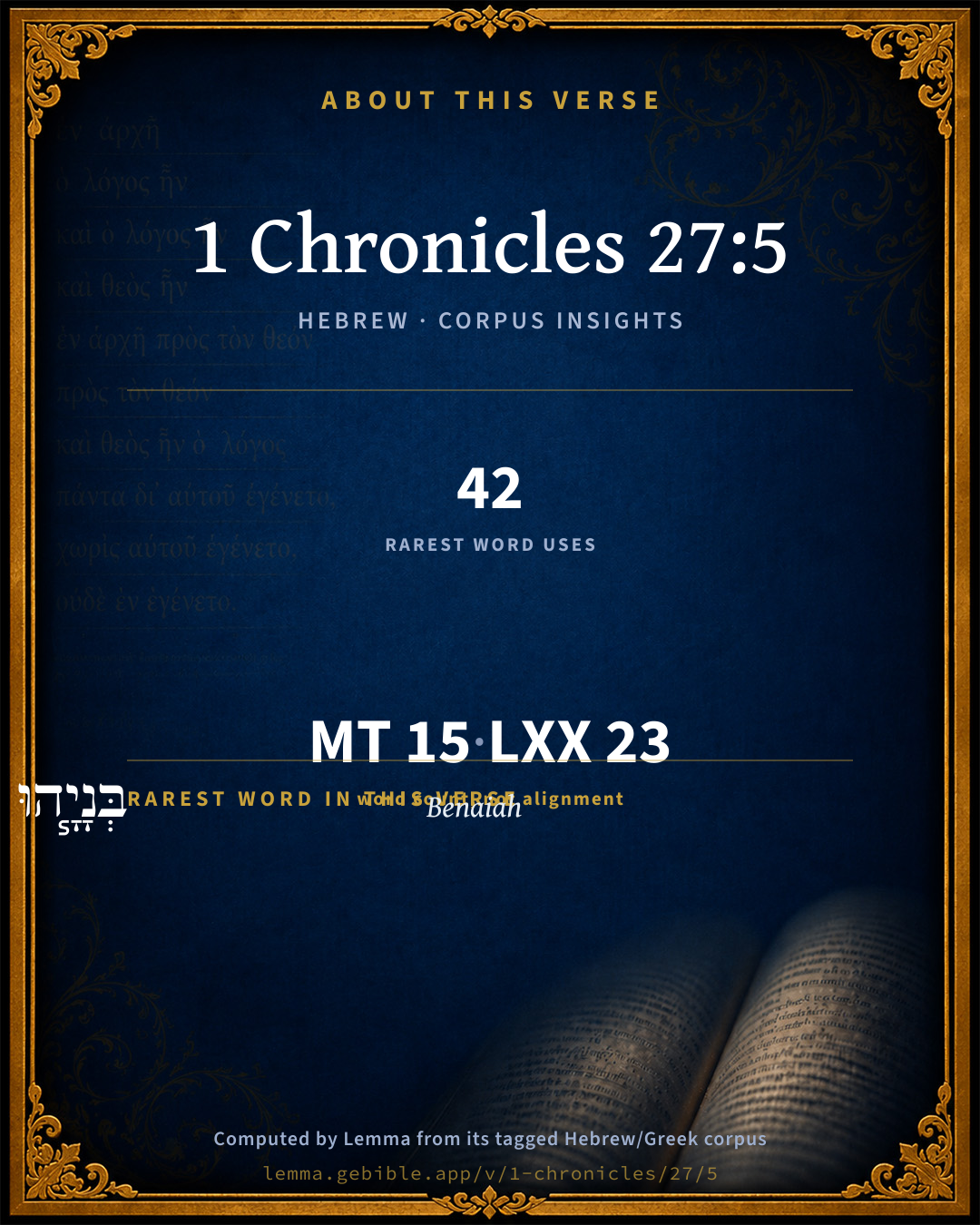
About this verse

These counts appear in no published source. They are computed here, from the morphology-tagged text and Lemma’s own curated glosses. What Lemma adds →

15
words
14
distinct lemmas
Historical
section

Shared distinctive vocabulary

בְּנָיָ֧הוּ Benaiah H1141 occurs in 41 verses of the Hebrew Bible. Also found in:

Grammatical profile

  • 9 nouns
  • 5 adjectives
  • 1 preposition

Repetition

A word recurs within this verse — often emphatic in Hebrew:

  • הַשְּׁלִישִׁי֙ third H7992 ×2

Hebrew & Septuagint length

In English translation the verse runs 26 words from the Hebrew and 24 from the Septuagint (LXX English) — closely comparable.

A rough comparison of the two English renderings, which tokenize alike — not a word-level alignment.

Word counts can differ between the Hebrew and the Greek without any difference in meaning — e.g. the Hebrew direct-object marker אֵת has no separate Greek word, and Greek often adds the article ὁ.

In the original languages it is 15 Hebrew tokens and 23 Greek tokens — but the two are counted differently (Hebrew bundles its prefixes and suffixes into one token; the Greek is in lemma form), so that isn’t a like-for-like length.

Cross-references

2

Topical passages linked to 1 Chronicles 27:5 in the Treasury of Scripture Knowledge — connected by theme and wording, ordered by reader-vote popularity; previews shown in the World English Bible.

  • 1 Kings 4:4–5 and Benaiah the son of Jehoiada was over the host; and Zadok and Abiathar were priests;
  • 1 Chronicles 18:17 and Benaiah the son of Jehoiada was over the Cherethites and the Pelethites; and the sons of David were chief about the king.

Cross-references courtesy of OpenBible.info (CC BY 4.0).

Hebrew and Greek witnesses Masoretic Hebrew ↔ Greek Septuagint

The same verse in the two great witnesses to the Old Testament, shown verse-for-verse.

These are two independent witnesses, not word-aligned to each other, and the Septuagint is shown in lemma (dictionary) form.

Hebrew 1 Chronicles 27:5 Masoretic · Westminster Leningrad Codex

שַׂ֣ר הַצָּבָ֤א הַשְּׁלִישִׁי֙ לַחֹ֣דֶשׁ הַשְּׁלִישִׁ֔י בְּנָיָ֧הוּ בֶן יְהוֹיָדָ֛ע הַכֹּהֵ֖ן רֹ֑אשׁ וְעַל֙ מַחֲלֻקְתּ֔וֹ עֶשְׂרִ֥ים וְאַרְבָּעָ֖ה אָֽלֶף

The third captain of the host for the third month was Benaiah, the son of Jehoiada the priest, chief: and in his division were twenty-four thousand.

World English Bible · Public Domain

Greek LXX 1 Chronicles 27:5 Septuagint · lemma form

ὁ τρίτος ὁ μήν ὁ τρίτος βαναιας ὁ ὁ ιωδαε ὁ ἱερεύς ὁ ἄρχων καί ἐπί ὁ διαίρεσις αὐτός τέσσαρες καί εἴκοσι χιλιάς

The third for the third month was Banaias the son of Jodae the chief priest: and in his division were twenty and four thousand.

LXX2012 (modern English Septuagint) · Public Domain

On this verse, Ellicott's Commentary for English Readers discusses the Septuagint’s reading. Read the note in Commentary ↓

Hebrew: Westminster Leningrad Codex (CC BY 4.0). Greek: Septuagint (public domain); English from LXX2012 (modern English Septuagint) (Public Domain). How the Septuagint differs from the Hebrew →

Commentary

Notes on 1 Chronicles 27:5 from classic Christian and Jewish commentators (each source and its license shown beneath its notes). The classic Christian expositions comment on the surrounding passage and are grouped to its opening verse, so a note may address several verses; the Jewish commentaries on the Tanakh (Rashi and others) are per-verse, so they appear only where the commentator wrote on this verse.

Lemma curates 59 commentaries, every one of them public domain or Creative Commons licensed, each selected and text-cleaned for this edition rather than reprinted as found. About our sources →

Joseph Benson's Commentary

1Ch 27:5-6. Jehoiada, a chief priest — Or rather, a chief prince, as the Hebrew word כהן, cohen, often signifies. For it is certain neither Benaiah nor his father was high-priest or second priest. In his course was Ammizabad his son — Who seems to have been his father’s lieutenant, because his father was captain of the king’s guard, (2Sa 18:18,) and therefore needed a deputy in the one or other place.

Joseph Benson's Commentary on the Old and New Testaments (1811–1818) — public domain. Text from a community e-Sword module.

Adam Clarke's Commentary

Verse 5. Benaiah the son of Jehoiada, a chief priest] Why should not this clause be read as it is in the Hebrew? "Benaiah, the son of Jehoiada the priest, a captain; and in his course," c. Or, as the Targum has it, "The third captain of the host for the month Sivan was Benaiah, the son of Jehoiada the priest, who was constituted a chief." He is distinguished from Benaiah, the Pirathonite, who was over the eleventh month. Some think that the original word הכהן haccohen, which generally signifies priest, should be translated here a principal officer so the margin has it. But, in the Old Testament, כהן cohen signifies both prince and priest; and translating it by the former removes the difficulty from this place, for we well know that Benaiah never was a priest.

Adam Clarke's Commentary on the Bible (1810–1826) — public domain. Text from a community e-Sword/MySword module.

Ellicott's Commentary for English Readers

(5) The third captain of the host.—Heb., captain of the third host. So Vulg.

Benaiah.—See 1Ch_11:22.

The son of Jehoiada, a chief priest.—Rather, son of Jehoiada the priest, as head, viz., of the third army corps. The term “chief,” or “head,” belongs to Benaiah, not to his father. But perhaps it is an erroneous gloss on Jehoiada. (Comp. 2Ch_23:8.) Both LXX. and Vulg. make Benaiah the priest.

A Bible Commentary for English Readers, edited by Charles John Ellicott (1878–1897) — public domain. Text from a community e-Sword module.

The Cambridge Bible for Schools and Colleges

gen. ed. J. J. S. Perowne

5. Benaiah] Cp. 1Ch_11:22 ff.

Jehoiada, a chief priest] R.V. Jehoiada the priest, chief, (“chief” referring to Benaiah).

The Cambridge Bible for Schools and Colleges (gen. ed. J. J. S. Perowne; Cambridge University Press, 1878–1918) — public domain. Text from a community e-Sword module.

Albert Barnes' Notes on the Bible

A chief priest - Rather, “the chief priest” - an expression by which is meant, not the high priest, but probably the high priest’s deputy, who is sometimes called “the second priest” 2Ki 25:18.

Albert Barnes' Notes on the Bible (1834–1885) — public domain. Text from a community e-Sword/MySword module.

Haydock's Catholic Bible Commentary

Priest. This we read no where else, so that some understand, "a chief officer at court," 2 Kings viii. 18. (Calmet) --- But he might be (Haydock) of the tribe of Levi. (Menochius) --- His exploits are mentioned, chap. xi. 21.

George Leo Haydock (1774–1849), Haydock's Catholic Family Bible and Commentary, 1859 edition — public domain. Excludes Psalms (Douay-Rheims chapter numbering differs from Protestant) and Deuterocanonical books (Catholic canon only).

Matthew Poole's English Annotations

A chief priest; or, the chief priest; or rather, a chief prince, as this Hebrew word is oft used, as Gen 41:45; Gen 47:22; 2Sa 8:18; 20:26; 1Ki 4:5; 2Ki 10:11, and elsewhere. Probably he was not only a captain of this course, but a great officer in the court and state. For although the priests might take up arms in some special cases; yet it is not likely that such were constant officers in the king’s army, especially seeing the rest of the captains here named were of other tribes. Besides, neither Benaiah nor Jehoiada was high priest at that time, but Zadok or Abiathar, and before them Abimelech, in whom the priesthood had been for a long time together, even in the days of Samuel, and Saul, and David, and Solomon.

Matthew Poole's English Annotations on the Holy Bible (1683–1685) — public domain. Text from a community e-Sword/MySword module.

Whedon's Commentary on the Bible

Daniel D. Whedon

5. A chief priest — Rather, as margin, a principal officer; the private counsellor of the king. Comp. 1Ki_4:5, note, and 2Sa_23:23.

Daniel D. Whedon (gen. ed.), Commentary on the Old and New Testaments (1874–1909) — public domain. Text from a community e-Sword module.

The Pulpit Commentary

Benaiah (1Ch_11:22-25; 2Sa_23:20-23) To this name Keil thinks the word chief (vaOr), in the succeeding expression, chief priest, belongs. Thus Jehoiada would be named here only priest. Yet seeroh) 1Ch_12:27, where Jehoiada is called dygiGj and 2Ki_25:18; where vaOrh; heKo stands for our vaOr heKoh, as applied to Seraiah. Benaiah was manifestly an Aaronite.

The Pulpit Commentary (1880–1919), ed. H.D.M. Spence-Jones & Joseph S. Exell — public domain. Text from a community e-Sword module.

Scofield Reference Notes

C. I. Scofield

third month

i.e. June.

The Scofield Reference Bible (1917 edition), notes by C. I. Scofield — public domain. Text from a community e-Sword module.

Rashi

Rabbi Shlomo Yitzchaki (Rashi)

The leader of the third host Heb. שַׂר הַצָּבָא הַשְּׁלִישִי. Because of the honor of Benaiah, he calls him the leader of the host more than the others, with the exception of Jashabeam, who was of the sons of Perez, who is likewise called (verse 3): “the chief of all the leaders of the hosts,” because of David’s honor, who was, like him, [one] of the sons of Perez.

the priest, the chief who was the chief, and some say that he was the high priest, but it is not so, because Zadok and Ebiathar were high priests.

Rashi on the Tanakh — English translations: “The Judaica Press complete Tanach with Rashi, translated by A. J. Rosenberg” (CC BY 4.0); “Pentateuch with Rashi's commentary by M. Rosenbaum and A.M. Silbermann, 1929-1934” (public domain); “The Metsudah Tanach series, Lakewood, N.J” (CC BY 4.0); and “The Book of Joshua, Metsudah Publications, 1997” (CC BY 4.0). Text via Sefaria.

Lesson kit

Teaching starters — assembled from the data on this page, not authored interpretation. Every prompt links to the verse data it draws on. Edit before teaching.

1 Chronicles, in the Historical, opens this verse with 15 words (14 distinct Hebrew lemmas). Its most distinctive word is Bᵉnâyâh (“Benaiah”). A historical commentator’s framing appears above. Read the whole chapter for the surrounding context.

Discussion questions

  1. How does “Benaiah” (Bᵉnâyâh) shape what this verse is saying?
  2. How does 2 Samuel 8:18, which shares the word «Benaiah», read alongside this verse?
  3. What does the repetition of “third” (2× in this one verse) do in this verse?
  4. These translations render this verse differently. What is at stake in choosing one wording over another?
  5. Compare how Joseph Benson's Commentary and Adam Clarke's Commentary read this verse. Where do they agree or differ?

Things to notice

Reading settings

Reading text

Shown beneath each verse's original-language words.

Old Testament
Old Testament edition

Read the OT as the Masoretic Hebrew (MT) or the Greek Septuagint (LXX).

English shown for the Greek Septuagint (in the Hebrew ↔ Greek comparison).

Comparing translations? Open the Compare panel on any verse page to stack up to four side by side.