
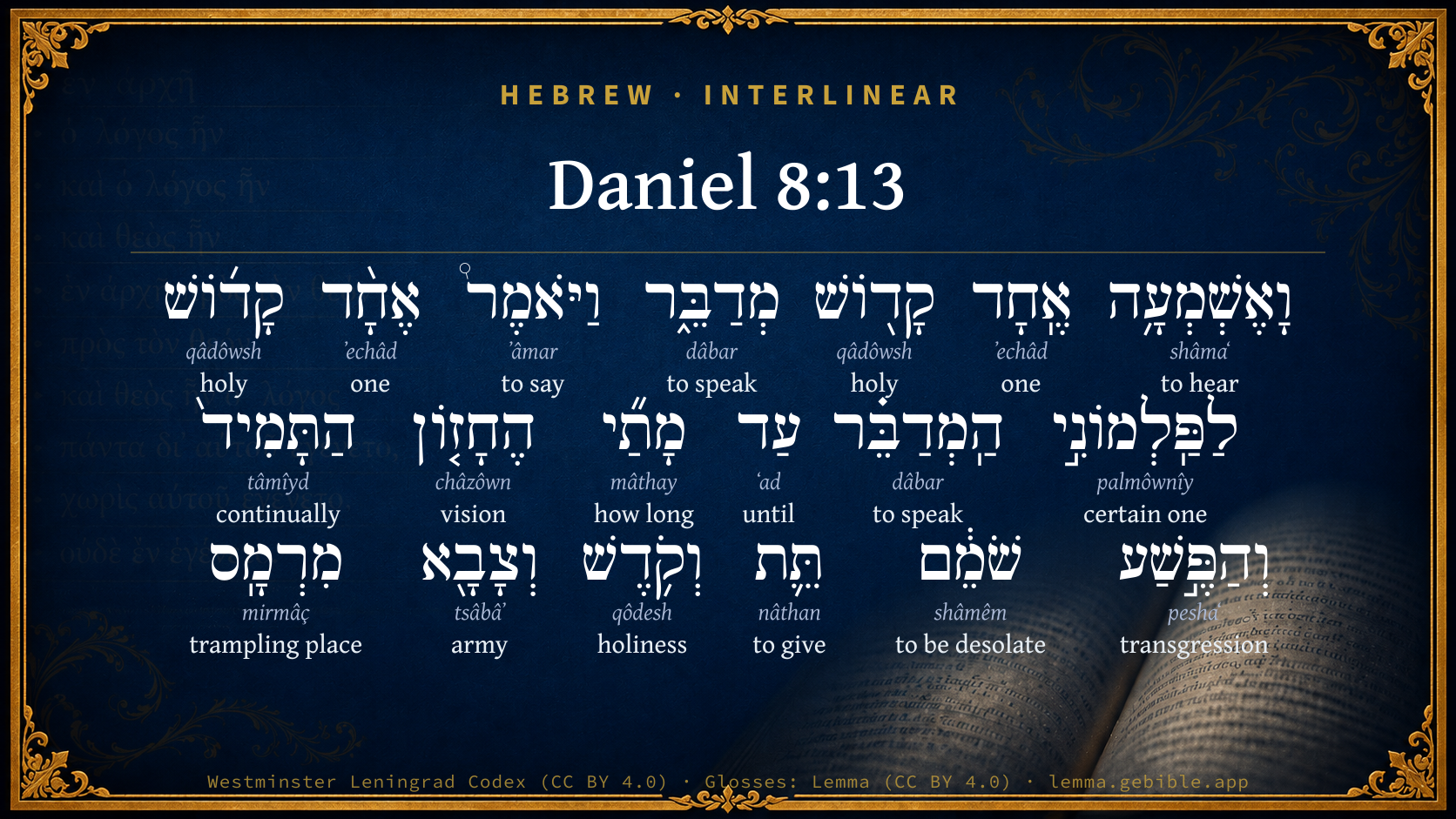
Daniel 8:13

Hebrew (Westminster Leningrad Codex) Daniel 8:13 appears in the Hebrew Old Testament. The text above is from the Westminster Leningrad Codex. Each word links to its Strong’s number, a concise gloss, and parsing drawn from the Open Scriptures Hebrew Bible morphology. Click any word for its full Brown-Driver-Briggs (BDB) entry.
Download image
Cite this verse

Daniel 8:13 (World English Bible). Public Domain. Lemma interlinear Bible study tool, https://lemma.gebible.app/v/daniel/8/13.

Show BibTeX & RIS
BibTeX
RIS
English Translation
Then I heard a holy one speaking; and another holy one said to that certain one who spoke, How long shall be the vision [concerning] the continual [burnt-offering], and the disobedience that makes desolate, to give both the sanctuary and the host to be trodden under foot?
World English Bible · Public Domain
Highlights
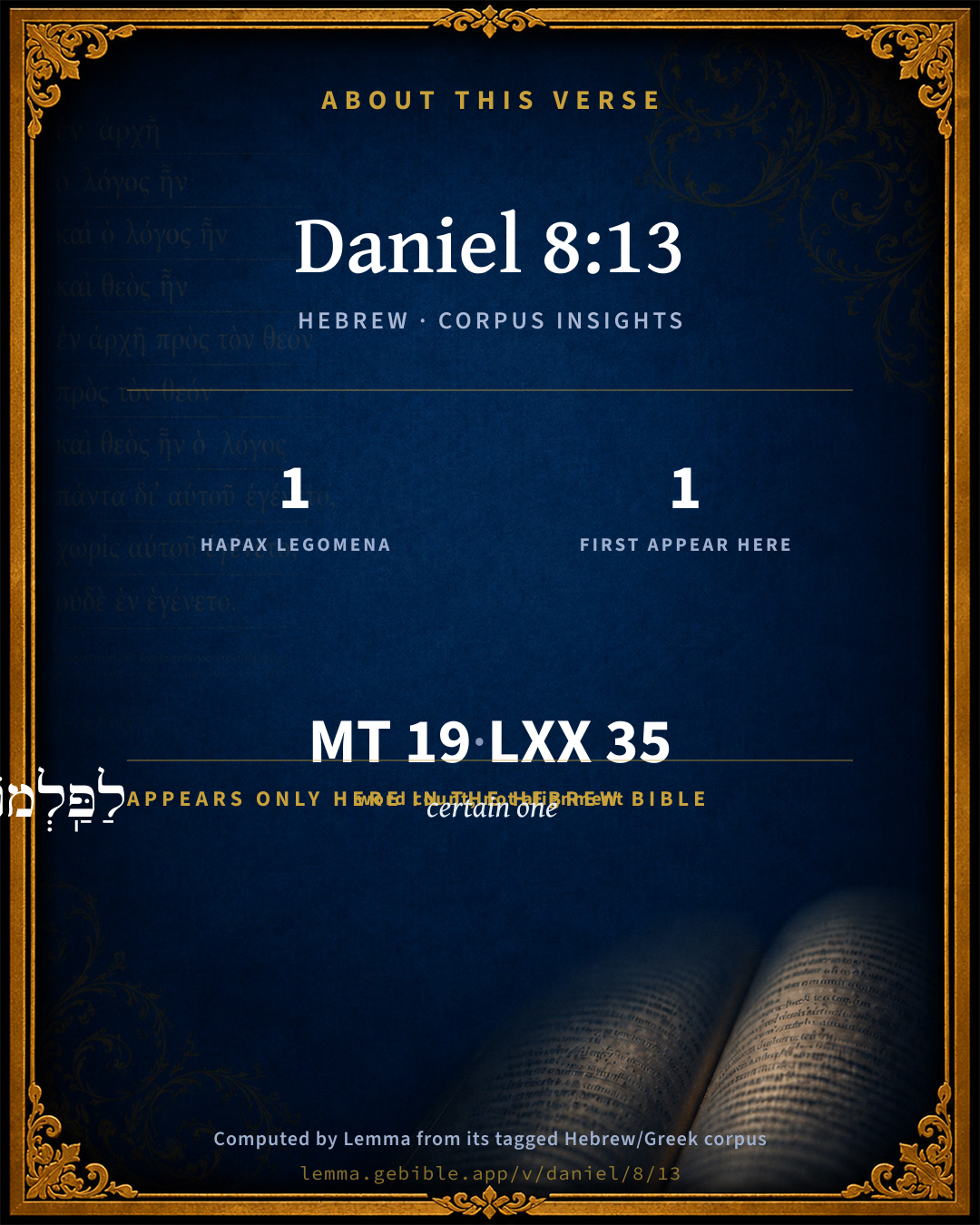
  • 1 hapax legomenon — only here in the Hebrew Bible
  • 1 first appearance in the Hebrew Bible
Full analysis ↓
Download a study sheet

One document with this verse’s original text, its word-by-word gloss line, the meaning frame, cross-references with their text, attributed commentary, and full source and license credits — printable, and it pastes into notes with its structure intact.

This verse Autodidact and up

Study sheet (.html) Plain text (.txt)

A passage Seminary Student

Up to 50 verses in one chapter. A passage sheet keeps up to 6 commentary sources and 12 cross-references per verse, in the order this page ranks them, and says so on the sheet whenever that leaves anything out. Ask for a single verse and you get the Autodidact verse sheet above.

Everything on this page stays free to read, with no account — the sheet is a download of what is already on screen, not access to it.

Want to remove ads? Support Godless Engineer
Compare translations 3

The same verse in 3 English versions, stacked beneath the original-language interlinear above. Click any original word for its lexicon entry.

Each is an independent rendering of the whole verse — the interlinear is not word-aligned to these translations.

Highlighted words mark where these versions differ — a whole-verse word diff, not a word-by-word alignment.

  • World English Bible Public Domain
    Then I heard a holy one speaking; and another holy one said to that certain one who spoke, How long shall be the vision [concerning] the continual [burnt-offering], and the disobedience that makes desolate, to give both the sanctuary and the host to be trodden under foot?
  • King James Version Public Domain
    Then I heard one saint speaking, and another saint said unto that certain saint which spake, How long shall be the vision concerning the daily sacrifice, and the transgression of desolation, to give both the sanctuary and the host to be trodden under foot?
  • unfoldingWord Literal Text CC BY-SA 4.0
    Then I heard a holy one speaking and another holy one said to that particular one who was speaking, “For how long is the vision about the regular burnt offering, the transgression that makes desolate, the giving over of the sanctuary and the host to be trampled on?”

unfoldingWord Literal Text — © unfoldingWord, licensed CC BY-SA 4.0. Word-aligned USFM3 via Door43 (git.door43.org/unfoldingWord/en_ult).

Versions to compare (up to 4)

3 of 4 selected

Show all 18 translations

Every available English version of this verse, each an independent rendering of the whole verse.

  • World English Bible Public Domain
    Then I heard a holy one speaking; and another holy one said to that certain one who spoke, How long shall be the vision [concerning] the continual [burnt-offering], and the disobedience that makes desolate, to give both the sanctuary and the host to be trodden under foot?
  • Berean Standard Bible Public Domain
    Then I heard a holy one speaking, and another holy one said to him, “How long until the fulfillment of the vision of the daily sacrifice, the rebellion that causes desolation, and the surrender of the sanctuary and of the host to be trampled?”
  • Majority Standard Bible Public Domain
    Then I heard a holy one speaking, and another holy one said to him, “How long until the fulfillment of the vision of the daily sacrifice, the rebellion that causes desolation, and the surrender of the sanctuary and of the host to be trampled?”
  • King James Version Public Domain
    Then I heard one saint speaking, and another saint said unto that certain saint which spake, How long shall be the vision concerning the daily sacrifice, and the transgression of desolation, to give both the sanctuary and the host to be trodden under foot?
  • American Standard Version (1901) Public Domain
    Then I heard a holy one speaking; and another holy one said unto that certain one who spake, How long shall be the vision `concerning' the continual `burnt-offering', and the transgression that maketh desolate, to give both the sanctuary and the host to be trodden under foot?
  • Revised Version (1885) Public Domain
    Then I heard a holy one speaking; and another holy one said unto that certain one which spake, How long shall be the vision concerning the continual burnt offering, and the transgression that maketh desolate, to give both the sanctuary and the host to be trodden under foot?
  • Geneva Bible (1599) Public Domain
    Then I heard one of the Saints speaking, and one of the Saints spake vnto a certaine one, saying, Howe long shall endure the vision of the dayly sacrifice, and the iniquitie of the desolation to treade both the Sanctuarie and the armie vnder foote?
  • Douay-Rheims (1899) Public Domain
    And I heard one of the saints speaking, and one saint said to another, I know not to whom that was speaking: How long shall be the vision, concerning the continual sacrifice, and the sin of the desolation that is made: and the sanctuary, and the strength be trodden under foot?
  • Young's Literal Translation Public Domain
    `And I hear a certain holy one speaking, and a certain holy one saith to the wonderful numberer who is speaking: Till when `is' the vision of the continual `sacrifice', and of the transgression, an astonishment, to make both sanctuary and host a treading down?
  • Literal Standard Version CC BY-SA 4.0
    And I hear a certain holy one speaking, and a certain holy one says to the wonderful numberer who is speaking: Until when [is] the vision of the continual [sacrifice], and of the transgression, an astonishment, to make a treading down of both sanctuary and host?
  • Unlocked Literal Bible CC BY-SA 4.0
    Then I heard a holy one speaking and another holy one answering him, “How long will these things last, this vision about the burnt offering, the sin that brings destruction, the handing over of the sanctuary, and heaven's army being trampled on?”
  • unfoldingWord Literal Text CC BY-SA 4.0
    Then I heard a holy one speaking and another holy one said to that particular one who was speaking, “For how long is the vision about the regular burnt offering, the transgression that makes desolate, the giving over of the sanctuary and the host to be trampled on?”
  • Darby Bible Public Domain
    And I heard one saint speaking, and another saint said unto that one who spoke, How long shall be the vision of the continual [sacrifice] and of the transgression that maketh desolate, to give both the sanctuary and the host to be trodden down under foot?
  • World Messianic Bible Public Domain
    Then I heard a holy one speaking; and another holy one said to that certain one who spoke, “How long will the vision about the continual burnt offering, and the disobedience that makes desolate, to give both the sanctuary and the army to be trodden under foot be?”
  • Webster's Bible Public Domain
    Then I heard one saint speaking, and another saint said to that certain saint who spoke, How long shall be the vision concerning the daily sacrifice, and the transgression of desolation, to give both the sanctuary and the host to be trodden under foot?
  • Free Bible Version CC BY-SA 4.0
    Then I heard a holy one speaking, and another holy one asked the one who was speaking, “How long is this vision for—the removal of the continual service, the rebellion that causes devastation, the handing over of the sanctuary and the army of people to be trampled down?”
  • Bible in Basic English Public Domain
    Then there came to my ears the voice of a holy one talking; and another holy one said to that certain one who was talking, How long will the vision be while the regular burned offering is taken away, and the unclean thing causing fear is put up, and the holy place crushed under foot?
  • JPS Tanakh (1917) Public Domain
    Then I heard a holy one speaking; and another holy one said unto that certain one who spoke: 'How long shall be the vision concerning the continual burnt-offering, and the transgression that causes appalment, to give both the sanctuary and the host to be trampled under foot?'

Literal Standard Version (2020), Covenant Press — licensed CC BY-SA 4.0. Text via the HelloAO Bible API (eBible.org). Unlocked Literal Bible (unfoldingWord) — licensed CC BY-SA 4.0. Text via the HelloAO Bible API (eBible.org). unfoldingWord Literal Text — © unfoldingWord, licensed CC BY-SA 4.0. Word-aligned USFM3 via Door43 (git.door43.org/unfoldingWord/en_ult). Free Bible Version, Dr. Jonathan Gallagher — licensed CC BY-SA 4.0. Text via the HelloAO Bible API (eBible.org).

Word by word

More ways to search: Search by grammar → Find every occurrence → Compare this word →

Practice this passage: Drill this verse → Learn its vocabulary →

לַפַּֽלְמוֹנִ֣י
palmôwnîy
H6422
“to/for the · certain one”
Preposition, Determined + Pronoun, Indefinite
Part of Speech
Preposition + Pronoun
Type
Indefinite
Full BDB Definition

Origin: probably for H6423

TWOT: 1772a

a certain one
  1. וָאֶשְׁמְעָ֥ה shâmaʻ H8085 “and · to hear” Conjunction + Verb, Qal, Sequential Imperfect, 1st Person, Common, Singular + Suffix, h
  2. אֶֽחָד ʼechâd H259 “one” Adjective, Cardinal number, Masculine, Singular, Absolute
  3. קָד֖וֹשׁ qâdôwsh H6918 “holy” Adjective, Adjective, Masculine, Singular, Absolute
  4. מְדַבֵּ֑ר dâbar H1696 “speaking” Verb, Piel, Participle Active, Masculine, Singular, Absolute
  5. וַיֹּאמֶר֩ ʼâmar H559 “and · to say” Conjunction + Verb, Qal, Sequential Imperfect, 3rd Person, Masculine, Singular
  6. אֶחָ֨ד ʼechâd H259 “one” Adjective, Cardinal number, Masculine, Singular, Absolute
  7. קָד֜וֹשׁ qâdôwsh H6918 “holy” Adjective, Adjective, Masculine, Singular, Absolute
  8. הַֽמְדַבֵּ֗ר dâbar H1696 “the · speaking” Particle, Definite Article + Verb, Piel, Participle Active, Masculine, Singular, Absolute
  9. עַד ʻad H5704 “until” Preposition
  10. מָתַ֞י mâthay H4970 “how long” Particle, Interrogative
  11. הֶחָז֤וֹן châzôwn H2377 “the · vision” Particle, Definite Article + Noun, Common, Masculine, Singular, Absolute
  12. הַתָּמִיד֙ tâmîyd H8548 “the · continually” Particle, Definite Article + Noun, Common, Masculine, Singular, Absolute
  13. וְהַפֶּ֣שַׁע peshaʻ H6588 “and · the · transgression” Conjunction + Particle, Definite Article + Noun, Common, Masculine, Singular, Absolute
  14. שֹׁמֵ֔ם shâmêm H8074 “being desolate” Verb, Qal, Participle Active, Masculine, Singular, Absolute
  15. תֵּ֛ת nâthan H5414 “to give” Verb, Qal, Infinitive Construct
  16. וְקֹ֥דֶשׁ qôdesh H6944 “and · holiness” Conjunction + Noun, Common, Masculine, Singular, Absolute
  17. וְצָבָ֖א tsâbâʼ H6635 “and · army” Conjunction + Noun, Common, Both, Singular, Absolute
  18. מִרְמָֽס mirmâç H4823 “trampling place” Noun, Common, Masculine, Singular, Absolute

About this verse

These counts appear in no published source. They are computed here, from the morphology-tagged text and Lemma’s own curated glosses. What Lemma adds →

19
words
16
distinct lemmas
Prophets
section

Notable vocabulary

1 hapax legomenon — a word that appears only here in the entire Hebrew Bible:

  • לַפַּֽלְמוֹנִ֣י certain one H6422

First appearance in Scripture

This word makes its first canonical appearance in the Hebrew Bible here:

  • לַפַּֽלְמוֹנִ֣י certain one H6422

Shared distinctive vocabulary

מִרְמָֽס trampling place H4823 occurs in 7 verses of the Hebrew Bible. Also found in:

Grammatical profile

  • 6 verbs
  • 6 nouns
  • 4 adjectives
  • 1 pronoun
  • 1 preposition
  • 1 particle

Verb forms

  • וָאֶשְׁמְעָ֥ה Qal · Sequential Imperfect
  • מְדַבֵּ֑ר Piel · Participle Active
  • וַיֹּאמֶר֩ Qal · Sequential Imperfect
  • הַֽמְדַבֵּ֗ר Piel · Participle Active
  • שֹׁמֵ֔ם Qal · Participle Active
  • תֵּ֛ת Qal · Infinitive Construct

Repetition

Words recur within this verse — often emphatic in Hebrew:

  • אֶֽחָד one H259 ×2
  • קָד֖וֹשׁ holy H6918 ×2
  • מְדַבֵּ֑ר to speak H1696 ×2

Hebrew & Septuagint length

In English translation the verse runs 47 words from the Hebrew and 46 from the Septuagint (LXX English) — closely comparable.

A rough comparison of the two English renderings, which tokenize alike — not a word-level alignment.

Word counts can differ between the Hebrew and the Greek without any difference in meaning — e.g. the Hebrew direct-object marker אֵת has no separate Greek word, and Greek often adds the article ὁ.

In the original languages it is 19 Hebrew tokens and 35 Greek tokens — but the two are counted differently (Hebrew bundles its prefixes and suffixes into one token; the Greek is in lemma form), so that isn’t a like-for-like length.

Cross-references

33

Topical passages linked to Daniel 8:13 in the Treasury of Scripture Knowledge — connected by theme and wording, ordered by reader-vote popularity; previews shown in the World English Bible.

  • Revelation 11:2 Leave out the court which is outside of the temple, and don't measure it, for it has been given to the gentiles. They will tread the holy city under foot for forty-two months.
  • Daniel 9:27 He shall make a firm covenant with many for one week: and in the midst of the week he shall cause the sacrifice and the offering to cease; and on the wing of abominations [shall come] one who makes desolate; and even to the full end, and that determined, shall [wrath] be poured out on the desolate.
  • Luke 21:24 They will fall by the edge of the sword, and will be led captive into all the nations. Jerusalem will be trampled down by the Gentiles, until the times of the Gentiles are fulfilled.
  • Revelation 6:10 They cried with a loud voice, saying, "How long, Master, the holy and true, until you judge and avenge our blood on those who dwell on the earth?"
  • Daniel 4:13 I saw in the visions of my head on my bed, and, behold, a watcher and a holy one came down from the sky.
  • Daniel 11:31 Forces shall stand on his part, and they shall profane the sanctuary, even the fortress, and shall take away the continual [burnt offering], and they shall set up the abomination that makes desolate.
  • Psalms 79:5 How long, Yahweh? Will you be angry forever? Will your jealousy burn like fire?
  • Isaiah 6:11 Then I said, "Lord, how long?" He answered, "Until cities are waste without inhabitant, And houses without man, And the land becomes utterly waste,
  • Isaiah 63:18 Your holy people possessed [it] but a little while: our adversaries have trodden down your sanctuary.
  • Matthew 24:15 "When, therefore, you see the abomination of desolation, which was spoken of through Daniel the prophet, standing in the holy place (let the reader understand),
  • Mark 13:14 But when you see the abomination of desolation, spoken of by Daniel the prophet, standing where it ought not (let the reader understand), then let those who are in Judea flee to the mountains,
  • Luke 21:20 "But when you see Jerusalem surrounded by armies, then know that its desolation is at hand.
  • 1 Thessalonians 3:13 to the end he may establish your hearts blameless in holiness before our God and Father, at the coming of our Lord Jesus with all his saints.
  • Hebrews 10:29 How much worse punishment, do you think, will he be judged worthy of, who has trodden under foot the Son of God, and has counted the blood of the covenant with which he was sanctified an unholy thing, and has insulted the Spirit of grace?
  • 1 Peter 1:12 To them it was revealed, that not to themselves, but to you, did they minister these things, which now have been announced to you through those who preached the Gospel to you by the Holy Spirit sent out from heaven; which things angels desire to look into.
  • Deuteronomy 33:2 He said, Yahweh came from Sinai, Rose from Seir to them; He shined forth from Mount Paran, He came from the ten thousands of holy ones: At his right hand was a fiery law for them.
  • Judges 13:18 The angel of Yahweh said to him, Why do you ask after my name, seeing it is wonderful?
  • Psalms 74:9 We see no miraculous signs. There is no longer any prophet, Neither is there among us anyone who knows how long.
  • Isaiah 9:6 For to us a child is born, to us a son is given; and the government shall be on his shoulder: and his name shall be called Wonderful, Counselor, Mighty God, Everlasting Father, Prince of Peace.
  • Daniel 4:23 Whereas the king saw a watcher and a holy one coming down from the sky, and saying, Hew down the tree, and destroy it; nevertheless leave the stump of the roots of it in the earth, even with a band of iron and brass, in the tender grass of the field, and let it be wet with the dew of the sky: and let his portion be with the animals of the field, until seven times pass over him;
  • Daniel 7:16 I came near to one of those who stood by, and asked him the truth concerning all this. So he told me, and made me know the interpretation of the things.
  • Daniel 7:23 Thus he said, The fourth animal shall be a fourth kingdom on earth, which shall be diverse from all the kingdoms, and shall devour the whole earth, and shall tread it down, and break it in pieces.
  • Daniel 8:11–12 Yes, it magnified itself, even to the prince of the host; and it took away from him the continual [burnt offering], and the place of his sanctuary was cast down.
  • Daniel 12:5–6 Then I, Daniel, looked, and, behold, there stood other two, the one on the brink of the river on this side, and the other on the brink of the river on that side.
  • Daniel 12:11 From the time that the continual [burnt offering] shall be taken away, and the abomination that makes desolate set up, there shall be one thousand two hundred ninety days.
  • Zechariah 1:9–12 Then I asked, 'My lord, what are these?'" The angel who talked with me said to me, "I will show you what these are."
  • Zechariah 1:19 I asked the angel who talked with me, "What are these?" He answered me, "These are the horns which have scattered Judah, Israel, and Jerusalem."
  • Zechariah 2:3–4 Behold, the angel who talked with me went forth, and another angel went out to meet him,
  • Zechariah 14:5 You shall flee by the valley of my mountains; for the valley of the mountains shall reach to Azel; yes, you shall flee, just like you fled from before the earthquake in the days of Uzziah king of Judah. Yahweh my God will come, and all the holy ones with you.
  • Matthew 11:27 All things have been delivered to me by my Father. No one knows the Son, except the Father; neither does anyone know the Father, except the Son, and he to whom the Son desires to reveal him.
  • Jude 1:14 About these also Enoch, the seventh from Adam, prophesied, saying, "Behold, the Lord came with ten thousands of his holy ones,
  • Luke 10:22 Turning to the disciples, he said, "All things have been delivered to me by my Father. No one knows who the Son is, except the Father, and who the Father is, except the Son, and he to whomever the Son desires to reveal him."
  • John 1:18 No one has seen God at any time. The one and only Son, who is in the bosom of the Father, he has declared him.

Cross-references courtesy of OpenBible.info (CC BY 4.0).

Hebrew and Greek witnesses Masoretic Hebrew ↔ Greek Septuagint

The same verse in the two great witnesses to the Old Testament, shown verse-for-verse.

These are two independent witnesses, not word-aligned to each other, and the Septuagint is shown in lemma (dictionary) form.

Hebrew Daniel 8:13 Masoretic · Westminster Leningrad Codex

וָאֶשְׁמְעָ֥ה אֶֽחָד קָד֖וֹשׁ מְדַבֵּ֑ר וַיֹּאמֶר֩ אֶחָ֨ד קָד֜וֹשׁ לַפַּֽלְמוֹנִ֣י הַֽמְדַבֵּ֗ר עַד מָתַ֞י הֶחָז֤וֹן הַתָּמִיד֙ וְהַפֶּ֣שַׁע שֹׁמֵ֔ם תֵּ֛ת וְקֹ֥דֶשׁ וְצָבָ֖א מִרְמָֽס

Then I heard a holy one speaking; and another holy one said to that certain one who spoke, How long shall be the vision [concerning] the continual [burnt-offering], and the disobedience that makes desolate, to give both the sanctuary and the host to be trodden under foot?

World English Bible · Public Domain

Greek LXX Daniel 8:13 Septuagint · lemma form

καί ἀκούω ἕτερος ἅγιος λαλέω καί εἶπον ὁ ἕτερος ὁ φελμουνι ὁ λαλέω ἕως τίς ὁ ὅραμα ἵστημι καί ὁ θυσία ὁ αἴρω καί ὁ ἁμαρτία ἐρήμωσις ὁ δίδωμι καί ὁ ἅγιος ἐρημόω εἰς καταπάτημα

And I heard one saint speaking, and a saint said to a certain one speaking, How long shall the vision continue, even the removal of the sacrifice, and the bringing in of the sin of desolation; and how long shall the sanctuary and host be trampled?

LXX2012 (modern English Septuagint) · Public Domain

On this verse, The Cambridge Bible for Schools and Colleges discusses the Septuagint’s reading. Read the note in Commentary ↓

Hebrew: Westminster Leningrad Codex (CC BY 4.0). Greek: Septuagint (public domain); English from LXX2012 (modern English Septuagint) (Public Domain). How the Septuagint differs from the Hebrew →

Commentary

Notes on Daniel 8:13 from classic Christian and Jewish commentators (each source and its license shown beneath its notes). The classic Christian expositions comment on the surrounding passage and are grouped to its opening verse, so a note may address several verses; the Jewish commentaries on the Tanakh (Rashi and others) are per-verse, so they appear only where the commentator wrote on this verse.

Lemma curates 59 commentaries, every one of them public domain or Creative Commons licensed, each selected and text-cleaned for this edition rather than reprinted as found. About our sources →

Trapp's Complete Commentary

John Trapp

Dan 8:13 Then I heard one saint speaking, and another saint said unto that certain [saint] which spake, How long [shall be] the vision [concerning] the daily [sacrifice], and the transgression of desolation, to give both the sanctuary and the host to be trodden under foot?

Ver. 13. And I heard one saint speaking,] i.e., One holy angel; for they are solicitous of God’s glory, and sensitive to the saints’ sufferings, whereof they would have a speedy end. And should not we be so too, weeping with those that weep, and rejoicing with those that rejoice?

And another saint said unto that certain saint which spake.] Anonymo illi qui loquebatur, so Piscator rendereth it; others, To the wonderful numberer who spake - i.e., who commanded Gabriel to declare the vision to Daniel. {Dan 8:16} This was Jesus Christ, the Wisdom and Word of God. He who knoweth all the secrets of his Father as perfectly as if they were numbered before him.

How long shall be the vision.] It appeareth, then, that angels know not all secrets, but that their knowledge is limited; they know not so much, but they would know more. {Eph 3:10 1Pe 1:12}

Concerning the daily sacrifice.] The loss whereof was a just matter of lamentation to godly minds. See Zep 3:18.

And the transgression of desolation.] Transgression is a land desolating evil. {Lam 1:9}

And the host to be trodden under foot,] i.e., The professors of the truth were overturned; some by persuasion, others by persecution.

John Trapp, A Commentary or Exposition upon All the Books of the Old and New Testament (1647–1656) — public domain. Text from a community e-Sword module.

Joseph Benson's Commentary

Dan 8:13-14. Then I heard one saint speaking — The word saint here is equivalent to angel: see Dan 4:13. What this saint or angel said, is not expressed; no more than the words spoken by that illustrious person who appeared to Dan 10:5, are recorded. And another saint said to that certain saint which spake — Several angels are introduced in Daniel’s visions, and so in Zechariah’s. This appears to be spoken of one of a higher rank, as being able to unfold those secrets which were hid from the other angels; and is therefore justly supposed to mean the Son of God, called the Wonderful Counsellor, Isa 9:6, as being acquainted with all God’s purposes and designs. How long shall be the vision concerning the daily sacrifice? &c. — The words, says Lowth, may be translated more agreeably to the Hebrew thus: For how long a time shall the vision last, the daily sacrifice be taken away, and the transgression of desolation continue? Since, however, there are no words in the Hebrew for taken away and continue, Mr. Wintle rather thinks the inquiry respects only the duration of the vision, and that the other words are by way of explaining what the vision is, namely, “of the daily sacrifice, and of the transgression of desolation, and of the sanctuary and host,” or its attendant ministers, “being suppressed and trampled on.” He therefore translates the clause thus: How long will be the term of the vision of the daily sacrifice, and the transgression that maketh desolate, exposing both the sanctuary and the host to be trampled on? The plain meaning of the verse is, that one of the angels asked the superior personage, distinguished here by the title of that certain saint, How long the evils signified in this vision, and particularly the taking away, or interruption, of the daily sacrifice, &c., should last. By the transgression of desolation seems to be meant the harassing and ravaging of the city by the garrison of Antiochus, setting up an idol to be worshipped in God’s temple, and, by that and other heathenish superstitions, profaning it, and also the host, or the Levites; persuading them, either by threats or enticements, to quit the worship of Jehovah, the true God, or to mix it with the worship of idols, contrary to the divine law. And he said, Unto two thousand and three hundred days — Hebrew, Until the evening [and] morning two thousand and three hundred. This signifies a space of about six years, and is to be taken from the first invasion of Judea by Antiochus, when he profaned the priesthood, and includes his second coming into that country, when he forbade the worship of God in the temple, and set up an idol there. After this time of two thousand three hundred days, or about six years from the first coming of Antiochus, it is here declared that the temple should be purged, or cleansed from the polluted or unclean things which Antiochus had brought into it, or from those things in it which he had defiled, by using them for idolatrous rites: see 1 Maccabees 4. It must, however, be remembered, that many interpreters understand these days in the same sense in which days are generally understood by this prophet, namely, for years; and thus refer the prophecy to antichrist, of whom Antiochus was a type. This will carry us on to a still distant time in the church of God, to the completion of that opposition to the church of Christ which has been wished for long since, when the sanctuary will be perfectly cleansed, and to which the twelve hundred ninety and thirteen hundred thirty-five years of chap. 12. must have a reference. Sir Isaac Newton, Obs., chap. 9., not only reckons the days to be years, but will have the horn to be Rome, and does not refer it at all to Antiochus; and in this he is followed, in a great measure, by Bishop Newton, who makes the years commence from the time of Alexander’s invading Asia, three hundred thirty-four years before Christ, and thus to end with near the sixth millennium of the world. With this interpretation of Bishop Newton, Mr. Faber (a late writer) finds great fault, and endeavours to prove that the Mohammedan delusion, and not that of the Papacy, is intended here by the little horn. His reasonings, calculations, and quotations on this subject, cannot possibly be inserted here, nor even an abstract of them. The reader that wishes to be acquainted with his scheme, must necessarily be referred to the book itself. There seems, however, to be one insuperable objection, both to Bishop Newton’s and this interpretation, and that is, that they are utterly irreconcileable with Dan 8:9, where it is expressly said, that this little horn came forth from one of the four notable horns, or kingdoms, into which Alexander’s empire was divided. Now it cannot be said that either the Papacy, which arose in the west of Europe, or Mohammedanism, which had its rise and first prevailed in Arabia, sprang from any of the four branches of the Macedonian empire.

Joseph Benson's Commentary on the Old and New Testaments (1811–1818) — public domain. Text from a community e-Sword module.

Keil & Delitzsch

C. F. Keil & F. Delitzsch

In Dan 8:13 תּת (to give) is more closely defined by מרמס (something trodden under foot); but in these passages in Ezekiel above referred to, it [the verb נתן] is connected with an actual object. Construed with the accus. pers. and על, נתן means "to place one over anything." This conception in its different shades is not so much derived from the words of the text as from a reference to the history; for it is supposed (cf. Grotius, Wies.) that because the matter spoken of is the wickedness of Antiochus, the entrance of the Syrian army into Jerusalem and its proceedings (1 Macc. 1:29ff.) must be set forth. צבא, notwithstanding the want of the article, and notwithstanding the feminine construction, cannot properly be otherwise understood in Dan 8:12 than in Dan 8:10, Dan 8:13, not of the host of the Syrians, but only of the people of Israel. The article is wanting also in Dan 8:13, where yet, because of its being taken in connection with קדשׁ, it can only refer to Israel. Besides this passage, the fem. construction is found also only in Isa 40:2, where it signifies the service of war or vassalage. But this meaning here, where weighty reasons oppose it, this construction does not require us to adopt, for such a construction is not infrequent. It is found not merely with names of nations and races, so far as land and people are nearly related ideas, but also with other words, such as even עם, people, fem., Exo 5:16; Kg1 18:7; Jer 8:5; המון, a multitude, Job 31:34; זרע, seed, i.e., descendants, Deu 31:21; cf. Ewald's Lehr. 174. But the want of the article in צבא in Dan 8:12 and in Dan 8:13 has its reason in this, that that which is said does not concern the whole host, but only one part of it, since, according to Dan 8:10, the hostile horn will cast only some הצבא מן (of the host) to the earth. If, therefore, there is no sufficient ground for rejecting the application of the צבא to the people of Israel, it follows that this interpretation is decidedly required not only by the connection, chiefly by Dan 8:13, but also by that which is said of צבא in Dan 8:12.

"Since in Dan 8:13 the inquirer resumes the contents of Dan 8:10-12, and along with the sanctuary names also the 'host' as the object of the 'treading down,' it is not credible that this 'host' should be different from that mentioned in Dan 8:12" (Klief.). Moreover, תּנּתן can have in this passage only the meaning of to be given up. התּמיד על can then only be translated because of the permanent sacrifice, if בּפשׁע (by reason of transgression) is united as object with תּנּתן in the sense: "was delivered up in transgression." But apart from this, that נתן in the sense of to give up is construed with בּיד, and there are wanting certain parallels for its construction with ב merely, this interpretation, "the host (= Israel) is given up in wickedness on account of the continual sacrifice," presents an idea not to be tolerated. We agree, therefore, in general with the interpretation of Daniel B. Michaelis, Hvernick, v. Lengerke, Maurer, Kranichfeld, and Kliefoth, and explain the words thus: "and (an) host shall be given up together with the daily sacrifice, because of transgression." צבא, an host, i.e., a great company of the host, the people of Israel. ב before פּשׁע (transgression) in the meaning of ב pretii, on account of (um), or because of, cf. Gen 18:28. פּשׁע is the apostasy of the Israelites from God, the wickedness proceeding from the פּשׁעים (transgressors), Dan 8:23. The objection that this interpretation is not appropriate, because פּשׁע is repeated in Dan 8:13 in union with שׁמם (desolation), and therefore a wickedness devoted to destruction is characterized (Klief.), avails nothing, because it in no way follows from this that the "transgression" must be wickedness seating itself in the place of the "daily sacrifice," idolatrous worship supplanting the true worship. But "the transgression" cannot be that which sets itself in the place of the "daily sacrifice," because התּמיד is not the subject of the sentence, but is only co-ordinated to the subject. If ב in בּפשׁע is regarded as the ב pretii, then פשׁע can only be that which would be put in the place of the צבא. The preposition על before התּמיד means thereon, after that, also at the same time, or together with, as in Amo 3:15; Hos 10:14, etc. תּמיד, as in Dan 8:11, is not merely the daily sacrifice, but all that had continuance in the Mosaic worship. Finally, the jussive forms תּנּתן and תּשׁלך d (to be trodden) are to be observed, since, according to the just observation of Kran., they are not simply identical with the future, as Ewald (343) thinks, but here, as in Dan 11:4, Dan 11:10,Dan 11:16, modify the conception of time by the presentation of the divine pre-determination or the decree, and thus express a should, may, or a faculty, a being able, in consequence of the divine counsel. To the verbs of the second half of the verse קרן (horn) is easily supplied from the foregoing context as the subject; and the passage closes with the thought: thus must the horn throw the truth to the ground, and he shall succeed in this.

(Note: "Successus Antiochi potuit pios omnes turbare, acsi tyrannus ille esset Deo superior. Ergo oportuit etiam hoc praedici, ne quid novum vel inopinatum constingeret fidelibus." - Calvin.)

אמת, the objective truth, the word of God, so far as it is embodied in the worship. As to this matter cf. 1 Macc. 1:43-52, 56, 60.

Dan 8:13-14

In addition to what has been already seen and communicated in the vision, a further vision unfolds itself, by which there is conveyed to the prophet disclosures regarding the duration of the oppression of the people of God by the little horn. Daniel hears a holy one, i.e., an angel (see under Dan 4:10), talking. What he said is not recorded. But while he is talking, another angel interrupts him with the question as to the duration of the affliction, and this is done that Daniel may hear the answer. Therefore the first angel immediately turns himself to Daniel, and, addressing him, makes known to him the information that was desired.

The אלי (to me), Dan 8:14, is not, according to the old versions, to be changed into אליו (to him). What Hitzig says in justification of אליו is of no weight; cf. Kran. The angel that talked is designated by פּלמוני, quidam, nescio quis, as not being more particularly definable. The question condenses the contents of Dan 8:10-12 : "Till how long is the vision, etc.?" החזון is not the action, but the contents of the vision, the thing seen. The contents of the vision are arranged in the form of appositions: that which is continual and the desolating wickedness, for: the vision of that which is continual and of the desolation. The meaning of this apposition is more particularly defined by the further passage following asyndetos: to give up the sanctuary as well as the host to destruction. שׁמם after the definite noun without the article, which is sometimes wanting (Jer 2:21; Eze 39:27; cf. Ew. 293), does not mean being benumbed, confounded, but laid waste, fallen into ruin; thus the wickedness which consists in laying waste. שׁמם cannot be understood transitively, since שׁמם and משׁמם are placed over against each other in Dan 9:27.

In the answer, עד is to be interpreted as in the question: till 2300 evening-mornings have been, or have passed, thus: 2300 evening-mornings long, so (=then) the sanctuary is brought into its right state. צדק primarily means to be just, whence the meaning is derived to justify, which is not here suitable, for it must be followed by, from the defilement of the desolation. The restoration of the temple to its right condition is, it is true, at the same time a justification of it from its desolation, and it includes in it the restoration of the permanent worship.

The interpretation of the period of time, 2300 evening-mornings, named by the angel is beset with difficulty. And first the verbal import of בּקר ערב is doubtful. Among recent interpreters, Berth., Hv., v. Leng., Maur., and Horm. (Weiss. u. Erf. p. 295) understand by its days consisting of morning and evening (twenty-four hours); others, as Bleek, Kirmss, Ewald, Hitzig, Wieseler (who, however, in his treatise, Die 70 Wochen, u.s.w., p. 115ff., defends the first explanation), Kran., and Delitzsch, are of opinion that evening-morning is particularly reckoned with reference to the offering of a morning and an evening sacrifice each day, so that 2300 evening-mornings make only 1150 whole days. But there is no exegetical foundation for this latter opinion. It is derived only from a comparison, or rather an identification, of this passage with Dan 7:25; Dan 12:11., and Dan 9:27; and therewith it is proved that, according to 1 Macc. 1:54, 59, cf. 4:52, the desolation of the sanctuary by the worship of idols under Antiochus Epiphanes lasted not longer than three years and ten days, and that from Dan 12:11 it extends only to 1290 days. But these arguments rest on assertions which must first be justified. The passages Dan 7:25 and Dan 9:27 cannot be here taken into account, because they do not speak of Antiochus Epiphanes, and the 1290 days (1335 days, Dan 12:11.) do not give 2300 evening-mornings, that we can and may at once identify these statements with this before us. In Dan 12:11 the terminus a quo of the 1290 days is unquestionably the putting away or the removal of the תּמיד (daily sacrifice), and the giving (placing, raising up) of the abomination that maketh desolate (i.e., the altar of idol-worship); but in this verse (Dan 8:14), on the contrary, the continuance not only of the taking away of the תּמיד, but also of the delivering up of the saints and the people to be trodden under foot, is fixed to 2300 evening-mornings. This oppression continued longer than the removal of the appointed daily sacrifice. According to 1 Macc. 1:10ff., the violent assaults of Antiochus against the temple and the Jews who remained faithful to the law began in the 143rd year of the era of the Seleucidae, but the abomination that maketh desolate, i.e., the idol-altar, was first erected on Jehovah's altar of burnt-offering, according to 1 Macc. 1:54, in the 145th year of the Seleucidae, and the purification of the temple from this abomination, and its re-consecration, took place on the 25th day of Kisleu (9th month) of the year of the Seleucidae 148. According to this, from the beginning of the desecration of the temple by the plundering of its vessels and its golden ornaments (1 Macc. 1:20ff.) to its restoration to its right condition, more than five years passed. The fulfilment, or the historical reference, of this prophecy accordingly affords, as is sufficiently manifest, no proper means of ascertaining the import of the "evening-morning." This must rather be exegetically decided. It occurs only here, and corresponds to νυχθήμερον, Co2 11:25. But the choice of so unusual a measure of time, derived from the two chief parts of the day, instead of the simple measure of time by days, probably originates with reference to the morning and evening sacrifice, by which the day was to be consecrated to the Lord, after Gen 1:5, Gen 1:8,Gen 1:13, etc., where the days of the creation week are named and reckoned according to the succession of evening and morning. This separation of the expression into evening and morning, so that to number them separately and add them together would make 2300 evening-mornings = 1150 days, is shown to be inadmissible, both by the asyndeton evening-morning and the usages of the Hebrew language. That in Dan 8:26 והבּקר הערב (the evening and the morning) stands for it, does not prove that the evening ad morning are reckoned separately, but only that evening-morning is a period of time consisting of evening and morning. When the Hebrews wish to express separately day and night, the component parts of a day of a week, then the number of both is expressed. They say, e.g., forty days and forty nights (Gen 7:4, Gen 7:12; Exo 24:18; Kg1 19:8), and three days and three nights (Jon 2:1; Mat 12:40), but not eighty or six days-and-nights, when they wish to speak of forty or three full days. A Hebrew reader could not possibly understand the period of time 2300 evening-mornings of 2300 half days or 1150 whole days, because evening and morning at the creation constituted not the half but the whole day. Still less, in the designation of time, "till 2300 evening-mornings," could "evening-mornings" be understood of the evening and morning sacrifices, and the words be regarded as meaning, that till 1150 evening sacrifices and 1150 morning sacrifices are discontinued. We must therefore take the words as they are, i.e., understand them of 2300 whole days.

This exegetical resolution of the matter is not made doubtful by the remark, that an increasing of the period of oppression to 2300 days, over against the duration of the oppression limited in Dan 7:25 to only three and a half times, or to 1290 (or 1335 days, Dan 12:11-12), is very unlikely, since there is in no respect any reason for this increase over against these statements (Kran. p. 298). This remark can only be valid as proof if, on the one side, the three and a half times in Dan 7:25 are equal to three and a half civil years, for which the proof fails, and, on the other side, if the 1290 or the 1335 days in Dan 12:11. indicate the whole duration of the oppression of Israel by Antiochus. But if these periods, on the contrary, refer only to the time of the greatest oppression, the erection of the idol-altar in the temple, this time cannot be made the measure for the duration of the whole period of tribulation.

The objection also, that it is more difficult to prove historically an oppression of the people of God for 2300 days by Antiochus than the 1150 days' duration of this oppression, need not move us to depart from the exegetically ascertained meaning of the words. The opponents of this view are indeed at one in this, that the consecration of the temple after its purification, and after the altar of Jehovah was restored, on the 25th Kisleu of the 148th year of the Seleucidae, formed the termination of the period named, but they are at variance as to the commencement of the period. Delitzsch reckons from the erection of the idol-altar in the temple on 15th Kisleu in the 145th year of the Sel., and thus makes it only three years and ten days, or 1090 to 1105 days. Hitzig reckons from the taking away of the daily sacrifice, which would take place somewhat earlier than the setting up of the idol-altar, but has not furnished proof that this happened tow months earlier. Bleek and Kirmss reckon from the taking of Jerusalem by Apollonius in the year of the Sel. 145 (1 Macc. 1:30ff.; 2 Macc. 5:24ff.), misplacing this in the first month of the year named, but without having any other proof for it than the agreement of the reckoning.

To this is to be added, that the adoption of the consecration of the temple as the terminus ad quem is not so well grounded as is supposed. The words of the text, קדשׁ ונצדּק ("thus is the sanctuary placed in the right state"), comprehend more than the purification and re-consecration of the temple. In Dan 8:11, also Dan 9:17 and Dan 11:31, Daniel uses the word מקדּשׁ for temple, while on the other hand קדשׁ means all that is holy. Was, then, the sanctuary, in this comprehensive meaning of the word, placed in its right state with the consecration of the temple, when after this occurrence "they that were in the tower (Acra) shut up the Israelites round about the sanctuary," sought to hinder access to the temple, and, when Judas Maccabaeus had begun to besiege the tower, the Syrians approached with a reinforced army, besieged the sanctuary for many days, and on their departure demolished its strongholds (1 Macc. 6:18ff., 51, 62)? - when, again, under Demetrius Soter of Bacchides, the high priest Menelaus was deposed, and Alcimus, who was not descended from the family of a high priest, was advanced to his place, who cruelly persecuted the pious in Israel? - when the Syrian general Nicanor mocked the priests who showed to him the burnt-offering for the king, and defiled and threatened to burn the temple (1 Macc. 7)? And did the trampling upon Israel cease with the consecration of the temple, when at the building up of the altar and the restoration of the temple the heathen around became so furious, that they resolved to destroy all who were of the race of Jacob amongst them, and began to murder them (1 Macc. 5:1ff.)? Hvernick therefore, with Bertholdt, places the terminus ad quem of the 2300 days in the victory over Nicanor, by which the power of the Syrians over Judea was first broken, and the land enjoyed rest, so that it was resolved to celebrate annually this victory as well as the consecration of the temple (1 Macc. 7:48-50), according to which the terminus a quo of the period named would be shortly before the erection of the abomination of idolatry in the temple.

If we now, however, turn from this supposition, since the text speaks further of it, to seek the end of the oppression in the restoration of the legal temple-worship, or in the overthrow of Antiochus Epiphanes, which the angel brings to view in the interpretation of the vision (Dan 8:26), so also in these cases the 2300 days are to be calculated. C. v. Leng., Maur., and Wiesel., who regard the death of Antiochus as the termination, place the beginning of the 2300 days one year before the beginning of violence with which Antiochus, after his return from the expedition into Egypt in the year 143 Sel., went forth to destroy (1 Macc. 1:20) the Mosaic worship and law. Only a few weeks or months earlier, in the middle of the year 142 Sel., the point of commencement must be placed, if the consecration of the temple is held to be the termination. In the year 142 not only was the pious high priest Onias removed from his office by the godless Jason, but also Jason himself was forced from the place he had usurped by Menelaus, who gave Antiochus a greater bribe than he did, and gave away as presents and sold to the heathen the golden utensils of the temple, and commanded Onias, who denounced his wickedness, to be deceitfully murdered (2 Macc. 2:4). Hence we need not, with Hofmann, regard the deposition of Onias, the date of which cannot be accurately fixed, but which, 2 Macc. 4:7ff., is brought into connection with the commencement of the reign of Antiochus, and which probably took place before the year 142, as the date of the commencement of the 2300 days, although the laying waste of the sanctuary may be dated from it; since Jason by royal authority set up a heathen γυμνάσιον with an ἐφηβεῖον, and by the wickedness of the profane and unpriestly conduct of this man Greek customs and the adoption of heathenish manners so prevailed, that the priests ceased to concern themselves about the service of the altar, but, despising the temple and forgetting the sacrifice, they hastened to witness the spectacles in the palaestra, which were contrary to the law; cf. 2 Macc. 4:13ff. with 1 Macc. 1:11-15. The 2300 days are thus, as well as the 1150 days, historically authenticated.

But it is on the whole questionable whether the number given by the angel is to be reckoned as an historico-chronological period of time, or is not rather to be interpreted as symbolical. The analogy of the other prophetic numbers speaks decidedly for the symbolical interpretation. The 2300 cannot, it is true, be directly a symbolical number, such as 7, 10, 40, 70, and other numbers are, but yet it can stand in such a relation to the number seven as to receive a symbolical meaning. The longer periods of time are usually reckoned not by days, but by weeks, months, or years; if, therefore, as to the question of the duration of the 2300 days, we reduce the days to weeks, months, and years, we shall find six years, three or four months, and some days, and discover that the oppression of the people by the little horn was to continue not fully a period of seven years. But the times of God's visitations, trials, and judgments are so often measured by the number seven, that this number came to bear stamped on it this signification; see under Dan 4:13; Dan 7:25. The number of seven years is used in the symbolical meaning when, not to mention the cases in Gen 29:18, Gen 29:27; Gen 41:26., and Jdg 6:1, seven years' famine were laid upon the land as a punishment for David's sin in numbering the people (Sa2 24:13), and when in Elisha's time Israel was visited with seven years' famine (Kg2 8:1). Thus the answer of the angel has this meaning: The time of the predicted oppression of Israel, and of the desolation of the sanctuary by Antiochus, the little horn, shall not reach the full duration of a period of divine judgment, shall not last so long as the severe oppression of Israel by the Midianites, Jdg 6:1, or as the famine which fell upon Israel in the time of Elisha, and shall not reach to a tenth part of the time of trial and of sorrow endured by the exiles, and under the weight of which Israel then mourned.

But if this is the meaning of the angel's message, why does not the divine messenger use a pure symbolical expression, such as "not full seven times?" and why does he not simply say, "not quite seven years?" As to the first of these questions, we answer that the expression "times" is too indefinite; for the duration of this period of sorrow must be given more minutely. As to the second question, we know no other answer that can be given than this, that, on the one side, only the positive determination of the length of time, measured by days, can afford full confidence that the domination and the tyranny of the oppressor shall not continue one day longer than God has before fixed; but, on the other side, by the measuring of this period by a number defined according to thousands and hundreds, both the long duration of the affliction is shown, and the symbolical character of the period named is indicated. While by the period "evening-morning" every ambiguity of the expression, and every uncertainty thence arising regarding the actual length of the time of affliction, is excluded, yet the number 2300 shows that the period must be defined in round numbers, measuring only nearly the actual time, in conformity with all genuine prophecy, which never passes over into the mantic prediction of historico-chronological data.

If we compare with this the designation of time in Dan 7:25, instead of the general idea there expressed, of "time, times, and half a time," which is not to be computed as to its duration, we have here a very definite space of time mentioned. This difference corresponds to the contents of the two prophecies. The oppression prophesied of in this chapter would visit the people of Israel at not too distant a time; and its commencement as well as its termination, announced by God beforehand, was fitted to strengthen believers in the faith of the truth and fidelity of God for the time of the great tribulation of the end, the duration of which God the Lord indeed determined accurately and firmly beforehand, but according to a measure of time whose extent men cannot calculate in advance. In this respect the designation of the time of the affliction which the horn growing up out of the third world-kingdom will bring upon God's people, becomes a type for the duration of the oppression of the last enemy of the church of the Lord at the end of the days.

Keil & Delitzsch — Biblical Commentary on the Old Testament (1861–1891) — public domain (CC PDM 1.0). Text via the HelloAO Bible API. (Old Testament only.)

Scofield Reference Notes

C. I. Scofield

desolation

Seven times in Daniel the "desolation" is spoken of:

(1) Of the sanctuary, Dan 8:13 fulfilled by Antiochus Epiphanes, B.C. 175-170.

(2) Of the sanctuary, Dan 9:17 the condition in Daniel’s time, when the Jews were in exile and the sanctuary desolate.

(3) Generally, of the land, Dan 9:18 also referring to Daniel’s time.

(4) Of the sanctuary, Dan 9:26 fulfilled A.D. 70, in the destruction of city and temple after the cutting off of Messiah. Luk 21:20.

(5,6,7) Of the sanctuary, by the Beast, Dan 9:27; Dan 11:31; Dan 12:11 Cf; Mat 24:15; Mar 13:14; 2Th 2:3; 2Th 2:8-12; Rev 13:14; Rev 13:15.

one saint Or, holy one, idem. Dan 4:13; Dan 4:17.

The Scofield Reference Bible (1917 edition), notes by C. I. Scofield — public domain. Text from a community e-Sword module.

Tyndale Open Study Notes

Tyndale Open Resources

8:13-14 How long: God’s people were called en masse to endure this period to the end. • The Temple would then be made right for its proper religious functions, not rebuilt physically (see 8:11-12; study note on 8:26).

Tyndale Open Study Notes — © Tyndale Open Resources, licensed CC BY-SA 4.0. Text via the HelloAO Bible API.

Geneva Bible (1599)

Geneva Bible translators

That is, which suppresseth God’s religion, and his people.

That is, the Jews’ sins, which were cause of his destruction.

Meaning, that he heard one of the Angels asking this question of Christ, whom he called a certain one, or a secret one, or a marvelous one.

Geneva Bible (1599) marginal notes — public domain. Text via Bolls.life.

Jamieson, Fausset & Brown

Robert Jamieson, A. R. Fausset & David Brown

that certain saint--Daniel did not know the names of these two holy angels, but saw only that one was speaking to the other.

How long shall be the vision concerning . . . daily sacrifice--How long shall the daily sacrifice be suspended?

transgression of desolation--literally, "making desolate," that is, Antiochus desolating profanation of the temple (Dan 11:31; Dan 12:11). Compare as to Rome and the last Antichrist, Mat 24:15.

Jamieson, Fausset & Brown — Commentary Critical and Explanatory on the Whole Bible (1871) — public domain (CC PDM 1.0). Text via the HelloAO Bible API.

Adam Clarke's Commentary

Verse 13. One saint speaking, and another saint said] One angel asked another how long the sanctuary was to be trodden down?

Adam Clarke's Commentary on the Bible (1810–1826) — public domain. Text from a community e-Sword/MySword module.

John Calvin's Commentaries

Here he expresses more clearly, what I formerly said, unfolding God’s intention of consoling and soothing the sorrows of the pious lest they should sink under the severity of their trials, at the sight of an impious tyrant domineering in the sanctuary of God. Besides, the spot which God had promised should be his perpetual dwelling-place, was exposed to impious superstitions, for the idol of Jupiter Olympius was erected there, the history of the Maccabees informs us. (2 Maccabees. 1:57; 2 Maccabees. 6:2.) God therefore wished to uphold his servants, lest too severe a temptation should overwhelm them, and lest trial in so many forms should cause them to yield and become deficient in piety through want of courage. But while Daniel is stupefied through astonishment, God provides for his infirmity by means of an angel. Daniel himself, without doubt, inquired concerning the vision as we shall see he did afterwards; but here God desired to meet him, as he saw the holy man so overcome by fear as scarcely to dare to make any inquiry. God, therefore, here affords no common proof of his paternal goodness and indulgence, in interposing and sending his angel to make inquiries in the Prophet’s name. He says, then, he heard a holy one, meaning an angel. For, although God deigns to call the faithful while dwelling in the world by this honorable title, yet the superior purity of angels is familiar to us, as they are altogether free from the lusts of the flesh. But we, alas! are detained in this prison-house, we are bound down in slavery to sin, and are polluted by much corruption. The holiness of angels, however, is far greater than that of mortals, and thus this attribute of “holiness” is properly applied to them. When Daniel was caught up by the prophetic spirit, he was separated from the society of men, and was admitted to that of angels.

An angel then, said to the wonderful one The Hebrews often use this expression when they mean “whoever it may be” — ploni almoni and apply it to places as well as persons. They use it also of any place unknown to them or concealed from them. They treat the noun as compounded of two words, and many interpret it of any one unknown, but I think the word to be more emphatic than this. Daniel here brings forward an angel speaking, and adds dignity to his description by calling him “holy.” Without doubt, then, the person of whom the angel asked the question was his superior; it is not likely that he would be called “a certain one,” while the angel is termed a holy one. Reason, then, requires the expression to be applied to some angel whose glory was incomprehensible, or at least far superior to ordinary ones; for, as Daniel calls one angel “holy,” so he would have called the rest, as we shall afterwards see. When treating, however, of a distinct being, he uses the word פלמוני, palmoni, and its etymology guides us to its sense, as meaning something mysterious and incomprehensible. Then, who does not see that Christ is denoted, who is the chief of angels and far superior to them all? In the ninth chapter of Isaiah, (Isaiah 9:6,) he is called פלא pela, “wonderful.” The word in the text is a compound one, as we have said, but as פלא pela, signifies “hidden” in Hebrew, as Christ is so called, and as in Judges 3:1, God claims this name as peculiarly his own, all these points agree well together. The sense then is, an angel comes to Christ for the sake of Daniel and of the whole Church, and seeks from him as from the supreme teacher and master, the meaning of the declarations which we have just heard. We need not feel surprise at angels inquiring into eternity, as if it were unknown to them. It is the property of Deity alone to know all things, while the knowledge of angels is necessarily limited. Paul teaches us to wonder at the Church being collected out of profane and strange people; this was a mystery hidden from angels themselves, before God really showed himself the father of the whole world. (Ephesians 3:10.) Hence, there is no absurdity in supposing angels to inquire into mysteries, as ignorance is not necessarily deserving of blame, and as God has not raised his creatures for his own level. It is his peculiar province to know all things, and to have everything under his eye. The angel desires to understand this mystery, not so much for his own sake as on account of the whole Church; for we know them to be our ministers, according to the clear testimony of the Apostle. (Hebrews 1:14.) As they keep watch over us so carefully, it does not surprise us to find the angel inquiring so anxiously concerning this vision, and thus benefiting the whole Church by the hand of Daniel.

Meanwhile, we must notice, how Christ is the chief of angels and also their instructor, because he is the eternal Wisdom of God. Angels, therefore, must draw all the light of their intelligence from that single fountain. Thus angels draw us to Christ by their example, and induce us to devote ourselves to him through the persuasion that this is the supreme and only wisdom. If we are his disciples, being obedient, humble, and teachable, we shall desire to know only what he will make manifest to us. But the angel asks. What is the meaning of the vision of the perpetual sacrifice, and of the sin? that is, what, is the object of the vision concerning the abrogation of the perpetual sacrifice, and concerning the sin which lays waste? As to the second point, we explained yesterday the various opinions of interpreters, some twisting it to Antiochus, who impiously dared to violate God’s temple, and others to the priests. But we said the people were intended, lest many, as they are accustomed, should blame the Almighty for so heavily afflicting the Church. But God wished to bear witness to the origin of this devastation from the sins of the people. It is just as if the angel had said, How long will the sacrifices cease? How long will this vengeance, by which God will chastise the wickedness of his people, endure? For the sin is called devastating, through being the cause of that calamity. It is afterwards added, how long will the sanctuary and the army be trodden, down? that is, how long will the worship of God, and true piety, and the people itself, be trodden down under this cruel tyranny of Antiochus? But this question has far more efficacy, than if the Prophet had said, as we saw yesterday, that the punishment should be uniform and temporal. It was now necessary to explain what had already been stated more clearly. Thus this question was interposed with the view of rendering Daniel more attentive, and of stirring up the people by this narrative to the pursuit of learning. For it is no common event when angels approach Christ for our sakes, and inquire into the events which concern the state and safety of the Church. As, therefore, angels discharge this duty, we must be worse than stony, if we are not urged to eagerness and carefulness in the pursuit of divine knowledge. We see, then, why this passage concerning the angel is interposed.

John Calvin's Commentaries (1540-1563) — public domain. Text from the Calvin Translation Society English edition (1840s-50s) via the Christian Classics Ethereal Library (ccel.org). Calvin's coverage is partial (roughly two-thirds of the Bible); uncommented books and verses are honest gaps, never fabricated. The 19th-century editor's footnotes and remarks are omitted so the notes are faithfully Calvin's own voice.

Ellicott's Commentary for English Readers

(13) One saint—i.e., an angel, who, however, has not been mentioned before. This part of the vision recalls Dan_7:16. It is implied that the angels were conversing upon the subject of this awful revelation concerning the future of God’s people. Only a portion of what they said is here recorded.

The vision.—The inquiry means, “How long shall be the duration of the object of this vision, so far as it has to do with the great apostasy?”

Transgression of desolation.—Comp. Dan_9:27. Probably these words mean the same as the “abomination that maketh desolate” (Dan_11:31; Dan_12:11; see 1Ma_1:59).

A Bible Commentary for English Readers, edited by Charles John Ellicott (1878–1897) — public domain. Text from a community e-Sword module.

The Cambridge Bible for Schools and Colleges

gen. ed. J. J. S. Perowne

13. one saint] a holy one, i.e. an angel, as Dan_4:13 (where see the note). So in the next line, and another holy one. In A.V. ‘saint’ is used, in an application which is now obsolete, of the angels: see Deu_33:2, Job_5:1; Job_15:15, Psa_89:5; Psa_89:7, Zec_14:5, Judges 14, and probably 1Th_3:13. But the term, as limited by modern usage, yields an incorrect sense; and hence, in all the passages quoted, except the last, ‘holy one(s)’ has been substituted in R.V.

speaking] What was said is not stated: but the question which follows shews that it had some reference to the vision which Daniel had just seen.

unto that certain one which spake] The indef. expression is used (cf. 1Sa_21:3; Rth_4:1), as the speaker could not be specified more closely.

How long (shall be) the vision? the continual (burnt-offering), and the transgression causing appalment, the giving both the sanctuary and the host (to be) trampled under foot?] The sentence (if the text is correct) is harshly constructed; but the words following ‘vision’ must be understood to be in apposition with that word, and to indicate the contents of the vision. The rendering of LXX. might suggest that ‘taken away’ had dropped out after ‘continual (burnt-offering)’; at any rate, whether actually read by the translators or not, this is a correct interpretation of the sense. ‘The transgression causing appalment’ is the heathen worship established by Antiochus in the Temple, with special reference, perhaps (cf. Dan_11:31, Dan_12:11), to the heathen altar erected by him on the altar of burnt-offering in the Temple court, which was naturally an object of extreme abhorrence to the pious Jews (see 1Ma_1:47; 1Ma_1:51; 1Ma_1:54; 1Ma_1:59).

causing appalment] Except in Daniel, the word used means either laid waste, desolated[326] (Isa_49:8; Lam_1:4; Lam_1:13; Lam_1:16; Lam_3:11), or appalled1 (2Sa_13:20): but the passive sense is unsuitable both here, and in Dan_9:27 (last word), Dan_12:11; and the active, whether causing appalment, or causing desolation, being defensible (see Ges.-Kautzsch, §§ 55 c, f; 52 s; König, Lehrgebäude, ii. p. 106), must be adopted. Comp. Dan_9:27, Dan_11:31 (where a probable explanation of the expression is mentioned in the note), Dan_12:11 : and the note on p. 151.

[326] On the connexion between these two senses, see the note on Dan_4:19. In the corresponding verb, the sense to be appalled, horror-struck, is common, as Jer_2:12; Jer_18:16, Eze_26:16; Eze_27:35 (A.V., R.V., be astonished).

the giving both] The meaning both is uncommon, though instances occur: perhaps, with a redivision of the words (תתו קדש for תת וקדש), we should read ‘his giving the sanctuary,’ &c., or (Bevan, Marti) מתתו ‘since he hath given,’ &c.

the host] i.e. the army, fig. of the Israelites, as in Dan_8:10.

(to be) trampled under foot] lit. (to be) a trampling (or treading down), exactly as Isa_10:6 (cf. R.V. marg.). See Dan_8:10 end (where the figure is the same), 11 end.

13, 14. A dialogue between two angels, which is overheard by Daniel, and the object of which is evidently to inform Daniel how long the suspension of the daily sacrifices and the desecration of the Temple are to continue.

The Cambridge Bible for Schools and Colleges (gen. ed. J. J. S. Perowne; Cambridge University Press, 1878–1918) — public domain. Text from a community e-Sword module.

John Gill's Exposition

Then I heard one saint speaking,.... An angel, either a created angel, pure and holy in his nature, as Gabriel; or the uncreated Angel Jesus Christ, the Word of God; what he was speaking of is not said; perhaps Daniel did not hear what he said, though he heard him speaking, or perceived that he spake; yet did not understand what he said, or what was the subject of his discourse; very probably it was something relative to the vision now seen:

and another saint said unto that certain saint that spake; another angel said to him that spake, whose name is unknown, only called such an one, or Palmoni, which some render "the wonderful numberer"; or, "the numberer of secrets", or "that has all secrets numbered" (g); and apply it to Christ, whose name is "Pele", wonderful; the eternal Word of God, that is in the bosom of the Father, and knows all secrets, and the number of times and seasons, how long they will last; what created angels know not, he does; and therefore they apply to him for instruction and knowledge in hidden things:

how long shall be the vision concerning the daily sacrifice, and the transgression of desolation, to give both the sanctuary and the host to be trodden underfoot? that is, how long will this vision last? or when will this prophecy be at an end, and have its full and final accomplishment? how long will the sacrifice be taken away, or made to cease? how long will that transgression, that abomination, making the temple desolate, the image of Jupiter Olympius set up by Antiochus, continue in it? how long shall it be given to him, or he be permitted to tread under foot, and use in the most contemptuous manner, the temple of the Lord, and his people?

(g) "illi qui occulta in numerato habet", Junius & Tremellius.

John Gill's Exposition of the Whole Bible (1746–1763) — public domain (CC PDM 1.0). Text via the HelloAO Bible API.

Albert Barnes' Notes on the Bible

Then I heard one saint speaking - One holy one. The vision was now ended, and the prophet represents himself now as hearing earnest inquiries as to the length of time during which this desolation was to continue. This conversation, or these inquiries, he represents himself as hearing among those whom he calls “saints” - or holy ones - קדשׁ qâdôsh. This word might refer to a saint on earth, or to an angel - to any holy being. As one of these, however, was able to explain the vision, and to tell how long the desolation was to continue, it is more natural to refer it to angels. So Lengerke understands it. The representation is, that one holy one, or angel, was heard by Daniel speaking on this subject, but nothing is recorded of what he said. It is implied only that he was conversing about the desolations that were to come upon the holy city and the people of God. To him thus speaking, and who is introduced as having power to explain it, another holy one approaches, and asks how long this state of things was to continue. The answer to this question Dan 8:14 is made, not to the one who made the inquiry, but to Daniel, evidently that it might be recorded. Daniel does not say where this vision occurred - whether in heaven or on earth. It was so near to him, however, that he could hear what was said.

And another saint - Another holy one - probably an angel. If so, we may conclude, what is in itself every way probable, that one angel has more knowledge than another, or that things are communicated to some which are not to others.

Unto that certain saint which spake - Margin, Palmoni, or, the numberer of secrets, or, the wondeful numberer. The Hebrew word, פלמוני palemônı̂y, occurs nowhere else in the Scriptures. The similar form, פלני pelonı̂y, occurs in Rth 4:1, “Ho, such a one, turn aside;” in 1Sa 21:2, “appointed my servants to such and such a place;” and 2Ki 6:8, “In such and such a place.” The Italic words denote the corresponding Hebrew word. The word, according to Gesenius, means some one, a certain one; in Arabic, one who is distinct or definite, whom one points out as with the finger, and not by name. It is derived from an obsolete noun, פלון pâlôn, from the verb פלה pâlâh, to distinguish, and is united commonly with the word אלמני 'alemonı̂y - meaning, properly, one concealed or unknown. It is language, therefore, which would be properly addressed to an unknown person with whom we would desire to speak, or whom we would designate by the finger, or in some such way, without being able to call the name. Thus applied in the passage here, it means that Daniel did not know the names of the persons thus speaking, but simply saw that one was speaking to another. He had no other way of designating or distinguishing them than by applying a term which was commonly used of a stranger when one wished to address him, or to point him out, or to call him to him. There is no foundation in the word for the meaning suggested in the margin. Theodotion does not attempt to translate the word, but retains it - φελμουνὶ phelmouni - Phelmouni. The Latin Vulgate well expresses the meaning, dixit unus sanctus alteri nescio loquenti. The full sense is undoubtedly conveyed by the two ideas,

(a) that the one referred to was unknown by name, and

(b) that he wished to designate him in some way, or to point him out.

How long shall be the vision concerning the daily sacrifice? - How long is what is designed to be represented by the vision to continue; that is, how long in fact will the offering of the daily sacrifice in the temple be suspended?

And the transgression of desolation - Margin, making desolate. That is, the act of iniquity on the part of Antiochus producing such desolation in the holy city and the temple - show long is that to continue?

To give both the sanctuary - The temple; the holy place where God dwelt by a visible symbol, and where he was worshipped.

And the host - The people of God - the Jewish people.

To be trodden under foot - To be utterly despised and prostrated - as anything which is trodden under our feet.

Albert Barnes' Notes on the Bible (1834–1885) — public domain. Text from a community e-Sword/MySword module.

Haydock's Catholic Bible Commentary

Another. We do not inquire how the angels explained themselves, or whether they instruct each other. This conversation was for the prophet’s information. (Calmet) --- One angel asked the other a question about futurity. (Worthington)

George Leo Haydock (1774–1849), Haydock's Catholic Family Bible and Commentary, 1859 edition — public domain. Excludes Psalms (Douay-Rheims chapter numbering differs from Protestant) and Deuterocanonical books (Catholic canon only).

Matthew Poole's English Annotations

By the first

saint is meant a holy angel, by the other is meant Jesus Christ,

Palmoni, a

numberer or revealer of secrets, a wonderful revealer, Isa 9:6. Of him the angel asks this secret concerning the calamity of the church, how long it would last, for Daniel’s sake and his people. For the Lord Christ is the Teacher of his people, the Wisdom of God, and hath all this in his power by office, and as he stands in relation to his church, and for them.

The Lord knows his suffering people are much concerned about the time of their sufferings, because there is an appointed time for it, and the Lord doth sometimes reveal it, as we see here, unto his considering ones, Dan 8:5, and praying saints, Da 9; they cry out in their agonies, How long, O Lord? and it is an addition to their sorrow that no man knoweth how long, Psa 74:9. How long shall Antiochus continue his tyrannical vexations against the people of God, and the worship of God? This is the

treading down of the sanctuary and the host.

Matthew Poole's English Annotations on the Holy Bible (1683–1685) — public domain. Text from a community e-Sword/MySword module.

Whedon's Commentary on the Bible

Daniel D. Whedon

13. “Then I heard a holy one speaking; and another holy one said unto that certain one which spake, How long shall be the vision concerning the continual burnt offering, and the transgression that maketh desolate, to give both the sanctuary and the host to be trodden under foot?” (R.V.) (Compare Dan_4:13; Zec_1:12-13.) Even the angels are interested in the question how long this defilement of the temple and punishment of the holy people is to last. As long as their transgression lasts the punishment will continue. However, the “transgression that maketh desolate” mentioned here may not refer to Israel’s sin but to the “iniquity (or abomination) of desolation” which was set up by this arch transgressor, Antiochus, in the temple. (See notes Dan_11:31; Dan_12:11.)

Daniel D. Whedon (gen. ed.), Commentary on the Old and New Testaments (1874–1909) — public domain. Text from a community e-Sword module.

The Pulpit Commentary

Then I heard one saint speaking, and another saint said unto that certain saint which spake, How long shall be the vision concerning the daily sacrifice, and the transgression of desolation, to give both the sanctuary and the host to be trodden under foot? Our Authorized rendering is clearly mistaken; it ought not to be "saint," but "holy one," as in the Revised Version. The versions leave palmoni, "a certain one," untranslated. Fust"s suggestion, held also by Behrmann, is that this is a contraction for paloni almoni. The renderings of the versions are worthy of note. The LXX, "And I heard one holy one speaking, and another holy one said to Phehnouni who spoke, How long shall the vision stand, and the removed sacrifice, and the sin of desolation given, and the holy place be desolate to be trodden underfoot (eijv katapathma)?" Here the word sthsetai, "shall stand," is supposed by Professor Bevan to be an addition by one who did not fully comprehend the sentence. Following Gratz, Professor Bevan suggests a word, (mooram), "removed," to explain the presence of hJ ajrqeisaa suggestion that appears well-founded. His further suggestion, that sim ( "to set up," has been read instead of shomaym ( must be due to inattention to the Greek. In it there is nothing about "set up," unless he transfers sthsetai from its place in the beginning of the sentence to the middle, and changes it to the active voice. Equally extraordinary is the suggestion that the translators read abxy, instead of abxw. The truth is, the introduction of ejrhmwqhsetai is probably due to a gloss or a confluence of readings. Theodotion is in close agreement with the Septuagint, save in the last clause, which he renders, "And the sanctuary and the power be trodden underfoot." The Peshitta is closer to the Massoretic, "And I heard a holy one who spake, and a holy one said to palmoni, who spake, When shall the vision of the perpetuity (daily sacrifice?), and of sin and of corruption be completed, and the holy place and the host be trodden underfoot?" The translators must have read shahata instead of shomaym. "Completed," nesh-tlem, may have been added, as sthsetai in the Greek, but the fact that all the versions have a word not represented in the Massoretic would indicate the probability that something has dropped out. Some part of the verb is suggested by the Greek Version, whereas some portion of is suggested by the Peshitta. Daniel hears one of those watching angels who desire to look into the evolution of the Divine purpose concerning man and his salvation, asking another, "How long shall be the desolation of Jerusalem under Epiphanes?" The irregular construction here suggests corruption. We would render the speech of the angel, "How long the vision, the sacrifice the sin of desolation to give the sanctuary and the service to be trodden underfoot?" as if Daniel had only heard snatches of what was said; we would, we may say, omit the "and" before "sanctuary." The Septuagint translators may have omitted abx (tzaba), thinking only of its ordinary meaning, "host," forgetful of the fact that it is used of the temple service in Num_4:23. These angels are most interested in the length of time that the sanctuary shall remain desolate. This may indicate that it was evident, from the vision, that the period of desolation was a limited one. The scene presented to the imagination is striking. The seer, as he gazes on the vision appearing to him over the marsh at Susa, hears angelic voices that direct attention to what was most important to him and to his people. To the Israelites of the period of the Maccabees, the length of time that the temple service would be in abeyance was of the highest importance. It was well that they should know that the time was shortened for the elect"s sake.

Vers. 13, 14, 26.

Prophecy"s sure fulfilments.

evenings and mornings, two thousand and three hundred; The vision of the evening and the morning which was told is true" (vers. 14, 26). Two thousand three hundred days, that is, six years and a hundred and ten days. Whence reckoned? To what time? The cleansing of the sanctuary took place under Judas Maccabaeus, December 25, B.C. 165. Reckoning back two thousand three hundred days, we come to August 1, B.C. 171. Up to this latter date the relations between Antiochus and the Jewish people had been peaceful; then began a series of aggressions, which ended only with his death. (For account of the new dedication of the temple see RAPC 1Ma 4:36-61) We suggest a homily on The certainty of the fulfilment of the Divine Word.

I THE DEFINITENESS OF THE END. Here "the cleansing of the sanctuary.

II. THE EXACT MEASUREMENT OF ALL INTERMEDIATE SECOND CAUSES. The number, force, combination, duration of their action.

III CONSEQUENT LIMIT OF TIME. In the Divine mind. Not necessarily revealed to us; though the exact number of the days was so in this case.

IV OUR MORAL ATTITUDE. Belief in the word. Confidence in the Word-giver. Obedience, active and passive. The entertainment of a great hope. Let the sunshine of the assured future light the present. R.

Vers. 13-27.

The place of angelic ministration.

Angels appear upon Daniel"s visionary scene, and indicate the manifold services they discharge for men. In all probability they have individual and special qualifications for different kinds of service. The utmost variety of gift is consistent with wisdom, happiness, and purity.

I OBSERVE THEIR HOLY CHARACTER. They are denominated "saints," i.e. "holy ones." Our Lord distinctly styles them by this epithet, "the holy angels." They are capable of sin; have been exposed to temptation; and yet have preserved their original purity. This is their high distinction, their crown of excellence. So far they are models for our imitation.

II THEIR PREVAILING DISPOSITION. They are not absorbed in thinking ant planning about themselves. The very reverse. Their chief concern is the honour and majesty of God about the well-being of man. They are represented as inquiring of each other respecting the cessation of symbolic sacrifice, the desolations of God"s temple, and the unhappy prospects of mankind. Into the great problems of atonement and redemption "the angels desire to look." So absorbed are their minds in these momentous themes, that all time appears to them but as a season of atonement. "Days" are described as evening-morning. " They are the subjects of hope, even as are men; and they encourage the faith of the godly by announcing the brevity of the disaster. It stirs their joy to anticipate the termination of the transient eclipse, and to see beforehand the brightness of Messiah"s reign.

III THEIR SUBMISSION TO THE GOD-MAN. The Son of God is Lord of angels, as well as Lord of saints. Without doubt this was a pre-incarnate visit of Christ to our earth. Daniel was staggered by the vision, and stood in an attitude of reverent inquiry. He was knocking at the gate of truth, and lo! Incarnate Truth himself stood before him. To his rapt vision there was "the appearance of a man." His organ of hearing caught the sounds of a human voice. Yet this voice was not addressed directly to Daniel Gabriel was summoned to intervene as mediator and instructor. Immediately Gabriel undertakes the office, and proceeds to instruct the trembling prophet. The obedience of angels is prompt, hearty, and complete.

IV THE SUPERIORITY IN KNOWLEDGE OF ANGELS TO MEN. They are said in the Book of Psalms to "excel in strength." We know that they excel in purity; here we learn that they excel also in wisdom and knowledge. Without doubt, they have clearer and larger vision of the kingdom of God, as it extends through the entire universe. As man possesses, through God"s goodness, a gift of memory; so it is possible theft the unfallen angels are endowed with a measure of foreknowledge. In this case Gabriel certainly knew the precise import of the vision, end knew the order of events which were about to occur in the Eastern empires. Such prescience may be an assistance to their loyal service; it would be mainly a hindrance in the discharge of human duty. But the case of Daniel was exceptional. So much of humility and patient trust had he that he would not run counter to the revealed will of God. This was a manifest reward of his piety, and was a banquet of peace for his soul. A large accession was made to his knowledge through the friendly interest of Gabriel.

V THEIR DESIRE THAT MEN, LIKE ANGELS, SHOULD DO ALL THE WILL OF GOD. Having certified to the veracity of the vision and to the certainty of approaching events, Gabriel enjoins Daniel to fulfil his part, viz. to seal up the vision. For the present it must be concealed from the common eye, and be carefully preserved for the future confirmation of human faith. To many men there would be a subtle temptation to publish abroad what they knew touching the march of events. This would serve to swell their self-importance. But Daniel was a wiser man. Fully to obey his God was his first principle in creed and life. To disclose these things prematurely might have injured the existing prospects of the captive Hebrews might, in some measure, have turned the history of the world into another channel. To wait is at times as plain a duty as to act Patiently to endure is one of the most heroic virtues the world has seen. D.

The Pulpit Commentary (1880–1919), ed. H.D.M. Spence-Jones & Joseph S. Exell — public domain. Text from a community e-Sword module.

John Wesley's Explanatory Notes

One saint - That is, one holy angel. How long - How long shall Antiochus continue his vexations against the people and prevent the worship of God? This is, the treading down of the sanctuary, and the host.

John Wesley, Explanatory Notes Upon the Whole Bible (1754–1765) — public domain. Text via the GEBible commentary corpus.

unfoldingWord translationNotes

Door43 World Missions Community

holy one

"angel"

the handing over of the sanctuary

"the surrender of the sanctuary"

heaven's army being trampled on

This can be stated in active form. AT: "the horn trampling on heaven's army" (See: Active or Passive)

2,300 evenings and mornings

"Two thousand three hundred evenings and mornings." Here "evenings and mornings" is a merism that refers to everything in between, which means full days. AT: "2,300 sunsets and sunrises" or "2,300 days" (See: Numbers and Merism)

the sanctuary will be put right

"the temple will be purified and set in order again"

translationWords

holy

vision

burnt offering

sin

sanctuary

heaven

unfoldingWord translationNotes — © Distant Shores Media and the Door43 World Missions Community, licensed CC BY-SA 4.0. Source: git.door43.org/Door43/en_tn.

Rashi

Rabbi Shlomo Yitzchaki (Rashi)

one holy one one of the angels.

and...said that angel.

to the anonymous Heb. לַפַּלְמוֹנִי. This word is like two: פְּלוֹנִי אַלְמוֹנִי, and Jonathan ben Uziel translated it in the Book of Samuel (I 21: 3): “covered and hidden,” like (Deut. 17:8): “If a matter be hidden (יִפָּלֵא) from you.” אַלְמוֹנִי means a widower (אַלְמָן) without a name, [i.e., bereft of a name] for he [the angel] did not explain to him what he was and what his name was.

to the anonymous one who was speaking to the angel who was speaking and issuing decrees, viz. “And a set time will be given for the daily sacrifice because of transgression.”

How long will be the vision this [vision] which concerns the daily sacrifice, that it should be discontinued, and the silent abomination will be placed in its stead. The silent abomination is an idol worshipped by the pagans, which was like a mute stone, and so it is called in this Book in many places, as it says (12:11): “And from the time the daily sacrifice was removed and the silent abomination placed.”

mute Heb. שֹּׁמֵם, an expression of being mute and silenced, like (4:16): “was bewildered (אֶשְּׁתּוֹמַם) for awhile;” (Ezek. 3:15): “and I sat there seven days bewildered (מַשְּׁמִים) among them,” like one who is dumb.

permitting the Sanctuary and the host to be trampled to make the base of the Sanctuary and the host of heaven, which he cast down to the earth, to be a trampling for his feet, as is stated above (verse 10): “and it cast down to the ground some of the host and some of the stars.”

the Sanctuary and the host Heb. וְקֹדֶשּׁ וְצָבָא. The “vav” [of וְקֹדֶשּׁ] is superfluous, and there are many such instances in Scripture, e.g. (Ps. 76:7): “chariot (וָרֶכֶב) and horse were stunned,” and also, in the language of people, some speak that way.

Rashi on the Tanakh — English translations: “The Judaica Press complete Tanach with Rashi, translated by A. J. Rosenberg” (CC BY 4.0); “Pentateuch with Rashi's commentary by M. Rosenbaum and A.M. Silbermann, 1929-1934” (public domain); “The Metsudah Tanach series, Lakewood, N.J” (CC BY 4.0); and “The Book of Joshua, Metsudah Publications, 1997” (CC BY 4.0). Text via Sefaria.

Lesson kit

Teaching starters — assembled from the data on this page, not authored interpretation. Every prompt links to the verse data it draws on. Edit before teaching.

Daniel, in the Prophets, opens this verse with 19 words (16 distinct Hebrew lemmas). Its most distinctive word is palmôwnîy (“certain one”). A historical commentator’s framing appears above. Read the whole chapter for the surrounding context.

Discussion questions

  1. What does “certain one” (palmôwnîy) contribute to the verse as a whole?
  2. 1 word here appears nowhere else in the Hebrew Bible. Why might the author reach for such rare wording?
  3. This is the first place “certain one” appears in Scripture (first appears here). What does its debut here establish?
  4. How does Isaiah 5:5, which shares the word «trampling place», read alongside this verse?
  5. What does the repetition of “one” (2× in this one verse) do in this verse?
  6. The translations on this page render this verse differently — a whole-verse word diff, not a word-by-word alignment. What might account for the different wordings?
  7. «וָאֶשְׁמְעָ֥ה» is a Qal Sequential Imperfect verb. How does that grammatical form shape the action described?
  8. Compare how Trapp's Complete Commentary and Joseph Benson's Commentary read this verse. Where do they agree or differ?

Things to notice

  • 1 word in this verse appears nowhere else in the Hebrew Bible.
  • 1 word makes its first canonical appearance in Scripture here.
  • This verse counts 19 Hebrew ↔ 35 Greek words.
  • These translations choose different wording for 31 words in this verse.
  • “one” occurs 2× in this single verse.

Reading settings

Reading text

Shown beneath each verse's original-language words.

Old Testament
Old Testament edition

Read the OT as the Masoretic Hebrew (MT) or the Greek Septuagint (LXX).

English shown for the Greek Septuagint (in the Hebrew ↔ Greek comparison).

Comparing translations? Open the Compare panel on any verse page to stack up to four side by side.