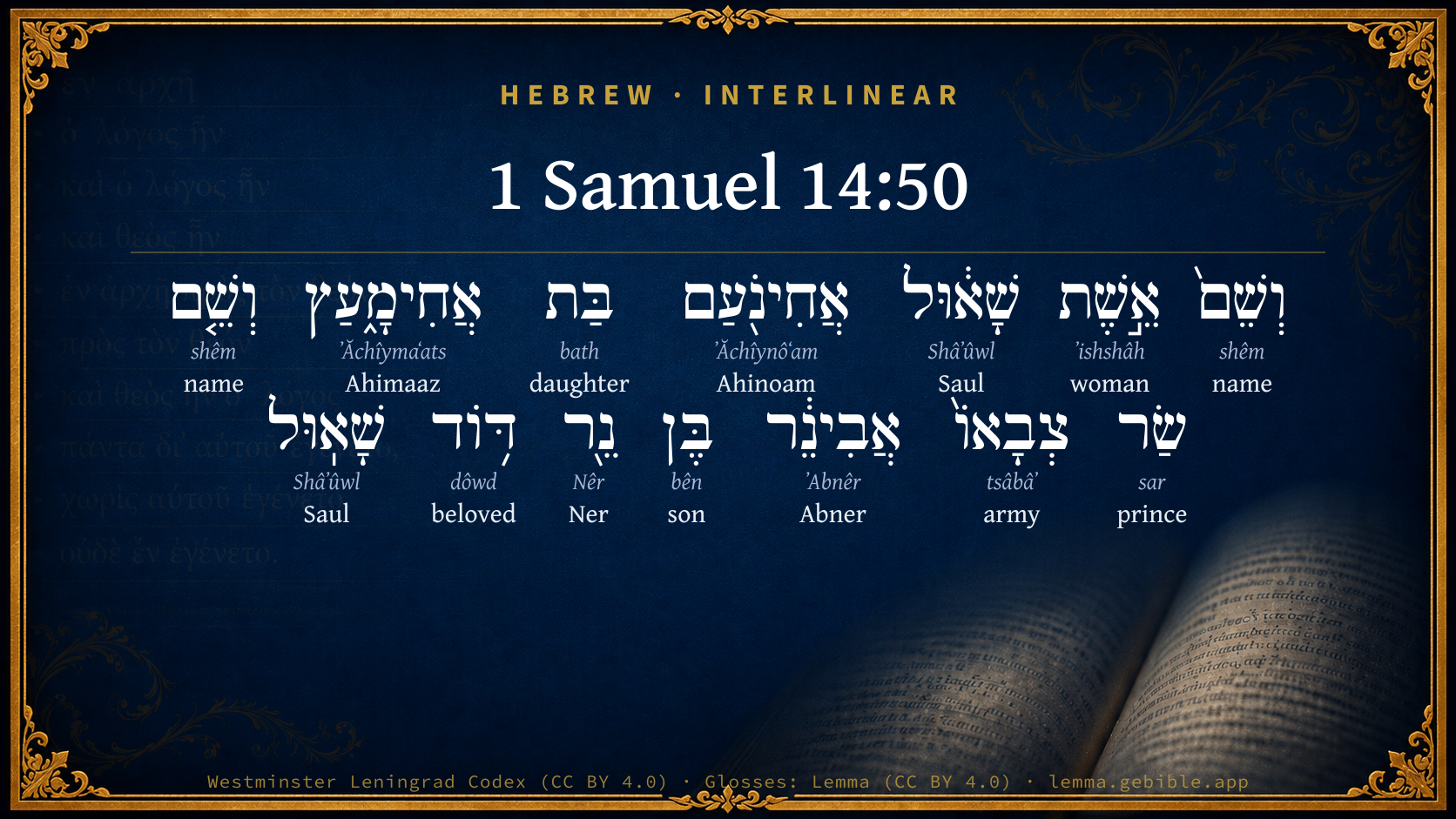
1 Samuel 14:50

Hebrew (Westminster Leningrad Codex) 1 Samuel 14:50 appears in the Hebrew Old Testament. The text above is from the Westminster Leningrad Codex. Each word links to its Strong’s number, a concise gloss, and parsing drawn from the Open Scriptures Hebrew Bible morphology. Click any word for its full Brown-Driver-Briggs (BDB) entry.
Download image
Cite this verse

1 Samuel 14:50 (World English Bible). Public Domain. Lemma interlinear Bible study tool, https://lemma.gebible.app/v/1-samuel/14/50.

Show BibTeX & RIS
BibTeX
RIS
English Translation
and the name of Saul's wife was Ahinoam the daughter of Ahimaaz. The name of the captain of his host was Abner the son of Ner, Saul's uncle.
World English Bible · Public Domain
Highlights
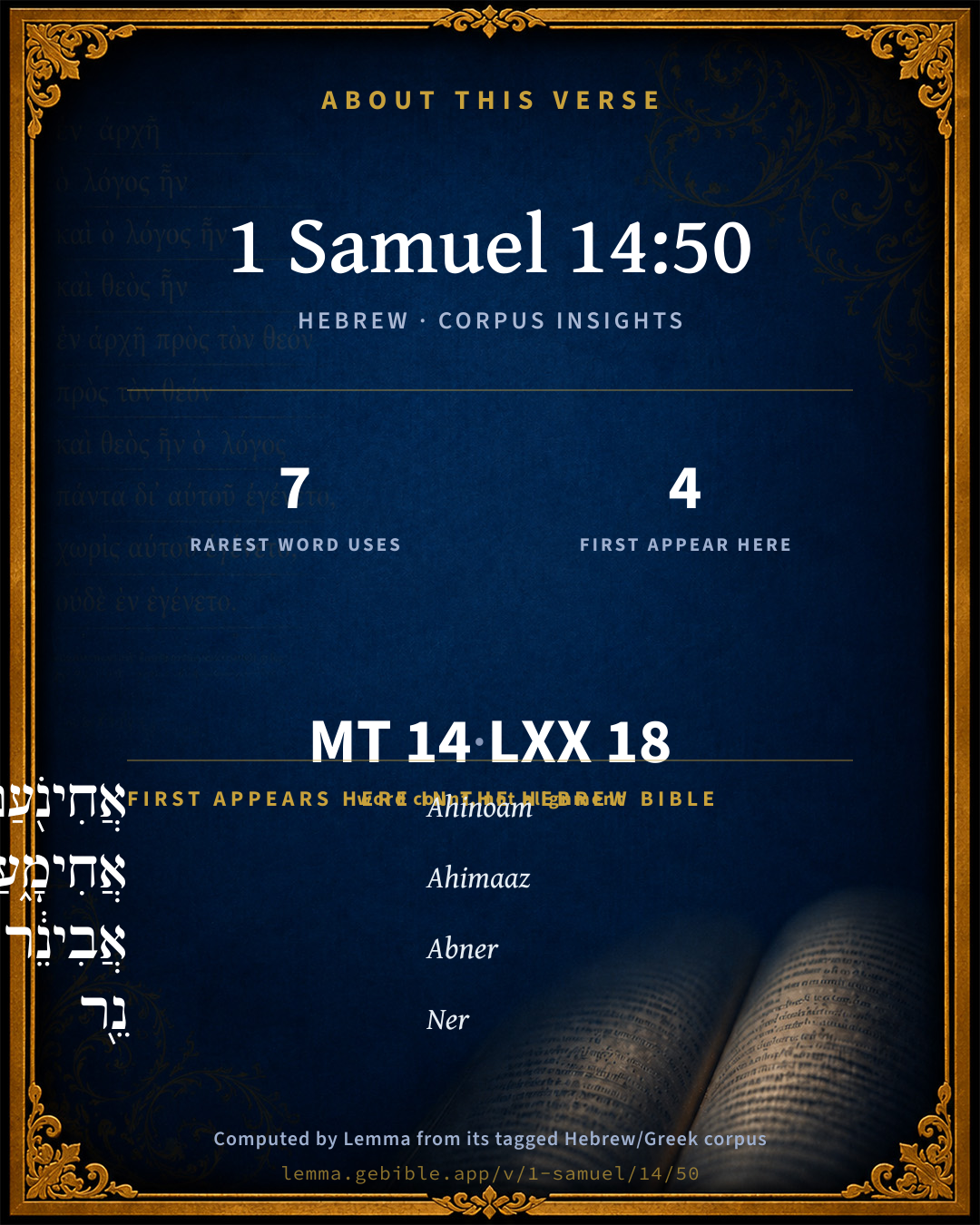
  • 4 first appearances in the Hebrew Bible
Full analysis ↓
Download a study sheet

One document with this verse’s original text, its word-by-word gloss line, the meaning frame, cross-references with their text, attributed commentary, and full source and license credits — printable, and it pastes into notes with its structure intact.

This verse Autodidact and up

Study sheet (.html) Plain text (.txt)

A passage Seminary Student

Up to 50 verses in one chapter. A passage sheet keeps up to 6 commentary sources and 12 cross-references per verse, in the order this page ranks them, and says so on the sheet whenever that leaves anything out. Ask for a single verse and you get the Autodidact verse sheet above.

Everything on this page stays free to read, with no account — the sheet is a download of what is already on screen, not access to it.

Want to remove ads? Support Godless Engineer
Compare translations 3

The same verse in 3 English versions, stacked beneath the original-language interlinear above. Click any original word for its lexicon entry.

Each is an independent rendering of the whole verse — the interlinear is not word-aligned to these translations.

Highlighted words mark where these versions differ — a whole-verse word diff, not a word-by-word alignment.

  • World English Bible Public Domain
    and the name of Saul's wife was Ahinoam the daughter of Ahimaaz. The name of the captain of his host was Abner the son of Ner, Saul's uncle.
  • King James Version Public Domain
    And the name of Saul's wife was Ahinoam, the daughter of Ahimaaz: and the name of the captain of his host was Abner, the son of Ner, Saul's uncle.
  • unfoldingWord Literal Text CC BY-SA 4.0
    And the name of the wife of Saul Ahinoam, the daughter of Ahimaaz. And the name of the commander of his army Abner, the son of Ner, the uncle of Saul.

unfoldingWord Literal Text — © unfoldingWord, licensed CC BY-SA 4.0. Word-aligned USFM3 via Door43 (git.door43.org/unfoldingWord/en_ult).

Versions to compare (up to 4)

3 of 4 selected

Show all 18 translations

Every available English version of this verse, each an independent rendering of the whole verse.

  • World English Bible Public Domain
    and the name of Saul's wife was Ahinoam the daughter of Ahimaaz. The name of the captain of his host was Abner the son of Ner, Saul's uncle.
  • Berean Standard Bible Public Domain
    His wife’s name was Ahinoam daughter of Ahimaaz. The name of the commander of his army was Abner, the son of Saul’s uncle Ner.
  • Majority Standard Bible Public Domain
    His wife’s name was Ahinoam daughter of Ahimaaz. The name of the commander of his army was Abner, the son of Saul’s uncle Ner.
  • King James Version Public Domain
    And the name of Saul's wife was Ahinoam, the daughter of Ahimaaz: and the name of the captain of his host was Abner, the son of Ner, Saul's uncle.
  • American Standard Version (1901) Public Domain
    and the name of Saul's wife was Ahinoam the daughter of Ahimaaz. And the name of the captain of his host was Abner the son of Ner, Saul's uncle.
  • Revised Version (1885) Public Domain
    and the name of Saul’s wife was Ahinoam the daughter of Ahimaaz: and the name of the captain of his host was Abner the son of Ner, Saul’s uncle.
  • Geneva Bible (1599) Public Domain
    And the name of Sauls wife was Ahinoam the daughter of Ahimaaz: and the name of his chiefe captaine was Abner the sonne of Ner, Sauls vncle.
  • Douay-Rheims (1899) Public Domain
    And the name of Saul's wife, was Achinoam the daughter of Achimaas; and the name of the captain of his army was Abner, the son of Ner, the cousin german of Saul.
  • Young's Literal Translation Public Domain
    and the name of the wife of Saul `is' Ahinoam, daughter of Ahimaaz; and the name of the head of his host `is' Abner son of Ner, uncle of Saul;
  • Literal Standard Version CC BY-SA 4.0
    and the name of the wife of Saul [is] Ahinoam, daughter of Ahimaaz; and the name of the head of his host [is] Abner son of Ner, uncle of Saul;
  • Unlocked Literal Bible CC BY-SA 4.0
    The name of Saul's wife was Ahinoam; she was the daughter of Ahimaaz. The name of the captain of his army was Abner son of Ner, Saul's uncle.
  • unfoldingWord Literal Text CC BY-SA 4.0
    And the name of the wife of Saul Ahinoam, the daughter of Ahimaaz. And the name of the commander of his army Abner, the son of Ner, the uncle of Saul.
  • Darby Bible Public Domain
    And the name of Saul's wife was Ahinoam, the daughter of Ahimaaz; and the name of the captain of his host was Abner, the son of Ner, Saul's uncle.
  • World Messianic Bible Public Domain
    The name of Saul’s wife was Ahinoam the daughter of Ahimaaz. The name of the captain of his army was Abner the son of Ner, Saul’s uncle.
  • Webster's Bible Public Domain
    And the name of Saul's wife was Ahinoam, the daughter of Ahimaaz: and the name of the captain of his host was Abner, the son of Ner, Saul's uncle.
  • Free Bible Version CC BY-SA 4.0
    The name of his wife was Ahinoam, daughter of Ahimaaz. The name of Saul's army commander was Abner, son of Ner, and Ner was Saul's uncle.
  • Bible in Basic English Public Domain
    The name of Saul's wife was Ahinoam, the daughter of Ahimaaz; the captain of his army was Abner, the son of Ner, brother of Saul's father.
  • JPS Tanakh (1917) Public Domain
    and the name of Saul's wife was Ahinoam the daughter of Ahimaaz; and the name of the captain of his host was Abner, the son of Ner, Saul's uncle.

Literal Standard Version (2020), Covenant Press — licensed CC BY-SA 4.0. Text via the HelloAO Bible API (eBible.org). Unlocked Literal Bible (unfoldingWord) — licensed CC BY-SA 4.0. Text via the HelloAO Bible API (eBible.org). unfoldingWord Literal Text — © unfoldingWord, licensed CC BY-SA 4.0. Word-aligned USFM3 via Door43 (git.door43.org/unfoldingWord/en_ult). Free Bible Version, Dr. Jonathan Gallagher — licensed CC BY-SA 4.0. Text via the HelloAO Bible API (eBible.org).

Word by word

More ways to search: Search by grammar → Find every occurrence → Compare this word →

Practice this passage: Drill this verse → Learn its vocabulary →

אֲחִינֹ֖עַם
ʼĂchîynôʻam
H293
“Ahinoam”
Noun, Proper
Part of Speech
Noun
Type
Proper
Full BDB Definition

Origin: from H251 and H5278

TWOT: None

Ahinoam = "my brother is delight" - wife of Saul, daughter of Ahimaaz - wife of David, mother of Amnon, a Jezreelitess
  1. וְשֵׁם֙ shêm H8034 “and · name of” Conjunction + Noun, Common, Masculine, Singular, Construct
  2. אֵ֣שֶׁת ʼishshâh H802 “woman of” Noun, Common, Feminine, Singular, Construct
  3. שָׁא֔וּל Shâʼûwl H7586 “Saul” Noun, Proper
  4. בַּת bath H1323 “daughter of” Noun, Common, Feminine, Singular, Construct
  5. אֲחִימָ֑עַץ ʼĂchîymaʻats H290 “Ahimaaz” Noun, Proper
  6. וְשֵׁ֤ם shêm H8034 “and · name of” Conjunction + Noun, Common, Masculine, Singular, Construct
  7. שַׂר sar H8269 “prince of” Noun, Common, Masculine, Singular, Construct
  8. צְבָאוֹ֙ tsâbâʼ H6635 “army · his” Noun, Common, Both, Singular, Construct + Suffix, Personal, 3rd Person, Masculine, Singular
  9. אֲבִינֵ֔ר ʼAbnêr H74 “Abner” Noun, Proper
  10. בֶּן bên H1121 “son of” Noun, Common, Masculine, Singular, Construct
  11. נֵ֖ר Nêr H5369 “Ner” Noun, Proper
  12. דּ֥וֹד dôwd H1730 “beloved of” Noun, Common, Masculine, Singular, Construct
  13. שָׁאֽוּל Shâʼûwl H7586 “Saul” Noun, Proper

About this verse

These counts appear in no published source. They are computed here, from the morphology-tagged text and Lemma’s own curated glosses. What Lemma adds →

14
words
12
distinct lemmas
Historical
section

Notable vocabulary

The rarest word here is אֲחִינֹ֖עַם Ahinoam H293 — appearing just 7 times in the whole Hebrew Bible.

First appearance in Scripture

These words make their first canonical appearance in the Hebrew Bible here:

  • אֲחִינֹ֖עַם Ahinoam H293
  • אֲחִימָ֑עַץ Ahimaaz H290
  • אֲבִינֵ֔ר Abner H74
  • נֵ֖ר Ner H5369

Shared distinctive vocabulary

אֲחִינֹ֖עַם Ahinoam H293 occurs in 7 verses of the Hebrew Bible. Also found in:

Grammatical profile

  • 14 nouns

Repetition

Words recur within this verse — often emphatic in Hebrew:

  • וְשֵׁם֙ name H8034 ×2
  • שָׁא֔וּל Saul H7586 ×2

Hebrew & Septuagint length

In English translation the verse runs 28 words from the Hebrew and 33 from the Septuagint (LXX English) — closely comparable.

A rough comparison of the two English renderings, which tokenize alike — not a word-level alignment.

Word counts can differ between the Hebrew and the Greek without any difference in meaning — e.g. the Hebrew direct-object marker אֵת has no separate Greek word, and Greek often adds the article ὁ.

In the original languages it is 14 Hebrew tokens and 18 Greek tokens — but the two are counted differently (Hebrew bundles its prefixes and suffixes into one token; the Greek is in lemma form), so that isn’t a like-for-like length.

Cross-references

3

Topical passages linked to 1 Samuel 14:50 in the Treasury of Scripture Knowledge — connected by theme and wording, ordered by reader-vote popularity; previews shown in the World English Bible.

  • 2 Samuel 2:8 Now Abner the son of Ner, captain of Saul's host, had taken Ish-bosheth the son of Saul, and brought him over to Mahanaim;
  • 1 Samuel 17:55 When Saul saw David go forth against the Philistine, he said to Abner, the captain of the host, Abner, whose son is this youth? Abner said, As your soul lives, O king, I can't tell.
  • 2 Samuel 3:27 When Abner was returned to Hebron, Joab took him aside into the midst of the gate to speak with him quietly, and struck him there in the body, so that he died, for the blood of Asahel his brother.

Cross-references courtesy of OpenBible.info (CC BY 4.0).

Hebrew and Greek witnesses Masoretic Hebrew ↔ Greek Septuagint

The same verse in the two great witnesses to the Old Testament, shown verse-for-verse.

These are two independent witnesses, not word-aligned to each other, and the Septuagint is shown in lemma (dictionary) form.

Hebrew 1 Samuel 14:50 Masoretic · Westminster Leningrad Codex

וְשֵׁם֙ אֵ֣שֶׁת שָׁא֔וּל אֲחִינֹ֖עַם בַּת אֲחִימָ֑עַץ וְשֵׁ֤ם שַׂר צְבָאוֹ֙ אֲבִינֵ֔ר בֶּן נֵ֖ר דּ֥וֹד שָׁאֽוּל

and the name of Saul's wife was Ahinoam the daughter of Ahimaaz. The name of the captain of his host was Abner the son of Ner, Saul's uncle.

World English Bible · Public Domain

Greek LXX 1 Samuel 14:50 Septuagint · lemma form

καί ὄνομα ὁ γυνή αὐτός αχινοομ θυγάτηρ αχιμαας καί ὄνομα ὁ ἀρχιστράτηγος αβεννηρ υἱός νηρ υἱός οἰκεῖος σαούλ

And the name of his wife was Achinoom, the daughter of Achimaa: and the name of his captain of the host was Abenner, the son of Ner, son of a kinsman of Saul.

LXX2012 (modern English Septuagint) · Public Domain

Hebrew: Westminster Leningrad Codex (CC BY 4.0). Greek: Septuagint (public domain); English from LXX2012 (modern English Septuagint) (Public Domain). How the Septuagint differs from the Hebrew →

Targum (Aramaic paraphrase)

1

The Targum is the ancient Jewish Aramaic paraphrase of the Hebrew Scriptures — an interpretive translation, not the Hebrew text itself. Onkelos (literal) and Pseudo-Jonathan (expansive) render the Torah, and Jonathan the Prophets. Coverage is partial: where no permissively-licensed English translation exists for a verse, only the Aramaic is shown. This is verse-level text, not a word-by-word alignment to the Hebrew.

  1. Targum Jonathan Prophets (Joshua–Malachi)
    וְשׁוּם אִתַּת שָׁאוּל אֲחִינוֹעַם בַּת אֲחִימָעַץ וְשׁוּם רַב חֵילֵיהּ אֲבִינֵר בַּר נֵר אָח אֲבוּהִי דְשָׁאוּל:

    (no public-domain English translation for this verse)

    Targum Jonathan — Aramaic: “Mikraot Gedolot” (public domain). English: “Sefaria Community Translation” (CC0 1.0 (public-domain dedication)); “London "Chaldee Paraphrase," 1871” (public domain). Text via Sefaria.

Commentary

Notes on 1 Samuel 14:50 from classic Christian and Jewish commentators (each source and its license shown beneath its notes). The classic Christian expositions comment on the surrounding passage and are grouped to its opening verse, so a note may address several verses; the Jewish commentaries on the Tanakh (Rashi and others) are per-verse, so they appear only where the commentator wrote on this verse.

Lemma curates 59 commentaries, every one of them public domain or Creative Commons licensed, each selected and text-cleaned for this edition rather than reprinted as found. About our sources →

Trapp's Complete Commentary

John Trapp

1Sa 14:50 And the name of Saul’s wife [was] Ahinoam, the daughter of Ahimaaz: and the name of the captain of his host [was] Abner, the son of Ner, Saul’s uncle.

Ver. 50. And the name of Saul’s wife.] We read but of this one wife that Saul had: and this some: {a} do number among his virtues, that he multiplied not wives, according to Deu 17:17. Howbeit, he had a concubine, Rizpah, and children by her, which for their father’s fault were hanged in David’s days.

{a} Pellican.

John Trapp, A Commentary or Exposition upon All the Books of the Old and New Testament (1647–1656) — public domain. Text from a community e-Sword module.

Tyndale Open Study Notes

Tyndale Open Resources

14:50 Ahinoam is mentioned only here in Saul’s story. In 25:43, David marries a woman also called Ahinoam (who might or might not have been the same person; cp. 2 Sam 12:8).

Tyndale Open Study Notes — © Tyndale Open Resources, licensed CC BY-SA 4.0. Text via the HelloAO Bible API.

Geneva Bible (1599)

Geneva Bible translators

Whom Joab the captain of David slew, 2 Sam. 3:27.

Geneva Bible (1599) marginal notes — public domain. Text via Bolls.life.

Ellicott's Commentary for English Readers

(50) Saul’s wife.—In accordance with a usual practice, the name of the most prominent of the family and royal household of the king are given. We know nothing of Saul’s queen besides her name. It has been surmised that she was of the family of Eli, the high priest, owing to the Ah (brother) entering into her name and that of her father, Ahimaaz, as this compound was apparently the favourite prefix to names in this great and renowned house. The simplicity and modesty of the king’s domestic habits is evident. Ewald thinks from this circumstance that he had only this one wife and one concubine, Rizpah, the daughter of Aiah, afterwards so famous for her sad misfortunes and for her devoted love to her ill-fated children. (See 2Sa_21:8-12.)

The captain of his host was Abner.—This “cousin”—or, as some have understood the sentence, the uncle—of King Saul was evidently a man of rare powers and ability. The brilliant campaigns of this reign were, no doubt, in no small measure owing to the military skill of this great commander. After the terrible disaster on Mount Gilboa, Abner was the mainstay of the house of the dead King Saul, and when he died the generous David followed the bier, and lamented over him with a lamentation which has come down to us in words ever memorable: “Know ye not that there is a prince and a great man fallen this day in Israel.” His son Jaasiel was subsequently allowed the first place in the tribe of Benjamin. (See 1Ch_27:21.)

A Bible Commentary for English Readers, edited by Charles John Ellicott (1878–1897) — public domain. Text from a community e-Sword module.

The Cambridge Bible for Schools and Colleges

gen. ed. J. J. S. Perowne

50. Abner the son of Ner Saul’s uncle] Grammatically, “Saul’s uncle” might refer either to Abner or to Ner, but it is almost certain that it must refer to the latter, so that Saul and Abner were first cousins. 1Sa_14:51 should be read, according to Josephus, “And Kish the father of Saul and Ner the father of Abner were sons of Abiel.” It is true that the genealogies in 1Ch_8:33; 1Ch_9:39 make Ner the grandfather of Saul and consequently Abner Saul’s uncle: but (a) Ner is not mentioned among Saul’s ancestors in ch. 1Sa_9:1, and (b) it is difficult to suppose that Abner who was in full vigour for seven years after Saul’s death (2 Samuel 2, 3) could have belonged to the generation above him. There is probably some confusion of the names in Chronicles.

The Cambridge Bible for Schools and Colleges (gen. ed. J. J. S. Perowne; Cambridge University Press, 1878–1918) — public domain. Text from a community e-Sword module.

John Gill's Exposition

And the name of Saul's wife was Ahinoam, the daughter of Ahimaaz,.... Who very probably was the mother of all the above children, and therefore taken notice of; and Abarbinel conjectures that Ishbosheth was not a son of her's, but the son of Saul by another wife, and which he takes to be another reason why he is not mentioned here; but though Saul had a concubine, we nowhere read of his having another wife:

and the name of the captain of his host was Abner the son of Ner, Saul's uncle; not Abner, but Ner, was Saul's uncle; for Kish the father of Saul, and Ner, were brothers, as Josephus (p) says, and as appears from the next verse; and Abner was first cousin to Saul, whom he raised and advanced to be captain of his army, and a very valiant man he was: we hear of him again in this history, and in the beginning of David's reign.

(p) Ut supra. (Antiqu. l. 6. c. 6. sect. 5.)

John Gill's Exposition of the Whole Bible (1746–1763) — public domain (CC PDM 1.0). Text via the HelloAO Bible API.

Albert Barnes' Notes on the Bible

The only other “Ahimaaz” mentioned in Scripture was the son of Zadok the priest. The word “Ahi” (brother) is frequently found in composition in names in the High Priest’s family, e. g. in Ahijah, Ahimelech. It is not improbable that Ahimaaz may have been of this family, as marriages between the reval and priestly houses were not unusual 2Ki 11:2; 2Ch 22:11, and perhaps it may have been owing to such a connection that Ahijah was brought into prominence by Saul. If there be any truth in the above supposition, it would be an indication that Saul was not married until after his election to the throne.

Albert Barnes' Notes on the Bible (1834–1885) — public domain. Text from a community e-Sword/MySword module.

Haydock's Catholic Bible Commentary

Achinoam. After he came to the throne, he had Respha, 2 Kings iii. 7. (Menochius)

George Leo Haydock (1774–1849), Haydock's Catholic Family Bible and Commentary, 1859 edition — public domain. Excludes Psalms (Douay-Rheims chapter numbering differs from Protestant) and Deuterocanonical books (Catholic canon only).

The Pulpit Commentary

Saul"s wife was Ahinoam, the daughter of Ahimaaz. We have noticed on ver. 3 the fondness of the family of Eli for names beginning with Ah, "brother." It does not justify us in concluding that Ahinoam was a descendant of Eli, but she may possibly have been so. Abner, whose name is here given in its strictly proper form, Abiner, was Saul"s first cousin, both Kish and Ner being sons of Abiel. (comp. 1Sa_9:1)

The Pulpit Commentary (1880–1919), ed. H.D.M. Spence-Jones & Joseph S. Exell — public domain. Text from a community e-Sword module.

Rashi

Rabbi Shlomo Yitzchaki (Rashi)

Avineir the son of Neir. Neir was Shaul's uncle, the brother of Kish, and both were the sons of Avieil. Aviei was also known as Neir, in Divrei Hayomim, because he would light candles for the public in the dark streets.

Rashi on the Tanakh — English translations: “The Judaica Press complete Tanach with Rashi, translated by A. J. Rosenberg” (CC BY 4.0); “Pentateuch with Rashi's commentary by M. Rosenbaum and A.M. Silbermann, 1929-1934” (public domain); “The Metsudah Tanach series, Lakewood, N.J” (CC BY 4.0); and “The Book of Joshua, Metsudah Publications, 1997” (CC BY 4.0). Text via Sefaria.

Lesson kit

Teaching starters — assembled from the data on this page, not authored interpretation. Every prompt links to the verse data it draws on. Edit before teaching.

1 Samuel, in the Historical, opens this verse with 14 words (12 distinct Hebrew lemmas). Its most distinctive word is ʼĂchîynôʻam (“Ahinoam”). A historical commentator’s framing appears above. Read the whole chapter for the surrounding context.

Discussion questions

  1. How does “Ahinoam” (ʼĂchîynôʻam) shape what this verse is saying?
  2. 4 words here appear for the first time in Scripture. What is being introduced at this debut?
  3. 1 Samuel 25:43 shares the word «Ahinoam» with this verse. How do the two illuminate each other?
  4. “name” occurs 2× in this one verse. What is the effect of the repetition?
  5. The translations on this page render this verse differently — a whole-verse word diff, not a word-by-word alignment. What might account for the different wordings?
  6. Reading how Trapp's Complete Commentary and Tyndale Open Study Notes read this verse, where do the two commentators agree and where do they part?

Things to notice

Reading settings

Reading text

Shown beneath each verse's original-language words.

Old Testament
Old Testament edition

Read the OT as the Masoretic Hebrew (MT) or the Greek Septuagint (LXX).

English shown for the Greek Septuagint (in the Hebrew ↔ Greek comparison).

Comparing translations? Open the Compare panel on any verse page to stack up to four side by side.