Habakkuk 2:13

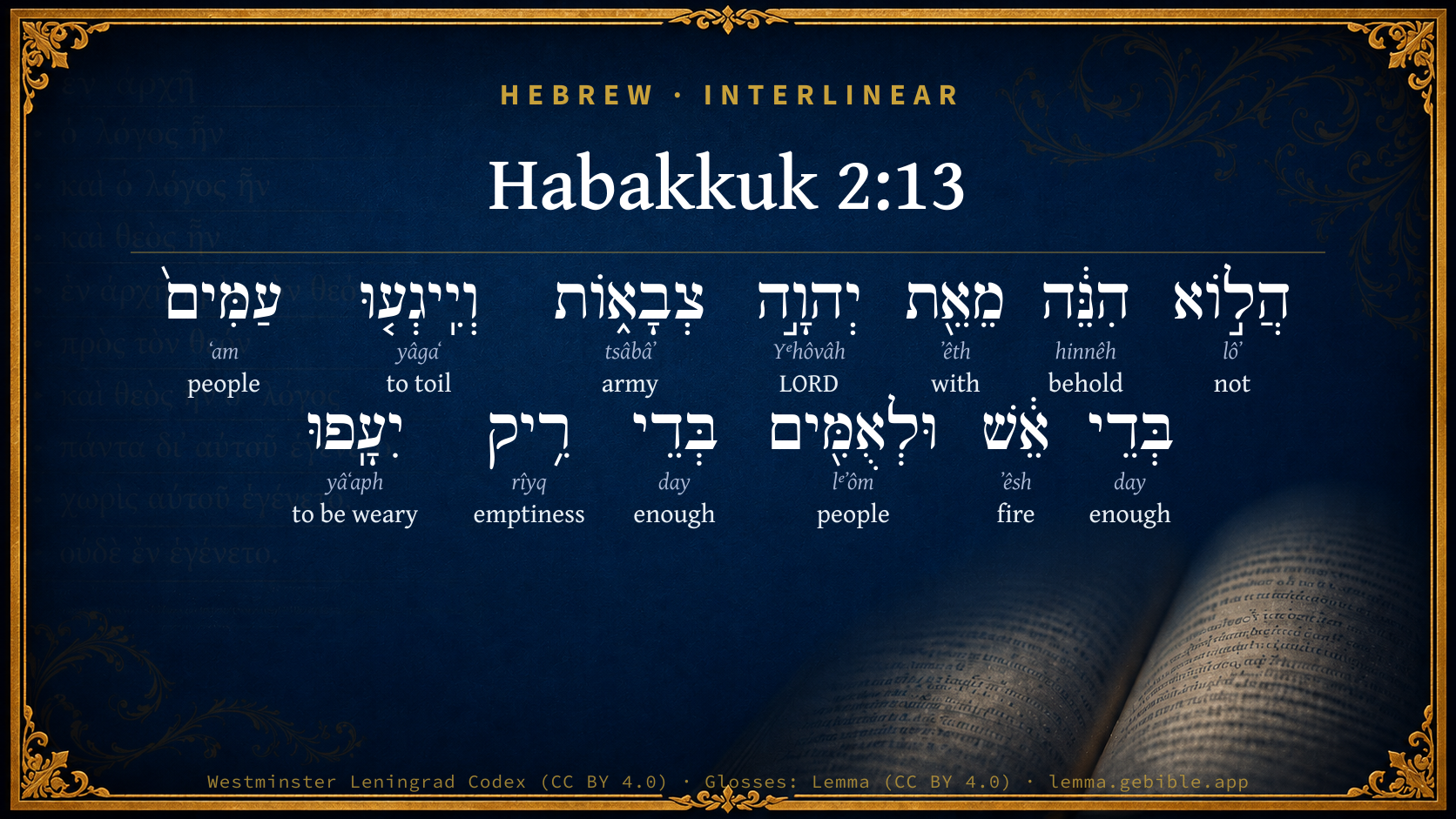
Hebrew (Westminster Leningrad Codex) Habakkuk 2:13 appears in the Hebrew Old Testament. The text above is from the Westminster Leningrad Codex. Each word links to its Strong’s number, a concise gloss, and parsing drawn from the Open Scriptures Hebrew Bible morphology. Click any word for its full Brown-Driver-Briggs (BDB) entry.
Download image
Cite this verse

Habakkuk 2:13 (World English Bible). Public Domain. Lemma interlinear Bible study tool, https://lemma.gebible.app/v/habakkuk/2/13.

Show BibTeX & RIS
BibTeX
RIS
English Translation
Behold, isn't it of Yahweh of Hosts that the peoples labor for the fire, and the nations weary themselves for vanity?
World English Bible · Public Domain
Download a study sheet

One document with this verse’s original text, its word-by-word gloss line, the meaning frame, cross-references with their text, attributed commentary, and full source and license credits — printable, and it pastes into notes with its structure intact.

This verse Autodidact and up

Study sheet (.html) Plain text (.txt)

A passage Seminary Student

Up to 50 verses in one chapter. A passage sheet keeps up to 6 commentary sources and 12 cross-references per verse, in the order this page ranks them, and says so on the sheet whenever that leaves anything out. Ask for a single verse and you get the Autodidact verse sheet above.

Everything on this page stays free to read, with no account — the sheet is a download of what is already on screen, not access to it.

Want to remove ads? Support Godless Engineer
Compare translations 3

The same verse in 3 English versions, stacked beneath the original-language interlinear above. Click any original word for its lexicon entry.

Each is an independent rendering of the whole verse — the interlinear is not word-aligned to these translations.

Highlighted words mark where these versions differ — a whole-verse word diff, not a word-by-word alignment.

  • World English Bible Public Domain
    Behold, isn't it of Yahweh of Hosts that the peoples labor for the fire, and the nations weary themselves for vanity?
  • King James Version Public Domain
    Behold, is it not of the LORD of hosts that the people shall labour in the very fire, and the people shall weary themselves for very vanity?
  • unfoldingWord Literal Text CC BY-SA 4.0
    Behold, not from Yahweh of armies that peoples labor for fire and nations become weary for emptiness?

unfoldingWord Literal Text — © unfoldingWord, licensed CC BY-SA 4.0. Word-aligned USFM3 via Door43 (git.door43.org/unfoldingWord/en_ult).

Versions to compare (up to 4)

3 of 4 selected

Show all 18 translations

Every available English version of this verse, each an independent rendering of the whole verse.

  • World English Bible Public Domain
    Behold, isn't it of Yahweh of Hosts that the peoples labor for the fire, and the nations weary themselves for vanity?
  • Berean Standard Bible Public Domain
    Is it not indeed from the LORD of Hosts that the labor of the people only feeds the fire, and the nations weary themselves in vain?
  • Majority Standard Bible Public Domain
    Is it not indeed from the LORD of Hosts that the labor of the people only feeds the fire, and the nations weary themselves in vain?
  • King James Version Public Domain
    Behold, is it not of the LORD of hosts that the people shall labour in the very fire, and the people shall weary themselves for very vanity?
  • American Standard Version (1901) Public Domain
    Behold, is it not of Jehovah of hosts that the peoples labor for the fire, and the nations weary themselves for vanity?
  • Revised Version (1885) Public Domain
    Behold, is it not of the LORD of hosts that the peoples labour for the fire, and the nations weary themselves for vanity?
  • Geneva Bible (1599) Public Domain
    Beholde, is it not of the Lord of hostes that the people shall labour in ye very fire? the people shall euen weary themselues for very vanitie.
  • Douay-Rheims (1899) Public Domain
    Are not these things from the Lord of hosts? for the people shall labour in a great fire: and the nations in vain, and they shall faint.
  • Young's Literal Translation Public Domain
    Lo, is it not from Jehovah of Hosts And peoples are fatigued for fire, And nations for vanity are weary?
  • Literal Standard Version CC BY-SA 4.0
    Behold, is it not from YHWH of Hosts || And peoples are fatigued for fire, || And nations for vanity are weary?
  • Unlocked Literal Bible CC BY-SA 4.0
    Is it not from Yahweh of hosts that peoples labor for fire and all the other nations weary themselves for nothing?
  • unfoldingWord Literal Text CC BY-SA 4.0
    Behold, not from Yahweh of armies that peoples labor for fire and nations become weary for emptiness?
  • Darby Bible Public Domain
    Behold, is it not of Jehovah of hosts that the peoples labour for the fire, and the nations weary themselves in vain?
  • World Messianic Bible Public Domain
    Behold, isn’t it from the LORD of Hosts that the peoples labor for the fire, and the nations weary themselves for vanity?
  • Webster's Bible Public Domain
    Behold, is it not from the LORD of hosts that the people shall labor in the very fire, and the people shall weary themselves for very vanity?
  • Free Bible Version CC BY-SA 4.0
    Hasn't the Lord Almighty decided that all the hard work of such nations is going to be burned up—that they wear themselves out for nothing?
  • Bible in Basic English Public Domain
    See, is it not the pleasure of the Lord of armies that the peoples are working for the fire and using themselves up for nothing?
  • JPS Tanakh (1917) Public Domain
    Behold, is it not of the LORD of hosts that the peoples labour for the fire, and the nations weary themselves for vanity?

Literal Standard Version (2020), Covenant Press — licensed CC BY-SA 4.0. Text via the HelloAO Bible API (eBible.org). Unlocked Literal Bible (unfoldingWord) — licensed CC BY-SA 4.0. Text via the HelloAO Bible API (eBible.org). unfoldingWord Literal Text — © unfoldingWord, licensed CC BY-SA 4.0. Word-aligned USFM3 via Door43 (git.door43.org/unfoldingWord/en_ult). Free Bible Version, Dr. Jonathan Gallagher — licensed CC BY-SA 4.0. Text via the HelloAO Bible API (eBible.org).

Word by word

More ways to search: Search by grammar → Find every occurrence → Compare this word →

Practice this passage: Drill this verse → Learn its vocabulary →

יִעָֽפוּ
yâʻaph
H3286
“to be weary”
Verb, Qal, Imperfect, 3rd Person, Masculine, Plural
Part of Speech
Verb
Stem
Qal
Form
Imperfect
Person
3rd Person
Gender
Masculine
Number
Plural
Full BDB Definition

Origin: a primitive root

TWOT: 885

to be or grow weary, be fatigued, be faint - (Qal) to be or grow weary, be fatigued, be faint - (Hophal) wearied (participle)
  1. הֲל֣וֹא lôʼ H3808 “not” Particle, Interrogative + Particle, Negative
  2. הִנֵּ֔ה hinnêh H2009 “behold” Particle, Demonstrative
  3. מֵאֵ֖ת ʼêth H854 “from · with” Preposition + Preposition
  4. יְהוָ֣ה Yᵉhôvâh H3068 “LORD” Noun, Proper
  5. צְבָא֑וֹת tsâbâʼ H6635 “armies” Noun, Common, Both, Plural, Absolute
  6. וְיִֽיגְע֤וּ yâgaʻ H3021 “and · to toil” Conjunction + Verb, Qal, Imperfect, 3rd Person, Masculine, Plural
  7. עַמִּים֙ ʻam H5971 “peoples” Noun, Common, Masculine, Plural, Absolute
  8. בְּדֵי day H1767 “in/at · enough of” Preposition + Noun, Common, Masculine, Singular, Construct
  9. אֵ֔שׁ ʼêsh H784 “fire” Noun, Common, Both, Singular, Absolute
  10. וּלְאֻמִּ֖ים lᵉʼôm H3816 “and · peoples” Conjunction + Noun, Common, Masculine, Plural, Absolute
  11. בְּדֵי day H1767 “in/at · enough of” Preposition + Noun, Common, Masculine, Singular, Construct
  12. רִ֥יק rîyq H7385 “emptiness” Noun, Common, Masculine, Singular, Absolute

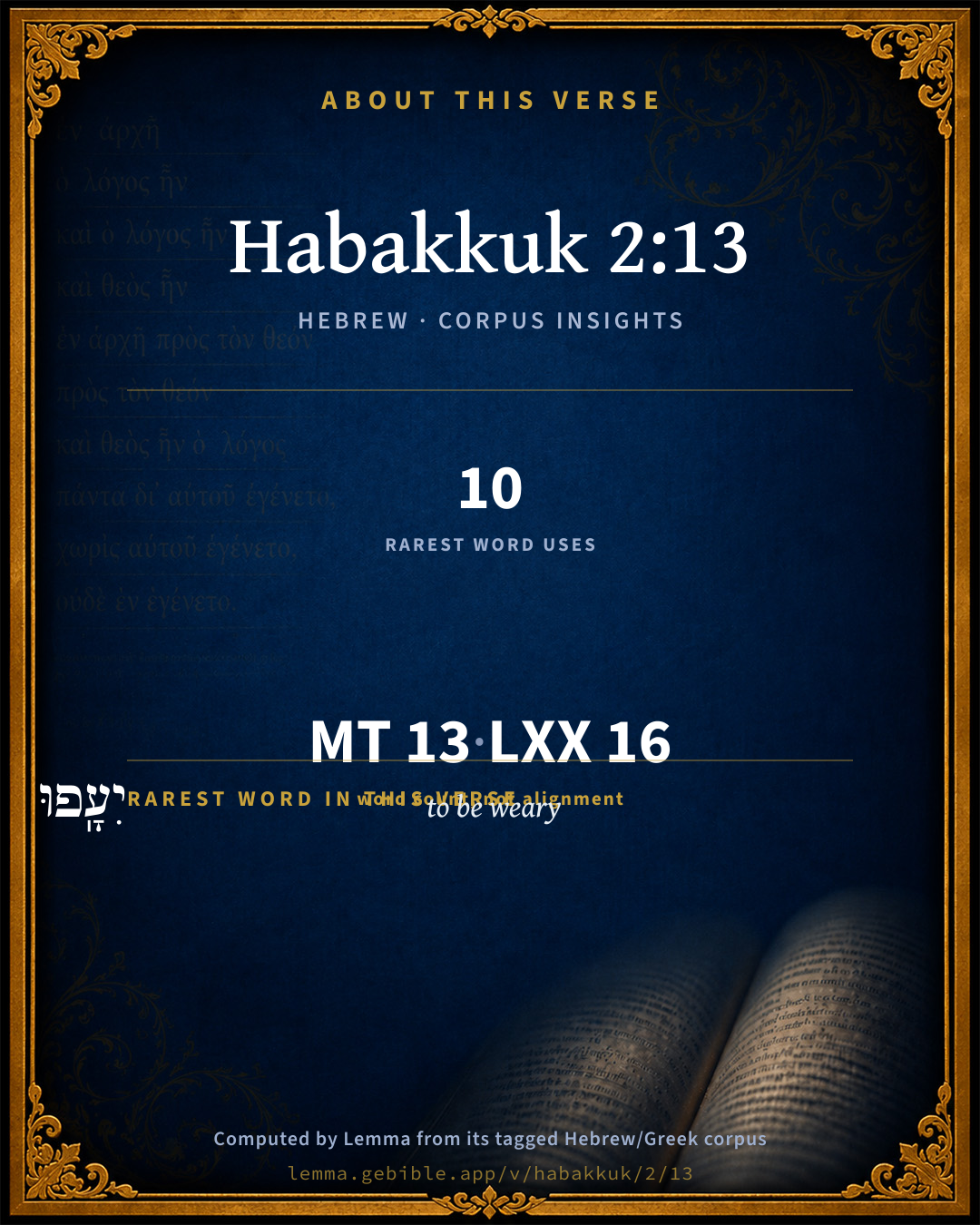
About this verse

These counts appear in no published source. They are computed here, from the morphology-tagged text and Lemma’s own curated glosses. What Lemma adds →

13
words
12
distinct lemmas
Prophets
section

Notable vocabulary

The rarest word here is יִעָֽפוּ to be weary H3286 — appearing just 10 times in the whole Hebrew Bible.

Shared distinctive vocabulary

יִעָֽפוּ to be weary H3286 occurs in 10 verses of the Hebrew Bible. Also found in:

Grammatical profile

  • 2 verbs
  • 8 nouns
  • 1 preposition
  • 2 particles

Verb forms

  • וְיִֽיגְע֤וּ Qal · Imperfect
  • יִעָֽפוּ Qal · Imperfect

Repetition

A word recurs within this verse — often emphatic in Hebrew:

  • בְּדֵי enough H1767 ×2

Hebrew & Septuagint length

In English translation the verse runs 21 words from the Hebrew and 22 from the Septuagint (LXX English) — closely comparable.

A rough comparison of the two English renderings, which tokenize alike — not a word-level alignment.

Word counts can differ between the Hebrew and the Greek without any difference in meaning — e.g. the Hebrew direct-object marker אֵת has no separate Greek word, and Greek often adds the article ὁ.

In the original languages it is 13 Hebrew tokens and 16 Greek tokens — but the two are counted differently (Hebrew bundles its prefixes and suffixes into one token; the Greek is in lemma form), so that isn’t a like-for-like length.

Cross-references

12

Topical passages linked to Habakkuk 2:13 in the Treasury of Scripture Knowledge — connected by theme and wording, ordered by reader-vote popularity; previews shown in the World English Bible.

  • Jeremiah 51:58 Thus says Yahweh of hosts: The broad walls of Babylon shall be utterly overthrown, and her high gates shall be burned with fire; and the peoples shall labor for vanity, and the nations for the fire; and they shall be weary.
  • Proverbs 21:30 There is no wisdom nor understanding Nor counsel against Yahweh.
  • Isaiah 50:11 Behold, all you who kindle a fire, who gird yourselves about with firebrands; walk you in the flame of your fire, and among the brands that you have kindled. This shall you have of my hand; you shall lie down in sorrow.
  • Genesis 11:6–9 Yahweh said, "Behold, they are one people, and they have all one language; and this is what they begin to do. Now nothing will be withheld from them, which they intend to do.
  • Job 5:13–14 He takes the wise in their own craftiness; The counsel of the cunning is carried headlong.
  • Psalms 39:6 "Surely every man walks like a shadow. Surely they busy themselves in vain. He heaps up, and doesn't know who shall gather.
  • Psalms 127:1–2 Unless Yahweh builds the house, They labor in vain who build it. Unless Yahweh watches over the city, The watchman guards it in vain.
  • Isaiah 41:5–8 The isles have seen, and fear; the ends of the earth tremble; they draw near, and come.
  • Isaiah 55:2 Why do you spend money for that which is not bread? and your labor for that which doesn't satisfy? listen diligently to me, and eat you that which is good, and let your soul delight itself in fatness.
  • Malachi 1:4 Whereas Edom says, "We are beaten down, but we will return and build the waste places;" thus says Yahweh of Hosts, "They shall build, but I will throw down; and men will call them 'The Wicked Land,' even the people against whom Yahweh shows wrath forever."
  • 2 Samuel 15:31 One told David, saying, Ahithophel is among the conspirators with Absalom. David said, Yahweh, please turn the counsel of Ahithophel into foolishness.
  • Jeremiah 51:64 and you shall say, Thus shall Babylon sink, and shall not rise again because of the evil that I will bring on her; and they shall be weary. Thus far are the words of Jeremiah.

Cross-references courtesy of OpenBible.info (CC BY 4.0).

Hebrew and Greek witnesses Masoretic Hebrew ↔ Greek Septuagint

The same verse in the two great witnesses to the Old Testament, shown verse-for-verse.

These are two independent witnesses, not word-aligned to each other, and the Septuagint is shown in lemma (dictionary) form.

Hebrew Habakkuk 2:13 Masoretic · Westminster Leningrad Codex

הֲל֣וֹא הִנֵּ֔ה מֵאֵ֖ת יְהוָ֣ה צְבָא֑וֹת וְיִֽיגְע֤וּ עַמִּים֙ בְּדֵי אֵ֔שׁ וּלְאֻמִּ֖ים בְּדֵי רִ֥יק יִעָֽפוּ

Behold, isn't it of Yahweh of Hosts that the peoples labor for the fire, and the nations weary themselves for vanity?

World English Bible · Public Domain

Greek LXX Habakkuk 2:13 Septuagint · lemma form

οὐ οὗτος εἰμί παρά κύριος παντοκράτωρ καί ἐκλείπω λαός ἱκανός ἐν πῦρ καί ἔθνος πολύς ὀλιγοψυχέω

Are not these things of the Lord Almighty? surely many people have been exhausted in the fire, and many nations have fainted.

LXX2012 (modern English Septuagint) · Public Domain

Hebrew: Westminster Leningrad Codex (CC BY 4.0). Greek: Septuagint (public domain); English from LXX2012 (modern English Septuagint) (Public Domain). How the Septuagint differs from the Hebrew →

Targum (Aramaic paraphrase)

1

The Targum is the ancient Jewish Aramaic paraphrase of the Hebrew Scriptures — an interpretive translation, not the Hebrew text itself. Onkelos (literal) and Pseudo-Jonathan (expansive) render the Torah, and Jonathan the Prophets. Coverage is partial: where no permissively-licensed English translation exists for a verse, only the Aramaic is shown. This is verse-level text, not a word-by-word alignment to the Hebrew.

  1. Targum Jonathan Prophets (Joshua–Malachi)
    הָא מְחָן תַּקִיפָן וַחֲסִינָן אָתְיָן מִן קֳדָם יְיָ צְבָאוֹת וְלֵיאוּת עַמְמַיָא תַּקִיפִין כְּאֶשְׁתָּא וּמַלְכוּתָא לְרֵיקָנוּ יִשְׁתַּלְהֲיָן:

    (no public-domain English translation for this verse)

    Targum Jonathan — Aramaic: “Mikraot Gedolot” (public domain). English: “Sefaria Community Translation” (CC0 1.0 (public-domain dedication)); “London "Chaldee Paraphrase," 1871” (public domain). Text via Sefaria.

Commentary

Notes on Habakkuk 2:13 from classic Christian and Jewish commentators (each source and its license shown beneath its notes). The classic Christian expositions comment on the surrounding passage and are grouped to its opening verse, so a note may address several verses; the Jewish commentaries on the Tanakh (Rashi and others) are per-verse, so they appear only where the commentator wrote on this verse.

Lemma curates 59 commentaries, every one of them public domain or Creative Commons licensed, each selected and text-cleaned for this edition rather than reprinted as found. About our sources →

Trapp's Complete Commentary

John Trapp

Hab 2:13 Behold, [is it] not of the LORD of hosts that the people shall labour in the very fire, and the people shall weary themselves for very vanity?

Ver. 13. Behold, is it not of the Lord of hosts that the people shall labour in the fire] Labour in vain to quench the fire, wherewith Babylon shall be burnt, Jer 51:58. Or have laboured to no purpose in building that city and enlarging that empire, which now God will have down. Is it not evident, that they have lost oleum et operam, oil and work, yea, hazarded their own lives, as those do that strive against a flame. What profit hath he that laboureth for the wind, Ecc 5:16, much less he that laboureth in the fire, that devouring element, see Isa 33:14. Possibly he may be saved himself, yet so as by fire, but his work shall be burnt, that loss he shall suffer, 1Co 3:15. As they that seek after the philosopher’s stone labour in the very fire to as little purpose as may be; for they must use so much gold, and spend so much gold, and then perhaps they can turn as much into gold by it as they have spent in making of it. Hence one calls alchemy a multiplying of something by nothing; another an Omne, Aliquid, Nihil all things, some things, nothing, another, an art without art, never taught by Moses and Miriam, as some have doted, and delivered, that this was a piece of their Egyptian learning. But it is certain that those holy souls never either learned or taught any such laborious loss of time and money. Demetrius Phalereus complaineth of these alchemists long gone not without indignation, quod certis consumptis incertorum gratis, quae se capturos sperabant, non ceperunt, quod vero habebant abiecerint, that they cast away certainties for uncertainties, that they attained not what they hoped for, but cast away what they had (Athenaeus). Julius Scaliger also, Fornaculas istas odi, saith he, odio plus quam Vatiniano. Sunt enim noctuae ad aucupia crumenarum. I cannot abide those furnaces; indeed, they are pick purses, &c.; know there is a true alchemy called by some the Spagirick art, being in great use in medicine. This I condemn not, so it be warily and wisely dealt in. But this by the way only. It seemed to some an impossible thing that Babylon should so suddenly be destroyed as was foretold, Hab 2:7. It will be done certo, cito, penitus, suddenly, surely, severely, saith the prophet, for the Lord of hosts hath undertaken the doing of it. Annon ecce a Domino exercituum (so the Hebrews hath it by an emphatic aposiopesis {a} device)? Is it not, look you, of the Lord of hosts? The people shall labour in the very fire.

The nations also shall weary themselves for very vanity] viz. In seeking to save Babylon, which by a Divine decree is to be destroyed without remedy, Psa 137:8. So is Rome, that other Babylon, Rev 18:2, cito itidem casura, si vos essetis viri, said Petrarch long since (De rein. ut. fort. dial. 118). It would soon be down would you but stand up as men. Neither shall the Jesuits (that ultimus diaboli crepitus) be able to uphold it; there is a cold sweat upon all the limbs of antichrist already.

{a} A rhetorical artifice, in which the speaker comes to a sudden halt, as if unable or unwilling to proceed. ŒD

John Trapp, A Commentary or Exposition upon All the Books of the Old and New Testament (1647–1656) — public domain. Text from a community e-Sword module.

Geneva Bible (1599)

Geneva Bible translators

Meaning, that God will not defer his vengeance long, but will come and destroy all their labors, as though they were consumed with fire.

Geneva Bible (1599) marginal notes — public domain. Text via Bolls.life.

Jamieson, Fausset & Brown

Robert Jamieson, A. R. Fausset & David Brown

is it not of the Lord of hosts--JEHOVAH, who has at His command all the hosts of heaven and earth, is the righteous author of Babylon's destruction. "Shall not God have His turn, when cruel rapacious men have triumphed so long, though He seem now to be still?" [CALVIN].

people . . . labour in the . . . fire . . . weary themselves for . . . vanity--The Chaldeans labor at what is to be food for the fire, namely, their city and fortresses which shall be burnt. Jer 51:58 adopts the same phraseology to express the vanity of the Chaldean's labor on Babylon, as doomed to the flames.

Jamieson, Fausset & Brown — Commentary Critical and Explanatory on the Whole Bible (1871) — public domain (CC PDM 1.0). Text via the HelloAO Bible API.

Adam Clarke's Commentary

Verse 13. The people shall labour in the very fire] All these superb buildings shall be burnt down. See the parallel passage, Jer 51:58, and the note there.

Shall weary themselves for very vanity?] For the gratification of the wishes of ambition, and in buildings which shall be brought to naught.

Adam Clarke's Commentary on the Bible (1810–1826) — public domain. Text from a community e-Sword/MySword module.

John Calvin's Commentaries

Then he adds, Shall it not be, behold, from Jehovah of hosts? Some give a wrong version, “Is not this,” as though הנה, ene, were put here instead of a pronoun demonstrative; but they extenuate and obscure the beauty of the expression; nay, they pervert the meaning of the Prophet: for when he says, הנה, ene, behold, he refers not to what he had said, nor specifies any particular thing, and yet he shows, as it were by the finger, the judgement of God, which he bids us to expect; as though he said, “Shall not God at length have his turn, when the avaricious and the cruel have obtained their triumphs in the world, and darkened the minds and thoughts of all, as though no account were to be given by them before the tribunal of God? Shall not God sometime show that it is his time to interpose?” When, therefore, he says, Shall it not be, behold, from Jehovah? it is an indefinite mode of speaking; he does not say, This or that shall be from the God of hosts; but, Shall it not be, behold, from Jehovah of hosts? that is, God seems now indeed to rest, and on this account men indulge themselves with greater boldness; but he will not always remain still, Shall not God then come forth, who seems now to be unconcerned? Something there will at length be from the God of hosts. And the demonstrative particle confirms the same thing: Behold, he says, as though he would show to the faithful as in a picture the tribunal of God, which cannot be seen by us now but by faith. He says, Behold, will not there be something from the God of hosts? that is, Will not God at length stretch forth his hand, to show that he is not unconcerned, but that he cares for the affairs of men? In a word, by this mode of speaking is pointed out to us the change, which we are to hope for, inasmuch as it cannot be soon realised.

Hence he concludes, The people, then, labor in the fire, and the people weary themselves in vain. To labor in the fire means the same thing as to take in hand an unprofitable work, the fruit of which is immediately consumed. Some say that people labor in the fire, because Babylon had been built by a great number of men, and at length perished by fire; but this explanation seems far-fetched. I take a simpler view—that people labor in the fire, like him who performs a work, and a fire is put under it and consumes it; or like him, who with great labor polishes his own work, and a fire is prepared, which destroys it while in the hands of the artificer. For it is certain that the Prophet repeats the same thing in another form, when he says, בדי-ריק, bedi-rik, with vanity, or for vanity. We now then apprehend his object.

We may here collect a useful doctrine—that not only the fruit of labor shall be lost by all who seek by wicked means to enrich themselves, but also that were the whole world favorable and subservient to them, the whole would yet be useless; as it happened to the king of Babylon, though he had many people ready to obey him. But the Prophet derides all those great preparations, for God had fire at hand to consume whatever they had so eagerly contrived who wished to spend all their labor to please one man. He at length adds—

John Calvin's Commentaries (1540-1563) — public domain. Text from the Calvin Translation Society English edition (1840s-50s) via the Christian Classics Ethereal Library (ccel.org). Calvin's coverage is partial (roughly two-thirds of the Bible); uncommented books and verses are honest gaps, never fabricated. The 19th-century editor's footnotes and remarks are omitted so the notes are faithfully Calvin's own voice.

Ellicott's Commentary for English Readers

(13) In the very fire . . . for very vanity. The preposition is the same in both clauses, and means “for an equivalent in.” The sense is sufficiently conveyed if we render “labour only for the fire . . . weary themselves all for nothing.” The same expressions occur in Jeremiah’s denunciation of Babylon (Jer_51:58). Both prophets predict that Jehovah shall render all this compulsory service fruitless. Jeremiah adds the explanatory clauses, “the broad walls of Babylon shall be utterly broken, and her high gates shall be burned with fire.”

A Bible Commentary for English Readers, edited by Charles John Ellicott (1878–1897) — public domain. Text from a community e-Sword module.

The Cambridge Bible for Schools and Colleges

gen. ed. J. J. S. Perowne

13. people … in the very fire] peoples shall labour for the fire. Those great cities of the heathen world on which the peoples labour are destined to become the prey of the fire.

people … for very vanity] the nations shall weary themselves for vanity, or, for nought, in vain. The great buildings on whose construction the nations exhaust themselves are doomed to annihilation. This is the decree of the Lord of Hosts. The words with some difference occur again, Jer_51:58, with special reference to Babylon. The passage is scarcely a quotation from Jer., neither do the words, Behold, is it not, &c., imply that it is a quotation from some other source. Cf. 2Ch_25:26, where the peculiar phrase occurs again.

The Cambridge Bible for Schools and Colleges (gen. ed. J. J. S. Perowne; Cambridge University Press, 1878–1918) — public domain. Text from a community e-Sword module.

John Gill's Exposition

For the earth shall be filled with the knowledge of the glory of the Lord,.... Of the glory of the Lord Jesus Christ; of the glory of his person, as the Son of God, and truly God; which is essential to him, and underived; the same with his Father's, and what transcends the glory of all created beings; and of the glory of his office as Mediator, which itself is glorious and honourable: and this his glory lies in his fitness for it; in his faithful performance of it, and the honour given him by his Father upon it; as well as in the fulness of grace in him, which makes him appear glorious to his people; and who are continually giving glory to him as the Lord their righteousness, by exercising faith on his righteousness, and glorying in it; and as their only Saviour and Redeemer, by looking to him, and believing in him as such; and as the only Head of the church, by owning and holding to him; and as the only Mediator between God and man, by making use of him for that purpose, and not angels and saints; and as their Prophet, by hearkening to his voice, yielding a subjection to his Gospel, and submission to his ordinances; and as their Priest, by dealing with his blood and sacrifice for the atonement and pardon of their sins; and as their King, by obedience to his commands; and who will now take to himself his great power, and reign gloriously before his saints; the glory of his kingly office will be now seen and known, when this prophecy shall have its full accomplishment, and which seems greatly intended. The "knowledge" of all this glory will not be a mere notional and speculative one, but special and spiritual; an experimental knowledge, accompanied with affection, approbation, confidence, and appropriation: and "the earth will be filled with" this; that is, the inhabitants of it: this had an accomplishment in part in the times of the apostles, when they were sent into all the world to preach the Gospel to every creature, and diffused the savour of the knowledge of Christ everywhere; and had a further accomplishment in the times of Constantine, when the whole Roman empire, or all the world, became Christians; and again at the time of the Reformation, when many nations, especially in Europe, were freed from Popish darkness by the pure light of the Gospel; but will have its final accomplishment in the latter day; and which will bring on the destruction of antichrist, and seems here intended; since this is given as a reason why it will be all labour in vain to attempt the prevention of it. It will be by means of the Gospel spreading the knowledge of Christ everywhere that antichrist will fall; this is the brightness of Christ's coming, with which he will be destroyed; hence the angel, with the everlasting Gospel to preach to all nations, and with whose glory the whole earth will be lightened, is represented as preceding the fall of Babylon, and as the means of it; see Th2 2:8 and the great spread and large abundance of this knowledge communicated by the preaching of the Gospel is thus illustrated and exemplified,

as the waters cover the sea; expressing the nature of Gospel doctrines, revealing the glory of Christ and his grace, which, like waters, refresh and make fruitful; and the force and power of them, bearing down all before them, like an inundation of water when it breaks its banks; and likewise the depths of them, these being the deep things of God; and more especially the general spread and large abundance of them, and of the knowledge conveyed by them; which will fill the earth, as the waters of the sea fill up and cover the vast chasm prepared for them; see Isa 11:9.

John Gill's Exposition of the Whole Bible (1746–1763) — public domain (CC PDM 1.0). Text via the HelloAO Bible API.

Albert Barnes' Notes on the Bible

Behold, is it not of the Lord of hosts that (the) people (nations) shall labor - o

In (for) the very fire - literally, to suffice the fire? By God’s appointment, the end of all their labor is for the fire, what may suffice it to consume. This is the whole result of their labor; and so it is as if they had toiled for this; they built ceiled palaces and gorgeous buildings, only for the fire to consume them.

And the peoples shall weary themselves for very vanity - They wearied themselves, and what was their reward? What had they to suffice and fill them? “Emptiness.” This is “from the Lord of hosts,” whom all the armies of heaven obey and all creatures stand at His command against the ungodly, and in whose Hand are all the hosts of earth, and so the oppressor’s also, to turn as He wills.

Near upon the first stage of the fulfillment, Jeremiah reinforces the words with the name of Babylon; Jer 51:58 : “Thus saith the Lord of hosts! The broad walls of Babylon, shall be utterly destroyed, and her high gates shall be burned with fire; and the people shall labor in vain (for vanity), and the folk in (for) the fire, and they shall be weary.”

Albert Barnes' Notes on the Bible (1834–1885) — public domain. Text from a community e-Sword/MySword module.

Haydock's Catholic Bible Commentary

Things, &c. That is, shall not these punishments that are here recorded come from the Lord upon him that is guilty of such crimes? (Challoner) or, are not these riches from the Lord? The king of Tyre thought himself a god, Ezechiel xxviii. 2. (Calmet) --- People; enemies of God’s people. (Challoner) --- The riches of the Tyrians shall perish, so that the troops of Nabuchodonosor shall find nothing worth their trouble. Thus all were justly punished.

George Leo Haydock (1774–1849), Haydock's Catholic Family Bible and Commentary, 1859 edition — public domain. Excludes Psalms (Douay-Rheims chapter numbering differs from Protestant) and Deuterocanonical books (Catholic canon only).

Matthew Poole's English Annotations

Behold: the prophet calls for attention, and that we observe who it is will execute vengeance on bloody cities and kingdoms. Babylon is a mighty city, and the kingdom is over-match to any kingdom, and perhaps it may be thought none can give Babylon blood to drink, or kindle a fire in her, that shall consume her.

Is it not of the Lord of hosts? though men cannot, the Lord of hosts can; and is not this vengeance his? will not he repay?

The people shall labour in the very fire; either Babylonians and their confederates labour for that the fire shall consume; or the adversaries of Babylon shall be able to endure a service for God against Babylon hot as if they laboured in the fire. Either literally taken or figuratively will well consist with the text.

The people, either Medes and Persians against Babylon, or the Chaldeans for Babylon, shall weary themselves, spend their strength and life, for very vanity; the one to preserve what shall never profit them, which they laid up in vain, the other to destroy all (though they lose their booty by destroying it) in the fire; yet all this from the Lord of hosts, justly punishing Babylon for all her cruelties.

Matthew Poole's English Annotations on the Holy Bible (1683–1685) — public domain. Text from a community e-Sword/MySword module.

Whedon's Commentary on the Bible

Daniel D. Whedon

13. Jehovah has decreed the destruction.

Behold, is it not of Jehovah — Is it not purposed by Jehovah? For Jehovah of hosts see on Hos_12:5.

The people… the people — Better, R.V., “the peoples… the nations”; that is, the nations subdued by the Chaldeans.

Labor in the very fire — R.V., “for the fire”; literally, for the need of the fire. Jehovah has purposed to give all the works of their hands a prey to the flames.

For very vanity — In vain. The judgment of Jehovah will bring all they have done to naught. Judgment upon Babylon is announced in similar terms in Jer_51:58, but it is not certain that there is a direct literary dependence of the one passage upon the other. Nowack, followed by Marti, thinks that the words are a free reproduction of Jer_51:58, and he renders the first sentence, “Behold, is not of Jehovah of hosts the word”; which he understands as an introduction to the quotation. If this passage is dependent upon Jer_51:58, Nowack is right in considering it a later addition, but there is insufficient evidence for Nowack’s contention.

Daniel D. Whedon (gen. ed.), Commentary on the Old and New Testaments (1874–1909) — public domain. Text from a community e-Sword module.

The Pulpit Commentary

Is it not of the Lord of hosts? Hath not God ordained that this, about to be mentioned, should be the issue of all this evil splendour? That the people shall labour in the very fire; rather, that the peoples labour for the.fire; i.e. that the Chaldees and such like nations expended all this toil on cities and fortresses only to supply food for fire, which, the prophet sees, will be their end. (Isa_40:16) Jeremiah (Jer_51:58) applies these and the following words to the destruction of Babylon. This is indeed to weary themselves for very vanity. Babylon, when it was finally taken, was given over to fire and sword. (comp. Jer_50:32 Jer_51:30, etc.)

The Pulpit Commentary (1880–1919), ed. H.D.M. Spence-Jones & Joseph S. Exell — public domain. Text from a community e-Sword module.

John Wesley's Explanatory Notes

Is it not of the Lord - Is it not a judgment from God? Shall labour - That men go thro' the most painful labour. For very vanity - For nothing; without any reward of their labour.

John Wesley, Explanatory Notes Upon the Whole Bible (1754–1765) — public domain. Text via the GEBible commentary corpus.

Scofield Reference Notes

C. I. Scofield

is it not Or, it is not of the LORD, etc., i.e. though permitted in His providence, not His plan. Cf. Mic 4:2-4.

The Scofield Reference Bible (1917 edition), notes by C. I. Scofield — public domain. Text from a community e-Sword module.

Rashi

Rabbi Shlomo Yitzchaki (Rashi)

Behold, is it not from the Lord that the retribution has been requited to the perpetrators of wickedness?

And peoples shall toil until they are sated with fire When My wrath, which is like fire, shall come upon them until they are sated. בְּדֵי אֵשׁ - Asec in O.F.; enough; assez in modern French.

Rashi on the Tanakh — English translations: “The Judaica Press complete Tanach with Rashi, translated by A. J. Rosenberg” (CC BY 4.0); “Pentateuch with Rashi's commentary by M. Rosenbaum and A.M. Silbermann, 1929-1934” (public domain); “The Metsudah Tanach series, Lakewood, N.J” (CC BY 4.0); and “The Book of Joshua, Metsudah Publications, 1997” (CC BY 4.0). Text via Sefaria.

Lesson kit

Teaching starters — assembled from the data on this page, not authored interpretation. Every prompt links to the verse data it draws on. Edit before teaching.

Habakkuk, in the Prophets, opens this verse with 13 words (12 distinct Hebrew lemmas). Its most distinctive word is yâʻaph (“to be weary”). A historical commentator’s framing appears above. Read the whole chapter for the surrounding context.

Discussion questions

  1. How does “to be weary” (yâʻaph) shape what this verse is saying?
  2. Judges 8:15 shares the word «to be weary» with this verse. How do the two illuminate each other?
  3. “enough” occurs 2× in this one verse. What is the effect of the repetition?
  4. These translations render this verse differently. What is at stake in choosing one wording over another?
  5. The verb «וְיִֽיגְע֤וּ» is Qal Imperfect. How does its form color the action?
  6. Reading how Trapp's Complete Commentary and Geneva Bible (1599) read this verse, where do the two commentators agree and where do they part?

Things to notice

Reading settings

Reading text

Shown beneath each verse's original-language words.

Old Testament
Old Testament edition

Read the OT as the Masoretic Hebrew (MT) or the Greek Septuagint (LXX).

English shown for the Greek Septuagint (in the Hebrew ↔ Greek comparison).

Comparing translations? Open the Compare panel on any verse page to stack up to four side by side.