
Psalms 68:12

Hebrew (Westminster Leningrad Codex) Psalms 68:12 appears in the Hebrew Old Testament. The text above is from the Westminster Leningrad Codex. Each word links to its Strong’s number, a concise gloss, and parsing drawn from the Open Scriptures Hebrew Bible morphology. Click any word for its full Brown-Driver-Briggs (BDB) entry.
Download image
Cite this verse

Psalms 68:12 (World English Bible). Public Domain. Lemma interlinear Bible study tool, https://lemma.gebible.app/v/psalms/68/12.

Show BibTeX & RIS
BibTeX
RIS
English Translation
"Kings of armies flee! They flee!" She who waits at home divides the spoil,
World English Bible · Public Domain
Download a study sheet

One document with this verse’s original text, its word-by-word gloss line, the meaning frame, cross-references with their text, attributed commentary, and full source and license credits — printable, and it pastes into notes with its structure intact.

This verse Autodidact and up

Study sheet (.html) Plain text (.txt)

A passage Seminary Student

Up to 50 verses in one chapter. A passage sheet keeps up to 6 commentary sources and 12 cross-references per verse, in the order this page ranks them, and says so on the sheet whenever that leaves anything out. Ask for a single verse and you get the Autodidact verse sheet above.

Everything on this page stays free to read, with no account — the sheet is a download of what is already on screen, not access to it.

Want to remove ads? Support Godless Engineer
Compare translations 3

The same verse in 3 English versions, stacked beneath the original-language interlinear above. Click any original word for its lexicon entry.

Each is an independent rendering of the whole verse — the interlinear is not word-aligned to these translations.

Highlighted words mark where these versions differ — a whole-verse word diff, not a word-by-word alignment.

  • World English Bible Public Domain
    "Kings of armies flee! They flee!" She who waits at home divides the spoil,
  • King James Version Public Domain
    Kings of armies did flee apace: and she that tarried at home divided the spoil.
  • unfoldingWord Literal Text CC BY-SA 4.0
    Kings of armies flee, they flee, and the habitation of the house, she divides the spoil.

unfoldingWord Literal Text — © unfoldingWord, licensed CC BY-SA 4.0. Word-aligned USFM3 via Door43 (git.door43.org/unfoldingWord/en_ult).

Versions to compare (up to 4)

3 of 4 selected

Show all 18 translations

Every available English version of this verse, each an independent rendering of the whole verse.

  • World English Bible Public Domain
    "Kings of armies flee! They flee!" She who waits at home divides the spoil,
  • Berean Standard Bible Public Domain
    “Kings and their armies flee in haste; she who waits at home divides the plunder.
  • Majority Standard Bible Public Domain
    “Kings and their armies flee in haste; she who waits at home divides the plunder.
  • King James Version Public Domain
    Kings of armies did flee apace: and she that tarried at home divided the spoil.
  • American Standard Version (1901) Public Domain
    Kings of armies flee, they flee; And she that tarrieth at home divideth the spoil.
  • Revised Version (1885) Public Domain
    Kings of armies flee, they flee: and she that tarrieth at home divideth the spoil.
  • Geneva Bible (1599) Public Domain
    Kings of the armies did flee: they did flee, and she that remained in the house, deuided the spoyle.
  • Douay-Rheims (1899) Public Domain
    The Lord shall give the word to them that preach good tidings with great power.
  • Young's Literal Translation Public Domain
    Kings of hosts flee utterly away, And a female inhabitant of the house apportioneth spoil.
  • Literal Standard Version CC BY-SA 4.0
    Kings of hosts utterly flee away, || And a female inhabitant of the house apportions spoil.
  • Unlocked Literal Bible CC BY-SA 4.0
    Kings of armies flee, they flee, and the women waiting at home divide the plunder: doves covered with silver with wings of yellow gold. When some of you people stayed among the sheepfolds, why did you do this?
  • unfoldingWord Literal Text CC BY-SA 4.0
    Kings of armies flee, they flee, and the habitation of the house, she divides the spoil.
  • Darby Bible Public Domain
    Kings of armies flee; they flee, and she that tarrieth at home divideth the spoil.
  • World Messianic Bible Public Domain
    “Kings of armies flee! They flee!” She who waits at home divides the plunder,
  • Webster's Bible Public Domain
    \\68:11\\The Lord gave the word: great was the company of those that published it.
  • Free Bible Version CC BY-SA 4.0
    The kings of the foreign armies are quick to run away, and the women who stayed at home divide the plunder!
  • Bible in Basic English Public Domain
    Kings of armies quickly go in flight: and the women in the houses make a division of their goods.
  • JPS Tanakh (1917) Public Domain
    (68-13) Kings of armies flee, they flee; and she that tarrieth at home divideth the spoil.

Literal Standard Version (2020), Covenant Press — licensed CC BY-SA 4.0. Text via the HelloAO Bible API (eBible.org). Unlocked Literal Bible (unfoldingWord) — licensed CC BY-SA 4.0. Text via the HelloAO Bible API (eBible.org). unfoldingWord Literal Text — © unfoldingWord, licensed CC BY-SA 4.0. Word-aligned USFM3 via Door43 (git.door43.org/unfoldingWord/en_ult). Free Bible Version, Dr. Jonathan Gallagher — licensed CC BY-SA 4.0. Text via the HelloAO Bible API (eBible.org).

Word by word

More ways to search: Search by grammar → Find every occurrence → Compare this word →

Practice this passage: Drill this verse → Learn its vocabulary →

יִדֹּד֣וּן
nâdad
H5074
“to flee”
Verb, Qal, Imperfect, 3rd Person, Masculine, Plural + Suffix, n
Part of Speech
Verb
Stem
Qal
Form
Imperfect
Person
3rd Person
Gender
Masculine
Number
Plural
Full BDB Definition

Origin: a primitive root

TWOT: 1300

to retreat, flee, depart, move, wander abroad, stray, flutter - (Qal) - to retreat, flee - to flee, depart - to wander, stray - to flutter (of birds) - (Poal) to flee away, be chased - (Hiphil) to chase away - (Hophal) to be chased away - (Hithpolel) to flee away
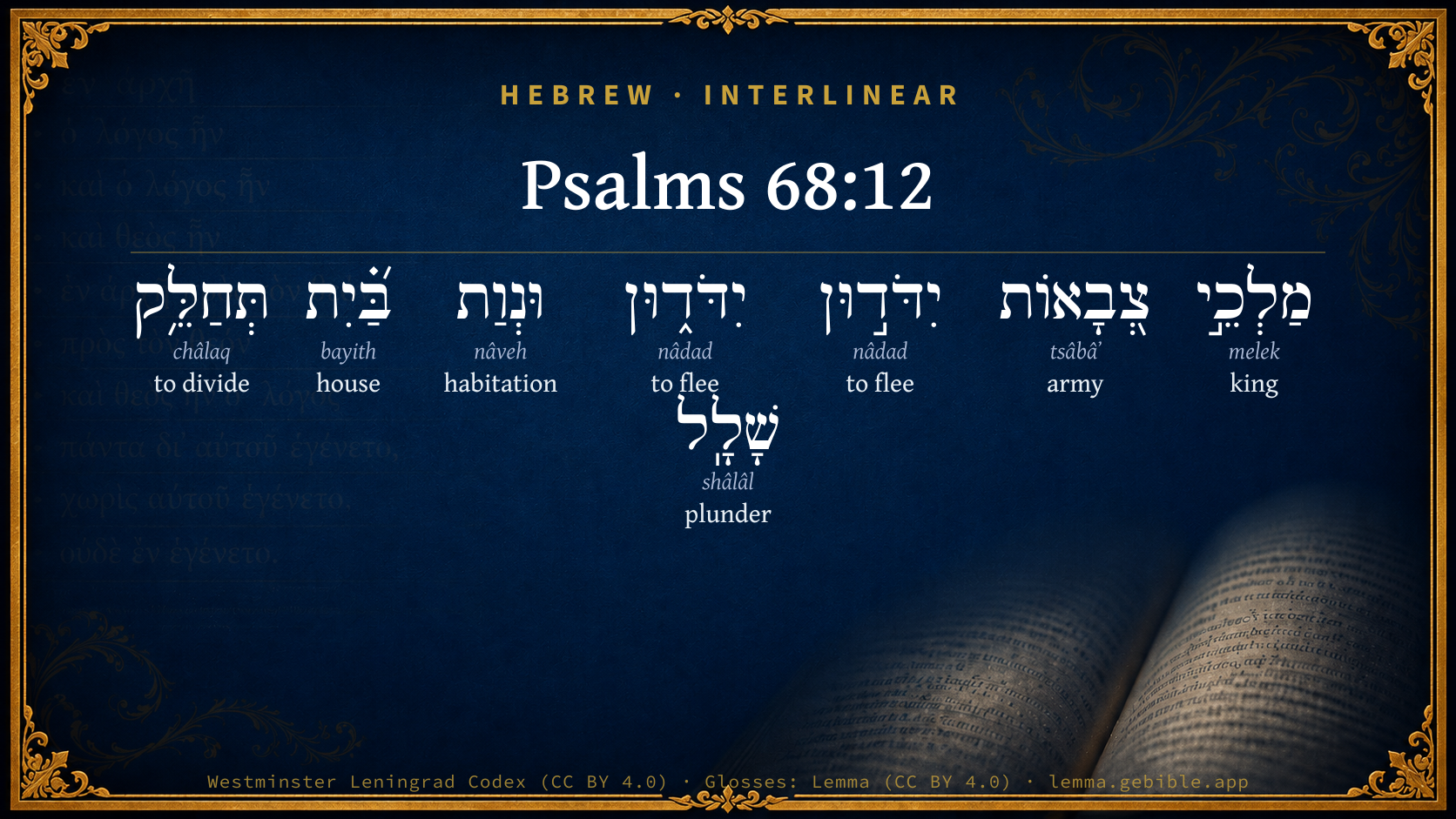
  1. מַלְכֵ֣י melek H4428 “kings of” Noun, Common, Masculine, Plural, Construct
  2. צְ֭בָאוֹת tsâbâʼ H6635 “armies” Noun, Common, Both, Plural, Absolute
  3. יִדֹּד֑וּן nâdad H5074 “to flee” Verb, Qal, Imperfect, 3rd Person, Masculine, Plural + Suffix, n
  4. וּנְוַת nâveh H5116 “and · habitation of” Conjunction + Adjective, Adjective, Feminine, Singular, Construct
  5. בַּ֝֗יִת bayith H1004 “house” Noun, Common, Masculine, Singular, Absolute
  6. תְּחַלֵּ֥ק châlaq H2505 “to divide” Verb, Piel, Imperfect, 3rd Person, Feminine, Singular
  7. שָׁלָֽל shâlâl H7998 “plunder” Noun, Common, Masculine, Singular, Absolute

About this verse

These counts appear in no published source. They are computed here, from the morphology-tagged text and Lemma’s own curated glosses. What Lemma adds →

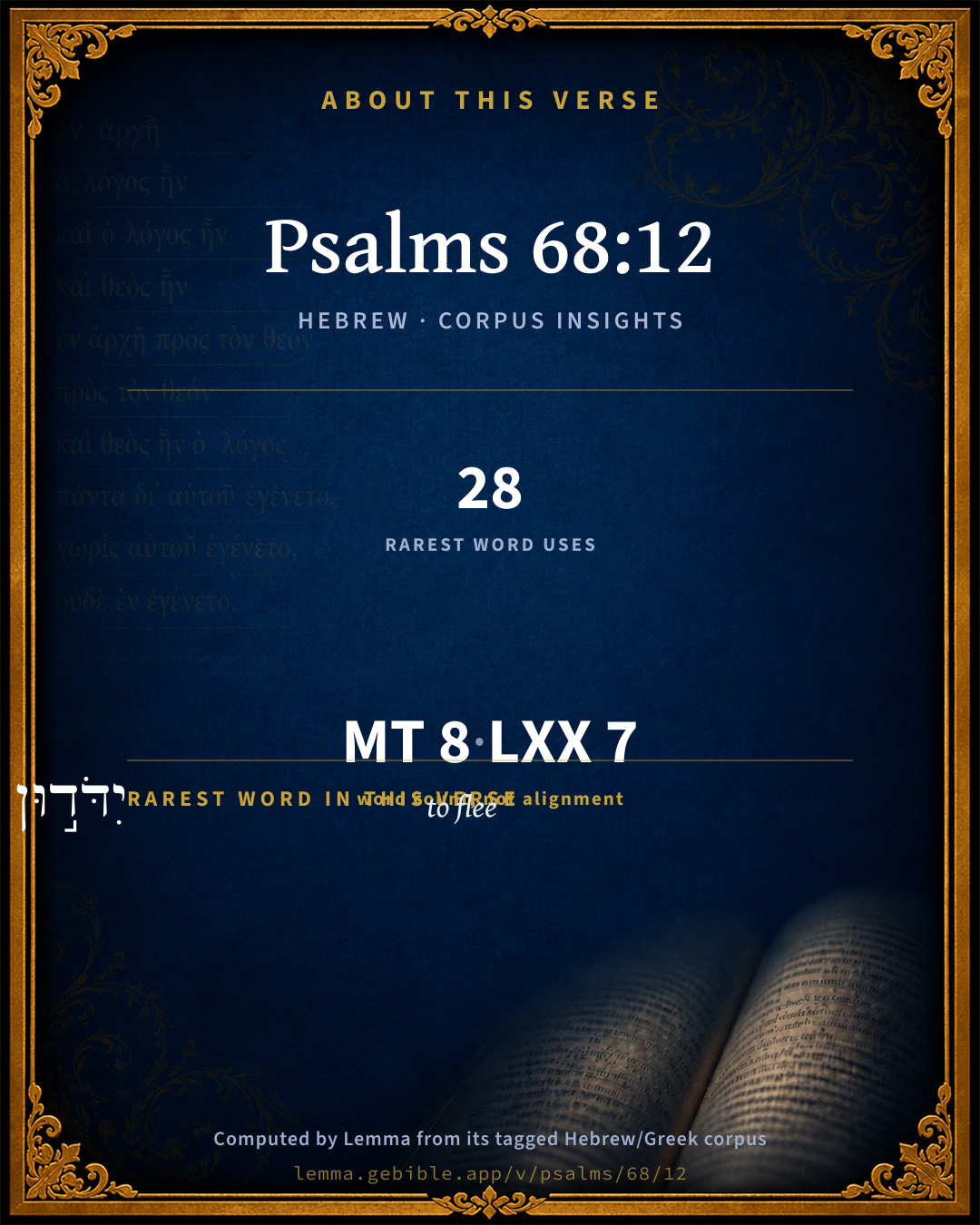
8
words
7
distinct lemmas
Wisdom
section

Shared distinctive vocabulary

יִדֹּד֣וּן to flee H5074 occurs in 26 verses of the Hebrew Bible. Also found in:

Grammatical profile

  • 3 verbs
  • 4 nouns
  • 1 adjective

Verb forms

  • יִדֹּד֣וּן Qal · Imperfect
  • יִדֹּד֑וּן Qal · Imperfect
  • תְּחַלֵּ֥ק Piel · Imperfect

Repetition

A word recurs within this verse — often emphatic in Hebrew:

  • יִדֹּד֣וּן to flee H5074 ×2

Hebrew & Septuagint length

In English translation the verse runs 14 words from the Hebrew and 25 from the Septuagint (LXX English) — closely comparable.

A rough comparison of the two English renderings, which tokenize alike — not a word-level alignment.

Word counts can differ between the Hebrew and the Greek without any difference in meaning — e.g. the Hebrew direct-object marker אֵת has no separate Greek word, and Greek often adds the article ὁ.

In the original languages it is 8 Hebrew tokens and 7 Greek tokens — but the two are counted differently (Hebrew bundles its prefixes and suffixes into one token; the Greek is in lemma form), so that isn’t a like-for-like length.

Cross-references

12

Topical passages linked to Psalms 68:12 in the Treasury of Scripture Knowledge — connected by theme and wording, ordered by reader-vote popularity; previews shown in the World English Bible.

  • Joshua 10:16 These five kings fled, and hid themselves in the cave at Makkedah.
  • Judges 5:19 The kings came and fought; Then fought the kings of Canaan. In Taanach by the waters of Megiddo: They took no gain of money.
  • Joshua 12:7–24 These are the kings of the land whom Joshua and the children of Israel struck beyond the Jordan westward, from Baal Gad in the valley of Lebanon even to Mount Halak, that goes up to Seir; and Joshua gave it to the tribes of Israel for a possession according to their divisions;
  • 1 Samuel 30:24 Who will listen to you in this matter? for as his share is who goes down to the battle, so shall his share be who tarries by the baggage: they shall share alike.
  • Revelation 19:17–20 I saw an angel standing in the sun. He cried with a loud voice, saying to all the birds that fly in the sky, "Come! Be gathered together to the great supper of God,
  • Exodus 14:25 He took off their chariot wheels, and they drove them heavily; so that the Egyptians said, "Let's flee from the face of Israel, for Yahweh fights for them against the Egyptians!"
  • Numbers 31:8–9 They killed the kings of Midian with the rest of their slain: Evi, and Rekem, and Zur, and Hur, and Reba, the five kings of Midian: Balaam also the son of Beor they killed with the sword.
  • Numbers 31:27 and divide the prey into two parts: between the men skilled in war, who went out to battle, and all the congregation.
  • Numbers 31:54 Moses and Eleazar the priest took the gold of the captains of thousands and of hundreds, and brought it into the tent of meeting, for a memorial for the children of Israel before Yahweh.
  • Joshua 10:42 All these kings and their land did Joshua take at one time, because Yahweh, the God of Israel, fought for Israel.
  • Judges 5:30 Have they not found, have they not divided the spoil? A lady, two ladies to every man; To Sisera a spoil of dyed garments, A spoil of dyed garments embroidered, Of dyed garments embroidered on both sides, on the necks of the spoil?
  • Revelation 6:15 The kings of the earth, the princes, the commanding officers, the rich, the strong, and every slave and free person, hid themselves in the caves and in the rocks of the mountains.

Cross-references courtesy of OpenBible.info (CC BY 4.0).

Hebrew and Greek witnesses Masoretic Hebrew ↔ Greek Septuagint

The same verse in the two great witnesses to the Old Testament, shown verse-for-verse.

You’re reading Greek Psalm 67 (Hebrew Psalm 68). The Septuagint counts the superscription, so verse numbers can differ from the Hebrew — chapter-level alignment, not verse-by-verse. Numbering follows Rahlfs.

These are two independent witnesses, not word-aligned to each other, and the Septuagint is shown in lemma (dictionary) form.

Hebrew Psalms 68:12 Masoretic · Westminster Leningrad Codex

מַלְכֵ֣י צְ֭בָאוֹת יִדֹּד֣וּן יִדֹּד֑וּן וּנְוַת בַּ֝֗יִת תְּחַלֵּ֥ק שָׁלָֽל

"Kings of armies flee! They flee!" She who waits at home divides the spoil,

World English Bible · Public Domain

Greek LXX Greek Psalm 67:12 Septuagint · lemma form

κύριος δίδωμι ῥῆμα ὁ εὐαγγελίζω δύναμις πολύς

The king of the forces of the beloved, of the beloved, will even grant them for the beauty of the house to divide the spoils.

LXX2012 (modern English Septuagint) · Public Domain

Hebrew: Westminster Leningrad Codex (CC BY 4.0). Greek: Septuagint (public domain); English from LXX2012 (modern English Septuagint) (Public Domain). How the Septuagint differs from the Hebrew →

Commentary

Notes on Psalms 68:12 from classic Christian and Jewish commentators (each source and its license shown beneath its notes). The classic Christian expositions comment on the surrounding passage and are grouped to its opening verse, so a note may address several verses; the Jewish commentaries on the Tanakh (Rashi and others) are per-verse, so they appear only where the commentator wrote on this verse.

Lemma curates 59 commentaries, every one of them public domain or Creative Commons licensed, each selected and text-cleaned for this edition rather than reprinted as found. About our sources →

The Cambridge Bible for Schools and Colleges

gen. ed. J. J. S. Perowne

12. Kings of hosts do flee, do flee,

And she that tarrieth at home divideth the spoil.

Psa_68:12-14. contain allusions to the Song of Deborah and possibly to similar poems which have not been preserved to us. Many commentators regard them as the triumphal song of the women celebrating the victory; but it is better to take them as the continuation of the poet’s description of the victory. The verses run in pairs, and Psa_68:13 is parallel to Psa_68:12. The first line paints the scene in the battle-field—the pell-mell rout of the defeated kings: the second line depicts the scene at home when the warriors have returned with their spoils.

The unusual expression kings of hosts seems to be chosen with reference to the title Jehovah of hosts. Vast as their armies may be, they are powerless to resist One who has infinitely stronger armies at His command. The graphic repetition do flee, do flee recalls the form of Jdg_5:22; and the next line recalls the words of Jdg_5:30. The battle has been won; the warriors return home with their spoils; and the matron who has anxiously awaited the issue of the battle divides among her family the rich garments and ornaments taken from the enemy. Cp. Jdg_8:26; 2Sa_1:24; 2Ki_7:8; 2Ki_7:15.

The Cambridge Bible for Schools and Colleges (gen. ed. J. J. S. Perowne; Cambridge University Press, 1878–1918) — public domain. Text from a community e-Sword module.

Trapp's Complete Commentary

John Trapp

Psa 68:12 Kings of armies did flee apace: and she that tarried at home divided the spoil.

Ver. 12. Kings of armies did flee apace] Heb. did flee, did flee. Or, shall flee, shall flee; which one interpreteth of devils (called principalities and powers), formerly using to give oracles; but after Christ’s birth ceasing to do so. As also of Licinius and other tyrants fleeing before Constantine, the first Christian emperor. See Rev 9:11. Antichrist is the king of locusts, and he fleeth daily before the Evangelici, the new gospellers, as he calleth them. Bellarmine complaineth, that ever since we held the Pope to be antichrist, non mode non crevit eius imperium, sed semper magis ac magis deerevit, his kingdom hath not only not increased, but more and more daily decreased (Lib. iii. de Pont. Rein., cap. 21).

And she that tarried at home divided the spoil] That is, tota congregatio quae non pugnabat, says Kimchi. Or, the women also (those domi portae) came forth to pillage. These days of the gospel do abound with many godly matrons and holy virgins. And it is easy to observe that the New Testament affordeth more store of good women than the Old.

John Trapp, A Commentary or Exposition upon All the Books of the Old and New Testament (1647–1656) — public domain. Text from a community e-Sword module.

Albert Barnes' Notes on the Bible

Kings of armies did flee apace - Margin, as in Hebrew, did flee, did flee. This is the Hebrew mode of expressing that which is emphatic or superlative. It is by simply repeating the word. The idea is, that they fled speedily; they fled at once, and in alarm. Psa 68:12-13 are marked by DeWette as a quotation, and the language is supposed by him to be the substance of the song that was sung by the women as referred to in Psa 68:11. This supposition is not improbable. The reference is, undoubtedly, to the former victories achieved by the people of God when they went out to war; and the idea is, that when the command came, when God gave the word Psa 68:11, their foes fled in consternation.

And she that tarried at home divided the spoil - The women remaining in their homes, while the men went out to war. On them devolved the office of dividing the plunder, and of giving the proper portions to each of the victors. They would take an interest in the battle, and receive the booty, and assign the portion due to each of the brave soldiers - the more acceptable as given to them by female hands. Possibly, however, the meaning may be, that the victors would bring the plunder home, and lay it at the feet of their wives and daughters to be divided among the women themselves. The dividing of the spoils of battle after a victory was always an important act. Compare Jdg 5:30; Jos 7:21; 1Ch 26:27; Heb 7:4.

Albert Barnes' Notes on the Bible (1834–1885) — public domain. Text from a community e-Sword/MySword module.

Joseph Benson's Commentary

Psa 68:12. Kings of armies — The kings of the Midianites, of Canaan, and other nations, which came forth against the Israelites with numerous and powerful armies; did flee apace — Hebrew, ידדונ ידדונ, jiddodun, jiddodun, fled away, fled away, the reduplication of this word denoting their hasty flight and utter dispersion. They fled with their routed forces, and were pursued, overtaken, and destroyed by the victorious Israelites. She that tarried at home divided the spoil — The spoil was so much that there was enough, not only for the proper use of those that took it, but also to be divided to their wives and children when they came home. After the conquest of the Midianites, God ordered the prey which was taken from them to be divided between them who went out on that expedition, and the rest of the people who continued in their tents, Num 31:27; and therefore this was part of the damsels’ song, that the women, who had charge of the household affairs, were enriched by an equal division of the enemies’ spoils, in which their husbands and fathers had their share; and perhaps it is the victory over the Midianites which is here referred to.

Joseph Benson's Commentary on the Old and New Testaments (1811–1818) — public domain. Text from a community e-Sword module.

J. A. Alexander on Psalms

Joseph Addison Alexander

13. (Psa 68:12). Kings of armies shall flee, shall flee, and she that tarrieth at home shall divide the spoil. The flight described is not that of Dings alone, but of kings at the head of armies. The repetition of the verb denotes the certainty and completeness of the rout. The dweller in the house is by some literally understood to mean the woman who takes no part in the battle. But others regard it as a figure for the chosen people, dwelling quietly at home, after the disappearance of their enemies, when "the land had rest," Jdg 5:31; Jdg 8:28.

Joseph Addison Alexander, The Psalms Translated and Explained (1850) — public domain. Text from a community e-Sword module.

Geneva Bible (1599)

Geneva Bible translators

The prey was so great, that not only the soldiers, but women also had part thereof.

Geneva Bible (1599) marginal notes — public domain. Text via Bolls.life.

Jamieson, Fausset & Brown

Robert Jamieson, A. R. Fausset & David Brown

Kings of armies--that is, with their armies.

she that . . . at home--Mostly women so remained, and the ease of victory appears in that such, without danger, quietly enjoyed the spoils.

Jamieson, Fausset & Brown — Commentary Critical and Explanatory on the Whole Bible (1871) — public domain (CC PDM 1.0). Text via the HelloAO Bible API.

Adam Clarke's Commentary

Verse 12. Kings of armies did flee] Jabin and the kings of the Canaanites, who united their forces to overwhelm the Israelites.

And she] Deborah the prophetess, a woman accustomed to tarry at home, and take care of the family; she divided the spoils, and vanquished their kings.

Adam Clarke's Commentary on the Bible (1810–1826) — public domain. Text from a community e-Sword/MySword module.

Ellicott's Commentary for English Readers

(12) Kings of armies did flee apace.—Better, Kings of armies flee, flee. This and the two next verses wear the air of being a fragment of those ancient battle-songs sung by the women after the defeat of the foe. The fact that they have thus been torn from their original context accounts for the great obscurity which hangs over them.

And she that tarried . . .—i.e., the woman keeping the house; so the Hebrew. (Comp. Jdg_5:24, “Women of the tent;” and the fond anticipations of Sisera’s mother, Psa_68:29.) So the Greeks called the mistress of the house οὶκουρός. (Eur. Herc. Fur. 45.)

Though this sense thus gives a general description of war, and the women waiting eagerly for the victorious home-coming is a picture true to life, yet the next verse indicates that we must suppose a latent reference to some tribe or party who shirked the dangers of battle, and played the part of the stay-at-home.

A Bible Commentary for English Readers, edited by Charles John Ellicott (1878–1897) — public domain. Text from a community e-Sword module.

John Gill's Exposition

Kings of armies did flee apace,.... Or "they fled, they fled" (y); or "they flee, they flee". This is either the subject matter of the word "published", the words of the publishers so saying; or the effect of the publication of the Gospel: for though some, by these kings of armies, understand the apostles either fleeing from place to place because of persecution, or running to and fro, as they interpret the words, to spread the Gospel; yet they rather intend the enemies of the Gospel, and the chief of them that opposed themselves to it; namely, Roman emperors and kings, and who fled before it; particularly at the time of the downfall of Paganism, when they fled to the mountains and hills, and called upon them to hide them from Christ, Rev 6:15;

and she that tarried at home divided the spoil; the church, compared to a woman that keeps at home, Tit 2:5, who shared in the spoils token out of the hands of Satan, and from among the Gentiles, even converted souls, brought unto her. What is promised to Christ, Isa 53:12; is said of the church; she being made more than a conqueror through him, and sharing in all his victories and spoils. It denotes the certain and easy success of the Gospel ministry, attended with a divine power, and the advantages thereof to the church of Christ; this was particularly true of the church in the times of Constantine.

(y) "fugiebant, fugiebant", Pagninus, Montanus; "fugerunt, fugerunt", Tigurine version, Musculus.

John Gill's Exposition of the Whole Bible (1746–1763) — public domain (CC PDM 1.0). Text via the HelloAO Bible API.

Matthew Poole's English Annotations

Kings of armies; the kings of Canaan and other nations which came forth against the Israelites, accompanied with great and numerous armies.

The spoil was so much, that there was enough, not only for the proper use of those who took it, but also to be divided to their wives and children when they came home. This verse and that which follows may be taken, either,

1. For the triumphant song sung by those publishers mentioned Psa 68:11. Or,

2. For the words of David, continuing the relation of the victories granted by God to Israel ever their enemies.

Matthew Poole's English Annotations on the Holy Bible (1683–1685) — public domain. Text from a community e-Sword/MySword module.

The Treasury of David

Charles H. Spurgeon

Ver. 12. Kings of armies did flee apace. The lords of hosts fled before the Lord of Hosts. No sooner did the ark advance than the enemy turned his back: even the princely leaders stayed not, but took to flight. The rout was complete, the retreat hurried and disorderly; --they "did flee, did flee; "helter skelter, pell mell, as we say.

"Where are the kings of mighty hosts?

Fled far away, fled far and wide.

Their triumph and their trophied boasts

The damsels in their bowers divide."

And she that tarried at home divided the spoil. The women who had published the war cry shared the booty. The feeblest in Israel had a portion of the prey. Gallant warriors cast their spoils at the feet of the women and bade them array themselves in splendour, taking each one "a prey of divers colours, of divers colours of needlework on both sides." When the Lord gives success to his gospel, the very best of his saints are made glad and feel themselves partakers in the blessing.

Ver. 12. Kings of armies did flee apace. In the Hebrew it is, they fled, they fled; fled is twice. Why so? That is, they did flee very hastily, and they fled most confusedly, they fled all ways; they fled, they fled, noting the greatness of the flight. William Bridge.

Ver. 12. The kings of hosts shall flee. The "hosts" are the numerous well equipped armies which the kings of the heathens lead forth to the battle against the people of God. The unusual expression, "kings of hosts, "sounds very much like an ironically disparaging antithesis to the customary "Jahve of Hosts." Bottcher, quoted by Delitzsch.

Ver. 12. She that tarried at home. That is, all the noncombatants, saith Kimchi. Or, the women also (those domi portae) came forth to pillage. These days of the gospel do abound with many godly matrons and holy virgins. And it is easy to observe that the New Testament affords more store of good women than the old. John Trapp.

Ver. 12. Divided the spoil, not merely (as Hupfeld) "receives her portion of the spoil, "but rather, "distributes among her daughters and handmaidens, etc., the share of the spoil" which her husband has brought home. J. J. Stewart Perowne.

Ver. 12. (last clause). The church in redemption as a spouse tarrying at home; her home duties; the spoil of her Lord's glorious and finished work, and her dividing it.

Psalms 68:13*

Charles H. Spurgeon's The Treasury of David (1869–1885) — public domain. Psalms only. Text from a community e-Sword/MySword module.

Whedon's Commentary on the Bible

Daniel D. Whedon

12. Kings of armies—That is, kings with their armies.

Did flee apace— Hebrew, Shall flee, shall flee. The rout shall be total and irretrievable.

She that tarried at home—That is, the housewife, as the words denote; she that dwelt in the house, as distinguished from the husband, who went out to battle.

Divided the spoil—Shared the spoil, which, by a law of equity, fell, by distribution, to her husband. See 1Sa_30:24; and compare Jdg_5:28-30. The wealth of the enemy shall enrich the households of the victors. The language is highly martial and oriental.

Daniel D. Whedon (gen. ed.), Commentary on the Old and New Testaments (1874–1909) — public domain. Text from a community e-Sword module.

The Pulpit Commentary

Kings of armies did flee apace; literally, did flee did flee; i.e. fled repeatedly before Israel. (see Jos_8:19-22 Jos_10:19, 20 11:8, 9 Jud_1:3:10, 29 4:14-16 7:19-25 8:11, 12 11:29-33 15:14-16 1Sa_7:10, 11 11:11 14:47, 48 15:7, 8 17:52 2Sa_5:17-25 2Sa_8:1, 2Sa_8:2, 2Sa_8:4, 2Sa_8:5, 13 10:6-18, etc.) And she that tarried at home divided the spoil. The wives of the conquerors shared in the spoil when it was brought home. (Jud 5:28-30)

The Pulpit Commentary (1880–1919), ed. H.D.M. Spence-Jones & Joseph S. Exell — public domain. Text from a community e-Sword module.

John Wesley's Explanatory Notes

Kings - The kings of Canaan, and other nations who came forth against the Israelites, accompanied with great and numerous armies. The spoil - There was enough, not only for those who took it, but also to be divided to their wives and children, when they came home.

John Wesley, Explanatory Notes Upon the Whole Bible (1754–1765) — public domain. Text via the GEBible commentary corpus.

Rashi

Rabbi Shlomo Yitzchaki (Rashi)

The Lord will give out a word; they will announce it to a great multitude Heb. אמר, [like] מאמר, statement. He will yet roar with [His] voice to allow the hosts of the great nations to hear it. Now what is the word?

Rashi on the Tanakh — English translations: “The Judaica Press complete Tanach with Rashi, translated by A. J. Rosenberg” (CC BY 4.0); “Pentateuch with Rashi's commentary by M. Rosenbaum and A.M. Silbermann, 1929-1934” (public domain); “The Metsudah Tanach series, Lakewood, N.J” (CC BY 4.0); and “The Book of Joshua, Metsudah Publications, 1997” (CC BY 4.0). Text via Sefaria.

Lesson kit

Teaching starters — assembled from the data on this page, not authored interpretation. Every prompt links to the verse data it draws on. Edit before teaching.

Psalms, in the Wisdom, opens this verse with 8 words (7 distinct Hebrew lemmas). Its most distinctive word is nâdad (“to flee”). A historical commentator’s framing appears above. Read the whole chapter for the surrounding context.

Discussion questions

  1. The word nâdad carries the sense “to flee.” How does it shape the verse?
  2. How does Genesis 31:40, which shares the word «to flee», read alongside this verse?
  3. What does the repetition of “to flee” (2× in this one verse) do in this verse?
  4. These translations render this verse differently; the difference is in the English rendering, not the original. What questions does that raise?
  5. «יִדֹּד֣וּן» is a Qal Imperfect verb. How does that grammatical form shape the action described?
  6. Compare how The Cambridge Bible for Schools and Colleges and Trapp's Complete Commentary read this verse. Where do they agree or differ?

Things to notice

Reading settings

Reading text

Shown beneath each verse's original-language words.

Old Testament
Old Testament edition

Read the OT as the Masoretic Hebrew (MT) or the Greek Septuagint (LXX).

English shown for the Greek Septuagint (in the Hebrew ↔ Greek comparison).

Comparing translations? Open the Compare panel on any verse page to stack up to four side by side.