Isaiah 34:2

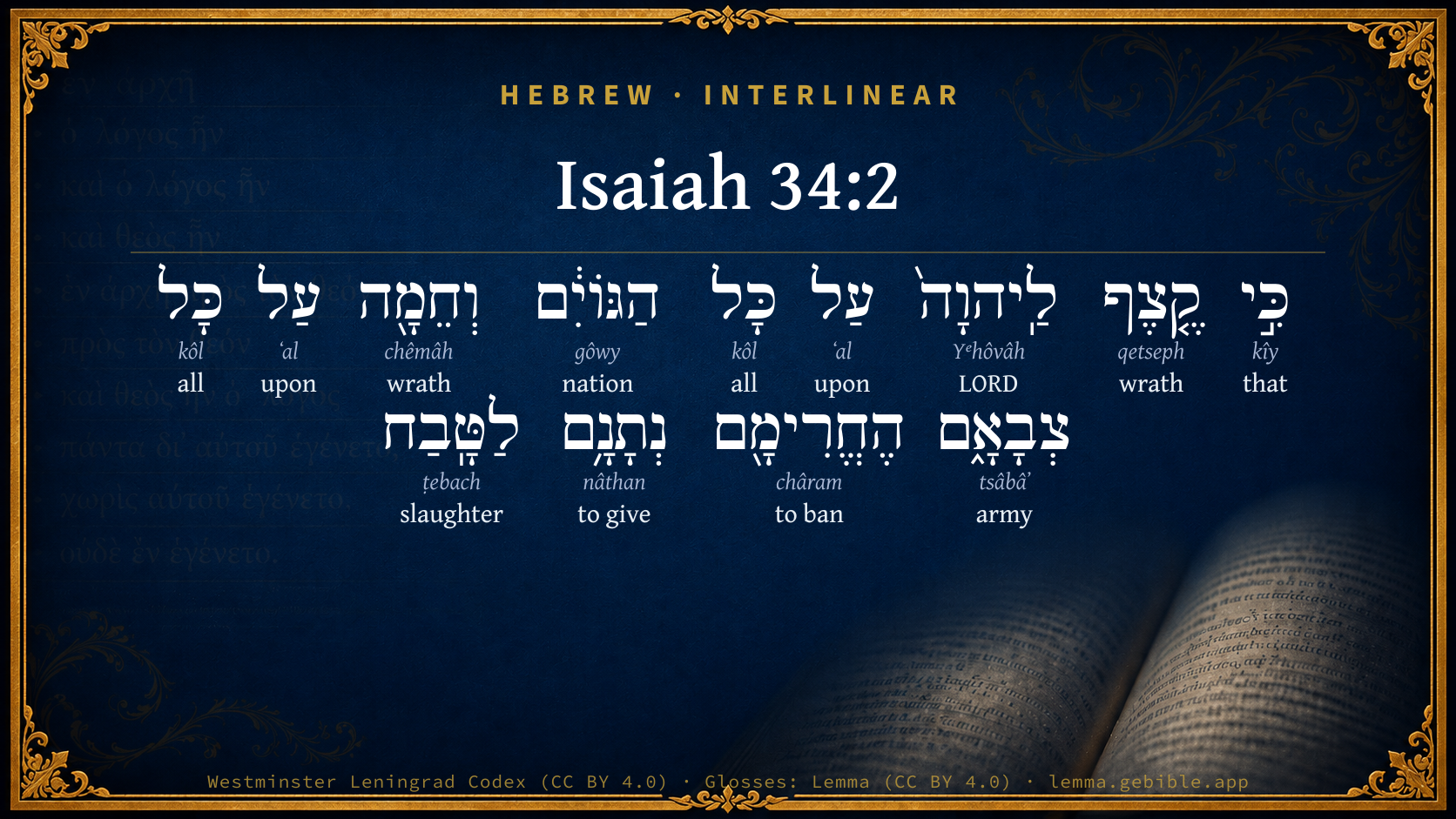
Hebrew (Westminster Leningrad Codex) Isaiah 34:2 appears in the Hebrew Old Testament. The text above is from the Westminster Leningrad Codex. Each word links to its Strong’s number, a concise gloss, and parsing drawn from the Open Scriptures Hebrew Bible morphology. Click any word for its full Brown-Driver-Briggs (BDB) entry.
Download image
Cite this verse

Isaiah 34:2 (World English Bible). Public Domain. Lemma interlinear Bible study tool, https://lemma.gebible.app/v/isaiah/34/2.

Show BibTeX & RIS
BibTeX
RIS
English Translation
For Yahweh has indignation against all the nations, and wrath against all their host: he has utterly destroyed them, he has delivered them to the slaughter.
World English Bible · Public Domain
Download a study sheet

One document with this verse’s original text, its word-by-word gloss line, the meaning frame, cross-references with their text, attributed commentary, and full source and license credits — printable, and it pastes into notes with its structure intact.

This verse Autodidact and up

Study sheet (.html) Plain text (.txt)

A passage Seminary Student

Up to 50 verses in one chapter. A passage sheet keeps up to 6 commentary sources and 12 cross-references per verse, in the order this page ranks them, and says so on the sheet whenever that leaves anything out. Ask for a single verse and you get the Autodidact verse sheet above.

Everything on this page stays free to read, with no account — the sheet is a download of what is already on screen, not access to it.

Want to remove ads? Support Godless Engineer
Compare translations 3

The same verse in 3 English versions, stacked beneath the original-language interlinear above. Click any original word for its lexicon entry.

Each is an independent rendering of the whole verse — the interlinear is not word-aligned to these translations.

Highlighted words mark where these versions differ — a whole-verse word diff, not a word-by-word alignment.

  • World English Bible Public Domain
    For Yahweh has indignation against all the nations, and wrath against all their host: he has utterly destroyed them, he has delivered them to the slaughter.
  • King James Version Public Domain
    For the indignation of the LORD is upon all nations, and his fury upon all their armies: he hath utterly destroyed them, he hath delivered them to the slaughter.
  • unfoldingWord Literal Text CC BY-SA 4.0
    For fury to Yahweh against all of the nations, and wrath, against all of their army. He has devoted them; he has given them over to slaughter.

unfoldingWord Literal Text — © unfoldingWord, licensed CC BY-SA 4.0. Word-aligned USFM3 via Door43 (git.door43.org/unfoldingWord/en_ult).

Versions to compare (up to 4)

3 of 4 selected

Show all 18 translations

Every available English version of this verse, each an independent rendering of the whole verse.

  • World English Bible Public Domain
    For Yahweh has indignation against all the nations, and wrath against all their host: he has utterly destroyed them, he has delivered them to the slaughter.
  • Berean Standard Bible Public Domain
    The LORD is angry with all the nations and furious with all their armies. He will devote them to destruction; He will give them over to slaughter.
  • Majority Standard Bible Public Domain
    The LORD is angry with all the nations and furious with all their armies. He will devote them to destruction; He will give them over to slaughter.
  • King James Version Public Domain
    For the indignation of the LORD is upon all nations, and his fury upon all their armies: he hath utterly destroyed them, he hath delivered them to the slaughter.
  • American Standard Version (1901) Public Domain
    For Jehovah hath indignation against all the nations, and wrath against all their host: he hath utterly destroyed them, he hath delivered them to the slaughter.
  • Revised Version (1885) Public Domain
    For the LORD hath indignation against all the nations, and fury against all their host: he hath utterly destroyed them, he hath delivered them to the slaughter.
  • Geneva Bible (1599) Public Domain
    For the indignation of the Lord is vpon all nations, and his wrath vpon all their armies: hee hath destroyed them and deliuered them to the slaughter.
  • Douay-Rheims (1899) Public Domain
    For the indignation of the Lord if upon all nations, and his fury upon all their armies: he hath killed them, and delivered them to slaughter.
  • Young's Literal Translation Public Domain
    For wrath `is' to Jehovah against all the nations, And fury against all their host, He hath devoted them to destruction, He hath given them to slaughter.
  • Literal Standard Version CC BY-SA 4.0
    For to YHWH [is] wrath against all the nations, || And fury against all their host, || He has devoted them to destruction, || He has given them to slaughter.
  • Unlocked Literal Bible CC BY-SA 4.0
    For Yahweh is angry with all the nations, and furious against all their armies; he has completely destroyed them, he has handed them over to the slaughter.
  • unfoldingWord Literal Text CC BY-SA 4.0
    For fury to Yahweh against all of the nations, and wrath, against all of their army. He has devoted them; he has given them over to slaughter.
  • Darby Bible Public Domain
    For the wrath of Jehovah is against all the nations, and [his] fury against all their armies: he hath devoted them to destruction, he hath delivered them to the slaughter.
  • World Messianic Bible Public Domain
    For the LORD is enraged against all the nations, and angry with all their armies. He has utterly destroyed them. He has given them over for slaughter.
  • Webster's Bible Public Domain
    For the indignation of the LORD is upon all nations, and his fury upon all their armies: he hath utterly destroyed them, he hath delivered them to the slaughter.
  • Free Bible Version CC BY-SA 4.0
    The Lord's anger is against all the nations and his fury is against all their armies. He will completely destroy them; he will have them slaughtered.
  • Bible in Basic English Public Domain
    For the Lord is angry with all the nations, and his wrath is burning against all their armies: he has put them to the curse, he has given them to destruction.
  • JPS Tanakh (1917) Public Domain
    For the LORD hath indignation against all the nations, and fury against all their host; He hath utterly destroyed them, He hath delivered them to the slaughter.

Literal Standard Version (2020), Covenant Press — licensed CC BY-SA 4.0. Text via the HelloAO Bible API (eBible.org). Unlocked Literal Bible (unfoldingWord) — licensed CC BY-SA 4.0. Text via the HelloAO Bible API (eBible.org). unfoldingWord Literal Text — © unfoldingWord, licensed CC BY-SA 4.0. Word-aligned USFM3 via Door43 (git.door43.org/unfoldingWord/en_ult). Free Bible Version, Dr. Jonathan Gallagher — licensed CC BY-SA 4.0. Text via the HelloAO Bible API (eBible.org).

Word by word

More ways to search: Search by grammar → Find every occurrence → Compare this word →

Practice this passage: Drill this verse → Learn its vocabulary →

לַטָּֽבַח
ṭebach
H2874
“to/for the · slaughter”
Preposition, Determined + Noun, Common, Masculine, Singular, Absolute
Part of Speech
Preposition + Noun
Type
Common
Gender
Masculine
Number
Singular
State
Absolute
Full BDB Definition

Origin: from H2873

TWOT: 786a

slaughter, slaughtering, animal - slaughtering, slaughter (of animals) - slaughter (figuratively)
  1. כִּ֣י kîy H3588 “that” Conjunction
  2. קֶ֤צֶף qetseph H7110 “wrath” Noun, Common, Masculine, Singular, Absolute
  3. לַֽיהוָה֙ Yᵉhôvâh H3068 “to/for · LORD” Preposition + Noun, Proper
  4. עַל ʻal H5921 “upon” Preposition
  5. כָּל kôl H3605 “all of” Noun, Common, Masculine, Singular, Construct
  6. הַגּוֹיִ֔ם gôwy H1471 “the · nations” Particle, Definite Article + Noun, Common, Masculine, Plural, Absolute
  7. וְחֵמָ֖ה chêmâh H2534 “and · wrath” Conjunction + Noun, Common, Feminine, Singular, Absolute
  8. עַל ʻal H5921 “upon” Preposition
  9. כָּל kôl H3605 “all of” Noun, Common, Masculine, Singular, Construct
  10. צְבָאָ֑ם tsâbâʼ H6635 “army · their” Noun, Common, Both, Singular, Construct + Suffix, Personal, 3rd Person, Masculine, Plural
  11. הֶחֱרִימָ֖ם châram H2763 “to ban · them” Verb, Hiphil, Perfect, 3rd Person, Masculine, Singular + Suffix, Personal, 3rd Person, Masculine, Plural
  12. נְתָנָ֥ם nâthan H5414 “to give · them” Verb, Qal, Perfect, 3rd Person, Masculine, Singular + Suffix, Personal, 3rd Person, Masculine, Plural

About this verse

These counts appear in no published source. They are computed here, from the morphology-tagged text and Lemma’s own curated glosses. What Lemma adds →

13
words
11
distinct lemmas
Prophets
section

Notable vocabulary

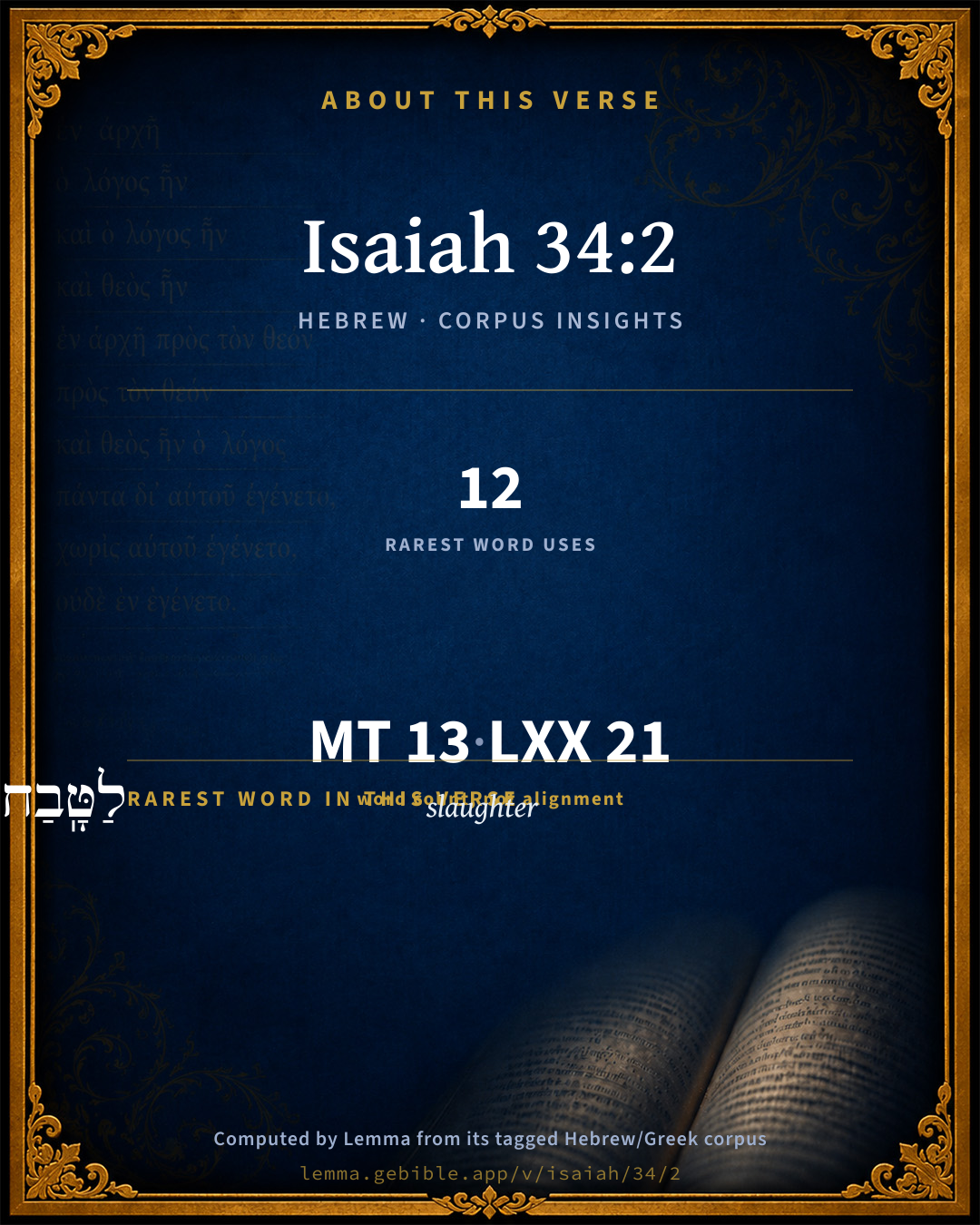
The rarest word here is לַטָּֽבַח slaughter H2874 — appearing just 12 times in the whole Hebrew Bible.

Shared distinctive vocabulary

לַטָּֽבַח slaughter H2874 occurs in 12 verses of the Hebrew Bible. Also found in:

Grammatical profile

  • 2 verbs
  • 8 nouns
  • 2 prepositions
  • 1 conjunction

Verb forms

  • הֶחֱרִימָ֖ם Hiphil · Perfect
  • נְתָנָ֥ם Qal · Perfect

Repetition

Words recur within this verse — often emphatic in Hebrew:

Hebrew & Septuagint length

In English translation the verse runs 26 words from the Hebrew and 27 from the Septuagint (LXX English) — closely comparable.

A rough comparison of the two English renderings, which tokenize alike — not a word-level alignment.

Word counts can differ between the Hebrew and the Greek without any difference in meaning — e.g. the Hebrew direct-object marker אֵת has no separate Greek word, and Greek often adds the article ὁ.

In the original languages it is 13 Hebrew tokens and 21 Greek tokens — but the two are counted differently (Hebrew bundles its prefixes and suffixes into one token; the Greek is in lemma form), so that isn’t a like-for-like length.

Cross-references

17

Topical passages linked to Isaiah 34:2 in the Treasury of Scripture Knowledge — connected by theme and wording, ordered by reader-vote popularity; previews shown in the World English Bible.

  • Jeremiah 25:15–29 For thus says Yahweh, the God of Israel, to me: take this cup of the wine of wrath at my hand, and cause all the nations, to whom I send you, to drink it.
  • Zephaniah 3:8 "Therefore wait for me," says Yahweh, "until the day that I rise up to the prey, for my determination is to gather the nations, that I may assemble the kingdoms, to pour on them my indignation, even all my fierce anger, for all the earth will be devoured with the fire of my jealousy.
  • Isaiah 13:5 They come from a far country, from the uttermost part of heaven, even Yahweh, and the weapons of his indignation, to destroy the whole land.
  • Isaiah 30:25 There shall be on every lofty mountain, and on every high hill, brooks [and] streams of waters, in the day of the great slaughter, when the towers fall.
  • Isaiah 30:27–30 Behold, the name of Yahweh comes from far, burning with his anger, and in thick rising smoke: his lips are full of indignation, and his tongue is as a devouring fire;
  • Joel 3:9–14 Proclaim this among the nations: Prepare war. Stir up the mighty men. Let all the warriors draw near. Let them come up.
  • Amos 1:1–2 The words of Amos, who was among the herdsmen of Tekoa, which he saw concerning Israel in the days of Uzziah king of Judah, and in the days of Jeroboam the son of Joash king of Israel, two years before the earthquake.
  • Zechariah 14:3 Then Yahweh will go out and fight against those nations, as when he fought in the day of battle.
  • Zechariah 14:12–16 This will be the plague with which Yahweh will strike all the peoples who have warred against Jerusalem: their flesh will consume away while they stand on their feet, and their eyes will consume away in their sockets, and their tongue will consume away in their mouth.
  • Isaiah 24:1–23 Behold, Yahweh makes the earth empty, and makes it waste, and turns it upside down, and scatters abroad the inhabitants of it.
  • Nahum 1:2–6 Yahweh is a jealous God and avenges. Yahweh avenges and is full of wrath. Yahweh takes vengeance on his adversaries, and he maintains wrath against his enemies.
  • Romans 1:18 For the wrath of God is revealed from heaven against all ungodliness and unrighteousness of men, who suppress the truth in unrighteousness,
  • Revelation 6:12–17 I saw when he opened the sixth seal, and there was a great earthquake. The sun became black as sackcloth made of hair, and the whole moon became as blood.
  • Revelation 14:15–20 Another angel came out from the temple, crying with a loud voice to him who sat on the cloud, "Send forth your sickle, and reap; for the hour to reap has come; for the harvest of the earth is ripe!"
  • Revelation 19:15–21 Out of his mouth proceeds a sharp, double-edged sword, that with it he should strike the nations. He will rule them with a rod of iron. He treads the winepress of the fierceness of the wrath of God, the Almighty.
  • Revelation 20:9 They went up over the breadth of the earth, and surrounded the camp of the saints, and the beloved city. Fire came down out of heaven from God, and devoured them.
  • Revelation 20:15 If anyone was not found written in the book of life, he was cast into the lake of fire.

Cross-references courtesy of OpenBible.info (CC BY 4.0).

Hebrew and Greek witnesses Masoretic Hebrew ↔ Greek Septuagint

The same verse in the two great witnesses to the Old Testament, shown verse-for-verse.

These are two independent witnesses, not word-aligned to each other, and the Septuagint is shown in lemma (dictionary) form.

Hebrew Isaiah 34:2 Masoretic · Westminster Leningrad Codex

כִּ֣י קֶ֤צֶף לַֽיהוָה֙ עַל כָּל הַגּוֹיִ֔ם וְחֵמָ֖ה עַל כָּל צְבָאָ֑ם הֶחֱרִימָ֖ם נְתָנָ֥ם לַטָּֽבַח

For Yahweh has indignation against all the nations, and wrath against all their host: he has utterly destroyed them, he has delivered them to the slaughter.

World English Bible · Public Domain

Greek LXX Isaiah 34:2 Septuagint · lemma form

διότι θυμός κύριος ἐπί πᾶς ὁ ἔθνος καί ὀργή ἐπί ὁ ἀριθμός αὐτός ὁ ἀποὀλλύω αὐτός καί παραδίδωμι αὐτός εἰς σφαγή

For the wrath of the Lord is upon all nations, and his anger upon the number of them, to destroy them, and give them up to slaughter.

LXX2012 (modern English Septuagint) · Public Domain

Hebrew: Westminster Leningrad Codex (CC BY 4.0). Greek: Septuagint (public domain); English from LXX2012 (modern English Septuagint) (Public Domain). How the Septuagint differs from the Hebrew →

Targum (Aramaic paraphrase)

1

The Targum is the ancient Jewish Aramaic paraphrase of the Hebrew Scriptures — an interpretive translation, not the Hebrew text itself. Onkelos (literal) and Pseudo-Jonathan (expansive) render the Torah, and Jonathan the Prophets. Coverage is partial: where no permissively-licensed English translation exists for a verse, only the Aramaic is shown. This is verse-level text, not a word-by-word alignment to the Hebrew.

  1. Targum Jonathan Prophets (Joshua–Malachi)
    אֲרֵי רְגַז מִן קֳדָם יְיָ עַל כָּל עַמְמַיָא וְרוּגְזָא עַל כָּל מַשִׁירְיָתֵיהוֹן חַיְבִינוּן מְסַרְנוּן לְקַטָלָא:

    For the wrath from before the presence of the Lord is upon all the nations, and slaughter upon all their hosts: He hath condemned them and delivered them over to the slaughter.

    Targum Jonathan — Aramaic: “Mikraot Gedolot” (public domain). English: “Sefaria Community Translation” (CC0 1.0 (public-domain dedication)); “London "Chaldee Paraphrase," 1871” (public domain). Text via Sefaria.

Commentary

Notes on Isaiah 34:2 from classic Christian and Jewish commentators (each source and its license shown beneath its notes). The classic Christian expositions comment on the surrounding passage and are grouped to its opening verse, so a note may address several verses; the Jewish commentaries on the Tanakh (Rashi and others) are per-verse, so they appear only where the commentator wrote on this verse.

Lemma curates 59 commentaries, every one of them public domain or Creative Commons licensed, each selected and text-cleaned for this edition rather than reprinted as found. About our sources →

Trapp's Complete Commentary

John Trapp

Isa 34:2 For the indignation of the LORD [is] upon all nations, and [his] fury upon all their armies: he hath utterly destroyed them, he hath delivered them to the slaughter.

Ver. 2. For the indignation of the Lord is upon all nations.] Is, or shall be, upon all the Church’s enemies, whether of former or latter time; even his "boiling wrath," as the Word signifieth.

He hath utterly destroyed them.] Or, He will make an anathema of them, as Isa 34:5, the "people of my curse," devoted to destruction.

John Trapp, A Commentary or Exposition upon All the Books of the Old and New Testament (1647–1656) — public domain. Text from a community e-Sword module.

Joseph Benson's Commentary

Isa 34:2-3. For the indignation of the Lord is upon all nations — Not only upon the Assyrians, and those nations which are confederate with them in their expedition against Judea, but upon all other enemies of my people. He hath utterly destroyed them — He will infallibly destroy all of them. Their slain also shall be cast out — Into the fields, where they shall lie unburied, and be left a prey to ravenous beasts and birds. In which words he implies, either that such vast numbers would be slain, that the survivers would not be able to find time or place to bury them, or that they should be held in such contempt and abhorrence that none would be inclined to do them that office: and the mountains — About Jerusalem, where they are supposed to be gathered to fight against her, like the Assyrians; shall be melted with their blood — Shall be covered with their blood, which shall flow down abundantly from them with great force, and dissolve, and carry down with it a part of the soil of the mountains, as great showers of rain frequently do. This sentence upon the nations, which thus exhibits a kind of general judgment, to be executed upon the enemies of God and his people, by the sword of God, is sufficient to strike terror into every hearer.

Joseph Benson's Commentary on the Old and New Testaments (1811–1818) — public domain. Text from a community e-Sword module.

Tyndale Open Study Notes

Tyndale Open Resources

34:2 completely destroy: See Lev 27:28-29.

Tyndale Open Study Notes — © Tyndale Open Resources, licensed CC BY-SA 4.0. Text via the HelloAO Bible API.

Geneva Bible (1599)

Geneva Bible translators

God hath determined in his counsel, and hath given sentence for their destruction.

Geneva Bible (1599) marginal notes — public domain. Text via Bolls.life.

Jamieson, Fausset & Brown

Robert Jamieson, A. R. Fausset & David Brown

utterly destroyed--rather, "doomed them to an utter curse" [HORSLEY].

delivered--rather, "appointed."

Jamieson, Fausset & Brown — Commentary Critical and Explanatory on the Whole Bible (1871) — public domain (CC PDM 1.0). Text via the HelloAO Bible API.

The Cambridge Bible for Schools and Colleges

gen. ed. J. J. S. Perowne

2. For the indignation of the Lord …] Rather, For Jehovah hath indignation … and fury. It is remarkable that no reason is assigned for Jehovah’s anger.

their armies] their host (R.V.). he hath utterly destroyed them] Lit. he hath made them a devoted thing,—ḥçrem, a technical word for that which is irrevocably devoted to the deity, usually implying utter destruction. Cf. ch. Isa_11:15.

The Cambridge Bible for Schools and Colleges (gen. ed. J. J. S. Perowne; Cambridge University Press, 1878–1918) — public domain. Text from a community e-Sword module.

John Gill's Exposition

For the indignation of the Lord is upon all nations,.... All the nations of the earth, which have committed fornication with the whore of Rome, or have given in to her false worship, superstition, and idolatry; which is the reason of God's wrath and indignation against them, and of such severe punishment being inflicted on them; see Rev 18:3,

and his fury upon all their armies; the armies of the kings of the earth, gathered together at Armageddon, to make war with Christ, and those that follow him; see Rev 16:14,

he hath utterly destroyed them; not only devoted them to destruction, but actually destroyed them, with "Cherem", an utter destruction; one of the words of which Armageddon is compounded, and so points at the place, as well as the nature and manner, of the destruction:

he hath delivered them to slaughter; to be slain with the sword of him that sitteth on the white horse, which proceeds out of his mouth, Rev 19:21.

John Gill's Exposition of the Whole Bible (1746–1763) — public domain (CC PDM 1.0). Text via the HelloAO Bible API.

Albert Barnes' Notes on the Bible

For the indignation of the Lord - Yahweh is about to express his wrath against all the nations which are opposed to his people.

He hath utterly destroyed them - In his purpose, or intention. The prophet represents this as so certain that it may be exhibited as already done.

Albert Barnes' Notes on the Bible (1834–1885) — public domain. Text from a community e-Sword/MySword module.

Matthew Poole's English Annotations

Upon all nations; not only upon the Assyrians, and those nations which were confederate with them in this expedition, but upon all other enemies of my people whatsoever.

He hath utterly destroyed them; he will infallibly destroy all of them.

Matthew Poole's English Annotations on the Holy Bible (1683–1685) — public domain. Text from a community e-Sword/MySword module.

The Pulpit Commentary

For the indignation of the Lord is upon, etc.; rather, for the Lord hath indignation against all the nations, and wrath against all their host. He hath utterly destroyed; rather, he hath devoted, or put under ban.

Divine indignations.

It is important that we use the words which express the severe side of Divine dealings with great judgment and carefulness. We should resist the tendency of modern times to eliminate all the severer features from the conception of the Divine Being. Dr. Bushnell thus expresses it: "Our age is at the point of apogee from all the robuster notions of Deity." Our fathers made too much of t he Divine "wrath;" but we are in danger of making too little. There is a considerable variety of words that we may use to express this sterner side of the Divine dealing "anger," "indignation," "fury," "vengeance," "judgment," "justice," and the like, but they are all more or less defective. Wrath is the term most commonly used in our translation, and it is really the best, if only we can hold it closely enough to the idea of a moral, in distinction from a merely animal, passion; else, failing in this, it will connect associations of unregulated temper that are painful, and as far as possible from being sacred. It requires in this view, like the safety-lamps of the miners, a gauze of definition round it, to save it from blazing into an explosion too fierce to serve the purposes of light." Indignation is the most unexceptionable word, and it is to one point in connection with it that attention is now invited. It is especially suited to express the feeling of God, because it applies to wrong-doers rather than to wrong actions. It links on to the view that the essence of sin is not a wrong thing done, but the wrong will out of which the doing came. We cannot get up indignation merely at things done; our feeling settles and centers on the bad doers. In all cases of sin we should keep quite clearly before us that the Divine concern is not, supremely, the disturbed circumstances, but the sinners and the sufferers. Divine power can readjust and rearrange all our conditions and circumstances, just as that power can preserve the order, and put straight the broken or deflected order, of creation. It is God"s own condition, laid upon himself, that moral states can only be reached by moral means. Divine indignations, as they concern moral beings, find expression in the persuasions of Divine judgments; these fall on the man himself, or they may fall on his substitute and representative; and so is opened up for treatment the mystery of Divine indignations resting on Christ for us, for our sakes. R.T.

The Pulpit Commentary (1880–1919), ed. H.D.M. Spence-Jones & Joseph S. Exell — public domain. Text from a community e-Sword module.

John Wesley's Explanatory Notes

All nations - Not only upon the Assyrians, but on all enemies of my people.

John Wesley, Explanatory Notes Upon the Whole Bible (1754–1765) — public domain. Text via the GEBible commentary corpus.

J. A. Alexander on Isaiah

Joseph Addison Alexander

This verse assigns the reason for the invocation in the one before it. “For (there is) anger to Jehovah.” The English Version has, ‘the indignation of the Lord is’, an idea which would be otherwise expressed in Hebrew. The construction is the same as in Isa 2:12. “Jehovah has anger (or is angry) against all the nations. And wrath (is to Jehovah) against all their host.” Not their armies in particular, but their whole multitude, all that belong to them. (Compare the same expression in Gen 2:1). He has doomed them, or devoted them irrevocably to destruction. For the peculiar usage of the Hebrew verb, see the note on Isa 11:15. “He has given (i.e., appointed and abandoned) them to the slaughter.” The past tense describes the divine determination or decree as really and literally past.

Joseph Addison Alexander, The Prophecies of Isaiah (1846–1847; New York: Scribner, 1870–1878) — public domain. Text from a community e-Sword module.

Ibn Ezra

Rabbi Abraham ibn Ezra

For the indignation, etc. All commentators refer this prophecy to the Messianic period, except R. Moses Hakkohen, who says, that Edom was destroyed in the time of the invasion by the Assyrians, and that all these chapters (xxiv—xxxiv) are connected with each other.

צבאם Their armies.

Ibn Ezra on the Tanakh — English translations: “Sefaria Community Translation” (CC0 1.0 (public-domain dedication)); “Yalkut, Sifsei Chachomim Chumash, Metsudah Publications, 2009” (CC BY 4.0); and “Commentary of Ibn Ezra on Isaiah - trans. by M. Friedlander, 1873” (public domain). Text via Sefaria.

Lesson kit

Teaching starters — assembled from the data on this page, not authored interpretation. Every prompt links to the verse data it draws on. Edit before teaching.

Isaiah, in the Prophets, opens this verse with 13 words (11 distinct Hebrew lemmas). Its most distinctive word is ṭebach (“slaughter”). A historical commentator’s framing appears above. Read the whole chapter for the surrounding context.

Discussion questions

  1. What does “slaughter” (ṭebach) contribute to the verse as a whole?
  2. Genesis 43:16 shares the word «slaughter» with this verse. How do the two illuminate each other?
  3. “upon” occurs 2× in this one verse. What is the effect of the repetition?
  4. These translations render this verse differently. What is at stake in choosing one wording over another?
  5. The verb «הֶחֱרִימָ֖ם» is Hiphil Perfect. How does its form color the action?
  6. Reading how Trapp's Complete Commentary and Joseph Benson's Commentary read this verse, where do the two commentators agree and where do they part?

Things to notice

Reading settings

Reading text

Shown beneath each verse's original-language words.

Old Testament
Old Testament edition

Read the OT as the Masoretic Hebrew (MT) or the Greek Septuagint (LXX).

English shown for the Greek Septuagint (in the Hebrew ↔ Greek comparison).

Comparing translations? Open the Compare panel on any verse page to stack up to four side by side.