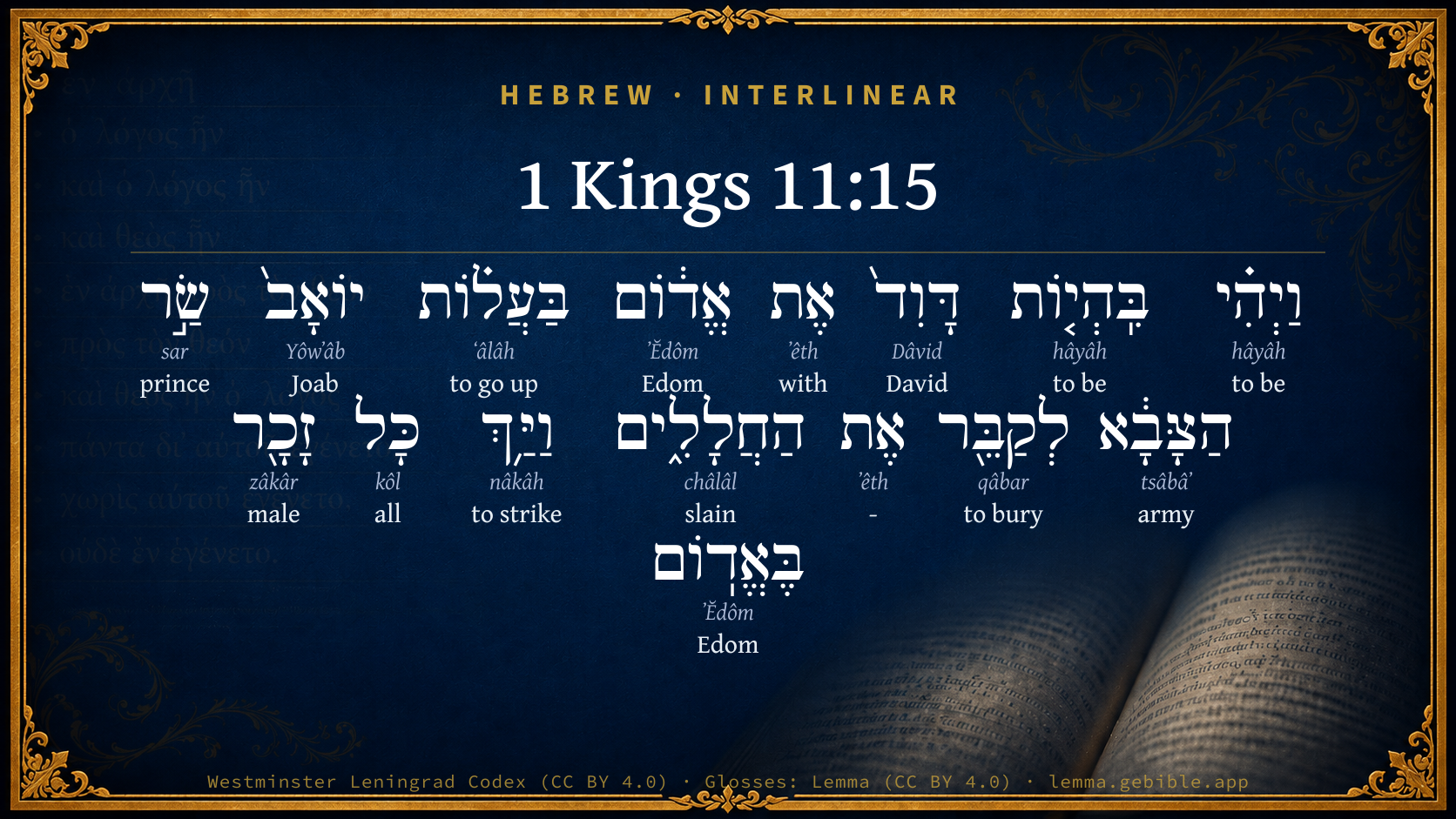
1 Kings 11:15

Hebrew (Westminster Leningrad Codex) 1 Kings 11:15 appears in the Hebrew Old Testament. The text above is from the Westminster Leningrad Codex. Each word links to its Strong’s number, a concise gloss, and parsing drawn from the Open Scriptures Hebrew Bible morphology. Click any word for its full Brown-Driver-Briggs (BDB) entry.
Download image
Cite this verse

1 Kings 11:15 (World English Bible). Public Domain. Lemma interlinear Bible study tool, https://lemma.gebible.app/v/1-kings/11/15.

Show BibTeX & RIS
BibTeX
RIS
English Translation
For it happened, when David was in Edom, and Joab the captain of the host was gone up to bury the slain, and had struck every male in Edom
World English Bible · Public Domain
Download a study sheet

One document with this verse’s original text, its word-by-word gloss line, the meaning frame, cross-references with their text, attributed commentary, and full source and license credits — printable, and it pastes into notes with its structure intact.

This verse Autodidact and up

Study sheet (.html) Plain text (.txt)

A passage Seminary Student

Up to 50 verses in one chapter. A passage sheet keeps up to 6 commentary sources and 12 cross-references per verse, in the order this page ranks them, and says so on the sheet whenever that leaves anything out. Ask for a single verse and you get the Autodidact verse sheet above.

Everything on this page stays free to read, with no account — the sheet is a download of what is already on screen, not access to it.

Want to remove ads? Support Godless Engineer
Compare translations 3

The same verse in 3 English versions, stacked beneath the original-language interlinear above. Click any original word for its lexicon entry.

Each is an independent rendering of the whole verse — the interlinear is not word-aligned to these translations.

Highlighted words mark where these versions differ — a whole-verse word diff, not a word-by-word alignment.

  • World English Bible Public Domain
    For it happened, when David was in Edom, and Joab the captain of the host was gone up to bury the slain, and had struck every male in Edom
  • King James Version Public Domain
    For it came to pass, when David was in Edom, and Joab the captain of the host was gone up to bury the slain, after he had smitten every male in Edom;
  • unfoldingWord Literal Text CC BY-SA 4.0
    Now it had happened, when David was in Edom, when Joab, the commander of the army, had gone up to bury the slain, that he had struck every male in Edom.

unfoldingWord Literal Text — © unfoldingWord, licensed CC BY-SA 4.0. Word-aligned USFM3 via Door43 (git.door43.org/unfoldingWord/en_ult).

Versions to compare (up to 4)

3 of 4 selected

Show all 18 translations

Every available English version of this verse, each an independent rendering of the whole verse.

  • World English Bible Public Domain
    For it happened, when David was in Edom, and Joab the captain of the host was gone up to bury the slain, and had struck every male in Edom
  • Berean Standard Bible Public Domain
    Earlier, when David was in Edom, Joab the commander of the army had gone to bury the dead and had struck down every male in Edom.
  • Majority Standard Bible Public Domain
    Earlier, when David was in Edom, Joab the commander of the army had gone to bury the dead and had struck down every male in Edom.
  • King James Version Public Domain
    For it came to pass, when David was in Edom, and Joab the captain of the host was gone up to bury the slain, after he had smitten every male in Edom;
  • American Standard Version (1901) Public Domain
    For it came to pass, when David was in Edom, and Joab the captain of the host was gone up to bury the slain, and had smitten every male in Edom;
  • Revised Version (1885) Public Domain
    For it came to pass, when David was in Edom, and Joab the captain of the host was gone up to bury the slain, and had smitten every male in Edom;
  • Geneva Bible (1599) Public Domain
    For when Dauid was in Edom, and Ioab the captaine of the hoste had smitten all the males in Edom, and was gone vp to bury ye slaine,
  • Douay-Rheims (1899) Public Domain
    For when David was in Edom, and Joab the general of the army was gone up to bury them that were slain, and had killed every male in Edom,
  • Young's Literal Translation Public Domain
    and it cometh to pass, in David's being with Edom, in the going up of Joab head of the host to bury the slain, that he smiteth every male in Edom --
  • Literal Standard Version CC BY-SA 4.0
    and it comes to pass, in David’s being with Edom, in the going up of Joab head of the host to bury the slain, that he strikes every male in Edom—
  • Unlocked Literal Bible CC BY-SA 4.0
    When David was in Edom, Joab the captain of the army had gone up to bury the dead, every man who had been killed in Edom.
  • unfoldingWord Literal Text CC BY-SA 4.0
    Now it had happened, when David was in Edom, when Joab, the commander of the army, had gone up to bury the slain, that he had struck every male in Edom.
  • Darby Bible Public Domain
    Now it came to pass when David was in Edom, when Joab the captain of the host had gone up to bury the slain, after he had smitten every male in Edom
  • World Messianic Bible Public Domain
    For when David was in Edom, and Joab the captain of the army had gone up to bury the slain, and had struck every male in Edom
  • Webster's Bible Public Domain
    For it came to pass, when David was in Edom, and Joab the captain of the host had gone up to bury the slain, after he had smitten every male in Edom;
  • Free Bible Version CC BY-SA 4.0
    Previously, when David was in Edom, Joab the commander of the Israelite army had gone to bury some of his soldiers who had been killed, and had slaughtered every male in Edom.
  • Bible in Basic English Public Domain
    And when David had sent destruction on Edom, and Joab, the captain of the army, had gone to put the dead into the earth, and had put to death every male in Edom;
  • JPS Tanakh (1917) Public Domain
    For it came to pass, when David was in Edom, and Joab the captain of the host was gone up to bury the slain, and had smitten every male in Edom —

Literal Standard Version (2020), Covenant Press — licensed CC BY-SA 4.0. Text via the HelloAO Bible API (eBible.org). Unlocked Literal Bible (unfoldingWord) — licensed CC BY-SA 4.0. Text via the HelloAO Bible API (eBible.org). unfoldingWord Literal Text — © unfoldingWord, licensed CC BY-SA 4.0. Word-aligned USFM3 via Door43 (git.door43.org/unfoldingWord/en_ult). Free Bible Version, Dr. Jonathan Gallagher — licensed CC BY-SA 4.0. Text via the HelloAO Bible API (eBible.org).

Word by word

More ways to search: Search by grammar → Find every occurrence → Compare this word →

Practice this passage: Drill this verse → Learn its vocabulary →

זָכָ֖ר
zâkâr
H2145
“male”
Adjective, Adjective, Masculine, Singular, Absolute
Part of Speech
Adjective
Type
Adjective
Gender
Masculine
Number
Singular
State
Absolute
Full BDB Definition

Origin: from H2142

TWOT: 551e

male (of humans and animals) (noun masculine) - male (of humans) (adjective)
  1. וַיְהִ֗י hâyâh H1961 “and · to be” Conjunction + Verb, Qal, Sequential Imperfect, 3rd Person, Masculine, Singular
  2. בִּֽהְי֤וֹת hâyâh H1961 “in/at · to be” Preposition + Verb, Qal, Infinitive Construct
  3. דָּוִד֙ Dâvid H1732 “David” Noun, Proper
  4. אֶת ʼêth H854 “with” Preposition
  5. אֱד֔וֹם ʼĔdôm H123 “Edom” Noun, Proper
  6. בַּעֲל֗וֹת ʻâlâh H5927 “in/at · to go up” Preposition + Verb, Qal, Infinitive Construct
  7. יוֹאָב֙ Yôwʼâb H3097 “Joab” Noun, Proper
  8. שַׂ֣ר sar H8269 “prince of” Noun, Common, Masculine, Singular, Construct
  9. הַצָּבָ֔א tsâbâʼ H6635 “the · army” Particle, Definite Article + Noun, Common, Both, Singular, Absolute
  10. לְקַבֵּ֖ר qâbar H6912 “to bury” Preposition + Verb, Piel, Infinitive Construct
  11. אֶת ʼêth H853 “-” Particle, Direct Object
  12. הַחֲלָלִ֑ים châlâl H2491 “the · slain” Particle, Definite Article + Adjective, Adjective, Masculine, Plural, Absolute
  13. וַיַּ֥ךְ nâkâh H5221 “and · to strike” Conjunction + Verb, Hiphil, Sequential Imperfect, 3rd Person, Masculine, Singular
  14. כָּל kôl H3605 “all of” Noun, Common, Masculine, Singular, Construct
  15. בֶּאֱדֽוֹם ʼĔdôm H123 “in/at · Edom” Preposition + Noun, Proper

About this verse

These counts appear in no published source. They are computed here, from the morphology-tagged text and Lemma’s own curated glosses. What Lemma adds →

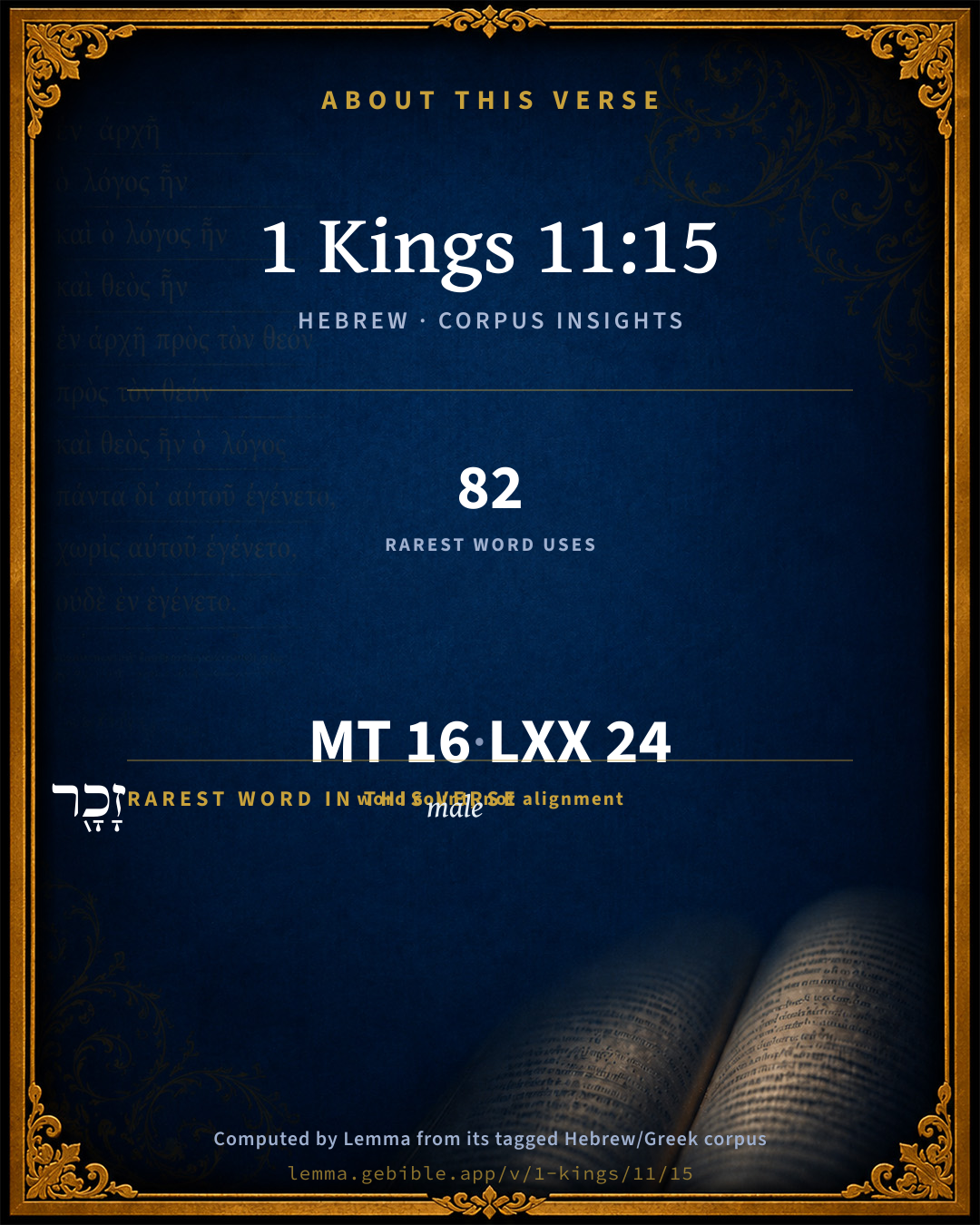
16
words
14
distinct lemmas
Historical
section

Grammatical profile

  • 5 verbs
  • 7 nouns
  • 2 adjectives
  • 1 preposition
  • 1 particle

Verb forms

  • וַיְהִ֗י Qal · Sequential Imperfect
  • בִּֽהְי֤וֹת Qal · Infinitive Construct
  • בַּעֲל֗וֹת Qal · Infinitive Construct
  • לְקַבֵּ֖ר Piel · Infinitive Construct
  • וַיַּ֥ךְ Hiphil · Sequential Imperfect

Repetition

Words recur within this verse — often emphatic in Hebrew:

  • וַיְהִ֗י to be H1961 ×2
  • אֱד֔וֹם Edom H123 ×2

Hebrew & Septuagint length

In English translation the verse runs 29 words from the Hebrew and 29 from the Septuagint (LXX English) — the same length.

A rough comparison of the two English renderings, which tokenize alike — not a word-level alignment.

Word counts can differ between the Hebrew and the Greek without any difference in meaning — e.g. the Hebrew direct-object marker אֵת has no separate Greek word, and Greek often adds the article ὁ.

In the original languages it is 16 Hebrew tokens and 24 Greek tokens — but the two are counted differently (Hebrew bundles its prefixes and suffixes into one token; the Greek is in lemma form), so that isn’t a like-for-like length.

Cross-references

10

Topical passages linked to 1 Kings 11:15 in the Treasury of Scripture Knowledge — connected by theme and wording, ordered by reader-vote popularity; previews shown in the World English Bible.

  • 2 Samuel 8:14 He put garrisons in Edom; throughout all Edom put he garrisons, and all the Edomites became servants to David. Yahweh gave victory to David wherever he went.
  • 1 Chronicles 18:12–13 Moreover Abishai the son of Zeruiah struck of the Edomites in the Valley of Salt eighteen thousand.
  • Deuteronomy 20:13 and when Yahweh your God delivers it into your hand, you shall strike every male of it with the edge of the sword:
  • Genesis 25:23 Yahweh said to her, Two nations are in your womb, Two peoples will be separated from your body. The one people will be stronger than the other people. The elder will serve the younger.
  • Genesis 27:40 By your sword will you live, and you will serve your brother. It will happen, when you will break loose, That you shall shake his yoke from off your neck."
  • Numbers 24:18–19 Edom shall be a possession, Seir also shall be a possession, [who were] his enemies; While Israel does valiantly.
  • Numbers 31:17 Now therefore kill every male among the little ones, and kill every woman who has known man by lying with him.
  • Psalms 60:1 God, you have rejected us. You have broken us down. You have been angry. Restore us, again.
  • Psalms 108:10 Who will bring me into the fortified city? Who has led me to Edom?
  • Malachi 1:2–3 "I have loved you," says Yahweh. Yet you say, "How have you loved us?" "Wasn't Esau Jacob's brother?" says Yahweh, "Yet I loved Jacob;

Cross-references courtesy of OpenBible.info (CC BY 4.0).

Hebrew and Greek witnesses Masoretic Hebrew ↔ Greek Septuagint

The same verse in the two great witnesses to the Old Testament, shown verse-for-verse.

These are two independent witnesses, not word-aligned to each other, and the Septuagint is shown in lemma (dictionary) form.

Hebrew 1 Kings 11:15 Masoretic · Westminster Leningrad Codex

וַיְהִ֗י בִּֽהְי֤וֹת דָּוִד֙ אֶת אֱד֔וֹם בַּעֲל֗וֹת יוֹאָב֙ שַׂ֣ר הַצָּבָ֔א לְקַבֵּ֖ר אֶת הַחֲלָלִ֑ים וַיַּ֥ךְ כָּל זָכָ֖ר בֶּאֱדֽוֹם

For it happened, when David was in Edom, and Joab the captain of the host was gone up to bury the slain, and had struck every male in Edom

World English Bible · Public Domain

Greek LXX 1 Kings 11:15 Septuagint · lemma form

καί γίγνομαι ἐν ὁ ἐκὀλεθρεύω δαυίδ ὁ εδωμ ἐν ὁ πορεύομαι ιωαβ ἄρχων ὁ στρατιά θάπτω ὁ τραυματίας κόπτω πᾶς ἀρσενικός ἐν ὁ ιδουμαία

And it happened, that while David was utterly destroying Edom, while Joab captain of the host was going to bury the dead, when they killed every male in Idumaea;

LXX2012 (modern English Septuagint) · Public Domain

On this verse, Ellicott's Commentary for English Readers discusses the Septuagint’s reading. Read the note in Commentary ↓

Hebrew: Westminster Leningrad Codex (CC BY 4.0). Greek: Septuagint (public domain); English from LXX2012 (modern English Septuagint) (Public Domain). How the Septuagint differs from the Hebrew →

Targum (Aramaic paraphrase)

1

The Targum is the ancient Jewish Aramaic paraphrase of the Hebrew Scriptures — an interpretive translation, not the Hebrew text itself. Onkelos (literal) and Pseudo-Jonathan (expansive) render the Torah, and Jonathan the Prophets. Coverage is partial: where no permissively-licensed English translation exists for a verse, only the Aramaic is shown. This is verse-level text, not a word-by-word alignment to the Hebrew.

  1. Targum Jonathan Prophets (Joshua–Malachi)
    וַהֲוָה כַּד הֲוָה דָוִד בֶּאֱדוֹם כַּד סְלִיק יוֹאָב רַב חֵילָא לְחַלָצָא קְטִילַיָא וּקְטַל כָּל דְכוּרָא בֶּאֱדוֹם:

    (no public-domain English translation for this verse)

    Targum Jonathan — Aramaic: “Mikraot Gedolot” (public domain). English: “Sefaria Community Translation” (CC0 1.0 (public-domain dedication)); “London "Chaldee Paraphrase," 1871” (public domain). Text via Sefaria.

Commentary

Notes on 1 Kings 11:15 from classic Christian and Jewish commentators (each source and its license shown beneath its notes). The classic Christian expositions comment on the surrounding passage and are grouped to its opening verse, so a note may address several verses; the Jewish commentaries on the Tanakh (Rashi and others) are per-verse, so they appear only where the commentator wrote on this verse.

Lemma curates 59 commentaries, every one of them public domain or Creative Commons licensed, each selected and text-cleaned for this edition rather than reprinted as found. About our sources →

Trapp's Complete Commentary

John Trapp

1Ki 11:15 For it came to pass, when David was in Edom, and Joab the captain of the host was gone up to bury the slain, after he had smitten every male in Edom;

Ver. 15. When David was in Edom.] See 2Sa 8:14, {See Trapp on "2Sa 8:14"}

To bury the slain.] David’s garrison soldiers, say some, left to keep Edom in subjection, but slain by the Edomites, which moved Joab to slay all the males he met with amongst them. War is the slaughter house of mankind. Pολεμος signifieth much blood.

John Trapp, A Commentary or Exposition upon All the Books of the Old and New Testament (1647–1656) — public domain. Text from a community e-Sword module.

Joseph Benson's Commentary

1Ki 11:15-17. When David was in Edom — By his army to war against it; and Joab was gone up to bury the slain — The Israelites who were slain in the battle, (2Sa 8:13-14,) whom he honourably interred in some certain place, to which he is said to go up for that end. And this gave Hadad the opportunity of making his escape, while Joab and his men were all employed in the solemnity. After he had smitten, &c. — Or, and he smote, as it is in the Hebrew: which is here observed as the cause of Hadad’s flight; he understood what Joab had done in part, and intended further to do, even to kill all the males, and therefore fled for his life. With all Israel — That is, with all his army. Until he had cut off every male — That bore arms; for it is hardly to be thought that they cut off all the male children and youths. That Hadad fled — While Joab was busy in giving a solemn burial to the Israelites, certain Edomites took the opportunity to carry Hadad into Egypt.

Joseph Benson's Commentary on the Old and New Testaments (1811–1818) — public domain. Text from a community e-Sword module.

Geneva Bible (1599)

Geneva Bible translators

Of the Edomites.

Geneva Bible (1599) marginal notes — public domain. Text via Bolls.life.

Adam Clarke's Commentary

Verse 15. Was gone up to bury the slain] The slain Edomites; for Joab had in the course of six months exterminated all the males, except Hadad and his servants, who escaped to Egypt. Instead of bury the slain, the Targum has to take the spoils of the slain.

Adam Clarke's Commentary on the Bible (1810–1826) — public domain. Text from a community e-Sword/MySword module.

Ellicott's Commentary for English Readers

(15) The war here described is briefly noted, with some differences of detail, in 2Sa_8:12-14, 1Ch_18:11-13, and Psalms 60 (title and 1Ki_11:8). It is there closely connected with the great struggle with the Syrians, and the victory is ascribed in one record to Joab, in the other to Abishai. Here David himself is described as taking part in the war—perhaps completing the conquest, as in the war with Ammon, after it had been successfully begun by Joab (2Sa_12:26-31). (Instead of “David was in Edom,” the LXX. and other versions read “David destroyed Edom,” by a slight variation of the Hebrew text.) The war was evidently one of ruthless extermination of “every male,” except those who fled the country, or found refuge in its rocky fastnesses, and was carried on by systematic ravage under the command of Joab. How it was provoked we do not know; for we have no previous notice of Edom since the time of the Exodus, except a reference to war against it in the days of Saul (1Sa_14:47).

A Bible Commentary for English Readers, edited by Charles John Ellicott (1878–1897) — public domain. Text from a community e-Sword module.

The Cambridge Bible for Schools and Colleges

gen. ed. J. J. S. Perowne

15. when David was in Edom] The time alluded to is the period of David’s conquests (2Sa_8:14), when it is said that all Edom became his servants. The LXX. says ‘when David destroyed Edom,’ which was perhaps the fact, as this verse shews, but is not stated in the earlier history. He conquered the land, and put garrisons of his own men throughout it.

and Joab the captain of the host was gone up to bury the slain] On Joab, see 1Ki_1:7. The slain were the Israelites who had fallen in David’s war with Edom. To bury these the captain of the host was appointed, and he abode after that work was over, till all were cut off, or driven away, from whom there could be any fear of resistance.

after he had smitten every male in Edom] This can only mean, as just stated, those persons who were likely to rebel against Israel. The narrative in 2Sa_8:14 implies that those who submitted were left, and put under tribute to Israel.

The Cambridge Bible for Schools and Colleges (gen. ed. J. J. S. Perowne; Cambridge University Press, 1878–1918) — public domain. Text from a community e-Sword module.

John Gill's Exposition

For six months did Joab remain with all Israel,.... With the whole army:

until he had cut off every male in Edom; as he supposed; for it was not fact, since after this they increased again, and became a powerful people, and had a king over them, and revolted from Judah, Kg2 8:20.

John Gill's Exposition of the Whole Bible (1746–1763) — public domain (CC PDM 1.0). Text via the HelloAO Bible API.

Albert Barnes' Notes on the Bible

The verse gives certain additional particulars of David’s conquest of Edom (marginal references). Joab was left, or sent, to complete the subjugation of the country, with orders to exterminate all the grown male inhabitants. It was not very often that David acted with any extreme severity in his wars; but he may have considered himself justified by policy, as he certainly was by the letter of the Law Deu 20:13, in adopting this fierce course against Edom.

Was in Edom - Or, according to another reading, “smote” Edom.

The slain - Probably the Israelites who had fallen in the strnggle. Translate, “when ... Joab was gone up to bury the slain, and had smitten every male,” etc.

Albert Barnes' Notes on the Bible (1834–1885) — public domain. Text from a community e-Sword/MySword module.

Haydock's Catholic Bible Commentary

In Edom, in the 15th year of his reign. (Salien) --- Abisai was the general in this expedition, 2 Kings viii., and 1 Paralipomenon xviii. 12.

George Leo Haydock (1774–1849), Haydock's Catholic Family Bible and Commentary, 1859 edition — public domain. Excludes Psalms (Douay-Rheims chapter numbering differs from Protestant) and Deuterocanonical books (Catholic canon only).

Matthew Poole's English Annotations

When David was in Edom, to wit, by his army, to war against it. See 1Ch 18:12,13.

To bury the slain, to wit, the Israelites which were slain in the battle, 2Sa 8:13,14, whom he honourably inferred in some certain place, to which he is said to go up for that end. And this may be mentioned as that which gave Hadad the opportunity of making his escape, whilst Joab and his men were employed in that solemnity.

After he had smitten every male in Edom; or, and he smote, &c., as it is in the Hebrew; which is here noted as the cause of Hadad’s flight, he smote, &c. He understood what Joab had done in part, and intended further to do, even to kill all the males, and therefore fled for his life.

Matthew Poole's English Annotations on the Holy Bible (1683–1685) — public domain. Text from a community e-Sword/MySword module.

Whedon's Commentary on the Bible

Daniel D. Whedon

15. When David was in Edom — See 2Sa_8:13-14, and notes there.

We bury the slain — The slain Israelites who fell in the Edomite war. From 1Ch_18:12, it would seem that Abishai, Joab’s brother, had chief command in the great battle that was fought in the Valley of Salt, and which resulted in the slaughter of eighteen thousand Edomites. Doubtless many an Israelite perished in this battle; and Joab, rather than Abishai, took charge of their burial.

Daniel D. Whedon (gen. ed.), Commentary on the Old and New Testaments (1874–1909) — public domain. Text from a community e-Sword module.

The Pulpit Commentary

For it came to pass, when David was in Edom. (2Sa_8:14) But the text is peculiar. Instead of "in Edom" we have "with Edom," unless we take ta to be the mark of the accusative, which, however, there is no verb to govern. Keil interprets, "When David had to do with Edom." Bahr refers to 1Ch_20:5, and Gen_19:4, but they are not strictly parallel, and it is possible that the text is slightly corrupt, as the LXX, Syr., and Arab. must have had twkhb instead of twyhb before them "when David smote Edom." The LXX, e.g., reads ejn tw ejxoloqreusai k.t.l. It was only vicariously, however, that David smote Edom, or was in Edom. According to 1Ch_18:12, Abishai slew 18, 000 Edomites, while Psalm 60. (title) represents Joab as having slain 12, 000 at the same time and place. The two brothers were both in high command, or Abishal may have been detailed by Joab to this service, and Joab the captain of the host was gone up to bury the slain The commentators generally are agreed that these are the Israelites slain by the Edomites during an invasion of Israel, and not either the Edomites or Israelites slain in the valley of Salt, after he had smitten rather, that he smote. This is the apodosis every male in Edom. This is, of course, hyperbolical (cf. "all Israel" below). It is clear that the whole Edomite nation did not perish. The words point to a terrible slaughter (cf. 1Ch_18:13) among the men of war. Possibly the cruelties of the Edomites (compare Psa_137:7; Oba_1:10-14) had provoked this act of retribution, as to which (see Deu_20:13)

The Pulpit Commentary (1880–1919), ed. H.D.M. Spence-Jones & Joseph S. Exell — public domain. Text from a community e-Sword module.

John Wesley's Explanatory Notes

In Edom - By his army, to war against it. To bury - The Israelites who were slain in the battle, 2 Sam. viii, 13, 14, whom he honourably interred in some certain place, to which he is said to go up for that end. And this gave Hadad the opportunity of making his escape, whilst Joab and his men were employed in that solemnity. Had smitten - Or, and he smote, as it is in the Hebrew: which is here noted as the cause of Hadad's flight; he understood what Joab had done in part, and intended farther to do, even to kill all the males and therefore fled for his life.

John Wesley, Explanatory Notes Upon the Whole Bible (1754–1765) — public domain. Text via the GEBible commentary corpus.

Rashi

Rabbi Shlomo Yitzchaki (Rashi)

Dovid was in Edom. Then Hadad fled from Dovid and Yoav.

To bury the dead. For they buried the slain of Edom, this is what is stated in the Book of Shmuel, “And Dovid made [for himself] a name when he returned from slaying [those of] Edom,”.” For clarification, see Tehillim 60:2. for all were praising him as a pious person for he buries his slain. And similarly it states concerning the wars of Gog and Magog, “And they will bury all the people of the land, and it will bring them fame.” However, [Targum] Yonoson rendered לקבר את החללים, “to strip the slain,” [i.e.,] to remove their clothing.

Rashi on the Tanakh — English translations: “The Judaica Press complete Tanach with Rashi, translated by A. J. Rosenberg” (CC BY 4.0); “Pentateuch with Rashi's commentary by M. Rosenbaum and A.M. Silbermann, 1929-1934” (public domain); “The Metsudah Tanach series, Lakewood, N.J” (CC BY 4.0); and “The Book of Joshua, Metsudah Publications, 1997” (CC BY 4.0). Text via Sefaria.

Lesson kit

Teaching starters — assembled from the data on this page, not authored interpretation. Every prompt links to the verse data it draws on. Edit before teaching.

1 Kings, in the Historical, opens this verse with 16 words (14 distinct Hebrew lemmas). Its most distinctive word is zâkâr (“male”). A historical commentator’s framing appears above. Read the whole chapter for the surrounding context.

Discussion questions

  1. How does “male” (zâkâr) shape what this verse is saying?
  2. How does 2 Samuel 8:14, which shares this passage’s theme, read alongside this verse?
  3. What does the repetition of “to be” (2× in this one verse) do in this verse?
  4. The translations on this page render this verse differently — a whole-verse word diff, not a word-by-word alignment. What might account for the different wordings?
  5. «וַיְהִ֗י» is a Qal Sequential Imperfect verb. How does that grammatical form shape the action described?
  6. Compare how Trapp's Complete Commentary and Joseph Benson's Commentary read this verse. Where do they agree or differ?

Things to notice

Reading settings

Reading text

Shown beneath each verse's original-language words.

Old Testament
Old Testament edition

Read the OT as the Masoretic Hebrew (MT) or the Greek Septuagint (LXX).

English shown for the Greek Septuagint (in the Hebrew ↔ Greek comparison).

Comparing translations? Open the Compare panel on any verse page to stack up to four side by side.