
2 Samuel 6:2

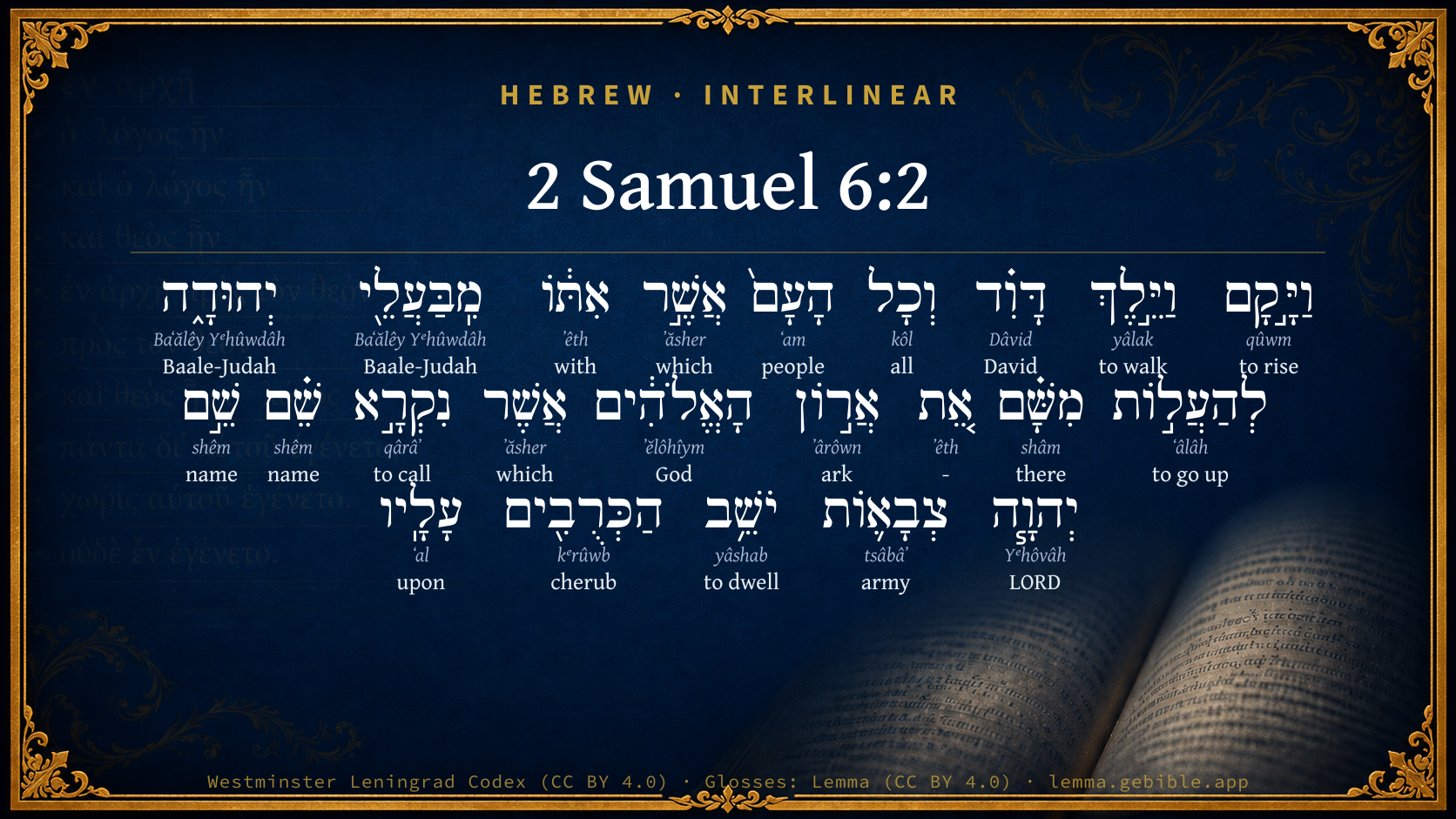
Hebrew (Westminster Leningrad Codex) 2 Samuel 6:2 appears in the Hebrew Old Testament. The text above is from the Westminster Leningrad Codex. Each word links to its Strong’s number, a concise gloss, and parsing drawn from the Open Scriptures Hebrew Bible morphology. Click any word for its full Brown-Driver-Briggs (BDB) entry.
Download image
Cite this verse

2 Samuel 6:2 (World English Bible). Public Domain. Lemma interlinear Bible study tool, https://lemma.gebible.app/v/2-samuel/6/2.

Show BibTeX & RIS
BibTeX
RIS
English Translation
David arose, and went with all the people who were with him, from Baale Judah, to bring up from there the ark of God, which is called by the Name, even the name of Yahweh of Hosts who sits [above] the cherubim.
World English Bible · Public Domain
Highlights
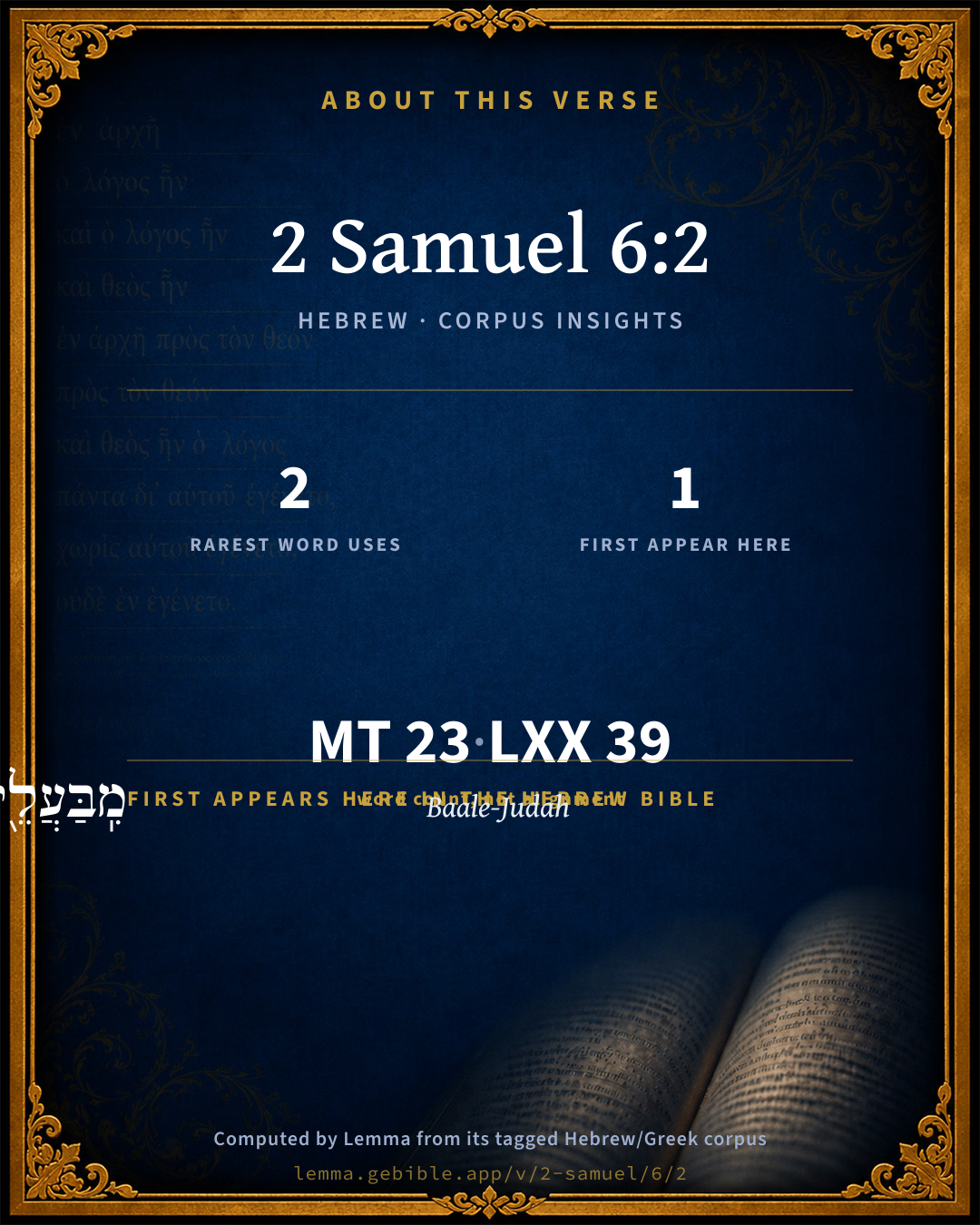
  • 1 first appearance in the Hebrew Bible
Full analysis ↓
Download a study sheet

One document with this verse’s original text, its word-by-word gloss line, the meaning frame, cross-references with their text, attributed commentary, and full source and license credits — printable, and it pastes into notes with its structure intact.

This verse Autodidact and up

Study sheet (.html) Plain text (.txt)

A passage Seminary Student

Up to 50 verses in one chapter. A passage sheet keeps up to 6 commentary sources and 12 cross-references per verse, in the order this page ranks them, and says so on the sheet whenever that leaves anything out. Ask for a single verse and you get the Autodidact verse sheet above.

Everything on this page stays free to read, with no account — the sheet is a download of what is already on screen, not access to it.

Want to remove ads? Support Godless Engineer
Compare translations 3

The same verse in 3 English versions, stacked beneath the original-language interlinear above. Click any original word for its lexicon entry.

Each is an independent rendering of the whole verse — the interlinear is not word-aligned to these translations.

Highlighted words mark where these versions differ — a whole-verse word diff, not a word-by-word alignment.

  • World English Bible Public Domain
    David arose, and went with all the people who were with him, from Baale Judah, to bring up from there the ark of God, which is called by the Name, even the name of Yahweh of Hosts who sits [above] the cherubim.
  • King James Version Public Domain
    And David arose, and went with all the people that were with him from Baale of Judah, to bring up from thence the ark of God, whose name is called by the name of the LORD of hosts that dwelleth between the cherubim.
  • unfoldingWord Literal Text CC BY-SA 4.0
    And David arose and went, and all of the people who with him, from Baalah of Judah to bring up from there the Box of God, whose name is called the name of Yahweh of Armies, dweller of the cherubim upon it.

unfoldingWord Literal Text — © unfoldingWord, licensed CC BY-SA 4.0. Word-aligned USFM3 via Door43 (git.door43.org/unfoldingWord/en_ult).

Versions to compare (up to 4)

3 of 4 selected

Show all 18 translations

Every available English version of this verse, each an independent rendering of the whole verse.

  • World English Bible Public Domain
    David arose, and went with all the people who were with him, from Baale Judah, to bring up from there the ark of God, which is called by the Name, even the name of Yahweh of Hosts who sits [above] the cherubim.
  • Berean Standard Bible Public Domain
    And he and all his troops set out for Baale of Judah to bring up from there the ark of God, which is called by the Name—the name of the LORD of Hosts, who is enthroned between the cherubim that are on it.
  • Majority Standard Bible Public Domain
    And he and all his troops set out for Baale of Judah to bring up from there the ark of God, which is called by the Name—the name of the LORD of Hosts, who is enthroned between the cherubim that are on it.
  • King James Version Public Domain
    And David arose, and went with all the people that were with him from Baale of Judah, to bring up from thence the ark of God, whose name is called by the name of the LORD of hosts that dwelleth between the cherubim.
  • American Standard Version (1901) Public Domain
    And David arose, and went with all the people that were with him, from Baale-judah, to bring up from thence the ark of God, which is called by the Name, even the name of Jehovah of hosts that sitteth `above' the cherubim.
  • Revised Version (1885) Public Domain
    And David arose, and went with all the people that were with him, from Baale Judah, to bring up from thence the ark of God, which is called by the Name, even the name of the LORD of hosts that sitteth upon the cherubim.
  • Geneva Bible (1599) Public Domain
    And Dauid arose and went with all the people that were with him from Baale of Iudah to bring vp from thence the Arke of God, whose name is called by the Name of the Lord, of hostes, that dwelleth vpon it betweene the Cherubims.
  • Douay-Rheims (1899) Public Domain
    And David arose and went, with all the people that were with him of the men of Juda to fetch the ark of God, upon which the name of the Lord of hosts is invoked, who sitteth over it upon the cherubims.
  • Young's Literal Translation Public Domain
    and David riseth and goeth, and all the people who `are' with him, from Baale-Judah, to bring up thence the ark of God, whose name hath been called -- the name of Jehovah of Hosts, inhabiting the cherubs -- upon it.
  • Literal Standard Version CC BY-SA 4.0
    and David rises and goes, and all the people who [are] with him, from Ba‘ale-Judah, to bring up the Ark of God from there, whose name has been called—the Name of YHWH of Hosts, inhabiting the cherubim—on it.
  • Unlocked Literal Bible CC BY-SA 4.0
    David arose and went with all his men who were with him from Baalah in Judah to bring up from there the ark of God, which is called by the name of Yahweh of hosts, who sits enthroned over the cherubim.
  • unfoldingWord Literal Text CC BY-SA 4.0
    And David arose and went, and all of the people who with him, from Baalah of Judah to bring up from there the Box of God, whose name is called the name of Yahweh of Armies, dweller of the cherubim upon it.
  • Darby Bible Public Domain
    And David arose and went with all the people that were with him from Baale-Judah, to bring up from thence the ark of God which is called by the name, the name of Jehovah of hosts who sitteth between the cherubim.
  • World Messianic Bible Public Domain
    David arose and went with all the people who were with him from Baale Judah, to bring up from there God’s ark, which is called by the Name, even the name of the LORD of Hosts who sits above the cherubim.
  • Webster's Bible Public Domain
    And David arose, and went with all the people that were with him from Baale of Judah, to bring up from thence the ark of God, whose name is called by the name of the LORD of hosts that dwelleth between the cherubim.
  • Free Bible Version CC BY-SA 4.0
    He went with all his men to Baalah in Judah to bring back the Ark of God, which belongs to the Lord Almighty who sits between the cherubim that are on the Ark.
  • Bible in Basic English Public Domain
    And David, and all the people who were with him, went to Baal of Judah to get the ark of God, over which the holy name is named, the name of the Lord of armies, whose place is between the winged ones.
  • JPS Tanakh (1917) Public Domain
    And David arose, and went with all the people that were with him, from Baale-judah, to bring up from thence the ark of God, whereupon is called the Name, even the name of the LORD of hosts that sitteth upon the cherubim.

Literal Standard Version (2020), Covenant Press — licensed CC BY-SA 4.0. Text via the HelloAO Bible API (eBible.org). Unlocked Literal Bible (unfoldingWord) — licensed CC BY-SA 4.0. Text via the HelloAO Bible API (eBible.org). unfoldingWord Literal Text — © unfoldingWord, licensed CC BY-SA 4.0. Word-aligned USFM3 via Door43 (git.door43.org/unfoldingWord/en_ult). Free Bible Version, Dr. Jonathan Gallagher — licensed CC BY-SA 4.0. Text via the HelloAO Bible API (eBible.org).

Word by word

More ways to search: Search by grammar → Find every occurrence → Compare this word →

Practice this passage: Drill this verse → Learn its vocabulary →

מִֽבַּעֲלֵ֖י
Baʻălêy Yᵉhûwdâh
H1184
“from · Baale-Judah”
Preposition + Noun, Proper
Part of Speech
Preposition + Noun
Type
Proper
Full BDB Definition

Origin: from the pl. of H1167 and H3063

TWOT: None

Baale-Judah = "the lords of Judah" - a place in Judah named for the Baalim, also known as Kirjath-jearim, Kirjath-baal; modern Kuriet el Enab
  1. וַיָּ֣קָם qûwm H6965 “and · to rise” Conjunction + Verb, Qal, Sequential Imperfect, 3rd Person, Masculine, Singular
  2. וַיֵּ֣לֶךְ yâlak H3212 “and · to walk” Conjunction + Verb, Qal, Sequential Imperfect, 3rd Person, Masculine, Singular
  3. דָּוִ֗ד Dâvid H1732 “David” Noun, Proper
  4. וְכָל kôl H3605 “and · all of” Conjunction + Noun, Common, Masculine, Singular, Construct
  5. הָעָם֙ ʻam H5971 “the · people” Particle, Definite Article + Noun, Common, Masculine, Singular, Absolute
  6. אֲשֶׁ֣ר ʼăsher H834 “which” Particle, Relative
  7. אִתּ֔וֹ ʼêth H854 “with · him” Preposition + Suffix, Personal, 3rd Person, Masculine, Singular
  8. יְהוּדָ֑ה Baʻălêy Yᵉhûwdâh H1184 “Baale-Judah” Noun, Proper
  9. לְהַעֲל֣וֹת ʻâlâh H5927 “to go up” Preposition + Verb, Hiphil, Infinitive Construct
  10. מִשָּׁ֗ם shâm H8033 “from · there” Preposition + Adverb
  11. אֵ֚ת ʼêth H853 “-” Particle, Direct Object
  12. אֲר֣וֹן ʼârôwn H727 “ark of” Noun, Common, Both, Singular, Construct
  13. הָאֱלֹהִ֔ים ʼĕlôhîym H430 “the · God(s)” Particle, Definite Article + Noun, Common, Masculine, Plural, Absolute
  14. אֲשֶׁר ʼăsher H834 “which” Particle, Relative
  15. נִקְרָ֣א qârâʼ H7121 “to call” Verb, Niphal, Perfect, 3rd Person, Masculine, Singular
  16. שֵׁ֗ם shêm H8034 “name” Noun, Common, Masculine, Singular, Absolute
  17. שֵׁ֣ם shêm H8034 “name of” Noun, Common, Masculine, Singular, Construct
  18. יְהוָ֧ה Yᵉhôvâh H3068 “LORD” Noun, Proper
  19. צְבָא֛וֹת tsâbâʼ H6635 “armies” Noun, Common, Both, Plural, Absolute
  20. יֹשֵׁ֥ב yâshab H3427 “dwelling” Verb, Qal, Participle Active, Masculine, Singular, Absolute
  21. הַכְּרֻבִ֖ים kᵉrûwb H3742 “the · cherubim” Particle, Definite Article + Noun, Common, Masculine, Plural, Absolute
  22. עָלָֽיו ʻal H5921 “upon · him” Preposition + Suffix, Personal, 3rd Person, Masculine, Singular

About this verse

These counts appear in no published source. They are computed here, from the morphology-tagged text and Lemma’s own curated glosses. What Lemma adds →

23
words
20
distinct lemmas
Historical
section

Notable vocabulary

The rarest word here is מִֽבַּעֲלֵ֖י Baale-Judah H1184 — appearing just 2 times in the whole Hebrew Bible.

First appearance in Scripture

This word makes its first canonical appearance in the Hebrew Bible here:

  • מִֽבַּעֲלֵ֖י Baale-Judah H1184

Grammatical profile

  • 5 verbs
  • 12 nouns
  • 2 prepositions
  • 1 adverb
  • 3 particles

Verb forms

  • וַיָּ֣קָם Qal · Sequential Imperfect
  • וַיֵּ֣לֶךְ Qal · Sequential Imperfect
  • לְהַעֲל֣וֹת Hiphil · Infinitive Construct
  • נִקְרָ֣א Niphal · Perfect
  • יֹשֵׁ֥ב Qal · Participle Active

Repetition

Words recur within this verse — often emphatic in Hebrew:

  • מִֽבַּעֲלֵ֖י Baale-Judah H1184 ×2
  • שֵׁ֗ם name H8034 ×2
  • אֲשֶׁ֣ר which H834 ×2

Hebrew & Septuagint length

In English translation the verse runs 42 words from the Hebrew and 54 from the Septuagint (LXX English) — closely comparable.

A rough comparison of the two English renderings, which tokenize alike — not a word-level alignment.

Word counts can differ between the Hebrew and the Greek without any difference in meaning — e.g. the Hebrew direct-object marker אֵת has no separate Greek word, and Greek often adds the article ὁ.

In the original languages it is 23 Hebrew tokens and 39 Greek tokens — but the two are counted differently (Hebrew bundles its prefixes and suffixes into one token; the Greek is in lemma form), so that isn’t a like-for-like length.

Cross-references

12

Topical passages linked to 2 Samuel 6:2 in the Treasury of Scripture Knowledge — connected by theme and wording, ordered by reader-vote popularity; previews shown in the World English Bible.

  • 1 Samuel 4:4 So the people sent to Shiloh; and they brought from there the ark of the covenant of Yahweh of Hosts, who sits [above] the cherubim: and the two sons of Eli, Hophni and Phinehas, were there with the ark of the covenant of God.
  • Exodus 25:18–22 You shall make two cherubim of hammered gold. You shall make them at the two ends of the mercy seat.
  • 1 Samuel 7:1 The men of Kiriath Jearim came, and fetched up the ark of Yahweh, and brought it into the house of Abinadab in the hill, and sanctified Eleazar his son to keep the ark of Yahweh.
  • 1 Chronicles 13:5–6 So David assembled all Israel together, from the Shihor [the brook] of Egypt even to the entrance of Hamath, to bring the ark of God from Kiriath Jearim.
  • Psalms 80:1 Hear us, Shepherd of Israel, You who lead Joseph like a flock, You who sit above the cherubim, shine forth.
  • 1 Peter 1:12 To them it was revealed, that not to themselves, but to you, did they minister these things, which now have been announced to you through those who preached the Gospel to you by the Holy Spirit sent out from heaven; which things angels desire to look into.
  • Leviticus 24:11–16 The son of the Israelite woman blasphemed the Name, and cursed; and they brought him to Moses. His mother's name was Shelomith, the daughter of Dibri, of the tribe of Dan.
  • 1 Kings 8:6–7 The priests brought in the ark of the covenant of Yahweh to its place, into the oracle of the house, to the most holy place, even under the wings of the cherubim.
  • Isaiah 47:4 Our Redeemer, Yahweh of hosts is his name, the Holy One of Israel.
  • Isaiah 54:5 For your Maker is your husband; Yahweh of Hosts is his name: and the Holy One of Israel is your Redeemer; the God of the whole earth shall he be called.
  • Joshua 15:9–10 and the border extended from the top of the mountain to the spring of the waters of Nephtoah, and went out to the cities of Mount Ephron; and the border extended to Baalah (the same is Kiriath Jearim);
  • Joshua 15:60 Kiriath Baal (the same is Kiriath Jearim), and Rabbah; two cities with their villages.

Cross-references courtesy of OpenBible.info (CC BY 4.0).

Hebrew and Greek witnesses Masoretic Hebrew ↔ Greek Septuagint

The same verse in the two great witnesses to the Old Testament, shown verse-for-verse.

These are two independent witnesses, not word-aligned to each other, and the Septuagint is shown in lemma (dictionary) form.

Hebrew 2 Samuel 6:2 Masoretic · Westminster Leningrad Codex

וַיָּ֣קָם וַיֵּ֣לֶךְ דָּוִ֗ד וְכָל הָעָם֙ אֲשֶׁ֣ר אִתּ֔וֹ מִֽבַּעֲלֵ֖י יְהוּדָ֑ה לְהַעֲל֣וֹת מִשָּׁ֗ם אֵ֚ת אֲר֣וֹן הָאֱלֹהִ֔ים אֲשֶׁר נִקְרָ֣א שֵׁ֗ם שֵׁ֣ם יְהוָ֧ה צְבָא֛וֹת יֹשֵׁ֥ב הַכְּרֻבִ֖ים עָלָֽיו

David arose, and went with all the people who were with him, from Baale Judah, to bring up from there the ark of God, which is called by the Name, even the name of Yahweh of Hosts who sits [above] the cherubim.

World English Bible · Public Domain

Greek LXX 2 Samuel 6:2 Septuagint · lemma form

καί ἀναἵστημι καί πορεύομαι δαυίδ καί πᾶς ὁ λαός ὁ μετά αὐτός ἀπό ὁ ἄρχων ιουδα ἐν ἀνάβασις ὁ ἀναἄγω ἐκεῖθεν ὁ κιβωτός ὁ θεός ἐπί ὅς ἐπικαλέω ὁ ὄνομα κύριος ὁ δύναμις καταἧμαι ἐπί ὁ χερουβιν ἐπί αὐτός

And David arose, and went, he and all the people that were with him, and some of the rulers of Juda, on an expedition to a distant place, to bring back thence the ark of God, on which the name of the Lord of Host who dwells between the cherubs upon it is called.

LXX2012 (modern English Septuagint) · Public Domain

On this verse, The Cambridge Bible for Schools and Colleges discusses the Septuagint’s reading. Read the note in Commentary ↓

Hebrew: Westminster Leningrad Codex (CC BY 4.0). Greek: Septuagint (public domain); English from LXX2012 (modern English Septuagint) (Public Domain). How the Septuagint differs from the Hebrew →

Targum (Aramaic paraphrase)

1

The Targum is the ancient Jewish Aramaic paraphrase of the Hebrew Scriptures — an interpretive translation, not the Hebrew text itself. Onkelos (literal) and Pseudo-Jonathan (expansive) render the Torah, and Jonathan the Prophets. Coverage is partial: where no permissively-licensed English translation exists for a verse, only the Aramaic is shown. This is verse-level text, not a word-by-word alignment to the Hebrew.

  1. Targum Jonathan Prophets (Joshua–Malachi)
    וְקָם וַאֲזַל דָוִד וְכָל עַמָא דִי עִמֵיהּ מִקִרְוַיָא מִדְבֵית יְהוּדָה לְאַסָקָא מִתַּמָן יַת אֲרוֹנָא דַייָ דְאִיתְקְרֵי שְׁמָא שְׁמָא דַייָ צְבָאוֹת דִשְׁכִינְתֵּה שַׁרְיָא עֵיל מִן כְּרוּבַיָא עֲלוֹהִי:

    (no public-domain English translation for this verse)

    Targum Jonathan — Aramaic: “Mikraot Gedolot” (public domain). English: “Sefaria Community Translation” (CC0 1.0 (public-domain dedication)); “London "Chaldee Paraphrase," 1871” (public domain). Text via Sefaria.

Commentary

Notes on 2 Samuel 6:2 from classic Christian and Jewish commentators (each source and its license shown beneath its notes). The classic Christian expositions comment on the surrounding passage and are grouped to its opening verse, so a note may address several verses; the Jewish commentaries on the Tanakh (Rashi and others) are per-verse, so they appear only where the commentator wrote on this verse.

Lemma curates 59 commentaries, every one of them public domain or Creative Commons licensed, each selected and text-cleaned for this edition rather than reprinted as found. About our sources →

Trapp's Complete Commentary

John Trapp

2Sa 6:2 And David arose, and went with all the people that [were] with him from Baale of Judah, to bring up from thence the ark of God, whose name is called by the name of the LORD of hosts that dwelleth [between] the cherubims.

Ver. 2. From Baale of Judah.] Called also Kirjathbaal, {Jos 15:60} and Kirjathjearim. {1Ch 13:6}

To bring up from thence the ark of God.] Which in Saul’s days had been slighted; and was now haply less regarded, because in a private house.

That dwelleth between the cherabims.] By the presence not only of his grace, but of his glory also upon earth.

John Trapp, A Commentary or Exposition upon All the Books of the Old and New Testament (1647–1656) — public domain. Text from a community e-Sword module.

Joseph Benson's Commentary

2Sa 6:2. From Baale of Judah — The same with Kirjath-jearim, 1Ch 13:6, called Baalah, Jos 15:9, and Kirjath-baal, Jos 15:60; Jos 18:14. Some have apprehended a difficulty here, because it is said they went from Baale, whereas, 1Ch 13:6, it is said they went to Baale. But there is no disagreement between these two places. They first went from Jerusalem and other places to Baale, where they assembled, and then from it to Gibeah. To bring up from thence the ark of God — Where it had been a long time in the house of Abinadab, whose son had been sanctified to attend it, 1Sa 7:1. Whose name is called by the name, &c. — This rendering is both obscure and inaccurate. The clause should either be translated, On which (ark) is called the name, even the name of the Lord of hosts; that is, which is named the ark of the Lord of hosts: or, At, by, or before which the name, even the name of the Lord of hosts is called upon; that is, by or before which they were to present their prayers to God for counsel and succour on all occasions. And this is mentioned here as the reason why David put himself and his people to so great trouble and charge; it was to fetch up the choicest treasure which they had; it was to convey to its appointed place the ark of the Lord of hosts; the symbol and token of his presence with them, and the medium and principal instrument of their whole worship and service.

Joseph Benson's Commentary on the Old and New Testaments (1811–1818) — public domain. Text from a community e-Sword module.

Tyndale Open Study Notes

Tyndale Open Resources

6:2 is enthroned between the cherubim: See also 1 Sam 4:4; 2 Kgs 19:15; Pss 80:1; 99:1.

Tyndale Open Study Notes — © Tyndale Open Resources, licensed CC BY-SA 4.0. Text via the HelloAO Bible API.

Geneva Bible (1599)

Geneva Bible translators

This was a city in Judah called also Kirjath Jearim, Josh. 15:9.

Geneva Bible (1599) marginal notes — public domain. Text via Bolls.life.

Jamieson, Fausset & Brown

Robert Jamieson, A. R. Fausset & David Brown

from Baale of Judah--A very large force of picked men were selected for this important work lest the undertaking might be opposed or obstructed by the Philistines. Besides, a great concourse of people accompanied them out of veneration for the sacred article. The journey to Baale, which is related (Ch1 13:6), is here presupposed, and the historian describes the course of the procession from that place to the capital.

Jamieson, Fausset & Brown — Commentary Critical and Explanatory on the Whole Bible (1871) — public domain (CC PDM 1.0). Text via the HelloAO Bible API.

Adam Clarke's Commentary

Verse 2. From Baale of Judah] This is supposed to be the same city which, in Jos 15:60, is called Kirjah-baal or Kirjath-jearim; (see 1Ch 13:6;) or Baalah, Jos 15:9.

Whose name is called by the name of the Lord] That is, The ark is called the ark of the Lord of hosts. But this is not a literal version; the word שם shem, NAME, occurs twice together; probably one of them should be read שם sham, THERE. There the name of the Lord of hosts was invoked, &c.

Adam Clarke's Commentary on the Bible (1810–1826) — public domain. Text from a community e-Sword/MySword module.

Ellicott's Commentary for English Readers

(2) From Baale of Judah.—There is either a textual error here, so that instead of from should be read to, or else the historian is so occupied with his main subject that he omits the mention of the journey to Baale. In Jos_15:9 and 1Ch_13:6, Baale is said to be another name for Kirjath-jearim. This was the place to which the ark was carried after its removal from Bethshemesh (1Sa_7:2), and it had remained here ever since. It has been generally identified with Kuryet-el-enab, about eight miles a little north of west from Jerusalem. More recent opinion places it at ‘Erma, about eleven miles a little south of west from Jerusalem, and four miles east of Bethshemesh. In either case it was three or four hours’ march from the capital.

Whose name is called.—Neither the text nor the margin of the English represents the original quite accurately. Translate, which is called by the name, the name of Jehovah of hosts. The ark is thus described as being the visible symbol of God’s presence and of His covenant with His people.

A Bible Commentary for English Readers, edited by Charles John Ellicott (1878–1897) — public domain. Text from a community e-Sword module.

The Cambridge Bible for Schools and Colleges

gen. ed. J. J. S. Perowne

2. from Baale of Judah] Baale of Judah is generally supposed to be another name for Kirjath-jearim, which is called Baalah in Jos_15:9; 1Ch_13:6, and Kirjath-Baal in Jos_15:60. Here the Ark had remained since its return from the country of the Philistines (1Sa_7:1-2). If the preposition “from” is correct, we must assume that the narrator passes over the journey to Kirjath-jearim, and speaks of the return only: but this seems improbable, and most commentators emend the text in accordance with 1Ch_13:6, and read “to.”

The ancient versions however do not take the words as a proper name, but render them “of the rulers” or “of the men, of Judah,” the word being the same as that translated “men” in ch. 2Sa_21:12. If this is right, the name of the place has dropped out from the text and must be restored, so that the verse would read, “And David and all the people that were with him of the rulers of Judah arose and went to Baalah to bring up, &c.” This appears to have been the reading found by the LXX., though partly misunderstood by them, and has strong claims to be considered as the true text.

The usual identification of Kirjath-jearim with Kuryet-el-enab (see note on 1Sa_6:21) has lately been called in question by Lieut. Conder, who proposes to place it at ’Erma, four miles E. of Ain Shems (Beth-shemesh), on the edge of the Wady-es-Surar or Valley of Sorek. The name ’Erma corresponds to the form Arim, which took the place of the original Jearim in later times (Ezr_2:25); the dense brushwood still clothing the hills agrees with the meaning of the name “city of forests;” and the position suits the data much better than the Kuryet-el-enab site. See Pal. Expl. Fund Quart. Paper for Oct. 1881, p. 261.

whose name, &c.] Better, which is called by the Name, the name of Jehovah of Hosts, who sitteth enthroned upon the cherubim. Cp. Deu_28:10; 1Ki_8:43. “The Name” is first written absolutely, as at the end of Lev_24:16, and then more fully defined as “the name of Jehovah of Hosts.” In later Jewish writings “the Name” is commonly used to signify God, and especially as an equivalent for the sacred name Jehovah which might not be pronounced.

The Ark is specially said to be “called by the name of Jehovah of Hosts,” because it was the symbol of the covenant between Jehovah and Israel, and because it was the place where He chiefly chose to manifest Himself by visible tokens to His people. Cp. notes on 1Sa_4:4; 1Sa_4:21; and for the meaning of the title “Jehovah of Hosts” see Additional Note I. to 1 Sam. p. 235.

The Cambridge Bible for Schools and Colleges (gen. ed. J. J. S. Perowne; Cambridge University Press, 1878–1918) — public domain. Text from a community e-Sword module.

John Gill's Exposition

And they set the ark of God upon a new cart,.... Which was a great mistake, since it ought not to have been put upon a cart, old or new; it was to be borne upon men's shoulders, and carried by Levites only, and those of the family of Kohath, to whom no wagons were given, when others had them, for the above reason, Num 7:9; it is strange that so many priests and Levites, and of the people of Israel gathered together on that account, and David also, so well versed in the law of God, should not refer to it; perhaps they were led by the example of the Philistines, who put it in a new cart, and set it forward towards Bethshemesh, and were not punished for it; but it should have been considered they were an ignorant Heathen people, and who had no proper persons among them to bear it, and so might be dispensed with. This mistake was afterwards seen by David, and rectified, Ch1 15:2; wherefore there is no reason to charge the text with an error or escape, and that the word "Kirjathjearim" is wanting, and to be supplied, as Spinosa (d) suggests:

and brought it out, or "after they had brought it out" (e):

of the house of Abinadab that was in Gibeah; or which was on the hill in Kirjathjearim, Sa1 7:1,

and Uzzah and Ahio the sons of Abinadab drew the new cart; perhaps not only Abinadab himself was dead, but Eleazar also, his eldest son, who was sanctified to keep the ark, as in Sa1 7:1; and these might be his younger sons who at this time had the care of it, and it may be especially Uzzah.

(d) Tractat. Theol. Politic. c. 9. p. 176. (e) "quum extulissent", Piscator.

John Gill's Exposition of the Whole Bible (1746–1763) — public domain (CC PDM 1.0). Text via the HelloAO Bible API.

Albert Barnes' Notes on the Bible

From Baale of Judah - See the margin and 1Sa 6:21 note.

Whose name ... - The literal rendering is, “Upon which is called the Name, the Name of Yahweh of Hosts, who sits upon the cherubim,” i. e. the ark which is called after the Lord of Hosts and bears His Name (see Deu 28:10; 1Ki 8:43; Isa 4:1).

Albert Barnes' Notes on the Bible (1834–1885) — public domain. Text from a community e-Sword/MySword module.

Haydock's Catholic Bible Commentary

Juda. But why are not the other tribes mentioned? and whither did they go? We should probably translate, "from the city of Baalim, in Juda;" which is another name of Cariathiarim, as the Paralipomenon insinuate, [1 Paralipomenon xiii.?] ver. 6. See Josue xv. 9, 60. --- Invoked; or which is called "the ark of the Lord."

George Leo Haydock (1774–1849), Haydock's Catholic Family Bible and Commentary, 1859 edition — public domain. Excludes Psalms (Douay-Rheims chapter numbering differs from Protestant) and Deuterocanonical books (Catholic canon only).

Matthew Poole's English Annotations

With all the people that were with him; with the whole body of the people; for these seem to be a differing party from the thirty thousand now mentioned. See 1Ch 13:1,2.

From Baale of Judah.

Quest. How from it, when they went to it; as is evident, both from 1Ch 13:6, and because the ark was there, and to be fetched thence?

Answ. Some affirm that the Hebrew preposition mem sometimes signifies to, as Gen 13:11. But there is no need of that; for 1Ch 13:6 mentions their going to Baalah, and this place mentions their going from it; and the one of these doth manifestly suppose the other; for they went thither, that they might return thence. So the sense is plain,

They went from Baale of Judah, to bring (or rather to carry, for the word signifies either)

up from thence the ark; whereby it is supposed that they first went thither, which is related 1Ch 13:6. Moreover, this place is commonly called Kirjath-jearim, 1Sa 7:1; 1Ch 12:5, and formerly Kirjath-baal, Jos 15:60, and Baalah, Jos 15:9, and here Baale of Judah; so called because it was in the tribe of Judah, as is evident from Jos 15:1, &c.

To bring up from thence the ark of God unto Jerusalem, which, in many respects, was fitter for it than Baalah; because this was a more public place, where it would be more observed and regarded; and in the centre of the kingdom, to which they might more easily come from all parts; and the royal city, where it might be always at hand for David to inquire at, as occasion required; and the place which God had allotted for it.

Whose name is called by the name of the Lord of hosts: thus whose belongs not to the ark, but to God; for what follows is not the name of the ark, but of God. The place may well be, and is by some, rendered thus, Upon (or at, or beside, or before) which (ark) the name, even the name of

the Lord of hosts, that dwelleth between the cherubims, is called upon; i. e. by or before which they were to present their prayers to God for counsel and succour upon all occasions. And this is mentioned here as the reason why David put himself and his people to so great trouble and charge, because it was to fetch up the choicest treasure which they had, and so the benefit would abundantly recompense the inconvenience.

Matthew Poole's English Annotations on the Holy Bible (1683–1685) — public domain. Text from a community e-Sword/MySword module.

Whedon's Commentary on the Bible

Daniel D. Whedon

2. From Baale of Judah — Another name for Kirjath-jearim. See on Jos_15:9. The preposition from (מן) is probably the error of some ancient copyist. In Chronicles it is went up to Baal-ah.

Whose name is called by the name of the Lord — Rather, as De Wette, Keil, and others translate, Over which is called the name, the name of Jehovah of hosts. The repetition of the word name intensifies the thought of the personal Presence of Jehovah over the mercy-seat. “There I will meet with thee, and I will commune with thee from above the mercy-seat, from between the two cherubim which are upon the ark of the testimony.” Exo_25:22.

Daniel D. Whedon (gen. ed.), Commentary on the Old and New Testaments (1874–1909) — public domain. Text from a community e-Sword module.

The Pulpit Commentary

From Baale of Judah. We learn from Jos_15:9, 60 that Baalah, or Kirjath-Baal, "the city of Baal," was the old Canaanite name of Kirjath-jearim, the "city of woods." It lay about eight miles westward from Jerusalem. (see 1Sa_6:21 1Sa_7:1, 1Sa_7:2) The preposition "from" is very startling, as really David went to Baale. Yet all the versions have it, but they put on Baale an incorrect meaning. Baal means "lord," "master," and they render, "David went with all the people that were with him from or, of the citizens of Judah," understanding by "master" a householder, one who was master of a family. The real explanation probably is that the narrator wrote according to the sense, and not according to the grammar. The thought in his mind was the bringing up of the ark from its long resting place, and not the prior physical necessity of going down to the place where it was. With all the people. David had consulted with "the captains of thousands and hundreds, and every leader", (1Ch_13:1) and it was with their good will that he drew the ark of God out of its long concealment. A select body of these nobles, or sheiks, would accompany the king, while the rest, with their attendants, would be posted along the eight miles of road. Whose name is called by the name. In the Hebrew, the word "name" is twice repeated, the words literally being, the ark of Elohim, whereon is called the Name, the Name of Jehovah of Sabaoth. Most of the versions omit the second Name, and the translators of the Authorized Version also felt it to be a difficulty, which they have tried to escape by inserting words between the two. Really it is a most interesting sign of the existence at this early date of a special reverence for the name "with four consonants" which we call "Jehovah." Subsequently it was never pronounced, but the word "Lord" was read instead, in the Revised Version, the importance of the passage is well brought out by the first Name being written with a capital, of the use of which the Revisers are very chary. With their usual inconsecutiveness, they retain Lord for Jehovah, though this is "the Name," and though they have restored the word Jehovah in several less important places.

The Pulpit Commentary (1880–1919), ed. H.D.M. Spence-Jones & Joseph S. Exell — public domain. Text from a community e-Sword module.

John Wesley's Explanatory Notes

On which, &c. - That is, by, or before which, they were to present their prayers to God for counsel and succor upon all occasions. And this is mentioned here as the reason why David put himself and his people to so great trouble and charge, because it was to fetch up the choicest treasure which they had.

John Wesley, Explanatory Notes Upon the Whole Bible (1754–1765) — public domain. Text via the GEBible commentary corpus.

Rashi

Rabbi Shlomo Yitzchaki (Rashi)

From Baalei Yehuda. This is [the city of] Kiryas Yearim as it is said in Yehoshua, "and the boundary circled" and went up "to Baaloh, which is Kiryas Yearim" (Yehoshua 15:9). This also [can be found] in Divrei Hayomim, "Dovid and all Yisroel went up to Baaloh, which is Kiryas Yearim" (Divrei Hayomim I, 13:6). [The word] Baal means a plain.

Dovid arose and went from Baalei Yehuda. That gathered there to bring up the Ark from there…

Whose name is called, the name. The Ark is called a name, and what is the name? The name of Adonoy of Hosts was upon it.

Rashi on the Tanakh — English translations: “The Judaica Press complete Tanach with Rashi, translated by A. J. Rosenberg” (CC BY 4.0); “Pentateuch with Rashi's commentary by M. Rosenbaum and A.M. Silbermann, 1929-1934” (public domain); “The Metsudah Tanach series, Lakewood, N.J” (CC BY 4.0); and “The Book of Joshua, Metsudah Publications, 1997” (CC BY 4.0). Text via Sefaria.

Lesson kit

Teaching starters — assembled from the data on this page, not authored interpretation. Every prompt links to the verse data it draws on. Edit before teaching.

2 Samuel, in the Historical, opens this verse with 23 words (20 distinct Hebrew lemmas). Its most distinctive word is Baʻălêy Yᵉhûwdâh (“Baale-Judah”). A historical commentator’s framing appears above. Read the whole chapter for the surrounding context.

Discussion questions

  1. The word Baʻălêy Yᵉhûwdâh carries the sense “Baale-Judah.” How does it shape the verse?
  2. This is the first place “Baale-Judah” appears in Scripture (first appears here). What does its debut here establish?
  3. How does 1 Samuel 4:4, which shares this passage’s theme, read alongside this verse?
  4. What does the repetition of “Baale-Judah” (2× in this one verse) do in this verse?
  5. These translations render this verse differently. What is at stake in choosing one wording over another?
  6. «וַיָּ֣קָם» is a Qal Sequential Imperfect verb. How does that grammatical form shape the action described?
  7. Compare how Trapp's Complete Commentary and Joseph Benson's Commentary read this verse. Where do they agree or differ?

Things to notice

Reading settings

Reading text

Shown beneath each verse's original-language words.

Old Testament
Old Testament edition

Read the OT as the Masoretic Hebrew (MT) or the Greek Septuagint (LXX).

English shown for the Greek Septuagint (in the Hebrew ↔ Greek comparison).

Comparing translations? Open the Compare panel on any verse page to stack up to four side by side.