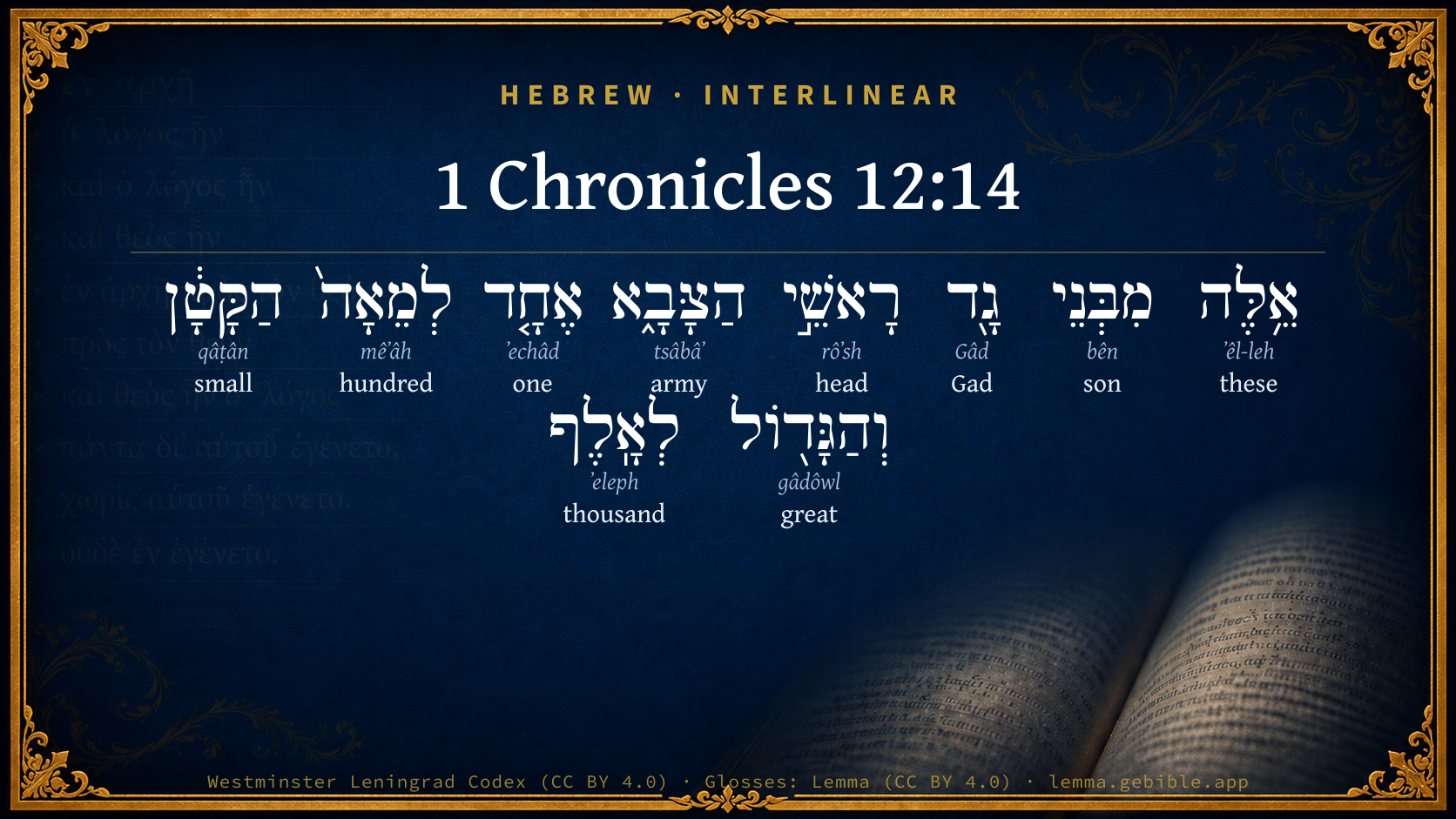
1 Chronicles 12:14

Hebrew (Westminster Leningrad Codex) 1 Chronicles 12:14 appears in the Hebrew Old Testament. The text above is from the Westminster Leningrad Codex. Each word links to its Strong’s number, a concise gloss, and parsing drawn from the Open Scriptures Hebrew Bible morphology. Click any word for its full Brown-Driver-Briggs (BDB) entry.
Download image
Cite this verse

1 Chronicles 12:14 (World English Bible). Public Domain. Lemma interlinear Bible study tool, https://lemma.gebible.app/v/1-chronicles/12/14.

Show BibTeX & RIS
BibTeX
RIS
English Translation
These of the sons of Gad were captains of the host: he who was least was equal to one hundred, and the greatest to one thousand.
World English Bible · Public Domain
Download a study sheet

One document with this verse’s original text, its word-by-word gloss line, the meaning frame, cross-references with their text, attributed commentary, and full source and license credits — printable, and it pastes into notes with its structure intact.

This verse Autodidact and up

Study sheet (.html) Plain text (.txt)

A passage Seminary Student

Up to 50 verses in one chapter. A passage sheet keeps up to 6 commentary sources and 12 cross-references per verse, in the order this page ranks them, and says so on the sheet whenever that leaves anything out. Ask for a single verse and you get the Autodidact verse sheet above.

Everything on this page stays free to read, with no account — the sheet is a download of what is already on screen, not access to it.

Want to remove ads? Support Godless Engineer
Compare translations 3

The same verse in 3 English versions, stacked beneath the original-language interlinear above. Click any original word for its lexicon entry.

Each is an independent rendering of the whole verse — the interlinear is not word-aligned to these translations.

Highlighted words mark where these versions differ — a whole-verse word diff, not a word-by-word alignment.

  • World English Bible Public Domain
    These of the sons of Gad were captains of the host: he who was least was equal to one hundred, and the greatest to one thousand.
  • King James Version Public Domain
    These were of the sons of Gad, captains of the host: one of the least was over an hundred, and the greatest over a thousand.
  • unfoldingWord Literal Text CC BY-SA 4.0
    These from the sons of Gad, heads of the army. One, the least, for 100, and the greatest for 1,000.

unfoldingWord Literal Text — © unfoldingWord, licensed CC BY-SA 4.0. Word-aligned USFM3 via Door43 (git.door43.org/unfoldingWord/en_ult).

Versions to compare (up to 4)

3 of 4 selected

Show all 18 translations

Every available English version of this verse, each an independent rendering of the whole verse.

  • World English Bible Public Domain
    These of the sons of Gad were captains of the host: he who was least was equal to one hundred, and the greatest to one thousand.
  • Berean Standard Bible Public Domain
    These Gadites were army commanders, the least of whom was a match for a hundred, and the greatest for a thousand.
  • Majority Standard Bible Public Domain
    These Gadites were army commanders, the least of whom was a match for a hundred, and the greatest for a thousand.
  • King James Version Public Domain
    These were of the sons of Gad, captains of the host: one of the least was over an hundred, and the greatest over a thousand.
  • American Standard Version (1901) Public Domain
    These of the sons of Gad were captains of the host: he that was least was equal to a hundred, and the greatest to a thousand.
  • Revised Version (1885) Public Domain
    These of the sons of Gad were captains of the host: he that was least was equal to an hundred, and the greatest to a thousand.
  • Geneva Bible (1599) Public Domain
    These were the sonnes of Gad, captaines of the hoste: one of the least could resist an hundreth, and the greatest a thousand.
  • Douay-Rheims (1899) Public Domain
    These were of the sons of Gad, captains of the army: the least of them was captain over a hundred soldiers, and the greatest over a thousand.
  • Young's Literal Translation Public Domain
    These `are' of the sons of Gad, heads of the host, one of a hundred `is' the least, and the greatest, of a thousand;
  • Literal Standard Version CC BY-SA 4.0
    These [are] of the sons of Gad, heads of the host; the least [is] one of one hundred, and the greatest, of one thousand;
  • Unlocked Literal Bible CC BY-SA 4.0
    These sons of Gad were leaders of the army. The least led a hundred, and the greatest led a thousand.
  • unfoldingWord Literal Text CC BY-SA 4.0
    These from the sons of Gad, heads of the army. One, the least, for 100, and the greatest for 1,000.
  • Darby Bible Public Domain
    These were of the sons of Gad, captains of the host: one of the least was over a hundred, and the greatest over a thousand.
  • World Messianic Bible Public Domain
    These of the sons of Gad were captains of the army. He who was least was equal to one hundred, and the greatest to one thousand.
  • Webster's Bible Public Domain
    These were of the sons of Gad, captains of the host: one of the least was over a hundred, and the greatest over a thousand.
  • Free Bible Version CC BY-SA 4.0
    These warriors from Gad were army officers. The least able of them was in charge of 100 men; the best was in charge of 1,000.
  • Bible in Basic English Public Domain
    These Gadites were captains of the army; the least of them was captain over a hundred men, and the greatest over a thousand.
  • JPS Tanakh (1917) Public Domain
    (12-15) These of the sons of Gad were captains of the host; he that was least was equal to a hundred, and the greatest to a thousand.

Literal Standard Version (2020), Covenant Press — licensed CC BY-SA 4.0. Text via the HelloAO Bible API (eBible.org). Unlocked Literal Bible (unfoldingWord) — licensed CC BY-SA 4.0. Text via the HelloAO Bible API (eBible.org). unfoldingWord Literal Text — © unfoldingWord, licensed CC BY-SA 4.0. Word-aligned USFM3 via Door43 (git.door43.org/unfoldingWord/en_ult). Free Bible Version, Dr. Jonathan Gallagher — licensed CC BY-SA 4.0. Text via the HelloAO Bible API (eBible.org).

Word by word

More ways to search: Search by grammar → Find every occurrence → Compare this word →

Practice this passage: Drill this verse → Learn its vocabulary →

גָ֖ד
Gâd
H1410
“Gad”
Noun, Proper
Part of Speech
Noun
Type
Proper
Full BDB Definition

Origin: from H1464

TWOT: None

Gad = "troop" - seventh son of Jacob by Zilpah, Leah's handmaid, and full brother of Asher. - the tribe descended from Gad - a prophet during the time of David; appears to have joined David when in the hold; reappears in connection with the punishment for taking a census; also assisted in the arrangements for the musical service of the " house of God"
  1. אֵ֥לֶּה ʼêl-leh H428 “these” Pronoun, Demonstrative, Common, Plural
  2. מִבְּנֵי bên H1121 “from · sons of” Preposition + Noun, Common, Masculine, Plural, Construct
  3. רָאשֵׁ֣י rôʼsh H7218 “heads of” Noun, Common, Masculine, Plural, Construct
  4. הַצָּבָ֑א tsâbâʼ H6635 “the · army” Particle, Definite Article + Noun, Common, Both, Singular, Absolute
  5. אֶחָ֤ד ʼechâd H259 “one” Adjective, Cardinal number, Masculine, Singular, Absolute
  6. לְמֵאָה֙ mêʼâh H3967 “to/for · hundred” Preposition + Adjective, Cardinal number, Both, Singular, Absolute
  7. הַקָּטָ֔ן qâṭân H6996 “the · small” Particle, Definite Article + Adjective, Adjective, Masculine, Singular, Absolute
  8. וְהַגָּד֖וֹל gâdôwl H1419 “and · the · great” Conjunction + Particle, Definite Article + Adjective, Adjective, Masculine, Singular, Absolute
  9. לְאָֽלֶף ʼeleph H505 “to/for · thousand” Preposition + Adjective, Cardinal number, Both, Singular, Absolute

About this verse

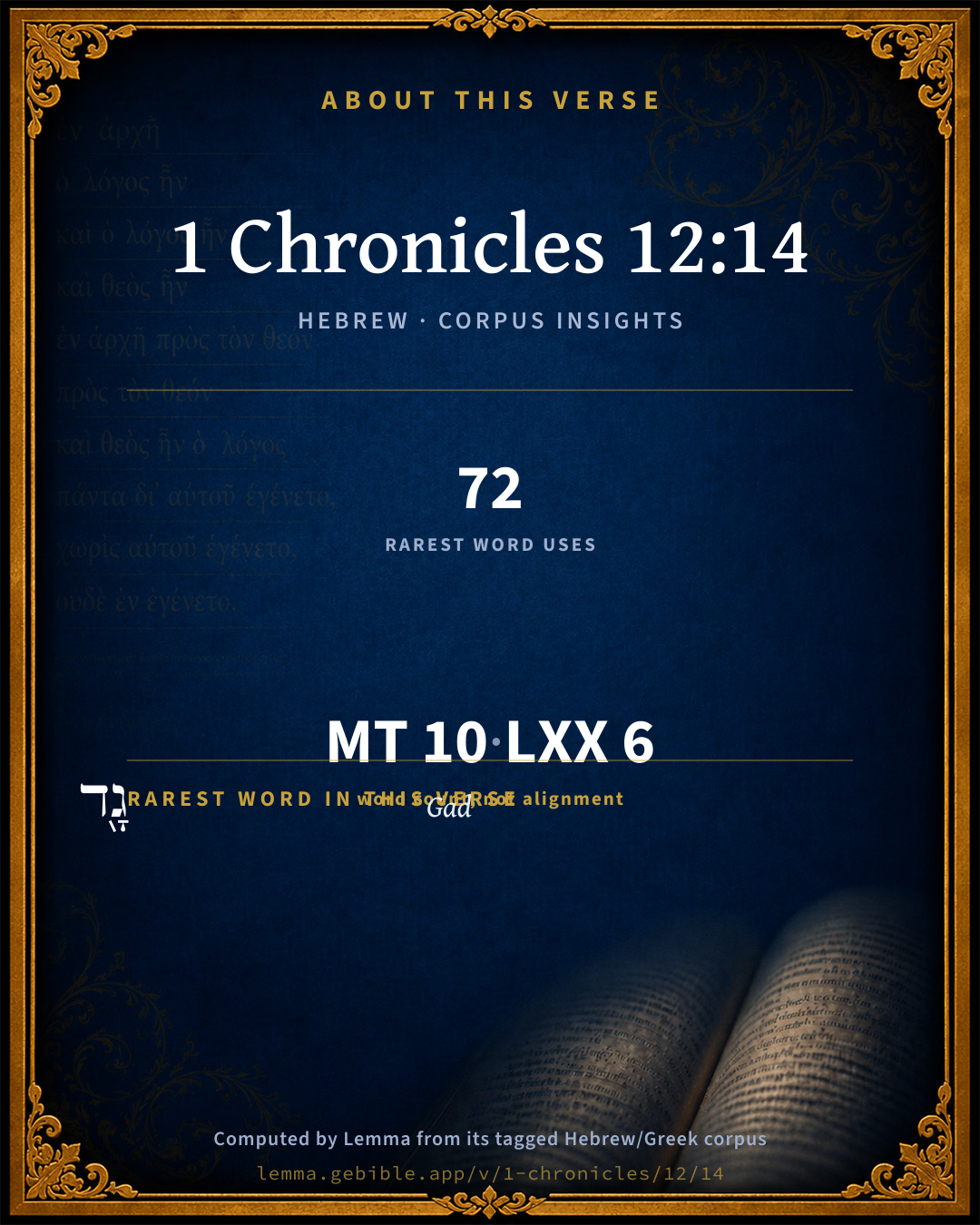
These counts appear in no published source. They are computed here, from the morphology-tagged text and Lemma’s own curated glosses. What Lemma adds →

10
words
10
distinct lemmas
Historical
section

Grammatical profile

  • 4 nouns
  • 5 adjectives
  • 1 pronoun

Hebrew & Septuagint length

In English translation the verse runs 26 words from the Hebrew and 25 from the Septuagint (LXX English) — closely comparable.

A rough comparison of the two English renderings, which tokenize alike — not a word-level alignment.

Word counts can differ between the Hebrew and the Greek without any difference in meaning — e.g. the Hebrew direct-object marker אֵת has no separate Greek word, and Greek often adds the article ὁ.

In the original languages it is 10 Hebrew tokens and 6 Greek tokens — but the two are counted differently (Hebrew bundles its prefixes and suffixes into one token; the Greek is in lemma form), so that isn’t a like-for-like length.

Cross-references

2

Topical passages linked to 1 Chronicles 12:14 in the Treasury of Scripture Knowledge — connected by theme and wording, ordered by reader-vote popularity; previews shown in the World English Bible.

  • Leviticus 26:8 Five of you shall chase a hundred, and a hundred of you shall chase ten thousand; and your enemies shall fall before you by the sword.
  • Deuteronomy 32:30 How should one chase a thousand, Two put ten thousand to flight, Except their Rock had sold them, Yahweh had delivered them up?

Cross-references courtesy of OpenBible.info (CC BY 4.0).

Hebrew and Greek witnesses Masoretic Hebrew ↔ Greek Septuagint

The same verse in the two great witnesses to the Old Testament, shown verse-for-verse.

These are two independent witnesses, not word-aligned to each other, and the Septuagint is shown in lemma (dictionary) form.

Hebrew 1 Chronicles 12:14 Masoretic · Westminster Leningrad Codex

אֵ֥לֶּה מִבְּנֵי גָ֖ד רָאשֵׁ֣י הַצָּבָ֑א אֶחָ֤ד לְמֵאָה֙ הַקָּטָ֔ן וְהַגָּד֖וֹל לְאָֽלֶף

These of the sons of Gad were captains of the host: he who was least was equal to one hundred, and the greatest to one thousand.

World English Bible · Public Domain

Greek LXX 1 Chronicles 12:14 Septuagint · lemma form

ιερμια ὁ δέκατος μαχαβανναι ὁ ἑνδέκατος

These were chiefs of the army of the sons of Gad, the least one commander of one hundred, and the greatest one of a thousand.

LXX2012 (modern English Septuagint) · Public Domain

On this verse, Ellicott's Commentary for English Readers discusses the Septuagint’s reading. Read the note in Commentary ↓

Hebrew: Westminster Leningrad Codex (CC BY 4.0). Greek: Septuagint (public domain); English from LXX2012 (modern English Septuagint) (Public Domain). How the Septuagint differs from the Hebrew →

Commentary

Notes on 1 Chronicles 12:14 from classic Christian and Jewish commentators (each source and its license shown beneath its notes). The classic Christian expositions comment on the surrounding passage and are grouped to its opening verse, so a note may address several verses; the Jewish commentaries on the Tanakh (Rashi and others) are per-verse, so they appear only where the commentator wrote on this verse.

Lemma curates 59 commentaries, every one of them public domain or Creative Commons licensed, each selected and text-cleaned for this edition rather than reprinted as found. About our sources →

Trapp's Complete Commentary

John Trapp

1Ch 12:14 These [were] of the sons of Gad, captains of the host: one of the least [was] over an hundred, and the greatest over a thousand.

Ver. 14. One of the least was over a hundred.] Or, One that was least could resist a hundred, and the greatest a thousand. Such a one was

“παντων ανταξιος αλλων.”

John Trapp, A Commentary or Exposition upon All the Books of the Old and New Testament (1647–1656) — public domain. Text from a community e-Sword module.

Jamieson, Fausset & Brown

Robert Jamieson, A. R. Fausset & David Brown

one of the least was over an hundred, and the greatest over a thousand--David, while at Ziklag, had not so large an amount of forces as to give to each of these the command of so many men. Another meaning, therefore, must obviously be sought, and excluding was, which is a supplement by our translators, the import of the passage is, that one of the least could discomfit a hundred, and the greatest was worth a thousand ordinary men; a strong hyperbole to express their uncommon valor.

Jamieson, Fausset & Brown — Commentary Critical and Explanatory on the Whole Bible (1871) — public domain (CC PDM 1.0). Text via the HelloAO Bible API.

Ellicott's Commentary for English Readers

(14) These were.—Subscription.

Captains of the host.—Literally, heads of the host, i.e., chief warriors.

One of the least was over an hundred.—The margin is correct. David’s band at this time was about 600 strong. The rendering of the text is that of the Syr. and Vulg. The LXX. closely intimates the Heb. εἷς τοῖς ἑκατὸν μικρὸς κτλ. For the true meaning, comp. Deu_32:30; and Lev_26:8. The Heb. says: “One to a hundred, the little one; and the great one to a thousand.” This. too, is poetic, or, at least, rhetorical in character, and quite unlike the chronicler’s usual style.

A Bible Commentary for English Readers, edited by Charles John Ellicott (1878–1897) — public domain. Text from a community e-Sword module.

The Cambridge Bible for Schools and Colleges

gen. ed. J. J. S. Perowne

14. These … the host] R.V. These of the sons of Gad were captains of the host.

one of the least, etc.] R.V. he that was least was equal to an hundred, and the greatest to a thousand. Cp. Lev_26:8; Isa_30:17.

The Cambridge Bible for Schools and Colleges (gen. ed. J. J. S. Perowne; Cambridge University Press, 1878–1918) — public domain. Text from a community e-Sword module.

John Gill's Exposition

And David went out to meet them,.... Out of the hold where he was; either out of respect and deference to them, some of them being persons of eminence; or it may be out of suspicion, fearing they were not his friends, being, it may be, chiefly of the tribe of Benjamin, and therefore was desirous of sounding them before he admitted them:

and said unto them, if ye be come peaceably unto me to help me; if they were come with a good will to him, and intention to help him against his enemy, and protect him:

mine heart shall be knit unto you; they should have such a share in his affections, that their hearts would be as one, as his and Jonathan's were, Sa1 18:1,

but if ye be come to betray me to mine enemies; into the hands of Saul, and his courtiers, that sought his life:

seeing there is no wrong in mine hands; no injury done by him to Saul, or to them, or to any other:

the God of our fathers look thereon, and rebuke it; he that sees all things, let him revenge it; and it is not only a wish that he would, but a prayer of faith that so it would be.

John Gill's Exposition of the Whole Bible (1746–1763) — public domain (CC PDM 1.0). Text via the HelloAO Bible API.

Albert Barnes' Notes on the Bible

The marginal rendering is preferable. (Compare Lev 26:8).

Albert Barnes' Notes on the Bible (1834–1885) — public domain. Text from a community e-Sword/MySword module.

Haydock's Catholic Bible Commentary

Thousand, after David had ascended the throne. (Calmet) --- At Siceleg he had only 600. (Menochius) --- Some suppose that each of these officers was worth 100 men, &c. (Vatable)

George Leo Haydock (1774–1849), Haydock's Catholic Family Bible and Commentary, 1859 edition — public domain. Excludes Psalms (Douay-Rheims chapter numbering differs from Protestant) and Deuterocanonical books (Catholic canon only).

Matthew Poole's English Annotations

Not that they brought now so many men with them; but either,

1. They had hitherto been captains or colonels under Saul, or in the established militia or bands of their tribe. Or,

2. They were so afterwards under David, who for their valour and fidelity thus advanced them.

Matthew Poole's English Annotations on the Holy Bible (1683–1685) — public domain. Text from a community e-Sword/MySword module.

Whedon's Commentary on the Bible

Daniel D. Whedon

14. One of the least was over a hundred, and the greatest over a thousand — Thus the Vulgate; but the marginal reading gives the sense of the Hebrew: One that was least could resist a hundred, and the greatest a thousand. The least or smallest of these heroes was able to cope with a hundred ordinary men, while the mightiest could maintain battle with a thousand. The expression is to be regarded as proverbial. Comp. Lev_26:8; Deu_32:30; Jos_23:10.

Daniel D. Whedon (gen. ed.), Commentary on the Old and New Testaments (1874–1909) — public domain. Text from a community e-Sword module.

The Pulpit Commentary

One of the least was over a hundred. This, evidently an incorrect translation, is easily superseded by the correct literal version, One to a hundred the little one, and the great one one to a thousand. The preposition lamed prefixed to the two numerals," hundred" and" thousand," will signify either that the "little one was as good as a hundred, and the great one as good as a thousand;" or that the "little one was rare as one of a hundred, and the great one rare as one of a thousand."

The Pulpit Commentary (1880–1919), ed. H.D.M. Spence-Jones & Joseph S. Exell — public domain. Text from a community e-Sword module.

Keil & Delitzsch

C. F. Keil & F. Delitzsch

And David went out to meet them,.... Out of the hold where he was; either out of respect and deference to them, some of them being persons of eminence; or it may be out of suspicion, fearing they were not his friends, being, it may be, chiefly of the tribe of Benjamin, and therefore was desirous of sounding them before he admitted them:

and said unto them, if ye be come peaceably unto me to help me; if they were come with a good will to him, and intention to help him against his enemy, and protect him:

mine heart shall be knit unto you; they should have such a share in his affections, that their hearts would be as one, as his and Jonathan's were, Sa1 18:1,

but if ye be come to betray me to mine enemies; into the hands of Saul, and his courtiers, that sought his life:

seeing there is no wrong in mine hands; no injury done by him to Saul, or to them, or to any other:

the God of our fathers look thereon, and rebuke it; he that sees all things, let him revenge it; and it is not only a wish that he would, but a prayer of faith that so it would be.

Keil & Delitzsch — Biblical Commentary on the Old Testament (1861–1891) — public domain (CC PDM 1.0). Text via the HelloAO Bible API. (Old Testament only.)

unfoldingWord translationNotes

Door43 World Missions Community

The least led a hundred

This means that the smallest group of the army that a leader led was 100 men. (See: Numbers)

the greatest led a thousand

This means that the largest group of the army that a leader led was 1,000 men. (See: Numbers)

first month

This is the first month of the Hebrew calendar. It is during the last part of March and the first part of April on Western calendars. It is at the beginning of the spring season when the late rains come. (See: Hebrew Months and Ordinal Numbers)

when it overflowed its banks

"when the Jordan overflowed its banks"

chased away all those living in the valleys

"they chased away all those living in the valleys"

translationWords

son

Gad

Jordan River

life

unfoldingWord translationNotes — © Distant Shores Media and the Door43 World Missions Community, licensed CC BY-SA 4.0. Source: git.door43.org/Door43/en_tn.

Lesson kit

Teaching starters — assembled from the data on this page, not authored interpretation. Every prompt links to the verse data it draws on. Edit before teaching.

1 Chronicles, in the Historical, opens this verse with 10 words (10 distinct Hebrew lemmas). Its most distinctive word is Gâd (“Gad”). A historical commentator’s framing appears above. Read the whole chapter for the surrounding context.

Discussion questions

  1. The word Gâd carries the sense “Gad.” How does it shape the verse?
  2. How does Leviticus 26:8, which shares this passage’s theme, read alongside this verse?
  3. These translations render this verse differently. What is at stake in choosing one wording over another?
  4. Compare how Trapp's Complete Commentary and Jamieson, Fausset & Brown read this verse. Where do they agree or differ?

Things to notice

Reading settings

Reading text

Shown beneath each verse's original-language words.

Old Testament
Old Testament edition

Read the OT as the Masoretic Hebrew (MT) or the Greek Septuagint (LXX).

English shown for the Greek Septuagint (in the Hebrew ↔ Greek comparison).

Comparing translations? Open the Compare panel on any verse page to stack up to four side by side.