
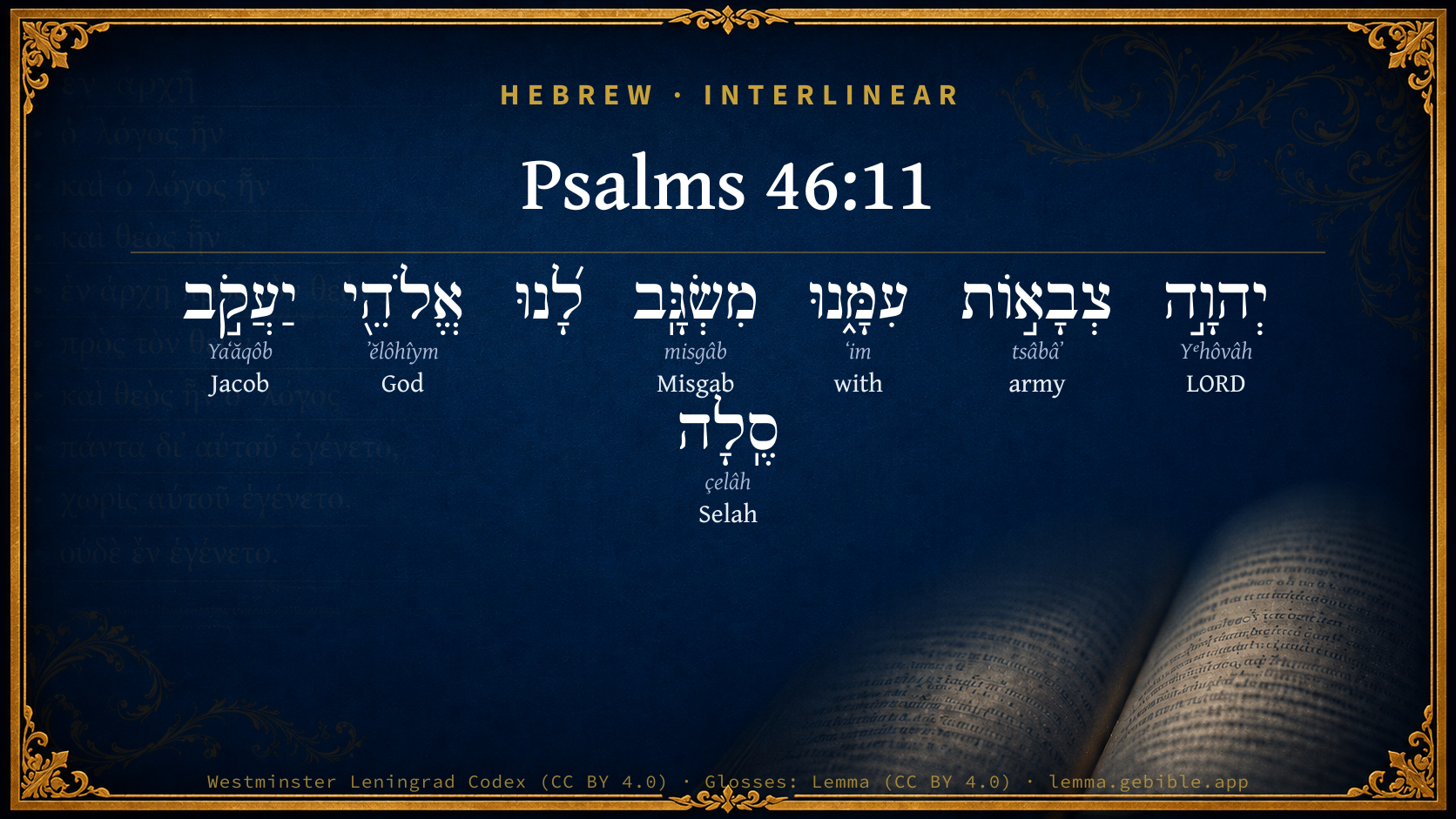
Psalms 46:11

Hebrew (Westminster Leningrad Codex) Psalms 46:11 appears in the Hebrew Old Testament. The text above is from the Westminster Leningrad Codex. Each word links to its Strong’s number, a concise gloss, and parsing drawn from the Open Scriptures Hebrew Bible morphology. Click any word for its full Brown-Driver-Briggs (BDB) entry.
Download image
Cite this verse

Psalms 46:11 (World English Bible). Public Domain. Lemma interlinear Bible study tool, https://lemma.gebible.app/v/psalms/46/11.

Show BibTeX & RIS
BibTeX
RIS
English Translation
Yahweh of Hosts is with us. The God of Jacob is our refuge. Selah.
World English Bible · Public Domain
Download a study sheet

One document with this verse’s original text, its word-by-word gloss line, the meaning frame, cross-references with their text, attributed commentary, and full source and license credits — printable, and it pastes into notes with its structure intact.

This verse Autodidact and up

Study sheet (.html) Plain text (.txt)

A passage Seminary Student

Up to 50 verses in one chapter. A passage sheet keeps up to 6 commentary sources and 12 cross-references per verse, in the order this page ranks them, and says so on the sheet whenever that leaves anything out. Ask for a single verse and you get the Autodidact verse sheet above.

Everything on this page stays free to read, with no account — the sheet is a download of what is already on screen, not access to it.

Want to remove ads? Support Godless Engineer
Compare translations 3

The same verse in 3 English versions, stacked beneath the original-language interlinear above. Click any original word for its lexicon entry.

Each is an independent rendering of the whole verse — the interlinear is not word-aligned to these translations.

Highlighted words mark where these versions differ — a whole-verse word diff, not a word-by-word alignment.

  • World English Bible Public Domain
    Yahweh of Hosts is with us. The God of Jacob is our refuge. Selah.
  • King James Version Public Domain
    The LORD of hosts is with us; the God of Jacob is our refuge. Selah.
  • unfoldingWord Literal Text CC BY-SA 4.0
    Yahweh of Armies with us; the God of Jacob a stronghold to us. Selah

unfoldingWord Literal Text — © unfoldingWord, licensed CC BY-SA 4.0. Word-aligned USFM3 via Door43 (git.door43.org/unfoldingWord/en_ult).

Versions to compare (up to 4)

3 of 4 selected

Show all 18 translations

Every available English version of this verse, each an independent rendering of the whole verse.

  • World English Bible Public Domain
    Yahweh of Hosts is with us. The God of Jacob is our refuge. Selah.
  • Berean Standard Bible Public Domain
    The LORD of Hosts is with us; the God of Jacob is our fortress. Selah
  • Majority Standard Bible Public Domain
    The LORD of Hosts is with us; the God of Jacob is our fortress. Selah
  • King James Version Public Domain
    The LORD of hosts is with us; the God of Jacob is our refuge. Selah.
  • American Standard Version (1901) Public Domain
    Jehovah of hosts is with us; The God of Jacob is our refuge. Selah Psalm 47 For the Chief Musician. A Psalm of the sons of Korah.
  • Revised Version (1885) Public Domain
    The LORD of hosts is with us; the God of Jacob is our refuge. Selah
  • Geneva Bible (1599) Public Domain
    The Lord of hostes is with vs: the God of Iaakob is our refuge. Selah.
  • Douay-Rheims (1899) Public Domain
    Be still and see that I am God; I will be exalted among the nations, and I will be exalted in the earth.
  • Young's Literal Translation Public Domain
    Jehovah of hosts `is' with us, A tower for us `is' the God of Jacob! Selah.
  • Literal Standard Version CC BY-SA 4.0
    YHWH of hosts [is] with us, || The God of Jacob [is] a tower for us! Selah.
  • Unlocked Literal Bible CC BY-SA 4.0
    Yahweh of hosts is with us; the God of Jacob is our refuge. Selah
  • unfoldingWord Literal Text CC BY-SA 4.0
    Yahweh of Armies with us; the God of Jacob a stronghold to us. Selah
  • Darby Bible Public Domain
    Jehovah of hosts is with us; the God of Jacob is our high fortress. Selah.
  • World Messianic Bible Public Domain
    The LORD of Hosts is with us. The God of Jacob is our refuge. Selah.
  • Webster's Bible Public Domain
    \\46:10\\Be still, and know that I am God: I will be exalted among the heathen, I will be exalted in the earth.
  • Free Bible Version CC BY-SA 4.0
    The Lord Almighty is with us; the God of Jacob protects us. Selah.
  • Bible in Basic English Public Domain
    The Lord of armies is with us; the God of Jacob is our high tower. (Selah.)
  • JPS Tanakh (1917) Public Domain
    (46-12) The LORD of hosts is with us; the God of Jacob is our high tower. Selah

Literal Standard Version (2020), Covenant Press — licensed CC BY-SA 4.0. Text via the HelloAO Bible API (eBible.org). Unlocked Literal Bible (unfoldingWord) — licensed CC BY-SA 4.0. Text via the HelloAO Bible API (eBible.org). unfoldingWord Literal Text — © unfoldingWord, licensed CC BY-SA 4.0. Word-aligned USFM3 via Door43 (git.door43.org/unfoldingWord/en_ult). Free Bible Version, Dr. Jonathan Gallagher — licensed CC BY-SA 4.0. Text via the HelloAO Bible API (eBible.org).

Word by word

More ways to search: Search by grammar → Find every occurrence → Compare this word →

Practice this passage: Drill this verse → Learn its vocabulary →

About this verse

These counts appear in no published source. They are computed here, from the morphology-tagged text and Lemma’s own curated glosses. What Lemma adds →

8
words
7
distinct lemmas
Wisdom
section

Notable vocabulary

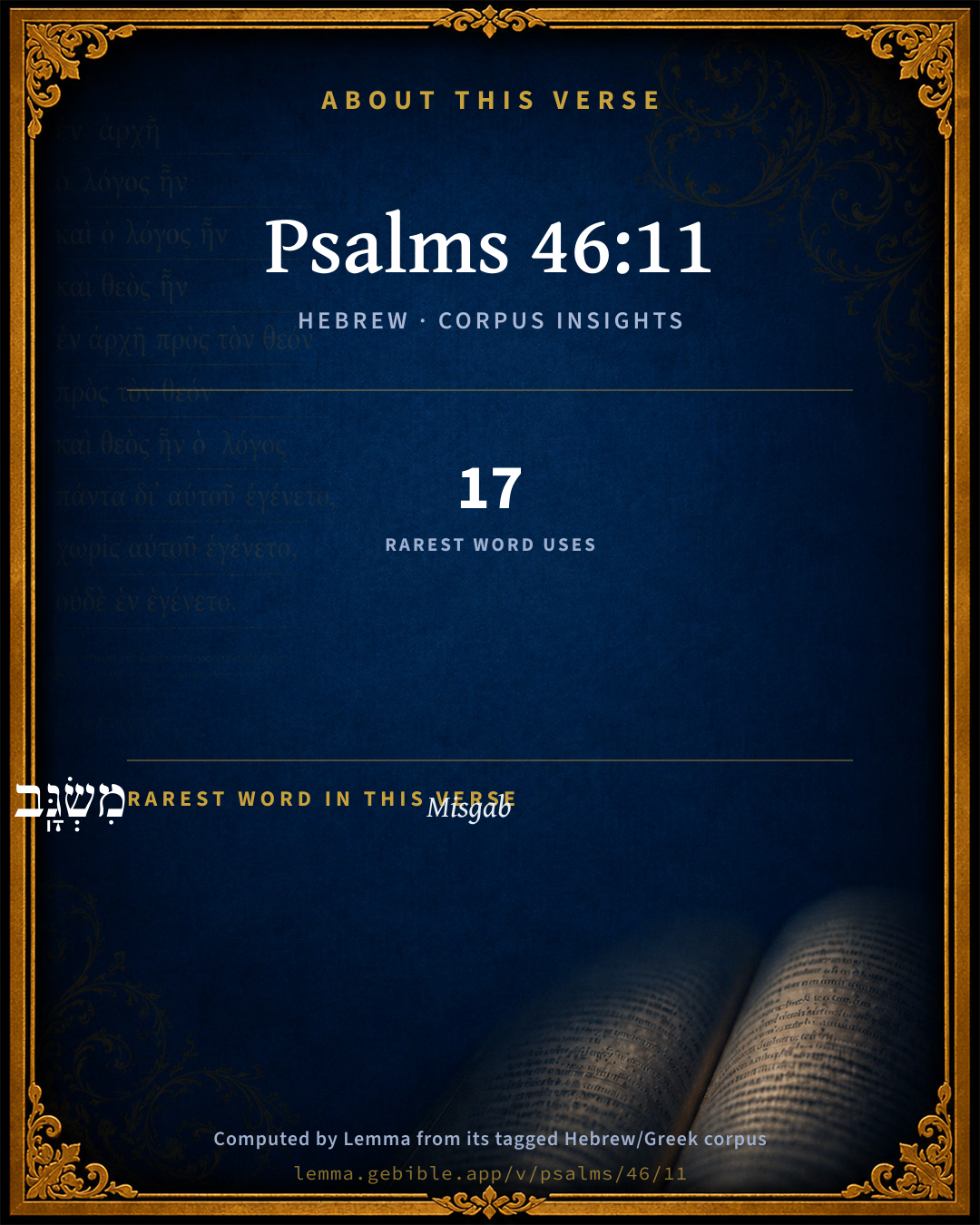
The rarest word here is מִשְׂגָּֽב Misgab H4869 — appearing just 17 times in the whole Hebrew Bible.

Shared distinctive vocabulary

מִשְׂגָּֽב Misgab H4869 occurs in 16 verses of the Hebrew Bible. Also found in:

Grammatical profile

  • 5 nouns
  • 2 prepositions
  • 1 particle

Hebrew & Septuagint length

In English translation the verse runs 14 words from the Hebrew and 14 from the Septuagint (LXX English) — the same length.

A rough comparison of the two English renderings, which tokenize alike — not a word-level alignment.

Word counts can differ between the Hebrew and the Greek without any difference in meaning — e.g. the Hebrew direct-object marker אֵת has no separate Greek word, and Greek often adds the article ὁ.

Cross-references

5

Topical passages linked to Psalms 46:11 in the Treasury of Scripture Knowledge — connected by theme and wording, ordered by reader-vote popularity; previews shown in the World English Bible.

  • Jeremiah 16:19 Yahweh, my strength, and my stronghold, and my refuge in the day of affliction, to you shall the nations come from the ends of the earth, and shall say, Our fathers have inherited nothing but lies, [even] vanity and things in which there is no profit.
  • Deuteronomy 33:27 The eternal God is [your] dwelling-place, Underneath are the everlasting arms. He thrust out the enemy from before you, Said, Destroy.
  • Psalms 46:7 Yahweh of Hosts is with us. The God of Jacob is our refuge. Selah.
  • Psalms 48:3 God has shown himself in her citadels as a refuge.
  • Psalms 46:1 God is our refuge and strength, A very present help in trouble.

Cross-references courtesy of OpenBible.info (CC BY 4.0).

Hebrew and Greek witnesses Masoretic Hebrew ↔ Greek Septuagint

The same verse in the two great witnesses to the Old Testament, shown verse-for-verse.

You’re reading Greek Psalm 45 (Hebrew Psalm 46). The Septuagint counts the superscription, so verse numbers can differ from the Hebrew — chapter-level alignment, not verse-by-verse. Numbering follows Rahlfs.

These are two independent witnesses, not word-aligned to each other, and the Septuagint is shown in lemma (dictionary) form.

Hebrew Psalms 46:11 Masoretic · Westminster Leningrad Codex

יְהוָ֣ה צְבָא֣וֹת עִמָּ֑נוּ מִשְׂגָּֽב לָ֝נוּ אֱלֹהֵ֖י יַעֲקֹ֣ב סֶֽלָה

Yahweh of Hosts is with us. The God of Jacob is our refuge. Selah.

World English Bible · Public Domain

Greek LXX Greek Psalm 45:11 Septuagint · lemma form

σχολάζω καί γιγνώσκω ὅτι ἐγώ εἰμί ὁ θεός ὑψόω ἐν ὁ ἔθνος ὑψόω ἐν ὁ γῆ

The Lord of hosts is with us; the God of Jacob is our helper.

LXX2012 (modern English Septuagint) · Public Domain

Hebrew: Westminster Leningrad Codex (CC BY 4.0). Greek: Septuagint (public domain); English from LXX2012 (modern English Septuagint) (Public Domain). How the Septuagint differs from the Hebrew →

Commentary

Notes on Psalms 46:11 from classic Christian and Jewish commentators (each source and its license shown beneath its notes). The classic Christian expositions comment on the surrounding passage and are grouped to its opening verse, so a note may address several verses; the Jewish commentaries on the Tanakh (Rashi and others) are per-verse, so they appear only where the commentator wrote on this verse.

Lemma curates 59 commentaries, every one of them public domain or Creative Commons licensed, each selected and text-cleaned for this edition rather than reprinted as found. About our sources →

Adam Clarke's Commentary

Verse 11. The Lord of hosts is with us] Having heard these declarations of God, the people cry out with joy and exultation, The Lord of hosts, the God of armies, is with us; we will not fear what man can do unto us.

The God of Jacob is our refuge.] He who saved our fathers will save us, and will never abandon his people in distress.

Selah.] This is a firm, lasting, unshaken, well-tried truth.

ANALYSIS OF THE FORTY-SIXTH PSALM

Two things especially are to be considered in this Psalm: -

I. The confidence the Church has in God, Ps 46:1-8.

II. The exhortation to consider him as the Lord of hosts, the Punisher of the refractory and disobedient nations, often by means of war; and the only Giver of peace and tranquillity, Ps 46:8-10.

I. He begins with a maxim which is the ground of all the confidence which the people of God can have. God is our Asylum, or place of refuge to fly to; our Strength, Stay, Munition, on which to rely: "A very present help to deliver us in time of trouble."

From which maxim this conclusion is drawn: "therefore will we not fear;" not even in the greatest calamities, nor in the midst of the most numerous adversaries. This he expresses, first, metaphorically; next, in plain terms: -

1. Though the earth on which the Church is seated be moved or removed.

2. "Though the mountains be carried into the midst of the sea;" that is, the greatest and strongest empires and kingdoms should be ruined and overwhelmed.

3. "Though the waters roar and be troubled." Though multitudes of people threaten, and join their forces to ruin the Church.

4. "Though the mountains (i.e., kingdoms) shake with the swelling thereof." Waters mean people, Re 17:15.

More plainly, for we have the interpretation of these metaphors, Ps 46:6: "Though the heathen raged, and the kingdoms were moved," yet we were not afraid, nor will we fear. We have a fine illustration of this bold feeling (from a consciousness of rectitude, and consequently Divine protection) from the pen of a heathen poet: -

ustum et tenacem propositi virum

Non civium ardor prava jubentium,

Non vultus instantis tyranni,

Mente quatit solida: Neque Auster,

Dux inquieti turbidus Adriae,

Nec fulminantis magna Jovis manus.

Si fractus illabatur orbis,

Impavidum ferient ruinae.

HOR. Car. lib. iii., od. 3.

"The man, in conscious virtue bold,

Who dares his secret purpose hold,

Unshaken hears the crowd's tumultuous cries;

And the impetuous tyrant's angry brow defies.

Let the wild winds that rule the seas,

Tempestuous all their horrors raise;

Let Jove's dread arm with thunders rend the spheres;

Beneath the crush of worlds, undaunted he appears."

FRANCIS.

2. Of this undaunted state of mind he next descends to show the reasons: -

1. "There is a river," c. The city of God was Jerusalem, the type of the Church and the holy place of the tabernacles was the temple. The little Shiloh, that ran softly, watered Jerusalem; and the promises of the Gospel, that shall always flow in the Church, shall make glad the hearts of God's people.

2. "God is in the midst of her," to keep, to defend her; "therefore she shall not be moved," i.e., utterly removed, but "shall remain for ever."

3. "God shall help her and deliver her;" right early - in the proper season.

4. "He uttered his voice, and the earth melted." The hearts of the men of the earth, that exalted themselves against his Church, at the least word uttered from his mouth, melted - were struck with fear and terror.

5. "The Lord of hosts is with us." And even the armies of our enemies are at his command, and will fight for us whenever he pleases: "He is the Lord of all hosts."

6. "The God of Jacob is our refuge." He is our Asylum, and he will save us, Ps 46:7; Ps 46:11.

II. The second part contains two exhortations: -

1. He calls on all to behold the works of the Lord; and he produces two instances worthy of observation: 1. JUDGMENT is his work, and he afflicts refractory and sinful nations by WAR: "See what desolations he hath made in the earth!" 2. PEACE is his work: "He maketh war to cease to the end of the earth."

2. Then, in the person of God, he exhorts the enemies of the Church to be quiet; for their endeavours are vain, and their rage is to no purpose: "Be still, and know that I am God."

3. And he concludes with a gracious promise, of being celebrated among the heathen, and through the whole earth.

Adam Clarke's Commentary on the Bible (1810–1826) — public domain. Text from a community e-Sword/MySword module.

Trapp's Complete Commentary

John Trapp

Psa 46:11 The LORD of hosts [is] with us; the God of Jacob [is] our refuge. Selah.

Ver. 11. The Lord of hosts, &c.] See Psa 46:7 Psa 47:1

John Trapp, A Commentary or Exposition upon All the Books of the Old and New Testament (1647–1656) — public domain. Text from a community e-Sword module.

The Biblical Illustrator

Joseph S. Exell

Psa_46:11

The Lord of Hosts is with us.

God with us

The Lord of Hosts--that means the God of power; the God who has all hosts of all sorts at His beck and under His control; the great King whom all created powers, whether marshalled in heaven or ranked on earth, somehow must obey. The Lord of Hosts is the God of Providence, therefore--the circle of whose wise government embraces the least and greatest persons, forces, things. The God of Jacob--that means the God of covenant-keeping; the God who promises, and never breaks His promises. And our Scripture asserts that He is with us, that He is our refuge. We are thus reminded of the double prop on which our faith rests; the infinite power, whereby He can subdue the universe unto Himself; and the fatherly love, which He has revealed in His Word. When these two are joined together, our faith may trample on all enemies.

I. This God is with Us as an inward invigoration. There is a river, the streams whereof shall make glad the city of God. No city was supplied with water as was Jerusalem within itself. For there was within Jerusalem a living spring beneath the temple vaults. It was this spring whence the water welled to fill the two Siloam pools. In this way this God of power and of promise will be with us, if we will have it so. Even as Jesus spoke of the Holy Spirit as the fountain of living water within the believing man. God shall be, for such a man, internal supply and strength, making the man the master of difficulties, not the slave of them. Right here is the mightiest need for all of us--that we have God thus with us, in the meaning of within us, by the Holy Spirit.

1. It is the cure for cold and laggard hearts.

2. It is the inspiration of delightful and loving service.

3. It is the power and defence against bad habits.

4. It is the sweet expeller of all unbrotherliness.

II. This God of power and of promise will be with us also as a helping presence. God is in the midst of her, etc.

III. This God of power and of promise shall be with us as a masterful deliverance (Psa_46:6). (W. Hoyt, D. D.)

Psa_47:1-9

The Biblical Illustrator, edited by Joseph S. Exell (c. 1880s–1900s) — public domain. Text from a community e-Sword module.

J. A. Alexander on Psalms

Joseph Addison Alexander

12. (Psa 46:11). Jehovah of Hosts (is) with us; a refuge for us (is) the God of Jacob. Selah. This repetition of the burden or refrain in Psa 46:8 (7), brings us back not only to the close of the second stanza, but to the beginning of the first, where the same idea is expressed in other words.

Joseph Addison Alexander, The Psalms Translated and Explained (1850) — public domain. Text from a community e-Sword module.

MacLaren's Expositions of Holy Scripture

Alexander MacLaren

Psalms

THE LORD OF HOSTS, THE GOD OF JACOB

Psa 46:11.

Some great deliverance, the details of which we do not know, had been wrought for Israel, and this psalmist comes forth, like Miriam with her choir of maidens, to hymn the victory. The psalm throbs with exultation, but no human victor’s name degrades the singer’s lips. There is only one Conqueror whom he celebrates. The deliverance has been ‘the work of the Lord’; the ‘desolations’ that have been made on the ‘earth’ ‘He has made.’ This great refrain of the song, which I have chosen for my text, takes the experience of deliverance as a proof in act of an astounding truth, and as a hope for the future. ‘The Lord of hosts is with us; the God of Jacob is our Refuge.’

There is in these words a significant duplication of idea, both in regard to the names which are given to God, and to that which He is conceived as being to us; and I desire now simply to try to bring out the force of the consolation and strength which lie in these two epithets of His, and in the double wonder of His relation to us men.

I. First, then, I ask you to look at the twin thoughts of God that are here. ‘The Lord of hosts . . . The God of Jacob.’

Now, with regard to the former of these grand names, it may be observed that it does not occur in the earliest stages of Revelation as recorded in the Old Testament. The first instance in which we find it is in the song of Hannah in the beginning of the first Book of Samuel; and it re-appears in the Davidic psalms and in psalms and prophecies of later date.

What ‘hosts’ are they of which God is the Lord? Is that great title a mere synonym for the half-heathenish idea of the ‘God of battles’? By no means. True! He is the Lord of the armies of Israel, but the hosts which the Psalmist sees ranged in embattled array, and obedient to the command of the great Captain, are far other and grander than any earthly armies. If we would understand the whole depth and magnificent sweep of the idea enshrined in this name, we cannot do better than recall one or two other Scripture phrases. For instance, the account of the Creation in the Book of Genesis is ended by, ‘Thus the heavens and the earth were finished, and all the host of them.’ Then, remember that, throughout the Old Testament, we meet constantly with the idea of the celestial bodies as being ‘the hosts of heaven.’ And, still further, remember how, in one of the psalms, we hear the invocation to ‘all ye His hosts, ye ministers of His that do His pleasure,’ ‘the angels that excel in strength,’ to praise and bless Him. If we take account of all these and a number of similar passages, I think we shall come to this conclusion, that by that title, ‘the Lord of hosts,’ the prophets and psalmists meant to express the universal dominion of God over the whole universe in all its battalions and sections, which they conceived of as one ranked army, obedient to the voice of the great General and Ruler of them all.

So the idea contained in the name is precisely parallel with that to which the heathen centurion in the Gospels had come, by reflecting upon the teaching of the legion in which he himself commanded, when he said, ‘I am a man under authority, having servants under me; and I say to this one, Go, and he goeth; to another, Come, and he cometh; to another, Do this, and he doeth it-speak Thou the word!’ To him Jesus Christ was Captain of the Lord’s hosts, and Ruler of all the ordered forces of the universe. The Old Testament name enshrines the same idea. The universe is an ordered whole. Science tells us that. Modern thought emphasises it. But how cruel, relentless, crushing, that conception may be unless we grasp the further thought which is presented in this great Name, and see, behind all the play of phenomena, the one Will which is the only power in the universe, and sways and orders all besides! The armies of heaven and every creature in the great Cosmos are the servants of this Lord. Then we can stand before the dreadful mysteries and the all but infinite complications of this mighty Whole, and say, ‘These are His soldiers, and He is their Captain, the Lord of hosts.’

Next we turn, by one quick bound, from the wide sweep of that mighty Name to the other, ‘The God of Jacob.’ The one carries us out among the glories of the universe, and shows us, behind them all, the personal Will of which they are the servants, and the Character of which they are the expressions. The other brings us down to the tent of the solitary wanderer, and shows us that that mighty Commander and Emperor enters into close, living, tender, personal relations with one poor soul, and binds Himself by that great covenant, which is rooted in His love alone, to be the God who cares for and keeps and blesses the man in all his wanderings. Neither does the command of the mighty Whole hinder the closest relation to the individual, nor does the care of the individual interfere with the direction of the Whole. The single soul stands out clear and isolated, as if there were none in the universe but God and himself; and the whole fulness of the divine power, and all the tenderness of the God-heart, are lavished upon the individual, even though the armies of the skies wait upon His nod.

So, if we put the two names together, we get the completion of the great idea; and whilst the one speaks to us of infinite power, of absolute supremacy, of universal rule, and so delivers us from the fear of nature, and from the blindness which sees only the material operations and not the working Hand that underlies them, the other speaks to us of gentle and loving and specific care, and holds out the hope that, between man and God, there may be a bond of friendship and of mutual possession so sweet and sacred that nothing else can compare with it. The God of Jacob is the Lord of hosts. More wondrous still, the Lord of hosts is the God of Jacob.

II. Note, secondly, the double wonder of our relation to this great God.

There is almost a tone of glad surprise, as well as of triumphant confidence, in this refrain of our psalm, which comes twice in it, and possibly ought to have come three times-at the end of each of its sections. The emphasis is to be laid on the ‘us’ and the ‘our,’ as if that was the miracle, and the fact which startled the Psalmist into the highest rapture of astonished thankfulness.

‘The Lord of hosts is with us.’ What does that say? It proclaims that wondrous truth that no gulf between the mighty Ruler of all and us, the insignificant little creatures that creep upon the face of this tiny planet, has any power of separating us from Him. It is always hard to believe that. It is harder to-day than it was when our Psalmist’s heart beat high at the thought. It is hard by reason of our sense-bound blindness, by reason of our superficial way of looking at things, which only shows us the nearest, and veils with their insignificances the magnitude of the furthest. Jupiter is blazing in our skies every night now; he is not one-thousandth part as great or bright as any one of the little needle-points of light, the fixed stars, that are so much further away; but he is nearer, and the intrusive brightness of the planet hides the modest glories of the distant and shrouded suns. Just so it is hard for us ever to realise, and to walk in the light of the realisation of, the fact that the Lord of hosts, the Emperor of all things, is of a truth with each of us.

It is harder to-day than ever it was; for we have learned to think rightly-or at least more rightly and approximately rightly-of the position and age of man upon this earth. The Psalmist’s ancient question of devout thankfulness is too often travestied to-day into a question of scoffing or of melancholy unbelief: ‘When I consider the heavens, the work of Thy hands; what is man? Art Thou mindful of him?’ This psalm comes to answer that. ‘The Lord of hosts is with us.’ True, we are but of yesterday, and know nothing. True, earth is but a pin-point amidst the universe’s glories. True, we are crushed down by sorrow and by care; and in some moods it seems supremely incredible that we should be of such worth in the scale of Creation as that the Lord of all things should, in a deeper sense than the Psalmist knew, have dwelt with us and be with us still. But bigness is not greatness, and there is nothing incredible in the belief that men, lower than the angels, and needing God more because of their sin, do receive His visitations in an altogether special sense, and that, passing by the lofty and the great that may inhabit His universe, His chariot wheels stoop to us, and that, because we are sinners, God is with us.

Let me remind you, dear brethren! of how this great thought of my text is heightened and transcended by the New Testament teaching. We believe in One whose name is ‘Immanuel, God with us.’ Jesus Christ has come to be with men, not only during the brief years of His earthly ministry, in corporeal reality, but to be with all who love Him and trust Him, in a far closer, more real, more deep, more precious, more operative Presence than when He dwelt here. Through all the ages Christ Himself is with every soul that loves Him; and He will dwell beside us and bless us and keep us. God’s presence means God’s sympathy, God’s knowledge, God’s actual help, and these are ours if we will. Instead of staggering at the apparent improbability that so transcendent and mighty a Being should stoop from His throne, where He lords it over the universe, and enter into the narrow room of our hearts, let us rather try to rise to the rapture of the astonished Psalmist when, looking upon the deliverance that had been wrought, this was the leading conviction that was written in flame upon his heart, ‘The Lord of hosts is with us.’

And then the second of the wonders that are here set forth in regard to our relations to Him is, ‘the God of Jacob is our Refuge.’

That carries for us the great truth that, just as the distance between us and God makes no separation, and the gulf is one that is bridged over by His love, so distance in time leads to no exhaustion of the divine faithfulness and care, nor any diminution of the resources of His grace. ‘The God of Jacob is our Refuge.’ The story of the past is the prophecy of the future. What God has been to any man He will be to every man, if the man will let Him. There is nothing in any of these grand narratives of ancient days which is not capable of being reproduced in our lives. God drew near to Jacob when he was lying on the stony ground, and showed him the ladder set upon earth, with its top in the heavens, and the bright-winged soldiers and messengers of His will ascending and descending upon it, and His own face at the top. God shows you and me that vision to-day. It was no vanishing splendour, no transient illumination, no hallucination of the man’s own thoughts seeking after a helper, and the wish being father to the vision. But it was the unveiling for a moment, in supernatural fashion, of the abiding reality. ‘The God of Jacob is our Refuge’; and whatever He was to His servant of old He is to-day to you and me.

We say that miracle has ceased. Yes. But that which the miracle effected has not ceased; and that from which the miracle came has not ceased. The realities of a divine protection, of a divine supply, of a divine guidance, of a divine deliverance, of a divine discipline, and of a divine reward at the last, are as real to-day as when they were mediated by signs and wonders, by an open heaven and by an outstretched hand. They who went before have not emptied the treasures of the Father’s house, nor eaten all the bread that He spreads upon the table. God has no stepchildren, and no favourite and spoiled ones. All that the elder brethren have had, we, on whom the ends of the dispensation are come, may have just as really; and whatever God has been to the patriarch He is to us to-day.

Remember the experience of the man of whom our text speaks. The God of Jacob manifested Himself to him as being a God who would draw near to, and care for, and help, a very unworthy and poor creature. Jacob was no saint at the beginning. Selfishness and cunning and many a vice clung very close to his character; but for all that, God drew near to him and cared for him and guided him, and promised that He would not leave him till He had done that which He had spoken to him of. And He will do the same for us-blessed be His name!-with all our faults and weaknesses and craftiness and worldliness and sins. If He cared for that huckstering Jew, as He did, even in his earlier days, He will not put us away because He finds faults in us. ‘The God of Jacob,’ the supplanter, the trickster, ‘is our Refuge.’

But remember how the divine Presence with that man had to be, because of his faults, a Presence that wrought him sorrows and forced him to undergo discipline. So it will be with us. He will not suffer sin upon us; He will pass us through the fire and the water; and do anything with us short of destroying us, in order to destroy the sin that is in us. He does not spare His rod for His child’s crying, but smites with judgment, and sends us sorrows ‘for our profit, that we should be partakers of His holiness.’ We may write this as the explanation over most of our griefs-’the God of Jacob is our Refuge,’ and He is disciplining us as He did him.

And remember what the end of the man was. ‘Thy name shall no more be called Jacob, but Israel; for as a prince thou hast power with God, and hast prevailed.’ So if we have God, who out of such a sow’s ear made a silk purse, out of such a stone raised up a servant for Himself, we may be sure that His purpose in all discipline will be effected on us submissive, and we shall end where His ancient servant ended, and shall be in our turn princes with God.

Let me recall to you also the meaning which Jesus Christ found in this name. He quoted ‘the God of Abraham and of Isaac and of Jacob’ as being the great guarantee and proof to us of immortality. ‘The God of Jacob is our Refuge.’ If so, what can the grim and ghastly phantom of death do to us? He may smite upon the gate, but he cannot enter the fortress. The man who has knit himself to God by saying to God, ‘Lo! I am Thine, and Thou art mine,’ in that communion has a proof and a pledge that nothing shall ever break it, and that death is powerless. The fact of religion-true, heartfelt religion, with its communion, its prayer, its consciousness of possessing and of being possessed, makes the idea that death ends a man’s conscious existence an absurdity and an impossibility.

‘The God of Jacob is our Refuge,’ and so we may say to the storms of life, and after them to the last howling tornado of death-Blow winds and crack your cheeks, and do your worst, you cannot touch me in the fortress where I dwell. The wind will hurtle around the stronghold, but within there shall be calm.

Dear brethren! make sure that you are in the refuge. Make sure that you have fled for ‘Refuge to the hope set before you in the Gospel.’ The Lord of hosts is with us,’ but you may be parted from Him. He is our Refuge, but you may be standing outside the sanctuary, and so be exposed to all the storms. Flee thither, cast yourselves on Him, trust in that great Saviour who has given Himself for us, and who says to us, ‘Lo! I am with you always.’ Take Christ for your hiding-place by simple faith in Him and loving obedience born of faith, and then the experience of our Psalmist will be yours. Your life will not want for deliverances which will thrill your heart with thankfulness, and turn the truth of faith into a truth of experience. So you may set to your seals the great saying of our psalm, which is fresh to-day, though centuries have passed since it came glowing fiery from the lips of the ancient seer, and may take up as yours the great words in which Luther has translated it for our times, the ‘Marseillaise’ of the Reformation-

‘A safe stronghold our God is still;

A trusty shield and weapon;

He’ll help us clear from all the ill

That hath us now o’ertaken.’

Alexander MacLaren, Expositions of Holy Scripture (1904–1910) — public domain. Text from a community e-Sword module.

The Cambridge Bible for Schools and Colleges

gen. ed. J. J. S. Perowne

11. The refrain with its triumphant chorus of faith and gratitude forms an appropriate conclusion.

The Cambridge Bible for Schools and Colleges (gen. ed. J. J. S. Perowne; Cambridge University Press, 1878–1918) — public domain. Text from a community e-Sword module.

John Gill's Exposition

The Lord of hosts is with us; the God of Jacob is our refuge. See Gill on Psa 46:7. The Targum paraphrases it, "the Word of the Lord of hosts", as in Psa 46:7; and the same words are here repeated, to comfort those that were fearful and unbelieving, with which the church then comforted herself.

Selah; on this word; see Gill on Psa 3:2.

Next: Psalms Chapter 47

John Gill's Exposition of the Whole Bible (1746–1763) — public domain (CC PDM 1.0). Text via the HelloAO Bible API.

Albert Barnes' Notes on the Bible

The Lord of hosts is with us ... - See Psa 46:7. This is the conclusion, or the result of the whole. As applied to the invasion of Sennacherib, this would be clearly seen, for all that occurred in that invasion was adapted to leave the impression that Jehovah, God of hosts, was with the Hebrew people. He had interposed in time of danger; he had saved his city and nation; he had overthrown one of the most mighty armies that had ever been assembled; he had caused the boasting conqueror himself to retrace his steps to his capita; he had wholly delivered the nation from all danger; and he had shown how easy it was, in ways which they could not have anticipated, to bring deliverance. The truth thus conveyed was adapted to the people of God in all lands and at all times, as showing that God has power to defend his people against the most formidable enemies, and that all their interests are safe in his hands.

Albert Barnes' Notes on the Bible (1834–1885) — public domain. Text from a community e-Sword/MySword module.

The Treasury of David

Charles H. Spurgeon

Ver. 11. The Lord of hosts is with us; the God of Jacob is our refuge. It was meet to sing this twice over. It is a truth of which no believer wearies, it is a fact too often forgotten, it is a precious privilege which cannot be too often considered. Reader, is the Lord on thy side? Is Emmanuel, God with us, thy Redeemer? Is there a covenant between thee and God as between God and Jacob? If so, thrice happy art thou. Show thy joy in holy song, and in times of trouble play the man by still making music for thy God. SELAH. Here as before, lift up the heart. Rest in contemplation after praise. Still keep the soul in tune. It is easier to sing a hymn of praise than to continue in the spirit of praise, but let it be our aim to maintain the uprising devotion of our grateful hearts, and so end our song as if we intended it to be continued.

SELAH bids the music rest.

Pause in silence soft and blest;

SELAH bids uplift the strain,

Harps and voices tune again;

SELAH ends the vocal praise,

Still your hearts to God upraise.

Ver. 11. The Lord of hosts is with us. On Tuesday Mr. Wesley could with difficulty be understood, though he often attempted to speak. At last, with all the strength he had, he cried out, "The best of all is, God is with us." Again, raising his hand, and waving it in triumph, he exclaimed with thrilling effect, "The best of all is, God is with us." These words seem to express the leading feature of his whole life, God had been with him from early childhood; his providence had guided him through all the devious wanderings of human life; and now, when he was entering the "valley of the shadow of death, "the same hand sustained him. From "Wesley and his Coadjutors. By Rev. W. C. Larrabee, A.M. Edited by Rev. B. F. Tefft, D.D. Cincinnati. 1851."

None.

Charles H. Spurgeon's The Treasury of David (1869–1885) — public domain. Psalms only. Text from a community e-Sword/MySword module.

Whedon's Commentary on the Bible

Daniel D. Whedon

11. The Lord of hosts, etc.—This is the befitting refrain (Psa_46:1; Psa_46:7)

for closing, as it is the key note and central idea of the psalm.

Daniel D. Whedon (gen. ed.), Commentary on the Old and New Testaments (1874–1909) — public domain. Text from a community e-Sword module.

The Pulpit Commentary

The Lord of hosts is with us; the God of Jacob is our Refuge (see the comment on ver. 7).

The Pulpit Commentary (1880–1919), ed. H.D.M. Spence-Jones & Joseph S. Exell — public domain. Text from a community e-Sword module.

John Wesley's Explanatory Notes

Be still - Stir no more against my people. God - The only true and almighty God; your gods are but dumb and impotent idols. Exalted - I will make myself glorious by my great and wonderful works.

John Wesley, Explanatory Notes Upon the Whole Bible (1754–1765) — public domain. Text via the GEBible commentary corpus.

Rashi

Rabbi Shlomo Yitzchaki (Rashi)

Desist all nations from further marching upon Jerusalem.

and know that I am God That I will execute judgment upon you.

I will be exalted among the nations I will be exalted with My vengeance which I will wreak upon those nations.

Rashi on the Tanakh — English translations: “The Judaica Press complete Tanach with Rashi, translated by A. J. Rosenberg” (CC BY 4.0); “Pentateuch with Rashi's commentary by M. Rosenbaum and A.M. Silbermann, 1929-1934” (public domain); “The Metsudah Tanach series, Lakewood, N.J” (CC BY 4.0); and “The Book of Joshua, Metsudah Publications, 1997” (CC BY 4.0). Text via Sefaria.

Lesson kit

Teaching starters — assembled from the data on this page, not authored interpretation. Every prompt links to the verse data it draws on. Edit before teaching.

Psalms, in the Wisdom, opens this verse with 8 words (7 distinct Hebrew lemmas). Its most distinctive word is misgâb (“Misgab”). A historical commentator’s framing appears above. Read the whole chapter for the surrounding context.

Discussion questions

  1. How does “Misgab” (misgâb) shape what this verse is saying?
  2. 2 Samuel 22:3 shares the word «Misgab» with this verse. How do the two illuminate each other?
  3. The translations on this page render this verse differently — a whole-verse word diff, not a word-by-word alignment. What might account for the different wordings?
  4. Reading how Adam Clarke's Commentary and Trapp's Complete Commentary read this verse, where do the two commentators agree and where do they part?

Things to notice

Reading settings

Reading text

Shown beneath each verse's original-language words.

Old Testament
Old Testament edition

Read the OT as the Masoretic Hebrew (MT) or the Greek Septuagint (LXX).

English shown for the Greek Septuagint (in the Hebrew ↔ Greek comparison).

Comparing translations? Open the Compare panel on any verse page to stack up to four side by side.