
Exodus 12:17

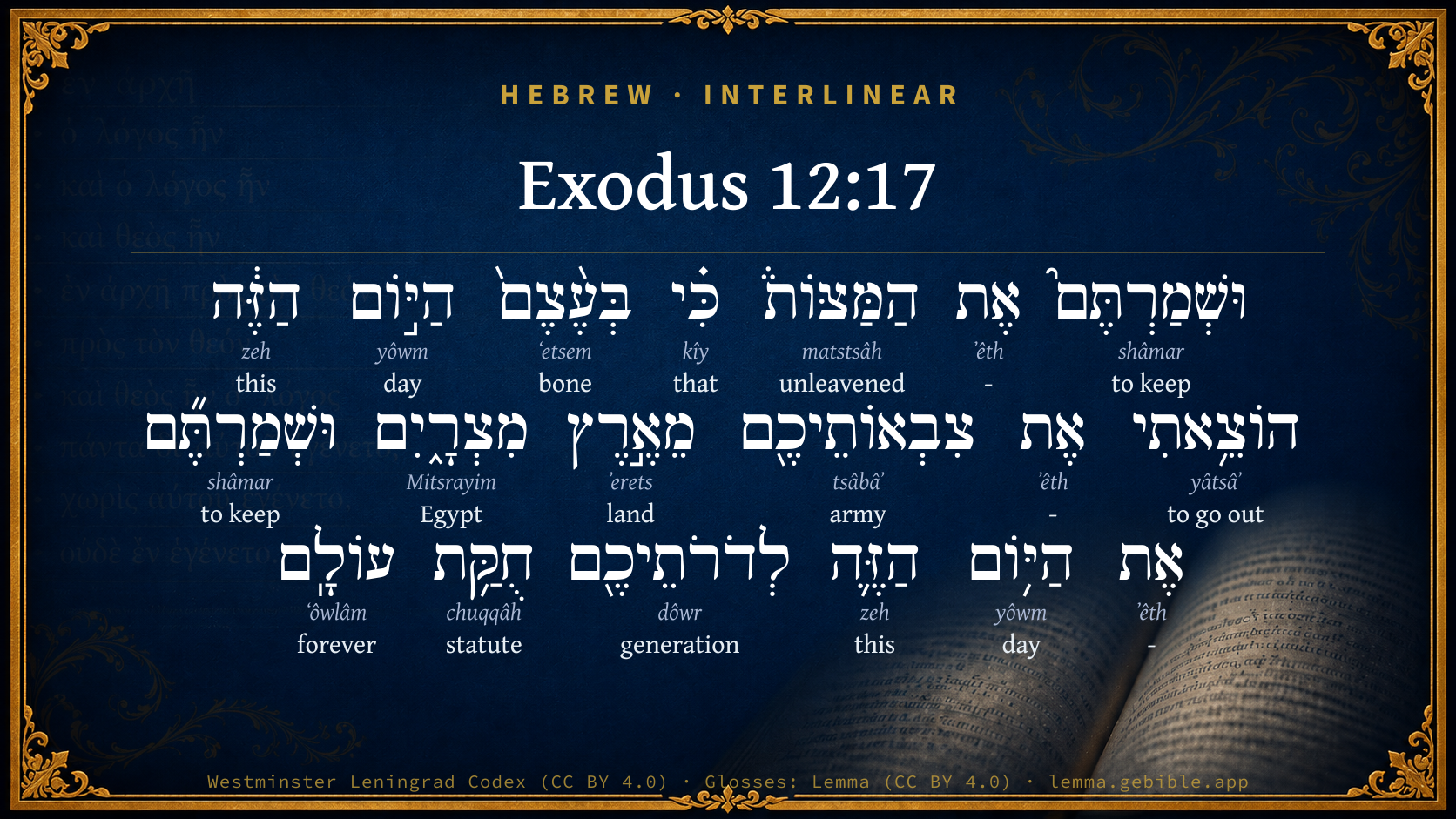
Hebrew (Westminster Leningrad Codex) Exodus 12:17 appears in the Hebrew Old Testament. The text above is from the Westminster Leningrad Codex. Each word links to its Strong’s number, a concise gloss, and parsing drawn from the Open Scriptures Hebrew Bible morphology. Click any word for its full Brown-Driver-Briggs (BDB) entry.
Download image
Cite this verse

Exodus 12:17 (World English Bible). Public Domain. Lemma interlinear Bible study tool, https://lemma.gebible.app/v/exodus/12/17.

Show BibTeX & RIS
BibTeX
RIS
English Translation
You shall observe the feast of unleavened bread; for in this same day have I brought your hosts out of the land of Egypt: therefore shall you observe this day throughout your generations by an ordinance forever.
World English Bible · Public Domain
Download a study sheet

One document with this verse’s original text, its word-by-word gloss line, the meaning frame, cross-references with their text, attributed commentary, and full source and license credits — printable, and it pastes into notes with its structure intact.

This verse Autodidact and up

Study sheet (.html) Plain text (.txt)

A passage Seminary Student

Up to 50 verses in one chapter. A passage sheet keeps up to 6 commentary sources and 12 cross-references per verse, in the order this page ranks them, and says so on the sheet whenever that leaves anything out. Ask for a single verse and you get the Autodidact verse sheet above.

Everything on this page stays free to read, with no account — the sheet is a download of what is already on screen, not access to it.

Want to remove ads? Support Godless Engineer
Compare translations 3

The same verse in 3 English versions, stacked beneath the original-language interlinear above. Click any original word for its lexicon entry.

Each is an independent rendering of the whole verse — the interlinear is not word-aligned to these translations.

Highlighted words mark where these versions differ — a whole-verse word diff, not a word-by-word alignment.

  • World English Bible Public Domain
    You shall observe the feast of unleavened bread; for in this same day have I brought your hosts out of the land of Egypt: therefore shall you observe this day throughout your generations by an ordinance forever.
  • King James Version Public Domain
    And ye shall observe the feast of unleavened bread; for in this selfsame day have I brought your armies out of the land of Egypt: therefore shall ye observe this day in your generations by an ordinance for ever.
  • unfoldingWord Literal Text CC BY-SA 4.0
    And you shall keep the Unleavened Bread, because on this very day I will have brought out your hosts from the land of Egypt. And you shall keep this day throughout your generations, a statute forever.

unfoldingWord Literal Text — © unfoldingWord, licensed CC BY-SA 4.0. Word-aligned USFM3 via Door43 (git.door43.org/unfoldingWord/en_ult).

Versions to compare (up to 4)

3 of 4 selected

Show all 18 translations

Every available English version of this verse, each an independent rendering of the whole verse.

  • World English Bible Public Domain
    You shall observe the feast of unleavened bread; for in this same day have I brought your hosts out of the land of Egypt: therefore shall you observe this day throughout your generations by an ordinance forever.
  • Berean Standard Bible Public Domain
    So you are to keep the Feast of Unleavened Bread, for on this very day I brought your divisions out of the land of Egypt. You must keep this day as a permanent statute for the generations to come.
  • Majority Standard Bible Public Domain
    So you are to keep the Feast of Unleavened Bread, for on this very day I brought your divisions out of the land of Egypt. You must keep this day as a permanent statute for the generations to come.
  • King James Version Public Domain
    And ye shall observe the feast of unleavened bread; for in this selfsame day have I brought your armies out of the land of Egypt: therefore shall ye observe this day in your generations by an ordinance for ever.
  • American Standard Version (1901) Public Domain
    And ye shall observe the `feast of' unleavened bread; for in this selfsame day have I brought your hosts out of the land of Egypt: therefore shall ye observe this day throughout your generations by an ordinance for ever.
  • Revised Version (1885) Public Domain
    And ye shall observe the feast of unleavened bread; for in this selfsame day have I brought your hosts out of the land of Egypt: therefore shall ye observe this day throughout your generations by an ordinance for ever.
  • Geneva Bible (1599) Public Domain
    Ye shall keepe also the feast of vnleauened bread: for that same daye I will bring your armies out of the lande of Egypt: therefore ye shall obserue this day, throughout your posteritie, by an ordinance for euer.
  • Douay-Rheims (1899) Public Domain
    And you shall observe the feast of the unleavened bread: for in this same day I will bring forth your army out of the land of Egypt, and you shall keep this day in your generations by a perpetual observance.
  • Young's Literal Translation Public Domain
    and ye have observed the unleavened things, for in this self-same day I have brought out your hosts from the land of Egypt, and ye have observed this day to your generations -- a statute age-during.
  • Literal Standard Version CC BY-SA 4.0
    and you have observed the Unleavened Things, for in this very day I have brought out your hosts from the land of Egypt, and you have observed this day throughout your generations—a continuous statute.
  • Unlocked Literal Bible CC BY-SA 4.0
    You must observe this Festival of Unleavened Bread because it is on this day that I will have brought your people, armed group by armed group, out of the land of Egypt. So you must observe this day throughout your people's generations. This will always be a law for you.
  • unfoldingWord Literal Text CC BY-SA 4.0
    And you shall keep the Unleavened Bread, because on this very day I will have brought out your hosts from the land of Egypt. And you shall keep this day throughout your generations, a statute forever.
  • Darby Bible Public Domain
    And ye shall keep the [feast of] unleavened [bread]; for in this same day have I brought your hosts out of the land of Egypt; and ye shall keep this day in your generations [as] an ordinance for ever.
  • World Messianic Bible Public Domain
    You shall observe the feast of unleavened bread; for in this same day I have brought your armies out of the land of Egypt. Therefore you shall observe this day throughout your generations by an ordinance forever.
  • Webster's Bible Public Domain
    And ye shall observe the feast of unleavened bread; for in this same day have I brought your armies out of the land of Egypt: therefore shall ye observe this day in your generations by an ordinance for ever.
  • Free Bible Version CC BY-SA 4.0
    You are to keep the Feast of Unleavened Bread because on this very day I led your tribes by their respective divisions out of Egypt. You are to observe this day for all time to come.
  • Bible in Basic English Public Domain
    So keep the feast of unleavened bread; for on this very day I have taken your armies out of the land of Egypt: this day, then, is to be kept through all your generations by an order for ever.
  • JPS Tanakh (1917) Public Domain
    And ye shall observe the feast of unleavened bread; for in this selfsame day have I brought your hosts out of the land of Egypt; therefore shall ye observe this day throughout your generations by an ordinance for ever.

Literal Standard Version (2020), Covenant Press — licensed CC BY-SA 4.0. Text via the HelloAO Bible API (eBible.org). Unlocked Literal Bible (unfoldingWord) — licensed CC BY-SA 4.0. Text via the HelloAO Bible API (eBible.org). unfoldingWord Literal Text — © unfoldingWord, licensed CC BY-SA 4.0. Word-aligned USFM3 via Door43 (git.door43.org/unfoldingWord/en_ult). Free Bible Version, Dr. Jonathan Gallagher — licensed CC BY-SA 4.0. Text via the HelloAO Bible API (eBible.org).

Word by word

More ways to search: Search by grammar → Find every occurrence → Compare this word →

Practice this passage: Drill this verse → Learn its vocabulary →

הַמַּצּוֹת֒
matstsâh
H4682
“the · unleavened bread”
Particle, Definite Article + Noun, Common, Feminine, Plural, Absolute
Part of Speech
Particle + Noun
Type
Common
Gender
Feminine
Number
Plural
State
Absolute
Full BDB Definition

Origin: from H4711 in the sense of greedily devouring for sweetness

TWOT: None

unleavened (bread, cake), without leaven.
  1. וּשְׁמַרְתֶּם֮ shâmar H8104 “and · to keep” Conjunction + Verb, Qal, Sequential Perfect, 2nd Person, Masculine, Plural
  2. אֶת ʼêth H853 “-” Particle, Direct Object
  3. כִּ֗י kîy H3588 “that” Conjunction
  4. בְּעֶ֨צֶם֙ ʻetsem H6106 “in/at · bone of” Preposition + Noun, Common, Feminine, Singular, Construct
  5. הַיּ֣וֹם yôwm H3117 “the · day” Particle, Definite Article + Noun, Common, Masculine, Singular, Absolute
  6. הַזֶּ֔ה zeh H2088 “the · this” Particle, Definite Article + Pronoun, Demonstrative, Masculine, Singular
  7. הוֹצֵ֥אתִי yâtsâʼ H3318 “to go out” Verb, Hiphil, Perfect, 1st Person, Common, Singular
  8. אֶת ʼêth H853 “-” Particle, Direct Object
  9. צִבְאוֹתֵיכֶ֖ם tsâbâʼ H6635 “armies · your” Noun, Common, Both, Plural, Construct + Suffix, Personal, 2nd Person, Masculine, Plural
  10. מֵאֶ֣רֶץ ʼerets H776 “from · land of” Preposition + Noun, Common, Both, Singular, Construct
  11. מִצְרָ֑יִם Mitsrayim H4714 “Egypt” Noun, Proper
  12. וּשְׁמַרְתֶּ֞ם shâmar H8104 “and · to keep” Conjunction + Verb, Qal, Sequential Perfect, 2nd Person, Masculine, Plural
  13. אֶת ʼêth H853 “-” Particle, Direct Object
  14. הַיּ֥וֹם yôwm H3117 “the · day” Particle, Definite Article + Noun, Common, Masculine, Singular, Absolute
  15. הַזֶּ֛ה zeh H2088 “the · this” Particle, Definite Article + Pronoun, Demonstrative, Masculine, Singular
  16. לְדֹרֹתֵיכֶ֖ם dôwr H1755 “to/for · generations · your” Preposition + Noun, Common, Masculine, Plural, Construct + Suffix, Personal, 2nd Person, Masculine, Plural
  17. חֻקַּ֥ת chuqqâh H2708 “statute of” Noun, Common, Both, Singular, Construct
  18. עוֹלָֽם ʻôwlâm H5769 “forever” Noun, Common, Masculine, Singular, Absolute

About this verse

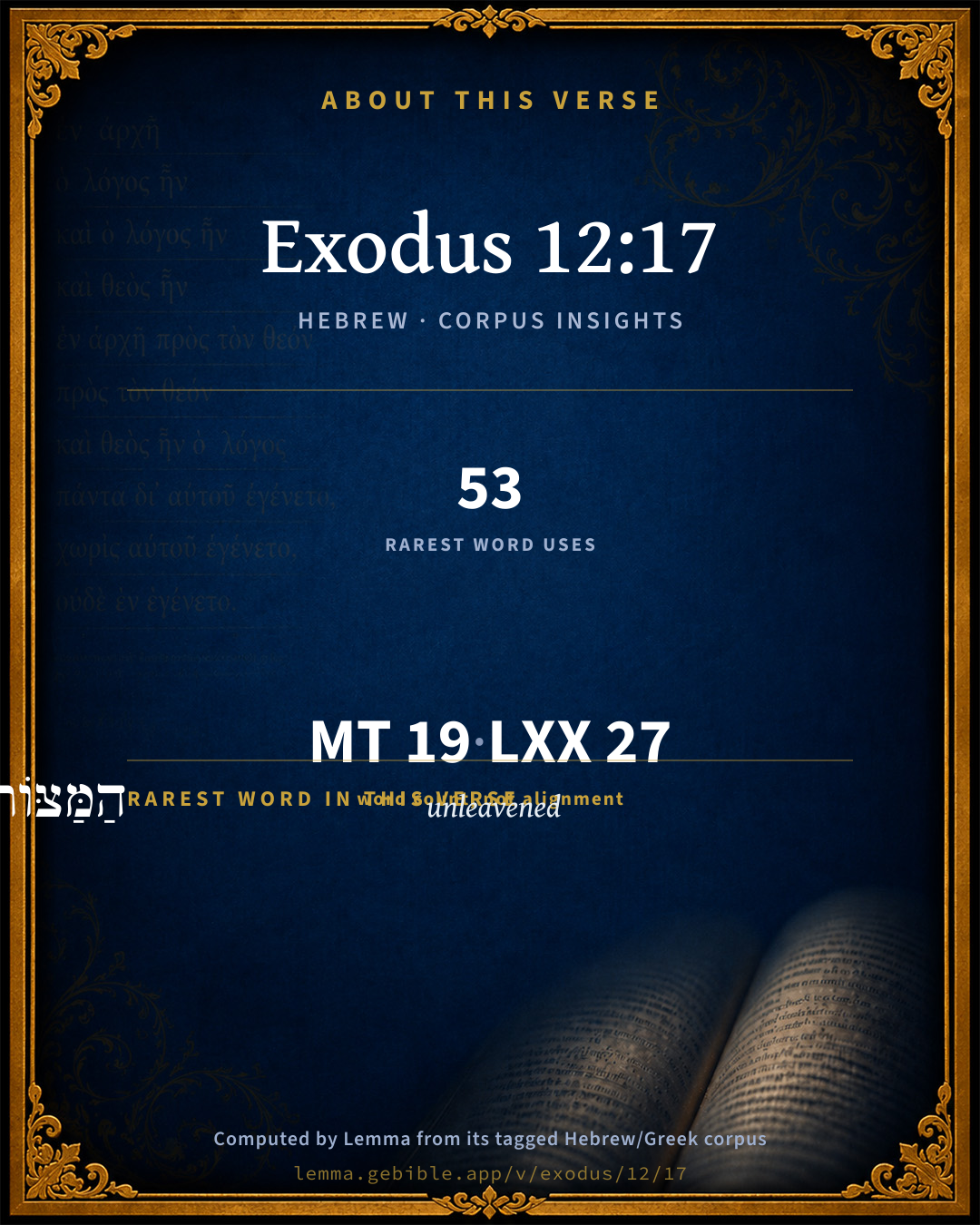
These counts appear in no published source. They are computed here, from the morphology-tagged text and Lemma’s own curated glosses. What Lemma adds →

19
words
14
distinct lemmas
Pentateuch
section

Shared distinctive vocabulary

הַמַּצּוֹת֒ unleavened H4682 occurs in 42 verses of the Hebrew Bible. Also found in:

Grammatical profile

  • 3 verbs
  • 10 nouns
  • 2 pronouns
  • 1 conjunction
  • 3 particles

Verb forms

  • וּשְׁמַרְתֶּם֮ Qal · Sequential Perfect
  • הוֹצֵ֥אתִי Hiphil · Perfect
  • וּשְׁמַרְתֶּ֞ם Qal · Sequential Perfect

Repetition

Words recur within this verse — often emphatic in Hebrew:

  • וּשְׁמַרְתֶּם֮ to keep H8104 ×2
  • הַיּ֣וֹם day H3117 ×2
  • הַזֶּ֔ה this H2088 ×2

Hebrew & Septuagint length

In English translation the verse runs 37 words from the Hebrew and 36 from the Septuagint (LXX English) — closely comparable.

A rough comparison of the two English renderings, which tokenize alike — not a word-level alignment.

Word counts can differ between the Hebrew and the Greek without any difference in meaning — e.g. the Hebrew direct-object marker אֵת has no separate Greek word, and Greek often adds the article ὁ.

In the original languages it is 19 Hebrew tokens and 27 Greek tokens — but the two are counted differently (Hebrew bundles its prefixes and suffixes into one token; the Greek is in lemma form), so that isn’t a like-for-like length.

Cross-references

5

Topical passages linked to Exodus 12:17 in the Treasury of Scripture Knowledge — connected by theme and wording, ordered by reader-vote popularity; previews shown in the World English Bible.

  • Exodus 7:5 The Egyptians shall know that I am Yahweh, when I stretch forth my hand on Egypt, and bring out the children of Israel from among them."
  • Exodus 12:41 It happened at the end of four hundred thirty years, even the same day it happened, that all the hosts of Yahweh went out from the land of Egypt.
  • Exodus 13:3 Moses said to the people, "Remember this day, in which you came out from Egypt, out of the house of bondage; for by strength of hand Yahweh brought you out from this place. No leavened bread shall be eaten.
  • Exodus 13:8 You shall tell your son in that day, saying, 'It is because of that which Yahweh did for me when I came forth out of Egypt.'
  • Numbers 20:16 and when we cried to Yahweh, he heard our voice, and sent an angel, and brought us forth out of Egypt: and, behold, we are in Kadesh, a city in the uttermost of your border.

Cross-references courtesy of OpenBible.info (CC BY 4.0).

Hebrew and Greek witnesses Masoretic Hebrew ↔ Greek Septuagint

The same verse in the two great witnesses to the Old Testament, shown verse-for-verse.

These are two independent witnesses, not word-aligned to each other, and the Septuagint is shown in lemma (dictionary) form.

Hebrew Exodus 12:17 Masoretic · Westminster Leningrad Codex

וּשְׁמַרְתֶּם֮ אֶת הַמַּצּוֹת֒ כִּ֗י בְּעֶ֨צֶם֙ הַיּ֣וֹם הַזֶּ֔ה הוֹצֵ֥אתִי אֶת צִבְאוֹתֵיכֶ֖ם מֵאֶ֣רֶץ מִצְרָ֑יִם וּשְׁמַרְתֶּ֞ם אֶת הַיּ֥וֹם הַזֶּ֛ה לְדֹרֹתֵיכֶ֖ם חֻקַּ֥ת עוֹלָֽם

You shall observe the feast of unleavened bread; for in this same day have I brought your hosts out of the land of Egypt: therefore shall you observe this day throughout your generations by an ordinance forever.

World English Bible · Public Domain

Greek LXX Exodus 12:17 Septuagint · lemma form

καί φυλάσσω ὁ ἐντολή οὗτος ἐν γάρ ὁ ἡμέρα οὗτος ἐκἄγω ὁ δύναμις σύ ἐκ γῆ αἴγυπτος καί ποιέω ὁ ἡμέρα οὗτος εἰς γενεά σύ νόμιμος αἰώνιος

And you⌃ shall keep this commandment, for on this day will I bring out your force out of the land of Egypt; and you⌃ shall make this day a perpetual ordinance for you throughout your generations.

LXX2012 (modern English Septuagint) · Public Domain

On this verse, Haydock's Catholic Bible Commentary discusses the Septuagint’s reading. Read the note in Commentary ↓

Hebrew: Westminster Leningrad Codex (CC BY 4.0). Greek: Septuagint (public domain); English from LXX2012 (modern English Septuagint) (Public Domain). How the Septuagint differs from the Hebrew →

Targum (Aramaic paraphrase)

2

The Targum is the ancient Jewish Aramaic paraphrase of the Hebrew Scriptures — an interpretive translation, not the Hebrew text itself. Onkelos (literal) and Pseudo-Jonathan (expansive) render the Torah, and Jonathan the Prophets. Coverage is partial: where no permissively-licensed English translation exists for a verse, only the Aramaic is shown. This is verse-level text, not a word-by-word alignment to the Hebrew.

  1. Targum Onkelos Torah (Genesis–Deuteronomy)
    וְתִטְרוּן יָת פַּטִירָא אֲרֵי בִּכְרַן יוֹמָא הָדֵין אַפֵּיקִית יָת חֵילֵיכוֹן מֵאַרְעָא דְמִצְרָיִם וְתִטְּרוּן יָת יוֹמָא הָדֵין לְדָרֵיכוֹן קְיָם עָלָם:

    (no public-domain English translation for this verse)

    Targum Onkelos — Aramaic: “Onkelos Genesis” (public domain); “Onkelos Exodus” (public domain); “Onkelos Leviticus” (public domain); “Onkelos Numbers” (public domain); “Onkelos Deuteronomy” (public domain). English: “Sefaria Community Translation” (CC0 1.0 (public-domain dedication)); “J.W. Etheridge. The Targums of Onkelos and Jonathan Ben Uzziel on the Pentateuch. London: Longmans, Green, 1862” (public domain). Text via Sefaria.

  2. Targum Pseudo-Jonathan Torah (Genesis–Deuteronomy)
    וְתִטְרוּן יַת לִישָׁתָא דְּפַטִּירֵי אֲרוּם בִּכְרַן יוֹמָא הָדֵין הַנְפֵּיק יְיָ יַת חֵילֵיכוֹן פְּרִיקִין מֵאַרְעָא דְמִצְרַיִם וְתִטְרוּן יַת יוֹמָא הָדֵין לְדָרֵיכוֹן קְיַם עֲלָם

    And you shall observe the feast of the unleavened bread, because in this same day the Lord will bring out your hosts free from the land of Mizraim; and you shall observe this day in your generations, a statute for ever.

    Targum Pseudo-Jonathan — Aramaic: “Targum Jonathan on Genesis” (public domain); “Targum Jonathan on Exodus” (public domain); “Targum Jonathan on Leviticus” (public domain); “Targum Jonathan on Numbers” (public domain); “Targum Jonathan on Deuteronomy” (public domain). English: “The Targum of Jonathan ben Uzziel, trans. J. W. Etheridge, London, 1862” (public domain). Text via Sefaria.

Commentary

Notes on Exodus 12:17 from classic Christian and Jewish commentators (each source and its license shown beneath its notes). The classic Christian expositions comment on the surrounding passage and are grouped to its opening verse, so a note may address several verses; the Jewish commentaries on the Tanakh (Rashi and others) are per-verse, so they appear only where the commentator wrote on this verse.

Lemma curates 59 commentaries, every one of them public domain or Creative Commons licensed, each selected and text-cleaned for this edition rather than reprinted as found. About our sources →

Trapp's Complete Commentary

John Trapp

Exo 12:17 And ye shall observe [the feast of] unleavened bread; for in this selfsame day have I brought your armies out of the land of Egypt: therefore shall ye observe this day in your generations by an ordinance for ever.

Ver. 17. In this selfsame day.] Heb., In the body, or strength, of this day: so the midday is called. Art thou delivered, helped? write up the time and place.

John Trapp, A Commentary or Exposition upon All the Books of the Old and New Testament (1647–1656) — public domain. Text from a community e-Sword module.

Jamieson, Fausset & Brown

Robert Jamieson, A. R. Fausset & David Brown

ye shall observe, &c.--The seven days of this feast were to commence the day after the passover. It was a distinct festival following that feast; but although this feast was instituted like the passover before the departure, the observance of it did not take place till after.

Jamieson, Fausset & Brown — Commentary Critical and Explanatory on the Whole Bible (1871) — public domain (CC PDM 1.0). Text via the HelloAO Bible API.

Adam Clarke's Commentary

Verse 17. Self - same day] בעצם beetsem, in the body of this day, or in the strength of this day; probably they began their march about day-break, called here the body or strength of the day, and in De 16:1, by night - sometime before the sun rose.

Adam Clarke's Commentary on the Bible (1810–1826) — public domain. Text from a community e-Sword/MySword module.

Ellicott's Commentary for English Readers

(17) In this selfsame day have I brought your armies out of the land of Egypt.—On the application of the word “armies” to the people of Israel, see above (Exo_6:26). The expression “have I brought” indicates either that these directions were not given until after the Exodus, or at any rate that they were not reduced to writing until then.

A Bible Commentary for English Readers, edited by Charles John Ellicott (1878–1897) — public domain. Text from a community e-Sword module.

The Cambridge Bible for Schools and Colleges

gen. ed. J. J. S. Perowne

17. selfsame day] A peculiar expression,—lit. the bone (i.e. the substance) of the day, the day itself, the very day (cf. Exo_24:10 ‘the heaven itself,’ and Job_21:23 Heb.),—found only in P (vv. 41, 47, 51, Gen_7:13; Gen_17:23; Gen_17:26 al.) and Ezek. (Eze_2:3, Eze_24:2, Eze_40:1).

have I brought forth, &c. The pilgrimage is to be observed in commemoration of the day of the Exodus from Egypt. Cf. v. 14a.

your hosts] P pictures the Israel of the Exodus as a vast army: see on Exo_6:26.

throughout, &c.] as v. 14b.

17–20. The essential parts of the institution repeated and insisted on again, in P’s manner; see on Exo_6:27.

The Cambridge Bible for Schools and Colleges (gen. ed. J. J. S. Perowne; Cambridge University Press, 1878–1918) — public domain. Text from a community e-Sword module.

John Gill's Exposition

And ye shall observe the feast of unleavened bread,.... Which was a distinct feast from the passover feast; for though at that unleavened bread was eaten, it was kept but one night, this seven days; and it is repeated that it might be taken notice of, and the rather, as it was to be observed in all ages as long as the Jewish economy lasted; the reason of which follows:

for in this selfsame day have I brought your armies out of the land of Egypt; which, though not already done, was just on doing, and was certain; and besides, it respects the day when it should come about another year: by their "armies" are meant the tribes of Israel, not so much for their military force, for as yet they were an unarmed people, but for their numbers, which were sufficient to make several considerable armies, and for their order and ease, and their being without any fear of the enemy, in which they marched out of Egypt:

therefore shall ye observe this day in your generations by an ordinance for ever; according to the rules given, with the same exactness, strictness, and constancy, as the first of the passover, and as long as that continued; See Gill on Exo 12:14.

John Gill's Exposition of the Whole Bible (1746–1763) — public domain (CC PDM 1.0). Text via the HelloAO Bible API.

Haydock's Catholic Bible Commentary

Bread. Hebrew matsoth. But the Samaritan and Septuagint read Motsue, precept, or ordinance. (Calmet)

George Leo Haydock (1774–1849), Haydock's Catholic Family Bible and Commentary, 1859 edition — public domain. Excludes Psalms (Douay-Rheims chapter numbering differs from Protestant) and Deuterocanonical books (Catholic canon only).

Matthew Poole's English Annotations

Your armies, so called, not from their military force or courage, but from their numbers, and the order and manner in which they came forth. See Exo 13:18.

Matthew Poole's English Annotations on the Holy Bible (1683–1685) — public domain. Text from a community e-Sword/MySword module.

Whedon's Commentary on the Bible

Daniel D. Whedon

17. In this selfsame day have I brought your armies out — This was said before the deliverance was effected, and it is spoken of in the past as if already made sure. Thus the Hebrew preterit is often used in prophecy for an emphatic future. (Nordh., Gram., § 966, 1, a.)

Daniel D. Whedon (gen. ed.), Commentary on the Old and New Testaments (1874–1909) — public domain. Text from a community e-Sword module.

The Pulpit Commentary

In this self-same day. The 15th of Abib the first day of the feast of unleavened bread. Have I brought your hosts out. This expression seems to prove that we have in the injunctions of verses 14-20, not the exact words of the revelation on the subject made by God to Moses before the institution of the Passover, but a re-casting of the words after the exodus had taken place. Otherwise, the expression must have been, "I will bring your hosts out." As an ordinance for ever. Easter eve, the day on which Satan was despoiled by the preaching of Jesus to the spirits in prison, (1Pe_3:19) and on which the Church first realises its deliverance from the bondage of sin by the Atonement of Good Friday, is the Christian continuance of the first day of unleavened bread, and so answers to this text, as Good Friday to the similar command in ver.

14.

The Pulpit Commentary (1880–1919), ed. H.D.M. Spence-Jones & Joseph S. Exell — public domain. Text from a community e-Sword module.

unfoldingWord translationNotes

Door43 World Missions Community

armed group by armed group

The term used for these groups is a military term referring to a large number of soldiers. AT: "division by division" or "regiment by regiment"

twilight

This refers to the time of evening after the sun has set but while there is still some light. See how you translated this in Exodus 12:6.

the fourteenth day in the first month

This is the first month of the Hebrew calendar. The fourteenth day is near the beginning of April on Western calendars. (See: Hebrew Months and Ordinal Numbers)

the twenty-first day of the month

"the twenty-first day of the first month." This is near the middle of April on Western calendars. (See: Hebrew Months and Ordinal Numbers and Ellipsis)

translationWords

festival

unleavened bread

day

people group

generation

year

unfoldingWord translationNotes — © Distant Shores Media and the Door43 World Missions Community, licensed CC BY-SA 4.0. Source: git.door43.org/Door43/en_tn.

Rashi

Rabbi Shlomo Yitzchaki (Rashi)

ושמרתם את המצות AND YE SHALL WATCH THE UNLEAVENED BREAD that it shall not reach the stage of becoming leavened; hence the Rabbis said, if it (the dough) is rising (a sign that the leavening process is setting in) she (the woman kneading the dough) polishes it with cold water (i. e. she slaps the dough with hands dipped in cold water). Rabbi Josiah said: Do not read “את המַּצּוֹת”, the unleavened bread, but את הַמִּצְוֹת “[ye shall watch] the commandements” — just as we may not cause the unleavened bread to become leavened by letting the dough remain in its raw state too long so we may not let the commandment become “leavened” by waiting too long before we perform it; but if it (a commandment) comes to your hand, perform it immediately (Mekhilta).

ושמרתם את היום הזה AND YE SHALL GUARD THIS DAY — against work,

לדרתיכם חקת עולם THROUGHOUT YOUR GENERATIONS, AN ORDINANCE FOR EVER — Because the expressions, “[throughout your] generations”, and “an ordinance for ever” have not been mentioned in connection with the prohibition of work but only in reference to the celebration of the Festival (v. 14), it is therefore repeated here in order that you should not say: the prohibition, (v. 16) “no work shall be done”, was not spoken for future generations but for that generation alone to whom the words were addressed.

Rashi on the Tanakh — English translations: “The Judaica Press complete Tanach with Rashi, translated by A. J. Rosenberg” (CC BY 4.0); “Pentateuch with Rashi's commentary by M. Rosenbaum and A.M. Silbermann, 1929-1934” (public domain); “The Metsudah Tanach series, Lakewood, N.J” (CC BY 4.0); and “The Book of Joshua, Metsudah Publications, 1997” (CC BY 4.0). Text via Sefaria.

Lesson kit

Teaching starters — assembled from the data on this page, not authored interpretation. Every prompt links to the verse data it draws on. Edit before teaching.

Exodus, in the Pentateuch, opens this verse with 19 words (14 distinct Hebrew lemmas). Its most distinctive word is matstsâh (“unleavened”). A historical commentator’s framing appears above. Read the whole chapter for the surrounding context.

Discussion questions

  1. What does “unleavened” (matstsâh) contribute to the verse as a whole?
  2. How does Genesis 19:3, which shares the word «unleavened», read alongside this verse?
  3. What does the repetition of “to keep” (2× in this one verse) do in this verse?
  4. The translations on this page render this verse differently — a whole-verse word diff, not a word-by-word alignment. What might account for the different wordings?
  5. «וּשְׁמַרְתֶּם֮» is a Qal Sequential Perfect verb. How does that grammatical form shape the action described?
  6. Compare how Trapp's Complete Commentary and Jamieson, Fausset & Brown read this verse. Where do they agree or differ?

Things to notice

Reading settings

Reading text

Shown beneath each verse's original-language words.

Old Testament
Old Testament edition

Read the OT as the Masoretic Hebrew (MT) or the Greek Septuagint (LXX).

English shown for the Greek Septuagint (in the Hebrew ↔ Greek comparison).

Comparing translations? Open the Compare panel on any verse page to stack up to four side by side.