Daniel 8:11

Hebrew (Westminster Leningrad Codex) Daniel 8:11 appears in the Hebrew Old Testament. The text above is from the Westminster Leningrad Codex. Each word links to its Strong’s number, a concise gloss, and parsing drawn from the Open Scriptures Hebrew Bible morphology. Click any word for its full Brown-Driver-Briggs (BDB) entry.
Download image
Cite this verse

Daniel 8:11 (World English Bible). Public Domain. Lemma interlinear Bible study tool, https://lemma.gebible.app/v/daniel/8/11.

Show BibTeX & RIS
BibTeX
RIS
English Translation
Yes, it magnified itself, even to the prince of the host; and it took away from him the continual [burnt offering], and the place of his sanctuary was cast down.
World English Bible · Public Domain
Download a study sheet

One document with this verse’s original text, its word-by-word gloss line, the meaning frame, cross-references with their text, attributed commentary, and full source and license credits — printable, and it pastes into notes with its structure intact.

This verse Autodidact and up

Study sheet (.html) Plain text (.txt)

A passage Seminary Student

Up to 50 verses in one chapter. A passage sheet keeps up to 6 commentary sources and 12 cross-references per verse, in the order this page ranks them, and says so on the sheet whenever that leaves anything out. Ask for a single verse and you get the Autodidact verse sheet above.

Everything on this page stays free to read, with no account — the sheet is a download of what is already on screen, not access to it.

Want to remove ads? Support Godless Engineer
Compare translations 3

The same verse in 3 English versions, stacked beneath the original-language interlinear above. Click any original word for its lexicon entry.

Each is an independent rendering of the whole verse — the interlinear is not word-aligned to these translations.

Highlighted words mark where these versions differ — a whole-verse word diff, not a word-by-word alignment.

  • World English Bible Public Domain
    Yes, it magnified itself, even to the prince of the host; and it took away from him the continual [burnt offering], and the place of his sanctuary was cast down.
  • King James Version Public Domain
    Yea, he magnified himself even to the prince of the host, and by him the daily sacrifice was taken away, and the place of the sanctuary was cast down.
  • unfoldingWord Literal Text CC BY-SA 4.0
    It magnified itself to be as great as the Prince of the host. It took away from him the regular burnt offering, and the place of his sanctuary was overthrown.

unfoldingWord Literal Text — © unfoldingWord, licensed CC BY-SA 4.0. Word-aligned USFM3 via Door43 (git.door43.org/unfoldingWord/en_ult).

Versions to compare (up to 4)

3 of 4 selected

Show all 18 translations

Every available English version of this verse, each an independent rendering of the whole verse.

  • World English Bible Public Domain
    Yes, it magnified itself, even to the prince of the host; and it took away from him the continual [burnt offering], and the place of his sanctuary was cast down.
  • Berean Standard Bible Public Domain
    It magnified itself, even to the Prince of the host; it removed His daily sacrifice and overthrew the place of His sanctuary.
  • Majority Standard Bible Public Domain
    It magnified itself, even to the Prince of the host; it removed His daily sacrifice and overthrew the place of His sanctuary.
  • King James Version Public Domain
    Yea, he magnified himself even to the prince of the host, and by him the daily sacrifice was taken away, and the place of the sanctuary was cast down.
  • American Standard Version (1901) Public Domain
    Yea, it magnified itself, even to the prince of the host; and it took away from him the continual `burnt-offering', and the place of his sanctuary was cast down.
  • Revised Version (1885) Public Domain
    Yea, it magnified itself, even to the prince of the host; and it took away from him the continual burnt offering, and the place of his sanctuary was cast down.
  • Geneva Bible (1599) Public Domain
    And extolled himselfe against the prince of the hoste from whome the dayly sacrifice was taken away, and the place of his Sanctuarie was cast downe.
  • Douay-Rheims (1899) Public Domain
    And it was magnified even to the prince of the strength: and it took away from him the continual sacrifice, and cast down the place of his sanctuary.
  • Young's Literal Translation Public Domain
    And unto the prince of the host it exerteth itself, and by it taken away hath been the continual `sacrifice', and thrown down the base of his sanctuary.
  • Literal Standard Version CC BY-SA 4.0
    And to the prince of the host it exerts itself, and the continual [sacrifice] has been taken away by it, and thrown down the base of his sanctuary.
  • Unlocked Literal Bible CC BY-SA 4.0
    It made itself to be as great as the commander of the army. It took away from him the regular burnt offering, and the place of his sanctuary was polluted.
  • unfoldingWord Literal Text CC BY-SA 4.0
    It magnified itself to be as great as the Prince of the host. It took away from him the regular burnt offering, and the place of his sanctuary was overthrown.
  • Darby Bible Public Domain
    (And he magnified [himself] even to the prince of the host, and from him the continual [sacrifice] was taken away, and the place of his sanctuary was cast down.
  • World Messianic Bible Public Domain
    Yes, it magnified itself, even to the prince of the army; and it took away from him the continual burnt offering, and the place of his sanctuary was cast down.
  • Webster's Bible Public Domain
    Yes, he magnified himself even to the prince of the host, and by him the daily sacrifice was taken away, and the place of his sanctuary was cast down.
  • Free Bible Version CC BY-SA 4.0
    It even tried to make itself as great as the Prince of the heavenly army—it removed the continual service, and the place of his sanctuary was destroyed.
  • Bible in Basic English Public Domain
    It made itself great, even as great as the lord of the army; and by it the regular burned offering was taken away, and the place overturned and the holy place made waste.
  • JPS Tanakh (1917) Public Domain
    Yea, it magnified itself, even to the prince of the host; and from him the continual burnt-offering was taken away, and the place of his sanctuary was cast down.

Literal Standard Version (2020), Covenant Press — licensed CC BY-SA 4.0. Text via the HelloAO Bible API (eBible.org). Unlocked Literal Bible (unfoldingWord) — licensed CC BY-SA 4.0. Text via the HelloAO Bible API (eBible.org). unfoldingWord Literal Text — © unfoldingWord, licensed CC BY-SA 4.0. Word-aligned USFM3 via Door43 (git.door43.org/unfoldingWord/en_ult). Free Bible Version, Dr. Jonathan Gallagher — licensed CC BY-SA 4.0. Text via the HelloAO Bible API (eBible.org).

Word by word

More ways to search: Search by grammar → Find every occurrence → Compare this word →

Practice this passage: Drill this verse → Learn its vocabulary →

מְכ֥וֹן
mâkôwn
H4349
“foundation of”
Noun, Common, Masculine, Singular, Construct
Part of Speech
Noun
Type
Common
Gender
Masculine
Number
Singular
State
Construct
Full BDB Definition

Origin: from H3559

TWOT: 964c

fixed or established place, foundation - fixed place - foundation
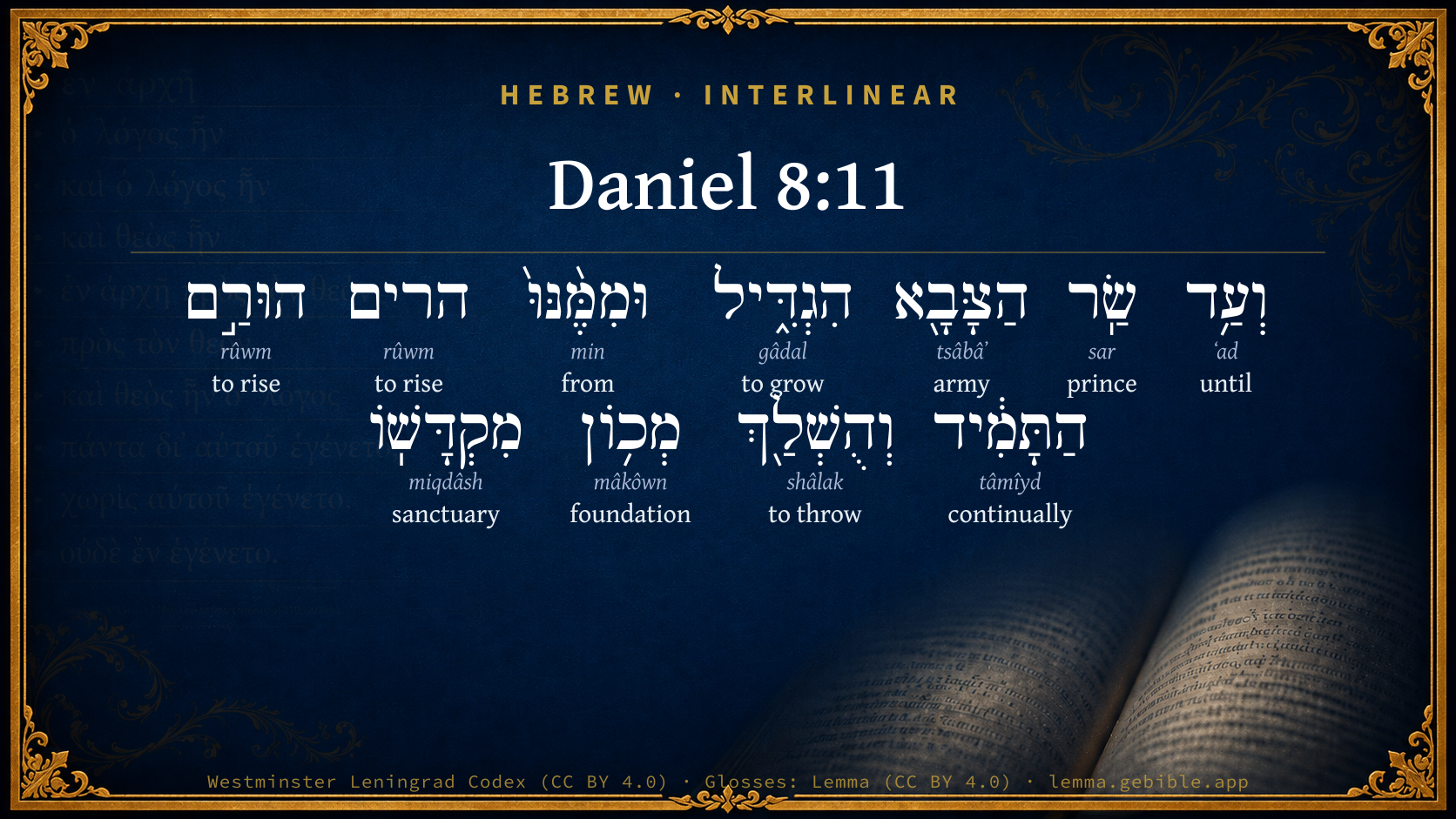
  1. וְעַ֥ד ʻad H5704 “and · until” Conjunction + Preposition
  2. שַֽׂר sar H8269 “prince of” Noun, Common, Masculine, Singular, Construct
  3. הַצָּבָ֖א tsâbâʼ H6635 “the · army” Particle, Definite Article + Noun, Common, Both, Singular, Absolute
  4. הִגְדִּ֑יל gâdal H1431 “to grow” Verb, Hiphil, Perfect, 3rd Person, Masculine, Singular
  5. וּמִמֶּ֨נּוּ֙ min H4480 “and · from · him” Conjunction + Preposition + Suffix, Personal, 3rd Person, Masculine, Singular
  6. הרים rûwm H7311 “to rise” Verb, Hiphil, Perfect, 3rd Person, Masculine, Singular
  7. הוּרַ֣ם rûwm H7311 “to rise” Verb, Hophal, Perfect, 3rd Person, Masculine, Singular
  8. הַתָּמִ֔יד tâmîyd H8548 “the · continually” Particle, Definite Article + Noun, Common, Masculine, Singular, Absolute
  9. וְהֻשְׁלַ֖ךְ shâlak H7993 “and · to throw” Conjunction + Verb, Hophal, Perfect, 3rd Person, Masculine, Singular
  10. מִקְדָּשֽׁוֹ miqdâsh H4720 “sanctuary · his” Noun, Common, Masculine, Singular, Construct + Suffix, Personal, 3rd Person, Masculine, Singular

About this verse

These counts appear in no published source. They are computed here, from the morphology-tagged text and Lemma’s own curated glosses. What Lemma adds →

11
words
10
distinct lemmas
Prophets
section

Notable vocabulary

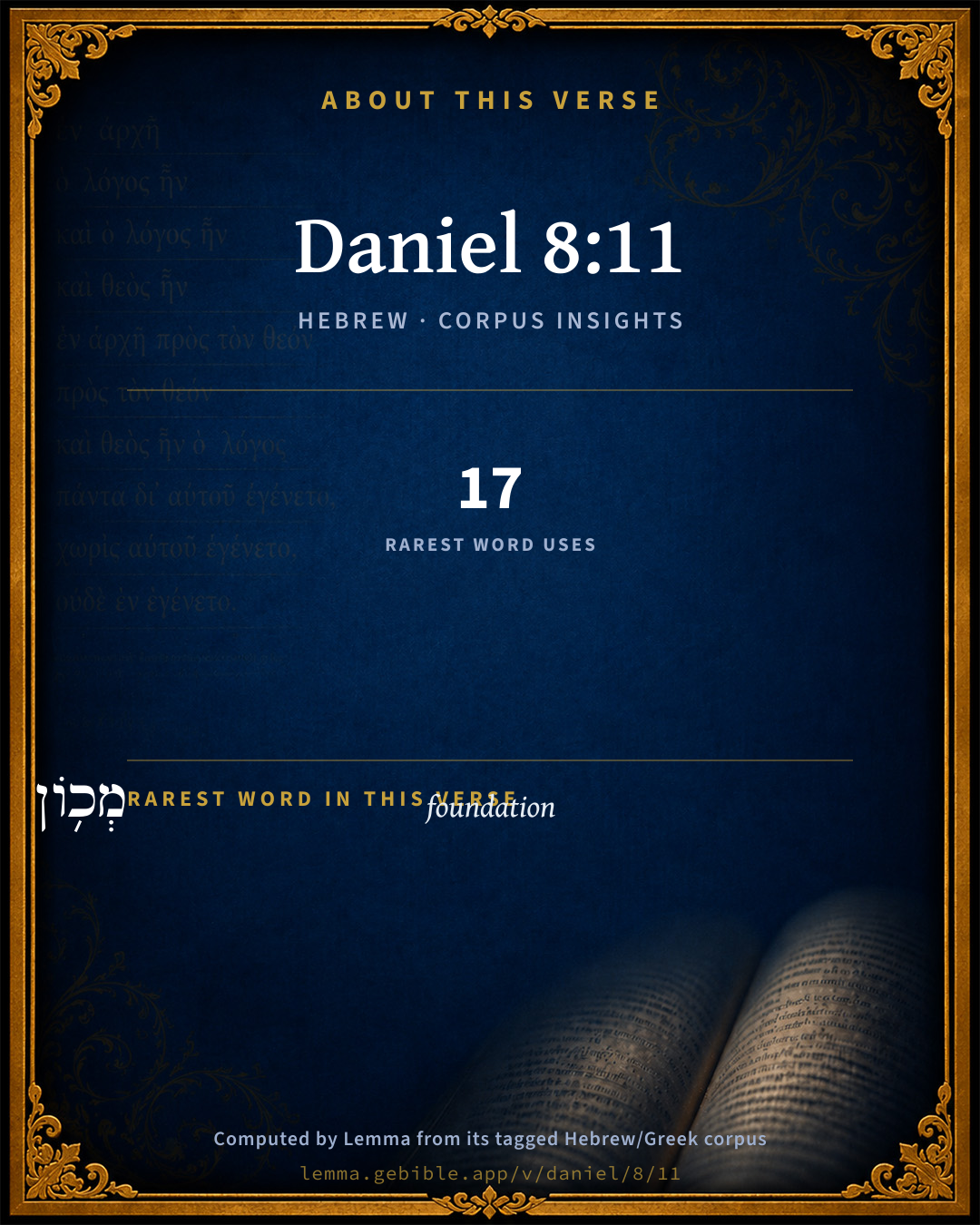
The rarest word here is מְכ֥וֹן foundation H4349 — appearing just 17 times in the whole Hebrew Bible.

Shared distinctive vocabulary

מְכ֥וֹן foundation H4349 occurs in 17 verses of the Hebrew Bible. Also found in:

Grammatical profile

  • 4 verbs
  • 5 nouns
  • 2 prepositions

Verb forms

  • הִגְדִּ֑יל Hiphil · Perfect
  • הרים Hiphil · Perfect
  • הוּרַ֣ם Hophal · Perfect
  • וְהֻשְׁלַ֖ךְ Hophal · Perfect

Repetition

A word recurs within this verse — often emphatic in Hebrew:

  • הרים to rise H7311 ×2

Hebrew & Septuagint length

In English translation the verse runs 30 words from the Hebrew and 33 from the Septuagint (LXX English) — closely comparable.

A rough comparison of the two English renderings, which tokenize alike — not a word-level alignment.

Word counts can differ between the Hebrew and the Greek without any difference in meaning — e.g. the Hebrew direct-object marker אֵת has no separate Greek word, and Greek often adds the article ὁ.

Cross-references

25

Topical passages linked to Daniel 8:11 in the Treasury of Scripture Knowledge — connected by theme and wording, ordered by reader-vote popularity; previews shown in the World English Bible.

  • Daniel 12:11 From the time that the continual [burnt offering] shall be taken away, and the abomination that makes desolate set up, there shall be one thousand two hundred ninety days.
  • Revelation 13:5–7 A mouth speaking great things and blasphemy was given to him. Authority to make war for forty-two months was given to him.
  • Ezekiel 46:14 You shall prepare a meal-offering with it morning by morning, the sixth part of an ephah, and the third part of a hin of oil, to moisten the fine flour; a meal-offering to Yahweh continually by a perpetual ordinance.
  • Daniel 8:25 Through his policy he shall cause craft to prosper in his hand; and he shall magnify himself in his heart, and in [their] security shall he destroy many: he shall also stand up against the prince of princes; but he shall be broken without hand.
  • Daniel 11:31 Forces shall stand on his part, and they shall profane the sanctuary, even the fortress, and shall take away the continual [burnt offering], and they shall set up the abomination that makes desolate.
  • 2 Kings 19:22–23 Whom have you defied and blasphemed? and against whom have you exalted your voice and lifted up your eyes on high? [even] against the Holy One of Israel.
  • Isaiah 37:23 Whom have you defied and blasphemed? and against whom have you exalted your voice and lifted up your eyes on high? [even] against the Holy One of Israel.
  • Revelation 17:14 These will war against the Lamb, and the Lamb will overcome them, for he is Lord of lords, and King of kings. They also will overcome who are with him, called and chosen and faithful."
  • Exodus 29:38–42 "Now this is that which you shall offer on the altar: two lambs a year old day by day continually.
  • Numbers 28:3 You shall tell them, This is the offering made by fire which you shall offer to Yahweh: he-lambs a year old without blemish, two day by day, for a continual burnt offering.
  • Joshua 5:14–15 He said, No; but [as] prince of the host of Yahweh am I now come. Joshua fell on his face to the earth, and did worship, and said to him, What says my lord to his servant?
  • 2 Chronicles 32:15–22 Now therefore don't let Hezekiah deceive you, nor persuade you after this manner, neither believe you him; for no god of any nation or kingdom was able to deliver his people out of my hand, and out of the hand of my fathers: how much less shall your God deliver you out of my hand?
  • Isaiah 37:29 Because of your raging against me, and because your arrogance is come up into my ears, therefore will I put my hook in your nose, and my bridle in your lips, and I will turn you back by the way by which you came.
  • Jeremiah 48:26 Make you him drunken; for he magnified himself against Yahweh: and Moab shall wallow in his vomit, and he also shall be in derision.
  • Jeremiah 48:42 Moab shall be destroyed from being a people, because he has magnified himself against Yahweh.
  • Daniel 5:23 but have lifted up yourself against the Lord of heaven; and they have brought the vessels of his house before you, and you and your lords, your wives and your concubines, have drunk wine from them; and you have praised the gods of silver and gold, of brass, iron, wood, and stone, which don't see, nor hear, nor know; and the God in whose hand your breath is, and whose are all your ways, you have not glorified.
  • Daniel 7:25 He shall speak words against the Most High, and shall wear out the saints of the Most High; and he shall think to change the times and the law; and they shall be given into his hand until a time and times and half a time.
  • Daniel 8:12 The host was given over [to it] together with the continual [burnt offering] through disobedience; and it cast down truth to the ground, and it did [its pleasure] and prospered.
  • Daniel 9:26–27 After the sixty-two weeks the Anointed One shall be cut off, and shall have nothing: and the people of the prince who shall come shall destroy the city and the sanctuary; and the end of it shall be with a flood, and even to the end shall be war; desolations are determined.
  • Daniel 11:36–37 The king shall do according to his will; and he shall exalt himself, and magnify himself above every god, and shall speak marvelous things against the God of gods; and he shall prosper until the indignation be accomplished; for that which is determined shall be done.
  • Luke 21:5–6 As some were talking about the temple and how it was decorated with beautiful stones and gifts, he said,
  • Luke 21:24 They will fall by the edge of the sword, and will be led captive into all the nations. Jerusalem will be trampled down by the Gentiles, until the times of the Gentiles are fulfilled.
  • Hebrews 2:10 For it became him, for whom are all things, and through whom are all things, in bringing many children to glory, to make the author of their salvation perfect through sufferings.
  • Revelation 19:13–16 He is clothed in a garment sprinkled with blood. His name is called "The Word of God."
  • 2 Thessalonians 2:4 he who opposes and exalts himself against all that is called God or that is worshiped; so that he sits as God in the temple of God, setting himself up as God.

Cross-references courtesy of OpenBible.info (CC BY 4.0).

Hebrew and Greek witnesses Masoretic Hebrew ↔ Greek Septuagint

The same verse in the two great witnesses to the Old Testament, shown verse-for-verse.

These are two independent witnesses, not word-aligned to each other, and the Septuagint is shown in lemma (dictionary) form.

Hebrew Daniel 8:11 Masoretic · Westminster Leningrad Codex

וְעַ֥ד שַֽׂר הַצָּבָ֖א הִגְדִּ֑יל וּמִמֶּ֨נּוּ֙ הרים הוּרַ֣ם הַתָּמִ֔יד וְהֻשְׁלַ֖ךְ מְכ֥וֹן מִקְדָּשֽׁוֹ

Yes, it magnified itself, even to the prince of the host; and it took away from him the continual [burnt offering], and the place of his sanctuary was cast down.

World English Bible · Public Domain

Greek LXX Daniel 8:11 Septuagint · lemma form

ἕως ὁ ἀρχιστράτηγος ῥύομαι ὁ αἰχμαλωσία καί διά αὐτός ὁ ὄρος ὁ ἀπό αἰών ῥάσσω καί ἐκαἴρω ὁ τόπος αὐτός καί θυσία καί τίθημι αὐτός ἕως χαμαί ἐπί ὁ γῆ καί εὐοδόω καί γίγνομαι καί ὁ ἅγιος ἐρημόω

And this shall be until the chief captain shall have delivered the captivity: and by reason of him the sacrifice was disturbed, and he prospered; and the holy place shall be made desolate.

LXX2012 (modern English Septuagint) · Public Domain

On this verse, The Pulpit Commentary discusses the Septuagint’s reading. Read the note in Commentary ↓

Hebrew: Westminster Leningrad Codex (CC BY 4.0). Greek: Septuagint (public domain); English from LXX2012 (modern English Septuagint) (Public Domain). How the Septuagint differs from the Hebrew →

Commentary

Notes on Daniel 8:11 from classic Christian and Jewish commentators (each source and its license shown beneath its notes). The classic Christian expositions comment on the surrounding passage and are grouped to its opening verse, so a note may address several verses; the Jewish commentaries on the Tanakh (Rashi and others) are per-verse, so they appear only where the commentator wrote on this verse.

Lemma curates 59 commentaries, every one of them public domain or Creative Commons licensed, each selected and text-cleaned for this edition rather than reprinted as found. About our sources →

Trapp's Complete Commentary

John Trapp

Dan 8:11 Yea, he magnified [himself] even to the prince of the host, and by him the daily [sacrifice] was taken away, and the place of his sanctuary was cast down.

Ver. 11. Yea, he magnified himself.] He extolled or extended himself, such was his insolence.

Even to (or against) the prince of the host.] Christ, the captain of his people’s sufferings, and of their salvation. {Heb 2:10} He bare a hostile spirit against the God of the Jews - such a hell hound hardly ever was born - casting him out of his place, and setting up in his room Jupiter Olympus - that is, the devil; he defaced also and burned up the books of the law, all he could light on. {1Ma 1:54-59}

John Trapp, A Commentary or Exposition upon All the Books of the Old and New Testament (1647–1656) — public domain. Text from a community e-Sword module.

Tyndale Open Study Notes

Tyndale Open Resources

8:11-12 God is the Commander of heaven’s army (cp. Josh 5:13-15; 1 Sam 4:4; 1 Kgs 22:19) to whom the daily sacrifices were offered in his Temple, where God’s name resided and Israel worshiped its King (Isa 18:7; Ezek 43:6-7). • destroying (literally casting down): The religious function of the Temple was disabled. • God restrained the heavenly army for reasons known only to him. • The truth of God’s law, embodied in true worship, was also overthrown (literally cast down).

Tyndale Open Study Notes — © Tyndale Open Resources, licensed CC BY-SA 4.0. Text via the HelloAO Bible API.

Geneva Bible (1599)

Geneva Bible translators

That is, God, who governeth and maintaineth his Church.

He labored to abolish all religion, and therefore cast God’s service out of his Temple, which God had chosen as a little corner from all the rest of the world to have his Name there truly called upon.

Geneva Bible (1599) marginal notes — public domain. Text via Bolls.life.

Jamieson, Fausset & Brown

Robert Jamieson, A. R. Fausset & David Brown

to the prince of the host--that is, God Himself, the Lord of Sabaoth, the hosts in heaven and earth, stars, angels, and earthly ministers. So Dan 8:25, "he shall stand up against the Prince of princes"; "against the God of gods" (Dan 11:36; compare Dan 7:8). He not only opposes God's ancient people, but also God Himself.

daily sacrifice--offered morning and evening (Exo 29:38-39).

taken away--by Antiochus (1 Maccabees 1:20-50).

sanctuary . . . cast down--Though robbed of its treasures, it was not strictly cast down" by Antiochus. So that a fuller accomplishment is future. Antiochus took away the daily sacrifice for a few years; the Romans, for many ages, and "cast down" the temple; and Antichrist, in connection with Rome, the fourth kingdom, shall do so again after the Jews in their own land, still unbelieving, shall have rebuilt the temple, and restored the Mosaic ritual: God giving them up to him "by reason of transgression" (Dan 8:12), that is, not owning the worship so rendered [TREGELLES]; and then the opposition of the horn to the "truth" is especially mentioned.

Jamieson, Fausset & Brown — Commentary Critical and Explanatory on the Whole Bible (1871) — public domain (CC PDM 1.0). Text via the HelloAO Bible API.

Adam Clarke's Commentary

Verse 11. Even to the prince of the host] They seemed, in this case, to fight against God himself.

The daily sacrifice was taken away] By the destruction of the city and temple; and has never been restored from that day until now.

Adam Clarke's Commentary on the Bible (1810–1826) — public domain. Text from a community e-Sword/MySword module.

John Calvin's Commentaries

Daniel announces something still more atrocious here, namely, the exaltation of the little horn against God. Some take “the prince of the army” for the high priest, as princes are sometimes called כוהנים, kuhnim, as well as שרים, serim; but that is too forced. The true sense of the passage imputes such arrogance and folly to Antiochus as to urge him to declare war with the stars of heaven, implying not only his opposition to God’s Church, which is separate from the world, but also his daring defiance of God himself and his resistance to his power. He not only exercised his cruelty against the faithful, but profaned the temple itself, and endeavored to extinguish all piety, and to abolish the worship of God throughout Judea, as we shall explain more fully in other passages. As, therefore, Antiochus not only raged against men, but used his utmost endeavors to overthrow religion, Daniel relates how that horn was raised up even against the prince of the army God is deservedly entitled to this appellation, because he defends his Church, and cherishes it under his wings. This expression ought to be explained not only of God’s glory and empire, but also of his paternal favor towards us, as he deigns to manifest his care for us as if he were our Prince.

From him, says he, was the perpetual sacrifice utterly snatched away, and the place of his sanctuary cast down These words are horrible in their import; God was thus spoiled of his rights, since he had chosen but a single corner in the world for his special worship. What heathen, then, would not despise this forbearance of God, in permitting himself to be deprived of his legitimate honor by that sordid tyrant? As we have already stated, Antiochus had neither greatness of mind nor warlike courage, being skillful only in cunning and in the basest acts of flattery. Besides, granting him to have comprised a hundred Alexanders in his own person, what can be the Almighty’s design in allowing his temple to be polluted, and all true sacrifices to cease throughout the world? One corner alone, as we have lately mentioned, was left where God wished to be worshipped, and now Antiochus seizes upon the temple, and profanes and defiles it with the utmost possible indignity, thus leaving no single place sacred to the Almighty. For this reason I have asserted the prophecy to appear very harsh. The Prophet now increases the indignity when he speaks of the perpetual sacrifice For God had often borne witness to his temple being his perpetual “rest,” or “station,” or “seat;” yet he is now ejected from this spot, as if exiled from the earth entirely. The temple could not exist without sacrifices, for the whole worship under the law was a kind of appendage to the temple. As God had promised the sacrifice should be perpetual and eternal, who would not assert, when Antiochus destroyed it, either all the promises to have been deceptive, or all authority to have departed from God, who failed to defend his right against that impious tyrant. Surely this must have been a distressing calamity, overwhelming all the faithful! And when even at this moment we read the prophecy, all our senses are horrified by its perusal. No wonder, then, that God forewarned his servant of such sorrowful events, and such incredible evils, to admonish his whole Church in due season, and to arm them against the severest temptations, which might otherwise strike down even the most courageous. The sacrifice, then, says he, was snatched away from God himself, and the place of his sanctuary was cast down or dissipated. It afterwards follows: —

John Calvin's Commentaries (1540-1563) — public domain. Text from the Calvin Translation Society English edition (1840s-50s) via the Christian Classics Ethereal Library (ccel.org). Calvin's coverage is partial (roughly two-thirds of the Bible); uncommented books and verses are honest gaps, never fabricated. The 19th-century editor's footnotes and remarks are omitted so the notes are faithfully Calvin's own voice.

Ellicott's Commentary for English Readers

(11) Prince of the host—i.e., Jehovah Himself. (Comp. Dan_8:25, Dan_11:36.)

The daily—i.e., everything permanent in the worship of God, such as sacrifices, &c. (See Note on Lev_6:13.) On this conduct of Antiochus see 1Ma_1:39; 1Ma_1:45, &c., 1Ma_3:45.

Place of his sanctuary—i.e., the Temple. (Comp. 1Ki_8:13.)

A Bible Commentary for English Readers, edited by Charles John Ellicott (1878–1897) — public domain. Text from a community e-Sword module.

The Cambridge Bible for Schools and Colleges

gen. ed. J. J. S. Perowne

11. And even unto the prince of the host it magnified itself] it not only mounted to the stars, but in impious defiance it shewed greatness (Dan_8:4; Dan_8:25), i.e. continued its acts of pride and presumption, even to the throne of the prince of the host, i.e. of God himself.

and it took away from him (i.e. from the prince of the host) the continual (burnt-offering)] So the Heb. text (K’tib): the Heb. marg. (Qrê) has, and by it the continual (burnt-offering) was taken away. The allusion is to Antiochus’ suspension of the temple-services for three years (1Ma_1:45; 1Ma_1:59; 1Ma_4:52 f.); see further on Dan_11:31.

The daily burnt-offering is called in Exo_29:42 and elsewhere the ‘continual (i.e. daily recurring) burnt-offering,’ lit. ‘the burnt-offering of continuance (Heb. tâmîd)’: from this expression, the daily burnt-offering came in later Heb. to be spoken of simply as ‘the tâmîd’; and this usage is found here, and in Dan_8:12-13, Dan_11:31, Dan_12:11. It does not occur elsewhere in the O.T., but it is common in the Mishna, &c., where the word is even used in the plural, ‘the tâmîds’ (תמידין).

and the place of his sanctuary was cast down] or, by a change of points, which has the effect of improving the sentence, and cast down the place, &c. The Temple does not seem to have been literally ‘cast down’ by Antiochus: but it suffered severely at his hands: its sacred vessels were carried away (1Ma_1:21-23); the sanctuary is described as being ‘laid waste like a wilderness (8:39), and ‘trampled down (καταπατούμενον)’ (1Ma_3:45); and in 1Ma_4:38 we read that when Judas and his brethren went up to mount Zion for the purpose of re-dedicating it, they ‘saw the sanctuary laid desolate, and the altar profaned, and the gates burned up, and shrubs growing in the court as in a forest or in one of the mountains, and the priests’ chambers pulled down’ (cf. 8:48, ‘and they built the holy place (τὰ ἅγια), and the inner parts of the house’).

place] not the usual word, but a rarer word, chiefly poetical, and meaning properly fixed or established place, used mostly of God’s abode, whether on earth, Exo_15:17, 1Ki_8:13, or in heaven, Isa_18:4, 1Ki_8:39; 1Ki_8:43; 1Ki_8:49, Psa_33:14, al.

The Cambridge Bible for Schools and Colleges (gen. ed. J. J. S. Perowne; Cambridge University Press, 1878–1918) — public domain. Text from a community e-Sword module.

John Gill's Exposition

Yea, he magnified himself even to the prince host,.... Either the high priest Onias, whom he disposed of his office, and put Jason a wicked man into it; or Judas Maccabeus, the prince of the Jewish nation; or rather, as Jacchiades, God himself, the Lord God of Israel, the King, Prince, Governor, and defender of them, whom Antiochus blasphemed; whose worship he puts stop to; and whose temple he profaned, and ill used his people; all which was against God himself, and is a proof of the pride and insolence of this king:

and by him the daily sacrifice was taken away; the lambs in the morning and evening were forbid to be sacrificed; or they could not be offered, because the altar was pulled down, or profaned; and so all other sacrifices were made to cease, as well as this, which is put for all: or, "from him" (d), the prince, "the daily sacrifice was taken away"; either from the priest, who used to offer it; or from God, to whom it was offered:

and the place of his sanctuary was cast down: not that the temple was destroyed by him, but it was profaned and rendered useless; the worship of God was not carried on in it, but the image of Jupiter was set up in it, and it was devoted to the service of an idol; yea, the altar was pulled down, and all the vessels and ornaments of the temple were taken away and destroyed; in the Apocrypha:

"And the table of the shewbread, and the pouring vessels, and the vials, and the censers of gold, and the veil, and the crown, and the golden ornaments that were before the temple, all which he pulled off.'' (1 Maccabees 1:22)

"Now Jerusalem lay void as a wilderness, there was none of her children that went in or out: the sanctuary also was trodden down, and aliens kept the strong hold; the heathen had their habitation in that place; and joy was taken from Jacob, and the pipe with the harp ceased.'' (1 Maccabees 3:45)

"And lo, the heathen are assembled together against us to destroy us: what things they imagine against us, thou knowest.'' (1 Maccabees 3:52)

(d) "ab eo", Pagninus, Montanus, Cocceius, "ab ipso", Junius & Tremellius, Piscator, Michaelis.

John Gill's Exposition of the Whole Bible (1746–1763) — public domain (CC PDM 1.0). Text via the HelloAO Bible API.

Albert Barnes' Notes on the Bible

Yea, he magnified himself even to the prince of the host - Grotius, Ephraem the Syrian, and others, understand this of Onias the high priest, as the chief officer of the holy people. Lengerke supposes that it means God himself. This interpretation is the more probable; and the idea in the phrase “prince of the host” is, that as God is the ruler of the host of heaven - leading on the constellations, and marshalling the stars, so he may be regarded as the ruler of the holy army here below - the ministers of religion, and his people. Against him as the Ruler and Leader of his people Antiochus exalted himself, particularly by attempting to change his laws, and to cause his worship to cease.

And by him - Margin, “from him.” The meaning is, that the command or authority to do this proceeded from him.

The daily sacrifice was taken away - The sacrifice that was offered daily in the temple, morning and evening, was suspended. A full account of this may be found in 1 Macc. 1:20-24, 29-32, 44-50. In the execution of the purposes of Antiochus, he “entered the sanctuary, and took away the golden altar, and the candlestick, and all the vessels thereof; and the table of showbread, the pouring vessels, etc., and stripped the temple of all the ornaments of gold.” After two years he again visited the city, and “smote it very sore, and destroyed much people of Israel, and when he had taken the spoils of the city he set it on fire, and pulled down the walls thereof on every side.” Everything in Jerusalem was made desolate. Her sanctuary was laid waste like a wilderness, her feasts were turned into mourning, her sabbaths into reproach, her honor into contempt.” Subsequently, by a solemn edict, and by more decisive acts, he put a period to the worship of God in the temple, and polluted and defiled every part of it. “For the king had sent letters by messengers unto Jerusalem and the cities of Judah, that they should follow the strange laws of the land, and forbid burnt-offerings, and sacrifices, and drink-offerings in the temple; and that they should profane the sabbaths and festival days, and pollute the sanctuary and holy people; set up altars, and groves, and chapels of idols, and sacrifice swine’s flesh, and unclean beasts; that they should also leave their children uncir. cumcised, and make their souls abominable with all manner of uncleanness and profanation; to the end they might forget the laws, and change all the ordinances,” 1 Macc. 1:44-49.

It was undoubtedly to these acts of Antiochus that the passage before us refers, and the event accords with the words of the prediction as clearly as if what is a prediction had been written afterward, and had been designed to represent what actually occurred as a matter of historical record. The word which is rendered “daily sacrifice” - the word “sacrifice” being supplied by the translators - תמיד tâmı̂yd - means, properly, continuance, prepetuity, and then what is continuous or constant - as a sacrifice or service daily occurring. The word sacrifice is properly inserted here. - Gesenius, Lexicon The meaning of the word rendered “was taken away” - הרם huram (Hophal from רום rûm - to exalt, to lift up) - here is, that it was lifted up, and then was taken away; that is, it was made to cease - as if it had been carried away. - Gesenius.

And the place of his sanctuary - Of the sanctuary or holy place of the, “Prince of the host,” that is, of God. The reference is to the temple.

Was cast down - The temple was not entirely destroyed by Antiochus, but it was robbed and rifled, and its holy vessels were carried away. The walls indeed remained, but it was desolate, and the whole service then was abandoned. See the passages quoted above from 1 Macc.

Albert Barnes' Notes on the Bible (1834–1885) — public domain. Text from a community e-Sword/MySword module.

Haydock's Catholic Bible Commentary

Strength; the God of armies, (Haydock) over whom Epiphanes seemed to triumph.

George Leo Haydock (1774–1849), Haydock's Catholic Family Bible and Commentary, 1859 edition — public domain. Excludes Psalms (Douay-Rheims chapter numbering differs from Protestant) and Deuterocanonical books (Catholic canon only).

Matthew Poole's English Annotations

Even to the prince of the host; not only against the high priest Onias, whom he put from his priesthood, and sold the high priesthood, 2Mac 4, but against God himself, which showed his daring insolence, and God’s patience and permission, for the sins of his people.

By him the daily sacrifice was taken away; for he so persecuted the people of God, that he forced them to omit the worship of God.

The place of his sanctuary was cast down; he took away the use of the temple as to the holy service and sacrifices, commanding that it should not be called the temple of God, but of Jupiter Olympus, whose image he set up in it, and gave the priesthood to wicked men, as Jason and Menelaus.

Matthew Poole's English Annotations on the Holy Bible (1683–1685) — public domain. Text from a community e-Sword/MySword module.

Whedon's Commentary on the Bible

Daniel D. Whedon

11, 12. The R.V. translates these difficult verses: “Yea, it magnified itself, even to the prince of the host; and it took away from him the continual burnt offering, and the place of his sanctuary was cast down. And the host was given over to it together with the continual burnt offering through transgression; and it cast down truth to the ground, and it did its pleasure and prospered.” It is absolutely impossible to reach certainty in regard to some of these words and phrases; but it seems clear that the “prince of the host” is either the “Ancient of days” (Dan_7:9; Dan_8:25), or else the Son of man to whom he gave the kingdom (Dan_7:13). It was because of the “transgression” of the Jewish people that the host of holy ones (Dan_8:10), and even the holy temple itself, was given into the power of this great transgressor, Antiochus Epiphanes. (See note Dan_8:9; compare Job_1:12.) “Any such triumph of a heathen power over the representatives of the true religion is a casting down of the truth to the ground.” — Terry.

Daniel D. Whedon (gen. ed.), Commentary on the Old and New Testaments (1874–1909) — public domain. Text from a community e-Sword module.

The Pulpit Commentary

Yea, he magnified himself even to the prince of the host, and by him the daily sacrifice was taken away, and the place of his sanctuary was cast down. This is said by Bevan to be the most difficult verse in this whole book. There is a difference here between the Q"ri and the K"thib. The latter reads the hiphil of while the former reads the hophal of the same verb At first sight the difficulty is not lessened by consideration of the versions. The Septuagint as it at present stands is utterly unintelligible, "Until the leader of the host shall save the captivity, and by him everlasting mountains were broken down, and their place and sacrifice taken away, and he placed it in the very ground, and he prospered reading with Syriac and was, and the holy place shall be laid waste." This confusion is due to confluence of readings, and is not difficult to disentangle with the help of the Massoretic text. Up to the last two words the Septuagint is a translation of a text differing from the Massoretic simply by intelligible variations and repetitions not uncommon in the Septuagint. The first clause of the LXX originally was probably, "Till the prince shall deliver the captivity," reading ybiv (shebee) instead of ab; x( tzaba) a scribe, finding abx in his Hebrew, then added the translation of it to the margin of his Greek copy, from which it got into the text. The original of the LXX had also lYXiy (yatztzeel) instead of lydighi (hig"deel) a confusion easily made in the elder script, in which y and h were like. We learn from the Talmud (Shabb. , 103b) that g was liable to be mistaken by scribes for x. Moreover, "captivity" would naturally suggest lxn, to deliver. " The second clause is, "By him the everlasting mountains were broken down." Here hayreem has been read with the K"thib, and vocalized as if it were hareem, and tameed, "continual," translated as equivalent to (olam), "everlasting." The next clause reveals the other meaning of tameed, "sacrifice," which probably had been written on the margin, and then dropped into the text. The latter part of the Septuagint verse appears to be confused with the latter part of the following verse according to the Massoretes. Theodotion is even less intelligible than the Septuagint, "Until the leader of the host shall save the captivity, and through him the sacrifice was broken down, and he prospered, and the holy place shall be made desolate." It is to be noticed that the first clause here agrees with the LXX It is possible that "and he prospered" is a doublet, jylixhi being read for dlvju in some copy. The Peshitta differs from beth the Greek versions, "Until it arrive to the chiefs of the host, and by it was set up in perpetuity, and preparing he strengthened the sanctuary," and while it is difficult to understand the origin of the variation in the first clause, it is clear that in the second clause the translator must have read hish-leem for hooshlak. The one thing that seems clear is that the reading of the K"thib is to be preferred. We should read hayreem, not hooram. Only the first of these could be read "mountains." If we translate the words as they stand, we shall certainly be removed out of the region of all the commentators. It is assumed that "the little horn" is the subject of this sentence; but "horn" is feminine in Hebrew, and the verbs here are in the masculine; this is against it being the nominative. The "prince of the host," then, must be the nominative of the verbs and subject of the sentence. The rendering of the first clause ought to be, then, "Until the prince of the host magnify himself, (1Sa_12:24) and by himself he shall offer the daily sacrifice. And he shall cast down the foundation of his holy place," reading hishlayk instead of hooshlak. We should feel strongly in. clined to transfer the first "and" to hayreem, and, changing the punctuation, read, "Until the prince of the host shall make himself greater than he viz, the tyrant represented by "the little horn shall offer the daily sacrifice." If we might read hishleem with the Peshitta instead of hoosh-lak, we get a satisfactory meaning to the last clause, in which case we should render, "He shall complete the place of his sanctuary." We would understand by "complete," "to perfectly purify." Taking the Massoretic text thus with little modification, we have a description of the successes of Judas Maccabseus, who was prince of the host, and as such became stronger than Epiphanes, and then cleansed the temple, and offered the continual daily sacrifice. We give, as a curiosity, the note of Saadiah Gaon: "The King of Ishmael was more powerful than the kings of Rome who had Jerusalem, and he took Jerusalem from them by force."

The Pulpit Commentary (1880–1919), ed. H.D.M. Spence-Jones & Joseph S. Exell — public domain. Text from a community e-Sword module.

John Wesley's Explanatory Notes

The prince - Not only against the high-priest, but against God himself. Was cast down - He took away the use of the temple as to the holy service and sacrifices.

John Wesley, Explanatory Notes Upon the Whole Bible (1754–1765) — public domain. Text via the GEBible commentary corpus.

unfoldingWord translationNotes

Door43 World Missions Community

Connecting Statement:

Daniel continues describing his vision of the horn. (See: Daniel 8:9)

General Information:

The horn is given qualities of a person. (See: Personification)

the commander of the army

This refers to God himself, who is the leader of the angel army. (See: Assumed Knowledge and Implicit Information)

It took away from him the regular burnt offering

Here "took away" means the horn stopped the offering. Here "him" refers to God, the commander of the army. AT: "It stopped the people from making their regular burnt offering to him"

the place of his sanctuary was polluted

This can be stated in active form. AT: "it defiled his sanctuary" (See: Active or Passive)

The horn will throw truth down to the ground

The horn ignoring truth and godliness is spoken of as if it will throw truth to the ground. AT: "The horn will reject the truth" (See: Metaphor)

translationWords

divine

commander

burnt offering

sanctuary

rebel

true

unfoldingWord translationNotes — © Distant Shores Media and the Door43 World Missions Community, licensed CC BY-SA 4.0. Source: git.door43.org/Door43/en_tn.

Rashi

Rabbi Shlomo Yitzchaki (Rashi)

And until the Prince of the host That is the Temple, which is the House of the Holy One, blessed be He, the Prince of the host. He blasphemed the Holy One, blessed be He.

and through him the daily sacrifice was removed And through his troops and his armies, which he sent to Jerusalem, the daily sacrifice was abolished, for he sent there Nero Caesar, his general, as our Rabbis relate in Gittin (56a) and in Gorion.

Rashi on the Tanakh — English translations: “The Judaica Press complete Tanach with Rashi, translated by A. J. Rosenberg” (CC BY 4.0); “Pentateuch with Rashi's commentary by M. Rosenbaum and A.M. Silbermann, 1929-1934” (public domain); “The Metsudah Tanach series, Lakewood, N.J” (CC BY 4.0); and “The Book of Joshua, Metsudah Publications, 1997” (CC BY 4.0). Text via Sefaria.

Lesson kit

Teaching starters — assembled from the data on this page, not authored interpretation. Every prompt links to the verse data it draws on. Edit before teaching.

Daniel, in the Prophets, opens this verse with 11 words (10 distinct Hebrew lemmas). Its most distinctive word is mâkôwn (“foundation”). A historical commentator’s framing appears above. Read the whole chapter for the surrounding context.

Discussion questions

  1. The word mâkôwn carries the sense “foundation.” How does it shape the verse?
  2. How does Exodus 15:17, which shares the word «foundation», read alongside this verse?
  3. What does the repetition of “to rise” (2× in this one verse) do in this verse?
  4. These translations render this verse differently. What is at stake in choosing one wording over another?
  5. «הִגְדִּ֑יל» is a Hiphil Perfect verb. How does that grammatical form shape the action described?
  6. Compare how Trapp's Complete Commentary and Tyndale Open Study Notes read this verse. Where do they agree or differ?

Things to notice

Reading settings

Reading text

Shown beneath each verse's original-language words.

Old Testament
Old Testament edition

Read the OT as the Masoretic Hebrew (MT) or the Greek Septuagint (LXX).

English shown for the Greek Septuagint (in the Hebrew ↔ Greek comparison).

Comparing translations? Open the Compare panel on any verse page to stack up to four side by side.