
Numbers 26:2

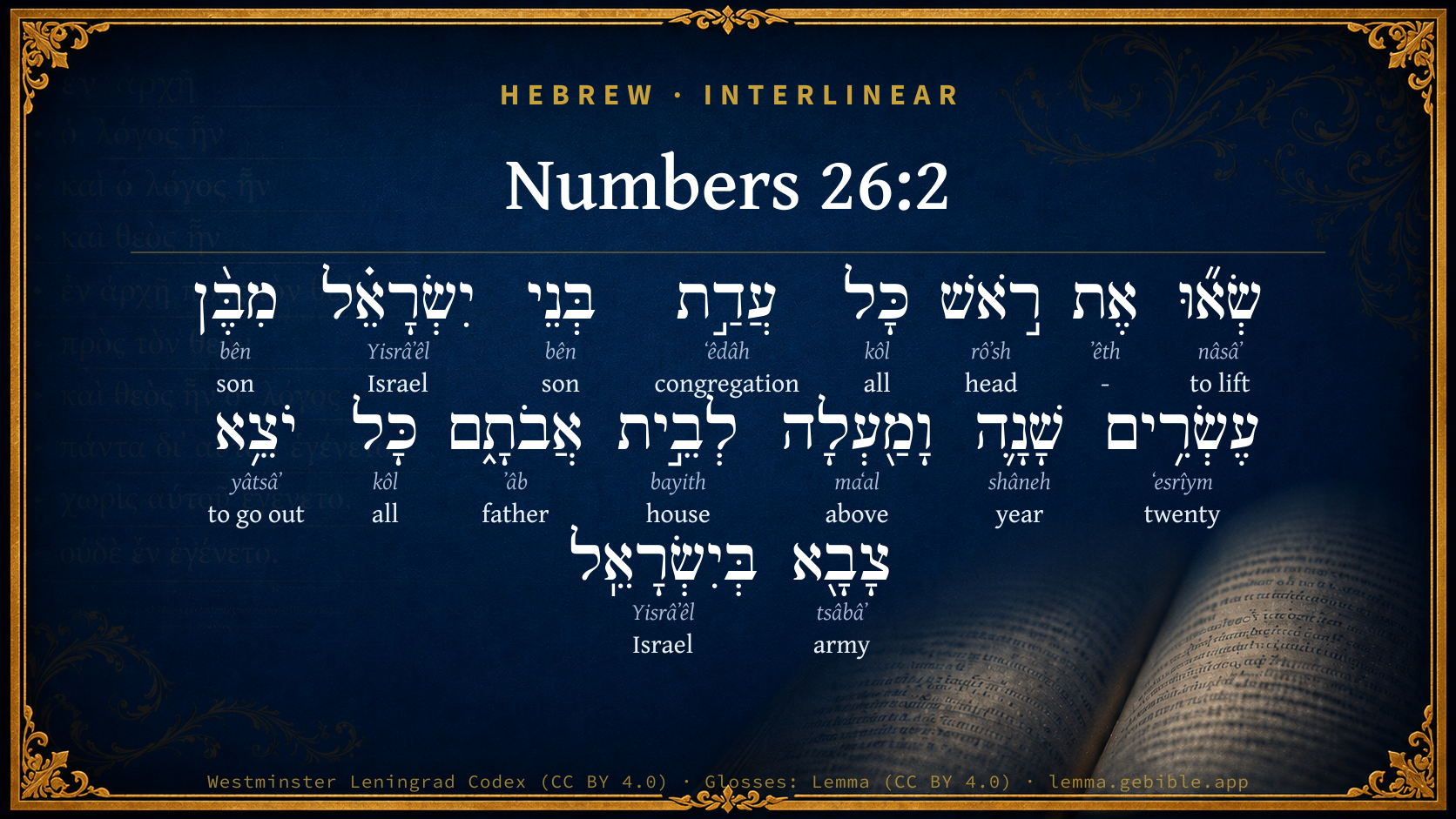
Hebrew (Westminster Leningrad Codex) Numbers 26:2 appears in the Hebrew Old Testament. The text above is from the Westminster Leningrad Codex. Each word links to its Strong’s number, a concise gloss, and parsing drawn from the Open Scriptures Hebrew Bible morphology. Click any word for its full Brown-Driver-Briggs (BDB) entry.
Download image
Cite this verse

Numbers 26:2 (World English Bible). Public Domain. Lemma interlinear Bible study tool, https://lemma.gebible.app/v/numbers/26/2.

Show BibTeX & RIS
BibTeX
RIS
English Translation
Take the sum of all the congregation of the children of Israel, from twenty years old and upward, by their fathers' houses, all who are able to go forth to war in Israel.
World English Bible · Public Domain
Download a study sheet

One document with this verse’s original text, its word-by-word gloss line, the meaning frame, cross-references with their text, attributed commentary, and full source and license credits — printable, and it pastes into notes with its structure intact.

This verse Autodidact and up

Study sheet (.html) Plain text (.txt)

A passage Seminary Student

Up to 50 verses in one chapter. A passage sheet keeps up to 6 commentary sources and 12 cross-references per verse, in the order this page ranks them, and says so on the sheet whenever that leaves anything out. Ask for a single verse and you get the Autodidact verse sheet above.

Everything on this page stays free to read, with no account — the sheet is a download of what is already on screen, not access to it.

Want to remove ads? Support Godless Engineer
Compare translations 3

The same verse in 3 English versions, stacked beneath the original-language interlinear above. Click any original word for its lexicon entry.

Each is an independent rendering of the whole verse — the interlinear is not word-aligned to these translations.

Highlighted words mark where these versions differ — a whole-verse word diff, not a word-by-word alignment.

  • World English Bible Public Domain
    Take the sum of all the congregation of the children of Israel, from twenty years old and upward, by their fathers' houses, all who are able to go forth to war in Israel.
  • King James Version Public Domain
    Take the sum of all the congregation of the children of Israel, from twenty years old and upward, throughout their fathers' house, all that are able to go to war in Israel.
  • unfoldingWord Literal Text CC BY-SA 4.0
    “Lift up the heads of all the congregation of the sons of Israel from a son of 20 years and upward according to the house of their fathers, all who go out to war in Israel.”

unfoldingWord Literal Text — © unfoldingWord, licensed CC BY-SA 4.0. Word-aligned USFM3 via Door43 (git.door43.org/unfoldingWord/en_ult).

Versions to compare (up to 4)

3 of 4 selected

Show all 18 translations

Every available English version of this verse, each an independent rendering of the whole verse.

  • World English Bible Public Domain
    Take the sum of all the congregation of the children of Israel, from twenty years old and upward, by their fathers' houses, all who are able to go forth to war in Israel.
  • Berean Standard Bible Public Domain
    “Take a census of the whole congregation of Israel by the houses of their fathers—all those twenty years of age or older who can serve in the army of Israel.”
  • Majority Standard Bible Public Domain
    “Take a census of the whole congregation of Israel by the houses of their fathers—all those twenty years of age or older who can serve in the army of Israel.”
  • King James Version Public Domain
    Take the sum of all the congregation of the children of Israel, from twenty years old and upward, throughout their fathers' house, all that are able to go to war in Israel.
  • American Standard Version (1901) Public Domain
    Take the sum of all the congregation of the children of Israel, from twenty years old and upward, by their fathers' houses, all that are able to go forth to war in Israel.
  • Revised Version (1885) Public Domain
    Take the sum of all the congregation of the children of Israel, from twenty years old and upward, by their fathers’ houses, all that are able to go forth to war in Israel.
  • Geneva Bible (1599) Public Domain
    Take the nomber of all the Congregation of the children of Israel from twentie yeere olde and aboue throughout their fathers houses, all that go forth to warre in Israel.
  • Douay-Rheims (1899) Public Domain
    Number the whole sum of the children of Israel from twenty years old and upward, by their houses and kindreds, all that are able to go forth to war.
  • Young's Literal Translation Public Domain
    `Take up the sum of all the company of the sons of Israel, from a son of twenty years and upward, by the house of their fathers, every one going out to the host in Israel.'
  • Literal Standard Version CC BY-SA 4.0
    “Take a census of all the congregation of the sons of Israel, from a son of twenty years and upward, by the house of their fathers, everyone going out to the host in Israel.”
  • Unlocked Literal Bible CC BY-SA 4.0
    “Count all the community of the people of Israel, from twenty years old and up, by their ancestor's families, all who are able to go to war for Israel.”
  • unfoldingWord Literal Text CC BY-SA 4.0
    “Lift up the heads of all the congregation of the sons of Israel from a son of 20 years and upward according to the house of their fathers, all who go out to war in Israel.”
  • Darby Bible Public Domain
    Take the sum of the whole assembly of the children of Israel, from twenty years old and upward, according to their fathers' houses, all that go forth to military service in Israel.
  • World Messianic Bible Public Domain
    “Take a census of all the congregation of the children of Israel, from twenty years old and upward, by their fathers’ houses, all who are able to go out to war in Israel.”
  • Webster's Bible Public Domain
    Take the sum of all the congregation of the children of Israel, from twenty years old and upward, throughout their fathers' house, all that are able to go to war in Israel.
  • Free Bible Version CC BY-SA 4.0
    “Census all the Israelites by family—all those twenty years of age or older who are eligible for military service in the army of Israel.”
  • Bible in Basic English Public Domain
    Let all the children of Israel be numbered, by the names of their fathers' families, all those of twenty years old and over who are able to go to war in Israel.
  • JPS Tanakh (1917) Public Domain
    'Take the sum of all the congregation of the children of Israel, from twenty years old and upward, by their fathers' houses, all that are able to go forth to war in Israel.'

Literal Standard Version (2020), Covenant Press — licensed CC BY-SA 4.0. Text via the HelloAO Bible API (eBible.org). Unlocked Literal Bible (unfoldingWord) — licensed CC BY-SA 4.0. Text via the HelloAO Bible API (eBible.org). unfoldingWord Literal Text — © unfoldingWord, licensed CC BY-SA 4.0. Word-aligned USFM3 via Door43 (git.door43.org/unfoldingWord/en_ult). Free Bible Version, Dr. Jonathan Gallagher — licensed CC BY-SA 4.0. Text via the HelloAO Bible API (eBible.org).

Word by word

More ways to search: Search by grammar → Find every occurrence → Compare this word →

Practice this passage: Drill this verse → Learn its vocabulary →

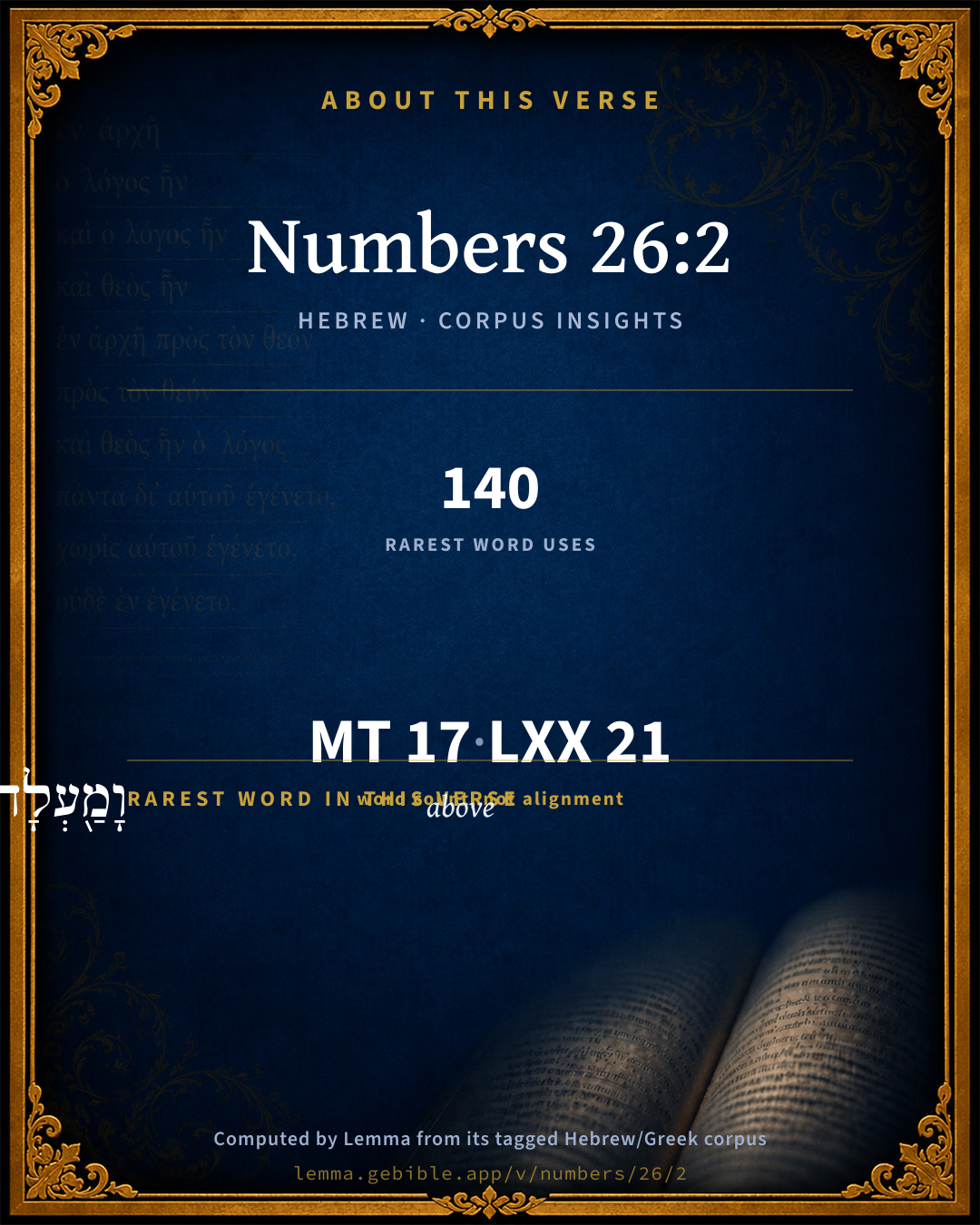
וָמַ֖עְלָה
maʻal
H4605
“and · above · toward”
Conjunction + Adverb + Suffix, Demonstrative
Part of Speech
Conjunction + Adverb
Full BDB Definition

Origin: from H5927

TWOT: 1624k

higher part, upper part (substantive) - above (adverb) - on the top of, above, on higher ground than (preposition) - upwards, higher, above (with locative)
  1. שְׂא֞וּ nâsâʼ H5375 “lift” Verb, Qal, Imperative, 2nd Person, Masculine, Plural
  2. אֶת ʼêth H853 “-” Particle, Direct Object
  3. רֹ֣אשׁ rôʼsh H7218 “head of” Noun, Common, Masculine, Singular, Construct
  4. כָּל kôl H3605 “all of” Noun, Common, Masculine, Singular, Construct
  5. עֲדַ֣ת ʻêdâh H5712 “congregation of” Noun, Common, Feminine, Singular, Construct
  6. בְּנֵי bên H1121 “sons of” Noun, Common, Masculine, Plural, Construct
  7. יִשְׂרָאֵ֗ל Yisrâʼêl H3478 “Israel” Noun, Proper
  8. מִבֶּ֨ן bên H1121 “from · son of” Preposition + Noun, Common, Masculine, Singular, Construct
  9. עֶשְׂרִ֥ים ʻesrîym H6242 “twenty” Adjective, Cardinal number, Both, Plural, Absolute
  10. שָׁנָ֛ה shâneh H8141 “year” Noun, Common, Feminine, Singular, Absolute
  11. לְבֵ֣ית bayith H1004 “to/for · house of” Preposition + Noun, Common, Masculine, Singular, Construct
  12. אֲבֹתָ֑ם ʼâb H1 “fathers · their” Noun, Common, Masculine, Plural, Construct + Suffix, Personal, 3rd Person, Masculine, Plural
  13. כָּל kôl H3605 “all of” Noun, Common, Masculine, Singular, Construct
  14. יֹצֵ֥א yâtsâʼ H3318 “going out” Verb, Qal, Participle Active, Masculine, Singular, Absolute
  15. צָבָ֖א tsâbâʼ H6635 “army” Noun, Common, Both, Singular, Absolute
  16. בְּיִשְׂרָאֵֽל Yisrâʼêl H3478 “in/at · Israel” Preposition + Noun, Proper

About this verse

These counts appear in no published source. They are computed here, from the morphology-tagged text and Lemma’s own curated glosses. What Lemma adds →

17
words
14
distinct lemmas
Pentateuch
section

Grammatical profile

  • 2 verbs
  • 12 nouns
  • 1 adjective
  • 1 adverb
  • 1 particle

Verb forms

  • שְׂא֞וּ Qal · Imperative
  • יֹצֵ֥א Qal · Participle Active

Repetition

Words recur within this verse — often emphatic in Hebrew:

  • כָּל all H3605 ×2
  • בְּנֵי son H1121 ×2
  • יִשְׂרָאֵ֗ל Israel H3478 ×2

Hebrew & Septuagint length

In English translation the verse runs 33 words from the Hebrew and 34 from the Septuagint (LXX English) — closely comparable.

A rough comparison of the two English renderings, which tokenize alike — not a word-level alignment.

Word counts can differ between the Hebrew and the Greek without any difference in meaning — e.g. the Hebrew direct-object marker אֵת has no separate Greek word, and Greek often adds the article ὁ.

In the original languages it is 17 Hebrew tokens and 21 Greek tokens — but the two are counted differently (Hebrew bundles its prefixes and suffixes into one token; the Greek is in lemma form), so that isn’t a like-for-like length.

Cross-references

3

Topical passages linked to Numbers 26:2 in the Treasury of Scripture Knowledge — connected by theme and wording, ordered by reader-vote popularity; previews shown in the World English Bible.

  • Exodus 38:25–26 The silver of those who were numbered of the congregation was one hundred talents, and one thousand seven hundred seventy-five shekels, after the shekel of the sanctuary:
  • Numbers 1:2–3 "Take a census of all the congregation of the children of Israel, by their families, by their fathers' houses, according to the number of the names, every male, one by one;
  • Exodus 30:11–16 Yahweh spoke to Moses, saying,

Cross-references courtesy of OpenBible.info (CC BY 4.0).

Hebrew and Greek witnesses Masoretic Hebrew ↔ Greek Septuagint

The same verse in the two great witnesses to the Old Testament, shown verse-for-verse.

These are two independent witnesses, not word-aligned to each other, and the Septuagint is shown in lemma (dictionary) form.

Hebrew Numbers 26:2 Masoretic · Westminster Leningrad Codex

שְׂא֞וּ אֶת רֹ֣אשׁ כָּל עֲדַ֣ת בְּנֵי יִשְׂרָאֵ֗ל מִבֶּ֨ן עֶשְׂרִ֥ים שָׁנָ֛ה וָמַ֖עְלָה לְבֵ֣ית אֲבֹתָ֑ם כָּל יֹצֵ֥א צָבָ֖א בְּיִשְׂרָאֵֽל

Take the sum of all the congregation of the children of Israel, from twenty years old and upward, by their fathers' houses, all who are able to go forth to war in Israel.

World English Bible · Public Domain

Greek LXX Numbers 26:2 Septuagint · lemma form

λαμβάνω ὁ ἀρχή πᾶς συναγωγή υἱός ἰσραήλ ἀπό εἰκοσαετής καί ἐπάνω κατά οἶκος πατριά αὐτός πᾶς ὁ ἐκπορεύομαι παρατάσσω ἐν ἰσραήλ

Take the sum of all the congregation of the children of Israel, from twenty years old and upward, according to the houses of their lineage, every one that goes forth to battle in Israel.

LXX2012 (modern English Septuagint) · Public Domain

On this verse, Haydock's Catholic Bible Commentary discusses the Septuagint’s reading. Read the note in Commentary ↓

Hebrew: Westminster Leningrad Codex (CC BY 4.0). Greek: Septuagint (public domain); English from LXX2012 (modern English Septuagint) (Public Domain). How the Septuagint differs from the Hebrew →

Targum (Aramaic paraphrase)

2

The Targum is the ancient Jewish Aramaic paraphrase of the Hebrew Scriptures — an interpretive translation, not the Hebrew text itself. Onkelos (literal) and Pseudo-Jonathan (expansive) render the Torah, and Jonathan the Prophets. Coverage is partial: where no permissively-licensed English translation exists for a verse, only the Aramaic is shown. This is verse-level text, not a word-by-word alignment to the Hebrew.

  1. Targum Onkelos Torah (Genesis–Deuteronomy)
    קַבִּילוּ יַת חוּשְׁבַּן כָּל כְּנִשְׁתָּא דִבְנֵי יִשְׂרָאֵל מִבַּר עַשְׂרִין שְׁנִין וּלְעֵילָא לְבֵית אֲבָהַתְהוֹן כָּל נָפֵיק חֵילָא בְּיִשְׂרָאֵל

    (no public-domain English translation for this verse)

    Targum Onkelos — Aramaic: “Onkelos Genesis” (public domain); “Onkelos Exodus” (public domain); “Onkelos Leviticus” (public domain); “Onkelos Numbers” (public domain); “Onkelos Deuteronomy” (public domain). English: “Sefaria Community Translation” (CC0 1.0 (public-domain dedication)); “J.W. Etheridge. The Targums of Onkelos and Jonathan Ben Uzziel on the Pentateuch. London: Longmans, Green, 1862” (public domain). Text via Sefaria.

  2. Targum Pseudo-Jonathan Torah (Genesis–Deuteronomy)
    קַבִּילוּ יַת סְכוּם חוּשְׁבַּן כָּל כְּנִשְׁתָּא דִבְנֵי יִשְרָאֵל מִבַּר עַשְרִין שְׁנִין וּלְעֵילָא לְבֵית אַבְהַתְהוֹן כָּל נָפִיק חֵילָא בְּיִשְרָאֵל

    Take the sum of the account of the whole congregation of the Beni Israel, from twenty years old and upward, according to the house of their fathers, of every one who goeth forth with the host in Israel.

    Targum Pseudo-Jonathan — Aramaic: “Targum Jonathan on Genesis” (public domain); “Targum Jonathan on Exodus” (public domain); “Targum Jonathan on Leviticus” (public domain); “Targum Jonathan on Numbers” (public domain); “Targum Jonathan on Deuteronomy” (public domain). English: “The Targum of Jonathan ben Uzziel, trans. J. W. Etheridge, London, 1862” (public domain). Text via Sefaria.

Commentary

Notes on Numbers 26:2 from classic Christian and Jewish commentators (each source and its license shown beneath its notes). The classic Christian expositions comment on the surrounding passage and are grouped to its opening verse, so a note may address several verses; the Jewish commentaries on the Tanakh (Rashi and others) are per-verse, so they appear only where the commentator wrote on this verse.

Lemma curates 59 commentaries, every one of them public domain or Creative Commons licensed, each selected and text-cleaned for this edition rather than reprinted as found. About our sources →

Trapp's Complete Commentary

John Trapp

Num 26:2 Take the sum of all the congregation of the children of Israel, from twenty years old and upward, throughout their fathers’ house, all that are able to go to war in Israel.

Ver. 2. From twenty.] {See Trapp on "Num 1:3"}

John Trapp, A Commentary or Exposition upon All the Books of the Old and New Testament (1647–1656) — public domain. Text from a community e-Sword module.

The Biblical Illustrator

Joseph S. Exell

Num_26:2

Take the sum of all the congregation.

Divine enumeration

God is a God of numbers. He is always numbering. He may number to find out who are present, but in numbering to find out who are present He soon comes to know who are absent. He knows the total number, but it is not enough for Him to know the totality; He must know whether Davids place is empty, whether the younger son has gone from the fathers house, whether one piece of silver out of ten has been lost, whether one sheep out of a hundred has gone astray. We are all of consequence to the Father, because He does not look upon us through the glory of His majesty, but through the solicitude of His fatherhood and His love. We need this kind of thought in human life: living would be weary work without it. This chapter reads very much like the other chapter in which the census was first taken . . . The historic names are the same, but what a going-down in the detail! We must enter into this thought and follow its applications if we would be wise in history; generic names are permanent, but the detail of life is a panorama continually changing. It is so always and everywhere. The world has its great generic and permanent names, and it is not enough to know these and to recite them with thoughtless fluency. Who could not take the statistics of the world in general names? Then we should have the wise and the foolish, the rich and the poor, the faithful and the faithless, the good and the bad. That has been the record of life from the beginning ; and yet that is too broadly-lined to be of any real service to us in the estimate of human prayers and human moral quality. What about the detailed numbers, the individual men, the particular households, the children in the crowd? It was in these under-lines that the great changes took place. The bold, leading names remained the same, but they stood up like monumental stones over graves in which thousands of men had been buried. So with regard to our own actions; we speak of them too frequently with generic vagueness; we are wanting in the persistent criticism that will never allow two threads of life to be intertangled, that must have them separated and specifically examined. God will have no roughness of judgment, no bold vagueness, no mere striking of averages; but heart-searching, weighing--not the action: any manufactured scales might weigh a deed. He will have the motive weighed, the invisible force, the subtle, ghostly movement that stirs the soul; not to be found out by human wisdom, but to be seized, detected, examined, estimated, and determined by the living Spirit of the living God. The sin of the individual does not destroy the election of the race. Israel is still here, but almost countless thousands of Israelites have sinned and gone to their doom. With all this individual criticism and specific numbering, do not imagine that it lies within the power of any man to stop the purpose or arrest the kingdom of God. There is a consolatory view of all human tumult and change, as well as a view that tries the faith and exhausts the patience of the saint. It is pitiful for any Christian man to talk about individual instances of lapse or faithlessness, as though they touched the infinite calm of the mind of God, and the infinite integrity of the covenant of Heaven. It is so in all other departments of life--why not so on the largest and noblest scale? The nation may be an honest nation, though a thousand felons may be under lock and key at the very moment when the declaration of the national honesty is made; the nation may be declared to be a healthy country, though ten thousand men be burning with fever at the very moment the declaration of health is made. So the Church of the living Christ, redeemed at an infinite cost, sealed by an infinite love, is still the Lambs bride, destined for the heavenly city, though in many instances there may be defalcation, apostasy--yea, very treason against truth and good. Live in the larger thought; do not allow the mind to be distressed by individual instances. The kingdom is one, and, like the seamless robe, must be taken in its unity. Individuals must not trust to ancestral piety. Individual Israelites might have quoted the piety of many who had gone before; but that piety goes for nothing when the individual will is in rebellion against God. No man has any overplus of piety. No man may bequeath his piety to his posterity. A man cannot bequeath his learning-how can he bequeath his holiness? (J. Parker, D. D.)

The apparent insignificance and the real importance of human life

These uninteresting verses suggest--

I. The apparent insignificance of human life. How dull are the details, and how wearisome the repetitions of this chapter! What a number of obscure names of unknown persons it contains!

II. The real importance of human life. This will appear if we consider that--

1. Every man has his own individuality of being and circumstances.

2. Every man has his own possibilities.

3. Every man has his own influence.

4. Every man has his own accountability.

5. Every man is an object of deep interest to God.

To Him nothing is mean, nothing unimportant. (W. Jones.)

The interesting hidden in the commonplace

I. Here is the commonplace.

II. Here is the interesting in the commonplace. If we look into this chapter carefully we shall discover certain words which are suggestive of deep and tender interests. Sons is a word of frequent occurrence so also is the word children; we also read of daughters (Num_26:33), and of a daughter (Num_26:46). A profound human interest attaches to words like these. They imply other words of an interest equally deep and sacred; e.g., father, mother. The humblest, dullest, most commonplace life has its relations. The least regarded person in all the thousands of Israel was Homebodys bairn. We also read of death (Num_26:19); most of the names which are here recorded belonged to men who, were gathered to their fathers; from the time of the twelve sons of Jacob here mentioned to the time of this census in the plains of Moab, many thousands of Israelites had died, of all ranks and of all ages. Reflection upon these facts awakens a mournful interest in the mind.

III. The importance of the commonplace. Impatience of the ordinary and the prosaic is an evidence of an unsound judgment and an unhealthy moral life.

1. Most of lifes duties are commonplace. Yet how important it is that these duties he faithfully fulfilled!

2. The greater number of persons are commonplace.

3. The greater part of life is commonplace. Be it ours to give the charm of poetry to prosaic duties, by doing them heartily; and to ennoble our commonplace lives by living them faithfully and holily. (W. Jones.)

The Biblical Illustrator, edited by Joseph S. Exell (c. 1880s–1900s) — public domain. Text from a community e-Sword module.

Joseph Benson's Commentary

Num 26:2. Take the sum of all the congregation — They were numbered twice before, Exo 30:11-12; Num 1:1-2. Now they are numbered a third time, to demonstrate the faithfulness of God, both in cutting all those off whom he had threatened to cut off, (Num 14:29,) and in a stupendous increase of the people, according to his promise, notwithstanding all their sins, and the sweeping judgments inflicted upon them; and to prepare the way for the equal division of the land, which they were now going to possess.

Joseph Benson's Commentary on the Old and New Testaments (1811–1818) — public domain. Text from a community e-Sword module.

Jamieson, Fausset & Brown

Robert Jamieson, A. R. Fausset & David Brown

Take the sum of all the congregation--The design of this new census, after a lapse of thirty-eight years, was primarily to establish the vast multiplication of the posterity of Abraham in spite of the severe judgments inflicted upon them; secondarily, it was to preserve the distinction of families and to make arrangements, preparatory to an entrance into the promised land, for the distribution of the country according to the relative population of the tribes.

Jamieson, Fausset & Brown — Commentary Critical and Explanatory on the Whole Bible (1871) — public domain (CC PDM 1.0). Text via the HelloAO Bible API.

Adam Clarke's Commentary

Verse 2. Take the sum of all the congregation] After thirty-eight years God commands a second census of the Israelites to be made, to preserve the distinction in families, and to regulate the tribes previously to their entry into the promised land, and to ascertain the proportion of land which should be allowed to each tribe. For though the whole was divided by lot, yet the portions were so disposed that a numerous tribe did not draw where the lots assigned small inheritances. See Nu 26:53-56, and also See Clarke on Nu 1:1.

Adam Clarke's Commentary on the Bible (1810–1826) — public domain. Text from a community e-Sword/MySword module.

Ellicott's Commentary for English Readers

(2) Take the sum . . . —The same command had been given to Moses and Aaron (Num_1:2-3). In that case a man taken out of every tribe, the head of his father’s house, was appointed to assist Moses and Aaron in taking the census. It is probable that the same arrangement was made in the present instance, though it is not recorded.

A Bible Commentary for English Readers, edited by Charles John Ellicott (1878–1897) — public domain. Text from a community e-Sword module.

John Gill's Exposition

Take the sum of all the congregation of the children of Israel,.... Excepting the Levites, who were to be numbered by themselves, and at a different age; this sum was to be taken, that it might appear that all of the old generation that came out of Egypt, of the age at which this sum was taken, were now dead, excepting two, as the Lord had threatened; and partly that as they were now about to enter the land of Canaan, it might be divided to them according to their number; as well as to show the faithfulness of God to his word and promise, that he would multiply and make them fruitful, notwithstanding all their provoking sins and transgressions:

from twenty years old and upwards, throughout their father's house; all of that age in every tribe, house, and family:

all that are able to go to war in Israel; for which they must prepare, being about to enter the land of Canaan, and dispossess and drive out the inhabitants of it.

John Gill's Exposition of the Whole Bible (1746–1763) — public domain (CC PDM 1.0). Text via the HelloAO Bible API.

Haydock's Catholic Bible Commentary

Number. This was done that the general might know what forces he could muster to attack the nations of Chanaan on the west side of the Jordan, and also in order that the lands might be properly distributed. The war lasted seven years, and the distribution of lands was not completed till some time afterwards. It is not clear that those who were not enrolled at this time, as being 20 years of age, would have any portion, except that of their fathers, allotted to them; but it seems, however, rational that those who were arrived at that age when the distribution was made, would have their share like the rest. There were 1820 people fewer than in the register which was taken before, (chap. i.,) thirteen months after the departure from Egypt. The Levites seem not to have been numbered with the utmost exactitude, as only five families are mentioned, (ver. 58, Jansenius,) though there were many more, 1 Paralipomenon xxiii. 6, &c. Their numbers amount to only 23,000. (Calmet) --- They had rather increased in the desert during 38 years; (see chap. iii. 39,) as had also the tribes of Juda, Issachar, and Zabulon, which lay to the east; of Manasses (who perhaps on that account precedes Ephraim) and Benjamin to the west; Dan and Aser to the north. Nephtali proved deficient; so did likewise the tribes of Ruben, Simeon, and Gad, who were stationed to the south of the tabernacle. When they were numbered the first and the second time (Exodus xxxviii. 25, and Numbers i. 46,) they amounted to 603,550, exclusively of the Levites. Now they could only count 601,730 men fit for war. Considering their frequent disasters, it is even a matter of surprise that their ranks were not thinned still more, particularly as we are assured that all who had been numbered before, except Josue and Caleb, the Levites, and such as had kept themselves free from murmuring, had perished, ver. 64. (Haydock) --- In the particular accounts of the tribes, and in the names of persons, the Septuagint frequently differ from the Hebrew. But the total amount agrees.

George Leo Haydock (1774–1849), Haydock's Catholic Family Bible and Commentary, 1859 edition — public domain. Excludes Psalms (Douay-Rheims chapter numbering differs from Protestant) and Deuterocanonical books (Catholic canon only).

Matthew Poole's English Annotations

They were numbered twice before, Exo 30:11,12, and Num 1:1,2. Now they are numbered a third time, partly to demonstrate the faithfulness of God, both in cutting all those off whom he had threatened to cut off, Num 14:29, and in a stupendous increase and multiplication of the people according to his promise, notwithstanding all their sins, and the sweeping judgments inflicted upon them; and partly to prepare the way for the equal division of the land which they were now going to possess.

Matthew Poole's English Annotations on the Holy Bible (1683–1685) — public domain. Text from a community e-Sword/MySword module.

Whedon's Commentary on the Bible

Daniel D. Whedon

2. Take the sum of all the congregation — This census subserved several purposes. (1.) It showed that the entire generation of those who rejected Jehovah at Kadesh-barnea had perished according to the divine threatening. (2.) Their number having diminished instead of having doubled in nearly four decades, as the population of a young and prosperous nation should have done, shows the severity of Israel’s lot while under the ban of Jehovah. (3.) The exact number of each tribe, of its divisions and subdivisions down to the families, was necessary for a just allotment of the land. (1.) The genealogical tables, which may have been lost during the wanderings and mishaps in the wilderness, were now restored.

Twenty years old — Num_1:3, note.

Fathers’ house — Num_1:2, note.

Daniel D. Whedon (gen. ed.), Commentary on the Old and New Testaments (1874–1909) — public domain. Text from a community e-Sword module.

The Pulpit Commentary

Take the sum of all the congregation. This was certainly not commanded with a view to the war against Midian, which was of no military importance, and was actually prosecuted with no more than 12, 000 men. (Num_31:5) A general command to "vex the Midianites" had indeed been given (Num_25:17) on the principle of just retribution, (cf. 2Th_1:6) but no attempt seems to have been made to act upon it until a more specific order was issued. (Num_31:2) In any case the present mustering has to do with something far more important, viz., with the approaching settlement of the people in its own territory. This is clear from the instructions given in verses 52-56, and from the distribution of the tribes into families. From twenty years. See on Num_1:3.

The Pulpit Commentary (1880–1919), ed. H.D.M. Spence-Jones & Joseph S. Exell — public domain. Text from a community e-Sword module.

John Wesley's Explanatory Notes

Take the sum - They were numbered twice before, Exod. xxx, 11, 12 chap. i, 1, 2. Now they are numbered a third time, to demonstrate the faithfulness of God, both in cutting all those off whom he had threatened to cut off, chap. xiv, 29, and in a stupendous increase of the people according to his promise, notwithstanding all their sins, and the sweeping judgments inflicted upon them; and to prepare the way for the equal division of the land, which they were now going to possess.

John Wesley, Explanatory Notes Upon the Whole Bible (1754–1765) — public domain. Text via the GEBible commentary corpus.

Rashi

Rabbi Shlomo Yitzchaki (Rashi)

לבית אבתם [TAKE THE SUM OF THE CONGREGATION] ACCORDING TO THEIR FATHERS’ HOUSE — after their fathers’ tribes shall they reckon their descent, and not after their mothers’ (Bava Batra 109b).

Rashi on the Tanakh — English translations: “The Judaica Press complete Tanach with Rashi, translated by A. J. Rosenberg” (CC BY 4.0); “Pentateuch with Rashi's commentary by M. Rosenbaum and A.M. Silbermann, 1929-1934” (public domain); “The Metsudah Tanach series, Lakewood, N.J” (CC BY 4.0); and “The Book of Joshua, Metsudah Publications, 1997” (CC BY 4.0). Text via Sefaria.

Lesson kit

Teaching starters — assembled from the data on this page, not authored interpretation. Every prompt links to the verse data it draws on. Edit before teaching.

Numbers, in the Pentateuch, opens this verse with 17 words (14 distinct Hebrew lemmas). Its most distinctive word is maʻal (“above”). A historical commentator’s framing appears above. Read the whole chapter for the surrounding context.

Discussion questions

  1. How does “above” (maʻal) shape what this verse is saying?
  2. Exodus 38:25–26 shares this passage’s theme. How do the two illuminate each other?
  3. “all” occurs 2× in this one verse. What is the effect of the repetition?
  4. The translations on this page render this verse differently — a whole-verse word diff, not a word-by-word alignment. What might account for the different wordings?
  5. The verb «שְׂא֞וּ» is Qal Imperative. How does its form color the action?
  6. Reading how Trapp's Complete Commentary and The Biblical Illustrator read this verse, where do the two commentators agree and where do they part?

Things to notice

Reading settings

Reading text

Shown beneath each verse's original-language words.

Old Testament
Old Testament edition

Read the OT as the Masoretic Hebrew (MT) or the Greek Septuagint (LXX).

English shown for the Greek Septuagint (in the Hebrew ↔ Greek comparison).

Comparing translations? Open the Compare panel on any verse page to stack up to four side by side.