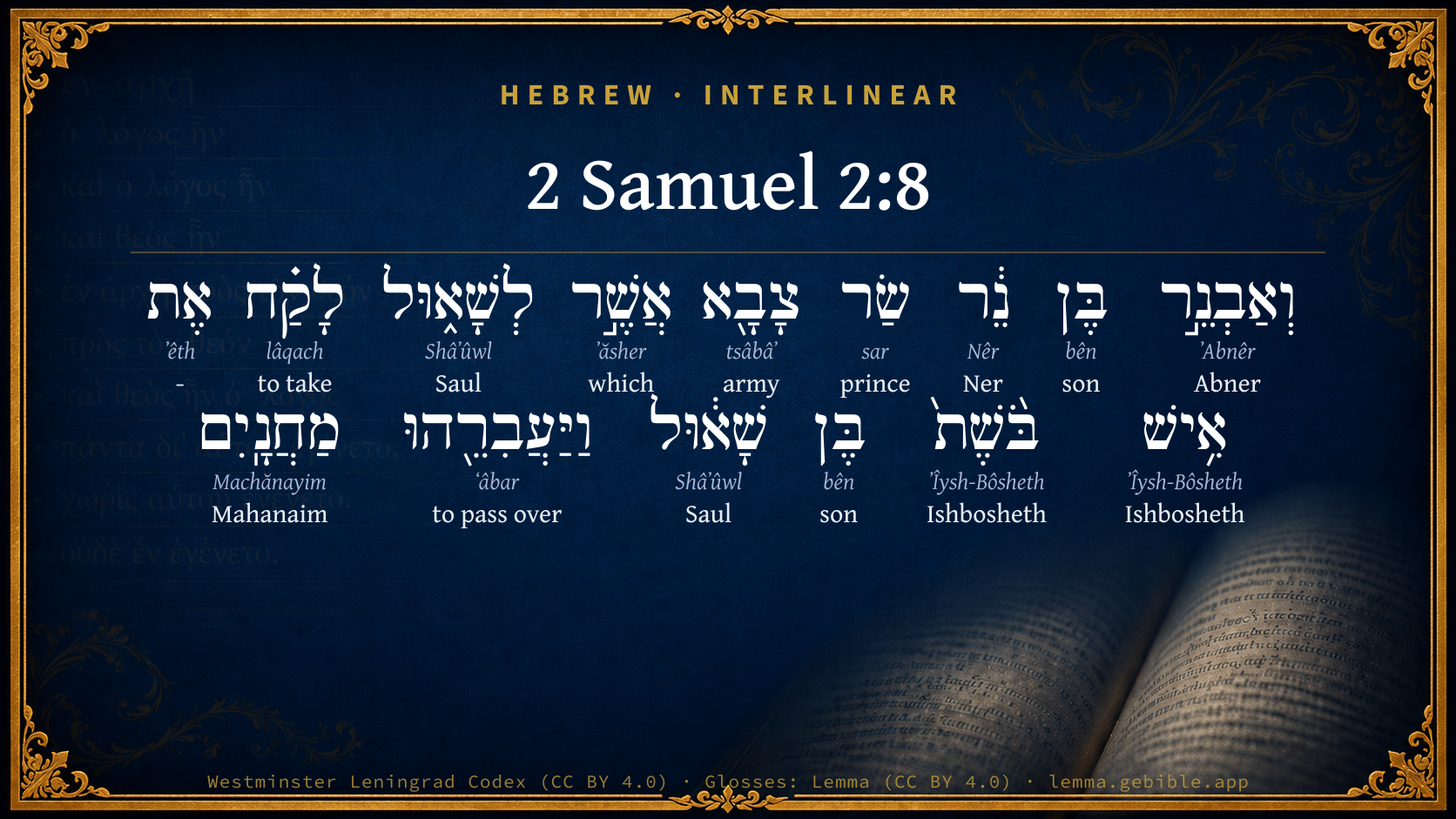
2 Samuel 2:8

Hebrew (Westminster Leningrad Codex) 2 Samuel 2:8 appears in the Hebrew Old Testament. The text above is from the Westminster Leningrad Codex. Each word links to its Strong’s number, a concise gloss, and parsing drawn from the Open Scriptures Hebrew Bible morphology. Click any word for its full Brown-Driver-Briggs (BDB) entry.
Download image
Cite this verse

2 Samuel 2:8 (World English Bible). Public Domain. Lemma interlinear Bible study tool, https://lemma.gebible.app/v/2-samuel/2/8.

Show BibTeX & RIS
BibTeX
RIS
English Translation
Now Abner the son of Ner, captain of Saul's host, had taken Ish-bosheth the son of Saul, and brought him over to Mahanaim;
World English Bible · Public Domain
Highlights
  • 1 first appearance in the Hebrew Bible
Full analysis ↓
Download a study sheet

One document with this verse’s original text, its word-by-word gloss line, the meaning frame, cross-references with their text, attributed commentary, and full source and license credits — printable, and it pastes into notes with its structure intact.

This verse Autodidact and up

Study sheet (.html) Plain text (.txt)

A passage Seminary Student

Up to 50 verses in one chapter. A passage sheet keeps up to 6 commentary sources and 12 cross-references per verse, in the order this page ranks them, and says so on the sheet whenever that leaves anything out. Ask for a single verse and you get the Autodidact verse sheet above.

Everything on this page stays free to read, with no account — the sheet is a download of what is already on screen, not access to it.

Want to remove ads? Support Godless Engineer
Compare translations 3

The same verse in 3 English versions, stacked beneath the original-language interlinear above. Click any original word for its lexicon entry.

Each is an independent rendering of the whole verse — the interlinear is not word-aligned to these translations.

Highlighted words mark where these versions differ — a whole-verse word diff, not a word-by-word alignment.

  • World English Bible Public Domain
    Now Abner the son of Ner, captain of Saul's host, had taken Ish-bosheth the son of Saul, and brought him over to Mahanaim;
  • King James Version Public Domain
    But Abner the son of Ner, captain of Saul's host, took Ishbosheth the son of Saul, and brought him over to Mahanaim;
  • unfoldingWord Literal Text CC BY-SA 4.0
    But Abner, the son of Ner, the commander of the army that to Saul, took Ish Bosheth, the son of Saul, and brought him over Mahanaim.

unfoldingWord Literal Text — © unfoldingWord, licensed CC BY-SA 4.0. Word-aligned USFM3 via Door43 (git.door43.org/unfoldingWord/en_ult).

Versions to compare (up to 4)

3 of 4 selected

Show all 18 translations

Every available English version of this verse, each an independent rendering of the whole verse.

  • World English Bible Public Domain
    Now Abner the son of Ner, captain of Saul's host, had taken Ish-bosheth the son of Saul, and brought him over to Mahanaim;
  • Berean Standard Bible Public Domain
    Meanwhile, Abner son of Ner, the commander of Saul’s army, took Saul’s son Ish-bosheth, moved him to Mahanaim,
  • Majority Standard Bible Public Domain
    Meanwhile, Abner son of Ner, the commander of Saul’s army, took Saul’s son Ish-bosheth, moved him to Mahanaim,
  • King James Version Public Domain
    But Abner the son of Ner, captain of Saul's host, took Ishbosheth the son of Saul, and brought him over to Mahanaim;
  • American Standard Version (1901) Public Domain
    Now Abner the son of Ner, captain of Saul's host, had taken Ish-bosheth the son of Saul, and brought him over to Mahanaim;
  • Revised Version (1885) Public Domain
    Now Abner the son of Ner, captain of Saul’s host, had taken Ish-bosheth the son of Saul, and brought him over to Mahanaim;
  • Geneva Bible (1599) Public Domain
    But Abner the sonne of Ner that was captaine of Sauls hoste, tooke Ish-bosheth the sonne of Saul, and brought him to Mahanaim,
  • Douay-Rheims (1899) Public Domain
    But Abner the son of Ner, general of Saul's army, took Isboseth the son of Saul, and led him about through the camp?
  • Young's Literal Translation Public Domain
    And Abner, son of Ner, head of the host which Saul hath, hath taken Ish-Bosheth, son of Saul, and causeth him to pass over to Mahanaim,
  • Literal Standard Version CC BY-SA 4.0
    And Abner, son of Ner, head of the host which Saul has, has taken Ish-Bosheth, son of Saul, and causes him to pass over to Mahanaim,
  • Unlocked Literal Bible CC BY-SA 4.0
    But Abner son of Ner, commander of Saul's army, took Ishbosheth son of Saul and brought him to Mahanaim.
  • unfoldingWord Literal Text CC BY-SA 4.0
    But Abner, the son of Ner, the commander of the army that to Saul, took Ish Bosheth, the son of Saul, and brought him over Mahanaim.
  • Darby Bible Public Domain
    And Abner the son of Ner, captain of Saul's host, took Ishbosheth the son of Saul, and brought him over to Mahanaim;
  • World Messianic Bible Public Domain
    Now Abner the son of Ner, captain of Saul’s army, had taken Ishbosheth the son of Saul and brought him over to Mahanaim.
  • Webster's Bible Public Domain
    But Abner the son of Ner, captain of Saul's host, took Ish-bosheth the son of Saul, and brought him over to Mahanaim;
  • Free Bible Version CC BY-SA 4.0
    However, Abner, son of Ner, commander of Saul's army, had taken Ishbosheth, son of Saul, to Mahanaim.
  • Bible in Basic English Public Domain
    Now Abner, the son of Ner, captain of Saul's army, had taken Saul's son Ish-bosheth over to Mahanaim,
  • JPS Tanakh (1917) Public Domain
    Now Abner the son of Ner, captain of Saul's host, had taken Ish-bosheth the son of Saul, and brought him over to Mahanaim;

Literal Standard Version (2020), Covenant Press — licensed CC BY-SA 4.0. Text via the HelloAO Bible API (eBible.org). Unlocked Literal Bible (unfoldingWord) — licensed CC BY-SA 4.0. Text via the HelloAO Bible API (eBible.org). unfoldingWord Literal Text — © unfoldingWord, licensed CC BY-SA 4.0. Word-aligned USFM3 via Door43 (git.door43.org/unfoldingWord/en_ult). Free Bible Version, Dr. Jonathan Gallagher — licensed CC BY-SA 4.0. Text via the HelloAO Bible API (eBible.org).

Word by word

More ways to search: Search by grammar → Find every occurrence → Compare this word →

Practice this passage: Drill this verse → Learn its vocabulary →

מַחֲנָֽיִם
Machănayim
H4266
“Mahanaim”
Noun, Proper
Part of Speech
Noun
Type
Proper
Full BDB Definition

Origin: dual of H4264

TWOT: None

Mahanaim = "two camps" - a place east of the Jordan, named from Jacob's encounter with angels - a Levitical city in Gad
  1. וְאַבְנֵ֣ר ʼAbnêr H74 “and · Abner” Conjunction + Noun, Proper
  2. בֶּן bên H1121 “son of” Noun, Common, Masculine, Singular, Construct
  3. נֵ֔ר Nêr H5369 “Ner” Noun, Proper
  4. שַׂר sar H8269 “prince of” Noun, Common, Masculine, Singular, Construct
  5. צָבָ֖א tsâbâʼ H6635 “army” Noun, Common, Both, Singular, Absolute
  6. אֲשֶׁ֣ר ʼăsher H834 “which” Particle, Relative
  7. לְשָׁא֑וּל Shâʼûwl H7586 “to/for · Saul” Preposition + Noun, Proper
  8. לָקַ֗ח lâqach H3947 “to take” Verb, Qal, Perfect, 3rd Person, Masculine, Singular
  9. אֶת ʼêth H853 “-” Particle, Direct Object
  10. אִ֥ישׁ ʼÎysh-Bôsheth H378 “Ishbosheth” Noun, Proper
  11. בֹּ֨שֶׁת֙ ʼÎysh-Bôsheth H378 “Ishbosheth” Noun, Proper
  12. בֶּן bên H1121 “son of” Noun, Common, Masculine, Singular, Construct
  13. שָׁא֔וּל Shâʼûwl H7586 “Saul” Noun, Proper
  14. וַיַּעֲבִרֵ֖הוּ ʻâbar H5674 “and · to pass over · him” Conjunction + Verb, Hiphil, Sequential Imperfect, 3rd Person, Masculine, Singular + Suffix, Personal, 3rd Person, Masculine, Singular

About this verse

These counts appear in no published source. They are computed here, from the morphology-tagged text and Lemma’s own curated glosses. What Lemma adds →

15
words
12
distinct lemmas
Historical
section

Notable vocabulary

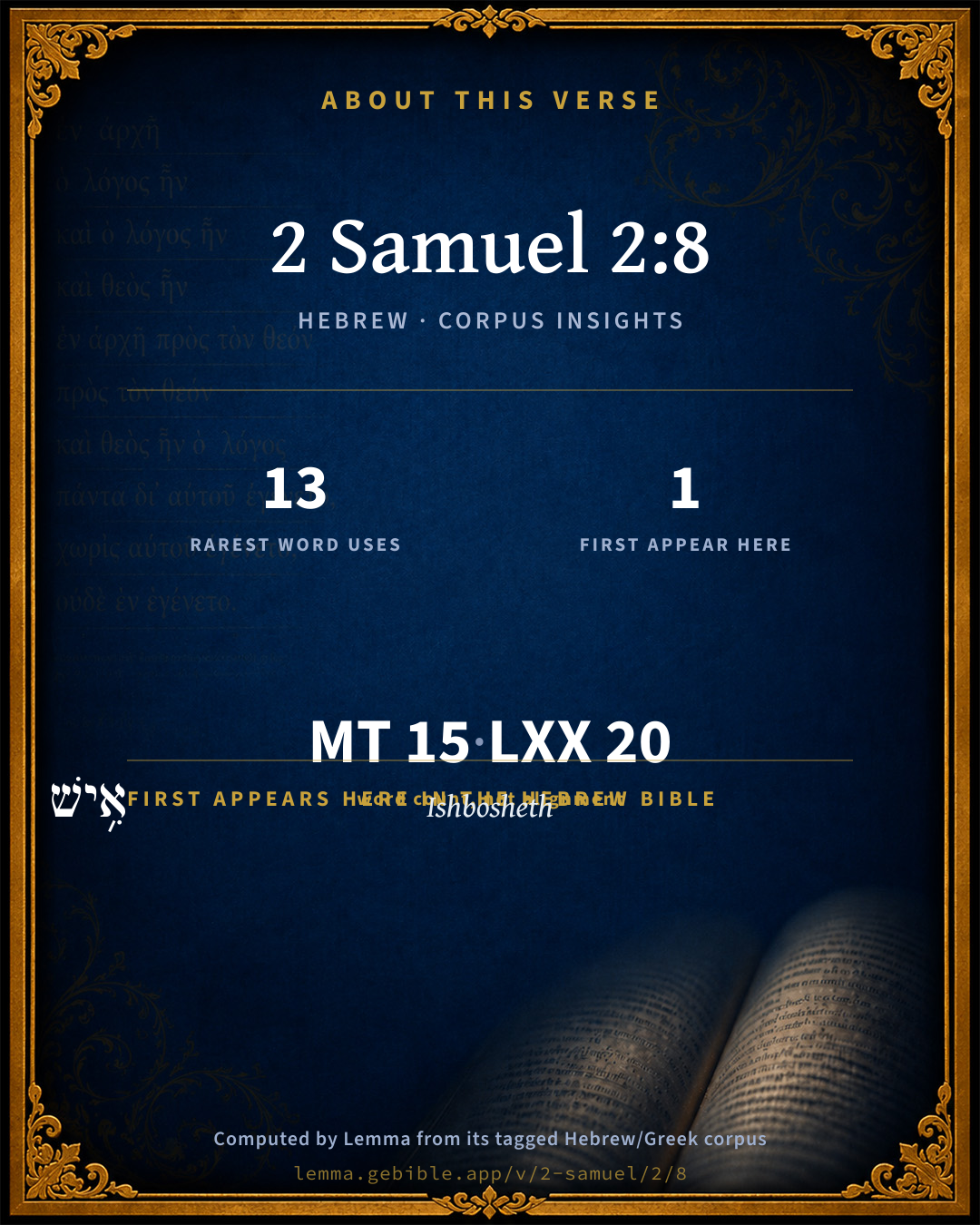
The rarest word here is מַחֲנָֽיִם Mahanaim H4266 — appearing just 13 times in the whole Hebrew Bible.

First appearance in Scripture

This word makes its first canonical appearance in the Hebrew Bible here:

  • אִ֥ישׁ Ishbosheth H378

Shared distinctive vocabulary

מַחֲנָֽיִם Mahanaim H4266 occurs in 13 verses of the Hebrew Bible. Also found in:

Grammatical profile

  • 2 verbs
  • 11 nouns
  • 2 particles

Verb forms

  • לָקַ֗ח Qal · Perfect
  • וַיַּעֲבִרֵ֖הוּ Hiphil · Sequential Imperfect

Repetition

Words recur within this verse — often emphatic in Hebrew:

  • בֶּן son H1121 ×2
  • לְשָׁא֑וּל Saul H7586 ×2
  • אִ֥ישׁ Ishbosheth H378 ×2

Hebrew & Septuagint length

In English translation the verse runs 23 words from the Hebrew and 25 from the Septuagint (LXX English) — closely comparable.

A rough comparison of the two English renderings, which tokenize alike — not a word-level alignment.

Word counts can differ between the Hebrew and the Greek without any difference in meaning — e.g. the Hebrew direct-object marker אֵת has no separate Greek word, and Greek often adds the article ὁ.

In the original languages it is 15 Hebrew tokens and 20 Greek tokens — but the two are counted differently (Hebrew bundles its prefixes and suffixes into one token; the Greek is in lemma form), so that isn’t a like-for-like length.

Cross-references

9

Topical passages linked to 2 Samuel 2:8 in the Treasury of Scripture Knowledge — connected by theme and wording, ordered by reader-vote popularity; previews shown in the World English Bible.

  • 1 Samuel 14:50 and the name of Saul's wife was Ahinoam the daughter of Ahimaaz. The name of the captain of his host was Abner the son of Ner, Saul's uncle.
  • Genesis 32:2 When he saw them, Jacob said, "This is God's host." He called the name of that place Mahanaim.
  • 1 Samuel 17:55 When Saul saw David go forth against the Philistine, he said to Abner, the captain of the host, Abner, whose son is this youth? Abner said, As your soul lives, O king, I can't tell.
  • 1 Samuel 26:14 and David cried to the people, and to Abner the son of Ner, saying, Don't you answer, Abner? Then Abner answered, Who are you who cries to the king?
  • 2 Samuel 3:7–8 Now Saul had a concubine, whose name was Rizpah, the daughter of Aiah: and [Ish-bosheth] said to Abner, Why have you gone in to my father's concubine?
  • 2 Samuel 4:5–6 The sons of Rimmon the Beerothite, Rechab and Baanah, went, and came about the heat of the day to the house of Ish-bosheth, as he took his rest at noon.
  • 2 Samuel 17:26–27 Israel and Absalom encamped in the land of Gilead.
  • 1 Chronicles 8:33 Ner became the father of Kish; and Kish became the father of Saul; and Saul became the father of Jonathan, and Malchishua, and Abinadab, and Eshbaal.
  • 1 Chronicles 9:39 Ner became the father of Kish; and Kish became the father of Saul; and Saul became the father of Jonathan, and Malchishua, and Abinadab, and Eshbaal.

Cross-references courtesy of OpenBible.info (CC BY 4.0).

Hebrew and Greek witnesses Masoretic Hebrew ↔ Greek Septuagint

The same verse in the two great witnesses to the Old Testament, shown verse-for-verse.

These are two independent witnesses, not word-aligned to each other, and the Septuagint is shown in lemma (dictionary) form.

Hebrew 2 Samuel 2:8 Masoretic · Westminster Leningrad Codex

וְאַבְנֵ֣ר בֶּן נֵ֔ר שַׂר צָבָ֖א אֲשֶׁ֣ר לְשָׁא֑וּל לָקַ֗ח אֶת אִ֥ישׁ בֹּ֨שֶׁת֙ בֶּן שָׁא֔וּל וַיַּעֲבִרֵ֖הוּ מַחֲנָֽיִם

Now Abner the son of Ner, captain of Saul's host, had taken Ish-bosheth the son of Saul, and brought him over to Mahanaim;

World English Bible · Public Domain

Greek LXX 2 Samuel 2:8 Septuagint · lemma form

καί αβεννηρ υἱός νηρ ἀρχιστράτηγος ὁ σαούλ λαμβάνω ὁ ιεβοσθε υἱός σαούλ καί ἀναβιβάζω αὐτός ἐκ ὁ παρεμβολή εἰς μαναεμ

But Abenner, the son of Ner, the commander-in-chief of Saul's army, took Jebosthe son of Saul, and brought him up from the camp to Manaem

LXX2012 (modern English Septuagint) · Public Domain

On this verse, Keil & Delitzsch discusses the Septuagint’s reading. Read the note in Commentary ↓

Hebrew: Westminster Leningrad Codex (CC BY 4.0). Greek: Septuagint (public domain); English from LXX2012 (modern English Septuagint) (Public Domain). How the Septuagint differs from the Hebrew →

Targum (Aramaic paraphrase)

1

The Targum is the ancient Jewish Aramaic paraphrase of the Hebrew Scriptures — an interpretive translation, not the Hebrew text itself. Onkelos (literal) and Pseudo-Jonathan (expansive) render the Torah, and Jonathan the Prophets. Coverage is partial: where no permissively-licensed English translation exists for a verse, only the Aramaic is shown. This is verse-level text, not a word-by-word alignment to the Hebrew.

  1. Targum Jonathan Prophets (Joshua–Malachi)
    וְאַבְנֵר בַּר נֵר רַב חֵילָא דִי לְשָׁאוּל דְבַר יַת אִישׁ בּוֹשֶׁת בַּר שָׁאוּל וְאַעֲבִירֵיהּ לְמַחֲנָיִם:

    (no public-domain English translation for this verse)

    Targum Jonathan — Aramaic: “Mikraot Gedolot” (public domain). English: “Sefaria Community Translation” (CC0 1.0 (public-domain dedication)); “London "Chaldee Paraphrase," 1871” (public domain). Text via Sefaria.

Commentary

Notes on 2 Samuel 2:8 from classic Christian and Jewish commentators (each source and its license shown beneath its notes). The classic Christian expositions comment on the surrounding passage and are grouped to its opening verse, so a note may address several verses; the Jewish commentaries on the Tanakh (Rashi and others) are per-verse, so they appear only where the commentator wrote on this verse.

Lemma curates 59 commentaries, every one of them public domain or Creative Commons licensed, each selected and text-cleaned for this edition rather than reprinted as found. About our sources →

Jamieson, Fausset & Brown

Robert Jamieson, A. R. Fausset & David Brown

ABNER MAKES ISH-BOSHETH KING OVER ISRAEL. (Sa2 2:8-17)

Abner the son of Ner, captain of Saul's host took Ish-bosheth--Here was the establishment of a rival kingdom, which, however, would probably have had no existence but for Abner.

Ish-bosheth--or "Esh-baal" (Ch1 8:33; Ch1 9:39). The Hebrews usually changed names ending with Baal into Bosheth ("shame") (compare Jdg 9:53 with Sa2 11:21). This prince was so called from his imbecility.

Abner--was first cousin of Saul, commander of the forces, and held in high respect throughout the country. Loyalty to the house of his late master was mixed up with opposition to David and views of personal ambition in his originating this factious movement. He, too, was alive to the importance of securing the eastern tribes; so, taking Ish-bosheth across the Jordan, he proclaimed him king at Mahanaim, a town on the north bank of the Jabbok, hallowed in patriarchal times by the divine presence (Gen 32:2). There he rallied the tribes around the standard of the unfortunate son of Saul.

Jamieson, Fausset & Brown — Commentary Critical and Explanatory on the Whole Bible (1871) — public domain (CC PDM 1.0). Text via the HelloAO Bible API.

Trapp's Complete Commentary

John Trapp

2Sa 2:8 But Abner the son of Ner, captain of Saul’s host, took Ishbosheth the son of Saul, and brought him over to Mahanaim;

Ver. 8. But Abner the son of Ner.] An ambitionist and an atheist; for he went against God’s express command, and the light of his own conscience, {2Sa 3:9} to bring about his own designs, and to keep himself in the saddle; but it turned to his own ruin, and his master’s also: so vain a thing is it to strive against God. But "all men have not faith," and are therefore "unreasonable and wicked." {2Th 3:2}

Took Ishbosheth.] Passing by Mephibosheth, the rightful heir, because young and lame, he setteth up Ishbosheth, a weak, unworthy man: as thinking to rule all under him, using him as a stale, or stalking horse: whence, {2Sa 3:6} not Ishbosheth but Abner is said to have made himself strong for the house of Saul.

And brought him over to Mahanaim.] Which was beyond Jordan, and not far from Jabeshgilead: which town David had so courted, and Abner therefore might be jealous of, and would thus overawe.

John Trapp, A Commentary or Exposition upon All the Books of the Old and New Testament (1647–1656) — public domain. Text from a community e-Sword module.

The Biblical Illustrator

Joseph S. Exell

2Sa_2:8

Ishbosheth.

Isbosheth and Abner

Saul's son was a poor, weak creature, who would never have thought of resisting David but for the stronger will behind him. To be weak is, in this world full of tempters, to drift into being wicked. We have to learn betimes to say No, and to stick to it. Moral weakness attracts tempters as surely as a camel fallen by the caravan track draws vultures from every corner of the sky. The fierce soldier who fought for his own hand while professing to be moved by loyalty to the dead king, may stand as a type of the self-deception with which we gloss over our ugliest selfishness with fine names, and for an instance of the madness which leads men to set themselves against God's plans, and therefore to be dashed in pieces, as some slim barrier reared across the track of a train would be. To rush against the thick bosses of the Almighty's buckler does no harm to the buckler, but kills the insane assailant. (A. Maclaren, D. D.)

The Biblical Illustrator, edited by Joseph S. Exell (c. 1880s–1900s) — public domain. Text from a community e-Sword module.

Joseph Benson's Commentary

2Sa 2:8. Abner took Ish-bosheth — Abner was not only Saul’s general, but his near kinsman also, and in this instance his interest and ambition, and perhaps also envy, strongly influenced him. He knew that Ish-bosheth, if advanced to the sovereignty, would only have the name of a king, while he himself had the power. It appears, however, sufficiently from the sequel of his history, that he was well acquainted with David’s divine designation to the throne; but should he now submit to it he must no more hope for the chief command of the army. Joab was in possession of that under David, and well deserved to be so; and it was not probable he would displace him, a tried friend and a near kinsman, (being the son of Zeruiah, David’s sister,) to make way for an inveterate enemy newly reconciled. Nor was this all; Ish-bosheth was Abner’s near kinsman; whom, if he did not support, the interest of his tribe and of his family must fall with his own. Add to all this, that Abner commanded under Saul in all the expeditions he made against David; and it appears sufficiently from the history that David was greatly an over-match for him in all military conduct. Thus envy, ambition, interest, and personal pique led him to espouse the cause of Ish- bosheth, whom he brought over Jordan with him to Mahanaim, a place in the tribe of Gad, (Jos 13:26,) which he chose for his residence, the better to gain that part of the country to his interest, to be more out of the reach of David’s and the Philistines’ incursions, and to have the better opportunity of recruiting his army among a people not only brave and courageous, but well affected to the cause he had espoused. See Delaney.

Joseph Benson's Commentary on the Old and New Testaments (1811–1818) — public domain. Text from a community e-Sword module.

The Pulpit Commentary

Abner. This hero had been present at the battle of Gilboa, and probably had rallied many of the defeated Israelites, and made as much resistance as was possible to the onward march of the Philistines. And as soon as he had effected his retreat into the region beyond the Jordan, his power would be supreme. There was no one there to oppose the commander-in-chief of what remained of Saul"s army. Certainly all that remained of Saul"s body guard of three thousand men would gather round Abner, and as the Philistines did not push their pursuit further than the Jordan, he was free to do as he chose. Nor would there be any opposition. Abner was bound to do his best for Saul"s family, and the people would feel this, and approve of his conduct in standing up for the children of their king. Moreover, David by his conduct had made himself an object of suspicion to all the valiant men who had formed Saul"s army, and these would be the more embittered against him by their defeat. Ishbosheth. This name signifies "man of shame," that is, "man of the shameful thing," the idol. Originally he was named Eshbaal, (1Ch_8:33 1Ch_9:39) that is "man of Baal," the word esh being merely a dialectic variation for ish, equivalent to "man." At this early date Baal was not the specific name of any idol, but simply meant "lord," "master," "husband." In the earlier books of the Bible we find the word used of many local deities, who were lords of this or that, but had nothing in common with the Phoenician Baal, whose worship Ahab attempted to introduce into Israel. From that time Baal became a term of reproach, and Bosheth, "the shame," was substituted for it in the old names of which it had formed part. Thus Gideon is still called Jerubbaal in 1Sa_12:11, but the title is transformed into Jerubbesheth, or more correctly, Jerubbosheth, "let the shame plead," in 2Sa_11:21. Originally, therefore, the name Ishbaal had no discreditable meaning, but signified, "man of the Lord," or, as Ewald supposes, "lordly man." It was not till long afterwards, when Israel had been horrified by Jezebel"s doings, that Baal, except in the sense of "husband," became an ill-omened word. Jonathan, whose own name, "Jehovah"s gift," in Greek Theodore, is proof sufficient that Saul"s family were worshippers of the true God, called his son"s name Meribbaal, "the Lord"s strife". (1Ch_8:34) In some strange way this was altered into Mephibosheth, that is, "from the face of the shameful thing" (ch. 4:4. etc.). Possibly it is a corruption of Meribbosheth, but it is remarkable that a son of Saul by his concubine Rizpah also bore the name. (2Sa_21:8) Among the ancestors of Saul, the simple name Baal, "Lord," occurs. (1Ch_8:30) Mahanaim. Abner chose this town because it was on the eastern side of the Jordan, and so beyond the range of the Philistines, who never seem to have crossed the river. It was situated on the borders of the tribe of Gad and the half-tribe of Manasseh, from both of which valiant warriors had joined David; hut the people generally were not ill affected to the house of Saul. As having been assigned to the Levites, (Jos_21:38) it had a quasi-religious character, inherited from the vision of angels seen there by Jacob. (Gen_32:2) As a safe, out of the way place, David subsequently took refuge there. (2Sa_17:24) (On its exact site, see Conder"s "Heth and Moab," pp. 177-181.)

Vers. 8-17.

Fanatical patriotism.

The facts are:

1. By degrees, and with the aid of Abner, those parts of the country not subject to David, and which, during the decay of Saul"s power, had come under the control of the Philistines, now became consolidated under the rule of Ishbosheth.

2. The jealousy between Israel and Judah, owing mostly to the hostility ofIshbosheth"s adherents to David, assumes threatening form, and the leaders on each side, attended by a small army, come together face to face, probably to consider the points in dispute.

3. The political questions not being solved by discussion, Abner proposes (vers. 13, 14; cf. ver. 27) as alternative a settlement by a combat of twelve select men from each side.

4. The combat issuing in mutual destruction, the main forces come intoconflict, and Abner suffers defeat. The men who entered into the strife here recorded doubtless prided themselves on the zeal they felt for their country, and were ready to justify in words the deeds of the sword. It is customary to credit people with patriotism, and to that extent condone their savage passions. But too often the plea of patriotism is only a cover for a lack of reason and a domination of inferior impulses.

I ATTACHMENT TO KING AND COUNTRY IS SUBORDINATE TO A HIGHER LAW. Considered in the abstract, such attachment is worthy only of admiration, and it forms an element in a people"s well being. But human feelings, with their corresponding acts, are parts of a great complex whole and their worth in any particular concrete instance depends on antecedent and concomitant facts. There is a gradation of obligations, and virtues in name cease to be virtues in reality when they appear in isolation, or consequent on a disregard of a higher law. The men of Israel were bound to love their country, and to show love to it by asserting the rights of their ruler. But at the same time they were bound to follow the guidance of God; to submit to his supreme will; and, making this the standard of feeling and action, to modify the form of expressing love to country and ruler accordingly. Now, the men of Israel, especially the leaders, ought to have known, from the events and words of Samuel"s life, and, indeed, from the manifest interposition in favour of David and against Saul, that it was the Divine will that they should not oppose David; that, in fact, love of country was to show itself in accepting whom God had chosen. Any personal interest, therefore, which they may have felt in a son of Saul, and any regard top what they deemed the good of their native land, should have shaped its form of expression in harmony with their primary and higher obligation. The principle is of wide range. Any passion for our country and sovereign must be exercised within the limits of a higher love. If so-called patriotism involves hatred of men as men, or injustice to them, or national selfishness, then it is a violation of the second great commandment. If upholding a ruler and seeking to subdue a neighbouring ruler involves a contravention of God"s will, revealed in the order of manifest Providence or Scripture, then it is a spurious patriotism. Human feelings are not the tests of truth.

II BLENDED IGNORANCE AND PASSION ENTAIL SUFFERING AND SLOW PROGRESS IN NATIONAL LIFE. Had Israel been alive to the lessons which God was teaching them all through the life of Saul, by means of Samuel and David and Jonathan, they would never have allowed the sentiment of interest in a monarch"s son to have developed into a strong aversion to David and a passionate effort to expel him from Judah. Considering all the facts of the case, there is no valid excuse for their ignorance, and, therefore, none for their feelings, even though patriotism be pleaded. Thus we see how neglect to gather up and use the lessons of Providence, slight an evil as it may seem to be at the time, really is the seed sowing of the innumerable miseries of a civil war. If, during those painful years of contention, the energies of men are diverted from industrial channels into the wasting channels of war, and if, consequently, national progress is retarded, the cause is to be found in the domination of ignorance and passion. So has it been again and again. That vox populi has always been vox Dei is little less than blasphemy. Generations looking back on their ancestors see how wars and strifes took their rise in stupidity; and yet, too often, there is an unwillingness to pause lest the same evil be repeated. The woes that have come upon nations in consequence of war are a dark foil, setting forth in wondrous light the wisdom and sweet reasonableness of the gospel of Christ. If peoples would find the clue to progressive national development, let them accept and put into practice the sober, generous precepts and principles of the New Testament. This harmony of Christ"s religion with economic law is no feeble strand in the evidence of its Divine origin.

III THE GREAT ERROR OF LEADERS TOO OFTEN LIES IN THEIR INDISPOSITION TO TRACE OUT THE LEADINGS OF THE HIGHER LAW. Abner"s suggestion that the dispute should be settled by combat of twelve on each side was an appearance of humanity and sobriety as compared with the indiscriminate use of force. But in the light of reason it is absurd; for right cannot be constituted by chance superiority of might.

The complication in which he found himself was simply the result of previous indisposition to find out the Divine meaning of Samuel"s dealings with Saul and of Jonathan"s compact with David. (1Sa_13:11-16 1Sa_15:24-31 1Sa_16:6-13 1Sa_20:12-17; cf. 16:57; 26:3-16) It had been easier to follow the family feeling and official impulse (1Sa_14:50; 2Sa_2:8, 2Sa_2:9) than to look at private and public interests in the light of such revelations of God"s will as were then available. It is a good maxim in moral questions that first promptings are best. The voice of conscience is quick to speak, even though in low tone, Most probably Abner recognized that voice telling of God"s will in David. But where there is an unwillingness, because of personal or other interests, to give heed to that voice, it soon becomes easier to follow the lower impulses; and when once on the slippery incline of lower impulse, every movement adds to the momentum downwards. Herein lies the danger of our public men. They especially need the "light of the Lord." Expediency and wrong principles gain on them unconsciously in so far as they lose the primary sensitiveness of conscience. The contagion of their spirit and conduct affects the lower orders. They will have no difficulty in finding men willing, under the cover of patriotic sentiment, to enter the "field of sharp edges," and kill and be killed. Hence, it behoves preachers and all good men to bring the light of the higher law of life to bear with all its clearness and directness on the minds of those in authority.

Vers. 8-12. (MAHANAIM.)

Opposition to the Divine purpose.

The purpose of God, to make David king over his people, was as yet only in part accomplished; and its fulfilment was opposed by Abner (1Sa_14:50 1Sa_17:55 1Sa_20:25 1Sa_26:5) on behalf of "the house of Saul." Having escaped from the battle of Gilboa, he "took Ishbosheth, the son of Saul" (a man of feeble character, and fitted to become a tool in his hands), "and brought him over to Mahanaim, and made him king over Gilead," etc. After five years of great exertions (while David reigned peacefully at Hebron) he drove the Philistines out of the country, openly proclaimed Ishbosheth (now forty years old) "king over all Israel," and "went out from Mahanaim to Gibeon" with the view of subjecting Judah to his sway. His principal motive was the desire of maintaining and increasing his own power. "He was angry that this tribe had set up David for their king" (Josephus). His conduct was "not only a continuation of the hostility of Saul towards David, but also an open act of rebellion against Jehovah" (Keil), whose purpose, as well as the wish of the elders of Israel, he well knew, as he afterwards acknowledged. (2Sa_3:17, 2Sa_3:18) His opposition represents and illustrates that of men to the purposes of God generally, and more especially to his purpose, that Christ shall reign over them and all mankind; of which observe that

I IT IS PLAINLY REVEALED. By the testimony of:

1. The Divine Word. (1Sa_16:1) "To him give all the prophets witness," etc. (Act_10:43; 1Pe_1:11)

2. Significant events, in confirmation of the Word; the overthrow of adversaries, the exaltation of "his Chosen," the growth of his power. (Act_2:22-24)

3. The irresistible convictions of reason and conscience, and the confessions which even opponents have been constrained to make. Abner was present when Saul said, "Thou shalt both do great things and shalt also still prevail". (1Sa_26:25) His opposition was therefore inexcusable. "While men go on in their sins, apparently without concern, they are often conscious that they are fighting against God" (Scott).

II IT MAY BE WICKEDLY OPPOSED (in virtue of the freedom which, within certain limits, men possess) because of:

1. The delusions of unbelief. The tempter whispers as of old, "Yea, hath God said?"; (Gen_3:1) they "wilfully forget" what has taken place; (2Pe_3:5) "neither will they be persuaded" of the truth and obligation of the Word of God. (Luk_16:31)

1. The plea of present expediency, and the expectation that, if they must submit, there will come a "more convenient season" for doing so. Abner thought "that he might be able, upon better terms, to make his peace with David when the time should come that the Lord was to advance him to be ruler over all Israel" (Chandler).

2. Selfishness, pride, and ambition; the love of pleasure and power, the habit of self-will, the self-confidence engendered by success, "the mind of the flesh," which "is enmity against God. Ye do always resist the Holy Ghost". (Act_7:51)

III IT CANNOT BE EFFECTUALLY DEFEATED. "He must reign," in fulfilment of the Divine decree, (Psa_2:7 Psa_110:1) which:

1. Changes not. "The Strength of Israel will not lie, nor repent". (1Sa_15:29)

2. Is effected by infinite wisdom and might, against which the skill andstrength of men contend in vain.

3. Comes to pass either with or without their will, in mercy or in judgment,in the salvation of the penitent or the destruction of the persistently rebellious "These mine enemies which would not that I should reign over them bring hither and slay them before me". D. (Luk_19:27)

The Pulpit Commentary (1880–1919), ed. H.D.M. Spence-Jones & Joseph S. Exell — public domain. Text from a community e-Sword module.

The Preacher's Complete Homiletical Commentary

Joseph S. Exell (gen. ed.)

CRITICAL AND EXPOSITORY NOTES—

2Sa_2:8. “Took Ishbosheth.” Rather had taken. “Ishbosheth had probably been in the battle of Gilboa, and fled with Abner across the Jordan after the battle had been lost.” (Keil.) “Mahanaim,” On the eastern side of the Jordan, north of the brook Jabbok (Gen_32:2-3). Ishbosheth or “Esh-baal” (see 1Ch_8:33). Literally son of Baal. “It seems probable that the name Baal (lord) was in early times given to the God of Israel, and proper names were formed from it afterwards. When the worship of the false Baal was introduced into Israel the change into Bosheth, or shame, was made. Possibly this change was made by later editors and scribes, and the original form was retained in the Book of Chronicles because this book was less read than the prophetic historical books.” (Transr. of Lange’s Commentary.)

2Sa_2:9. “Over,” rather for, etc. The use of this preposition seems to indicate that the title was assumed before the places named really became subject to Ishbosheth. “Gilead,” the whole of trans-Jordanic Israelitish territory. “Ashurites.” This name cannot be identified, and commentators vary greatly in the opinions concerning the people here referred to. “Jezreel.” The plain as well as the city, so-called, which had just been occupied by the Philistines, and therefore must have needed to be re-conquered by Abner. “All Israel,” i.e., all the rest excepting Judah.

2Sa_2:10. “Two years.” It is not quite clear how these words are to be understood, inasmuch as it seems certain that Ishbosheth was proclaimed king immediately after Saul’s death, and we know that he reigned until the time (seven and a half years later) when David became king over all Israel. He reigned two years, may be understood to mean that five years and a half were occupied in re-conquering the territory from the Philistines, so that Ishbosheth was only a nominal king during that period. Or the last clause of 2Sa_2:10 and 2Sa_2:11 may be regarded as a parenthesis, and the two years taken as referring to the time which elapsed before the event recorded in the following paragraph. Each of these interpretations has been adopted by eminent Biblical scholars, but the latter seems most in keeping with the movement of Abner which is now recorded.

2Sa_2:12. To “Gibeon.” Now “El-Jib” in the western part of Benjamin, about six miles north of Jerusalem. He came here, doubtless, with the view of subduing Judah also to the rule of Ishbosheth, and it is remarked by Erdmann that he would not have taken this step if he had not already subdued the Philistines.

2Sa_2:13. “Joab, the son of Zeruiah.” This man here for the first time comes forward in the history of David. “He had no doubt already, as his brother Abishai, had a military training with his uncle, and had taken a prominent position among his warriors, else he would not now appear as the chief leader of David’s forces. In the roll of heroes, in 2Sa_23:8, his name is not given, probably because his name already stood above them all as general, as we may conjecture from 2Sa_23:18; 2Sa_23:24.” (Erdmann.). Zeruiah was David’s sister, and is most likely named, instead of her husband, to show Joab’s relation to David. “The pool of Gibeon.” A spring still “issues in a cave excavated in the limestone rock, so as to form a large reservoir. In the trees farther down are the remains of a pool or tank of considerable size, probably, says Dr. Robinson, 120 feet by 100.” (Biblical Dictionary.). This is the “great water” mentioned by Jeremiah (Jer_41:12).

2Sa_2:14. “Play.” Here used to denote the war-play of single combat. (Keil.)

2Sa_2:15. “Went over.” They probably met at some intermediate place. (Transr. of Lange’s Commentary.)

2Sa_2:16. “Helkath-hazzurim,” i.e., The field of knives, or sharp edges. Everyone must recall to mind the similar combat of the Horatii and the Curatii of Roman history (Livy i. 25). “These single combats still occur among the Arabs.” (Trans. of Lange’s Commentary.)

2Sa_2:17. “A sore battle.” Consequent upon the undecisive nature of the single combat.

2Sa_2:21. “And Abner said,” etc. Abner’s speaking supposes that Asahel had already overtaken him. “Take his armour,” i.e., after slaying him.

2Sa_2:22. “How, then, should I,” etc. “Abner did not want to put the young hero to death, out of regard for Joab and their former friendship.” (Keil.)

2Sa_2:23. “The hinder end of the spear.” He used the hinder end from his desire to spare Asahel’s life. But owing to his great strength and prowess, the wooden end which was more or less pointed to enable the owner to stick it into the ground (1Sa_27:7), ran into his body.” (Biblical Commentary.)

2Sa_2:24. “Ammah.” … “Giah.” Nothing further is known about these places.

2Sa_2:27. “If thou,” etc. “If thou hadst not by that challenge given the signal for the battle, then early in the morning one side would have retreated before the other, and the battle would not have occurred.… In Joab’s address and bearing it may be seen that he would not have made the attack, but that his march against Abner was simply to protect the territory of Judah.” (Erdmann.) Keil, Lightfoot, Patrick, Wordsworth, and others agree with Erdmann’s interpretation, but others understand Joab to say, “Even if thou hadst not spoken, the pursuit would have ceased to-morrow morning.”

2Sa_2:29. “The plain,” or the “Arabah,” the deep gorge of the Jordan. “Having marched first from the battle-field directly east towards Jericho.” (Erdmann.) “All Bithron,” rather “All the Bithron.” As the word signifies a cutting, it was probably a name given to some ravine between Jordan and Mahanaim.

2Sa_2:31. “Three hundred and threescore.” “This striking disproportion in the numbers may be accounted for from the fact that in Joab’s army there were none but brave and well-tried men, who had gathered round David a long time before; whereas in Abner’s army there were only the remnants of those who had been beaten upon Gilboa, and who had been still further weakened and depressed by their attempts to recover the land which was occupied by the Philistines.” (Keil.)

2Sa_2:32. “They burled him.” Bethlehem lay only a little to the left of the road between Gibeon and Hebron, and about fifteen miles from the latter place.

MAIN HOMILETICS OF THE PARAGRAPH.—2Sa_2:8-32

ABNER’S OPPOSITION TO DAVID

I. Self-will is a sin that dies hard. We should have thought before experience that the humiliating disaster at Gilboa would have been sufficient to bring Abner and the men of Israel into grateful submission to God’s will concerning the person who was to be their ruler. Having but barely escaped with their own lives, and having to mourn the best and bravest of their kindred, it might have been expected they would gladly welcome one under whose rule they might look for God’s protection and their own consequent security and comfort. But their own way was yet so much dearer to them than God’s way that to have it they were willing to enter upon all the miseries of a civil war. Abner, as he himself afterwards confesses (2Sa_3:9), knew that the Lord had sworn unto David to translate the kingdom from the house of Saul, yet he is here found the most prominent person concerned in the elevation of Ishbosheth to the kingship. If his followers could plead ignorance of the Divine will in the matter, their leader could not, and his act must be regarded as a declaration that, whatever God had said, he would do as he pleased. He was not, however, we may well believe, so honest a man as to permit himself thus to interpret his own conduct, but probably sheltered himself behind some plea of necessity or policy. The sin of Abner and his followers is the sin of all men who, when the will of God is plainly revealed either by His word or providence, set up their own in opposition to it—who, when the finger-post of duty points in one direction, choose another because they are so deluded as to fancy there is something to be gained by it.

II. The sin of one often affects the destiny of many. All the bloodshed by the pool of Gibeon on this day must be laid to the account of one man. Joab spoke truly when he said (2Sa_2:27) that Abner’s word was the spark that lighted the fire of battle which afterwards raged so fiercely, and with such special fatality among his own men. Although each man had to some extent the power of individual choice when he followed his general into the field, yet position and ability give some so great an influence over others that the few who possess them have the many in a large measure in their hands, and are the makers of their weal or woe, so far at least as this life is concerned. If such a man as Abner had not put forth a rival to David, we may conclude with certainty that there would have been no organised opposition to him, and this murderous affray and the civil strife of the following years would have been avoided. The same may be said of most of the wars that have cursed the world. They have almost all been to gratify the ambition of one or two, and thousands have been the sufferers. This dependence of the many upon the few is one of the facts of human life, and often one of its mysteries. If not an ordination of God, it is certainly a Divine permission; and unless society were all upon a dead level it is hard to see how it could be otherwise. And although this incident shows its dark side, we know it has a bright one—a side which will efface the darkness when all leaders and rulers of men have learnt of Him who rules to save and to redeem souls from deceit and violence, and in whose sight the blood of His followers is precious. (Psa_72:13-14.)

OUTLINES AND SUGGESTIVE COMMENTS

Even the Amalekite could carry the crown to him as the true owner: yet there wants not an Abner to resist him, and the title of an Ishbosheth to colour his resistance. If any of Saul’s house could have made challenge to the crown, it should have been Mephibosheth, the son of Jonathan, who, it seems, had too much of his father’s blood to be a competitor with David: the question is, not who may claim the most right, but who may best serve the faction: neither was Ishbosheth any other than Abner’s stale.—Bp. Hall.

2Sa_2:10. When David came into possession of his kingdom, even yet he remained quiet awhile, without considering how he might increase it, because he cast all this care upon Divine Providence. He thus shames the behaviour of those spiritual men, who, when they recognise that God wishes to do something through them, are constantly making attempts and all sorts of beginnings to see whether they may, perhaps, achieve the work, and are never willing in patience and self-forgetfulness to wait on God, until God Himself performs His will. The hour must come itself, and so it must simply be waited for.—Berlenberger Bible.

2Sa_2:13. A righteous war is a royal duty, from which no prince can venture to withdraw, even if it were fraternal war. It may have come hard to David to take up war against his brothers, and yet he could not do otherwise. God the Lord had Himself given the arms into his hand.—Schlier.

2Sa_2:23. See here

(1). How often death comes upon us by ways that we least suspect. Who would fear the hand of a flying enemy, or the buttend of a spear?

(2). How we are often betrayed by the accomplishments we are proud of. Asahel’s swiftness, which he presumed so much upon, did him no kindness, but forwarded his fate.—Henry.

2Sa_2:18-23. (A Sunday-school address.) The rash young prince.

1. He had a shining gift (2Sa_2:18). In ancient warfare more were often slain in the pursuit than in the battle; and so swiftness of foot was important in a warrior.

2. He was ambitious—pursuing the distinguished general of the enemy.

3. He had decision and perseverance—turning not to the right or left, and yielding to no persuasion.

4. He fancied himself superior to an old man—a common and natural, but grave fault in the young.

5. He was slain as the penalty of self-confidence and rashness—besetting sins of many gifted youths.—Translator of Lange’s Commentary.

2Sa_2:26. This may have been a mere stroke of policy, or it may have been the promptings of conscience bringing home the guilt of the slaughter to himself. What he probably meant was, that matters might remain as they were, Ishbosheth reigning over the ten tribes, and David over Judah.… He who had been so keen for war in the morning, was still more keen for peace in the evening, for it is not easy for a man with even a shred of conscience to think of nearly four hundred of his own brethren lying dead on the field of battle, and to remember that the responsibility of the terrific slaughter lies at his own door.—Blaikie.

The Preacher's Complete Homiletical Commentary (gen. ed. Joseph S. Exell; Funk & Wagnalls, c. 1892) — public domain (pre-1929). A full-Bible homiletical/sermon-outline anthology covering 65 of 66 books (2 John is absent from the source module). Text from a community e-Sword module.

The Annotated Bible

Arno C. Gaebelein

3. Abner’s Revolt and the War which Followed

CHAPTER 2:8-32

1. Abner makes Ish-bosheth king over Israel (2Sa 2:8-11)

2. The defeat of Abner (2Sa 2:12-17)

3. Abner and Joab and Joab’s victory (2Sa 2:18-32)

God’s king began his reign in quietness, and opposition and open revolt followed at once. Abner, who had been the captain of Saul’s host, took a son of Saul by the name of Ish-bosheth and made him king in Gilead. The original name of this son was “Esh-baal,” which means “the fire of Baal” (1Ch 8:33). “Ish-bosheth” was his other name; it means “man of shame.” He seems to have been a weakling and a tool in Abner’s hand. Ish-bosheth’s influence was soon extended over all Israel and the false King ruled, while David was only acknowledged by the faithful men of Judah. David’s reign over Judah was seven years and six months. Here are faint hints of what will be repeated in the future history of Israel. Another Ish-bosheth, a pretender to the throne of Israel, the false king, will be in the earth. He comes in his own name, with no claim whatever to the throne. And the true King, like David, will only be acknowledged by a faithful remnant of his people. The seven years and a half remind us of the last period of Israel’s history when these things come to pass. However, Ish-bosheth’s weakness and especially his end makes a fuller application on these lines impossible.

The other prominent person is Joab, the son of Zeruiah, who went out with the servants of David. (Joab was David’s nephew. See 1Sa 26:6; 1Ch 2:16.) They met Abner’s force about six miles northwest of Jerusalem by the pool of Gibeon. Then followed at Abner’s suggestion a conflict between twelve young men of Benjamin, the subjects of Ish-bosheth, and twelve of David’s servants. A wicked scene followed. They slaughtered each other at Helkathhazzurim, “the field of sharp swords,” after which there was a severe battle which ended with the defeat of Abner. All this shows the sorrowful conditions which existed among Israel, foreshadowing again the worse conditions throughout this age and especially at the close of it. Then follows the record of the three sons of Zeruiah, Joab, Abishai and Asahel. Asahel followed hard after Abner and though repeatedly warned by Abner, continued in his pursuit till Abner in self-defense slew him. The battle ended with the loss of nineteen servants of David and Asahel, while Abner lost 360 men. “Shall the sword devour forever?” was Abner’s question. As long as God’s true King does not occupy the throne, ruling in righteousness and in peace, wars and bloodshed will continue. The sword cannot be stopped till He reigns. In His coming kingdom nations will learn war no more and beat their swords into plowshares.

Arno C. Gaebelein, The Annotated Bible (1913–1922) — public domain. Text from a community e-Sword module.

Tyndale Open Study Notes

Tyndale Open Resources

2:8 Abner: See study note on 1 Sam 20:25. • Mahanaim was located east of the Jordan River, deep in the highlands of Gilead near a plentiful source of fresh water. Saul and his family had close ties to Gilead (1 Sam 11:1-11; 31:11-13). Locating east of the Jordan made Ishbosheth’s regime less susceptible to attack by David’s forces. This same area was later King David’s temporary refuge after Absalom’s coup (2 Sam 17:24, 27). • Ishbosheth means “man of shame.” His original name, Esh-baal, means “man of Baal.” The name Baal (“lord, master, possessor”) was associated with a pagan Canaanite deity (e.g., see Num 25:3), so it is likely that Ishbosheth’s name was later changed because of that association.

Tyndale Open Study Notes — © Tyndale Open Resources, licensed CC BY-SA 4.0. Text via the HelloAO Bible API.

Matthew Henry's Commentary

Here is, I. A rivalship between two kings - David, whom God made king, and Ishbosheth, whom Abner made king. One would have thought, when Saul was slain, and all his sons that had sense and spirit enough to take the field with him, David would come to the throne without any opposition, since all Israel knew, not only how he had signalized himself, but how manifestly God had designated him to it; but such a spirit of contradiction is there, in the devices of men, to the counsels of God, that such a weak and silly thing as Ishbosheth, who was not thought fit to go with his father to the battle, shall yet be thought fit to succeed him in the government, rather than David shall come peaceably to it. Herein David's kingdom was typical of the Messiah's, against which the heathens rage and the rulers take counsel, Psa 2:1, Psa 2:2. 1. Abner was the person who set up Ishbosheth in competition with David, perhaps in his zeal for the lineal succession (since they must have a king like the nations, in this they must be like them, that the crown must descend from father to son), or rather in his affection to his own family and relations (for he was Saul's uncle), and because he had no other way to secure to himself the post of honour he was in, as captain of the host. See how much mischief the pride and ambition of one man may be the occasion of. Ishbosheth would never have set up himself if Abner had not set him up, and made a tool of him to serve his own purposes. 2. Mahanaim, the place where he first made his claim, was on the other side Jordan, where it was thought David had the least interest, and being at a distance from his forces they might have time to strengthen themselves. But having set up his standard there, the unthinking people of all the tribes of Israel (that is, the generality of them) submitted to him (Sa2 2:9), and Judah only was entirely for David. This was a further trial of the faith of David in the promise of God, and of his patience, whether he could wait God's time for the performance of that promise. 3. Some difficulty there is about the time of the continuance of this competition. David reigned about seven years over Judah only (Sa2 2:11), and yet (Sa2 2:10) Ishbosheth reigned over Israel but two years: before those two years, or after, or both, it was in general for the house of Saul (Sa2 3:6), and not any particular person of that house, that Abner declared. Or these two years he reigned before the war broke out (Sa2 2:12), which continued long, even the remaining five years, Sa2 3:1.

II. An encounter between their two armies.

1. It does not appear that either side brought their whole force into the field, for the slaughter was but small, Sa2 2:30, Sa2 2:31. We may wonder, (1.) That the men of Judah did not appear and act more vigorously for David, to reduce all the nation into obedience to him; but, it is likely, David would not suffer them to act offensively, choosing rather to wait till the thing would do itself or rather till God would do it for him, without the effusion of Israelitish blood; for to him, as a type of Christ, that was very precious, Psa 72:14. Even those that were his adversaries he looked upon as his subjects, and would treat them accordingly. (2.) That the men of Israel could in a manner stand neuter, and sit down tamely under Ishbosheth, for so many years, especially considering what characters many of the tribes displayed at this time (as we find, Ch1 12:23, etc.): Wise men, mighty men, men of valour, expert in war, and not of double heart, and yet for seven years together, for aught that appears, most of them seemed indifferent in whose hand the public administration was. Divine Providence serves its own purposes by the stupidity of men at some times and the activity of the same persons at other times; they are unlike themselves, and yet the motions of Providence are uniform.

2. In this battle Abner was the aggressor. David sat still to see how the matter would fall, but the house of Saul, and Abner at the head of it, gave the challenge, and they went by the worst. Therefore go not forth hastily to strive, nor be forward to begin quarrels, lest thou know not what to do in the end thereof, Pro 25:8. A fool's lips and hands enter into contention.

3. The seat of the war was Gibeon. Abner chose it because it was in the lot of Benjamin, where Saul had the most friends; yet, since he offered battle, Joab, David's general, would not decline it, but there joined issue with him, and met him by the pool of Gibeon, Sa2 2:13. David's cause, being built upon God's promise, feared not the disadvantages of the ground. The pool between them gave both sides time to deliberate.

4. The engagement was at first proposed by Abner, and accepted by Joab, to be between twelve and twelve of a side. (1.) It should seem this trial of skill began in sport. Abner made the motion (Sa2 2:14): Let the young men arise and play before us, as gladiators. Perhaps Saul had used his men to these barbarous pastimes, like a tyrant indeed, and Abner had learnt of him to make a jest of wounds and death and divert himself with the scenes of blood and horror. He meant, "Let them fight before us," when he said, "Let them play before us." Fools thus make a mock at sin. but he is unworthy the name of a man that can be thus prodigal of human blood, that can thus throw about firebrands, arrows, and death, and say, Am not I in sport? Pro 26:18, Pro 26:19. Joab, having been bred up under David, had so much wisdom as not to make such a proposal, yet had not resolution enough to resist and gainsay it when another made it; for he stood upon a point of honour, and thought it a blemish to his reputation to refuse a challenge, and therefore said, Let them arise; not that he was fond of the sport, or expected that the duels would be decisive, but he would not be hectored by his antagonist. How many precious lives have thus been sacrificed to the caprices of proud men! Twelve of each side were accordingly called out as champions to enter the lists, a double jury of life and death, not of others', but their own; and the champions on Abner's side seem to have been most forward, for they took the field first (Sa2 2:15), having perhaps been bred up in a foolish ambition thus to serve the humour of their commander-in-chief. But, (2.) However it began, it ended in blood (Sa2 2:16): They thrust every man his sword into his fellow's side (spurred on by honour, not by enmity); so they fell down together, that is, all the twenty-four were slain, such an equal match were they for one another, and so resolute, that neither side would either beg or give quarter; they did as it were by agreement (says Josephus) dispatch one another with mutual wounds. Those that strike at other men's lives often throw away their own and death only conquers and rides in triumph. The wonderful obstinacy of both sides was remembered in the name given to the place: Heldath-hazzurim - the field of rocky men, men that were not only strong in body, but of firm and unshaken constancy, that stirred not at the sight of death. Yet the stout-hearted were spoiled, and slept their sleep, Psa 76:5. Poor honour for men to purchase at so vast an expense! Those that lose their lives for Christ shall find them.

5. The whole army at length engaged, and Abner's forces were routed, Sa2 2:17. The former was a drawn battle, in which all were killed on both sides, and therefore they must put it upon another trial, in which (as it often happens) those that gave the challenge went away with loss. David had God on his side; his side therefore was victorious.

Matthew Henry's Commentary on the Whole Bible (1708–1710) — public domain (CC PDM 1.0). Text via the HelloAO Bible API.

Adam Clarke's Commentary

Verse 8. Abner the son of Ner] This man had long been one of the chief captains of Saul's army, and commander-in-chief on several occasions; he was probably envious of David's power, by whom he had often been out-generalled in the field.

Adam Clarke's Commentary on the Bible (1810–1826) — public domain. Text from a community e-Sword/MySword module.

Ellicott's Commentary for English Readers

(8) But Abner the son of Ner.—According to 1Ch_9:36, Ner was the brother of Kish, Saul’s father. Abner was therefore the cousin-german of Saul, and had been made by him the commander in chief of his army (1Sa_14:51). He was thus, both by kindred and office, strongly attached to the house of Saul. He had been with Saul in his pursuit of David, and may have resented David’s address to him on that occasion (1Sa_26:14-16). There is no statement of the time that had elapsed after the death of Saul before Ish-bosheth was set up as king by Abner, but it was probably four or five years, for the following reasons: Ish-bosheth reigned only two years (2Sa_2:10), but David appears to have been acknowledged as king over all Israel soon after his death, and had then reigned over Judah alone seven and a half years. Again, at the death of Saul all the northern part of the country was under the control of the Philistines, and some time must have elapsed before the Israelites would have been in condition to make themselves a new king; and, finally, Ish-bosheth was the youngest of Saul’s sons, born apparently some time after he came to the throne, and he was now forty years old (2Sa_2:10), Saul himself having reigned about forty years (Act_13:21).

Ish-bosheth.—Called in 1Ch_8:33; 1Ch_9:39, “Eshbaal” (the fire of Baal), just as his nephew, Mephibosheth (2Sa_4:4), is called in the same places Meribaal, and Gideon’s surname Jerubbaal (Jdg_6:32; Jdg_8:35) is changed to Jerubbesheth (2Sa_11:21). These names compounded with Baal may have been originally given, as certainly was the case with Jerubbaal, in consequence of the manful opposition to idolatry of those who bore them, and have been subsequently changed to a compound with “bosheth” (shame), in view of the sequel of their histories; or, on the other hand, in the case of Saul’s family the compound with Baal may have been a later name, given in view of their opposition to the divinely appointed king, and to mark God’s utter rejection of the house of Saul.

Mahanaim, famous in the story of Jacob (Gen_32:2), was on the east of the Jordan, and not far from the brook Jabbok. A Levitical city (Jos_21:38), in comparative safety from the Philistines, was well chosen by Abner for the coronation and residence of his new king. Mahanaim afterwards became the place of refuge for David in his flight from Absalom (2Sa_17:24). The expression “brought him over” refers to the crossing of the Jordan.

A Bible Commentary for English Readers, edited by Charles John Ellicott (1878–1897) — public domain. Text from a community e-Sword module.

The Cambridge Bible for Schools and Colleges

gen. ed. J. J. S. Perowne

8–11. Ish-bosheth set up by Abner as a rival to David

8. Abner] Both by his relationship of first cousin to Saul (1Sa_14:50, note), and by his office as commander of the army, Abner was marked out as the natural champion of Saul’s house.

took] Better, had taken. The historian goes back to relate events immediately succeeding the battle of Gilboa. Abner had escaped from the fatal field and carried Ish-bosheth with him across the Jordan, whither it would seem there was a general retreat, while the country west of the Jordan was abandoned to the Philistines (1Sa_31:7).

Ish-bosheth] Saul’s fourth son, not previously mentioned, was a mere tool in the hands of Abner. His original name, as given in the genealogies in 1Ch_8:33; 1Ch_9:39, was Esh-baal (= man of Baal), but this has been changed to Ish-bosheth (= man of shame), to avoid the scandal of pronouncing the name of the false god Baal. Compare the substitution of Mephibosheth for Meribbaal (2Sa_4:4; 1Ch_8:34), and Jerubbesheth for Jerubbaal (2Sa_11:21; Jdg_8:35), and see Hos_9:10; Jer_11:13. There are indications that Esh-baal was the original reading here, and the change may have been made in books commonly read, while the original form was retained in the genealogy.

As regards the origin of the name, it is a question whether it was a relic of the old Baal worship, or whether baal (=lord) was at one time used as a title of Jehovah until discredited by idolatry (Hos_2:16).

to Mahanaim] Mahanaim (= two hosts), “the spot consecrated by the presence of God in primeval times, where Jacob had divided his people into ‘two hosts,’ and had seen the ‘two hosts’ of the angelic vision” (Gen_32:2; Gen_32:10), was chosen by Abner as the capital of Ish-bosheth’s kingdom. Afterwards it became the retreat of David when he fled from Absalom (ch. 2Sa_17:24), and at that time was a fortified town with walls and gates (ch. 2Sa_18:24). It was situated on the frontier between Gad and Manasseh (Jos_13:26; Jos_13:30), but its exact position has not been identified with certainty. Canon Tristram places it at Mahneh, a few miles E. of Jabesh-Gilead (Land of Israel, p. 474).

The Cambridge Bible for Schools and Colleges (gen. ed. J. J. S. Perowne; Cambridge University Press, 1878–1918) — public domain. Text from a community e-Sword module.

John Gill's Exposition

But Abner, the son of Ner, captain of Saul's host,.... This man's father, Ner, was Saul's uncle, Sa1 14:50, and he was his own cousin, and being general of his army, a post he was willing to keep, might be the reasons for doing what he did, as follows:

took Ishbosheth the son of Saul; and who seems to be his only son left, except what he had by his concubine. This man's name is Eshbaal in Ch1 8:33. Baal is the name of a shameful idol, and which was therefore sometimes called Bosheth, "shame". See Hos 9:10; wherefore such names of men, which had Baal in them, were changed for Besheth or Bosheth, as the names of Jerubbaal and Meribbaal, who were called Jerubbesheth and Mephibosheth. See Jdg 8:35; compared with Sa2 11:21, and Sa2 4:4 with Ch1 8:34. The latter of these, a son of Jonathan, bid fairest for the crown by lineal succession, but he being but five years of age, and lame, this man Abner judged fittest for his purpose; and though he knew it was the will of God, and he had sworn that David should be king, yet so blind and obstinate was his ambition, that he set up another against him:

and brought him over to Mahanaim; a city on the other side Jordan, in the tribe of Gad, on the border of the half tribe of Manasseh; see Jos 13:26; and hither Abner had Ishbosheth, partly to keep the men of Jabeshgilead in awe, to whom David had sent messengers, acquainting them with his being king of Judah, and prevent their joining with him; and partly that he might be at a proper distance both from the Philistines and from David, till he could form his measures, and gradually carry his point, as he did.

John Gill's Exposition of the Whole Bible (1746–1763) — public domain (CC PDM 1.0). Text via the HelloAO Bible API.

Albert Barnes' Notes on the Bible

Mahanaim - See Gen 32:2. From 2Sa 2:12 it would seem to have been Ish-bosheth’s capital.

Albert Barnes' Notes on the Bible (1834–1885) — public domain. Text from a community e-Sword/MySword module.

Haydock's Catholic Bible Commentary

Camp. Hebrew Machanayim, which many take for a proper name (Calmet) of the town, on the river Jabok, where Jacob had encamped, Genesis xxxii. 2. (Haydock) --- Abner was aware that he should not retain his authority under David, and therefore conducted Isboseth to the camps in various places, (Menochius) but chiefly on the east side of the Jordan, (Haydock; ver. 29.) where the people were particularly attached to Saul’s family. Isboseth seems to have been a fit tool for his purpose.

George Leo Haydock (1774–1849), Haydock's Catholic Family Bible and Commentary, 1859 edition — public domain. Excludes Psalms (Douay-Rheims chapter numbering differs from Protestant) and Deuterocanonical books (Catholic canon only).

Matthew Poole's English Annotations

Partly out of envy and malice against David; and partly out of his own ambition and desire of rule, because he knew that Ish-bosheth would have only the name of king, whilst he had the power.

Ish-bosheth, called also Esh-baal, 1Ch 8:33; 9:39; it being usual with the Hebrews, instead of Baal, the name of false gods, to put Bosheth, which signifies shame, or confusion, or a shameful thing; as appeareth by comparing Jdg 9:53, with 2Sa 11:21; and 2Sa 4:4, with 1Ch 8:31; and from Jer 3:21; Hos 9:10.

Mahanaim; a place beyond Jordan, whither he carried him; partly to secure those brave and valiant men of Jabesh-gilead to himself; and principally because this place was most remote from David, and from the Philistines too; and therefore here he might recruit his forces with less disturbance than in other places.

Matthew Poole's English Annotations on the Holy Bible (1683–1685) — public domain. Text from a community e-Sword/MySword module.

Whedon's Commentary on the Bible

Daniel D. Whedon

8. Captain of Saul’s host — Abner’s position and influence in the army rendered it meet for him, at the present emergency, to look after the interests of the family of his fallen king. His action in making Ishbosheth king may have been hastened by this message of David to the men of Jabesh-gilead.

Ishbosheth — Called also Eshbaal. 1Ch_8:33. He was the fourth and only surviving son of Saul

Mahanaim — A place of importance on the east side of the Jordan, probably at the modern Mahneh, but its site has not been satisfactorily determined. See on Gen_32:2, and Jos_13:26. The reason of Abner’s anointing Ishbosheth king in one of the cities east of the Jordan was, because the chief cities of the west were now in the hands of Philistines, and Mahanaim was especially appropriate from its sacred associations.

Daniel D. Whedon (gen. ed.), Commentary on the Old and New Testaments (1874–1909) — public domain. Text from a community e-Sword module.

John Wesley's Explanatory Notes

Abner - Tho' ambition and desire of rule, because he knew that Ishbosheth would have only the name of king, whilst he had the power.

John Wesley, Explanatory Notes Upon the Whole Bible (1754–1765) — public domain. Text via the GEBible commentary corpus.

Keil & Delitzsch

C. F. Keil & F. Delitzsch

Promotion of Ishbosheth to be king over Israel. - The account of this is attached to the foregoing in the form of an antithesis: "But Abner, the chief captain of Saul (see at Sa1 14:50), had taken Ishbosheth the son of Saul, and led him over to Mahanaim." Ishbosheth had probably been in the battle at Gilboa, and fled with Abner across the Jordan after the battle had been lost. Ishbosheth (i.e., man of shame) was the fourth son of Saul (according to Ch1 8:33; Ch1 9:39): his proper name was Esh-baal (i.e., fire of Baal, probably equivalent to destroyer of Baal). This name was afterwards changed into Ishbosheth, just as the name of the god Baal was also translated into Bosheth ("shame," Hos 9:10; Jer 3:24, etc.), and Jerubbaal changed into Jerubbosheth (see at Jdg 8:35). Ewald's supposition, that bosheth was originally employed in a good sense as well, like αἰδως and פּחד (Gen 31:53), cannot be sustained. Mahanaim was on the eastern side of the Jordan, not far from the ford of Jabbok, and was an important place for the execution of Abner's plans, partly from its historical associations (Gen 32:2-3), and partly also from its situation. There he made Ishbosheth king "for Gilead," i.e., the whole of the land to the east of the Jordan (as in Num 32:29; Jos 22:9, etc.). "For the Ashurites:" this reading is decidedly faulty, since we can no more suppose it to refer to Assyria (Asshur) than to the Arabian tribe of the Assurim (Gen 25:3); but the true name cannot be discovered.

(Note: In the Septuagint we find Θασιρὶ or Θασούρ, an equally mistaken form. The Chaldee has "over the tribe of Asher," which is also unsuitable, unless we include the whole of the northern portion of Canaan, including the territory of Zebulun and Naphtali. But there is no proof that the name Asher was ever extended to the territory of the three northern tribes. We should be rather disposed to agree with Bachienne, who supposes it to refer to the city of Asher (Jos 17:7) and its territory, as this city was in the south-east of Jezreel, and Abner may possibly have conquered this district for Ishbosheth with Gilead as a base, before he ventured to dispute the government of Israel with the Philistines, if only we could discover any reason why the inhabitants ("the Ashurites") should be mentioned instead of the city Asher, or if it were at all likely that one city should be introduced in the midst of a number of large districts. The Syriac and Vulgate have Geshuri, and therefore seem to have read or conjectured הגּשׁוּרי; and Thenius decides in favour of this, understanding the name Geshur to refer to the most northerly portion of the land on both sides of the Jordan, from Mount Hermon to the Lake of Gennesareth (as in Deu 3:14; Jos 12:5; Jos 13:13; Ch1 2:23). But no such usage of speech can be deduced from any of these passages, as Geshuri is used there to denote the land of the Geshurites, on the north-east of Bashan, which had a king of its own in the time of David (see at Sa2 3:3), and which Abner would certainly never have thought of conquering.)

"And for Jezreel," i.e., not merely the city of that name, but the plain that was named after it (as in Sa1 29:1). "And for Ephraim, and Benjamin, and all (the rest of) Israel," of course not including Judah, where David had already been acknowledged as king.

Keil & Delitzsch — Biblical Commentary on the Old Testament (1861–1891) — public domain (CC PDM 1.0). Text via the HelloAO Bible API. (Old Testament only.)

Scofield Reference Notes

C. I. Scofield

Abner

(See Scofield "Jdg 8:1")

The Scofield Reference Bible (1917 edition), notes by C. I. Scofield — public domain. Text from a community e-Sword module.

unfoldingWord translationNotes

Door43 World Missions Community

Ner ... Ishbosheth

These are the names of men. (See: How to Translate Names)

Mahanaim ... Gilead ... Jezreel

These are the names of places. (See: How to Translate Names)

translationWords

Abner

commander

Asher

Ephraim

Benjamin

Israel

unfoldingWord translationNotes — © Distant Shores Media and the Door43 World Missions Community, licensed CC BY-SA 4.0. Source: git.door43.org/Door43/en_tn.

Rashi

Rabbi Shlomo Yitzchaki (Rashi)

Took Ish Boshes. He extrapolated from a verse that two kings were destined to come from Binyomin. Because the Holy One, blessed is He told Yakov, "Kings will come forth from you," and [by this time] all of his children had been born except for Binyomin.

Rashi on the Tanakh — English translations: “The Judaica Press complete Tanach with Rashi, translated by A. J. Rosenberg” (CC BY 4.0); “Pentateuch with Rashi's commentary by M. Rosenbaum and A.M. Silbermann, 1929-1934” (public domain); “The Metsudah Tanach series, Lakewood, N.J” (CC BY 4.0); and “The Book of Joshua, Metsudah Publications, 1997” (CC BY 4.0). Text via Sefaria.

Lesson kit

Teaching starters — assembled from the data on this page, not authored interpretation. Every prompt links to the verse data it draws on. Edit before teaching.

2 Samuel, in the Historical, opens this verse with 15 words (12 distinct Hebrew lemmas). Its most distinctive word is Machănayim (“Mahanaim”). A historical commentator’s framing appears above. Read the whole chapter for the surrounding context.

Discussion questions

  1. How does “Mahanaim” (Machănayim) shape what this verse is saying?
  2. This is the first place “Ishbosheth” appears in Scripture (first appears here). What does its debut here establish?
  3. How does Genesis 32:2, which shares the word «Mahanaim», read alongside this verse?
  4. What does the repetition of “son” (2× in this one verse) do in this verse?
  5. These translations render this verse differently; the difference is in the English rendering, not the original. What questions does that raise?
  6. «לָקַ֗ח» is a Qal Perfect verb. How does that grammatical form shape the action described?
  7. Compare how Jamieson, Fausset & Brown and Trapp's Complete Commentary read this verse. Where do they agree or differ?

Things to notice

Reading settings

Reading text

Shown beneath each verse's original-language words.

Old Testament
Old Testament edition

Read the OT as the Masoretic Hebrew (MT) or the Greek Septuagint (LXX).

English shown for the Greek Septuagint (in the Hebrew ↔ Greek comparison).

Comparing translations? Open the Compare panel on any verse page to stack up to four side by side.