
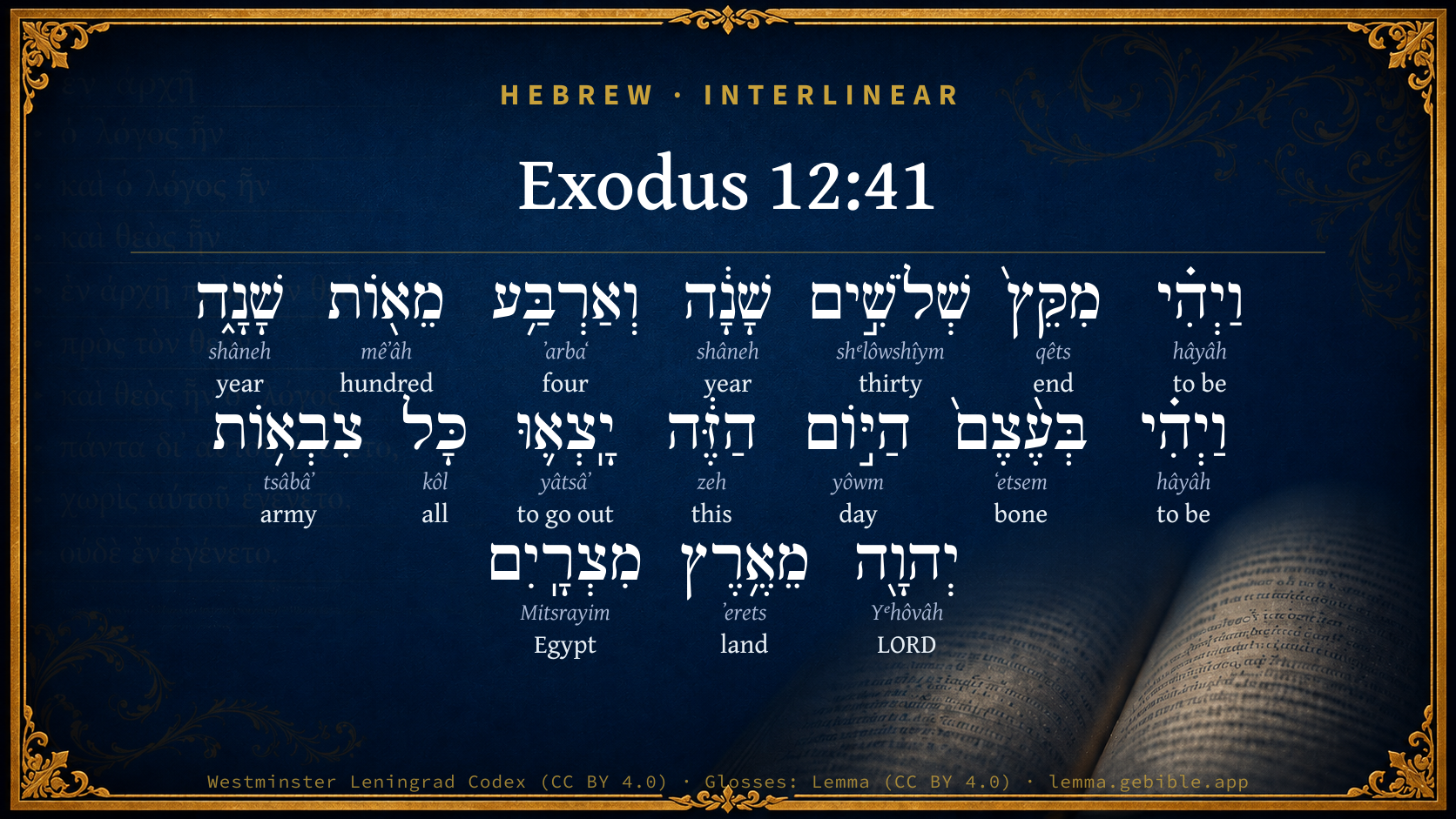
Exodus 12:41

Hebrew (Westminster Leningrad Codex) Exodus 12:41 appears in the Hebrew Old Testament. The text above is from the Westminster Leningrad Codex. Each word links to its Strong’s number, a concise gloss, and parsing drawn from the Open Scriptures Hebrew Bible morphology. Click any word for its full Brown-Driver-Briggs (BDB) entry.
Download image
Cite this verse

Exodus 12:41 (World English Bible). Public Domain. Lemma interlinear Bible study tool, https://lemma.gebible.app/v/exodus/12/41.

Show BibTeX & RIS
BibTeX
RIS
English Translation
It happened at the end of four hundred thirty years, even the same day it happened, that all the hosts of Yahweh went out from the land of Egypt.
World English Bible · Public Domain
Download a study sheet

One document with this verse’s original text, its word-by-word gloss line, the meaning frame, cross-references with their text, attributed commentary, and full source and license credits — printable, and it pastes into notes with its structure intact.

This verse Autodidact and up

Study sheet (.html) Plain text (.txt)

A passage Seminary Student

Up to 50 verses in one chapter. A passage sheet keeps up to 6 commentary sources and 12 cross-references per verse, in the order this page ranks them, and says so on the sheet whenever that leaves anything out. Ask for a single verse and you get the Autodidact verse sheet above.

Everything on this page stays free to read, with no account — the sheet is a download of what is already on screen, not access to it.

Want to remove ads? Support Godless Engineer
Compare translations 3

The same verse in 3 English versions, stacked beneath the original-language interlinear above. Click any original word for its lexicon entry.

Each is an independent rendering of the whole verse — the interlinear is not word-aligned to these translations.

Highlighted words mark where these versions differ — a whole-verse word diff, not a word-by-word alignment.

  • World English Bible Public Domain
    It happened at the end of four hundred thirty years, even the same day it happened, that all the hosts of Yahweh went out from the land of Egypt.
  • King James Version Public Domain
    And it came to pass at the end of the four hundred and thirty years, even the selfsame day it came to pass, that all the hosts of the LORD went out from the land of Egypt.
  • unfoldingWord Literal Text CC BY-SA 4.0
    And so it was, at the end of 430 years, it was on that very day all of the hosts of Yahweh went out from the land of Egypt.

unfoldingWord Literal Text — © unfoldingWord, licensed CC BY-SA 4.0. Word-aligned USFM3 via Door43 (git.door43.org/unfoldingWord/en_ult).

Versions to compare (up to 4)

3 of 4 selected

Show all 18 translations

Every available English version of this verse, each an independent rendering of the whole verse.

  • World English Bible Public Domain
    It happened at the end of four hundred thirty years, even the same day it happened, that all the hosts of Yahweh went out from the land of Egypt.
  • Berean Standard Bible Public Domain
    At the end of the 430 years, to the very day, all the LORD’s divisions went out of the land of Egypt.
  • Majority Standard Bible Public Domain
    At the end of the 430 years, to the very day, all the LORD’s divisions went out of the land of Egypt.
  • King James Version Public Domain
    And it came to pass at the end of the four hundred and thirty years, even the selfsame day it came to pass, that all the hosts of the LORD went out from the land of Egypt.
  • American Standard Version (1901) Public Domain
    And it came to pass at the end of four hundred and thirty years, even the selfsame day it came to pass, that all the hosts of Jehovah went out from the land of Egypt.
  • Revised Version (1885) Public Domain
    And it came to pass at the end of four hundred and thirty years, even the selfsame day it came to pass, that all the hosts of the LORD went out from the land of Egypt.
  • Geneva Bible (1599) Public Domain
    And when the foure hundreth and thirtie yeeres were expired, euen the selfe same day departed all the hostes of the Lord out of the land of Egypt.
  • Douay-Rheims (1899) Public Domain
    Which being expired, the same day all the army of the Lord went forth out of the land of Egypt.
  • Young's Literal Translation Public Domain
    and it cometh to pass, at the end of four hundred and thirty years -- yea, it cometh to pass in this self-same day -- all the hosts of Jehovah have gone out from the land of Egypt.
  • Literal Standard Version CC BY-SA 4.0
    and it comes to pass, at the end of four hundred and thirty years—indeed, it comes to pass on this very same day—all the hosts of YHWH have gone out from the land of Egypt.
  • Unlocked Literal Bible CC BY-SA 4.0
    At the end of 430 years, on that very day, all of Yahweh's armed groups went out from the land of Egypt.
  • unfoldingWord Literal Text CC BY-SA 4.0
    And so it was, at the end of 430 years, it was on that very day all of the hosts of Yahweh went out from the land of Egypt.
  • Darby Bible Public Domain
    And it came to pass at the end of the four hundred and thirty years, on that same day it came to pass that all the hosts of Jehovah went out from the land of Egypt.
  • World Messianic Bible Public Domain
    At the end of four hundred thirty years, to the day, all of the LORD’s armies went out from the land of Egypt.
  • Webster's Bible Public Domain
    And it came to pass, at the end of the four hundred and thirty years, even the same day it came to pass, that all the hosts of the LORD departed from the land of Egypt.
  • Free Bible Version CC BY-SA 4.0
    On the very day the 430 years ended, all the tribes of the Lord by their respective divisions left Egypt.
  • Bible in Basic English Public Domain
    And at the end of four hundred and thirty years, to the very day, all the armies of the Lord went out of the land of Egypt.
  • JPS Tanakh (1917) Public Domain
    And it came to pass at the end of four hundred and thirty years, even the selfsame day it came to pass, that all the host of the LORD went out from the land of Egypt.

Literal Standard Version (2020), Covenant Press — licensed CC BY-SA 4.0. Text via the HelloAO Bible API (eBible.org). Unlocked Literal Bible (unfoldingWord) — licensed CC BY-SA 4.0. Text via the HelloAO Bible API (eBible.org). unfoldingWord Literal Text — © unfoldingWord, licensed CC BY-SA 4.0. Word-aligned USFM3 via Door43 (git.door43.org/unfoldingWord/en_ult). Free Bible Version, Dr. Jonathan Gallagher — licensed CC BY-SA 4.0. Text via the HelloAO Bible API (eBible.org).

Word by word

More ways to search: Search by grammar → Find every occurrence → Compare this word →

Practice this passage: Drill this verse → Learn its vocabulary →

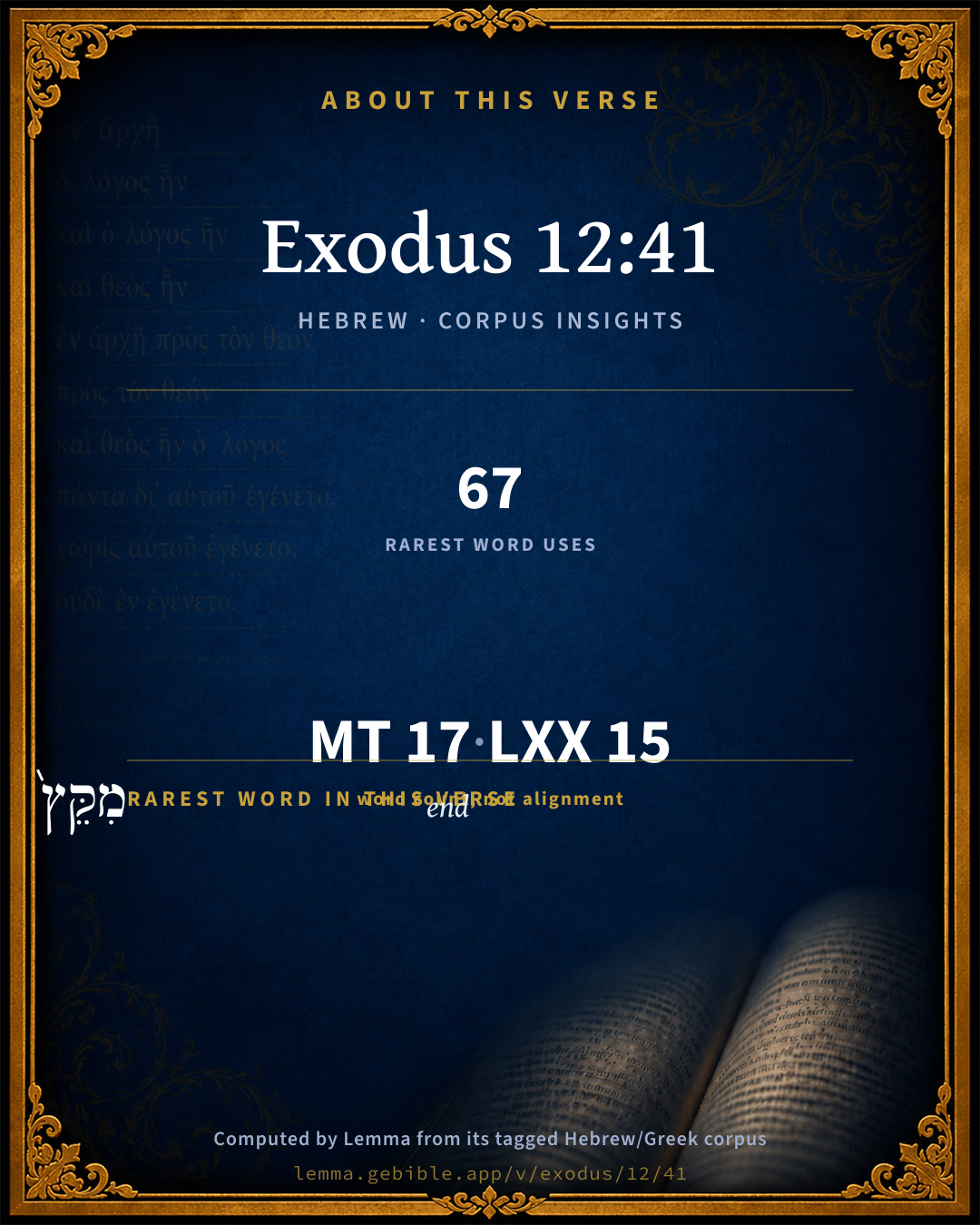
מִקֵּץ֙
qêts
H7093
“from · end of”
Preposition + Noun, Common, Masculine, Singular, Construct
Part of Speech
Preposition + Noun
Type
Common
Gender
Masculine
Number
Singular
State
Construct
Full BDB Definition

Origin: contracted from H7112 , an extremity

TWOT: 2060a

end - end, at the end of (of time) - end (of space)
  1. וַיְהִ֗י hâyâh H1961 “and · to be” Conjunction + Verb, Qal, Sequential Imperfect, 3rd Person, Masculine, Singular
  2. שְׁלֹשִׁ֣ים shᵉlôwshîym H7970 “thirty” Adjective, Cardinal number, Both, Plural, Absolute
  3. שָׁנָ֔ה shâneh H8141 “year” Noun, Common, Feminine, Singular, Absolute
  4. וְאַרְבַּ֥ע ʼarbaʻ H702 “and · four” Conjunction + Adjective, Cardinal number, Feminine, Singular, Absolute
  5. מֵא֖וֹת mêʼâh H3967 “hundred” Adjective, Cardinal number, Both, Plural, Absolute
  6. שָׁנָ֑ה shâneh H8141 “year” Noun, Common, Feminine, Singular, Absolute
  7. וַיְהִ֗י hâyâh H1961 “and · to be” Conjunction + Verb, Qal, Sequential Imperfect, 3rd Person, Masculine, Singular
  8. בְּעֶ֨צֶם֙ ʻetsem H6106 “in/at · bone of” Preposition + Noun, Common, Feminine, Singular, Construct
  9. הַיּ֣וֹם yôwm H3117 “the · day” Particle, Definite Article + Noun, Common, Masculine, Singular, Absolute
  10. הַזֶּ֔ה zeh H2088 “the · this” Particle, Definite Article + Pronoun, Demonstrative, Masculine, Singular
  11. יָֽצְא֛וּ yâtsâʼ H3318 “to go out” Verb, Qal, Perfect, 3rd Person, Common, Plural
  12. כָּל kôl H3605 “all of” Noun, Common, Masculine, Singular, Construct
  13. צִבְא֥וֹת tsâbâʼ H6635 “armies of” Noun, Common, Both, Plural, Construct
  14. יְהוָ֖ה Yᵉhôvâh H3068 “LORD” Noun, Proper
  15. מֵאֶ֥רֶץ ʼerets H776 “from · land of” Preposition + Noun, Common, Both, Singular, Construct
  16. מִצְרָֽיִם Mitsrayim H4714 “Egypt” Noun, Proper

About this verse

These counts appear in no published source. They are computed here, from the morphology-tagged text and Lemma’s own curated glosses. What Lemma adds →

17
words
15
distinct lemmas
Pentateuch
section

Grammatical profile

  • 3 verbs
  • 10 nouns
  • 3 adjectives
  • 1 pronoun

Verb forms

  • וַיְהִ֗י Qal · Sequential Imperfect
  • וַיְהִ֗י Qal · Sequential Imperfect
  • יָֽצְא֛וּ Qal · Perfect

Repetition

Words recur within this verse — often emphatic in Hebrew:

  • וַיְהִ֗י to be H1961 ×2
  • שָׁנָ֔ה year H8141 ×2

Hebrew & Septuagint length

In English translation the verse runs 29 words from the Hebrew and 28 from the Septuagint (LXX English) — closely comparable.

A rough comparison of the two English renderings, which tokenize alike — not a word-level alignment.

Word counts can differ between the Hebrew and the Greek without any difference in meaning — e.g. the Hebrew direct-object marker אֵת has no separate Greek word, and Greek often adds the article ὁ.

In the original languages it is 17 Hebrew tokens and 15 Greek tokens — but the two are counted differently (Hebrew bundles its prefixes and suffixes into one token; the Greek is in lemma form), so that isn’t a like-for-like length.

Cross-references

10

Topical passages linked to Exodus 12:41 in the Treasury of Scripture Knowledge — connected by theme and wording, ordered by reader-vote popularity; previews shown in the World English Bible.

  • Exodus 7:4 But Pharaoh will not listen to you, and I will lay my hand on Egypt, and bring forth my hosts, my people the children of Israel, out of the land of Egypt by great judgments.
  • Habakkuk 2:3 For the vision is yet for the appointed time, and it hurries toward the end, and won't prove false. Though it takes time, wait for it; because it will surely come. It won't delay.
  • John 7:8 You go up to the feast. I am not yet going up to this feast, because my time is not yet fulfilled."
  • Acts 1:7 He said to them, "It isn't for you to know times or seasons which the Father has set within His own authority.
  • Exodus 3:10 Come now therefore, and I will send you to Pharaoh, that you may bring forth my people, the children of Israel, out of Egypt."
  • Exodus 12:17 You shall observe the feast of unleavened bread; for in this same day have I brought your hosts out of the land of Egypt: therefore shall you observe this day throughout your generations by an ordinance forever.
  • Exodus 12:51 It happened the same day, that Yahweh brought the children of Israel out of the land of Egypt by their hosts.
  • Joshua 5:14 He said, No; but [as] prince of the host of Yahweh am I now come. Joshua fell on his face to the earth, and did worship, and said to him, What says my lord to his servant?
  • Psalms 102:13 You will arise and have mercy on Zion; For it is time to have pity on her. Yes, the set time has come.
  • Daniel 9:24 Seventy weeks are decreed on your people and on your holy city, to finish disobedience, and to make an end of sins, and to make reconciliation for iniquity, and to bring in everlasting righteousness, and to seal up vision and prophecy, and to anoint the most holy.

Cross-references courtesy of OpenBible.info (CC BY 4.0).

Hebrew and Greek witnesses Masoretic Hebrew ↔ Greek Septuagint

The same verse in the two great witnesses to the Old Testament, shown verse-for-verse.

These are two independent witnesses, not word-aligned to each other, and the Septuagint is shown in lemma (dictionary) form.

Hebrew Exodus 12:41 Masoretic · Westminster Leningrad Codex

וַיְהִ֗י מִקֵּץ֙ שְׁלֹשִׁ֣ים שָׁנָ֔ה וְאַרְבַּ֥ע מֵא֖וֹת שָׁנָ֑ה וַיְהִ֗י בְּעֶ֨צֶם֙ הַיּ֣וֹם הַזֶּ֔ה יָֽצְא֛וּ כָּל צִבְא֥וֹת יְהוָ֖ה מֵאֶ֥רֶץ מִצְרָֽיִם

It happened at the end of four hundred thirty years, even the same day it happened, that all the hosts of Yahweh went out from the land of Egypt.

World English Bible · Public Domain

Greek LXX Exodus 12:41 Septuagint · lemma form

καί γίγνομαι μετά ὁ τετρακόσιοι τριάκοντα ἔτος ἐκἔρχομαι πᾶς ὁ δύναμις κύριος ἐκ γῆ αἴγυπτος

And it came to pass after the four hundred and thirty years, all the forces of the Lord came forth out of the land of Egypt by night.

LXX2012 (modern English Septuagint) · Public Domain

Hebrew: Westminster Leningrad Codex (CC BY 4.0). Greek: Septuagint (public domain); English from LXX2012 (modern English Septuagint) (Public Domain). How the Septuagint differs from the Hebrew →

Targum (Aramaic paraphrase)

2

The Targum is the ancient Jewish Aramaic paraphrase of the Hebrew Scriptures — an interpretive translation, not the Hebrew text itself. Onkelos (literal) and Pseudo-Jonathan (expansive) render the Torah, and Jonathan the Prophets. Coverage is partial: where no permissively-licensed English translation exists for a verse, only the Aramaic is shown. This is verse-level text, not a word-by-word alignment to the Hebrew.

  1. Targum Onkelos Torah (Genesis–Deuteronomy)
    וַהֲוָה מִסוֹף אַרְבַּע מְאָה וּתְלָתִין שְׁנִין וַהֲוָה בִּכְרַן יוֹמָא הָדֵין נְפָקוּ כָּל חֵילַיָא דַיְיָ מֵאַרְעָא דְמִצְרָיִם:

    (no public-domain English translation for this verse)

    Targum Onkelos — Aramaic: “Onkelos Genesis” (public domain); “Onkelos Exodus” (public domain); “Onkelos Leviticus” (public domain); “Onkelos Numbers” (public domain); “Onkelos Deuteronomy” (public domain). English: “Sefaria Community Translation” (CC0 1.0 (public-domain dedication)); “J.W. Etheridge. The Targums of Onkelos and Jonathan Ben Uzziel on the Pentateuch. London: Longmans, Green, 1862” (public domain). Text via Sefaria.

  2. Targum Pseudo-Jonathan Torah (Genesis–Deuteronomy)
    וַהֲוָה מִסּוֹף תְּלָתִין שְׁנִין מִדְאִיתְגַּזְרַת גְּזֵירְתָּא הָדָא עַד דְּאִיתְיְלִיד יִצְחָק עַד דִנְפָקוּ פְּרִיקִין מִמִּצְרַיִם אַרְבַּע מְאָה שְׁנִין וַהֲוָה בִּכְרַן יוֹמָא הָדֵין נְפָקוּ כָּל חֵילַיָא דַיְיָ פְּרִיקִין מֵאַרְעָא דְּמִצְרָיִם

    And it was at the end of thirty years from the making of this covenant, that Izhak was born; and thence until they went out of Mizraim four hundred (years), on the selfsame day it was that all the hosts of the Lord went forth made free from the land of Mizraim.

    Targum Pseudo-Jonathan — Aramaic: “Targum Jonathan on Genesis” (public domain); “Targum Jonathan on Exodus” (public domain); “Targum Jonathan on Leviticus” (public domain); “Targum Jonathan on Numbers” (public domain); “Targum Jonathan on Deuteronomy” (public domain). English: “The Targum of Jonathan ben Uzziel, trans. J. W. Etheridge, London, 1862” (public domain). Text via Sefaria.

Commentary

Notes on Exodus 12:41 from classic Christian and Jewish commentators (each source and its license shown beneath its notes). The classic Christian expositions comment on the surrounding passage and are grouped to its opening verse, so a note may address several verses; the Jewish commentaries on the Tanakh (Rashi and others) are per-verse, so they appear only where the commentator wrote on this verse.

Lemma curates 59 commentaries, every one of them public domain or Creative Commons licensed, each selected and text-cleaned for this edition rather than reprinted as found. About our sources →

Trapp's Complete Commentary

John Trapp

Exo 12:41 And it came to pass at the end of the four hundred and thirty years, even the selfsame day it came to pass, that all the hosts of the LORD went out from the land of Egypt.

Ver. 41. Even the selfsame day.] God, saith one, had well nigh forfeited his bond; but ere the sun went down he payed the debt. His premises are good surehold. At midnight the firstborn were slain, because then exactly the four hundred and thirty years were expired.

John Trapp, A Commentary or Exposition upon All the Books of the Old and New Testament (1647–1656) — public domain. Text from a community e-Sword module.

Geneva Bible (1599)

Geneva Bible translators

From Abraham’s departing from Ur in Chaldea unto the departing of the children of Israel from Egypt are 430 years.

Geneva Bible (1599) marginal notes — public domain. Text via Bolls.life.

Jamieson, Fausset & Brown

Robert Jamieson, A. R. Fausset & David Brown

even the selfsame day--implying an exact and literal fulfilment of the predicted period.

Jamieson, Fausset & Brown — Commentary Critical and Explanatory on the Whole Bible (1871) — public domain (CC PDM 1.0). Text via the HelloAO Bible API.

Ellicott's Commentary for English Readers

(41) The selfsame day . . . all the hosts . . . went out.—All started, i.e., on one and the same day—the fifteenth of the month Abib. Some would start during the night, some in the morning, others at different periods of the day. They had different distances to traverse in order to reach the appointed halt, Succoth.

A Bible Commentary for English Readers, edited by Charles John Ellicott (1878–1897) — public domain. Text from a community e-Sword module.

The Cambridge Bible for Schools and Colleges

gen. ed. J. J. S. Perowne

41. the selfsame day] See on v. 17.

the hosts of Jehovah] cf. v. 17; and see on Exo_6:26.

The Cambridge Bible for Schools and Colleges (gen. ed. J. J. S. Perowne; Cambridge University Press, 1878–1918) — public domain. Text from a community e-Sword module.

John Gill's Exposition

And the Lord said unto Moses and Aaron,.... At the same time he acquainted them with the above things:

this is the ordinance of the passover; as before delivered, and these the laws and rules, according to which it is to be observed, as now related, both with respect to the lamb, and to the unleavened bread; and the following is an account of the persons that were to partake of it:

there shall no stranger eat thereof, one that is of another country, an entire Heathen, and unacquainted with, and does not profess the Jewish religion, which was the religion of God.

John Gill's Exposition of the Whole Bible (1746–1763) — public domain (CC PDM 1.0). Text via the HelloAO Bible API.

Matthew Poole's English Annotations

If this be the right translation, the four hundred and thirty years mentioned Gal 3:17 are to be taken in a latitude, for about or near so many years, as is very frequent in Scripture and other authors; else there wants one year of it, because the law was not given till about a year after their coming out of Egypt. Nor was it of any concernment to the apostle’s argument there, whether it wanted a year of that number or no, as here it is. But the words may be rendered here, as Gen 7:12, in the body or strength of the day, i.e. when the day-light was full, and clear, and strong, when it was broad day-light, the Egyptians seeing and not being able to hinder them. If it be said they went out by night, Deu 16:1, that is true, in regard of their resolution, and preparation, and the beginning of their journey; but their actual marching forth was by day-light, or in the morning; nor could it be done sooner from the nature of the thing, and the time necessarily required for so great a work.

The selfsame day: this circumstance is noted to set forth the accurateness and infallibility of God’s foreknowledge, and the efficacy of his providence in accomplishing all his own counsels in his own appointed time.

Matthew Poole's English Annotations on the Holy Bible (1683–1685) — public domain. Text from a community e-Sword/MySword module.

Whedon's Commentary on the Bible

Daniel D. Whedon

41. The selfsame day — That is, on the very day after the passover and death of the firstborn, whose incidents are previously related — the fifteenth of Abib; not that it was four hundred and thirty years to a day since the sojourn commenced. The same phrase occurs in Exo_12:51.

Daniel D. Whedon (gen. ed.), Commentary on the Old and New Testaments (1874–1909) — public domain. Text from a community e-Sword module.

The Pulpit Commentary

The self-same day all the hosts went out. The setting forth upon the journey is regarded as the "going out not the actual exit, which was only effected by the passage of the Red Sea.

Vers. 41-50. Passover precepts realised in Christian practice.

The precepts were:

I THAT NO UNCIRCUMCISED STRANGER, NOT EVEN THOUGH A HIRED SERVANT IN A HEBREW FAMILY, SHOULD EAT OF IT. Formally, baptism corresponds to circumcision, both of them admitting into covenant with God; and thus the rule of Christian communities generally, that the reception of baptism must precede that of the Lord"s Supper, is a carrying out of this precept. But it is also carried out in another way. Spiritually, the correspondent to the circumcision of the flesh is the circumcision of the spirit; and thus all Churches which warn the wicked from approaching the Lord"s table, do their best to enforce the precept, "No uncircumcised person shall eat thereof." Hired servants of the Church, unless circumcised in heart, are as unfit to communicate as those who have no external connection with Divine things. Nay, may we not say more unfit?

II THAT ALL THE CONGREGATION OF ISRAEL, FREEMEN AND SLAVES ALIKE, SHOULD EAT OF IT. The frequent exhortation of all Christian Churches to all their members to receive the Communion, especially at Easter-time, and the general allowance of the duty by those who have any real sense of religion constitute a realisation, to a considerable extent, of this precept in Christian practice. It is to be wished that the realisation were complete. The joint participation of freemen with slaves has always charactcrised the Christian Church; and though there have been Christian communities which have acted differently, the cases are too exceptional to deserve much notice, and are disappearing as slavery disappears.

III THAT IT SHOULD BE EATEN IN ONE PLACE, AND NONE OF IT CARRIED FORTH. Churches which allow not only reservation, but the carrying forth of the holy elements to the bedsides of the sick, break at any rate the letter of this precept. But the Reformed Churches, which disallow even reservation, keep close to it.

IV THAT NOT A BONE OF IT SHOULD BE BROKEN. This precept can only be spiritually observed, for in the Christian passover, the "flesh" to be eaten has no "bones." But it is spiritually kept wherever communicants are warned against dividing Christ in their thoughts, against separating his humanity from his Divinity, or against practising special devotion to any separate portion of his person, as to his "Sacred Heart" or his "Five wounds." It was the essence of one of the early forms of heresy to "divide Christ;" and on this account the Church of England protests in her second article of religion, that in him "two whole and perfect natures are joined together in one person, never to be divided, whereof is One Christ."

The Pulpit Commentary (1880–1919), ed. H.D.M. Spence-Jones & Joseph S. Exell — public domain. Text from a community e-Sword module.

unfoldingWord translationNotes

Door43 World Missions Community

430 years

"four hundred and thirty years" (See: Numbers)

Yahweh's armed groups

This refers to the tribes of Israel. See how you translated "armed group" in Exodus 12:17.

to be observed by all the Israelites

This can be stated in active form. AT: "that all the Israelites were to observe" (See: Active or Passive)

all the Israelites throughout their people's generations

"all the Israelites and the all the generations of their descendants"

translationWords

Yahweh

people group

generation

unfoldingWord translationNotes — © Distant Shores Media and the Door43 World Missions Community, licensed CC BY-SA 4.0. Source: git.door43.org/Door43/en_tn.

Rashi

Rabbi Shlomo Yitzchaki (Rashi)

ויהי מקץ שלשים שנה וגו' ויהי בעצם היום הזה AND IT CAME TO PASS AT THE END OF THE 430 YEARS … EVEN ON THE SELF-SAME DAY — The addition of the latter phrase tells us that as soon as the predetermined end of the bondage arrived the Omnipresent did not detain them even as long as the twinkling of an eye (Mekhilta). For on the fifteenth of Nisan the ministering angels had come to Abraham to announce to him the promised birth of Isaac, and on the fifteenth of Nisan Isaac was born, and on the fifteenth of Nisan the decree “between the parts” relating to Israel’s slavery was made.

Rashi on the Tanakh — English translations: “The Judaica Press complete Tanach with Rashi, translated by A. J. Rosenberg” (CC BY 4.0); “Pentateuch with Rashi's commentary by M. Rosenbaum and A.M. Silbermann, 1929-1934” (public domain); “The Metsudah Tanach series, Lakewood, N.J” (CC BY 4.0); and “The Book of Joshua, Metsudah Publications, 1997” (CC BY 4.0). Text via Sefaria.

Lesson kit

Teaching starters — assembled from the data on this page, not authored interpretation. Every prompt links to the verse data it draws on. Edit before teaching.

Exodus, in the Pentateuch, opens this verse with 17 words (15 distinct Hebrew lemmas). Its most distinctive word is qêts (“end”). A historical commentator’s framing appears above. Read the whole chapter for the surrounding context.

Discussion questions

  1. How does “end” (qêts) shape what this verse is saying?
  2. Exodus 7:4 shares this passage’s theme. How do the two illuminate each other?
  3. “to be” occurs 2× in this one verse. What is the effect of the repetition?
  4. The translations on this page render this verse differently — a whole-verse word diff, not a word-by-word alignment. What might account for the different wordings?
  5. The verb «וַיְהִ֗י» is Qal Sequential Imperfect. How does its form color the action?
  6. Reading how Trapp's Complete Commentary and Geneva Bible (1599) read this verse, where do the two commentators agree and where do they part?

Things to notice

Reading settings

Reading text

Shown beneath each verse's original-language words.

Old Testament
Old Testament edition

Read the OT as the Masoretic Hebrew (MT) or the Greek Septuagint (LXX).

English shown for the Greek Septuagint (in the Hebrew ↔ Greek comparison).

Comparing translations? Open the Compare panel on any verse page to stack up to four side by side.