
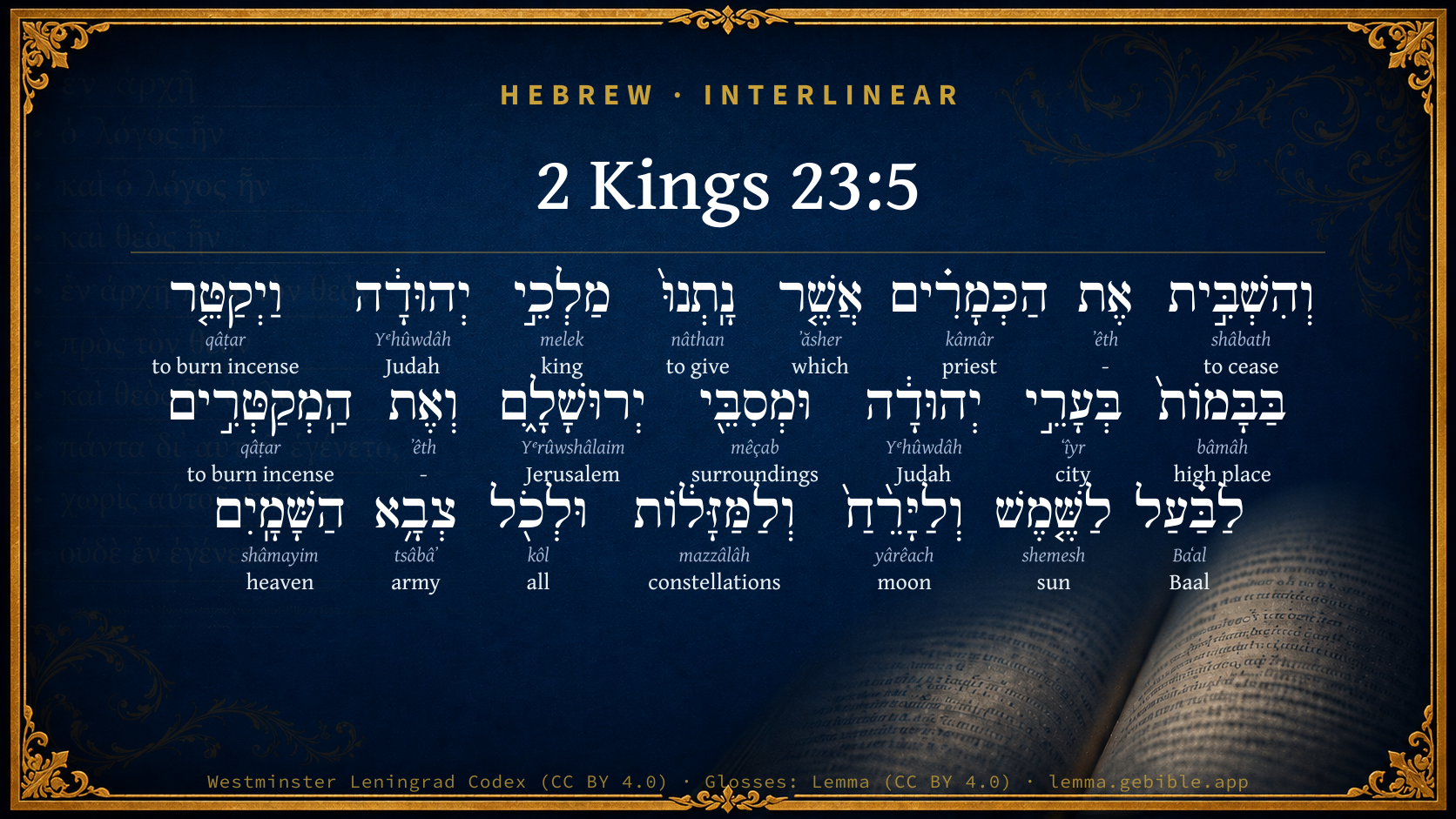
2 Kings 23:5

Hebrew (Westminster Leningrad Codex) 2 Kings 23:5 appears in the Hebrew Old Testament. The text above is from the Westminster Leningrad Codex. Each word links to its Strong’s number, a concise gloss, and parsing drawn from the Open Scriptures Hebrew Bible morphology. Click any word for its full Brown-Driver-Briggs (BDB) entry.
Download image
Cite this verse

2 Kings 23:5 (World English Bible). Public Domain. Lemma interlinear Bible study tool, https://lemma.gebible.app/v/2-kings/23/5.

Show BibTeX & RIS
BibTeX
RIS
English Translation
He put down the idolatrous priests, whom the kings of Judah had ordained to burn incense in the high places in the cities of Judah, and in the places round about Jerusalem; those also who burned incense to Baal, to the sun, and to the moon, and to the planets, and to all the host of the sky.
World English Bible · Public Domain
Highlights
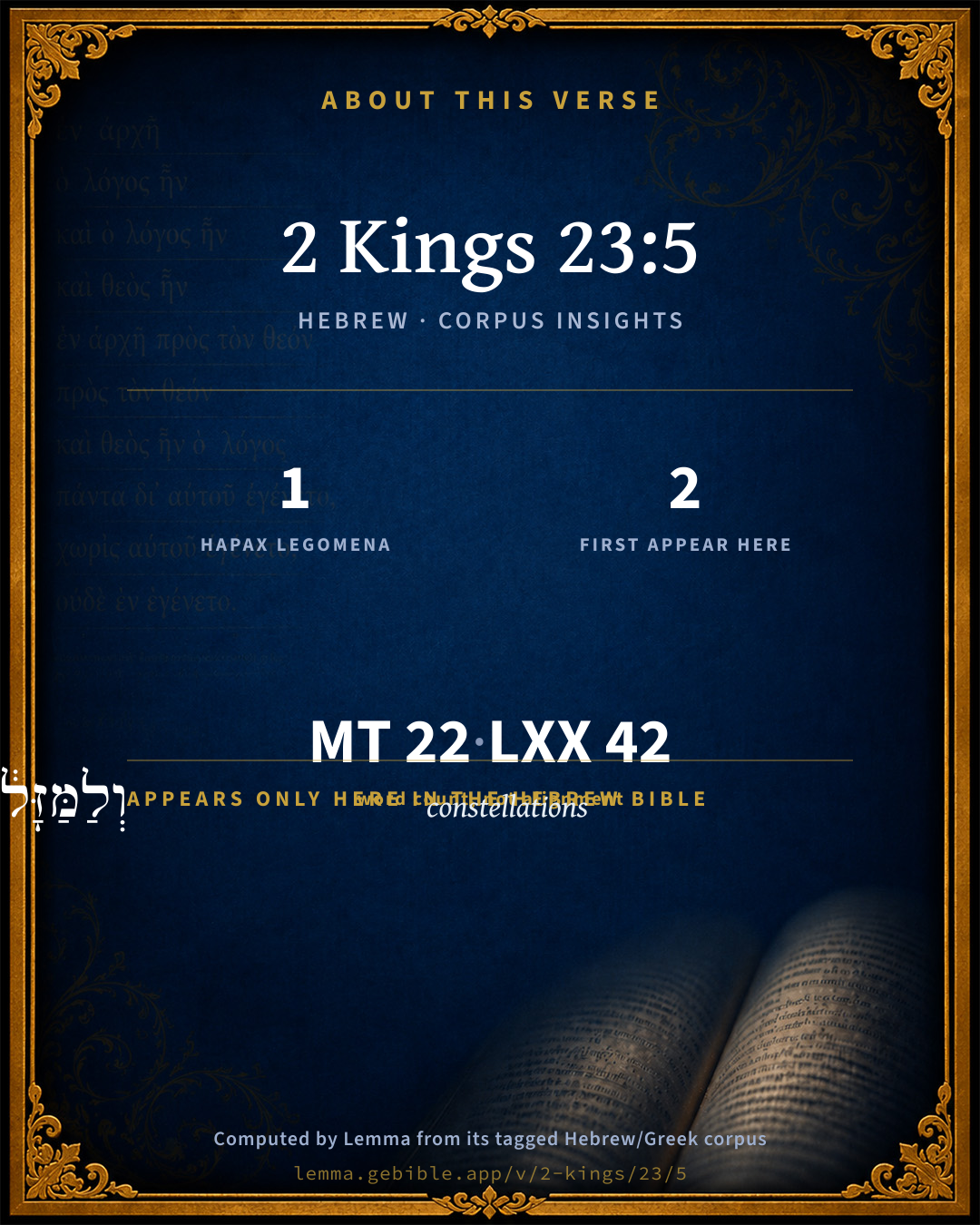
  • 1 hapax legomenon — only here in the Hebrew Bible
  • 2 first appearances in the Hebrew Bible
Full analysis ↓
Download a study sheet

One document with this verse’s original text, its word-by-word gloss line, the meaning frame, cross-references with their text, attributed commentary, and full source and license credits — printable, and it pastes into notes with its structure intact.

This verse Autodidact and up

Study sheet (.html) Plain text (.txt)

A passage Seminary Student

Up to 50 verses in one chapter. A passage sheet keeps up to 6 commentary sources and 12 cross-references per verse, in the order this page ranks them, and says so on the sheet whenever that leaves anything out. Ask for a single verse and you get the Autodidact verse sheet above.

Everything on this page stays free to read, with no account — the sheet is a download of what is already on screen, not access to it.

Want to remove ads? Support Godless Engineer
Compare translations 3

The same verse in 3 English versions, stacked beneath the original-language interlinear above. Click any original word for its lexicon entry.

Each is an independent rendering of the whole verse — the interlinear is not word-aligned to these translations.

Highlighted words mark where these versions differ — a whole-verse word diff, not a word-by-word alignment.

  • World English Bible Public Domain
    He put down the idolatrous priests, whom the kings of Judah had ordained to burn incense in the high places in the cities of Judah, and in the places round about Jerusalem; those also who burned incense to Baal, to the sun, and to the moon, and to the planets, and to all the host of the sky.
  • King James Version Public Domain
    And he put down the idolatrous priests, whom the kings of Judah had ordained to burn incense in the high places in the cities of Judah, and in the places round about Jerusalem; them also that burned incense unto Baal, to the sun, and to the moon, and to the planets, and to all the host of heaven.
  • unfoldingWord Literal Text CC BY-SA 4.0
    And he made cease the idol-priests whom the kings of Judah had appointed that one should burn incense in the high places in the cities of Judah and the environs of Jerusalem and the ones burning incense to Baal, to the sun and to the moon and to the constellations and to the whole army of the heavens.

unfoldingWord Literal Text — © unfoldingWord, licensed CC BY-SA 4.0. Word-aligned USFM3 via Door43 (git.door43.org/unfoldingWord/en_ult).

Versions to compare (up to 4)

3 of 4 selected

Show all 18 translations

Every available English version of this verse, each an independent rendering of the whole verse.

  • World English Bible Public Domain
    He put down the idolatrous priests, whom the kings of Judah had ordained to burn incense in the high places in the cities of Judah, and in the places round about Jerusalem; those also who burned incense to Baal, to the sun, and to the moon, and to the planets, and to all the host of the sky.
  • Berean Standard Bible Public Domain
    Josiah also did away with the idolatrous priests ordained by the kings of Judah to burn incense on the high places of the cities of Judah and in the places all around Jerusalem—those who had burned incense to Baal, to the sun and moon, to the constellations, and to all the host of heaven.
  • Majority Standard Bible Public Domain
    Josiah also did away with the idolatrous priests ordained by the kings of Judah to burn incense on the high places of the cities of Judah and in the places all around Jerusalem—those who had burned incense to Baal, to the sun and moon, to the constellations, and to all the host of heaven.
  • King James Version Public Domain
    And he put down the idolatrous priests, whom the kings of Judah had ordained to burn incense in the high places in the cities of Judah, and in the places round about Jerusalem; them also that burned incense unto Baal, to the sun, and to the moon, and to the planets, and to all the host of heaven.
  • American Standard Version (1901) Public Domain
    And he put down the idolatrous priests, whom the kings of Judah had ordained to burn incense in the high places in the cities of Judah, and in the places round about Jerusalem; them also that burned incense unto Baal, to the sun, and to the moon, and to the planets, and to all the host of heaven.
  • Revised Version (1885) Public Domain
    And he put down the idolatrous priests, whom the kings of Judah had ordained to burn incense in the high places in the cities of Judah, and in the places round about Jerusalem; them also that burned incense unto Baal, to the sun, and to the moon, and to the planets, and to all the host of heaven.
  • Geneva Bible (1599) Public Domain
    And he put downe the Chemarims, whom the Kings of Iudah had founded to burne incense in the hie places, and in the cities of Iudah, and about Ierusalem, and also them that burnt incense vnto Baal, to the sunne and to the moone, and to the planets, and to all the hoste of heauen.
  • Douay-Rheims (1899) Public Domain
    And he destroyed the soothsayers, whom the kings of Juda had appointed to sacrifice in the high places in the cities of Juda, and round about Jerusalem: them also that burnt incense to Baal, and to the sun, and to the moon, and to the twelve signs, and to all the host of heaven.
  • Young's Literal Translation Public Domain
    And he hath caused to cease the idolatrous priests whom the kings of Judah have appointed, (and they make perfume in high places, in cities of Judah and suburbs of Jerusalem,) and those making perfume to Baal, to the sun, and to the moon, and to the planets, and to all the host of the heavens.
  • Literal Standard Version CC BY-SA 4.0
    And he has caused to cease the idolatrous priests whom the kings of Judah have appointed (and they make incense in high places, in cities of Judah and outskirts of Jerusalem), and those making incense to Ba‘al, to the sun, and to the moon, and to the twelve signs, and to all the host of the heavens.
  • Unlocked Literal Bible CC BY-SA 4.0
    He got rid of the idolatrous priests whom the kings of Judah had chosen to burn incense at the high places in the cities of Judah and in the places around Jerusalem—those who burned incense to Baal, to the sun and the moon, to the planets, and to all the stars of heaven.
  • unfoldingWord Literal Text CC BY-SA 4.0
    And he made cease the idol-priests whom the kings of Judah had appointed that one should burn incense in the high places in the cities of Judah and the environs of Jerusalem and the ones burning incense to Baal, to the sun and to the moon and to the constellations and to the whole army of the heavens.
  • Darby Bible Public Domain
    And he abolished the idolatrous priests, whom the kings of Judah had ordained to burn incense on the high places in the cities of Judah, and the environs of Jerusalem; and them that burned incense to Baal, to the sun, and to the moon, and to the constellations, and to all the host of heaven.
  • World Messianic Bible Public Domain
    He got rid of the idolatrous priests whom the kings of Judah had ordained to burn incense in the high places in the cities of Judah and in the places around Jerusalem; those also who burned incense to Baal, to the sun, to the moon, to the planets, and to all the army of the sky.
  • Webster's Bible Public Domain
    And he put down the idolatrous priests, whom the kings of Judah had ordained to burn incense in the high places in the cities of Judah, and in the places around Jerusalem; them also that burned incense to Baal, to the sun, and to the moon, and to the planets, and to all the host of heaven.
  • Free Bible Version CC BY-SA 4.0
    He also dismissed the priests appointed by the kings of Judah to present burnt offerings on the high places of the towns of Judah and in the places all around Jerusalem, those who had sacrificed to Baal, to the sun and moon, to the constellations, and to all the powers of heaven.
  • Bible in Basic English Public Domain
    And he put an end to the false priests, who had been put in their positions by the kings of Judah to see to the burning of offerings in the high places in the towns of Judah and the outskirts of Jerusalem, and all those who made offerings to Baal and to the sun and the moon and the twelve signs and all the stars of heaven.
  • JPS Tanakh (1917) Public Domain
    And he put down the idolatrous priests, whom the kings of Judah had ordained to offer in the high places in the cities of Judah, and in the places round about Jerusalem; them also that offered unto Baal, to the sun, and to the moon, and to the constellations, and to all the host of heaven.

Literal Standard Version (2020), Covenant Press — licensed CC BY-SA 4.0. Text via the HelloAO Bible API (eBible.org). Unlocked Literal Bible (unfoldingWord) — licensed CC BY-SA 4.0. Text via the HelloAO Bible API (eBible.org). unfoldingWord Literal Text — © unfoldingWord, licensed CC BY-SA 4.0. Word-aligned USFM3 via Door43 (git.door43.org/unfoldingWord/en_ult). Free Bible Version, Dr. Jonathan Gallagher — licensed CC BY-SA 4.0. Text via the HelloAO Bible API (eBible.org).

Word by word

More ways to search: Search by grammar → Find every occurrence → Compare this word →

Practice this passage: Drill this verse → Learn its vocabulary →

וְלַמַּזָּל֔וֹת
mazzâlâh
H4208
“and · to/for the · constellations”
Conjunction + Preposition, Determined + Noun, Common, Masculine, Plural, Absolute
Part of Speech
Conjunction + Preposition + Noun
Type
Common
Gender
Masculine
Number
Plural
State
Absolute
Full BDB Definition

Origin: apparently from H5140 in the sense of raining

TWOT: 1173

constellations - signs of zodiac (maybe)
  1. וְהִשְׁבִּ֣ית shâbath H7673 “and · to cease” Conjunction + Verb, Hiphil, Perfect, 3rd Person, Masculine, Singular
  2. אֶת ʼêth H853 “-” Particle, Direct Object
  3. הַכְּמָרִ֗ים kâmâr H3649 “the · priests” Particle, Definite Article + Noun, Common, Masculine, Plural, Absolute
  4. אֲשֶׁ֤ר ʼăsher H834 “which” Particle, Relative
  5. נָֽתְנוּ֙ nâthan H5414 “to give” Verb, Qal, Perfect, 3rd Person, Common, Plural
  6. מַלְכֵ֣י melek H4428 “kings of” Noun, Common, Masculine, Plural, Construct
  7. יְהוּדָ֔ה Yᵉhûwdâh H3063 “Judah” Noun, Proper
  8. וַיְקַטֵּ֤ר qâṭar H6999 “and · to burn incense” Conjunction + Verb, Piel, Sequential Imperfect, 3rd Person, Masculine, Singular
  9. בַּבָּמוֹת֙ bâmâh H1116 “in/at the · high places” Preposition, Determined + Noun, Common, Feminine, Plural, Absolute
  10. בְּעָרֵ֣י ʻîyr H5892 “in/at · cities of” Preposition + Noun, Common, Feminine, Plural, Construct
  11. יְהוּדָ֔ה Yᵉhûwdâh H3063 “Judah” Noun, Proper
  12. וּמְסִבֵּ֖י mêçab H4524 “and · surroundings of” Conjunction + Noun, Common, Both, Plural, Construct
  13. יְרוּשָׁלִָ֑ם Yᵉrûwshâlaim H3389 “Jerusalem” Noun, Proper
  14. וְאֶת ʼêth H853 “and · -” Conjunction + Particle, Direct Object
  15. הַֽמְקַטְּרִ֣ים qâṭar H6999 “the · burning incense” Particle, Definite Article + Verb, Piel, Participle Active, Masculine, Plural, Absolute
  16. לַבַּ֗עַל Baʻal H1168 “to/for the · Baal” Preposition, Determined + Noun, Proper
  17. לַשֶּׁ֤מֶשׁ shemesh H8121 “to/for the · sun” Preposition, Determined + Noun, Common, Both, Singular, Absolute
  18. וְלַיָּרֵ֨חַ֙ yârêach H3394 “and · to/for the · moon” Conjunction + Preposition, Determined + Noun, Common, Masculine, Singular, Absolute
  19. וּלְכֹ֖ל kôl H3605 “and · to/for · all of” Conjunction + Preposition + Noun, Common, Masculine, Singular, Construct
  20. צְבָ֥א tsâbâʼ H6635 “army of” Noun, Common, Both, Singular, Construct
  21. הַשָּׁמָֽיִם shâmayim H8064 “the · heaven(s)” Particle, Definite Article + Noun, Common, Masculine, Plural, Absolute

About this verse

These counts appear in no published source. They are computed here, from the morphology-tagged text and Lemma’s own curated glosses. What Lemma adds →

22
words
19
distinct lemmas
Historical
section

Notable vocabulary

1 hapax legomenon — a word that appears only here in the entire Hebrew Bible:

  • וְלַמַּזָּל֔וֹת constellations H4208

First appearance in Scripture

These words make their first canonical appearance in the Hebrew Bible here:

  • הַכְּמָרִ֗ים priest H3649
  • וְלַמַּזָּל֔וֹת constellations H4208

Shared distinctive vocabulary

הַכְּמָרִ֗ים priest H3649 occurs in 3 verses of the Hebrew Bible. Also found in:

Grammatical profile

  • 4 verbs
  • 15 nouns
  • 3 particles

Verb forms

  • וְהִשְׁבִּ֣ית Hiphil · Perfect
  • נָֽתְנוּ֙ Qal · Perfect
  • וַיְקַטֵּ֤ר Piel · Sequential Imperfect
  • הַֽמְקַטְּרִ֣ים Piel · Participle Active

Repetition

Words recur within this verse — often emphatic in Hebrew:

  • יְהוּדָ֔ה Judah H3063 ×2
  • וַיְקַטֵּ֤ר to burn incense H6999 ×2

Hebrew & Septuagint length

In English translation the verse runs 58 words from the Hebrew and 58 from the Septuagint (LXX English) — the same length.

A rough comparison of the two English renderings, which tokenize alike — not a word-level alignment.

Word counts can differ between the Hebrew and the Greek without any difference in meaning — e.g. the Hebrew direct-object marker אֵת has no separate Greek word, and Greek often adds the article ὁ.

In the original languages it is 22 Hebrew tokens and 42 Greek tokens — but the two are counted differently (Hebrew bundles its prefixes and suffixes into one token; the Greek is in lemma form), so that isn’t a like-for-like length.

Cross-references

4

Topical passages linked to 2 Kings 23:5 in the Treasury of Scripture Knowledge — connected by theme and wording, ordered by reader-vote popularity; previews shown in the World English Bible.

  • Jeremiah 44:17–19 But we will certainly perform every word that is gone forth out of our mouth, to burn incense to the queen of the sky, and to pour out drink-offerings to her, as we have done, we and our fathers, our kings and our princes, in the cities of Judah, and in the streets of Jerusalem; for then had we plenty of food, and were well, and saw no evil.
  • 2 Kings 21:3–4 For he built again the high places which Hezekiah his father had destroyed; and he reared up altars for Baal, and made an Asherah, as did Ahab king of Israel, and worshiped all the host of the sky, and served them.
  • Jeremiah 8:1–2 At that time, says Yahweh, they shall bring out the bones of the kings of Judah, and the bones of his princes, and the bones of the priests, and the bones of the prophets, and the bones of the inhabitants of Jerusalem, out of their graves;
  • Hosea 10:5 The inhabitants of Samaria will be in terror for the calves of Beth Aven; For its people will mourn over it, Along with its priests who rejoiced over it, For its glory, because it has departed from it.

Cross-references courtesy of OpenBible.info (CC BY 4.0).

Hebrew and Greek witnesses Masoretic Hebrew ↔ Greek Septuagint

The same verse in the two great witnesses to the Old Testament, shown verse-for-verse.

These are two independent witnesses, not word-aligned to each other, and the Septuagint is shown in lemma (dictionary) form.

Hebrew 2 Kings 23:5 Masoretic · Westminster Leningrad Codex

וְהִשְׁבִּ֣ית אֶת הַכְּמָרִ֗ים אֲשֶׁ֤ר נָֽתְנוּ֙ מַלְכֵ֣י יְהוּדָ֔ה וַיְקַטֵּ֤ר בַּבָּמוֹת֙ בְּעָרֵ֣י יְהוּדָ֔ה וּמְסִבֵּ֖י יְרוּשָׁלִָ֑ם וְאֶת הַֽמְקַטְּרִ֣ים לַבַּ֗עַל לַשֶּׁ֤מֶשׁ וְלַיָּרֵ֨חַ֙ וְלַמַּזָּל֔וֹת וּלְכֹ֖ל צְבָ֥א הַשָּׁמָֽיִם

He put down the idolatrous priests, whom the kings of Judah had ordained to burn incense in the high places in the cities of Judah, and in the places round about Jerusalem; those also who burned incense to Baal, to the sun, and to the moon, and to the planets, and to all the host of the sky.

World English Bible · Public Domain

Greek LXX 2 Kings 23:5 Septuagint · lemma form

καί καταπαύω ὁ χωμαριμ ὅς δίδωμι βασιλεύς ιουδα καί θυμιάζω ἐν ὁ ὑψηλός καί ἐν ὁ πόλις ιουδα καί ὁ περικύκλῳ ἰερουσαλήμ καί ὁ θυμιάζω ὁ βααλ καί ὁ ἥλιος καί ὁ σελήνη καί ὁ μαζουρωθ καί πᾶς ὁ δύναμις ὁ οὐρανός

And he burned the idolatrous priests, whom the kings of Juda had appointed, (and they burned incense in the high places and in the cities of Juda, and the places around about Jerusalem); and them that burned incense to Baal, and to the sun, and to the moon, and to Mazuroth, and to all the host of heaven.

LXX2012 (modern English Septuagint) · Public Domain

On this verse, Ellicott's Commentary for English Readers discusses the Septuagint’s reading. Read the note in Commentary ↓

Hebrew: Westminster Leningrad Codex (CC BY 4.0). Greek: Septuagint (public domain); English from LXX2012 (modern English Septuagint) (Public Domain). How the Septuagint differs from the Hebrew →

Targum (Aramaic paraphrase)

1

The Targum is the ancient Jewish Aramaic paraphrase of the Hebrew Scriptures — an interpretive translation, not the Hebrew text itself. Onkelos (literal) and Pseudo-Jonathan (expansive) render the Torah, and Jonathan the Prophets. Coverage is partial: where no permissively-licensed English translation exists for a verse, only the Aramaic is shown. This is verse-level text, not a word-by-word alignment to the Hebrew.

  1. Targum Jonathan Prophets (Joshua–Malachi)
    וּבַטֵיל יַת כּוּמְרַיָא דִי יְהָבוּ מַלְכַיָא דְבֵית יְהוּדָה וְאַסִיקוּ בוּסְמִין עַל בָּמָתָא בְּקִרְוַיָא דְבֵית יְהוּדָה וּבְסַחֲרָנֵי יְרוּשְׁלֵם וְיַת דַאֲסִיקוּ בוּסְמִין לִבְעָלָא וּלְשִׁמְשָׁא וּלְסִיהֲרָא וּלְמַזְלָתָא וּלְכָל חֵילֵי שְׁמַיָא:

    (no public-domain English translation for this verse)

    Targum Jonathan — Aramaic: “Mikraot Gedolot” (public domain). English: “Sefaria Community Translation” (CC0 1.0 (public-domain dedication)); “London "Chaldee Paraphrase," 1871” (public domain). Text via Sefaria.

Commentary

Notes on 2 Kings 23:5 from classic Christian and Jewish commentators (each source and its license shown beneath its notes). The classic Christian expositions comment on the surrounding passage and are grouped to its opening verse, so a note may address several verses; the Jewish commentaries on the Tanakh (Rashi and others) are per-verse, so they appear only where the commentator wrote on this verse.

Lemma curates 59 commentaries, every one of them public domain or Creative Commons licensed, each selected and text-cleaned for this edition rather than reprinted as found. About our sources →

Trapp's Complete Commentary

John Trapp

2Ki 23:5 And he put down the idolatrous priests, whom the kings of Judah had ordained to burn incense in the high places in the cities of Judah, and in the places round about Jerusalem; them also that burned incense unto Baal, to the sun, and to the moon, and to the planets, and to all the host of heaven.

Ver. 5. And he put down the idolatrous priests.] Heb., Chemarims, Baal’s chimney-chaplains, {see Zep 1:14, with the note there} black sooty fellows, like those greasy mass priests, or abbey lubbers, amongst the Papists.

And to the planets.] Or, Influences: a radice Nazal fluxit.

John Trapp, A Commentary or Exposition upon All the Books of the Old and New Testament (1647–1656) — public domain. Text from a community e-Sword module.

Joseph Benson's Commentary

2Ki 23:5. He put down the idolatrous priests — כמרים, chemarim. Their particular business, as appears from this place, was to burn incense. Hence it is thought by some, that the faithful Jews gave them this name by way of contempt, as being continually scorched by their fumigating fires. But, according to Bishop Patrick, they were so called from being clothed in black: for the Egyptians, as well as many other pagan nations; made use of black garments when they sacrificed to the infernal deities: in opposition to which the Jewish priests were clothed with white at their sacrifices.

Joseph Benson's Commentary on the Old and New Testaments (1811–1818) — public domain. Text from a community e-Sword module.

Tyndale Open Study Notes

Tyndale Open Resources

23:5-7 Josiah stopped the idolatrous priests from officiating over pagan rituals. He also demolished the living quarters of the cult prostitutes. Manasseh and Amon apparently had allowed the prostitution carried over from Canaanite practices (see 1 Kgs 14:24; 15:12; 22:46) to be practiced within the Temple itself.

Tyndale Open Study Notes — © Tyndale Open Resources, licensed CC BY-SA 4.0. Text via the HelloAO Bible API.

Geneva Bible (1599)

Geneva Bible translators

Meaning, the priests of Baal, which were called Chemarims, either because they wore black garments, or else were smoked with burning incense to idols.

Geneva Bible (1599) marginal notes — public domain. Text via Bolls.life.

Jamieson, Fausset & Brown

Robert Jamieson, A. R. Fausset & David Brown

put down the idolatrous priests--Hebrew, chemarim, "scorched," that is, Guebres, or fire-worshippers, distinguished by a girdle (Eze 23:14-17) or belt of wool and camel's hair, twisted round the body twice and tied with four knots, which had a symbolic meaning, and made it a supposed defense against evil.

them also that burned incense unto Baal, to the sun, and to the moon, &c.--or Baal-shemesh, for Baal was sometimes considered the sun. This form of false worship was not by images, but pure star-worship, borrowed from the old Assyrians.

and--rather, "even to all the host of heaven."

Jamieson, Fausset & Brown — Commentary Critical and Explanatory on the Whole Bible (1871) — public domain (CC PDM 1.0). Text via the HelloAO Bible API.

Adam Clarke's Commentary

Verse 5. The idolatrous priests] הכמרים hakkemarim. Who these were is not well known. The Chaldee, Syriac, and Arabic, call them the priests simply, which the kings of Judah had ordained. Probably they were an order made by the idolatrous kings of Judah, and called kemarim, from כמר camar, which signifies to be scorched, shrivelled together, made dark, or black, because their business was constantly to attend sacrificial fires, and probably they were black garments; hence the Jews in derision call Christian ministers kemarim, because of their black clothes and garments. Why we should imitate, in our sacerdotal dress, those priests of Baal, is strange to think and hard to tell.

Unto Baal, to the sun] Though Baal was certainly the sun, yet here they are distinguished; Baal being worshipped under different forms and attributes, Baal-peor, Baal-zephon, Baal-zebub, c.

The planets] מזלות mazzaloth. The Vulgate translates this the twelve signs, i.e., the zodiac. This is as likely as any of the other conjectures which have been published relative to this word. See a similar word Job 37:9; Job 38:32.

Adam Clarke's Commentary on the Bible (1810–1826) — public domain. Text from a community e-Sword/MySword module.

Ellicott's Commentary for English Readers

(5) He put down.—Syriac and Arabic, he slew.

The idolatrous priests.—The kìmârîm, or black-robed priests (Hos_10:5, of the priests of the calf-worship at Beth-el). Only occurring besides in Zep_1:4. Here, as in the passage of Hosea, the word denotes the unlawful priests of Jehovah, as contrasted with those of the Baal, mentioned in the next place. Whether the term really means black-robed, as Kimchi explains, is questionable. Priests used to wear white throughout the ancient world, except on certain special occasions. Gesenius derives it from a root meaning black, but explains, one clad in black, i.e., a mourner, an ascetic, and so a priest. Perhaps the true derivation is from another root, meaning to weave: weaver of spells or charms; as magic was an invariable concomitant of false worship. (Comp. 2Ki_17:17; 2Ki_21:6.) It is a regular word for priest in Syriac (chûmrâ; Psa_110:4; and the Ep. to the Heb., passim.)

To burn incense.—So Syriac, Vulg., and Arabic. The Hebrew has, and he burnt incense. Probably it should be plural, as in the Vatican LXX. and Targum.

In the places round about.—1Ki_6:29. Omit in the places.

Unto Baal, to the sun.—Unto the Baal, to wit, unto the sun. But it is better to supply and with all the versions. Bel and Samas were distinct deities in the Assyro-Babylonian system. When Reuss remarks that “the knowledge of the old Semitic worships, possessed by the Hebrew historians, appears to have been very superficial, for Baal and the sun are one and the same deity,” he lays himself open to the same charge.

The planets.—Or, the signs of the Zodiac. The Heb. is mazzalôth, probably a variant form of mazzarôth (Job_38:32). The word is used in the Targums, and by rabbinical writers, in the sense of star, as influencing human destiny, and so fate, fortune, in the singular, and in the plural of the signs of the Zodiac (e.g., Ecc_9:3; Est_3:7). It is, perhaps, derived from ’azar, “to gird,” and means “belt,” or “girdle;” or from ’azal, “to journey,” and so means “stages” of the sun’s course in the heavens. (Comp. Arab, manzal.)

A Bible Commentary for English Readers, edited by Charles John Ellicott (1878–1897) — public domain. Text from a community e-Sword module.

The Cambridge Bible for Schools and Colleges

gen. ed. J. J. S. Perowne

5. the idolatrous priests] The Hebrew has a special name (Chemarim) for these priests, and the most generally accepted derivation of the word is from a root meaning ‘black’, which may have been the colour of the robes used by these priests, though we are never told of black-robed priests in the Old Testament. In Hos_10:5 the name is applied to the priests of the calves, and we may almost be certain that these were in dress made to look as much like those in the temple at Jerusalem as possible. The only other place where the name is found is Zep_1:4 where the words also refer to this false worship in Judah. The Syriac cognate word is used in the N. Test. for the ordinary Jewish priests, so that perhaps some notion of ministerial solemnity, rather than the mere idea of colour, is attached to the name.

whom the kings of Judah had ordained] The use of Chemarim in Hos_10:5 for the priests of the calves might lead to the supposition that the ordination here spoken of was an introduction of calf-worship into Judah. We have however no definite statement that this was ever done. Perhaps as Chemarim had become the name of the irregular priests in Israel, who offered to Jehovah but before the calves, the term came into use for all such priests as served at the high places in the way mentioned 2Ch_33:17 ‘The people did sacrifice still in the high places, yet unto the Lord their God only’.

The Cambridge Bible for Schools and Colleges (gen. ed. J. J. S. Perowne; Cambridge University Press, 1878–1918) — public domain. Text from a community e-Sword module.

John Gill's Exposition

And he brought out the grove from the house of the Lord,.... Not a real grove of trees, but a carved one, as some think; or rather the image of the grove, Kg2 21:7 that is, the idol Ashtoreth, or Astarte, which was set up there; so Theodoret says; some interpreters call it Astoreth, the name of Venus, whom they call Astarte: this Josiah ordered to be brought

without Jerusalem, unto the brook Kidron, and burnt it at the brook Kidron; the black brook, where the filth of the sacrifices was carried:

and stamped it small to powder; as Moses did the golden calf:

and cast the powder thereof upon the graves of the children of the people; the common people, see Jer 26:23 or rather on the graves of the worshippers of idols, as it seems from Ch2 34:4 the Targum is,"on the graves of the children of Galia,''which, Kimchi says, is the name of an idol; this was done partly in contempt of the idol, groves being, according to law, impure; and partly to the reproach of the deceased, and the memory of them, for their idolatry, and to deter from it those that survived them.

John Gill's Exposition of the Whole Bible (1746–1763) — public domain (CC PDM 1.0). Text via the HelloAO Bible API.

Haydock's Catholic Bible Commentary

Soothsayers. Protestants, "the idolatrous priests." Grotius thinks that camilli, or "ministers of the gods," (Serv.[Servius?] and Varro. vi.) may be derived from the Hebrew hacemarim, "the black-vested," or cryers. The Rabbins give this title in derision to the religious of the Christian Church. There were some melanophori, or people "in black," who honoured Isis, or the moon, by this dress; as if to condole with her on the absence of the sun. Plutarch Apuleius describes a shining black veil, which was carried in the procession of her statue. --- Baal. Hebrew, "to Baal the son;" (Calmet) or rather, "to Baal, to the son." (Haydock) --- The Hebrew mazatoth, (Calmet) Septuagint Mazouroth (Haydock) is not better understood. St. Jerome translates signs of the zodiac; others have, influences, planets, Lucifer, Venus, &c. Job (xxxviii. 32.) designates some stars by the name of Mozruth, and Mozrim. (Calmet)

George Leo Haydock (1774–1849), Haydock's Catholic Family Bible and Commentary, 1859 edition — public domain. Excludes Psalms (Douay-Rheims chapter numbering differs from Protestant) and Deuterocanonical books (Catholic canon only).

Matthew Poole's English Annotations

The idolatrous priests, Heb. the chemarim; which were ministers of idols, Hos 10:5, distinct from the priests, Zep 1:4. Possibly they were the highest rank of priests, because they are here employed in the highest work, which was to burn incense.

Baal; a particular god, of greatest esteem with them, so called; though elsewhere the name of Baal is common to all false gods.

Matthew Poole's English Annotations on the Holy Bible (1683–1685) — public domain. Text from a community e-Sword/MySword module.

Whedon's Commentary on the Bible

Daniel D. Whedon

5. Put down — The margin is better, he caused to cease; he set them aside by prohibiting their idolatrous service, and destroying all their places of worship.

The idolatrous priests — The chemarim, (כמרים,) These are mentioned again at Hos_10:5, and Zep_1:4, where they seem to be the priests of the calf-worship. Here they are described as those whom the kings of Judah had ordained to burn incense in the high places, and are distinguished from the priests of Baal and other idolaters. Of the word chemarim, over which there has been dispute, Furst says: “The application to idolatrous priests is obviously only a Hebrew peculiarity, since the Syriac chumero denotes any priest; and it is a question how this designation is united with the meaning of the stem. According to Kimchi, the idolatrous priest is so named from his gloomy, black dress; or, from the Syriac meaning of the stem, to mourn, then, to be an ascetic. But if a particular fundamental signification of the stem should be assumed for this noun, it would be appropriate to take כמר=עמר, (Arabic, amar, coluit deum,) and accordingly כמרwould be a serving one, a servant, like כהן, priest, in its fundamental meaning.”

To the sun, and to the moon — The worship of Baal was really a worship of the sun and moon, for these luminaries were the real gods represented by Baal and Ashtoreth. See note on Jdg_2:13.

The planets — מזלות, synonymous with מזרותof Job_38:32, stands for the twelve signs or constellations of the zodiac, which the ancients conceived of as so many stations of the sun in his course through the heavens. “In Arabic the twelve stations are called twelve palaces of the sun, and the zodiac is named the circle of palaces.” — Furst.

Daniel D. Whedon (gen. ed.), Commentary on the Old and New Testaments (1874–1909) — public domain. Text from a community e-Sword module.

The Pulpit Commentary

And he put down the idolatrous priests; literally, the chemarim. The same word is used of idolatrous priests in Hos_10:5 Zep_1:4. It is best connected with the Arabic root chamar, colere deum, and with the Syriac cumro, "priest" or "sacrificer." The Syrian priests were probably so called at the time, and the Hebrews took the word, and applied it to all false priests or idolatrous priests, reserving their own cohanim ( for true Jehovistic priests only. Whom the kings of Judah had ordained to burn incense in the high places in the cities of Judah, and in the places round about Jerusalem. This practice had not been mentioned previously, and can scarcely have belonged to the earlier kingdom of Judah, when the people" (as we are told so often) "worshipped and burnt incense in the high places." But it is quite in harmony with the other doings of Manasseh and Amen, that, when they reestablished the high places, (2Ki_21:3, 2Ki_21:21) they should have followed the custom of the Israelite monarchs at Dan and Bethel, (1Ki_12:28-32) and have "ordained priests" to conduct the worship at them. Them also that burned incense unto Baal, to the sun, and to the moon (on the Baal-worship of Manasseh and Amen, see 2Ki_21:3; on the sun-worship, compare below, ver. 11; the moon-worship was probably a form of the worship of Astarte), and to the planets; rather, to the twelve signs. The constellations or signs of the zodiac are, no doubt, intended. (comp. Job_38:32, where the term twOdZm may be regarded as a mere variant form of the twOlZm of this passage) The proper meaning of the term is "mansions;" or "houses," the zodiacal signs being regarded as the "mansions of the sun" by the Babylonians (see "Ancient Monarchies," vol. 3. p. 419). And to all the host of heaven (see the comment on 2Ki_21:3)

The Pulpit Commentary (1880–1919), ed. H.D.M. Spence-Jones & Joseph S. Exell — public domain. Text from a community e-Sword module.

John Wesley's Explanatory Notes

Priests - Hebrew. the Chemarim; the highest rank of priests, employed in the highest work, which was to burn incense.

John Wesley, Explanatory Notes Upon the Whole Bible (1754–1765) — public domain. Text via the GEBible commentary corpus.

Rashi

Rabbi Shlomo Yitzchaki (Rashi)

And who had burned incense on the high places. And those who burned incense on the high places in the cities of Yehudah.

Rashi on the Tanakh — English translations: “The Judaica Press complete Tanach with Rashi, translated by A. J. Rosenberg” (CC BY 4.0); “Pentateuch with Rashi's commentary by M. Rosenbaum and A.M. Silbermann, 1929-1934” (public domain); “The Metsudah Tanach series, Lakewood, N.J” (CC BY 4.0); and “The Book of Joshua, Metsudah Publications, 1997” (CC BY 4.0). Text via Sefaria.

Lesson kit

Teaching starters — assembled from the data on this page, not authored interpretation. Every prompt links to the verse data it draws on. Edit before teaching.

2 Kings, in the Historical, opens this verse with 22 words (19 distinct Hebrew lemmas). Its most distinctive word is mazzâlâh (“constellations”). A historical commentator’s framing appears above. Read the whole chapter for the surrounding context.

Discussion questions

  1. How does “constellations” (mazzâlâh) shape what this verse is saying?
  2. This verse holds 1 word here found nowhere else in the Hebrew Bible. What might the rare word draw attention to?
  3. 2 words here appear for the first time in Scripture. What is being introduced at this debut?
  4. Hosea 10:5 shares the word «priest» with this verse. How do the two illuminate each other?
  5. “Judah” occurs 2× in this one verse. What is the effect of the repetition?
  6. These translations render this verse differently. What is at stake in choosing one wording over another?
  7. The verb «וְהִשְׁבִּ֣ית» is Hiphil Perfect. How does its form color the action?
  8. Reading how Trapp's Complete Commentary and Joseph Benson's Commentary read this verse, where do the two commentators agree and where do they part?

Things to notice

  • 1 word in this verse appears nowhere else in the Hebrew Bible.
  • 2 words make their first canonical appearance in Scripture here.
  • This verse counts 22 Hebrew ↔ 42 Greek words.
  • These translations choose different wording for 28 words in this verse.
  • “Judah” occurs 2× in this single verse.

Reading settings

Reading text

Shown beneath each verse's original-language words.

Old Testament
Old Testament edition

Read the OT as the Masoretic Hebrew (MT) or the Greek Septuagint (LXX).

English shown for the Greek Septuagint (in the Hebrew ↔ Greek comparison).

Comparing translations? Open the Compare panel on any verse page to stack up to four side by side.