
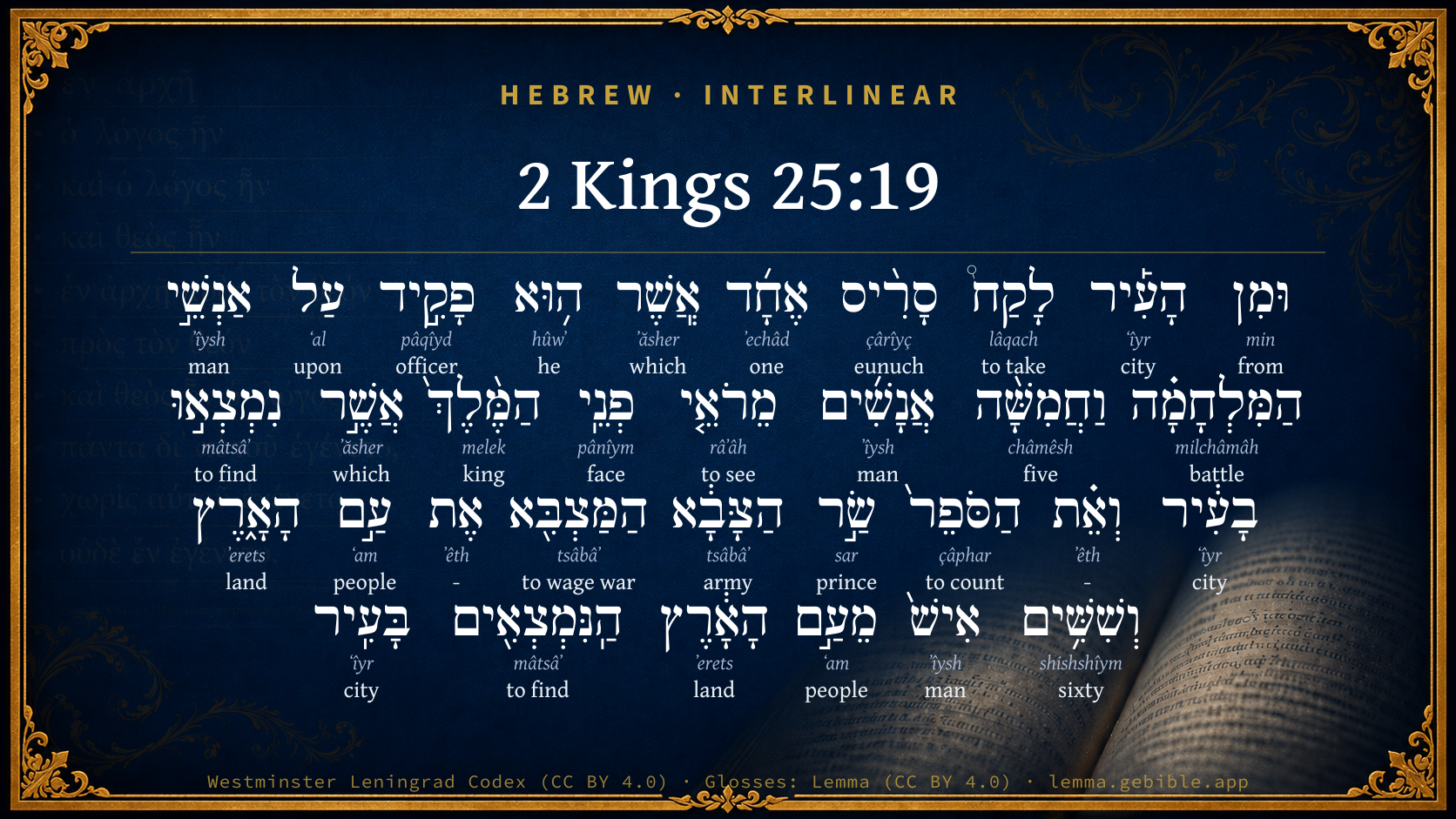
2 Kings 25:19

Hebrew (Westminster Leningrad Codex) 2 Kings 25:19 appears in the Hebrew Old Testament. The text above is from the Westminster Leningrad Codex. Each word links to its Strong’s number, a concise gloss, and parsing drawn from the Open Scriptures Hebrew Bible morphology. Click any word for its full Brown-Driver-Briggs (BDB) entry.
Download image
Cite this verse

2 Kings 25:19 (World English Bible). Public Domain. Lemma interlinear Bible study tool, https://lemma.gebible.app/v/2-kings/25/19.

Show BibTeX & RIS
BibTeX
RIS
English Translation
and out of the city he took an officer who was set over the men of war; and five men of those who saw the king's face, who were found in the city; and the scribe, the captain of the host, who mustered the people of the land; and sixty men of the people of the land, who were found in the city.
World English Bible · Public Domain
Download a study sheet

One document with this verse’s original text, its word-by-word gloss line, the meaning frame, cross-references with their text, attributed commentary, and full source and license credits — printable, and it pastes into notes with its structure intact.

This verse Autodidact and up

Study sheet (.html) Plain text (.txt)

A passage Seminary Student

Up to 50 verses in one chapter. A passage sheet keeps up to 6 commentary sources and 12 cross-references per verse, in the order this page ranks them, and says so on the sheet whenever that leaves anything out. Ask for a single verse and you get the Autodidact verse sheet above.

Everything on this page stays free to read, with no account — the sheet is a download of what is already on screen, not access to it.

Want to remove ads? Support Godless Engineer
Compare translations 3

The same verse in 3 English versions, stacked beneath the original-language interlinear above. Click any original word for its lexicon entry.

Each is an independent rendering of the whole verse — the interlinear is not word-aligned to these translations.

Highlighted words mark where these versions differ — a whole-verse word diff, not a word-by-word alignment.

  • World English Bible Public Domain
    and out of the city he took an officer who was set over the men of war; and five men of those who saw the king's face, who were found in the city; and the scribe, the captain of the host, who mustered the people of the land; and sixty men of the people of the land, who were found in the city.
  • King James Version Public Domain
    And out of the city he took an officer that was set over the men of war, and five men of them that were in the king's presence, which were found in the city, and the principal scribe of the host, which mustered the people of the land, and threescore men of the people of the land that were found in the city:
  • unfoldingWord Literal Text CC BY-SA 4.0
    And from the city he took a eunuch because he the overseer over the men of war and five men from the seers of the face of the king who were found in the city and the scribe, the commander of the army, the one mustering the people of the land and 60 men from the people of the land found in the city.

unfoldingWord Literal Text — © unfoldingWord, licensed CC BY-SA 4.0. Word-aligned USFM3 via Door43 (git.door43.org/unfoldingWord/en_ult).

Versions to compare (up to 4)

3 of 4 selected

Show all 18 translations

Every available English version of this verse, each an independent rendering of the whole verse.

  • World English Bible Public Domain
    and out of the city he took an officer who was set over the men of war; and five men of those who saw the king's face, who were found in the city; and the scribe, the captain of the host, who mustered the people of the land; and sixty men of the people of the land, who were found in the city.
  • Berean Standard Bible Public Domain
    Of those still in the city, he took a court official who had been appointed over the men of war, as well as five royal advisors. He also took the scribe of the captain of the army, who had enlisted the people of the land, and sixty men who were found in the city.
  • Majority Standard Bible Public Domain
    Of those still in the city, he took a court official who had been appointed over the men of war, as well as five royal advisors. He also took the scribe of the captain of the army, who had enlisted the people of the land, and sixty men who were found in the city.
  • King James Version Public Domain
    And out of the city he took an officer that was set over the men of war, and five men of them that were in the king's presence, which were found in the city, and the principal scribe of the host, which mustered the people of the land, and threescore men of the people of the land that were found in the city:
  • American Standard Version (1901) Public Domain
    and out of the city he took an officer that was set over the men of war; and five men of them that saw the king's face, who were found in the city; and the scribe, the captain of the host, who mustered the people of the land; and threescore men of the people of the land, that were found in the city.
  • Revised Version (1885) Public Domain
    and out of the city he took an officer that was set over the men of war; and five men of them that saw the king’s face, which were found in the city; and the scribe, the captain of the host, which mustered the people of the land; and threescore men of the people of the land, that were found in the city.
  • Geneva Bible (1599) Public Domain
    And out of the citie hee tooke an Eunuch that had the ouersight of the men of warre, and fiue men of them that were in the Kinges presence, which were founde in the citie, and Sopher captaine of the hoste, who mustred the people of the lande, and threescore men of the people of the lande, that were founde in the citie.
  • Douay-Rheims (1899) Public Domain
    And out of the city one eunuch, who was captain over the men of war: and five men of them that had stood before the king, whom he found in the city, and Sopher the captain of the army who exercised the young soldiers of the people of the land: and threescore men of the common people, who were found in the city.
  • Young's Literal Translation Public Domain
    and out of the city he hath taken a certain eunuch who is appointed over the men of war, and five men of those seeing the king's face who have been found in the city, and the head scribe of the host, who mustereth the people of the land, and sixty men of the people of the land who are found in the city,
  • Literal Standard Version CC BY-SA 4.0
    and he has taken out of the city a certain eunuch who is appointed over the men of war, and five men of those seeing the king’s face who have been found in the city, and the head scribe of the host who musters the people of the land, and sixty men of the people of the land who are found in the city;
  • Unlocked Literal Bible CC BY-SA 4.0
    From the city he took prisoner an officer who was in charge of soldiers, and five men of those who advised the king, who were still in the city. He also took prisoner the king's army officer responsible for drafting men into the army, along with sixty important men from the land who were in the city.
  • unfoldingWord Literal Text CC BY-SA 4.0
    And from the city he took a eunuch because he the overseer over the men of war and five men from the seers of the face of the king who were found in the city and the scribe, the commander of the army, the one mustering the people of the land and 60 men from the people of the land found in the city.
  • Darby Bible Public Domain
    And out of the city he took a chamberlain that was set over the men of war, and five men of them that were in the king's presence, who were found in the city, and the scribe of the captain of the host, who enrolled the people of the land; and sixty men of the people of the land that were found in the city.
  • World Messianic Bible Public Domain
    and out of the city he took an officer who was set over the men of war; and five men of those who saw the king’s face, who were found in the city; and the scribe, the captain of the army, who mustered the people of the land, and sixty men of the people of the land who were found in the city.
  • Webster's Bible Public Domain
    And out of the city he took an officer that was set over the men of war, and five men of them that were in the king's presence, who were found in the city, and the principal scribe of the host, who mustered the people of the land, and sixty men of the people of the land that were found in the city:
  • Free Bible Version CC BY-SA 4.0
    From those left in the city he took the officer in charge of the soldiers, and five of the king's advisors. He also took the secretary to the army commander who was in charge of calling up the people for military service, and sixty other men who were present in the city.
  • Bible in Basic English Public Domain
    And from the town he took the unsexed servant who was over the men of war, and five of the king's near friends who were in the town, and the scribe of the captain of the army, who was responsible for getting the people of the land together in military order, and sixty men of the people of the land who were in the town.
  • JPS Tanakh (1917) Public Domain
    and out of the city he took an officer that was set over the men of war; and five men of them that saw the king's face, who were found in the city; and the scribe of the captain of the host, who mustered the people of the land; and threescore men of the people of the land, that were found in the city.

Literal Standard Version (2020), Covenant Press — licensed CC BY-SA 4.0. Text via the HelloAO Bible API (eBible.org). Unlocked Literal Bible (unfoldingWord) — licensed CC BY-SA 4.0. Text via the HelloAO Bible API (eBible.org). unfoldingWord Literal Text — © unfoldingWord, licensed CC BY-SA 4.0. Word-aligned USFM3 via Door43 (git.door43.org/unfoldingWord/en_ult). Free Bible Version, Dr. Jonathan Gallagher — licensed CC BY-SA 4.0. Text via the HelloAO Bible API (eBible.org).

Word by word

More ways to search: Search by grammar → Find every occurrence → Compare this word →

Practice this passage: Drill this verse → Learn its vocabulary →

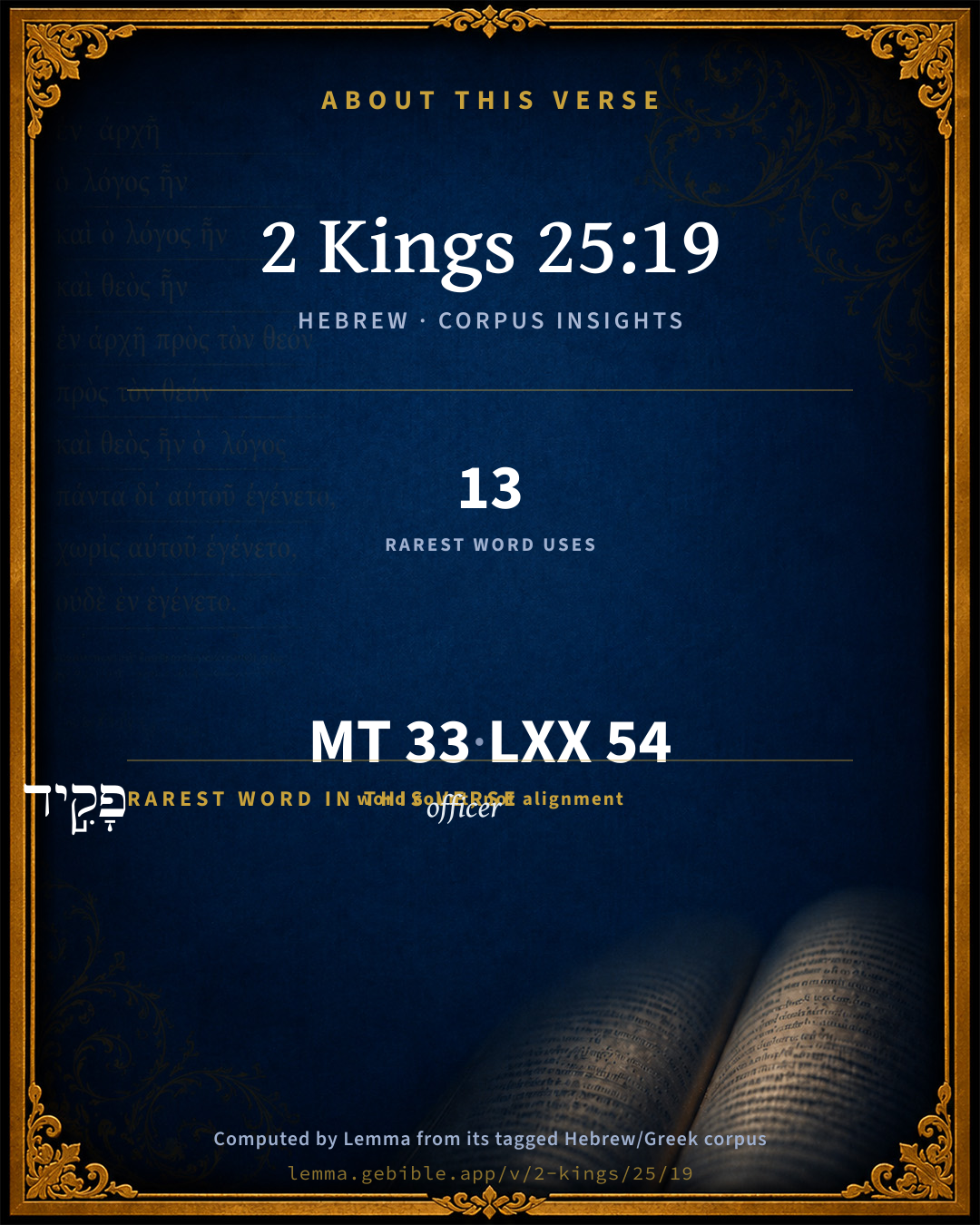
פָקִ֣יד
pâqîyd
H6496
“officer”
Noun, Common, Masculine, Singular, Absolute
Part of Speech
Noun
Type
Common
Gender
Masculine
Number
Singular
State
Absolute
Full BDB Definition

Origin: from H6485

TWOT: 1802c

commissioner, deputy, overseer, officer
  1. וּמִן min H4480 “and · from” Conjunction + Preposition
  2. הָעִ֡יר ʻîyr H5892 “the · city” Particle, Definite Article + Noun, Common, Feminine, Singular, Absolute
  3. לָקַח֩ lâqach H3947 “to take” Verb, Qal, Perfect, 3rd Person, Masculine, Singular
  4. סָרִ֨יס çârîyç H5631 “eunuch” Noun, Common, Masculine, Singular, Absolute
  5. אֶחָ֜ד ʼechâd H259 “one” Adjective, Cardinal number, Masculine, Singular, Absolute
  6. אֲֽשֶׁר ʼăsher H834 “which” Particle, Relative
  7. ה֥וּא hûwʼ H1931 “he” Pronoun, Personal, 3rd Person, Masculine, Singular
  8. עַל ʻal H5921 “upon” Preposition
  9. אַנְשֵׁ֣י ʼîysh H376 “men of” Noun, Common, Masculine, Plural, Construct
  10. הַמִּלְחָמָ֗ה milchâmâh H4421 “the · battle” Particle, Definite Article + Noun, Common, Feminine, Singular, Absolute
  11. וַחֲמִשָּׁ֨ה châmêsh H2568 “and · five” Conjunction + Adjective, Cardinal number, Masculine, Singular, Absolute
  12. אֲנָשִׁ֜ים ʼîysh H376 “men” Noun, Common, Masculine, Plural, Absolute
  13. מֵרֹאֵ֤י râʼâh H7200 “from · seeing” Preposition + Verb, Qal, Participle Active, Masculine, Plural, Construct
  14. פְנֵֽי pânîym H6440 “face(s) of” Noun, Common, Both, Plural, Construct
  15. הַמֶּ֨לֶךְ֙ melek H4428 “the · king” Particle, Definite Article + Noun, Common, Masculine, Singular, Absolute
  16. אֲשֶׁ֣ר ʼăsher H834 “which” Particle, Relative
  17. נִמְצְא֣וּ mâtsâʼ H4672 “to find” Verb, Niphal, Perfect, 3rd Person, Common, Plural
  18. בָעִ֔יר ʻîyr H5892 “in/at the · city” Preposition, Determined + Noun, Common, Feminine, Singular, Absolute
  19. וְאֵ֗ת ʼêth H853 “and · -” Conjunction + Particle, Direct Object
  20. הַסֹּפֵר֙ çâphar H5608 “the · scribe” Particle, Definite Article + Noun, Common, Masculine, Singular, Absolute
  21. שַׂ֣ר sar H8269 “prince of” Noun, Common, Masculine, Singular, Construct
  22. הַצָּבָ֔א tsâbâʼ H6635 “the · army” Particle, Definite Article + Noun, Common, Both, Singular, Absolute
  23. הַמַּצְבִּ֖א tsâbâʼ H6633 “the · waging war” Particle, Definite Article + Verb, Hiphil, Participle Active, Masculine, Singular, Absolute
  24. אֶת ʼêth H853 “-” Particle, Direct Object
  25. עַ֣ם ʻam H5971 “people of” Noun, Common, Masculine, Singular, Construct
  26. הָאָ֑רֶץ ʼerets H776 “the · land” Particle, Definite Article + Noun, Common, Both, Singular, Absolute
  27. וְשִׁשִּׁ֥ים shishshîym H8346 “and · sixty” Conjunction + Adjective, Cardinal number, Both, Plural, Absolute
  28. אִישׁ֙ ʼîysh H376 “man” Noun, Common, Masculine, Singular, Absolute
  29. מֵעַ֣ם ʻam H5971 “from · people of” Preposition + Noun, Common, Masculine, Singular, Construct
  30. הָאָ֔רֶץ ʼerets H776 “the · land” Particle, Definite Article + Noun, Common, Both, Singular, Absolute
  31. הַֽנִּמְצְאִ֖ים mâtsâʼ H4672 “the · finding” Particle, Definite Article + Verb, Niphal, Participle Active, Masculine, Plural, Absolute
  32. בָּעִֽיר ʻîyr H5892 “in/at the · city” Preposition, Determined + Noun, Common, Feminine, Singular, Absolute

About this verse

These counts appear in no published source. They are computed here, from the morphology-tagged text and Lemma’s own curated glosses. What Lemma adds →

33
words
24
distinct lemmas
Historical
section

Notable vocabulary

The rarest word here is פָקִ֣יד officer H6496 — appearing just 13 times in the whole Hebrew Bible.

Shared distinctive vocabulary

פָקִ֣יד officer H6496 occurs in 13 verses of the Hebrew Bible. Also found in:

Grammatical profile

  • 5 verbs
  • 18 nouns
  • 3 adjectives
  • 1 pronoun
  • 2 prepositions
  • 4 particles

Verb forms

  • לָקַח֩ Qal · Perfect
  • מֵרֹאֵ֤י Qal · Participle Active
  • נִמְצְא֣וּ Niphal · Perfect
  • הַמַּצְבִּ֖א Hiphil · Participle Active
  • הַֽנִּמְצְאִ֖ים Niphal · Participle Active

Repetition

Words recur within this verse — often emphatic in Hebrew:

  • הָעִ֡יר city H5892 ×3
  • אַנְשֵׁ֣י man H376 ×3
  • נִמְצְא֣וּ to find H4672 ×2
  • עַ֣ם people H5971 ×2
  • הָאָ֑רֶץ land H776 ×2
  • אֲֽשֶׁר which H834 ×2

Hebrew & Septuagint length

In English translation the verse runs 63 words from the Hebrew and 63 from the Septuagint (LXX English) — the same length.

A rough comparison of the two English renderings, which tokenize alike — not a word-level alignment.

Word counts can differ between the Hebrew and the Greek without any difference in meaning — e.g. the Hebrew direct-object marker אֵת has no separate Greek word, and Greek often adds the article ὁ.

In the original languages it is 33 Hebrew tokens and 54 Greek tokens — but the two are counted differently (Hebrew bundles its prefixes and suffixes into one token; the Greek is in lemma form), so that isn’t a like-for-like length.

Cross-references

1

Topical passages linked to 2 Kings 25:19 in the Treasury of Scripture Knowledge — connected by theme and wording, ordered by reader-vote popularity; previews shown in the World English Bible.

  • Esther 1:14 and the next to him were Carshena, Shethar, Admatha, Tarshish, Meres, Marsena, and Memucan, the seven princes of Persia and Media, who saw the king's face, and sat first in the kingdom),

Cross-references courtesy of OpenBible.info (CC BY 4.0).

Hebrew and Greek witnesses Masoretic Hebrew ↔ Greek Septuagint

The same verse in the two great witnesses to the Old Testament, shown verse-for-verse.

These are two independent witnesses, not word-aligned to each other, and the Septuagint is shown in lemma (dictionary) form.

Hebrew 2 Kings 25:19 Masoretic · Westminster Leningrad Codex

וּמִן הָעִ֡יר לָקַח֩ סָרִ֨יס אֶחָ֜ד אֲֽשֶׁר ה֥וּא פָקִ֣יד עַל אַנְשֵׁ֣י הַמִּלְחָמָ֗ה וַחֲמִשָּׁ֨ה אֲנָשִׁ֜ים מֵרֹאֵ֤י פְנֵֽי הַמֶּ֨לֶךְ֙ אֲשֶׁ֣ר נִמְצְא֣וּ בָעִ֔יר וְאֵ֗ת הַסֹּפֵר֙ שַׂ֣ר הַצָּבָ֔א הַמַּצְבִּ֖א אֶת עַ֣ם הָאָ֑רֶץ וְשִׁשִּׁ֥ים אִישׁ֙ מֵעַ֣ם הָאָ֔רֶץ הַֽנִּמְצְאִ֖ים בָּעִֽיר

and out of the city he took an officer who was set over the men of war; and five men of those who saw the king's face, who were found in the city; and the scribe, the captain of the host, who mustered the people of the land; and sixty men of the people of the land, who were found in the city.

World English Bible · Public Domain

Greek LXX 2 Kings 25:19 Septuagint · lemma form

καί ἐκ ὁ πόλις λαμβάνω εὐνοῦχος εἷς ὅς εἰμί ἐπιστάτης ἐπί ὁ ἀνήρ ὁ πολεμιστής καί πέντε ἀνήρ ὁ ὁράω ὁ πρόσωπον ὁ βασιλεύς ὁ εὑρίσκω ἐν ὁ πόλις καί ὁ γραμματεύς ὁ ἄρχων ὁ δύναμις ὁ ἐκτάσσω ὁ λαός ὁ γῆ καί ἑξήκοντα ἀνήρ ὁ λαός ὁ γῆ ὁ εὑρίσκω ἐν ὁ πόλις

And they took out of the city one eunuch who was commander of the men of war, and five men that saw the face of the king, that were found in the city, and the secretary of the commander-in-chief, who took account of the people of the land, and sixty men of the people of the land that were found in the city.

LXX2012 (modern English Septuagint) · Public Domain

On this verse, Ellicott's Commentary for English Readers discusses the Septuagint’s reading. Read the note in Commentary ↓

Hebrew: Westminster Leningrad Codex (CC BY 4.0). Greek: Septuagint (public domain); English from LXX2012 (modern English Septuagint) (Public Domain). How the Septuagint differs from the Hebrew →

Targum (Aramaic paraphrase)

1

The Targum is the ancient Jewish Aramaic paraphrase of the Hebrew Scriptures — an interpretive translation, not the Hebrew text itself. Onkelos (literal) and Pseudo-Jonathan (expansive) render the Torah, and Jonathan the Prophets. Coverage is partial: where no permissively-licensed English translation exists for a verse, only the Aramaic is shown. This is verse-level text, not a word-by-word alignment to the Hebrew.

  1. Targum Jonathan Prophets (Joshua–Malachi)
    וּמִן קַרְתָּא דְבַר גַוָזָא חַד דְהוּא מְמַנָא עַל גַבְרֵי עָבְדֵי קְרָבָא וְחַמְשָׁא גַבְרִין דְחָזָן אַפֵּי מַלְכָּא דְאִשְׁתְּכָחוּ בְקַרְתָּא וְיַת סַפְרָא רַב חֵילָא דִכְנַשׁ יַת עַמָא דְאַרְעָא וְשִׁתִּין גַבְרָא מֵעַמָא דְאַרְעָא דְאִשְׁתְּכָחוּ בְקַרְתָּא:

    (no public-domain English translation for this verse)

    Targum Jonathan — Aramaic: “Mikraot Gedolot” (public domain). English: “Sefaria Community Translation” (CC0 1.0 (public-domain dedication)); “London "Chaldee Paraphrase," 1871” (public domain). Text via Sefaria.

Commentary

Notes on 2 Kings 25:19 from classic Christian and Jewish commentators (each source and its license shown beneath its notes). The classic Christian expositions comment on the surrounding passage and are grouped to its opening verse, so a note may address several verses; the Jewish commentaries on the Tanakh (Rashi and others) are per-verse, so they appear only where the commentator wrote on this verse.

Lemma curates 59 commentaries, every one of them public domain or Creative Commons licensed, each selected and text-cleaned for this edition rather than reprinted as found. About our sources →

Trapp's Complete Commentary

John Trapp

2Ki 25:19 And out of the city he took an officer that was set over the men of war, and five men of them that were in the king’s presence, which were found in the city, and the principal scribe of the host, which mustered the people of the land, and threescore men of the people of the land [that were] found in the city:

Ver. 19. That was set over the men of war.] Lieutenant-general, likely, to General Sophar. {Jer 25:1-38}

And five men of them.] Jeremiah saith seven men; two of them, perhaps, were less considerable, or taken at another time.

John Trapp, A Commentary or Exposition upon All the Books of the Old and New Testament (1647–1656) — public domain. Text from a community e-Sword module.

Geneva Bible (1599)

Geneva Bible translators

Jeremiah maketh mention of seven, but here he speaketh of them that were the chiefest.

Geneva Bible (1599) marginal notes — public domain. Text via Bolls.life.

Jamieson, Fausset & Brown

Robert Jamieson, A. R. Fausset & David Brown

five men of them that were in the king's presence--that is, who belonged to the royal retinue. It is probable that there were five at first, and that other two were found afterwards (Jer 52:25).

Jamieson, Fausset & Brown — Commentary Critical and Explanatory on the Whole Bible (1871) — public domain (CC PDM 1.0). Text via the HelloAO Bible API.

Adam Clarke's Commentary

Verse 19. And five men of them that were in the king's presence] These were principal counsellors, and confidential officers.

In Jer 52:25, it is said he took seven men who were near the king's person, and the same number is found in the Arabic in this place; and the Chaldee has no less than fifty men; but in Jeremiah this, as well as all the rest of the versions, reads seven. Probably they were no more than five at first, or, perhaps Jeremiah reckoned with the five the officer that was set over the men of war, and the principal scribe of the host mentioned here, as two with the five; and thus made seven in the whole.

Adam Clarke's Commentary on the Bible (1810–1826) — public domain. Text from a community e-Sword/MySword module.

Ellicott's Commentary for English Readers

(19) The city.—Thenius is probably right in explaining the city of David.

An officer that was set over the men of war—i.e., a royal officer commanding the garrison of the city of David. He was probably not an eunuch (2Ki_20:18; 2Ki_24:12), though in the Byzantine empire, at all events, eunuchs were sometimes great soldiers—e.g., the heroic Narses.

And five men of them . . .—See margin. The phrase is explained by the seclusion affected by Oriental sovereigns. The LXX., Syriac, and Vulg., read five; the Targum, fifty. Jeremiah 52 and the Arabic read seven. The numeral letter denoting 5 had probably become partially obliterated in the MS. used by the writer of Jeremiah 52. The persons in question were royal counsellors. They may have dissuaded the king from flight, and so held out to the last (Thenius).

The principal scribe of the host.—See margin. This scribe was an officer on the staff of the commander-in-chief, who had himself either fallen fighting or accompanied the king in his flight.

Which mustered the people of the land—i.e., enrolled the names of such persons as were bound to serve in the army.

Threescore men of the people of the land . . .—i.e., apparently the remains of the garrison of the citadel. Keil thinks such as had distinguished themselves above others in the defence, or had been ringleaders in the rebellion.

That were found . . .—This expression seems to imply that they were the few survivors of a much larger force.

In the city.—Jeremiah 52 in the midst of the city, an expression which seems to point to the city of David, which was the strategical centre of Jerusalem.

A Bible Commentary for English Readers, edited by Charles John Ellicott (1878–1897) — public domain. Text from a community e-Sword module.

The Cambridge Bible for Schools and Colleges

gen. ed. J. J. S. Perowne

19. five men of them that were in the king’s presence] R.V. that saw the king’s face. For the expression, cf. Est_1:14. The officer over the men of war, and the five persons admitted to closest intimacy with the king, together with the scribe, represented the remaining conspicuous persons in the city: Seraiah and the others were prominent among the servants of the temple.

principal scribe of the host] R.V. the scribe, the captain of the host. This was the chief military secretary, Secretary at War. Some would render ‘the scribe of the captain of the host,’ and suggest that his superior officer had been already taken away, or had fled.

threescore men of the people of the land] These, though undefined, had made themselves obnoxious in some way or other; else they would not have been taken and put to death among the distinguished people named before them.

The Cambridge Bible for Schools and Colleges (gen. ed. J. J. S. Perowne; Cambridge University Press, 1878–1918) — public domain. Text from a community e-Sword module.

Albert Barnes' Notes on the Bible

Out of the city - This clause shows that the five persons mentioned in 2Ki 25:18 were taken out of the temple.

Five men - Or, “seven men,” according to Jer 52:25. It is impossible to say which of the two numbers is correct.

Of them that were in the king’s presence - See the margin. A mode of speech arising from the custom of Eastern rulers to withdraw themselves as much as possible from the view of their subjects.

Albert Barnes' Notes on the Bible (1834–1885) — public domain. Text from a community e-Sword/MySword module.

Haydock's Catholic Bible Commentary

Eunuch. Protestants, "officer." (Haydock) --- Five. Arabic and Jeremias lii. 25., read seven, as two were probably discovered afterwards, (Calmet) or had fled. (Du Hamel) --- These were chief officers. --- Sopher. Septuagint, "and the secretary of the general." Syriac, "the secretary and chiefs of the armies." (Calmet) --- Protestants, "the principal scribe." (Haydock) --- It is not clear whether the general have this title of sopher, "scribe," himself; or it rather designates his secretary, or scribe, Judges viii. 14. (Calmet) --- Many date the 70 years captivity from the last year of Joachin. (Du Hamel)

George Leo Haydock (1774–1849), Haydock's Catholic Family Bible and Commentary, 1859 edition — public domain. Excludes Psalms (Douay-Rheims chapter numbering differs from Protestant) and Deuterocanonical books (Catholic canon only).

Matthew Poole's English Annotations

Of them that were in the king’s presence, i.e. of them who constantly attended upon the king’s person: see 1Ki 10:8; Est 1:14.

Object. These were seven, Jer 52:25.

Answ. Either five were first taken, and two after them; or two of the seven were of an inferior rank, who therefore are here omitted.

Threescore men of the people of the land; who had been most forward or active in the rebellion.

Matthew Poole's English Annotations on the Holy Bible (1683–1685) — public domain. Text from a community e-Sword/MySword module.

Whedon's Commentary on the Bible

Daniel D. Whedon

19. An officer — Hebrew, a eunuch, but evidently not one in the strict sense, (see note on 2Ki_20:18,) for this officer was a military commander.

Five men — According to Jer_52:25, seven. Compare note on 2Ki_25:8. These were in the king’s presence, that is, were among his most intimate counsellors, (comp. Est_1:13,) but they had not fled with their royal master, but seem to have concealed themselves in the city where they were found.

Principal scribe of the host — Rather, scribe of the prince of the host, that is, his clerk, or aid-de-camp. The prince himself, whose office was to muster the army or levy for military service, had probably, as Thenius suggests, fled along with the king.

Threescore… of the land — Probably leading men from the land of Judah, who had distinguished themselves during the siege.

Daniel D. Whedon (gen. ed.), Commentary on the Old and New Testaments (1874–1909) — public domain. Text from a community e-Sword module.

The Pulpit Commentary

And out of the city he took an officer literally, a eunuchthat was set over the man of war eunuchs were often employed in the East as commanders of soldiers. Bagoas, general of the Persian monarch, Ochus, is a noted exampleand five men of them that were in the king"s presence literally, of them that saw the king"s face; i.e. that were habitually about the court; Jeremiah says (Jer_50:25) "seven men" instead of five which were found in the city the majority of the courtiers had, no doubt, dispersed, and were not to be found when Nebuzar-adan searched for themand the principal scribe of the host; rather, as in the margin, the scribe of the captain of the host (toa tou arcontov thv dunamewv, LXX). "Scribes" or "secretaries" always accompanied the march of Assyrian armies, to count and record the number of the slain, to catalogue the spoil, perhaps to write dispatches and the like. We may gather that Jewish commandants were similarly attended. Which mustered the people of the landi.e., enrolled them, or entered them upon the army list, another of the "scribe"s" dutiesand threescore men of the people of the land that were found in the city. Probably notables of one kind or another, persons regarded as especially responsible for the revolt.

The Pulpit Commentary (1880–1919), ed. H.D.M. Spence-Jones & Joseph S. Exell — public domain. Text from a community e-Sword module.

Rashi

Rabbi Shlomo Yitzchaki (Rashi)

The scribe of the general of the army. Who knew the number of each city, how many men it enlists into the army.

Rashi on the Tanakh — English translations: “The Judaica Press complete Tanach with Rashi, translated by A. J. Rosenberg” (CC BY 4.0); “Pentateuch with Rashi's commentary by M. Rosenbaum and A.M. Silbermann, 1929-1934” (public domain); “The Metsudah Tanach series, Lakewood, N.J” (CC BY 4.0); and “The Book of Joshua, Metsudah Publications, 1997” (CC BY 4.0). Text via Sefaria.

Lesson kit

Teaching starters — assembled from the data on this page, not authored interpretation. Every prompt links to the verse data it draws on. Edit before teaching.

2 Kings, in the Historical, opens this verse with 33 words (24 distinct Hebrew lemmas). Its most distinctive word is pâqîyd (“officer”). A historical commentator’s framing appears above. Read the whole chapter for the surrounding context.

Discussion questions

  1. What does “officer” (pâqîyd) contribute to the verse as a whole?
  2. How does Genesis 41:34, which shares the word «officer», read alongside this verse?
  3. What does the repetition of “city” (3× in this one verse) do in this verse?
  4. The translations on this page render this verse differently — a whole-verse word diff, not a word-by-word alignment. What might account for the different wordings?
  5. «לָקַח֩» is a Qal Perfect verb. How does that grammatical form shape the action described?
  6. Compare how Trapp's Complete Commentary and Geneva Bible (1599) read this verse. Where do they agree or differ?

Things to notice

Reading settings

Reading text

Shown beneath each verse's original-language words.

Old Testament
Old Testament edition

Read the OT as the Masoretic Hebrew (MT) or the Greek Septuagint (LXX).

English shown for the Greek Septuagint (in the Hebrew ↔ Greek comparison).

Comparing translations? Open the Compare panel on any verse page to stack up to four side by side.