
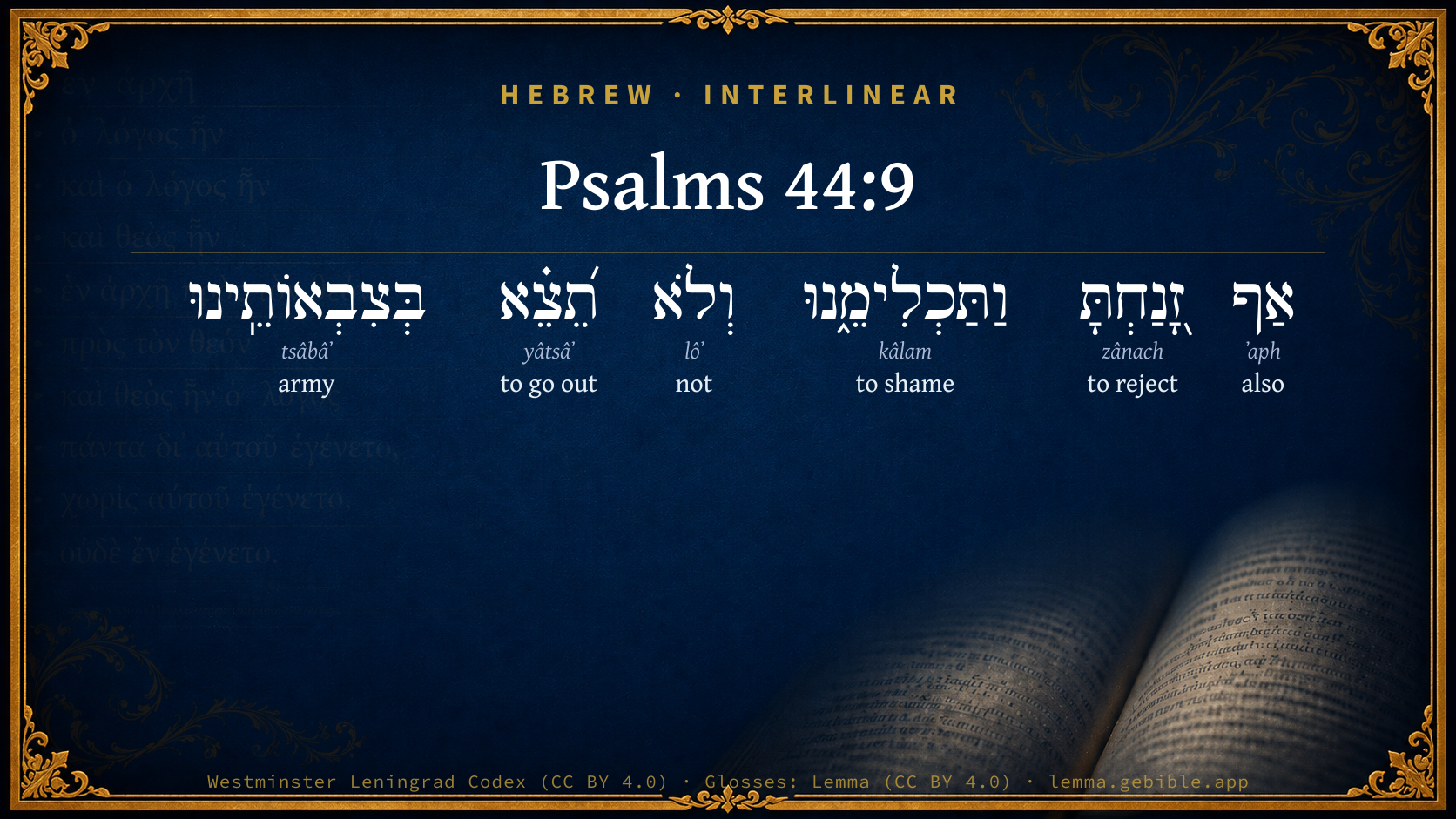
Psalms 44:9

Hebrew (Westminster Leningrad Codex) Psalms 44:9 appears in the Hebrew Old Testament. The text above is from the Westminster Leningrad Codex. Each word links to its Strong’s number, a concise gloss, and parsing drawn from the Open Scriptures Hebrew Bible morphology. Click any word for its full Brown-Driver-Briggs (BDB) entry.
Download image
Cite this verse

Psalms 44:9 (World English Bible). Public Domain. Lemma interlinear Bible study tool, https://lemma.gebible.app/v/psalms/44/9.

Show BibTeX & RIS
BibTeX
RIS
English Translation
But now you rejected us, and brought us to dishonor, And don't go out with our armies.
World English Bible · Public Domain
Download a study sheet

One document with this verse’s original text, its word-by-word gloss line, the meaning frame, cross-references with their text, attributed commentary, and full source and license credits — printable, and it pastes into notes with its structure intact.

This verse Autodidact and up

Study sheet (.html) Plain text (.txt)

A passage Seminary Student

Up to 50 verses in one chapter. A passage sheet keeps up to 6 commentary sources and 12 cross-references per verse, in the order this page ranks them, and says so on the sheet whenever that leaves anything out. Ask for a single verse and you get the Autodidact verse sheet above.

Everything on this page stays free to read, with no account — the sheet is a download of what is already on screen, not access to it.

Want to remove ads? Support Godless Engineer
Compare translations 3

The same verse in 3 English versions, stacked beneath the original-language interlinear above. Click any original word for its lexicon entry.

Each is an independent rendering of the whole verse — the interlinear is not word-aligned to these translations.

Highlighted words mark where these versions differ — a whole-verse word diff, not a word-by-word alignment.

  • World English Bible Public Domain
    But now you rejected us, and brought us to dishonor, And don't go out with our armies.
  • King James Version Public Domain
    But thou hast cast off, and put us to shame; and goest not forth with our armies.
  • unfoldingWord Literal Text CC BY-SA 4.0
    But you have rejected and humiliated us, and you do not go out with our armies.

unfoldingWord Literal Text — © unfoldingWord, licensed CC BY-SA 4.0. Word-aligned USFM3 via Door43 (git.door43.org/unfoldingWord/en_ult).

Versions to compare (up to 4)

3 of 4 selected

Show all 18 translations

Every available English version of this verse, each an independent rendering of the whole verse.

  • World English Bible Public Domain
    But now you rejected us, and brought us to dishonor, And don't go out with our armies.
  • Berean Standard Bible Public Domain
    But You have rejected and humbled us; You no longer go forth with our armies.
  • Majority Standard Bible Public Domain
    But You have rejected and humbled us; You no longer go forth with our armies.
  • King James Version Public Domain
    But thou hast cast off, and put us to shame; and goest not forth with our armies.
  • American Standard Version (1901) Public Domain
    But now thou hast cast `us' off, and brought us to dishonor, And goest not forth with our hosts.
  • Revised Version (1885) Public Domain
    But now thou hast cast us off, and brought us to dishonour; and goest not forth with our hosts.
  • Geneva Bible (1599) Public Domain
    But now thou art farre off, and puttest vs to confusion, and goest not forth with our armies.
  • Douay-Rheims (1899) Public Domain
    In God shall we glory all the day long: and in thy name we will give praise for ever.
  • Young's Literal Translation Public Domain
    In anger Thou hast cast off and causest us to blush, And goest not forth with our hosts.
  • Literal Standard Version CC BY-SA 4.0
    In anger You have cast off and cause us to blush, || And do not go forth with our hosts.
  • Unlocked Literal Bible CC BY-SA 4.0
    But now you have thrown us off and brought us dishonor, and you do not go out with our armies.
  • unfoldingWord Literal Text CC BY-SA 4.0
    But you have rejected and humiliated us, and you do not go out with our armies.
  • Darby Bible Public Domain
    But thou hast cast off, and put us to confusion, and dost not go forth with our armies;
  • World Messianic Bible Public Domain
    But now you rejected us, and brought us to dishonor, and don’t go out with our armies.
  • Webster's Bible Public Domain
    \\44:8\\In God we boast all the day long, and praise thy name for ever. Selah.
  • Free Bible Version CC BY-SA 4.0
    But now you have rejected and disgraced us; you no longer accompany our armies.
  • Bible in Basic English Public Domain
    But now you have sent us away from you, and put us to shame; you do not go out with our armies.
  • JPS Tanakh (1917) Public Domain
    (44-10) Yet Thou hast cast off, and brought us to confusion; and goest not forth with our hosts.

Literal Standard Version (2020), Covenant Press — licensed CC BY-SA 4.0. Text via the HelloAO Bible API (eBible.org). Unlocked Literal Bible (unfoldingWord) — licensed CC BY-SA 4.0. Text via the HelloAO Bible API (eBible.org). unfoldingWord Literal Text — © unfoldingWord, licensed CC BY-SA 4.0. Word-aligned USFM3 via Door43 (git.door43.org/unfoldingWord/en_ult). Free Bible Version, Dr. Jonathan Gallagher — licensed CC BY-SA 4.0. Text via the HelloAO Bible API (eBible.org).

Word by word

More ways to search: Search by grammar → Find every occurrence → Compare this word →

Practice this passage: Drill this verse → Learn its vocabulary →

About this verse

These counts appear in no published source. They are computed here, from the morphology-tagged text and Lemma’s own curated glosses. What Lemma adds →

6
words
6
distinct lemmas
Wisdom
section

Notable vocabulary

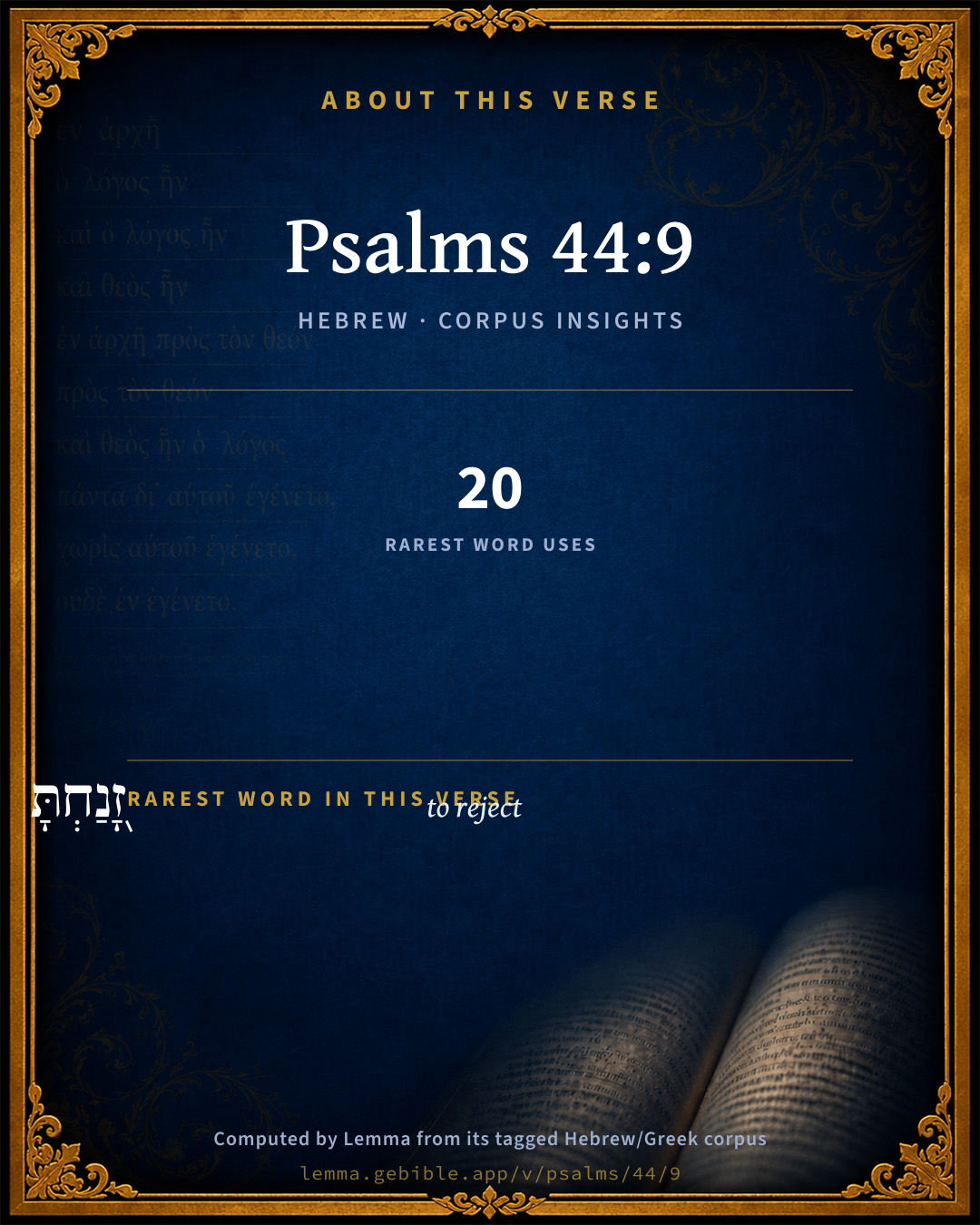
The rarest word here is זָ֭נַחְתָּ to reject H2186 — appearing just 20 times in the whole Hebrew Bible.

Shared distinctive vocabulary

זָ֭נַחְתָּ to reject H2186 occurs in 20 verses of the Hebrew Bible. Also found in:

Grammatical profile

  • 3 verbs
  • 1 noun
  • 2 particles

Verb forms

  • זָ֭נַחְתָּ Qal · Perfect
  • וַתַּכְלִימֵ֑נוּ Hiphil · Sequential Imperfect
  • תֵ֝צֵ֗א Qal · Imperfect

Hebrew & Septuagint length

In English translation the verse runs 17 words from the Hebrew and 20 from the Septuagint (LXX English) — closely comparable.

A rough comparison of the two English renderings, which tokenize alike — not a word-level alignment.

Word counts can differ between the Hebrew and the Greek without any difference in meaning — e.g. the Hebrew direct-object marker אֵת has no separate Greek word, and Greek often adds the article ὁ.

Cross-references

11

Topical passages linked to Psalms 44:9 in the Treasury of Scripture Knowledge — connected by theme and wording, ordered by reader-vote popularity; previews shown in the World English Bible.

  • Psalms 60:10 Haven't you, God, rejected us? You don't go out with our armies, God.
  • Psalms 74:1 God, why have you rejected us forever? Why does your anger smolder against the sheep of your pasture?
  • Psalms 60:1 God, you have rejected us. You have broken us down. You have been angry. Restore us, again.
  • Psalms 108:11 Haven't you rejected us, God? You don't go forth, God, with our armies.
  • Psalms 43:2 For you are the God of my strength. Why have you rejected me? Why do I go mourning because of the oppression of the enemy?
  • Psalms 89:38–45 But you have rejected and spurned. You have been angry with your anointed.
  • Jeremiah 33:24–26 Don't you consider what this people has spoken, saying, The two families which Yahweh did choose, he has cast them off? thus do they despise my people, that they should be no more a nation before them.
  • Lamentations 3:31–32 For the Lord will not cast off forever.
  • Romans 11:1–6 I ask then, Did God reject his people? May it never be! For I also am an Israelite, a descendant of Abraham, of the tribe of Benjamin.
  • Psalms 80:12–13 Why have you broken down its walls, So that all those who pass by the way pluck it?
  • Psalms 88:14 Yahweh, why do you reject my soul? Why do you hide your face from me?

Cross-references courtesy of OpenBible.info (CC BY 4.0).

Hebrew and Greek witnesses Masoretic Hebrew ↔ Greek Septuagint

The same verse in the two great witnesses to the Old Testament, shown verse-for-verse.

You’re reading Greek Psalm 43 (Hebrew Psalm 44). The Septuagint counts the superscription, so verse numbers can differ from the Hebrew — chapter-level alignment, not verse-by-verse. Numbering follows Rahlfs.

These are two independent witnesses, not word-aligned to each other, and the Septuagint is shown in lemma (dictionary) form.

Hebrew Psalms 44:9 Masoretic · Westminster Leningrad Codex

אַף זָ֭נַחְתָּ וַתַּכְלִימֵ֑נוּ וְלֹא תֵ֝צֵ֗א בְּצִבְאוֹתֵֽינוּ

But now you rejected us, and brought us to dishonor, And don't go out with our armies.

World English Bible · Public Domain

Greek LXX Greek Psalm 43:9 Septuagint · lemma form

ἐν ὁ θεός ἐπιαἰνέω ὅλος ὁ ἡμέρα καί ἐν ὁ ὄνομα σύ ἐκὁμολογέω εἰς ὁ αἰών διάψαλμα

But now you have cast off, and put us to shame; and you will not go forth with our hosts.

LXX2012 (modern English Septuagint) · Public Domain

Hebrew: Westminster Leningrad Codex (CC BY 4.0). Greek: Septuagint (public domain); English from LXX2012 (modern English Septuagint) (Public Domain). How the Septuagint differs from the Hebrew →

Commentary

Notes on Psalms 44:9 from classic Christian and Jewish commentators (each source and its license shown beneath its notes). The classic Christian expositions comment on the surrounding passage and are grouped to its opening verse, so a note may address several verses; the Jewish commentaries on the Tanakh (Rashi and others) are per-verse, so they appear only where the commentator wrote on this verse.

Lemma curates 59 commentaries, every one of them public domain or Creative Commons licensed, each selected and text-cleaned for this edition rather than reprinted as found. About our sources →

Matthew Henry's Commentary

The people of God here complain to him of the low and afflicted condition that they were now in, under the prevailing power of their enemies and oppressors, which was the more grievous to them because they were now trampled upon, who had always been used, in their struggles with their neighbours, to win the day and get the upper hand, and because those were now their oppressors whom they had many a time triumphed over and made tributaries, and especially because they had boasted in their God with great assurance that he would still protect and prosper them, which made the distress they were in, and the disgrace they were under, the more shameful. Let us see what the complaint is.

I. That they wanted the usual tokens of God's favour to them and presence with them (Psa 44:9): "Thou hast cast off; thou seemest to have cast us off and our cause, and to have cast off thy wonted care of us and concern for us, and so hast put us to shame, for we boasted of the constancy and perpetuity of thy favour. Our armies go forth as usual, but they are put to flight; we gain no ground, but lose what we have gained, for thou goest not forth with them, for, if thou didst, which way soever they turned they would prosper; but it is quite contrary." Note, God's people, when they are cast down, are tempted to think themselves cast off and forsaken of God; but it is a mistake. Hath God cast away his people? God forbid, Rom 11:1.

II. That they were put to the worst before their enemies in the field of battle (Psa 44:10): Thou makest us to turn back from the enemy, as Joshua complained when they met with a repulse at Ai (Jos 7:8): "We are dispirited, and have lost the ancient valour of Israelites; we flee, we fall, before those that used to flee and fall before us; and then those that hate us have the plunder of our camp and of our country; they spoil for themselves, and reckon all their own that they can lay their hands on. Attempts to shake off the Babylonish yoke have been ineffectual, and we have rather lost ground by them."

III. That they were doomed to the sword and to captivity (Psa 44:11): "Thou hast given us like sheep appointed for meat. They make no more scruple of killing an Israelite than of killing a sheep; nay, like the butcher, they make a trade of it, they take a pleasure in it as a hungry man in his meat; and we are led with as much ease, and as little resistance, as a lamb to the slaughter; many are slain, and the rest scattered among the heathen, continually insulted by their malice or in danger of being infected by their iniquities." They looked upon themselves as bought and sold, and charged it upon God, Thou sellest thy people, when they should have charged it upon their own sin. For your iniquities have you sold yourselves, Isa 50:1. However, thus far was right that they looked above the instruments of their trouble and kept their eye upon God, as well knowing that their worst enemies had no power against them but what was given them from above; they own it was God that delivered them into the hand of the ungodly, as that which is sold is delivered to the buyer. Thou sellest them for nought, and dost not increase in their price (so it may be read); "thou dost not sell them by auction, to those that will bid most for them, but in haste, to those that will bid first for them; any one shall have them that will." Or, as we read it, Thou dost not increase thy wealth by their price, intimating that they could have suffered this contentedly if they had been sure that it would redound to the glory of God and that his interest might be some way served by their sufferings; but it was quite contrary: Israel's disgrace turned to God's dishonour, so that he was so far from being a gainer in his glory by the sale of them that it should seem he was greatly a loser by it; see Isa 52:5; Eze 36:20.

IV. That they were loaded with contempt, and all possible ignominy was put upon them. In this also they acknowledge God: "Thou makest us a reproach; thou bringest those calamities upon us which occasion the reproach, and thou permittest their virulent tongues to smite us." They complain, 1. That they were ridiculed and bantered, and were looked upon as the most contemptible people under the sun; their troubles were turned to their reproach, and upon the account of them they were derided. 2. That their neighbours, those about them, from whom they could not withdraw, were most abusive to them, Psa 44:13. 3. That the heathen, the people that were strangers to the commonwealth of Israel and aliens to the covenants of promise, made them a by-word, and shook the head at them, as triumphing in their fall, Psa 44:14. 4. That the reproach was constant and incessant (Psa 44:15): My confusion is continually before me. The church in general, the psalmist in particular, were continually teased and vexed with the insults of the enemy. Concerning those that are going down every one cries, "Down with them." 5. That it was very grievous, and in a manner overwhelmed him: The shame of my face has covered me. He blushed for sin, or rather for the dishonour done to God, and then it was a holy blushing. 6. That it reflected upon God himself; the reproach which the enemy and the avenger cast upon them was downright blasphemy against God, Psa 44:16, and Kg2 19:3. There was therefore strong reason to believe that God would appear for them. As there is no trouble more grievous to a generous and ingenuous mind than reproach and calumny, so there is none more grievous to a holy gracious soul than blasphemy and dishonour done to God.

Matthew Henry's Commentary on the Whole Bible (1708–1710) — public domain (CC PDM 1.0). Text via the HelloAO Bible API.

Trapp's Complete Commentary

John Trapp

Psa 44:9 But thou hast cast off, and put us to shame; and goest not forth with our armies.

Ver. 9. But thou hast cut off, and put us to shame] Here is a sudden change, and a sad complaint, but handsomely brought in, the better to insinuate, the sooner to prevail for redress. Only this, it should have been remembered that the Lord’s hand was not shortened … but their iniquities had separated between them and their God, Isa 59:1-2. That noble General Trajan told Valens, the Arian emperor, that by warring against God he had abandoned the victory, and sent it to the enemies (Niceph. l. 11, c. 40).

John Trapp, A Commentary or Exposition upon All the Books of the Old and New Testament (1647–1656) — public domain. Text from a community e-Sword module.

Joseph Benson's Commentary

Psa 44:9-10. But thou hast cast us off — Now thy countenance and course are quite changed to us; and hast put us to shame — Hast made us ashamed of our boasting and trust in thee, which we have often professed to the face of our enemies. And goest not forth with our armies — To lead them and fight for them, as this phrase signifies, Jdg 4:14; 1Sa 8:20. He seems to allude to God’s marching with and before the Israelites in the wilderness, and afterward as occasion was offered, Psa 68:7. Thou makest us to turn back — We have lost the courage wherewith thou didst formerly inspire us, and cannot defend our cities and fortresses. For, according to thy threatening, (Lev 26:36,) thou hast sent a faintness into our hearts in the land of our enemies. And they which hate us spoil for themselves — Plunder our camps, and take our estates, and other property for their own use; and that not with a view to comply with thy will, which was to punish us for our sins, nor for thy service and glory. They mind nothing but their own advantage.

Joseph Benson's Commentary on the Old and New Testaments (1811–1818) — public domain. Text from a community e-Sword module.

Whedon's Commentary on the Bible

Daniel D. Whedon

9-16. The strain suddenly turns to lamentation and complaint, and the poet spreads the national distress before God. Psa_44:9-12 clearly portray a state of war, of general defeat, and of the captivity and slavery of multitudes. See introduction, and reference there made.

Thou hast cast off—All their distress results from this one cause.

Goest not forth with our armies—In vain did they muster their hosts when God was not with them.

They… spoil for themselves—That is, at will, to their heart’s content, with none to hinder.

Like sheep appointed for meat—Hebrew, sheep of food, or, as Psa_44:22, sheep for slaughter, sheep counted out for slaughter. The figure is expressive of great numbers and helplessness. Sheep make, when attacked, a feeble and vain resistance.

Scattered us among the heathen—Anciently captivity and dispersion followed in the train of defeat.

Thou sellest thy people for naught—The allusion is to the selling of captives as slaves. The market is overstocked, and the price is as nothing. See Deu_28:68 and Joe_3:3. The Hebrew reads, for no wealth. This was the last downward step in their degradation. The multitude of captives and the hatred of the nations towards the Hebrews, made them unvaluable as slaves. The northern and eastern tribes had gone into captivity, and the kingdom of Judah itself was invaded. [The final fall of the nation by the Romans, A.D. 70, was still more dreadful.]

Dost not increase—A delicate figure of speech (the litotes) for thou decreasest. The idea, though not literally a parallel, is well expressed Pro_22:16. God is confessed as the author of the national judgments, and it is reverently pleaded that they appeared in excess of profitable chastisement. Psa_44:13-14, show the extent of the humiliation of the people, by the terms reproach, scorn, derision, byword, shaking of the head, and how these had taken effect is confessed Psa_44:15.

Enemy and avenger—The words may mean any opponent or adversary of revengeful temper, (Psa_8:2,) and may fitly apply to Sennacherib, who also “reproached and blasphemed.” Isa_37:17; Isa_37:23

Daniel D. Whedon (gen. ed.), Commentary on the Old and New Testaments (1874–1909) — public domain. Text from a community e-Sword module.

J. A. Alexander on Psalms

Joseph Addison Alexander

10. (Psa 44:9). Nay, thou hast rejected and disgraced us, and thou wilt not go forth with our hosts. The particle at the beginning implies something more than a negation of the favours just described. "But now thou dost not so deal with us; nay more, thou hast rejected us." This Hebrew verb implies disgust and abhorrence. See above; on Psa 43:2. The other verb means to put to shame, to cover with disgrace, as in Psa 35:4; Psa 40:15 (14). The past tense of the first verbs implies that the rejection was already manifest; the future following implies an apprehension that it would continue. Go out with our hosts, as a guide, a commander, and an ally. Compare 2Sa 5:24.

Joseph Addison Alexander, The Psalms Translated and Explained (1850) — public domain. Text from a community e-Sword module.

Tyndale Open Study Notes

Tyndale Open Resources

44:9-16 The people have experienced defeat (44:9-12), so they understand suffering and disgrace (44:13-16).

Tyndale Open Study Notes — © Tyndale Open Resources, licensed CC BY-SA 4.0. Text via the HelloAO Bible API.

Geneva Bible (1599)

Geneva Bible translators

As they confessed before that their strength came of God, so now they acknowledge that this affliction came by his just judgment.

Geneva Bible (1599) marginal notes — public domain. Text via Bolls.life.

Jamieson, Fausset & Brown

Robert Jamieson, A. R. Fausset & David Brown

But--contrasting, cast off as abhorrent (Psa 43:2).

goest not forth--literally, "will not go" (Sa2 5:23). In several consecutive verses the leading verb is future, and the following one past (in Hebrew), thus denoting the causes and effects. Thus (Psa 44:10-12), when defeated, spoiling follows; when delivered as sheep, dispersion follows, &c.

Jamieson, Fausset & Brown — Commentary Critical and Explanatory on the Whole Bible (1871) — public domain (CC PDM 1.0). Text via the HelloAO Bible API.

Adam Clarke's Commentary

Verse 9. But thou hast cast off] Our enemies have dominion over us.

And goest not forth with our armies.] Were we to attempt to muster our several tribes, and form a host, like our fathers when they came out of Egypt, thou wouldst not accompany us as thou didst them: the horses and chariots of the Babylonians would soon overtake and destroy us.

Adam Clarke's Commentary on the Bible (1810–1826) — public domain. Text from a community e-Sword/MySword module.

John Calvin's Commentaries

9. Nevertheless thou hast abhorred us Here follows a complaint, in which they bewail their present miseries and extreme calamity. There is here described such a change as showed not only that God had ceased to exercise towards them his accustomed favor, but also, that he was openly adverse and hostile to his people. First, they complain that they have been rejected as through hatred, for such is the proper import of the word זנחת, zanachta, which, along with others, I have translated abhorred If, however, any would rather translate it to forget, or to be cast off, I have no great objection to it. They next add, that they had been put to shame, namely, because it must necessarily follow that every thing should go ill with them when deprived of the protection of God. This they declare immediately after, when they say, that God no longer goes forth with their armies — goes forth as their leader or standard-bearer when they go forth to war.

John Calvin's Commentaries (1540-1563) — public domain. Text from the Calvin Translation Society English edition (1840s-50s) via the Christian Classics Ethereal Library (ccel.org). Calvin's coverage is partial (roughly two-thirds of the Bible); uncommented books and verses are honest gaps, never fabricated. The 19th-century editor's footnotes and remarks are omitted so the notes are faithfully Calvin's own voice.

The Cambridge Bible for Schools and Colleges

gen. ed. J. J. S. Perowne

9. But now] The conjunction is peculiar, and implies surprise. And then, after all these proofs of Thy good will, and in spite of our loyalty to Thee, hast thou cast us off and dishonoured us, and goest not forth with our hosts; leading them to victory as in the days of old, as the God of the armies of Israel. Almost the same words recur in Psa_60:10. In ancient times the Ark was carried to battle as the symbol of Jehovah’s presence. See Num_10:35; Jos_6:6; 1Sa_4:3; 2Sa_11:11. Cp. also Jdg_6:14; 2Sa_5:24.

9–16. But the present circumstances of the nation contradict these expressions of faith based upon past experience. Israel is abandoned to be the scorn and prey of its foes. Comp. the transition in Psa_89:38.

The Cambridge Bible for Schools and Colleges (gen. ed. J. J. S. Perowne; Cambridge University Press, 1878–1918) — public domain. Text from a community e-Sword module.

John Gill's Exposition

But thou hast cast off,.... This, with what follows to Psa 44:17, describe the desolate and afflicted state of the church, under the Gospel dispensation, in some parts and ages of it; and in the light in which it was viewed by the church, previous to the encouragement she took from the consideration of favours and benefits formerly bestowed, and of her covenant interest in God, related in the preceding verses. She looked upon herself as cast off, because afflicted and persecuted, and the Lord did not arise to her immediate help and deliverance; this may regard the ten persecutions under Rome Pagan; See Gill on Psa 43:2;

and put us to shame; before men, at the taking of the ark, as Arama; rather for their faith in God, and boasting of him, when he did not appear for them, but suffered them to continue in their afflictions and distresses; which occasioned their enemies to triumph over them, and say unto them, where is your God? and also before God, who being forsaken by him, could not come before him with that holy boldness and confidence they were wont to do; see Sol 2:14;

and goest not forth with our armies; as the Generalissimo of them; see Sa1 8:20; not leading them forth, and going before them; not teaching their hands to war and their fingers to fight; nor inspiring them with courage and valour; nor giving success and victory to them as formerly; but seeing that Christians, at least in the first ages of Christianity, had no armies in a literal sense, this may rather be understood of the lack of success of the Gospel in some period of it, and of the power and prevalence of antichrist, the man of sin. The Gospel ministry is a warfare; the preachers of it are good soldiers of Christ under him; their weapons are not carnal, but spiritual; great success attended the word in the first times of the Gospel; Christ went forth with his armies conquering and to conquer; and multitudes were subdued by him, and became subjects of him; but in some ages there has been but little success, few have believed the report of the Gospel, and been converted by it; Christ's ministers have laboured in vain, Satan's kingdom, though attacked, yet not weakened, nor Christ's kingdom enlarged, but rather all the reverse; antichrist has been suffered, as to make war with the saints, so to prevail and overcome, and will do so, Rev 13:4; but it will not be always the case, Christ will go forth with his armies, and make great conquests again, Rev 11:15; this may refer to the wars of the Papists with the Waldenses and Albigenses, who were vanquished by the former.

John Gill's Exposition of the Whole Bible (1746–1763) — public domain (CC PDM 1.0). Text via the HelloAO Bible API.

Albert Barnes' Notes on the Bible

But thou hast cast off - The author of the psalm now commences a description of the existing circumstances of the nation, so strongly in contrast with what had existed in former times when God interposed in their behalf, and when he gave them success. This is properly the commencement of the second part of the psalm, and the description is continued to Psa 44:16. The Hebrew word here rendered “hast cast off” implies disgust and abhorrence, as the casting away of that which is loathsome. See the word explained in the notes at Psa 43:2. The reference is to what had occurred at the time when the psalm was written. See introduction to this psalm. The allusion is to the invasion of the land by foreigners; their own discomfiture in their wars; and the calamities consequent on these invasions and defeats.

And put us to shame - By defeat and disgrace. See the word explained above, Psa 44:7. For the defeat and discomfiture supposed to be referred to, see 2Ch 35:20-27; 2Ch 36:5-6.

And goest not forth with our armies - See the places referred to above. Thus Josiah was defeated and slain; and thus the land was conquered by the invaders.

Albert Barnes' Notes on the Bible (1834–1885) — public domain. Text from a community e-Sword/MySword module.

Matthew Poole's English Annotations

Thou hast cast us off; but now thy countenance and course is quite changed to us.

Put us to shame; made us ashamed of our boasting, and trust in thee, which we have oft professed to the face of our enemies.

Goest not forth with our armies, to lead them, and fight for them, as this phrase signifies, Jdg 4:14; 1Sa 8:20. He seems to allude to God’s marching with and before the Israelites in the wilderness, and afterwards, as occasion was offered. Compare Psa 68:7.

Matthew Poole's English Annotations on the Holy Bible (1683–1685) — public domain. Text from a community e-Sword/MySword module.

The Treasury of David

Charles H. Spurgeon

Ver. 9. But thou hast cast off, and put us to shame. Here the patriot bard begins to contrast the past glories of the nation's history with its present sadness and distress; which he does not ascribe to the death of some human champion, or to the accidents of war, but solely and alone to the withdrawal of Israel's God. It seemed to the mourner that Jehovah had grown weary of his people and put them away in abhorrence, as men lay aside leprous garments, loathing the sight of them. To show his displeasure he had made his people to be ridiculed by the heathen, whose easy victories over their largest armies covered Israel with disgrace. Alas! for a church and people when the Lord in the active energy of his Spirit withdraws from them, they want no greater shame or sorrow. He will not cast away his people finally and totally, but many a church has been left to defeat and disgrace on account of sin, and therefore all churches should be exceedingly watchful lest the like should happen to themselves. Poverty and distress bring no shame on a people, but the Lord's absence takes from a church everything which can exalt and ennoble. And goest not forth with our armies. If the Lord be not the leader, of what avail are strong battalions? Vain are the combined efforts of the most zealous workers if God's arm be not revealed. May none of us in our churches have to mourn over the ministry, the Sabbath school, the missionary work, the visiting, the street preaching, left to be carried out without the divine aid. If our great ally will not go with us our defeat is inevitable.

None.

Ver. 9. A lament for the declension of the church.

Ver. 9. In what sense God casts off his people, and why.

Ver. 9. (last clause). The greatest of all calamities for our churches.

Psalms 44:10*

Charles H. Spurgeon's The Treasury of David (1869–1885) — public domain. Psalms only. Text from a community e-Sword/MySword module.

The Pulpit Commentary

Vers. 9-16. These verses form the second stanza, and are a loud and bitter complaint. God has recently dealt with Israel exceptionally has seemed to "cast them off," has "put them to shame," allowed them to be defeated and despoiled, slain and carried into captivity, made a scorn and a derision, a reproach and a byword. He no longer "goes forth with their armies," to secure them victory over their foes, but holds aloof, and covers them with confusion. The description implies, not a single defeat, but a somewhat prolonged period of depression, during which several "armies" have been beaten, several battles lost, multitudes slain, and great numbers carried away captive (ver. 11). Still, a general captivity, like the Babylonian, is certainly not spoken of. The nation is as yet unconquered. It needs but a return of God"s favour to turn the vanquished into the victors, and to replace shame by boasting.

But thou hast cast off (comp. Psa_43:2) and put us to shame (see also ver. 16). It is the shame of defeat, rather than the physical pains or material losses, that grieve the writer . And goest not forth with our armies. Israel has still "armies" at her disposal. It is therefore certainly not the early Maccabean period, nor the time of the expiring monarchy. Her armies have free play, are sent forth, only God does not "go forth" with them. (comp. Psa_60:10)

The Pulpit Commentary (1880–1919), ed. H.D.M. Spence-Jones & Joseph S. Exell — public domain. Text from a community e-Sword module.

Keil & Delitzsch

C. F. Keil & F. Delitzsch

(Heb.: 44:10-13) Just as אף signifies imo vero (Psa 58:3) when it comes after an antecedent clause that is expressly or virtually a negative, it may mean "nevertheless, ho'moos," when it opposes a contrastive to an affirmative assertion, as is very frequently the case with גּם or וגם. True, it does not mean this in itself, but in virtue of its logical relation: we praise Thee, we celebrate Thy name unceasingly - also (= nevertheless) Thou hast cast off. From this point the Psalm comes into closest connection with Psa 89:39, on a still more extended scale, however, with Psa 60:1-12, which dates from the time of the Syro-Ammonitish war, in which Psalm Psa 44:10 recurs almost word for word. The צבאות are not exactly standing armies (an objection which has been raised against the Maccabean explanation), they are the hosts of the people that are drafted into battle, as in Exo 12:41, the hosts that went forth out of Egypt. Instead of leading these to victory as their victorious Captain (Sa2 5:24), God leaves them to themselves and allows them to be smitten by the enemy. The enemy spoil למו, i.e., just as they like, without meeting with any resistance, to their hearts' content. And whilst He gives over (נתן as in Mic 5:2, and the first יתּן in Isa 41:2) one portion of the people as "sheep appointed for food," another becomes a diaspora or dispersion among the heathen, viz., by being sold to them as slaves, and that בּלא־הון, "for not-riches," i.e., for a very low price, a mere nothing. We see from Joe 3:3 in what way this is intended. The form of the litotes is continued in Psa 44:13: Thou didst not go high in the matter of their purchase-money; the rendering of Maurer is correct: in statuendis pretiis eorum. The ב is in this instance not the Beth of the price as in Psa 44:13, but, as in the phrase הלּל בּ, the Beth of the sphere and thereby indirectly of the object. רבּה in the sense of the Aramaic רבּי (cf. Pro 22:16, and the derivatives תּרבּית, מרבּית), to make a profit, to practise usury (Hupfeld), produces a though that is unworthy of God; vid., on the other hand, Isa 52:3. At the heads of the strophe stands (Psa 44:10) a perfect with an aorist following: ולא תצא is consequently a negative ותּצא. And Psa 44:18, which sums up the whole, shows that all the rest is also intended to be retrospective.

Keil & Delitzsch — Biblical Commentary on the Old Testament (1861–1891) — public domain (CC PDM 1.0). Text via the HelloAO Bible API. (Old Testament only.)

unfoldingWord translationNotes

Door43 World Missions Community

thrown us off

The writer speaks of God's rejection of Israel as if he were discarding an unwanted piece of clothing. AT: "rejected us" (See: Metaphor)

spoil

resources and treasures that an army collects after winning a battle

You have made us like sheep to be slaughtered

The writer compares the Israelites to sheep that people kill and eat. As sheep are helpless before those who kill them, so the Israelites are helpless before their enemies. This can be translated in active form. AT: "You have allowed our enemies to kill us like they would kill a sheep and eat it" (See: Simile and Active or Passive)

scattered us among the nations

"caused us to live in many different nations"

translationWords

dishonor

ewe

unfoldingWord translationNotes — © Distant Shores Media and the Door43 World Missions Community, licensed CC BY-SA 4.0. Source: git.door43.org/Door43/en_tn.

Lesson kit

Teaching starters — assembled from the data on this page, not authored interpretation. Every prompt links to the verse data it draws on. Edit before teaching.

Psalms, in the Wisdom, opens this verse with 6 words (6 distinct Hebrew lemmas). Its most distinctive word is zânach (“to reject”). A historical commentator’s framing appears above. Read the whole chapter for the surrounding context.

Discussion questions

  1. The word zânach carries the sense “to reject.” How does it shape the verse?
  2. How does 1 Chronicles 28:9, which shares the word «to reject», read alongside this verse?
  3. These translations render this verse differently. What is at stake in choosing one wording over another?
  4. «זָ֭נַחְתָּ» is a Qal Perfect verb. How does that grammatical form shape the action described?
  5. Compare how Matthew Henry's Commentary and Trapp's Complete Commentary read this verse. Where do they agree or differ?

Things to notice

Reading settings

Reading text

Shown beneath each verse's original-language words.

Old Testament
Old Testament edition

Read the OT as the Masoretic Hebrew (MT) or the Greek Septuagint (LXX).

English shown for the Greek Septuagint (in the Hebrew ↔ Greek comparison).

Comparing translations? Open the Compare panel on any verse page to stack up to four side by side.