
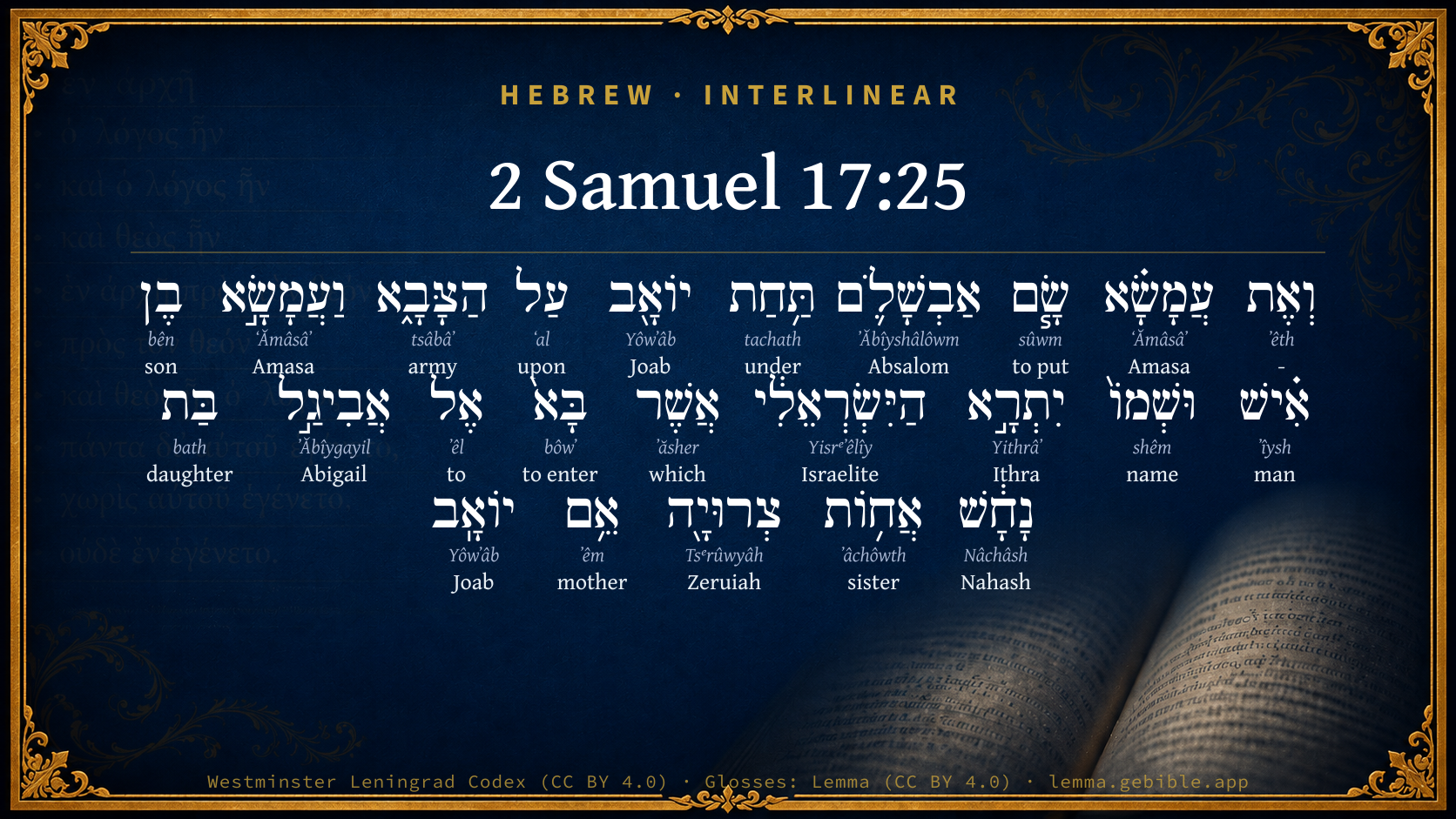
2 Samuel 17:25

Hebrew (Westminster Leningrad Codex) 2 Samuel 17:25 appears in the Hebrew Old Testament. The text above is from the Westminster Leningrad Codex. Each word links to its Strong’s number, a concise gloss, and parsing drawn from the Open Scriptures Hebrew Bible morphology. Click any word for its full Brown-Driver-Briggs (BDB) entry.
Download image
Cite this verse

2 Samuel 17:25 (World English Bible). Public Domain. Lemma interlinear Bible study tool, https://lemma.gebible.app/v/2-samuel/17/25.

Show BibTeX & RIS
BibTeX
RIS
English Translation
Absalom set Amasa over the host instead of Joab. Now Amasa was the son of a man, whose name was Ithra the Israelite, who went in to Abigail the daughter of Nahash, sister to Zeruiah, Joab's mother.
World English Bible · Public Domain
Highlights
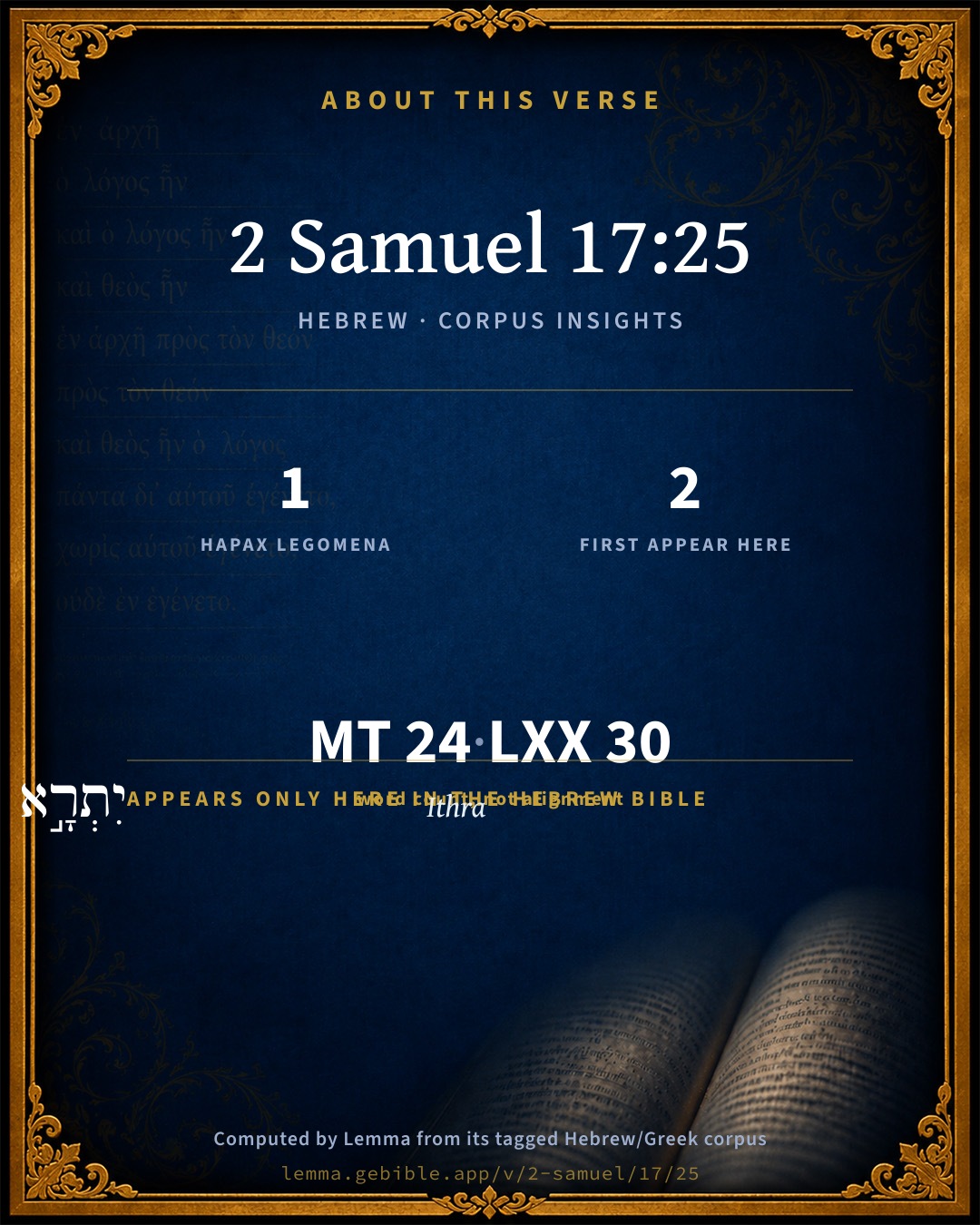
  • 1 hapax legomenon — only here in the Hebrew Bible
  • 2 first appearances in the Hebrew Bible
Full analysis ↓
Download a study sheet

One document with this verse’s original text, its word-by-word gloss line, the meaning frame, cross-references with their text, attributed commentary, and full source and license credits — printable, and it pastes into notes with its structure intact.

This verse Autodidact and up

Study sheet (.html) Plain text (.txt)

A passage Seminary Student

Up to 50 verses in one chapter. A passage sheet keeps up to 6 commentary sources and 12 cross-references per verse, in the order this page ranks them, and says so on the sheet whenever that leaves anything out. Ask for a single verse and you get the Autodidact verse sheet above.

Everything on this page stays free to read, with no account — the sheet is a download of what is already on screen, not access to it.

Want to remove ads? Support Godless Engineer
Compare translations 3

The same verse in 3 English versions, stacked beneath the original-language interlinear above. Click any original word for its lexicon entry.

Each is an independent rendering of the whole verse — the interlinear is not word-aligned to these translations.

Highlighted words mark where these versions differ — a whole-verse word diff, not a word-by-word alignment.

  • World English Bible Public Domain
    Absalom set Amasa over the host instead of Joab. Now Amasa was the son of a man, whose name was Ithra the Israelite, who went in to Abigail the daughter of Nahash, sister to Zeruiah, Joab's mother.
  • King James Version Public Domain
    And Absalom made Amasa captain of the host instead of Joab: which Amasa was a man's son, whose name was Ithra an Israelite, that went in to Abigail the daughter of Nahash, sister to Zeruiah Joab's mother.
  • unfoldingWord Literal Text CC BY-SA 4.0
    And Absalom appointed Amasa over the army in place of Joab. Now Amasa the son of a man and his name Ithra the Israelite, who had gone in to Abigail, the daughter of Nahash, the sister of Zeruiah the mother of Joab.

unfoldingWord Literal Text — © unfoldingWord, licensed CC BY-SA 4.0. Word-aligned USFM3 via Door43 (git.door43.org/unfoldingWord/en_ult).

Versions to compare (up to 4)

3 of 4 selected

Show all 18 translations

Every available English version of this verse, each an independent rendering of the whole verse.

  • World English Bible Public Domain
    Absalom set Amasa over the host instead of Joab. Now Amasa was the son of a man, whose name was Ithra the Israelite, who went in to Abigail the daughter of Nahash, sister to Zeruiah, Joab's mother.
  • Berean Standard Bible Public Domain
    Absalom had appointed Amasa over the army in place of Joab. Amasa was the son of a man named Ithra, the Ishmaelite who had married Abigail, the daughter of Nahash and sister of Zeruiah the mother of Joab.
  • Majority Standard Bible Public Domain
    Absalom had appointed Amasa over the army in place of Joab. Amasa was the son of a man named Ithra, the Ishmaelite who had married Abigail, the daughter of Nahash and sister of Zeruiah the mother of Joab.
  • King James Version Public Domain
    And Absalom made Amasa captain of the host instead of Joab: which Amasa was a man's son, whose name was Ithra an Israelite, that went in to Abigail the daughter of Nahash, sister to Zeruiah Joab's mother.
  • American Standard Version (1901) Public Domain
    And Absalom set Amasa over the host instead of Joab. Now Amasa was the son of a man, whose name was Ithra the Israelite, that went in to Abigal the daughter of Nahash, sister to Zeruiah, Joab's mother.
  • Revised Version (1885) Public Domain
    And Absalom set Amasa over the host instead of Joab. Now Amasa was the son of a man, whose name was Ithra the Israelite, that went in to Abigal the daughter of Nahash, sister to Zeruiah Joab’s mother.
  • Geneva Bible (1599) Public Domain
    And Absalom made Amasa captaine of the hoste in the stead of Ioab: which Amasa was a mans sonne named Ithra an Israelite, that went in to Abigail the daughter of Nahash, sister to Zeruiah Ioabs mother.
  • Douay-Rheims (1899) Public Domain
    Now Absalom appointed Amasa in Joab's stead over the army: and Amasa was the son of a man who was called Jethra of Jezrael, who went in to Abigail the daughter of Naas, the sister of Sarvia who was the mother of Joab.
  • Young's Literal Translation Public Domain
    and Amasa hath Absalom set instead of Joab over the host, and Amasa `is' a man's son whose name is Ithra the Israelite who hath gone in unto Abigail, daughter of Nahash, sister of Zeruiah, mother of Joab;
  • Literal Standard Version CC BY-SA 4.0
    and Absalom has set Amasa over the host instead of Joab, and Amasa [is] a man’s son whose name is Ithra the Israeli who has gone in to Abigail, daughter of Nahash, sister of Zeruiah, mother of Joab;
  • Unlocked Literal Bible CC BY-SA 4.0
    Absalom had set Amasa over the army instead of Joab. Amasa was the son of Jether the Ishmaelite, who had slept with Abigail, who was the daughter of Nahash and sister of Zeruiah, the mother of Joab.
  • unfoldingWord Literal Text CC BY-SA 4.0
    And Absalom appointed Amasa over the army in place of Joab. Now Amasa the son of a man and his name Ithra the Israelite, who had gone in to Abigail, the daughter of Nahash, the sister of Zeruiah the mother of Joab.
  • Darby Bible Public Domain
    And Absalom set Amasa over the host instead of Joab; which Amasa was the son of a man whose name was Jithra the Israelite, that went in to Abigail the daughter of Nahash, sister to Zeruiah, Joab's mother.
  • World Messianic Bible Public Domain
    Absalom set Amasa over the army instead of Joab. Now Amasa was the son of a man whose name was Ithra the Israelite, who went in to Abigail the daughter of Nahash, sister to Zeruiah, Joab’s mother.
  • Webster's Bible Public Domain
    And Absalom made Amasa captain of the host instead of Joab: which Amasa was a man's son, whose name was Ithra, an Israelite, that went in to Abigail the daughter of Nahash, sister to Zeruiah, Joab's mother.
  • Free Bible Version CC BY-SA 4.0
    Absalom had put Amasa in charge of the army to replace Joab. Amasa was the son of a man named Ithra, the Ishmaelite who lived with Abigail, the daughter of Nahash and sister of Zeruiah, Joab's mother.
  • Bible in Basic English Public Domain
    And Absalom put Amasa at the head of the army in place of Joab. Now Amasa was the son of a man named Ithra the Ishmaelite, who had been the lover of Abigail, the daughter of Jesse, sister of Zeruiah, Joab's mother.
  • JPS Tanakh (1917) Public Domain
    And Absalom had set Amasa over the host instead of Joab. Now Amasa was the son of a man, whose name was Ithra the Jesraelite, that went in to Abigal the daughter of Nahash, sister to Zeruiah Joab's mother.

Literal Standard Version (2020), Covenant Press — licensed CC BY-SA 4.0. Text via the HelloAO Bible API (eBible.org). Unlocked Literal Bible (unfoldingWord) — licensed CC BY-SA 4.0. Text via the HelloAO Bible API (eBible.org). unfoldingWord Literal Text — © unfoldingWord, licensed CC BY-SA 4.0. Word-aligned USFM3 via Door43 (git.door43.org/unfoldingWord/en_ult). Free Bible Version, Dr. Jonathan Gallagher — licensed CC BY-SA 4.0. Text via the HelloAO Bible API (eBible.org).

Word by word

More ways to search: Search by grammar → Find every occurrence → Compare this word →

Practice this passage: Drill this verse → Learn its vocabulary →

יִתְרָ֣א
Yithrâʼ
H3501
“Ithra”
Noun, Proper
Part of Speech
Noun
Type
Proper
Full BDB Definition

Origin: by variation for H3502

TWOT: None

Ithra = "abundance" - father of Amasa, the commander of Absalom's army; also 'Jether'
  1. וְאֶת ʼêth H853 “and · -” Conjunction + Particle, Direct Object
  2. עֲמָשָׂ֗א ʻĂmâsâʼ H6021 “Amasa” Noun, Proper
  3. שָׂ֧ם sûwm H7760 “to put” Verb, Qal, Perfect, 3rd Person, Masculine, Singular
  4. אַבְשָׁלֹ֛ם ʼĂbîyshâlôwm H53 “Absalom” Noun, Proper
  5. תַּ֥חַת tachath H8478 “under” Preposition
  6. יוֹאָ֖ב Yôwʼâb H3097 “Joab” Noun, Proper
  7. עַל ʻal H5921 “upon” Preposition
  8. הַצָּבָ֑א tsâbâʼ H6635 “the · army” Particle, Definite Article + Noun, Common, Both, Singular, Absolute
  9. וַעֲמָשָׂ֣א ʻĂmâsâʼ H6021 “and · Amasa” Conjunction + Noun, Proper
  10. בֶן bên H1121 “son of” Noun, Common, Masculine, Singular, Construct
  11. אִ֗ישׁ ʼîysh H376 “man” Noun, Common, Masculine, Singular, Absolute
  12. וּשְׁמוֹ֙ shêm H8034 “and · name · his” Conjunction + Noun, Common, Masculine, Singular, Construct + Suffix, Personal, 3rd Person, Masculine, Singular
  13. הַיִּשְׂרְאֵלִ֔י Yisrᵉʼêlîy H3481 “the · Israelite” Particle, Definite Article + Noun, Gentilic, Masculine, Singular, Absolute
  14. אֲשֶׁר ʼăsher H834 “which” Particle, Relative
  15. בָּא֙ bôwʼ H935 “to enter” Verb, Qal, Perfect, 3rd Person, Masculine, Singular
  16. אֶל ʼêl H413 “to” Preposition
  17. אֲבִיגַ֣ל ʼĂbîygayil H26 “Abigail” Noun, Proper
  18. בַּת bath H1323 “daughter of” Noun, Common, Feminine, Singular, Construct
  19. נָחָ֔שׁ Nâchâsh H5176 “Nahash” Noun, Proper
  20. אֲח֥וֹת ʼâchôwth H269 “sister of” Noun, Common, Feminine, Singular, Construct
  21. צְרוּיָ֖ה Tsᵉrûwyâh H6870 “Zeruiah” Noun, Proper
  22. אֵ֥ם ʼêm H517 “mother of” Noun, Common, Feminine, Singular, Construct
  23. יוֹאָֽב Yôwʼâb H3097 “Joab” Noun, Proper

About this verse

These counts appear in no published source. They are computed here, from the morphology-tagged text and Lemma’s own curated glosses. What Lemma adds →

24
words
22
distinct lemmas
Historical
section

Notable vocabulary

1 hapax legomenon — a word that appears only here in the entire Hebrew Bible:

  • יִתְרָ֣א Ithra H3501

First appearance in Scripture

These words make their first canonical appearance in the Hebrew Bible here:

  • עֲמָשָׂ֗א Amasa H6021
  • יִתְרָ֣א Ithra H3501

Shared distinctive vocabulary

הַיִּשְׂרְאֵלִ֔י Israelite H3481 occurs in 2 verses of the Hebrew Bible. Also found in:

Grammatical profile

  • 2 verbs
  • 17 nouns
  • 3 prepositions
  • 2 particles

Verb forms

  • שָׂ֧ם Qal · Perfect
  • בָּא֙ Qal · Perfect

Repetition

Words recur within this verse — often emphatic in Hebrew:

  • עֲמָשָׂ֗א Amasa H6021 ×2
  • יוֹאָ֖ב Joab H3097 ×2

Hebrew & Septuagint length

In English translation the verse runs 37 words from the Hebrew and 43 from the Septuagint (LXX English) — closely comparable.

A rough comparison of the two English renderings, which tokenize alike — not a word-level alignment.

Word counts can differ between the Hebrew and the Greek without any difference in meaning — e.g. the Hebrew direct-object marker אֵת has no separate Greek word, and Greek often adds the article ὁ.

In the original languages it is 24 Hebrew tokens and 30 Greek tokens — but the two are counted differently (Hebrew bundles its prefixes and suffixes into one token; the Greek is in lemma form), so that isn’t a like-for-like length.

Cross-references

7

Topical passages linked to 2 Samuel 17:25 in the Treasury of Scripture Knowledge — connected by theme and wording, ordered by reader-vote popularity; previews shown in the World English Bible.

  • 2 Samuel 19:13 Say you to Amasa, Aren't you my bone and my flesh? God do so to me, and more also, if you aren't captain of the host before me continually in the room of Joab.
  • 1 Chronicles 2:13 and Jesse became the father of his firstborn Eliab, and Abinadab the second, and Shimea the third,
  • 2 Samuel 20:9–12 Joab said to Amasa, Is it well with you, my brother? Joab took Amasa by the beard with his right hand to kiss him.
  • 2 Samuel 20:4 Then said the king to Amasa, Call me the men of Judah together within three days, and be here present.
  • 1 Kings 2:5 Moreover you know also what Joab the son of Zeruiah did to me, even what he did to the two captains of the hosts of Israel, to Abner the son of Ner, and to Amasa the son of Jether, whom he killed, and shed the blood of war in peace, and put the blood of war on his sash that was about his loins, and in his shoes that were on his feet.
  • 1 Kings 2:32 Yahweh will return his blood on his own head, because he fell on two men more righteous and better than he, and killed them with the sword, and my father David didn't know it, [to wit], Abner the son of Ner, captain of the host of Israel, and Amasa the son of Jether, captain of the host of Judah.
  • 1 Chronicles 2:16–17 and their sisters were Zeruiah and Abigail. The sons of Zeruiah: Abishai, and Joab, and Asahel, three.

Cross-references courtesy of OpenBible.info (CC BY 4.0).

Hebrew and Greek witnesses Masoretic Hebrew ↔ Greek Septuagint

The same verse in the two great witnesses to the Old Testament, shown verse-for-verse.

These are two independent witnesses, not word-aligned to each other, and the Septuagint is shown in lemma (dictionary) form.

Hebrew 2 Samuel 17:25 Masoretic · Westminster Leningrad Codex

וְאֶת עֲמָשָׂ֗א שָׂ֧ם אַבְשָׁלֹ֛ם תַּ֥חַת יוֹאָ֖ב עַל הַצָּבָ֑א וַעֲמָשָׂ֣א בֶן אִ֗ישׁ וּשְׁמוֹ֙ יִתְרָ֣א הַיִּשְׂרְאֵלִ֔י אֲשֶׁר בָּא֙ אֶל אֲבִיגַ֣ל בַּת נָחָ֔שׁ אֲח֥וֹת צְרוּיָ֖ה אֵ֥ם יוֹאָֽב

Absalom set Amasa over the host instead of Joab. Now Amasa was the son of a man, whose name was Ithra the Israelite, who went in to Abigail the daughter of Nahash, sister to Zeruiah, Joab's mother.

World English Bible · Public Domain

Greek LXX 2 Samuel 17:25 Septuagint · lemma form

καί ὁ αμεσσαϊ καταἵστημι αβεσσαλωμ ἀντί ιωαβ ἐπί ὁ δύναμις καί αμεσσαϊ υἱός ἀνήρ καί ὄνομα αὐτός ιοθορ ὁ ἰσραηλίτης οὗτος εἰςἔρχομαι πρός αβιγαιαν θυγάτηρ ναας ἀδελφή σαρουιας μήτηρ ιωαβ

And Abessalom appointed Amessai in the room of Joab over the host. And Amessai was the son of a man whose name was Jether of Jezrael: he went in to Abigaia the daughter of Naas, the sister of Saruia the mother of Joab.

LXX2012 (modern English Septuagint) · Public Domain

On this verse, The Preacher's Complete Homiletical Commentary discusses the Septuagint’s reading. Read the note in Commentary ↓

Hebrew: Westminster Leningrad Codex (CC BY 4.0). Greek: Septuagint (public domain); English from LXX2012 (modern English Septuagint) (Public Domain). How the Septuagint differs from the Hebrew →

Targum (Aramaic paraphrase)

1

The Targum is the ancient Jewish Aramaic paraphrase of the Hebrew Scriptures — an interpretive translation, not the Hebrew text itself. Onkelos (literal) and Pseudo-Jonathan (expansive) render the Torah, and Jonathan the Prophets. Coverage is partial: where no permissively-licensed English translation exists for a verse, only the Aramaic is shown. This is verse-level text, not a word-by-word alignment to the Hebrew.

  1. Targum Jonathan Prophets (Joshua–Malachi)
    וְיַת עַמָשָׂא מַנִי אַבְשָׁלוֹם חֲלַף יוֹאָב עַל חֵילָא וְעַמָשָׂא בַּר גַבְרָא וּשְׁמֵיהּ יִתְרָא יִשְׂרָאֵלָא דְעַל לְוַת אֲבִיגַל בַּת נָחָשׁ אֲחָתֵיהּ דִצְרוּיָה אִמֵיהּ דְיוֹאָב:

    (no public-domain English translation for this verse)

    Targum Jonathan — Aramaic: “Mikraot Gedolot” (public domain). English: “Sefaria Community Translation” (CC0 1.0 (public-domain dedication)); “London "Chaldee Paraphrase," 1871” (public domain). Text via Sefaria.

Commentary

Notes on 2 Samuel 17:25 from classic Christian and Jewish commentators (each source and its license shown beneath its notes). The classic Christian expositions comment on the surrounding passage and are grouped to its opening verse, so a note may address several verses; the Jewish commentaries on the Tanakh (Rashi and others) are per-verse, so they appear only where the commentator wrote on this verse.

Lemma curates 59 commentaries, every one of them public domain or Creative Commons licensed, each selected and text-cleaned for this edition rather than reprinted as found. About our sources →

Trapp's Complete Commentary

John Trapp

2Sa 17:25 And Absalom made Amasa captain of the host instead of Joab: which Amasa [was] a man’s son, whose name [was] Ithra an Israelite, that went in to Abigail the daughter of Nahash, sister to Zeruiah Joab’s mother.

Ver. 25. Ithra an Israelite,] sc, For his faith and religion, as by nature he was an Ishmaelite. {1Ch 7:17}

That went in to Abigail,] i.e., Married her; went in to the wedding chamber to her, as Jdg 15:1.

The daughter of Nahash.] Otherwise called Ishai, the father of David; wherefore many Greek copies for Naas have Jesse, and both Josephus and Jerome affirm him to be the same. Kimchi thinketh he was called Nahash, or Serpent, per antiphrasin, as being void of venom or bitterness.

John Trapp, A Commentary or Exposition upon All the Books of the Old and New Testament (1647–1656) — public domain. Text from a community e-Sword module.

Joseph Benson's Commentary

2Sa 17:25. Absalom made Amasa captain of the host — Amasa was another of David’s nephews, the son of his sister Abigail. The daughter of Nahash — Nahash was one of Jesse’s wives, by whom he had this Abigail, the mother of Amasa, as he had Zeruiah, the mother of Joab, by another wife; so that they were sisters by the father, but not by the mother, and Joab and Amasa were cousins.

Joseph Benson's Commentary on the Old and New Testaments (1811–1818) — public domain. Text from a community e-Sword module.

The Preacher's Complete Homiletical Commentary

Joseph S. Exell (gen. ed.)

CRITICAL AND EXPOSITORY NOTES.

2Sa_17:25. “An Israelite.” Rather, as in 1Ch_2:17, an Ishmaelite. He was an illegitimate son. “From the description here given of Abigail as a daughter of Nahash and sister of Zeruiah, not of David, some of the earlier commentators have very justly concluded that Abigail and Zeruiah were only step-sisters of David, i.e., daughters of his mother by Nahash and not by Jesse.” (Keil). Otherwise we must either take Nahash as a woman’s name or as another name for David’s father.

2Sa_17:27. “Shobi.” “Possibly a son of Nahash, the deceased king of the Ammonites, and brother of Hanun, who was defeated by David (2Sa_10:1), and one of those to whom David had shown kindness when Rabbah was taken.” (Keil). “Maohir.” (See 2Sa_9:4.) “Rogelim.” Only mentioned here and in 2Sa_19:32, and otherwise unknown.

2Sa_17:28. “Basons.” Metal vessels for cooking.

2Sa_17:29. “Batter.” “Rather, curdled milk, which being mixed with the honey, forms a light and refreshing beverage.” (Song Son_4:11). (Jamieson). “Cheese of kine.” “Slices of coagulated milk.” (Jamieson).

MAIN HOMILETICS OF THE PARAGRAPH.—2Sa_17:25-29

DAVID AT MAHANAIM

I. That help is the most effectual which is most fitted to supply the present need. Although the seat of David’s distress at this time was in the mind rather than in the body, the goodwill of his friends in Gilead could have been expressed in no more acceptable manner at this moment than by giving to him and his followers food and the means of bodily rest. The events of the past day must have told greatly upon David’s body, and he, in common with the most ordinary man, must sometimes submit to be at the mercy of his animal organism. He was at this moment most likely incapable of appreciating anything of a spiritual nature so highly as this kindly provision for his material wants. That is the true and real sympathy which discerns the most pressing need of the present moment, and hastens to supply it to the best of its ability. For those wrung with the deepest anguish of soul cannot ignore the demands of the body, and solace to a wounded spirit sometimes enters by this channel. When Elijah, in bitterness of soul, lay down in the wilderness and prayed for death, the first step which God took to restore his spiritual strength was to provide food for his body (1Ki_19:6-8). The goodwill, also, which is expressed by such a ministration, is a direct balm to a soul in sorrow.

II. Even self-love should prompt men to a generous treatment of those beneath them. The reversals of position which are continually taking place in human life ought to teach men wisdom in this matter. Human beings are continually changing places, the servant becomes the master, and he who rules to-day may soon be at the mercy of those whom he now commands. When David set the crown of Ammon upon his own head (2Sa_12:30) it did not seem likely that in a few years he would be a fugitive from his kingdom and indebted to the good offices of an Ammonite prince. But this had now come to pass, and any kindness which he then showed to those whom he conquered was now returned with interest, or, if he had upon that occasion been unduly harsh, the magnanimity of Nahash must have smitten him with remorse. If we would in adversity receive the favours of others without self-reproach we must beware lest in prosperity we forget the claims of those over whom for a time God has exalted us.

OUTLINES AND SUGGESTIVE COMMENTS

The same God that raised enmity to David from his own loins, procured him favour from foreigners: strangers shall relieve him, whom his own son persecutes: here is not a loss, but an exchange of love. Had Absalom been a son of Ammon, and Shobi a son of David, David had found no cause of complaint. If God takes with one hand, he gives with another; while that divine bounty serves us in good meat, though not in our dishes, we have good reason to be thankful. No sooner is David come to Mahanaim, than Barzillai, Machir, and Shobi, refresh him with provisions. Who ever saw any child of God left utterly destitute? Whosoever be the messenger of our aid, we know whence he comes: heaven shall want power, and earth means, before any of the household of faith shall want maintenance.—Bp. Hall.

The faithfulness of human love is not only the copy, but also the means and instrument of the Divine love, granted to those who bow humbly beneath God’s hand and wholly trust Him.—Lange’s Commentary.

David was received with kindness in the land of Gilead, on the east of Jordan, at a time when he was driven by his own son out of his own capital, Jerusalem, in his own tribe. The Jews rejected Christ, but the gospel was gladly received by Samaritans (Act_8:4-6) and by the Gentiles (Act_13:46-48; Act_28:28).—Wordsworth.

It has been conjectured with much probability that as the first sleep of that evening was commemorated in the fourth Psalm, so in the third is expressed the feeling of David’s thankfulness at the final close of those twenty-four hours, of which every detail has been handed down, as if with the consciousness of their importance at the time. He had “laid him down in peace” that night and slept; for in that great defection of man “the Lord alone had caused him to dwell in safety.” The tradition of the Septuagint ascribes the 143rd Psalm to the time “when his son was pursuing him.” Some at least of its contents might well belong to that night (2Sa_17:2; 2Sa_17:8). There is another group of Psalms, the 41st, the 55th, the 69th, and the 109th, in which a long popular belief has seen an amplification of David’s bitter cry, “O Lord, turn the counsel of Ahithophel into foolishness.” Many of the circumstances agree. The dreadful imprecations in these Psalms—unequalled for vehemence in any other part of the sacred writings—correspond with the passion of David’s own expressions. The greatness, too, of Ahithophel himself in the history is worthy of the importance ascribed to the object of those awful maledictions. That oracular wisdom which made his house a kind of shrine (2Sa_15:31) seems to move the spirit of the sacred writer with an involuntary admiration. Everywhere he is treated with a touch of awful reverence. When he dies, the interest of the plot ceases, and his death is given with an awful grandeur, quite unlike the mixture of the terrible and the contemptible which has sometimes gathered round the end of those whom the religious sentiment of mankind has placed under its ban. When “he hanged himself, and died” he was buried, not like an excommunicated outcast, but like a venerable Patriarch ‘in the sepulchre of his father.’ ”—Stanley.

The Preacher's Complete Homiletical Commentary (gen. ed. Joseph S. Exell; Funk & Wagnalls, c. 1892) — public domain (pre-1929). A full-Bible homiletical/sermon-outline anthology covering 65 of 66 books (2 John is absent from the source module). Text from a community e-Sword module.

Tyndale Open Study Notes

Tyndale Open Resources

17:25 According to 1 Chr 2:15-16, Abigail and Zeruiah were David’s sisters. But since Abigail is called the daughter of Nahash, she and Zeruiah were apparently David’s half sisters (Nahash was probably their father; his widow would then have married Jesse and given birth to David and his brothers).

Tyndale Open Study Notes — © Tyndale Open Resources, licensed CC BY-SA 4.0. Text via the HelloAO Bible API.

Geneva Bible (1599)

Geneva Bible translators

Who was also called Jesse David’s Father.

Geneva Bible (1599) marginal notes — public domain. Text via Bolls.life.

Jamieson, Fausset & Brown

Robert Jamieson, A. R. Fausset & David Brown

Amasa--By the genealogy it appears that this captain stood in the same relation to David as Joab, both being his nephews. Of course, Amasa was Absalom's cousin, and though himself an Israelite, his father was an Ishmaelite (Ch1 2:17).

Nahash--is thought by some to be another name of Jesse, or according to others, the name of Jesse's wife.

Jamieson, Fausset & Brown — Commentary Critical and Explanatory on the Whole Bible (1871) — public domain (CC PDM 1.0). Text via the HelloAO Bible API.

Adam Clarke's Commentary

Verse 25. Amasa captain of the host] From the account in this verse, it appears that Joab and Amasa were sisters' children, and both nephews to David.

Adam Clarke's Commentary on the Bible (1810–1826) — public domain. Text from a community e-Sword/MySword module.

Ellicott's Commentary for English Readers

(25) Amasa.—Joab having adhered to David and gone away with him, Absalom chose his cousin to succeed him as commander-in-chief.

Ithra an Israelite.—Called in 1Ch_2:17. Jether the Ishmeelite. Jether and Ithra are merely different forms of the same name; but Israelite is probably an error for Ishmeelite. The LXX. has, in the Alexandrian copy, Ishmaelite, and in the Vatican, Jezreelite.

Abigail the daughter of Nahash.—Since this Abigail is said to be “sister to Zeruiah,” and in 1Ch_2:16 both Abigail and Zeruiah are said to be the sisters of Jesse’s sons, it follows, either that sister is used in the sense of half-sister, or else that Nahash, usually a man’s name, was the name of Jesse’s wife. It is impossible to decide certainly. The Jewish tradition that Nahash is another name for Jesse has no support.

A Bible Commentary for English Readers, edited by Charles John Ellicott (1878–1897) — public domain. Text from a community e-Sword module.

The Cambridge Bible for Schools and Colleges

gen. ed. J. J. S. Perowne

25. Amasa] It has been supposed by some that he is the same as Amasai who came to David at Hebron (1Ch_12:16-18). But if so, would not the fact of his relationship to David have been mentioned there?

Ithra an Israelite] Called in 1Ch_2:17 Jether the Ishmeelite. Jether and Ithra are different forms of the same name: and Ishmaelite should probably be read here in place of Israelite, which has no point. The Alex. MS. of the LXX reads Ishmaelite, the Vatican MS. Jezreelite.

Abigal the daughter of Nahash] Amasa’s mother Abigal (or Abigail) was David’s sister, and we should naturally infer from 1Ch_2:16-17 that Abigail and Zeruiah were Jesse’s daughters. Who then was Nahash? To this three answers may be given. (1) The obvious one, that she was Jesse’s wife, to which the objection is that Nahash is not a woman’s name. (2) That Nahash is another name for Jesse, which is the Jewish tradition, but is not supported by any evidence. (3) That Nahash was the first husband of Jesse’s wife, so that Abigail and Zeruiah were only step-sisters to David. This view has in its favour the guarded statement of 1Ch_2:16, which does not say that they were Jesse’s daughters, but sisters of his sons. To go on to identify Nahash with the king of the Ammonites defeated by Saul is mere conjecture. It should be noted that Amasa and Joab were cousins.

The Cambridge Bible for Schools and Colleges (gen. ed. J. J. S. Perowne; Cambridge University Press, 1878–1918) — public domain. Text from a community e-Sword module.

John Gill's Exposition

So Israel and Absalom pitched in the land of Gilead. Which belonged to the tribes of Reuben and Gad, and the half tribe of Manasseh; here the Israelites that were with Absalom encamped, in order to give battle to David and his men.

So Israel and Absalom pitched in the land of Gilead. Which belonged to the tribes of Reuben and Gad, and the half tribe of Manasseh; here the Israelites that were with Absalom encamped, in order to give battle to David and his men.

2 Samuel 17:27

sa2 17:27

sa2 17:27

sa2 17:27And it came to pass, when David was come to Mahanaim,.... When he first came thither, Sa2 17:24,

that Shobi the son of Nahash of Rabbah of the children of Ammon: who was either the son, or rather the brother of Hanun king of the Ammonites, that used David's ambassadors in so shameful a manner, whom David overcame and deposed, and set up this brother in his room; who had showed his dislike of his brother's conduct, and now makes a grateful return to David for his favours; though some say this was Hanun himself, as Jarchi, now become a proselyte, which is not so likely; others take this man to be an Israelite that continued in Rabbah, the metropolis of the Ammonites, after it was taken by David:

and Machir the son of Ammiel of Lodebar; the same that brought up Mephibosheth, from whom David received him and took him off of his hands, for which now he requited him, see Sa2 9:5,

and Barzillai the Gileadite of Rogelim; a place that lay under the hills of Gilead (y); it had its name from the "fullers" who dwelt here for the convenience of fountains of water to wash their clothes in.

(y) Fuller's Pisgah-View, B. 2. c. 3. sect. 10. p. 94.

John Gill's Exposition of the Whole Bible (1746–1763) — public domain (CC PDM 1.0). Text via the HelloAO Bible API.

Albert Barnes' Notes on the Bible

Ithra an Israelite - Or “Jether the Ishmeelite” 1Ch 2:17. “Ithra” and “Jether” are practically the same names. “Israelite” in the text is wrong. It should be either “Ishmaelite” or “Jezreelite” 2Sa 3:2.

Abigail the daughter of Nahash - If Zeruiah and Abigail were Jesse’s daughters, the only probable way of reconciling our text with 1Ch 2:16-17, is to suppose that Nahash was Jesse’s wife. If Zeruiah and Abigail were only sisters of David by the mother, then Nahash might be the name of her first husband.

Albert Barnes' Notes on the Bible (1834–1885) — public domain. Text from a community e-Sword/MySword module.

Haydock's Catholic Bible Commentary

Jazrael, or Israel. (Du Hamel) --- Gortius would read Ismael, as 1 Paralipomenon ii. 17, Jether, the Ismaelite. (Haydock) --- Went in. This expressing makes Sanchez believe that Amasa was illegitimate. (Menochius) --- Naas is either the name of Isai’s wife, or rather the latter had both names, 1 Paralipomenon ii. 13, 16. Septuagint read Jesse, in the edition of Complutensian; in others, Naas. (Calmet) --- Joab; so that these two were own cousins, and both nephews of David.

George Leo Haydock (1774–1849), Haydock's Catholic Family Bible and Commentary, 1859 edition — public domain. Excludes Psalms (Douay-Rheims chapter numbering differs from Protestant) and Deuterocanonical books (Catholic canon only).

Matthew Poole's English Annotations

Ithra an Israelite.

Object. He was an Ishmaelite, 1Ch 2:17.

Answ. Not Amasa; but Ithra, or Jether, Amasa’s father, is there so called, because he was such, either by his birth from such parents, or by his long habitation among them, or for some other reason now unknown. Compare 2Sa 15:18. And Amasa is here called an Israelite, either because he was a proselyte; or in opposition to Joab, who was of the tribe of Judah, as Amasa was of one of the ten tribes; or rather, to intimate, that although he or his parents were called Ishmaelites for some reason, yet as to their extraction they were indeed Israelites; which if Amasa had not been, it is not probable that he could have had so powerful an influence upon the tribe of Judah as he had, 2Sa 19:14.

That went in to Abigail, i.e. lay with her, whether being first married to her, or not, is uncertain.

The daughter of Nahash. Nahash is either another name of Jesse; or rather, the name of Jesse’s wife; by whom he had this Abigail, as he had Zeruiah by another wife; so they were sisters by the father, but not by the mother; and Nahash is here named to signify so much.

Matthew Poole's English Annotations on the Holy Bible (1683–1685) — public domain. Text from a community e-Sword/MySword module.

The Pulpit Commentary

Ithra an Israelite. In 1Ch_2:17 he is called "Jether the Ishmeelite." The first name is the same, Ithra being the emphatic form of Jether; and as it is difficult to find a reason for mentioning so ordinary a fact as that his father was an Israelite, we may conclude that "Ishmeelite" is the correct reading. Bishop Wordsworth, however, suggests that "Israelite" was in contrast to "Judahite;" but this distinction did not come into use until after the disruption of the kingdom. The Vatican text of the Septuagint has "Jezreelite," which is probably a conjecture to get rid of the obvious error of calling him an Israelite. Amasa was an illegitimate son, which confirms the reading "Ishmeelite" in 1Ch_2:17, as a marriage between Abigail and a foreigner would be sure to be opposed by all the members of Jesse"s family. Nahash. Jewish interpreters regard Nahash (equivalent to "serpent as another name for Jesse, quoting in proof, "Out of the root of Nahash (the serpent) shall come forth the basilisk", (Isa_14:29) which in the Chaldee Paraphrase is explained as meaning, "out of the root of Jesse shall come forth the Messiah." This conceit would scarcely have deserved mention, had it not found a place in the margin of the Authorized Version. Some few commentators regard Nahash as a woman"s name, and think that she was a wife of Jesse, and mother of Abigail and Zerniah, but not of David. But Nahash is so constantly a man"s name that it is easier to believe that Nahash was the first husband of David"s mother, and Abigail and Zerniah his half-sisters, not on the father"s, but on the mother"s side. Joab and his brothers are always described as sons of Zeruiah, both to mark their relationship to David, and also because the rank was on her side. Amasa was probably the Amasai mentioned in 1Ch_12:18 as bringing a powerful reinforcement to David while at Ziklag; but the ambition of supplanting Joab made him now forget David"s long friendship.

The Pulpit Commentary (1880–1919), ed. H.D.M. Spence-Jones & Joseph S. Exell — public domain. Text from a community e-Sword module.

John Wesley's Explanatory Notes

Nahash - Nahash is the name of Jesse's wife, by whom he had this Abigail, as he had Zeruiah by another wife; so they were sisters by the father, but not by the mother.

John Wesley, Explanatory Notes Upon the Whole Bible (1754–1765) — public domain. Text via the GEBible commentary corpus.

Keil & Delitzsch

C. F. Keil & F. Delitzsch

Absalom had made Amasa captain over his army instead of Joab, who had remained true to David, and had gone with his king to Mahanaim. Amasa was the son of a man named Jithra, היּשׂראלי, who had gone in to (i.e., had seduced) Abigail, the daughter of Nahash and sister of Zeruiah, Joab's mother. He was therefore an illegitimate cousin of Joab. The description given of Jithra as ישׂראלי is very striking, since there was no reason whatever why it should be stated that Amasa's father was an Israelite. The Seventy have therefore given ὁ Ἰεζραηλίτης, i.e., sprung from Jezreel, where David's wife Ahinoam came from (Sa1 27:3); but they have done so apparently from mere conjecture. The true reading is evidently היּשׁמעאלי, an Ishmaelite, according to Ch1 2:17, where the name is written Jether, a contracted form of Jithra. From the description given of Abigail as a daughter of Nahash and sister of Zeruiah, not of David, some of the earlier commentators have very justly concluded that Abigail and Zeruiah were only step-sisters of David, i.e., daughters of his mother by Nahash and not by Jesse.

Keil & Delitzsch — Biblical Commentary on the Old Testament (1861–1891) — public domain (CC PDM 1.0). Text via the HelloAO Bible API. (Old Testament only.)

Rashi

Rabbi Shlomo Yitzchaki (Rashi)

The daughter of Nochosh. This is Yeshai, Dovid's father. Our Rabbis said that [Yeshai] died without sin [but only] because of the serpent's counsel.

Rashi on the Tanakh — English translations: “The Judaica Press complete Tanach with Rashi, translated by A. J. Rosenberg” (CC BY 4.0); “Pentateuch with Rashi's commentary by M. Rosenbaum and A.M. Silbermann, 1929-1934” (public domain); “The Metsudah Tanach series, Lakewood, N.J” (CC BY 4.0); and “The Book of Joshua, Metsudah Publications, 1997” (CC BY 4.0). Text via Sefaria.

Lesson kit

Teaching starters — assembled from the data on this page, not authored interpretation. Every prompt links to the verse data it draws on. Edit before teaching.

2 Samuel, in the Historical, opens this verse with 24 words (22 distinct Hebrew lemmas). Its most distinctive word is Yithrâʼ (“Ithra”). A historical commentator’s framing appears above. Read the whole chapter for the surrounding context.

Discussion questions

  1. How does “Ithra” (Yithrâʼ) shape what this verse is saying?
  2. This verse holds 1 word here found nowhere else in the Hebrew Bible. What might the rare word draw attention to?
  3. 2 words here appear for the first time in Scripture. What is being introduced at this debut?
  4. Leviticus 24:10 shares the word «Israelite» with this verse. How do the two illuminate each other?
  5. “Amasa” occurs 2× in this one verse. What is the effect of the repetition?
  6. The translations on this page render this verse differently — a whole-verse word diff, not a word-by-word alignment. What might account for the different wordings?
  7. The verb «שָׂ֧ם» is Qal Perfect. How does its form color the action?
  8. Reading how Trapp's Complete Commentary and Joseph Benson's Commentary read this verse, where do the two commentators agree and where do they part?

Things to notice

  • 1 word in this verse appears nowhere else in the Hebrew Bible.
  • 2 words make their first canonical appearance in Scripture here.
  • This verse counts 24 Hebrew ↔ 30 Greek words.
  • These translations choose different wording for 19 words in this verse.
  • “Amasa” occurs 2× in this single verse.

Reading settings

Reading text

Shown beneath each verse's original-language words.

Old Testament
Old Testament edition

Read the OT as the Masoretic Hebrew (MT) or the Greek Septuagint (LXX).

English shown for the Greek Septuagint (in the Hebrew ↔ Greek comparison).

Comparing translations? Open the Compare panel on any verse page to stack up to four side by side.