
Numbers 2:3

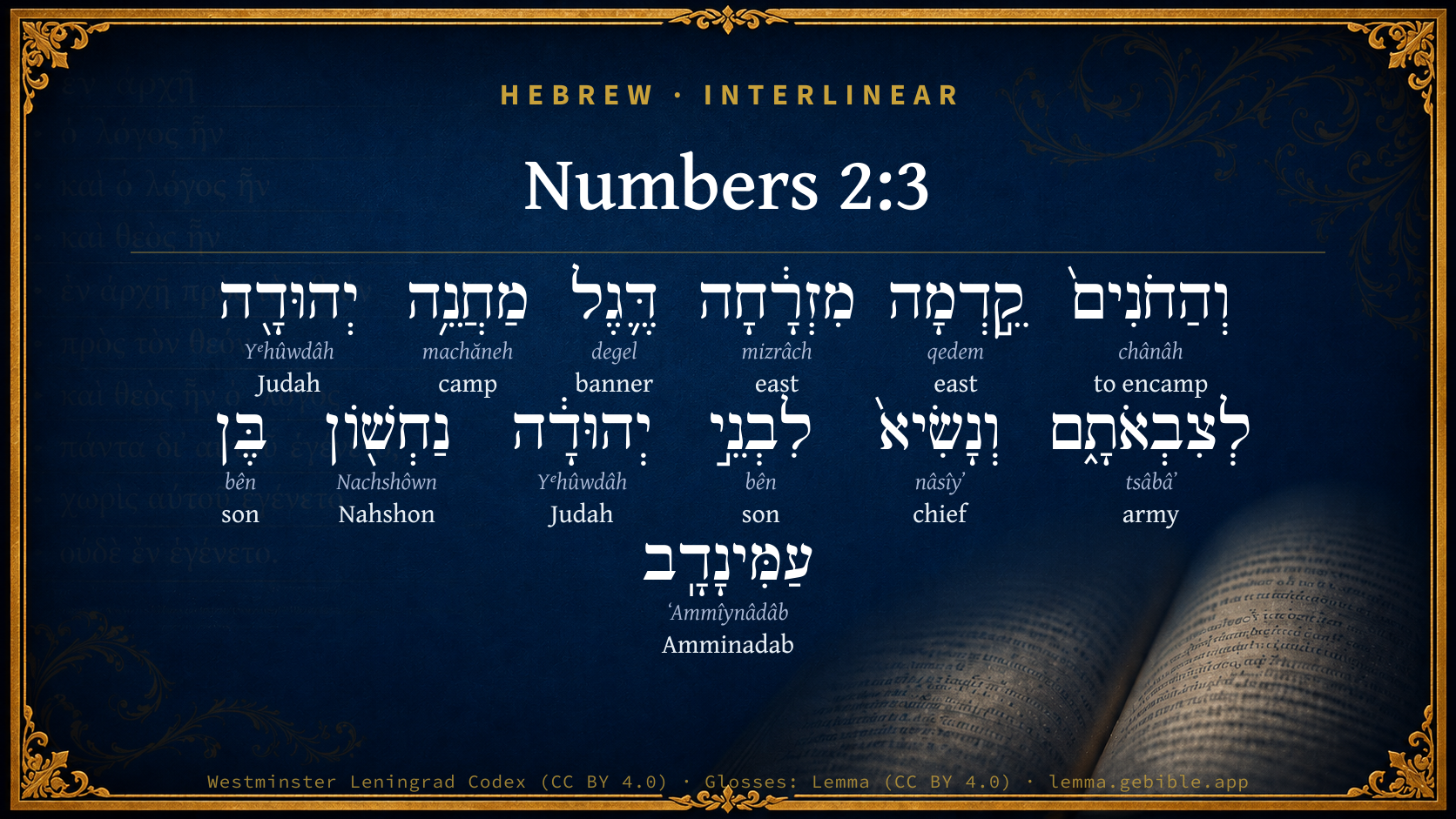
Hebrew (Westminster Leningrad Codex) Numbers 2:3 appears in the Hebrew Old Testament. The text above is from the Westminster Leningrad Codex. Each word links to its Strong’s number, a concise gloss, and parsing drawn from the Open Scriptures Hebrew Bible morphology. Click any word for its full Brown-Driver-Briggs (BDB) entry.
Download image
Cite this verse

Numbers 2:3 (World English Bible). Public Domain. Lemma interlinear Bible study tool, https://lemma.gebible.app/v/numbers/2/3.

Show BibTeX & RIS
BibTeX
RIS
English Translation
Those who encamp on the east side toward the sunrise shall be of the standard of the camp of Judah, according to their divisions: and the prince of the children of Judah shall be Nahshon the son of Amminadab.
World English Bible · Public Domain
Download a study sheet

One document with this verse’s original text, its word-by-word gloss line, the meaning frame, cross-references with their text, attributed commentary, and full source and license credits — printable, and it pastes into notes with its structure intact.

This verse Autodidact and up

Study sheet (.html) Plain text (.txt)

A passage Seminary Student

Up to 50 verses in one chapter. A passage sheet keeps up to 6 commentary sources and 12 cross-references per verse, in the order this page ranks them, and says so on the sheet whenever that leaves anything out. Ask for a single verse and you get the Autodidact verse sheet above.

Everything on this page stays free to read, with no account — the sheet is a download of what is already on screen, not access to it.

Want to remove ads? Support Godless Engineer
Compare translations 3

The same verse in 3 English versions, stacked beneath the original-language interlinear above. Click any original word for its lexicon entry.

Each is an independent rendering of the whole verse — the interlinear is not word-aligned to these translations.

Highlighted words mark where these versions differ — a whole-verse word diff, not a word-by-word alignment.

  • World English Bible Public Domain
    Those who encamp on the east side toward the sunrise shall be of the standard of the camp of Judah, according to their divisions: and the prince of the children of Judah shall be Nahshon the son of Amminadab.
  • King James Version Public Domain
    And on the east side toward the rising of the sun shall they of the standard of the camp of Judah pitch throughout their armies: and Nahshon the son of Amminadab shall be captain of the children of Judah.
  • unfoldingWord Literal Text CC BY-SA 4.0
    And the ones camping to the east, from the sunrise, the banner of the camp of Judah according to their armies, and the leader of the sons of Judah Nahshon, the son of Amminadab,

unfoldingWord Literal Text — © unfoldingWord, licensed CC BY-SA 4.0. Word-aligned USFM3 via Door43 (git.door43.org/unfoldingWord/en_ult).

Versions to compare (up to 4)

3 of 4 selected

Show all 18 translations

Every available English version of this verse, each an independent rendering of the whole verse.

  • World English Bible Public Domain
    Those who encamp on the east side toward the sunrise shall be of the standard of the camp of Judah, according to their divisions: and the prince of the children of Judah shall be Nahshon the son of Amminadab.
  • Berean Standard Bible Public Domain
    On the east side, toward the sunrise, the divisions of Judah are to camp under their standard: The leader of the descendants of Judah is Nahshon son of Amminadab,
  • Majority Standard Bible Public Domain
    On the east side, toward the sunrise, the divisions of Judah are to camp under their standard: The leader of the Judahites is Nahshon son of Amminadab,
  • King James Version Public Domain
    And on the east side toward the rising of the sun shall they of the standard of the camp of Judah pitch throughout their armies: and Nahshon the son of Amminadab shall be captain of the children of Judah.
  • American Standard Version (1901) Public Domain
    And those that encamp on the east side toward the sunrising shall be they of the standard of the camp of Judah, according to their hosts: and the prince of the children of Judah shall be Nahshon the son of Amminadab.
  • Revised Version (1885) Public Domain
    And those that pitch on the east side toward the sunrising shall be they of the standard of the camp of Judah, according to their hosts: and the prince of the children of Judah shall be Nahshon the son of Amminadab.
  • Geneva Bible (1599) Public Domain
    On the East side towarde the rising of the sunne, shall they of the standerd of the hoste of Iudah pitch according to their armies: and Nahshon the sonne of Amminadab shalbe captaine of the sonnes of Iudah.
  • Douay-Rheims (1899) Public Domain
    On the east Juda shall pitch his tents by the bands of his army: and the prince of his sons shall be Nahasson the son of Aminadab.
  • Young's Literal Translation Public Domain
    And those encamping eastward towards the sun-rising, `are of' the standard of the camp of Judah, by their hosts; and the prince of the sons of Judah `is' Nahshon, son of Amminadab;
  • Literal Standard Version CC BY-SA 4.0
    And those encamping eastward toward the sun-rising [are] of the standard of the camp of Judah, by their hosts; and the prince of the sons of Judah [is] Nahshon, son of Amminadab;
  • Unlocked Literal Bible CC BY-SA 4.0
    Those will be camping on the east of the tent of meeting, where the sun rises, they are the camp of Judah and they are camping under their standard. Nahshon son of Amminadab is the leader of the people of Judah.
  • unfoldingWord Literal Text CC BY-SA 4.0
    And the ones camping to the east, from the sunrise, the banner of the camp of Judah according to their armies, and the leader of the sons of Judah Nahshon, the son of Amminadab,
  • Darby Bible Public Domain
    And [for] those encamping eastward toward the sun-rising [there shall be] the standard of the camp of Judah according to their hosts; and the prince of the sons of Judah shall be Nahshon the son of Amminadab;
  • World Messianic Bible Public Domain
    “Those who encamp on the east side toward the sunrise shall be of the standard of the camp of Judah, according to their divisions. The prince of the children of Judah shall be Nahshon the son of Amminadab.
  • Webster's Bible Public Domain
    And on the east side towards the rising of the sun shall they of the standard of the camp of Judah pitch throughout their armies: and Nahshon the son of Amminadab shall be captain of the children of Judah.
  • Free Bible Version CC BY-SA 4.0
    The tribal division of Judah is to camp under their flag on the east side. Their leader is Nahshon, son of Amminadab,
  • Bible in Basic English Public Domain
    Those whose tents are on the east side, looking to the dawn, will be round the flag of the children of Judah, with Nahshon, the son of Amminadab, as their chief.
  • JPS Tanakh (1917) Public Domain
    Now those that pitch on the east side toward the sunrising shall be they of the standard of the camp of Judah, according to their hosts; the prince of the children of Judah being Nahshon the son of Amminadab,

Literal Standard Version (2020), Covenant Press — licensed CC BY-SA 4.0. Text via the HelloAO Bible API (eBible.org). Unlocked Literal Bible (unfoldingWord) — licensed CC BY-SA 4.0. Text via the HelloAO Bible API (eBible.org). unfoldingWord Literal Text — © unfoldingWord, licensed CC BY-SA 4.0. Word-aligned USFM3 via Door43 (git.door43.org/unfoldingWord/en_ult). Free Bible Version, Dr. Jonathan Gallagher — licensed CC BY-SA 4.0. Text via the HelloAO Bible API (eBible.org).

Word by word

More ways to search: Search by grammar → Find every occurrence → Compare this word →

Practice this passage: Drill this verse → Learn its vocabulary →

נַחְשׁ֖וֹן
Nachshôwn
H5177
“Nahshon”
Noun, Proper
Part of Speech
Noun
Type
Proper
Full BDB Definition

Origin: from H5172

TWOT: None

Nahshon = "enchanter" - son of Amminadab and prince of the Judah at the first numbering in the wilderness; 5th in descent from Judah in the genealogy of Christ
  1. וְהַחֹנִים֙ chânâh H2583 “and · the · encamping” Conjunction + Particle, Definite Article + Verb, Qal, Participle Active, Masculine, Plural, Absolute
  2. קֵ֣דְמָה qedem H6924 “east · toward” Noun, Common, Masculine, Singular, Absolute + Suffix, Demonstrative
  3. מִזְרָ֔חָה mizrâch H4217 “east · toward” Noun, Common, Masculine, Singular, Absolute + Suffix, Demonstrative
  4. דֶּ֛גֶל degel H1714 “banner of” Noun, Common, Masculine, Singular, Construct
  5. מַחֲנֵ֥ה machăneh H4264 “camp of” Noun, Common, Both, Singular, Construct
  6. יְהוּדָ֖ה Yᵉhûwdâh H3063 “Judah” Noun, Proper
  7. לְצִבְאֹתָ֑ם tsâbâʼ H6635 “to/for · armies · their” Preposition + Noun, Common, Both, Plural, Construct + Suffix, Personal, 3rd Person, Masculine, Plural
  8. וְנָשִׂיא֙ nâsîyʼ H5387 “and · chief” Conjunction + Noun, Common, Masculine, Singular, Absolute
  9. לִבְנֵ֣י bên H1121 “to/for · sons of” Preposition + Noun, Common, Masculine, Plural, Construct
  10. יְהוּדָ֔ה Yᵉhûwdâh H3063 “Judah” Noun, Proper
  11. בֶּן bên H1121 “son of” Noun, Common, Masculine, Singular, Construct
  12. עַמִּינָדָֽב ʻAmmîynâdâb H5992 “Amminadab” Noun, Proper

About this verse

These counts appear in no published source. They are computed here, from the morphology-tagged text and Lemma’s own curated glosses. What Lemma adds →

13
words
11
distinct lemmas
Pentateuch
section

Notable vocabulary

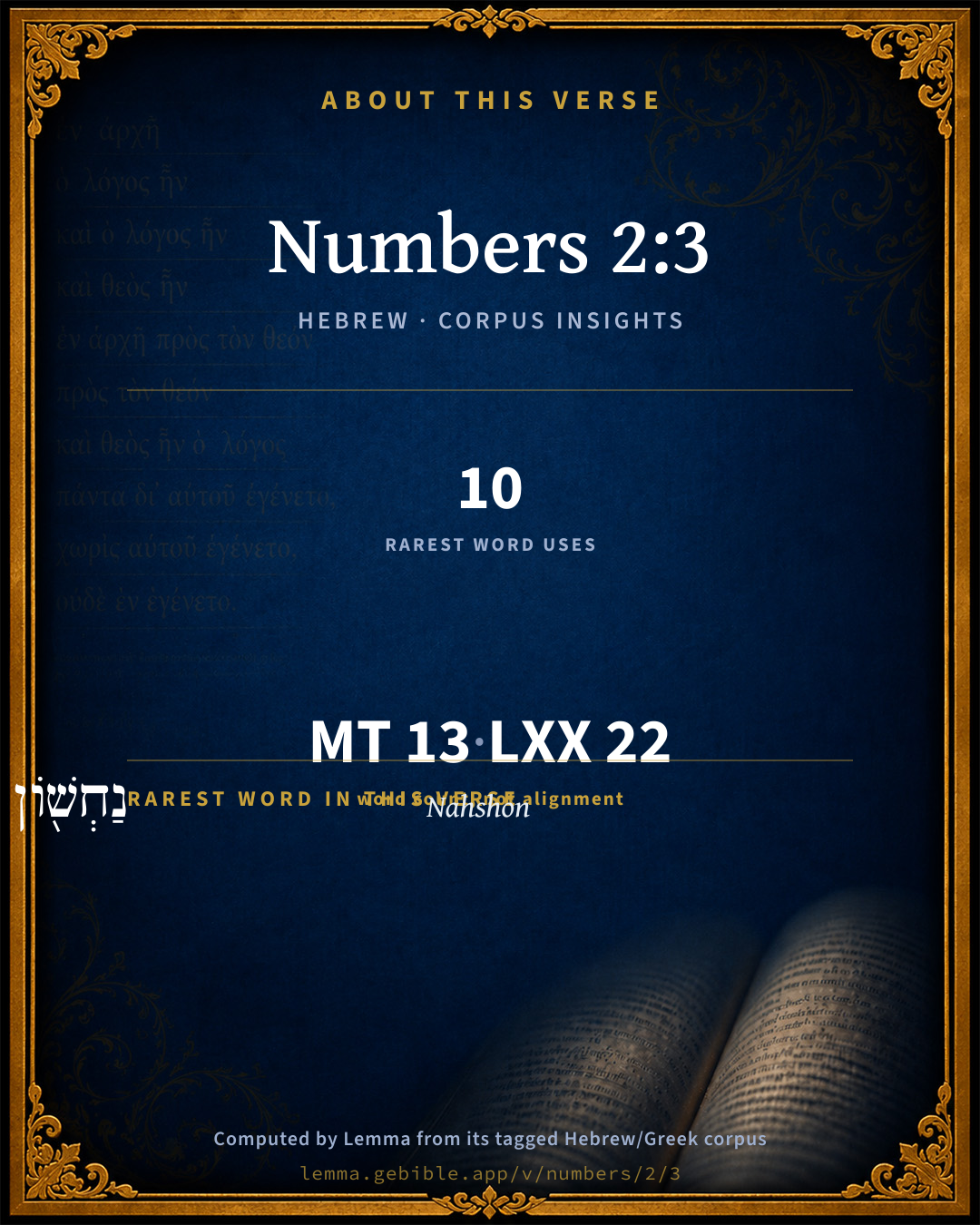
The rarest word here is נַחְשׁ֖וֹן Nahshon H5177 — appearing just 10 times in the whole Hebrew Bible.

Shared distinctive vocabulary

נַחְשׁ֖וֹן Nahshon H5177 occurs in 9 verses of the Hebrew Bible. Also found in:

Grammatical profile

  • 1 verb
  • 12 nouns

Verb forms

  • וְהַחֹנִים֙ Qal · Participle Active

Repetition

Words recur within this verse — often emphatic in Hebrew:

  • יְהוּדָ֖ה Judah H3063 ×2
  • לִבְנֵ֣י son H1121 ×2

Hebrew & Septuagint length

In English translation the verse runs 39 words from the Hebrew and 33 from the Septuagint (LXX English) — closely comparable.

A rough comparison of the two English renderings, which tokenize alike — not a word-level alignment.

Word counts can differ between the Hebrew and the Greek without any difference in meaning — e.g. the Hebrew direct-object marker אֵת has no separate Greek word, and Greek often adds the article ὁ.

In the original languages it is 13 Hebrew tokens and 22 Greek tokens — but the two are counted differently (Hebrew bundles its prefixes and suffixes into one token; the Greek is in lemma form), so that isn’t a like-for-like length.

Cross-references

12

Topical passages linked to Numbers 2:3 in the Treasury of Scripture Knowledge — connected by theme and wording, ordered by reader-vote popularity; previews shown in the World English Bible.

  • Ruth 4:20 and Amminadab became the father of Nahshon, and Nahshon became the father of Salmon,
  • 1 Chronicles 2:10 Ram became the father of Amminadab, and Amminadab became the father of Nahshon, prince of the children of Judah;
  • Numbers 1:7 Of Judah: Nahshon the son of Amminadab.
  • Numbers 10:14–16 In the first [place] the standard of the camp of the children of Judah set forward according to their hosts: and over his host was Nahshon the son of Amminadab.
  • Luke 3:32–33 the son of Jesse, the son of Obed, the son of Boaz, the son of Salmon, the son of Nahshon,
  • Genesis 49:8–10 "Judah, your brothers will praise you: Your hand will be on the neck of your enemies; Your father's sons will bow down before you.
  • Numbers 7:17 and for the sacrifice of peace offerings, two oxen, five rams, five male goats, and five male lambs a year old. This was the offering of Nahshon the son of Amminadab.
  • Numbers 26:19–22 The sons of Judah: Er and Onan; and Er and Onan died in the land of Canaan.
  • Judges 1:1–2 It happened after the death of Joshua, the children of Israel asked of Yahweh, saying, Who shall go up for us first against the Canaanites, to fight against them?
  • 1 Chronicles 5:2 For Judah prevailed above his brothers, and of him came the prince; but the birthright was Joseph's:)
  • Matthew 1:4 Ram became the father of Amminadab. Amminadab became the father of Nahshon. Nahshon became the father of Salmon.
  • Numbers 7:12 He who offered his offering the first day was Nahshon the son of Amminadab, of the tribe of Judah,

Cross-references courtesy of OpenBible.info (CC BY 4.0).

Hebrew and Greek witnesses Masoretic Hebrew ↔ Greek Septuagint

The same verse in the two great witnesses to the Old Testament, shown verse-for-verse.

These are two independent witnesses, not word-aligned to each other, and the Septuagint is shown in lemma (dictionary) form.

Hebrew Numbers 2:3 Masoretic · Westminster Leningrad Codex

וְהַחֹנִים֙ קֵ֣דְמָה מִזְרָ֔חָה דֶּ֛גֶל מַחֲנֵ֥ה יְהוּדָ֖ה לְצִבְאֹתָ֑ם וְנָשִׂיא֙ לִבְנֵ֣י יְהוּדָ֔ה נַחְשׁ֖וֹן בֶּן עַמִּינָדָֽב

Those who encamp on the east side toward the sunrise shall be of the standard of the camp of Judah, according to their divisions: and the prince of the children of Judah shall be Nahshon the son of Amminadab.

World English Bible · Public Domain

Greek LXX Numbers 2:3 Septuagint · lemma form

καί ὁ παρα ἐνβάλλω πρῶτος κατά ἀνατολή τάγμα παρεμβολή ιουδα σύν δύναμις αὐτός καί ὁ ἄρχων ὁ υἱός ιουδα ναασσων υἱός αμιναδαβ

And they that encamp first toward the east shall be the order of the camp of Juda with their host, and the prince of the sons of Juda, Naasson the son of Aminadab.

LXX2012 (modern English Septuagint) · Public Domain

On this verse, Keil & Delitzsch discusses the Septuagint’s reading. Read the note in Commentary ↓

Hebrew: Westminster Leningrad Codex (CC BY 4.0). Greek: Septuagint (public domain); English from LXX2012 (modern English Septuagint) (Public Domain). How the Septuagint differs from the Hebrew →

Targum (Aramaic paraphrase)

2

The Targum is the ancient Jewish Aramaic paraphrase of the Hebrew Scriptures — an interpretive translation, not the Hebrew text itself. Onkelos (literal) and Pseudo-Jonathan (expansive) render the Torah, and Jonathan the Prophets. Coverage is partial: where no permissively-licensed English translation exists for a verse, only the Aramaic is shown. This is verse-level text, not a word-by-word alignment to the Hebrew.

  1. Targum Onkelos Torah (Genesis–Deuteronomy)
    וְדִי שְׁרַן קִדוּמָא מַדִינְחָא טֵקַס מַשְׁרִית יְהוּדָה לְחֵילֵיהוֹן וְרַבָּא לִבְנֵי יְהוּדָה נַחְשׁוֹן בַּר עַמִינָדָב

    (no public-domain English translation for this verse)

    Targum Onkelos — Aramaic: “Onkelos Genesis” (public domain); “Onkelos Exodus” (public domain); “Onkelos Leviticus” (public domain); “Onkelos Numbers” (public domain); “Onkelos Deuteronomy” (public domain). English: “Sefaria Community Translation” (CC0 1.0 (public-domain dedication)); “J.W. Etheridge. The Targums of Onkelos and Jonathan Ben Uzziel on the Pentateuch. London: Longmans, Green, 1862” (public domain). Text via Sefaria.

  2. Targum Pseudo-Jonathan Torah (Genesis–Deuteronomy)
    מַשְׁרִיתָא דְיִשְרָאֵל הֲוָה אוּרְכָּא תְּרֵיסַר מִילִין וּפוּתְיָהּ תְּרֵיסַר מִילִין וְדִישְׁרַן קִידוּמָא מַדִינְחָא טֵיקַס מַשְׁרִיתָא יְהוּדָה לְחֵילֵיהוֹן בְּאַרְבַּעְתֵּי מִילִין מְרַבְּעִין וְטִיקְסֵיהּ הֲוָה מִמֵילַת תְּלַת גְוָונִין כָּל קְבֵיל תְּלַת מַרְגַלְיָתָא דִבְחוּשְׁנָא סְמוּקָא וְיָרוּקָא וּבְרוֹקָא וּבֵיהּ חָקִיק וּמְפָרֵשׁ שְׁמָהַת תְּלַת שִׁבְטַיָא יְהוּדָה יִשָשׁכָר וּזְבוּלוּן וּבִמְצִיעוּתֵיהּ כְּתִיב יְקוּם יְיָ וְיִתְבַּדְרוּן סַנְאָךְ וְיִעַרְקוּן בַּעֲלֵי דְבָבָךְ מִן קֳדָמָךְ וּבֵיהּ הֲוָה חָקִיק צוּרַת בַּר אַרְיְוָן מְטוֹל דְרַבָּא לִבְנֵי יְהוּדָה נַחְשׁוֹן בַּר עַמִינָדָב

    The length of the camp of Israel shall be twelve miles, and its breadth twelve miles. And they who encamp eastward to the sunrise shall be of the standard of the camp of Jehudah by their hosts, spreading over four miles. And his standard shall be of silk, of three colours, corresponding with (those of) the precious stones which are in the breastplate,--sardius, topaz, and carbuncle; and upon it shall be expressed and set forth the names of the three tribes of Jehudah, Issakar, and Zebulon; and in the midst shall be written: Arise, O Lord, and let Thine enemies be scattered, and Thine adversaries be driven away before Thee; and upon it shall be set forth the figure of a young lion. And the Rabba of the Beni Jehudah shall be Nachshon bar Amminadab.

    Targum Pseudo-Jonathan — Aramaic: “Targum Jonathan on Genesis” (public domain); “Targum Jonathan on Exodus” (public domain); “Targum Jonathan on Leviticus” (public domain); “Targum Jonathan on Numbers” (public domain); “Targum Jonathan on Deuteronomy” (public domain). English: “The Targum of Jonathan ben Uzziel, trans. J. W. Etheridge, London, 1862” (public domain). Text via Sefaria.

Commentary

Notes on Numbers 2:3 from classic Christian and Jewish commentators (each source and its license shown beneath its notes). The classic Christian expositions comment on the surrounding passage and are grouped to its opening verse, so a note may address several verses; the Jewish commentaries on the Tanakh (Rashi and others) are per-verse, so they appear only where the commentator wrote on this verse.

Lemma curates 59 commentaries, every one of them public domain or Creative Commons licensed, each selected and text-cleaned for this edition rather than reprinted as found. About our sources →

Trapp's Complete Commentary

John Trapp

Num 2:3 And on the east side toward the rising of the sun shall they of the standard of the camp of Judah pitch throughout their armies: and Nahshon the son of Amminadab [shall be] captain of the children of Judah.

Ver. 3. And on the east side.] Judah encamped foremost. It was fit the lion should lead the way. Better an army of harts, with a lion to lead them on, &c. This order in their march showed the principality that should continue in this tribe till Shiloh came. Judah herein also was a type of Christ, who is "the Captain of the Lord’s host," {Jos 5:14} and "of our salvation," {Heb 2:10} and goeth before his heavenly armies. {Rev 12:7}

John Trapp, A Commentary or Exposition upon All the Books of the Old and New Testament (1647–1656) — public domain. Text from a community e-Sword module.

The Biblical Illustrator

Joseph S. Exell

Num_2:3-4

The camp of Judah.

The encampment of Judah

I. The tribe. Judah signifies praise. Now will I praise the Lord, said his mother Leah at his birth (Gen_29:35). Thus is the spiritual Judah established and made a praise in the earth (Isa_62:7), to the glory of God of whom it is born and made. This whole family in heaven and earth is named and appointed to be a continual praise to the glory of the omnipotent grace of Jehovah. Kings and priests as they all are, is not each a brand plucked out of the fire? (Zec_3:2).

II. Their encampment. Judah shall encamp. But in what form and order? Upon this we have only to say, with respect to the spiritual Judah, that the mystical Cross of their great High Priest embodies itself in all their stations and movements, gives shape to all their hopes and expectations, directs and regulates their prayers, praises, and exertions. Whatever they attempt or whatever they enjoy is conformed to the Cross.

III. The direction in which the camp is situated. Judah shall encamp toward the sun-rising. Such too is the cheerful situation of the beloved people; they have the evening behind them, and the morning in their eye. All are looking towards the rising day, towards the Day-star from on high.

IV. Judahs encampment toward the sun-rising was to be with his banner. Banners gave the signal for the people to march; they were painted upon hills and eminences, that they might be seen at a distance, and straightway the hosts marched towards and gathered round them. So it is with our banner of the Cross. It is a magnet of irresistible attraction. Wherever it is lifted up, there is a movement, an excitement, a stir, and the elect of God gather around it with exultation or with weeping.

V. Judahs host. How astonished should we be, what mingled terror and great joy would surprise us, if suddenly those covering angel-hosts, which encompass the spiritual Israel, were to burst the veil which renders them invisible to mortal eyes, and come forth at once into full view! Some in this world have been favoured to behold a portion of those invisible squadrons which always attend the children of God. Judahs host is the heavenly band of watchers, who are sent forth to minister to the safety and welfare of those who shall be heirs of salvation.

VI. The name of Judahs captain is Nahshon, son of Amminadab. This name truly belongs to the Prince of the host, the Captain of our salvation. Nahshon signifies experience; and who is so experienced in conflict as He who was made perfect in sufferings, and having spoiled principalities and powers, overcame death, and opened to us the gate of everlasting life! Who is so experienced a captain as He, whose unslumbering pastoral care has been exercised for ages in behalf of His people! Who is so experienced in the tumult and alarm of war as He, against whom the infatuated and cold-hearted world have been bearing arms day and night for so many centuries I And who is so accustomed to triumph as He, who is making all such enemies His footstool and everywhere abides last upon the field! Appropriate therefore to Him is the name of Nahshon. He is also as truly in character the son of Amminadab. For this name, which signifies My people are a willing gift, directs our thoughts first to God the Father, as freely giving to Christ all who will ever come unto Him, and as making them also willing in the day of His power. (F. W. Krummacher, D. D.)

Aspects of honour

I. Honour wisely conferred.

II. Honour in relation with duty and responsibility.

III. Honour as connected with parental influence,

IV. Honour as related to future greatness.

Jacob had predicted that Judah should be the ruling tribe; he promised to Judah a kingdom and sovereignty. Ages more were to pass away before the prediction was fulfilled; but the honour now conferred on the tribe would encourage faith in its predicted destiny. Its natural tendency would be to stimulate them to--

1. Believe in their destiny.

2. Work for their destiny.

3. Wait for their destiny.

Let every privilege conferred upon us increase our assurance of the splendid honours which await us hereafter. (W. Jones)

.

The Biblical Illustrator, edited by Joseph S. Exell (c. 1880s–1900s) — public domain. Text from a community e-Sword module.

Joseph Benson's Commentary

Num 2:3. Judah — This tribe was in the first post, and in their marches led the van, not only because it was the most numerous, but chiefly because Christ, the Lion of the tribe of Judah, was to descend from it: yea, from the loins of Nahshon, who is here appointed the chief captain of it.

Joseph Benson's Commentary on the Old and New Testaments (1811–1818) — public domain. Text from a community e-Sword module.

Keil & Delitzsch

C. F. Keil & F. Delitzsch

Order of the tribes in the camp and on the march. - Num 2:3-9. The standard of the tribe of Judah was to encamp in front, namely towards the east, according to its hosts; and by its side the tribes of Issachar and Zebulun, the descendants of Leah, under the command and banner of Judah: an army of 186,400 men, which was to march out first when the camp was broken up (Num 2:9), so that Judah led the way as the champion of his brethren (Gen 49:10).

Num 2:4-9

"His host, and those that were numbered of them" (cf. Num 2:6, Num 2:8, Num 2:11, etc.), i.e., the army according to its numbered men.

Num 2:10-16

On the south side was the standard of Reuben, with which Simeon and Gad, descendants of Leah and her maid Zilpah, were associated, and to which they were subordinated. In Num 2:14, Reuel is a mistake for Reuel (Num 1:14; Num 7:42; Num 10:20), which is the reading given here in 118 MSS cited by Kennicott and De Rossi, in several of the ancient editions, and in the Samaritan, Vulgate, and Jonah Saad., whereas the lxx, Onk., Syr., and Pers. read Reuel. This army of 151,450 men was to break up and march as the second division.

Num 2:17

The tabernacle, the camp of the Levites, was to break up after this in the midst of the camps (i.e., of the other tribes). "As they encamp, so shall they break up," that is to say, with Levi in the midst of the tribes, "every man in his place, according to his banner." יד, place, as in Deu 23:13; Isa 57:8.

Num 2:18-24

On the west the standard of Ephraim, with the tribes of Manasseh and Benjamin, that is to say, the whole of the descendants of Rachel, 108,100 men, as the third division of the army.

Num 2:25-30

Lastly, towards the north was the standard of Gad, with Asher and Naphtali, the descendants of the maids Bilhah and Zilpah, 157,600 men, who were to be the last to break up, and formed the rear on the march.

Num 2:31

לדגליהם (according to their standards) is equivalent to לצבאתם (according to their hosts) in Num 2:9, Num 2:16, and Num 2:24, i.e., according to the hosts of which they consisted.

Keil & Delitzsch — Biblical Commentary on the Old Testament (1861–1891) — public domain (CC PDM 1.0). Text via the HelloAO Bible API. (Old Testament only.)

Tyndale Open Study Notes

Tyndale Open Resources

2:3-9 The tribes of Judah, Issachar, and Zebulun camped in the most prestigious place on the east side of the Tabernacle and led the way when Israel was on the move. This largest of the tribal groups (186,400) could provide adequate protection for the sacred tent and its attendants.

Tyndale Open Study Notes — © Tyndale Open Resources, licensed CC BY-SA 4.0. Text via the HelloAO Bible API.

Geneva Bible (1599)

Geneva Bible translators

Or, prince.

Geneva Bible (1599) marginal notes — public domain. Text via Bolls.life.

Matthew Henry's Commentary

We have here the particular distribution of the twelve tribes into four squadrons, three tribes in a squadron, one of which was to lead the other two. Observe, 1. God himself appointed them their place, to prevent strife and envy among them. Had they been left to determine precedency among themselves, they would have been in danger of quarrelling with one another (as the disciples who strove which should be greatest); each would have had a pretence to be first, or at least not to be last. Had it been left to Moses to determine, they would have quarrelled with him, and charged him with partiality; therefore God does it, who is himself the fountain and judge of honour, and in his appointment all must acquiesce. If God in his providence advance others above us, and abase us, we ought to be as well satisfied in his doing it in that way as if he did it, as this was done here, by a voice out of the tabernacle; and this consideration, that it appears to be the will of God it should be so, should effectually silence all envies and discontents. And as far as our place comes to be our choice our Saviour has given us a rule in Luk 14:8, Sit not down in the highest room; and another in Mat 20:27, He that will be chief, let him be your servant. Those that are most humble and most serviceable are really most honourable. 2. Every tribe had a captain, a prince, or commander-in-chief, whom God himself nominated, the same that had been appointed to number them, Num 1:5. Our being all the children of one Adam is so far from justifying the levellers, and taking away the distinction of place and honour, that even among the children of the same Abraham, the same Jacob, the same Judah, God himself appointed that one should be captain of all the rest. There are powers ordained of God, and those to whom honour and fear are due and must be paid. Some observe the significancy of the names of these princes, at least, in general, how much God was in the thoughts of those that gave them their names, for most of them have El, God, at one end or other of their names. Nethaneel, the gift of God; Eliab, my God a Father; Elizur, my God a rock; Shelumiel, God my peace; Eliasaph, God has added; Elishama, my God has heard: Gamaliel, God my reward; Pagiel, God has met me. By this it appears that the Israelites in Egypt did not quite forget the name of their God, but, when they wanted other memorials, preserved the remembrance of it in the names of their children, and therewith comforted themselves in their affliction. 3. Those tribes were placed together under the same standard that were nearest of kin to each other; Judah, Issachar, and Zebulun, were the three younger sons of Leah, and they were put together; and Issachar and Zebulun would not grudge to be under Judah, since they were his younger brethren. Reuben and Simeon would not have been content in their place. Therefore Reuben, Jacob's eldest son, is made chief of the next squadron; Simeon, no doubt, is willing to be under him, and Gad, the son of Zilpah, Leah's handmaid, is fitly added to them in Levi's room: Ephraim, Manasseh, and Benjamin, are all the posterity of Rachel. Dan, the eldest son of Bilhah, is made a leading tribe, though the son of a concubine, that more abundant honour might be bestowed on that which lacked; and it was said, Dan should judge his people, and to him were added two younger sons of the handmaids. Thus unexceptionable was the order in which they were placed. 4. The tribe of Judah was in the first post of honour, encamped towards the rising sun, and in their marches led the van, not only because it was the most numerous tribe, but chiefly because from that tribe Christ was to come, who is the Lion of the tribe of Judah, and was to descend from the loins of him who was now nominated chief captain of that tribe. Nahshon is reckoned among the ancestors of Christ, Mat 1:4. So that, when he went before them, Christ himself went before them in effect, as their leader. Judah was the first of the twelve sons of Jacob that was blessed. Reuben, Simeon, and Levi, were censured by their dying father; he therefore being first in blessing, though not in birth, is put first, to teach children how to value the smiles of their godly parents and dread their frowns. 5. The tribes of Levi pitched closely about the tabernacle, within the rest of their tribes, Num 2:17. They must defend the sanctuary, and then the rest of the tribes must defend them. Thus, in the vision which John saw of the glory of heaven, between the elders and the throne were four living creatures full of eyes, Rev 4:6, Rev 4:8. Civil powers should protect the religious interests of a nation, and be a defence upon that glory. 6. The camp of Dan (and so that tribe is called long after their settlement in Canaan (Jdg 13:25), because celebrated for their military prowess), though posted in the left wing when they encamped, was ordered in their march to bring up the rear, Num 2:31. They were the most numerous, next to Judah, and therefore were ordered into a post which, next to the front, required the most strength, for as the strength is so shall the day be. Lastly, The children of Israel observed the orders given them, and did as the Lord commanded Moses, Num 2:34. They put themselves in the posts assigned them, without murmuring or disputing, and, as it was their safety, so it was their beauty; Balaam was charmed with the sight of it: How goodly are thy tents, O Jacob! Num 24:5. Thus the gospel church, called the camp of saints, ought to be compact according to the scripture model, every one knowing and keeping his place, and then all that wish well to the church rejoice, beholding their order, Col 2:5.

Matthew Henry's Commentary on the Whole Bible (1708–1710) — public domain (CC PDM 1.0). Text via the HelloAO Bible API.

Jamieson, Fausset & Brown

Robert Jamieson, A. R. Fausset & David Brown

on the east side toward the rising of the sun shall they of the standard of the camp of Judah pitch throughout their armies--Judah, placed at the head of a camp composed of three tribes rallying under its standard, was said to have combined the united colors in the high priest's breastplate, but called by the name of Judah. They were appointed to occupy the east side and to take the lead in the march, which, for the most part, was in an easterly direction.

Nahshon--or Naasson (Mat 1:4; Luk 3:32-33).

shall be captain--It appears that the twelve men who were called to superintend the census were also appointed to be the captains of their respective tribes--a dignity which they owed probably to the circumstances, formerly noticed, of their holding the hereditary office of head or "prince."

Jamieson, Fausset & Brown — Commentary Critical and Explanatory on the Whole Bible (1871) — public domain (CC PDM 1.0). Text via the HelloAO Bible API.

The Cambridge Bible for Schools and Colleges

gen. ed. J. J. S. Perowne

3. Judah] The most important tribe in each group of three is mentioned first, and the numbers of all the three together are reckoned under its name (Num_2:9; Num_2:16; Num_2:24; Num_2:31).

The Cambridge Bible for Schools and Colleges (gen. ed. J. J. S. Perowne; Cambridge University Press, 1878–1918) — public domain. Text from a community e-Sword module.

John Gill's Exposition

And on the east side, towards the rising of the sun,.... Which rises in the east; or of all; for, as Jarchi observes, that which is "before" is called "Kedem", the east, as the west is called "behind":

shall they of the standard of the camp of Judah pitch, throughout their armies; the tribes of Judah, Issachar, and Zebulun, formed one camp, which had its name from the principal tribe Judah; and this was divided into various regiments and companies, called armies, who severally pitched under one and the same standard. It is said (g) Judah's stone was the "nophech" (which we render an emerald), and his flag was coloured in the likeness of the colour of the heavens, and there was formed upon it a lion. Issachar's was the sapphire, and his flag was coloured black, like to black lead, and there were framed upon it the sun and moon, on account of what is said, Ch1 12:32. Zebulun's was a diamond, and his flag was coloured white, and there was formed upon it a ship, because of what is said, Gen 49:13,

and Nahshon, the son of Amminadab, shall be captain of the children of Judah; who had been assisting in numbering the people, and who afterwards offered to the dedication of the altar, Num 1:2.

(g) Bemidbar Rabba, sect. 2. fol. 178. 2.

John Gill's Exposition of the Whole Bible (1746–1763) — public domain (CC PDM 1.0). Text via the HelloAO Bible API.

Albert Barnes' Notes on the Bible

The following plan shows the general arrangement of the camp, which would vary in different places according to local exigencies. The area of the camp might be about three square miles:

Num 2:14

Reuel - Doubtless an error of transcription for Deuel Num 1:14.

Albert Barnes' Notes on the Bible (1834–1885) — public domain. Text from a community e-Sword/MySword module.

Whedon's Commentary on the Bible

Daniel D. Whedon

3. On the east — Or, in front of the door of the tabernacle. Nearest to the tents of Moses and Aaron and the priests, and situated toward the sunrise, was Judah’s standard, planted with the first grand army corps of 186,600 soldiers, to constitute the van of the ponderous column. Issachar and Zebulun and Judah are all sons of Leah, hence there is the strongest motive for harmony. By birthright, Reuben’s was the right of precedence, or the hegemony, as the Greeks called it; but he had forfeited it by a very flagrant crime against the peace and order of his father Jacob’s house, and especially insulting to him. See Gen_35:22; and Gen_49:4. His sin dis-crowned him, as sin will dis-crown every impenitent soul. Nahshon, the phylarch or captain of the tribe, with the captains of the other tribes, were those whom Jehovah chose to assist Moses and Aaron in the census.

Num_1:5. It is probable that Nahshon outranked not only the two captains of his division, but all the others also, being next to Moses and his vicegerent Joshua. These are doubtless the same men who were assembled by Moses and Aaron in Exo_4:29, as “all the elders.”

Daniel D. Whedon (gen. ed.), Commentary on the Old and New Testaments (1874–1909) — public domain. Text from a community e-Sword module.

The Pulpit Commentary

On the east. The van, the post of honour. The general direction indeed of their march was northwards, not eastwards; but nothing can obliterate the natural pre-eminence given to the east by the sunrise, the scattering of light upon the earth, the daily symbol of the day-spring from on high. The standard of the camp of Judah. Judah led the way not because he was the greatest in number, for the order of the tribes was not determined by this consideration, but because of his place in prophecy, and as the ancestor of the Messiah. (Gen_49:10) According to Aben Ezra and other Jewish expositors, the device upon the standard of Judah was a young lion, and this agrees with Rev_5:5. The same authorities assign to Reuben a man, to Ephraim an ox, (cf. Deu_33:17) to Dan an eagle. If it were so, we should find in these banners the origin of the forms of the living creatures in the visions of Ezekiel and St. John, (Eze_1:26 Eze_10:1 Rev_4:4-6) unless, indeed, the devices on the standards were themselves taken from the symbolic forms of the cherubim in the tabernacle, and these in their turn borrowed from the religious art of Egypt. But the tradition of the Jews is too fluctuating to carry any weight. The Targum of Palestine assigns to Judea the lion, but to Reuben a stag, to Ephraim a young man, and to Dan a basilisk serpent.

The Pulpit Commentary (1880–1919), ed. H.D.M. Spence-Jones & Joseph S. Exell — public domain. Text from a community e-Sword module.

John Wesley's Explanatory Notes

Judah - This tribe was in the first post, and in their marches led the van, not only because it was the most numerous, but chiefly because Christ, the Lion of the tribe of Judah, was to descend from it: Yea, from the loins of Nahshon, who is here appointed the chief captain of it.

John Wesley, Explanatory Notes Upon the Whole Bible (1754–1765) — public domain. Text via the GEBible commentary corpus.

unfoldingWord translationNotes

Door43 World Missions Community

under their standard

The "standards" were four larger groups that the tribes were divided into. Each standard was commanded to camp together, and was represented by a banner. See how you translated "standards" in Numbers 2:2.

Nahshon son of Amminadab

See how you translated this man's name in Numbers 1:7.

74,600

"seventy-four thousand six hundred" (See: Numbers)

translationWords

Judah

unfoldingWord translationNotes — © Distant Shores Media and the Door43 World Missions Community, licensed CC BY-SA 4.0. Source: git.door43.org/Door43/en_tn.

Rashi

Rabbi Shlomo Yitzchaki (Rashi)

קדמה means IN FRONT, which is expressed by קדם; and which side is it? The east side (מזרחה), and accordingly the west is termed אחור, the back side of the world (cf. Rashi on Exodus 27:13 and Note thereon).

Rashi on the Tanakh — English translations: “The Judaica Press complete Tanach with Rashi, translated by A. J. Rosenberg” (CC BY 4.0); “Pentateuch with Rashi's commentary by M. Rosenbaum and A.M. Silbermann, 1929-1934” (public domain); “The Metsudah Tanach series, Lakewood, N.J” (CC BY 4.0); and “The Book of Joshua, Metsudah Publications, 1997” (CC BY 4.0). Text via Sefaria.

Lesson kit

Teaching starters — assembled from the data on this page, not authored interpretation. Every prompt links to the verse data it draws on. Edit before teaching.

Numbers, in the Pentateuch, opens this verse with 13 words (11 distinct Hebrew lemmas). Its most distinctive word is Nachshôwn (“Nahshon”). A historical commentator’s framing appears above. Read the whole chapter for the surrounding context.

Discussion questions

  1. How does “Nahshon” (Nachshôwn) shape what this verse is saying?
  2. How does Exodus 6:23, which shares the word «Nahshon», read alongside this verse?
  3. What does the repetition of “Judah” (2× in this one verse) do in this verse?
  4. These translations render this verse differently. What is at stake in choosing one wording over another?
  5. «וְהַחֹנִים֙» is a Qal Participle Active verb. How does that grammatical form shape the action described?
  6. Compare how Trapp's Complete Commentary and The Biblical Illustrator read this verse. Where do they agree or differ?

Things to notice

Reading settings

Reading text

Shown beneath each verse's original-language words.

Old Testament
Old Testament edition

Read the OT as the Masoretic Hebrew (MT) or the Greek Septuagint (LXX).

English shown for the Greek Septuagint (in the Hebrew ↔ Greek comparison).

Comparing translations? Open the Compare panel on any verse page to stack up to four side by side.