
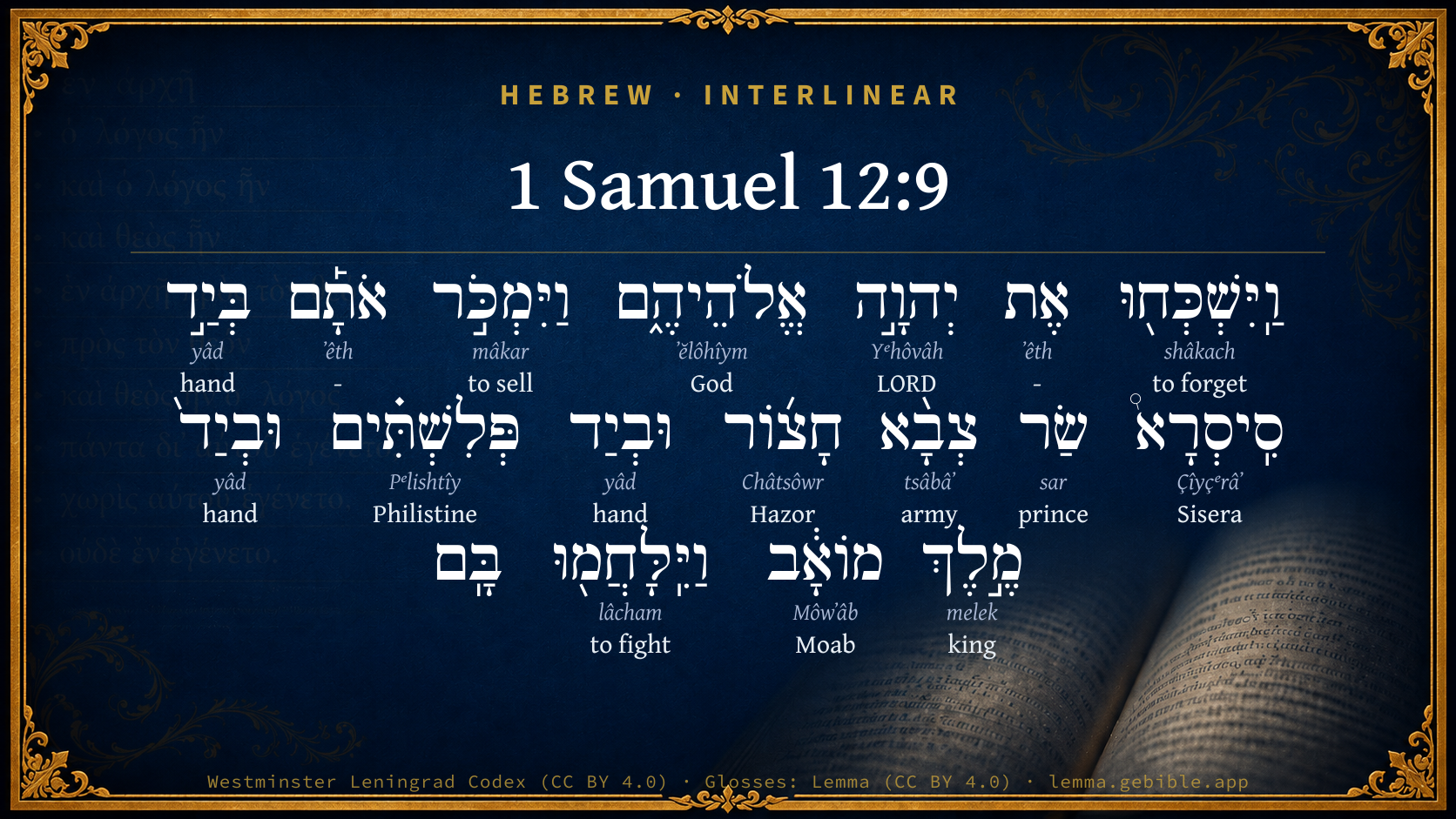
1 Samuel 12:9

Hebrew (Westminster Leningrad Codex) 1 Samuel 12:9 appears in the Hebrew Old Testament. The text above is from the Westminster Leningrad Codex. Each word links to its Strong’s number, a concise gloss, and parsing drawn from the Open Scriptures Hebrew Bible morphology. Click any word for its full Brown-Driver-Briggs (BDB) entry.
Download image
Cite this verse

1 Samuel 12:9 (World English Bible). Public Domain. Lemma interlinear Bible study tool, https://lemma.gebible.app/v/1-samuel/12/9.

Show BibTeX & RIS
BibTeX
RIS
English Translation
But they forgot Yahweh their God; and he sold them into the hand of Sisera, captain of the host of Hazor, and into the hand of the Philistines, and into the hand of the king of Moab; and they fought against them.
World English Bible · Public Domain
Download a study sheet

One document with this verse’s original text, its word-by-word gloss line, the meaning frame, cross-references with their text, attributed commentary, and full source and license credits — printable, and it pastes into notes with its structure intact.

This verse Autodidact and up

Study sheet (.html) Plain text (.txt)

A passage Seminary Student

Up to 50 verses in one chapter. A passage sheet keeps up to 6 commentary sources and 12 cross-references per verse, in the order this page ranks them, and says so on the sheet whenever that leaves anything out. Ask for a single verse and you get the Autodidact verse sheet above.

Everything on this page stays free to read, with no account — the sheet is a download of what is already on screen, not access to it.

Want to remove ads? Support Godless Engineer
Compare translations 3

The same verse in 3 English versions, stacked beneath the original-language interlinear above. Click any original word for its lexicon entry.

Each is an independent rendering of the whole verse — the interlinear is not word-aligned to these translations.

Highlighted words mark where these versions differ — a whole-verse word diff, not a word-by-word alignment.

  • World English Bible Public Domain
    But they forgot Yahweh their God; and he sold them into the hand of Sisera, captain of the host of Hazor, and into the hand of the Philistines, and into the hand of the king of Moab; and they fought against them.
  • King James Version Public Domain
    And when they forgat the LORD their God, he sold them into the hand of Sisera, captain of the host of Hazor, and into the hand of the Philistines, and into the hand of the king of Moab, and they fought against them.
  • unfoldingWord Literal Text CC BY-SA 4.0
    But they forgot Yahweh their God. So he sold them into the hand of Sisera, the commander of the army of Hazor, and into the hand of the Philistines, and into the hand of the king of Moab. And they fought with them.

unfoldingWord Literal Text — © unfoldingWord, licensed CC BY-SA 4.0. Word-aligned USFM3 via Door43 (git.door43.org/unfoldingWord/en_ult).

Versions to compare (up to 4)

3 of 4 selected

Show all 18 translations

Every available English version of this verse, each an independent rendering of the whole verse.

  • World English Bible Public Domain
    But they forgot Yahweh their God; and he sold them into the hand of Sisera, captain of the host of Hazor, and into the hand of the Philistines, and into the hand of the king of Moab; and they fought against them.
  • Berean Standard Bible Public Domain
    But they forgot the LORD their God, and He sold them into the hand of Sisera the commander of the army of Hazor, and into the hands of the Philistines and the king of Moab, who fought against them.
  • Majority Standard Bible Public Domain
    But they forgot the LORD their God, and He sold them into the hand of Sisera the commander of the army of Hazor, and into the hands of the Philistines and the king of Moab, who fought against them.
  • King James Version Public Domain
    And when they forgat the LORD their God, he sold them into the hand of Sisera, captain of the host of Hazor, and into the hand of the Philistines, and into the hand of the king of Moab, and they fought against them.
  • American Standard Version (1901) Public Domain
    But they forgat Jehovah their God; and he sold them into the hand of Sisera, captain of the host of Hazor, and into the hand of the Philistines, and into the hand of the king of Moab; and they fought against them.
  • Revised Version (1885) Public Domain
    But they forgat the LORD their God, and he sold them into the hand of Sisera, captain of the host of Hazor, and into the hand of the Philistines, and into the hand of the king of Moab, and they fought against them.
  • Geneva Bible (1599) Public Domain
    And when they forgate the Lord their God, he solde them into the hand of Sisera captaine of the hoste of Hazor, and into the hand of the Philistims, and into the hande of the king of Moab, and they fought against them.
  • Douay-Rheims (1899) Public Domain
    And they forgot the Lord their God, and he delivered them into the hands of Sisara, captain of the army of Hasor, and into the hands of the Philistines, and into the hand of the king of Moab, and they fought against them.
  • Young's Literal Translation Public Domain
    and they forget Jehovah their God, and He selleth them into the hand of Sisera, head of the host of Hazor, and into the hand of the Philistines, and into the hand of the king of Moab, and they fight against them,
  • Literal Standard Version CC BY-SA 4.0
    and they forget their God YHWH, and He sells them into the hand of Sisera, head of the host of Hazor, and into the hand of the Philistines, and into the hand of the king of Moab, and they fight against them,
  • Unlocked Literal Bible CC BY-SA 4.0
    But they forgot Yahweh their God; he sold them into the hand of Sisera, captain of the armies of Hazor, into the hand of the Philistines, and into the hand of the king of Moab; these all fought against your ancestors.
  • unfoldingWord Literal Text CC BY-SA 4.0
    But they forgot Yahweh their God. So he sold them into the hand of Sisera, the commander of the army of Hazor, and into the hand of the Philistines, and into the hand of the king of Moab. And they fought with them.
  • Darby Bible Public Domain
    And they forgot Jehovah their God, and he sold them into the hand of Sisera, captain of the host of Hazor, and into the hand of the Philistines, and into the hand of the king of Moab, and they fought against them.
  • World Messianic Bible Public Domain
    But they forgot the LORD their God; and he sold them into the hand of Sisera, captain of the army of Hazor, and into the hand of the Philistines, and into the hand of the king of Moab; and they fought against them.
  • Webster's Bible Public Domain
    And when they forgot the LORD their God, he sold them into the hand of Sisera, captain of the host of Hazor, and into the hand of the Philistines, and into the hand of the king of Moab, and they fought against them.
  • Free Bible Version CC BY-SA 4.0
    But they forgot about the Lord their God, so he abandoned them to Sisera, the commander of the army of Hazor, to the Philistines, and to the king of Moab, who attacked them.
  • Bible in Basic English Public Domain
    But they were false to the Lord their God, and he gave them up into the hands of Sisera, captain of the army of Jabin, king of Hazor, and into the hands of the Philistines, and into the hands of the king of Moab, who made war against them.
  • JPS Tanakh (1917) Public Domain
    But they forgot the LORD their God, and He gave them over into the hand of Sisera, captain of the host of Hazor, and into the hand of the Philistines, and into the hand of the king of Moab, and they fought against them.

Literal Standard Version (2020), Covenant Press — licensed CC BY-SA 4.0. Text via the HelloAO Bible API (eBible.org). Unlocked Literal Bible (unfoldingWord) — licensed CC BY-SA 4.0. Text via the HelloAO Bible API (eBible.org). unfoldingWord Literal Text — © unfoldingWord, licensed CC BY-SA 4.0. Word-aligned USFM3 via Door43 (git.door43.org/unfoldingWord/en_ult). Free Bible Version, Dr. Jonathan Gallagher — licensed CC BY-SA 4.0. Text via the HelloAO Bible API (eBible.org).

Word by word

More ways to search: Search by grammar → Find every occurrence → Compare this word →

Practice this passage: Drill this verse → Learn its vocabulary →

חָצ֜וֹר
Châtsôwr
H2674
“Hazor”
Noun, Proper
Part of Speech
Noun
Type
Proper
Full BDB Definition

Origin: a collective form of H2691

TWOT: None

Hazor = "castle" - a royal city of northern Palestine allotted to Naphtali - one of the cities of Judah in the extreme south - a town north of Jerusalem in which the Benjamites resided after the return from exile - a site in Arabia
  1. וַֽיִּשְׁכְּח֖וּ shâkach H7911 “and · to forget” Conjunction + Verb, Qal, Sequential Imperfect, 3rd Person, Masculine, Plural
  2. אֶת ʼêth H853 “-” Particle, Direct Object
  3. יְהוָ֣ה Yᵉhôvâh H3068 “LORD” Noun, Proper
  4. אֱלֹהֵיהֶ֑ם ʼĕlôhîym H430 “God(s) · their” Noun, Common, Masculine, Plural, Construct + Suffix, Personal, 3rd Person, Masculine, Plural
  5. וַיִּמְכֹּ֣ר mâkar H4376 “and · to sell” Conjunction + Verb, Qal, Sequential Imperfect, 3rd Person, Masculine, Singular
  6. אֹתָ֡ם ʼêth H853 “- · them” Particle, Direct Object + Suffix, Personal, 3rd Person, Masculine, Plural
  7. בְּיַ֣ד yâd H3027 “in/at · hand of” Preposition + Noun, Common, Both, Singular, Construct
  8. סִֽיסְרָא֩ Çîyçᵉrâʼ H5516 “Sisera” Noun, Proper
  9. שַׂר sar H8269 “prince of” Noun, Common, Masculine, Singular, Construct
  10. צְבָ֨א tsâbâʼ H6635 “army of” Noun, Common, Both, Singular, Construct
  11. וּבְיַד yâd H3027 “and · in/at · hand of” Conjunction + Preposition + Noun, Common, Both, Singular, Construct
  12. פְּלִשְׁתִּ֗ים Pᵉlishtîy H6430 “Philistines” Noun, Gentilic, Masculine, Plural, Absolute
  13. וּבְיַד֙ yâd H3027 “and · in/at · hand of” Conjunction + Preposition + Noun, Common, Both, Singular, Construct
  14. מֶ֣לֶךְ melek H4428 “king of” Noun, Common, Masculine, Singular, Construct
  15. מוֹאָ֔ב Môwʼâb H4124 “Moab” Noun, Proper
  16. וַיִּֽלָּחֲמ֖וּ lâcham H3898 “and · to fight” Conjunction + Verb, Niphal, Sequential Imperfect, 3rd Person, Masculine, Plural

About this verse

These counts appear in no published source. They are computed here, from the morphology-tagged text and Lemma’s own curated glosses. What Lemma adds →

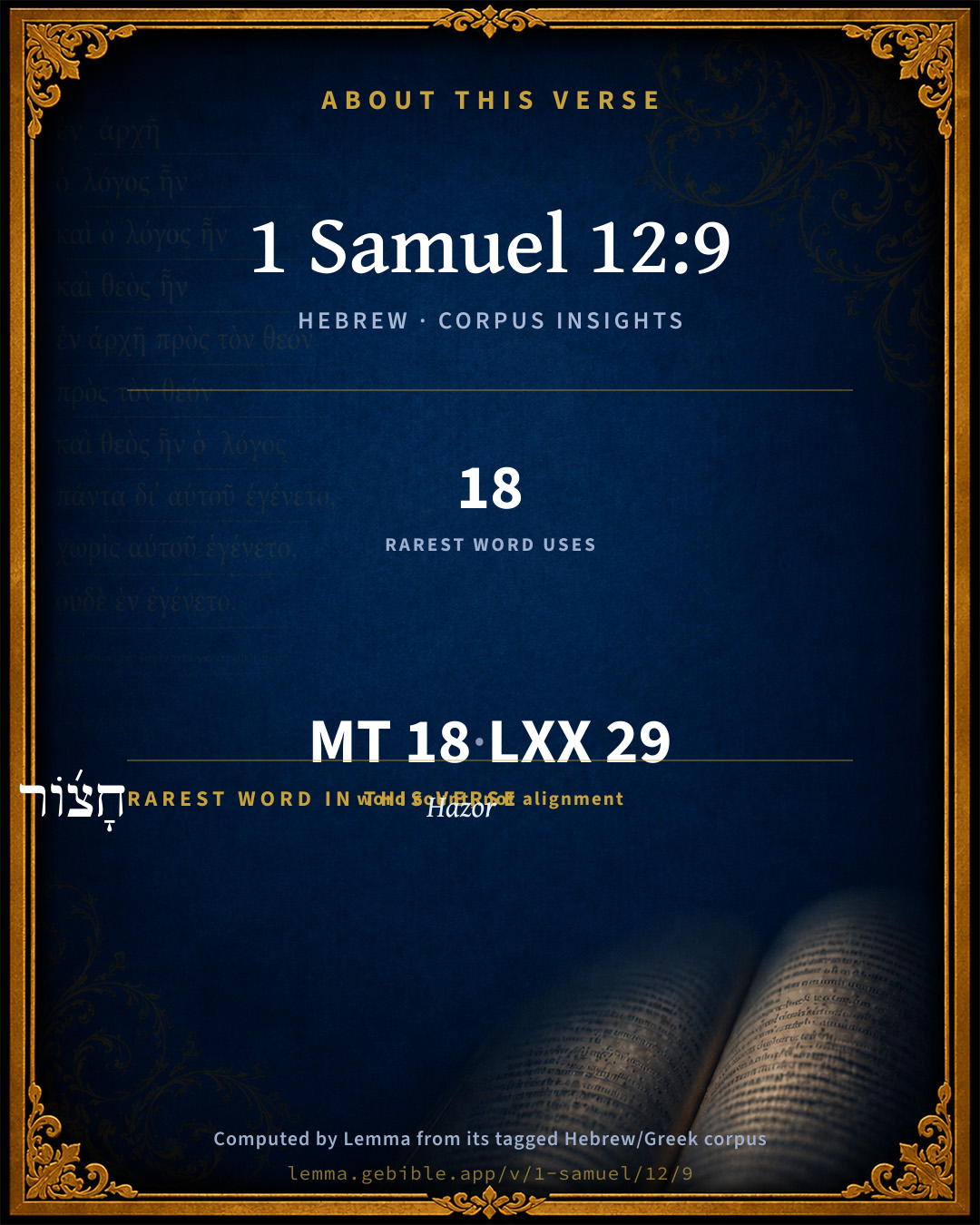
18
words
14
distinct lemmas
Historical
section

Notable vocabulary

The rarest word here is חָצ֜וֹר Hazor H2674 — appearing just 18 times in the whole Hebrew Bible.

Shared distinctive vocabulary

חָצ֜וֹר Hazor H2674 occurs in 17 verses of the Hebrew Bible. Also found in:

Grammatical profile

  • 3 verbs
  • 12 nouns
  • 1 preposition
  • 2 particles

Verb forms

  • וַֽיִּשְׁכְּח֖וּ Qal · Sequential Imperfect
  • וַיִּמְכֹּ֣ר Qal · Sequential Imperfect
  • וַיִּֽלָּחֲמ֖וּ Niphal · Sequential Imperfect

Repetition

A word recurs within this verse — often emphatic in Hebrew:

  • בְּיַ֣ד hand H3027 ×3

Hebrew & Septuagint length

In English translation the verse runs 42 words from the Hebrew and 46 from the Septuagint (LXX English) — closely comparable.

A rough comparison of the two English renderings, which tokenize alike — not a word-level alignment.

Word counts can differ between the Hebrew and the Greek without any difference in meaning — e.g. the Hebrew direct-object marker אֵת has no separate Greek word, and Greek often adds the article ὁ.

In the original languages it is 18 Hebrew tokens and 29 Greek tokens — but the two are counted differently (Hebrew bundles its prefixes and suffixes into one token; the Greek is in lemma form), so that isn’t a like-for-like length.

Cross-references

13

Topical passages linked to 1 Samuel 12:9 in the Treasury of Scripture Knowledge — connected by theme and wording, ordered by reader-vote popularity; previews shown in the World English Bible.

  • Judges 3:12 The children of Israel again did that which was evil in the sight of Yahweh: and Yahweh strengthened Eglon the king of Moab against Israel, because they had done that which was evil in the sight of Yahweh.
  • Judges 4:2 Yahweh sold them into the hand of Jabin king of Canaan, who reigned in Hazor; the captain of whose host was Sisera, who lived in Harosheth of the Gentiles.
  • Judges 10:7 The anger of Yahweh was kindled against Israel, and he sold them into the hand of the Philistines, and into the hand of the children of Ammon.
  • Judges 13:1 The children of Israel again did that which was evil in the sight of Yahweh; and Yahweh delivered them into the hand of the Philistines forty years.
  • Deuteronomy 32:18 Of the Rock that became your father, you are unmindful, Have forgotten God who gave you birth.
  • Deuteronomy 32:30 How should one chase a thousand, Two put ten thousand to flight, Except their Rock had sold them, Yahweh had delivered them up?
  • Judges 2:14 The anger of Yahweh was kindled against Israel, and he delivered them into the hands of spoilers who despoiled them; and he sold them into the hands of their enemies round about, so that they could not any longer stand before their enemies.
  • Judges 3:7–8 The children of Israel did that which was evil in the sight of Yahweh, and forgot Yahweh their God, and served the Baals and the Asheroth.
  • Judges 3:31 After him was Shamgar the son of Anath, who struck of the Philistines six hundred men with an ox-goad: and he also saved Israel.
  • Psalms 106:21 They forgot God, their Savior, Who had done great things in Egypt,
  • Isaiah 50:1–2 Thus says Yahweh, Where is the bill of your mother's divorce, with which I have put her away? or which of my creditors is it to whom I have sold you? Behold, for your iniquities were you sold, and for your transgressions was your mother put away.
  • Isaiah 63:10 But they rebelled, and grieved his holy Spirit: therefore he was turned to be their enemy, [and] himself fought against them.
  • Jeremiah 2:32 Can a virgin forget her ornaments, or a bride her attire? yet my people have forgotten me days without number.

Cross-references courtesy of OpenBible.info (CC BY 4.0).

Hebrew and Greek witnesses Masoretic Hebrew ↔ Greek Septuagint

The same verse in the two great witnesses to the Old Testament, shown verse-for-verse.

These are two independent witnesses, not word-aligned to each other, and the Septuagint is shown in lemma (dictionary) form.

Hebrew 1 Samuel 12:9 Masoretic · Westminster Leningrad Codex

וַֽיִּשְׁכְּח֖וּ אֶת יְהוָ֣ה אֱלֹהֵיהֶ֑ם וַיִּמְכֹּ֣ר אֹתָ֡ם בְּיַ֣ד סִֽיסְרָא֩ שַׂר צְבָ֨א חָצ֜וֹר וּבְיַד פְּלִשְׁתִּ֗ים וּבְיַד֙ מֶ֣לֶךְ מוֹאָ֔ב וַיִּֽלָּחֲמ֖וּ בָּֽם

But they forgot Yahweh their God; and he sold them into the hand of Sisera, captain of the host of Hazor, and into the hand of the Philistines, and into the hand of the king of Moab; and they fought against them.

World English Bible · Public Domain

Greek LXX 1 Samuel 12:9 Septuagint · lemma form

καί ἐπιλανθάνω κύριος ὁ θεός αὐτός καί ἀποδίδωμι αὐτός εἰς χείρ σισαρα ἀρχιστράτηγος ιαβιν βασιλεύς ασωρ καί εἰς χείρ ἀλλόφυλος καί εἰς χείρ βασιλεύς μωαβ καί πολεμέω ἐν αὐτός

And they forgot the Lord their God, and he sold them into the hands of Sisara captain of the host of Jabis king of Asor, and into the hands of the Philistines, and into the hands of the king of Moab; and he fought with them.

LXX2012 (modern English Septuagint) · Public Domain

Hebrew: Westminster Leningrad Codex (CC BY 4.0). Greek: Septuagint (public domain); English from LXX2012 (modern English Septuagint) (Public Domain). How the Septuagint differs from the Hebrew →

Targum (Aramaic paraphrase)

1

The Targum is the ancient Jewish Aramaic paraphrase of the Hebrew Scriptures — an interpretive translation, not the Hebrew text itself. Onkelos (literal) and Pseudo-Jonathan (expansive) render the Torah, and Jonathan the Prophets. Coverage is partial: where no permissively-licensed English translation exists for a verse, only the Aramaic is shown. This is verse-level text, not a word-by-word alignment to the Hebrew.

  1. Targum Jonathan Prophets (Joshua–Malachi)
    וְאִתְנְשִׁיאוּ יַת פּוּלְחָנָא דַייָ אֱלָהָהוֹן וּמְסַר יַתְהוֹן בְּיַד סִיסְרָא רַב חֵילָא דְחָצוֹר וּבִידָא דִפְלִשְׁתָּאֵי וּבִידָא מַלְכָּא דְמוֹאָב וְאַגִיחוּ קְרָבָא בְּהוֹן:

    (no public-domain English translation for this verse)

    Targum Jonathan — Aramaic: “Mikraot Gedolot” (public domain). English: “Sefaria Community Translation” (CC0 1.0 (public-domain dedication)); “London "Chaldee Paraphrase," 1871” (public domain). Text via Sefaria.

Commentary

Notes on 1 Samuel 12:9 from classic Christian and Jewish commentators (each source and its license shown beneath its notes). The classic Christian expositions comment on the surrounding passage and are grouped to its opening verse, so a note may address several verses; the Jewish commentaries on the Tanakh (Rashi and others) are per-verse, so they appear only where the commentator wrote on this verse.

Lemma curates 59 commentaries, every one of them public domain or Creative Commons licensed, each selected and text-cleaned for this edition rather than reprinted as found. About our sources →

Trapp's Complete Commentary

John Trapp

1Sa 12:9 And when they forgat the LORD their God, he sold them into the hand of Sisera, captain of the host of Hazor, and into the hand of the Philistines, and into the hand of the king of Moab, and they fought against them.

Ver. 9. And when they forgat the Lord.] As their wont was: and hence grew all their other wickednesses. See Rom 3:17-18.

John Trapp, A Commentary or Exposition upon All the Books of the Old and New Testament (1647–1656) — public domain. Text from a community e-Sword module.

The Biblical Illustrator

Joseph S. Exell

1Sa_12:9-15

And when they forgot the Lord their God he sold them into the hand of Sisera.

National judgments the consequence of national sins

Let us learn from this transaction the important lesson, that national judgments are the certain consequences of national transgression! A lesson, taught not merely in this particular passage of Jewish history, but written in characters the most legible upon every period of their national career--a truth, for the confirmation of which we need not search the annals of other countries; we have merely to look back to the past experience of our own. Yes, whatever be the instrument to which the Almighty may see fit to entrust the execution of His vengeance; whether it be the sword, or the famine, or the pestilence, or the far more terrible scourge of popular fury and civil discord; whether He raise up a tyrant to oppress His people, and grievously afflict them with a rod of iron; whatever may be the means employed to inflict the chastisement, the occasion of that chastisement is sin. The same spirit is at work among us,--the self-willed spirit of insubordination,--the spirit of opposition to all constituted authority--of dissatisfaction with all long established institutions. The same principles are broached among us; principles which, if carried out to their legitimate conclusions, must lead inevitably to the same miserable results. Now, as in those days, the majesty of the people is held to be the only true source of power; the will of the multitude is substituted for the authority of God! Surely, when we see these things come to pass, there can be nothing very unreasonable in the fear that trouble may be hard at hand; that the day of calamity may be nearer than we are willing to believe? Should the Almighty deal with us after our sins, and reward us according to our iniquities, (Psa_103:10), the issue may be easily foreseen. Did the transgression of our fathers draw down upon them the calamities which we this day deplore, and are we better than they? No! in nowise. Our privileges, indeed, are greater--our deliverances have been greater--our responsibilities are greater--let us beware lest our condemnation, also, be greater. (W. Brickwell.)

Unheeding warnings prepare for judgment

Things to which, says Manton, we are used do not work upon us; we are not much moved with them. Custom maketh men sleep quietly by the falls of great waters, where much noise is; and some parts of the body grow callous, brawny, dry, and dead, as the labourers hand, and the travellers heel, by much use. So doth the conscience gradually lose its force. At first, like a cataract, its great roar astounds the soul, and effectually prevents its slumbers of carnal security; but by-and-by its noise is scarcely heard, and men are even lulled to sleep by its sound. Now this is to be dreaded exceedingly, for it is the forerunner of doom. No more warnings are heard because sentence has gone forth and the mans destruction is sealed.

The Biblical Illustrator, edited by Joseph S. Exell (c. 1880s–1900s) — public domain. Text from a community e-Sword module.

Joseph Benson's Commentary

1Sa 12:9. They forgat the Lord — That is, they revolted from him, and carried themselves as if they had wholly forgotten his innumerable favours. This he says to answer an objection, that the reason why they desired a king was, because in the time of the judges they were at great uncertainties, and often exercised with sharp afflictions: to which he answereth by concession that they were so; but adds, that they themselves were the cause of it, by their forgetting God: so that it was not the fault of that kind of government, but their transgressing the rules of it. Fought — With success, and subdued them.

Joseph Benson's Commentary on the Old and New Testaments (1811–1818) — public domain. Text from a community e-Sword module.

Tyndale Open Study Notes

Tyndale Open Resources

12:9 handed them over: See Judg 3:8; 4:1-3. • the king of Moab: See Judg 3:12. Not all of Israel’s enemies in the era of the judges are listed (e.g., the Ammonites and Midianites). This list is representative to emphasize the highs and lows of that era.

Tyndale Open Study Notes — © Tyndale Open Resources, licensed CC BY-SA 4.0. Text via the HelloAO Bible API.

Geneva Bible (1599)

Geneva Bible translators

Captain of Jabin’s host, King of Hazor.

Geneva Bible (1599) marginal notes — public domain. Text via Bolls.life.

Adam Clarke's Commentary

Verse 9. The hand of Sisera] See these transactions in the book of Judges, as marked in the margin; and see the notes on those passages. Jdg 4:2 (note)

Adam Clarke's Commentary on the Bible (1810–1826) — public domain. Text from a community e-Sword/MySword module.

Ellicott's Commentary for English Readers

(9) And when they forgot the Lord their God.—The idolatry of Israel, and the immorality and shame less wickedness which ever attended it, was simply an act of rebellion against the pure government of the invisible King, and was punished by the withdrawal of the Divine protection. The instances which are here adduced of the people being given up into the hands of strange hostile nations are prominent ones, quoted as they occurred to him, without any careful attention being paid to the order of events and times, which was here not necessary for the course of his argument. Three leading nations out of the neighbouring peoples are mentioned by him as having been allowed, in consequence of Israel’s rebellion against the Eternal, to oppress and harass, for a season, the tribes of God’s inheritance—the Canaanites, the Philistines, and the Moabites.

Captain of the host of Hazor.—Hazor is mentioned as the capital city of the Canaanites in Jos_11:1; Jos_11:10; Jos_11:13, &c., and again as a royal residence in Jdg_4:2. Sisera is specially named as the well-known commander of the army against which Israel fought, and as the victim of the sanguinary but patriotic deed of fury of Jael.

Into the hand of the Philistines.—These “Phœnicians,” who literally dwelt among the Israelites, were most formidable foes to the chosen people for a long series of years. We have before compared their many strongholds and fastnesses to those robber nests which in the stormy middle ages disturbed the peace, and were the scourge of the commerce and trade, of Central Europe. It was owing especially to these Philistines that for so long a period such slow progress in wealth and the arts of civilisation was made in Israel. The advance of the Hebrew nation, from the days of Samuel, who first really checked these Philistine robbers, was singularly rapid. In an almost incredibly short period, from being a poor, half-barbarous people, the Israelites became a highly cultured, wealthy, and powerful nation. In great measure this strangely rapid progress was owing to the complete subjugation of the Philistines under the rule of Samuel, Saul, and David.

The king of Moab.—The king referred to here is Eglon, who was slain by Ehud. (See Judges 3)

A Bible Commentary for English Readers, edited by Charles John Ellicott (1878–1897) — public domain. Text from a community e-Sword module.

The Cambridge Bible for Schools and Colleges

gen. ed. J. J. S. Perowne

9. he sold them] God’s abandonment of His people to their enemies is described under the figure of sale, just as the deliverance of them is called redemption or buying back. Cp. Jdg_2:14; Jdg_3:8; Psa_44:12.

The three chief oppressors of Israel during the period of the Judges are mentioned. (1) The Canaanites, who were led by Sisera, general of the army of King Jabin. Their chief city was Hazor (= stronghold) situated on the high ground west of the Lake of Merom, where Jebel Hadîreh perhaps still preserves the name. This oppression lasted for 20 years. See Jdg_4:5. (2) The Philistines. See Jdg_3:31; Jdg_10:7; Jdg_13:1, and Note IV. p. 238. (3) The Moabites under Eglon. See Jdg_3:12-30.

The Cambridge Bible for Schools and Colleges (gen. ed. J. J. S. Perowne; Cambridge University Press, 1878–1918) — public domain. Text from a community e-Sword module.

John Gill's Exposition

And when they forgat the Lord their God,.... The worship of the Lord their God, as the Targum; that is, they fell into idolatry, which is a plain instance and proof of forgetfulness of God; for such that neglect his worship, and serve idols, may be truly said to forget him:

he sold them into the hand of Sisera, captain of the host of Hazor; who was general of the army of Jabin king of Canaan, who reigned in Hazor, Jdg 4:2, where they are said to be sold into the hands of Jabin, here into the hands of Sisera; because it is highly probable he was sent against them by Jabin, and subdued them, as he afterwards was sent by him, when they rebelled against him, and were delivered out of his hand:

and into the hand of the Philistines: as they were in and before the times of Samson, Jdg 13:1.

and into the hand of the king of Moab; as in the times of Ehud, Jdg 3:14, the exact order of these things is not observed:

and they fought against them; the king of Moab, Sisera, and the Philistines, and overcame them, and so they fell into their hands.

John Gill's Exposition of the Whole Bible (1746–1763) — public domain (CC PDM 1.0). Text via the HelloAO Bible API.

Albert Barnes' Notes on the Bible

According to the present arrangement of the Book of Judges, and the common chronology, the oppression of Sisera must have occurred about 200 years after the entrance into Canaan. But Samuel here places it as the first great servitude, before that under Eglon king of Moab, or that from which Shamgar delivered them. And this is in accordance with the internal evidence of the Book of Judges itself. It is also the order of Jdg 10:11, except that there the Ammonites Jdg 3:13 are placed before the Philistines.

Albert Barnes' Notes on the Bible (1834–1885) — public domain. Text from a community e-Sword/MySword module.

Haydock's Catholic Bible Commentary

Hasor. See Judges iv. 1. --- Moab. Jephte delivered the people from the hands of the Ammonites, who claimed all that country, Judges xi. 15. Eglon had been slain by Aod, before the Chanaanites enslaved Israel. (Calmet)

George Leo Haydock (1774–1849), Haydock's Catholic Family Bible and Commentary, 1859 edition — public domain. Excludes Psalms (Douay-Rheims chapter numbering differs from Protestant) and Deuterocanonical books (Catholic canon only).

Matthew Poole's English Annotations

They forgat the Lord, i.e. they revolted from him, as it is explained, 1Sa 12:10, and carried themselves as ungratefully and unworthily towards God, as if they had wholly forgotten his great and innumerable favours, and their infinite obligations to him.

Forgetting of God is oft put for all manner of wickedness, whereof indeed that is the true cause. See Isa 17:10; Jer 3:21; Eze 22:12. This he saith, partly to answer all objection, That the reason why they desired a king was, because in the time of the judges they were at great uncertainties, and ofttimes exercised with sharp afflictions: to which he answereth by concession that they were so; but adds, by way of retortion, that they themselves were the cause of it, by their forgetting of God; so that it was not the fault of that kind of government, but their transgressing the rules of it; and partly to mind them that this their ungrateful carriage towards God was no new or strange thing, but an hereditary and inveterate disease, that so they might more easily believe their own guilt herein, and be more deeply humbled, both for their own and for their parents’ sins.

They fought against them, to wit, with success, and subdued them.

Matthew Poole's English Annotations on the Holy Bible (1683–1685) — public domain. Text from a community e-Sword/MySword module.

The Pulpit Commentary

When they forgat Jehovah their God. The theocracy, as we have seen, (1Sa_10:18) was a moral government, under which idolatry and the immorality attendant upon it, as being rebellion, were punished by Jehovah"s withdrawing his protection, and the consequent subjection of the nation to foreign rule. It was the repeated sin, therefore, of the people which made Israel"s history so checquered. Sisera, (Jud_1:4:2) the Philistines (Jdg_3:31), and Eaton, king of, (Jud_1:3:12) are mentioned as three of the earlier oppressors of Israel, but are given here in the reverse order to that found in the Book of Judges.

The Pulpit Commentary (1880–1919), ed. H.D.M. Spence-Jones & Joseph S. Exell — public domain. Text from a community e-Sword module.

John Wesley's Explanatory Notes

Forgat - That is, they revolted from him, and carried themselves, as if they had wholly forgotten his innumerable favours. This he saith to answer an objection, that the reason why they desired a king, was, because in the time of the Judges they were at great uncertainties, and often exercised with sharp afflictions: to which he answereth by concession that they were so; but adds, by way of retortion, that they themselves were the cause of it, by their forgetting God: so that it was not the fault of that kind of government, but their transgressing the rules of it. Fought - With success, and subdued them.

John Wesley, Explanatory Notes Upon the Whole Bible (1754–1765) — public domain. Text via the GEBible commentary corpus.

Lesson kit

Teaching starters — assembled from the data on this page, not authored interpretation. Every prompt links to the verse data it draws on. Edit before teaching.

1 Samuel, in the Historical, opens this verse with 18 words (14 distinct Hebrew lemmas). Its most distinctive word is Châtsôwr (“Hazor”). A historical commentator’s framing appears above. Read the whole chapter for the surrounding context.

Discussion questions

  1. The word Châtsôwr carries the sense “Hazor.” How does it shape the verse?
  2. Joshua 11:1 shares the word «Hazor» with this verse. How do the two illuminate each other?
  3. “hand” occurs 3× in this one verse. What is the effect of the repetition?
  4. The translations on this page render this verse differently — a whole-verse word diff, not a word-by-word alignment. What might account for the different wordings?
  5. The verb «וַֽיִּשְׁכְּח֖וּ» is Qal Sequential Imperfect. How does its form color the action?
  6. Reading how Trapp's Complete Commentary and The Biblical Illustrator read this verse, where do the two commentators agree and where do they part?

Things to notice

Reading settings

Reading text

Shown beneath each verse's original-language words.

Old Testament
Old Testament edition

Read the OT as the Masoretic Hebrew (MT) or the Greek Septuagint (LXX).

English shown for the Greek Septuagint (in the Hebrew ↔ Greek comparison).

Comparing translations? Open the Compare panel on any verse page to stack up to four side by side.