

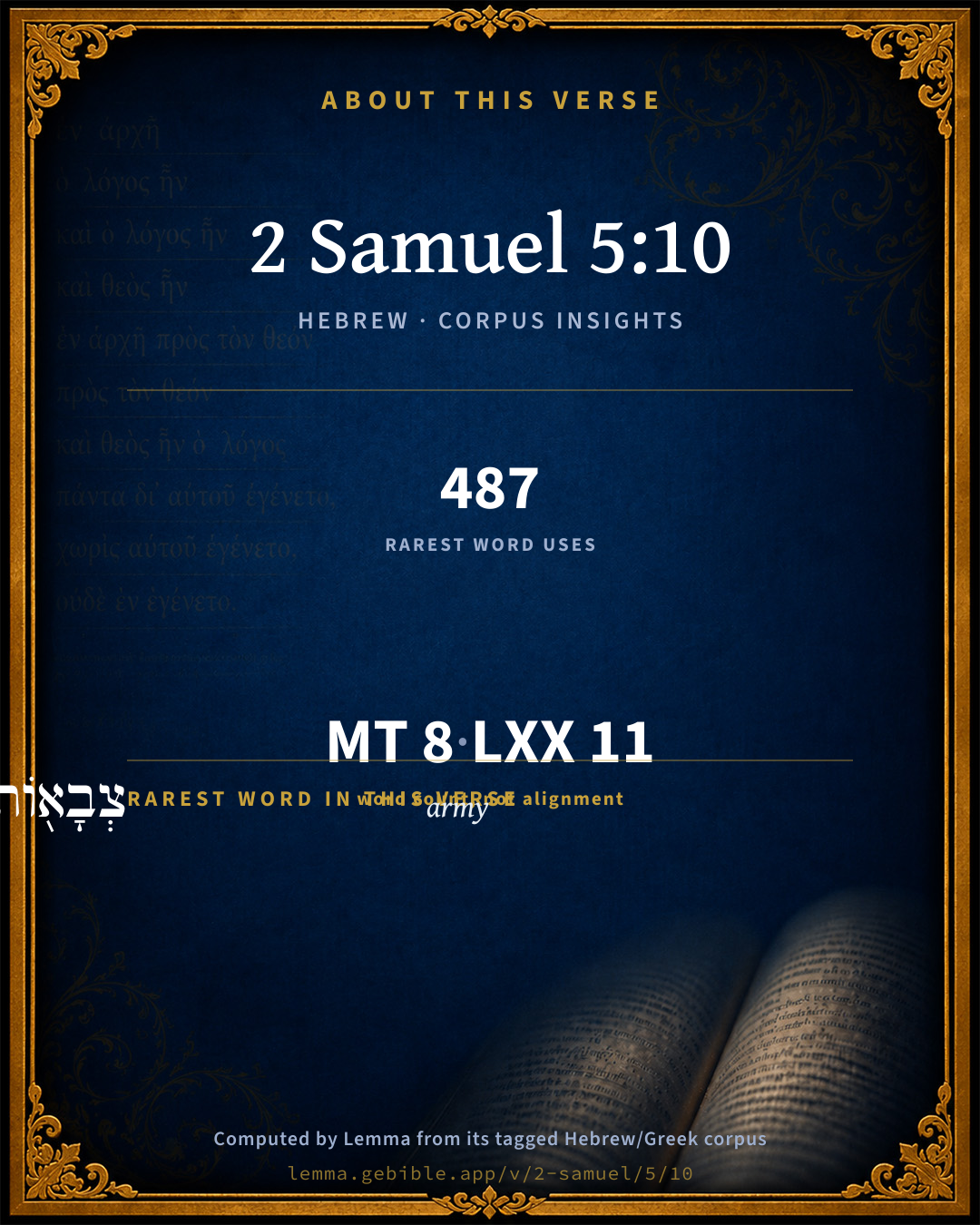
2 Samuel 5:10

Hebrew (Westminster Leningrad Codex) 2 Samuel 5:10 appears in the Hebrew Old Testament. The text above is from the Westminster Leningrad Codex. Each word links to its Strong’s number, a concise gloss, and parsing drawn from the Open Scriptures Hebrew Bible morphology. Click any word for its full Brown-Driver-Briggs (BDB) entry.
Download image
Cite this verse

2 Samuel 5:10 (World English Bible). Public Domain. Lemma interlinear Bible study tool, https://lemma.gebible.app/v/2-samuel/5/10.

Show BibTeX & RIS
BibTeX
RIS
English Translation
David grew greater and greater; for Yahweh, the God of hosts, was with him.
World English Bible · Public Domain
Download a study sheet

One document with this verse’s original text, its word-by-word gloss line, the meaning frame, cross-references with their text, attributed commentary, and full source and license credits — printable, and it pastes into notes with its structure intact.

This verse Autodidact and up

Study sheet (.html) Plain text (.txt)

A passage Seminary Student

Up to 50 verses in one chapter. A passage sheet keeps up to 6 commentary sources and 12 cross-references per verse, in the order this page ranks them, and says so on the sheet whenever that leaves anything out. Ask for a single verse and you get the Autodidact verse sheet above.

Everything on this page stays free to read, with no account — the sheet is a download of what is already on screen, not access to it.

Want to remove ads? Support Godless Engineer
Compare translations 3

The same verse in 3 English versions, stacked beneath the original-language interlinear above. Click any original word for its lexicon entry.

Each is an independent rendering of the whole verse — the interlinear is not word-aligned to these translations.

Highlighted words mark where these versions differ — a whole-verse word diff, not a word-by-word alignment.

  • World English Bible Public Domain
    David grew greater and greater; for Yahweh, the God of hosts, was with him.
  • King James Version Public Domain
    And David went on, and grew great, and the LORD God of hosts was with him.
  • unfoldingWord Literal Text CC BY-SA 4.0
    And David went, going and becoming great, for Yahweh, the God of Armies, with him.

unfoldingWord Literal Text — © unfoldingWord, licensed CC BY-SA 4.0. Word-aligned USFM3 via Door43 (git.door43.org/unfoldingWord/en_ult).

Versions to compare (up to 4)

3 of 4 selected

Show all 18 translations

Every available English version of this verse, each an independent rendering of the whole verse.

  • World English Bible Public Domain
    David grew greater and greater; for Yahweh, the God of hosts, was with him.
  • Berean Standard Bible Public Domain
    And David became greater and greater, for the LORD God of Hosts was with him.
  • Majority Standard Bible Public Domain
    And David became greater and greater, for the LORD God of Hosts was with him.
  • King James Version Public Domain
    And David went on, and grew great, and the LORD God of hosts was with him.
  • American Standard Version (1901) Public Domain
    And David waxed greater and greater; for Jehovah, the God of hosts, was with him.
  • Revised Version (1885) Public Domain
    And David waxed greater and greater; for the LORD, the God of hosts, was with him.
  • Geneva Bible (1599) Public Domain
    And Dauid prospered and grewe: for the Lord God of hostes was with him.
  • Douay-Rheims (1899) Public Domain
    And David dwelt in the castle, and called it, The city of David: and built round about from Mello and inwards.
  • Young's Literal Translation Public Domain
    and David goeth, going on and becoming great, and Jehovah, God of Hosts, `is' with him.
  • Literal Standard Version CC BY-SA 4.0
    and David goes, going on and becoming great, and YHWH, God of Hosts, [is] with him.
  • Unlocked Literal Bible CC BY-SA 4.0
    David became very powerful because Yahweh, the God of hosts, was with him.
  • unfoldingWord Literal Text CC BY-SA 4.0
    And David went, going and becoming great, for Yahweh, the God of Armies, with him.
  • Darby Bible Public Domain
    And David became continually greater; and Jehovah the God of hosts was with him.
  • World Messianic Bible Public Domain
    David grew greater and greater, for the LORD, the God of Hosts, was with him.
  • Webster's Bible Public Domain
    And David went on, and grew great, and the LORD God of hosts was with him.
  • Free Bible Version CC BY-SA 4.0
    David became increasingly powerful, for the Lord God Almighty was with him.
  • Bible in Basic English Public Domain
    And David became greater and greater; for the Lord, the God of armies, was with him.
  • JPS Tanakh (1917) Public Domain
    And David waxed greater and greater; for the LORD, the God of hosts, was with him.

Literal Standard Version (2020), Covenant Press — licensed CC BY-SA 4.0. Text via the HelloAO Bible API (eBible.org). Unlocked Literal Bible (unfoldingWord) — licensed CC BY-SA 4.0. Text via the HelloAO Bible API (eBible.org). unfoldingWord Literal Text — © unfoldingWord, licensed CC BY-SA 4.0. Word-aligned USFM3 via Door43 (git.door43.org/unfoldingWord/en_ult). Free Bible Version, Dr. Jonathan Gallagher — licensed CC BY-SA 4.0. Text via the HelloAO Bible API (eBible.org).

Word by word

More ways to search: Search by grammar → Find every occurrence → Compare this word →

Practice this passage: Drill this verse → Learn its vocabulary →

About this verse

These counts appear in no published source. They are computed here, from the morphology-tagged text and Lemma’s own curated glosses. What Lemma adds →

8
words
8
distinct lemmas
Historical
section

Grammatical profile

  • 3 verbs
  • 4 nouns
  • 1 preposition

Verb forms

  • וַיֵּ֥לֶךְ Qal · Sequential Imperfect
  • הָל֣וֹךְ Qal · Infinitive Absolute
  • וְגָד֑וֹל Qal · Infinitive Absolute

Hebrew & Septuagint length

In English translation the verse runs 14 words from the Hebrew and 13 from the Septuagint (LXX English) — closely comparable.

A rough comparison of the two English renderings, which tokenize alike — not a word-level alignment.

Word counts can differ between the Hebrew and the Greek without any difference in meaning — e.g. the Hebrew direct-object marker אֵת has no separate Greek word, and Greek often adds the article ὁ.

In the original languages it is 8 Hebrew tokens and 11 Greek tokens — but the two are counted differently (Hebrew bundles its prefixes and suffixes into one token; the Greek is in lemma form), so that isn’t a like-for-like length.

Cross-references

11

Topical passages linked to 2 Samuel 5:10 in the Treasury of Scripture Knowledge — connected by theme and wording, ordered by reader-vote popularity; previews shown in the World English Bible.

  • 2 Samuel 3:1 Now there was long war between the house of Saul and the house of David: and David grew stronger and stronger, but the house of Saul grew weaker and weaker.
  • Psalms 46:11 Yahweh of Hosts is with us. The God of Jacob is our refuge. Selah.
  • Romans 8:31 What then shall we say about these things? If God is for us, who can be against us?
  • Psalms 46:7 Yahweh of Hosts is with us. The God of Jacob is our refuge. Selah.
  • Proverbs 4:18 But the path of the righteous is like the dawning light, That shines more and more until the perfect day.
  • Isaiah 9:7 Of the increase of his government and of peace there shall be no end, on the throne of David, and on his kingdom, to establish it, and to uphold it with justice and with righteousness from henceforth even forever. The zeal of Yahweh of Hosts will perform this.
  • Daniel 2:44–45 In the days of those kings shall the God of heaven set up a kingdom which shall never be destroyed, nor shall the sovereignty of it be left to another people; but it shall break in pieces and consume all these kingdoms, and it shall stand forever.
  • Luke 2:52 And Jesus increased in wisdom and stature, and in favor with God and men.
  • Genesis 21:22 It happened at that time, that Abimelech and Phicol the captain of his host spoke to Abraham, saying, "God is with you in all that you do.
  • Job 17:9 Yet shall the righteous hold on his way. He who has clean hands shall grow stronger and stronger.
  • Isaiah 8:9–10 Make an uproar, O you peoples, and be broken in pieces! And give ear, all you of far countries: gird yourselves, and be broken in pieces! Gird yourselves, and be broken in pieces!

Cross-references courtesy of OpenBible.info (CC BY 4.0).

Hebrew and Greek witnesses Masoretic Hebrew ↔ Greek Septuagint

The same verse in the two great witnesses to the Old Testament, shown verse-for-verse.

These are two independent witnesses, not word-aligned to each other, and the Septuagint is shown in lemma (dictionary) form.

Hebrew 2 Samuel 5:10 Masoretic · Westminster Leningrad Codex

וַיֵּ֥לֶךְ דָּוִ֖ד הָל֣וֹךְ וְגָד֑וֹל וַיהוָ֛ה אֱלֹהֵ֥י צְבָא֖וֹת עִמּֽוֹ

David grew greater and greater; for Yahweh, the God of hosts, was with him.

World English Bible · Public Domain

Greek LXX 2 Samuel 5:10 Septuagint · lemma form

καί πορεύομαι δαυίδ πορεύομαι καί μεγαλύνω καί κύριος παντοκράτωρ μετά αὐτός

And David advanced and became great, and the Lord Almighty was with him.

LXX2012 (modern English Septuagint) · Public Domain

Hebrew: Westminster Leningrad Codex (CC BY 4.0). Greek: Septuagint (public domain); English from LXX2012 (modern English Septuagint) (Public Domain). How the Septuagint differs from the Hebrew →

Targum (Aramaic paraphrase)

1

The Targum is the ancient Jewish Aramaic paraphrase of the Hebrew Scriptures — an interpretive translation, not the Hebrew text itself. Onkelos (literal) and Pseudo-Jonathan (expansive) render the Torah, and Jonathan the Prophets. Coverage is partial: where no permissively-licensed English translation exists for a verse, only the Aramaic is shown. This is verse-level text, not a word-by-word alignment to the Hebrew.

  1. Targum Jonathan Prophets (Joshua–Malachi)
    וַאֲזַל דָוִד אָזֵיל וּסְגִי וּמֵימְרָא דַייָ אֱלָהָא צְבָאוֹת בְּסַעֲדֵיהּ:

    (no public-domain English translation for this verse)

    Targum Jonathan — Aramaic: “Mikraot Gedolot” (public domain). English: “Sefaria Community Translation” (CC0 1.0 (public-domain dedication)); “London "Chaldee Paraphrase," 1871” (public domain). Text via Sefaria.

Commentary

Notes on 2 Samuel 5:10 from classic Christian and Jewish commentators (each source and its license shown beneath its notes). The classic Christian expositions comment on the surrounding passage and are grouped to its opening verse, so a note may address several verses; the Jewish commentaries on the Tanakh (Rashi and others) are per-verse, so they appear only where the commentator wrote on this verse.

Lemma curates 59 commentaries, every one of them public domain or Creative Commons licensed, each selected and text-cleaned for this edition rather than reprinted as found. About our sources →

Trapp's Complete Commentary

John Trapp

2Sa 5:10 And David went on, and grew great, and the LORD God of hosts [was] with him.

Ver. 10. And David went on, and grew great.] Heb., He went going and growing. How could he do less, who had the Lord God of hosts with him and for him? who may better say than any earthly prince, Cui adhaereo, praeest. He must needs have the better whom I take part with.

John Trapp, A Commentary or Exposition upon All the Books of the Old and New Testament (1647–1656) — public domain. Text from a community e-Sword module.

The Biblical Illustrator

Joseph S. Exell

2Sa_5:10

David went on, and grew great, and the Lord God of Hosts was with him.

Greatness by gentleness

Thy gentleness bath made me great. So wrote David when he rehearsed the history that had culminated in his advancement to the throne of all Israel. He admits, therefore, that he was a made man, but not a self-made. man. Here in the narrative of his prosperity he confesses that it had been the Lord who established him king, who also exalted his kingdom; and then in a Psalm of devotion he ascribes all his glory to Divine grace.

I. We consider the greatness David had just reached. Six successive steps, at the least, had the eternal God taken in his behalf on the way to his advancement.

1. He caused that a full and loyal call should come from the realm over which he was now to rule as the second king (2Sa_5:1.)

2. The Lord trained David for the position he was to occupy by a long and intricate process Of providential discipline (2Sa_5:2.)

3. Moreover, God had chosen David intelligently, years before, and announced him as the man who should come after Saul (2Sa_5:3.)

4. Then, too, God helped on Davids greatness by providing for the stability of his government a capital and a royal abode (2Sa_5:7.)

5. Gods gentleness made David great in that a perpetual presence was vouchsafed to him for his entire life (2Sa_5:10.)

6. Then, also, God had made this monarch great by opening his intelligence so that he should understand the meaning of Divine Providence, past and future, and admit its special reach (2Sa_5:12.)

II. The gentleness in the Divine dealing with him from his first recognition as a shepherd-boy to this final establishment of him in the throne of Israel; is that in particular among the attributes of God which he acknowledges just now. The poet Goethe has left behind him, in his autobiography, this somewhat curious sentence as a revelation of personal fact: I was especially troubled by a giddiness which came over me every time that I looked down from a height. Many people, since his day and before it, have had the same characteristic disturbance; but it has more often been a height of ambition than merely a height of tower or precipice. But there is no symptom of giddiness in the quiet ascription of his gratitude: Thy gentleness has made me great.

1. Gods gentleness had borne with Davids want of memory.

2. Then, also, there was Davids want of faith, with which the Almighty bore in a like spirit of gentleness.

3. To this we may add that Gods gentleness is disclosed in his patiently bearing with Davids want of courage. (C. S. Robinson, D. D.)

Davids prosperity

I. What David did. He went on.

1. He went on with his appointed work. David was not alone in this. Every man has a work given him by God. David was, above all things, a servant of God, and every man may be that if he will!

2. He went on in the face of opposition. He was opposed by the Jebusites, and later by the Philistines. If we are in the path of duty, let us go forward! Tis patient going on that wins! In school and college, in workshop and office, perseverance triumphs. Even so is it in the godly life. He that endureth to the end shall be saved. To patient faith the prize is sure, etc.

II. What David became. He grew great. David grew great in his kingly power, and honours, and victories, great in the eyes of his foes, and great in the estimation of his subjects. The large majority have to be content with mediocrity. Most natures possess a spark of wholesome ambition, but in many cases it has become smothered and buried! Many throw away splendid opportunities of becoming at any rate greater than they are. The idler, the spendthrift, the drunkard, etc. Ambition may be worthy or unworthy. He who aspires to be great in an honourable calling by honourable means, to push his way by dint of hard work to the front, is surely to be commended! Let us grow great without sacrificing our integrity, or not at all! If we may not rise on the wings of righteousness let us be content to keep on the ground! Above all, let it be our aim to grow great morally and spiritually. But moral ennoblement comes from a higher source. Tennysons Arthur, speaking of the Knights of the Round Table, says:--

I made them lay their hands in mine and swear

To reverence the king as if he were

Their conscience, and their conscience as their king,

To break the heathen and uphold the Christ,

To ride abroad redressing human wrongs,

To speak no slander, no, nor listen to it,

To honour his own word as if his Gods,

To live sweet lives in purest chastity.

Write Christ instead of Arthur and you have the patent of a higher nobility than earthly sovereign ever bestowed.

III. The secret of Davids prosperity. The Lord God of Hosts was with him. The secret of all real greatness is in having the Lord on our side. How can we secure His presence and help? How did David secure these?

1. He trusted God.

2. He acknowledged and consulted Him.

3. He obeyed God.

The same method of ensuring the Divine help is open to all. If we would go on and grow great, if we would prosper in all right ways we must begin to walk in those ways. Have we made the great commencement? He calls us now! (J. Sellicks.)

Prosperity

I. The tide of prosperity.

1. David as sole ruler over Israel. Every tide has a turning, and at last the ebb-tide of Davids misfortunes began to flow. Judah had for seven and a half years been subject to Davids sway, and now all Israel was anxious to array itself under his banner. The account given in our lesson is very meagre, but a fuller account in (1Ch_12:23-40) will prove that the whole proceeding was full of pomp. Adding up the military escorts there mentioned, we find that they reached the grand total of three hundred and forty thousand eight hundred, For three days there was universal rejoicing and festivity. Thus with ceremonies of appropriate dignity, the former shepherd was at last recognized as sovereign over all Gods chosen people.

2. As military conqueror. Soon after his installation as king over all Israel, David began to cast wistful glances at Jerusalem. It was really the Gibraltar of Canaan. But thus far, by reason of its impregnable situation, it had defied the efforts of the Israelites to capture it, though on one occasion they had been partially successful. David therefore laid plans for its complete subjugation. Thus David gained a kingdom, a capital, and a religious centre from which to rule his people.

3. As king among nations. Prosperity at home was followed by the recognition of the sovereigns of other nations. Among them was Hiram, king of ancient Tyre. Distant rulers sought alliance with the king of Israel, and courted his favour. So he advanced, and became great. The tide of prosperity swept far up on the sands of Davids life, and the promise of happiness and usefulness was golden.

II. The cause of prosperity.

1. David recognized that it was not for his own individual sake that God had thus prospered him, but that it was for his people Israels sake. If he had stopped to think, he would have recognized that he was no more talented a man than Saul had been. Saul began well, when raised to the throne. In some respects, indeed, Saul had the advantage over David. At this time in his life David probably recognized all this, and ascribed the glory to Him to whom it belonged. Had he only always borne this in mind, he would have made fewer mistakes and committed fewer sins than he did. So long as his thought ran God-ward he was safe; but as soon as his mind began to say, by mine own might, he lost power and fell. These first few years of Davids reign were among the happiest of his whole life. His hardships as an exile were at an end. He no longer lay down and rose up in fear of his implacable enemy. He was no longer separated from family and friends, and driven from post to pillar like a wild beast. His heart was not tried by the apparent contradiction between Gods promise and Gods performance. The promise of the kingdom had been made good, and David felt that alls well that ends well. Moreover, the people had not yet become alienated from this ruler. The enthusiasm of a united and prosperous nation, led by a wise and talented military chieftain, still pervaded all classes. The great and overwhelming temptations of royalty had not yet enfeebled the moral character of the king. Enlarged life, filled with unusual opportunities for usefulness, spread out before him, and filled him with the enthusiasm of full manhood. This was Davids golden age. He stood at the beginning of a career which might be almost perfect in its achievements. So stands many a young man and woman. Life stretches out before them, and is full of grand possibilities. The restraints incident to childhood and the years of tutelage are over. Powers of body and mind are in full vigour, and hope stands with face erect and confidence on its brow. Friends applaud, and predict great success in future days. Well is it for such persons to remember that God is the source of all their talents and of the conditions of their future success. (A. F. Schauffler.)

The nature of true progress

It is slow. Ewald would translate this phrase, And David gradually became greater and greater. It was not a sudden and unexplained outburst of prosperity, but a gradual growth. Gods greatest results are the slowest of accomplishment. Haste is a sign of feebleness, but that which is to abide must be slowly achieved. The lower forms of life quickly reach maturity, and quickly decay. Man alone spends years of helpless childhood. The building up of a kingdom and the formation of character are alike works that cannot be hurried. The setting up of the Kingdom of God on the earth is a task more difficult of accomplishment than was the establishment of Davids kingdom. We must not be impatient. God has eternity in which to work. (R. C. Ford, M. A.)

Growing great

There are men who go on and grow great, among or above their fellows, while the Lord is not with them. Such growth and greatness are neither to be desired nor to be admired. Again, there are men with whom the Lord is, who do not go on, as they might go: and there are yet more of them who do not grow great by their doings, or by the Lords planning. Having the Lord with us, is the chief thing. Going on is the thing of next importance; that is, going on, while the Lord is with us. Growing great, is of least importance; but if a man is to grow great, let him see to it that he does not grow away from the Lord, and that he has the Lord with him in all his going and in all his growing. (H. Clay Trumbull.)

Improvement a duty

Progress and improvement are every mans duty. It is not right to remain as we were, or as we are. We ought to be all the time gaining and growing in experience and attainment and grace. It may be to our shame that we are just where God put us, and that we have just what God gave to us. A man whose looks were spoken of contemptuously, said in rejoinder, Youve no right to find fault with my looks; Im just as God made me. I know it, and thats what Im blaming you for, said his critic; youve never made any improvement on yourself. That answer made a fair point. If God puts us at the bottom of a hill, or at the beginning of a road, it may be for us to mount or to proceed, and not to stop where we are. It was the man who retained just what his Lord gave him, and who was ready to give back that at the day of reckoning, who not only lost his possessions, but was cast out into outer darkness as an unprofitable servant. Remaining just as God made us may be the cause of our condemnation. (Great Thoughts.)

The laws of vigorous growth

Dr. Hugh Macmillan tells us that the motto on the crest of John Spreull, of Glasgow, who, for his defence of religious liberty in the times of Claverhouse, was imprisoned on the Bass Rock, in the Firth of Forth, was Sub pondere cresco--I grow under a weight. His crest was a palm tree, with two weights hanging on each side of it from the fronds, and yet maintaining, in spite of this heavy down-dragging force, its upright position, carrying its graceful crown of foliage up into the serene air. So the very things that threatened to hinder the growth of the early Church became helps to its progress. The stumbling-block became the stepping-stone; the weights became wings.

Going and growing great

David went on growing. His activities were not fruitless. There are some people who do a deal of the going, but all too little of the growing. We want both of these. There must not merely be the signs of activity, but there must really be actual improvement and development. A mill-wheel is always going, but it never gets any further forward; no blame to the mill-wheel, for it is doing its business by simply going round. A door is constantly moving on its hinges, creaking, perhaps, as well, but it makes no progress. Still, there it stands, day after day. This is all right for the door, but all wrong for you. Keep on going, but see to it that the growing is not neglected either. (Thomas Spurgeon.)

The Biblical Illustrator, edited by Joseph S. Exell (c. 1880s–1900s) — public domain. Text from a community e-Sword module.

Tyndale Open Study Notes

Tyndale Open Resources

5:10 the Lord . . . was with him: While David was a skilled and charismatic leader, his growing success was ultimately due to God’s blessing.

Tyndale Open Study Notes — © Tyndale Open Resources, licensed CC BY-SA 4.0. Text via the HelloAO Bible API.

The Cambridge Bible for Schools and Colleges

gen. ed. J. J. S. Perowne

10. And David went on, and grew great] = “So David waxed greater and greater” in Chron. The E. V. obliterates the identity of the Hebrew. See Introd. p. 22, note [99]

[99] This verbal coincidence is frequently obscured in the E.V. by different renderings of the same original. This may be partly due to the fact that the books of Samuel and Chronicles fell to the lot of different companies of translators (see Dr Westcott’s History of the English Bible, p. 147 ff.); but unfortunately the false principle of introducing variety by different renderings of the same words was deliberately adopted by the translators of 1611.

the Lord God of hosts] See Additional Note I. to 1 Samuel, p. 235.

The Cambridge Bible for Schools and Colleges (gen. ed. J. J. S. Perowne; Cambridge University Press, 1878–1918) — public domain. Text from a community e-Sword module.

John Gill's Exposition

And David went on, and grew great,.... In honour and wealth, in fame and reputation, in subduing his enemies, obtaining conquests over them, and enlarging his dominions:

and the Lord God of hosts, of armies above and below:

was with him: to whom all his prosperity and success was owing. The Targum is,"the Word of the Lord God of hosts was for his help,''or his helper.

John Gill's Exposition of the Whole Bible (1746–1763) — public domain (CC PDM 1.0). Text via the HelloAO Bible API.

Matthew Poole's English Annotations

Grew great in reputation and power.

Matthew Poole's English Annotations on the Holy Bible (1683–1685) — public domain. Text from a community e-Sword/MySword module.

The Pulpit Commentary

David went on, and grew great. This is the Hebrew phrase for "David grew greater and greater." In this and the six following verses (10-16) we have a summary of David"s reign, telling us how he increased in prosperity because of the blessing of "Jehovah God of hosts." The birth of Solomon even is recorded in it, though it took place long afterwards. The insertion in this summary of Hiram"s acknowledgment of David proves that this event made a great impression upon the minds of the people.

Desirable greatness.

David went on, and grew great, and the Lord God of hosts was with him." The growing greatness of David was owing to the presence and favour of God, and was accompanied with them. It was, then

I GREATNESS WELL-DERIVED. All greatness is in some sense from God; but all does not spring from his favour. "Surely thou didst set them in slippery places; thou castedst them down into destruction". (Psa_73:18) He that becomes "a great man" through unjust violence, the oppression and swallowing up of the weak, low cunning, unscrupulous ambition, insatiable avarice, or an absorbing activity of mind and bevy which excludes God from thought and life, cannot rightly attribute his success to the blessing of God. Such greatness is disastrous, and carries a curse with it. It is reached by serving Satan, and accompanied with slavery to him and participation of his doom. He was not altogether lying when he (Luk_4:6, Luk_4:7) that the power and glory of the world were given by him to those who would worship him. The world abounds in instances of greatness so won. But the greatness which is a gift of God"s favour is reached by paths of truth and uprightness and piety; by the strenuous employment of all the powers, indeed, but in harmony with the Divine will; not so much, therefore, with the purpose to grow great as to be of service to others. It is rather accepted as a gift of God than sought; and is accepted "with fear and trembling," lest the strong temptations which accompany all worldly greatness should become victorious. Such greatness is accompanied with a good conscience, and may be without serious peril to the soul. It may foster principles of godliness and benevolence. It qualifies for high service of others, and, so employed, enlarges the heart and elevates instead of degrading the character. It thus ministers to the truest greatness that which is spiritual and eternal.

II GREATNESS WELL-ACCOMPANIED. Some, the greater they grow the less of God they enjoy; they gradually forsake him, and he at length abandons them. But there are those of whom it may be said, as they grow great in this world, still "the Lord God of hosts is with them.

1. How the great may secure this blessing. By:

1. Humility (Deu_8:13, Deu_8:14; Psa_138:6; Jam_4:6)

2. Devotion of their enlarged powers to the service of God and of man.

3. Constant prayer. On the other hand, pride, selfishness, and prayerlessness will separate them from God.

1. The benefits they will derive from it.

1. The highest and purest enjoyment to which worldly honours and resources can minister.

2. Preservation from the perils of their position.

3. The power to gain the best kind of good. from it.

4. And to do the most good by it.

5. Greatness thus accompanied is likely to be lasting.

Finally, spiritual greatness combines in a pre-eminent degree the two excellences of being God derived and God accompanied. It springs from the favour of God, and secures its constant enjoyment. It consists in abundance of spiritual wisdom, holiness, and love, and consequent power for good; in the honour which these bring from God, and in the confidence, affection, and respect with which they inspire men. It has the advantage of being accessible to all, its conditions being, first, faith in Christ and God; and then the fruits of faith, such as love, humility, (Mat_18:4) obedience to God, (Mat_5:19) self-control, (Pro_16:32) self-denying service. (Mat_20:20-28) Such greatness is intrinsic and essential. It is best for ourselves and best for others. It is inseparable from the man himself, and, surviving all worldly distinctions, goes with him into eternity, and abides forever. (see 1Jn_2:17) G.W.

The Pulpit Commentary (1880–1919), ed. H.D.M. Spence-Jones & Joseph S. Exell — public domain. Text from a community e-Sword module.

Lesson kit

Teaching starters — assembled from the data on this page, not authored interpretation. Every prompt links to the verse data it draws on. Edit before teaching.

2 Samuel, in the Historical, opens this verse with 8 words (8 distinct Hebrew lemmas). Its most distinctive word is tsâbâʼ (“army”). A historical commentator’s framing appears above. Read the whole chapter for the surrounding context.

Discussion questions

  1. What does “army” (tsâbâʼ) contribute to the verse as a whole?
  2. How does 2 Samuel 3:1, which shares this passage’s theme, read alongside this verse?
  3. These translations render this verse differently; the difference is in the English rendering, not the original. What questions does that raise?
  4. «וַיֵּ֥לֶךְ» is a Qal Sequential Imperfect verb. How does that grammatical form shape the action described?
  5. Compare how Trapp's Complete Commentary and The Biblical Illustrator read this verse. Where do they agree or differ?

Things to notice

Reading settings

Reading text

Shown beneath each verse's original-language words.

Old Testament
Old Testament edition

Read the OT as the Masoretic Hebrew (MT) or the Greek Septuagint (LXX).

English shown for the Greek Septuagint (in the Hebrew ↔ Greek comparison).

Comparing translations? Open the Compare panel on any verse page to stack up to four side by side.