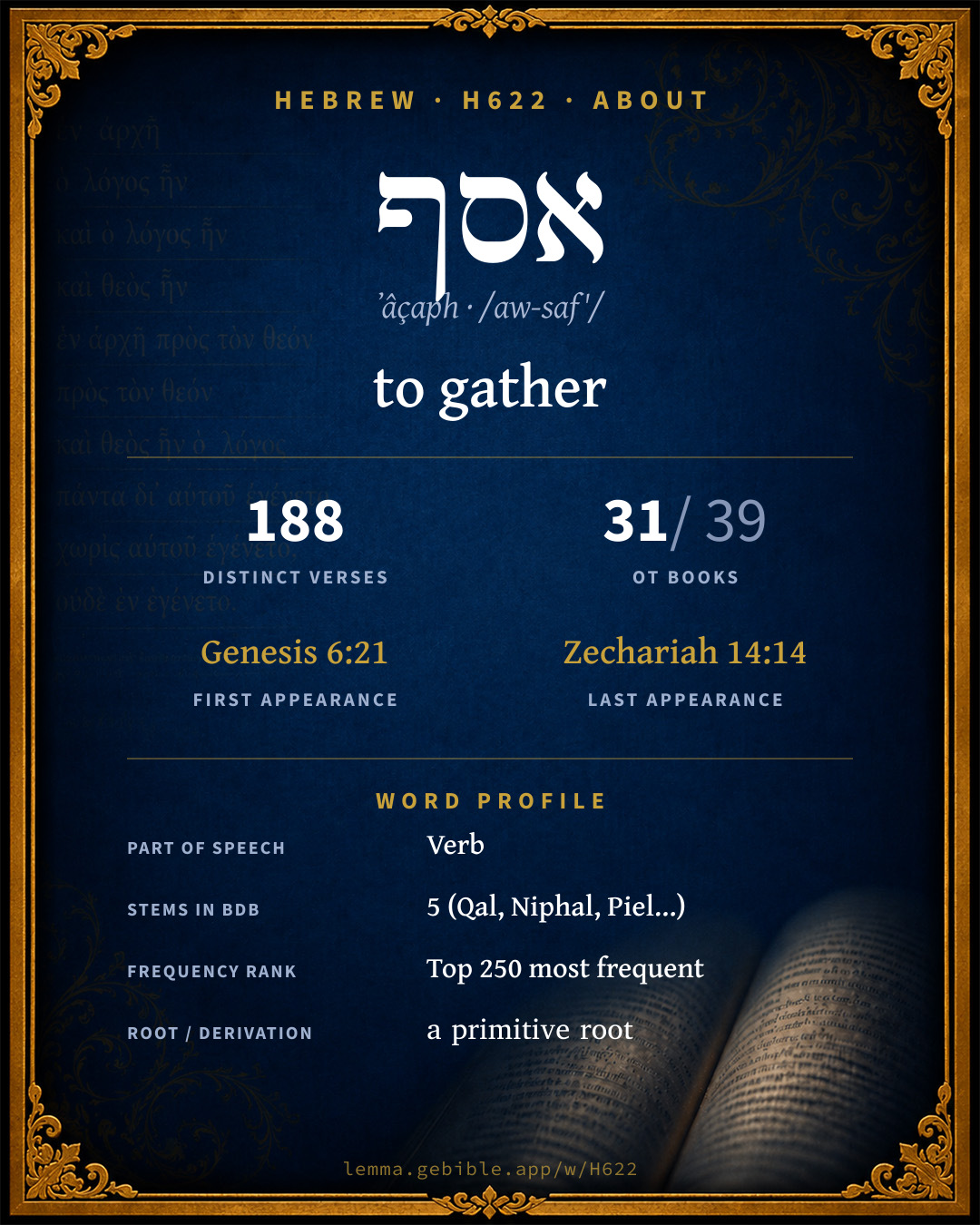
אָסַף
to gather
also: receive, remove, gather in fuller range ↓
Full lexicon entry — Brown-Driver-Briggs (BDB)
From Brown-Driver-Briggs (BDB)
Where this word appears
See every Qal verb in the Hebrew Bible →
Grammar key — what these labels mean
Part of speech
- Verb
- An action or state-of-being word.
Stem
- Qal
- The basic, simple active stem — the plain form of the verb (“he wrote”). Here: ‘gather’
- Niphal
- Usually the simple passive or reflexive of the Qal (“he was written”). Here: ‘assemble’
- Piel
- An intensive or resultative active stem. Here: ‘gather harvest Is 62’
- Pual
- The passive counterpart of the Piel.
- Hiphil
- The causative active stem (“he caused / brought about”).
- Hithpael
- The reflexive or reciprocal stem (the subject acts on itself).
Form
- Sequential Imperfect
- An imperfect with prefixed waw — the standard past-narrative form (waw-consecutive imperfect).
- Perfect
- A completed action or state — Hebrew marks aspect (completeness) more than strict tense (“he wrote”).
- Imperfect
- An incomplete, ongoing, or future action (“he will / would write”).
- Imperative
- A direct command (“write!”).
- Sequential Perfect
- A perfect with prefixed waw continuing a preceding imperfect or command (waw-consecutive perfect).
- Infinitive Construct
- A bound verbal noun, frequently with prepositions (“to write / in writing”).
- Participle Active
- A verbal adjective expressing ongoing or characteristic action (“writing / one who writes”).
- Infinitive Absolute
- An unbound verbal noun, often intensifying or standing in for a finite verb.
- Participle Passive
- A verbal adjective expressing action received (“written”).
- Cohortative
- A first-person volitional form expressing wish or resolve (“let me / let us write”).
- Jussive
- A third- or second-person volitional form expressing wish or command (“let him write”).
State
- Absolute
- The independent form of a noun, not bound to a following word.
- Construct
- A noun bound to a following noun in a possessive / “of” relationship (the construct chain).
Person
- 3rd Person
- The one spoken about (“he / she / it / they”).
- 2nd Person
- The one addressed (“you”).
- 1st Person
- The speaker (“I / we”).
Gender
- Masculine
- Grammatically masculine.
- Common
- Either gender — not distinguished for this form.
- Feminine
- Grammatically feminine.
Number
- Singular
- One.
- Plural
- More than one (in Hebrew, generally three or more).
Grammatical forms 53 distinct
- Verb, Qal, Sequential Imperfect, 3rd Person, Masculine, Singular 24 times (12%)
- Verb, Niphal, Perfect, 3rd Person, Common, Plural 19 times (9%)
- Verb, Niphal, Sequential Imperfect, 3rd Person, Masculine, Plural 12 times (6%)
- Verb, Qal, Sequential Imperfect, 3rd Person, Masculine, Plural 10 times (5%)
- Verb, Niphal, Imperfect, 3rd Person, Masculine, Singular 9 times (4%)
- Verb, Niphal, Imperfect, 3rd Person, Masculine, Plural 8 times (4%)
- Verb, Qal, Infinitive Construct 8 times (4%)
- Verb, Niphal, Sequential Imperfect, 3rd Person, Masculine, Singular 7 times (3%)
+45 more forms (105 occurrences)
Parsed forms decoded from the imported morphology (morphhb / Westminster Leningrad Codex — WLC text public domain, morphhb tagging CC BY 4.0), counted across 202 parsed occurrences — not distinct verses.
Every verse where H622 appears — 188 distinct verses across 31 books. Click any verse to open its interlinear word-by-word view. Verse text shown in the World English Bible for context — . Each verse’s Hebrew form is shown with its reference; the English is not keyword-highlighted, since the data carries no word-level English alignment. Use “Compare translations” on any verse to read it across multiple English versions. This concordance covers the Hebrew Bible; Septuagint (Greek Old Testament) occurrences are not indexed here.
Genesis 14 verses
- Genesis 6:21 וְ/אָסַפְתָּ֖ conj + Qal pf 2ms Take with you of all food that is eaten, and gather it to you; and it will be for food for you, and for them."
- Genesis 25:8 וַ/יֵּאָ֖סֶף conj + Niphal wimpf 3ms Abraham gave up the spirit, and died in a good old age, an old man, and full of years, and was gathered to his people.
- Genesis 25:17 וַ/יֵּאָ֖סֶף conj + Niphal wimpf 3ms These are the years of the life of Ishmael: one hundred thirty-seven years. He gave up the spirit and died, and was gathered to his people.
- Genesis 29:3 וְ/נֶאֶסְפוּ conj + Niphal pf 3cp There all the flocks were gathered. They rolled the stone from the well's mouth, and watered the sheep, and put the stone again on the well's mouth in its place.
- Genesis 29:7 הֵאָסֵ֣ף Niphal inf.cs He said, "Behold, it is still the middle of the day, not time to gather the cattle together. Water the sheep, and go and feed them."
- Genesis 29:8 יֵאָֽסְפוּ֙ Niphal impf 3mp They said, "We can't, until all the flocks are gathered together, and they roll the stone from the well's mouth. Then we water the sheep."
- Genesis 29:22 וַ/יֶּאֱסֹ֥ף conj + Qal wimpf 3ms Laban gathered together all the men of the place, and made a feast.
- Genesis 30:23 אָסַ֥ף Qal pf 3ms She conceived, bore a son, and said, "God has taken away my reproach."
- Genesis 34:30 וְ/נֶאֶסְפ֤וּ conj + Niphal pf 3cp Jacob said to Simeon and Levi, "You have troubled me, to make me odious to the inhabitants of the land, among the Canaanites and the Perizzites. I am few in number. They will gather themselves together against me and strike me, and I will be destroyed, I and my house."
- Genesis 35:29 וַ/יֵּאָ֣סֶף conj + Niphal wimpf 3ms Isaac gave up the spirit, and died, and was gathered to his people, old and full of days. Esau and Jacob, his sons, buried him.
- Genesis 42:17 וַ/יֶּאֱסֹ֥ף conj + Qal wimpf 3ms He put them all together into custody three days.
- Genesis 49:1 הֵאָֽסְפוּ֙ Niphal impv 2mp Jacob called to his sons, and said: "Gather yourselves together, that I may tell you that which will happen to you in the days to come.
- Genesis 49:29 נֶאֱסָ֣ף Niphal ptcp.pass ms He charged them, and said to them, "I am to be gathered to my people. Bury me with my fathers in the cave that is in the field of Ephron the Hittite,
- Genesis 49:33 וַ/יֶּאֱסֹ֥ף וַ/יֵּאָ֥סֶף conj + Qal wimpf 3ms conj + Niphal wimpf 3ms When Jacob made an end of charging his sons, he gathered up his feet into the bed, and yielded up the spirit, and was gathered to his people.
Exodus 6 verses
- Exodus 3:16 וְ/אָֽסַפְתָּ֞ conj + Qal wpf 2ms Go, and gather the elders of Israel together, and tell them, 'Yahweh, the God of your fathers, the God of Abraham, of Isaac, and of Jacob, has appeared to me, saying, "I have surely visited you, and seen that which is done to you in Egypt;
- Exodus 4:29 וַ/יַּ֣אַסְפ֔וּ conj + Qal wimpf 3mp Moses and Aaron went and gathered together all the elders of the children of Israel.
- Exodus 9:19 יֵֽאָסֵף֙ Niphal impf 3ms Now therefore command that all of your cattle and all that you have in the field be brought into shelter. Every man and animal that is found in the field, and isn't brought home, the hail shall come down on them, and they shall die."'"
- Exodus 23:10 וְ/אָסַפְתָּ֖ conj + Qal wpf 2ms "For six years you shall sow your land, and shall gather in its increase,
- Exodus 23:16 בְּ/אָסְפְּ/ךָ֥ prep + Qal inf.cs + sfx pers 2ms And the feast of harvest, the first fruits of your labors, which you sow in the field: and the feast of harvest, at the end of the year, when you gather in your labors out of the field.
- Exodus 32:26 וַ/יֵּאָסְפ֥וּ conj + Niphal wimpf 3mp then Moses stood in the gate of the camp, and said, "Whoever is on Yahweh's side, come to me!" All the sons of Levi gathered themselves together to him.
Leviticus 4 verses
- Leviticus 23:39 בְּ/אָסְפְּ/כֶם֙ prep + Qal inf.cs + sfx pers 2mp "'So on the fifteenth day of the seventh month, when you have gathered in the fruits of the land, you shall keep the feast of Yahweh seven days: on the first day shall be a solemn rest, and on the eighth day shall be a solemn rest.
- Leviticus 25:3 וְ/אָסַפְתָּ֖ conj + Qal wpf 2ms Six years you shall sow your field, and six years you shall prune your vineyard, and gather in its fruits;
- Leviticus 25:20 נֶאֱסֹ֖ף Qal impf 1cp If you said, "What shall we eat the seventh year? Behold, we shall not sow, nor gather in our increase;"
- Leviticus 26:25 וְ/נֶאֱסַפְתֶּ֖ם conj + Niphal wpf 2mp I will bring a sword upon you, that will execute the vengeance of the covenant; and you will be gathered together within your cities: and I will send the pestilence among you; and you will be delivered into the hand of the enemy.
Numbers 16 verses
- Numbers 10:25 מְאַסֵּ֥ף Piel ptcp.act ms The standard of the camp of the children of Dan, which was the rearward of all the camps, set forward according to their hosts: and over his host was Ahiezer the son of Ammishaddai.
- Numbers 11:16 אֶסְפָ/ה Qal impv 2ms + sfx h Yahweh said to Moses, Gather to me seventy men of the elders of Israel, whom you know to be the elders of the people, and officers over them; and bring them to the tent of meeting, that they may stand there with you.
- Numbers 11:22 יֵאָסֵ֥ף Niphal impf 3ms Shall flocks and herds be slain for them, to suffice them? or shall all the fish of the sea be gathered together for them, to suffice them?
- Numbers 11:24 וַ/יֶּאֱסֹ֞ף conj + Qal wimpf 3ms Moses went out, and told the people the words of Yahweh: and he gathered seventy men of the elders of the people, and set them round about the Tent.
- Numbers 11:30 וַ/יֵּאָסֵ֥ף conj + Niphal wimpf 3ms Moses got him into the camp, he and the elders of Israel.
- Numbers 11:32 וַ/יַּֽאַסְפוּ֙ אָסַ֖ף conj + Qal wimpf 3mp Qal pf 3ms The people rose up all that day, and all the night, and all the next day, and gathered the quails: he who gathered least gathered ten homers: and they spread them all abroad for themselves round about the camp.
- Numbers 12:14 תֵּאָסֵֽף Niphal impf 3fs Yahweh said to Moses, If her father had but spit in her face, shouldn't she be ashamed seven days? let her be shut up outside of the camp seven days, and after that she shall be brought in again.
- Numbers 12:15 הֵאָסֵ֖ף Niphal inf.cs Miriam was shut up outside of the camp seven days: and the people didn't travel until Miriam was brought in again.
- Numbers 19:9 וְ/אָסַ֣ף conj + Qal wpf 3ms A man who is clean shall gather up the ashes of the heifer, and lay them up outside of the camp in a clean place; and it shall be kept for the congregation of the children of Israel for a water for impurity: it is a sin-offering.
- Numbers 19:10 הָ/אֹסֵ֨ף ptcl def.art + Qal ptcp.act ms He who gathers the ashes of the heifer shall wash his clothes, and be unclean until the even: and it shall be to the children of Israel, and to the stranger who lives as a foreigner among them, for a statute forever.
- Numbers 20:24 יֵאָסֵ֤ף Niphal impf 3ms Aaron shall be gathered to his people; for he shall not enter into the land which I have given to the children of Israel, because you rebelled against my word at the waters of Meribah.
- Numbers 20:26 יֵאָסֵ֖ף Niphal impf 3ms and strip Aaron of his garments, and put them on Eleazar his son: and Aaron shall be gathered [to his people], and shall die there.
- Numbers 21:16 אֱסֹף֙ Qal impv 2ms From there they traveled to Beer: that is the well of which Yahweh said to Moses, Gather the people together, and I will give them water.
- Numbers 21:23 וַ/יֶּאֱסֹ֨ף conj + Qal wimpf 3ms Sihon would not allow Israel to pass through his border: but Sihon gathered all his people together, and went out against Israel into the wilderness, and came to Jahaz; and he fought against Israel.
- Numbers 27:13 וְ/נֶאֱסַפְתָּ֥ נֶאֱסַ֖ף conj + Niphal wpf 2ms Niphal pf 3ms When you have seen it, you also shall be gathered to your people, as Aaron your brother was gathered;
- Numbers 31:2 תֵּאָסֵ֥ף Niphal impf 2ms Avenge the children of Israel of the Midianites: afterward you shall be gathered to your people.
Deuteronomy 6 verses
- Deuteronomy 11:14 וְ/אָסַפְתָּ֣ conj + Qal wpf 2ms that I will give the rain of your land in its season, the former rain and the latter rain, that you may gather in your grain, and your new wine, and your oil.
- Deuteronomy 16:13 בְּ/אָ֨סְפְּ/ךָ֔ prep + Qal inf.cs + sfx pers 2ms You shall keep the feast of tents seven days, after that you have gathered in from your threshing floor and from your winepress:
- Deuteronomy 22:2 וַ/אֲסַפְתּ/וֹ֙ conj + Qal wpf 2ms + sfx pers 3ms If your brother isn't near to you, or if you don't know him, then you shall bring it home to your house, and it shall be with you until your brother seek after it, and you shall restore it to him.
- Deuteronomy 28:38 תֶּאֱסֹ֔ף Qal impf 2ms You shall carry much seed out into the field, and shall gather little in; for the locust shall consume it.
- Deuteronomy 32:50 וְ/הֵאָסֵ֖ף וַ/יֵּאָ֖סֶף conj + Niphal impv 2ms conj + Niphal wimpf 3ms and die on the mountain where you go up, and be gathered to your people, as Aaron your brother died on Mount Hor, and was gathered to his people:
- Deuteronomy 33:5 בְּ/הִתְאַסֵּף֙ prep + Hithpael inf.cs He was king in Jeshurun, When the heads of the people were gathered, All the tribes of Israel together.
Joshua 6 verses
- Joshua 2:18 תַּאַסְפִ֥י Qal impf 2fs Behold, when we come into the land, you shall bind this line of scarlet thread in the window which you did let us down by: and you shall gather to you into the house your father, and your mother, and your brothers, and all your father's household.
- Joshua 6:9 וְ/הַֽ/מְאַסֵּ֗ף conj + ptcl def.art + Piel ptcp.act ms The armed men went before the priests who blew the trumpets, and the rearward went after the ark, [the priests] blowing the trumpets as they went.
- Joshua 6:13 וְ/הַֽ/מְאַסֵּ֗ף conj + ptcl def.art + Piel ptcp.act ms The seven priests bearing the seven trumpets of rams' horns before the ark of Yahweh went on continually, and blew the trumpets: and the armed men went before them; and the rearward came after the ark of Yahweh, [the priests] blowing the trumpets as they went.
- Joshua 10:5 וַ/יֵּאָסְפ֨וּ conj + Niphal wimpf 3mp Therefore the five kings of the Amorites, the king of Jerusalem, the king of Hebron, the king of Jarmuth, the king of Lachish, the king of Eglon, gathered themselves together, and went up, they and all their hosts, and encamped against Gibeon, and made war against it.
- Joshua 20:4 וְ/אָסְפ֨וּ conj + Qal pf 3cp He shall flee to one of those cities, and shall stand at the entrance of the gate of the city, and declare his cause in the ears of the elders of that city; and they shall take him into the city to them, and give him a place, that he may dwell among them.
- Joshua 24:1 וַ/יֶּאֶסֹ֧ף conj + Qal wimpf 3ms Joshua gathered all the tribes of Israel to Shechem, and called for the elders of Israel, and for their heads, and for their judges, and for their officers; and they presented themselves before God.
Judges 12 verses
- Judges 2:10 נֶאֶסְפ֖וּ Niphal pf 3cp Also all that generation were gathered to their fathers: and there arose another generation after them, who didn't know Yahweh, nor yet the work which he had worked for Israel.
- Judges 3:13 וַ/יֶּאֱסֹ֣ף conj + Qal wimpf 3ms He gathered to him the children of Ammon and Amalek; and he went and struck Israel, and they possessed the city of palm trees.
- Judges 6:33 נֶאֶסְפ֣וּ Niphal pf 3cp Then all the Midianites and the Amalekites and the children of the east assembled themselves together; and they passed over, and encamped in the valley of Jezreel.
- Judges 9:6 וַ/יֵּאָ֨סְפ֜וּ conj + Niphal wimpf 3mp All the men of Shechem assembled themselves together, and all the house of Millo, and went and made Abimelech king, by the oak of the pillar that was in Shechem.
- Judges 10:17 וַ/יֵּאָֽסְפוּ֙ conj + Niphal wimpf 3mp Then the children of Ammon were gathered together, and encamped in Gilead. The children of Israel assembled themselves together, and encamped in Mizpah.
- Judges 11:20 וַ/יֶּאֱסֹ֤ף conj + Qal wimpf 3ms But Sihon didn't trust Israel to pass through his border; but Sihon gathered all his people together, and encamped in Jahaz, and fought against Israel.
- Judges 16:23 נֶֽאֱסְפוּ֙ Niphal pf 3cp The lords of the Philistines gathered them together to offer a great sacrifice to Dagon their god, and to rejoice; for they said, Our god has delivered Samson our enemy into our hand.
- Judges 18:25 וְ/אָסַפְתָּ֥ה conj + Qal wpf 2ms The children of Dan said to him, "Don't let your voice be heard among us, lest angry fellows fall on you, and you lose your life, with the lives of your household."
- Judges 19:15 מְאַסֵּֽף Piel ptcp.act ms They turned aside there, to go in to lodge in Gibeah: and he went in, and sat him down in the street of the city; for there was no man who took them into his house to lodge.
- Judges 19:18 מְאַסֵּ֥ף Piel ptcp.act ms He said to him, We are passing from Bethlehem Judah to the farther side of the hill-country of Ephraim; from there am I, and I went to Bethlehem Judah: and I am [now] going to the house of Yahweh; and there is no man who takes me into his house.
- Judges 20:11 וַ/יֵּֽאָסֵ֞ף conj + Niphal wimpf 3ms So all the men of Israel were gathered against the city, knit together as one man.
- Judges 20:14 וַ/יֵּאָסְפ֧וּ conj + Niphal wimpf 3mp The children of Benjamin gathered themselves together out of the cities to Gibeah, to go out to battle against the children of Israel.
Ruth 1 verse
1 Samuel 9 verses
- 1 Samuel 5:8 וַ/יַּאַסְפוּ֩ conj + Qal wimpf 3mp They sent therefore and gathered all the lords of the Philistines to them, and said, What shall we do with the ark of the God of Israel? They answered, Let the ark of the God of Israel be carried about to Gath. They carried the ark of the God of Israel [there].
- 1 Samuel 5:11 וַ/יַּאַסְפ֜וּ conj + Qal wimpf 3mp They sent therefore and gathered together all the lords of the Philistines, and they said, Send away the ark of the God of Israel, and let it go again to its own place, that it not kill us and our people. For there was a deadly confusion throughout all the city; the hand of God was very heavy there.
- 1 Samuel 13:5 נֶאֶסְפ֣וּ Niphal pf 3cp The Philistines assembled themselves together to fight with Israel, thirty thousand chariots, and six thousand horsemen, and people as the sand which is on the sea-shore in multitude: and they came up, and encamped in Michmash, eastward of Beth Aven.
- 1 Samuel 13:11 נֶאֱסָפִ֥ים Niphal ptcp.act mp Samuel said, What have you done? Saul said, Because I saw that the people were scattered from me, and that you didn't come within the days appointed, and that the Philistines assembled themselves together at Michmash;
- 1 Samuel 14:19 אֱסֹ֥ף Qal impv 2ms It happened, while Saul talked to the priest, that the tumult that was in the camp of the Philistines went on and increased: and Saul said to the priest, Withdraw your hand.
- 1 Samuel 14:52 וַ/יַּאַסְפֵ֖/הוּ conj + Qal wimpf 3ms + sfx pers 3ms There was sore war against the Philistines all the days of Saul: and when Saul saw any mighty man, or any valiant man, he took him to him.
- 1 Samuel 15:6 אֹֽסִפְ/ךָ֙ Qal impf 1cs + sfx pers 2ms Saul said to the Kenites, Go, depart, get you down from among the Amalekites, lest I destroy you with them; for you shown kindness to all the children of Israel, when they came up out of Egypt. So the Kenites departed from among the Amalekites.
- 1 Samuel 17:1 וַ/יַּאַסְפ֨וּ וַ/יֵּאָ֣סְפ֔וּ conj + Qal wimpf 3mp conj + Niphal wimpf 3mp Now the Philistines gathered together their armies to battle; and they were gathered together at Socoh, which belongs to Judah, and encamped between Socoh and Azekah, in Ephesdammim.
- 1 Samuel 17:2 נֶאֶסְפ֔וּ Niphal pf 3cp Saul and the men of Israel were gathered together, and encamped in the valley of Elah, and set the battle in array against the Philistines.
2 Samuel 12 verses
- 2 Samuel 6:1 וַ/יֹּ֨סֶף conj + Qal wimpf 3ms David again gathered together all the chosen men of Israel, thirty thousand.
- 2 Samuel 10:15 וַ/יֵּאָסְפ֖וּ conj + Niphal wimpf 3mp When the Syrians saw that they were put to the worse before Israel, they gathered themselves together.
- 2 Samuel 10:17 וַ/יֶּאֱסֹ֤ף conj + Qal wimpf 3ms It was told David; and he gathered all Israel together, and passed over the Jordan, and came to Helam. The Syrians set themselves in array against David, and fought with him.
- 2 Samuel 11:27 וַ/יַּאַסְפָ֤/הּ conj + Qal wimpf 3ms + sfx pers 3fs When the mourning was past, David sent and took her home to his house, and she became his wife, and bore him a son. But the thing that David had done displeased Yahweh.
- 2 Samuel 12:28 אֱסֹף֙ Qal impv 2ms Now therefore gather the rest of the people together, and encamp against the city, and take it; lest I take the city, and it be called after my name.
- 2 Samuel 12:29 וַ/יֶּאֱסֹ֥ף conj + Qal wimpf 3ms David gathered all the people together, and went to Rabbah, and fought against it, and took it.
- 2 Samuel 14:14 יֵאָסֵ֑פוּ Niphal impf 3mp For we must needs die, and are as water split on the ground, which can't be gathered up again; neither does God take away life, but devises means, that he who is banished not be an outcast from him.
- 2 Samuel 17:11 הֵ֠אָסֹף יֵאָסֵ֨ף Niphal inf.abs Niphal impf 3ms But I counsel that all Israel be gathered together to you, from Dan even to Beersheba, as the sand that is by the sea for multitude; and that you go to battle in your own person.
- 2 Samuel 17:13 יֵֽאָסֵ֔ף Niphal impf 3ms Moreover, if he be gotten into a city, then shall all Israel bring ropes to that city, and we will draw it into the river, until there not be one small stone found there.
- 2 Samuel 21:13 וַ/יַּ֣אַסְפ֔וּ conj + Qal wimpf 3mp and he brought up from there the bones of Saul and the bones of Jonathan his son: and they gathered the bones of those who were hanged.
- 2 Samuel 23:9 נֶאֶסְפוּ Niphal pf 3cp After him was Eleazar the son of Dodai the son of an Ahohite, one of the three mighty men with David, when they defied the Philistines who were there gathered together to battle, and the men of Israel were gone away.
- 2 Samuel 23:11 וַ/יֵּאָסְפ֨וּ conj + Niphal wimpf 3mp After him was Shammah the son of Agee a Hararite. The Philistines were gathered together into a troop, where was a plot of ground full of lentils; and the people fled from the Philistines.
1 Kings 1 verse
2 Kings 7 verses
- 2 Kings 5:3 יֶאֱסֹ֥ף Qal impf 3ms She said to her mistress, Would that my lord were with the prophet who is in Samaria! then would he recover him of his leprosy.
- 2 Kings 5:6 וַ/אֲסַפְתּ֖/וֹ conj + Qal wpf 2ms + sfx pers 3ms He brought the letter to the king of Israel, saying, Now when this letter is come to you, behold, I have sent Naaman my servant to you, that you may recover him of his leprosy.
- 2 Kings 5:7 לֶ/אֱסֹ֥ף prep + Qal inf.cs It happened, when the king of Israel had read the letter, that he tore his clothes, and said, Am I God, to kill and to make alive, that this man does send to me to recover a man of his leprosy? but consider, I pray you, and see how he seeks a quarrel against me.
- 2 Kings 5:11 וְ/אָסַ֥ף conj + Qal wpf 3ms But Naaman was angry, and went away, and said, Behold, I thought, He will surely come out to me, and stand, and call on the name of Yahweh his God, and wave his hand over the place, and recover the leper.
- 2 Kings 22:4 אָסְפ֛וּ Qal pf 3cp Go up to Hilkiah the high priest, that he may sum the money which is brought into the house of Yahweh, which the keepers of the threshold have gathered of the people:
- 2 Kings 22:20 אֹֽסִפְ/ךָ֜ וְ/נֶאֱסַפְתָּ֣ Qal ptcp.act ms cs + sfx pers 2ms conj + Niphal wpf 2ms Therefore, behold, I will gather you to your fathers, and you shall be gathered to your grave in peace, neither shall your eyes see all the evil which I will bring on this place. They brought the king word again.
- 2 Kings 23:1 וַ/יַּאַסְפ֣וּ conj + Qal wimpf 3mp The king sent, and they gathered to him all the elders of Judah and of Jerusalem.
1 Chronicles 5 verses
- 1 Chronicles 11:13 נֶאֱסְפוּ Niphal pf 3cp He was with David at Pasdammim, and there the Philistines were gathered together to battle, where was a plot of ground full of barley; and the people fled from before the Philistines.
- 1 Chronicles 15:4 וַ/יֶּאֱסֹ֥ף conj + Qal wimpf 3ms David gathered together the sons of Aaron, and the Levites:
- 1 Chronicles 19:7 נֶאֶסְפוּ֙ Niphal pf 3cp So they hired them thirty-two thousand chariots, and the king of Maacah and his people, who came and encamped before Medeba. The children of Ammon gathered themselves together from their cities, and came to battle.
- 1 Chronicles 19:17 וַ/יֶּאֱסֹ֤ף conj + Qal wimpf 3ms It was told David; and he gathered all Israel together, and passed over the Jordan, and came on them, and set the battle in array against them. So when David had put the battle in array against the Syrians, they fought with him.
- 1 Chronicles 23:2 וַ/יֶּאֱסֹף֙ conj + Qal wimpf 3ms He gathered together all the princes of Israel, with the priests and the Levites.
2 Chronicles 12 verses
- 2 Chronicles 1:14 וַ/יֶּאֱסֹ֣ף conj + Qal wimpf 3ms Solomon gathered chariots and horsemen: and he had one thousand four hundred chariots, and twelve thousand horsemen, that he placed in the chariot cities, and with the king at Jerusalem.
- 2 Chronicles 12:5 נֶאֶסְפ֥וּ Niphal pf 3cp Now Shemaiah the prophet came to Rehoboam, and to the princes of Judah, who were gathered together to Jerusalem because of Shishak, and said to them, Thus says Yahweh, You have forsaken me, therefore have I also left you in the hand of Shishak.
- 2 Chronicles 24:11 וַ/יַּֽאַסְפוּ conj + Qal wimpf 3mp It was so, that whenever the chest was brought to the king's officers by the hand of the Levites, and when they saw that there was much money, the king's scribe and the chief priest's officer came and emptied the chest, and took it, and carried it to its place again. Thus they did day by day, and gathered money in abundance.
- 2 Chronicles 28:24 וַ/יֶּאֱסֹ֨ף conj + Qal wimpf 3ms Ahaz gathered together the vessels of the house of God, and cut in pieces the vessels of the house of God, and shut up the doors of the house of Yahweh; and he made him altars in every corner of Jerusalem.
- 2 Chronicles 29:4 וַ/יַּֽאַסְפֵ֖/ם conj + Qal wimpf 3ms + sfx pers 3mp He brought in the priests and the Levites, and gathered them together into the broad place on the east,
- 2 Chronicles 29:15 וַ/יַּֽאַסְפ֤וּ conj + Qal wimpf 3mp They gathered their brothers, and sanctified themselves, and went in, according to the commandment of the king by the words of Yahweh, to cleanse the house of Yahweh.
- 2 Chronicles 29:20 וַ/יֶּאֱסֹ֕ף conj + Qal wimpf 3ms Then Hezekiah the king arose early, and gathered the princes of the city, and went up to the house of Yahweh.
- 2 Chronicles 30:3 נֶאֶסְפ֥וּ Niphal pf 3cp For they could not keep it at that time, because the priests had not sanctified themselves in sufficient number, neither had the people gathered themselves together to Jerusalem.
- 2 Chronicles 30:13 וַ/יֵּֽאָסְפ֤וּ conj + Niphal wimpf 3mp There assembled at Jerusalem much people to keep the feast of unleavened bread in the second month, a very great assembly.
- 2 Chronicles 34:9 אָסְפֽוּ Qal pf 3cp They came to Hilkiah the high priest, and delivered the money that was brought into the house of God, which the Levites, the keepers of the threshold, had gathered of the hand of Manasseh and Ephraim, and of all the remnant of Israel, and of all Judah and Benjamin, and of the inhabitants of Jerusalem.
- 2 Chronicles 34:28 אֹֽסִפְ/ךָ֜ וְ/נֶאֱסַפְתָּ֣ Qal ptcp.act ms cs + sfx pers 2ms conj + Niphal wpf 2ms Behold, I will gather you to your fathers, and you shall be gathered to your grave in peace, neither shall your eyes see all the evil that I will bring on this place, and on the inhabitants of it. They brought back word to the king.
- 2 Chronicles 34:29 וַ/יֶּאֱסֹ֕ף conj + Qal wimpf 3ms Then the king sent and gathered together all the elders of Judah and Jerusalem.
Ezra 2 verses
- Ezra 3:1 וַ/יֵּאָסְפ֥וּ conj + Niphal wimpf 3mp When the seventh month was come, and the children of Israel were in the cities, the people gathered themselves together as one man to Jerusalem.
- Ezra 9:4 יֵאָסְפ֗וּ Niphal impf 3mp Then were assembled to me everyone who trembled at the words of the God of Israel, because of the trespass of them of the captivity; and I sat confounded until the evening offering.
Nehemiah 4 verses
- Nehemiah 8:1 וַ/יֵּאָסְפ֤וּ conj + Niphal wimpf 3mp All the people gathered themselves together as one man into the broad place that was before the water gate; and they spoke to Ezra the scribe to bring the book of the law of Moses, which Yahweh had commanded to Israel.
- Nehemiah 8:13 נֶאֶסְפוּ֩ Niphal pf 3cp On the second day were gathered together the heads of fathers' [houses] of all the people, the priests, and the Levites, to Ezra the scribe, even to give attention to the words of the law.
- Nehemiah 9:1 נֶאֶסְפ֤וּ Niphal pf 3cp Now in the twenty-fourth day of this month the children of Israel were assembled with fasting, and with sackcloth, and earth on them.
- Nehemiah 12:28 וַ/יֵּאָ֣סְפ֔וּ conj + Niphal wimpf 3mp The sons of the singers gathered themselves together, both out of the plain round about Jerusalem, and from the villages of the Netophathites;
Job 3 verses
- Job 27:19 יֵאָסֵ֑ף Niphal impf 3ms He lies down rich, but he shall not do so again. He opens his eyes, and he is not.
- Job 34:14 יֶאֱסֹֽף Qal impf 3ms If he set his heart on himself, If he gathered to himself his spirit and his breath;
- Job 39:12 יֶאֱסֹֽף Qal impf 3ms Will you confide in him, that he will bring home your seed, And gather the grain of your threshing floor?
Psalms 9 verses
- Psalms 26:9 תֶּאֱסֹ֣ף Qal juss 2ms Don't gather my soul with sinners, Nor my life with bloodthirsty men;
- Psalms 27:10 יַֽאַסְפֵֽ/נִי Qal impf 3ms + sfx pers 1cs When my father and my mother forsake me, Then Yahweh will take me up.
- Psalms 35:15 וְֽ/נֶאֱ֫סָ֥פוּ נֶאֶסְפ֬וּ conj + Niphal pf 3cp Niphal pf 3cp But in my adversity, they rejoiced, and gathered themselves together. The attackers gathered themselves together against me, and I didn't know it. They tore at me, and didn't cease.
- Psalms 39:6 אֹסְפָֽ/ם Qal ptcp.act ms cs + sfx pers 3mp "Surely every man walks like a shadow. Surely they busy themselves in vain. He heaps up, and doesn't know who shall gather.
- Psalms 47:9 נֶאֱסָ֗פוּ Niphal pf 3cp The princes of the peoples are gathered together, The people of the God of Abraham. For the shields of the earth belong to God. He is greatly exalted!
- Psalms 50:5 אִסְפוּ Qal impv 2mp "Gather my saints together to me, Those who have made a covenant with me by sacrifice."
- Psalms 85:3 אָסַ֥פְתָּ Qal pf 2ms You have taken away all your wrath. You have turned from the fierceness of your anger.
- Psalms 104:22 יֵאָסֵפ֑וּ/ן Niphal impf 3mp + sfx n The sun rises, and they steal away, And lay down in their dens.
- Psalms 104:29 תֹּסֵ֣ף Qal impf 2ms You hide your face: they are troubled; You take away their breath: they die, and return to the dust.
Proverbs 2 verses
- Proverbs 27:25 וְ֝/נֶאֶסְפ֗וּ conj + Niphal pf 3cp The hay is removed, and the new growth appears, The grasses of the hills are gathered in.
- Proverbs 30:4 אָֽסַף Qal pf 3ms Who has ascended up into heaven, and descended? Who has gathered the wind in his fists? Who has bound the waters in his garment? Who has established all the ends of the earth? What is his name, and what is his son's name, if you know?
Ecclesiastes 1 verse
Isaiah 15 verses
- Isaiah 4:1 אֱסֹ֖ף Qal impv 2ms Seven women shall take hold of one man in that day, saying, "We will eat our own bread, and wear our own clothing: only let us be called by your name. Take away our reproach."
- Isaiah 10:14 וְ/כֶ/אֱסֹף֙ אָסָ֑פְתִּי conj + prep + Qal inf.cs Qal pf 1cs and my hand has found as a nest the riches of the peoples; and as one gathers eggs that are forsaken, have I gathered all the earth: and there was none that moved the wing, or that opened the mouth, or chirped.
- Isaiah 11:12 וְ/אָסַ֖ף conj + Qal wpf 3ms He will set up an ensign for the nations, and will assemble the outcasts of Israel, and gather together the dispersed of Judah from the four corners of the earth.
- Isaiah 13:4 נֶֽאֱסָפִ֔ים Niphal ptcp.act mp The noise of a multitude in the mountains, as of a great people! the noise of a tumult of the kingdoms of the nations gathered together! Yahweh of Hosts is mustering the host for the battle.
- Isaiah 16:10 וְ/נֶאֱסַ֨ף conj + Niphal wpf 3ms Gladness is taken away, and joy out of the fruitful field; and in the vineyards there shall be no singing, neither joyful noise: nobody shall tread out wine in the presses; I have made the [vintage] shout to cease.
- Isaiah 17:5 כֶּֽ/אֱסֹף֙ prep + Qal inf.cs It shall be as when the harvester gathers the standing grain, and his arm reaps the ears; yes, it shall be as when one gleans ears in the valley of Rephaim.
- Isaiah 24:22 וְ/אֻסְּפ֨וּ conj + Pual wpf 3cp They shall be gathered together, as prisoners are gathered in the pit, and shall be shut up in the prison; and after many days shall they be visited.
- Isaiah 33:4 וְ/אֻסַּ֣ף conj + Pual wpf 3ms Your spoil shall be gathered as the caterpillar gathers: as locusts leap shall men leap on it.
- Isaiah 43:9 וְ/יֵאָֽסְפוּ֙ conj + Niphal impf 3mp Let all the nations be gathered together, and let the peoples be assembled: who among them can declare this, and show us former things? let them bring their witnesses, that they may be justified; or let them hear, and say, It is truth.
- Isaiah 49:5 יֵאָסֵ֑ף Niphal impf 3ms Now says Yahweh who formed me from the womb to be his servant, to bring Jacob again to him, and that Israel be gathered to him (for I am honorable in the eyes of Yahweh, and my God is become my strength);
- Isaiah 52:12 וּ/מְאַסִּפְ/כֶ֖ם conj + Piel ptcp.act ms cs + sfx pers 2mp For you shall not go out in haste, neither shall you go by flight: for Yahweh will go before you; and the God of Israel will be your rearward.
- Isaiah 57:1 נֶֽאֱסָפִים֙ נֶאֱסַ֥ף Niphal ptcp.act mp Niphal pf 3ms The righteous perishes, and no man lays it to heart; and merciful men are taken away, none considering that the righteous is taken away from the evil [to come].
- Isaiah 58:8 יַאַסְפֶֽ/ךָ Qal impf 3ms + sfx pers 2ms Then shall your light break forth as the morning, and your healing shall spring forth speedily; and your righteousness shall go before you; the glory of Yahweh shall by your rearward.
- Isaiah 60:20 יֵאָסֵ֑ף Niphal impf 3ms Your sun shall no more go down, neither shall your moon withdraw itself; for Yahweh will be your everlasting light, and the days of your mourning shall be ended.
- Isaiah 62:9 מְאַסְפָי/ו֙ Piel ptcp.act mp cs + sfx pers 3ms but those who have garnered it shall eat it, and praise Yahweh; and those who have gathered it shall drink it in the courts of my sanctuary.
Jeremiah 14 verses
- Jeremiah 4:5 הֵאָסְפ֥וּ Niphal impv 2mp Declare you in Judah, and publish in Jerusalem; and say, Blow you the trumpet in the land: cry aloud and say, Assemble yourselves, and let us go into the fortified cities.
- Jeremiah 8:2 יֵאָֽסְפוּ֙ Niphal impf 3mp and they shall spread them before the sun, and the moon, and all the host of the sky, which they have loved, and which they have served, and after which they have walked, and which they have sought, and which they have worshiped: they shall not be gathered, nor be buried, they shall be for dung on the surface of the earth.
- Jeremiah 8:13 אָסֹ֥ף Qal inf.abs I will utterly consume them, says Yahweh: there shall be no grapes on the vine, nor figs on the fig tree, and the leaf shall fade; and [the things that] I have given them shall pass away from them.
- Jeremiah 8:14 הֵֽאָסְפ֗וּ Niphal impv 2mp Why do we sit still? assemble yourselves, and let us enter into the fortified cities, and let us be silent there; for Yahweh our God has put us to silence, and given us water of gall to drink, because we have sinned against Yahweh.
- Jeremiah 9:22 מְאַסֵּֽף Piel ptcp.act ms Speak, Thus says Yahweh, The dead bodies of men shall fall as dung on the open field, and as the handful after the harvester; and none shall gather [them].
- Jeremiah 10:17 אִסְפִּ֥י Qal impv 2fs Gather up your wares out of the land, you who abide in the siege.
- Jeremiah 12:9 אִסְפ֛וּ Qal impv 2mp Is my heritage to me as a speckled bird of prey? are the birds of prey against her round about? go you, assemble all the animals of the field, bring them to devour.
- Jeremiah 16:5 אָסַ֨פְתִּי Qal pf 1cs For thus says Yahweh, Don't enter into the house of mourning, neither go to lament, neither bemoan them; for I have taken away my peace from this people, says Yahweh, even loving kindness and tender mercies.
- Jeremiah 21:4 וְ/אָסַפְתִּ֣י conj + Qal wpf 1cs Thus says Yahweh, the God of Israel, Behold, I will turn back the weapons of war that are in your hands, with which you fight against the king of Babylon, and against the Chaldeans who besiege you, without the walls; and I will gather them into the midst of this city.
- Jeremiah 25:33 יֵאָֽסְפוּ֙ Niphal impf 3mp The slain of Yahweh shall be at that day from one end of the earth even to the other end of the earth: they shall not be lamented, neither gathered, nor buried; they shall be dung on the surface of the ground.
- Jeremiah 40:10 אִסְפוּ֩ Qal impv 2mp As for me, behold, I will dwell at Mizpah, to stand before the Chaldeans who shall come to us: but you, gather you wine and summer fruits and oil, and put them in your vessels, and dwell in your cities that you have taken.
- Jeremiah 40:12 וַ/יַּאַסְפ֛וּ conj + Qal wimpf 3mp then all the Jews returned out of all places where they were driven, and came to the land of Judah, to Gedaliah, to Mizpah, and gathered wine and summer fruits very much.
- Jeremiah 47:6 הֵאָֽסְפִי֙ Niphal impv 2fs You sword of Yahweh, how long will it be before you be quiet? put up yourself into your scabbard; rest, and be still.
- Jeremiah 48:33 וְ/נֶאֶסְפָ֨ה conj + Niphal pf 3fs Gladness and joy is taken away from the fruitful field and from the land of Moab; and I have caused wine to cease from the wine presses: none shall tread with shouting; the shouting shall be no shouting.
Ezekiel 6 verses
- Ezekiel 11:17 וְ/אָסַפְתִּ֣י conj + Qal wpf 1cs Therefore say, Thus says the Lord Yahweh: I will gather you from the peoples, and assemble you out of the countries where you have been scattered, and I will give you the land of Israel.
- Ezekiel 24:4 אֱסֹ֤ף Qal impv 2ms gather the pieces of it into it, even every good piece, the thigh, and the shoulder; fill it with the choice bones.
- Ezekiel 29:5 תֵאָסֵ֖ף Niphal impf 2ms I will cast you forth into the wilderness, you and all the fish of your rivers: you shall fall on the open field; you shall not be brought together, nor gathered; I have given you for food to the animals of the earth and to the birds of the sky.
- Ezekiel 34:29 אֲסֻפֵ֤י Qal ptcp.pass mp cs I will raise up to them a plantation for renown, and they shall be no more consumed with famine in the land, neither bear the shame of the nations any more.
- Ezekiel 38:12 מְאֻסָּ֣ף Pual ptcp.pass ms to take the spoil and to take the prey; to turn your hand against the waste places that are [now] inhabited, and against the people who are gathered out of the nations, who have gotten cattle and goods, who dwell in the middle of the earth.
- Ezekiel 39:17 הֵאָסְפ֣וּ Niphal impv 2mp You, son of man, thus says the Lord Yahweh: Speak to the birds of every sort, and to every animal of the field, Assemble yourselves, and come; gather yourselves on every side to my sacrifice that I do sacrifice for you, even a great sacrifice on the mountains of Israel, that you may eat flesh and drink blood.
Daniel 1 verse
Hosea 2 verses
- Hosea 4:3 יֵאָסֵֽפוּ Niphal impf 3mp Therefore the land will mourn, And everyone who dwells therein will waste away. All living things in her, Even the animals of the field and the birds of the sky; Yes, the fish of the sea also die.
- Hosea 10:10 וְ/אֻסְּפ֤וּ conj + Pual wpf 3cp When it is my desire, I will chastise them; And the nations will be gathered against them, When they are bound to their two transgressions.
Joel 4 verses
- Joel 1:14 אִסְפ֣וּ Qal impv 2mp Sanctify a fast. Call a solemn assembly. Gather the elders, And all the inhabitants of the land, to the house of Yahweh, your God, And cry to Yahweh.
- Joel 2:10 אָסְפ֥וּ Qal pf 3cp The earth quakes before them. The heavens tremble. The sun and the moon are darkened, And the stars withdraw their shining.
- Joel 2:16 אִסְפוּ אִסְפוּ֙ Qal impv 2mp Qal impv 2mp Gather the people. Sanctify the assembly. Assemble the elders. Gather the children, and those who suck the breasts. Let the bridegroom go forth from his room, And the bride out of her chamber.
- Joel 3:15 אָסְפ֥וּ Qal pf 3cp The sun and the moon are darkened, And the stars withdraw their shining."
Amos 1 verse
Micah 3 verses
- Micah 2:12 אָסֹ֨ף אֶאֱסֹ֜ף Qal inf.abs Qal impf 1cs I will surely assemble, Jacob, all of you; I will surely gather the remnant of Israel; I will put them together as the sheep of Bozrah, As a flock in the midst of their pasture; They will swarm with people.
- Micah 4:6 אֹֽסְפָה֙ Qal coh 1cs "In that day," says Yahweh, "I will assemble that which is lame, And I will gather that which is driven away, And that which I have afflicted;
- Micah 4:11 נֶאֶסְפ֥וּ Niphal pf 3cp Now many nations have assembled against you, that say, 'Let her be defiled, And let our eye gloat over Zion.'
Habakkuk 3 verses
- Habakkuk 1:9 וַ/יֶּאֱסֹ֥ף conj + Qal wimpf 3ms All of them come for violence. Their hordes face the desert. He gathers prisoners like sand.
- Habakkuk 1:15 וְ/יַאַסְפֵ֖/הוּ conj + Qal impf 3ms + sfx pers 3ms He takes up all of them with the hook. He catches them in his net, and gathers them in his dragnet. Therefore he rejoices and is glad.
- Habakkuk 2:5 וַ/יֶּאֱסֹ֤ף conj + Qal wimpf 3ms Yes, moreover, wine is treacherous. A haughty man who doesn't stay at home, who enlarges his desire as Sheol, and he is like death, and can't be satisfied, but gathers to himself all nations, and heaps to himself all peoples.
Zephaniah 4 verses
- Zephaniah 1:2 אָסֹ֨ף Qal inf.abs I will utterly sweep away everything off of the surface of the earth, says Yahweh.
- Zephaniah 1:3 אָסֵ֨ף אָסֵ֤ף Hiphil impf 1cs Hiphil impf 1cs I will sweep away man and animal. I will sweep away the birds of the sky, the fish of the sea, and the heaps of rubble with the wicked. I will cut off man from the surface of the earth, says Yahweh.
- Zephaniah 3:8 לֶ/אֱסֹ֨ף prep + Qal inf.cs "Therefore wait for me," says Yahweh, "until the day that I rise up to the prey, for my determination is to gather the nations, that I may assemble the kingdoms, to pour on them my indignation, even all my fierce anger, for all the earth will be devoured with the fire of my jealousy.
- Zephaniah 3:18 אָסַ֖פְתִּי Qal pf 1cs Those who are sad for the appointed feasts, I will remove from you. They are a burden and a reproach to you.
Zechariah 3 verses
- Zechariah 12:3 וְ/נֶאֶסְפ֣וּ conj + Niphal wpf 3cp It will happen in that day, that I will make Jerusalem a burdensome stone for all the peoples. All who burden themselves with it will be severely wounded, and all the nations of the earth will be gathered together against it.
- Zechariah 14:2 וְ/אָסַפְתִּ֨י conj + Qal wpf 1cs For I will gather all nations against Jerusalem to battle; and the city will be taken, the houses rifled, and the women ravished. half of the city will go out into captivity, and the rest of the people will not be cut off from the city.
- Zechariah 14:14 וְ/אֻסַּף֩ conj + Pual wpf 3ms Judah also will fight at Jerusalem; and the wealth of all the surrounding nations will be gathered together: gold, and silver, and clothing, in great abundance.
About this entry
At a glance — auto-summarized from this page’s data, not written by a person. Every figure links to its source below. This summary describes the numbers; it doesn’t interpret them.
“to gather” is the headline sense of the Hebrew verb אסף (ʼâçaph). Where the King James Version says “gather,” newer translations reach for “and” (unfoldingWord Literal Text); the renderings breakdown has the detail. It appears 188 verses across 31 books of the Hebrew Bible, among its common vocabulary. First canonically at Genesis 6:21, it enters the text early. Across 5 stems, its meaning turns on the binyan (Qal, Niphal). For the data behind this summary, explore the sense tree and the renderings breakdown below.
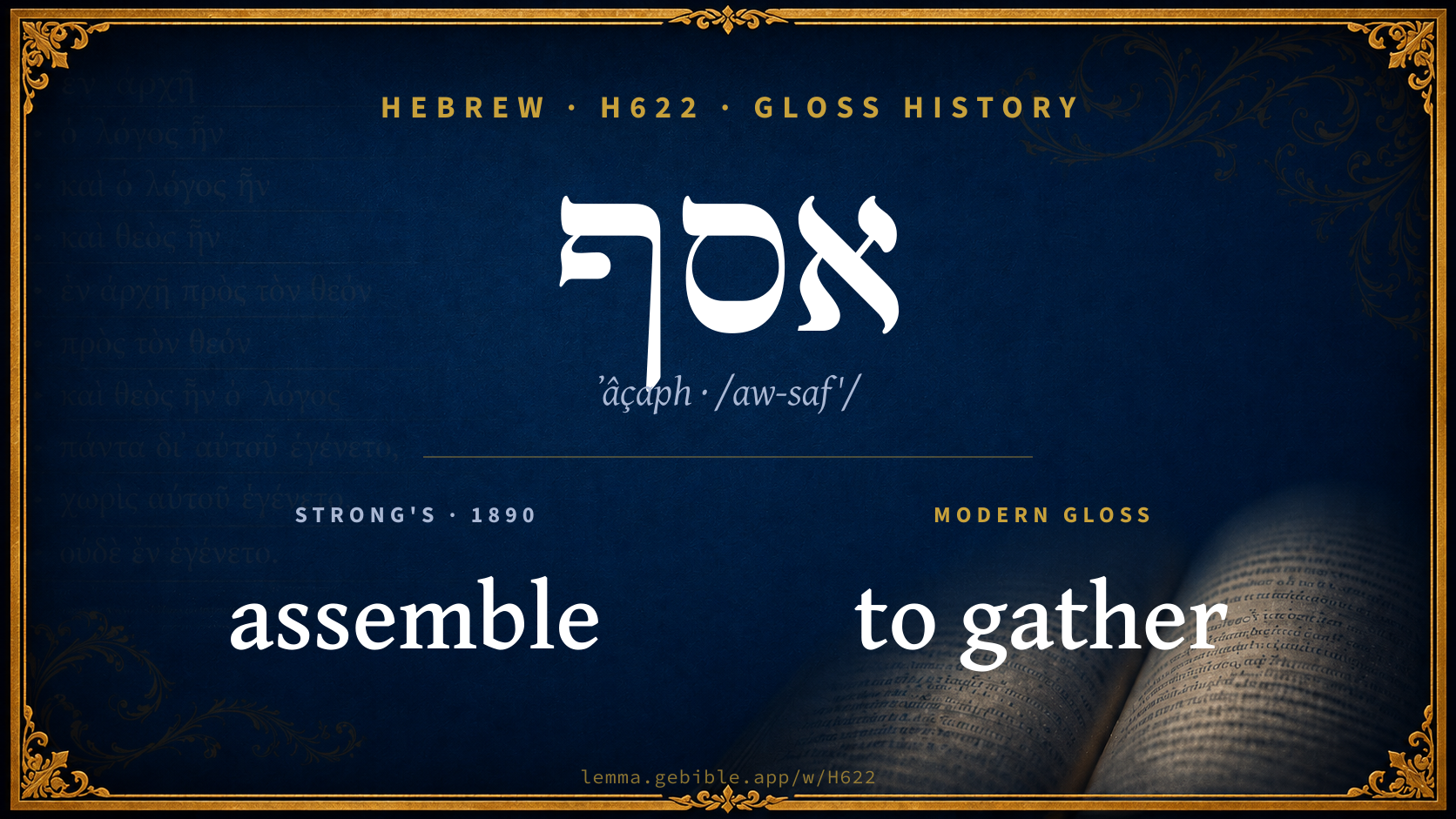
Gloss history
Strong's 1890 vs modern scholarship
About this word
Strong's H622 catalogs a Hebrew word from the Hebrew Old Testament.
These counts are not copied from any lexicon or concordance. They are computed here, from the morphology-tagged Hebrew Old Testament. What Lemma adds →
- 188
- distinct verses
- The word appears in 188 distinct verses.
- 31 / 39
- OT books
- The word appears in 31 of 39 Old Testament books.
- #236
- by frequency
- Top 250 most frequent Hebrew words (rank 236 of 8,640 Hebrew words by occurrence).
View all 188 occurrences in the concordance →
By section of the Old Testament
By traditional corpus
Conventional, traditional groupings — biblical authorship is debated, so this is a traditional corpus grouping, not an authorship claim. Each share is this word’s portion of its verses in that division of the Hebrew canon. Each figure is a share of the word’s 188 distinct verses.
- Prophets (Nevi'im) 102 verses · 54%
- Torah (Pentateuch) 46 verses · 24%
- Writings (Ketuvim) 40 verses · 21%
How translations render this word
Counts come from each version’s own published word-to-Strong’s tagging or interlinear alignment — an approximate guide to how each version renders this word, not a word-level alignment the data otherwise carries. Because each total is that version’s own tagged count, the per-version totals vary from one another and need not match the appearance or distinct-verse counts above. These counts may also differ from a printed concordance because Lemma counts each distinctly tagged rendering and does not collapse phrase taggings into a single head-word total. This is a fixed set of word-tagged versions (KJV, ASV, BSB, ULT) and does not change with the reading translation you choose elsewhere. Each version’s license is shown beside its name below (and on Sources).
- King James Version: Gather 16×, Gathered 14×, Gathered themselves together 11×
- American Standard Version: Gathered 13×, Gather 11×, Gathered themselves together 8×
- Berean Standard Bible: Gathered 18×, Gather 15×, Assembled 9×
- unfoldingWord Literal Text: And 22×, Gathered 19×, Gather 17×
King James Version Public Domain
Renders H622 across 208 tagged occurrences — most commonly:
Plus other, less common renderings. Plus 80 renderings that appear only once — usually multi-word phrases or single function words the recovered tagging swept in, not distinct renderings.
American Standard Version Public Domain
Renders H622 across 207 tagged occurrences — most commonly:
Plus other, less common renderings. Plus 93 renderings that appear only once — usually multi-word phrases or single function words the recovered tagging swept in, not distinct renderings.
Berean Standard Bible Public Domain
Renders H622 across 193 tagged occurrences — most commonly:
Plus other, less common renderings. Plus 95 renderings that appear only once — usually multi-word phrases or single function words the recovered tagging swept in, not distinct renderings. Not rendered by a distinct English word in 7 further occurrences.
unfoldingWord Literal Text CC BY-SA 4.0
Renders H622 across 247 tagged occurrences — most commonly:
Plus other, less common renderings. Plus 88 renderings that appear only once — usually multi-word phrases or single function words the recovered tagging swept in, not distinct renderings.
15 senses and sub-senses in the full BDB
Hebrew verbs can shift meaning by stem (binyan): Qal is the basic action, Niphal is often passive or reflexive, Piel often intensifies or makes it factitive, and Hiphil is typically causative. The senses below are grouped under the stem BDB assigns to each. This entry also uses Pual (the passive of Piel) and Hithpael (reflexive or reciprocal).
What do BDB’s symbols mean?
BDB uses these scholarly abbreviations:
| Symbol | Meaning |
|---|---|
| 𝔊 | the Septuagint (the ancient Greek translation, LXX) |
| 𝔙 | the Vulgate (the Latin translation) |
| 𝔖 | the Syriac version (the Peshitta) |
| 𝔗 | the Targum (the Aramaic translation) |
| ψ | the Psalms |
| √ | root (the underlying root or stem) |
| ‖ | parallel passage (a synonymous or contrasted parallel) |
| † | the dagger: every passage where the word occurs is cited |
The 15 senses and sub-senses the full Brown-Driver-Briggs lexicon distinguishes for this word, in lexicon order (not ranked by frequency), with BDB’s own verbatim wording and sub-sense lettering. Shown in Hebrew script with BDB’s own scholarly abbreviations. The condensed entry is in the Lexicon Entry tab. See also the Forms in the corpus table below.
Qal
- Pf. אָסַף Gn 30:23 +; אָסַפְתָּ ψ 85:4, etc.; Impf. יֶאֱסֹף 2 K 5:3; יַאַסְפֵנִי ψ 27:10, etc.; also וַיֹּסֶף 2 S 6:1; 2 ms. תֹּסֵף ψ 104:29; 1 s. אֹסְפָה Mi 4:6; so prob. (sf.) אֹסִֽפְךָ 1 S 15:6 (read אֹסִפְךָ) v. Köi 382 DrSm; Imv. אֱסֹף Nu 21:16 + אֶסְפָה Nu 11:16; 2 fs. אִסְפִּי Je 10:17; אִסְפוּ ψ 50:5 +; Inf. abs. אָסֹף Je 8:13 + (Hiph., from סוף according to BaNB 73); cstr. אֱסֹף 2 K 5:7 +; אָסְפְּךָ Ex 23:16; אָסְפְּכֶם Lv 23:39; Pt. act. אֹסֵף Nu 19:10; אֹסִפְךָ 2 K 22:20; 2 Ch 34:28 (pointed אֹסִֽפְךָ i.e. Hiph.; cf. Köl.c.); אֹסְפָם ψ 39:7; pass. pl. cstr. אֲסֻפֵי Ez 34:29;— e.g. Genesis 30:23
- 1. gather, collect (a) persons Gn 29:22; 42:17 (sq. אֶל־) Ex 3:16; 4:29; Nu 11:16, 24; 21:16 Jos 2:18 (sq. אֶל־ + ־ה loc.) 24:1 (sq. ־ה loc.; all these JE); 1 S 5:8, 11; 2 K 23:1 (sq. אֶל־) Jo 2:16; Is 11:12 Zp 3:8; Hb 2:6; Ez 11:17 (all ‖ קבץ) +; collect men, people, armies, etc., for fighting Nu 21:23 (E) Ju 11:20; 1 S 17:1 2 S 10:17; 12:29 +; cf. Zc 14:2 (sq. אֶל־ against); (b) once obj. beasts Je 12:9; (c) things, especially fruits of earth Ex 23:10, 16 (Cov’t code) Lv 23:39; 25:3, 20 (H) Dt 11:14; 16:13; 28:38; Is 17:5; Je 40:10, 12; Jb 39:12 ψ 39:7; cf. Ru 2:7 (‖ לקט glean); the quails Nu 11:32(×2); food in gen. (מַאֲכָל) Gn 6:21 (sq. אֶל־); eggs Is 10:14; money 2 K 22:4; 2 Ch 24:11; ashes of red heifer Nu 19:9, 10; chariots 1 K 10:26; 2 Ch 1:14, etc.; of fisherman (בְּמִכְמַרְתּוֹ, in metaph.) Hb 1:15; of collecting wind Pr 30:4 מִי א׳־רוּחַ בְּחָפְנָיו. e.g. Genesis 29:22
- 2. gather an individual into company of others: (a) obj. pers. especially gather to one’s fathers 2 K 22:20 (עַל־אֲבֹתֶיךָ) = 2 Ch 34:28 (אֶל־; both ‖ Niph. of same vb. q.v.); hence also (b) bring, obj. pers. 1 S 14:52 (on form here v. Dr) 2 S 11:27 (both sq. אֶל־), association, responsibility, protection being implied; also of stray ox or sheep Dt 22:2 (sq. אֶל־תּוֹךְ); hence also (c) take up, care for, subj. י׳ ψ 27:10 (cf. perhaps Is 40:11 קבץ); (d) draw up the feet upon the bed (אֶל־) Gn 49:33. e.g. 2 Kings 22:20
- 3. bring up the rear of Is 58:8 כְּבוֹד י׳ יַאַסְפֶ֑ךָ i.e. be thy rear-guard (‖ הָלַךְ לְפָנֶיךָ צִדְקֶ֑ךָ)—52:12 has Pi. מְאְסִּפְכֶם q.v. e.g. Isaiah 58:8
- 4. gather and take away, remove, withdraw 1 S 14:19 (obj. hand), Je 10:17 (bundle, sq. מִן), leper 2 K 5:11 (v. צרע); cf. also א׳ מִצָּרַעַת, remove (set free) a man from leprosy v 3, 6, 7; Gn 30:23; Is 4:1 (reproach), ψ 85:4 (wrath, ‖ הֵשִׁיב), Je 16:5 (peace, sq. מִן), Jo 2:10; 4:15 (light), ψ 26:9 (נֶפֶשׁ) so Ju 18:25; ψ 104:29 (רוּחַ) v. also Jb 34:14 (sq. אֶל־); hence destroy 1 S 15:6 (obj. pers.); pass. אֲסֻפֵי רָעָב destroyed with hunger Ez 34:29; also Inf. abs. Je 8:13; Zp 1:2 (joined with הֵסִיף from סוף, v. Köi. 445; considered Hiph. Inf. abs. by BaNB 73 v. supr.) e.g. 1 Samuel 14:19
Niphal
- Pf. נֶאֱסַף Nu 27:13 + נֶאֶסְפָה Je 48:33 etc.; Impf. יֵאָסֵף Ex 9:19 +; וַיֵּאָ֫סֶף Gn 25:8 +; יֵאָסֵכּ֑וּן ψ 104:22 etc.; Imv. הֵאָסֵף Dt 32:50; הֵאָֽסְפִי Je 47:6; הֵאָֽסְפוּ Gn 49:1 +; Inf. abs. הֵאָסֹף 2 S 17:11 (on form cf. BaNB 74); cstr. הֵאָסֵף Gn 29:7; Nu 12:15; Pt. נֶאֱסָף Gn 49:29; נֶאֱסָפִים 1 S 13:11; Is 13:4; נֶאֱסָפִים Is 57:1;— e.g. Numbers 27:13
- 1. assemble, be gathered, reflex. (a) subj. men Gn 49:1 (‖ קבץ v 2), Is 43:9 (‖ קבץ), 2 Ch 30:3 (sq. לְ) v 13 (sq. acc. loc.), Ezr 3:1; 9:4; Ne 8:1, 13 (all sq. אֶל־) 9:1; 12:28; earlier mostly of assembling for war Gn 34:30 (sq. עַל־), Jos 10:5; Ju 6:33; 9:6; 10:17 (‖ נצעק), 20:11 (sq. אֶל־) v 14 (sq. ־ה loc.), 1 S 13:11 (sq. acc. loc.) +; (b) subj. flocks, etc. Gn 29:3 (pass.; sq. שָׁמָּה) v 7, 8 (all J); fish Nu 11:22 (cf. Hb 1:16 Qal); (c) inanim. subj. herbs Pr 27:25; water 2 S 14:14 (in sim.); bones for burial Je 8:2 cf. 25:33 (bodies of slain) v. also Ez 29:5 (‖ קבץ which Co reads קבר), appar. = compose, arrange for burial. so יֵאָסֵף Jb 27:19; but read prob. יאסִף = יוֹסִף (Ex 5:7), 𝔊 𝔖 Ew De Di Du. e.g. Genesis 49:1
- 2. pass. of Qal 2; (a) be gathered to one’s fathers נֶא׳ אֶל־אֲבוֹהָיו Ju 2:10; elsewhere to one’s people אֶל־עַמָּיו (all P) Gn 25:8, 17; 35:29 (‖ וַיִּגְוַע וַיָּמָת) 49:29, 33 (‖ גוע), Nu 20:24, 26 (‖ מות) 27:13; 31:2; Dt 32:50(×2) (both ‖ מות); also אֶל־קִבְרֹתֶיךָ 2 K 22:20 = 2 Ch 34:28 (both ‖ Qal q.v.); abs. Nu 27:13; (b) be brought in (into association with others, etc.) Nu 12:14, 15 (E) of Miriam, after leprosy; also refl. betake oneself, of Moses 11:30 (E), cf. 2 S 17:13 (both sq. אֶל־); even with inanim. subj. Je 47:6 הֵאָֽסְפִי אֶל־תַּעְרֵךְ (addressed to sword); of man & beast brought home (sq. ־ה loc.) for protection Ex 9:19. e.g. Judges 2:10
- 3. Pass. of Qal 4; be taken away, removed, perish, of men Is 57:1(×2) (‖ אבד); fish Ho 4:3; gladness Is 16:10 Je 48:33 (sq. מִן); also reflex., withdraw itself, of moon Is 60:20 (‖ בוא שׁמשׁ). e.g. Isaiah 57:1
Piel
- Pt. מְאַסֵּף Nu 10:25 +; מְאָֽסְפָיו Is 62:9 (so BD v. Köi201); מְאַסִּפְכֶם Is 52:12;— e.g. Numbers 10:25
- 1. gather harvest Is 62:9 (‖ קבץ); bodies for burial Je 9:21. e.g. Isaiah 62:9
- 2. take in, receive into (sq. בַּיְתָה) Ju 19:15, 18. e.g. Judges 19:15
- 3. as subst. rearguard, rearward Nu 10:25 (P) Jos 6:9, 13 (both E); fig. of God Is 52:12. e.g. Numbers 10:25
Pual
- Pf. וְאֻסַּף (cons.) Is 33:4; Zc 14:14 etc.; Pt. מְאֻסָּף, Ez 38:12—be gathered, of men Is 24:22; Ho 10:10 (sq. עַל against), Ez 38:12; booty Is 33:4; wealth Zc 14:14. e.g. Isaiah 33:4
Hithpael
- Inf. הִתְאַסֵּף Dt 33:5 gather themselves. e.g. Deuteronomy 33:5
Senses from the full Brown-Driver-Briggs lexicon (Brown, Driver, Briggs; Oxford 1906 — public domain), digitized via Sefaria, supplemented by the OpenScriptures HebrewLexicon (CC BY 4.0). Full attribution on Sources.
Word origin
vb. gather, remove (Assyrian esêpu, DlPr 45)—
— Brown-Driver-Briggs (Oxford 1906, public domain), digitized via Sefaria, supplemented by the OpenScriptures HebrewLexicon (CC BY 4.0). See Sources.
Origin: a primitive root
Jastrow Dictionary
A second Hebrew/Aramaic lexicon for comparison, covering Aramaic and post-biblical (Talmudic, Targumic, Midrashic) usage that the biblical-Hebrew BDB does not. Matched by lemma rather than by Strong’s number, so a lemma may carry more than one Jastrow headword (shown separately below), and the entries cover usage well beyond the Bible.
אָסַף
- [to scrape together], to gather, harvest. Snh. III, 3 אוֹסְפֵי שביעית those who harvest the fruits of the Sabbath year (for storage); ib. 26ᵃ אוֹסְפִין (opp. to סוחרין traders in fruits of the Sabbath year).
- 1. to be gathered; to be taken away (by death). Num. R. s. 14 (p. 257ᵈ ed. Amst.) והם נֶאֱסָפִים לשָׁמְעוֹ and they (the people) gather themselves to hear him. Ib. (p. 258ᵃ) בזמן שבעליהם נאספים מהם after their teachers have been taken away from them (when they are dead); Pesik. R. s. 3; Koh. to XII, 11; Tanḥ. B’haãl., 15; a. e. e.g. Ecclesiastes 12:11
- 2. to be picked up. Kidd. IV, 1; v. אֲסוּפִי.
- , mostly הוֹסִיף, v. יָסַף
אֲסַף
- Y. Keth. V, 30ᵇ top לא מסתברא דלא כאספון וכ׳ (read כאספין) it would be unreasonable not to consider students like harvesters, for they work (even) harder.
A Dictionary of the Targumim, the Talmud Babli and Yerushalmi, and the Midrashic Literature (Marcus Jastrow; London, Luzac, 1903) — Public Domain. Digitized via Sefaria. Digitized via Sefaria. Full attribution on Sources.
Forms in the corpus
The 163 distinct written forms H622 takes in the Hebrew Bible, most frequent first — each parse links to that stem’s occurrences in the concordance. Hebrew forms include their vowel points and cantillation, so a single lemma takes many written forms.
The 60 most common forms are shown; 103 rarer forms follow in the full concordance.
Same root — word family
Other BDB entries built from the same root as H622, grouped by Strong’s listed origin. These share a root / origin per the lexicon — not necessarily a shared meaning. Each links to that word’s own entry.
Derived from this word
- אסיף ʼâçîyph H614 harvest
- אסף ʼâçuph H624 storehouse
- אסף ʼôçeph H625 harvest
- אספה ʼăçêphâh H626 gathering
- אפיק ʼâphîyq H650 channel
Proper names from this root
People and places named from this root — a name, not an additional meaning of the word.
Compare all same-root words → Showing 4 of 7 — not the complete family. 1 of the same-root words is a proper name (a person or place). They share a root, not necessarily a meaning.
Septuagint verse parallels
This word appears in 179 verses that also exist in the Greek Old Testament (Septuagint), out of the 188 Hebrew verses it occurs in. You can read those verses in Greek by switching the Old Testament edition to the Septuagint.
Read these verses in the Septuagint
- Genesis 6:21
- Exodus 3:16
- Leviticus 23:39
- Numbers 10:25
- Deuteronomy 11:14
- Joshua 2:18
- Judges 2:10
- Ruth 2:7
- 1 Samuel 5:8
- 2 Samuel 6:1
- 1 Kings 10:26
- 2 Kings 5:3
This is a verse-level parallel only — the same verses exist in both the Hebrew and Greek Old Testaments. No word-level Hebrew↔Greek correspondence is claimed: the data carries no such alignment, so no Greek word is shown as this Hebrew word’s translation. Coverage is not total — the Septuagint omits the deuterocanon and renumbers the Psalms, so some Hebrew verses have no direct Greek parallel.