
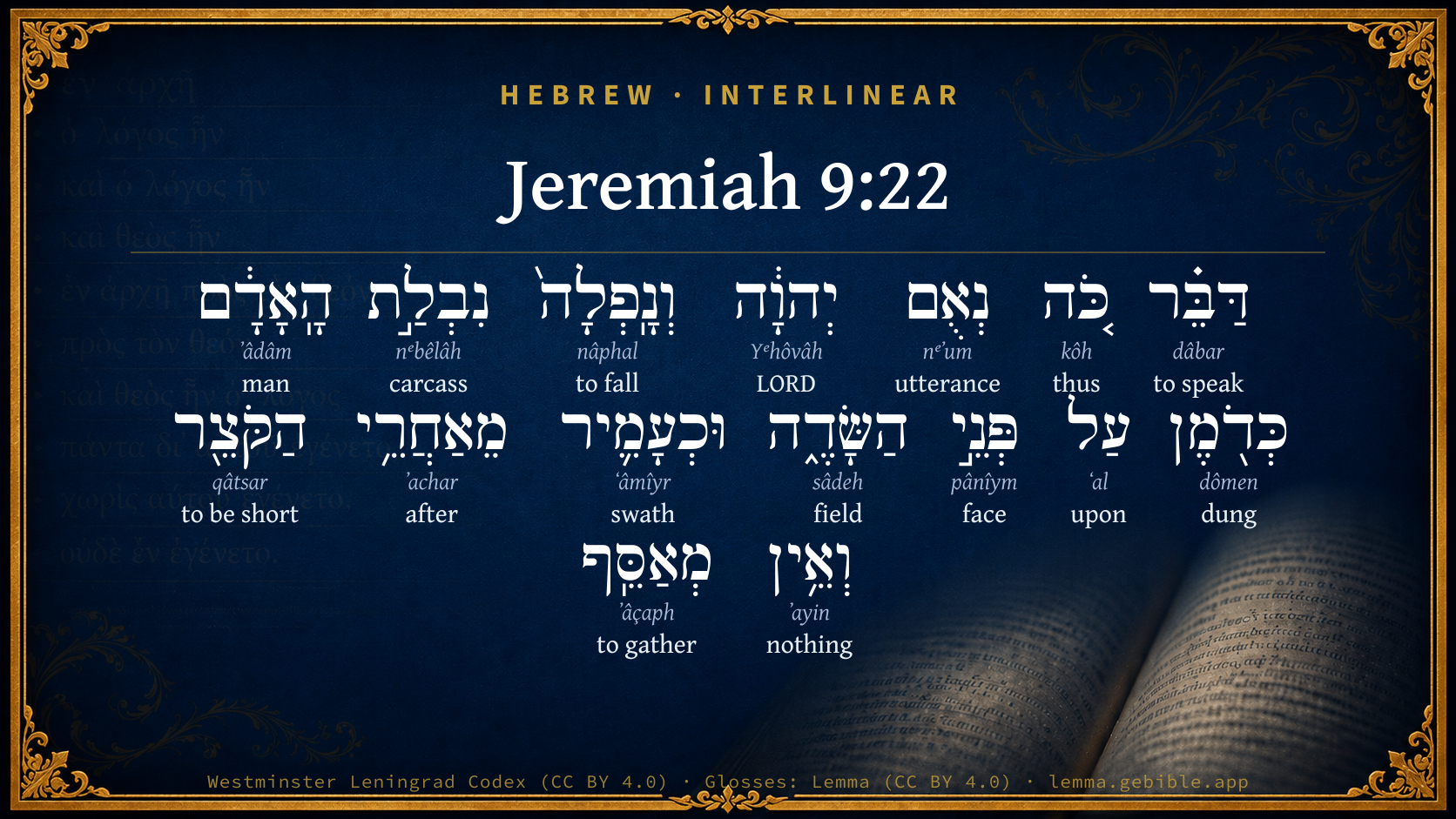
Jeremiah 9:22

Hebrew (Westminster Leningrad Codex) Jeremiah 9:22 appears in the Hebrew Old Testament. The text above is from the Westminster Leningrad Codex. Each word links to its Strong’s number, a concise gloss, and parsing drawn from the Open Scriptures Hebrew Bible morphology. Click any word for its full Brown-Driver-Briggs (BDB) entry.
Download image
Cite this verse

Jeremiah 9:22 (World English Bible). Public Domain. Lemma interlinear Bible study tool, https://lemma.gebible.app/v/jeremiah/9/22.

Show BibTeX & RIS
BibTeX
RIS
English Translation
Speak, Thus says Yahweh, The dead bodies of men shall fall as dung on the open field, and as the handful after the harvester; and none shall gather [them].
World English Bible · Public Domain
Highlights
  • 1 first appearance in the Hebrew Bible
Full analysis ↓
Download a study sheet

One document with this verse’s original text, its word-by-word gloss line, the meaning frame, cross-references with their text, attributed commentary, and full source and license credits — printable, and it pastes into notes with its structure intact.

This verse Autodidact and up

Study sheet (.html) Plain text (.txt)

A passage Seminary Student

Up to 50 verses in one chapter. A passage sheet keeps up to 6 commentary sources and 12 cross-references per verse, in the order this page ranks them, and says so on the sheet whenever that leaves anything out. Ask for a single verse and you get the Autodidact verse sheet above.

Everything on this page stays free to read, with no account — the sheet is a download of what is already on screen, not access to it.

Want to remove ads? Support Godless Engineer
Compare translations 3

The same verse in 3 English versions, stacked beneath the original-language interlinear above. Click any original word for its lexicon entry.

Each is an independent rendering of the whole verse — the interlinear is not word-aligned to these translations.

Highlighted words mark where these versions differ — a whole-verse word diff, not a word-by-word alignment.

  • World English Bible Public Domain
    Speak, Thus says Yahweh, The dead bodies of men shall fall as dung on the open field, and as the handful after the harvester; and none shall gather [them].
  • King James Version Public Domain
    Speak, Thus saith the LORD, Even the carcases of men shall fall as dung upon the open field, and as the handful after the harvestman, and none shall gather them.
  • unfoldingWord Literal Text CC BY-SA 4.0
    Speak “Thus the declaration of Yahweh—‘and the corpse of man will fall like dung upon the face of the field, and like sheaves after the harvester, and no one to gather.’”

unfoldingWord Literal Text — © unfoldingWord, licensed CC BY-SA 4.0. Word-aligned USFM3 via Door43 (git.door43.org/unfoldingWord/en_ult).

Versions to compare (up to 4)

3 of 4 selected

Show all 18 translations

Every available English version of this verse, each an independent rendering of the whole verse.

  • World English Bible Public Domain
    Speak, Thus says Yahweh, The dead bodies of men shall fall as dung on the open field, and as the handful after the harvester; and none shall gather [them].
  • Berean Standard Bible Public Domain
    Declare that this is what the LORD says: “The corpses of men will fall like dung upon the open field, like newly cut grain behind the reaper, with no one to gather it.”
  • Majority Standard Bible Public Domain
    Declare that this is what the LORD says: “The corpses of men will fall like dung upon the open field, like newly cut grain behind the reaper, with no one to gather it.”
  • King James Version Public Domain
    Speak, Thus saith the LORD, Even the carcases of men shall fall as dung upon the open field, and as the handful after the harvestman, and none shall gather them.
  • American Standard Version (1901) Public Domain
    Speak, Thus saith Jehovah, The dead bodies of men shall fall as dung upon the open field, and as the handful after the harvestman; and none shall gather `them'.
  • Revised Version (1885) Public Domain
    Speak, Thus saith the LORD, The carcases of men shall fall as dung upon the open field, and as the handful after the harvestman, and none shall gather them.
  • Geneva Bible (1599) Public Domain
    Speake, thus sayth the Lord, The carkeises of men shall lye, euen as the doung vpon the fielde, and as the handfull after the mower, and none shall gather them.
  • Douay-Rheims (1899) Public Domain
    Speak: Thus saith the Lord: Even the carcass of man shall fall as dung upon the face of the country, and as grass behind the back of the mower, and there is none to gather it.
  • Young's Literal Translation Public Domain
    Speak thus -- an affirmation of Jehovah, And fallen hath the carcase of man, As dung on the face of the field, And as a handful after the reaper, And there is none gathering.
  • Literal Standard Version CC BY-SA 4.0
    Speak thus, “A declaration of YHWH, || And the carcass of man has fallen, || As dung on the face of the field, || And as a handful after the reaper, || And there is none gathering.”
  • Unlocked Literal Bible CC BY-SA 4.0
    Declare this, 'This is Yahweh's declaration—the corpses of men will fall like dung in the fields, and like grain stalks after the reapers, and there will be no one to gather them.'”
  • unfoldingWord Literal Text CC BY-SA 4.0
    Speak “Thus the declaration of Yahweh—‘and the corpse of man will fall like dung upon the face of the field, and like sheaves after the harvester, and no one to gather.’”
  • Darby Bible Public Domain
    Speak, Thus saith Jehovah: Yea, the carcases of men shall fall as dung upon the open field, and as the handful after the reaper, and there shall be none to gather.
  • World Messianic Bible Public Domain
    Speak, “The LORD says, “‘The dead bodies of men will fall as dung on the open field, and as the handful after the harvester. No one will gather them.’”
  • Webster's Bible Public Domain
    Speak, Thus saith the LORD, Even the carcasses of men shall fall as dung upon the open field, and as the handful after the harvest-man, and none shall gather them.
  • Free Bible Version CC BY-SA 4.0
    Tell everyone this is what the Lord says: Dead bodies will be left where they fall like manure in the fields, lying there like stalks of freshly-cut grain behind the reaper, with no one to collect them.
  • Bible in Basic English Public Domain
    The bodies of men will be falling like waste on the open fields, and like grain dropped by the grain-cutter, and no one will take them up.
  • JPS Tanakh (1917) Public Domain
    (9-21) Speak: Thus saith the LORD — And the carcasses of men fall as dung upon the open field, and as the handful after the harvestman, which none gathereth.'

Literal Standard Version (2020), Covenant Press — licensed CC BY-SA 4.0. Text via the HelloAO Bible API (eBible.org). Unlocked Literal Bible (unfoldingWord) — licensed CC BY-SA 4.0. Text via the HelloAO Bible API (eBible.org). unfoldingWord Literal Text — © unfoldingWord, licensed CC BY-SA 4.0. Word-aligned USFM3 via Door43 (git.door43.org/unfoldingWord/en_ult). Free Bible Version, Dr. Jonathan Gallagher — licensed CC BY-SA 4.0. Text via the HelloAO Bible API (eBible.org).

Word by word

More ways to search: Search by grammar → Find every occurrence → Compare this word →

Practice this passage: Drill this verse → Learn its vocabulary →

וּכְעָמִ֛יר
ʻâmîyr
H5995
“and · like/as · swath”
Conjunction + Preposition + Noun, Common, Masculine, Singular, Absolute
Part of Speech
Conjunction + Preposition + Noun
Type
Common
Gender
Masculine
Number
Singular
State
Absolute
Full BDB Definition

Origin: from H6014

TWOT: 1645c

swath, a row of fallen grain
  1. דַּבֵּ֗ר dâbar H1696 “speak” Verb, Piel, Imperative, 2nd Person, Masculine, Singular
  2. כֹּ֚ה kôh H3541 “thus” Adverb
  3. נְאֻם nᵉʼum H5002 “utterance of” Noun, Common, Masculine, Singular, Construct
  4. יְהוָ֔ה Yᵉhôvâh H3068 “LORD” Noun, Proper
  5. וְנָֽפְלָה֙ nâphal H5307 “and · to fall” Conjunction + Verb, Qal, Sequential Perfect, 3rd Person, Feminine, Singular
  6. נִבְלַ֣ת nᵉbêlâh H5038 “carcass of” Noun, Common, Feminine, Singular, Construct
  7. הָֽאָדָ֔ם ʼâdâm H120 “the · man” Particle, Definite Article + Noun, Common, Masculine, Singular, Absolute
  8. כְּדֹ֖מֶן dômen H1828 “like/as · dung” Preposition + Noun, Common, Masculine, Singular, Absolute
  9. עַל ʻal H5921 “upon” Preposition
  10. פְּנֵ֣י pânîym H6440 “face(s) of” Noun, Common, Both, Plural, Construct
  11. הַשָּׂדֶ֑ה sâdeh H7704 “the · field” Particle, Definite Article + Noun, Common, Masculine, Singular, Absolute
  12. מֵאַחֲרֵ֥י ʼachar H310 “from · after” Preposition + Preposition
  13. הַקֹּצֵ֖ר qâtsar H7114 “the · being short” Particle, Definite Article + Verb, Qal, Participle Active, Masculine, Singular, Absolute
  14. וְאֵ֥ין ʼayin H369 “and · nothing” Conjunction + Particle, Negative
  15. מְאַסֵּֽף ʼâçaph H622 “gathering” Verb, Piel, Participle Active, Masculine, Singular, Absolute

About this verse

These counts appear in no published source. They are computed here, from the morphology-tagged text and Lemma’s own curated glosses. What Lemma adds →

16
words
16
distinct lemmas
Prophets
section

Notable vocabulary

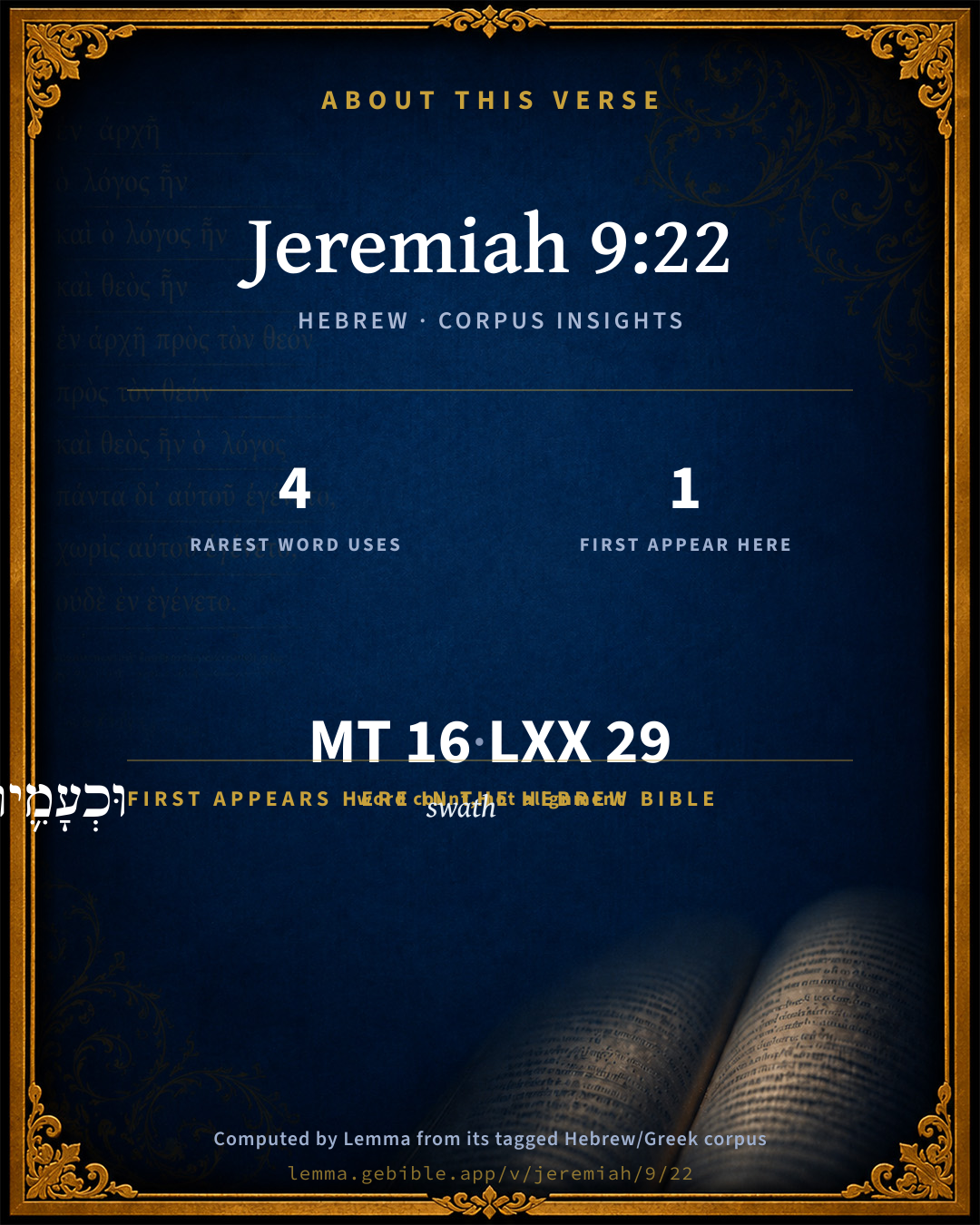
The rarest word here is וּכְעָמִ֛יר swath H5995 — appearing just 4 times in the whole Hebrew Bible.

First appearance in Scripture

This word makes its first canonical appearance in the Hebrew Bible here:

  • וּכְעָמִ֛יר swath H5995

Shared distinctive vocabulary

וּכְעָמִ֛יר swath H5995 occurs in 4 verses of the Hebrew Bible. Also found in:

Grammatical profile

  • 4 verbs
  • 8 nouns
  • 2 prepositions
  • 1 adverb
  • 1 particle

Verb forms

  • דַּבֵּ֗ר Piel · Imperative
  • וְנָֽפְלָה֙ Qal · Sequential Perfect
  • הַקֹּצֵ֖ר Qal · Participle Active
  • מְאַסֵּֽף Piel · Participle Active

Hebrew & Septuagint length

In the original languages it is 16 Hebrew tokens and 29 Greek tokens — but the two are counted differently (Hebrew bundles its prefixes and suffixes into one token; the Greek is in lemma form), so that isn’t a like-for-like length.

Cross-references

8

Topical passages linked to Jeremiah 9:22 in the Treasury of Scripture Knowledge — connected by theme and wording, ordered by reader-vote popularity; previews shown in the World English Bible.

  • Jeremiah 8:2 and they shall spread them before the sun, and the moon, and all the host of the sky, which they have loved, and which they have served, and after which they have walked, and which they have sought, and which they have worshiped: they shall not be gathered, nor be buried, they shall be for dung on the surface of the earth.
  • Jeremiah 25:33 The slain of Yahweh shall be at that day from one end of the earth even to the other end of the earth: they shall not be lamented, neither gathered, nor buried; they shall be dung on the surface of the ground.
  • Psalms 83:10 Who perished at Endor, Who became as dung for the earth.
  • Isaiah 5:25 Therefore Yahweh's anger burns against his people, And he has stretched out his hand against them, and has struck them. The mountains tremble, And their dead bodies are as refuse in the midst of the streets. For all this, his anger is not turned away, But his hand is still stretched out.
  • Jeremiah 16:4 They shall die grievous deaths: they shall not be lamented, neither shall they be buried; they shall be as dung on the surface of the ground; and they shall be consumed by the sword, and by famine; and their dead bodies shall be food for the birds of the sky, and for the animals of the earth.
  • Zephaniah 1:17 I will bring distress on men, that they will walk like blind men, because they have sinned against Yahweh, and their blood will be poured out like dust, and their flesh like dung.
  • 2 Kings 9:37 and the body of Jezebel shall be as dung on the face of the field in the portion of Jezreel, so that they shall not say, This is Jezebel.
  • Jeremiah 7:33 The dead bodies of this people shall be food for the birds of the sky, and for the animals of the earth; and none shall frighten them away.

Cross-references courtesy of OpenBible.info (CC BY 4.0).

Hebrew and Greek witnesses Masoretic Hebrew ↔ Greek Septuagint

The same verse in the two great witnesses to the Old Testament, shown verse-for-verse.

These are two independent witnesses, not word-aligned to each other, and the Septuagint is shown in lemma (dictionary) form.

Hebrew Jeremiah 9:22 Masoretic · Westminster Leningrad Codex

דַּבֵּ֗ר כֹּ֚ה נְאֻם יְהוָ֔ה וְנָֽפְלָה֙ נִבְלַ֣ת הָֽאָדָ֔ם כְּדֹ֖מֶן עַל פְּנֵ֣י הַשָּׂדֶ֑ה וּכְעָמִ֛יר מֵאַחֲרֵ֥י הַקֹּצֵ֖ר וְאֵ֥ין מְאַסֵּֽף

Speak, Thus says Yahweh, The dead bodies of men shall fall as dung on the open field, and as the handful after the harvester; and none shall gather [them].

World English Bible · Public Domain

Greek LXX Structure differs

In the Septuagint, Jeremiah is about an eighth shorter than the Hebrew and arranges its material differently — the Oracles Against the Nations (Hebrew chapters 46–51) appear in the middle of the Greek book, after 25:13. Because the chapter and verse boundaries do not line up, a verse-for-verse comparison with the Hebrew is not shown.

A verse-for-verse comparison isn’t shown here because the chapters and verses don’t line up. Switch to the LXX edition with the MT / LXX toggle above to read the Greek directly.

On this verse, The Cambridge Bible for Schools and Colleges discusses the Septuagint’s reading. Read the note in Commentary ↓

Hebrew: Westminster Leningrad Codex (CC BY 4.0). Greek: Septuagint (public domain); English from a public-domain English Septuagint. How the Septuagint differs from the Hebrew →

Targum (Aramaic paraphrase)

1

The Targum is the ancient Jewish Aramaic paraphrase of the Hebrew Scriptures — an interpretive translation, not the Hebrew text itself. Onkelos (literal) and Pseudo-Jonathan (expansive) render the Torah, and Jonathan the Prophets. Coverage is partial: where no permissively-licensed English translation exists for a verse, only the Aramaic is shown. This is verse-level text, not a word-by-word alignment to the Hebrew.

  1. Targum Jonathan Prophets (Joshua–Malachi)
    כִּדְנַן אֲמַר יְיָ לָא יִשְׁתַּבַּח שְׁלֹמֹה בַּר דָוִד חַכִימָא בְּחוּכְמָתֵיהּ וְלָא יִשְׁתַּבַּח שִׁמְשׁוֹן בַּר מָנוֹחַ גְבָּרָא בִּגְבוּרְתֵיהּ וְלָא יִשְׁתַּבַּח אַחְאָב בַּר עָמְרִי עַתִּירָא בְּעוּתְרֵיהּ:

    (no public-domain English translation for this verse)

    Targum Jonathan — Aramaic: “Mikraot Gedolot” (public domain). English: “Sefaria Community Translation” (CC0 1.0 (public-domain dedication)); “London "Chaldee Paraphrase," 1871” (public domain). Text via Sefaria.

Commentary

Notes on Jeremiah 9:22 from classic Christian and Jewish commentators (each source and its license shown beneath its notes). The classic Christian expositions comment on the surrounding passage and are grouped to its opening verse, so a note may address several verses; the Jewish commentaries on the Tanakh (Rashi and others) are per-verse, so they appear only where the commentator wrote on this verse.

Lemma curates 59 commentaries, every one of them public domain or Creative Commons licensed, each selected and text-cleaned for this edition rather than reprinted as found. About our sources →

Trapp's Complete Commentary

John Trapp

Jer 9:22 Speak, Thus saith the LORD, Even the carcases of men shall fall as dung upon the open field, and as the handful after the harvestman, and none shall gather [them].

Ver. 22. Speak, Thus saith the Lord.] Heb., Speak, it is the Lord’s saying; and therefore thou mayest be bold to speak it. So 1Th 4:15, "For I say unto you in (or, by) the word of the Lord."

And as the handful after the harvestman.] Death shall cut them up by handfuls, and lay them heaps upon heaps.

John Trapp, A Commentary or Exposition upon All the Books of the Old and New Testament (1647–1656) — public domain. Text from a community e-Sword module.

Jamieson, Fausset & Brown

Robert Jamieson, A. R. Fausset & David Brown

saith the Lord--continuing the thread of discourse from Jer 9:20.

dung-- (Jer 8:2).

handful . . . none . . . gather them--implying that the handful has been so trodden as to be not worth even the poor gleaner's effort to gather it. Or the Eastern custom may be referred to: the reaper cuts the grain and is followed by another who gathers it. This grain shall not be worth gathering. How galling to the pride of the Jews to hear that so shall their carcasses be trodden contemptuously under foot!

Jamieson, Fausset & Brown — Commentary Critical and Explanatory on the Whole Bible (1871) — public domain (CC PDM 1.0). Text via the HelloAO Bible API.

Adam Clarke's Commentary

Verse 22. And as the handful after the harvestman] The reapers, after having cut enough to fill their hand, threw it down; and the binders, following after, collected those handfuls, and bound them in sheaves. Death is represented as having cut down the inhabitants of the land, as the reapers do the corn; but so general was the slaughter, that there was none to bury the dead, to gather up these handfuls; so that they lay in a state of putrescence, as dung upon the open field.

Adam Clarke's Commentary on the Bible (1810–1826) — public domain. Text from a community e-Sword/MySword module.

John Calvin's Commentaries

Though Jeremiah continues the same subject, he yet introduces a preface, — that he had been commanded to declare what he says here; for on account of the strangeness of the event, the prophecy seemed incredible. He might, indeed, have proceeded with the subject, and omitted the words, “Thus saith Jehovah,” and have begun thus: “Fall shall the carcase of man,” etc. But, as I have said, this prophecy seemed to the greatest part as worthless, as though it was a fable: it was therefore necessary to introduce these words, — that he came forth furnished with God’s command; and he at the same time shews that he introduced nothing of his own, but that God himself spoke. We now perceive why these few words were introduced.

He afterwards says, that the carcases of men would be cast forth as dung He speaks by way of reproach, as though he had said, that all would without honor be laid prostrate by their enemies. And he adds a similitude, They shall fall, he says, on the face of the field, that is, everywhere through all the fields shall they fall as dung, which is cast forth, and which excites nausea by its sight and by its odor. Thus the Prophet here denotes foetor and a deformed sight by the comparison of dung: yet we know with what pride were they then filled. This threatening then was to them very disagreeable; but as they flattered themselves in their vices, it was the more necessary to treat them roughly; for thus ought hypocrites to be dealt with, who indulge their own delusions: the more boldly they rise up against God, the more violently ought they to be east down, so that they may at length humble themselves under the mighty hand of God.

He adds another comparison, As a handful, etc. Jerome renders it “hay.” If עמיד omid, were found elsewhere in this sense, I would willingly adopt this meaning; but I rather think that it means those ears of corn which are not gathered while the reapers collect their handfuls. They do not, indeed, leave complete handfuls, nor east them away; but it happens, through carelessness, that a few ears escape them. Then the Prophet says, that the Jews would be like those ears of corn which the reapers pass by and leave behind; and there is no one afterwards to gather them: and those ears of corn which thus remain in the field either rot of themselves, or are devoured by cattle or wild beasts. He then means, that there would be no residue of the people, for all, from the least to the greatest, would be given up to destruction.

This is the meaning; and at the same time he expresses contempt; for when reapers do not collect the whole produce of the field, there are still the poor, who gather the ears of corn; but when they are trodden under foot, and when there is no one to gather them, it betokens contempt; and this is what the Prophet intended to express. It now follows —

John Calvin's Commentaries (1540-1563) — public domain. Text from the Calvin Translation Society English edition (1840s-50s) via the Christian Classics Ethereal Library (ccel.org). Calvin's coverage is partial (roughly two-thirds of the Bible); uncommented books and verses are honest gaps, never fabricated. The 19th-century editor's footnotes and remarks are omitted so the notes are faithfully Calvin's own voice.

Ellicott's Commentary for English Readers

(22) Speak, Thus saith the Lord.—The abrupt opening indicates a new prediction, coming to him unbidden, which he is constrained to utter as a message from Jehovah.

As the handful.—The reaper gathered into swathes, or small sheaves, what he could hold in his left hand, as he went on cutting with his sickle. These he threw down as they became too big to hold, and they were left strewn on the field till he returned to gather them up into larger sheaves. So should the bodies of the dead be strewn, the prophet says, on the open field, but there should be none to take them up and bury them.

A Bible Commentary for English Readers, edited by Charles John Ellicott (1878–1897) — public domain. Text from a community e-Sword module.

The Cambridge Bible for Schools and Colleges

gen. ed. J. J. S. Perowne

22. Speak, Thus saith the Lord] The words are not found in LXX and they break the connexion.

The Cambridge Bible for Schools and Colleges (gen. ed. J. J. S. Perowne; Cambridge University Press, 1878–1918) — public domain. Text from a community e-Sword module.

John Gill's Exposition

Speak, thus saith the Lord,.... These are the words of the Lord to Jeremiah, to go on with his prophecy in his name; so the Targum,

"prophesy, thus saith the Lord:''

even the carcasses of men shall fall as dung upon the open field; or, "upon the face of the field" (f); this shows the reason why the women are called to mourning, because the men would fall by the sword in the open field, and there lie and rot, and become dung upon it. The Targum is,

"as dung spread upon the face of the field;''

which denotes the great number that should fall, which would cover the face of the field; the condition they should be in; and the contempt and neglect they should be had in:

and as the handful after the harvestman, and none shall gather them; as a handful of corn that is forgot, and left by the harvestman; or as ears of corn which are dropped by the reaper, or binder, and are usually gleaned or gathered up by the poor that follow; but in the case referred to, or supposed, are not gathered; so it would be with these people; they should be left upon the ground, like a handful forgot, or like ears of corn dropped, and not gathered up, and there they should lie, and none should bury them.

(f) "super faciebus agri", Montanus, Schmidt; "in facie agri", Cocceius; "in superficie agri", Junius & Tremellius, Piscator.

John Gill's Exposition of the Whole Bible (1746–1763) — public domain (CC PDM 1.0). Text via the HelloAO Bible API.

Haydock's Catholic Bible Commentary

CHAPTER IX.

Speak. Our editions of the Septuagint omit this word, though St. Jerome found it in his copies, (Calmet) and in Theodotion, expressed by "death;" while others rendered it, "speak," as the same letters dbr, may have both meanings, according as people may please to pronounce them. (St. Jerome) --- Grabe supplies, "by death. (22.) These things, says the Lord." (Haydock)

George Leo Haydock (1774–1849), Haydock's Catholic Family Bible and Commentary, 1859 edition — public domain. Excludes Psalms (Douay-Rheims chapter numbering differs from Protestant) and Deuterocanonical books (Catholic canon only).

Matthew Poole's English Annotations

Speak, Thus saith the Lord; lest they should think these things would never be, cease not to tell them from me that they shall certainly come to pass, viz. what was said before, and what is said now in this verse (these words, Speak, Thus saith the Lord, being best read in a parenthesis).

The carcasses of men, Heb. a carcass of a man, noting here and there a scattered carcass.

Shall fall as dung upon the open field; as Jezebel was, 2Ki 9:37, exposed to all contempt, strewed up and down on the superficies of the earth, Heb. face of the field, and be offensive by their stench to all that pass by, Jer 44:12.

As the handful after the harvest man; either laid in heaps by death, as the harvestman doth his cocks of hay or sheaves of corn; or rather, they shall be no more regarded than a few scattered ears that drop out of the reaper’s hand, which either lie on the ground, and are eaten by birds, or trod to dirt by beasts; thus God would pour contempt upon them, which must needs be grievous to so proud a people as the Jews were.

None shall gather them; none shall have so much respect to them, or compassion of them, as to afford burial, Jer 8:2.

Matthew Poole's English Annotations on the Holy Bible (1683–1685) — public domain. Text from a community e-Sword/MySword module.

Whedon's Commentary on the Bible

Daniel D. Whedon

22. Carcasses of men — The burning utterances of the prophet burst forth into one vivid and comprehensive statement — a fitting conclusion to this remarkable passage. The dead shall be too many to be buried, as in Jeremiah 8:32, 33. As the reaper lets fall his handful of grain for the gleaner, so death shall cast down his handful, and none shall gather them.

Daniel D. Whedon (gen. ed.), Commentary on the Old and New Testaments (1874–1909) — public domain. Text from a community e-Sword module.

The Pulpit Commentary

Speak, Thus saith the Lord. These words are in three important respects contrary to the style of Jeremiah:

(1) such a prefix as "speak" is unique; (2). such a phrase as hk is also unique m Jeremiah;

(3) when our prophet does use the formula it is not at the beginning of a verse.

They are omitted by the Septuagint translator, who presumably did not find them in his copy of the Hebrew, and the text gains greatly by their removal. The following words are mistranslated in the Authorized Version, and should run, not even, but and, the carcasses of men shall fall; etc. It is most improbable, however, that a fresh Divine revelation should begin with "and." With other points, the word rendered "speak" would mean "pestilence." Possibly the word fell out of Ver. 21, where it would find an excellent place in the second clause, (as an explanatory parallel to "death," Psa_78:50) which would thus obtain greater roundness and symmetry. As the handful ; i.e. as thickly as one heap of corn succeeds another under the deft hand of the leaper.

Vers. 22-24. The knowledge of God the only real "glory" of man.

Comparison of the earthly acquisitions and properties of the natural man with those which are spiritual and Divine frequent in Scripture. In history and in life they are seen in competition. It is not that the one class of gifts is to be wholly despised and the other alone sought. A correct perspective must be established. It is the "glory" of a man that requires in the first place to be determined. After that is settled, all other things will take their due place and precedency.

I THE "GLORY" OF MAN MUST DEPEND UPON THE END FOR WHICH HE HAS BEEN BROUGHT INTO EXISTENCE. This is written in his nature, confirmed by providence, and made clear by revelation. In the words of the Westminster Catechism," The chief end of man is to glorify God, and to enjoy him for ever." Everything else must be subordinated to this; but if pursued in its place, will show itself to be a perversion of his nature, and will end in calamity and misery. How very few care to satisfy themselves upon this momentous question! Hence the necessity for the teachings and warnings of experience.

1. The "glory of man will be declared by the manner in which the circumstances of his earthly lot affect it in the working out of that end. Each of the qualities and properties upon which men usually pride themselves has been tried in this way and found deficient. The wisdom of the world has a thousand times been shown to be foolishness before God. There are a myriad problems for which it has no key. "Might" has been reduced to nothingness by the least of the duties and experiences of the spiritual life. Disease and death can bring down the mighty from their seats, and stay the greatest worker at his task. Many a time has the cherished object after which one has labored with apparent success been snatched away just when about to be attained. And "wealth" is similarly discredited. The moth and the rust can corrupt the treasures of earth, and the thief breaks through and steals them from their most guarded security. The accident of fortune may give or take away the greatest fortune. And when death comes, all these earthly possessions have to be left behind. They cannot avail for what lies beyond. How seldom are these gifts used for the highest end! And how unavailing of themselves would they be to secure it!

2. The glory" of man must depend upon the success with which it contributes to secure that end.

II THE KNOWLEDGE OF GOD IS INDICATED UNMISTAKABLY BY THESE TESTS AS THE ONLY TRUE "GLORY" OF MAN. God is identified with the ultimate aim of our being. He made us, and it is for him we live. Consequently, the better we know him, the better shall we be able to serve him.

1. Imitation of God will spring from the knowledge of him. The more we know of him the more we must love him, and admiration will lead to resemblance in spirit and in life. "We love him, because he first loved us.

2. Knowledge depends on and leads to obedience. (Joh_7:17) The knowledge of God sheds light upon the universe and life, and directs the soul and body into the channels of health, happiness, and usefulness.

3. It is connected with and culminates in Divine fellowship. In this way the character and presence of God are brought into closest contact with the spirit of man, his character is molded into the image of the Divine original, and the joys of communion deepen and enlarge into the blessedness of heaven. "This is life eternal, even now to know thee the only true God, and Jesus Christ, whom thou hast sent. M.

The Pulpit Commentary (1880–1919), ed. H.D.M. Spence-Jones & Joseph S. Exell — public domain. Text from a community e-Sword module.

John Wesley's Explanatory Notes

As the handful - They shall be no more regarded than a few scattered ears that drop out of the reapers hand, which either lie on the ground and are eaten by birds, or trod to dirt by beasts. None - None shall have so much respect to them, as to afford burial.

John Wesley, Explanatory Notes Upon the Whole Bible (1754–1765) — public domain. Text via the GEBible commentary corpus.

Rashi

Rabbi Shlomo Yitzchaki (Rashi)

Let not the wise man boast Do not boast, saying, “We are wise.” Behold, you have rejected My words, so what wisdom do you have? If you understand and know Me, then you can boast of your wisdom.

Rashi on the Tanakh — English translations: “The Judaica Press complete Tanach with Rashi, translated by A. J. Rosenberg” (CC BY 4.0); “Pentateuch with Rashi's commentary by M. Rosenbaum and A.M. Silbermann, 1929-1934” (public domain); “The Metsudah Tanach series, Lakewood, N.J” (CC BY 4.0); and “The Book of Joshua, Metsudah Publications, 1997” (CC BY 4.0). Text via Sefaria.

Lesson kit

Teaching starters — assembled from the data on this page, not authored interpretation. Every prompt links to the verse data it draws on. Edit before teaching.

Jeremiah, in the Prophets, opens this verse with 16 words (16 distinct Hebrew lemmas). Its most distinctive word is ʻâmîyr (“swath”). A historical commentator’s framing appears above. Read the whole chapter for the surrounding context.

Discussion questions

  1. How does “swath” (ʻâmîyr) shape what this verse is saying?
  2. The word “swath” first appears here in Scripture. What is being introduced at this debut?
  3. Amos 2:13 shares the word «swath» with this verse. How do the two illuminate each other?
  4. The translations on this page render this verse differently — a whole-verse word diff, not a word-by-word alignment. What might account for the different wordings?
  5. The verb «דַּבֵּ֗ר» is Piel Imperative. How does its form color the action?
  6. Reading how Trapp's Complete Commentary and Jamieson, Fausset & Brown read this verse, where do the two commentators agree and where do they part?

Things to notice

Reading settings

Reading text

Shown beneath each verse's original-language words.

Old Testament
Old Testament edition

Read the OT as the Masoretic Hebrew (MT) or the Greek Septuagint (LXX).

English shown for the Greek Septuagint (in the Hebrew ↔ Greek comparison).

Comparing translations? Open the Compare panel on any verse page to stack up to four side by side.