
Jeremiah 40:10

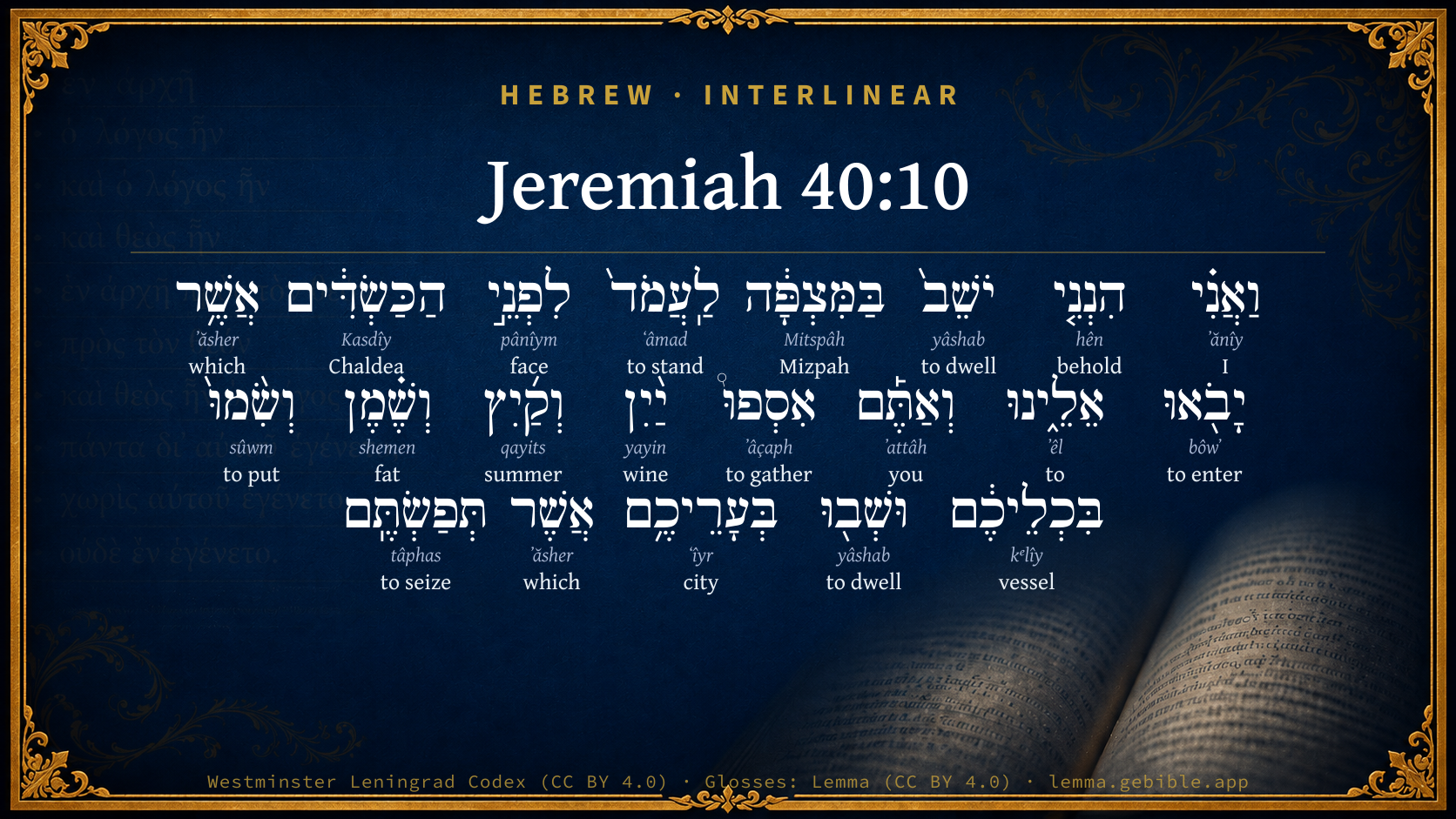
Hebrew (Westminster Leningrad Codex) Jeremiah 40:10 appears in the Hebrew Old Testament. The text above is from the Westminster Leningrad Codex. Each word links to its Strong’s number, a concise gloss, and parsing drawn from the Open Scriptures Hebrew Bible morphology. Click any word for its full Brown-Driver-Briggs (BDB) entry.
Download image
Cite this verse

Jeremiah 40:10 (World English Bible). Public Domain. Lemma interlinear Bible study tool, https://lemma.gebible.app/v/jeremiah/40/10.

Show BibTeX & RIS
BibTeX
RIS
English Translation
As for me, behold, I will dwell at Mizpah, to stand before the Chaldeans who shall come to us: but you, gather you wine and summer fruits and oil, and put them in your vessels, and dwell in your cities that you have taken.
World English Bible · Public Domain
Download a study sheet

One document with this verse’s original text, its word-by-word gloss line, the meaning frame, cross-references with their text, attributed commentary, and full source and license credits — printable, and it pastes into notes with its structure intact.

This verse Autodidact and up

Study sheet (.html) Plain text (.txt)

A passage Seminary Student

Up to 50 verses in one chapter. A passage sheet keeps up to 6 commentary sources and 12 cross-references per verse, in the order this page ranks them, and says so on the sheet whenever that leaves anything out. Ask for a single verse and you get the Autodidact verse sheet above.

Everything on this page stays free to read, with no account — the sheet is a download of what is already on screen, not access to it.

Want to remove ads? Support Godless Engineer
Compare translations 3

The same verse in 3 English versions, stacked beneath the original-language interlinear above. Click any original word for its lexicon entry.

Each is an independent rendering of the whole verse — the interlinear is not word-aligned to these translations.

Highlighted words mark where these versions differ — a whole-verse word diff, not a word-by-word alignment.

  • World English Bible Public Domain
    As for me, behold, I will dwell at Mizpah, to stand before the Chaldeans who shall come to us: but you, gather you wine and summer fruits and oil, and put them in your vessels, and dwell in your cities that you have taken.
  • King James Version Public Domain
    As for me, behold, I will dwell at Mizpah, to serve the Chaldeans, which will come unto us: but ye, gather ye wine, and summer fruits, and oil, and put them in your vessels, and dwell in your cities that ye have taken.
  • unfoldingWord Literal Text CC BY-SA 4.0
    Look, I am living in Mizpah to meet with the Chaldeans who came to us. So harvest wine, summer fruit, and oil and store them in your containers. Live in the cities that you have occupied.”

unfoldingWord Literal Text — © unfoldingWord, licensed CC BY-SA 4.0. Word-aligned USFM3 via Door43 (git.door43.org/unfoldingWord/en_ult).

Versions to compare (up to 4)

3 of 4 selected

Show all 18 translations

Every available English version of this verse, each an independent rendering of the whole verse.

  • World English Bible Public Domain
    As for me, behold, I will dwell at Mizpah, to stand before the Chaldeans who shall come to us: but you, gather you wine and summer fruits and oil, and put them in your vessels, and dwell in your cities that you have taken.
  • Berean Standard Bible Public Domain
    As for me, I will stay in Mizpah to represent you before the Chaldeans who come to us. As for you, gather wine grapes, summer fruit, and oil, place them in your storage jars, and live in the cities you have taken.”
  • Majority Standard Bible Public Domain
    As for me, I will stay in Mizpah to represent you before the Chaldeans who come to us. As for you, gather wine grapes, summer fruit, and oil, place them in your storage jars, and live in the cities you have taken.”
  • King James Version Public Domain
    As for me, behold, I will dwell at Mizpah, to serve the Chaldeans, which will come unto us: but ye, gather ye wine, and summer fruits, and oil, and put them in your vessels, and dwell in your cities that ye have taken.
  • American Standard Version (1901) Public Domain
    As for me, behold, I will dwell at Mizpah, to stand before the Chaldeans that shall come unto us: but ye, gather ye wine and summer fruits and oil, and put them in your vessels, and dwell in your cities that ye have taken.
  • Revised Version (1885) Public Domain
    As for me, behold, I will dwell at Mizpah, to stand before the Chaldeans, which shall come unto us: but ye, gather ye wine and summer fruits and oil, and put them in your vessels, and dwell in your cities that ye have taken.
  • Geneva Bible (1599) Public Domain
    As for me, Beholde, I will dwell at Mizpah to serue the Caldeans, which will come vnto vs: but you, gather you wine, and sommer fruites, and oyle, and put them in your vessels, and dwell in your cities, that ye haue taken.
  • Douay-Rheims (1899) Public Domain
    Behold I dwell in Masphath, that I may answer the commandment of the Chaldeans that are sent to us: but as for you, gather ye the vintage, and the harvest, and the oil, and lay it up in your vessels, and abide in your cities which you hold.
  • Young's Literal Translation Public Domain
    and I, lo, I am dwelling in Mizpah, to stand before the Chaldeans who are come in unto us, and ye, gather ye wine, and summer fruit, and oil, and put in your vessels, and dwell in your cities that ye have taken.'
  • Literal Standard Version CC BY-SA 4.0
    and I, behold, I am dwelling in Mizpah to stand before the Chaldeans who have come to us, and you, gather wine, and summer fruit, and oil, and put [them] in your vessels, and dwell in your cities that you have taken.”
  • Unlocked Literal Bible CC BY-SA 4.0
    Look, I am living in Mizpah to meet with the Chaldeans who came to us. So harvest wine, summer fruit, and oil and store them in your containers. Live in the cities that you have occupied.”
  • unfoldingWord Literal Text CC BY-SA 4.0
    Look, I am living in Mizpah to meet with the Chaldeans who came to us. So harvest wine, summer fruit, and oil and store them in your containers. Live in the cities that you have occupied.”
  • Darby Bible Public Domain
    And as for me, behold, I dwell at Mizpah, to stand before the Chaldeans, who will come unto us; and ye, gather wine, and summer fruits, and oil, and put [them] in your vessels, and dwell in your cities which ye have taken.
  • World Messianic Bible Public Domain
    As for me, behold, I will dwell at Mizpah, to stand before the Kasdim who will come to us; but you, gather wine and summer fruits and oil, and put them in your vessels, and dwell in your cities that you have taken.”
  • Webster's Bible Public Domain
    As for me, behold, I will dwell at Mizpah, to serve the Chaldeans, who will come to us: but ye, gather ye wine, and summer fruits, and oil, and put them in your vessels, and dwell in your cities that ye have taken.
  • Free Bible Version CC BY-SA 4.0
    I myself will stay here in Mizpah to represent you to the Babylonians when they come to meet with us. You yourselves should get busy harvesting grapes and summer fruit and olive oil, storing them in jars, and living in the towns you have occupied.”
  • Bible in Basic English Public Domain
    As for me, I will be living in Mizpah as your representative before the Chaldaeans who come to us: but you are to get in your wine and summer fruits and oil and put them in your vessels, and make living-places for yourselves in the towns which you have taken.
  • JPS Tanakh (1917) Public Domain
    As for me, behold, I will dwell at Mizpah, to stand before the Chaldeans that may come unto us; but ye, gather ye wine and summer fruits and oil, and put them in your vessels, and dwell in your cities that ye have taken.'

Literal Standard Version (2020), Covenant Press — licensed CC BY-SA 4.0. Text via the HelloAO Bible API (eBible.org). Unlocked Literal Bible (unfoldingWord) — licensed CC BY-SA 4.0. Text via the HelloAO Bible API (eBible.org). unfoldingWord Literal Text — © unfoldingWord, licensed CC BY-SA 4.0. Word-aligned USFM3 via Door43 (git.door43.org/unfoldingWord/en_ult). Free Bible Version, Dr. Jonathan Gallagher — licensed CC BY-SA 4.0. Text via the HelloAO Bible API (eBible.org).

Word by word

More ways to search: Search by grammar → Find every occurrence → Compare this word →

Practice this passage: Drill this verse → Learn its vocabulary →

וְקַ֜יִץ
qayits
H7019
“and · summer”
Conjunction + Noun, Common, Masculine, Singular, Absolute
Part of Speech
Conjunction + Noun
Type
Common
Gender
Masculine
Number
Singular
State
Absolute
Full BDB Definition

Origin: from H6972

TWOT: 2020a

summer, summer-fruit - summer - summer-fruit
  1. וַאֲנִ֗י ʼănîy H589 “and · I” Conjunction + Pronoun, Personal, 1st Person, Common, Singular
  2. הִנְנִ֤י hên H2005 “behold · me” Particle, Demonstrative + Suffix, Personal, 1st Person, Common, Singular
  3. יֹשֵׁב֙ yâshab H3427 “dwelling” Verb, Qal, Participle Active, Masculine, Singular, Absolute
  4. בַּמִּצְפָּ֔ה Mitspâh H4709 “in/at the · Mizpah” Preposition, Determined + Noun, Proper
  5. לַֽעֲמֹד֙ ʻâmad H5975 “to stand” Preposition + Verb, Qal, Infinitive Construct
  6. לִפְנֵ֣י pânîym H6440 “to/for · face(s) of” Preposition + Noun, Common, Both, Plural, Construct
  7. הַכַּשְׂדִּ֔ים Kasdîy H3778 “the · Chaldea” Particle, Definite Article + Noun, Proper
  8. אֲשֶׁ֥ר ʼăsher H834 “which” Particle, Relative
  9. יָבֹ֖אוּ bôwʼ H935 “to enter” Verb, Qal, Imperfect, 3rd Person, Masculine, Plural
  10. אֵלֵ֑ינוּ ʼêl H413 “to · us” Preposition + Suffix, Personal, 1st Person, Common, Plural
  11. וְאַתֶּ֡ם ʼattâh H859 “and · you” Conjunction + Pronoun, Personal, 2nd Person, Masculine, Plural
  12. אִסְפוּ֩ ʼâçaph H622 “gather” Verb, Qal, Imperative, 2nd Person, Masculine, Plural
  13. יַ֨יִן yayin H3196 “wine” Noun, Common, Masculine, Singular, Absolute
  14. וְשֶׁ֗מֶן shemen H8081 “and · fat” Conjunction + Noun, Common, Masculine, Singular, Absolute
  15. וְשִׂ֨מוּ֙ sûwm H7760 “and · put” Conjunction + Verb, Qal, Imperative, 2nd Person, Masculine, Plural
  16. בִּכְלֵיכֶ֔ם kᵉlîy H3627 “in/at · vessels · your” Preposition + Noun, Common, Masculine, Plural, Construct + Suffix, Personal, 2nd Person, Masculine, Plural
  17. וּשְׁב֖וּ yâshab H3427 “and · dwell” Conjunction + Verb, Qal, Imperative, 2nd Person, Masculine, Plural
  18. בְּעָרֵיכֶ֥ם ʻîyr H5892 “in/at · cities · your” Preposition + Noun, Common, Feminine, Plural, Construct + Suffix, Personal, 2nd Person, Masculine, Plural
  19. אֲשֶׁר ʼăsher H834 “which” Particle, Relative
  20. תְּפַשְׂתֶּֽם tâphas H8610 “to seize” Verb, Qal, Perfect, 2nd Person, Masculine, Plural

About this verse

These counts appear in no published source. They are computed here, from the morphology-tagged text and Lemma’s own curated glosses. What Lemma adds →

21
words
19
distinct lemmas
Prophets
section

Notable vocabulary

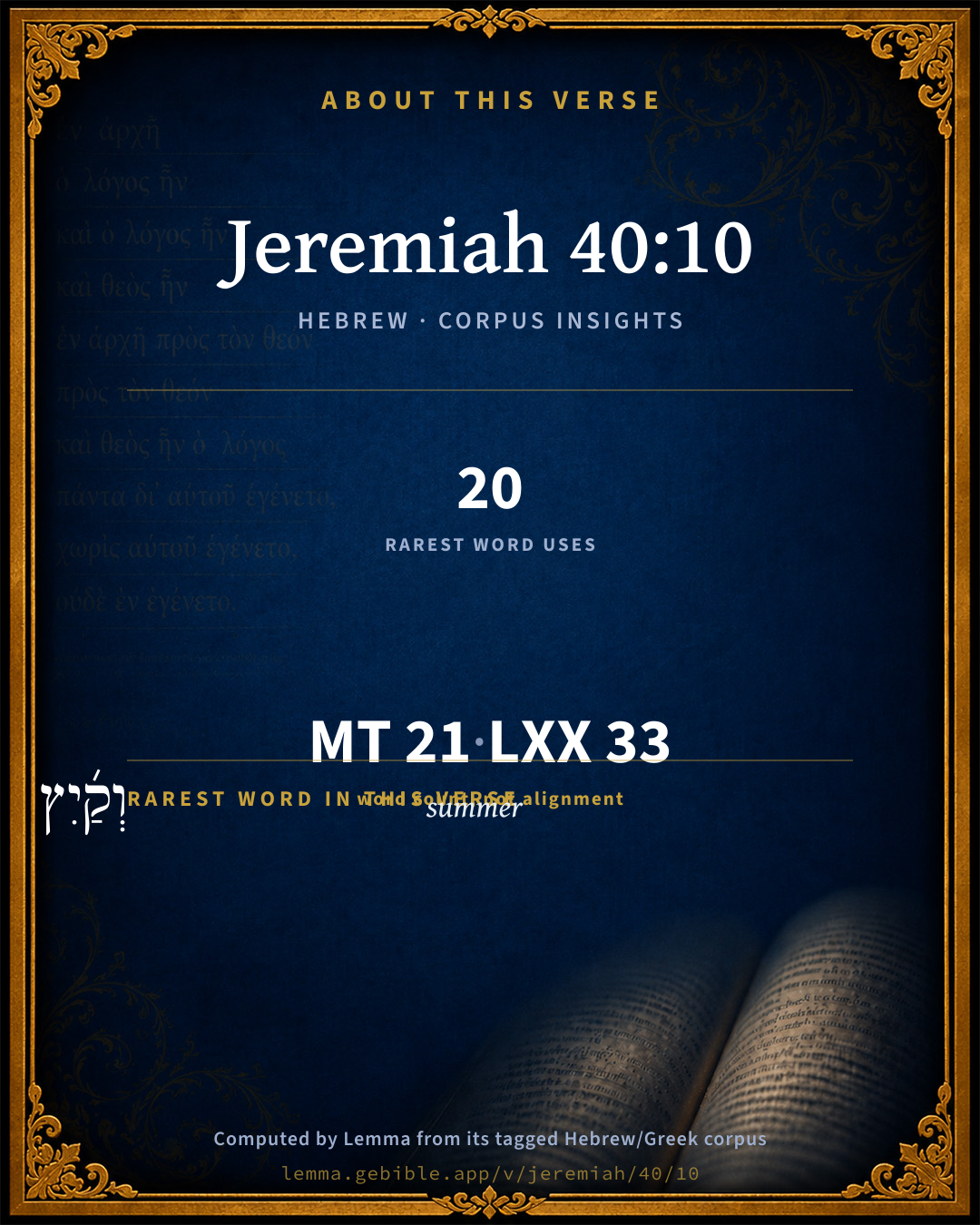
The rarest word here is וְקַ֜יִץ summer H7019 — appearing just 20 times in the whole Hebrew Bible.

Shared distinctive vocabulary

וְקַ֜יִץ summer H7019 occurs in 20 verses of the Hebrew Bible. Also found in:

Grammatical profile

  • 7 verbs
  • 8 nouns
  • 2 pronouns
  • 1 preposition
  • 3 particles

Verb forms

  • יֹשֵׁב֙ Qal · Participle Active
  • לַֽעֲמֹד֙ Qal · Infinitive Construct
  • יָבֹ֖אוּ Qal · Imperfect
  • אִסְפוּ֩ Qal · Imperative
  • וְשִׂ֨מוּ֙ Qal · Imperative
  • וּשְׁב֖וּ Qal · Imperative
  • תְּפַשְׂתֶּֽם Qal · Perfect

Repetition

Words recur within this verse — often emphatic in Hebrew:

  • יֹשֵׁב֙ to dwell H3427 ×2
  • אֲשֶׁ֥ר which H834 ×2

Hebrew & Septuagint length

In the original languages it is 21 Hebrew tokens and 33 Greek tokens — but the two are counted differently (Hebrew bundles its prefixes and suffixes into one token; the Greek is in lemma form), so that isn’t a like-for-like length.

Cross-references

11

Topical passages linked to Jeremiah 40:10 in the Treasury of Scripture Knowledge — connected by theme and wording, ordered by reader-vote popularity; previews shown in the World English Bible.

  • Jeremiah 40:12 then all the Jews returned out of all places where they were driven, and came to the land of Judah, to Gedaliah, to Mizpah, and gathered wine and summer fruits very much.
  • Deuteronomy 1:38 Joshua the son of Nun, who stands before you, he shall go in there: encourage you him; for he shall cause Israel to inherit it.
  • 2 Samuel 16:1 When David was a little past the top [of the ascent], behold, Ziba the servant of Mephibosheth met him, with a couple of donkeys saddled, and on them two hundred loaves of bread, and one hundred clusters of raisins, and one hundred summer fruits, and a bottle of wine.
  • Isaiah 16:9 Therefore I will weep with the weeping of Jazer for the vine of Sibmah; I will water you with my tears, Heshbon, and Elealeh: for on your summer fruits and on your harvest the [battle] shout is fallen.
  • Jeremiah 35:19 therefore thus says Yahweh of Hosts, the God of Israel: Jonadab the son of Rechab shall not want a man to stand before me forever.
  • Jeremiah 39:10 But Nebuzaradan the captain of the guard left of the poor of the people, who had nothing, in the land of Judah, and gave them vineyards and fields at the same time.
  • Jeremiah 48:32 With more than the weeping of Jazer will I weep for you, vine of Sibmah: your branches passed over the sea, they reached even to the sea of Jazer: on your summer fruits and on your vintage the destroyer is fallen.
  • Proverbs 22:29 Do you see a man skilled in his work? He will serve kings; He won't serve obscure men.
  • Jeremiah 40:6 Then went Jeremiah to Gedaliah the son of Ahikam to Mizpah, and lived with him among the people who were left in the land.
  • Micah 7:1 Misery is mine! Indeed, I am like one who gathers the summer fruits, as gleanings of the vinyard: There is no cluster of grapes to eat. My soul desires to eat the early fig.
  • Luke 21:36 Therefore be watchful all the time, asking that you may be counted worthy to escape all these things that will happen, and to stand before the Son of Man."

Cross-references courtesy of OpenBible.info (CC BY 4.0).

Hebrew and Greek witnesses Masoretic Hebrew ↔ Greek Septuagint

The same verse in the two great witnesses to the Old Testament, shown verse-for-verse.

These are two independent witnesses, not word-aligned to each other, and the Septuagint is shown in lemma (dictionary) form.

Hebrew Jeremiah 40:10 Masoretic · Westminster Leningrad Codex

וַאֲנִ֗י הִנְנִ֤י יֹשֵׁב֙ בַּמִּצְפָּ֔ה לַֽעֲמֹד֙ לִפְנֵ֣י הַכַּשְׂדִּ֔ים אֲשֶׁ֥ר יָבֹ֖אוּ אֵלֵ֑ינוּ וְאַתֶּ֡ם אִסְפוּ֩ יַ֨יִן וְקַ֜יִץ וְשֶׁ֗מֶן וְשִׂ֨מוּ֙ בִּכְלֵיכֶ֔ם וּשְׁב֖וּ בְּעָרֵיכֶ֥ם אֲשֶׁר תְּפַשְׂתֶּֽם

As for me, behold, I will dwell at Mizpah, to stand before the Chaldeans who shall come to us: but you, gather you wine and summer fruits and oil, and put them in your vessels, and dwell in your cities that you have taken.

World English Bible · Public Domain

Greek LXX Structure differs

In the Septuagint, Jeremiah is about an eighth shorter than the Hebrew and arranges its material differently — the Oracles Against the Nations (Hebrew chapters 46–51) appear in the middle of the Greek book, after 25:13. Because the chapter and verse boundaries do not line up, a verse-for-verse comparison with the Hebrew is not shown.

A verse-for-verse comparison isn’t shown here because the chapters and verses don’t line up. Switch to the LXX edition with the MT / LXX toggle above to read the Greek directly.

Hebrew: Westminster Leningrad Codex (CC BY 4.0). Greek: Septuagint (public domain); English from a public-domain English Septuagint. How the Septuagint differs from the Hebrew →

Targum (Aramaic paraphrase)

1

The Targum is the ancient Jewish Aramaic paraphrase of the Hebrew Scriptures — an interpretive translation, not the Hebrew text itself. Onkelos (literal) and Pseudo-Jonathan (expansive) render the Torah, and Jonathan the Prophets. Coverage is partial: where no permissively-licensed English translation exists for a verse, only the Aramaic is shown. This is verse-level text, not a word-by-word alignment to the Hebrew.

  1. Targum Jonathan Prophets (Joshua–Malachi)
    וַאֲנָא הָא אֲנָא יָתֵיב בְּמִצְפְּיָא לְמֵיקַם קֳדָם כַּסְדָאֵי דְיֵתוֹן עֲלָנָא וְאַתּוּן כְּנוּשׁוּ חַמְרָא וּדְבֵילָתָא וּמִשְׁחָא וְשַׁווּ בְּמָנֵיכוֹן וּתְבוּ בְּקִרְוֵיכוֹן דַאֲחַדְתּוּן:

    (no public-domain English translation for this verse)

    Targum Jonathan — Aramaic: “Mikraot Gedolot” (public domain). English: “Sefaria Community Translation” (CC0 1.0 (public-domain dedication)); “London "Chaldee Paraphrase," 1871” (public domain). Text via Sefaria.

Commentary

Notes on Jeremiah 40:10 from classic Christian and Jewish commentators (each source and its license shown beneath its notes). The classic Christian expositions comment on the surrounding passage and are grouped to its opening verse, so a note may address several verses; the Jewish commentaries on the Tanakh (Rashi and others) are per-verse, so they appear only where the commentator wrote on this verse.

Lemma curates 59 commentaries, every one of them public domain or Creative Commons licensed, each selected and text-cleaned for this edition rather than reprinted as found. About our sources →

Trapp's Complete Commentary

John Trapp

Jer 40:10 As for me, behold, I will dwell at Mizpah to serve the Chaldeans, which will come unto us: but ye, gather ye wine, and summer fruits, and oil, and put [them] in your vessels, and dwell in your cities that ye have taken.

Ver. 10. As for me, behold, I will dwell at Mizpah.] To agitate for you, to the Chaldeans; and to secure you to mine utmost.

But ye, gather ye wine.] Humanissima haec sunt, pia, et utilissima Gedaliae verba ad populum. It was a wonder the Chaldees, after so long a siege, had left any fruits behind them. Soldiers today lay all waste mostly.

John Trapp, A Commentary or Exposition upon All the Books of the Old and New Testament (1647–1656) — public domain. Text from a community e-Sword module.

Geneva Bible (1599)

Geneva Bible translators

Or, chosen to dwell in.

Or, to receive them, or to entreat them for you.

Geneva Bible (1599) marginal notes — public domain. Text via Bolls.life.

Jamieson, Fausset & Brown

Robert Jamieson, A. R. Fausset & David Brown

Mizpah--lying on the way between Babylon and Judah, and so convenient for transacting business between the two countries.

As for me . . . but ye--He artfully, in order to conciliate them, represents the burden of the service to the Chaldeans as falling on him, while they may freely gather their wine, fruits, and oil. He does not now add that these very fruits were to constitute the chief part of the tribute to be paid to Babylon: which, though fruitful in corn, was less productive of grapes, figs, and olives [HERODOTUS, 1.193]. The grant of "vineyards" to the "poor" (Jer 39:10) would give hope to the discontended of enjoying the best fruits (Jer 40:12).

Jamieson, Fausset & Brown — Commentary Critical and Explanatory on the Whole Bible (1871) — public domain (CC PDM 1.0). Text via the HelloAO Bible API.

John Calvin's Commentaries

And he ordered them to gather wine, and corn, and fruit, and to store them up, as there would be no danger from war. He also ordered them to dwell in the cities which they had taken, or to which they had been driven. The verb here is ambiguous; but I prefer its most literal meaning, which ye have taken. They could not, indeed, have taken a city by force and arms, as they had only a few men, and could never have been equal to their enemies. Then the forcible taking of cities is not what is meant; but Gedaliah’s meaning was, that they might safely remain wherever they were, or that they might dwell in any city they came to. But it was a great ‘thing when he said to them, that he would stand for them; for he thus laid down his own life, as though he had said that he would be a surety that nothing grievous should happen to them. And hence it is more clearly seen that he did not regard himself, but that he used the power given him for the public good; for if he had ambition, he would have been, doubtless, more careful to ingratiate himself with the king of Babylon, and he would have resolved to deal no less cruelly with a people so hard and refractory, than their enemies. But when he extended his wings as the hen, to gather under them the residue of his own nation, it appears quite evident that he had no care for his own private safety, but that whatever power had been given him by King Nebuchadnezzar, he employed it wholly for the public good.

Then these words ought to be especially noticed, And I, behold, I will dwell in Mizpah, that I may stand, etc., that is, that I may meet the Chaldeans who may come to us, that is, lest they should come upon you for some hostile purpose. It afterwards follows —

John Calvin's Commentaries (1540-1563) — public domain. Text from the Calvin Translation Society English edition (1840s-50s) via the Christian Classics Ethereal Library (ccel.org). Calvin's coverage is partial (roughly two-thirds of the Bible); uncommented books and verses are honest gaps, never fabricated. The 19th-century editor's footnotes and remarks are omitted so the notes are faithfully Calvin's own voice.

Ellicott's Commentary for English Readers

(10) Gather ye wine, and summer fruits.—The words show that the application took place in the autumn. The captains and their followers were invited to help themselves freely from the fields and vineyards and olive-yards, the owners of which had been carried off to Babylon, so as to relieve their immediate wants and provide for the coming winter. The “summer fruits” would probably include figs, apples, and the like.

A Bible Commentary for English Readers, edited by Charles John Ellicott (1878–1897) — public domain. Text from a community e-Sword module.

The Cambridge Bible for Schools and Colleges

gen. ed. J. J. S. Perowne

10. to stand before] probably meaning that, as a servant of the Chaldaeans, he would be able in their presence to defend the interests of the Jews. See on Jer_15:1.

The Cambridge Bible for Schools and Colleges (gen. ed. J. J. S. Perowne; Cambridge University Press, 1878–1918) — public domain. Text from a community e-Sword module.

John Gill's Exposition

As for me, behold, I will dwell at Mizpah, to serve the Chaldeans that come unto us,.... Here he urges his own example, as before their welfare, to engage them to dwell in the land, and serve the Chaldeans; this was what he had determined to do, and had fixed upon Mizpah, a frontier town, and in the way to Babylon, as a proper seat of residence for him, as a governor under the king of Babylon: "to serve the Chaldeans"; or "to stand before them" (u); that should come to him as messengers from the king of Babylon, to receive tribute or bring orders to him; all which he would take care of, as well as be an advocate for the Jews, and plead on their behalf, for favours to be bestowed on them; and particularly for these generals and their forces, that they might be pardoned, and dwell safely in the land: he suggests, that they need not trouble themselves about these things; all affairs of this kind he would take upon himself to transact; so that they would have nothing to fear, nor anything to do, but as follows:

but ye, gather ye wine, and summer fruits, and oil; that is, grapes to make wine of, and olives to make oil of, and summer fruits, such as figs and apples. The Targum interprets it lumps of figs; and so Jarchi; for fruits of trees are meant, and not fruits of the earth, as corn and wheat; for both barley and wheat harvests were over before this time; the city being taken in July, and, a month after that, Nebuzaradan came and carried off the captives, and left the poor with Gedaliah, appointed governor. It may be rendered, "autumnal fruits" (w); for the word signifies autumn as well as summer;

and put them in your vessels; casks, bottles, and such like vessels, suitable to the things mentioned, and which were in common use, in order to be laid up for winter; and as they used to do in times of peace, not fearing any enemy to come and take them from them:

and dwell in your cities which ye have taken; not by force of arms, or as they pleased; but which they had held in possession formerly as the inheritances of their families, and which they had lately reassumed, or might however enter upon the quiet possession of.

(u) "ut stem coram", Vatablus, Pagninus; "ad standum coram", Schmidt. (w) "et autumni fructus", Schmidt; "fructus autumnales", Vatablus.

John Gill's Exposition of the Whole Bible (1746–1763) — public domain (CC PDM 1.0). Text via the HelloAO Bible API.

Haydock's Catholic Bible Commentary

Answer. Hebrew, "stand before," as minister (Haydock) for the Chaldeans. You need not be jealous of my power; and I can answer that they will not hurt you, provided you continue quiet. (Calmet) --- He promises to act in behalf of the people, as a governor ought to do. (Worthington)

George Leo Haydock (1774–1849), Haydock's Catholic Family Bible and Commentary, 1859 edition — public domain. Excludes Psalms (Douay-Rheims chapter numbering differs from Protestant) and Deuterocanonical books (Catholic canon only).

Matthew Poole's English Annotations

That is, I have made choice of Mizpah, a city upon the frontiers, where I intend to make my residence, it being a convenient place for me to receive orders from the king of Babylon, and to manage state matters. But do ye live in the country, and gather such fruits as the country affordeth; do not fear being stripped or spoiled of them, but do as you use to do in the times of greatest peace and security.

Matthew Poole's English Annotations on the Holy Bible (1683–1685) — public domain. Text from a community e-Sword/MySword module.

Whedon's Commentary on the Bible

Daniel D. Whedon

10. The Chaldeans, which will come unto us — The meaning of this somewhat ambiguous phrase seems to be, that he would remain among them as the representative of the Chaldeans, and as a medium of intercourse between the Chaldeans and the natives of Palestine.

Wine, and summer fruits, and oil — These terms suggest not bare subsistence, but prosperity.

Daniel D. Whedon (gen. ed.), Commentary on the Old and New Testaments (1874–1909) — public domain. Text from a community e-Sword module.

The Pulpit Commentary

To serve the Chaldeans; rather, to stand before the Chaldeans (so literally); i.e. to mediate between you and them. (comp. Jer_15:1) Gather ye wine, etc. It was the fifth or sixth month, (Jer_41:1 2Ki_25:8) the end of July or the beginning of August, when grapes, figs, and olives become ripe. Observe, "wine" is here the wine in the grape; the Hebrew yayin seems originally to have meant a cluster of grapes, like the corresponding word (wain) in Arabic. (Jer_48:33) That ye have taken; rather, that ye shall have taken. (The "captains" had up to this time been in the open country, ver. 7.)

The Pulpit Commentary (1880–1919), ed. H.D.M. Spence-Jones & Joseph S. Exell — public domain. Text from a community e-Sword module.

John Wesley's Explanatory Notes

I will dwell - I have choice made of Mizpah, a city upon the frontiers, to make my residence, it being a convenient place for me to receive orders from the king of Babylon. But ye - Gather such fruits as the country affords, as you use to do in the times of peace.

John Wesley, Explanatory Notes Upon the Whole Bible (1754–1765) — public domain. Text via the GEBible commentary corpus.

Rashi

Rabbi Shlomo Yitzchaki (Rashi)

and dried figs Heb. וקיץ, dried figs.

Rashi on the Tanakh — English translations: “The Judaica Press complete Tanach with Rashi, translated by A. J. Rosenberg” (CC BY 4.0); “Pentateuch with Rashi's commentary by M. Rosenbaum and A.M. Silbermann, 1929-1934” (public domain); “The Metsudah Tanach series, Lakewood, N.J” (CC BY 4.0); and “The Book of Joshua, Metsudah Publications, 1997” (CC BY 4.0). Text via Sefaria.

Lesson kit

Teaching starters — assembled from the data on this page, not authored interpretation. Every prompt links to the verse data it draws on. Edit before teaching.

Jeremiah, in the Prophets, opens this verse with 21 words (19 distinct Hebrew lemmas). Its most distinctive word is qayits (“summer”). A historical commentator’s framing appears above. Read the whole chapter for the surrounding context.

Discussion questions

  1. The word qayits carries the sense “summer.” How does it shape the verse?
  2. Genesis 8:22 shares the word «summer» with this verse. How do the two illuminate each other?
  3. “to dwell” occurs 2× in this one verse. What is the effect of the repetition?
  4. The translations on this page render this verse differently — a whole-verse word diff, not a word-by-word alignment. What might account for the different wordings?
  5. The verb «יֹשֵׁב֙» is Qal Participle Active. How does its form color the action?
  6. Reading how Trapp's Complete Commentary and Geneva Bible (1599) read this verse, where do the two commentators agree and where do they part?

Things to notice

Reading settings

Reading text

Shown beneath each verse's original-language words.

Old Testament
Old Testament edition

Read the OT as the Masoretic Hebrew (MT) or the Greek Septuagint (LXX).

English shown for the Greek Septuagint (in the Hebrew ↔ Greek comparison).

Comparing translations? Open the Compare panel on any verse page to stack up to four side by side.