Micah 4:6

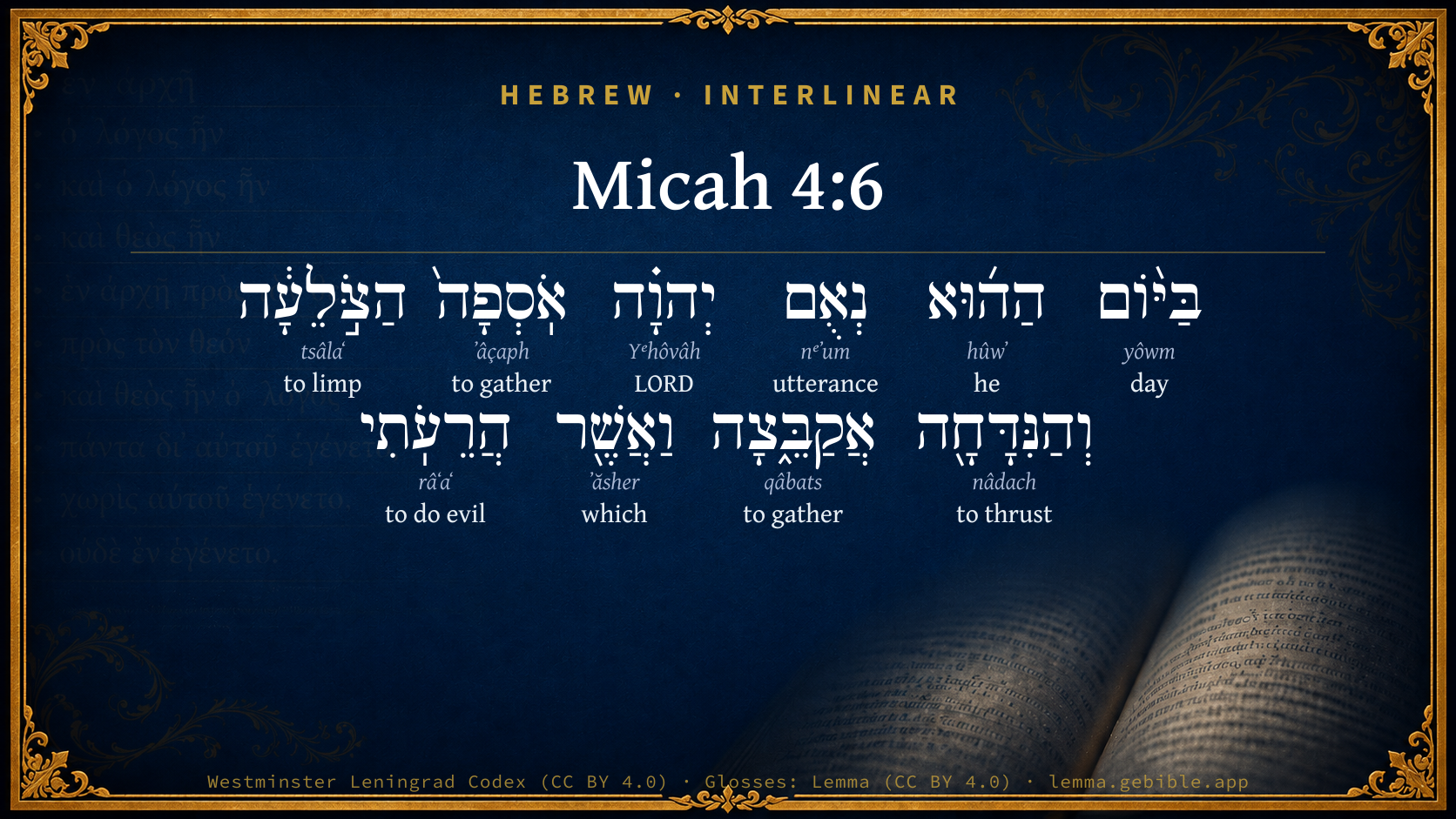
Hebrew (Westminster Leningrad Codex) Micah 4:6 appears in the Hebrew Old Testament. The text above is from the Westminster Leningrad Codex. Each word links to its Strong’s number, a concise gloss, and parsing drawn from the Open Scriptures Hebrew Bible morphology. Click any word for its full Brown-Driver-Briggs (BDB) entry.
Download image
Cite this verse

Micah 4:6 (World English Bible). Public Domain. Lemma interlinear Bible study tool, https://lemma.gebible.app/v/micah/4/6.

Show BibTeX & RIS
BibTeX
RIS
English Translation
"In that day," says Yahweh, "I will assemble that which is lame, And I will gather that which is driven away, And that which I have afflicted;
World English Bible · Public Domain
Download a study sheet

One document with this verse’s original text, its word-by-word gloss line, the meaning frame, cross-references with their text, attributed commentary, and full source and license credits — printable, and it pastes into notes with its structure intact.

This verse Autodidact and up

Study sheet (.html) Plain text (.txt)

A passage Seminary Student

Up to 50 verses in one chapter. A passage sheet keeps up to 6 commentary sources and 12 cross-references per verse, in the order this page ranks them, and says so on the sheet whenever that leaves anything out. Ask for a single verse and you get the Autodidact verse sheet above.

Everything on this page stays free to read, with no account — the sheet is a download of what is already on screen, not access to it.

Want to remove ads? Support Godless Engineer
Compare translations 3

The same verse in 3 English versions, stacked beneath the original-language interlinear above. Click any original word for its lexicon entry.

Each is an independent rendering of the whole verse — the interlinear is not word-aligned to these translations.

Highlighted words mark where these versions differ — a whole-verse word diff, not a word-by-word alignment.

  • World English Bible Public Domain
    "In that day," says Yahweh, "I will assemble that which is lame, And I will gather that which is driven away, And that which I have afflicted;
  • King James Version Public Domain
    In that day, saith the LORD, will I assemble her that halteth, and I will gather her that is driven out, and her that I have afflicted;
  • unfoldingWord Literal Text CC BY-SA 4.0
    “On that day,” declares Yahweh, “I shall assemble the lame and gather the outcast, and those whom I have afflicted.

unfoldingWord Literal Text — © unfoldingWord, licensed CC BY-SA 4.0. Word-aligned USFM3 via Door43 (git.door43.org/unfoldingWord/en_ult).

Versions to compare (up to 4)

3 of 4 selected

Show all 18 translations

Every available English version of this verse, each an independent rendering of the whole verse.

  • World English Bible Public Domain
    "In that day," says Yahweh, "I will assemble that which is lame, And I will gather that which is driven away, And that which I have afflicted;
  • Berean Standard Bible Public Domain
    “On that day,” declares the LORD, “I will gather the lame; I will assemble the outcast, even those whom I have afflicted.
  • Majority Standard Bible Public Domain
    “On that day,” declares the LORD, “I will gather the lame; I will assemble the outcast, even those whom I have afflicted.
  • King James Version Public Domain
    In that day, saith the LORD, will I assemble her that halteth, and I will gather her that is driven out, and her that I have afflicted;
  • American Standard Version (1901) Public Domain
    In that day, saith Jehovah, will I assemble that which is lame, and I will gather that which is driven away, and that which I have afflicted;
  • Revised Version (1885) Public Domain
    In that day, saith the LORD, will I assemble her that halteth, and I will gather her that is driven away, and her that I have afflicted;
  • Geneva Bible (1599) Public Domain
    At the same day, saith the Lord, will I gather her that halteth, and I will gather her that is cast out, and her that I haue afflicted.
  • Douay-Rheims (1899) Public Domain
    In that day, saith the Lord, I will gather up her that halteth: and her that I had cast out, I will gather up: and her whom I had afflicted.
  • Young's Literal Translation Public Domain
    In that day -- an affirmation of Jehovah, I do gather the halting one, And the driven away one I bring together, And she whom I have afflicted.
  • Literal Standard Version CC BY-SA 4.0
    “In that day,” a declaration of YHWH, || “I gather the halting one, || And the driven away one I bring together, || And she whom I have afflicted.
  • Unlocked Literal Bible CC BY-SA 4.0
    “On that day”—this is Yahweh's declaration— “I will assemble the lame and gather the outcast, those whom I have afflicted.
  • unfoldingWord Literal Text CC BY-SA 4.0
    “On that day,” declares Yahweh, “I shall assemble the lame and gather the outcast, and those whom I have afflicted.
  • Darby Bible Public Domain
    In that day, saith Jehovah, will I assemble her that halteth, and I will gather her that is driven out, and her that I have afflicted;
  • World Messianic Bible Public Domain
    “In that day,” says the LORD, “I will assemble that which is lame, and I will gather that which is driven away, and that which I have afflicted;
  • Webster's Bible Public Domain
    In that day, saith the LORD, I will assemble her that halteth, and I will gather her that is driven out, and her that I have afflicted;
  • Free Bible Version CC BY-SA 4.0
    On that day, declares the Lord, I will gather those who are lame, I will bring together those who have been scattered in exile, those whom I punished.
  • Bible in Basic English Public Domain
    In that day, says the Lord, I will get together her who goes with uncertain steps, I will get together her who has been sent away, and her on whom I have sent evil;
  • JPS Tanakh (1917) Public Domain
    In that day, saith the LORD, will I assemble her that halteth, and I will gather her that is driven away, and her that I have afflicted;

Literal Standard Version (2020), Covenant Press — licensed CC BY-SA 4.0. Text via the HelloAO Bible API (eBible.org). Unlocked Literal Bible (unfoldingWord) — licensed CC BY-SA 4.0. Text via the HelloAO Bible API (eBible.org). unfoldingWord Literal Text — © unfoldingWord, licensed CC BY-SA 4.0. Word-aligned USFM3 via Door43 (git.door43.org/unfoldingWord/en_ult). Free Bible Version, Dr. Jonathan Gallagher — licensed CC BY-SA 4.0. Text via the HelloAO Bible API (eBible.org).

Word by word

More ways to search: Search by grammar → Find every occurrence → Compare this word →

Practice this passage: Drill this verse → Learn its vocabulary →

הַצֹּ֣לֵעָ֔ה
tsâlaʻ
H6760
“the · limping”
Particle, Definite Article + Verb, Qal, Participle Active, Feminine, Singular, Absolute
Part of Speech
Particle + Verb
Stem
Qal
Form
Participle Active
Gender
Feminine
Number
Singular
State
Absolute
Full BDB Definition

Origin: a primitive root: probably to curve

TWOT: 1925

to limp, be lame - (Qal) - to limp - to be lame
  1. בַּיּ֨וֹם yôwm H3117 “in/at the · day” Preposition, Determined + Noun, Common, Masculine, Singular, Absolute
  2. הַה֜וּא hûwʼ H1931 “the · he” Particle, Definite Article + Pronoun, Personal, 3rd Person, Masculine, Singular
  3. נְאֻם nᵉʼum H5002 “utterance of” Noun, Common, Masculine, Singular, Construct
  4. יְהוָ֗ה Yᵉhôvâh H3068 “LORD” Noun, Proper
  5. אֹֽסְפָה֙ ʼâçaph H622 “to gather” Verb, Qal, Cohortative, 1st Person, Common, Singular
  6. וְהַנִּדָּחָ֖ה nâdach H5080 “and · the · thrusting” Conjunction + Particle, Definite Article + Verb, Niphal, Participle Active, Feminine, Singular, Absolute
  7. אֲקַבֵּ֑צָה qâbats H6908 “to gather” Verb, Piel, Cohortative, 1st Person, Common, Singular
  8. וַאֲשֶׁ֖ר ʼăsher H834 “and · which” Conjunction + Particle, Relative
  9. הֲרֵעֹֽתִי râʻaʻ H7489 “to do evil” Verb, Hiphil, Perfect, 1st Person, Common, Singular

About this verse

These counts appear in no published source. They are computed here, from the morphology-tagged text and Lemma’s own curated glosses. What Lemma adds →

10
words
10
distinct lemmas
Prophets
section

Notable vocabulary

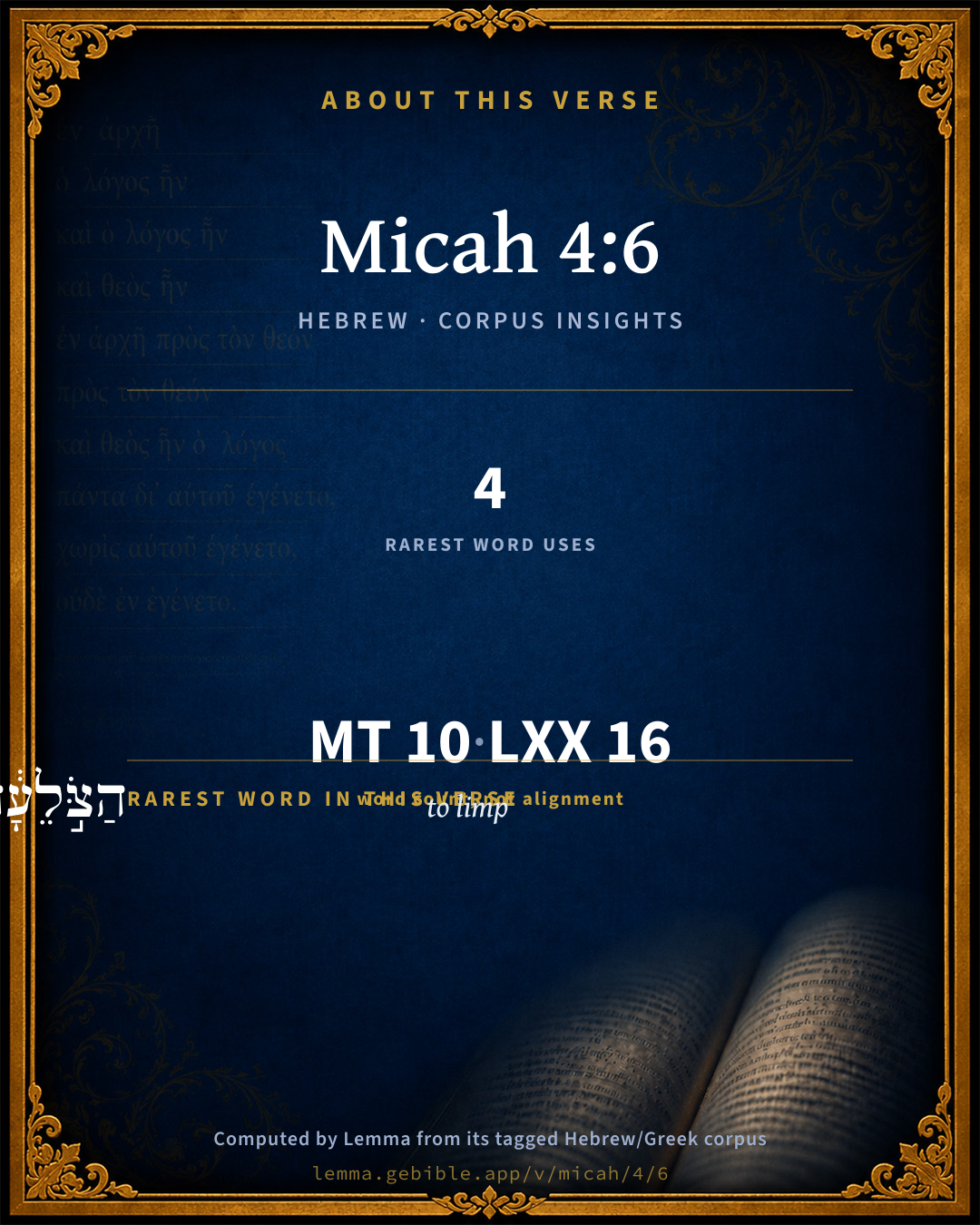
The rarest word here is הַצֹּ֣לֵעָ֔ה to limp H6760 — appearing just 4 times in the whole Hebrew Bible.

Shared distinctive vocabulary

הַצֹּ֣לֵעָ֔ה to limp H6760 occurs in 4 verses of the Hebrew Bible. Also found in:

Grammatical profile

  • 5 verbs
  • 3 nouns
  • 1 pronoun
  • 1 particle

Verb forms

  • אֹֽסְפָה֙ Qal · Cohortative
  • הַצֹּ֣לֵעָ֔ה Qal · Participle Active
  • וְהַנִּדָּחָ֖ה Niphal · Participle Active
  • אֲקַבֵּ֑צָה Piel · Cohortative
  • הֲרֵעֹֽתִי Hiphil · Perfect

Hebrew & Septuagint length

In English translation the verse runs 27 words from the Hebrew and 26 from the Septuagint (LXX English) — closely comparable.

A rough comparison of the two English renderings, which tokenize alike — not a word-level alignment.

Word counts can differ between the Hebrew and the Greek without any difference in meaning — e.g. the Hebrew direct-object marker אֵת has no separate Greek word, and Greek often adds the article ὁ.

In the original languages it is 10 Hebrew tokens and 16 Greek tokens — but the two are counted differently (Hebrew bundles its prefixes and suffixes into one token; the Greek is in lemma form), so that isn’t a like-for-like length.

Cross-references

16

Topical passages linked to Micah 4:6 in the Treasury of Scripture Knowledge — connected by theme and wording, ordered by reader-vote popularity; previews shown in the World English Bible.

  • Zephaniah 3:19 Behold, at that time I will deal with all those who afflict you, and I will save those who are lame, and gather those who were driven away. I will give them praise and honor, whose shame has been in all the earth.
  • Isaiah 56:8 The Lord Yahweh, who gathers the outcasts of Israel, says, Yet will I gather [others] to him, besides his own who are gathered.
  • Ezekiel 34:12–17 As a shepherd seeks out his flock in the day that he is among his sheep that are scattered abroad, so will I seek out my sheep; and I will deliver them out of all places where they have been scattered in the cloudy and dark day.
  • Psalms 147:2 Yahweh builds up Jerusalem. He gathers together the outcasts of Israel.
  • Isaiah 35:3–6 Strengthen you the weak hands, and confirm the feeble knees.
  • Micah 2:12 I will surely assemble, Jacob, all of you; I will surely gather the remnant of Israel; I will put them together as the sheep of Bozrah, As a flock in the midst of their pasture; They will swarm with people.
  • John 10:16 I have other sheep, which are not of this fold. I must bring them also, and they will hear my voice. They will become one flock with one shepherd.
  • Jeremiah 3:18 In those days the house of Judah shall walk with the house of Israel, and they shall come together out of the land of the north to the land that I gave for an inheritance to your fathers.
  • Jeremiah 31:8 Behold, I will bring them from the north country, and gather them from the uttermost parts of the earth, [and] with them the blind and the lame, the woman with child and her who travails with child together: a great company shall they return here.
  • Ezekiel 36:24 For I will take you from among the nations, and gather you out of all the countries, and will bring you into your own land.
  • Ezekiel 37:21–22 Say to them, Thus says the Lord Yahweh: Behold, I will take the children of Israel from among the nations, where they are gone, and will gather them on every side, and bring them into their own land:
  • Ezekiel 39:25–29 Therefore thus says the Lord Yahweh: Now will I bring back the captivity of Jacob, and have mercy on the whole house of Israel; and I will be jealous for my holy name.
  • Luke 19:10 For the Son of Man came to seek and to save that which was lost."
  • Hebrews 12:12–13 Therefore, lift up the hands that hang down and the feeble knees,
  • Psalms 38:17 For I am ready to fall. My pain is continually before me.
  • Jeremiah 30:17–18 For I will restore health to you, and I will heal you of your wounds, says Yahweh; because they have called you an outcast, [saying], It is Zion, whom no man seeks after.

Cross-references courtesy of OpenBible.info (CC BY 4.0).

Hebrew and Greek witnesses Masoretic Hebrew ↔ Greek Septuagint

The same verse in the two great witnesses to the Old Testament, shown verse-for-verse.

These are two independent witnesses, not word-aligned to each other, and the Septuagint is shown in lemma (dictionary) form.

Hebrew Micah 4:6 Masoretic · Westminster Leningrad Codex

בַּיּ֨וֹם הַה֜וּא נְאֻם יְהוָ֗ה אֹֽסְפָה֙ הַצֹּ֣לֵעָ֔ה וְהַנִּדָּחָ֖ה אֲקַבֵּ֑צָה וַאֲשֶׁ֖ר הֲרֵעֹֽתִי

"In that day," says Yahweh, "I will assemble that which is lame, And I will gather that which is driven away, And that which I have afflicted;

World English Bible · Public Domain

Greek LXX Micah 4:6 Septuagint · lemma form

ἐν ὁ ἡμέρα ἐκεῖνος λέγω κύριος συνἄγω ὁ συντρίβω καί ὁ ἐκὠθέω εἰςδέχομαι καί ὅς ἀποὠθέω

In that day, says the Lord, I will gather her that is bruised, and will receive her that is cast out, and those whom I rejected.

LXX2012 (modern English Septuagint) · Public Domain

On this verse, Trapp's Complete Commentary discusses the Septuagint’s reading. Read the note in Commentary ↓

Hebrew: Westminster Leningrad Codex (CC BY 4.0). Greek: Septuagint (public domain); English from LXX2012 (modern English Septuagint) (Public Domain). How the Septuagint differs from the Hebrew →

Targum (Aramaic paraphrase)

1

The Targum is the ancient Jewish Aramaic paraphrase of the Hebrew Scriptures — an interpretive translation, not the Hebrew text itself. Onkelos (literal) and Pseudo-Jonathan (expansive) render the Torah, and Jonathan the Prophets. Coverage is partial: where no permissively-licensed English translation exists for a verse, only the Aramaic is shown. This is verse-level text, not a word-by-word alignment to the Hebrew.

  1. Targum Jonathan Prophets (Joshua–Malachi)
    בְּעִדָנָא הַהִיא אֲמַר יְיָ אֶכְנוֹשׁ מְטַלְטְלַיָא וּמְבַדְרַיָא אֲקָרֵיב וּדְאַבְאֵשִׁית לְהוֹן מִן קֳדָם חוֹבֵי עַמִי:

    (no public-domain English translation for this verse)

    Targum Jonathan — Aramaic: “Mikraot Gedolot” (public domain). English: “Sefaria Community Translation” (CC0 1.0 (public-domain dedication)); “London "Chaldee Paraphrase," 1871” (public domain). Text via Sefaria.

Commentary

Notes on Micah 4:6 from classic Christian and Jewish commentators (each source and its license shown beneath its notes). The classic Christian expositions comment on the surrounding passage and are grouped to its opening verse, so a note may address several verses; the Jewish commentaries on the Tanakh (Rashi and others) are per-verse, so they appear only where the commentator wrote on this verse.

Lemma curates 59 commentaries, every one of them public domain or Creative Commons licensed, each selected and text-cleaned for this edition rather than reprinted as found. About our sources →

Trapp's Complete Commentary

John Trapp

Mic 4:6 In that day, saith the LORD, will I assemble her that halteth, and I will gather her that is driven out, and her that I have afflicted;

Ver. 6. In that day] sc. of grace and of the gospel. It is called a day, and that day, by an excellence, in regard of revelation, adornation, consolation, distinction, speedy preterition.

Saith the Lord] Whose word cannot be broken, Joh 10:25, and is therefore the best security, 2Co 1:20.

Will I assemble her that halteth] Heb. that goeth sideling, that is maimed, disjointed, lamed, Isa 35:3, torn, Psa 35:15, and tired out with long journeys into captivity, as the Jews were by the Babylonians, Greeks, and Romans before Christ’s coming: that they might breathe after those days of refreshing from the presence of the Lord, Mal 3:1.

And I will gather her that is driven out] Or, rejected, thrust away with a force, that is, the Gentiles suffered to walk in their own ways, Act 14:16, and carried away unto dumb idols, even as they were led, 1Co 12:2.

And her that I have afflicted] Both Jews and Gentiles, the whole community of people: for God shook all nations then, when the Desire of all nations {Christ, Heb 12:26} was to come, Hag 2:7; Hag 2:22-23. Junius, after the Septuagint, rendereth it, ut veniant desiderati omnium gentium, So may they come, the desire of all nations, that the saints, those desirable ones, out of all nations may come: for unto Shiloh in a most afflicted time (when the sceptre was departed from Judah, &c.) was the gathering of all people to be, Gen 49:10 Isa 26:8-9, See Isa 66:20 : rather in litters (as lame people are carried) should they come, than not at all: rather on one leg, with Jacob, should they wrestle, than not prevail.

John Trapp, A Commentary or Exposition upon All the Books of the Old and New Testament (1647–1656) — public domain. Text from a community e-Sword module.

The Biblical Illustrator

Joseph S. Exell

Mic_4:6-8

The Lord shall reign over them in Mount Zion

The blessing of the ingathered ones

I.

The character of the assembly.

1. The halt.

2. The banished.

3. The afflicted.

From this gather the ruined condition of man.

(1) The halt--incapable of any spiritual movement. Hence the corruption of the understanding, will, affections, memory; the whole man.

(2) Driven out; banished; expelled from God. Condemned by the law. Subject to Gods wrath. Allied to Gods enemies.

(3) Afflicted, that is, grievously distressed. Afflicted with blindness, lameness, deafness, dumbness, leprosy; and by sin, Satan, etc.

II. Their gracious advancement and honour. I will make her that halteth a remnant. A remnant is a small quantity or number. A definitive or proportioned remnant. An eternally saved remnant. A gathered or collected remnant. A prosperous or happy remnant. A holy and righteous remnant. An opposed remnant. Yet finally a successful remnant. And her that was cast far off a strong nation. Strong by reason of its situation; its fortifications; its judicious and good laws; its military skill; its rulers wisdom. Consequently a blessed nation. And the Lord shall reign over them in Mount Zion from henceforth forever. They are made submissive to Christ. Christ reigns in the Church generally. He reigns in the Churchs officers. He reigns in the Church members. He reigns in the understandings of His people. He reigns in their will, subduing them. He reigns in their hearts. This reign is by the power of Divine grace.

III. Their positive and infallible security (Mic_4:8). Represented by a flock of sheep, denotive of feebleness, and liability to danger. But Christ is their tower of defence. A high and lofty tower, and a strong and safe tower. The stronghold of the daughter of Zion. By the word daughter is meant the Church. This stronghold denotes that we have enemies. It is a hiding place for the Lords prisoners. Unto thee shall it come, even the first dominion. An eternally decreed dominion, over sin, Satan, the world, death. The kingdom shall come to the daughter of Jerusalem. The kingdom of Gods power; grace; glory. Improvement--

1. This subject teaches us mans total depravity and utter helplessness.

2. It also further proves that our salvation is entirely of grace.

3. It evinces the final security of all true believers. (T. B. Baker.)

The moral monarchy of Christ in the world

Whether the subject of these verses is the restoration of the Jews after the Babylonish Captivity or the gathering of men by Christ into a grand spiritual community, is a question on which there has been considerable discussion among biblical scholars, and, therefrom, should preclude anything like dogmatism on either side.

I. It embraces amongst its subjects the most wretched and scattered of men. In that day, saith the Lord, will I assemble [gather] her that halteth [that which limpeth], and I will gather her that is driven out [that which was thrust out], and her that [which] I have afflicted; and I will make her that [that which] halted [limps] a remnant, and her that [that which] was cast off a strong nation: End the Lord shall reign over them in Mount Zion from henceforth, even forever. Christ was sent to the lost sheep of the house of Israel (Mat_10:6), and His invitation was to all that are weary and heavy laden. The Church of Christ from the beginning has comprised those who were the most afflicted, the most scattered, and the most distressed of mankind.

1. Christs moral monarchy knows nothing of favouritism. Every soul to Him is a matter of profound practical interest.

2. Christs moral monarchy is remedial in its design. It brings all the miserable together in order to rid them of their sorrows.

II. It establishes itself as the guardian of men forever. And thou, O tower of the flock, the stronghold of the daughter of Zion, etc. The watchtower spoken of by Isaiah is most likely the tower here referred to by Micah. Flock tower is a good expression, inasmuch as it indicates the watchfulness of Christ as a moral Shepherd, the great Shepherd of souls. What a Guardian, what a Bishop of souls is Christ!

1. He knows all His sheep.

2. He has ample provision for all His sheep.

3. He has power to protect all His sheep. Thank God this moral kingdom is established on our earth. Because it is moral, men have the power of resisting it. (Homilist.)

Prophecies relative to the Jewish nation

The Jewish nation, when restored, will be the most glorious of the nations of the earth. There is, in this passage, a comparison instituted between the glory of other nations; and it is stated that her glory shall be superior to that of all others.

I. Reasons drawn from the nature of national glory. The glory of the Jewish nation cannot be what is generally considered as the glory of nations.

1. Because the glory of common nations is inseparable from unrighteousness. Self is the moving power of the machine, interest and vanity form its mainspring.

2. Because it leads to war and bloodshed, to wretchedness and misery.

3. Because it may consist with infidelity.

II. Reasons drawn from what is revealed respecting the Jews.

1. Because the Jews, when brought back to their own land, will be a righteous nation.

2. It will be a peaceful, happy nation.

3. A nation of faithful worshippers of the one only living and true God. What then will be her glory? It will consist in righteousness, penitence, godliness, purity, and devotion.

Lessons--

1. A political lesson. The duty of the Christian is submission to the powers that be, patiently waiting for the time when righteousness alone shall prevail.

2. A religious lesson. How should this subject enhance the importance of being snatched out of the vortex of this present state, and of becoming so established as to be able to sing, by anticipation, the songs of joy which are here set to be sung by the ransomed of the Lord in Zion. (Hugh MNeile.)

The Biblical Illustrator, edited by Joseph S. Exell (c. 1880s–1900s) — public domain. Text from a community e-Sword module.

Joseph Benson's Commentary

Mic 4:6-7. In that day — At that time; will I assemble her that halteth —

Or, her that is weak, or bowed down; namely, the Jewish people, weakened with the hard usage of oppressing conquerors. And I will gather her that is driven out — Captive Judah, driven out from their own land. And her that I have afflicted — That I have subjected to great calamities. The calamity of the seventy years’ captivity in Babylon seems to be chiefly referred to: as if he had said, “Though I have broken the power of my people, removed them into captivity afar off, and afflicted them; yet will I restore them to their country, I will send them the Messiah, and will be always their king.” I will make her that halted a remnant — A part of them shall be preserved, as a seed which shall take root and increase, which shall continue to the coming of the Messiah, and in which the designs of my providence shall be accomplished.

Joseph Benson's Commentary on the Old and New Testaments (1811–1818) — public domain. Text from a community e-Sword module.

Whedon's Commentary on the Bible

Daniel D. Whedon

Restoration and healing of the dispersed — Revival of the kingdom of David, Mic_4:6-8.

6. When the era of Messianic peace dawns, the dispersed of Israel will share in its glory; Jehovah will bring back all whom in his anger he cast out. A similar promise is found in Mic_2:12-13, only in the present passage is added a new thought, the restoration of health, physical and moral, to the dispersed. R.V. reads instead of “her that halteth… ,” “that which is lame,… that which is driven away,… that which I have afflicted,” which is preferable in English, though the Hebrew has the feminine form. All three expressions are pictures of the judgment suffered in consequence of sin. The affliction has been severe and the outcasts are near unto death, but Jehovah will revive them.

Daniel D. Whedon (gen. ed.), Commentary on the Old and New Testaments (1874–1909) — public domain. Text from a community e-Sword module.

Keil & Delitzsch

C. F. Keil & F. Delitzsch

From this salvation even the Israel that may be in misery or scattered abroad will not be excluded. Mic 4:6. "In that day, is the saying of Jehovah, will I assemble that which limps, and gather together that which has been thrust out, and which I have afflicted. Mic 4:7. And I will make that which limps into a remnant, and that which is far removed into a strong nation; and Jehovah will rule over them from henceforth, even for ever." "In that day" points back to the end of the days in Mic 4:1. At the time when many nations shall go on pilgrimage to the highly exalted mountain of the Lord, and therefore Zion-Jerusalem will not only be restored, but greatly glorified, the Lord will assemble that which limps and is scattered abroad. The feminines הצּלעה and הנּדּחה are neuters, and to be understood collectively. Limping denotes the miserable condition into which the dispersed have been brought (cf. Psa 35:15; Psa 38:18). And this misery is inflicted by God. The limping and dispersed are those whom Jehovah has afflicted, whom He has punished for their sins. The gathering together of the nation has already been promised in Mic 2:12; but there the assembling of all Israel was foretold, whereas here it is merely the assembling of the miserable, and of those who are scattered far and wide. There is no discrepancy in these two promises. The difference may easily be explained from the different tendencies of the two addressed. "All Jacob" referred to the two separate kingdoms into which the nation was divided in the time of the prophet, viz., Israel and Judah, and it was distinctly mentioned there, because the banishment of both had been foretold. This antithesis falls into the background here; and, on the other hand, prominence is given, in connection with what precedes, to the idea of happiness in the enjoyment of the blessings of the holy land. The gathering together involves reinstatement in the possession and enjoyment of these blessings. Hence only the miserable and dispersed are mentioned, to express the thought that no one is to be excluded from the salvation which the Lord will bestow upon His people in the future, though now he may be pining in the misery of the exile inflicted upon them. But just as the whole of the nation of Israel to be gathered together, according to Mic 2:12, consists of the remnant of the nation only, so does the gathering together referred to here point only to the restoration of the remnant, which is to become a strong nation, over which Jehovah reigns as King in Zion. מלך is emphatic, expressing the setting up of the perfected monarchy, as it has never yet existed, either in the present or the past.

(Note: "Micah does not mention the descendants of David here, but Jehovah Himself, not to exclude the kingdom of David, but to show that God will prove that He was the author of that kingdom, and that all the power is His. For although God governed the ancient people by the hand of David, and by the hand of Josiah and Hezekiah, yet there was as it were a cloud interposed, so that God then reigned obscurely. The prophet therefore indicates a certain difference here between that shadowy kingdom and the new kingdom which God will openly manifest at the advent of the Messiah." - Calvin.)

This dominion will never be interrupted again, as it formerly was, by the banishment of the nation into exile on account of its sins, but will endure מעתּה (henceforth), i.e., from the future, which is regarded as present, even for ever.

So far as the realization of this exceedingly glorious promise is concerned, the expression standing at the head, be'achărı̄th hayyâmı̄m (at the end of the days), already points to the Messianic times: and the substance of the promise itself points to the times of the completion of the Messianic kingdom, i.e., to the establishment of the kingdom of glory (Mat 19:28). The temple mountain is a type of the kingdom of God in its New Testament form, which is described by all the prophets after the forms of the Old Testament kingdom of God. Accordingly, the going of the nations to the mountain of the house of Jehovah is, as a matter of fact, the entrance of the heathen who have been brought to the faith into the kingdom of Christ. This commenced with the spread of the gospel among the Gentiles, and has been continued through all the ages of the Christian church. But however many nations have hitherto entered into the Christian church, the time has not yet come for them to be so entirely pervaded with the spirit of Christ, as to allow their disputes to be settled by the Lord as their King, or to renounce war, and live in everlasting peace. Even for Israel the time has not yet come for the limping and exiled to be gathered together and made into a strong nation, however many individual Jews have already found salvation and peace within the bosom of the Christian church. The cessation of war and establishment of eternal peace can only take place after the destruction of all the ungodly powers on earth, at the return of Christ to judgment and for the perfecting of His kingdom. But even then, when, according to Rom 11:25., the pleroma of the Gentiles shall have entered into the kingdom of God, and Israel as a nation (πᾶς Ἰσραήλ = יעקב כּלּו in Mic 2:12) shall have turned to its Redeemer, and shall be assembled or saved, no physical elevation of the mountain of Zion will ensue, nor any restoration of the temple in Jerusalem, or return of the dispersed of Israel to Palestine. The kingdom of glory will be set up on the new earth, in the Jerusalem which was shown to the holy seer on Patmos in the Spirit, on a great and lofty mountain (Rev 21:10). In this holy city of God there will be no temple, "for the Lord, the Almighty God, and the Lamb, are the temple thereof" (Rev 21:22). The word of the Lord to the Samaritan woman concerning the time when men would neither worship God on this mountain, nor yet in Jerusalem, but worship Him in spirit and in truth (Joh 4:21, Joh 4:23), applies not only to the kingdom of God in its temporal development into the Christian church, but also to the time of the completion of the kingdom of God in glory.

Keil & Delitzsch — Biblical Commentary on the Old Testament (1861–1891) — public domain (CC PDM 1.0). Text via the HelloAO Bible API. (Old Testament only.)

Tyndale Open Study Notes

Tyndale Open Resources

4:6-7 Usually the remnants of destroyed cities in the ancient Near East were lost or assimilated. When Israel’s remnant was rescued, it would be the foundation of the Lord’s new people (Deut 4:26-31; 30:1-5; 2 Kgs 19:31; Isa 10:21; Jer 29:10-14; see Ezra 9:8; Neh 1:2).

Tyndale Open Study Notes — © Tyndale Open Resources, licensed CC BY-SA 4.0. Text via the HelloAO Bible API.

Jamieson, Fausset & Brown

Robert Jamieson, A. R. Fausset & David Brown

assemble her that halteth--feminine for neuter in Hebrew idiom, "whatever halteth": metaphor from sheep wearied out with a journey: all the suffering exiles of Israel (Eze 34:16; Zep 3:19).

her . . . driven out--all Israel's outcasts. Called "the Lord's flock" (Jer 13:17; Eze 34:13; Eze 37:21).

Jamieson, Fausset & Brown — Commentary Critical and Explanatory on the Whole Bible (1871) — public domain (CC PDM 1.0). Text via the HelloAO Bible API.

Adam Clarke's Commentary

Verse 6. Will I assemble her that halteth - driven out - afflicted] Under these epithets, the state of the Jews, who were to be gathered into the Christian Church, is pointed out. They halted between the true God and idols; they were driven out into captivity, because of this idolatry; and they were variously afflicted, because they would not return unto the Lord that bought them.

Adam Clarke's Commentary on the Bible (1810–1826) — public domain. Text from a community e-Sword/MySword module.

John Calvin's Commentaries

The Prophet pursues the same subject. But we must ever remember what I have previously reminded you of, — that the trials would be so grievous and violent that there would be need of strong and uncommon remedies; for the faithful might have been a hundred times sunk, as it were, in the deepest gulfs, except they had been supported by various means. This then is the reason why the Prophet confirms so fully the truth which we have noticed respecting the restoration of the Church.

In that day, he says, I will gather the halting This metaphor is not only found here; for David sage that his own affliction was like that of halting. The word צלעה, tsaloe, means the side: hence they metaphorically call those halters who walk only on one side: it is the same as though he had said, that they were maimed or weak. He then adds, I will assemble the ejected, whom I have afflicted. In the next verse he repeats the same, I will make the halting, he says, a remnant; that is, I will make her who is now halting to remain alive, and her who is cast afar off, a strong nation. Some explain אנאלאה, enelae, in a more refined manner, and say that it means, She who is gone before; as though the Prophet said, God will sustain the halting, and to those who are lively he will add strength. But this exposition is too strained. We see that the context will not admit it; for the Prophet brings forward the Church here as afflicted by the hand of God, and nigh utter ruin: and then, on the other hand, he intimates, that it was to be restored by God’s power, and that it would thereby gather new strength, and flourish as before: he therefore calls the Church as one cast far away, as in the previous verse; and the other verse clearly shows, that the Prophet’s design was no other but to point out the twofold state of the Church.

Now, in the first place, we must observe, that the Prophet meets the trial then present, which must have otherwise depressed the hearts of the godly. He saw that they were in a manner broken down; and then their dispersion was as it were a symbol of final ruin. If then the faithful had their minds continually fixed on that spectacle, they might have a hundred times despaired. The Prophet therefore comes here seasonably to their help, and reminds them, that though they were now halting, there was yet in God new vigor; that though they were scattered, it was yet in God’s power to gather those who had been driven afar off. The meaning briefly is, that though the Church differed nothing for a time from a dead man, or at least from one that is maimed, no despair ought to be entertained; for the Lord sometimes raises up his people, as though he raised the dead from the grave: and this fact ought to be carefully noticed, for as soon as the Church of God does not shine forth, we think that it is wholly extinct and destroyed. But the Church is so preserved in the world, that it sometimes rises again from death: in short, the preservation of the Church, almost every day, is accompanied with many miracles.

But we ought to bear in mind, that the life of the Church is not without a resurrection, nay, it is not without many resurrections, if the expression be allowed. This we learn from the words of the Prophet, when he says, ‘I will then gather the halting, and assemble the driven away;’ and then he adds, ‘and her whom I have with evils afflicted.’ And this has been expressly said, that the faithful may know, that God can bring out of the grave those whom he has delivered to death. For if the Jews had been destroyed at the pleasure of their enemies, they could not have hoped for so certain a remedy from God: but when they acknowledged that nothing happened to them except through the just judgment of God, they could entertain hope of restoration. How so? Because it is what is peculiar to God to bring forth the dead, as I have already said, from the grave; as it is also his work to kill. We then see that what the Prophet promised, respecting the restoration of the Church, is confirmed by this verse: I am he, says God, who has afflicted; cannot I again restore you to life? For as your death is in my hand, so also is your salvation. If the Assyrians or the Chaldeans had gained the victory over you against my will, there would be some difficulty in my purpose of gathering you; but as nothing has happened but by my command, and as I have proved that your salvation and your destruction is in my power, there is no reason for you to think that it is difficult for me to gather you, who have through my judgment been dispersed.

John Calvin's Commentaries (1540-1563) — public domain. Text from the Calvin Translation Society English edition (1840s-50s) via the Christian Classics Ethereal Library (ccel.org). Calvin's coverage is partial (roughly two-thirds of the Bible); uncommented books and verses are honest gaps, never fabricated. The 19th-century editor's footnotes and remarks are omitted so the notes are faithfully Calvin's own voice.

Ellicott's Commentary for English Readers

(6, 7) Her that halted.—Like flocks wearied with heat and journeyings. The promise immediately refers to the return when God would re-establish the Jews, and eventually come Himself to the restored Temple. And, further, His own promise sanctions the words of Micah as to the abiding character of His rule, that legacy which He left to the Church—“Lo, I am with yon alway, even unto the end of the world.”

A Bible Commentary for English Readers, edited by Charles John Ellicott (1878–1897) — public domain. Text from a community e-Sword module.

The Cambridge Bible for Schools and Colleges

gen. ed. J. J. S. Perowne

6, 7. Prophecy of restoration

6. In that day] i.e. in the Messianic age (Mic_4:1).

will I assemble, &c.] A similar promise has been made in Mic_2:12. There the emphasis is laid on the closing of the national schism; here, on the remedy to be applied to the physical and moral misery of the exiles. In both cases, it is only a remnant of the nominal Israelites which is restored. Comp. the imitation in Zep_3:19.

The Cambridge Bible for Schools and Colleges (gen. ed. J. J. S. Perowne; Cambridge University Press, 1878–1918) — public domain. Text from a community e-Sword module.

John Gill's Exposition

In that day, saith the Lord, will I assemble her that halteth,.... The Jews or Israelites so described; not from the halting of Jacob their father, as Abarbinel thinks; nor because of their halting between two opinions, worshipping both the true God and idols, as in the times of Elijah; for this will not suit with the Jews in their present state; but because they were like lame and maimed sheep, to which the allusion is; or because they were guilty of sins, which are sometimes expressed by halting, Jer 20:10. The word signifies such that go sideways, and not uprightly; and fitly describes such who deviate from the ways of God, and walk not according to the divine word: now "in that day" or time before referred to, the last days of the Gospel dispensation, the Lord will convert the Jews; or "heal" these lame and maimed ones, so Jarchi interprets the word; or will gather them by his Spirit and grace to the Messiah, and assemble them into his church, and among his people, and bring them into the sheepfold, under the care of the one Shepherd, the Lord Jesus Christ:

and I will gather her that is driven out; out of the land of Israel, and scattered among the nations of the world; even driven out by the Lord himself, because of their transgressions against him; see Jer 16:15;

and her that I have afflicted; with various calamities, with famine and sword, with captivity and poverty; the Targum adds,

"for the sins of my people;''

the Israelites for their idolatry, and the Jews for the rejection of the Messiah, and other sins.

John Gill's Exposition of the Whole Bible (1746–1763) — public domain (CC PDM 1.0). Text via the HelloAO Bible API.

Albert Barnes' Notes on the Bible

In that day - that is, in that day of Christ and of His Gospel, of grace and salvation, the last days of which he had been speaking. Hitherto he had prophesied the glory of Zion, chiefly through the coming-in of the Gentiles. Now he adds, how the Jews should, with them, be gathered by grace into the one fold, in that long last day of the Gospel, at the beginning, in the course of it, and completely at the end Rom 11:26.

Her that halteth - The prophet resumes the image of the scattered flock, under which he had before Mic 2:12-13 foretold their restoration. This was no hope of his own, but His word who cannot fail. The course of events, upon which he is entering, would be, at times, for their greatness and their difficulty, past human belief. So he adds straightway, at the outset, “saith the Lord.” To “halt” is used of bodily lameness Gen 32:32, and that, of a flock, worn out by its wanderings Zep 3:19. It is used also of moral halting Psa 35:15; Psa 38:18, such as had been a chief sin of Israel, serving partly God, partly Baal ; God, with a service of fear, Baal with a service of that counterfeit of love, sensuality. So it was sick, both in body and soul, and driven out also, and afflicted.

Albert Barnes' Notes on the Bible (1834–1885) — public domain. Text from a community e-Sword/MySword module.

Haydock's Catholic Bible Commentary

Halteth, as the synagogue did, (3 Kings xviii. 21.) bringing nothing to perfection, (Hebrews vii. 19.) while the Gentiles were abandoned to idolatry. From both Christ chose his Church, Acts xxi. 20., &c. (Calmet) --- The Jews will be at last converted. (Worthington)

George Leo Haydock (1774–1849), Haydock's Catholic Family Bible and Commentary, 1859 edition — public domain. Excludes Psalms (Douay-Rheims chapter numbering differs from Protestant) and Deuterocanonical books (Catholic canon only).

Matthew Poole's English Annotations

In that day; called last or latter days, Mic 4:1; in the day wherein I shall restore my captived people, and in the day I shall redeem mine elect. I will assemble; first, and in part, by the edicts of Cyrus, Darius, and Artaxerxes, for the release of the captives, their return to Jerusalem, and for the rebuilding the temple, and for restoring the worship of God; but more fully by the preaching of the gospel, publishing salvation by Christ, to whom the gathering of the Gentiles was to be, Gen 49:10.

Her that halteth; see Zep 3:19; weakened with the hard usages of oppressing conquerors; who were as lamed ones, unable to walk: such were the impoverished Jews in the Babylonish captivity, utterly unprovided for so long a journey; and it is likely they were unresolved, too, whether to go or not go, halted between a desire of going and a fear of the difficulties that would unavoidably attend their poverty. Now the bounty and favour which God moved in the Persian kings toward the Jews was such, that these poor were encouraged to set forward on the journey. This word is to this day fulfilled, in that Christ doth by the power of his Word and Spirit make his people a willing people, determines their resolution, and enables them to perform it, and to give up themselves to God.

I will gather her that is driven out: in this phrase,

I will gather, does God by Ezekiel, Eze 28:25, promise the recovery of his people from captivity; and so does Jeremiah, Jer 31:8, almost in the same manner promise the restoring of captive Judah. Here they are said to be

driven out, i.e. of their own land, into a strange land, where they are captives, Jer 8:3; 16:15; 23:3; 24:8,9; 29:14; Eze 4:13. The Lord will by his power and goodness gather those whom Nebuchadnezzar scattered through his kingdom, and Christ will much more gather to his filled those who were captives to Satan.

Her that I have afflicted: this in the letter refers to wasted and impoverished Israel, on whom God laid an affliction of seventy years.

Matthew Poole's English Annotations on the Holy Bible (1683–1685) — public domain. Text from a community e-Sword/MySword module.

The Pulpit Commentary

Vers. 6, 7. In this promised restoration all Israel is included, if they choose to accept, the offer.

In that day. The Messianic age of ver. 1. Her that halteth; Septuagint, thnhn , "her that is bruised;" Vulgate, claudicantem. Under the image of a flock footsore and dispersed, the prophet signifies the depressed condition of the excelled Hebrews. (comp. Mic_2:12 Zep_3:19) It is the sick and afflicted here who are to he gathered together, the remnant, that is (ver. 7), wherever found, which turns to the Lord in repentance and humility.

Vers. 6, 7. The restoration of Israel.

It is the Gentile nations for whom the blessings of "the last days" have just been predicted (vers. 2-4). The new Mount Zion of the Messiah"s days will have a magnetic power on "the East and the West". (Mat_8:11Jo Mat_12:32) But Israel, through whom these blessings reach the nations, shall not be excluded from a share in them. Yet the form of the prediction reminds us of the abject condition of God"s ancient people and of the gradual extension of the glories of Messiah"s reign over them.

I THEIR ABJECT CONDITION. They are described as:

1. Halting. This was the result of internal infirmity or of injury from without, or of both. The Jewish people at the advent were suffering both from ecclesiastical and moral corruptions, which made them figuratively like the folk at Bethesda, "halt, withered, impotent.

2. Driven out." Multitudes had been driven out of their heritage in Palestine by the decrees of conquerors or the oppressions of foreign tyrants. Centuries before, Jeremiah had declared, "Israel is a scattered sheep; the lions have driven him away: first the King of Assyria hath devoured him; and last this Nebuchadrezzar King of Babylon hath broken his bones". (Jer_50:17) In subsequent centuries similar captivities or oppressions were endured at the hands of the Ptolemies, the Seleucidae, the Idumeans, and the Romans. Those who remained were as strangers in their own fatherland. And soon a far more fearful catastrophe scattered them from one end of the heavens to the other, after the destruction of their city by the Romans. "But we must wander witheringly In other lands to die; And where our fathers" ashes be Our own must never lie: Our temple hath not left a stone, And Mockery sits on Salem"s throne. (Byron)

3. Stricken of God, and afflicted." Unfaithful "shepherds" among their own rulers (Eze_34:1-6) or heathen conquerors were the scourges; but "shall there be evil in a city, and the Lord hath not done it?" Devout men recognized this, and uttered such penitential wails as we find in Ps 44 Ps 74 Lam_1:2., etc.

II THEIR RESTORATION. The establishment of the new kingdom of God Christ"s kingdom on Mount Zion was itself a pledge of the restoration of the Jews and of their participation in its blessings. For it could not be that Christ should reign over the Gentile nations and leave "his own people" (Joh_1:11) to perish finally in unbelief. This would be opposed both to the ancient promises of God (Isa_45:17 Isa_59:20, Isa_59:21, etc.) as well as to the predictions and the heart of Christ. (Mat_23:37-39) Yet there are stages in this process of restoration.

1. The halting ones are restored, but they are only a remnant. (Cf. Mic_5:3, Mic_5:7, Mic_5:8) The immediate effect of the establishment of Christ"s kingdom was seen in a great religious revival among the Jews from Pentecost onwards. But all the converts were but a remnant of the nation which, because of its unbelief, was "broken off". (Rom_11:1-5, Rom_11:17-20) Yet in the fact of the salvation of the few the Apostle Paul sees the pledge of the final salvation of the many.

2. The banished ones shall be made a strong nation. Trace St. Paul"s inspired argument in Ro 11 till he arrives at the sublime conclusion in vers. 32-36. The nation"s restoration to God will be accompanied by a restoration to their own land. (Zec_12:10-14 Zec_14:8-11, etc.)

3. The Lord shall reign ever them in Mount Zion. " We look for the restoration of Israel to their Saviour and to their land as one of the marvellous evidences of the truth of the prophetic word which God is reserving for the scepticism of these latter days. We need not anticipate a literal and local throne of Christ at Jerusalem. But the Lord Christ, being enthroned in the hearts of his long faithless yet much beloved people, will as truly "reign over them in Mount Zion" as though they had his glorified humanity always manifested in their midst. And then his reign shall be "from henceforth, even forever." "I the Lord will hasten it in his time." "O come, O come, Emmanuel, And ransom captive Israel, That mourns in lonely exile here Until the Son of God appear. Rejoice, rejoice: Emmanuel Shall come to thee, O Israel! E.S.P.

Vers. 6-8. The moral monarchy of Christ in the world.

"In that day, saith the Lord, will I assemble her that halteth, and I will gather her that is driven out, and her that I have afflicted; and I will make her that halted a remnant, and bet that was cast far off a strong nation: and the Lord shall reign over them in Mount Zion from henceforth, even forever. And thou, O tower of the flock, the strong hold of the daughter of Zion, unto thee shall it come, even the first dominion; the kingdom shall come to the daughter of Jerusalem." Whether the subject of these verses is the restoration of the Jews after the Babylonish captivity or the gathering of men by Christ into a grand spiritual community, is a question on which there has been considerable discussion among biblical scholars, and therefore should preclude anything like dogmatism on either side. I am disposed, however, to entertain the latter idea, because it seems most in accordance with the previous verses, in which there is an undoubted reference to the gospel age, and because it gives the passage a wide practical application. Delitzsch says, "In that day" points back to the end of the days. At the time when many nations shall go on pilgrimage to the highly exalted mountain of the Lord, and therefore Zion-Jerusalem will not only be restored but greatly glorified, the Lord will assemble that which limps and is scattered abroad." We shall take the words, then, as illustrating certain facts connected with the moral monarchy of Christ in the world.

I IT EMBRACES AMONGST ITS SUBJECTS THE MOST WRETCHED AND SCATTERED OF MEN. "In that clay, saith the Lord, will I assemble gather her that halteth that which limpeth, and I will gather her that is driven out that which was thrust out and her that which I have afflicted; and I will make her that that which halted limps a remnant, and her that that which was cast far off a strong nation: and the Lord shall reign over them in Mount Zion from henceforth, even forever." Christ was sent to the lost sheep of the house of Israel, (Mat_10:6) and his invitation was to all that are "weary" and "heavy laden." The Church of Christ from the beginning has comprised those who were the most afflicted, the most scattered, and the most distressed of mankind. It has been and is the grand asylum for the tried and the sorrowful and those who are counted "the offscouring of all things". (1Co_4:13)

1. Christ"s moral monarchy knows nothing of favouritism. It does not treat men according to their physical condition, social status, or temporal circumstances. It has respect to souls. It is as much interested in the soul of the pauper as in that of the prince, the soul of the slave as in that of the sovereign. Human monarchies have ever been taken up with man in his material relations. The more wealthy and influential a man is, the more favours will worldly kings bestow; the indigent and the homeless are only regarded as beasts of burden. Not so with Christ as the Monarch. Every soul to him is a matter of profound practical interest.

2. Christ"s moral monarchy is remedial in its design. It brings all the miserable together in order to rid them of their sorrows. By working into human souls right principles of action and expelling wrong ones, it indirectly, though most efficiently, heals all the temporary woes of mankind. "Seek first the things from above, and all others shall be added unto you." "Godliness is profitable unto all things, having the promise of the life which now is, as well as of that which is to come.

II IT ESTABLISHES ITSELF AS THE GUARDIAN OF MEN FOREVER. "And thou, O tower of the flock, the strong hold of the daughter of Zion," etc. The address to the "tower of the flock" shows that, as the most wretched and scattered of men will be brought into a great community, so shall the reign of the daughter of Zion be restored, i.e. the Jews be converted and brought in with the Gentiles. The watch tower spoken of by Isaiah (Isa_32:14) is most likely the tower here referred to by Micah. "Flock tower" is a good expression, inasmuch as it indicates the watchfulness of Christ as a moral Shepherd, the great Shepherd of souls. It is said here that "the kingdom shall come to the daughter of Jerusalem." It did so come; it began with the Jews. "He came to his own, and his own received him not." Although oh his last visit to Jerusalem the common people did receive him as their King: "Hosanna to the Son of David!" What a Guardian, what a "Bishop of souls," is Christ!

1. He knows all his sheep. Each of the millions is known to him his idiosyncrasies, imperfections, necessities, etc.

2. He has ample provision for all his sheep. His provisions are adapted to all, and are inexhaustible.

3. He has power to protect all his sheep.

CONCLUSION. Thank God this moral monarchy of Christ is established on our earth! The kingdom of God is come unto us. Thousands of all grades and classes have entered into it, and they have found it to be "righteousness, peace, and joy in the Holy Ghost." Would that it were universal! It will be so one day. It is not so yet, because, being moral, men have the power of resisting it. D.T.

The Pulpit Commentary (1880–1919), ed. H.D.M. Spence-Jones & Joseph S. Exell — public domain. Text from a community e-Sword module.

John Wesley's Explanatory Notes

That halteth - The Jews weakened with the hard usage of oppressing conquerors. Her - Captive Judah; driven out, of their own land. And Christ will much more gather to his fold those who were captives to Satan.

John Wesley, Explanatory Notes Upon the Whole Bible (1754–1765) — public domain. Text via the GEBible commentary corpus.

unfoldingWord translationNotes

Door43 World Missions Community

On that day

"at that time" or "when I do those things." These words refer to "the last days" (Micah 4:1). The word "day" can refer to a period of days or even years.

the lame

This refers to those who cannot walk well. Being lame is a synecdoche for having any form of disability. (See: Synecdoche)

gather the outcast

"gather those whom I drove out of Jerusalem"

the ones driven away into a strong nation

The words "I will turn" are understood from the previous phrase. They can be repeated. The phrase "the ones driven away" can be translated with an active verb. AT: "I will turn the ones I drove away into a strong nation" or "I will make the ones I forcefully sent away into a strong nation" (See: Active or Passive and Ellipsis)

As for you, watchtower for the flock, hill of the daughter of Zion—to you it will come, your former dominion

Micah speaks to the people of Jerusalem by speaking to the temple mount as if it could hear him. You may need to make explicit that Micah is giving his message to the people. AT: "As for the temple mount, the place from which Yahweh watches over you, his sheep, the place that Jerusalem's people are most proud of—its former dominion will return" (See: Apostrophe)

watchtower for the flock

The people of Jerusalem protecting the other people in surrounding areas is spoken of as if they were a shepherd in a watchtower watching over his flock. (See: Metaphor)

daughter of Zion ... daughter of Jerusalem

The people who live in a place are spoken of as if the place is a mother and they are the daughter. AT: "people who live in Zion ... people who live in Jerusalem" (See: Metaphor)

hill

Some modern versions understand this Hebrew word to mean "fortress" or "stronghold" here.

to you it will come, your former dominion

The abstract noun "dominion" can be translated as a verb. AT: "you will rule over the nations as you did before" or "I will make you rule over the nations as you did before" (See: Abstract Nouns)

translationWords

afflicted

remnant

cast out

nation

Yahweh

reign

Zion

eternity

watchtower

flocks

kingdom

Jerusalem

unfoldingWord translationNotes — © Distant Shores Media and the Door43 World Missions Community, licensed CC BY-SA 4.0. Source: git.door43.org/Door43/en_tn.

Rashi

Rabbi Shlomo Yitzchaki (Rashi)

I will heal the limping one Heb. אֹסְפָה. I will gather in the exiles. So did Jonathan render. To me, however, it appears as an expression of healing, as in (II Kings 5:6) “And you shall cure him (וְאֲסַפְתּוֹ) of his zaraath.”

and those whom I harmed—And those whom I harmed because of their iniquity.

Rashi on the Tanakh — English translations: “The Judaica Press complete Tanach with Rashi, translated by A. J. Rosenberg” (CC BY 4.0); “Pentateuch with Rashi's commentary by M. Rosenbaum and A.M. Silbermann, 1929-1934” (public domain); “The Metsudah Tanach series, Lakewood, N.J” (CC BY 4.0); and “The Book of Joshua, Metsudah Publications, 1997” (CC BY 4.0). Text via Sefaria.

Lesson kit

Teaching starters — assembled from the data on this page, not authored interpretation. Every prompt links to the verse data it draws on. Edit before teaching.

Micah, in the Prophets, opens this verse with 10 words (10 distinct Hebrew lemmas). Its most distinctive word is tsâlaʻ (“to limp”). A historical commentator’s framing appears above. Read the whole chapter for the surrounding context.

Discussion questions

  1. The word tsâlaʻ carries the sense “to limp.” How does it shape the verse?
  2. Genesis 32:31 shares the word «to limp» with this verse. How do the two illuminate each other?
  3. The translations on this page render this verse differently — a whole-verse word diff, not a word-by-word alignment. What might account for the different wordings?
  4. The verb «אֹֽסְפָה֙» is Qal Cohortative. How does its form color the action?
  5. Reading how Trapp's Complete Commentary and The Biblical Illustrator read this verse, where do the two commentators agree and where do they part?

Things to notice

Reading settings

Reading text

Shown beneath each verse's original-language words.

Old Testament
Old Testament edition

Read the OT as the Masoretic Hebrew (MT) or the Greek Septuagint (LXX).

English shown for the Greek Septuagint (in the Hebrew ↔ Greek comparison).

Comparing translations? Open the Compare panel on any verse page to stack up to four side by side.