
Genesis 42:17

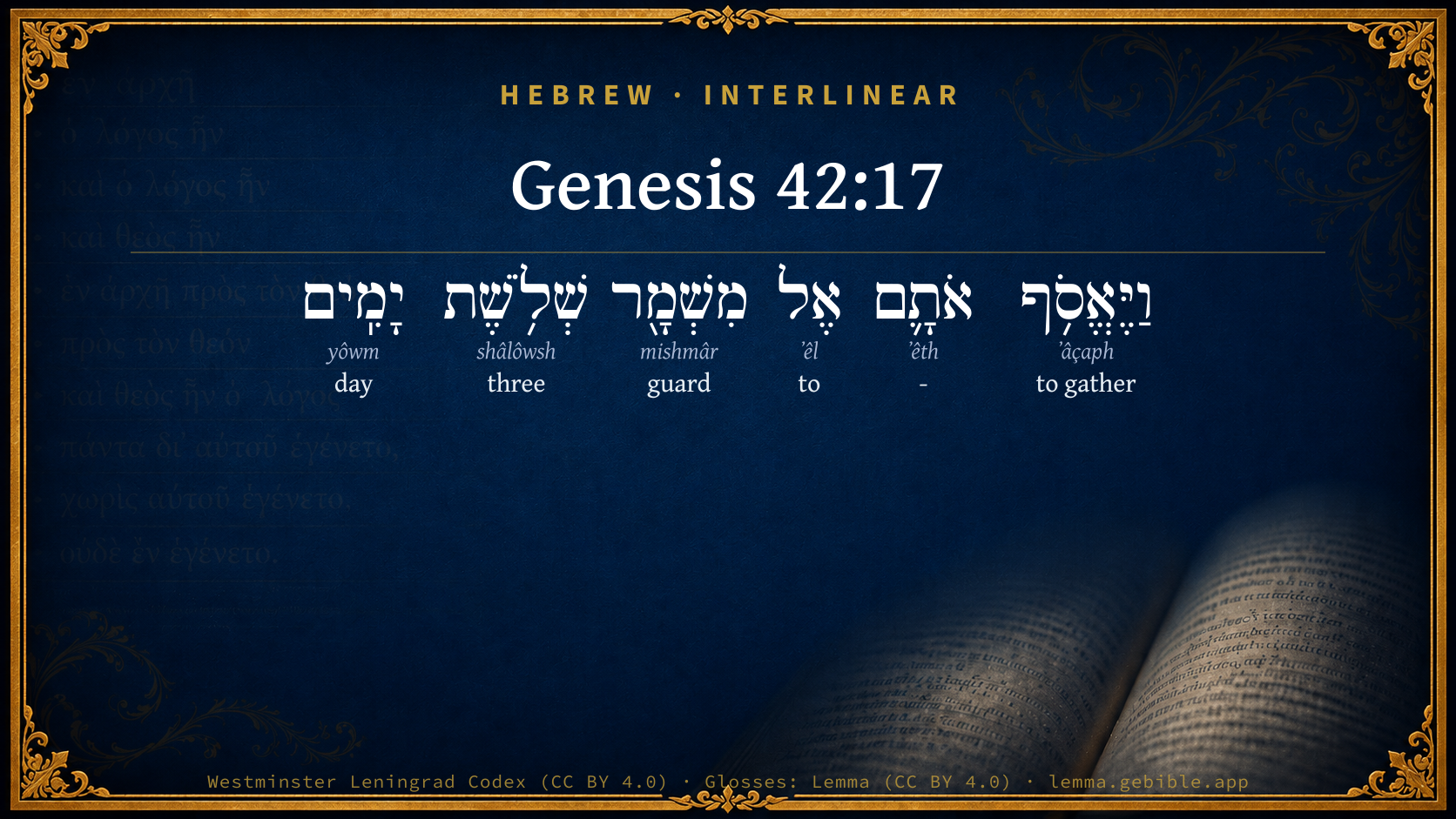
Hebrew (Westminster Leningrad Codex) Genesis 42:17 appears in the Hebrew Old Testament. The text above is from the Westminster Leningrad Codex. Each word links to its Strong’s number, a concise gloss, and parsing drawn from the Open Scriptures Hebrew Bible morphology. Click any word for its full Brown-Driver-Briggs (BDB) entry.
Download image
Cite this verse

Genesis 42:17 (World English Bible). Public Domain. Lemma interlinear Bible study tool, https://lemma.gebible.app/v/genesis/42/17.

Show BibTeX & RIS
BibTeX
RIS
English Translation
He put them all together into custody three days.
World English Bible · Public Domain
Download a study sheet

One document with this verse’s original text, its word-by-word gloss line, the meaning frame, cross-references with their text, attributed commentary, and full source and license credits — printable, and it pastes into notes with its structure intact.

This verse Autodidact and up

Study sheet (.html) Plain text (.txt)

A passage Seminary Student

Up to 50 verses in one chapter. A passage sheet keeps up to 6 commentary sources and 12 cross-references per verse, in the order this page ranks them, and says so on the sheet whenever that leaves anything out. Ask for a single verse and you get the Autodidact verse sheet above.

Everything on this page stays free to read, with no account — the sheet is a download of what is already on screen, not access to it.

Want to remove ads? Support Godless Engineer
Compare translations 3

The same verse in 3 English versions, stacked beneath the original-language interlinear above. Click any original word for its lexicon entry.

Each is an independent rendering of the whole verse — the interlinear is not word-aligned to these translations.

Highlighted words mark where these versions differ — a whole-verse word diff, not a word-by-word alignment.

  • World English Bible Public Domain
    He put them all together into custody three days.
  • King James Version Public Domain
    And he put them all together into ward three days.
  • unfoldingWord Literal Text CC BY-SA 4.0
    Then he put them together in custody three days.

unfoldingWord Literal Text — © unfoldingWord, licensed CC BY-SA 4.0. Word-aligned USFM3 via Door43 (git.door43.org/unfoldingWord/en_ult).

Versions to compare (up to 4)

3 of 4 selected

Show all 18 translations

Every available English version of this verse, each an independent rendering of the whole verse.

  • World English Bible Public Domain
    He put them all together into custody three days.
  • Berean Standard Bible Public Domain
    So Joseph imprisoned them for three days,
  • Majority Standard Bible Public Domain
    So Joseph imprisoned them for three days,
  • King James Version Public Domain
    And he put them all together into ward three days.
  • American Standard Version (1901) Public Domain
    And he put them all together into ward three days.
  • Revised Version (1885) Public Domain
    And he put them all together into ward three days.
  • Geneva Bible (1599) Public Domain
    So he put them in warde three dayes.
  • Douay-Rheims (1899) Public Domain
    So he put them in prison three days.
  • Young's Literal Translation Public Domain
    and he removeth them unto charge three days.
  • Literal Standard Version CC BY-SA 4.0
    and he gathers them into confinement [for] three days.
  • Unlocked Literal Bible CC BY-SA 4.0
    He put them all in custody for three days.
  • unfoldingWord Literal Text CC BY-SA 4.0
    Then he put them together in custody three days.
  • Darby Bible Public Domain
    And he put them in custody three days.
  • World Messianic Bible Public Domain
    He put them all together into custody for three days.
  • Webster's Bible Public Domain
    And he put them all together into custody three days.
  • Free Bible Version CC BY-SA 4.0
    So Joseph put all of them in prison for three days.
  • Bible in Basic English Public Domain
    So he put them in prison for three days.
  • JPS Tanakh (1917) Public Domain
    And he put them all together into ward three days.

Literal Standard Version (2020), Covenant Press — licensed CC BY-SA 4.0. Text via the HelloAO Bible API (eBible.org). Unlocked Literal Bible (unfoldingWord) — licensed CC BY-SA 4.0. Text via the HelloAO Bible API (eBible.org). unfoldingWord Literal Text — © unfoldingWord, licensed CC BY-SA 4.0. Word-aligned USFM3 via Door43 (git.door43.org/unfoldingWord/en_ult). Free Bible Version, Dr. Jonathan Gallagher — licensed CC BY-SA 4.0. Text via the HelloAO Bible API (eBible.org).

Word by word

More ways to search: Search by grammar → Find every occurrence → Compare this word →

Practice this passage: Drill this verse → Learn its vocabulary →

About this verse

These counts appear in no published source. They are computed here, from the morphology-tagged text and Lemma’s own curated glosses. What Lemma adds →

6
words
6
distinct lemmas
Pentateuch
section

Notable vocabulary

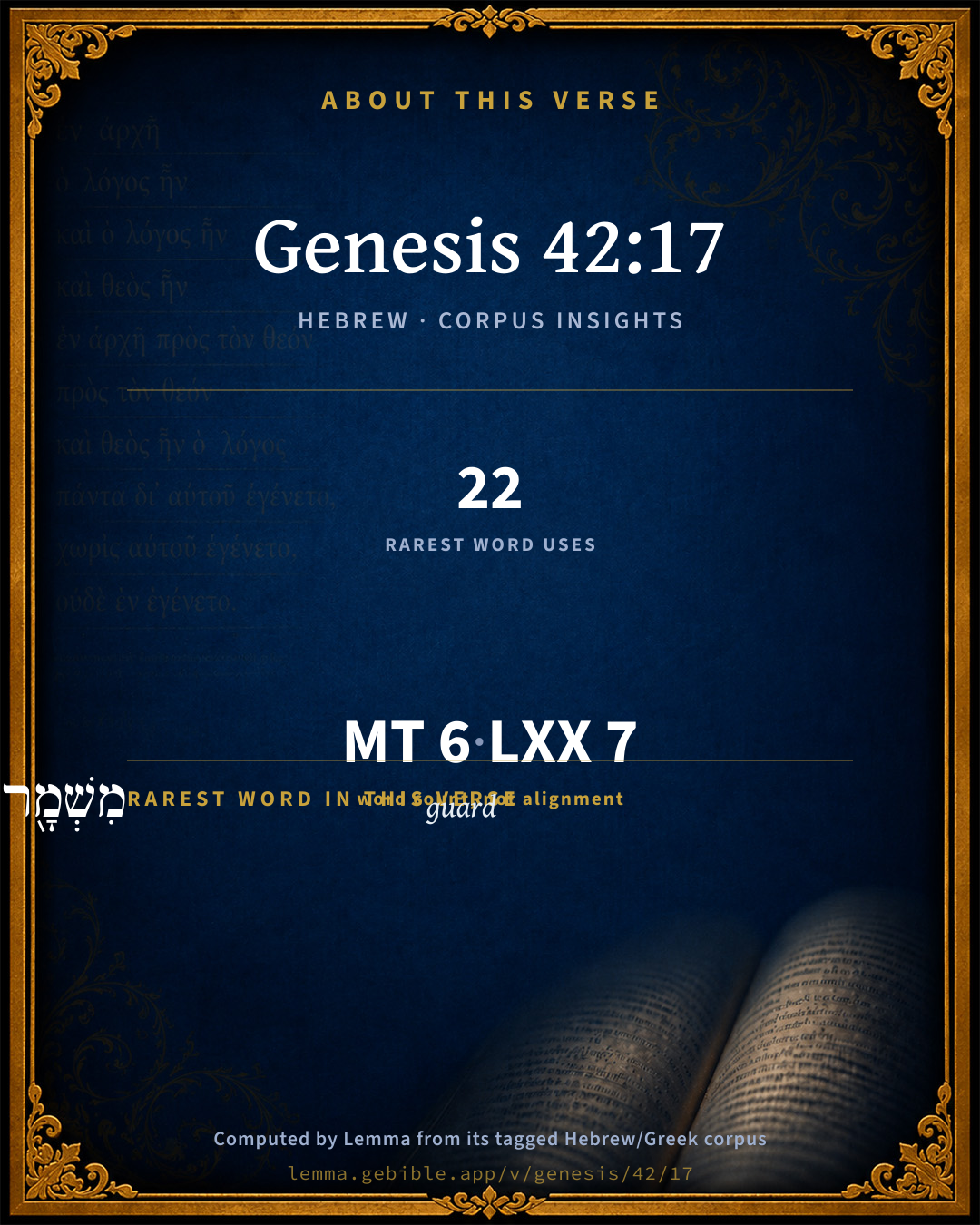
The rarest word here is מִשְׁמָ֖ר guard H4929 — appearing just 22 times in the whole Hebrew Bible.

Shared distinctive vocabulary

מִשְׁמָ֖ר guard H4929 occurs in 20 verses of the Hebrew Bible. Also found in:

Grammatical profile

  • 1 verb
  • 2 nouns
  • 1 adjective
  • 1 preposition
  • 1 particle

Verb forms

  • וַיֶּאֱסֹ֥ף Qal · Sequential Imperfect

Hebrew & Septuagint length

In English translation the verse runs 9 words from the Hebrew and 8 from the Septuagint (LXX English) — closely comparable.

A rough comparison of the two English renderings, which tokenize alike — not a word-level alignment.

Word counts can differ between the Hebrew and the Greek without any difference in meaning — e.g. the Hebrew direct-object marker אֵת has no separate Greek word, and Greek often adds the article ὁ.

In the original languages it is 6 Hebrew tokens and 7 Greek tokens — but the two are counted differently (Hebrew bundles its prefixes and suffixes into one token; the Greek is in lemma form), so that isn’t a like-for-like length.

Cross-references

9

Topical passages linked to Genesis 42:17 in the Treasury of Scripture Knowledge — connected by theme and wording, ordered by reader-vote popularity; previews shown in the World English Bible.

  • Genesis 40:4 The captain of the guard assigned them to Joseph, and he took care of them. They stayed in prison many days.
  • Genesis 40:7 He asked Pharaoh's officers who were with him in custody in his master's house, saying, "Why do you look so sad today?"
  • Hebrews 12:10 For they indeed, for a few days, punished us as seemed good to them; but he for our profit, that we may be partakers of his holiness.
  • Genesis 41:10 Pharaoh was angry with his servants, and put me in custody in the house of the captain of the guard, me and the chief baker.
  • Leviticus 24:12 They put him in custody, until the will of Yahweh should be declared to them.
  • Psalms 119:65 Do good to your servant, According to your word, Yahweh.
  • Isaiah 24:22 They shall be gathered together, as prisoners are gathered in the pit, and shall be shut up in the prison; and after many days shall they be visited.
  • Acts 4:3 They laid hands on them, and put them in custody until the next day, for it was now evening.
  • Acts 5:18 and laid hands on the apostles, and put them in public custody.

Cross-references courtesy of OpenBible.info (CC BY 4.0).

Hebrew and Greek witnesses Masoretic Hebrew ↔ Greek Septuagint

The same verse in the two great witnesses to the Old Testament, shown verse-for-verse.

These are two independent witnesses, not word-aligned to each other, and the Septuagint is shown in lemma (dictionary) form.

Hebrew Genesis 42:17 Masoretic · Westminster Leningrad Codex

וַיֶּאֱסֹ֥ף אֹתָ֛ם אֶל מִשְׁמָ֖ר שְׁלֹ֥שֶׁת יָמִֽים

He put them all together into custody three days.

World English Bible · Public Domain

Greek LXX Genesis 42:17 Septuagint · lemma form

καί τίθημι αὐτός ἐν φυλακή ἡμέρα τρεῖς

And he put them in prison three days.

LXX2012 (modern English Septuagint) · Public Domain

Hebrew: Westminster Leningrad Codex (CC BY 4.0). Greek: Septuagint (public domain); English from LXX2012 (modern English Septuagint) (Public Domain). How the Septuagint differs from the Hebrew →

Targum (Aramaic paraphrase)

2

The Targum is the ancient Jewish Aramaic paraphrase of the Hebrew Scriptures — an interpretive translation, not the Hebrew text itself. Onkelos (literal) and Pseudo-Jonathan (expansive) render the Torah, and Jonathan the Prophets. Coverage is partial: where no permissively-licensed English translation exists for a verse, only the Aramaic is shown. This is verse-level text, not a word-by-word alignment to the Hebrew.

  1. Targum Onkelos Torah (Genesis–Deuteronomy)
    וּכְנַשׁ יָתְהוֹן לְבֵית מַטְרָא תְּלָתָא יוֹמִין

    (no public-domain English translation for this verse)

    Targum Onkelos — Aramaic: “Onkelos Genesis” (public domain); “Onkelos Exodus” (public domain); “Onkelos Leviticus” (public domain); “Onkelos Numbers” (public domain); “Onkelos Deuteronomy” (public domain). English: “Sefaria Community Translation” (CC0 1.0 (public-domain dedication)); “J.W. Etheridge. The Targums of Onkelos and Jonathan Ben Uzziel on the Pentateuch. London: Longmans, Green, 1862” (public domain). Text via Sefaria.

  2. Targum Pseudo-Jonathan Torah (Genesis–Deuteronomy)
    וּכְנַשׁ יַתְהוֹם לְבֵית מַטְרָא תְּלָתָא יוֹמִין

    And he kept them together in the house of confinement three days.

    Targum Pseudo-Jonathan — Aramaic: “Targum Jonathan on Genesis” (public domain); “Targum Jonathan on Exodus” (public domain); “Targum Jonathan on Leviticus” (public domain); “Targum Jonathan on Numbers” (public domain); “Targum Jonathan on Deuteronomy” (public domain). English: “The Targum of Jonathan ben Uzziel, trans. J. W. Etheridge, London, 1862” (public domain). Text via Sefaria.

Commentary

Notes on Genesis 42:17 from classic Christian and Jewish commentators (each source and its license shown beneath its notes). The classic Christian expositions comment on the surrounding passage and are grouped to its opening verse, so a note may address several verses; the Jewish commentaries on the Tanakh (Rashi and others) are per-verse, so they appear only where the commentator wrote on this verse.

Lemma curates 59 commentaries, every one of them public domain or Creative Commons licensed, each selected and text-cleaned for this edition rather than reprinted as found. About our sources →

Trapp's Complete Commentary

John Trapp

Gen 42:17 And he put them all together into ward three days.

Ver. 17. And he put them all together into ward three days.] Not into close prison, but into some chamber, or private room, where they might have opportunity of reflecting upon themselves, and repenting. {a} I have heard of a grave divine, lately living, that did much good upon many that came to him to crave alms, by shutting them up in a room by themselves, having first taken great pains with them by way of direction what to do to be saved, joining in prayer, setting them in a course of better living, and then providing for them fit services. {b}

{a} In conclave aliquod, ubi custodiebantur. - Pisc.

{b} Dr Chetwind, Dean of Brist.

John Trapp, A Commentary or Exposition upon All the Books of the Old and New Testament (1647–1656) — public domain. Text from a community e-Sword module.

Jamieson, Fausset & Brown

Robert Jamieson, A. R. Fausset & David Brown

put them . . . into ward three days--Their confinement had been designed to bring them to salutary reflection. And this object was attained, for they looked upon the retributive justice of God as now pursuing them in that foreign land. The drift of their conversation is one of the most striking instances on record of the power of conscience [Gen 42:21-22].

Jamieson, Fausset & Brown — Commentary Critical and Explanatory on the Whole Bible (1871) — public domain (CC PDM 1.0). Text via the HelloAO Bible API.

John Calvin's Commentaries

17. And he put them altogether into ward. Here, not by words only, as before, but by the act itself, Joseph shows himself severe towards his brethren, when he shuts them all up in prison, as if about to bring them to punishment: and during three days torments them with fear. We said a little while ago, that from this act no rule for acting severely and rigidly is to be drawn; because it is doubtful whether he acted rightly or otherwise. Again, it is to be feared lest they who plead his example should be far removed from his mildness, and that they should prove to be rather his apes than his true imitators. Meanwhile, it plainly appears what he was aiming at; for he does not mitigate their punishment, as if at the end of three days he was appeased; but he renders them more anxious about the redemption of their brother, whom he retains as a hostage. Lest, however, immoderate fear should deter them from returning, he promises to act with good faith towards them: and to convince them of that, he declares that he fears God, which expression is worthy of observation. Doubtless he speaks from the inward feeling of his heart, when he declares that he will deal well and truly with them, because he fears God. Therefore the commencement and the fountain of that good and honest conscience, whereby we cultivate fidelity and justice towards men, is the fear of God. There appears indeed some probity in the despisers of God; but it soon goes off in smoke, unless the depraved affections of the flesh are restrained as with a bridle, by the thought that God is to be feared, because he will be the Judge of the world. For whoever does not think that he must render an account, will never so cultivate integrity as to refrain from pursuing what he supposes will be useful to himself. Wherefore, if we wish to be free from perfidy, craft, cruelty, and all wicked desire of doing injure, we must labor earnestly that religion may flourish among us. For whenever we act with want of sincerity or humanity towards each other, impiety openly betrays itself. For whatever there is of rectitude or justice in the world, Joseph comprised in this short sentence, when he said, that he feared God.

John Calvin's Commentaries (1540-1563) — public domain. Text from the Calvin Translation Society English edition (1840s-50s) via the Christian Classics Ethereal Library (ccel.org). Calvin's coverage is partial (roughly two-thirds of the Bible); uncommented books and verses are honest gaps, never fabricated. The 19th-century editor's footnotes and remarks are omitted so the notes are faithfully Calvin's own voice.

The Cambridge Bible for Schools and Colleges

gen. ed. J. J. S. Perowne

17. put them … into ward] i.e. “in charge, or safe keeping”; as in Gen_40:3. Not “in prison,” as in Gen_39:20. Joseph’s treatment sounds to us harsh and cruel. Arbitrary confinement, however, was, and is, only too common in the East. The brethren would be a prey to the sickening dread either of being brought out only to be executed, or of being prevented from returning to their homes.

Joseph himself had endured a long experience of captive life in Egypt.

The Cambridge Bible for Schools and Colleges (gen. ed. J. J. S. Perowne; Cambridge University Press, 1878–1918) — public domain. Text from a community e-Sword module.

John Gill's Exposition

And they said one to another,.... Before they went out of the prison, at least while in the presence of Joseph:

we are verily guilty concerning our brother; meaning Joseph, whom they had sold for a slave, and who they supposed was dead through grief and hard servitude; and now being in trouble themselves, it brings to mind the sin they had been guilty of, which, though committed twenty two years ago, was still fresh in their memories, and lay heavy on their consciences; for length of time neither makes sin less, nor the conscience lighter, when it is revived and charged home upon it, and which was aggravated particularly by the following circumstance:

in that we saw the anguish of his soul, when he besought us, and we would not hear; when in the utmost agony, with trembling limbs, and quivering lips, and floods of tears, as they stripped him of his coat, he most earnestly and importunately requested of them they would not put him into the pit, and leave him there; and in the same manner entreated them they would not put him into the hands of strangers, but restore him alive to his father; but they turned a deaf ear to all his cries and entreaties, and hardened themselves against him:

therefore is this distress come upon us; the same measure that was measured by them to him, was now measured to them again, and they were dealt with according to "lex talionis": they cast Joseph into a pit, and now they were committed to a prison; they would not attend to his cries and tears, and the anguish of his soul did not move their pity, and now he is inexorable to them, and will not at least appear to have any compassion on them, or show pity to them; and perhaps their being dealt with in this similar way brought to their remembrance what they had done.

John Gill's Exposition of the Whole Bible (1746–1763) — public domain (CC PDM 1.0). Text via the HelloAO Bible API.

Whedon's Commentary on the Bible

Daniel D. Whedon

17. Put them all together — Hebrews, Gathered, or, assembled them to prison. He huddled them together in one cell. This might remind them of their casting Joseph into the pit. Gen_37:24. But Joseph’s character and tender heart forbid our supposing that his severity towards his brethren was in retaliation for their sins against him. He doubtless sought in this way to test them, and find out their feeling toward Jacob and Benjamin. And in all this he was acting, in a way which he scarcely comprehended, the part of a minister of retribution. God used him and his methods to chasten and punish those who were virtually guilty of his blood. He seems all through to have entertained dark suspicions of his brethren. How could he else, when his experience at their hands showed them to be utterly heartless and cruel? He proposes to find out if Benjamin still lives, and what their feeling is towards him. Also, if his father still lives, and whether they love or hate him. He may find it necessary to become the avenger of their blood.

Daniel D. Whedon (gen. ed.), Commentary on the Old and New Testaments (1874–1909) — public domain. Text from a community e-Sword module.

The Pulpit Commentary

And he put them all together into ward (literally, and he assembled them into prison) three days. Ostensibly in consequence of their unwillingness to agree to his proposal, but in reality to give them an experience of the suffering which they had inflicted on him, their brother, and so to awaken in their hearts a feeling of repentance. Yet the clemency of Joseph appears in this, that whereas he had lain three long years in prison as the result of their inhumanity towards him, he only inflicts on them a confinement of three days.

The Pulpit Commentary (1880–1919), ed. H.D.M. Spence-Jones & Joseph S. Exell — public domain. Text from a community e-Sword module.

Rashi

Rabbi Shlomo Yitzchaki (Rashi)

משמר WARD — the prison-house.

Rashi on the Tanakh — English translations: “The Judaica Press complete Tanach with Rashi, translated by A. J. Rosenberg” (CC BY 4.0); “Pentateuch with Rashi's commentary by M. Rosenbaum and A.M. Silbermann, 1929-1934” (public domain); “The Metsudah Tanach series, Lakewood, N.J” (CC BY 4.0); and “The Book of Joshua, Metsudah Publications, 1997” (CC BY 4.0). Text via Sefaria.

Ramban (Nachmanides)

Rabbi Moshe ben Nachman (Ramban / Nachmanides)

AND HE PUT THEM ALL TOGETHER INTO A WARD THREE DAYS. This he did in order to frighten them and to make them believe that it is G-d he fears, meaning that it is because of his fear of G-d that he is releasing them lest the people of their households perish from hunger. This is the meaning of his words, The rest of you, go and take grain home to your starving households. Besides, they would not have consented to leave the one [Simeon] behind except for the purpose of saving all their families.

Ramban (Nachmanides) on the Tanakh — English translation: “Commentary on the Torah by Ramban (Nachmanides). Translated and annotated by Charles B. Chavel. New York, Shilo Pub. House, 1971-1976” (CC BY 4.0). Text via Sefaria.

Radak

Rabbi David Kimhi (Radak)

ויאסוף, he caused them mental pain without touching their bodies or causing them financial loss.

Radak on the Tanakh — English translations: “Sefaria Community Translation” (CC0 1.0 (public-domain dedication)); “Eliyahu Munk, HaChut Hameshulash” (CC BY 4.0); “Rabbi Mike Feuer, Jerusalem Anthology” (CC BY 4.0); and “R. David Kimhi on the first book of Psalms, Translated by R.G. Finch, London, 1919” (public domain). Text via Sefaria.

Lesson kit

Teaching starters — assembled from the data on this page, not authored interpretation. Every prompt links to the verse data it draws on. Edit before teaching.

Genesis, in the Pentateuch, opens this verse with 6 words (6 distinct Hebrew lemmas). Its most distinctive word is mishmâr (“guard”). A historical commentator’s framing appears above. Read the whole chapter for the surrounding context.

Discussion questions

  1. The word mishmâr carries the sense “guard.” How does it shape the verse?
  2. Genesis 40:3 shares the word «guard» with this verse. How do the two illuminate each other?
  3. These translations render this verse differently. What is at stake in choosing one wording over another?
  4. The verb «וַיֶּאֱסֹ֥ף» is Qal Sequential Imperfect. How does its form color the action?
  5. Reading how Trapp's Complete Commentary and Jamieson, Fausset & Brown read this verse, where do the two commentators agree and where do they part?

Things to notice

Reading settings

Reading text

Shown beneath each verse's original-language words.

Old Testament
Old Testament edition

Read the OT as the Masoretic Hebrew (MT) or the Greek Septuagint (LXX).

English shown for the Greek Septuagint (in the Hebrew ↔ Greek comparison).

Comparing translations? Open the Compare panel on any verse page to stack up to four side by side.