
Jeremiah 21:4

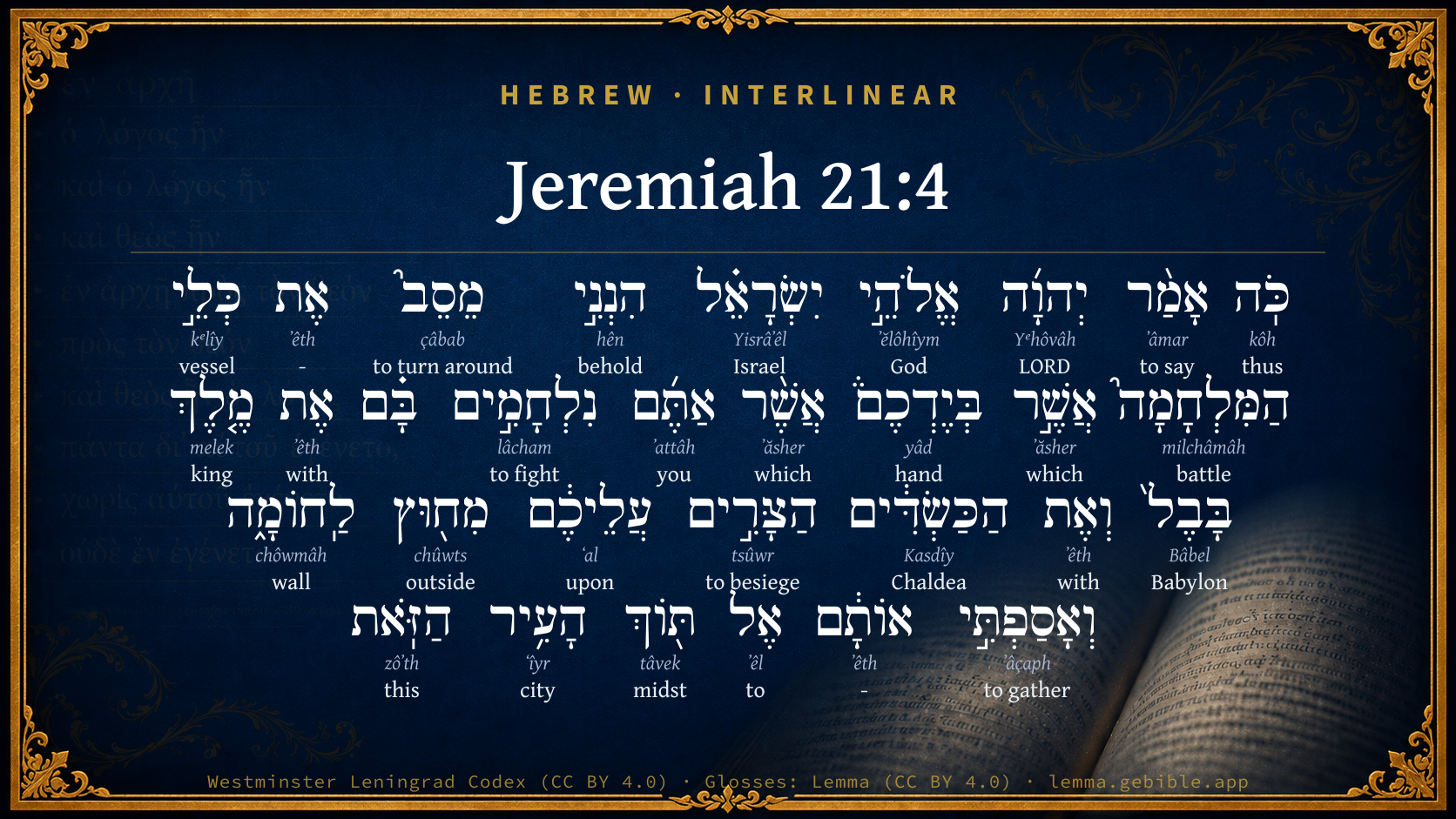
Hebrew (Westminster Leningrad Codex) Jeremiah 21:4 appears in the Hebrew Old Testament. The text above is from the Westminster Leningrad Codex. Each word links to its Strong’s number, a concise gloss, and parsing drawn from the Open Scriptures Hebrew Bible morphology. Click any word for its full Brown-Driver-Briggs (BDB) entry.
Download image
Cite this verse

Jeremiah 21:4 (World English Bible). Public Domain. Lemma interlinear Bible study tool, https://lemma.gebible.app/v/jeremiah/21/4.

Show BibTeX & RIS
BibTeX
RIS
English Translation
Thus says Yahweh, the God of Israel, Behold, I will turn back the weapons of war that are in your hands, with which you fight against the king of Babylon, and against the Chaldeans who besiege you, without the walls; and I will gather them into the midst of this city.
World English Bible · Public Domain
Download a study sheet

One document with this verse’s original text, its word-by-word gloss line, the meaning frame, cross-references with their text, attributed commentary, and full source and license credits — printable, and it pastes into notes with its structure intact.

This verse Autodidact and up

Study sheet (.html) Plain text (.txt)

A passage Seminary Student

Up to 50 verses in one chapter. A passage sheet keeps up to 6 commentary sources and 12 cross-references per verse, in the order this page ranks them, and says so on the sheet whenever that leaves anything out. Ask for a single verse and you get the Autodidact verse sheet above.

Everything on this page stays free to read, with no account — the sheet is a download of what is already on screen, not access to it.

Want to remove ads? Support Godless Engineer
Compare translations 3

The same verse in 3 English versions, stacked beneath the original-language interlinear above. Click any original word for its lexicon entry.

Each is an independent rendering of the whole verse — the interlinear is not word-aligned to these translations.

Highlighted words mark where these versions differ — a whole-verse word diff, not a word-by-word alignment.

  • World English Bible Public Domain
    Thus says Yahweh, the God of Israel, Behold, I will turn back the weapons of war that are in your hands, with which you fight against the king of Babylon, and against the Chaldeans who besiege you, without the walls; and I will gather them into the midst of this city.
  • King James Version Public Domain
    Thus saith the LORD God of Israel; Behold, I will turn back the weapons of war that are in your hands, wherewith ye fight against the king of Babylon, and against the Chaldeans, which besiege you without the walls, and I will assemble them into the midst of this city.
  • unfoldingWord Literal Text CC BY-SA 4.0
    ‘Thus says Yahweh, the God of Israel: “Behold, I am turning back the weapons of war that in your hand, with which you are fighting against the king of Babylon and against the Chaldeans who are besieging against you from outside the wall, and I will gather them to the middle of this city.

unfoldingWord Literal Text — © unfoldingWord, licensed CC BY-SA 4.0. Word-aligned USFM3 via Door43 (git.door43.org/unfoldingWord/en_ult).

Versions to compare (up to 4)

3 of 4 selected

Show all 18 translations

Every available English version of this verse, each an independent rendering of the whole verse.

  • World English Bible Public Domain
    Thus says Yahweh, the God of Israel, Behold, I will turn back the weapons of war that are in your hands, with which you fight against the king of Babylon, and against the Chaldeans who besiege you, without the walls; and I will gather them into the midst of this city.
  • Berean Standard Bible Public Domain
    this is what the LORD, the God of Israel, says: ‘I will turn against you the weapons of war in your hands, with which you are fighting the king of Babylon and the Chaldeans who besiege you outside the wall, and I will assemble their forces in the center of this city.
  • Majority Standard Bible Public Domain
    this is what the LORD, the God of Israel, says: ‘I will turn against you the weapons of war in your hands, with which you are fighting the king of Babylon and the Chaldeans who besiege you outside the wall, and I will assemble their forces in the center of this city.
  • King James Version Public Domain
    Thus saith the LORD God of Israel; Behold, I will turn back the weapons of war that are in your hands, wherewith ye fight against the king of Babylon, and against the Chaldeans, which besiege you without the walls, and I will assemble them into the midst of this city.
  • American Standard Version (1901) Public Domain
    Thus saith Jehovah, the God of Israel, Behold, I will turn back the weapons of war that are in your hands, wherewith ye fight against the king of Babylon, and against the Chaldeans that besiege you, without the walls; and I will gather them into the midst of this city.
  • Revised Version (1885) Public Domain
    Thus saith the LORD, the God of Israel, Behold, I will turn back the weapons of war that are in your hands; wherewith ye fight against the king of Babylon, and against the Chaldeans which besiege you, without the walls, and I will gather them into the midst of this city.
  • Geneva Bible (1599) Public Domain
    Thus saith the Lord God of Israel, Behold, I will turne backe the weapons of warre that are in your hands, wherewith ye fight against the King of Babel, and against the Caldeans, which besiege you without the walles, and I will assemble them into the middes of this citie.
  • Douay-Rheims (1899) Public Domain
    Thus saith the Lord, the God of Israel: Behold I will turn back the weapons of war that are in your hands, with which you fight against the king of Babylon, and the Chaldeans, that besiege you round about the walls: and I will gather them together in the midst of this city.
  • Young's Literal Translation Public Domain
    Thus said Jehovah, God of Israel: Lo, I am turning round the weapons of battle That `are' in your hand, With which ye do fight the king of Babylon, And the Chaldeans, who are laying siege against you, At the outside of the wall, And I have gathered them into the midst of this city,
  • Literal Standard Version CC BY-SA 4.0
    Thus said YHWH, God of Israel: Behold, I am turning around the weapons of battle || That [are] in your hand, || With which you fight the king of Babylon, || And the Chaldeans, who are laying siege against you, || At the outside of the wall, || And I have gathered them into the midst of this city,
  • Unlocked Literal Bible CC BY-SA 4.0
    'Yahweh, God of Israel, says this: See, I am about to turn back the instruments of war that are in your hand, with which you are fighting against the king of Babylon and the Chaldeans who are closing you in from outside the walls! For I will gather them in the middle of this city.
  • unfoldingWord Literal Text CC BY-SA 4.0
    ‘Thus says Yahweh, the God of Israel: “Behold, I am turning back the weapons of war that in your hand, with which you are fighting against the king of Babylon and against the Chaldeans who are besieging against you from outside the wall, and I will gather them to the middle of this city.
  • Darby Bible Public Domain
    Thus saith Jehovah the God of Israel: Behold, I will turn back the weapons of war that are in your hands, with which ye fight against the king of Babylon, and against the Chaldeans who besiege you, outside the walls, and I will assemble them into the midst of this city.
  • World Messianic Bible Public Domain
    ‘The LORD, the God of Israel says, “Behold, I will turn back the weapons of war that are in your hands, with which you fight against the king of Babylon, and against the Kasdim who besiege you outside the walls; and I will gather them into the middle of this city.
  • Webster's Bible Public Domain
    Thus saith the LORD God of Israel; Behold, I will turn back the weapons of war that are in your hands, with which ye fight against the king of Babylon, and against the Chaldeans, who besiege you without the walls, and I will assemble them into the midst of this city.
  • Free Bible Version CC BY-SA 4.0
    This is what the Lord, the God of Israel, says: I'm going to turn the weapons you're holding against you, the weapons you're using to fight the king of Babylon and the Babylonian army outside the wall besieging you. I'm going to bring them right into the center of this city.
  • Bible in Basic English Public Domain
    The Lord God of Israel has said, See, I am turning back the instruments of war in your hands, with which you are fighting against the king of Babylon and the Chaldaeans, who are outside the walls and shutting you in; and I will get them together inside this town.
  • JPS Tanakh (1917) Public Domain
    Thus saith the LORD, the God of Israel: Behold, I will turn back the weapons of war that are in your hands, wherewith ye fight against the king of Babylon, and against the Chaldeans, that besiege you without the walls, and I will gather them into the midst of this city.

Literal Standard Version (2020), Covenant Press — licensed CC BY-SA 4.0. Text via the HelloAO Bible API (eBible.org). Unlocked Literal Bible (unfoldingWord) — licensed CC BY-SA 4.0. Text via the HelloAO Bible API (eBible.org). unfoldingWord Literal Text — © unfoldingWord, licensed CC BY-SA 4.0. Word-aligned USFM3 via Door43 (git.door43.org/unfoldingWord/en_ult). Free Bible Version, Dr. Jonathan Gallagher — licensed CC BY-SA 4.0. Text via the HelloAO Bible API (eBible.org).

Word by word

More ways to search: Search by grammar → Find every occurrence → Compare this word →

Practice this passage: Drill this verse → Learn its vocabulary →

הַצָּרִ֣ים
tsûwr
H6696
“the · besieging”
Particle, Definite Article + Verb, Qal, Participle Active, Masculine, Plural, Absolute
Part of Speech
Particle + Verb
Stem
Qal
Form
Participle Active
Gender
Masculine
Number
Plural
State
Absolute
Full BDB Definition

Origin: a primitive root

TWOT: 1898 , 1899 , 1900

to bind, besiege, confine, cramp - (Qal) - to confine, secure - to shut in, beseige - to shut up, enclose - (Qal) to show hostility to, be an adversary, treat as foe - (Qal) to form, fashion, delineate
  1. כֹּֽה kôh H3541 “thus” Adverb
  2. אָמַ֨ר ʼâmar H559 “to say” Verb, Qal, Perfect, 3rd Person, Masculine, Singular
  3. יְהוָ֜ה Yᵉhôvâh H3068 “LORD” Noun, Proper
  4. אֱלֹהֵ֣י ʼĕlôhîym H430 “God(s) of” Noun, Common, Masculine, Plural, Construct
  5. יִשְׂרָאֵ֗ל Yisrâʼêl H3478 “Israel” Noun, Proper
  6. הִנְנִ֣י hên H2005 “behold · me” Particle, Demonstrative + Suffix, Personal, 1st Person, Common, Singular
  7. מֵסֵב֮ çâbab H5437 “turning around” Verb, Hiphil, Participle Active, Masculine, Singular, Absolute
  8. אֶת ʼêth H853 “-” Particle, Direct Object
  9. כְּלֵ֣י kᵉlîy H3627 “vessels of” Noun, Common, Masculine, Plural, Construct
  10. הַמִּלְחָמָה֮ milchâmâh H4421 “the · battle” Particle, Definite Article + Noun, Common, Feminine, Singular, Absolute
  11. אֲשֶׁ֣ר ʼăsher H834 “which” Particle, Relative
  12. בְּיֶדְכֶם֒ yâd H3027 “in/at · hand · your” Preposition + Noun, Common, Both, Singular, Construct + Suffix, Personal, 2nd Person, Masculine, Plural
  13. אֲשֶׁ֨ר ʼăsher H834 “which” Particle, Relative
  14. אַתֶּ֜ם ʼattâh H859 “you” Pronoun, Personal, 2nd Person, Masculine, Plural
  15. נִלְחָמִ֣ים lâcham H3898 “fighting” Verb, Niphal, Participle Active, Masculine, Plural, Absolute
  16. אֶת ʼêth H854 “with” Preposition
  17. מֶ֤לֶךְ melek H4428 “king of” Noun, Common, Masculine, Singular, Construct
  18. בָּבֶל֙ Bâbel H894 “Babylon” Noun, Proper
  19. וְאֶת ʼêth H854 “and · with” Conjunction + Preposition
  20. הַכַּשְׂדִּ֔ים Kasdîy H3778 “the · Chaldea” Particle, Definite Article + Noun, Proper
  21. עֲלֵיכֶ֔ם ʻal H5921 “upon · you” Preposition + Suffix, Personal, 2nd Person, Masculine, Plural
  22. מִח֖וּץ chûwts H2351 “from · outside” Preposition + Noun, Common, Masculine, Singular, Absolute
  23. לַֽחוֹמָ֑ה chôwmâh H2346 “to/for the · wall” Preposition, Determined + Noun, Common, Feminine, Singular, Absolute
  24. וְאָסַפְתִּ֣י ʼâçaph H622 “and · to gather” Conjunction + Verb, Qal, Sequential Perfect, 1st Person, Common, Singular
  25. אוֹתָ֔ם ʼêth H853 “- · them” Particle, Direct Object + Suffix, Personal, 3rd Person, Masculine, Plural
  26. אֶל ʼêl H413 “to” Preposition
  27. תּ֖וֹךְ tâvek H8432 “midst of” Noun, Common, Masculine, Singular, Construct
  28. הָעִ֥יר ʻîyr H5892 “the · city” Particle, Definite Article + Noun, Common, Feminine, Singular, Absolute
  29. הַזֹּֽאת zôʼth H2063 “the · this” Particle, Definite Article + Pronoun, Demonstrative, Feminine, Singular

About this verse

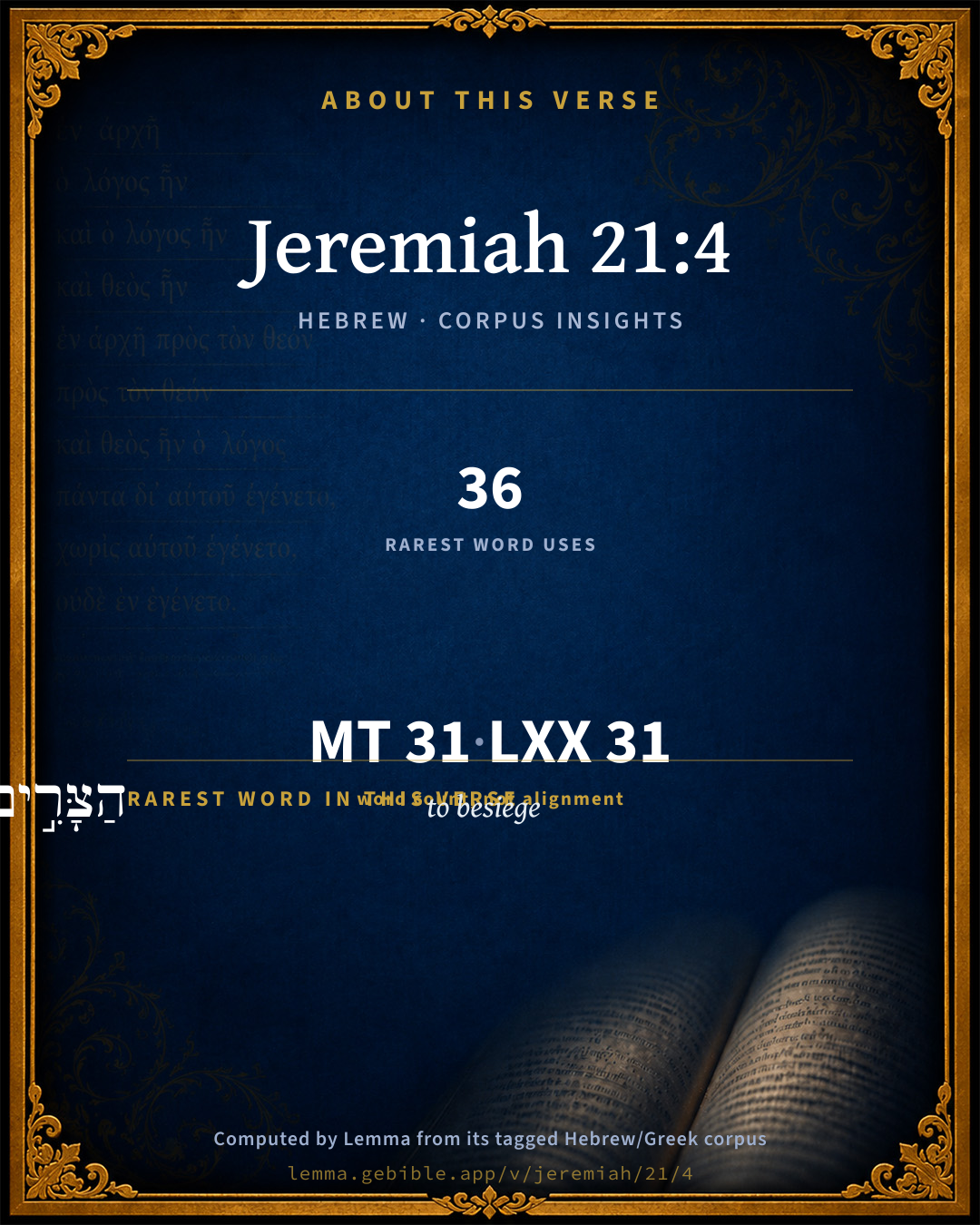
These counts appear in no published source. They are computed here, from the morphology-tagged text and Lemma’s own curated glosses. What Lemma adds →

31
words
27
distinct lemmas
Prophets
section

Shared distinctive vocabulary

הַצָּרִ֣ים to besiege H6696 occurs in 36 verses of the Hebrew Bible. Also found in:

Grammatical profile

  • 5 verbs
  • 13 nouns
  • 2 pronouns
  • 5 prepositions
  • 1 adverb
  • 5 particles

Verb forms

  • אָמַ֨ר Qal · Perfect
  • מֵסֵב֮ Hiphil · Participle Active
  • נִלְחָמִ֣ים Niphal · Participle Active
  • הַצָּרִ֣ים Qal · Participle Active
  • וְאָסַפְתִּ֣י Qal · Sequential Perfect

Repetition

Words recur within this verse — often emphatic in Hebrew:

  • אֲשֶׁ֣ר which H834 ×2
  • אֶת with H854 ×2

Hebrew & Septuagint length

In the original languages it is 31 Hebrew tokens and 31 Greek tokens — but the two are counted differently (Hebrew bundles its prefixes and suffixes into one token; the Greek is in lemma form), so that isn’t a like-for-like length.

Cross-references

16

Topical passages linked to Jeremiah 21:4 in the Treasury of Scripture Knowledge — connected by theme and wording, ordered by reader-vote popularity; previews shown in the World English Bible.

  • Isaiah 5:5 Now I will tell you what I will do to my vineyard. I will take away its hedge, and it will be eaten up. I will break down its wall of it, and it will be trampled down.
  • Isaiah 13:4 The noise of a multitude in the mountains, as of a great people! the noise of a tumult of the kingdoms of the nations gathered together! Yahweh of Hosts is mustering the host for the battle.
  • Jeremiah 32:5 and he shall bring Zedekiah to Babylon, and there shall he be until I visit him, says Yahweh: though you fight with the Chaldeans, you shall not prosper?
  • Jeremiah 33:5 while [men] come to fight with the Chaldeans, and to fill them with the dead bodies of men, whom I have killed in my anger and in my wrath, and for all whose wickedness I have hid my face from this city:
  • Jeremiah 37:8–10 The Chaldeans shall come again, and fight against this city; and they shall take it, and burn it with fire.
  • Jeremiah 38:17–18 Then said Jeremiah to Zedekiah, Thus says Yahweh, the God of hosts, the God of Israel: If you will go forth to the king of Babylon's princes, then your soul shall live, and this city shall not be burned with fire; and you shall live, and your house.
  • Zechariah 14:2 For I will gather all nations against Jerusalem to battle; and the city will be taken, the houses rifled, and the women ravished. half of the city will go out into captivity, and the rest of the people will not be cut off from the city.
  • Jeremiah 38:2–3 Thus says Yahweh, He who remains in this city shall die by the sword, by the famine, and by the pestilence; but he who goes forth to the Chaldeans shall live, and his life shall be to him for a prey, and he shall live.
  • Jeremiah 39:3 that all the princes of the king of Babylon came in, and sat in the middle gate, [to wit], Nergal Sharezer, Samgar-nebo, Sarsechim, Rabsaris, Nergal Sharezer, Rabmag, with all the rest of the princes of the king of Babylon.
  • Lamentations 2:5 The Lord is become as an enemy, he has swallowed up Israel; He has swallowed up all her palaces, he has destroyed his strongholds; He has multiplied in the daughter of Judah mourning and lamentation.
  • Lamentations 2:7 The Lord has cast off his altar, he has abhorred his sanctuary; He has given up into the hand of the enemy the walls of her palaces: They have made a noise in the house of Yahweh, as in the day of a solemn assembly.
  • Isaiah 10:4 They shall only bow down under the prisoners, and shall fall under the slain. For all this his anger is not turned away, but his hand is stretched out still.
  • Jeremiah 52:18 The pots also, and the shovels, and the snuffers, and the basins, and the spoons, and all the vessels of brass with which they ministered, took they away.
  • Ezekiel 16:37–41 therefore see, I will gather all your lovers, with whom you have taken pleasure, and all those who you have loved, with all those who you have hated; I will even gather them against you on every side, and will uncover your nakedness to them, that they may see all your nakedness.
  • Hosea 9:12 Though they bring up their children, Yet I will bereave them, so that not a man shall be left. Indeed, woe also to them when I depart from them!
  • Matthew 22:7 When the king heard that, he was angry, and he sent his armies, destroyed those murderers, and burned their city.

Cross-references courtesy of OpenBible.info (CC BY 4.0).

Hebrew and Greek witnesses Masoretic Hebrew ↔ Greek Septuagint

The same verse in the two great witnesses to the Old Testament, shown verse-for-verse.

These are two independent witnesses, not word-aligned to each other, and the Septuagint is shown in lemma (dictionary) form.

Hebrew Jeremiah 21:4 Masoretic · Westminster Leningrad Codex

כֹּֽה אָמַ֨ר יְהוָ֜ה אֱלֹהֵ֣י יִשְׂרָאֵ֗ל הִנְנִ֣י מֵסֵב֮ אֶת כְּלֵ֣י הַמִּלְחָמָה֮ אֲשֶׁ֣ר בְּיֶדְכֶם֒ אֲשֶׁ֨ר אַתֶּ֜ם נִלְחָמִ֣ים בָּ֗ם אֶת מֶ֤לֶךְ בָּבֶל֙ וְאֶת הַכַּשְׂדִּ֔ים הַצָּרִ֣ים עֲלֵיכֶ֔ם מִח֖וּץ לַֽחוֹמָ֑ה וְאָסַפְתִּ֣י אוֹתָ֔ם אֶל תּ֖וֹךְ הָעִ֥יר הַזֹּֽאת

Thus says Yahweh, the God of Israel, Behold, I will turn back the weapons of war that are in your hands, with which you fight against the king of Babylon, and against the Chaldeans who besiege you, without the walls; and I will gather them into the midst of this city.

World English Bible · Public Domain

Greek LXX Structure differs

In the Septuagint, Jeremiah is about an eighth shorter than the Hebrew and arranges its material differently — the Oracles Against the Nations (Hebrew chapters 46–51) appear in the middle of the Greek book, after 25:13. Because the chapter and verse boundaries do not line up, a verse-for-verse comparison with the Hebrew is not shown.

A verse-for-verse comparison isn’t shown here because the chapters and verses don’t line up. Switch to the LXX edition with the MT / LXX toggle above to read the Greek directly.

On this verse, The Cambridge Bible for Schools and Colleges discusses the Septuagint’s reading. Read the note in Commentary ↓

Hebrew: Westminster Leningrad Codex (CC BY 4.0). Greek: Septuagint (public domain); English from a public-domain English Septuagint. How the Septuagint differs from the Hebrew →

Targum (Aramaic paraphrase)

1

The Targum is the ancient Jewish Aramaic paraphrase of the Hebrew Scriptures — an interpretive translation, not the Hebrew text itself. Onkelos (literal) and Pseudo-Jonathan (expansive) render the Torah, and Jonathan the Prophets. Coverage is partial: where no permissively-licensed English translation exists for a verse, only the Aramaic is shown. This is verse-level text, not a word-by-word alignment to the Hebrew.

  1. Targum Jonathan Prophets (Joshua–Malachi)
    כִּדְנַן אֲמַר יְיָ אֱלָהָא דְיִשְׂרָאֵל הָאֲנָא מַסְחַר יַת מָאנֵי קְרָבָא דִבְיֶדְכוֹן דְאַתּוּן מְגִיחִין קְרָבָא בְהוֹן עִם מַלְכָּא דְבָבֶל וְעִם כַּשְׂדָאֵי דְצָיְרִין עֲלֵיכוֹן מִבָּרָא לְשׁוּרָא וַאֲכַנֵשׁ יַתְהוֹן לְגוֹ קַרְתָּא הָדָא:

    (no public-domain English translation for this verse)

    Targum Jonathan — Aramaic: “Mikraot Gedolot” (public domain). English: “Sefaria Community Translation” (CC0 1.0 (public-domain dedication)); “London "Chaldee Paraphrase," 1871” (public domain). Text via Sefaria.

Commentary

Notes on Jeremiah 21:4 from classic Christian and Jewish commentators (each source and its license shown beneath its notes). The classic Christian expositions comment on the surrounding passage and are grouped to its opening verse, so a note may address several verses; the Jewish commentaries on the Tanakh (Rashi and others) are per-verse, so they appear only where the commentator wrote on this verse.

Lemma curates 59 commentaries, every one of them public domain or Creative Commons licensed, each selected and text-cleaned for this edition rather than reprinted as found. About our sources →

Trapp's Complete Commentary

John Trapp

Jer 21:4 Thus saith the LORD God of Israel; Behold, I will turn back the weapons of war that [are] in your hands, wherewith ye fight against the king of Babylon, and [against] the Chaldeans, which besiege you without the walls, and I will assemble them into the midst of this city.

Ver. 4. Behold, I will turn back the weapons of war,] i.e., I will render them vain and useless; as it is God who in battle ordereth the ammunition, {Jer 50:25} and maketh the weapons vain or prosperous. {Isa 54:17 Jer 50:9} This was plainly seen at Edgehill fight.

John Trapp, A Commentary or Exposition upon All the Books of the Old and New Testament (1647–1656) — public domain. Text from a community e-Sword module.

Joseph Benson's Commentary

Jer 21:4-7. Behold, I will turn back the weapons, &c. — Instead of doing execution upon your enemies, they shall hurt yourselves, and be the occasion of your own destruction. God will as visibly appear against you as if a miraculous wind were to drive back your own darts and arrows, and turn them upon yourselves. And I myself will fight against you — By the executioners of my wrath, the sword, the famine, and the pestilence. I will plainly appear on your enemies’ side, by the success I will give to their arms. And I will smite the inhabitants of this city — I the Lord will do it, and it shall evidently appear to be my work; both man and beast — Even the beasts shall perish, both those that are for food, and those that are for service in war. They shall die of a great pestilence — Which shall rage within the walls, while their enemies are encamped about them. Though the walls and gates of Jerusalem may for a time keep out the Chaldeans, they cannot keep out God’s judgments. His arrows of pestilence can reach those that think themselves safe from other arrows. And I will deliver Zedekiah, &c. — The king himself, and all the people that escape the sword, famine, and pestilence, shall fall into the hands of Nebuchadnezzar and the Chaldeans. And he shall smite them with the edge of the sword — Zedekiah himself was not put to death, but carried to Babylon, where he died: see Jer 24:5. But his sons and his great men were slain by the command of Nebuchadnezzar, 2Ki 25:7-8. “It is common in all writers to express that indefinitely which is true of the greater part of the persons concerned.” — Lowth. He shall not spare, neither have pity nor mercy — These three synonymous terms are used by way of emphasis, to express the severe revenge the Babylonians would take of them. The inhabitants of Jerusalem must indeed have been sensible at last, that they could expect little or no mercy, since they had rebelled three times against the king of Babylon.

Joseph Benson's Commentary on the Old and New Testaments (1811–1818) — public domain. Text from a community e-Sword module.

Geneva Bible (1599)

Geneva Bible translators

To wit, from your enemies to destroy yourselves.

Geneva Bible (1599) marginal notes — public domain. Text via Bolls.life.

Jamieson, Fausset & Brown

Robert Jamieson, A. R. Fausset & David Brown

God of Israel--Those "wondrous works" (Jer 21:2) do not belong to you; God is faithful; it is you who forfeit the privileges of the covenant by unfaithfulness. "God will always remain the God of Israel, though He destroy thee and thy people" [CALVIN].

turn back the weapons--I will turn them to a very different use from what you intend them. With them you now fight against the Chaldees "without the walls" (the Jewish defenders being as yet able to sally forth more freely, and defend the fountains outside the walls in the valley under Mount Zion; see Jer 21:13; Jer 19:6-7); but soon ye shall be driven back within the city [MAURER], and "in the midst" of it, I will cause all your arms to be gathered in one place ("I will assemble them," namely, your arms) by the Chaldean conquerors [GROTIUS], who shall slay you with those very arms [MENOCHIUS].

Jamieson, Fausset & Brown — Commentary Critical and Explanatory on the Whole Bible (1871) — public domain (CC PDM 1.0). Text via the HelloAO Bible API.

Adam Clarke's Commentary

Verse 4. I will turn back the weapons] Every attempt you make to repel the Chaldeans shall be unsuccessful.

I will assemble them into the midst of this city.] I will deliver the city into their hands.

Adam Clarke's Commentary on the Bible (1810–1826) — public domain. Text from a community e-Sword/MySword module.

John Calvin's Commentaries

He says, Behold I, etc.; it was said before, Nebuchadnezzar is come to make war with us: now he says, “I am God;” as though he had said, “Nebuchadnezzar may be conquered, he may change his counsel, he may leave you through weariness; but know ye that Nebuchadnezzar fights under my authority.” Behold, he says, I prohibit (for so ought מסכ to be rendered) all the warlike instruments which are in your hands, and with which ye fight against the king of Babylon and against the Chaldeans; as though he had said, “However furnished ye may be with weapons and forces, and whatever may be necessary to defend the city, I forbid the use of these weapons, that is, I will cause that they will avail you nothing.” Some, as I have said, render the word, “I will turn them against you.” But the meaning seems more suitable to the etymology of the word, when we say, that the weapons which the Jews had would avail them nothing, because God would prevent them from producing any effect.

He afterwards adds, the Chaldeans, who fight without the wall against you He described their state at that time, for the city was besieged by the Chaldeans; there was a wall between them, and the Jews thought that they could repel the attacks of their enemies. But God says, “the Chaldeans are this day shut out by the wall, but I will gather them, he says, into the middle of this city; that is, I will make a breach, so that the wall may not be a hinderance to prevent, the Chaldeans from occupying the very bosom of the city.” It follows, —

John Calvin's Commentaries (1540-1563) — public domain. Text from the Calvin Translation Society English edition (1840s-50s) via the Christian Classics Ethereal Library (ccel.org). Calvin's coverage is partial (roughly two-thirds of the Bible); uncommented books and verses are honest gaps, never fabricated. The 19th-century editor's footnotes and remarks are omitted so the notes are faithfully Calvin's own voice.

Ellicott's Commentary for English Readers

(4) Behold, I will turn back . . .—Jeremiah’s answer is far other than they looked for, and had even ventured to suggest. The judgment could no longer be averted. The hand of Jehovah was against them, and would bring the Chaldæans that were now outside the walls nearer and nearer, till they came within them. In the structure of the sentence, however, “without the walls “belongs to “wherewith ye fight.” The defenders of the city were to be driven back within its gates from the outer line of fortifications.

A Bible Commentary for English Readers, edited by Charles John Ellicott (1878–1897) — public domain. Text from a community e-Sword module.

The Cambridge Bible for Schools and Colleges

gen. ed. J. J. S. Perowne

4. There is here a suspicious harshness of expression, and Co. on that account omits the v. The harshness is diminished, though not quite removed, if we omit (with LXX) “and I will gather them.” The Jews shall no longer be able, as at present, to make sallies on the besiegers.

The Cambridge Bible for Schools and Colleges (gen. ed. J. J. S. Perowne; Cambridge University Press, 1878–1918) — public domain. Text from a community e-Sword module.

John Gill's Exposition

Thus saith the Lord God of Israel,.... Who had been, still was, and would be, Israel's God, even the God of such who are Israelites indeed; though he should, as he would, give up the present generation to ruin and destruction; they having by their sins forfeited his care and protection of them; and therefore it was in vain to hope for it from this character which they bore:

behold, I will turn back the weapons of war that are in your hands; so that they should do no hurt to the enemy, but recoil upon themselves. The meaning is, that they should be useless and unserviceable; that they should neither be defensive to them, nor offensive to their enemies; but rather hurtful to themselves. It seems to suggest, as if they should fall out with one another; and, like the Midianites, turn their swords upon one another, and destroy each other:

wherewith ye fight against the king of Babylon, and against the Chaldeans which besiege you without the walls; by shooting arrows at them from within the city; or by sallying out unto them with sword in hand: this, shows that the Chaldean army, under the command of the king of Babylon, was now without the walls of Jerusalem besieging it:

and I will assemble them into the midst of this city; either the weapons of war, as Jarchi and others; which the Chaldeans, breaking into the city, should cause to be brought in to them in the middle of the city, and there slay them with them: or rather the Chaldeans, as Kimchi; who, though now without the walls, and which the Jews thought a sufficient security for them; yet should not be long there, but the walls would be broken down, and they should enter the city, and rendezvous their whole army in the midst of it.

John Gill's Exposition of the Whole Bible (1746–1763) — public domain (CC PDM 1.0). Text via the HelloAO Bible API.

Albert Barnes' Notes on the Bible

Without the walls - These words are to be joined to wherewith ye fight.

Albert Barnes' Notes on the Bible (1834–1885) — public domain. Text from a community e-Sword/MySword module.

Haydock's Catholic Bible Commentary

City. The people shall turn their arms against each other; or rather the Chaldeans shall use their weapons to destroy them. (Calmet)

George Leo Haydock (1774–1849), Haydock's Catholic Family Bible and Commentary, 1859 edition — public domain. Excludes Psalms (Douay-Rheims chapter numbering differs from Protestant) and Deuterocanonical books (Catholic canon only).

Matthew Poole's English Annotations

The honour that the king of Judah had put upon the prophet, in sending these special messengers to him, is no temptation to this good prophet to prophesy smooth and pleasing things, for which he had no warrant from God. The prophet styleth God

the God of Israel, because the whole posterity of Jacob were in covenant with God; notwithstanding which, ten parts of twelve were at this time carried into a captivity from which they never returned; yet God was the God of Israel, for all were not Israel that were descended from Israel, but those only who were Israelites indeed, without guile; so that the prophet by this name given to God doth both assert God’s faithfulness to his covenant, and also show the consistency of that faithfulness with those judgments which he was now bringing upon that remnant of Israel which yet were in their own land. Tile message which God by the prophet sendeth to Zedekiah is exceeding terrible. The sum of it is, that as they had not dealt with God according to the works of Israel, and the former generation that descended from him, or those at least who were the true Israel of God; so they must not expect that God should deal with them according to his former wondrous works, but that as he with the pure had showed himself upright, so with the froward he should show himself froward. For God had determined to turn into their own bowels, and against themselves, the weapons they had in their hands taken up

against the king of Babylon and the Chaldeans that were now besieging them (by which we may learn that this message was sent during the time of the siege, probably about the beginning of it, for it lasted eighteen months).

I will assemble them into the midst of this city; God threateneth to bring the Chaldeans into the midst of the holy city, that their city should be broken up, their arms taken from them, and they killed with their own swords. There is a great emphasis in the pronoun

I. It is not an enemy that is to be feared, but God’s being our enemy.

Matthew Poole's English Annotations on the Holy Bible (1683–1685) — public domain. Text from a community e-Sword/MySword module.

Whedon's Commentary on the Bible

Daniel D. Whedon

THE PROPHET’S ANSWER, Jer_21:3-14.

4. I will turn back, etc. — No help for the king in God. Without the walls, should be joined to ye fight, and not as in the Authorized Version.

Daniel D. Whedon (gen. ed.), Commentary on the Old and New Testaments (1874–1909) — public domain. Text from a community e-Sword module.

The Pulpit Commentary

I will assemble them into the midst of this city; i.e. I will compel the warriors to give up resistance, and shut themselves up within the walls.

The Pulpit Commentary (1880–1919), ed. H.D.M. Spence-Jones & Joseph S. Exell — public domain. Text from a community e-Sword module.

Rashi

Rabbi Shlomo Yitzchaki (Rashi)

Behold I turn back the weapons of war There are some among you who know how to adjure the heavenly princes in charge of retribution, that each one save them from the evil he is in charge of, and you rely on that. Behold, I will transfer one’s authority to another one, and you will not know whom to adjure.

and I will gather them i.e., the weapons of war, into this city, that I will destroy you with pestilence through the angel of death, who is one of the heavenly princes. And in this manner it is explained in the chapter (v. 6): “with a great pestilence they shall die.”

Rashi on the Tanakh — English translations: “The Judaica Press complete Tanach with Rashi, translated by A. J. Rosenberg” (CC BY 4.0); “Pentateuch with Rashi's commentary by M. Rosenbaum and A.M. Silbermann, 1929-1934” (public domain); “The Metsudah Tanach series, Lakewood, N.J” (CC BY 4.0); and “The Book of Joshua, Metsudah Publications, 1997” (CC BY 4.0). Text via Sefaria.

Lesson kit

Teaching starters — assembled from the data on this page, not authored interpretation. Every prompt links to the verse data it draws on. Edit before teaching.

Jeremiah, in the Prophets, opens this verse with 31 words (27 distinct Hebrew lemmas). Its most distinctive word is tsûwr (“to besiege”). A historical commentator’s framing appears above. Read the whole chapter for the surrounding context.

Discussion questions

  1. What does “to besiege” (tsûwr) contribute to the verse as a whole?
  2. Exodus 23:22 shares the word «to besiege» with this verse. How do the two illuminate each other?
  3. “which” occurs 2× in this one verse. What is the effect of the repetition?
  4. These translations render this verse differently; the difference is in the English rendering, not the original. What questions does that raise?
  5. The verb «אָמַ֨ר» is Qal Perfect. How does its form color the action?
  6. Reading how Trapp's Complete Commentary and Joseph Benson's Commentary read this verse, where do the two commentators agree and where do they part?

Things to notice

Reading settings

Reading text

Shown beneath each verse's original-language words.

Old Testament
Old Testament edition

Read the OT as the Masoretic Hebrew (MT) or the Greek Septuagint (LXX).

English shown for the Greek Septuagint (in the Hebrew ↔ Greek comparison).

Comparing translations? Open the Compare panel on any verse page to stack up to four side by side.