
Numbers 20:24

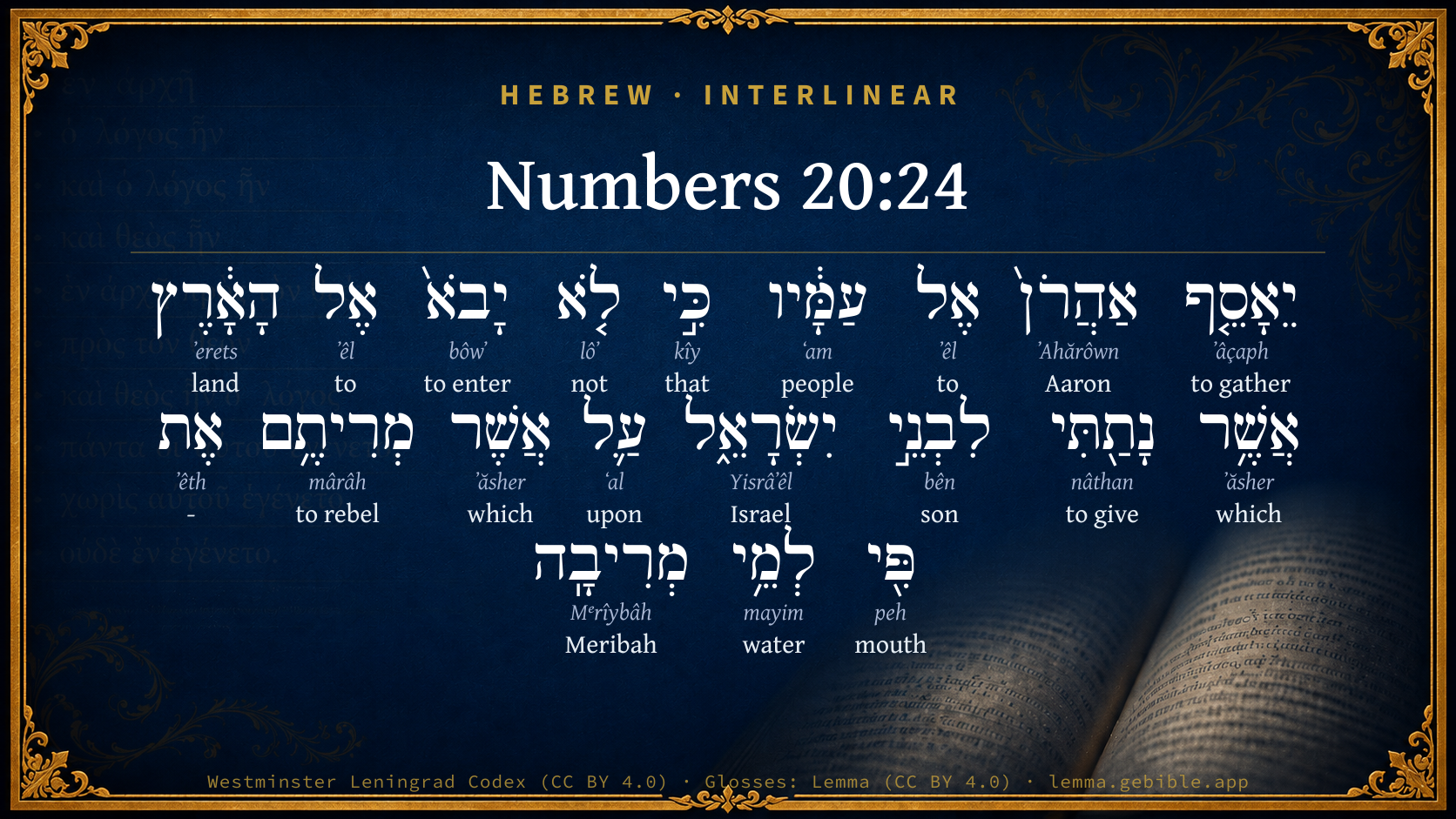
Hebrew (Westminster Leningrad Codex) Numbers 20:24 appears in the Hebrew Old Testament. The text above is from the Westminster Leningrad Codex. Each word links to its Strong’s number, a concise gloss, and parsing drawn from the Open Scriptures Hebrew Bible morphology. Click any word for its full Brown-Driver-Briggs (BDB) entry.
Download image
Cite this verse

Numbers 20:24 (World English Bible). Public Domain. Lemma interlinear Bible study tool, https://lemma.gebible.app/v/numbers/20/24.

Show BibTeX & RIS
BibTeX
RIS
English Translation
Aaron shall be gathered to his people; for he shall not enter into the land which I have given to the children of Israel, because you rebelled against my word at the waters of Meribah.
World English Bible · Public Domain
Download a study sheet

One document with this verse’s original text, its word-by-word gloss line, the meaning frame, cross-references with their text, attributed commentary, and full source and license credits — printable, and it pastes into notes with its structure intact.

This verse Autodidact and up

Study sheet (.html) Plain text (.txt)

A passage Seminary Student

Up to 50 verses in one chapter. A passage sheet keeps up to 6 commentary sources and 12 cross-references per verse, in the order this page ranks them, and says so on the sheet whenever that leaves anything out. Ask for a single verse and you get the Autodidact verse sheet above.

Everything on this page stays free to read, with no account — the sheet is a download of what is already on screen, not access to it.

Want to remove ads? Support Godless Engineer
Compare translations 3

The same verse in 3 English versions, stacked beneath the original-language interlinear above. Click any original word for its lexicon entry.

Each is an independent rendering of the whole verse — the interlinear is not word-aligned to these translations.

Highlighted words mark where these versions differ — a whole-verse word diff, not a word-by-word alignment.

  • World English Bible Public Domain
    Aaron shall be gathered to his people; for he shall not enter into the land which I have given to the children of Israel, because you rebelled against my word at the waters of Meribah.
  • King James Version Public Domain
    Aaron shall be gathered unto his people: for he shall not enter into the land which I have given unto the children of Israel, because ye rebelled against my word at the water of Meribah.
  • unfoldingWord Literal Text CC BY-SA 4.0
    “Aaron will be gathered to his peoples, for he will not come to the land that I have given to the sons of Israel, because you rebelled against my mouth at the waters of Meribah.

unfoldingWord Literal Text — © unfoldingWord, licensed CC BY-SA 4.0. Word-aligned USFM3 via Door43 (git.door43.org/unfoldingWord/en_ult).

Versions to compare (up to 4)

3 of 4 selected

Show all 18 translations

Every available English version of this verse, each an independent rendering of the whole verse.

  • World English Bible Public Domain
    Aaron shall be gathered to his people; for he shall not enter into the land which I have given to the children of Israel, because you rebelled against my word at the waters of Meribah.
  • Berean Standard Bible Public Domain
    “Aaron will be gathered to his people; he will not enter the land that I have given the Israelites, because both of you rebelled against My command at the waters of Meribah.
  • Majority Standard Bible Public Domain
    “Aaron will be gathered to his people; he will not enter the land that I have given the Israelites, because both of you rebelled against My command at the waters of Meribah.
  • King James Version Public Domain
    Aaron shall be gathered unto his people: for he shall not enter into the land which I have given unto the children of Israel, because ye rebelled against my word at the water of Meribah.
  • American Standard Version (1901) Public Domain
    Aaron shall be gathered unto his people; for he shall not enter into the land which I have given unto the children of Israel, because ye rebelled against my word at the waters of Meribah.
  • Revised Version (1885) Public Domain
    Aaron shall be gathered unto his people: for he shall not enter into the land which I have given unto the children of Israel, because ye rebelled against my word at the waters of Meribah.
  • Geneva Bible (1599) Public Domain
    Aaron shall be gathered vnto his people: for hee shall not enter into the lande, which I haue giuen vnto the children of Israel, because ye disobeyed my commandement at the water of Meribah.
  • Douay-Rheims (1899) Public Domain
    Let Aaron, saith he, go to his people: for he shall not go into the land which I have given the children of Israel, because he was incredulous to my words, at the waters of contradiction.
  • Young's Literal Translation Public Domain
    `Aaron is gathered unto his people, for he doth not go in unto the land which I have given to the sons of Israel, because that ye provoked My mouth at the waters of Meribah.
  • Literal Standard Version CC BY-SA 4.0
    “Aaron is gathered to his people, for he does not go into the land which I have given to the sons of Israel, because that you provoked My mouth at the waters of Meribah.
  • Unlocked Literal Bible CC BY-SA 4.0
    “Aaron must be gathered to his people, for he will not enter the land that I have given to the people of Israel. This is because you both rebelled against my word at the waters of Meribah.
  • unfoldingWord Literal Text CC BY-SA 4.0
    “Aaron will be gathered to his peoples, for he will not come to the land that I have given to the sons of Israel, because you rebelled against my mouth at the waters of Meribah.
  • Darby Bible Public Domain
    Aaron shall be gathered unto his peoples; for he shall not enter into the land that I have given unto the children of Israel, because ye rebelled against my commandment at the waters of Meribah.
  • World Messianic Bible Public Domain
    “Aaron shall be gathered to his people; for he shall not enter into the land which I have given to the children of Israel, because you rebelled against my word at the waters of Meribah.
  • Webster's Bible Public Domain
    Aaron shall be gathered to his people: for he shall not enter into the land which I have given to the children of Israel, because ye rebelled against my word at the water of Meribah.
  • Free Bible Version CC BY-SA 4.0
    “Aaron will shortly join his forefathers in death. He will not enter the country I have given the Israelites, because you both disobeyed my command at the waters of Meribah.
  • Bible in Basic English Public Domain
    Aaron will be put to rest with his people; he will not go into the land which I have given to the children of Israel, because you went against my word at the waters of Meribah.
  • JPS Tanakh (1917) Public Domain
    'Aaron shall be gathered unto his people; for he shall not enter into the land which I have given unto the children of Israel, because ye rebelled against My word at the waters of Meribah.

Literal Standard Version (2020), Covenant Press — licensed CC BY-SA 4.0. Text via the HelloAO Bible API (eBible.org). Unlocked Literal Bible (unfoldingWord) — licensed CC BY-SA 4.0. Text via the HelloAO Bible API (eBible.org). unfoldingWord Literal Text — © unfoldingWord, licensed CC BY-SA 4.0. Word-aligned USFM3 via Door43 (git.door43.org/unfoldingWord/en_ult). Free Bible Version, Dr. Jonathan Gallagher — licensed CC BY-SA 4.0. Text via the HelloAO Bible API (eBible.org).

Word by word

More ways to search: Search by grammar → Find every occurrence → Compare this word →

Practice this passage: Drill this verse → Learn its vocabulary →

מְרִיבָֽה
Mᵉrîybâh
H4809
“Meribah”
Noun, Proper
Part of Speech
Noun
Type
Proper
Full BDB Definition

Origin: the same as H4808

TWOT: None

Meribah = "strife" or " contention" - a fountain at Rephidim, in the desert of Sin; so called because the Israelites murmured against God - the name of the water supply at Kadesh on the southern border of the promised land; the people also murmured here against God
  1. יֵאָסֵ֤ף ʼâçaph H622 “to gather” Verb, Niphal, Imperfect, 3rd Person, Masculine, Singular
  2. אַהֲרֹן֙ ʼAhărôwn H175 “Aaron” Noun, Proper
  3. אֶל ʼêl H413 “to” Preposition
  4. עַמָּ֔יו ʻam H5971 “peoples · his” Noun, Common, Masculine, Plural, Construct + Suffix, Personal, 3rd Person, Masculine, Singular
  5. כִּ֣י kîy H3588 “that” Conjunction
  6. לֹ֤א lôʼ H3808 “not” Particle, Negative
  7. יָבֹא֙ bôwʼ H935 “to enter” Verb, Qal, Imperfect, 3rd Person, Masculine, Singular
  8. אֶל ʼêl H413 “to” Preposition
  9. הָאָ֔רֶץ ʼerets H776 “the · land” Particle, Definite Article + Noun, Common, Both, Singular, Absolute
  10. אֲשֶׁ֥ר ʼăsher H834 “which” Particle, Relative
  11. נָתַ֖תִּי nâthan H5414 “to give” Verb, Qal, Perfect, 1st Person, Common, Singular
  12. לִבְנֵ֣י bên H1121 “to/for · sons of” Preposition + Noun, Common, Masculine, Plural, Construct
  13. יִשְׂרָאֵ֑ל Yisrâʼêl H3478 “Israel” Noun, Proper
  14. עַ֛ל ʻal H5921 “upon” Preposition
  15. אֲשֶׁר ʼăsher H834 “which” Particle, Relative
  16. מְרִיתֶ֥ם mârâh H4784 “to rebel” Verb, Qal, Perfect, 2nd Person, Masculine, Plural
  17. אֶת ʼêth H853 “-” Particle, Direct Object
  18. פִּ֖י peh H6310 “mouth · my” Noun, Common, Masculine, Singular, Construct + Suffix, Personal, 1st Person, Common, Singular
  19. לְמֵ֥י mayim H4325 “to/for · water(s) of” Preposition + Noun, Common, Masculine, Plural, Construct

About this verse

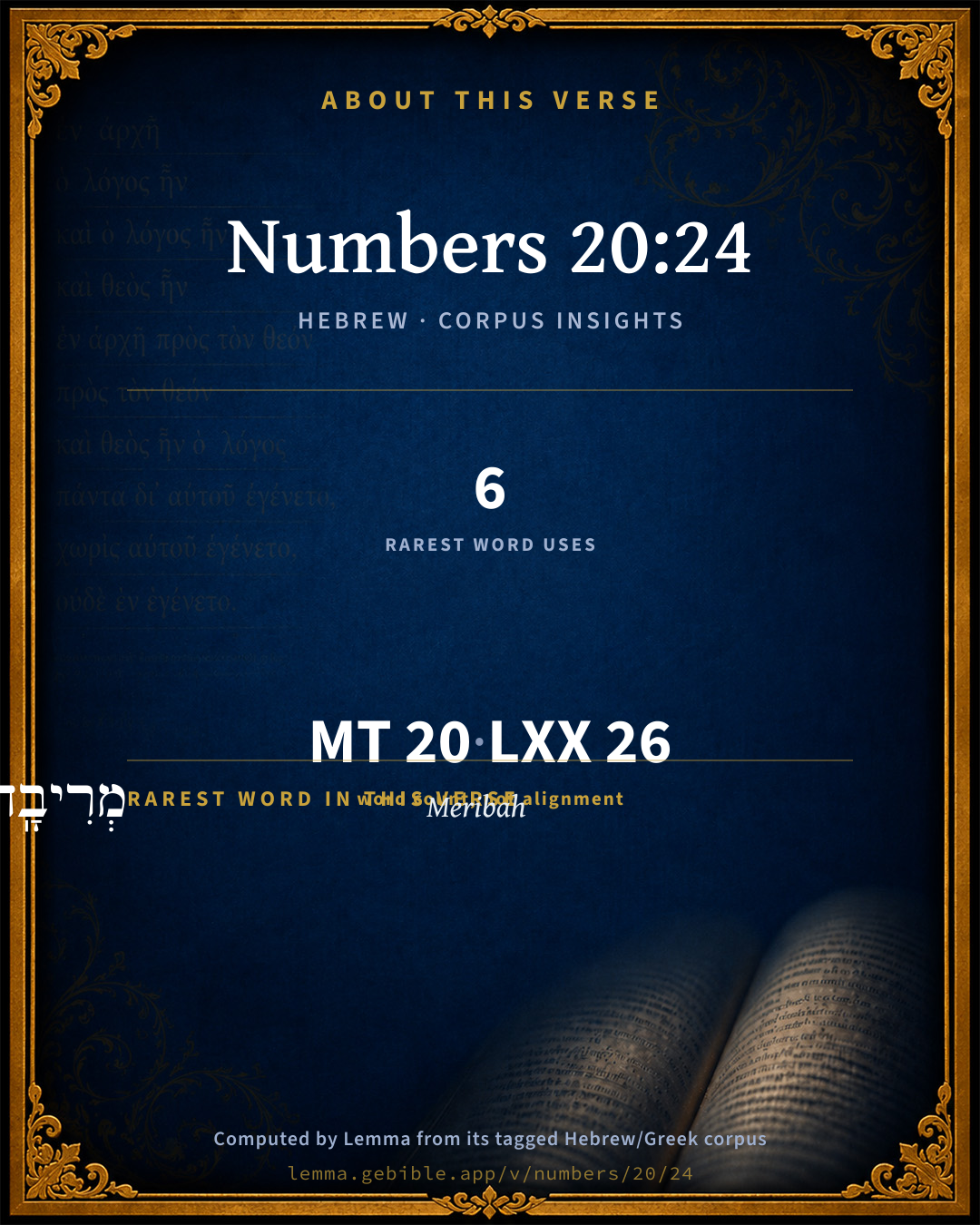
These counts appear in no published source. They are computed here, from the morphology-tagged text and Lemma’s own curated glosses. What Lemma adds →

20
words
18
distinct lemmas
Pentateuch
section

Notable vocabulary

The rarest word here is מְרִיבָֽה Meribah H4809 — appearing just 6 times in the whole Hebrew Bible.

Shared distinctive vocabulary

מְרִיבָֽה Meribah H4809 occurs in 6 verses of the Hebrew Bible. Also found in:

Grammatical profile

  • 4 verbs
  • 8 nouns
  • 3 prepositions
  • 1 conjunction
  • 4 particles

Verb forms

  • יֵאָסֵ֤ף Niphal · Imperfect
  • יָבֹא֙ Qal · Imperfect
  • נָתַ֖תִּי Qal · Perfect
  • מְרִיתֶ֥ם Qal · Perfect

Repetition

Words recur within this verse — often emphatic in Hebrew:

  • אֶל to H413 ×2
  • אֲשֶׁ֥ר which H834 ×2

Hebrew & Septuagint length

In English translation the verse runs 35 words from the Hebrew and 33 from the Septuagint (LXX English) — closely comparable.

A rough comparison of the two English renderings, which tokenize alike — not a word-level alignment.

Word counts can differ between the Hebrew and the Greek without any difference in meaning — e.g. the Hebrew direct-object marker אֵת has no separate Greek word, and Greek often adds the article ὁ.

In the original languages it is 20 Hebrew tokens and 26 Greek tokens — but the two are counted differently (Hebrew bundles its prefixes and suffixes into one token; the Greek is in lemma form), so that isn’t a like-for-like length.

Cross-references

13

Topical passages linked to Numbers 20:24 in the Treasury of Scripture Knowledge — connected by theme and wording, ordered by reader-vote popularity; previews shown in the World English Bible.

  • Genesis 25:8 Abraham gave up the spirit, and died in a good old age, an old man, and full of years, and was gathered to his people.
  • Deuteronomy 32:50 and die on the mountain where you go up, and be gathered to your people, as Aaron your brother died on Mount Hor, and was gathered to his people:
  • Numbers 27:13 When you have seen it, you also shall be gathered to your people, as Aaron your brother was gathered;
  • Numbers 31:2 Avenge the children of Israel of the Midianites: afterward you shall be gathered to your people.
  • 2 Chronicles 34:28 Behold, I will gather you to your fathers, and you shall be gathered to your grave in peace, neither shall your eyes see all the evil that I will bring on this place, and on the inhabitants of it. They brought back word to the king.
  • Genesis 15:15 But you will go to your fathers in peace. You will be buried in a good old age.
  • Genesis 25:17 These are the years of the life of Ishmael: one hundred thirty-seven years. He gave up the spirit and died, and was gathered to his people.
  • Genesis 35:29 Isaac gave up the spirit, and died, and was gathered to his people, old and full of days. Esau and Jacob, his sons, buried him.
  • Genesis 49:29 He charged them, and said to them, "I am to be gathered to my people. Bury me with my fathers in the cave that is in the field of Ephron the Hittite,
  • Genesis 49:33 When Jacob made an end of charging his sons, he gathered up his feet into the bed, and yielded up the spirit, and was gathered to his people.
  • Numbers 4:27 At the commandment of Aaron and his sons shall be all the service of the sons of the Gershonites, in all their burden, and in all their service; and you shall appoint to them in charge all their burden.
  • Numbers 20:10–12 Moses and Aaron gathered the assembly together before the rock, and he said to them, Hear now, you rebels; shall we bring you forth water out of this rock?
  • Judges 2:10 Also all that generation were gathered to their fathers: and there arose another generation after them, who didn't know Yahweh, nor yet the work which he had worked for Israel.

Cross-references courtesy of OpenBible.info (CC BY 4.0).

Hebrew and Greek witnesses Masoretic Hebrew ↔ Greek Septuagint

The same verse in the two great witnesses to the Old Testament, shown verse-for-verse.

These are two independent witnesses, not word-aligned to each other, and the Septuagint is shown in lemma (dictionary) form.

Hebrew Numbers 20:24 Masoretic · Westminster Leningrad Codex

יֵאָסֵ֤ף אַהֲרֹן֙ אֶל עַמָּ֔יו כִּ֣י לֹ֤א יָבֹא֙ אֶל הָאָ֔רֶץ אֲשֶׁ֥ר נָתַ֖תִּי לִבְנֵ֣י יִשְׂרָאֵ֑ל עַ֛ל אֲשֶׁר מְרִיתֶ֥ם אֶת פִּ֖י לְמֵ֥י מְרִיבָֽה

Aaron shall be gathered to his people; for he shall not enter into the land which I have given to the children of Israel, because you rebelled against my word at the waters of Meribah.

World English Bible · Public Domain

Greek LXX Numbers 20:24 Septuagint · lemma form

προςτίθημι ἀαρών πρός ὁ λαός αὐτός ὅτι οὐ μή εἰςἔρχομαι εἰς ὁ γῆ ὅς δίδωμι ὁ υἱός ἰσραήλ διότι παραὀξύνω ἐγώ ἐπί ὁ ὕδωρ ὁ λοιδορία

Let Aaron be added to his people; for you⌃ shall certainly not go into the land which I have given the children of Israel, because you⌃ provoked me at the water of strife.

LXX2012 (modern English Septuagint) · Public Domain

On this verse, Haydock's Catholic Bible Commentary discusses the Septuagint’s reading. Read the note in Commentary ↓

Hebrew: Westminster Leningrad Codex (CC BY 4.0). Greek: Septuagint (public domain); English from LXX2012 (modern English Septuagint) (Public Domain). How the Septuagint differs from the Hebrew →

Targum (Aramaic paraphrase)

2

The Targum is the ancient Jewish Aramaic paraphrase of the Hebrew Scriptures — an interpretive translation, not the Hebrew text itself. Onkelos (literal) and Pseudo-Jonathan (expansive) render the Torah, and Jonathan the Prophets. Coverage is partial: where no permissively-licensed English translation exists for a verse, only the Aramaic is shown. This is verse-level text, not a word-by-word alignment to the Hebrew.

  1. Targum Onkelos Torah (Genesis–Deuteronomy)
    יִתְכְּנֵשׁ אַהֲרֹן לְעַמֵיהּ אֲרֵי לָא יֵעוֹל לְאַרְעָא דִי יְהָבִית לִבְנֵי יִשְׂרָאֵל עַל דִי סְרֵיבְתּוּן עַל מֵימְרִי לְמֵי מַצוּתָא

    (no public-domain English translation for this verse)

    Targum Onkelos — Aramaic: “Onkelos Genesis” (public domain); “Onkelos Exodus” (public domain); “Onkelos Leviticus” (public domain); “Onkelos Numbers” (public domain); “Onkelos Deuteronomy” (public domain). English: “Sefaria Community Translation” (CC0 1.0 (public-domain dedication)); “J.W. Etheridge. The Targums of Onkelos and Jonathan Ben Uzziel on the Pentateuch. London: Longmans, Green, 1862” (public domain). Text via Sefaria.

  2. Targum Pseudo-Jonathan Torah (Genesis–Deuteronomy)
    יִתְכְּנֵישׁ אַהֲרן לְעַמֵיהּ אֲרוּם לָא יֵיעוֹל לְאַרְעָא דִיהָבִית לִבְנֵי יִשְרָאֵל מְטוֹל דְסָרֵבְתּוּן עַל מֵימְרִי בְּמֵי מַצוּתָא

    Aharon shall be gathered unto his people; for he shall not enter into the land which I have given unto the children of Israel, because you were rebels against My Word at the Waters of Contention.

    Targum Pseudo-Jonathan — Aramaic: “Targum Jonathan on Genesis” (public domain); “Targum Jonathan on Exodus” (public domain); “Targum Jonathan on Leviticus” (public domain); “Targum Jonathan on Numbers” (public domain); “Targum Jonathan on Deuteronomy” (public domain). English: “The Targum of Jonathan ben Uzziel, trans. J. W. Etheridge, London, 1862” (public domain). Text via Sefaria.

Commentary

Notes on Numbers 20:24 from classic Christian and Jewish commentators (each source and its license shown beneath its notes). The classic Christian expositions comment on the surrounding passage and are grouped to its opening verse, so a note may address several verses; the Jewish commentaries on the Tanakh (Rashi and others) are per-verse, so they appear only where the commentator wrote on this verse.

Lemma curates 59 commentaries, every one of them public domain or Creative Commons licensed, each selected and text-cleaned for this edition rather than reprinted as found. About our sources →

Trapp's Complete Commentary

John Trapp

Num 20:24 Aaron shall be gathered unto his people: for he shall not enter into the land which I have given unto the children of Israel, because ye rebelled against my word at the water of Meribah.

Ver. 24. Ye rebelled.] In that ye smote the rock, and smote it twice: he spoke bitterly also to the people, calling them rebels, and slighting them. This is called rebellion here. Every man’s heel hath some iniquity, as dirt, cleaving to it: and the greatest lamps have needed snuffers.

John Trapp, A Commentary or Exposition upon All the Books of the Old and New Testament (1647–1656) — public domain. Text from a community e-Sword module.

Joseph Benson's Commentary

Num 20:24. Because ye rebelled — This was one, but not the only reason. God would not have Moses and Aaron to carry the people into Canaan, for this reason also, to signify the insufficiency of the Mosaical law and Aaronical priesthood to make them perfectly happy, and the necessity of a better dispensation, and to keep the Israelites from resting in them, so as to be taken off from their expectation of the Messiah.

Joseph Benson's Commentary on the Old and New Testaments (1811–1818) — public domain. Text from a community e-Sword module.

Tyndale Open Study Notes

Tyndale Open Resources

20:24-26 Aaron’s participation in the rebellion of his generation resulted in his death outside the Promised Land (20:10-12).

Tyndale Open Study Notes — © Tyndale Open Resources, licensed CC BY-SA 4.0. Text via the HelloAO Bible API.

Geneva Bible (1599)

Geneva Bible translators

Or, rebelled.

Read Gen. 25:8.

Or, strife.

Geneva Bible (1599) marginal notes — public domain. Text via Bolls.life.

Jamieson, Fausset & Brown

Robert Jamieson, A. R. Fausset & David Brown

Aaron shall be gathered unto his people--In accordance with his recent doom, he, attired in the high priest's costume, was commanded to ascend that mountain and die. But although the time of his death was hastened by the divine displeasure as a punishment for his sins, the manner of his death was arranged in tenderness of love, and to do him honor at the close of his earthly service. His ascent of the mount was to afford him a last look of the camp and a distant prospect of the promised land. The simple narrative of the solemn and impressive scene implies, though it does not describe, the pious resignation, settled faith, and inward peace of the aged pontiff.

Jamieson, Fausset & Brown — Commentary Critical and Explanatory on the Whole Bible (1871) — public domain (CC PDM 1.0). Text via the HelloAO Bible API.

Ellicott's Commentary for English Readers

(24) Shall be gathered unto his people.—This expression does not refer to the place of sepulture. (See Gen_25:8. and Note.)

A Bible Commentary for English Readers, edited by Charles John Ellicott (1878–1897) — public domain. Text from a community e-Sword module.

John Gill's Exposition

Take Aaron and Eleazar his son,.... His eldest son, who was to succeed him in the priesthood, and did:

and bring them up unto Mount Hor; to the top of it, they being now at the foot of it, where the people of Israel lay encamped.

John Gill's Exposition of the Whole Bible (1746–1763) — public domain (CC PDM 1.0). Text via the HelloAO Bible API.

Haydock's Catholic Bible Commentary

People, in the bosom of Abraham, while his body is consigned to the grave. --- Incredulous. Hebrew, "you rebelled against," &c., the words were addressed to both. Septuagint, "you irritated me." (Haydock)

George Leo Haydock (1774–1849), Haydock's Catholic Family Bible and Commentary, 1859 edition — public domain. Excludes Psalms (Douay-Rheims chapter numbering differs from Protestant) and Deuterocanonical books (Catholic canon only).

Matthew Poole's English Annotations

This was one, but not the only reason. God would not have Moses and Aaron to carry the people into Canaan, for this reason also, to signify the insufficiency of the Mosaical and Aaronical priesthood to make them happy, and the necessity of a better, and so to keep the Israelites from resting in them so as to be taken off from their expectation of Christ, and from the entertainment of him when he should come.

Matthew Poole's English Annotations on the Holy Bible (1683–1685) — public domain. Text from a community e-Sword/MySword module.

Whedon's Commentary on the Bible

Daniel D. Whedon

24. Shall be gathered unto his people — This phrase is a Hebrew euphemism for death, as is seen in Num_20:26. “Merciful men are gathered, none considering that the righteous is gathered from the evil to come.” See the Hebrew of Isa_57:1. Thus David was gathered unto his fathers. See the Greek of Act_13:36. “His people” are “the spirits of just men made perfect.” That this “gathering” has reference to the soul, see David’s prayer, Psa_26:9.

Because ye rebelled — Evinced a spirit not in harmony with Jehovah’s will. See Num_20:12, where the sin is stated, “because ye believed not.” The two statements are harmonized by the consideration that unbelief is the root and essence of every sin. Joh_16:9, note.

Meribah — Num_20:13, note.

Daniel D. Whedon (gen. ed.), Commentary on the Old and New Testaments (1874–1909) — public domain. Text from a community e-Sword module.

The Pulpit Commentary

Aaron shall be gathered unto his people. On this expression see at Gen_25:8.

The Pulpit Commentary (1880–1919), ed. H.D.M. Spence-Jones & Joseph S. Exell — public domain. Text from a community e-Sword module.

John Wesley's Explanatory Notes

Because they rebelled - This was one but not the only reason. God would not have Moses and Aaron to carry the people into Canaan, for this reason also, to signify the insufficiency of the Mosaical law and Aaronical priesthood to make them perfectly happy, and the necessity of a better, and to keep the Israelites from resting in them, so as to be taken off from their expectation of Christ.

John Wesley, Explanatory Notes Upon the Whole Bible (1754–1765) — public domain. Text via the GEBible commentary corpus.

Lesson kit

Teaching starters — assembled from the data on this page, not authored interpretation. Every prompt links to the verse data it draws on. Edit before teaching.

Numbers, in the Pentateuch, opens this verse with 20 words (18 distinct Hebrew lemmas). Its most distinctive word is Mᵉrîybâh (“Meribah”). A historical commentator’s framing appears above. Read the whole chapter for the surrounding context.

Discussion questions

  1. What does “Meribah” (Mᵉrîybâh) contribute to the verse as a whole?
  2. Exodus 17:7 shares the word «Meribah» with this verse. How do the two illuminate each other?
  3. “to” occurs 2× in this one verse. What is the effect of the repetition?
  4. These translations render this verse differently. What is at stake in choosing one wording over another?
  5. The verb «יֵאָסֵ֤ף» is Niphal Imperfect. How does its form color the action?
  6. Reading how Trapp's Complete Commentary and Joseph Benson's Commentary read this verse, where do the two commentators agree and where do they part?

Things to notice

Reading settings

Reading text

Shown beneath each verse's original-language words.

Old Testament
Old Testament edition

Read the OT as the Masoretic Hebrew (MT) or the Greek Septuagint (LXX).

English shown for the Greek Septuagint (in the Hebrew ↔ Greek comparison).

Comparing translations? Open the Compare panel on any verse page to stack up to four side by side.