
2 Kings 22:4

Hebrew (Westminster Leningrad Codex) 2 Kings 22:4 appears in the Hebrew Old Testament. The text above is from the Westminster Leningrad Codex. Each word links to its Strong’s number, a concise gloss, and parsing drawn from the Open Scriptures Hebrew Bible morphology. Click any word for its full Brown-Driver-Briggs (BDB) entry.
Download image
Cite this verse

2 Kings 22:4 (World English Bible). Public Domain. Lemma interlinear Bible study tool, https://lemma.gebible.app/v/2-kings/22/4.

Show BibTeX & RIS
BibTeX
RIS
English Translation
Go up to Hilkiah the high priest, that he may sum the money which is brought into the house of Yahweh, which the keepers of the threshold have gathered of the people:
World English Bible · Public Domain
Download a study sheet

One document with this verse’s original text, its word-by-word gloss line, the meaning frame, cross-references with their text, attributed commentary, and full source and license credits — printable, and it pastes into notes with its structure intact.

This verse Autodidact and up

Study sheet (.html) Plain text (.txt)

A passage Seminary Student

Up to 50 verses in one chapter. A passage sheet keeps up to 6 commentary sources and 12 cross-references per verse, in the order this page ranks them, and says so on the sheet whenever that leaves anything out. Ask for a single verse and you get the Autodidact verse sheet above.

Everything on this page stays free to read, with no account — the sheet is a download of what is already on screen, not access to it.

Want to remove ads? Support Godless Engineer
Compare translations 3

The same verse in 3 English versions, stacked beneath the original-language interlinear above. Click any original word for its lexicon entry.

Each is an independent rendering of the whole verse — the interlinear is not word-aligned to these translations.

Highlighted words mark where these versions differ — a whole-verse word diff, not a word-by-word alignment.

  • World English Bible Public Domain
    Go up to Hilkiah the high priest, that he may sum the money which is brought into the house of Yahweh, which the keepers of the threshold have gathered of the people:
  • King James Version Public Domain
    Go up to Hilkiah the high priest, that he may sum the silver which is brought into the house of the LORD, which the keepers of the door have gathered of the people:
  • unfoldingWord Literal Text CC BY-SA 4.0
    “Go up to Hilkiah, the great priest, and he shall complete the silver having been brought the house of Yahweh, which the keepers of the threshold have collected from the people.

unfoldingWord Literal Text — © unfoldingWord, licensed CC BY-SA 4.0. Word-aligned USFM3 via Door43 (git.door43.org/unfoldingWord/en_ult).

Versions to compare (up to 4)

3 of 4 selected

Show all 18 translations

Every available English version of this verse, each an independent rendering of the whole verse.

  • World English Bible Public Domain
    Go up to Hilkiah the high priest, that he may sum the money which is brought into the house of Yahweh, which the keepers of the threshold have gathered of the people:
  • Berean Standard Bible Public Domain
    “Go up to Hilkiah the high priest and have him count the money that has been brought into the house of the LORD, which the doorkeepers have collected from the people.
  • Majority Standard Bible Public Domain
    “Go up to Hilkiah the high priest and have him count the money that has been brought into the house of the LORD, which the doorkeepers have collected from the people.
  • King James Version Public Domain
    Go up to Hilkiah the high priest, that he may sum the silver which is brought into the house of the LORD, which the keepers of the door have gathered of the people:
  • American Standard Version (1901) Public Domain
    Go up to Hilkiah the high priest, that he may sum the money which is brought into the house of Jehovah, which the keepers of the threshold have gathered of the people:
  • Revised Version (1885) Public Domain
    Go up to Hilkiah the high priest, that he may sum the money which is brought into the house of the LORD, which the keepers of the door have gathered of the people:
  • Geneva Bible (1599) Public Domain
    Goe vp to Hilkiah the high Priest, that hee may summe the siluer which is brought into the house of the Lord, which the keepers of the doore haue gathered of the people.
  • Douay-Rheims (1899) Public Domain
    Go to Helcias the high priest, that the money may be put together which is brought into the temple of the Lord, which the doorkeepers of the temple have gathered of the people.
  • Young's Literal Translation Public Domain
    `Go up unto Hilkiah the high priest, and he doth complete the silver that is brought into the house of Jehovah, that the keepers of the threshold have gathered from the people,
  • Literal Standard Version CC BY-SA 4.0
    “Go up to Hilkiah the high priest, and he completes the silver that is brought into the house of YHWH, that the keepers of the threshold have gathered from the people,
  • Unlocked Literal Bible CC BY-SA 4.0
    “Go up to Hilkiah the high priest and tell him to count the money that has been brought into the house of Yahweh, which the temple guards have gathered from the people.
  • unfoldingWord Literal Text CC BY-SA 4.0
    “Go up to Hilkiah, the great priest, and he shall complete the silver having been brought the house of Yahweh, which the keepers of the threshold have collected from the people.
  • Darby Bible Public Domain
    Go up to Hilkijah the high priest, that he may sum up the money which is brought into the house of Jehovah, which the doorkeepers have gathered of the people,
  • World Messianic Bible Public Domain
    “Go up to Hilkiah the high priest, that he may count the money which is brought into the LORD’s house, which the keepers of the threshold have gathered of the people.
  • Webster's Bible Public Domain
    Go to Hilkiah the high priest, that he may sum the silver which is brought into the house of the LORD, which the keepers of the door have gathered from the people:
  • Free Bible Version CC BY-SA 4.0
    “Go to Hilkiah the high priest and have him count the money the doorkeepers have collected from the people coming to the Lord's Temple.
  • Bible in Basic English Public Domain
    Go up to Hilkiah, the chief priest, and let him give out the money which is taken into the house of the Lord, which the keepers of the door have got together from the people;
  • JPS Tanakh (1917) Public Domain
    'Go up to Hilkiah the high priest, that he may sum the money which is brought into the house of the LORD, which the keepers of the door have gathered of the people;

Literal Standard Version (2020), Covenant Press — licensed CC BY-SA 4.0. Text via the HelloAO Bible API (eBible.org). Unlocked Literal Bible (unfoldingWord) — licensed CC BY-SA 4.0. Text via the HelloAO Bible API (eBible.org). unfoldingWord Literal Text — © unfoldingWord, licensed CC BY-SA 4.0. Word-aligned USFM3 via Door43 (git.door43.org/unfoldingWord/en_ult). Free Bible Version, Dr. Jonathan Gallagher — licensed CC BY-SA 4.0. Text via the HelloAO Bible API (eBible.org).

Word by word

More ways to search: Search by grammar → Find every occurrence → Compare this word →

Practice this passage: Drill this verse → Learn its vocabulary →

הַסַּ֖ף
çaph
H5592
“the · basin”
Particle, Definite Article + Noun, Common, Masculine, Singular, Absolute
Part of Speech
Particle + Noun
Type
Common
Gender
Masculine
Number
Singular
State
Absolute
Full BDB Definition

Origin: from H5605 , in its original sense of containing

TWOT: 1538a , 1538b

a spreading out, basin, goblet, bowl - basin, goblet - threshold, sill - threshold, sill, door-keeper
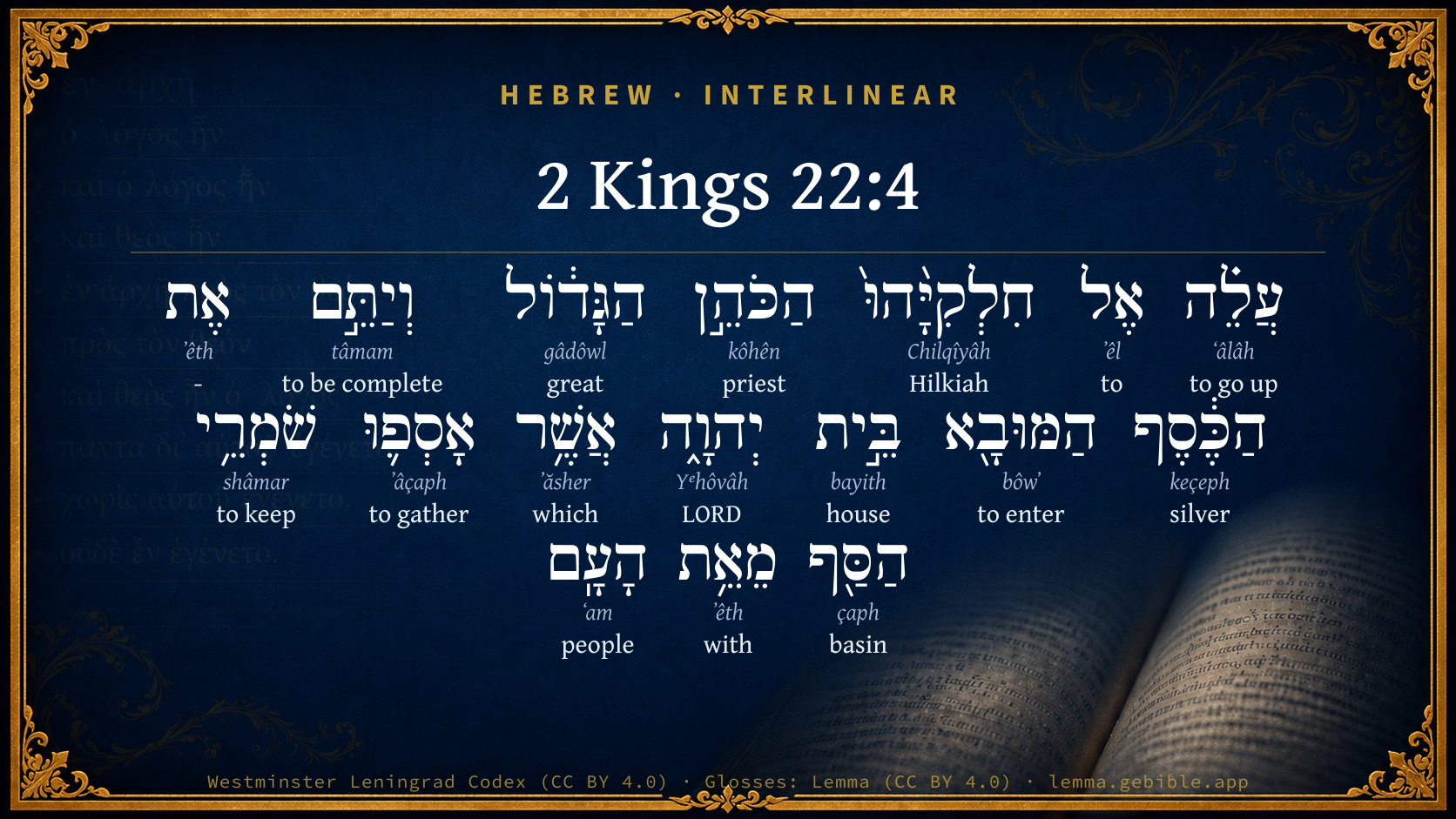
  1. עֲלֵ֗ה ʻâlâh H5927 “go up” Verb, Qal, Imperative, 2nd Person, Masculine, Singular
  2. אֶל ʼêl H413 “to” Preposition
  3. חִלְקִיָּ֨הוּ֙ Chilqîyâh H2518 “Hilkiah” Noun, Proper
  4. הַכֹּהֵ֣ן kôhên H3548 “the · priest” Particle, Definite Article + Noun, Common, Masculine, Singular, Absolute
  5. הַגָּד֔וֹל gâdôwl H1419 “the · great” Particle, Definite Article + Adjective, Adjective, Masculine, Singular, Absolute
  6. וְיַתֵּ֣ם tâmam H8552 “and · to be complete” Conjunction + Verb, Hiphil, Imperfect, 3rd Person, Masculine, Singular
  7. אֶת ʼêth H853 “-” Particle, Direct Object
  8. הַכֶּ֔סֶף keçeph H3701 “the · silver” Particle, Definite Article + Noun, Common, Masculine, Singular, Absolute
  9. הַמּוּבָ֖א bôwʼ H935 “the · entered” Particle, Definite Article + Verb, Hophal, Participle Passive, Masculine, Singular, Absolute
  10. בֵּ֣ית bayith H1004 “house of” Noun, Common, Masculine, Singular, Construct
  11. יְהוָ֑ה Yᵉhôvâh H3068 “LORD” Noun, Proper
  12. אֲשֶׁ֥ר ʼăsher H834 “which” Particle, Relative
  13. אָסְפ֛וּ ʼâçaph H622 “to gather” Verb, Qal, Perfect, 3rd Person, Common, Plural
  14. שֹׁמְרֵ֥י shâmar H8104 “keeping” Verb, Qal, Participle Active, Masculine, Plural, Construct
  15. מֵאֵ֥ת ʼêth H854 “from · with” Preposition + Preposition
  16. הָעָֽם ʻam H5971 “the · people” Particle, Definite Article + Noun, Common, Masculine, Singular, Absolute

About this verse

These counts appear in no published source. They are computed here, from the morphology-tagged text and Lemma’s own curated glosses. What Lemma adds →

17
words
17
distinct lemmas
Historical
section

Shared distinctive vocabulary

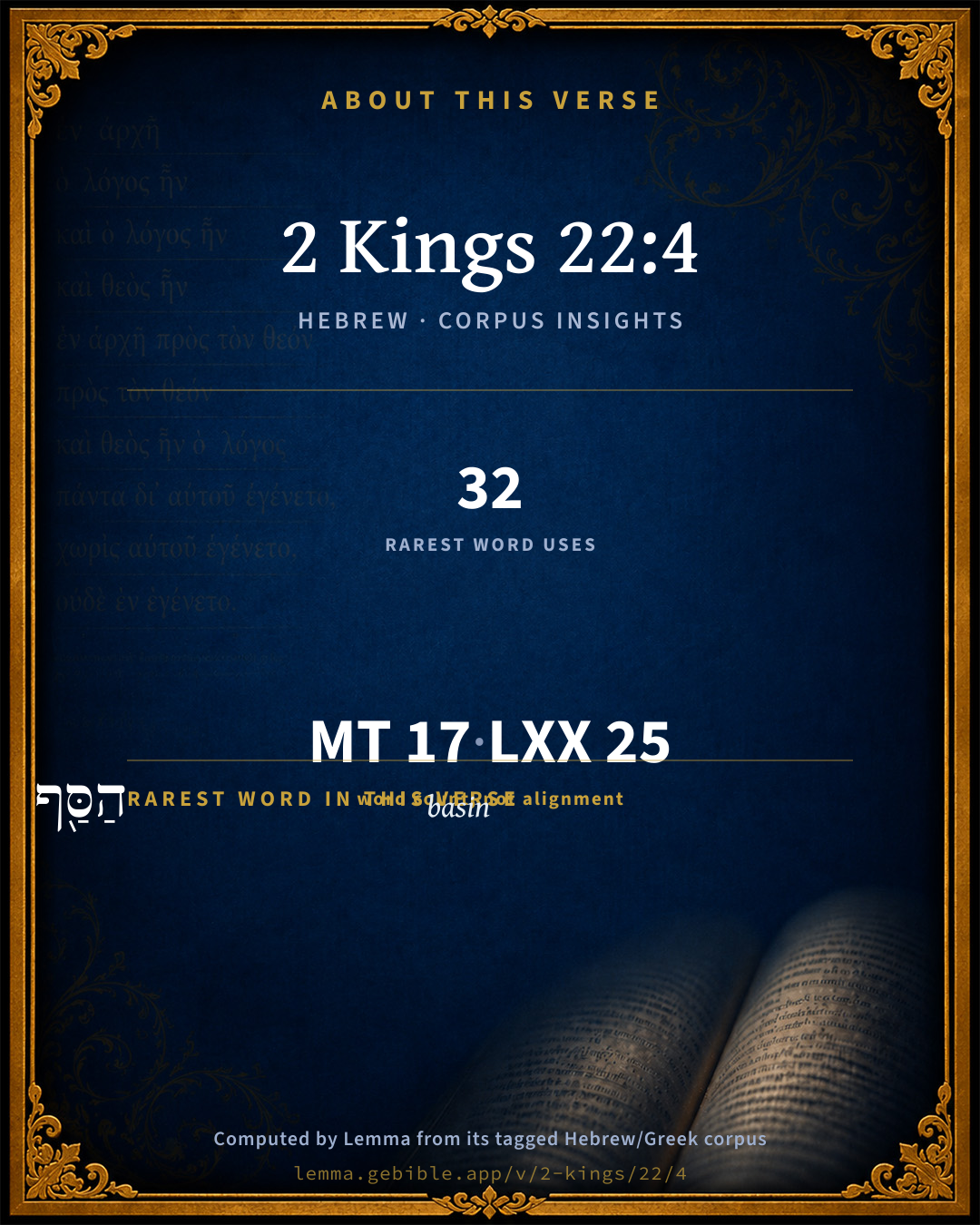
הַסַּ֖ף basin H5592 occurs in 28 verses of the Hebrew Bible. Also found in:

Grammatical profile

  • 5 verbs
  • 7 nouns
  • 1 adjective
  • 2 prepositions
  • 2 particles

Verb forms

  • עֲלֵ֗ה Qal · Imperative
  • וְיַתֵּ֣ם Hiphil · Imperfect
  • הַמּוּבָ֖א Hophal · Participle Passive
  • אָסְפ֛וּ Qal · Perfect
  • שֹׁמְרֵ֥י Qal · Participle Active

Hebrew & Septuagint length

In English translation the verse runs 32 words from the Hebrew and 33 from the Septuagint (LXX English) — closely comparable.

A rough comparison of the two English renderings, which tokenize alike — not a word-level alignment.

Word counts can differ between the Hebrew and the Greek without any difference in meaning — e.g. the Hebrew direct-object marker אֵת has no separate Greek word, and Greek often adds the article ὁ.

In the original languages it is 17 Hebrew tokens and 25 Greek tokens — but the two are counted differently (Hebrew bundles its prefixes and suffixes into one token; the Greek is in lemma form), so that isn’t a like-for-like length.

Cross-references

12

Topical passages linked to 2 Kings 22:4 in the Treasury of Scripture Knowledge — connected by theme and wording, ordered by reader-vote popularity; previews shown in the World English Bible.

  • 2 Kings 12:4 Jehoash said to the priests, All the money of the holy things that is brought into the house of Yahweh, in current money, the money of the persons for whom each man is rated, and all the money that it comes into any man's heart to bring into the house of Yahweh,
  • 2 Kings 12:8–11 The priests consented that they should take no [more] money from the people, neither repair the breaches of the house.
  • 1 Chronicles 6:13 and Shallum became the father of Hilkiah, and Hilkiah became the father of Azariah,
  • 1 Chronicles 9:11 and Azariah the son of Hilkiah, the son of Meshullam, the son of Zadok, the son of Meraioth, the son of Ahitub, the ruler of the house of God;
  • 1 Chronicles 9:19 Shallum the son of Kore, the son of Ebiasaph, the son of Korah, and his brothers, of his father's house, the Korahites, were over the work of the service, keepers of the thresholds of the tent: and their fathers had been over the camp of Yahweh, keepers of the entry.
  • 1 Chronicles 26:13–19 They cast lots, the small as well as the great, according to their fathers' houses, for every gate.
  • 2 Chronicles 8:14 He appointed, according to the ordinance of David his father, the divisions of the priests to their service, and the Levites to their offices, to praise, and to minister before the priests, as the duty of every day required; the doorkeepers also by their divisions at every gate: for so had David the man of God commanded.
  • 2 Chronicles 24:8–12 So the king commanded, and they made a chest, and set it outside at the gate of the house of Yahweh.
  • 2 Chronicles 34:9–18 They came to Hilkiah the high priest, and delivered the money that was brought into the house of God, which the Levites, the keepers of the threshold, had gathered of the hand of Manasseh and Ephraim, and of all the remnant of Israel, and of all Judah and Benjamin, and of the inhabitants of Jerusalem.
  • Nehemiah 11:19 Moreover the porters, Akkub, Talmon, and their brothers, who kept watch at the gates, were one hundred seventy-two.
  • Psalms 84:10 For a day in your courts is better than a thousand. I would rather be a doorkeeper in the house of my God, Than to dwell in the tents of wickedness.
  • Mark 12:41–42 Jesus sat down opposite the treasury, and saw how the multitude cast money into the treasury. Many who were rich cast in much.

Cross-references courtesy of OpenBible.info (CC BY 4.0).

Hebrew and Greek witnesses Masoretic Hebrew ↔ Greek Septuagint

The same verse in the two great witnesses to the Old Testament, shown verse-for-verse.

These are two independent witnesses, not word-aligned to each other, and the Septuagint is shown in lemma (dictionary) form.

Hebrew 2 Kings 22:4 Masoretic · Westminster Leningrad Codex

עֲלֵ֗ה אֶל חִלְקִיָּ֨הוּ֙ הַכֹּהֵ֣ן הַגָּד֔וֹל וְיַתֵּ֣ם אֶת הַכֶּ֔סֶף הַמּוּבָ֖א בֵּ֣ית יְהוָ֑ה אֲשֶׁ֥ר אָסְפ֛וּ שֹׁמְרֵ֥י הַסַּ֖ף מֵאֵ֥ת הָעָֽם

Go up to Hilkiah the high priest, that he may sum the money which is brought into the house of Yahweh, which the keepers of the threshold have gathered of the people:

World English Bible · Public Domain

Greek LXX 2 Kings 22:4 Septuagint · lemma form

ἀναβαίνω πρός χελκιας ὁ ἱερεύς ὁ μέγας καί σφραγίζω ὁ ἀργύριον ὁ εἰςφέρω ἐν οἶκος κύριος ὅς συνἄγω ὁ φυλάσσω ὁ σταθμός παρά ὁ λαός

Go up to Chelcias the high priest, and take account of the money that is brought into the house of the Lord, which they that keep the door have collected of the people.

LXX2012 (modern English Septuagint) · Public Domain

On this verse, Haydock's Catholic Bible Commentary discusses the Septuagint’s reading. Read the note in Commentary ↓

Hebrew: Westminster Leningrad Codex (CC BY 4.0). Greek: Septuagint (public domain); English from LXX2012 (modern English Septuagint) (Public Domain). How the Septuagint differs from the Hebrew →

Targum (Aramaic paraphrase)

1

The Targum is the ancient Jewish Aramaic paraphrase of the Hebrew Scriptures — an interpretive translation, not the Hebrew text itself. Onkelos (literal) and Pseudo-Jonathan (expansive) render the Torah, and Jonathan the Prophets. Coverage is partial: where no permissively-licensed English translation exists for a verse, only the Aramaic is shown. This is verse-level text, not a word-by-word alignment to the Hebrew.

  1. Targum Jonathan Prophets (Joshua–Malachi)
    סַק לְוַת חִלְקִיָה כַּהֲנָא רַבָּא וְיַטְקֵיס יַת כַּסְפָּא דְאִתָעַל בְּבֵית מַקְדְשָׁא דַייָ דִי כְנָשׁוּ אֲמַרְכְּלַיָא מִן עַמָא:

    (no public-domain English translation for this verse)

    Targum Jonathan — Aramaic: “Mikraot Gedolot” (public domain). English: “Sefaria Community Translation” (CC0 1.0 (public-domain dedication)); “London "Chaldee Paraphrase," 1871” (public domain). Text via Sefaria.

Commentary

Notes on 2 Kings 22:4 from classic Christian and Jewish commentators (each source and its license shown beneath its notes). The classic Christian expositions comment on the surrounding passage and are grouped to its opening verse, so a note may address several verses; the Jewish commentaries on the Tanakh (Rashi and others) are per-verse, so they appear only where the commentator wrote on this verse.

Lemma curates 59 commentaries, every one of them public domain or Creative Commons licensed, each selected and text-cleaned for this edition rather than reprinted as found. About our sources →

Trapp's Complete Commentary

John Trapp

2Ki 22:4 Go up to Hilkiah the high priest, that he may sum the silver which is brought into the house of the LORD, which the keepers of the door have gathered of the people:

Ver. 4. Go up to Helkiah the high priest.] Who perhaps was father to Jeremiah the prophet. {Jer 1:1}

That he may sum the silver.] That is, Count it; or as some will, Stamp it, and put it into current money.

John Trapp, A Commentary or Exposition upon All the Books of the Old and New Testament (1647–1656) — public domain. Text from a community e-Sword module.

Geneva Bible (1599)

Geneva Bible translators

Or, coin, as verse 9.

Or, vessel.

Certain of the Priests were appointed to this office, as 2 Kings 12:9.

Geneva Bible (1599) marginal notes — public domain. Text via Bolls.life.

Adam Clarke's Commentary

Verse 4. That he may sum the silver] As Josiah began to seek the Lord as soon as he began to reign, we may naturally conclude that the worship of God that was neglected and suppressed by his father, was immediately restored; and the people began their accustomed offerings to the temple. Ten years therefore had elapsed since these offerings began; no one had, as yet, taken account of them; nor were they applied to the use for which they were given, viz., the repairing the breaches of the temple.

Adam Clarke's Commentary on the Bible (1810–1826) — public domain. Text from a community e-Sword/MySword module.

The Cambridge Bible for Schools and Colleges

gen. ed. J. J. S. Perowne

4. Hilkiah the high priest] From 1Ch_6:13 it seems that he was the son of Shallum, and judging from Ezr_7:1 he appears to have been an ancestor of Ezra.

that he may sum the silver] R.V. money. With a view to a restoration of the temple, a collection of money like that in the reign of Joash (see above, chap. 12.) had been in progress, and now, acting on the precedent of that previous time, as appears from the great similarity in the language used to describe them both, Josiah sets about the repair of all that had fallen into decay during the seven and fifty years which had passed since the death of Hezekiah.

the keepers of the door have gathered of the people] The keepers of the door were the priests (see 2Ki_12:9) who had charge of the treasury into which the offerings of the devout were put. In Chronicles they are said to be the Levites. It is noted in 2 Chron. that money was not only gathered from Judah and Benjamin, but also from the tribes of Manasseh and Ephraim, and from all the remnant of Israel.

The Cambridge Bible for Schools and Colleges (gen. ed. J. J. S. Perowne; Cambridge University Press, 1878–1918) — public domain. Text from a community e-Sword module.

John Gill's Exposition

Go up to Hilkiah the high priest,.... Who had an apartment in the temple; there was an Hilkiah, a priest, in those times, who was the father of Jeremiah the prophet, Jer 1:1, whom an Arabic writer (l) takes to be the same with this; but it is not likely:

that he may sum the silver which is brought into the house of the Lord which the people voluntarily offered for the repairing of it; this he would have the priest take an account of, that the sum total might be known; his meaning is, that he should take it out of the chest in which it was put, and count it, that it might be known what it amounted to; see Kg2 12:9, some understand this of melting and coining the silver thus given

which the keepers of the door have gathered of the people: who were Levites, Ch2 34:9, either porters of the door, or rather the treasurers, as the Targum; the keepers of the vessels of the sanctuary, that had the care of them, as the Jewish commentators generally interpret it.

(l) Abulpharag. Hist. Dynast. p. 68.

John Gill's Exposition of the Whole Bible (1746–1763) — public domain (CC PDM 1.0). Text via the HelloAO Bible API.

Albert Barnes' Notes on the Bible

Hilkiah - Hilkiah was the father (or grandfather) of Seraiah (compare 1Ch 6:13-14, with Neh 11:11), high priest at the time of the captivity 2Ki 25:18. and ancestor of Ezra the scribe Ezr 7:1.

It is evident from the expressions of this verse that a collection for the repairs of the temple, similar to that established in the reign of Joash 2Ki 12:9-10, had been for some considerable time in progress (compare 2Ch 34:3), and the king now sent to know the result.

Albert Barnes' Notes on the Bible (1834–1885) — public domain. Text from a community e-Sword/MySword module.

Haydock's Catholic Bible Commentary

Together, so as to be reduced into a mass, and refined by fire. (Pagnin) --- Septuagint, "seal up the money." Protestants, "that he may sum the silver which," &c. (Haydock) --- Let him make all be paid up that is due, (Piscator) and cease to demand any more. --- Door-keepers. Their office was of some consequence, 1 Paralipomenon ix. 26, 29. (Calmet)

George Leo Haydock (1774–1849), Haydock's Catholic Family Bible and Commentary, 1859 edition — public domain. Excludes Psalms (Douay-Rheims chapter numbering differs from Protestant) and Deuterocanonical books (Catholic canon only).

Matthew Poole's English Annotations

That he may sum the silver, i.e. take an exact account how much it is, and then dispose it in manner following.

The keepers of the door were priests or Levites, as appears from 2Ki 12:9; 2Ch 8:14; 23:4; 34:9.

Matthew Poole's English Annotations on the Holy Bible (1683–1685) — public domain. Text from a community e-Sword/MySword module.

Whedon's Commentary on the Bible

Daniel D. Whedon

4. Hilkiah the high priest — Son of Shallum and grandson of Zadok. 1Ch_6:12-13. His name is immortalized by his discovery of the book of the law.

Sum the silver — Ascertain the sum or complete amount of the silver now on hand.

Which the keepers of the door have gathered — The arrangement for receiving money was like that in the time of Jehoash, (2Ki_12:9-12,) when a chest was placed at the door of the temple into which the people put their contributions for repairing the house of the Lord; and “when they saw that there was much money in the chest, the king’s scribe and the high priest came up, and they put up in bags and told the money that was found in the house of the Lord.” The keepers of the door were Levites, (1Ch_23:5,) sometimes priests. 2Ki_12:9.

Daniel D. Whedon (gen. ed.), Commentary on the Old and New Testaments (1874–1909) — public domain. Text from a community e-Sword module.

The Pulpit Commentary

Go up to Hilkiah the high priest. Hilkiah is mentioned again in the genealogy of Ezra. (Ezr_7:1) He is there called "the son of Shallum." That he may sum the silver which is brought into the house of the Lord. A collection must have been progressing for some time. As in the reign of Joash, after the impieties and idolatry of Athaliah, it was found necessary to collect money for the repair of the temple, (2Ki_12:4-14) so now, after the wicked doings of Manasseh and Amen, a renovation of the sacred building was required, and the money needed was being raised by a collection. Great care was taken in all such cases that an exact account should be kept and rendered. Which the keepers of the door literally, of the thresholdhave gathered of the people. The money had, apparently, been allowed to accumulate in a box or boxes, (see 2Ki_12:9) from the time when the collection was first authorized, probably six years previously. The high priest was now required to count it, to take the sum of it, and undertake the distribution.

The Pulpit Commentary (1880–1919), ed. H.D.M. Spence-Jones & Joseph S. Exell — public domain. Text from a community e-Sword module.

Lesson kit

Teaching starters — assembled from the data on this page, not authored interpretation. Every prompt links to the verse data it draws on. Edit before teaching.

2 Kings, in the Historical, opens this verse with 17 words (17 distinct Hebrew lemmas). Its most distinctive word is çaph (“basin”). A historical commentator’s framing appears above. Read the whole chapter for the surrounding context.

Discussion questions

  1. How does “basin” (çaph) shape what this verse is saying?
  2. Exodus 12:22 shares the word «basin» with this verse. How do the two illuminate each other?
  3. These translations render this verse differently; the difference is in the English rendering, not the original. What questions does that raise?
  4. The verb «עֲלֵ֗ה» is Qal Imperative. How does its form color the action?
  5. Reading how Trapp's Complete Commentary and Geneva Bible (1599) read this verse, where do the two commentators agree and where do they part?

Things to notice

Reading settings

Reading text

Shown beneath each verse's original-language words.

Old Testament
Old Testament edition

Read the OT as the Masoretic Hebrew (MT) or the Greek Septuagint (LXX).

English shown for the Greek Septuagint (in the Hebrew ↔ Greek comparison).

Comparing translations? Open the Compare panel on any verse page to stack up to four side by side.