Judges 10:17

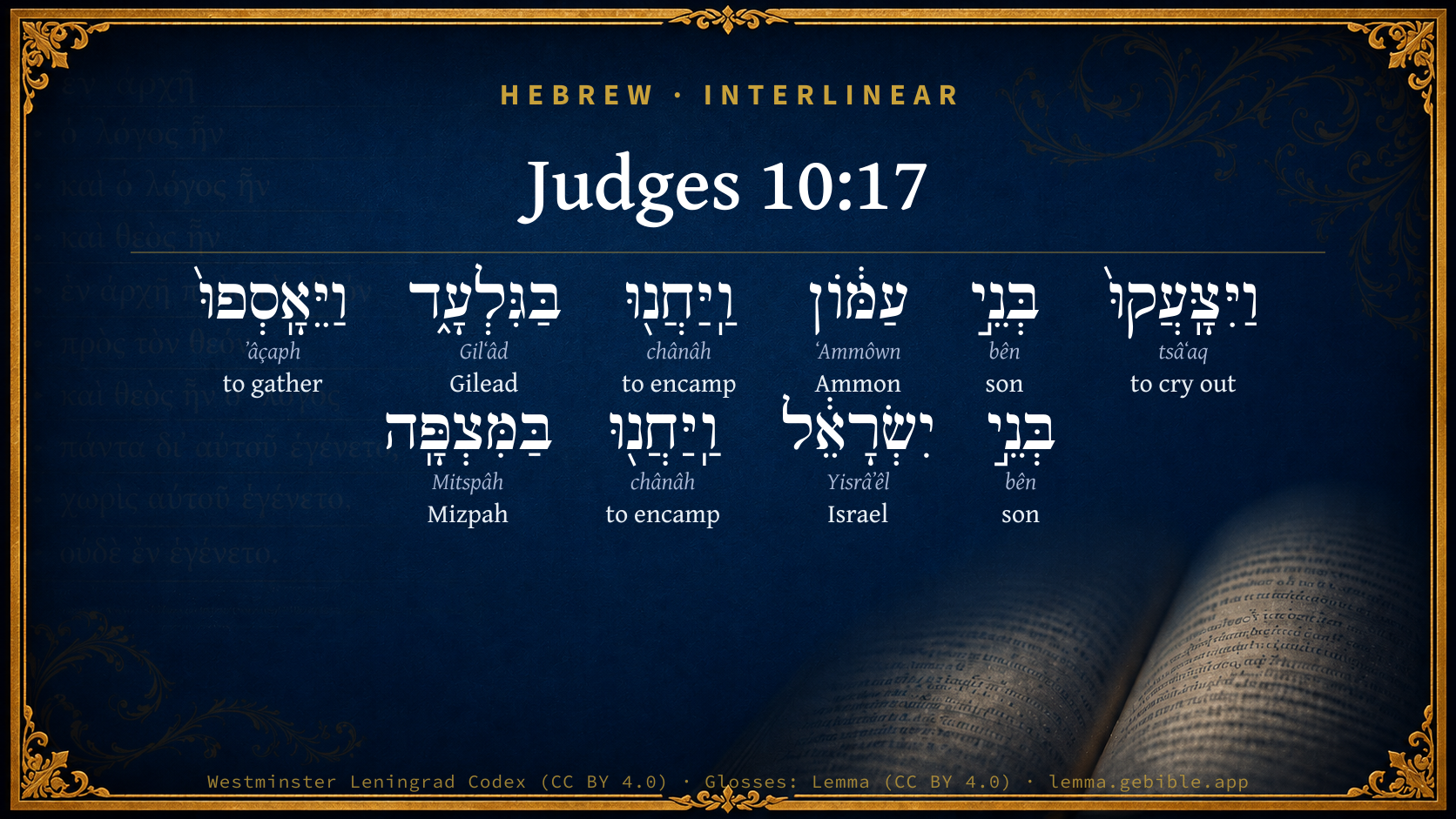
Hebrew (Westminster Leningrad Codex) Judges 10:17 appears in the Hebrew Old Testament. The text above is from the Westminster Leningrad Codex. Each word links to its Strong’s number, a concise gloss, and parsing drawn from the Open Scriptures Hebrew Bible morphology. Click any word for its full Brown-Driver-Briggs (BDB) entry.
Download image
Cite this verse

Judges 10:17 (World English Bible). Public Domain. Lemma interlinear Bible study tool, https://lemma.gebible.app/v/judges/10/17.

Show BibTeX & RIS
BibTeX
RIS
English Translation
Then the children of Ammon were gathered together, and encamped in Gilead. The children of Israel assembled themselves together, and encamped in Mizpah.
World English Bible · Public Domain
Download a study sheet

One document with this verse’s original text, its word-by-word gloss line, the meaning frame, cross-references with their text, attributed commentary, and full source and license credits — printable, and it pastes into notes with its structure intact.

This verse Autodidact and up

Study sheet (.html) Plain text (.txt)

A passage Seminary Student

Up to 50 verses in one chapter. A passage sheet keeps up to 6 commentary sources and 12 cross-references per verse, in the order this page ranks them, and says so on the sheet whenever that leaves anything out. Ask for a single verse and you get the Autodidact verse sheet above.

Everything on this page stays free to read, with no account — the sheet is a download of what is already on screen, not access to it.

Want to remove ads? Support Godless Engineer
Compare translations 3

The same verse in 3 English versions, stacked beneath the original-language interlinear above. Click any original word for its lexicon entry.

Each is an independent rendering of the whole verse — the interlinear is not word-aligned to these translations.

Highlighted words mark where these versions differ — a whole-verse word diff, not a word-by-word alignment.

  • World English Bible Public Domain
    Then the children of Ammon were gathered together, and encamped in Gilead. The children of Israel assembled themselves together, and encamped in Mizpah.
  • King James Version Public Domain
    Then the children of Ammon were gathered together, and encamped in Gilead. And the children of Israel assembled themselves together, and encamped in Mizpeh.
  • unfoldingWord Literal Text CC BY-SA 4.0
    Now the sons of Ammon were summoned, and they encamped in Gilead. So the sons of Israel gathered themselves, and they encamped at Mizpah.

unfoldingWord Literal Text — © unfoldingWord, licensed CC BY-SA 4.0. Word-aligned USFM3 via Door43 (git.door43.org/unfoldingWord/en_ult).

Versions to compare (up to 4)

3 of 4 selected

Show all 18 translations

Every available English version of this verse, each an independent rendering of the whole verse.

  • World English Bible Public Domain
    Then the children of Ammon were gathered together, and encamped in Gilead. The children of Israel assembled themselves together, and encamped in Mizpah.
  • Berean Standard Bible Public Domain
    Then the Ammonites were called to arms and camped in Gilead, and the Israelites assembled and camped at Mizpah.
  • Majority Standard Bible Public Domain
    Then the Ammonites were called to arms and camped in Gilead, and the Israelites assembled and camped at Mizpah.
  • King James Version Public Domain
    Then the children of Ammon were gathered together, and encamped in Gilead. And the children of Israel assembled themselves together, and encamped in Mizpeh.
  • American Standard Version (1901) Public Domain
    Then the children of Ammon were gathered together, and encamped in Gilead. And the children of Israel assembled themselves together, and encamped in Mizpah.
  • Revised Version (1885) Public Domain
    Then the children of Ammon were gathered together, and encamped in Gilead. And the children of Israel assembled themselves together, and encamped in Mizpah.
  • Geneva Bible (1599) Public Domain
    Then the children of Ammon gathered themselues together, and pitched in Gilead: and the children of Israel assembled themselues, and pitched in Mizpeh.
  • Douay-Rheims (1899) Public Domain
    And the children of Ammon shouting together, pitched their tents in Galaad: against whom the children of Israel assembled themselves together and camped in Maspha.
  • Young's Literal Translation Public Domain
    And the Bene-Ammon are called together, and encamp in Gilead, and the sons of Israel are gathered together, and encamp in Mizpah.
  • Literal Standard Version CC BY-SA 4.0
    And the sons of Ammon are called together, and encamp in Gilead, and the sons of Israel are gathered together, and encamp in Mizpah.
  • Unlocked Literal Bible CC BY-SA 4.0
    Then Ammonites gathered together and set up camp in Gilead. The Israelites came together and set up their camp at Mizpah.
  • unfoldingWord Literal Text CC BY-SA 4.0
    Now the sons of Ammon were summoned, and they encamped in Gilead. So the sons of Israel gathered themselves, and they encamped at Mizpah.
  • Darby Bible Public Domain
    Then the Ammonites were called to arms, and they encamped in Gilead; and the people of Israel came together, and they encamped at Mizpah.
  • World Messianic Bible Public Domain
    Then the children of Ammon were gathered together and encamped in Gilead. The children of Israel assembled themselves together and encamped in Mizpah.
  • Webster's Bible Public Domain
    Then the children of Ammon were assembled, and encamped in Gilead. And the children of Israel assembled themselves, and encamped in Mizpeh.
  • Free Bible Version CC BY-SA 4.0
    The Ammonite armies had been called up and were camped in Gilead. The Israelites assembled and camped at Mizpah.
  • Bible in Basic English Public Domain
    Then the children of Ammon came together and put their army in position in Gilead. And the children of Israel came together and put their army in position in Mizpah.
  • JPS Tanakh (1917) Public Domain
    Then the children of Ammon were gathered together, and encamped in Gilead. And the children of Israel assembled themselves together, and encamped in Mizpah.

Literal Standard Version (2020), Covenant Press — licensed CC BY-SA 4.0. Text via the HelloAO Bible API (eBible.org). Unlocked Literal Bible (unfoldingWord) — licensed CC BY-SA 4.0. Text via the HelloAO Bible API (eBible.org). unfoldingWord Literal Text — © unfoldingWord, licensed CC BY-SA 4.0. Word-aligned USFM3 via Door43 (git.door43.org/unfoldingWord/en_ult). Free Bible Version, Dr. Jonathan Gallagher — licensed CC BY-SA 4.0. Text via the HelloAO Bible API (eBible.org).

Word by word

More ways to search: Search by grammar → Find every occurrence → Compare this word →

Practice this passage: Drill this verse → Learn its vocabulary →

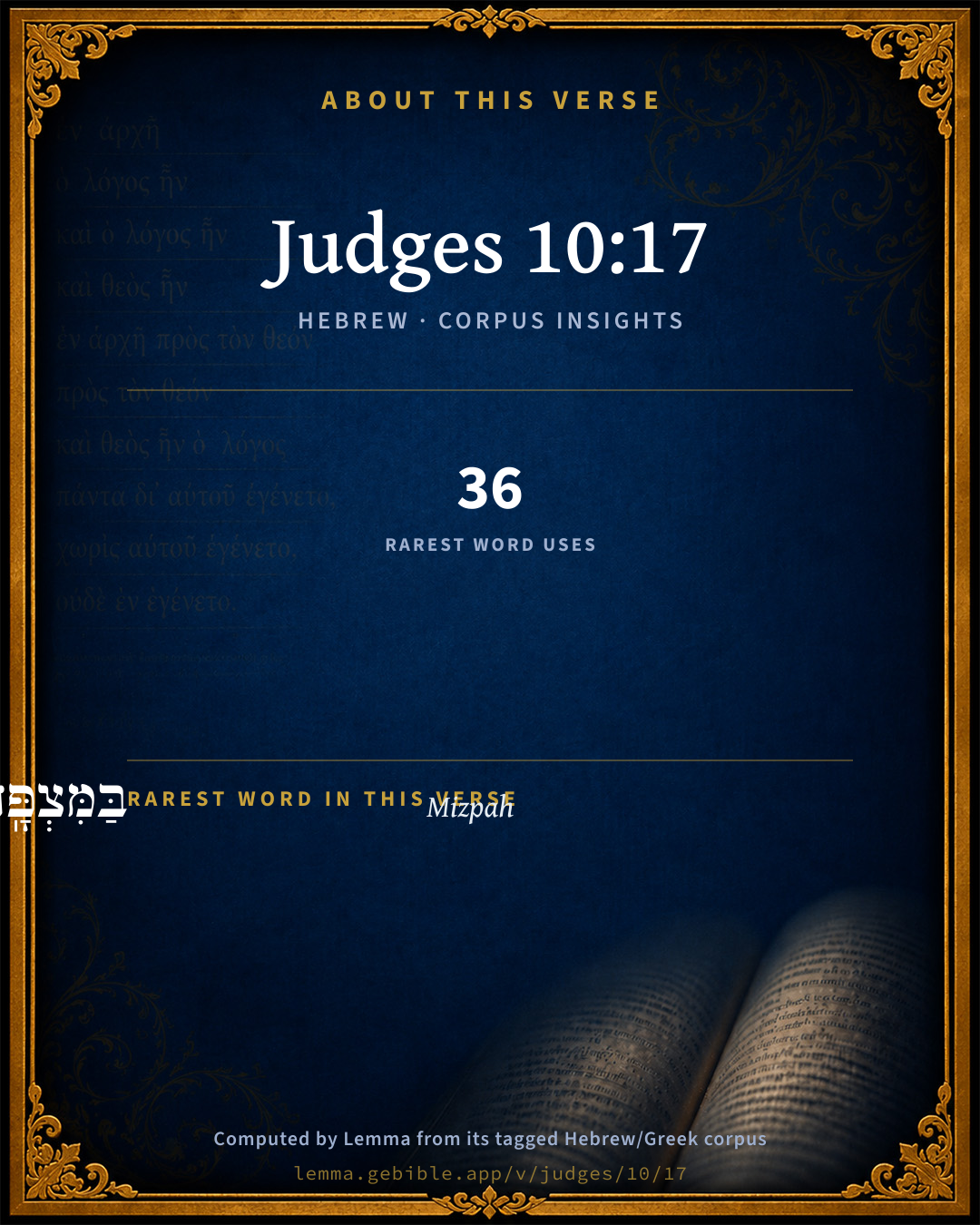
בַּמִּצְפָּֽה
Mitspâh
H4709
“in/at the · Mizpah”
Preposition, Determined + Noun, Proper
Part of Speech
Preposition + Noun
Type
Proper
Full BDB Definition

Origin: from H4708

TWOT: None

Mizpah = "watchtower" - a place in Gilead north of Jabbok and location of Laban's cairn - a place in Gilead south of Jabbok; site unknown - a place near Mount Hermon - an old sacred place in Benjamin
  1. וַיִּצָּֽעֲקוּ֙ tsâʻaq H6817 “and · to cry out” Conjunction + Verb, Niphal, Sequential Imperfect, 3rd Person, Masculine, Plural
  2. בְּנֵ֣י bên H1121 “sons of” Noun, Common, Masculine, Plural, Construct
  3. עַמּ֔וֹן ʻAmmôwn H5983 “Ammon” Noun, Proper
  4. וַֽיַּחֲנ֖וּ chânâh H2583 “and · to encamp” Conjunction + Verb, Qal, Sequential Imperfect, 3rd Person, Masculine, Plural
  5. בַּגִּלְעָ֑ד Gilʻâd H1568 “in/at the · Gilead” Preposition, Determined + Noun, Proper
  6. וַיֵּאָֽסְפוּ֙ ʼâçaph H622 “and · to gather” Conjunction + Verb, Niphal, Sequential Imperfect, 3rd Person, Masculine, Plural
  7. בְּנֵ֣י bên H1121 “sons of” Noun, Common, Masculine, Plural, Construct
  8. יִשְׂרָאֵ֔ל Yisrâʼêl H3478 “Israel” Noun, Proper
  9. וַֽיַּחֲנ֖וּ chânâh H2583 “and · to encamp” Conjunction + Verb, Qal, Sequential Imperfect, 3rd Person, Masculine, Plural

About this verse

These counts appear in no published source. They are computed here, from the morphology-tagged text and Lemma’s own curated glosses. What Lemma adds →

10
words
8
distinct lemmas
Historical
section

Shared distinctive vocabulary

בַּמִּצְפָּֽה Mizpah H4709 occurs in 33 verses of the Hebrew Bible. Also found in:

Grammatical profile

  • 4 verbs
  • 6 nouns

Verb forms

  • וַיִּצָּֽעֲקוּ֙ Niphal · Sequential Imperfect
  • וַֽיַּחֲנ֖וּ Qal · Sequential Imperfect
  • וַיֵּאָֽסְפוּ֙ Niphal · Sequential Imperfect
  • וַֽיַּחֲנ֖וּ Qal · Sequential Imperfect

Repetition

Words recur within this verse — often emphatic in Hebrew:

  • בְּנֵ֣י son H1121 ×2
  • וַֽיַּחֲנ֖וּ to encamp H2583 ×2

Hebrew & Septuagint length

In English translation the verse runs 23 words from the Hebrew and 24 from the Septuagint (LXX English) — closely comparable.

A rough comparison of the two English renderings, which tokenize alike — not a word-level alignment.

Word counts can differ between the Hebrew and the Greek without any difference in meaning — e.g. the Hebrew direct-object marker אֵת has no separate Greek word, and Greek often adds the article ὁ.

Cross-references

3

Topical passages linked to Judges 10:17 in the Treasury of Scripture Knowledge — connected by theme and wording, ordered by reader-vote popularity; previews shown in the World English Bible.

  • Judges 11:29 Then the Spirit of Yahweh came on Jephthah, and he passed over Gilead and Manasseh, and passed over Mizpeh of Gilead, and from Mizpeh of Gilead he passed over to the children of Ammon.
  • Genesis 31:49 and Mizpah, for he said, "Yahweh watch between me and you, when we are absent one from another.
  • Judges 11:11 Then Jephthah went with the elders of Gilead, and the people made him head and chief over them: and Jephthah spoke all his words before Yahweh in Mizpah.

Cross-references courtesy of OpenBible.info (CC BY 4.0).

Hebrew and Greek witnesses Masoretic Hebrew ↔ Greek Septuagint

The same verse in the two great witnesses to the Old Testament, shown verse-for-verse.

These are two independent witnesses, not word-aligned to each other, and the Septuagint is shown in lemma (dictionary) form.

Hebrew Judges 10:17 Masoretic · Westminster Leningrad Codex

וַיִּצָּֽעֲקוּ֙ בְּנֵ֣י עַמּ֔וֹן וַֽיַּחֲנ֖וּ בַּגִּלְעָ֑ד וַיֵּאָֽסְפוּ֙ בְּנֵ֣י יִשְׂרָאֵ֔ל וַֽיַּחֲנ֖וּ בַּמִּצְפָּֽה

Then the children of Ammon were gathered together, and encamped in Gilead. The children of Israel assembled themselves together, and encamped in Mizpah.

World English Bible · Public Domain

Greek LXX Judges 10:17 Septuagint · lemma form

καί ἀναβαίνω ὁ υἱός αμμων καί παρα ἐνβάλλω ἐν γαλαάδ καί συνἄγω ὁ υἱός ἰσραήλ καί παρα ἐνβάλλω ἐν ὁ σκοπιά

And the children of Ammon went up, and encamped in Galaad; and the children of Israel were gathered together and encamped on the hill.

LXX2012 (modern English Septuagint) · Public Domain

On this verse, The Cambridge Bible for Schools and Colleges discusses the Septuagint’s reading. Read the note in Commentary ↓

Hebrew: Westminster Leningrad Codex (CC BY 4.0). Greek: Septuagint (public domain); English from LXX2012 (modern English Septuagint) (Public Domain). How the Septuagint differs from the Hebrew →

Targum (Aramaic paraphrase)

1

The Targum is the ancient Jewish Aramaic paraphrase of the Hebrew Scriptures — an interpretive translation, not the Hebrew text itself. Onkelos (literal) and Pseudo-Jonathan (expansive) render the Torah, and Jonathan the Prophets. Coverage is partial: where no permissively-licensed English translation exists for a verse, only the Aramaic is shown. This is verse-level text, not a word-by-word alignment to the Hebrew.

  1. Targum Jonathan Prophets (Joshua–Malachi)
    וְאִתְכְּנִישׁוּ בְּנֵי עַמוֹן וּשְׁרוֹ בַּגִלְעָד וְאִתְכְּנִישׁוּ בְּנֵי יִשְׂרָאֵל וּשְׁרוֹ בְּמִצְפָּה:

    (no public-domain English translation for this verse)

    Targum Jonathan — Aramaic: “Mikraot Gedolot” (public domain). English: “Sefaria Community Translation” (CC0 1.0 (public-domain dedication)); “London "Chaldee Paraphrase," 1871” (public domain). Text via Sefaria.

Commentary

Notes on Judges 10:17 from classic Christian and Jewish commentators (each source and its license shown beneath its notes). The classic Christian expositions comment on the surrounding passage and are grouped to its opening verse, so a note may address several verses; the Jewish commentaries on the Tanakh (Rashi and others) are per-verse, so they appear only where the commentator wrote on this verse.

Lemma curates 59 commentaries, every one of them public domain or Creative Commons licensed, each selected and text-cleaned for this edition rather than reprinted as found. About our sources →

Trapp's Complete Commentary

John Trapp

Jdg 10:17 Then the children of Ammon were gathered together, and encamped in Gilead. And the children of Israel assembled themselves together, and encamped in Mizpeh.

Ver. 17. Then the children of Ammon were gathered together.] But, that they might be "broken in pieces" {Isa 8:9}

And the children of Israel assembled.] Now they have taken heart of grace, and can face their enemies; who before durst not mute or move against them. And although they had no answer or comfort from God, yet knowing his gracious disposition and dealing with the penitent, they take courage to encounter the Ammonites. "The righteous are bold as a lion," {Pro 28:1} and "God hath not given to his the spirit of fear, but of power, of love, and of a sound mind." {2Ti 1:7}

John Trapp, A Commentary or Exposition upon All the Books of the Old and New Testament (1647–1656) — public domain. Text from a community e-Sword module.

Matthew Poole's English Annotations

That Mizpeh which was beyond Jordan in Gad or Manasseh; of which see Gen 31:49; Jos 18:26; Jdg 10:17; 11:11,29,34. There were other cities of that name in Scripture.

Matthew Poole's English Annotations on the Holy Bible (1683–1685) — public domain. Text from a community e-Sword/MySword module.

Whedon's Commentary on the Bible

Daniel D. Whedon

PREPARATIONS FOR WAR, Jdg_10:17-18.

These two verses serve as an introduction to the history of Jephthah, and ought not to have been separated from it by a division of chapters. Chapter 11 should have begun here.

17. Were gathered together — Literally, let themselves be called together. Clarke’s rendering, they cried against Israel, is not allowable.

Gilead — The mountainous tract of country on the east of the Jordan, extending from the northern end of the Dead Sea to the Sea of Galilee. In what particular part of this region the Ammonites encamped is not said, but probably at the southern base of Mount Gilead, (Jebel Osha,) or between that place and Rabbah, their capital. This whole region was wrested from the Ammonites and ruled by Jephthah. See map, page 234.

Mizpeh — Probably identical with Mizpeh of Gilead, (Judges 2:29,) and the Ramoth-mizpeh of Jos_13:26, near or at the modern es-Salt. It was the great gathering place of the Israelites east of the Jordan. “About three miles northwest of es-Salt is the highest peak east of the Jordan, commanding one of the widest and most interesting views in the country.

Its top is broad and flat, and would form a fine gathering place for a nation of warriors. On its northern shape is an ancient ruin called Jiliad. It is probable that this is the true site of Mizpeh of Gilead, the gathering-place of the eastern tribes. Mizpeh was situated close to the frontier of the Ammonites, and apparently near their capital, Rabbath, (Jdg_11:29;) consequently it must have been on the south side of the Jabbok, and could not have been identical, as some have thought, with the Mizpeh where Jacob and Laban met. Gen_31:49.” — Porter.

Daniel D. Whedon (gen. ed.), Commentary on the Old and New Testaments (1874–1909) — public domain. Text from a community e-Sword module.

Lange's Commentary on the Holy Scriptures

Repentance followed by energy, concord, and mutual confidence.

Jdg_10:17-18.

17Then [And] the children [sons] of Ammon were gathered together, and encamped in Gilead. And the children [sons] of Israel assembled themselves together, and encamped in Mizpeh [Mizpah]. 18And the people and princes [the people (namely) the chiefs] of Gilead said one to another, What man is he [Who is the man] that will [doth] begin to fight against the children [sons] of Ammon? he shall be head over all the inhabitants of Gilead.

EXEGETICAL AND DOCTRINAL

The call of Gideon to be a deliverer took place just when the national distress was at its greatest height, and Midian had entered on a new expedition of pillage and plunder. A like coincidence marked the present crisis. The sons of Ammon were just making a new incursion into Gilead, when they met with a new spirit. The signature of apostasy and sin, is discord and weakness, despondency and self-seeking, issuing in failure and disaster, whenever action be undertaken. The sign of conversion and true penitence is concord and confidence, leading, by God’s assistance, to victory.

Jdg_10:17. And the sons of Ammon were gathered together . . . . the sons of Israel also assembled themselves. The phrase “sons of Israel” does not always include all the tribes. The men of any single tribe may be so designated. The narrator uses the expression here, however, in order to intimate that though Gilead alone actually engages in the war it is nevertheless done as Israel, according to the mind and spirit of the whole nation. As soon as Israel repents, the collective national spirit, the consciousness of national unity through the calling of God, reawakes in each of the tribes. The localities at which the respective armies are said to have assembled and prepared for the conflict, will be considered under Jdg_11:29.

Jdg_10:18. And the body of the nobles of Gilead said. The hitherto cowed Israelites assembled themselves; but that was not all: they were moreover united in all they did. The narrative says expressly הָעָם שָׂרֵי גִלְעָד, “the people of the nobles of Gilead,” i. e. all, without exception.7 No envious, self-seeking voice of protest or dissent was heard. In times in which distress is recognized with real repentance, private interests cease to govern. People then begin to honor truth and actual merit. No deference is then paid to personal vanity, family connections, or wealth; but, all by-views and self-seeking being set aside, he is sought after who renders service. The nobles of Gilead could not more clearly indicate their new temper, than by unitedly promising to subordinate themselves to him who begins to render the banners of Israel once more victorious, as their head.

It is to be noted that they say, “whoso beginneth to fight against the sons of Ammon.” In him who first again gains an advantage over the enemy in battle, it will be manifest that God is with him. He, accordingly, is to be, not what Gideon’s legions desired him to become, their מֹשֵׁל, ruler, nor what the sinful people of Shechem made of Abimelech, their מֶלֶךְ, king, but their רֹאשׁ, leader. Him, who conquers with God, they desire to follow unanimously, as a common head.

And this one soon appeared.

Footnotes:

[7][Dr. Cassel evidently takes הָעָם as stat. const. Scarcely correct. First, because of the article (cf. Ges. Gram. 110, 2); and, secondly, because עַם never stands for the mere notion of totality. It is better to take גִלְעָד שָׁרֵי as standing in apposition to הָעָם; “the people (namely) the chiefs of Gilead,” i. e. the people through their chiefs, as represented by them.—Tr.]

Lange's Commentary on the Holy Scriptures (Critical, Doctrinal, and Homiletical), ed. John Peter Lange, English translation edited by Philip Schaff (1864–1880) — public domain. Text from a community e-Sword module.

Jamieson, Fausset & Brown

Robert Jamieson, A. R. Fausset & David Brown

the children of Ammon were gathered together--From carrying on guerrilla warfare, the Ammonites proceeded to a continued campaign. Their settled aim was to wrest the whole of the trans-jordanic territory from its actual occupiers. In this great crisis, a general meeting of the Israelitish tribes was held at Mizpeh. This Mizpeh was in eastern Manasseh (Jos 11:3).

Next: Judges Chapter 11

Jamieson, Fausset & Brown — Commentary Critical and Explanatory on the Whole Bible (1871) — public domain (CC PDM 1.0). Text via the HelloAO Bible API.

Adam Clarke's Commentary

Verse 17. The children of Ammon were gathered together] Literally, they cried against Israel-they sent out criers in different directions to stir up all the enemies of Israel; and when they had made a mighty collection, they encamped in Gilead.

Adam Clarke's Commentary on the Bible (1810–1826) — public domain. Text from a community e-Sword/MySword module.

Ellicott's Commentary for English Readers

(17) Then.—Rather, and, a general note of time.

Were gathered together.—Literally, were cried together. Conclamati sunt.

In Mizpeh.—A very common name, since it means “watch-tower.” This is doubtless the Mizpeh in Gilead (Jdg_11:29; Jos_11:3), also called Ramoth-Mizpeh, or Ramoth-Gilead (Jos_13:26; Jos_20:8). (Comp. Gen_31:49).

A Bible Commentary for English Readers, edited by Charles John Ellicott (1878–1897) — public domain. Text from a community e-Sword module.

The Cambridge Bible for Schools and Colleges

gen. ed. J. J. S. Perowne

17. On this and the following verse see above. The Ammonites occupied the district which lay to the N.E. of Moab, bordered by the eastern desert. Their chief city was Rabbath-ammon, in Greek Philadelphia, now ‘Ammân, near the source of the Jabbok; their other cities (Jdg_11:33, 2Sa_12:31) were insignificant. Like the Moabites, the Ammonites were regarded as akin to Israel, but with feelings of repugnance, Gen_19:36 ff.; probably also, like the Moabites, they spoke a language closely allied to that of Israel. In the days of Saul (1 Samuel 11) and David (2 Samuel 10-12) their hostility broke out afresh. The Bedouin on the edge of the Syrian desert have always been ready to plunder the agricultural country within reach.

encamped in Gilead] Here apparently a city, cf. Hos_6:8, perhaps the modern Jal‘ûd, on the high ground a little S. of the Jabbok.

encamped in Mizpah] Cf. Jdg_11:11; Jdg_11:34, apparently = Mizpeh of Gilead Jdg_11:29; the name (which belongs to several places) means ‘outlook point,’ LXX here ἡ σκοπιά, and implies a situation commanding a view; Jebel Ôsha‘, near es-Salt, not far S. of Jal‘ûd, would suit the conditions. Among other sites proposed, that of Ḳal‘at er-Rabaḍ, N. of Jal‘ûd and of the Jabbok, may be mentioned. At Mizpah was a sanctuary of Jehovah, and the home of Jephthah (Jdg_11:11; Jdg_11:34). The Israelites gathered to the camp, but as yet they had no leader.

The Cambridge Bible for Schools and Colleges (gen. ed. J. J. S. Perowne; Cambridge University Press, 1878–1918) — public domain. Text from a community e-Sword module.

John Gill's Exposition

Then the children of Ammon were gathered together,.... By a crier, as Jarchi; they had passed over Jordan, as in Jdg 10:9 and had been distressing three of the tribes of Israel on that side; but now being informed, by an herald at arms, that the children of Israel, on the other side Jordan, were risen up in defence of their country, rights, and liberties, the children of Ammon came back and crossed over Jordan again:

and encamped in Gilead; in the land of Gilead, part of which belonged to the tribes of Reuben and Gad, and the other part to the half tribe of Manasseh:

and the children of Israel assembled themselves together, and encamped at Mizpeh: of which name there were several cities in the land of Israel, on both sides Jordan; this must design a place on the other side Jordan, either in the tribe of Gad or Manasseh, for it seems there was of this name in each, see Gen 31:49.

John Gill's Exposition of the Whole Bible (1746–1763) — public domain (CC PDM 1.0). Text via the HelloAO Bible API.

Albert Barnes' Notes on the Bible

The historian, having related the preliminary incidents, now comes to the final issue which forms the subject matter of his narrative. On a certain occasion, as on many previous ones, the Ammonites were encamped in Gilead, with the intention of dispossessing the Israelites of the whole country, or at least as far as the river Jabbok Jdg 11:13, and of invading the West-Jordanic tribes. The children of Israel on the East of Jordan assembled together to resist them, and pitched their camp in Mizpeh. The narrative proceeds to detail what happened.

Mizpeh - , as its name, “watch-tower” or “look-out” indicates was situated on a height of Mount Gilead, and was, as such, a strong post. It is almost always written, “THE Mizpeh,” or watch-tower. Four or five places of the name occur in Scripture.

Albert Barnes' Notes on the Bible (1834–1885) — public domain. Text from a community e-Sword/MySword module.

Haydock's Catholic Bible Commentary

Together, as people sure of victory. --- Galaad, the capital of the country of the same name. It belonged to Gad. --- Maspha, near the springs of the Jaboc, Josue xi. 3., and xiii. 26. (Calmet) --- It signifies "a watch-tower." (Menochius)

George Leo Haydock (1774–1849), Haydock's Catholic Family Bible and Commentary, 1859 edition — public domain. Excludes Psalms (Douay-Rheims chapter numbering differs from Protestant) and Deuterocanonical books (Catholic canon only).

The Pulpit Commentary

This verse ought to begin the new chapter. The preliminary matter of Israel"s sin, of their oppression by the Ammonites, of their repentance and return to the God of their fathers, and of God"s merciful acceptance of their penitence and prayer, was concluded in the last verse. The history of their deliverance by Jephthah begins here. And the children of Ammon, etc., i.e. they encamped, as they had done during the previous seventeen years, in Gilead, either to carry off the crops or to wring tribute from the people, or in some other way to oppress them, expecting no doubt to meet with tame submission as before. But a new spirit was aroused among the Israelites. By whatever channel the bitter reproach in vers. 11-14 had been convey. ed to them, probably by the same channel, whether angel, or prophet, or high priest, had an answer of peace come to them on their repentance, and so they were roused and encouraged to resistance. As a first step, they encamped in Mizpeh. (see Jud_1:11:11, 29, 34) Mizpeh, or Mizpah of Gilead, is probably the same as Mizpah in Gilead where Laban and Jacob parted; (Gen_31:25, Gen_31:49) as Ramoth-Mizpeh, (Jos_13:26) called simply Ramoth in Gilead ; (Jos_20:8 1Ch_6:80) and as the place well known in later Israelite history as Ramoth-Gilead, (1Ki_4:13 1Ki_22:3, 1Ki_22:6) situated in the tribe of Gad, and a strong place of much importance. It was the place of national meeting for the whole of Gilead. Mizpah means the watch-tower, and would of course be upon a height, as the name Ramoth-Mizpeh, the heights of Mizpeh, also shows. It almost always preserves its meaning as an appellative, having the article prefixed, ham-mizpah, which is its usual form; only once ham-mizpeh, (Jos_15:38) and Mizpeh, (Jos_11:18 Jud_1:11:29 1Sa_22:3) and once Mizpah. (Hos_5:1) Whether Mizpeh in Jud 20:1-3 is the same will be considered in the note to that passage. The modern site is not identified with certainty; it is thought to be es-Salt.

Vers. 17, 18. Faith restoring courage and might.

I BY PROMOTING THE UNITY OF GOD"S PEOPLE. The worship of Jehovah is the uniting and inspiring principle. All other worship disunites and weakens. The very site of their camp was instinct with solemn, Divine associations.

II ENABLING THEM TO FACE RESOLUTELY THE GREATEST TROUBLES OF LIFE. Israel is in the field against Ammon, a circumstance full of meaning. When the Spirit of God enters a man he looks upon difficulties with a new resolution. It enables him "to take arms against a sea of troubles, and by opposing, end them.

III RENDERING THEM WILLING TO ACCEPT THE LEADER GOD SHALL INDICATE. It is no lusting after a king now. The only King is Jehovah. But a leader and judge is sought. So the true Christian will reverence and follow all who are inspired and appointed by God. M.

The Pulpit Commentary (1880–1919), ed. H.D.M. Spence-Jones & Joseph S. Exell — public domain. Text from a community e-Sword module.

John Wesley's Explanatory Notes

Mizpeh - That Mizpeh which was beyond Jordan.

John Wesley, Explanatory Notes Upon the Whole Bible (1754–1765) — public domain. Text via the GEBible commentary corpus.

unfoldingWord translationNotes

Door43 World Missions Community

Who is the man who will begin to fight the Ammonites?

"Who will lead our army to fight against the Ammonites?"

translationWords

Ammon

Gilead

Israel

Mizpah

unfoldingWord translationNotes — © Distant Shores Media and the Door43 World Missions Community, licensed CC BY-SA 4.0. Source: git.door43.org/Door43/en_tn.

Rashi

Rabbi Shlomo Yitzchaki (Rashi)

Were called together. They were assembled by proclamation.

Rashi on the Tanakh — English translations: “The Judaica Press complete Tanach with Rashi, translated by A. J. Rosenberg” (CC BY 4.0); “Pentateuch with Rashi's commentary by M. Rosenbaum and A.M. Silbermann, 1929-1934” (public domain); “The Metsudah Tanach series, Lakewood, N.J” (CC BY 4.0); and “The Book of Joshua, Metsudah Publications, 1997” (CC BY 4.0). Text via Sefaria.

Lesson kit

Teaching starters — assembled from the data on this page, not authored interpretation. Every prompt links to the verse data it draws on. Edit before teaching.

Judges, in the Historical, opens this verse with 10 words (8 distinct Hebrew lemmas). Its most distinctive word is Mitspâh (“Mizpah”). A historical commentator’s framing appears above. Read the whole chapter for the surrounding context.

Discussion questions

  1. The word Mitspâh carries the sense “Mizpah.” How does it shape the verse?
  2. How does Genesis 31:49, which shares the word «Mizpah», read alongside this verse?
  3. What does the repetition of “son” (2× in this one verse) do in this verse?
  4. These translations render this verse differently; the difference is in the English rendering, not the original. What questions does that raise?
  5. «וַיִּצָּֽעֲקוּ֙» is a Niphal Sequential Imperfect verb. How does that grammatical form shape the action described?
  6. Compare how Trapp's Complete Commentary and Matthew Poole's English Annotations read this verse. Where do they agree or differ?

Things to notice

Reading settings

Reading text

Shown beneath each verse's original-language words.

Old Testament
Old Testament edition

Read the OT as the Masoretic Hebrew (MT) or the Greek Septuagint (LXX).

English shown for the Greek Septuagint (in the Hebrew ↔ Greek comparison).

Comparing translations? Open the Compare panel on any verse page to stack up to four side by side.