
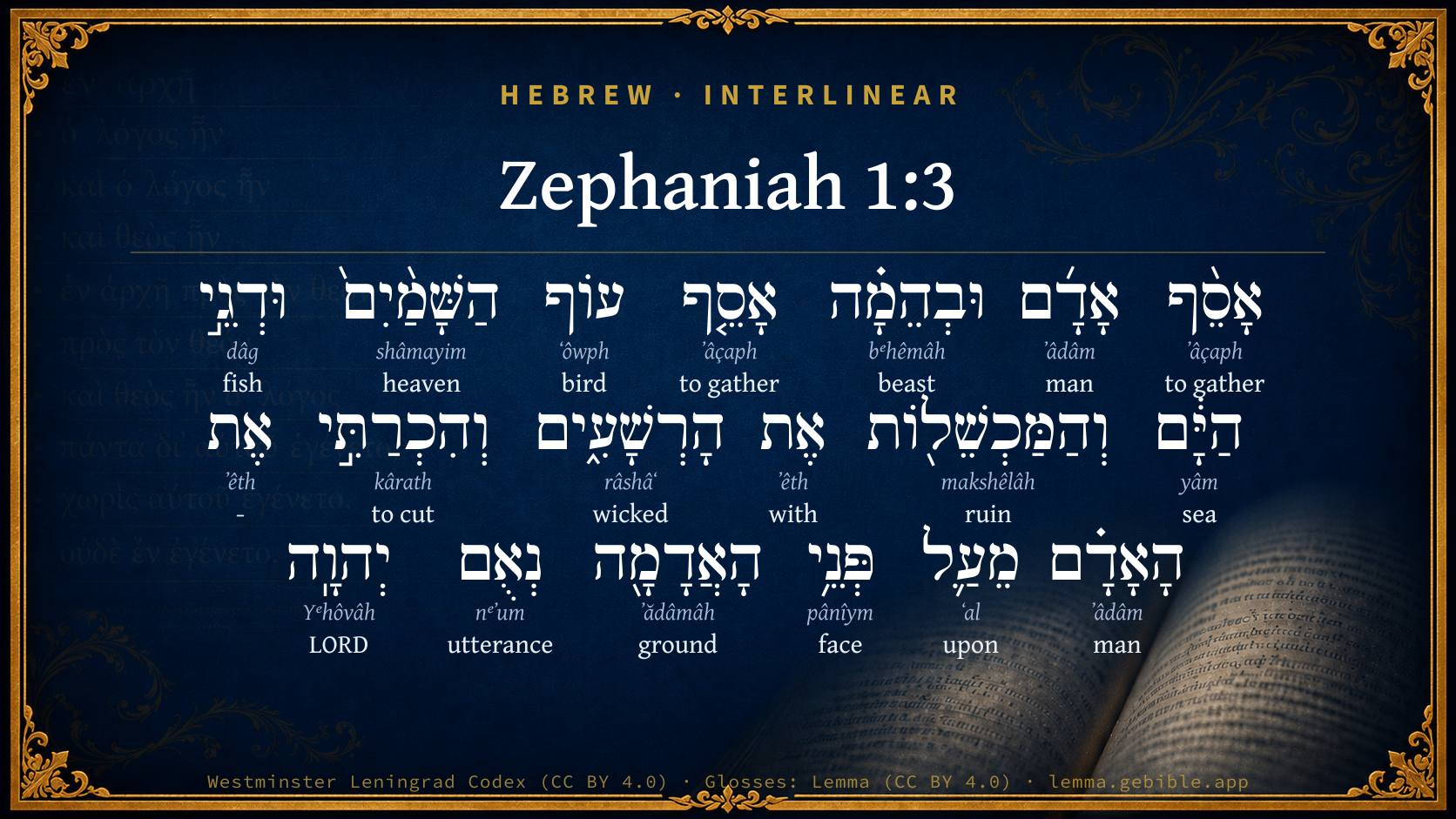
Zephaniah 1:3

Hebrew (Westminster Leningrad Codex) Zephaniah 1:3 appears in the Hebrew Old Testament. The text above is from the Westminster Leningrad Codex. Each word links to its Strong’s number, a concise gloss, and parsing drawn from the Open Scriptures Hebrew Bible morphology. Click any word for its full Brown-Driver-Briggs (BDB) entry.
Download image
Cite this verse

Zephaniah 1:3 (World English Bible). Public Domain. Lemma interlinear Bible study tool, https://lemma.gebible.app/v/zephaniah/1/3.

Show BibTeX & RIS
BibTeX
RIS
English Translation
I will sweep away man and animal. I will sweep away the birds of the sky, the fish of the sea, and the heaps of rubble with the wicked. I will cut off man from the surface of the earth, says Yahweh.
World English Bible · Public Domain
Download a study sheet

One document with this verse’s original text, its word-by-word gloss line, the meaning frame, cross-references with their text, attributed commentary, and full source and license credits — printable, and it pastes into notes with its structure intact.

This verse Autodidact and up

Study sheet (.html) Plain text (.txt)

A passage Seminary Student

Up to 50 verses in one chapter. A passage sheet keeps up to 6 commentary sources and 12 cross-references per verse, in the order this page ranks them, and says so on the sheet whenever that leaves anything out. Ask for a single verse and you get the Autodidact verse sheet above.

Everything on this page stays free to read, with no account — the sheet is a download of what is already on screen, not access to it.

Want to remove ads? Support Godless Engineer
Compare translations 3

The same verse in 3 English versions, stacked beneath the original-language interlinear above. Click any original word for its lexicon entry.

Each is an independent rendering of the whole verse — the interlinear is not word-aligned to these translations.

Highlighted words mark where these versions differ — a whole-verse word diff, not a word-by-word alignment.

  • World English Bible Public Domain
    I will sweep away man and animal. I will sweep away the birds of the sky, the fish of the sea, and the heaps of rubble with the wicked. I will cut off man from the surface of the earth, says Yahweh.
  • King James Version Public Domain
    I will consume man and beast; I will consume the fowls of the heaven, and the fishes of the sea, and the stumblingblocks with the wicked: and I will cut off man from off the land, saith the LORD.
  • unfoldingWord Literal Text CC BY-SA 4.0
    “I will take away man and beast; I will take away the birds of the skies and the fish of the sea and the stumbling blocks with the wicked, and I will cut off man from upon the face of the ground” —the declaration of Yahweh.

unfoldingWord Literal Text — © unfoldingWord, licensed CC BY-SA 4.0. Word-aligned USFM3 via Door43 (git.door43.org/unfoldingWord/en_ult).

Versions to compare (up to 4)

3 of 4 selected

Show all 18 translations

Every available English version of this verse, each an independent rendering of the whole verse.

  • World English Bible Public Domain
    I will sweep away man and animal. I will sweep away the birds of the sky, the fish of the sea, and the heaps of rubble with the wicked. I will cut off man from the surface of the earth, says Yahweh.
  • Berean Standard Bible Public Domain
    “I will sweep away man and beast; I will sweep away the birds of the air, and the fish of the sea, and the idols with their wicked worshipers. I will cut off mankind from the face of the earth,” declares the LORD.
  • Majority Standard Bible Public Domain
    “I will sweep away man and beast; I will sweep away the birds of the air, and the fish of the sea, and the idols with their wicked worshipers. I will cut off mankind from the face of the earth,” declares the LORD.
  • King James Version Public Domain
    I will consume man and beast; I will consume the fowls of the heaven, and the fishes of the sea, and the stumblingblocks with the wicked: and I will cut off man from off the land, saith the LORD.
  • American Standard Version (1901) Public Domain
    I will consume man and beast; I will consume the birds of the heavens, and the fishes of the sea, and the stumblingblocks with the wicked; and I will cut off man from off the face of the ground, saith Jehovah.
  • Revised Version (1885) Public Domain
    I will consume man and beast; I will consume the fowls of the heaven, and the fishes of the sea, and the stumblingblocks with the wicked; and I will cut off man from off the face of the ground, saith the LORD.
  • Geneva Bible (1599) Public Domain
    I will destroy man and beast: I wil destroy the foules of the heauen, and the fishes of the sea, and ruines shalbe to the wicked, and I will cut off man from off the land, saith the Lord.
  • Douay-Rheims (1899) Public Domain
    I will gather man, and beast, I will gather the birds of the air, and the fishes of the sea: and the ungodly shall meet with ruin: and I will destroy men from off the face of the land, saith the Lord.
  • Young's Literal Translation Public Domain
    I consume man and beast, I consume fowl of the heavens, and fishes of the sea, And the stumbling-blocks -- the wicked, And I have cut off man from the face of the ground, An affirmation of Jehovah,
  • Literal Standard Version CC BY-SA 4.0
    “I consume man and beast, || I consume bird of the heavens, and fishes of the sea, || And the stumbling-blocks—the wicked, || And I have cut off man from the face of the ground,” || A declaration of YHWH,
  • Unlocked Literal Bible CC BY-SA 4.0
    I will destroy man and beast; I will destroy the birds of the heavens and the fish of the sea, the ruins along with the wicked. For I will cut off man from the surface of the earth—this is Yahweh's declaration.
  • unfoldingWord Literal Text CC BY-SA 4.0
    “I will take away man and beast; I will take away the birds of the skies and the fish of the sea and the stumbling blocks with the wicked, and I will cut off man from upon the face of the ground” —the declaration of Yahweh.
  • Darby Bible Public Domain
    I will take away man and beast; I will take away the fowl of the heavens and the fishes of the sea, and the stumbling-blocks with the wicked, and I will cut off mankind from off the face of the ground, saith Jehovah.
  • World Messianic Bible Public Domain
    I will sweep away man and animal. I will sweep away the birds of the sky, the fish of the sea, and the heaps of rubble with the wicked. I will cut off man from the surface of the earth, says the LORD.
  • Webster's Bible Public Domain
    I will consume man and beast; I will consume the fowls of the heaven, and the fishes of the sea, and the stumbling-blocks with the wicked; and I will cut off man from off the land, saith the LORD.
  • Free Bible Version CC BY-SA 4.0
    I will sweep away people and animals, I will sweep away the birds of the air and the fish of the sea. I will overthrow the wicked; I will destroy human beings from the face of the earth.
  • Bible in Basic English Public Domain
    I will take away man and beast; I will take away the birds of the heaven and the fishes of the sea; causing the downfall of the evil-doers, and cutting man off from the face of the earth, says the Lord.
  • JPS Tanakh (1917) Public Domain
    I will consume man and beast, I will consume the fowls of the heaven, and the fishes of the sea, and the stumblingblocks with the wicked; and I will cut off man from off the face of the earth, saith the LORD.

Literal Standard Version (2020), Covenant Press — licensed CC BY-SA 4.0. Text via the HelloAO Bible API (eBible.org). Unlocked Literal Bible (unfoldingWord) — licensed CC BY-SA 4.0. Text via the HelloAO Bible API (eBible.org). unfoldingWord Literal Text — © unfoldingWord, licensed CC BY-SA 4.0. Word-aligned USFM3 via Door43 (git.door43.org/unfoldingWord/en_ult). Free Bible Version, Dr. Jonathan Gallagher — licensed CC BY-SA 4.0. Text via the HelloAO Bible API (eBible.org).

Word by word

More ways to search: Search by grammar → Find every occurrence → Compare this word →

Practice this passage: Drill this verse → Learn its vocabulary →

וְהַמַּכְשֵׁל֖וֹת
makshêlâh
H4384
“and · the · ruins”
Conjunction + Particle, Definite Article + Noun, Common, Feminine, Plural, Absolute
Part of Speech
Conjunction + Particle + Noun
Type
Common
Gender
Feminine
Number
Plural
State
Absolute
Full BDB Definition

Origin: from H3782

TWOT: 1050d

overthrown mass, stumbling-block, something overthrown, decay, ruin - thing overthrown (figurative of kingdom) - stumbling-block (of idols)
  1. אָסֵ֨ף ʼâçaph H622 “to gather” Verb, Hiphil, Imperfect, 1st Person, Common, Singular
  2. אָדָ֜ם ʼâdâm H120 “man” Noun, Common, Masculine, Singular, Absolute
  3. וּבְהֵמָ֗ה bᵉhêmâh H929 “and · beast” Conjunction + Noun, Common, Feminine, Singular, Absolute
  4. אָסֵ֤ף ʼâçaph H622 “to gather” Verb, Hiphil, Imperfect, 1st Person, Common, Singular
  5. עוֹף ʻôwph H5775 “bird of” Noun, Common, Masculine, Singular, Construct
  6. הַשָּׁמַ֨יִם֙ shâmayim H8064 “the · heaven(s)” Particle, Definite Article + Noun, Common, Masculine, Plural, Absolute
  7. וּדְגֵ֣י dâg H1709 “and · fish of” Conjunction + Noun, Common, Masculine, Plural, Construct
  8. הַיָּ֔ם yâm H3220 “the · sea” Particle, Definite Article + Noun, Common, Masculine, Singular, Absolute
  9. אֶת ʼêth H854 “with” Preposition
  10. הָרְשָׁעִ֑ים râshâʻ H7563 “the · wicked” Particle, Definite Article + Adjective, Adjective, Masculine, Plural, Absolute
  11. וְהִכְרַתִּ֣י kârath H3772 “and · to cut” Conjunction + Verb, Hiphil, Sequential Perfect, 1st Person, Common, Singular
  12. אֶת ʼêth H853 “-” Particle, Direct Object
  13. הָאָדָ֗ם ʼâdâm H120 “the · man” Particle, Definite Article + Noun, Common, Masculine, Singular, Absolute
  14. מֵעַ֛ל ʻal H5921 “from · upon” Preposition + Preposition
  15. פְּנֵ֥י pânîym H6440 “face(s) of” Noun, Common, Both, Plural, Construct
  16. הָאֲדָמָ֖ה ʼădâmâh H127 “the · ground” Particle, Definite Article + Noun, Common, Feminine, Singular, Absolute
  17. נְאֻם nᵉʼum H5002 “utterance of” Noun, Common, Masculine, Singular, Construct
  18. יְהוָֽה Yᵉhôvâh H3068 “LORD” Noun, Proper

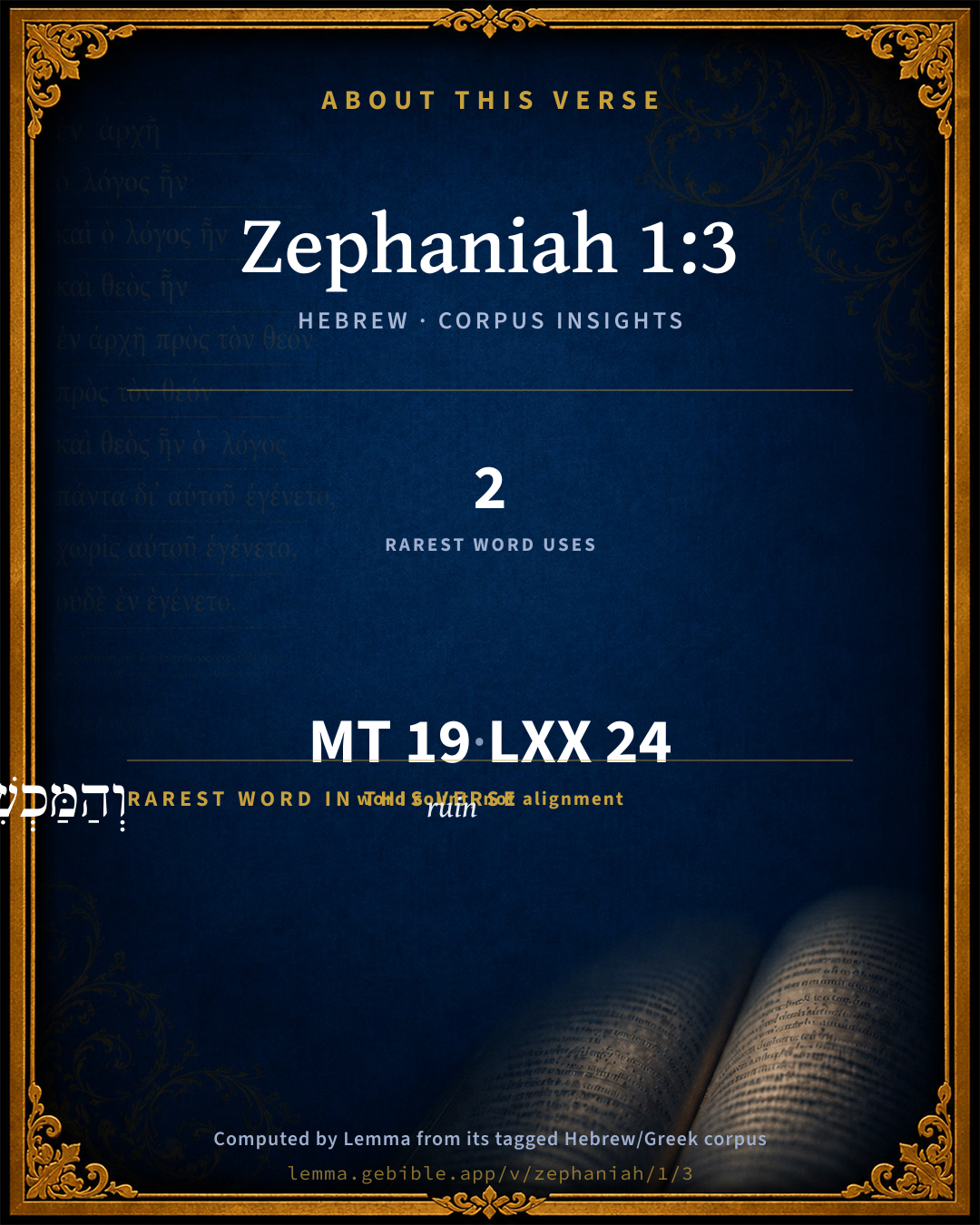
About this verse

These counts appear in no published source. They are computed here, from the morphology-tagged text and Lemma’s own curated glosses. What Lemma adds →

19
words
17
distinct lemmas
Prophets
section

Notable vocabulary

The rarest word here is וְהַמַּכְשֵׁל֖וֹת ruin H4384 — appearing just 2 times in the whole Hebrew Bible.

Shared distinctive vocabulary

וְהַמַּכְשֵׁל֖וֹת ruin H4384 occurs in 2 verses of the Hebrew Bible. Also found in:

Grammatical profile

  • 3 verbs
  • 12 nouns
  • 1 adjective
  • 2 prepositions
  • 1 particle

Verb forms

  • אָסֵ֨ף Hiphil · Imperfect
  • אָסֵ֤ף Hiphil · Imperfect
  • וְהִכְרַתִּ֣י Hiphil · Sequential Perfect

Repetition

Words recur within this verse — often emphatic in Hebrew:

  • אָסֵ֨ף to gather H622 ×2
  • אָדָ֜ם man H120 ×2

Hebrew & Septuagint length

In English translation the verse runs 42 words from the Hebrew and 43 from the Septuagint (LXX English) — closely comparable.

A rough comparison of the two English renderings, which tokenize alike — not a word-level alignment.

Word counts can differ between the Hebrew and the Greek without any difference in meaning — e.g. the Hebrew direct-object marker אֵת has no separate Greek word, and Greek often adds the article ὁ.

In the original languages it is 19 Hebrew tokens and 24 Greek tokens — but the two are counted differently (Hebrew bundles its prefixes and suffixes into one token; the Greek is in lemma form), so that isn’t a like-for-like length.

Cross-references

15

Topical passages linked to Zephaniah 1:3 in the Treasury of Scripture Knowledge — connected by theme and wording, ordered by reader-vote popularity; previews shown in the World English Bible.

  • Hosea 4:3 Therefore the land will mourn, And everyone who dwells therein will waste away. All living things in her, Even the animals of the field and the birds of the sky; Yes, the fish of the sea also die.
  • Ezekiel 7:19 They shall cast their silver in the streets, and their gold shall be as an unclean thing; their silver and their gold shall not be able to deliver them in the day of the wrath of Yahweh: they shall not satisfy their souls, neither fill their bowels; because it has been the stumbling block of their iniquity.
  • Isaiah 27:9 Therefore by this shall the iniquity of Jacob be forgiven, and this is all the fruit of taking away his sin: that he makes all the stones of the altar as chalk stones that are beaten in sunder, [so that] the Asherim and the sun-images shall rise no more.
  • Jeremiah 12:4 How long shall the land mourn, and the herbs of the whole country wither? for the wickedness of those who dwell therein, the animals are consumed, and the birds; because they said, He shall not see our latter end.
  • Ezekiel 14:13–21 Son of man, when a land sins against me by committing a trespass, and I stretch out my hand on it, and break the staff of the bread of it, and send famine on it, and cut off from it man and animal;
  • Matthew 23:39 For I tell you, you will not see me from now on, until you say, 'Blessed is he who comes in the name of the Lord!'"
  • Jeremiah 4:23–29 I saw the earth, and, behold, it was waste and void; and the heavens, and they had no light.
  • Ezekiel 14:3–7 Son of man, these men have taken their idols into their heart, and put the stumbling block of their iniquity before their face: should I be inquired of at all by them?
  • Ezekiel 15:6–8 Therefore thus says the Lord Yahweh: As the vine tree among the trees of the forest, which I have given to the fire for fuel, so will I give the inhabitants of Jerusalem.
  • Hosea 14:3 Assyria can't save us. We won't ride on horses; Neither will we say any more to the work of our hands, 'Our gods!' For in you the fatherless finds mercy."
  • Hosea 14:8 Ephraim, what have I to do any more with idols? I answer, and will take care of him. I am like a green fir tree; From me your fruit is found."
  • Micah 5:11–14 I will cut off the cities of your land, And will tear down all your strongholds.
  • Zechariah 13:2 It will come to pass in that day, says Yahweh of Hosts, that I will cut off the names of the idols out of the land, and they will no more be remembered; and also I will cause the prophets and the spirit of impurity to pass out of the land.
  • Revelation 2:14 But I have a few things against you, because you have there some who hold the teaching of Balaam, who taught Balak to throw a stumbling block before the children of Israel, to eat things sacrificed to idols, and to commit sexual immorality.
  • Ezekiel 44:12 Because they ministered to them before their idols, and became a stumbling block of iniquity to the house of Israel; therefore have I lifted up my hand against them, says the Lord Yahweh, and they shall bear their iniquity.

Cross-references courtesy of OpenBible.info (CC BY 4.0).

Hebrew and Greek witnesses Masoretic Hebrew ↔ Greek Septuagint

The same verse in the two great witnesses to the Old Testament, shown verse-for-verse.

These are two independent witnesses, not word-aligned to each other, and the Septuagint is shown in lemma (dictionary) form.

Hebrew Zephaniah 1:3 Masoretic · Westminster Leningrad Codex

אָסֵ֨ף אָדָ֜ם וּבְהֵמָ֗ה אָסֵ֤ף עוֹף הַשָּׁמַ֨יִם֙ וּדְגֵ֣י הַיָּ֔ם וְהַמַּכְשֵׁל֖וֹת אֶת הָרְשָׁעִ֑ים וְהִכְרַתִּ֣י אֶת הָאָדָ֗ם מֵעַ֛ל פְּנֵ֥י הָאֲדָמָ֖ה נְאֻם יְהוָֽה

I will sweep away man and animal. I will sweep away the birds of the sky, the fish of the sea, and the heaps of rubble with the wicked. I will cut off man from the surface of the earth, says Yahweh.

World English Bible · Public Domain

Greek LXX Zephaniah 1:3 Septuagint · lemma form

ἐκλείπω ἄνθρωπος καί κτῆνος ἐκλείπω ὁ πετεινόν ὁ οὐρανός καί ὁ ἰχθύς ὁ θάλασσα καί ἐκαἴρω ὁ ἄνθρωπος ἀπό πρόσωπον ὁ γῆ λέγω κύριος

Let man and cattle be cut off; let the birds of the air and the fishes of the sea be cut off; and the ungodly shall fail, and I will take away the transgressors from the face of the land, says the Lord.

LXX2012 (modern English Septuagint) · Public Domain

On this verse, John Gill's Exposition discusses the Septuagint’s reading. Read the note in Commentary ↓

Hebrew: Westminster Leningrad Codex (CC BY 4.0). Greek: Septuagint (public domain); English from LXX2012 (modern English Septuagint) (Public Domain). How the Septuagint differs from the Hebrew →

Targum (Aramaic paraphrase)

1

The Targum is the ancient Jewish Aramaic paraphrase of the Hebrew Scriptures — an interpretive translation, not the Hebrew text itself. Onkelos (literal) and Pseudo-Jonathan (expansive) render the Torah, and Jonathan the Prophets. Coverage is partial: where no permissively-licensed English translation exists for a verse, only the Aramaic is shown. This is verse-level text, not a word-by-word alignment to the Hebrew.

  1. Targum Jonathan Prophets (Joshua–Malachi)
    אָסֵיף אֱנָשָׁא וּבְעִירָא אָסֵיף עוֹפָא דִשְׁמַיָא וְנוּנֵי יַמָא עַל דְסַגִיאָה תַּקְלַת רַשִׁיעַיָא וֶאֱשֵׁיצֵי יַת אֱנָשָׁא מֵעַל אַפֵּי אַרְעָא אֲמַר יְיָ:

    (no public-domain English translation for this verse)

    Targum Jonathan — Aramaic: “Mikraot Gedolot” (public domain). English: “Sefaria Community Translation” (CC0 1.0 (public-domain dedication)); “London "Chaldee Paraphrase," 1871” (public domain). Text via Sefaria.

Commentary

Notes on Zephaniah 1:3 from classic Christian and Jewish commentators (each source and its license shown beneath its notes). The classic Christian expositions comment on the surrounding passage and are grouped to its opening verse, so a note may address several verses; the Jewish commentaries on the Tanakh (Rashi and others) are per-verse, so they appear only where the commentator wrote on this verse.

Lemma curates 59 commentaries, every one of them public domain or Creative Commons licensed, each selected and text-cleaned for this edition rather than reprinted as found. About our sources →

The Cambridge Bible for Schools and Colleges

gen. ed. J. J. S. Perowne

3. Zep_1:3 particularises the “all things” of Zep_1:2, cattle and fowl and fishes of the sea, and man. Hos_4:3, “Therefore shall the land mourn, and everyone that dwelleth therein shall languish, with the beasts of the field and the fowls of heaven; yea the fishes of the sea also shall be taken away.” Similarly Eze_38:19, “Surely in that day there shall be a great shaking in the land of Israel; so that the fishes of the sea, and the fowls of the heaven, and the beasts of the field and all creeping things that creep upon the earth, and all the men that are upon the face of the earth, shall shake at my presence”; cf. Isa_2:19-21.

the stumblingblocks … wicked] The words are rather obscure, and seem to disturb the connexion. The term rendered “stumblingblock” occurs again Isa_3:6, “let this ruin (the country in anarchy) be under thy hand,” and Hitzig would understand it here in a somewhat similar sense, the houses, &c. “destined to become heaps” (Job_15:28). The somewhat similar word usually rendered “stumblingblock” is used in the sense of idol, or any object or practice of false worship (Eze_14:3-4; Eze_14:7), and this sense is more probable here. But the clause introduces an idea not in harmony with the rest of the verse.

The Cambridge Bible for Schools and Colleges (gen. ed. J. J. S. Perowne; Cambridge University Press, 1878–1918) — public domain. Text from a community e-Sword module.

Trapp's Complete Commentary

John Trapp

Zep 1:3 I will consume man and beast; I will consume the fowls of the heaven, and the fishes of the sea, and the stumblingblocks with the wicked; and I will cut off man from off the land, saith the LORD.

Ver. 3. I will consume man and beast] Heb. I will gather {as Zep 1:2} them, and cast them away as they do the sweepings of the house. See the word used in this sense, Psa 26:9, "Gather not my soul with sinners," &c. God gathered his people for a better purpose; both while they are alive, Psa 27:10, and when they die, Isa 57:1. The righteous is taken away (Heb. gathered) from the evil to come: as a shepherd gathereth his sheep when a storm is coming; or as a master of a family doth his jewels, when his house is on fire. But as for the wicked, they are gathered too, but it is for slaughter, as beasts in a pound, malefactors in a prison; and at the last day the tares shall be gathered and bundled up together for hell’s furnace, Mat 13:41-42.

I will consume the fowls of the heaven] Made for man’s use, to be to him for food, Gen 9:2, for health and for delight, as companions of his life; hence it is threatened as a judgment to him to lose them, Jer 4:25, and here.

And the fishes of the sea] Made likewise for man’s use to feed him, Num 11:5; Num 11:22 Luk 24:42; hence the Latin piscis of pasco, to feed, and the Hebrew Berechah for a fishpool; the word signifieth a blessing, Gen 12:2 cf. Neh 2:20. Now the Lord here threateneth destruction to beasts, birds, and fishes, not by the way of hyperbole, as the Rabbis dream; but because in common calamities, in warlike tumults, and when God will destroy a people indeed, the beasts also are killed, the fowls hunted away, the fishpools wasted, &c. Let those that will not believe this look into Illyricum, Thracia, Macedonia, Greece, and various parts of Turkey, laid utterly desolate and empty both of men and other creatures. Jerome upon this text, and likewise upon Hos 4:3, affirmeth the same of his native country, wasted so with war, ut praeter coelum et coenum, et crescentes vipres et condensa silvarum, cuncta perierint, that besides air and earth, and briers and forests, all was destroyed. And that we may not wonder at this severity of God, hear what the same Father saith elsewhere of his ungracious countrymen (Epist. ad Chremat.): In men patria deus Venter est, et in diem vivitur, et sanctior est ille qui ditior: In my country their belly is their god, their glory is in their shame, they mind earthly things: and so their end hath been destruction, and utter desolation, as Php 3:19. Gualther’s note here is very good; herein we may observe, saith he, the judgment of God and his wonderful providence; that whereas we see in populous places rivers and pools to abound with fish, woods and fields with birds and beasts, though they be continually caught and carried away; yet where there lack men to make use of them, there are few or none to be found. For as they were all made for man, so when men are consumed they also are consumed, as is here threatened. Non ita temere fieri putemus. Let us not think this to happend rashly. Let God’s hand herein be acknowledged, and his anger appeased by faith in Christ Jesus and repentance from dead works, that our land may be sowed with the seed of men and of beasts.

And the stumblingblocks of the wicked] Those Balaam’s blocks, those moments and monuments of idolatry, that so much offend God, and cause offence and ruin to those that worship them (as Eucherius interpreteth it), who are here called wicked, with an accent, and by a speciality.

And I will cut off man from off the land] Even the better sort of men too, who shall be wrapped up together with the wicked in the common calamity. The good figs as well as the bad are packed to Babylon; but with this difference that God will there set his eyes upon the good for good, Jer 24:6, as the grain is cut down as well as the weeds, but for better purpose.

Saith the Lord] Who hath spoken it twice that you may once well observe it, and lay it to heart.

John Trapp, A Commentary or Exposition upon All the Books of the Old and New Testament (1647–1656) — public domain. Text from a community e-Sword module.

Geneva Bible (1599)

Geneva Bible translators

Not that God was angry with these dumb creatures, but because man was so wicked for whose cause they were created, God maketh them to take part of the punishments with him.

Geneva Bible (1599) marginal notes — public domain. Text via Bolls.life.

Jamieson, Fausset & Brown

Robert Jamieson, A. R. Fausset & David Brown

Enumeration in detail of the "all things" (Zep 1:2; compare Jer 9:10; Hos 4:3).

the stumbling-blocks--idols which cause Judah to offend or stumble (Eze 14:3-4, Eze 14:7).

with the wicked--The idols and their worshippers shall be involved in a common destruction.

Jamieson, Fausset & Brown — Commentary Critical and Explanatory on the Whole Bible (1871) — public domain (CC PDM 1.0). Text via the HelloAO Bible API.

Adam Clarke's Commentary

Verse 3. I will consume man and beast] By war, and by pestilence. Even the waters shall he infected, and the fish destroyed; the air become contaminated, and the fowls die.

Adam Clarke's Commentary on the Bible (1810–1826) — public domain. Text from a community e-Sword/MySword module.

Ellicott's Commentary for English Readers

(3) The stumblingblocks with the wicked.—i.e., the enticements to sin together with the sinners. The word macshêlâh is used in Isa_3:6 in the sense of “a ruin.” Here, however, such a signification would not be apposite. It is exactly the πάντα τὰ σκάνδαλα of Mat_13:41, a passage wherein we may perhaps see a reminiscence of the text before us.

A Bible Commentary for English Readers, edited by Charles John Ellicott (1878–1897) — public domain. Text from a community e-Sword module.

John Gill's Exposition

I will consume man and beast Wicked men for their sins, and beasts for the sins of men; and, as a punishment for them, the creatures whom they have abused to the gratifying of their lusts: I will consume the fowls of the heaven, and the fishes of the sea; so that there shall be none for the use of man, which are both delicate food; the latter were not consumed at the general deluge. Kimchi thinks this is said by way of hyperbole; but it is possible for these to be consumed, as men by famine, pestilence, and captivity, and beasts by murrain; so the fowls of the air by the noisomeness of it; and the fishes of the sea, that is, such as were in the sea of Tiberias, and other lakes in Judea, by the stagnation of the waters, or by some disease sent among them; unless wicked men, comparable to them, are intended; though they are expressly mentioned, both before and after: and the stumblingblocks with the wicked: that is, idols, which are stumblingblocks to men, and cause them to offend and fall; these, together with those that made them, and the priests that sacrificed unto them, and the people that worshipped them, should be consumed from off the land: or, "the stumblingblocks of the wicked"; for (ta) is sometimes used as a sign of the genitive case, as Noldius F9 observes; and so the Vulgate Latin version and the Targum render it: and I will cut off men from off the land, saith the Lord: this is repeated for the certainty of it; or else this designs another sort of men from the former; and that, as before wicked men are designed, here such as are not perfectly wicked, as Kimchi observes; yea, the righteous should be carried captive, so that the land should be left desolate, without men, good or bad; for even good men may fall in a general calamity, and be cut off from the land, though not from the Lord. The Septuagint indeed here render it wicked men. The phrase, "saith the Lord", is twice expressed, for the certain confirmation of it; for it may be concluded it will be, since God has said it again and again that it shall be. FOOTNOTES: F9 Ebr. Concord. Part. p. 122.

John Gill's Exposition of the Whole Bible (1746–1763) — public domain (CC PDM 1.0). Text via the HelloAO Bible API.

Albert Barnes' Notes on the Bible

The stumbling-blocks with the wicked - Not only shall the wicked be utterly brought to an end, or, in the other meaning of the word, “gathered into bundles to be taken away,” but all causes of stumbling too; everything, through which others can fall, which will not be until the end of all things. Then, he repeats, yet more emphatically, “I will cut off the whole race of man from the face of the earth,” and then he closes the verse, like the foregoing, with the solemn words, “saith the Lord.” All this shall be fulfilled in the Day of Judgment, and all other fulfillments are earnests of the final Judgment. They are witnesses of the ever-living presence of the Judge of all, that God does take account of man’s deeds. They speak to men’s conscience, they attest the existence of a divine law, and therewith of the future complete manifestation of that law, of which they are individual sentences. Not until the prophet has brought this circle of judgments to their close, does he pass on to the particular judgments on Judah and Jerusalem.

Albert Barnes' Notes on the Bible (1834–1885) — public domain. Text from a community e-Sword/MySword module.

Haydock's Catholic Bible Commentary

Sea: the waters and air shall be pestilential. (Haydock) --- St. Jerome frequently observes that when a country is depopulated, as the Roman empire was in his days, the most fertile regions were soon abandoned even by beasts and birds. --- Meet. Septuagint, "be weak." Hebrew, "I will gather (Calmet; Protestants, "consume;" Haydock) scandals (or idols) with the wicked." (Symmachus)

George Leo Haydock (1774–1849), Haydock's Catholic Family Bible and Commentary, 1859 edition — public domain. Excludes Psalms (Douay-Rheims chapter numbering differs from Protestant) and Deuterocanonical books (Catholic canon only).

Matthew Poole's English Annotations

The former verse denounced the future desolation in general terms. This verse specifieth what desolation in particular God would bring upon the land.

I will consume man and beast; man shall be consumed for his own sin, and the beasts consumed for man’s sake; men by the pestilence and famine, the beasts by murrain, and devoured by multitudes of hungry soldiers, that shall make greater havoc than any murrain ordinarily doth.

The fowls of the heaven; either by some unknown disease among them, or else by a distaste at the stench of putrefying carcasses, they fled away, so that none, or very few, appeared, insomuch that it looked as if all were consumed.

The fishes of the sea: by sea, some understand ponds, lakes, or smaller seas, such as that of Gennesareth and Tiberias, the waters whereof might be made noisome to the fish by the streams of blood and carcasses which might possibly be east into them; or God might destroy the fishes by some consuming disease too. He hath ways to do it, who hath once said he will do it.

The stumbling-blocks; the idols.

The wicked; the idolatrous priests, and others who worshipped them.

I will cut off man, all shall disappear,

from off the land of Judah.

Matthew Poole's English Annotations on the Holy Bible (1683–1685) — public domain. Text from a community e-Sword/MySword module.

The Pulpit Commentary

Man and beast, etc This is not mere hyperbole to express the utter wasting and destruction that were impending, but points to the mysterious connection between man and the lower creation, how in agreement with the primal curse even material nature suffers for man"s sin. (Gen_3:17 Rom_8:22) If we expect a new heaven and a new earth, we know that God will show his wrath against the old creation defiled with sin. (2Pe_3:10; comp. Jer_4:25 Jer_9:9, etc.; Hos_4:3) And the stumbling blocks with the wicked. Not the sinners only shall be swept away by this judgment, but also all offences, all causes of stumbling, whether idols or other incentives to departure from truth and right. Septuagint, kai asyenhsousin oi asebeiv . "and the ungodly shall be weak;" Vulgate, et ruinae impiorum erunt. These versions seem to have missed the point. I will cut off man. It is on man"s account that this judgment is sent a truth which the prophet enforces by reiteration.

The Pulpit Commentary (1880–1919), ed. H.D.M. Spence-Jones & Joseph S. Exell — public domain. Text from a community e-Sword module.

Rashi

Rabbi Shlomo Yitzchaki (Rashi)

and the stumbling blocks with the wicked They are the pagan deities.

Rashi on the Tanakh — English translations: “The Judaica Press complete Tanach with Rashi, translated by A. J. Rosenberg” (CC BY 4.0); “Pentateuch with Rashi's commentary by M. Rosenbaum and A.M. Silbermann, 1929-1934” (public domain); “The Metsudah Tanach series, Lakewood, N.J” (CC BY 4.0); and “The Book of Joshua, Metsudah Publications, 1997” (CC BY 4.0). Text via Sefaria.

Lesson kit

Teaching starters — assembled from the data on this page, not authored interpretation. Every prompt links to the verse data it draws on. Edit before teaching.

Zephaniah, in the Prophets, opens this verse with 19 words (17 distinct Hebrew lemmas). Its most distinctive word is makshêlâh (“ruin”). A historical commentator’s framing appears above. Read the whole chapter for the surrounding context.

Discussion questions

  1. What does “ruin” (makshêlâh) contribute to the verse as a whole?
  2. Isaiah 3:6 shares the word «ruin» with this verse. How do the two illuminate each other?
  3. “to gather” occurs 2× in this one verse. What is the effect of the repetition?
  4. These translations render this verse differently. What is at stake in choosing one wording over another?
  5. The verb «אָסֵ֨ף» is Hiphil Imperfect. How does its form color the action?
  6. Reading how The Cambridge Bible for Schools and Colleges and Trapp's Complete Commentary read this verse, where do the two commentators agree and where do they part?

Things to notice

Reading settings

Reading text

Shown beneath each verse's original-language words.

Old Testament
Old Testament edition

Read the OT as the Masoretic Hebrew (MT) or the Greek Septuagint (LXX).

English shown for the Greek Septuagint (in the Hebrew ↔ Greek comparison).

Comparing translations? Open the Compare panel on any verse page to stack up to four side by side.