
Isaiah 58:8

Hebrew (Westminster Leningrad Codex) Isaiah 58:8 appears in the Hebrew Old Testament. The text above is from the Westminster Leningrad Codex. Each word links to its Strong’s number, a concise gloss, and parsing drawn from the Open Scriptures Hebrew Bible morphology. Click any word for its full Brown-Driver-Briggs (BDB) entry.
Download image
Cite this verse

Isaiah 58:8 (World English Bible). Public Domain. Lemma interlinear Bible study tool, https://lemma.gebible.app/v/isaiah/58/8.

Show BibTeX & RIS
BibTeX
RIS
English Translation
Then shall your light break forth as the morning, and your healing shall spring forth speedily; and your righteousness shall go before you; the glory of Yahweh shall by your rearward.
World English Bible · Public Domain
Download a study sheet

One document with this verse’s original text, its word-by-word gloss line, the meaning frame, cross-references with their text, attributed commentary, and full source and license credits — printable, and it pastes into notes with its structure intact.

This verse Autodidact and up

Study sheet (.html) Plain text (.txt)

A passage Seminary Student

Up to 50 verses in one chapter. A passage sheet keeps up to 6 commentary sources and 12 cross-references per verse, in the order this page ranks them, and says so on the sheet whenever that leaves anything out. Ask for a single verse and you get the Autodidact verse sheet above.

Everything on this page stays free to read, with no account — the sheet is a download of what is already on screen, not access to it.

Want to remove ads? Support Godless Engineer
Compare translations 3

The same verse in 3 English versions, stacked beneath the original-language interlinear above. Click any original word for its lexicon entry.

Each is an independent rendering of the whole verse — the interlinear is not word-aligned to these translations.

Highlighted words mark where these versions differ — a whole-verse word diff, not a word-by-word alignment.

  • World English Bible Public Domain
    Then shall your light break forth as the morning, and your healing shall spring forth speedily; and your righteousness shall go before you; the glory of Yahweh shall by your rearward.
  • King James Version Public Domain
    Then shall thy light break forth as the morning, and thine health shall spring forth speedily: and thy righteousness shall go before thee; the glory of the LORD shall be thy rereward.
  • unfoldingWord Literal Text CC BY-SA 4.0
    Then your light will break forth like the dawn, and your healing will sprout up quickly. And your righteousness will go to your face; the glory of Yahweh will assemble you.

unfoldingWord Literal Text — © unfoldingWord, licensed CC BY-SA 4.0. Word-aligned USFM3 via Door43 (git.door43.org/unfoldingWord/en_ult).

Versions to compare (up to 4)

3 of 4 selected

Show all 18 translations

Every available English version of this verse, each an independent rendering of the whole verse.

  • World English Bible Public Domain
    Then shall your light break forth as the morning, and your healing shall spring forth speedily; and your righteousness shall go before you; the glory of Yahweh shall by your rearward.
  • Berean Standard Bible Public Domain
    Then your light will break forth like the dawn, and your healing will come quickly. Your righteousness will go before you, and the glory of the LORD will be your rear guard.
  • Majority Standard Bible Public Domain
    Then your light will break forth like the dawn, and your healing will come quickly. Your righteousness will go before you, and the glory of the LORD will be your rear guard.
  • King James Version Public Domain
    Then shall thy light break forth as the morning, and thine health shall spring forth speedily: and thy righteousness shall go before thee; the glory of the LORD shall be thy rereward.
  • American Standard Version (1901) Public Domain
    Then shall thy light break forth as the morning, and thy healing shall spring forth speedily; and thy righteousness shall go before thee; the glory of Jehovah shall by thy rearward.
  • Revised Version (1885) Public Domain
    Then shall thy light break forth as the morning, and thy healing shall spring forth speedily: and thy righteousness shall go before thee; the glory of the LORD shall be thy rearward.
  • Geneva Bible (1599) Public Domain
    Then shall thy light breake foorth as the morning, and thine health shall grow speedily: thy righteousnes shall goe before thee, and the glorie of the Lord shall embrace thee.
  • Douay-Rheims (1899) Public Domain
    Then shall thy light break forth as the morning, and thy health shall speedily arise, and thy justice shall go before thy face, end the glory of the Lord shall gather thee up.
  • Young's Literal Translation Public Domain
    Then broken up as the dawn is thy light, And thy health in haste springeth up, Gone before thee hath thy righteousness, The honour of Jehovah doth gather thee.
  • Literal Standard Version CC BY-SA 4.0
    Then your light breaks forth as the dawn, || And your health springs up in haste, || Your righteousness has gone before you, || The glory of YHWH gathers you.
  • Unlocked Literal Bible CC BY-SA 4.0
    Then your light would be broken open like the sunrise, and your healing would quickly sprout up; your righteousness would go before you, and the glory of Yahweh would be your rearguard.
  • unfoldingWord Literal Text CC BY-SA 4.0
    Then your light will break forth like the dawn, and your healing will sprout up quickly. And your righteousness will go to your face; the glory of Yahweh will assemble you.
  • Darby Bible Public Domain
    Then shall thy light break forth as the dawn, and thy health shall spring forth speedily; and thy righteousness shall go before thee, the glory of Jehovah shall be thy rearguard.
  • World Messianic Bible Public Domain
    Then your light will break out as the morning, and your healing will appear quickly; then your righteousness shall go before you, and the LORD’s glory will be your rear guard.
  • Webster's Bible Public Domain
    Then shall thy light break forth as the morning, and thy health shall spring forth speedily: and thy righteousness shall go before thee; the glory of the LORD shall be thy rear-ward.
  • Free Bible Version CC BY-SA 4.0
    Then your light will shine out like the dawn, and you will be healed quickly; your salvation will go before you, and the glory of the Lord will go behind you.
  • Bible in Basic English Public Domain
    Then will light be shining on you like the morning, and your wounds will quickly be well: and your righteousness will go before you, and the glory of the Lord will come after you.
  • JPS Tanakh (1917) Public Domain
    Then shall thy light break forth as the morning, and thy healing shall spring forth speedily; and thy righteousness shall go before thee, the glory of the LORD shall be thy rearward.

Literal Standard Version (2020), Covenant Press — licensed CC BY-SA 4.0. Text via the HelloAO Bible API (eBible.org). Unlocked Literal Bible (unfoldingWord) — licensed CC BY-SA 4.0. Text via the HelloAO Bible API (eBible.org). unfoldingWord Literal Text — © unfoldingWord, licensed CC BY-SA 4.0. Word-aligned USFM3 via Door43 (git.door43.org/unfoldingWord/en_ult). Free Bible Version, Dr. Jonathan Gallagher — licensed CC BY-SA 4.0. Text via the HelloAO Bible API (eBible.org).

Word by word

More ways to search: Search by grammar → Find every occurrence → Compare this word →

Practice this passage: Drill this verse → Learn its vocabulary →

וַאֲרֻכָתְךָ֖
ʼărûwkâh
H724
“and · healing · your”
Conjunction + Noun, Common, Feminine, Singular, Construct + Suffix, Personal, 2nd Person, Masculine, Singular
Part of Speech
Conjunction + Noun
Type
Common
Gender
Feminine
Number
Singular
State
Construct
Full BDB Definition

Origin: passive participle of H748 (in the sense of restoring to soundness)

TWOT: 162d

healing, restoration
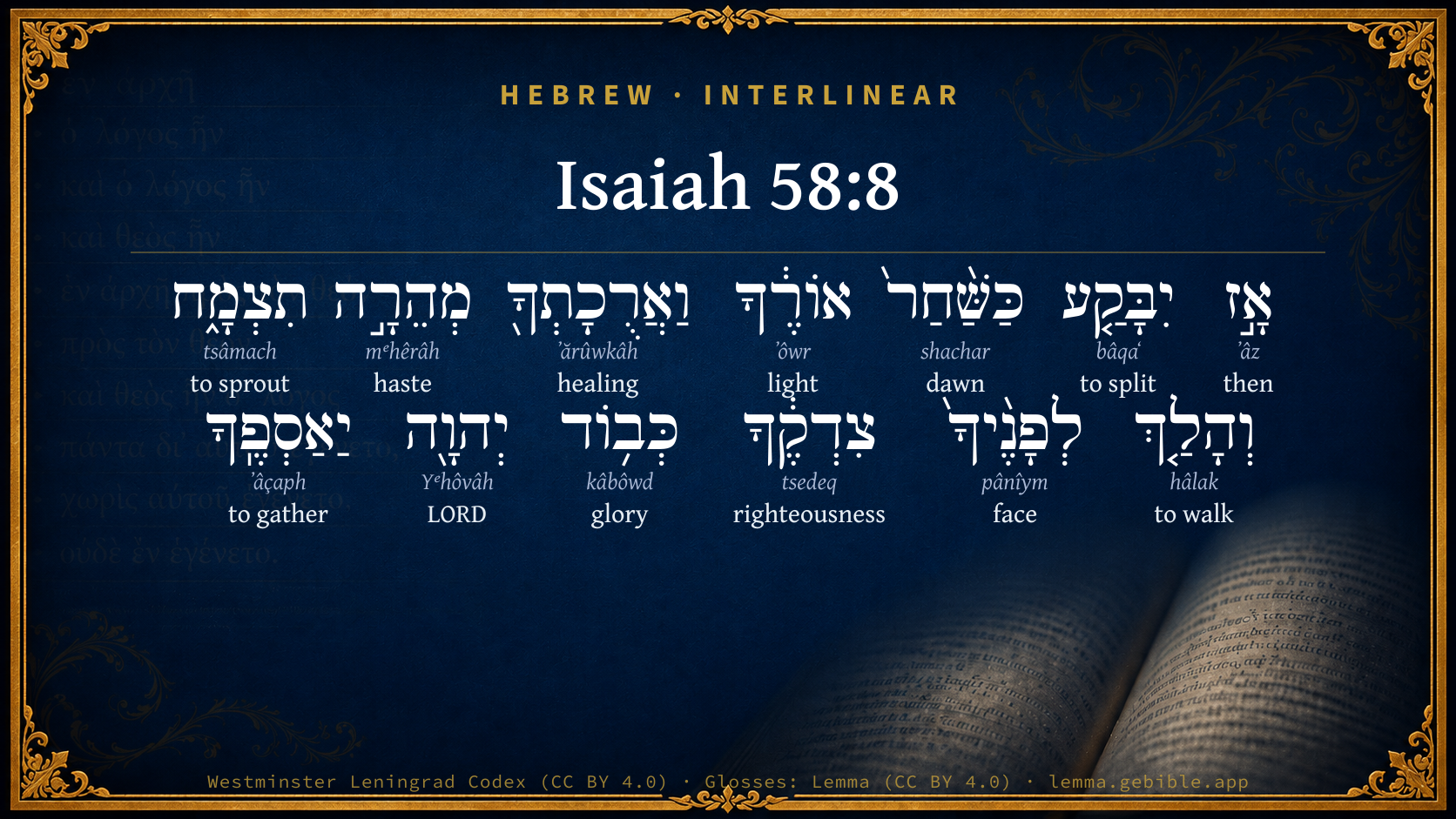
  1. אָ֣ז ʼâz H227 “then” Adverb
  2. יִבָּקַ֤ע bâqaʻ H1234 “to split” Verb, Niphal, Imperfect, 3rd Person, Masculine, Singular
  3. כַּשַּׁ֨חַר֙ shachar H7837 “like/as the · dawn” Preposition, Determined + Noun, Common, Masculine, Singular, Absolute
  4. אוֹרֶ֔ךָ ʼôwr H216 “light · your” Noun, Common, Both, Singular, Construct + Suffix, Personal, 2nd Person, Masculine, Singular
  5. מְהֵרָ֣ה mᵉhêrâh H4120 “haste” Noun, Common, Feminine, Singular, Absolute
  6. תִצְמָ֑ח tsâmach H6779 “to sprout” Verb, Qal, Imperfect, 3rd Person, Feminine, Singular
  7. וְהָלַ֤ךְ hâlak H1980 “and · to walk” Conjunction + Verb, Qal, Sequential Perfect, 3rd Person, Masculine, Singular
  8. לְפָנֶ֨יךָ֙ pânîym H6440 “to/for · face(s) · your” Preposition + Noun, Common, Both, Plural, Construct + Suffix, Personal, 2nd Person, Masculine, Singular
  9. צִדְקֶ֔ךָ tsedeq H6664 “righteousness · your” Noun, Common, Masculine, Singular, Construct + Suffix, Personal, 2nd Person, Masculine, Singular
  10. כְּב֥וֹד kâbôwd H3519 “glory of” Noun, Common, Both, Singular, Construct
  11. יְהוָ֖ה Yᵉhôvâh H3068 “LORD” Noun, Proper
  12. יַאַסְפֶֽךָ ʼâçaph H622 “to gather · you” Verb, Qal, Imperfect, 3rd Person, Masculine, Singular + Suffix, Personal, 2nd Person, Masculine, Singular

About this verse

These counts appear in no published source. They are computed here, from the morphology-tagged text and Lemma’s own curated glosses. What Lemma adds →

13
words
13
distinct lemmas
Prophets
section

Notable vocabulary

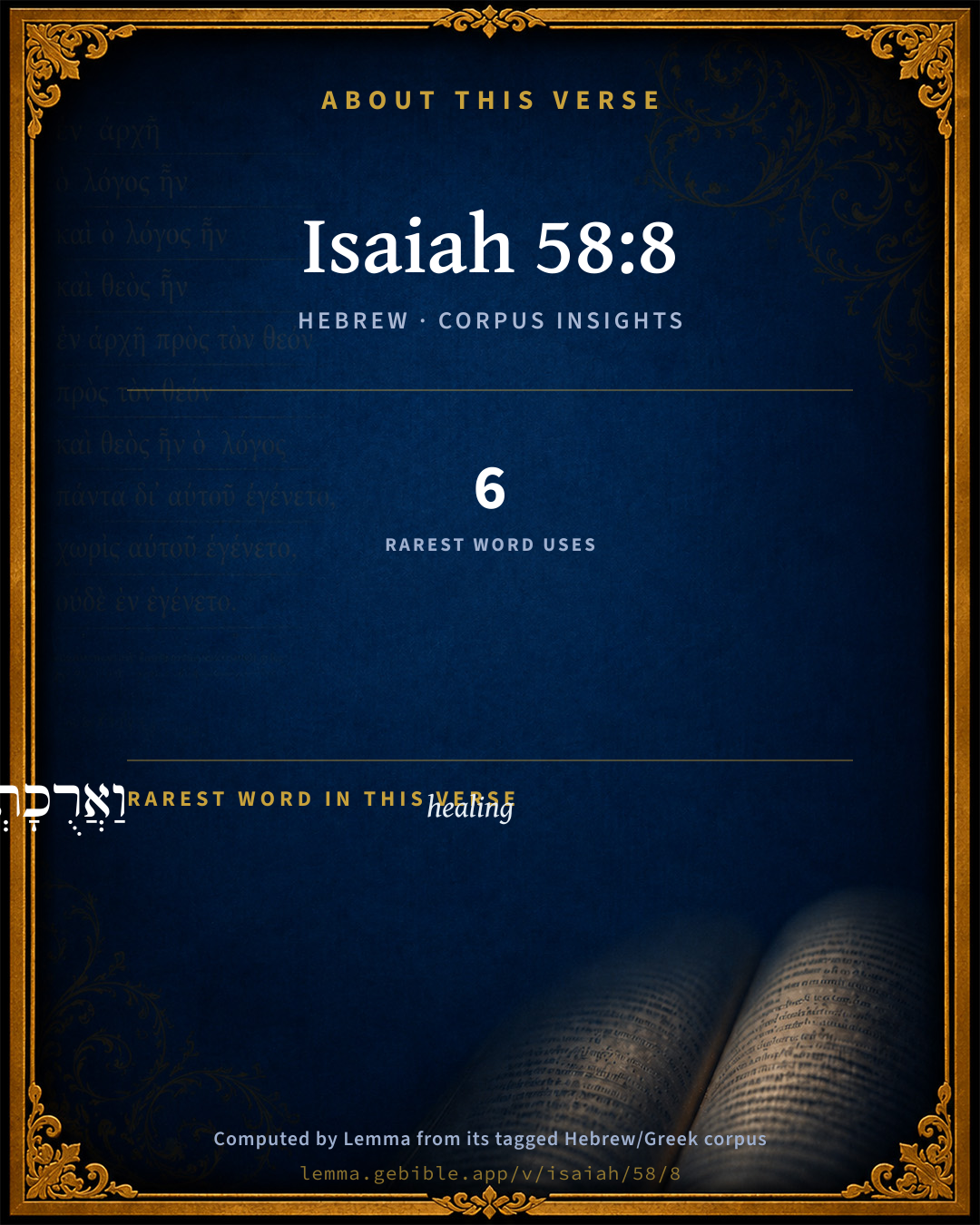
The rarest word here is וַאֲרֻכָתְךָ֖ healing H724 — appearing just 6 times in the whole Hebrew Bible.

Shared distinctive vocabulary

וַאֲרֻכָתְךָ֖ healing H724 occurs in 6 verses of the Hebrew Bible. Also found in:

Grammatical profile

  • 4 verbs
  • 8 nouns
  • 1 adverb

Verb forms

  • יִבָּקַ֤ע Niphal · Imperfect
  • תִצְמָ֑ח Qal · Imperfect
  • וְהָלַ֤ךְ Qal · Sequential Perfect
  • יַאַסְפֶֽךָ Qal · Imperfect

Hebrew & Septuagint length

In English translation the verse runs 31 words from the Hebrew and 31 from the Septuagint (LXX English) — the same length.

A rough comparison of the two English renderings, which tokenize alike — not a word-level alignment.

Word counts can differ between the Hebrew and the Greek without any difference in meaning — e.g. the Hebrew direct-object marker אֵת has no separate Greek word, and Greek often adds the article ὁ.

Cross-references

20

Topical passages linked to Isaiah 58:8 in the Treasury of Scripture Knowledge — connected by theme and wording, ordered by reader-vote popularity; previews shown in the World English Bible.

  • Isaiah 52:12 For you shall not go out in haste, neither shall you go by flight: for Yahweh will go before you; and the God of Israel will be your rearward.
  • Jeremiah 33:6 Behold, I will bring it health and cure, and I will cure them; and I will reveal to them abundance of peace and truth.
  • Psalms 37:6 He will make your righteousness go forth as the light, And your justice as the noon day sun.
  • Jeremiah 30:17 For I will restore health to you, and I will heal you of your wounds, says Yahweh; because they have called you an outcast, [saying], It is Zion, whom no man seeks after.
  • Psalms 85:13 Righteousness goes before him, And prepares the way for his steps.
  • Malachi 4:2 But to you who fear my name shall the sun of righteousness arise with healing in its wings. You will go out, and leap like calves of the stall.
  • Isaiah 58:10–11 and if you draw out your soul to the hungry, and satisfy the afflicted soul: then shall your light rise in darkness, and your obscurity be as the noonday;
  • Acts 10:35 but in every nation he who fears him and works righteousness is acceptable to him.
  • Psalms 97:11 Light is sown for the righteous, And gladness for the upright in heart.
  • Exodus 14:19 The angel of God, who went before the camp of Israel, moved and went behind them; and the pillar of cloud moved from before them, and stood behind them.
  • Proverbs 4:18 But the path of the righteous is like the dawning light, That shines more and more until the perfect day.
  • Job 11:17 Life shall be clearer than the noonday; Though there is darkness, it shall be as the morning.
  • Isaiah 57:18 I have seen his ways, and will heal him: I will lead him also, and restore comforts to him and to his mourners.
  • Hosea 14:4 "I will heal their waywardness. I will love them freely; For my anger is turned away from him.
  • Hosea 6:2–3 After two days will he revive us. On the third day he will raise us up, And we will live before him.
  • Isaiah 30:26 Moreover the light of the moon shall be as the light of the sun, and the light of the sun shall be sevenfold, as the light of seven days, in the day that Yahweh binds up the hurt of his people, and heals the stroke of their wound.
  • Psalms 112:4 Light dawns in the darkness for the upright, Gracious, merciful, and righteous.
  • Matthew 13:15 For this people's heart has grown callous, Their ears are dull of hearing, They have closed their eyes; Or else perhaps they might perceive with their eyes, Hear with their ears, Understand with their heart, And should turn again; And I would heal them.'
  • Acts 10:4 He, fastening his eyes on him, and being frightened, said, "What is it, Lord?" He said to him, "Your prayers and your gifts to the needy have gone up for a memorial before God.
  • Acts 10:31 and said, 'Cornelius, your prayer is heard, and your gifts to the needy are remembered in the sight of God.

Cross-references courtesy of OpenBible.info (CC BY 4.0).

Hebrew and Greek witnesses Masoretic Hebrew ↔ Greek Septuagint

The same verse in the two great witnesses to the Old Testament, shown verse-for-verse.

These are two independent witnesses, not word-aligned to each other, and the Septuagint is shown in lemma (dictionary) form.

Hebrew Isaiah 58:8 Masoretic · Westminster Leningrad Codex

אָ֣ז יִבָּקַ֤ע כַּשַּׁ֨חַר֙ אוֹרֶ֔ךָ וַאֲרֻכָתְךָ֖ מְהֵרָ֣ה תִצְמָ֑ח וְהָלַ֤ךְ לְפָנֶ֨יךָ֙ צִדְקֶ֔ךָ כְּב֥וֹד יְהוָ֖ה יַאַסְפֶֽךָ

Then shall your light break forth as the morning, and your healing shall spring forth speedily; and your righteousness shall go before you; the glory of Yahweh shall by your rearward.

World English Bible · Public Domain

Greek LXX Isaiah 58:8 Septuagint · lemma form

τότε ῥήγνυμι πρώιμος ὁ φῶς σύ καί ὁ ἴαμα σύ ταχύς ἀνατέλλω καί προπορεύομαι ἔμπροσθεν σύ ὁ δικαιοσύνη σύ καί ὁ δόξα ὁ θεός περιστέλλω σύ

Then shall your light break forth as the morning, and your health shall speedily spring forth: and your righteousness shall go before you, and the glory of God shall compass you.

LXX2012 (modern English Septuagint) · Public Domain

On this verse, Keil & Delitzsch discusses the Septuagint’s reading. Read the note in Commentary ↓

Hebrew: Westminster Leningrad Codex (CC BY 4.0). Greek: Septuagint (public domain); English from LXX2012 (modern English Septuagint) (Public Domain). How the Septuagint differs from the Hebrew →

Targum (Aramaic paraphrase)

1

The Targum is the ancient Jewish Aramaic paraphrase of the Hebrew Scriptures — an interpretive translation, not the Hebrew text itself. Onkelos (literal) and Pseudo-Jonathan (expansive) render the Torah, and Jonathan the Prophets. Coverage is partial: where no permissively-licensed English translation exists for a verse, only the Aramaic is shown. This is verse-level text, not a word-by-word alignment to the Hebrew.

  1. Targum Jonathan Prophets (Joshua–Malachi)
    בְּכֵן יִתְגְלֵי כִּשְׁפַּרְפָּרָא נְהוֹרָךְ וְאַסוּת מַחֲתָךְ בִּפְרִיעַ תִּיסָק וִיהָכוּן קֳדָמָךְ זַכְוָתָךְ בִּיקָר מִן קֳדָם יְיָ תִתְכְּנִישׁ:

    Then shall thy light be revealed like the early dawn, and the healing of thy wound shall appear quickly; thy great righteousness shall go before thee, and thou shalt be gathered to the glory, which is in the presence of the Lord.

    Targum Jonathan — Aramaic: “Mikraot Gedolot” (public domain). English: “Sefaria Community Translation” (CC0 1.0 (public-domain dedication)); “London "Chaldee Paraphrase," 1871” (public domain). Text via Sefaria.

Commentary

Notes on Isaiah 58:8 from classic Christian and Jewish commentators (each source and its license shown beneath its notes). The classic Christian expositions comment on the surrounding passage and are grouped to its opening verse, so a note may address several verses; the Jewish commentaries on the Tanakh (Rashi and others) are per-verse, so they appear only where the commentator wrote on this verse.

Lemma curates 59 commentaries, every one of them public domain or Creative Commons licensed, each selected and text-cleaned for this edition rather than reprinted as found. About our sources →

Matthew Henry's Commentary

Here are precious promises for those to feast freely and cheerfully upon by faith who keep the fast that God has chosen; let them know that God will make it up to them. Here is,

I. A further account of the duty to be done in order to our interest in these promises (Isa 58:9, Isa 58:10); and here, as before, it is required that we both do justly and love mercy, that we cease to do evil and learn to do well. 1. We must abstain from all acts of violence and fraud. "Those must be taken away from the midst of thee, from the midst of thy person, out of thy heart" (so some); "thou must not only refrain from the practice of injury, but mortify in thee all inclination and disposition towards it." Or from the midst of thy people. Those in authority must not only not be oppressive themselves, but must do all they can to prevent and restrain oppression in all within their jurisdiction. They must not only break the yoke (Isa 58:6), but take away the yoke, that those who have been oppressed may never be re-enslaved (as they were Jer 34:10, Jer 34:11); they must likewise forbear threatening (Eph 6:9) and take away the putting forth of the finger, which seems to have been then, as sometimes with us, a sign of displeasure and the indication of a purpose to correct. Let not the finger be put forth to point at those that are poor and in misery, and so to expose them to contempt; such expressions of contumely as are provoking, and the products of ill-nature, ought to be banished from all societies. And let them not speak vanity, flattery or fraud, to one another, but let all conversation be governed by sincerity. Perhaps that dissimulation which is the bane of friendship is meant by the putting forth of the finger (as Pro 6:13 by teaching with the finger), or it is putting forth the finger with the ring on it, which was the badge of authority, and which therefore they produced when they spoke iniquity, that is, gave unrighteous sentences. 2. We must abound in all acts of charity and beneficence. We must not only give alms according as the necessities of the poor require, but, (1.) We must give freely and cheerfully, and from a principle of charity. We must draw out our soul to the hungry (Isa 58:10), not only draw out the money and reach forth the hand, but do this from the heart, heartily, and without grudging, from a principle of compassion and with a tender affection to such as we see to be in misery. Let the heart go along with the gift; for God loves a cheerful giver, and so does a poor man too. When our Lord Jesus healed and fed the multitude it was as having compassion on them. (2.) We must give plentifully and largely, so as not to tantalize, but to satisfy, the afflicted soul: "Do not only feed the hungry, but gratify the desire of the afflicted, and, if it lies in your power, make them easy." What are we born for, and what have we our abilities of body, mind, and estate for, but to do all the good we can in this world with them? And the poor we have always with us.

II. Here is a full account of the blessings and benefits which attend the performance of this duty. If a person, a family, a people, be thus disposed to every thing that is good, let them know for their comfort that they shall find God their bountiful rewarder and what they lay out in works of charity shall be abundantly made up to them. 1. God will surprise them with the return of mercy after great affliction, which shall be as welcome as the light of the morning after a long and dark night (Isa 58:8): "Then shall thy light break forth as the morning and (Isa 58:10) thy light shall rise in obscurity. Though thou hast been long buried alive thou shalt recover thy eminency; though long overwhelmed with grief, thou shalt again look pleasant as the dawning day." Those that are cheerful in doing good God will make cheerful in enjoying good; and this also is a special gift of God, Ecc 2:24. Those that have shown mercy shall find mercy. Job, who in his prosperity had done a great deal of good, had friends raised up for him by the Lord when he was reduced, who helped him with their substance, so that his light rose in obscurity. "Not only thy light, which is sweet, but thy health too, or the healing of the wounds thou hast long complained of, shall spring forth speedily; all thy grievances shall be redressed, and thou shalt renew thy youth and recover thy vigour." Those that have helped others out of trouble will obtain help of God when it is their turn. 2. God will put honour upon them. Good works shall be recompensed with a good name; this is included in that light which rises out of obscurity. Though a man's extraction be mean, his family obscure, and he has no external advantages to gain him honour, yet, if he do good in his place, that will procure him respect and veneration, and his darkness shall by this means become as the noon-day, that is, he shall become very eminent and shine brightly in his generation. See here what is the surest way for a man to make himself illustrious; let him study to do good. He that would be the greatest of all, and best-loved, let him by humility and industry make himself a servant of all. "Thy righteousness shall answer for thee (as Jacob says, Gen 30:33), that is, it shall silence reproaches, nay, it shall bespeak thee more praises than thy humility can be pleased with." He that has given to the poor, his righteousness (that is, the honour of it) endures for ever, Psa 112:9. 3. They shall always be safe under the divine protection: "Thy righteousness shall go before thee as thy vanguard, to secure thee from enemies that charge thee in the front, and the glory of the Lord shall be thy rearward, the gathering host, to bring up those of thee that are weary and are left behind, and to secure thee from the enemies, that, like Amalek, fall upon thy rear." Observe, How good people are safe on all sides. Let them look which way they will, behind them or before them; let them look backward or forward; they see themselves safe, and find themselves easy and quiet from the fear of evil. And observe what it is that is their defence; it is their righteousness, and the glory of the Lord, that is, as some suppose, Christ; for it is by him that we are justified, and God is glorified. He it is that goes before us, and is the captain of our salvation, as he is the Lord our righteousness; he it is that is our rearward, on whom alone we can depend for safety when our sins pursue us and are ready to take hold on us. Or, "God himself in his providence and grace shall both go before thee as thy guide to conduct thee, and attend thee as thy rearward to protect thee, and this shall be the reward of thy righteousness and so shall be for the glory of the Lord as the rewarder of it." 4. God will be always nigh unto them, to hear their prayers, Isa 58:9. As, on the one hand, he that shuts his ears to the cry of the poor shall himself cry and God will not hear him; so, on the other hand, he that is liberal to the poor, his prayers shall come up with his alms for a memorial before God, as Cornelius's did (Act 10:4): "Then shalt thou call, on thy fast-days, which ought to be days of prayer, and the Lord shall answer, shall give thee the things thou callest to him for; thou shalt cry when thou art in any distress or sudden fright, and he shall say, Here I am." This is a very condescending expression of God's readiness to hear prayer. When God calls to us by his word it becomes us to say, Here we are; what saith our Lord unto his servants? But that God should say to us, Behold me, here I am, is strange. When we cry to him, as if he were at a distance, he will let us know that he is near, even at our right hand, nearer than we thought he was. It is I, be not afraid. When danger is near our protector is nearer, a very present help. "Here I am, ready to give you what you want, and do for you what you desire; what have you to say to me?" God is attentive to the prayers of the upright, Psa 130:2. No sooner do they call to him than he answers, Ready, ready. Wherever they are praying, God says, "Here I am hearing; I am in the midst of you." He is nigh unto them in all things, Deu 4:7. 6. God will direct them in all difficult and doubtful cases (Isa 58:11): The Lord shall guide thee continually. While we are here, in the wilderness of this world, we have need of continual direction from heaven; for, if at any time we be left to ourselves, we shall certainly miss our way; and therefore it is to those who are good in God's sight that he gives the wisdom which in all cases is profitable to direct, and he will be to them instead of eyes, Ecc 2:26. His providence will make their way plain to them, both what is their duty and what will be most for their comfort. 6. God will give them abundance of satisfaction in their own minds. As the world is a wilderness in respect of wanderings, so that they need to be guided continually, so also is it in respect of wants, which makes it necessary that they should have continual supplies, as Israel in the wilderness had not only the pillar of cloud to guide them continually, but manna and water out of the rock to satisfy their souls in drought, in a dry and thirsty land where no water is, Psa 63:1. To a good man God gives not only wisdom and knowledge, but joy; he is satisfied in himself with the testimony of his conscience and the assurances of God's favour. "These will satisfy thy soul, will put gladness into thy heart, even in the drought of affliction; these will make fat thy bones, and fill them with marrow, will give thee that pleasure which will be a support to thee as the bones to the body, that joy of the Lord which will be thy strength. He shall give thy bones rest" (so some read it), "rest from the pain and sickness which they have laboured under and been chastened with;" so it agrees with that promise made to the merciful. The Lord will make all his bed in his sickness, Psa 41:3. "Thou shalt be like a watered garden, so flourishing and fruitful in graces and comforts, and like a spring of water, like a garden that has a spring of water in it, whose waters fail not either in droughts or in frosts." The principle of holy love in those that are good shall be a well of living water, Joh 4:14. As a spring of water, though it is continually sending forth its streams, is yet always full, so the charitable man abounds in good as he abounds in doing good and is never the poorer for his liberality. He that waters shall himself be watered. 7. They and their families shall be public blessings. It is a good reward to those that are fruitful and useful to be rendered more so, and especially to have those who descend from them to be so too. This is here promised (Isa 58:12): "Those that now are of thee, thy princes, and nobles, and great men, shall have such authority and influence as they never had;" or, "Those that hereafter shall be of thee, thy posterity, shall be serviceable to their generation, as thou art to thine." It completes the satisfaction of a good man, as to this world, to think that those that come after him shall be doing good when he is gone. 1. They shall re-edify cities that have been long in ruins, shall build the old waste places, which had lain so long desolate that the rebuilding of them was quite despaired of. This was fulfilled when the captives, after their return, repaired the cities of Judah, and dwelt in them, and many of those in Israel too, which had lain waste ever since the carrying away of the ten tribes. 2. They shall carry on and finish that good work which was begun long before, and shall be helped over the obstructions which had retarded the progress of it: They shall raise up to the top that building the foundation of which was laid long since and has been for many generations in the rearing. This was fulfilled when the building of the temple was revived after it had stood still for many years, Ezr 5:2. Or, "They shall raise up foundations which shall continue for many generations yet to come;" they shall do that good which shall be of lasting consequence. 3. They shall have the blessing and praise of all about them: "Thou shalt be called (and it shall be to thy honour) the repairer of the breach, the breach made by the enemy in the wall of a besieged city, which whoso has the courage and dexterity to make up, or make good, gains great applause." Happy are those who make up the breach at which virtue is running out and judgments are breaking in. "Thou shalt be the restorer of paths, safe and quiet paths, not only to travel in, but to dwell in, so safe and quiet that people shall make no difficulty of building their houses by the road-side." The sum is that, if they keep such fasts as God has chosen, he will settle them again in their former peace and prosperity, and there shall be none to make them afraid. See Zac 7:5, Zac 7:9; Zac 8:3-5. It teaches us that those who do justly and love mercy shall have the comfort thereof in this world.

Matthew Henry's Commentary on the Whole Bible (1708–1710) — public domain (CC PDM 1.0). Text via the HelloAO Bible API.

Trapp's Complete Commentary

John Trapp

Isa 58:8 Then shall thy light break forth as the morning, and thine health shall spring forth speedily: and thy righteousness shall go before thee; the glory of the LORD shall be thy rereward.

Ver. 8. Then shall thy light break forth as the morning.] He saith not "shall appear," but "shall break forth," ut velocitatem et copiam dantis exprimeret, saith Chrysostom, that he might express the swiftness and bountifulness of God the giver of it.

And thy health shall spring forth speedily.] "The Sun of righteousness shall arise unto thee with healing under his wings." {Mal 4:2} {See Trapp on "Mal 4:2"}

And thy righteousness shall go before thee.] Thou shalt have the comfort and credit of thy bounty and charity, which is oft called "righteousness," as in Psa 112:9 Dan 4:24 Act 10:35.

And the glory of the Lord shall be thy rereward,] i.e., The glorious Jehovah shall see to thy safety. See Psa 27:10. {See Trapp on "Pro 27:10"} See also Isa 52:12.

John Trapp, A Commentary or Exposition upon All the Books of the Old and New Testament (1647–1656) — public domain. Text from a community e-Sword module.

The Biblical Illustrator

Joseph S. Exell

Isa_58:8-14

Then shall thy light break forth

The secret of prosperity to nations, churches, and men

(Isa_58:8-10; Isa_58:14, Then, then, then, then ):--

I.

MEN AND CHURCHES CHARGE GOD FOOLISHLY, AND COMPLAIN WITHOUT CAUSE OF THEIR OWN LOW ESTATE.

II. GOD REBUTS THEIR BLASPHEMOUS CHARGE, AND ASSERTS THE RIGHTEOUSNESS OF HIS DEALINGS IN AN APPEAL TO THEIR OWN CONSCIENCES AND COMMON-SENSE.

III. GOD RETURNS THE CHARGE AGAINST HIMSELF ON THE SINNERS OWN HEADS, AND REVEALS HIS SECRET, IF MEN WILL HAVE EARS TO HEAR. Then is the secret of light and darkness; of health and sickness, or want of spiritual vigour and vitality; of covenant righteousness in the enjoyment of covenant blessings, or apparent breach of covenant in the withholding of what is good; of glory, such as that of Israel in the wilderness, when the glory of the Lord was their rereward, when the pillar of cloud and fire was in the midst of them by day and night, or shame, as when the ark was in the hands of the Philistines, or the Assyrian or Babylonian invaded Gods heritage and profaned His temple; of prayers answered, or unanswered; of Gods presence manifested in undeniable! tokens, or denied, undiscerned, apparently withdrawn; of power to be Gods witnesses and workmen in doing good to others, or impotence, conscious inability to be fellow-labourers with God and for God, want of spiritual life and energy. Then is the secret--then, and not till then--then, and not otherwise--then certainly-then according to the promise of the covenant, and in the way of the covenant and kingdom. In further application of the text to ourselves learn such lessons as the following--

1. The salvation of the Gospel is salvation from sin itself.

2. In the Gospel, accordingly, blessedness and righteousness go together, and so also sin and misery.

3. There is under the Gospel no substitute for repentance.

4. Man, in all the work of salvation, from beginning to end, must co-operate with God. (R. Paisley.)

God the rewarder

If a person, a family, a people be thus disposed to everything that is good, let them know for their comfort that they shall find God their bountiful rewarder.

1. God shall surprise them with the return of mercy after great affliction, which shall be as welcome as the light of the morning after a long and dark night (Isa_58:8; Isa_58:10). They that arc cheerful in doing good, God will make them cheerful in enjoying good. They that have showed mercy shall find mercy. Those that have helped others out of trouble, God will help them when it is their turn.

2. God will put honour upon them. Good works shall be recompensed with a good name. This is included in that light which riseth out of obscurity.

3. They shall always be safe under the Divine protection. Thy righteousness shall go before thee, as the vanguard, to secure thee from enemies that charge thee in the front; and the glory of the Lord shall be thy rearward, the gathering, host to bring up those of thee that are weary and are left behind, and to secure thee from the enemies that, like Amalek, fall upon thy rear.

4. God will be always nigh unto them to hear their prayers (Isa_58:9). As, on the one hand, he that shuts his ears to the cry of the poor shall himself cry and God will not hear him, so on the other hand, he that is liberal to the poor, his prayers shall come up, with his alms, for a memorial before God Act_10:4).

5. God will direct them in all difficult and doubtful cases (verse 11).

6. God will give them abundance of satisfaction in their own minds (verse 11).

7. They and their families shall be public blessings (verse 12). (M. Henry.)

Break forth as the dawn

Break forth is the verb used in IsaGe 7:11; Psa_74:15, of the bursting of waters through a fissure in the earths surface; by a vivid metaphor the dawn was conceived as splitting the heavens and flooding the world with light The same word occurs on the Moaite Stone in the phrase from the splitting of the dawn. (Prof. J. Skinner,D. D.)

Thine health shall spring forth speedily

A healthy Church

I. ESSENTIALS OF A HEALTHY CHURCH.

1. A Scriptural constitution.

2. Nutritious food.

3. Pure air.

4. Regular exercise.

II. CHARACTERISTICS OF A HEALTHY CHURCH

1. Health is sometimes known by outward appearances. The rosy cheeks, the sparkling eyes, the sonorous voice, all testify to health. A healthy Church may be known by its prayer-meetings, contributions, missionary spirit, etc.

2. Health is known by tastes. A sickly mans taste is bad. Unwholesome dainties are preferred to strong meat. So with regard to an unhealthy Church. Silly anecdotes are preferred to good scriptural teaching. Thinks much of forms and ceremonies.

3. Contentment of mind. An unhealthy man is querulous and difficult to please. So an unhealthy Church. It is a fault-finding Church.

4. Work. Sickness disables a man for labour. Health stimulates to work. A healthy Church may be known by its labour.

III. THE DESIRABILITY OF A HEALTHY CHURCH. A healthy Church--

1. Is one of great comfort to itself.

2. Will survive through many trials. The healthy man is heedless of east winds, etc. So a healthy Church survives persecutions, etc.

3. Is attractive. People shun unhealthy Churches as they do fever dens.

4. Is one likely to live.

Lessons:

1. A morally sick Church is a great curse to a neighbourhood.

2. The sooner the better that many a Church should apply to the great Physician for spiritual healing.

3. The Church will by and by become perfectly whole.

4. When perfectly whole, diseased persons will no longer be admitted into its fellowship (Rev_21:27). (J. Williams.)

The Biblical Illustrator, edited by Joseph S. Exell (c. 1880s–1900s) — public domain. Text from a community e-Sword module.

Joseph Benson's Commentary

Isa 58:8. Then shall thy light — Matter or cause of rejoicing, break forth as the morning — Arise as certainly and speedily as in the morning the light arises out of darkness. It shall not only appear, but break, or dart itself forth, notwithstanding all obstructions, as the sun breaks and pierces through a cloud. So ready is God to help his people when they are truly humbled! Thus quickly and clearly does salvation break forth upon them! And thy health shall spring forth speedily — The recovery of thy former prosperous condition. Another metaphor to express the same thing. And thy righteousness shall go before thee — To prepare thy way to safety and happiness; ensuring to thee, O my church, the peculiar direction and care of thy God, and the favour and approbation of wise and good men; see Rom 14:17-18. Or manifold blessings shall be bestowed upon thee, upon all occasions, as the reward of thy righteousness. The glory of the Lord shall be thy rereward — The glorious presence, power, and providence of God shall protect and secure thee. Thus the angel of his presence secured the Israelites when they came up out of Egypt. Or, the meaning may be, A glorious state shall succeed this thy present calamitous condition.

Joseph Benson's Commentary on the Old and New Testaments (1811–1818) — public domain. Text from a community e-Sword module.

The Preacher's Complete Homiletical Commentary

Joseph S. Exell (gen. ed.)

A HEALTHY CHURCH

Isa_58:8. And thine health shall spring forth speedily

I. ESSENTIALS OF A HEALTHY CHURCH.

1. A scriptural constitution. As Noah built the ark, Moses the tabernacle, and Solomon the temple, according to the Divine instructions; so a healthy church is formed according to the teaching of the New Testament and pattern of the churches planted by the apostles. The foundation must be well laid, otherwise the superstructure cannot but fall.

2. Nutritious food. As the body requires to be fed with a sufficient amount of wholesome food, so the soul must be fed with the bread which came down from heaven. Truth in its purity, without any adulteration, should be the soul’s spiritual diet (1Pe_2:2).

3. Pure air. The man who breathes in a polluted atmosphere sows the seed of disease and death in the human body. So the soul which lives in an impure moral atmosphere greatly injures itself. The spirit of worldliness, and the society of evil companions, should be most carefully avoided.

4. Regular exercise. Physical exercise is one of the conditions of health, and is the means of saving many a doctor’s bill. In like manner, Christian work and the faithful discharge of religious duties is conducive to sound spiritual health.

II. CHARACTERISTICS OF A HEALTHY CHURCH.

1. Health is sometimes known by outward appearances. The rosy cheeks, the sparkling eyes, the sonorous voice, all testify to health. One invalid in a family puts everything out of sorts. A healthy church may be known by its prayer-meetings, contributions, missionary spirit, &c.

2. Health is known by tastes. A sickly man’s taste is bad. Unwholesome dainties are preferred to strong meat. So with regard to an unhealthy church. Its taste is bad. Silly anecdotes are preferred to good scriptural teaching—thinks much of forms and ceremonies, &c.

3. Contentment of mind. An unhealthy man is peevish, querulous, and difficult to please. So an unhealthy church. It is a fault-finding church. Never pleased with its ministry, with its officers, with its choir, &c. It fancies that matters are managed better everywhere than at home.

4. Work. Sickness disables a man for labour. Health stimulates to work. A healthy man cannot be idle. A healthy church may be known by its labour. It teaches the young, visits the sick and needy, supports the missions, &c.

III. THE DESIRABILITY OF A HEALTHY CHURCH.

1. A healthy church is one of great comfort to itself. Though a man has wide estates, baronial castles, chariots innumerable, and though he be rolling in wealth, if health fails, his chief comfort departs. So with a church. Though it may have a beautiful chapel, a crowded congregation, a large endowment; if lacking in spiritual health, its consolations are indeed small.

2. A healthy church will survive through many trials. The healthy man is heedless of easterly winds, and furious hurricanes. So a healthy church. It survives through persecutions, imprisonments, and martyrdom. Like the bush of old fires cannot destroy it.

3. A healthy church is attractive. Healthy neighbourhoods entice visitors. So healthy churches attract men into their communion, and make all who come better and holier. People shun unhealthy churches as they do fever dens.

4. A healthy church is one likely to live. Sickness is the precursor of death. When a church becomes morally sick, people will begin to speak of its death, funeral, and grave. But a healthy church will live. Its chapel may become dilapidated, its members may die, but the healthy church lives on.

LESSONS.—

1. A morally sick church is a great curse to a neighbourhood.

2. The sooner the better that many a church should apply to the great Physician for spiritual healing.

3. The church will by and by become perfectly whole.

4. When perfectly whole, diseased persons will no longer be admitted into its fellowship (Rev_21:27).—J. Williams, Newcastle-Emlyn: “Cofiant.”

The Preacher's Complete Homiletical Commentary (gen. ed. Joseph S. Exell; Funk & Wagnalls, c. 1892) — public domain (pre-1929). A full-Bible homiletical/sermon-outline anthology covering 65 of 66 books (2 John is absent from the source module). Text from a community e-Sword module.

Keil & Delitzsch

C. F. Keil & F. Delitzsch

The prophet now proceeds to point out the reward of divine grace, which would follow such a fast as this, consisting of self-renouncing, self-sacrificing love; and in the midst of the promise he once more reminds of the fact, that this love is the condition of the promise. This divides the promises into two. The middle promise is linked on to the first; the morning dawn giving promise of the "perfect day" (Pro 4:18). The first series of promises we have in Isa 58:8, Isa 58:9. "Then will thy light break forth as the morning dawn, and thy healing will sprout up speedily, and thy righteousness will go before thee, the glory of Jehovah will follow thee. Then wilt thou call and Jehovah will answer; thou wilt beseech, and He will say, Here am I!" The love of God is called "light" in contrast with His wrath; and a quiet cheerful life in God's love is so called, in contrast with a wild troubled life spent in God's wrath. This life in God's love has its dawn and its noon-day. When it is night both within and around a man, and he suffers himself to be awakened by the love of God to a reciprocity of love; then does the love of God, like the rising sun, open for itself a way through the man's dark night and overcome the darkness of wrath, but so gradually that the sky within is at first only streaked as it were with the red of the morning dawn, the herald of the sun. A second figure of a promising character follows. The man is sick unto death; but when the love of God stimulates him to reciprocal love, he is filled with new vigour, and his recovery springs up suddenly; he feels within him a new life working through with energetic force like a miraculous springing up of verdure from the earth, or of growing and flowering plants. The only other passages in which ארוּכה occurs are in the books of Jeremiah, Chronicles, and Nehemiah. It signifies recovery (lxx here, τὰ ἰάματά σου ταχὺ ἀνατελεῖ, an old mistake for ἱμάτια, vestimenta), and hence general prosperity (Ch2 24:13). It always occurs with the predicate עלתה (causative העלה, cf., Targ. Psa 147:3, ארכא אסּק, another reading ארוּכין), oritur (for which we have here poetically germinat) alicui sanitas; hence Gesenius and others have inferred, that the word originally meant the binding up of a wound, bandage (impontiru alicui fascia). But the primary word is ארך = ארך, to set to rights, to restore or put into the right condition (e.g., b. Sabbath 33b, "he cured his wounded flesh"), connected with אריך, Arab. ârak, accommodatus; so that ארוּכה, after the form מלוּכה, Arab. (though rarely) arika, signifies properly, setting to rights, i.e., restoration.

The third promise is: "thy righteousness will go before thee, the glory of Jehovah will gather thee, or keep thee together," i.e., be thy rear-guard (lxx περιστελεῖ σε, enclose thee with its protection; אסף as in מאסּף, Isa 52:12). The figure is a significant one: the first of the mercies of God is δικαιοῦν, and the last δοξάζειν. When Israel is diligent in the performance of works of compassionate love, it is like an army on the march or a travelling caravan, for which righteousness clear and shows the way as being the most appropriate gift of God, and whose rear is closed by the glory of God, which so conducts it to its goal that not one is left behind. The fourth promise assures them of the immediate hearing of prayer, of every appeal to God, every cry for help.

But before the prophet brings his promises up to their culminating point, he once more lays down the condition upon which they rest. "If thou put away from the midst of thee the yoke, the pointing of the finger, and speaking of evil, and offerest up thy gluttony to the hungry, and satisfiest the soul that is bowed down: thy light will stream out in the darkness, and thy darkness become like the brightness of noon-day. And Jehovah will guide thee continually, and satisfy thy soul in droughts, and refresh thy bones; and thou wilt become like a well-watered garden, and like a fountain, whose waters never deceive. And thy people will build ruins of the olden time, foundations of earlier generations wilt thou erect; and men will call thee repairers of breaches, restorers of habitable streets." מוטה, a yoke, is here equivalent to yoking or oppression, as in Isa 58:6, where it stands by the side of רשׁע. שׁלח־אצבּא (only met with here, for שׁלח, Ges. 65, 1, a), the stretching out of the finger, signifies a scornful pointing with the fingers (Pro 6:13, δακτυλοδεικτεῖν) at humbler men, and especially at such as are godly (Isa 57:4). דּבּר־און, the utterance of things which are wicked in themselves and injurious to one's neighbour, hence sinful conversation in general. The early commentators looked for more under נפשׁך, than is really meant (and so does even Stier: "they soul, thy heart, all thy sympathetic feelings," etc.). The name of the soul, which is regarded here as greedily longing (Isa 56:11), is used in Deu 24:6 for that which nourishes it, and here for that which it longs for; the longing itself (appetitus) for the object of the longing (Psychol. p. 204). We may see this very clearly from the choice of the verb תּפק (a voluntative in a conditional clause, Ges. 128, 2), which, starting from the primary meaning educere (related to נפק, Arabic anfaqa, to give out, distribute, nafaqa, distribution, especially of alms), signifies both to work out, acquire, carry off (Pro 3:13; Pro 8:35, etc.), and also to take out, deliver, offer, expromere (as in this instance and Psa 140:9; Psa 144:13). The soul "bowed down" is bowed down in this instance through abstinence. The apodoses commence with the perf. cons. וזרח. אפלה is the darkness caused by the utter absence of light (Arab. afalat esh-shemsu, "the sun has become invisible"); see at Job 10:22. This, as the substantive clause affirms, is like the noon-day, which is called צהרים, because at that point the daylight of both the forenoon and afternoon, the rising and setting light, is divided as it were into two by the climax which it has attained. A new promise points to the fat, that such a man may enjoy without intermission the mild and safe guidance of divine grace, for which נחה (הנחה, syn. נהל) is the word commonly employed; and another to the communication of the most copious supply of strength. The ἅπαξ γεγρ בצחצחות does not state with what God will satisfy the soul, as Hahn supposes (after Jerome, "splendoribus"), but according to צסהיחה (Psa 68:7) and such promises as Isa 43:20; Isa 48:21; Isa 49:10, the kind of satisfaction and the circumstances under which it occurs, viz., in extreme droughts (Targ. "years of drought"). In the place of the perf. cons. we have then the future, which facilitates the elevation of the object: "and thy bones will He make strong," יחליח, for which Hupfeld would read יחליף, "will He rejuvenate." חחליץ is a denom. of חלוּץ, expeditus; it may, however, be directly derived from a verb חלץ, presupposed by חלצים, not, however, in the meaning "to be fat" (lxx πιανθήσεται, and so also Kimchi), but "to be strong," lit., to be loose or ready for action; and b. Jebamoth 102b has the very suitable gloss גרמי זרוזי (making the bones strong). This idea of invigorating is then unfolded in two different figures, of which that of a well-watered garden sets forth the abundance received, that of a spring the abundance possessed. Natural objects are promised, but as a gift of grace; for this is the difference between the two testaments, that in the Old Testament the natural is ever striving to reach the spiritual, whereas in the New Testament the spiritual lifts up the natural to its own level. The Old Testament is ever striving to give inwardness to what was outward; in the New Testament this object is attained, and the further object now is to make the outward conformed to the inward, the natural life to the spiritual.

The last promise (whether the seventh or eighth, depends upon whether we include the growing of the morning light into the light of noon, or not) takes its form from the pining of the exiles for their home: "and thy people (ממּך) build" (Ewald, 295, c); and Bttcher would read ממך וּבנּוּ; but מן with a passive, although more admissible in Hebrew than in Arabic, is very rarely met with, and then more frequently in the sense of ἀπό than in that of ὑπό, and בּנּוּ followed by a plural of the thing would be more exact than customary. Moreover, there is no force in the objection that ממּך with the active can only signify "some of thee," since it is equivalent to ממך אשׁר, those who sprang from thee and belong to thee by kindred descent. The members born to the congregation in exile will begin, as soon as they return to their home, to build up again the ruins of olden time, the foundations of earlier generations, i.e., houses and cities of which only the foundations are left (Isa 61:4); therefore Israel restored to its fatherland receives the honourable title of "builder of breaches," "restorer of streets (i.e., of places much frequented once) לשׁבת" (for inhabiting), i.e., so that, although so desolate now (Isa 33:8), they become habitable and populous once more.

Keil & Delitzsch — Biblical Commentary on the Old Testament (1861–1891) — public domain (CC PDM 1.0). Text via the HelloAO Bible API. (Old Testament only.)

Tyndale Open Study Notes

Tyndale Open Resources

58:8 your salvation (literally your light): The light of the coming age (see 42:6-7; 60:1-3) will dawn on those who turn fully to the Lord. The night of divine judgment and oppression will be over. • your wounds: The nation of Israel was wounded when they were conquered and sent into exile. • protect you from behind: See also 52:12.

Tyndale Open Study Notes — © Tyndale Open Resources, licensed CC BY-SA 4.0. Text via the HelloAO Bible API.

Geneva Bible (1599)

Geneva Bible translators

The Testimony of thy goodness shall appear before God and man.

That is, the prosperous estate wherewith God will bless thee.

Geneva Bible (1599) marginal notes — public domain. Text via Bolls.life.

Jamieson, Fausset & Brown

Robert Jamieson, A. R. Fausset & David Brown

light--emblem of prosperity (Isa 58:10; Job 11:17).

health--literally, a long bandage, applied by surgeons to heal a wound (compare Isa 1:6). Hence restoration from all past calamities.

go before thee--Thy conformity to the divine covenant acts as a leader, conducting thee to peace and prosperity.

glory . . . reward--like the pillar of cloud and fire, the symbol of God's "glory," which went behind Israel, separating them from their Egyptian pursuers (Isa 52:12; Exo 14:19-20).

Jamieson, Fausset & Brown — Commentary Critical and Explanatory on the Whole Bible (1871) — public domain (CC PDM 1.0). Text via the HelloAO Bible API.

Adam Clarke's Commentary

Verse 8. And thine health shall spring forth speedily - "And thy wounds shall speedily be healed over"] Et cicatrix vulneris tui cito obducetur; "And the scar of thy wounds shall be speedily removed." Aquila's Version, as reported by Jerome, with which agrees that of the Chaldee.

The glory - "And the glory"] Sixteen MSS. (five ancient) of Dr. Kennicott's, and the Septuagint, Syriac, and Vulgate add the conjunction ו vau, וכבוד vechabod.

Adam Clarke's Commentary on the Bible (1810–1826) — public domain. Text from a community e-Sword/MySword module.

Ellicott's Commentary for English Readers

(8) Then shall thy light . . .—The dawning of a new day, as in 2Sa_23:4; the growth as of new and healthy flesh after long illness; “righteousness,” i.e., the sentence of acquittal in the eyes of all the world, as leading the van of a triumphant march, the “glory of Jehovah” following in the rear as a protection; all these images are heaped together to paint the fulness of blessing that follows on that true renunciation of the old evil selfishness of which fasting is but a symbol and a part.

A Bible Commentary for English Readers, edited by Charles John Ellicott (1878–1897) — public domain. Text from a community e-Sword module.

John Gill's Exposition

Then shall thy light break forth as the morning,.... Through thick clouds, or the darkness of the night, suddenly, swiftly, irresistibly, and increase more and more, till it is perfect day. This is to be understood best of temporal and spiritual prosperity, especially the latter, which will attend the churches of the Reformation, when a spirit of persecution is laid aside, and a spirit of love commences, which will be in the Philadelphian church state; and it particularly respects the glorious light of the Gospel, which will break forth very clearly, and shine out in all the world; and the light of joy, peace, and comfort, which will attend it, in the hearts of the Lord's people; see Isa 60:1,

and thine health shall spring forth speedily; as the herbs and grass out of the earth, by clear shining after rain; by which is meant the healthful and sound state of the church in the latter day, when all divisions shall be healed; contentions and animosities cease; sound doctrine preached; the ordinances administered according to their original institution; true discipline restored; and all the parts of worship performed, according to the rule of the divine word; and so the souls of men, under all these means, be in thriving and flourishing circumstances:

and thy righteousness shall go before thee; not the external righteousness of the saints, or works of righteousness done by them; these do not go before them, at least to prepare the way for them into a future state of happiness, but follow after, Rev 14:13, rather the righteousness of Christ imputed to them, and so theirs; or Christ their righteousness, the sun of righteousness, that arises upon them with healing in his wings, and from whom they have the health before mentioned; he goes before his people by way of example, as a guide to direct them, and as the forerunner of them, and whose righteousness will introduce them into the heavenly glory. Though perhaps the meaning here is, that their righteousness, in the latter day glory, shall be very manifest, both their righteousness before God, and before men; which will, as it were, visibly walk before them, make way for them, and protect them; see Isa 60:21,

and the glory of the Lord shall be thy reward, the glorious power and providence of God, preserving his people; or the glorious Lord himself, our Lord Jesus Christ, the brightness of his Father's glory, he, as the word may be rendered, "shall gather thee" (i); he gathers his people to himself; he protects and defends them; he takes care of the weak and feeble, and that are straggling behind; and he brings them up, being the reward, and saves them. The phrase denotes a glorious state of the church in the latter day, when the glory of the Lord will be risen on his church, and abide upon it, and upon all that glory there shall be a defence; see Isa 60:1.

(i) "colliget te", V. L. Munster, Pagninus, Montanus, Tigurine version.

John Gill's Exposition of the Whole Bible (1746–1763) — public domain (CC PDM 1.0). Text via the HelloAO Bible API.

Albert Barnes' Notes on the Bible

Then shall thy light - (See the notes at Isa 44:7). The idea here is, that if they were faithful in the discharge of their duty to God, he would bless them with abundant prosperity (compare Job 11:17). The image is, that such prosperity would come on the people like the spreading light of the morning.

And thine health - Lowth and Noyes render this, ‘And thy wounds shall be speedily healed over.’ The authority on which Lowth relies, is the version of Aquila as reported by Jerome, and the Chaldee. The Hebrew word used here, (ארוּכה 'ărûkâh), means properly “a long bandage” (from ארך 'ârak, “to make long”), such as is applied by surgeons to heal a wound (compare the notes at Isa 1:6). It is then used to denote the healing which is secured by the application of the bandage; and figuratively here means their restoration from all the calamities which had been inflicted on the nation. The word rendered ‘spring forth’ (from צמח tsâmach) properly relates to the manner in which plants germinate (compare the notes at Isa 42:9). Here the sense is, that if they would return to God, they would be delivered from the calamities which their crimes had brought on them, and that peace and prosperity would again visit the nation.

And thy righteousness shall go before thee - Shall be thy leader - as an army is conducted. The idea is that their conformity to the divine laws would serve the purpose of a leader to conduct them in the ways of peace, happiness, and prosperity.

The glory of the Lord - The allusion here is doubtless to the mode in which the children of Israel came out of Egypt (see the notes at Isa 6:5).

Shall be thy rere-ward - Margin, ‘Shall gather thee up.’ That is, shall bring up the rear (see the notes at Isa 52:12).

Albert Barnes' Notes on the Bible (1834–1885) — public domain. Text from a community e-Sword/MySword module.

Haydock's Catholic Bible Commentary

Light. Prosperity, (Calmet) or Saviour. (Haydock) --- Matthew iv. 2., and John i. 8. (Calmet) --- Health. Aquila, "the scar of thy wound shall soon be covered." (St. Jerome) --- Up. He shall close the rear, like the angel in the cloud, Exodus xiii. 21., and xiv. 19. He will grant thee rest from bondage in the grave and in heaven. (Calmet)

George Leo Haydock (1774–1849), Haydock's Catholic Family Bible and Commentary, 1859 edition — public domain. Excludes Psalms (Douay-Rheims chapter numbering differs from Protestant) and Deuterocanonical books (Catholic canon only).

Matthew Poole's English Annotations

Thy light: it is put in general for all happiness and prosperity; as all kind of adversity and calamity is set forth and resembled by darkness: but here more particularly for a comfortable and free estate after their dark and calamitous condition in the Babylonish captivity; for the like reason Josephus tells us, lib. 12. cap. 11., that the Jews instituted a feast to be observed by their posterity, upon the account of the service of the temple being re-established, which they called the feast of lights, because, saith he, so great a happiness broke forth upon them beyond their hope. Break forth as the morning: here is a metaphorical allusion in a metonymical expression, viz. of the efficient, describing the comfortable effect of humbling themselves in a right manner, which like the daylight shall

break forth from the blackness of their night of affliction, and bring with it the joy and comfort of all good things; and he doth not only say this light shall appear, but break forth, dart itself forth, notwithstanding all difficulties, as the sun breaks and pierceth through a cloud, noting how ready God is to help is people when they are rightly humbled, how quickly and how clearly salvation shall break forth upon them.

Thine health shall spring forth speedily: another metaphor to express the same thing, unless there may be this difference, the light with reference to their outward state, and health with reference to the inward delight of their minds, in both to describe the complete satisfaction they should have. Deliverances out of great pressures are often in Scripture represented by the recovery of health, as Isa 57:18; Jer 8:22; and this prophet especially delights in this metaphor, because all affliction is as it were a sickness to the soul, altering the heart and countenance; see Neh 2:2,3; and a recovery out of this estate maketh the heart glad, and the countenance cheerful, Est 8:16,17; Jer 33:6; compare Isa 58:10,11. Hence the LXX. render it; medicines. Thy righteousness; either,

1. Thy uprightness and sincerity, Gen 30:33. Or,

2. The reward of thy righteousness, by a metonymy, Isa 48:18; Psa 24:5; and here perhaps it may particularly relate to their works of mercy and charity, it being the thing in hand, and often so called, Psa 112:9, and applied by the apostle to this purpose, 2Co 9:9. It brings temporal, spiritual, and eternal blessings, and all this not of desert, but free grace, as a reward that naturally springs forth from the faithfulness of his promises, as the harvest from the earth, when the seed is sown; see Hos 10:12; so the fruit and reward of our righteousness springs not from our deserts, but from God’s righteousness, Heb 6 10. Or,

3. The witness of thy righteousness; by what thou doest thou wilt appear to be righteous, Psa 37:6. For such a notion as this was vulgarly sucked in, that adversity did never befall a person or people but for their sins, and was strongly urged by way of argument against Job’s integrity by his friends; therefore they being delivered shall be as a testimony of thy righteousness. Or,

4. The fruit and effect of thy righteousness, viz. the due, just, and right order of thy government, which, as Calvin saith, is a sign of God’s fatherly kindness; things that are now in a confusion he will bring into right order again, i.e. justice shall be duly administered, and men shall carry themselves justly all the land over: see Isa 32:16-18. Or,

5. Christ’s righteousness, Jer 23:6, compared with Isa 33:16. Then the meaning is, He shall go in and out before thee.

Shall go before thee; as it were making way for thy better state, as the break of day or the morning star goes before the sun.

The glory of the Lord, i.e. the glory of his power and providence, or his glorious power, shall be seen in bringing thee up from captivity, and defending thee free from their pursuit; or, as some, a glorious stale shall succeed this thy calamitous condition, and called the glory of the Lord to express the greatness of this glory, as very great mountains are called the mountains of God, and tall cedars the cedars of God. The glorious Lord, by a metonymy of the adjunct.

Shall be thy rereward, Heb. shall gather thee: thus the word is used concerning Dan, who was appointed to bring up the rear, or to. close up the march of the Israelites, when they marched through the wilderness of Sinai, Num 10:25. This office God takes upon himself; for it argues great skill and courage, and makes much for the honour and glory of a commander, both to gather up all the stragglers, that none be picked up by the enemy, which relates to the Hebrew word of gathering, and to secure and cover the rear of his army; thus the angel of his presence secured the Israelites when they came up out of Egypt, Exo 14:19.

Matthew Poole's English Annotations on the Holy Bible (1683–1685) — public domain. Text from a community e-Sword/MySword module.

Whedon's Commentary on the Bible

Daniel D. Whedon

8. The blessings here mentioned follow true obedience.

Thy light — Spiritual light, in which the obedient walk, is as the hopeful morning dawn.

Health… spring forth — Thy spiritual growth shall be rapid.

Thy righteousness — Abstract for the concrete, much as St. Paul uses the word in Romans; sometimes a moral rightness of character, leading one to do what pleases God; sometimes, thy Righteous One, who justifies, shall go before thee.

Daniel D. Whedon (gen. ed.), Commentary on the Old and New Testaments (1874–1909) — public domain. Text from a community e-Sword module.

The Pulpit Commentary

Then. When thou hast taken this advice to heart, and adopted it, and made it the rule of thy conduct. Upon such a change in thee, all good things shall follow. Thou shalt have no more to complain of unanswered prayers or covenant promises left in abeyance (see the comment on vers. 2 and 3). Shall thy lightbreak forth; i.e. thy glorious, time shall begin. (comp Isa_50:1) Thine health rather, thine healing; the "healing of thy bruise," or thy recovery from the low estate to which thy sins have brought thee down shall spring forth speedily; i.e. shall soon manifest itself; and the result will be twofold:

(1) thy own righteousness will go before thee will be, as it were, thy vanguard; and

(2) The glory of the Lord; i.e. the glory which he will confer upon thee, will follow thee up, and be, as it were, thy rearguard. (comp. Isa_52:12)

The break of day.

"Then shall thy light break forth as the morning." The hindrances to progress in God"s Church are not in Divine limitations, but in human perversions.

I THE LIGHT IS THERE. We hide it under the bushel of our formalism and worldliness. Divine revelation gives it yea, keeps it alive; and it" we remove the obstacles to its glory, it will burst forth. Many blame religion for the faults and formalities of nominally religious men.

II THE REVELATION OF THIS LIGHT IS A MORNING. Mornings have often come alike in Jewish and Christian history. Isaiah awakened the Hebrew nation to a new life. Mediaevalism with its dark superstitions, the inquisition with its abhorrent cruelties, did not destroy Christianity. What has been well called the "morning of the Reformation" came. Look back now to Savonarola, and you will see what one man can do to herald a better day in darkest times. Then! Not by an accident in history, nor by an arbitrary decree of God; but by obedience to his Word and by the baptism of his Spirit. And beautiful as are all mornings, when the sun touches the clouds with gold, and fills the earth with splendour, and makes dancing sunshine on the sapphire sea, none are so beautiful as the mornings of new moral life for the world. W.M.S.

The Pulpit Commentary (1880–1919), ed. H.D.M. Spence-Jones & Joseph S. Exell — public domain. Text from a community e-Sword module.

John Wesley's Explanatory Notes

Thy light - Happiness and prosperity. Break forth - It shall not only appear, but break forth, dart itself forth, notwithstanding all difficulties, as the sun breaks, and pierces through a cloud. Thy health - Another metaphor to express the same thing. Righteousness - The reward of thy righteousness. Before thee - As the morning-star goes before the sun. The glory - His glorious power and providence. Thy rereward - Thus the angel of his presence secured the Israelites when they came up out of Egypt.

John Wesley, Explanatory Notes Upon the Whole Bible (1754–1765) — public domain. Text via the GEBible commentary corpus.

J. A. Alexander on Isaiah

Joseph Addison Alexander

“Then shall break forth as the dawn thy light, and thy healing speedily shall spring up; then shall go before thee thy righteousness, and the glory of Jehovah shall be thy reward (or bring up thy rear).” It is evident that the writer has here lost sight of the particular example upon which he had been dwelling so minutely, and is now entirely occupied with the effects which would arise from a conformity to God’s will, not in reference to fasting merely, but to every other part of duty. ‘Then’, (i.e., when this cordial compliance shall have taken place). The verb to ‘break forth’ (literally, to be cleft), elsewhere applied to the hatching of eggs (Isa 59:5), and the gushing of water (Isa 35:6) is here used in reference to the dawn or break of day, a common figure for relief succeeding deep affliction. (See Isa 8:20; Isa 9:2; Isa 60:1). By a mixture of metaphors, which does not in the least obscure the sense, this healing is here said to sprout or germinate, a figure employed elsewhere to denote the sudden, rapid, and spontaneous growth or rise of anything. (See above, on Isa 42:9 and Isa 43:19). In the last clause a third distinct figure is employed to express the same idea, viz. that of a march like the journey through the wilderness, with the pillar of cloud, as the symbol of God’s presence, going before and after. (See above, on Isa 52:12; and compare Exo 13:21; Exo 14:19) Jehovah here assumes the conduct of His people, as their righteousness or justifier. (See Jer 23:6; Jer 33:16; and compare Isa 54:17). The parallel term ‘glory’ may then be understood as denoting the manifested glory of Jehovah, or Jehovah Himself in glorious epiphany; just as His presence with His people in the wilderness was manifested by the pillar of cloud and of fire, which sometimes went before them and at other times brought up their rear. (See above, on Isa 52:12).

Joseph Addison Alexander, The Prophecies of Isaiah (1846–1847; New York: Scribner, 1870–1878) — public domain. Text from a community e-Sword module.

Kretzmann's Popular Commentary

Paul E. Kretzmann

The Blessings Following True Repentance

v. 8. Then, namely, when a person acts in accordance with the suggestion made in the first part of the chapter, shall thy light break forth as the morning, like the dawn of the Orient, which speedily covers the sky, and thine health shall spring forth speedily, the spiritual healing going on with great rapidity; and thy righteousness, the deliverance promised in the covenant, shall go before thee, as the pillar of Jehovah did at the time of the wilderness journey; the glory of the Lord shall be thy rearward, to protect him against any attack from that quarter. This is nothing else than the glory of God in the face of Jesus Christ, the Messiah Himself. Cf 2Co 4:6; 1Co 10:4.

v. 9. Then, namely, when this wonderful fellowship obtains, shalt thou call, and the Lord shall answer, with a ready assistance; thou shalt cry, appealing to Him for help, and He shall say, Here I am, indicating His presence and readiness to help with the customary answer. If thou take away from the midst of thee the yoke, removing every form of oppression, the putting forth of the finger, in a threatening gesture, and speaking vanity, things which would prove harmful to the neighbor;

v. 10. and if thou draw out thy soul to the hungry, opening his heart in true mercy, and satisfy the afflicted soul, offering it the desired relief, then shall thy light rise in obscurity, in the midst of the darkness of this vale of tears, and thy darkness, what seems to be the worst form of affliction, be as the noonday, filled with the glorious light of God’s kindness and mercy;

v. 11. and the Lord shall guide thee continually, throughout life, and satisfy thy soul in drought, whenever a time of spiritual want comes, and make fat thy bones, strengthening a man’s frame for endurance; and thou shalt be like a watered garden, a park with luxuriant growth, and like a spring of water whose waters fail not, such as do not disappoint the traveler by being dried up at the crucial time.

v. 12. And they that shall be of thee, their descendants, the members of their nation, shall build the old waste places, changing ruins into inhabited dwellings; thou shalt raise up the foundations of many generations, all the cities of the Holy Land, but especially Jerusalem; and thou shalt be called The Repairer of the Breach, The Restorer of Paths to Dwell In, both activities making the dwelling in the Promised Land possible once more.

v. 13. If thou turn away thy foot from the Sabbath, the Sabbath being regarded as holy ground, which no unholy foot dared touch, from doing thy pleasure on My holy day, whatever pleases the natural heart of man, and call the Sabbath a delight, refreshment for the soul, the holy of the Lord, honorable, keeping it sacred in the manner commanded by the Lord, and shalt honor Him, not doing thine own ways, nor finding thine own pleasure, nor speaking thine own words, in vanity and foolishness:

v. 14. then shalt thou delight thyself in the Lord, finding the soul’s true refreshment in Him; and I will cause thee to ride upon the high places of the earth, once more to occupy the hills of their homeland, and feed thee with the heritage of Jacob, thy father, enjoying all the blessings promised to that patriarch; for the mouth of the Lord hath spoken it, a solemn formula to assure men of the fulfillment of God’s promises. Even as Israel, the Church of the Old Testament, could come to the enjoyment of Jehovah’s heritage only by true repentance, so the believers of the New Testament fitly keep the admonition of the Lord before their eyes, "Repent ye, for the kingdom of heaven is at hand. "

Paul E. Kretzmann, Popular Commentary of the Bible (1921–1924) — public domain. Text from a community e-Sword module.

unfoldingWord translationNotes

Door43 World Missions Community

General Information:

Yahweh continues speaking to the people of Israel.

Then your light would be broken open like the sunrise

"Break open" here is an idiom that means when a light begins to shine brightly. This means that if they help people in need, their deeds will be like lights others will see, as when the sun comes up after a dark night. Or the light may refer to the light of the Lord, shining on them and blessing them. (See: Idiom and Metaphor)

your healing would quickly sprout up

This means God will bless and restore them quickly, as a wound heals quickly. (See: Metaphor)

your righteousness would go before you, and the glory of Yahweh would be your rearguard

This refers to the time when God protected the people of Israel as they escaped from Egypt. This means God will again protect them from their enemies if they will do what is right.

your righteousness

This expression in Hebrew can also be interpreted as the one who gives righteousness or even victory. In this context, this expression would refer to God. A few modern versions have this interpretation.

translationWords

light

cure

righteous

glory

Yahweh

unfoldingWord translationNotes — © Distant Shores Media and the Door43 World Missions Community, licensed CC BY-SA 4.0. Source: git.door43.org/Door43/en_tn.

Rashi

Rabbi Shlomo Yitzchaki (Rashi)

as the dawn Like the ray of dawn that breaks through the clouds.

and your healing Heb. וַאֲרֻכָתְךָ, and your healing shall quickly sprout. Comp. (Jer. 30:17) “I will bring up healing (אֲרֻכָה) for you.”

Rashi on the Tanakh — English translations: “The Judaica Press complete Tanach with Rashi, translated by A. J. Rosenberg” (CC BY 4.0); “Pentateuch with Rashi's commentary by M. Rosenbaum and A.M. Silbermann, 1929-1934” (public domain); “The Metsudah Tanach series, Lakewood, N.J” (CC BY 4.0); and “The Book of Joshua, Metsudah Publications, 1997” (CC BY 4.0). Text via Sefaria.

Ibn Ezra

Rabbi Abraham ibn Ezra

Then shall thy light break forth as the morning, gradually increasing.

וארוכתך And thine health. ארוכה is a noun; comp. Jer. 30:17. Some say that ארוכה, lit. length refers here to the time during which the illness is to last; the word מהרה speedily, which follows, agrees well with this explanation.

יאספך Shall be thy rereward. Comp. מאסף rereward (Num. 10:25). And thy righteousness shall go, etc. Thus, there will be protection from all sides.

Ibn Ezra on the Tanakh — English translations: “Sefaria Community Translation” (CC0 1.0 (public-domain dedication)); “Yalkut, Sifsei Chachomim Chumash, Metsudah Publications, 2009” (CC BY 4.0); and “Commentary of Ibn Ezra on Isaiah - trans. by M. Friedlander, 1873” (public domain). Text via Sefaria.

Lesson kit

Teaching starters — assembled from the data on this page, not authored interpretation. Every prompt links to the verse data it draws on. Edit before teaching.

Isaiah, in the Prophets, opens this verse with 13 words (13 distinct Hebrew lemmas). Its most distinctive word is ʼărûwkâh (“healing”). A historical commentator’s framing appears above. Read the whole chapter for the surrounding context.

Discussion questions

  1. What does “healing” (ʼărûwkâh) contribute to the verse as a whole?
  2. 2 Chronicles 24:13 shares the word «healing» with this verse. How do the two illuminate each other?
  3. The translations on this page render this verse differently — a whole-verse word diff, not a word-by-word alignment. What might account for the different wordings?
  4. The verb «יִבָּקַ֤ע» is Niphal Imperfect. How does its form color the action?
  5. Reading how Matthew Henry's Commentary and Trapp's Complete Commentary read this verse, where do the two commentators agree and where do they part?

Things to notice

Reading settings

Reading text

Shown beneath each verse's original-language words.

Old Testament
Old Testament edition

Read the OT as the Masoretic Hebrew (MT) or the Greek Septuagint (LXX).

English shown for the Greek Septuagint (in the Hebrew ↔ Greek comparison).

Comparing translations? Open the Compare panel on any verse page to stack up to four side by side.