
Joshua 6:9

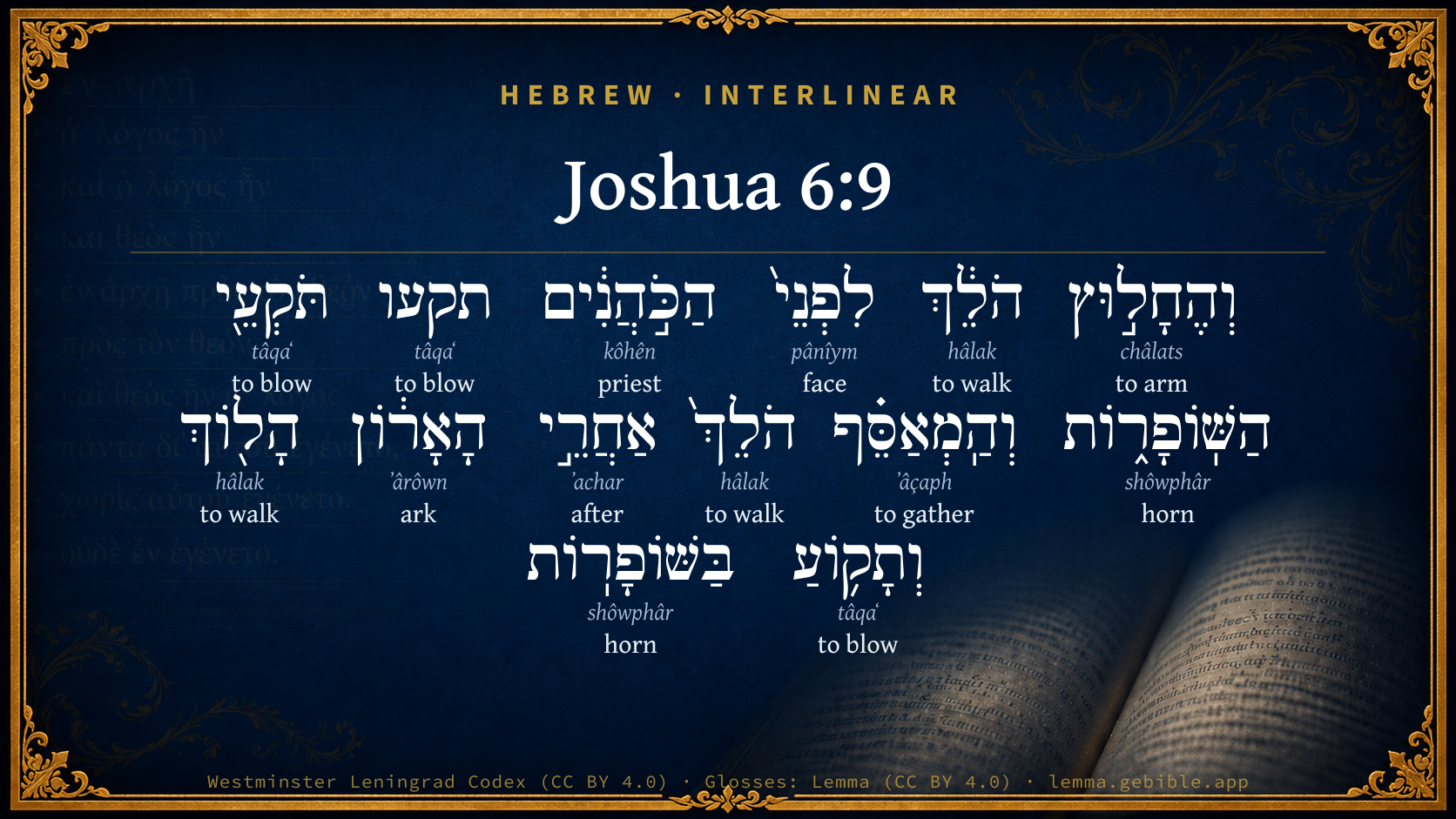
Hebrew (Westminster Leningrad Codex) Joshua 6:9 appears in the Hebrew Old Testament. The text above is from the Westminster Leningrad Codex. Each word links to its Strong’s number, a concise gloss, and parsing drawn from the Open Scriptures Hebrew Bible morphology. Click any word for its full Brown-Driver-Briggs (BDB) entry.
Download image
Cite this verse

Joshua 6:9 (World English Bible). Public Domain. Lemma interlinear Bible study tool, https://lemma.gebible.app/v/joshua/6/9.

Show BibTeX & RIS
BibTeX
RIS
English Translation
The armed men went before the priests who blew the trumpets, and the rearward went after the ark, [the priests] blowing the trumpets as they went.
World English Bible · Public Domain
Download a study sheet

One document with this verse’s original text, its word-by-word gloss line, the meaning frame, cross-references with their text, attributed commentary, and full source and license credits — printable, and it pastes into notes with its structure intact.

This verse Autodidact and up

Study sheet (.html) Plain text (.txt)

A passage Seminary Student

Up to 50 verses in one chapter. A passage sheet keeps up to 6 commentary sources and 12 cross-references per verse, in the order this page ranks them, and says so on the sheet whenever that leaves anything out. Ask for a single verse and you get the Autodidact verse sheet above.

Everything on this page stays free to read, with no account — the sheet is a download of what is already on screen, not access to it.

Want to remove ads? Support Godless Engineer
Compare translations 3

The same verse in 3 English versions, stacked beneath the original-language interlinear above. Click any original word for its lexicon entry.

Each is an independent rendering of the whole verse — the interlinear is not word-aligned to these translations.

Highlighted words mark where these versions differ — a whole-verse word diff, not a word-by-word alignment.

  • World English Bible Public Domain
    The armed men went before the priests who blew the trumpets, and the rearward went after the ark, [the priests] blowing the trumpets as they went.
  • King James Version Public Domain
    And the armed men went before the priests that blew with the trumpets, and the rearward came after the ark, the priests going on, and blowing with the trumpets.
  • unfoldingWord Literal Text CC BY-SA 4.0
    And the armed walking to the face of the priests blowing the shofars. And the rearguard walking behind the Box, walking and blowing on the shofars.

unfoldingWord Literal Text — © unfoldingWord, licensed CC BY-SA 4.0. Word-aligned USFM3 via Door43 (git.door43.org/unfoldingWord/en_ult).

Versions to compare (up to 4)

3 of 4 selected

Show all 18 translations

Every available English version of this verse, each an independent rendering of the whole verse.

  • World English Bible Public Domain
    The armed men went before the priests who blew the trumpets, and the rearward went after the ark, [the priests] blowing the trumpets as they went.
  • Berean Standard Bible Public Domain
    While the horns continued to sound, the armed troops marched ahead of the priests who blew the horns, and the rear guard followed the ark.
  • Majority Standard Bible Public Domain
    While the horns continued to sound, the armed troops marched ahead of the priests who blew the horns, and the rear guard followed the ark.
  • King James Version Public Domain
    And the armed men went before the priests that blew with the trumpets, and the rearward came after the ark, the priests going on, and blowing with the trumpets.
  • American Standard Version (1901) Public Domain
    And the armed men went before the priests that blew the trumpets, and the rearward went after the ark, `the priests' blowing the trumpets as they went.
  • Revised Version (1885) Public Domain
    And the armed men went before the priests that blew the trumpets, and the rearward went after the ark, the priests blowing with the trumpets as they went.
  • Geneva Bible (1599) Public Domain
    And the men of armes went before the Priestes, that blewe the trumpets: then the gathering hoste came after the Arke, as they went and blewe the trumpets.
  • Douay-Rheims (1899) Public Domain
    And all the armed men went before, the rest of the common people followed the ark, and the sound of the trumpets was heard on all sides.
  • Young's Literal Translation Public Domain
    and he who is armed is going before the priests blowing the trumpets, and he who is gathering up is going after the ark, going on and blowing with the trumpets;
  • Literal Standard Version CC BY-SA 4.0
    and he who is armed is going before the priests blowing the horns, and he who is gathering up is going after the Ark, going on and blowing with the horns;
  • Unlocked Literal Bible CC BY-SA 4.0
    Armed men walked before the priests, and they made a blast on their trumpets, but then the rear guard walked up behind the ark, and the priests blew their trumpets continually.
  • unfoldingWord Literal Text CC BY-SA 4.0
    And the armed walking to the face of the priests blowing the shofars. And the rearguard walking behind the Box, walking and blowing on the shofars.
  • Darby Bible Public Domain
    And the armed men went before the priests who blew with the trumpets, and the rearguard came after the ark; they blew with the trumpets in marching.
  • World Messianic Bible Public Domain
    The armed men went before the priests who blew the shofars, and the ark went after them. The shofars sounded as they went.
  • Webster's Bible Public Domain
    And the armed men went before the priests that blew with the trumpets, and the rear-guard came after the ark, the priests going on, and blowing with the trumpets.
  • Free Bible Version CC BY-SA 4.0
    Some of the armed men marched ahead of the priests blowing the horns, while some followed the Ark, the horns being blown continually.
  • Bible in Basic English Public Domain
    And the armed men went before the priests who were blowing the horns, and the mass of the people went after the ark, blowing their horns.
  • JPS Tanakh (1917) Public Domain
    And the armed men went before the priests that blew the horns, and the rearward went after the ark, the priests blowing with the horns continually.

Literal Standard Version (2020), Covenant Press — licensed CC BY-SA 4.0. Text via the HelloAO Bible API (eBible.org). Unlocked Literal Bible (unfoldingWord) — licensed CC BY-SA 4.0. Text via the HelloAO Bible API (eBible.org). unfoldingWord Literal Text — © unfoldingWord, licensed CC BY-SA 4.0. Word-aligned USFM3 via Door43 (git.door43.org/unfoldingWord/en_ult). Free Bible Version, Dr. Jonathan Gallagher — licensed CC BY-SA 4.0. Text via the HelloAO Bible API (eBible.org).

Word by word

More ways to search: Search by grammar → Find every occurrence → Compare this word →

Practice this passage: Drill this verse → Learn its vocabulary →

וְהֶחָל֣וּץ
châlats
H2502
“and · the · armed”
Conjunction + Particle, Definite Article + Verb, Qal, Participle Passive, Masculine, Singular, Absolute
Part of Speech
Conjunction + Particle + Verb
Stem
Qal
Form
Participle Passive
Gender
Masculine
Number
Singular
State
Absolute
Full BDB Definition

Origin: a primitive root

TWOT: 667 , 668

to remove, draw out, draw off, take off, withdraw, equip (for war), arm for war, rescue, be rescued - (Qal) equipped (participle) - (Niphal) - to be equipped - to go equipped - to be armed - (Hiphil) - to make strong, brace up - to invigorate - to draw off or out, withdraw - (Qal) - to draw, draw off - to withdraw - (Niphal) - to be delivered - to be saved - (Piel) - to pull out, tear out - to rescue, deliver, set free - to take away, plunder
  1. הֹלֵ֔ךְ hâlak H1980 “walking” Verb, Qal, Participle Active, Masculine, Singular, Absolute
  2. לִפְנֵי֙ pânîym H6440 “to/for · face(s) of” Preposition + Noun, Common, Both, Plural, Construct
  3. הַכֹּ֣הֲנִ֔ים kôhên H3548 “the · priests” Particle, Definite Article + Noun, Common, Masculine, Plural, Absolute
  4. תקעו tâqaʻ H8628 “to blow” Verb, Qal, Perfect, 3rd Person, Common, Plural
  5. תֹּקְעֵ֖י tâqaʻ H8628 “blowing” Verb, Qal, Participle Active, Masculine, Plural, Construct
  6. הַשּֽׁוֹפָר֑וֹת shôwphâr H7782 “the · horns” Particle, Definite Article + Noun, Common, Masculine, Plural, Absolute
  7. וְהַֽמְאַסֵּ֗ף ʼâçaph H622 “and · the · gathering” Conjunction + Particle, Definite Article + Verb, Piel, Participle Active, Masculine, Singular, Absolute
  8. הֹלֵךְ֙ hâlak H1980 “walking” Verb, Qal, Participle Active, Masculine, Singular, Absolute
  9. אַחֲרֵ֣י ʼachar H310 “after” Preposition
  10. הָאָר֔וֹן ʼârôwn H727 “the · ark” Particle, Definite Article + Noun, Common, Both, Singular, Absolute
  11. הָל֖וֹךְ hâlak H1980 “to walk” Verb, Qal, Infinitive Absolute
  12. וְתָק֥וֹעַ tâqaʻ H8628 “and · to blow” Conjunction + Verb, Qal, Infinitive Absolute
  13. בַּשּׁוֹפָרֽוֹת shôwphâr H7782 “in/at the · horns” Preposition, Determined + Noun, Common, Masculine, Plural, Absolute

About this verse

These counts appear in no published source. They are computed here, from the morphology-tagged text and Lemma’s own curated glosses. What Lemma adds →

14
words
9
distinct lemmas
Historical
section

Shared distinctive vocabulary

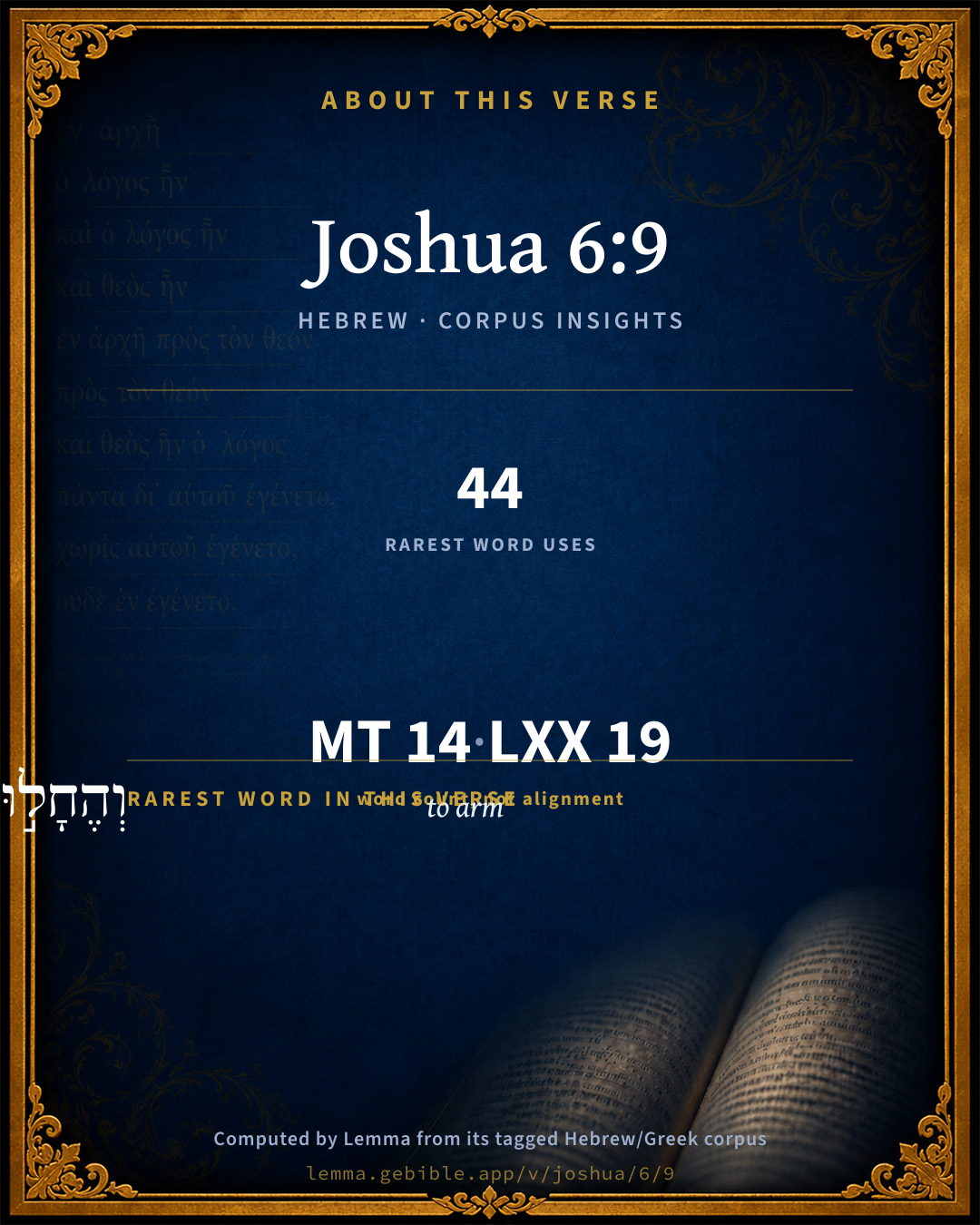
וְהֶחָל֣וּץ to arm H2502 occurs in 44 verses of the Hebrew Bible. Also found in:

Grammatical profile

  • 8 verbs
  • 5 nouns
  • 1 preposition

Verb forms

  • וְהֶחָל֣וּץ Qal · Participle Passive
  • הֹלֵ֔ךְ Qal · Participle Active
  • תקעו Qal · Perfect
  • תֹּקְעֵ֖י Qal · Participle Active
  • וְהַֽמְאַסֵּ֗ף Piel · Participle Active
  • הֹלֵךְ֙ Qal · Participle Active
  • הָל֖וֹךְ Qal · Infinitive Absolute
  • וְתָק֥וֹעַ Qal · Infinitive Absolute

Repetition

Words recur within this verse — often emphatic in Hebrew:

  • הֹלֵ֔ךְ to walk H1980 ×3
  • תקעו to blow H8628 ×3
  • הַשּֽׁוֹפָר֑וֹת horn H7782 ×2

Hebrew & Septuagint length

In English translation the verse runs 26 words from the Hebrew and 28 from the Septuagint (LXX English) — closely comparable.

A rough comparison of the two English renderings, which tokenize alike — not a word-level alignment.

Word counts can differ between the Hebrew and the Greek without any difference in meaning — e.g. the Hebrew direct-object marker אֵת has no separate Greek word, and Greek often adds the article ὁ.

In the original languages it is 14 Hebrew tokens and 19 Greek tokens — but the two are counted differently (Hebrew bundles its prefixes and suffixes into one token; the Greek is in lemma form), so that isn’t a like-for-like length.

Cross-references

4

Topical passages linked to Joshua 6:9 in the Treasury of Scripture Knowledge — connected by theme and wording, ordered by reader-vote popularity; previews shown in the World English Bible.

  • Joshua 6:13 The seven priests bearing the seven trumpets of rams' horns before the ark of Yahweh went on continually, and blew the trumpets: and the armed men went before them; and the rearward came after the ark of Yahweh, [the priests] blowing the trumpets as they went.
  • Numbers 10:25 The standard of the camp of the children of Dan, which was the rearward of all the camps, set forward according to their hosts: and over his host was Ahiezer the son of Ammishaddai.
  • Isaiah 58:8 Then shall your light break forth as the morning, and your healing shall spring forth speedily; and your righteousness shall go before you; the glory of Yahweh shall by your rearward.
  • Isaiah 52:11–12 Depart you, depart you, go you out from there, touch no unclean thing; go you out of the midst of her; cleanse yourselves, you who bear the vessels of Yahweh.

Cross-references courtesy of OpenBible.info (CC BY 4.0).

Hebrew and Greek witnesses Masoretic Hebrew ↔ Greek Septuagint

The same verse in the two great witnesses to the Old Testament, shown verse-for-verse.

These are two independent witnesses, not word-aligned to each other, and the Septuagint is shown in lemma (dictionary) form.

Hebrew Joshua 6:9 Masoretic · Westminster Leningrad Codex

וְהֶחָל֣וּץ הֹלֵ֔ךְ לִפְנֵי֙ הַכֹּ֣הֲנִ֔ים תקעו תֹּקְעֵ֖י הַשּֽׁוֹפָר֑וֹת וְהַֽמְאַסֵּ֗ף הֹלֵךְ֙ אַחֲרֵ֣י הָאָר֔וֹן הָל֖וֹךְ וְתָק֥וֹעַ בַּשּׁוֹפָרֽוֹת

The armed men went before the priests who blew the trumpets, and the rearward went after the ark, [the priests] blowing the trumpets as they went.

World English Bible · Public Domain

Greek LXX Joshua 6:9 Septuagint · lemma form

ὁ δέ μάχιμος ἔμπροσθεν παραπορεύομαι καί ὁ ἱερεύς ὁ οὐραγέω ὀπίσω ὁ κιβωτός ὁ διαθήκη κύριος πορεύομαι καί σαλπίζω

And let the men of war proceed before, and the priests bringing up the rear behind the ark of the covenant of the Lord proceed sounding the trumpets.

LXX2012 (modern English Septuagint) · Public Domain

Hebrew: Westminster Leningrad Codex (CC BY 4.0). Greek: Septuagint (public domain); English from LXX2012 (modern English Septuagint) (Public Domain). How the Septuagint differs from the Hebrew →

Targum (Aramaic paraphrase)

1

The Targum is the ancient Jewish Aramaic paraphrase of the Hebrew Scriptures — an interpretive translation, not the Hebrew text itself. Onkelos (literal) and Pseudo-Jonathan (expansive) render the Torah, and Jonathan the Prophets. Coverage is partial: where no permissively-licensed English translation exists for a verse, only the Aramaic is shown. This is verse-level text, not a word-by-word alignment to the Hebrew.

  1. Targum Jonathan Prophets (Joshua–Malachi)
    וּמְזַרְזֵי חֵילָא אָזְלִן קֳדָם כַּהֲנַיָא תָּקְעֵי שׁוֹפָרַיָא וְשִׁבְטָא דְבֵית דָן אָזַל בָּתַר אֲרוֹנָא וְכַהֲנַיָא אָזְלִין וְתָקְעוּן בְּשׁוֹפָרַיָא:

    (no public-domain English translation for this verse)

    Targum Jonathan — Aramaic: “Mikraot Gedolot” (public domain). English: “Sefaria Community Translation” (CC0 1.0 (public-domain dedication)); “London "Chaldee Paraphrase," 1871” (public domain). Text via Sefaria.

Commentary

Notes on Joshua 6:9 from classic Christian and Jewish commentators (each source and its license shown beneath its notes). The classic Christian expositions comment on the surrounding passage and are grouped to its opening verse, so a note may address several verses; the Jewish commentaries on the Tanakh (Rashi and others) are per-verse, so they appear only where the commentator wrote on this verse.

Lemma curates 59 commentaries, every one of them public domain or Creative Commons licensed, each selected and text-cleaned for this edition rather than reprinted as found. About our sources →

Trapp's Complete Commentary

John Trapp

Jos 6:9 And the armed men went before the priests that blew with the trumpets, and the rereward came after the ark, [the priests] going on, and blowing with the trumpets.

Ver. 9. And the rereward came after the ark.] Heb., The gathering host, that in their march through the wilderness was wont to arise at the fourth alarm, and their charge was to look that nothing was left behind. {Num 10:25} {See Trapp on "Psa 27:10"}

John Trapp, A Commentary or Exposition upon All the Books of the Old and New Testament (1647–1656) — public domain. Text from a community e-Sword module.

Geneva Bible (1599)

Geneva Bible translators

Meaning, the rearward, wherein was the standard of the tribe of Dan, Num. 10:25.

Geneva Bible (1599) marginal notes — public domain. Text via Bolls.life.

Adam Clarke's Commentary

Verse 9. The rereward came after the ark] The word מאסף measseph, from אסף asaph, to collect or gather up, may signify either the rereward, as our translation understands it, or the people who carried the baggage of the army; for on the seventh day this was necessary, as much fighting might be naturally expected in the assault, and they would need a supply of arms, darts, &c., as well as conveniences for those who might happen to be wounded: or the persons here intended might be such as carried the sacred articles belonging to the ark, or merely such people as might follow in the procession, without observing any particular order. The Jews think the division of Dan is meant, which always brought up the rear. See Nu 10:25.

Adam Clarke's Commentary on the Bible (1810–1826) — public domain. Text from a community e-Sword/MySword module.

The Cambridge Bible for Schools and Colleges

gen. ed. J. J. S. Perowne

9. the rereward] The remaining warriors were to act as a rearguard. During the march through the wilderness this duty devolved on the tribe of Dan (see Num_10:25). “Rereward” means the “rearguard” of an army; guard and ward being related as guise and wise, Fr. guerre, and E. war. It is a corruption of the Fr. arrière-garde, as vanguard for avant-garde; or rather the first part of the word is formed from the O. Fr. riere (Lat. retro). Comp. 1Sa_29:2, “but David and his men passed on in the rereward with Achish;” Isa_52:12, “the God of Israel will be your rereward;” Isa_58:8, “the glory of the Lord shall be thy rereward;” Shakespeare, Ι.Hen. 6. 3. 3,

“Now in the rearward comes the duke, and his;”

Rom. and Jul. 3.2,

“But with a rearward following Tybalt’s death,

Romeo is banished.”

The Cambridge Bible for Schools and Colleges (gen. ed. J. J. S. Perowne; Cambridge University Press, 1878–1918) — public domain. Text from a community e-Sword module.

John Gill's Exposition

And the armed men went before the priests that blew with the trumpets,.... Whom Jarchi, Kimchi, and Abarbinel, interpret of Reuben and Gad, and the half tribe of Manasseh; that is, as many of them as Joshua took with him over Jordan; though rather all the armed men in the camp are meant; at least along with those mentioned went the standards of Judah and Ephraim:

and the rereward came after the ark; because the tribe of Dan was the rereward in journeying, Num 2:31; hence the Targum paraphrases the words,"and the tribe of the house of Dan went after the ark;''and so both Jarchi and Kimchi interpret it: but rather the body of the people unarmed are designed; at least these were brought up by the standard of Dan; or otherwise no place in this procession is appointed for them, whose business it was to make the great shout on the seventh day with the rest:

the priests going on and blowing with the trumpets; the word "priests" is not in the text, but is rightly supplied; for, as Kimchi and Abarbinel observe, this is not said of the rereward, but of the priests, for they only bore and blew the trumpets; and so the Targum reads,"the priests going on, &c.''

John Gill's Exposition of the Whole Bible (1746–1763) — public domain (CC PDM 1.0). Text via the HelloAO Bible API.

Matthew Poole's English Annotations

The

rereward being opposed to the armed men, may seem to note the unarmed people, who were desirous to be spectators of this wonderful work.

The priests; which is rightly supplied here from Jos 6:4.

Matthew Poole's English Annotations on the Holy Bible (1683–1685) — public domain. Text from a community e-Sword/MySword module.

Whedon's Commentary on the Bible

Daniel D. Whedon

9. The rearward — Margin, the gathering host; that part of the army which occupies the last place on the march, protecting the front columns, and gathering up the faint and sick. The tribe of Dan had this position in the wilderness. Num_10:25. Had the ark been at the head of the column, its usual place, it would have been more exposed to capture by a sudden sally of the enemy.

Daniel D. Whedon (gen. ed.), Commentary on the Old and New Testaments (1874–1909) — public domain. Text from a community e-Sword module.

John Wesley's Explanatory Notes

The rereward - Which being opposed to the armed men, may seem to note the unarmed people, who were desirous to be spectators of this wonderful work.

John Wesley, Explanatory Notes Upon the Whole Bible (1754–1765) — public domain. Text via the GEBible commentary corpus.

Rashi

Rabbi Shlomo Yitzchaki (Rashi)

And the warriors. These were the men of the tribes of Reuvein and Gad who went before them, because the men of Gad were mighty warriors and they would smite with a strong arm, as it is said, ‘And he rips off the shoulder and the head.’

Rashi on the Tanakh — English translations: “The Judaica Press complete Tanach with Rashi, translated by A. J. Rosenberg” (CC BY 4.0); “Pentateuch with Rashi's commentary by M. Rosenbaum and A.M. Silbermann, 1929-1934” (public domain); “The Metsudah Tanach series, Lakewood, N.J” (CC BY 4.0); and “The Book of Joshua, Metsudah Publications, 1997” (CC BY 4.0). Text via Sefaria.

Lesson kit

Teaching starters — assembled from the data on this page, not authored interpretation. Every prompt links to the verse data it draws on. Edit before teaching.

Joshua, in the Historical, opens this verse with 14 words (9 distinct Hebrew lemmas). Its most distinctive word is châlats (“to arm”). A historical commentator’s framing appears above. Read the whole chapter for the surrounding context.

Discussion questions

  1. How does “to arm” (châlats) shape what this verse is saying?
  2. How does Leviticus 14:40, which shares the word «to arm», read alongside this verse?
  3. What does the repetition of “to walk” (3× in this one verse) do in this verse?
  4. These translations render this verse differently. What is at stake in choosing one wording over another?
  5. «וְהֶחָל֣וּץ» is a Qal Participle Passive verb. How does that grammatical form shape the action described?
  6. Compare how Trapp's Complete Commentary and Geneva Bible (1599) read this verse. Where do they agree or differ?

Things to notice

Reading settings

Reading text

Shown beneath each verse's original-language words.

Old Testament
Old Testament edition

Read the OT as the Masoretic Hebrew (MT) or the Greek Septuagint (LXX).

English shown for the Greek Septuagint (in the Hebrew ↔ Greek comparison).

Comparing translations? Open the Compare panel on any verse page to stack up to four side by side.