Judges 20:14

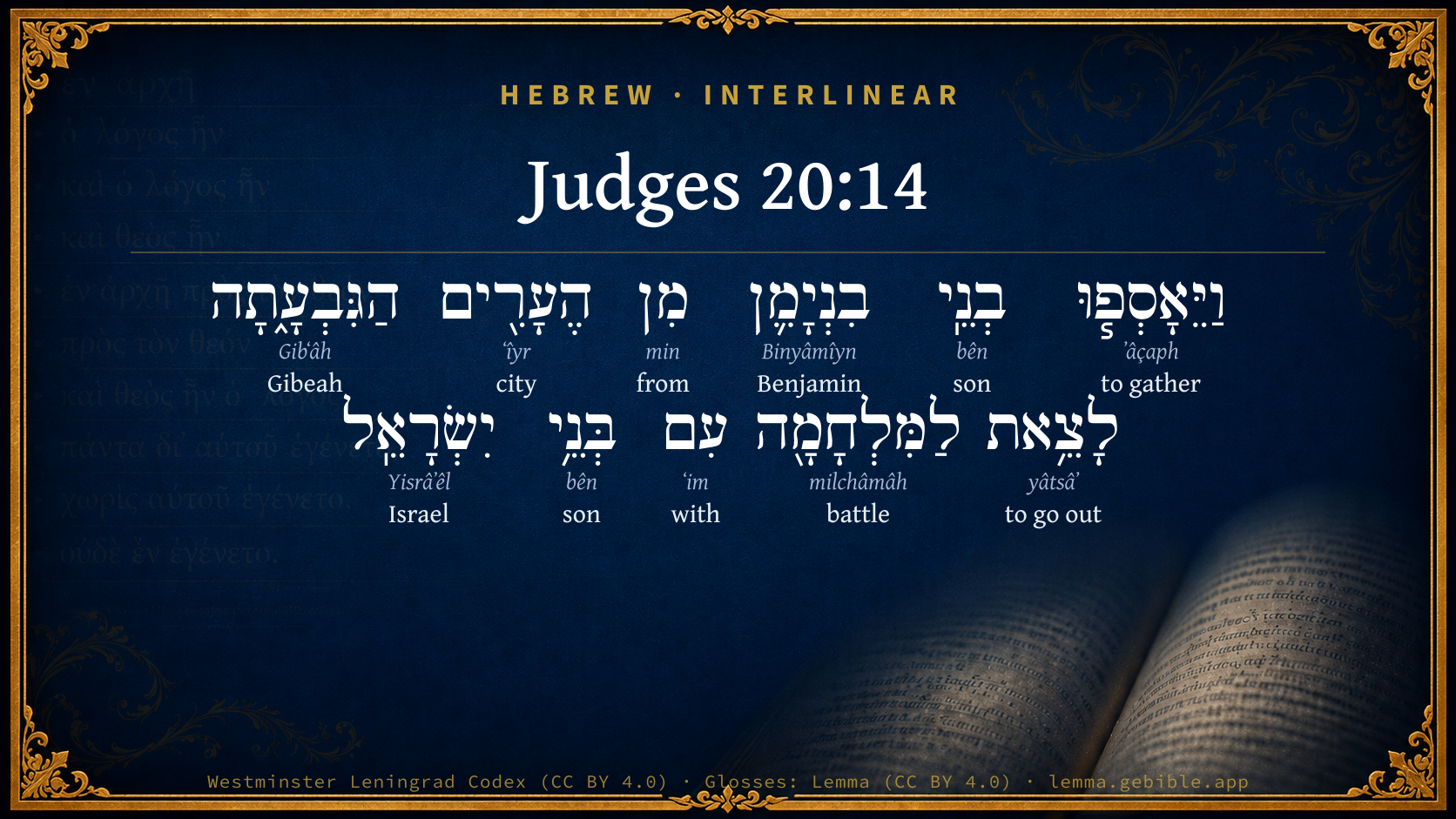
Hebrew (Westminster Leningrad Codex) Judges 20:14 appears in the Hebrew Old Testament. The text above is from the Westminster Leningrad Codex. Each word links to its Strong’s number, a concise gloss, and parsing drawn from the Open Scriptures Hebrew Bible morphology. Click any word for its full Brown-Driver-Briggs (BDB) entry.
Download image
Cite this verse

Judges 20:14 (World English Bible). Public Domain. Lemma interlinear Bible study tool, https://lemma.gebible.app/v/judges/20/14.

Show BibTeX & RIS
BibTeX
RIS
English Translation
The children of Benjamin gathered themselves together out of the cities to Gibeah, to go out to battle against the children of Israel.
World English Bible · Public Domain
Download a study sheet

One document with this verse’s original text, its word-by-word gloss line, the meaning frame, cross-references with their text, attributed commentary, and full source and license credits — printable, and it pastes into notes with its structure intact.

This verse Autodidact and up

Study sheet (.html) Plain text (.txt)

A passage Seminary Student

Up to 50 verses in one chapter. A passage sheet keeps up to 6 commentary sources and 12 cross-references per verse, in the order this page ranks them, and says so on the sheet whenever that leaves anything out. Ask for a single verse and you get the Autodidact verse sheet above.

Everything on this page stays free to read, with no account — the sheet is a download of what is already on screen, not access to it.

Want to remove ads? Support Godless Engineer
Compare translations 3

The same verse in 3 English versions, stacked beneath the original-language interlinear above. Click any original word for its lexicon entry.

Each is an independent rendering of the whole verse — the interlinear is not word-aligned to these translations.

Highlighted words mark where these versions differ — a whole-verse word diff, not a word-by-word alignment.

  • World English Bible Public Domain
    The children of Benjamin gathered themselves together out of the cities to Gibeah, to go out to battle against the children of Israel.
  • King James Version Public Domain
    But the children of Benjamin gathered themselves together out of the cities unto Gibeah, to go out to battle against the children of Israel.
  • unfoldingWord Literal Text CC BY-SA 4.0
    Then the sons of Benjamin gathered themselves from the cities to Gibeah, to come out to battle with the sons of Israel.

unfoldingWord Literal Text — © unfoldingWord, licensed CC BY-SA 4.0. Word-aligned USFM3 via Door43 (git.door43.org/unfoldingWord/en_ult).

Versions to compare (up to 4)

3 of 4 selected

Show all 18 translations

Every available English version of this verse, each an independent rendering of the whole verse.

  • World English Bible Public Domain
    The children of Benjamin gathered themselves together out of the cities to Gibeah, to go out to battle against the children of Israel.
  • Berean Standard Bible Public Domain
    And from their cities they came together at Gibeah to go out and fight against the Israelites.
  • Majority Standard Bible Public Domain
    And from their cities they came together at Gibeah to go out and fight against the Israelites.
  • King James Version Public Domain
    But the children of Benjamin gathered themselves together out of the cities unto Gibeah, to go out to battle against the children of Israel.
  • American Standard Version (1901) Public Domain
    And the children of Benjamin gathered themselves together out of the cities unto Gibeah, to go out to battle against the children of Israel.
  • Revised Version (1885) Public Domain
    And the children of Benjamin gathered themselves together out of the cities unto Gibeah, to go out to battle against the children of Israel.
  • Geneva Bible (1599) Public Domain
    But ye children of Beniamin gathered them selues together out of the cities vnto Gibeah, to come out and fight against the children of Israel.
  • Douay-Rheims (1899) Public Domain
    But out of all the cities which were of their lot, they gathered themselves together into Gabaa, to aid them, and to fight against the whole people of Israel.
  • Young's Literal Translation Public Domain
    and the sons of Benjamin are gathered out of the cities to Gibeah, to go out to battle with the sons of Israel.
  • Literal Standard Version CC BY-SA 4.0
    and the sons of Benjamin are gathered out of the cities to Gibeah, to go out to battle with the sons of Israel.
  • Unlocked Literal Bible CC BY-SA 4.0
    Then the people of Benjamin came together out of the cities to Gibeah to get ready to fight against the people of Israel.
  • unfoldingWord Literal Text CC BY-SA 4.0
    Then the sons of Benjamin gathered themselves from the cities to Gibeah, to come out to battle with the sons of Israel.
  • Darby Bible Public Domain
    And the Benjaminites came together out of the cities to Gib'e-ah, to go out to battle against the people of Israel.
  • World Messianic Bible Public Domain
    The children of Benjamin gathered themselves together out of the cities to Gibeah, to go out to battle against the children of Israel.
  • Webster's Bible Public Domain
    But the children of Benjamin assembled out of the cities to Gibeah, to go out to battle against the children of Israel.
  • Free Bible Version CC BY-SA 4.0
    They left their towns and assembled at Gibeah to go and fight the other Israelites.
  • Bible in Basic English Public Domain
    And the children of Benjamin came together from all their towns to Gibeah, to go to war with the children of Israel.
  • JPS Tanakh (1917) Public Domain
    And the children of Benjamin gathered themselves together out of their cities unto Gibeah, to go out to battle against the children of Israel.

Literal Standard Version (2020), Covenant Press — licensed CC BY-SA 4.0. Text via the HelloAO Bible API (eBible.org). Unlocked Literal Bible (unfoldingWord) — licensed CC BY-SA 4.0. Text via the HelloAO Bible API (eBible.org). unfoldingWord Literal Text — © unfoldingWord, licensed CC BY-SA 4.0. Word-aligned USFM3 via Door43 (git.door43.org/unfoldingWord/en_ult). Free Bible Version, Dr. Jonathan Gallagher — licensed CC BY-SA 4.0. Text via the HelloAO Bible API (eBible.org).

Word by word

More ways to search: Search by grammar → Find every occurrence → Compare this word →

Practice this passage: Drill this verse → Learn its vocabulary →

הַגִּבְעָ֑תָה
Gibʻâh
H1390
“the · Gibeah · toward”
Particle, Definite Article + Noun, Proper + Suffix, Demonstrative
Part of Speech
Particle + Noun
Type
Proper
Full BDB Definition

Origin: the same as H1389

TWOT: None

Gibeah = "hill" - a city in the mountain district of Judah - a city of Benjamin, birthplace of king Saul - a city in Kirjath-jearim of Ephraim
  1. וַיֵּאָסְפ֧וּ ʼâçaph H622 “and · to gather” Conjunction + Verb, Niphal, Sequential Imperfect, 3rd Person, Masculine, Plural
  2. בְנֵֽי bên H1121 “sons of” Noun, Common, Masculine, Plural, Construct
  3. בִנְיָמִ֛ן Binyâmîyn H1144 “Benjamin” Noun, Proper
  4. מִן min H4480 “from” Preposition
  5. הֶעָרִ֖ים ʻîyr H5892 “the · cities” Particle, Definite Article + Noun, Common, Feminine, Plural, Absolute
  6. לָצֵ֥את yâtsâʼ H3318 “to go out” Preposition + Verb, Qal, Infinitive Construct
  7. לַמִּלְחָמָ֖ה milchâmâh H4421 “to/for the · battle” Preposition, Determined + Noun, Common, Feminine, Singular, Absolute
  8. עִם ʻim H5973 “with” Preposition
  9. בְּנֵ֥י bên H1121 “sons of” Noun, Common, Masculine, Plural, Construct
  10. יִשְׂרָאֵֽל Yisrâʼêl H3478 “Israel” Noun, Proper

About this verse

These counts appear in no published source. They are computed here, from the morphology-tagged text and Lemma’s own curated glosses. What Lemma adds →

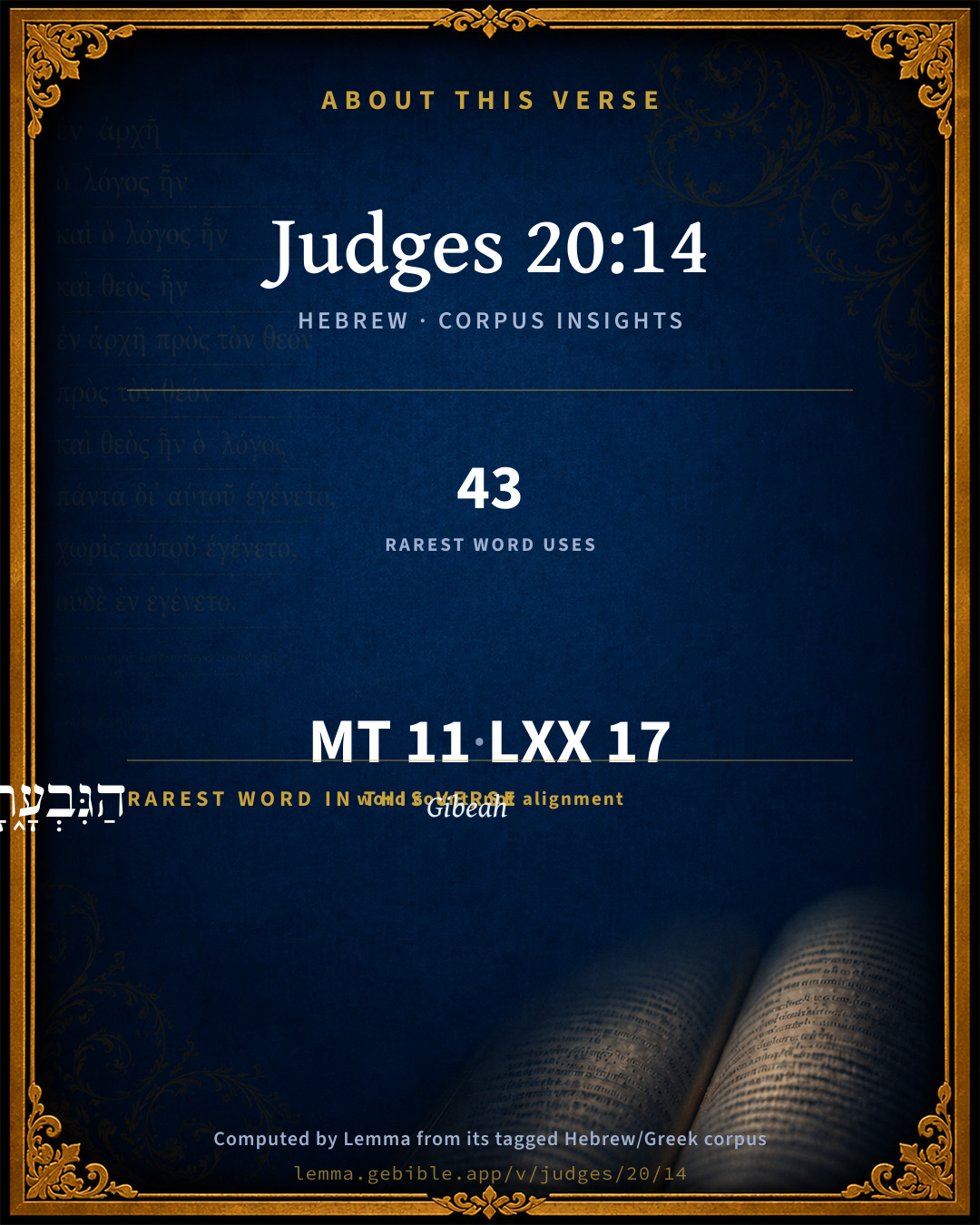
11
words
10
distinct lemmas
Historical
section

Shared distinctive vocabulary

הַגִּבְעָ֑תָה Gibeah H1390 occurs in 42 verses of the Hebrew Bible. Also found in:

Grammatical profile

  • 2 verbs
  • 7 nouns
  • 2 prepositions

Verb forms

  • וַיֵּאָסְפ֧וּ Niphal · Sequential Imperfect
  • לָצֵ֥את Qal · Infinitive Construct

Repetition

A word recurs within this verse — often emphatic in Hebrew:

  • בְנֵֽי son H1121 ×2

Hebrew & Septuagint length

In English translation the verse runs 23 words from the Hebrew and 22 from the Septuagint (LXX English) — closely comparable.

A rough comparison of the two English renderings, which tokenize alike — not a word-level alignment.

Word counts can differ between the Hebrew and the Greek without any difference in meaning — e.g. the Hebrew direct-object marker אֵת has no separate Greek word, and Greek often adds the article ὁ.

In the original languages it is 11 Hebrew tokens and 17 Greek tokens — but the two are counted differently (Hebrew bundles its prefixes and suffixes into one token; the Greek is in lemma form), so that isn’t a like-for-like length.

Cross-references

4

Topical passages linked to Judges 20:14 in the Treasury of Scripture Knowledge — connected by theme and wording, ordered by reader-vote popularity; previews shown in the World English Bible.

  • Numbers 20:20 He said, You shall not pass through. Edom came out against him with much people, and with a strong hand.
  • Numbers 21:23 Sihon would not allow Israel to pass through his border: but Sihon gathered all his people together, and went out against Israel into the wilderness, and came to Jahaz; and he fought against Israel.
  • 2 Chronicles 13:13 But Jeroboam caused an ambush to come about behind them: so they were before Judah, and the ambush was behind them.
  • Job 15:25–26 Because he has stretched out his hand against God, And behaves himself proudly against the Almighty;

Cross-references courtesy of OpenBible.info (CC BY 4.0).

Hebrew and Greek witnesses Masoretic Hebrew ↔ Greek Septuagint

The same verse in the two great witnesses to the Old Testament, shown verse-for-verse.

These are two independent witnesses, not word-aligned to each other, and the Septuagint is shown in lemma (dictionary) form.

Hebrew Judges 20:14 Masoretic · Westminster Leningrad Codex

וַיֵּאָסְפ֧וּ בְנֵֽי בִנְיָמִ֛ן מִן הֶעָרִ֖ים הַגִּבְעָ֑תָה לָצֵ֥את לַמִּלְחָמָ֖ה עִם בְּנֵ֥י יִשְׂרָאֵֽל

The children of Benjamin gathered themselves together out of the cities to Gibeah, to go out to battle against the children of Israel.

World English Bible · Public Domain

Greek LXX Judges 20:14 Septuagint · lemma form

καί συνἄγω ὁ υἱός βενιαμίν ἀπό ὁ πόλις αὐτός εἰς γαβαα ἐκἔρχομαι εἰς παράταξις πρός υἱός ἰσραήλ

And the children of Benjamin were gathered from their cities to Gabaa, to go forth to fight with the children of Israel.

LXX2012 (modern English Septuagint) · Public Domain

On this verse, Keil & Delitzsch discusses the Septuagint’s reading. Read the note in Commentary ↓

Hebrew: Westminster Leningrad Codex (CC BY 4.0). Greek: Septuagint (public domain); English from LXX2012 (modern English Septuagint) (Public Domain). How the Septuagint differs from the Hebrew →

Targum (Aramaic paraphrase)

1

The Targum is the ancient Jewish Aramaic paraphrase of the Hebrew Scriptures — an interpretive translation, not the Hebrew text itself. Onkelos (literal) and Pseudo-Jonathan (expansive) render the Torah, and Jonathan the Prophets. Coverage is partial: where no permissively-licensed English translation exists for a verse, only the Aramaic is shown. This is verse-level text, not a word-by-word alignment to the Hebrew.

  1. Targum Jonathan Prophets (Joshua–Malachi)
    וְאִתְכְּנִישׁוּ בְנֵי בִנְיָמִין מִן קִרְוַיָא לְגִבְעָתָא לְמִפַּק לְאַגָחָא קְרָבָא עִם בְּנֵי יִשְׂרָאֵל:

    (no public-domain English translation for this verse)

    Targum Jonathan — Aramaic: “Mikraot Gedolot” (public domain). English: “Sefaria Community Translation” (CC0 1.0 (public-domain dedication)); “London "Chaldee Paraphrase," 1871” (public domain). Text via Sefaria.

Commentary

Notes on Judges 20:14 from classic Christian and Jewish commentators (each source and its license shown beneath its notes). The classic Christian expositions comment on the surrounding passage and are grouped to its opening verse, so a note may address several verses; the Jewish commentaries on the Tanakh (Rashi and others) are per-verse, so they appear only where the commentator wrote on this verse.

Lemma curates 59 commentaries, every one of them public domain or Creative Commons licensed, each selected and text-cleaned for this edition rather than reprinted as found. About our sources →

Trapp's Complete Commentary

John Trapp

Jdg 20:14 But the children of Benjamin gathered themselves together out of the cities unto Gibeah, to go out to battle against the children of Israel.

Ver. 14. But the children of Benjamin gathered themselves, &c.] In the defence of those sons of Belial, and out of self-confidence, they venture their lives and fortunes upon a very great disadvantage. What should not we then do for the dear servants of God, and in assurance of his assistance? Queen Elizabeth was famous for this; when she undertook the protection of the Netherlanders against the Spaniard, all princes admired her fortitude: and the king of Sweden said that she had now taken the crown from her head and set it upon the doubtful chance of war, A.D. 1585. {a}

{a} Camden’s Elisab.

John Trapp, A Commentary or Exposition upon All the Books of the Old and New Testament (1647–1656) — public domain. Text from a community e-Sword module.

Keil & Delitzsch

C. F. Keil & F. Delitzsch

Both sides now made their preparations. The Benjaminites assembled together at Gibeah out of their different towns, and "were mustered 26,000 men drawing the sword, beside the inhabitants of Gibeah they were mustered, 700 picked men" (הגפּקדוּ, with the reduplication dropped, like the Hothpael in Num 1:47). "Out of all this people there were 700 picked men, lamed in the right hand, all these (were) slinging with a stone (hitting) at a hair's breadth without fail." These statement are not quite clear. Since, according to the distinct words of Jdg 20:16, the 700 slingers with their left hands were "out of the whole people," i.e., out of the whole number of fighting men mentioned in Jdg 20:16, they cannot be the same as the 700 chosen men referred to in Jdg 20:15, notwithstanding the similarity in the numbers and the expression "chosen men." The obscurity arises chiefly from the word התפּקדוּ in Jdg 20:15, which is separated by the Masoretic accents from שׁבע מ, and connected with the previous words: "Beside the inhabitants of Gibeah they (the men of the towns of Benjamin) were mustered." On the other hand, the earlier translators took the clause as a relative one: "Beside the inhabitants of Gibeah, who were mustered 700 men." And this seems absolutely necessary, because otherwise the following words, "700 picked men," would stand without any connection; whilst we should certainly expect at least to find the cop. vav, if these 700 men were not inhabitants of Gibeah. But even if התפּקדוּ should be taken as a simple repetition of ויּתפּקדוּ, the statement which follows could not be understood in any other way than as referring to the number of the fighting men of Gibeah. There is something striking too in the fact that only Benjaminites "out of the cities" are mentioned, and that emphasis is laid upon this by the repetition of the expression "out of the cities" (Jdg 20:14, Jdg 20:15). Some have inferred from this, that the Benjaminites as the rulers had settled in the towns, whilst the Canaanites who had been subdued settled as dependants in the villages (Bertheau); or that the Benjaminites had formed military brotherhoods, the members of which lived unmarried in the towns, and that this may possibly account for the abominable crime to which the inhabitants of Gibeah were addicted, and in relation to which the whole tribe took their part (O. v. Gerlach). But such inferences as these are extremely uncertain, as the cities may be mentioned a potiori for all the places inhabited by this tribe. There is another difficulty in the numbers. According to Jdg 20:14, Jdg 20:15, the total number of the fighting men of Benjamin amounted to 26,000 and 700, without reckoning Gibeah. But, according to the account of the battle, 25,100 were slain (Jdg 20:35), viz., 18,000 in the principal engagement, 5000 as a gleaning, and 200 in the pursuit, i.e., 25,000 men in all (Jdg 20:44-46), and only 600 were left, who fled into the desert to the rock Rimmon (Jdg 20:47). According to these accounts, the whole tribe would have contained only 25,100 + 600 = 25,700 fighting men, or 25,000 + 600 = 25,600. Accordingly, in Jdg 20:15, the lxx (Cod. Al. etc.) and Vulgate give only 25,000 men; whilst the rest of the ancient versions have 26,000, in agreement with the Masoretic text. Josephus (Ant. v. 2, 10) also gives the number of fighting men in Benjamin as 25,600, of whom 600 were splendid slingers; but he has merely taken the numbers from Jdg 20:44-47. Now, although mistakes do frequently occur in the numbers given, it is a most improbable supposition that we have a mistake of this kind (26,000 for 25,000) in the instance before us, since even the latter number would not agree with Jdg 20:44.; and the assumption, that in Jdg 20:35 and Jdg 20:44. we have an account of all the Benjaminites who fell, finds no support whatever in the history itself. In the verses referred to we have simply a statement of the number of Benjaminites who fell in the defeat which they sustained on the third day, whereas the victories which they gained on the first and second days could hardly have been obtained without some loss on their part; on the contrary, we may confidently assume that they would not lose less than a thousand men, though these are not mentioned in the brief account before us. The other difference between Jdg 20:35 and Jdg 20:44-46, viz., that 25,100 are given in the one and 25,000 in the other, may be explained on the simple assumption that we have only the full thousands mentioned in the latter, whilst the exact number is given in the former. "Left-handed:" see at Jdg 3:15.

Keil & Delitzsch — Biblical Commentary on the Old Testament (1861–1891) — public domain (CC PDM 1.0). Text via the HelloAO Bible API. (Old Testament only.)

Lange's Commentary on the Holy Scriptures

The war against Benjamin. The armies of Israel are twice smitten. The divine promise of victory.

Jdg_20:14-28

14But [And] the children [sons] of Benjamin gathered themselves together out of the cities unto Gibeah, to go out to battle against [with] the children [sons] of Israel. 15And the children [sons] of Benjamin were numbered at that time out of the cities twenty and six thousand men that drew sword, beside the inhabitants of Gibeah, which were numbered seven hundred chosen men. 16Among all this people there were seven hundred chosen men left-handed; every one could sling stones at an hair-breadth, and not miss.1 17And the men of Israel, beside Benjamin, were numbered four hundred thousand men that drew sword: all these were men of war. 18And the children [sons] of Israel arose, and went up to the house of God [Beth-el], and asked counsel of God, and said, Which of us shall go up2 first to the battle against [with] the children [sons] of Benjamin? And the Lord [Jehovah] said, Judah shall go up first. 19And the children [sons] of Israel rose up in the morning, and encamped against Gibeah. 20And the men of Israel went out to battle against [with] Benjamin; and the men of Israel put themselves in array to fight against [with] them at Gibeah. 21And the children [sons] of Benjamin came [went] forth out of Gibeah, and destroyed [felled] down to the ground of the Israelites 22that day twenty and two thousand men. And [But] the people, the men of Israel, encouraged themselves [took courage], and set their battle again in array in the place where they put themselves in array the first day. 23(And the children [sons] of Israel went up and wept before the Lord [Jehovah] until even, and asked counsel of the Lord [Jehovah], saying, Shall I go up [advance] again to battle against [with] the children [sons] of Benjamin my brother? And the Lord 24[Jehovah] said, Go up against him.) And the children [sons] of Israel came near against the children [sons] of Benjamin the second day. 25And Benjamin went forth against them out of Gibeah the second day, and destroyed [felled] down to the ground of the children [sons] of Israel again eighteen thousand men; all these drew the sword. 26Then all the children [sons] of Israel, and all the people, went up, and came unto the house of God [Beth-el], and wept, and sat there before the Lord [Jehovah], and fasted that day until even, and offered burnt-offerings and peace-offerings before the Lord [Jehovah]. 27And the children [sons] of Israel inquired of the Lord [Jehovah], (for the ark of the covenant of God was there in those days, 28And Phinehas, the son of Eleazar, the son of Aaron, stood before it in those days,) saying, Shall I yet again go out to battle against [with] the children [sons] of Benjamin my brother, or shall I cease? And the Lord [Jehovah] said, Go up; for to-morrow I will deliver them into thine hand.

TEXTUAL AND GRAMMATICAL

[1 Jdg_20:16.—יַחֲטִא, from חָטָא, to miss, whence חַטָּאת, a miss, failure, sin. The Greek ἁμαρτία is explained in a similar way (cf. Ernesti, die Theorie vom Ursprung der Sünde, p. 10, where the reference to our passage, however must not be suffered to mislead, as if the substantive חַטָּאת were read).

[2 Jdg_20:18.—מִי יַעֲלֶה־לָּנוּ: “Who shall go up for us.” Compare “Textual and Grammatical,” note 2, on Jdg_1:1.—Tr.]

EXEGETICAL AND DOCTRINAL

The tribe of Benjamin refuses to confess its guilt, and to surrender the guilty. Defiant and warlike of spirit, it prefers to run the risks of war. It builds its hopes on the unwieldiness of the national organization, on differences of opinion, on partisan sympathies in its favor, and on the lack of inclination to war, especially to a war waged against a brother-tribe. It hopes, therefore, notwithstanding the great preponderance of force on the other side, to maintain its ground. And it is certain that by reason of the divisions of great confederacies (like the German), many a small government has often maintained itself in defiance and resistance. Thus also in antiquity, the Phocian town of Crissa, having injured Delphi and therewith wronged the national sanctuary of the Greeks, and being charged with other moral delinquencies,3 thought nevertheless to be able to defend itself against the executionary army of the Amphictyonic Council. And it succeeded in a degree. The war, waged against the unaided city by the Thessalians, Athenians, and Sicyonians, assisted by the wisdom of Solon, lasted ten years. It was ended at last by an oracular response and a stratagem of war, as in the case of the war with Benjamin (Paus. x. 37). John Frederick the Intermediate, of Gotha, likewise, expected to be able to maintain himself on his Gibeah, the Grimmenstein, in order to protect Grumbach, despite all his sins, against the ban of the German Empire; but, like Benjamin, he had to succumb before his brethren (of Saxony. Cf. Beck, Gesch. Joh. Fried. des Mittleren, i. 518). A similar war was that waged by the States of North America, in which the South defended itself like Benjamin, and with even greater success, albeit that the motives of the conflict were less manifest than they were at Gibeah.

Benjamin, however, would certainly have given up all thought of resistance, if the singular exposition were correct, which makes all the 400,000 men of Israel to proceed against Gibeah of Benjamin. This tribe numbered 26,700 men fit for military service. That the whole of this force is at once brought into the field is a matter easily explained, seeing they are about to enter on a desperate war. But that all the 400,000 men of all Israel appeared within the limited district of Gibeah, is both in itself and strategically improbable. The renewed mention of this number in Jdg_20:17, is only designed to point out the enormous superiority of Israel in the means of war; just as to indicate the superior strength of Prussia over Denmark, it has doubtless happened that persons have spoken of the 500,000 men at the command of the Prussian state. But it surely could not occur that those 500,000 should all be sent against Schleswig. Nor is there anything in our narrative to require a different conclusion with reference to the 400,000 of Israel. On the contrary, we have, as above explained, the definite statement that 40,000 men were chosen for the war against Benjamin, which still left the advantage of numbers with the national army. The expositors, in considering Jdg_20:9, have overlooked the fact that the purpose for which the lot was used is fully described in Jdg_20:10; that the mere business of procuring provisions was not of such a nature as to demand such exactness of statement; that further, לָקַחַת stands perfectly parallel with לַעֲשוֹת and לְבוֹאָם לְגֶבַע, and that therefore the tenth part was levied for the purpose of executing judgment on Benjamin. It is also well known that the expression “sons of Israel,” in Jdg_20:19, stands not only for all the tribes, but is used in all the war narratives we have hitherto considered, of single tribes as well. Should it be objected, that especially according to Biblical narratives, the defeat of great armies by small ones is not an unheard of thing, it must be admitted that this is indeed true. But whenever this occurred in Biblical narratives, the victors had the cause of God and of truth on their side. And whenever that was the case—and it may perhaps be assumed to have been the case in the battle of Marathon also—the victory was of so decisive a character as to admit of no comparison with the ultimately useless successes of Benjamin. Gibeah means “height;” and victory remained with the Benjamites, as long as they kept their position on the elevated points. But what specially proves that the narrator views the army of Israel as composed of 40,000 men, is the circumstance that in the first engagement 22,000, and in the second, 18,000, together exactly 40,000, were put hors de combat. He mentions this to show that the assurance which Israel felt that a tenth part of its forces were enough to settle with Benjamin, was not justified in the event. Properly speaking, they are only ten tribes who confront Benjamin; and 40,000 are the tenth part of their available military strength: it costs, therefore, the military capacity of what, in a certain sense, is a tribe, before a tribe like Benjamin succumbs. The losses indicate, as we shall point out farther on, that Israel’s cause in this war was by no means a perfectly pure one.

Jdg_20:14-17. And the sons of Benjamin gathered themselves together out of their districts unto Gibeah. Expositors have taken offense here at the word הֶעָרִים, as if the Benjamites had only lived in cities; but the narrator designs to state that the fighting men of Benjamin assembled themselves from all the regions assigned to the tribe at Gibeah, as a fixed point of rendezvous, and at the same time for the purpose of protecting this city, as the special object of attack, against the other tribes. The number, also, here given of the tribe, 26,700, appeared to many not to harmonize with the subsequent enumeration of 25,700 men (Jdg_20:35; Jdg_20:47). But it would have been surprising, indeed, if after two engagements, in which the enemy lost 40,000 men, none of Benjamin’s men had been found wanting. Accordingly, the corrections suggested even as anciently as the Septuagint and Josephus, are less credible than this natural difference between the beginning and the end of the war. Of the 26,700, only 700 belonged to Gibeah,—a statement which is made for the purpose of testifying to the strong sense of community, through which the whole tribe takes up the cause of these few. The connection of Jdg_20:16 with the preceding is perfectly clear. It states expressly that in the entire host (מִכֹּל הָעָם), there were 700 left-handed persons (cf. on these at Jdg_3:15), who were skillful slingers. This number has nothing to do with the 700 of Jdg_20:15. Since the Benjamites defended themselves from the heights, the far-throwing slingers were of special value. They were slingers, perhaps, because they were left handed. According to the Cyropœdia, Cyrus caused all who were incapable of bearing other arms to exercise themselves in slinging. The Persians were fond of using slingers (Brisson, p. 658). The friend of the younger Cyrus, Mithridates, had four hundred slingers, “exceedingly light and active” (Anab. iii. 3, 6). The Rhodian slingers threw leaden plummets to a great distance. The Achæans struck any part of the body at which they aimed.4 That skill in slinging was not confined to Benjamin, is evident from David’s victory over Goliath. What a terrible weapon the sling could be, is demonstrated by the narrative of Livy concerning the Balearians, who hurled such a quantity of stones, like thickest hail showers, on the approaching Carthaginian fleet, as to prevent them from casting anchor (xxviii. 37).

Jdg_20:18. And the sons of Israel arose, and went up to Bethel, and inquired of God (בֵּאלֹהִים). It is Jehovah who answers, but their inquiry was addressed to Elohim. It is no wonder that they suffered a defeat. For they approach God without sorrow because they are obliged to fight against a brother tribe, without repentance for their own sins, and without sacrifices. It is thus that heathen inquire of their Elohim, just as oracles were consulted from a desire to know the future. Nor do they ask whether they should advance, whether they shall conquer—that they regard as certain—but who shall first attack. The answer was: “Judah shall go up first.” It conforms in scope to their inquiry. They have not inquired concerning victory; hence, the answer contains nothing to inform them on this head. Had any other tribe but Judah been named, that might have been interpreted into an assurance of victory; for Judah always marched at the head (cf. on Jdg_1:2). Judah’s leading on the present occasion is, therefore, only in accordance with the common rule. The divine response abstains from giving any information beyond what the inquiry called for. This circumstance might have been a warning to them, had they been less certain. But does not the inquiry and its answer countenance the opinion that all the troops of all the tribes (400,000 men) were encamped before Gibeah? But in that case, we would have to suppose, in accordance with the analogy of Jdg_1:2, that Judah began the conflict alone, which is against the whole narrative. On the contrary, the question rather serves to show that the 40,000 represented all Israel on a decimated scale; that they were not chosen according to tribes, but by the lot, out of the whole people. Consequently, the internal relations of this army differed from what they would have been, had the selection been according to tribes. Hence arose the question: Who shall take the lead in this army? God replies: “Judah,—as always”; and leaves every other question undetermined.

Jdg_20:19 ff.. And the men of Israel arrayed themselves for battle with them at Gibeah (וַיַעַרְכרּ, they formed a מַעֲרָכָה, an acies, cf. on Jdg_6:26), but the untrustworthy character of their generalship demonstrates itself thereby. Without a definite plan of attack and of the war, they dispose themselves before the city, and hope thereby to terrify the threatened tribe. But the latter falls upon them, and institutes a great destruction among them. The text says: וַיּשִׁחִיתוּ כְישְׂרָאֵל. The word שָׁחַת is not only to kill, but also to wound, and to disable for war.

It is to be assumed, as a matter of course, although it is not stated, that after this first engagement, and again after the second, some time elapsed before a renewal of hostilities took place. It was unnecessary to state a fact that lay in the nature of the case. The troops were reinforced after the first defeat, although no thought was as yet entertained of adopting a different battle-plan, by which the enemy might be drawn away from his favorable position on the height. They determined, however, not to await an attack this time, as formerly, but to make one (וַיִּקְרְכוּ Jdg_20:24); for this is the meaning of קָרַכ (to advance at a rapid march), when used of movements in war. But, more important still, they begin to lose their self-righteous assurance. They go to Bethel, and weep there. They see how lamentable it is, to fight against their brethren, and lose thousands of lives in such a war. They begin to doubt whether their cause be a good one; and hence they inquire not now of an Elohim, after the manner of the heathen, but of their Elohim, Jehovah. The answer says: “Go up,” but gives no promise of victory. In this way, the battle is renewed,—not on the next day after the former, but for the second time. They still fail to conquer Gibeah: the attack is repulsed, and the loss, though not as great as before, is yet terribly large.

The divine reply, “Go up,” was not a deception of the people, but was grounded in the sad necessity of chastizing both parts of the warring nation. Had the answer been, “Go not up,” Israel would have abandoned the war, and Benjamin would have been hardened in the pride of successful resistance. Israel, on the other hand, by going up and experiencing defeat, would again be brought nearer to the right spirit, which alone insures victory in Israel. Accordingly, in Jdg_20:26 this spirit manifests itself. Proceeding to Bethel, they no longer merely weep there, and lament over the calamity of waging war on their brethren at such fearful sacrifices, but they abide in prayer and fasting. It is a sign of the penitence which they feel on account of their own sins. Hitherto, they had fought against Benjamin under a feeling of their own superior virtue, as if among their opponents there had been only sinners, among themselves none but Israelites without guile. Theirs was an exhibition of Pharisaism, which modern history also carries on all its pages, in which there is much to be read of “moral indignation,” but very little of “righteous self-knowledge” and repentance. Through the command of Lev_23:26-32, concerning the day of atonement, on which all nourishment was to be withheld from the body, fasting became in Israel the sign of confession of sin and repentance. The word צוּם occurs here for the first time: in the Books of Samuel it is the ordinary term. The great victory of Samuel over the Philistines is also preceded by a fast (1Sa_7:6). The signification of the word resembles that of תַּעְנִית, a fast, from עָנָה (Lev_23:27 : וִעִנִּיתֶם) oppressit, domuit, and is etymologically connected with the Sanskrit dam, δαμᾶν, domare, to tame. The Sanskrit prâja, to fast, is in like manner explained as meaning “to restrain one’s self” (cf. Benfey, Gr. Gram. ii. 202).—Israel now performs what it had formerly neglected: it brings burnt-offerings and peace-offerings—the burnt-offerings as penitential offerings for the past, as in Jdg_6:26 ff; the peace-offerings as votive offerings with reference to the future (Lev_7:16). The Jewish expositors have a beautiful explanation. They derive שְׁלָמִים from שָׁלוֹם, peace. The last word of the law concerning sacrifices in Leviticus 7. is שָׁלָמִים (Jdg_20:37); and peace, say they, is the close of every holy life (cf. my Irene, p. 37.)

In Jdg_20:27-28, the words: “for the ark. … those days,” form a parenthetical intercalation, which, as we shall point out below, is of importance in determining the time to which the events belong. After repentance and sacrifices, Israel inquires now for the third time of the Urim and Thummim; and now only, when they who inquire are in the right frame of mind, and receive a full and favorable reply, is the statement inserted that the ark of the covenant was at Bethel,5 and that Phinehas, the grandson of Aaron, was the high-priest. And now the answer is not simply “Go up,” but conveys the assurance, “to-morrow will I give victory into thine hand.”

Footnotes:

[1]Jdg_20:16.—יַחֲטִא, from חָטָא, to miss, whence חַטָּאת, a miss, failure, sin. The Greek ἁμαρτία is explained in a similar way (cf. Ernesti, die Theorie vom Ursprung der Sünde, p. 10, where the reference to our passage, however must not be suffered to mislead, as if the substantive חַטָּאת were read).

[2][Jdg_20:18.—מִי יַעֲלֶה־לָּנוּ: “Who shall go up for us.” Compare “Textual and Grammatical,” note 2, on Jdg_1:1.—Tr.]

[3]Compare Dunker, Gesch. des Alterthums, iv. 38, who however leans towards the side of Crissa as against the priesthood of Delphi.

[4]Livy (xxxviii. 29) describes their slingers quite fully: Non capita solum hostium vulnerabant, sed quem locum destinassent cris.

[5][How came the ark to be at Bethel, if the one national sanctuary was at Shiloh? Hengstenberg (Keil also) replies that it was brought from Shiloh to Bethel during the war. For his arguments, see Pentateuch, ii. 37–39, Ryland’s edition For our author’s explanation, see the “Concluding Note, on p. 269.—Tr.]

Lange's Commentary on the Holy Scriptures (Critical, Doctrinal, and Homiletical), ed. John Peter Lange, English translation edited by Philip Schaff (1864–1880) — public domain. Text from a community e-Sword module.

Jamieson, Fausset & Brown

Robert Jamieson, A. R. Fausset & David Brown

the children of Benjamin gathered themselves together out of the cities unto Gibeah--Allowing their valor to be ever so great, nothing but blind passion and unbending obstinacy could have impelled them to take the field against their brethren with such a disparity of numbers.

Jamieson, Fausset & Brown — Commentary Critical and Explanatory on the Whole Bible (1871) — public domain (CC PDM 1.0). Text via the HelloAO Bible API.

John Gill's Exposition

But the children of Benjamin gathered themselves together out of the cities unto Gibeah,.... To protect and defend it against the other tribes, being a city of theirs and where the persons charged with the crime lived; these got together thither out of the several cities of the tribe of Benjamin, as many as could bear arms:

to go out to battle against the children of Israel; they neither denied the fact, nor attempted to palliate and excuse it, nor sought for peace but at once betook themselves to arms; which showed not only want of prudence but pride, passion and self-confidence, and that they were sadly depraved in their morals to rise up in defence of such wicked men; and a strange infatuation to expect success against such vastly superior numbers, and in so bad a cause.

John Gill's Exposition of the Whole Bible (1746–1763) — public domain (CC PDM 1.0). Text via the HelloAO Bible API.

The Pulpit Commentary

But the children of Benjamin. It should be And the children, etc. It is not dependent upon the preceding verse, but begins a new head of the narrative. From the cities, i.e. the different cities of the tribe of Benjamin, enumerated in Jos_18:21-28, twenty-six in number.

The Pulpit Commentary (1880–1919), ed. H.D.M. Spence-Jones & Joseph S. Exell — public domain. Text from a community e-Sword module.

Kretzmann's Popular Commentary

Paul E. Kretzmann

The Reverses of Israel

v. 14. But the children of Benjamin gathered themselves together out of the cities, namely, those of the entire tribe, unto Gibeah, thus placing themselves under the leadership of its wicked chiefs, to go out to battle against the children of Israel.

v. 15. And the children of Benjamin were numbered at that time out of the cities, out of their entire territory, twenty and six thousand men that drew sword, able-bodied warriors, beside the inhabitants of Gibeah, which were numbered seven hundred chosen men.

v. 16. Among all this people there were seven hundred chosen men left-handed, literally, "deprived of the use of their right hand"; everyone could sling stones at an hair breadth, and not miss. Since the Benjamites at first took up their stand on the heights, these skilful slingers were of special value to them in repelling the attacks of the Israelites.

v. 17. And the men of Israel, beside Benjamin, with the exception of this one tribe, were numbered four hundred thousand men that drew sword; all these were men of war.

v. 18. And the children of Israel arose and went up to the house of God, to Bethel, where the ark had probably been brought for the duration of this expedition, and asked counsel of God, through the Urim and Thummim of the high priest, and said, Which of us shall go up first to the battle against the children of Benjamin? And the Lord said, Judah shall go up first, to fight in the vanguard of the army, to open the battle, as the champion of the nation.

v. 19. And the children of Israel rose up in the morning and encamped against Gibeah, they set themselves in battle array.

v. 20. And the men of Israel went out to battle against Benjamin; and the men of Israel put themselves in array to fight against them at Gibeah.

v. 21. And the children of Benjamin came forth out of Gibeah, in a sudden, desperate thrust, and destroyed down to the ground of the Israelites that day, both by slaying and by disabling, twenty and two thousand men. It was a case of overconfidence, of self-righteous assurance on the part of Israel.

v. 22. And the people, the men of Israel, encouraged themselves, they invested themselves with new strength, and set their battle again in array in the place where they put themselves in array the first day, anxious to wipe out the disgrace of the first defeat.

v. 23. (And the children of Israel went up and wept before the Lord until even, truly sorrowful over their display of sinful self-confidence, and asked counsel of the Lord, saying, Shall I go up again to battle against the children of Benjamin, my brother? The question implies some doubts concerning the justice of their cause. And the Lord said, Go up against him. )

v. 24. And the children of Israel came near against the children of Benjamin the second day, they advanced in a rapid attack.

v. 25. And Benjamin went forth against them out of Gibeah the second day, and destroyed down to the ground of the children of Israel again, by slaying, wounding, and disabling eighteen thousand men; all these drew the sword, the tenth part of their army had thus been slaughtered or put out of commission.

v. 26. Then all the children of Israel, the soldiers, and all the people, the non-combatants that had come along with the army, went up, and came unto the house of God, apparently again to Bethel, and wept, and sat there before the Lord, and fasted that day until evening, in deep sorrow over their own sins, for they felt that these defeats were placed upon them in the nature of a chastisement, in order to teach them humility and trust in God alone, and offered burnt offerings and peace-offerings before the Lord, sacrifices intended to plead for God’s merciful assistance.

v. 27. And the children of Israel enquired of the Lord, (for the Ark of the Covenant of God was there in those days,

v. 28. and Phinehas, the son of Eleazar, the son of Aaron, stood before it in those days, so these events happened not long after the death of Joshua,) saying, Shall I yet again go out to battle against the children of Benjamin, my brother, or shall I cease? And the Lord, whose object of teaching the Israelites repentance and humility had been attained, said, Go up; for tomorrow I will deliver them into thine hand. This was not a mere permission, but a definite command, with a promise attached to it. Chastisements, such as the Lord laid upon Israel in this instance, are always beneficial to His children, for they make them realize their absolute dependence upon God and remind them of their many lapses in faithfulness and obedience toward Jehovah.

Paul E. Kretzmann, Popular Commentary of the Bible (1921–1924) — public domain. Text from a community e-Sword module.

Lesson kit

Teaching starters — assembled from the data on this page, not authored interpretation. Every prompt links to the verse data it draws on. Edit before teaching.

Judges, in the Historical, opens this verse with 11 words (10 distinct Hebrew lemmas). Its most distinctive word is Gibʻâh (“Gibeah”). A historical commentator’s framing appears above. Read the whole chapter for the surrounding context.

Discussion questions

  1. How does “Gibeah” (Gibʻâh) shape what this verse is saying?
  2. How does Joshua 15:57, which shares the word «Gibeah», read alongside this verse?
  3. What does the repetition of “son” (2× in this one verse) do in this verse?
  4. The translations on this page render this verse differently — a whole-verse word diff, not a word-by-word alignment. What might account for the different wordings?
  5. «וַיֵּאָסְפ֧וּ» is a Niphal Sequential Imperfect verb. How does that grammatical form shape the action described?
  6. Compare how Trapp's Complete Commentary and Keil & Delitzsch read this verse. Where do they agree or differ?

Things to notice

Reading settings

Reading text

Shown beneath each verse's original-language words.

Old Testament
Old Testament edition

Read the OT as the Masoretic Hebrew (MT) or the Greek Septuagint (LXX).

English shown for the Greek Septuagint (in the Hebrew ↔ Greek comparison).

Comparing translations? Open the Compare panel on any verse page to stack up to four side by side.