2 Kings 5:3

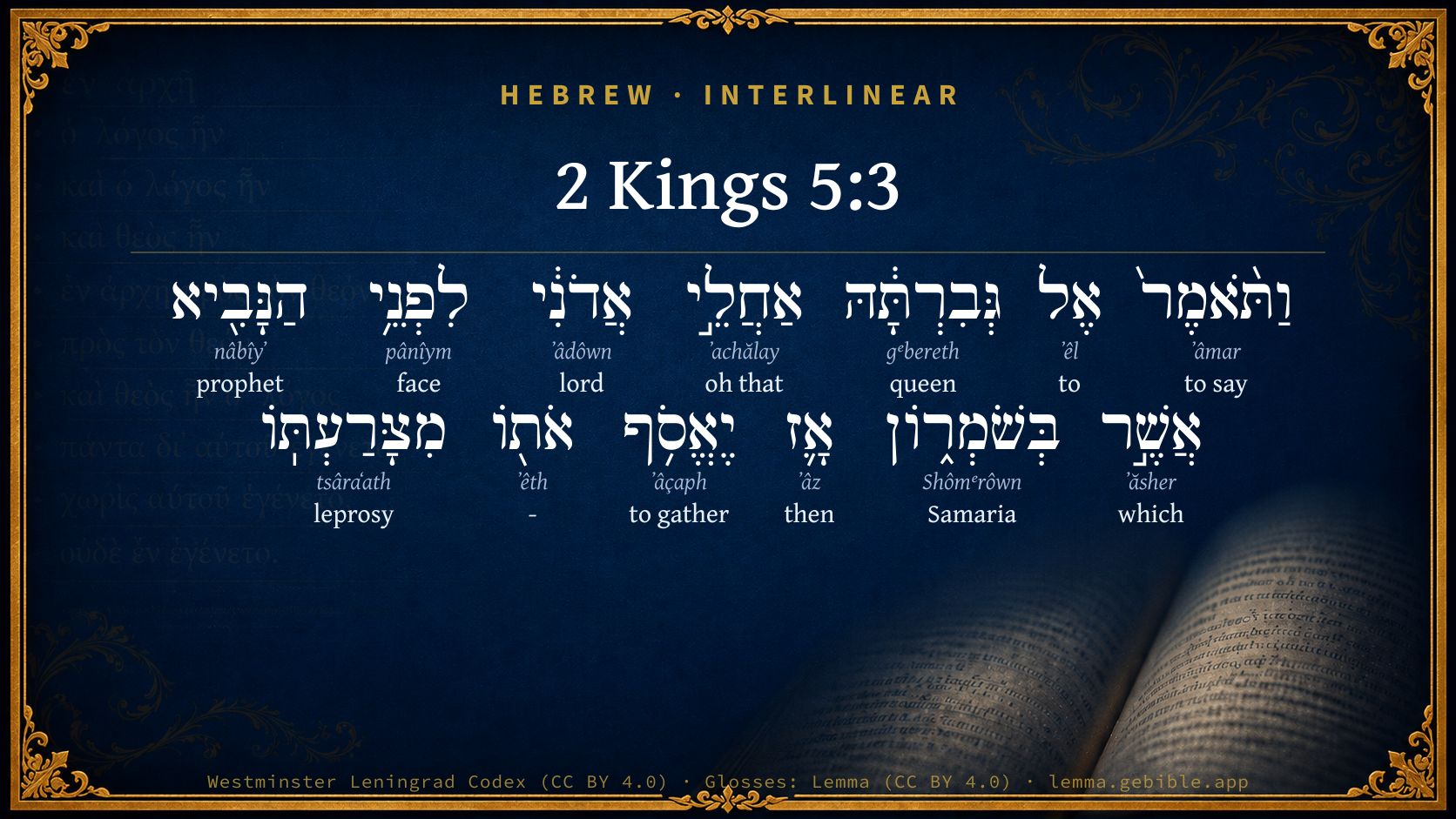
Hebrew (Westminster Leningrad Codex) 2 Kings 5:3 appears in the Hebrew Old Testament. The text above is from the Westminster Leningrad Codex. Each word links to its Strong’s number, a concise gloss, and parsing drawn from the Open Scriptures Hebrew Bible morphology. Click any word for its full Brown-Driver-Briggs (BDB) entry.
Download image
Cite this verse

2 Kings 5:3 (World English Bible). Public Domain. Lemma interlinear Bible study tool, https://lemma.gebible.app/v/2-kings/5/3.

Show BibTeX & RIS
BibTeX
RIS
English Translation
She said to her mistress, Would that my lord were with the prophet who is in Samaria! then would he recover him of his leprosy.
World English Bible · Public Domain
Highlights
  • 1 first appearance in the Hebrew Bible
Full analysis ↓
Download a study sheet

One document with this verse’s original text, its word-by-word gloss line, the meaning frame, cross-references with their text, attributed commentary, and full source and license credits — printable, and it pastes into notes with its structure intact.

This verse Autodidact and up

Study sheet (.html) Plain text (.txt)

A passage Seminary Student

Up to 50 verses in one chapter. A passage sheet keeps up to 6 commentary sources and 12 cross-references per verse, in the order this page ranks them, and says so on the sheet whenever that leaves anything out. Ask for a single verse and you get the Autodidact verse sheet above.

Everything on this page stays free to read, with no account — the sheet is a download of what is already on screen, not access to it.

Want to remove ads? Support Godless Engineer
Compare translations 3

The same verse in 3 English versions, stacked beneath the original-language interlinear above. Click any original word for its lexicon entry.

Each is an independent rendering of the whole verse — the interlinear is not word-aligned to these translations.

Highlighted words mark where these versions differ — a whole-verse word diff, not a word-by-word alignment.

  • World English Bible Public Domain
    She said to her mistress, Would that my lord were with the prophet who is in Samaria! then would he recover him of his leprosy.
  • King James Version Public Domain
    And she said unto her mistress, Would God my lord were with the prophet that is in Samaria! for he would recover him of his leprosy.
  • unfoldingWord Literal Text CC BY-SA 4.0
    And she said to her mistress, “Oh that my lord to the face of the prophet who in Samaria! Then he would remove him from his leprosy.”

unfoldingWord Literal Text — © unfoldingWord, licensed CC BY-SA 4.0. Word-aligned USFM3 via Door43 (git.door43.org/unfoldingWord/en_ult).

Versions to compare (up to 4)

3 of 4 selected

Show all 18 translations

Every available English version of this verse, each an independent rendering of the whole verse.

  • World English Bible Public Domain
    She said to her mistress, Would that my lord were with the prophet who is in Samaria! then would he recover him of his leprosy.
  • Berean Standard Bible Public Domain
    She said to her mistress, “If only my master would go to the prophet who is in Samaria, he would cure him of his leprosy.”
  • Majority Standard Bible Public Domain
    She said to her mistress, “If only my master would go to the prophet who is in Samaria, he would cure him of his leprosy.”
  • King James Version Public Domain
    And she said unto her mistress, Would God my lord were with the prophet that is in Samaria! for he would recover him of his leprosy.
  • American Standard Version (1901) Public Domain
    And she said unto her mistress, Would that my lord were with the prophet that is in Samaria! then would he recover him of his leprosy.
  • Revised Version (1885) Public Domain
    And she said unto her mistress, Would God my lord were with the prophet that is in Samaria! then would he recover him of his leprosy.
  • Geneva Bible (1599) Public Domain
    And she sayd vnto her mistres, Would God my lord were with the Prophet that is in Samaria, he would soone deliuer him of his leprosie.
  • Douay-Rheims (1899) Public Domain
    And she said to her mistress: I wish my master had been with the prophet, that is in Samaria: he would certainly have healed him of the leprosy which he hath.
  • Young's Literal Translation Public Domain
    and she saith unto her mistress, `O that my lord `were' before the prophet who `is' in Samaria; then he doth recover him from his leprosy.'
  • Literal Standard Version CC BY-SA 4.0
    and she says to her mistress, “O that my lord [were] before the prophet who [is] in Samaria; then he recovers him from his leprosy.”
  • Unlocked Literal Bible CC BY-SA 4.0
    The girl said to her mistress, “I wish that my master were with the prophet who is in Samaria! Then he would heal my master of his leprosy.”
  • unfoldingWord Literal Text CC BY-SA 4.0
    And she said to her mistress, “Oh that my lord to the face of the prophet who in Samaria! Then he would remove him from his leprosy.”
  • Darby Bible Public Domain
    And she said to her mistress, Oh, would that my lord were before the prophet that is in Samaria! then he would cure him of his leprosy.
  • World Messianic Bible Public Domain
    She said to her mistress, “I wish that my lord were with the prophet who is in Samaria! Then he would heal him of his leprosy.”
  • Webster's Bible Public Domain
    And she said to her mistress, I would that my lord were with the prophet that is in Samaria! for he would recover him of his leprosy.
  • Free Bible Version CC BY-SA 4.0
    She told her mistress, “If only my master would go and see the prophet who lives in Samaria. I'm sure he could cure him of his leprosy.”
  • Bible in Basic English Public Domain
    And she said to her master's wife, If only my lord would go to the prophet in Samaria, he would make him well.
  • JPS Tanakh (1917) Public Domain
    And she said unto her mistress: 'Would that my lord were with the prophet that is in Samaria! then would he recover him of his leprosy.'

Literal Standard Version (2020), Covenant Press — licensed CC BY-SA 4.0. Text via the HelloAO Bible API (eBible.org). Unlocked Literal Bible (unfoldingWord) — licensed CC BY-SA 4.0. Text via the HelloAO Bible API (eBible.org). unfoldingWord Literal Text — © unfoldingWord, licensed CC BY-SA 4.0. Word-aligned USFM3 via Door43 (git.door43.org/unfoldingWord/en_ult). Free Bible Version, Dr. Jonathan Gallagher — licensed CC BY-SA 4.0. Text via the HelloAO Bible API (eBible.org).

Word by word

More ways to search: Search by grammar → Find every occurrence → Compare this word →

Practice this passage: Drill this verse → Learn its vocabulary →

אַחֲלֵ֣י
ʼachălay
H305
“oh that”
Particle, Interjection
Part of Speech
Particle
Type
Interjection
Full BDB Definition

Origin: probably from H253 and a variation of H3863

TWOT: 67a

Oh that...!; oh would that!; ah that!
  1. וַתֹּ֨אמֶר֙ ʼâmar H559 “and · to say” Conjunction + Verb, Qal, Sequential Imperfect, 3rd Person, Feminine, Singular
  2. אֶל ʼêl H413 “to” Preposition
  3. גְּבִרְתָּ֔הּ gᵉbereth H1404 “queen · her” Noun, Common, Feminine, Singular, Construct + Suffix, Personal, 3rd Person, Feminine, Singular
  4. אֲדֹנִ֔י ʼâdôwn H113 “lord · my” Noun, Common, Masculine, Singular, Construct + Suffix, Personal, 1st Person, Common, Singular
  5. לִפְנֵ֥י pânîym H6440 “to/for · face(s) of” Preposition + Noun, Common, Both, Plural, Construct
  6. הַנָּבִ֖יא nâbîyʼ H5030 “the · prophet” Particle, Definite Article + Noun, Common, Masculine, Singular, Absolute
  7. אֲשֶׁ֣ר ʼăsher H834 “which” Particle, Relative
  8. בְּשֹׁמְר֑וֹן Shômᵉrôwn H8111 “in/at · Samaria” Preposition + Noun, Proper
  9. אָ֛ז ʼâz H227 “then” Adverb
  10. יֶאֱסֹ֥ף ʼâçaph H622 “to gather” Verb, Qal, Imperfect, 3rd Person, Masculine, Singular
  11. אֹת֖וֹ ʼêth H853 “- · him” Particle, Direct Object + Suffix, Personal, 3rd Person, Masculine, Singular
  12. מִצָּרַעְתּֽוֹ tsâraʻath H6883 “from · leprosy · his” Preposition + Noun, Common, Feminine, Singular, Construct + Suffix, Personal, 3rd Person, Masculine, Singular

About this verse

These counts appear in no published source. They are computed here, from the morphology-tagged text and Lemma’s own curated glosses. What Lemma adds →

13
words
13
distinct lemmas
Historical
section

Notable vocabulary

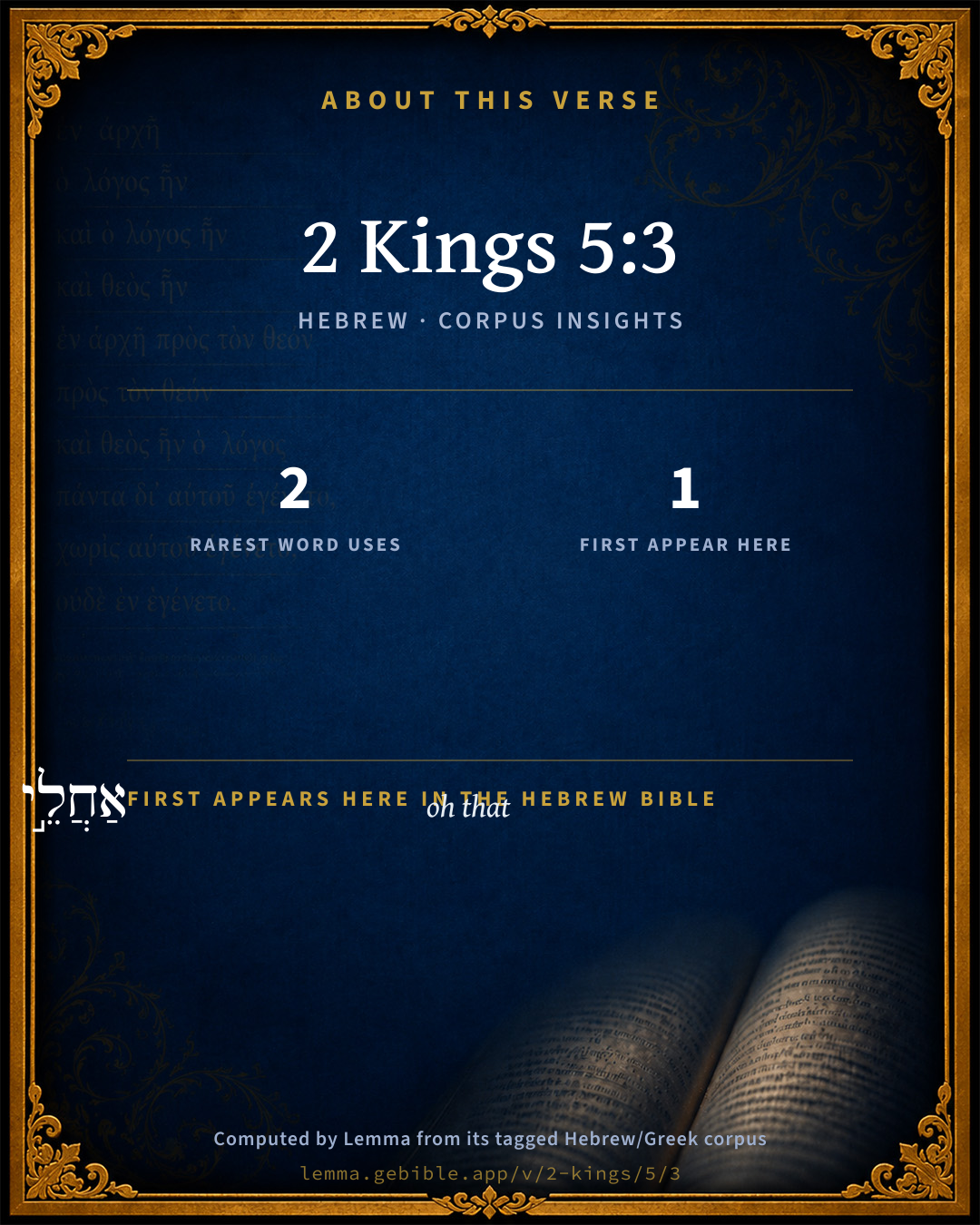
The rarest word here is אַחֲלֵ֣י oh that H305 — appearing just 2 times in the whole Hebrew Bible.

First appearance in Scripture

This word makes its first canonical appearance in the Hebrew Bible here:

  • אַחֲלֵ֣י oh that H305

Shared distinctive vocabulary

אַחֲלֵ֣י oh that H305 occurs in 2 verses of the Hebrew Bible. Also found in:

Grammatical profile

  • 2 verbs
  • 6 nouns
  • 1 preposition
  • 1 adverb
  • 3 particles

Verb forms

  • וַתֹּ֨אמֶר֙ Qal · Sequential Imperfect
  • יֶאֱסֹ֥ף Qal · Imperfect

Hebrew & Septuagint length

In English translation the verse runs 25 words from the Hebrew and 26 from the Septuagint (LXX English) — closely comparable.

A rough comparison of the two English renderings, which tokenize alike — not a word-level alignment.

Word counts can differ between the Hebrew and the Greek without any difference in meaning — e.g. the Hebrew direct-object marker אֵת has no separate Greek word, and Greek often adds the article ὁ.

Cross-references

7

Topical passages linked to 2 Kings 5:3 in the Treasury of Scripture Knowledge — connected by theme and wording, ordered by reader-vote popularity; previews shown in the World English Bible.

  • Numbers 11:29 Moses said to him, Are you jealous for my sake? would that all Yahweh's people were prophets, that Yahweh would put his Spirit on them!
  • Luke 17:12–14 As he entered into a certain village, ten men who were lepers met him, who stood at a distance.
  • Acts 26:29 Paul said, "I pray to God, that whether with little or with much, not only you, but also all that hear me this day, might become such as I am, except for these bonds."
  • 2 Kings 5:8 It was so, when Elisha the man of God heard that the king of Israel had torn his clothes, that he sent to the king, saying, Why have you torn your clothes? let him come now to me, and he shall know that there is a prophet in Israel.
  • Matthew 11:5 the blind receive their sight, the lame walk, the lepers are cleansed, the deaf hear, the dead are raised up, and the poor have good news preached to them.
  • 1 Corinthians 4:8 You are already filled. You have already become rich. You have come to reign without us. Yes, and I wish that you did reign, that we also might reign with you.
  • Matthew 8:2–3 Behold, a leper came to him and worshiped him, saying, "Lord, if you want to, you can make me clean."

Cross-references courtesy of OpenBible.info (CC BY 4.0).

Hebrew and Greek witnesses Masoretic Hebrew ↔ Greek Septuagint

The same verse in the two great witnesses to the Old Testament, shown verse-for-verse.

These are two independent witnesses, not word-aligned to each other, and the Septuagint is shown in lemma (dictionary) form.

Hebrew 2 Kings 5:3 Masoretic · Westminster Leningrad Codex

וַתֹּ֨אמֶר֙ אֶל גְּבִרְתָּ֔הּ אַחֲלֵ֣י אֲדֹנִ֔י לִפְנֵ֥י הַנָּבִ֖יא אֲשֶׁ֣ר בְּשֹׁמְר֑וֹן אָ֛ז יֶאֱסֹ֥ף אֹת֖וֹ מִצָּרַעְתּֽוֹ

She said to her mistress, Would that my lord were with the prophet who is in Samaria! then would he recover him of his leprosy.

World English Bible · Public Domain

Greek LXX 2 Kings 5:3 Septuagint · lemma form

ὁ δέ εἶπον ὁ κυρία αὐτός ὀφείλω ὁ κύριος ἐγώ ἐνώπιον ὁ προφήτης ὁ θεός ὁ ἐν σαμαρεία τότε ἀπο συνἄγω αὐτός ἀπό ὁ λέπρα αὐτός

And she said to her mistress, O that my lord were before the prophet of God in Samaria; then he would recover him from his leprosy.

LXX2012 (modern English Septuagint) · Public Domain

Hebrew: Westminster Leningrad Codex (CC BY 4.0). Greek: Septuagint (public domain); English from LXX2012 (modern English Septuagint) (Public Domain). How the Septuagint differs from the Hebrew →

Targum (Aramaic paraphrase)

1

The Targum is the ancient Jewish Aramaic paraphrase of the Hebrew Scriptures — an interpretive translation, not the Hebrew text itself. Onkelos (literal) and Pseudo-Jonathan (expansive) render the Torah, and Jonathan the Prophets. Coverage is partial: where no permissively-licensed English translation exists for a verse, only the Aramaic is shown. This is verse-level text, not a word-by-word alignment to the Hebrew.

  1. Targum Jonathan Prophets (Joshua–Malachi)
    וַאֲמַרַת לְמָרָתָהּ טוּבֵי רִבּוֹנִי אִם יֵזֵיל לָקֳדָם נְבִיָא דִי בְשֹׁמְרוֹן בְּכֵן יַסֵי יָתֵיהּ מִסְגִירוּתֵיהּ:

    (no public-domain English translation for this verse)

    Targum Jonathan — Aramaic: “Mikraot Gedolot” (public domain). English: “Sefaria Community Translation” (CC0 1.0 (public-domain dedication)); “London "Chaldee Paraphrase," 1871” (public domain). Text via Sefaria.

Commentary

Notes on 2 Kings 5:3 from classic Christian and Jewish commentators (each source and its license shown beneath its notes). The classic Christian expositions comment on the surrounding passage and are grouped to its opening verse, so a note may address several verses; the Jewish commentaries on the Tanakh (Rashi and others) are per-verse, so they appear only where the commentator wrote on this verse.

Lemma curates 59 commentaries, every one of them public domain or Creative Commons licensed, each selected and text-cleaned for this edition rather than reprinted as found. About our sources →

Trapp's Complete Commentary

John Trapp

2Ki 5:3 And she said unto her mistress, Would God my lord [were] with the prophet that [is] in Samaria! for he would recover him of his leprosy.

Ver. 3. For he would recover him of his leprosy.] Few in Israel believed thus much. {Luk 4:27} This poor girl was confident that the prophet, famous in her country for so many miracles, both could and would cure her master, if duly sought unto; and her words found credit, to the great honour of the true God.

John Trapp, A Commentary or Exposition upon All the Books of the Old and New Testament (1647–1656) — public domain. Text from a community e-Sword module.

Joseph Benson's Commentary

2Ki 5:3. Would God my Lord were with the prophet that is in Samaria — In the kingdom of Samaria; or, rather, in the city of Samaria; where Elisha was when she was taken, and where he commonly resided, though he went to other places as need required. For he would recover him of his leprosy — She had heard of the wonderful things which he had done, and therefore was confident he could work this cure. Children should betimes acquaint themselves with the wondrous works of God, that wherever they go they may speak of them, to the profit of others. Yea, and servants, like this little maid, may be blessings to the families in which Providence casts their lot, by telling what they know of the glory of God, and the honour of his ministers.

Joseph Benson's Commentary on the Old and New Testaments (1811–1818) — public domain. Text from a community e-Sword module.

Geneva Bible (1599)

Geneva Bible translators

Meaning, Elisha.

Geneva Bible (1599) marginal notes — public domain. Text via Bolls.life.

Adam Clarke's Commentary

Verse 3. Would God my lord] אחלי achaley, I wish; or, as the Chaldee, Syrian, and Arabic have, "Happy would it be for my master if he were with the prophet," &c.

Here the mystery of the Divine providence begins to develop itself. By the captivity of this little maid, one Syrian family at least, and that one of the most considerable in the Syrian empire, is brought to the knowledge of the true God.

Adam Clarke's Commentary on the Bible (1810–1826) — public domain. Text from a community e-Sword/MySword module.

Ellicott's Commentary for English Readers

(3) Would God.—O that! ’Ahalê here; in Psa_119:5, ’Ahalay. The word seems to follow the analogy of ’ashrê, “O the bliss of!” (Psa_1:1). It perhaps means “O the delight of!” the root ’ahal being assumed equivalent to the Arabic halâ, Syriac halî, “dulcis fuit.”

For he would recover him.—Then he would receive him back. (Comp. Num_12:14-15.) In Israel lepers were excluded from society. Restoration to society implied restoration to health. Hence the same verb came to be used in the sense of healing as well as of receiving back the leper. Thenius, however, argues that as the phrase “from leprosy” is wanting in Numbers 12, the real meaning is, “to take a person away from leprosy,” to which he had been, as it were, delivered up.

A Bible Commentary for English Readers, edited by Charles John Ellicott (1878–1897) — public domain. Text from a community e-Sword module.

The Cambridge Bible for Schools and Colleges

gen. ed. J. J. S. Perowne

3. Would God] This interjection is found only here and in Psa_119:5. There it is rendered ‘O that my ways were directed’.

the prophet that is in Samaria] Elisha had a house in the city of Samaria, as we see from verse 9, and also from 2Ki_6:32. The fame of the prophet, and the mighty cures which God wrought through him, must have been matter of much note ere they reached this little servant.

he would recover him] The verb, which commonly means ‘to assemble’ or ‘gather together’, is very expressive in the mouth of the Israelitish maiden, for the leper in Israel must keep himself apart, and never be gathered with the rest of the people. The passive is used (Num_11:14-15) when Miriam was cured of her leprosy, ‘she was received in again’, i.e. joined in the company of the rest of the people.

The Cambridge Bible for Schools and Colleges (gen. ed. J. J. S. Perowne; Cambridge University Press, 1878–1918) — public domain. Text from a community e-Sword module.

John Gill's Exposition

And she said unto her mistress,.... As she was waiting upon her at a certain time, and perhaps her mistress was lamenting the case of her husband as desperate and incurable:

would God my lord were with the prophet that is in Samaria; meaning Elisha, who, though sometimes in one place, and sometimes in another, yet often at Samaria, and it seems was there when this girl was taken captive:

for he would recover him of his leprosy; the maid had heard of the miracles wrought by Elisha, and doubted not that at the request of her lord he would be willing, as she believed he was able, to cure him of this disease.

John Gill's Exposition of the Whole Bible (1746–1763) — public domain (CC PDM 1.0). Text via the HelloAO Bible API.

Matthew Poole's English Annotations

In Samaria; either, first, In the kingdom of Samaria. Or, secondly, In the city of Samaria; where he was when she was taken; or where he commonly resided, though he went to other places, as need required.

He would recover him of his leprosy; or, take him away (as this Hebrew verb is used, Gen 30:23; Zep 1:2) from his leprosy, i.e. take away his leprosy from him.

Matthew Poole's English Annotations on the Holy Bible (1683–1685) — public domain. Text from a community e-Sword/MySword module.

Whedon's Commentary on the Bible

Daniel D. Whedon

3. Recover him of his leprosy — Literally, he would gather him from his leprosy. The expression is an allusion to the Israelitish custom of shutting lepers out of the camp, and gathering them in again after their leprosy was healed. The same expression is used of Miriam’s reception into the camp after her exclusion of seven days. Num_12:14.

Daniel D. Whedon (gen. ed.), Commentary on the Old and New Testaments (1874–1909) — public domain. Text from a community e-Sword module.

The Pulpit Commentary

And she said unto her mistress, Would God my lord were with the prophet that is in Samaria! literally, Oh that my lord were before the prophet who is in Samaria! Elisha had a house in Samaria, (2Ki_6:32) where he resided occasionally. For he would recover him of his leprosy. The "little maid" concludes from her small experience that, if her master and the great miracle-working prophet of her own land could be brought together, the result would be his cure. She has, in her servile condition, contracted an affection both for her master and her mistress, and her sympathies are strongly with them. Perhaps she had no serious purpose in speaking as she did. The words burst from her as a mere expression of goodwill. She did not contemplate any action resulting from them. "Oh that things could be otherwise than as they are! Had I my dear master in my own country, it would be easy to accomplish his cure. The prophet is so powerful and so kind. He both could and would recover him." Any notion of her vague wish being carried out, being made the ground of a serious embassy, was probably far from the girl"s thought. But the "bread cast upon the waters returns after many days." There is no kind wish or kind utterance that may not have a result far beyond anything that the wisher or utterer contemplated. Good wishes are seeds that ofttimes take root, and grow, and blossom, and bear fruit beyond the uttermost conception of those who sow them.

The Pulpit Commentary (1880–1919), ed. H.D.M. Spence-Jones & Joseph S. Exell — public domain. Text from a community e-Sword module.

unfoldingWord translationNotes

Door43 World Missions Community

The girl said to her mistress

The girl from Israel, who had been captured by the Aramean soldiers, spoke to Naaman's wife.

my master

Here "my master" refers to Naaman.

translationWords

prophet

Samaria

cure

unfoldingWord translationNotes — © Distant Shores Media and the Door43 World Missions Community, licensed CC BY-SA 4.0. Source: git.door43.org/Door43/en_tn.

Rashi

Rabbi Shlomo Yitzchaki (Rashi)

“My master should plead [for curing his illness] before the prophet.” An expression [similar to], “and Moshe prayed [וַיְחַל].” The supplications of all those who pray for him, will be that the miracle shall come before the prophet.

Plead. Soheidement, in O.F., i.e., this is the supplication that he needs.

Rashi on the Tanakh — English translations: “The Judaica Press complete Tanach with Rashi, translated by A. J. Rosenberg” (CC BY 4.0); “Pentateuch with Rashi's commentary by M. Rosenbaum and A.M. Silbermann, 1929-1934” (public domain); “The Metsudah Tanach series, Lakewood, N.J” (CC BY 4.0); and “The Book of Joshua, Metsudah Publications, 1997” (CC BY 4.0). Text via Sefaria.

Lesson kit

Teaching starters — assembled from the data on this page, not authored interpretation. Every prompt links to the verse data it draws on. Edit before teaching.

2 Kings, in the Historical, opens this verse with 13 words (13 distinct Hebrew lemmas). Its most distinctive word is ʼachălay (“oh that”). A historical commentator’s framing appears above. Read the whole chapter for the surrounding context.

Discussion questions

  1. What does “oh that” (ʼachălay) contribute to the verse as a whole?
  2. The word “oh that” first appears here in Scripture. What is being introduced at this debut?
  3. Psalms 119:5 shares the word «oh that» with this verse. How do the two illuminate each other?
  4. These translations render this verse differently; the difference is in the English rendering, not the original. What questions does that raise?
  5. The verb «וַתֹּ֨אמֶר֙» is Qal Sequential Imperfect. How does its form color the action?
  6. Reading how Trapp's Complete Commentary and Joseph Benson's Commentary read this verse, where do the two commentators agree and where do they part?

Things to notice

  • 1 word makes its first canonical appearance in Scripture here.
  • These translations choose different wording for 6 words in this verse.
  • 13 distinct Hebrew lemmas span 13 words in this verse.

Reading settings

Reading text

Shown beneath each verse's original-language words.

Old Testament
Old Testament edition

Read the OT as the Masoretic Hebrew (MT) or the Greek Septuagint (LXX).

English shown for the Greek Septuagint (in the Hebrew ↔ Greek comparison).

Comparing translations? Open the Compare panel on any verse page to stack up to four side by side.