2 Samuel 12:28

Hebrew (Westminster Leningrad Codex) 2 Samuel 12:28 appears in the Hebrew Old Testament. The text above is from the Westminster Leningrad Codex. Each word links to its Strong’s number, a concise gloss, and parsing drawn from the Open Scriptures Hebrew Bible morphology. Click any word for its full Brown-Driver-Briggs (BDB) entry.
Download image
Cite this verse

2 Samuel 12:28 (World English Bible). Public Domain. Lemma interlinear Bible study tool, https://lemma.gebible.app/v/2-samuel/12/28.

Show BibTeX & RIS
BibTeX
RIS
English Translation
Now therefore gather the rest of the people together, and encamp against the city, and take it; lest I take the city, and it be called after my name.
World English Bible · Public Domain
Download a study sheet

One document with this verse’s original text, its word-by-word gloss line, the meaning frame, cross-references with their text, attributed commentary, and full source and license credits — printable, and it pastes into notes with its structure intact.

This verse Autodidact and up

Study sheet (.html) Plain text (.txt)

A passage Seminary Student

Up to 50 verses in one chapter. A passage sheet keeps up to 6 commentary sources and 12 cross-references per verse, in the order this page ranks them, and says so on the sheet whenever that leaves anything out. Ask for a single verse and you get the Autodidact verse sheet above.

Everything on this page stays free to read, with no account — the sheet is a download of what is already on screen, not access to it.

Want to remove ads? Support Godless Engineer
Compare translations 3

The same verse in 3 English versions, stacked beneath the original-language interlinear above. Click any original word for its lexicon entry.

Each is an independent rendering of the whole verse — the interlinear is not word-aligned to these translations.

Highlighted words mark where these versions differ — a whole-verse word diff, not a word-by-word alignment.

  • World English Bible Public Domain
    Now therefore gather the rest of the people together, and encamp against the city, and take it; lest I take the city, and it be called after my name.
  • King James Version Public Domain
    Now therefore gather the rest of the people together, and encamp against the city, and take it: lest I take the city, and it be called after my name.
  • unfoldingWord Literal Text CC BY-SA 4.0
    And now, gather the rest of the people and encamp against the city and capture it, lest I myself capture the city and my name be called to it.”

unfoldingWord Literal Text — © unfoldingWord, licensed CC BY-SA 4.0. Word-aligned USFM3 via Door43 (git.door43.org/unfoldingWord/en_ult).

Versions to compare (up to 4)

3 of 4 selected

Show all 18 translations

Every available English version of this verse, each an independent rendering of the whole verse.

  • World English Bible Public Domain
    Now therefore gather the rest of the people together, and encamp against the city, and take it; lest I take the city, and it be called after my name.
  • Berean Standard Bible Public Domain
    Now, therefore, assemble the rest of the troops, lay siege to the city, and capture it. Otherwise I will capture the city, and it will be named after me.”
  • Majority Standard Bible Public Domain
    Now, therefore, assemble the rest of the troops, lay siege to the city, and capture it. Otherwise I will capture the city, and it will be named after me.”
  • King James Version Public Domain
    Now therefore gather the rest of the people together, and encamp against the city, and take it: lest I take the city, and it be called after my name.
  • American Standard Version (1901) Public Domain
    Now therefore gather the rest of the people together, and encamp against the city, and take it; lest I take the city, and it be called after my name.
  • Revised Version (1885) Public Domain
    Now therefore gather the rest of the people together, and encamp against the city, and take it: lest I take the city, and it be called after my name.
  • Geneva Bible (1599) Public Domain
    Now therefore gather the rest of the people together, and besiege the city, that thou mayest take it, lest the victorie be attributed to me.
  • Douay-Rheims (1899) Public Domain
    Now therefore gather thou the rest of the people together, and besiege the city and take it: lest when the city shall be wasted by me, the victory be ascribed to my name.
  • Young's Literal Translation Public Domain
    and now, gather the rest of the people, and encamp against the city, and capture it, lest I capture the city, and my name hath been called upon it.'
  • Literal Standard Version CC BY-SA 4.0
    and now, gather the rest of the people, and encamp against the city, and capture it, lest I capture the city, and my name has been called on it.”
  • Unlocked Literal Bible CC BY-SA 4.0
    Now therefore gather the rest of the army together and camp against the city and take it, because if I take the city, it will be named after me.”
  • unfoldingWord Literal Text CC BY-SA 4.0
    And now, gather the rest of the people and encamp against the city and capture it, lest I myself capture the city and my name be called to it.”
  • Darby Bible Public Domain
    And now gather the rest of the people, and encamp against the city and take it: lest I take the city and it be called by my name.
  • World Messianic Bible Public Domain
    Now therefore gather the rest of the people together, and encamp against the city and take it; lest I take the city, and it be called by my name.”
  • Webster's Bible Public Domain
    Now therefore collect the rest of the people, and encamp against the city, and take it: lest I take the city, and it be called after my name.
  • Free Bible Version CC BY-SA 4.0
    So please call up the rest of the army, besiege the town, and capture it. Otherwise I will capture the city, and I will get the credit.”
  • Bible in Basic English Public Domain
    So now, get the rest of the people together, and put them in position against the town and take it, for if I take it, it will be named after my name.
  • JPS Tanakh (1917) Public Domain
    Now therefore gather the rest of the people together, and encamp against the city, and take it; lest I take the city, and it be called after my name.'

Literal Standard Version (2020), Covenant Press — licensed CC BY-SA 4.0. Text via the HelloAO Bible API (eBible.org). Unlocked Literal Bible (unfoldingWord) — licensed CC BY-SA 4.0. Text via the HelloAO Bible API (eBible.org). unfoldingWord Literal Text — © unfoldingWord, licensed CC BY-SA 4.0. Word-aligned USFM3 via Door43 (git.door43.org/unfoldingWord/en_ult). Free Bible Version, Dr. Jonathan Gallagher — licensed CC BY-SA 4.0. Text via the HelloAO Bible API (eBible.org).

Word by word

More ways to search: Search by grammar → Find every occurrence → Compare this word →

Practice this passage: Drill this verse → Learn its vocabulary →

יֶ֣תֶר
yether
H3499
“remainder of”
Noun, Common, Masculine, Singular, Construct
Part of Speech
Noun
Type
Common
Gender
Masculine
Number
Singular
State
Construct
Full BDB Definition

Origin: from H3498

TWOT: 936a

remainder, excess, rest, remnant, excellence - remainder, remnant - remainder, rest, other part - excess - abundantly (adverb) - abundance, affluence - superiority, excellency
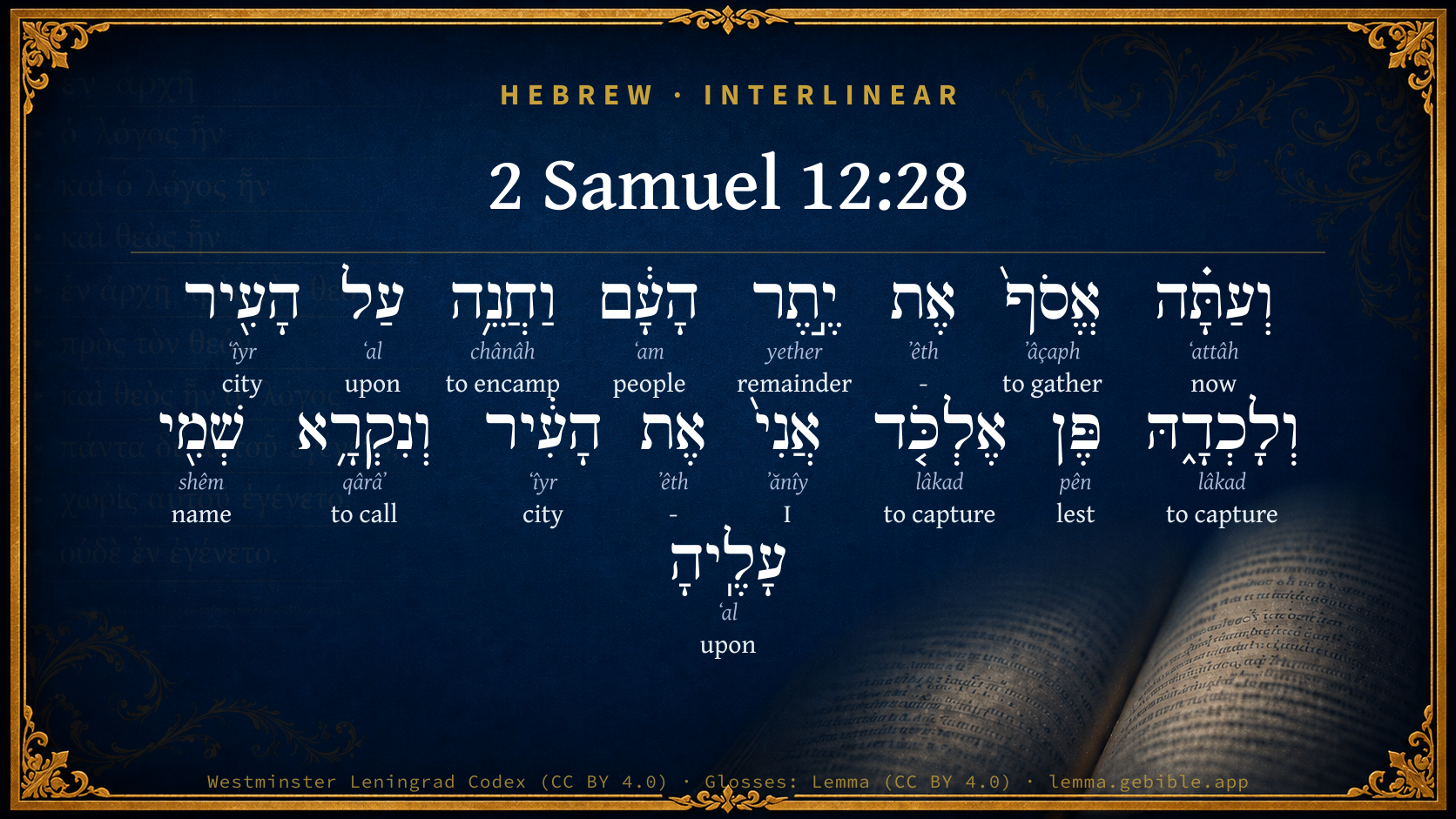
  1. וְעַתָּ֗ה ʻattâh H6258 “and · now” Conjunction + Adverb
  2. אֱסֹף֙ ʼâçaph H622 “gather” Verb, Qal, Imperative, 2nd Person, Masculine, Singular
  3. אֶת ʼêth H853 “-” Particle, Direct Object
  4. הָעָ֔ם ʻam H5971 “the · people” Particle, Definite Article + Noun, Common, Masculine, Singular, Absolute
  5. וַחֲנֵ֥ה chânâh H2583 “and · encamp” Conjunction + Verb, Qal, Imperative, 2nd Person, Masculine, Singular
  6. עַל ʻal H5921 “upon” Preposition
  7. הָעִ֖יר ʻîyr H5892 “the · city” Particle, Definite Article + Noun, Common, Feminine, Singular, Absolute
  8. וְלָכְדָ֑הּ lâkad H3920 “and · capture · her” Conjunction + Verb, Qal, Imperative, 2nd Person, Masculine, Singular + Suffix, Personal, 3rd Person, Feminine, Singular
  9. פֶּן pên H6435 “lest” Conjunction
  10. אֶלְכֹּ֤ד lâkad H3920 “to capture” Verb, Qal, Imperfect, 1st Person, Common, Singular
  11. אֲנִי֙ ʼănîy H589 “I” Pronoun, Personal, 1st Person, Common, Singular
  12. אֶת ʼêth H853 “-” Particle, Direct Object
  13. הָעִ֔יר ʻîyr H5892 “the · city” Particle, Definite Article + Noun, Common, Feminine, Singular, Absolute
  14. וְנִקְרָ֥א qârâʼ H7121 “and · to call” Conjunction + Verb, Niphal, Sequential Perfect, 3rd Person, Masculine, Singular
  15. שְׁמִ֖י shêm H8034 “name · my” Noun, Common, Masculine, Singular, Construct + Suffix, Personal, 1st Person, Common, Singular
  16. עָלֶֽיהָ ʻal H5921 “upon · her” Preposition + Suffix, Personal, 3rd Person, Feminine, Singular

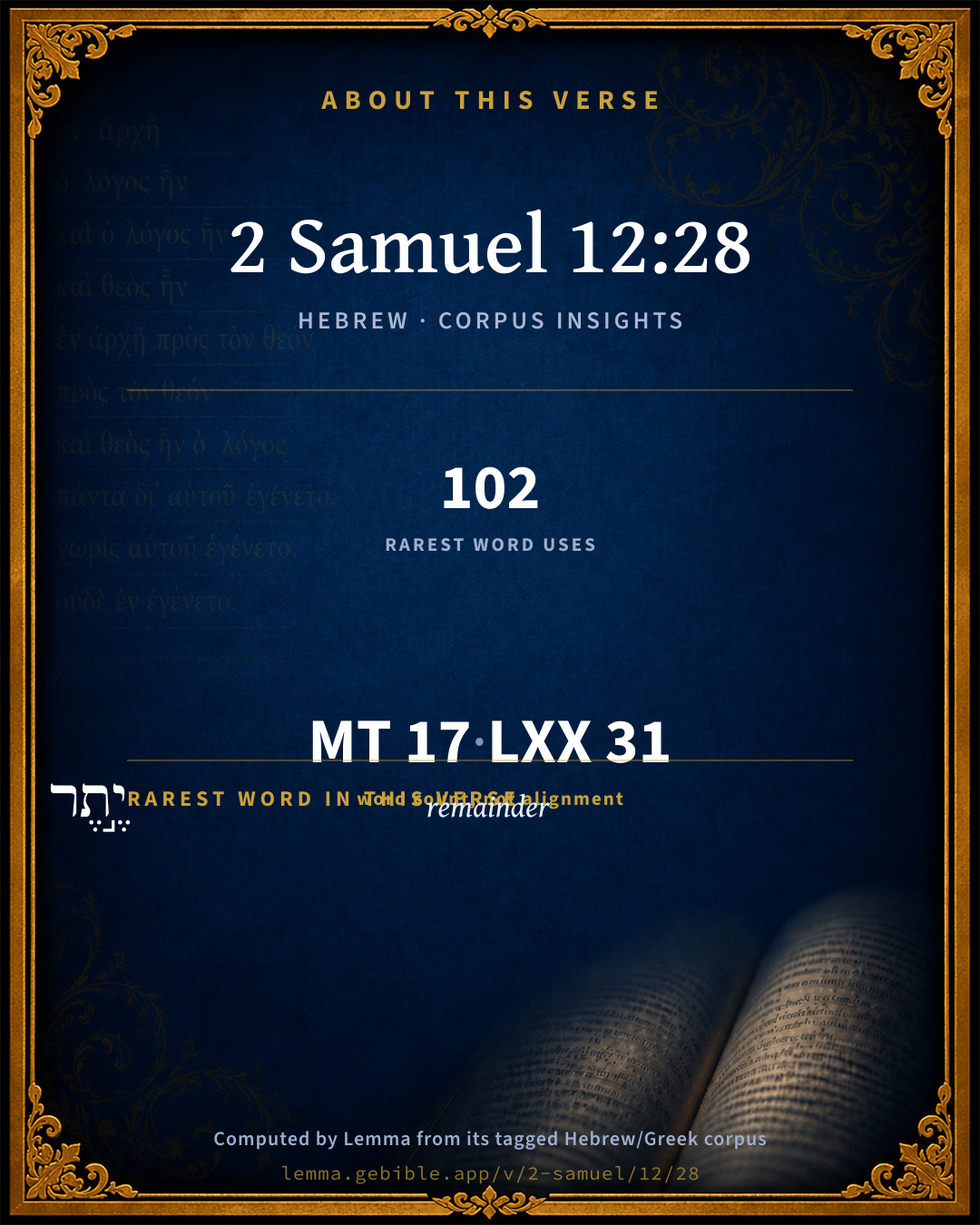
About this verse

These counts appear in no published source. They are computed here, from the morphology-tagged text and Lemma’s own curated glosses. What Lemma adds →

17
words
13
distinct lemmas
Historical
section

Grammatical profile

  • 5 verbs
  • 5 nouns
  • 1 pronoun
  • 2 prepositions
  • 1 conjunction
  • 1 adverb
  • 2 particles

Verb forms

  • אֱסֹף֙ Qal · Imperative
  • וַחֲנֵ֥ה Qal · Imperative
  • וְלָכְדָ֑הּ Qal · Imperative
  • אֶלְכֹּ֤ד Qal · Imperfect
  • וְנִקְרָ֥א Niphal · Sequential Perfect

Repetition

Words recur within this verse — often emphatic in Hebrew:

  • עַל upon H5921 ×2
  • הָעִ֖יר city H5892 ×2
  • וְלָכְדָ֑הּ to capture H3920 ×2

Hebrew & Septuagint length

In English translation the verse runs 29 words from the Hebrew and 30 from the Septuagint (LXX English) — closely comparable.

A rough comparison of the two English renderings, which tokenize alike — not a word-level alignment.

Word counts can differ between the Hebrew and the Greek without any difference in meaning — e.g. the Hebrew direct-object marker אֵת has no separate Greek word, and Greek often adds the article ὁ.

In the original languages it is 17 Hebrew tokens and 31 Greek tokens — but the two are counted differently (Hebrew bundles its prefixes and suffixes into one token; the Greek is in lemma form), so that isn’t a like-for-like length.

Cross-references

1

Topical passages linked to 2 Samuel 12:28 in the Treasury of Scripture Knowledge — connected by theme and wording, ordered by reader-vote popularity; previews shown in the World English Bible.

  • John 7:18 He who speaks from himself seeks his own glory, but he who seeks the glory of him who sent him, the same is true, and no unrighteousness is in him.

Cross-references courtesy of OpenBible.info (CC BY 4.0).

Hebrew and Greek witnesses Masoretic Hebrew ↔ Greek Septuagint

The same verse in the two great witnesses to the Old Testament, shown verse-for-verse.

These are two independent witnesses, not word-aligned to each other, and the Septuagint is shown in lemma (dictionary) form.

Hebrew 2 Samuel 12:28 Masoretic · Westminster Leningrad Codex

וְעַתָּ֗ה אֱסֹף֙ אֶת יֶ֣תֶר הָעָ֔ם וַחֲנֵ֥ה עַל הָעִ֖יר וְלָכְדָ֑הּ פֶּן אֶלְכֹּ֤ד אֲנִי֙ אֶת הָעִ֔יר וְנִקְרָ֥א שְׁמִ֖י עָלֶֽיהָ

Now therefore gather the rest of the people together, and encamp against the city, and take it; lest I take the city, and it be called after my name.

World English Bible · Public Domain

Greek LXX 2 Samuel 12:28 Septuagint · lemma form

καί νῦν συνἄγω ὁ κατάλοιπος ὁ λαός καί παρα ἐνβάλλω ἐπί ὁ πόλις καί προ καταλαμβάνω αὐτός ἵνα μή προ καταλαμβάνω ἐγώ ὁ πόλις καί καλέω ὁ ὄνομα ἐγώ ἐπί αὐτός

And now gather the rest of the people, and encamp against the city, and take it beforehand; lest I take the city first, and my name be called upon it.

LXX2012 (modern English Septuagint) · Public Domain

Hebrew: Westminster Leningrad Codex (CC BY 4.0). Greek: Septuagint (public domain); English from LXX2012 (modern English Septuagint) (Public Domain). How the Septuagint differs from the Hebrew →

Targum (Aramaic paraphrase)

1

The Targum is the ancient Jewish Aramaic paraphrase of the Hebrew Scriptures — an interpretive translation, not the Hebrew text itself. Onkelos (literal) and Pseudo-Jonathan (expansive) render the Torah, and Jonathan the Prophets. Coverage is partial: where no permissively-licensed English translation exists for a verse, only the Aramaic is shown. This is verse-level text, not a word-by-word alignment to the Hebrew.

  1. Targum Jonathan Prophets (Joshua–Malachi)
    וּכְעַן כְּנוֹשׁ יַת שְׁאַר עַמָא וּשְׁרֵי עַל קַרְתָּא וְכַבְּשָׁהּ דִלְמָא אֶכְבּוֹשׁ אֲנָא יַת קַרְתָּא וְיִתְקְרִי שְׁמִי עֲלָהּ:

    (no public-domain English translation for this verse)

    Targum Jonathan — Aramaic: “Mikraot Gedolot” (public domain). English: “Sefaria Community Translation” (CC0 1.0 (public-domain dedication)); “London "Chaldee Paraphrase," 1871” (public domain). Text via Sefaria.

Commentary

Notes on 2 Samuel 12:28 from classic Christian and Jewish commentators (each source and its license shown beneath its notes). The classic Christian expositions comment on the surrounding passage and are grouped to its opening verse, so a note may address several verses; the Jewish commentaries on the Tanakh (Rashi and others) are per-verse, so they appear only where the commentator wrote on this verse.

Lemma curates 59 commentaries, every one of them public domain or Creative Commons licensed, each selected and text-cleaned for this edition rather than reprinted as found. About our sources →

Trapp's Complete Commentary

John Trapp

2Sa 12:28 Now therefore gather the rest of the people together, and encamp against the city, and take it: lest I take the city, and it be called after my name.

Ver. 28. Lest I take the city, and it be called by my name.] Mirare hic modestiam et fidelitatem dueis Ioab, saith one; the modesty and fidelity of General Joab herein is worthy of admiration; and that above all other his noble acts whatsoever; for in those, he overcame others; but in this, himself. And surely his sending for David in this sort, was more for his honour than if he had triumphed a hundred times over Rabbah and the Ammonites. Inter omnia eius praeclara facta hoc heroicum virtutis eius specimen praecipuum semper censui, quod victoriae suo Marte partae gloriam et coronam in Davidis caput transferre voluerit et valuerit, {a} Do we the like by Jesus Christ, when we get any victory over our spiritual enemies, let him have the whole glory; say we as those two disciples in Act 3:12-16.

{a} Magnetis Reductor, per Sam. Ward, p. 85.

John Trapp, A Commentary or Exposition upon All the Books of the Old and New Testament (1647–1656) — public domain. Text from a community e-Sword module.

Joseph Benson's Commentary

2Sa 12:28. Encamp against the city, and take it — For, having taken one part of the city, he concluded the remaining part of it could not long stand out. Lest I take the city — Lest I have the honour of taking it; and it be called by my name — As from the conquest of Africa, the Roman general Scipio, many years after, was called Africanus. By this it appears that though Joab had many faults, yet he loved his prince, and endeavoured to raise his glory. “There is a magnificence in this proposal capable of creating admiration in the meanest minds. The man that could transfer the glory of his own conquests upon his prince, needs no higher eulogy. And it is but justice to the character of Joab to declare that he is supreme, if not unrivalled, in this singular instance of heroism. Rabbah, it must be observed, was a royal, a large, and a populous city, the metropolis of Arabia Felix, watered, and in some measure encompassed by the river Jabbok. It had its name from its grandeur, being derived from a Hebrew word which signifies to increase and grow great, and was now in the height of its glory.” — Delaney.

Joseph Benson's Commentary on the Old and New Testaments (1811–1818) — public domain. Text from a community e-Sword module.

Geneva Bible (1599)

Geneva Bible translators

Hebrew, my name be called upon it.

Geneva Bible (1599) marginal notes — public domain. Text via Bolls.life.

Jamieson, Fausset & Brown

Robert Jamieson, A. R. Fausset & David Brown

encamp against the city, and take it--It has always been characteristic of Oriental despots to monopolize military honors; and as the ancient world knew nothing of the modern refinement of kings gaining victories by their generals, so Joab sent for David to command the final assault in person. A large force was levied for the purpose. David without much difficulty captured the royal city and obtained possession of its immense wealth.

lest I take the city, and it be called after my name--The circumstance of a city receiving a new name after some great person, as Alexandria, Constantinople, Hyderabad, is of frequent occurrence in the ancient and modern history of the East.

Jamieson, Fausset & Brown — Commentary Critical and Explanatory on the Whole Bible (1871) — public domain (CC PDM 1.0). Text via the HelloAO Bible API.

Ellicott's Commentary for English Readers

(28) The rest of the people.—Joab proposes a general muster of the remaining forces of Israel, either because additional force was actually needed for the capture of the citadel, or simply to carry out the formal capturing of the city by David in person.

A Bible Commentary for English Readers, edited by Charles John Ellicott (1878–1897) — public domain. Text from a community e-Sword module.

The Cambridge Bible for Schools and Colleges

gen. ed. J. J. S. Perowne

28. and take it] Curtius relates how Craterus in like manner resigned the capture of Artacacna into the hands of Alexander. “After all the preparations were made, he awaited the king’s arrival, yielding to him, as was fitting, the honour of taking the city” (Curt. vi. 6).

and it be called after my name] This is the usual meaning of the phrase. Rabbah might have been called “the city of Joab” as Zion was called “the city of David.”

The Cambridge Bible for Schools and Colleges (gen. ed. J. J. S. Perowne; Cambridge University Press, 1878–1918) — public domain. Text from a community e-Sword module.

John Gill's Exposition

And David gathered all the people together,.... The soldiers that were with him, or near him; which was done partly to recruit Joab's troops, who, by the continuance of the siege, and the sallies of the enemy on them, might be greatly diminished; and partly to make conquests of other cities of the Ammonites, and to carry off the spoil of them:

and went to Rabbah; which must be after the death of Uriah, and very probably during the time of Bathsheba's mourning for him:

and fought against it, and took it; by assault.

John Gill's Exposition of the Whole Bible (1746–1763) — public domain (CC PDM 1.0). Text via the HelloAO Bible API.

Haydock's Catholic Bible Commentary

Take it. The higher, and more impregnable part; which honour Joab reserved for David.

George Leo Haydock (1774–1849), Haydock's Catholic Family Bible and Commentary, 1859 edition — public domain. Excludes Psalms (Douay-Rheims chapter numbering differs from Protestant) and Deuterocanonical books (Catholic canon only).

Matthew Poole's English Annotations

Take it; for having taken one part of the city, he concluded the remaining part of it could not long stand out.

Lest it be called after my name; lest I have the honour of taking it. Thus he seeks to ingratiate himself with the king, by pretending great care for his honour and interest.

Matthew Poole's English Annotations on the Holy Bible (1683–1685) — public domain. Text from a community e-Sword/MySword module.

Whedon's Commentary on the Bible

Daniel D. Whedon

28. Encamp against the city and take it — The city here meant was the acropolis or upper city, which, like the stronghold of Zion, still held out against the besiegers, after the lower city had fallen into their hands. See note on 2Sa_5:6.

It be called after my name — So that I bear away all the glory of the victory. This was a sort of challenge, half jest, half earnest, and shows Joab’s characteristic boldness with the king. Compare his rebuke in 2Sa_19:5-7.

Daniel D. Whedon (gen. ed.), Commentary on the Old and New Testaments (1874–1909) — public domain. Text from a community e-Sword module.

John Wesley's Explanatory Notes

Take it - For having taken one part of the city, he concluded the remaining part of it could not long stand out. Lest - Lest I have the honour of taking it.

John Wesley, Explanatory Notes Upon the Whole Bible (1754–1765) — public domain. Text via the GEBible commentary corpus.

Lesson kit

Teaching starters — assembled from the data on this page, not authored interpretation. Every prompt links to the verse data it draws on. Edit before teaching.

2 Samuel, in the Historical, opens this verse with 17 words (13 distinct Hebrew lemmas). Its most distinctive word is yether (“remainder”). A historical commentator’s framing appears above. Read the whole chapter for the surrounding context.

Discussion questions

  1. How does “remainder” (yether) shape what this verse is saying?
  2. John 7:18 shares this passage’s theme. How do the two illuminate each other?
  3. “upon” occurs 2× in this one verse. What is the effect of the repetition?
  4. These translations render this verse differently; the difference is in the English rendering, not the original. What questions does that raise?
  5. The verb «אֱסֹף֙» is Qal Imperative. How does its form color the action?
  6. Reading how Trapp's Complete Commentary and Joseph Benson's Commentary read this verse, where do the two commentators agree and where do they part?

Things to notice

Reading settings

Reading text

Shown beneath each verse's original-language words.

Old Testament
Old Testament edition

Read the OT as the Masoretic Hebrew (MT) or the Greek Septuagint (LXX).

English shown for the Greek Septuagint (in the Hebrew ↔ Greek comparison).

Comparing translations? Open the Compare panel on any verse page to stack up to four side by side.