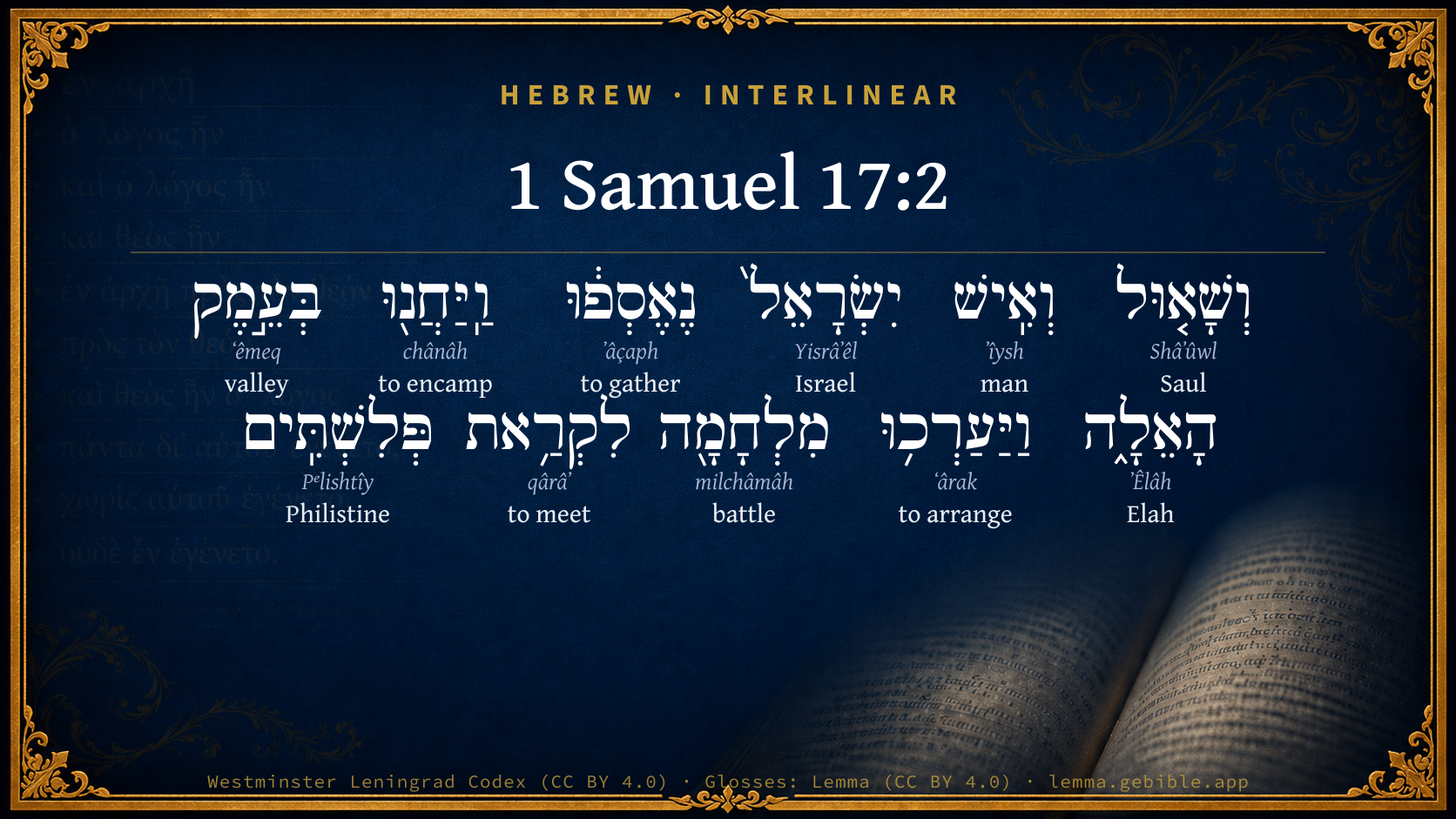
1 Samuel 17:2

Hebrew (Westminster Leningrad Codex) 1 Samuel 17:2 appears in the Hebrew Old Testament. The text above is from the Westminster Leningrad Codex. Each word links to its Strong’s number, a concise gloss, and parsing drawn from the Open Scriptures Hebrew Bible morphology. Click any word for its full Brown-Driver-Briggs (BDB) entry.
Download image
Cite this verse

1 Samuel 17:2 (World English Bible). Public Domain. Lemma interlinear Bible study tool, https://lemma.gebible.app/v/1-samuel/17/2.

Show BibTeX & RIS
BibTeX
RIS
English Translation
Saul and the men of Israel were gathered together, and encamped in the valley of Elah, and set the battle in array against the Philistines.
World English Bible · Public Domain
Download a study sheet

One document with this verse’s original text, its word-by-word gloss line, the meaning frame, cross-references with their text, attributed commentary, and full source and license credits — printable, and it pastes into notes with its structure intact.

This verse Autodidact and up

Study sheet (.html) Plain text (.txt)

A passage Seminary Student

Up to 50 verses in one chapter. A passage sheet keeps up to 6 commentary sources and 12 cross-references per verse, in the order this page ranks them, and says so on the sheet whenever that leaves anything out. Ask for a single verse and you get the Autodidact verse sheet above.

Everything on this page stays free to read, with no account — the sheet is a download of what is already on screen, not access to it.

Want to remove ads? Support Godless Engineer
Compare translations 3

The same verse in 3 English versions, stacked beneath the original-language interlinear above. Click any original word for its lexicon entry.

Each is an independent rendering of the whole verse — the interlinear is not word-aligned to these translations.

Highlighted words mark where these versions differ — a whole-verse word diff, not a word-by-word alignment.

  • World English Bible Public Domain
    Saul and the men of Israel were gathered together, and encamped in the valley of Elah, and set the battle in array against the Philistines.
  • King James Version Public Domain
    And Saul and the men of Israel were gathered together, and pitched by the valley of Elah, and set the battle in array against the Philistines.
  • unfoldingWord Literal Text CC BY-SA 4.0
    And Saul and the men of Israel were gathered, and they camped by the Valley of Elah. And they arrayed for battle to meet the Philistines.

unfoldingWord Literal Text — © unfoldingWord, licensed CC BY-SA 4.0. Word-aligned USFM3 via Door43 (git.door43.org/unfoldingWord/en_ult).

Versions to compare (up to 4)

3 of 4 selected

Show all 18 translations

Every available English version of this verse, each an independent rendering of the whole verse.

  • World English Bible Public Domain
    Saul and the men of Israel were gathered together, and encamped in the valley of Elah, and set the battle in array against the Philistines.
  • Berean Standard Bible Public Domain
    Saul and the men of Israel assembled and camped in the Valley of Elah, arraying themselves for battle against the Philistines.
  • Majority Standard Bible Public Domain
    Saul and the men of Israel assembled and camped in the Valley of Elah, arraying themselves for battle against the Philistines.
  • King James Version Public Domain
    And Saul and the men of Israel were gathered together, and pitched by the valley of Elah, and set the battle in array against the Philistines.
  • American Standard Version (1901) Public Domain
    And Saul and the men of Israel were gathered together, and encamped in the vale of Elah, and set the battle in array against the Philistines.
  • Revised Version (1885) Public Domain
    And Saul and the men of Israel were gathered together, and pitched in the vale of Elah, and set the battle in array against the Philistines.
  • Geneva Bible (1599) Public Domain
    And Saul, and the men of Israel assembled, and pitched in the valley of Elah, and put themselues in battell araie to meete the Philistims.
  • Douay-Rheims (1899) Public Domain
    And Saul and the children of Israel being gathered together came to the valley of Terebinth, and they set the army in array to fight against the Philistines.
  • Young's Literal Translation Public Domain
    and Saul and the men of Israel have been gathered, and encamp by the valley of Elah, and set the battle in array to meet the Philistines.
  • Literal Standard Version CC BY-SA 4.0
    and Saul and the men of Israel have been gathered, and encamp by the Valley of Elah, and set in array [for] battle to meet the Philistines.
  • Unlocked Literal Bible CC BY-SA 4.0
    Saul and the men of Israel gathered and encamped in the Valley of Elah, and drew up their battle line to meet the Philistines.
  • unfoldingWord Literal Text CC BY-SA 4.0
    And Saul and the men of Israel were gathered, and they camped by the Valley of Elah. And they arrayed for battle to meet the Philistines.
  • Darby Bible Public Domain
    And Saul and the men of Israel were gathered together, and encamped in the valley of terebinths, and set the battle in array against the Philistines.
  • World Messianic Bible Public Domain
    Saul and the men of Israel were gathered together, and encamped in the valley of Elah, and set the battle in array against the Philistines.
  • Webster's Bible Public Domain
    And Saul and the men of Israel were assembled and encamped by the valley of Elah, and they set the battle in array against the Philistines.
  • Free Bible Version CC BY-SA 4.0
    Saul and the Israelites gathered and camped in the Valley of Elah and took up their positions to engage in battle with the Philistines.
  • Bible in Basic English Public Domain
    And Saul and the men of Israel came together and took up their position in the valley of Elah, and put their forces in order against the Philistines.
  • JPS Tanakh (1917) Public Domain
    And Saul and the men of Israel were gathered together, and pitched in the vale of Elah, and set the battle in array against the Philistines.

Literal Standard Version (2020), Covenant Press — licensed CC BY-SA 4.0. Text via the HelloAO Bible API (eBible.org). Unlocked Literal Bible (unfoldingWord) — licensed CC BY-SA 4.0. Text via the HelloAO Bible API (eBible.org). unfoldingWord Literal Text — © unfoldingWord, licensed CC BY-SA 4.0. Word-aligned USFM3 via Door43 (git.door43.org/unfoldingWord/en_ult). Free Bible Version, Dr. Jonathan Gallagher — licensed CC BY-SA 4.0. Text via the HelloAO Bible API (eBible.org).

Word by word

More ways to search: Search by grammar → Find every occurrence → Compare this word →

Practice this passage: Drill this verse → Learn its vocabulary →

הָאֵלָ֑ה
ʼÊlâh
H425
“Elah”
Noun, Proper
Part of Speech
Noun
Type
Proper
Full BDB Definition

Origin: the same as H424

TWOT: None

Elah = "An oak" - an Edomite chief - a king of Israel for two years, son of Baasha - the father of king Hoshea of Israel - a son of Caleb - son of Uzzi
  1. וְשָׁא֤וּל Shâʼûwl H7586 “and · Saul” Conjunction + Noun, Proper
  2. וְאִֽישׁ ʼîysh H376 “and · man of” Conjunction + Noun, Common, Masculine, Singular, Construct
  3. יִשְׂרָאֵל֙ Yisrâʼêl H3478 “Israel” Noun, Proper
  4. נֶאֶסְפ֔וּ ʼâçaph H622 “to gather” Verb, Niphal, Perfect, 3rd Person, Common, Plural
  5. וַֽיַּחֲנ֖וּ chânâh H2583 “and · to encamp” Conjunction + Verb, Qal, Sequential Imperfect, 3rd Person, Masculine, Plural
  6. בְּעֵ֣מֶק ʻêmeq H6010 “in/at · valley of” Preposition + Noun, Common, Masculine, Singular, Construct
  7. וַיַּעַרְכ֥וּ ʻârak H6186 “and · to arrange” Conjunction + Verb, Qal, Sequential Imperfect, 3rd Person, Masculine, Plural
  8. מִלְחָמָ֖ה milchâmâh H4421 “battle” Noun, Common, Feminine, Singular, Absolute
  9. לִקְרַ֥את qârâʼ H7122 “to meet” Preposition + Verb, Qal, Infinitive Construct
  10. פְּלִשְׁתִּֽים Pᵉlishtîy H6430 “Philistines” Noun, Gentilic, Masculine, Plural, Absolute

About this verse

These counts appear in no published source. They are computed here, from the morphology-tagged text and Lemma’s own curated glosses. What Lemma adds →

11
words
11
distinct lemmas
Historical
section

Notable vocabulary

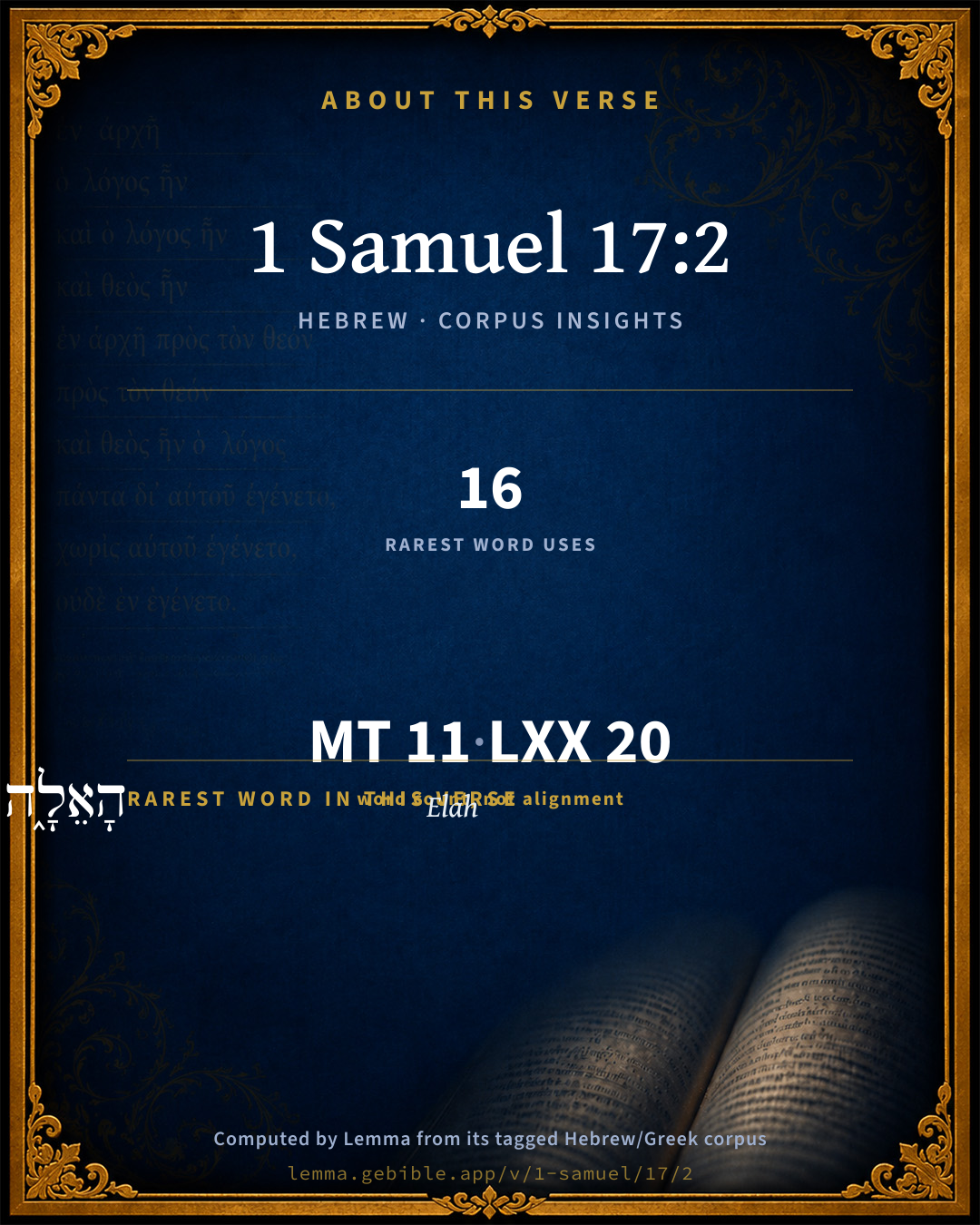
The rarest word here is הָאֵלָ֑ה Elah H425 — appearing just 16 times in the whole Hebrew Bible.

Shared distinctive vocabulary

הָאֵלָ֑ה Elah H425 occurs in 15 verses of the Hebrew Bible. Also found in:

Grammatical profile

  • 4 verbs
  • 7 nouns

Verb forms

  • נֶאֶסְפ֔וּ Niphal · Perfect
  • וַֽיַּחֲנ֖וּ Qal · Sequential Imperfect
  • וַיַּעַרְכ֥וּ Qal · Sequential Imperfect
  • לִקְרַ֥את Qal · Infinitive Construct

Hebrew & Septuagint length

In English translation the verse runs 25 words from the Hebrew and 24 from the Septuagint (LXX English) — closely comparable.

A rough comparison of the two English renderings, which tokenize alike — not a word-level alignment.

Word counts can differ between the Hebrew and the Greek without any difference in meaning — e.g. the Hebrew direct-object marker אֵת has no separate Greek word, and Greek often adds the article ὁ.

In the original languages it is 11 Hebrew tokens and 20 Greek tokens — but the two are counted differently (Hebrew bundles its prefixes and suffixes into one token; the Greek is in lemma form), so that isn’t a like-for-like length.

Cross-references

2

Topical passages linked to 1 Samuel 17:2 in the Treasury of Scripture Knowledge — connected by theme and wording, ordered by reader-vote popularity; previews shown in the World English Bible.

  • 1 Samuel 21:9 The priest said, The sword of Goliath the Philistine, whom you killed in the valley of Elah, behold, it is here wrapped in a cloth behind the ephod: if you will take that, take it; for there is no other except that here. David said, There is none like that; give it me.
  • 1 Samuel 17:19 Now Saul, and they, and all the men of Israel, were in the valley of Elah, fighting with the Philistines.

Cross-references courtesy of OpenBible.info (CC BY 4.0).

Hebrew and Greek witnesses Masoretic Hebrew ↔ Greek Septuagint

The same verse in the two great witnesses to the Old Testament, shown verse-for-verse.

These are two independent witnesses, not word-aligned to each other, and the Septuagint is shown in lemma (dictionary) form.

Hebrew 1 Samuel 17:2 Masoretic · Westminster Leningrad Codex

וְשָׁא֤וּל וְאִֽישׁ יִשְׂרָאֵל֙ נֶאֶסְפ֔וּ וַֽיַּחֲנ֖וּ בְּעֵ֣מֶק הָאֵלָ֑ה וַיַּעַרְכ֥וּ מִלְחָמָ֖ה לִקְרַ֥את פְּלִשְׁתִּֽים

Saul and the men of Israel were gathered together, and encamped in the valley of Elah, and set the battle in array against the Philistines.

World English Bible · Public Domain

Greek LXX 1 Samuel 17:2 Septuagint · lemma form

καί σαούλ καί ὁ ἀνήρ ἰσραήλ συνἄγω καί παρα ἐνβάλλω ἐν ὁ κοιλάς αὐτός παρατάσσω εἰς πόλεμος ἐκ ἐναντίος ἀλλόφυλος

And Saul and the men of Israel gather together, and they encamp in the valley, and set the battle in array against the Philistines.

LXX2012 (modern English Septuagint) · Public Domain

Hebrew: Westminster Leningrad Codex (CC BY 4.0). Greek: Septuagint (public domain); English from LXX2012 (modern English Septuagint) (Public Domain). How the Septuagint differs from the Hebrew →

Targum (Aramaic paraphrase)

1

The Targum is the ancient Jewish Aramaic paraphrase of the Hebrew Scriptures — an interpretive translation, not the Hebrew text itself. Onkelos (literal) and Pseudo-Jonathan (expansive) render the Torah, and Jonathan the Prophets. Coverage is partial: where no permissively-licensed English translation exists for a verse, only the Aramaic is shown. This is verse-level text, not a word-by-word alignment to the Hebrew.

  1. Targum Jonathan Prophets (Joshua–Malachi)
    וְשָׁאוּל וֶאֱנַשׁ יִשְׂרָאֵל אִתְכְּנִישׁוּ וּשְׁרוֹ בְּמֵישַׁר בּוּטְמָא וְסַדָרוּ קְרָבָא לָקֳדָמוּת פְּלִשְׁתָּאֵי:

    (no public-domain English translation for this verse)

    Targum Jonathan — Aramaic: “Mikraot Gedolot” (public domain). English: “Sefaria Community Translation” (CC0 1.0 (public-domain dedication)); “London "Chaldee Paraphrase," 1871” (public domain). Text via Sefaria.

Commentary

Notes on 1 Samuel 17:2 from classic Christian and Jewish commentators (each source and its license shown beneath its notes). The classic Christian expositions comment on the surrounding passage and are grouped to its opening verse, so a note may address several verses; the Jewish commentaries on the Tanakh (Rashi and others) are per-verse, so they appear only where the commentator wrote on this verse.

Lemma curates 59 commentaries, every one of them public domain or Creative Commons licensed, each selected and text-cleaned for this edition rather than reprinted as found. About our sources →

Trapp's Complete Commentary

John Trapp

1Sa 17:2 And Saul and the men of Israel were gathered together, and pitched by the valley of Elah, and set the battle in array against the Philistines.

Ver. 2. By the valley of Elah.] So called from the store of oaks that grew there. Ad convallem querceti. {a}

{a} Tremel.

John Trapp, A Commentary or Exposition upon All the Books of the Old and New Testament (1647–1656) — public domain. Text from a community e-Sword module.

Tyndale Open Study Notes

Tyndale Open Resources

17:2 The valley of Elah was a fertile area that ran east–west, fifteen miles southwest of Bethlehem.

Tyndale Open Study Notes — © Tyndale Open Resources, licensed CC BY-SA 4.0. Text via the HelloAO Bible API.

Geneva Bible (1599)

Geneva Bible translators

Or, of the oak.

Geneva Bible (1599) marginal notes — public domain. Text via Bolls.life.

Jamieson, Fausset & Brown

Robert Jamieson, A. R. Fausset & David Brown

valley of Elah--that is, "the Terebinth," now Wady Er-Sumt [ROBINSON]. Another valley somewhat to the north, now called Wady Beit Hanina, has been fixed on by the tradition of ages.

Jamieson, Fausset & Brown — Commentary Critical and Explanatory on the Whole Bible (1871) — public domain (CC PDM 1.0). Text via the HelloAO Bible API.

Adam Clarke's Commentary

Verse 2. The valley of Elah] Some translate this the turpentine valley, or the valley of the terebinth trees; and others, the valley of oaks. The situation of this valley is well known.

Adam Clarke's Commentary on the Bible (1810–1826) — public domain. Text from a community e-Sword/MySword module.

The Cambridge Bible for Schools and Colleges

gen. ed. J. J. S. Perowne

2. by the valley of Elah] Rather, “in the valley of Elah.”

The Cambridge Bible for Schools and Colleges (gen. ed. J. J. S. Perowne; Cambridge University Press, 1878–1918) — public domain. Text from a community e-Sword module.

John Gill's Exposition

And Saul and the men of Israel were gathered together,.... He being cured, at least being better of his disorder, through the music of David, and alarmed and aroused by the invasion of the Philistines, which might serve to dissipate any remains of it, or prevent its return, got together his forces:

and pitched by the valley of Elah; which Jerom (u) says Aquila and Theodotion interpret "the valley of the oak"; but the Vulgate Latin version, the valley of Terebinth; which, according to our countryman Sandys (w), was four miles from Ramaosophim, where Samuel dwelt; for he says,"after four miles riding, we descended into the valley of Terebinth, famous, though little, for the slaughter of Goliath;''and in the Targum this valley is called the valley of Butma, which in the Arabic language signifies a "terebinth", or turpentine tree; though some translate it "the oak"; and, according to some modern travellers (x), to this day it bears a name similar to that; for they say it is"now called the vale of Bitumen, very famous all over those parts for David's victory over Goliath:"

and set the battle in array against the Philistines; prepared to give them battle.

(u) Deloc. Heb. fol. 91. F. (w) Travels, p. 157. ed. 5. (x) Egmont and Heyman's Travels, vol. 1. p. 305.

John Gill's Exposition of the Whole Bible (1746–1763) — public domain (CC PDM 1.0). Text via the HelloAO Bible API.

Albert Barnes' Notes on the Bible

The valley of Elah - i. e., of the terebinth, now called Wady es Sunt, from the acacias which are scattered in it.

Albert Barnes' Notes on the Bible (1834–1885) — public domain. Text from a community e-Sword/MySword module.

Haydock's Catholic Bible Commentary

Terebinth. Hebrew ela, "the oak." (Aquila)

George Leo Haydock (1774–1849), Haydock's Catholic Family Bible and Commentary, 1859 edition — public domain. Excludes Psalms (Douay-Rheims chapter numbering differs from Protestant) and Deuterocanonical books (Catholic canon only).

Whedon's Commentary on the Bible

Daniel D. Whedon

2. The valley of Elah — The Wady es-Sumt, which has been often visited by travellers, and is represented by all as corresponding fully to the statements of this narrative. This valley is a mile in width, and through its centre runs a watercourse whose banks and bed abound with pebbles. The mountains on either side have a steep, uniform slope, and are about five hundred feet high. “It took its name Elah of old from the terebinth, (butm,) of which the largest specimen we saw in Palestine still stands in the vicinity; just as now it takes its name es-Sumt (Sunt) from the acacias which are scattered in it.” — Robinson.

Daniel D. Whedon (gen. ed.), Commentary on the Old and New Testaments (1874–1909) — public domain. Text from a community e-Sword module.

The Pulpit Commentary

Vers. 2, 3. The valley of Elah. Ie. of the terebinth tree. A valley between them. Conder ("Tent Work," 2:160) describes the spot from personal observation thus: "Saul, coming down by the highway from the land of Benjamin, encamped by the valley on one of the low hills; and between the two hosts was the gai or ravine." In the A.V no exactness of rendering is ever attempted, and both the emek, the broad strath or valley of Elah, with gently sloping sides, and the flag, the narrow, precipitous ravine, are equally rendered valley. Really the gai is most remarkable, and fully explains how the two hosts could remain in face of one another so long without fighting; for Conder proceeds, "Two points require to be made clear as to the episode of David"s battle with Goliath: one was the meaning of the expression gai or ravine; the other was the source whence David took the "smooth stones." A visit to the spot explains both. In the middle of the broad, open valley we found a deep trench with vertical sides, impassable except at certain places a valley in a valley, and a natural barrier between the two hosts. The sides and bed of this trench are strewn with rounded and waterworn pebbles, which would have been well fitted for David"s sling. Here, then, we may picture to ourselves the two hosts, covering the low, rocky hills opposite to each other, and half hidden among the lentisk bushes. Between them was the rich expanse of ripening barley, and the red banks of the torrent, with its white, shingly bed. Behind all were the distant blue hill walls of Judah, whence Saul had just come down. The mail clad champion advanced from the west through the low corn, with his mighty lance perhaps tufted with feathers, his brazen helmet shining in the sun. From the east a ruddy boy in his white shirt and sandals, armed with a goat"s hair sling, came down to the brook, and, according to the poetic fancy of the Rabbis, the pebbles were given voices, and cried, "By us shalt thou overcome the giant." The champion fell from an unseen cause, and the wild Philistines fled to the mouth of the valley, where Gath stood towering on its white chalk cliff, a frontier fortress, the key to the high road leading to the corn lands of Judah and to the vineyards of Hebron."

The Pulpit Commentary (1880–1919), ed. H.D.M. Spence-Jones & Joseph S. Exell — public domain. Text from a community e-Sword module.

unfoldingWord translationNotes

Door43 World Missions Community

the Valley of Elah

This is the name of a place. (See: How to Translate Names)

translationWords

Saul (OT)

Israel

Philistines

unfoldingWord translationNotes — © Distant Shores Media and the Door43 World Missions Community, licensed CC BY-SA 4.0. Source: git.door43.org/Door43/en_tn.

Lesson kit

Teaching starters — assembled from the data on this page, not authored interpretation. Every prompt links to the verse data it draws on. Edit before teaching.

1 Samuel, in the Historical, opens this verse with 11 words (11 distinct Hebrew lemmas). Its most distinctive word is ʼÊlâh (“Elah”). A historical commentator’s framing appears above. Read the whole chapter for the surrounding context.

Discussion questions

  1. What does “Elah” (ʼÊlâh) contribute to the verse as a whole?
  2. Genesis 36:41 shares the word «Elah» with this verse. How do the two illuminate each other?
  3. These translations render this verse differently; the difference is in the English rendering, not the original. What questions does that raise?
  4. The verb «נֶאֶסְפ֔וּ» is Niphal Perfect. How does its form color the action?
  5. Reading how Trapp's Complete Commentary and Tyndale Open Study Notes read this verse, where do the two commentators agree and where do they part?

Things to notice

Reading settings

Reading text

Shown beneath each verse's original-language words.

Old Testament
Old Testament edition

Read the OT as the Masoretic Hebrew (MT) or the Greek Septuagint (LXX).

English shown for the Greek Septuagint (in the Hebrew ↔ Greek comparison).

Comparing translations? Open the Compare panel on any verse page to stack up to four side by side.